Early Warning Signals in Ecological Time-Series


Abstract
1. Introduction
2. Theoretical Foundations of Early Warning Signals in Ecology
2.1. Critical Transitions, Resilience, and Tipping Points
2.2. Ecological Resilience: Definitions and Quantification
2.3. Critical Slowing Down: The Dynamical Basis of Early Warning Signals
2.4. Additional Statistical Indicators
2.5. Scope, Limitations, and Applicability of CSD-Based Early Warning Signals
- 1.
- Detection power is data-limited. The statistical power to detect early warning signals depends critically on time-series length, sampling frequency, measurement error, and the magnitude of natural variability [17,23]. Crucially, sampling frequency must be interpreted in the context of time-scale separation: the sampling interval must be sufficiently short to resolve the intrinsic fast dynamics of the system and fluctuations and recovery trajectories from small perturbations, while the external forcing parameter driving the system toward the bifurcation operates on a much slower timescale [37,38]. This separation of timescales is a core requirement of the CSD framework; when it is violated, either because sampling is too coarse to capture internal fluctuations, or because external forcing changes too rapidly relative to the system’s own dynamics, the statistical precursors of fold bifurcations may not accumulate detectably, or may be confounded with non-stationarity artifacts [82,83]. In practice, this means that the appropriate sampling frequency is system-specific and must be calibrated against the characteristic return time of the focal state variable. Short or noisy time series may yield high false-positive or false-negative rates, limiting operational predictive capacity [18,38].
- 2.
- EWSs are transition-mechanism specific. Not all ecological transitions are preceded by detectable critical slowing down. Transitions driven primarily by external forcing (e.g., abrupt climate shifts; acute disturbances) rather than gradual erosion of resilience may occur without the slow approach to instability that generates classical EWSs [82,84]. Transitions arising from noise-induced, rate-induced, or shock-induced tipping (N-, R-, and S-tipping; see Section 2.6) do not produce the characteristic statistical precursors of fold bifurcations [20,21].
- 3.
- EWS signal instability, not timing. Even when EWSs are detectable, they provide information only about the approach to instability, not about the precise timing, magnitude, or nature of the impending transition [24,37]. Translating generic indicators into specific, actionable predictions remains a substantial challenge.
- 4.
- High-dimensional complexity obscures signals. Regime shifts in real ecosystems often involve complex, high-dimensional dynamics, spatial heterogeneity, multiple interacting stressors, and cascading effects across trophic levels—complexities that may obscure, amplify, or fundamentally alter the expression of critical slowing down [85,86].
2.6. A Typology of Tipping Mechanisms and Their EWS Signatures
2.6.1. B-Tipping (Bifurcation-Induced)
2.6.2. N-Tipping (Noise-Induced)
2.6.3. R-Tipping (Rate-Induced)
2.6.4. S-Tipping (Shock-Induced)
3. Time Series Early Warning Methods
3.1. Moving-Window Frameworks for EWS Detection
3.1.1. Rolling vs. Expanding Window Approaches
3.1.2. Overlap and Computational Considerations
3.1.3. Trend Detection Methods
3.1.4. Preprocessing: Detrending and De-Seasonalizing
3.2. Interpretation and Limitations of Window-Based EWSs
3.2.1. Specificity and Alternative Mechanisms
3.2.2. Conditional Sampling and Retrospective Bias
3.2.3. Window Size Sensitivity and Reporting Standards
3.2.4. Practical Recommendations
3.3. Complementary Models and Approaches to Detect EWSs
3.3.1. Methods Based on System Dynamics (Mechanistic Models)
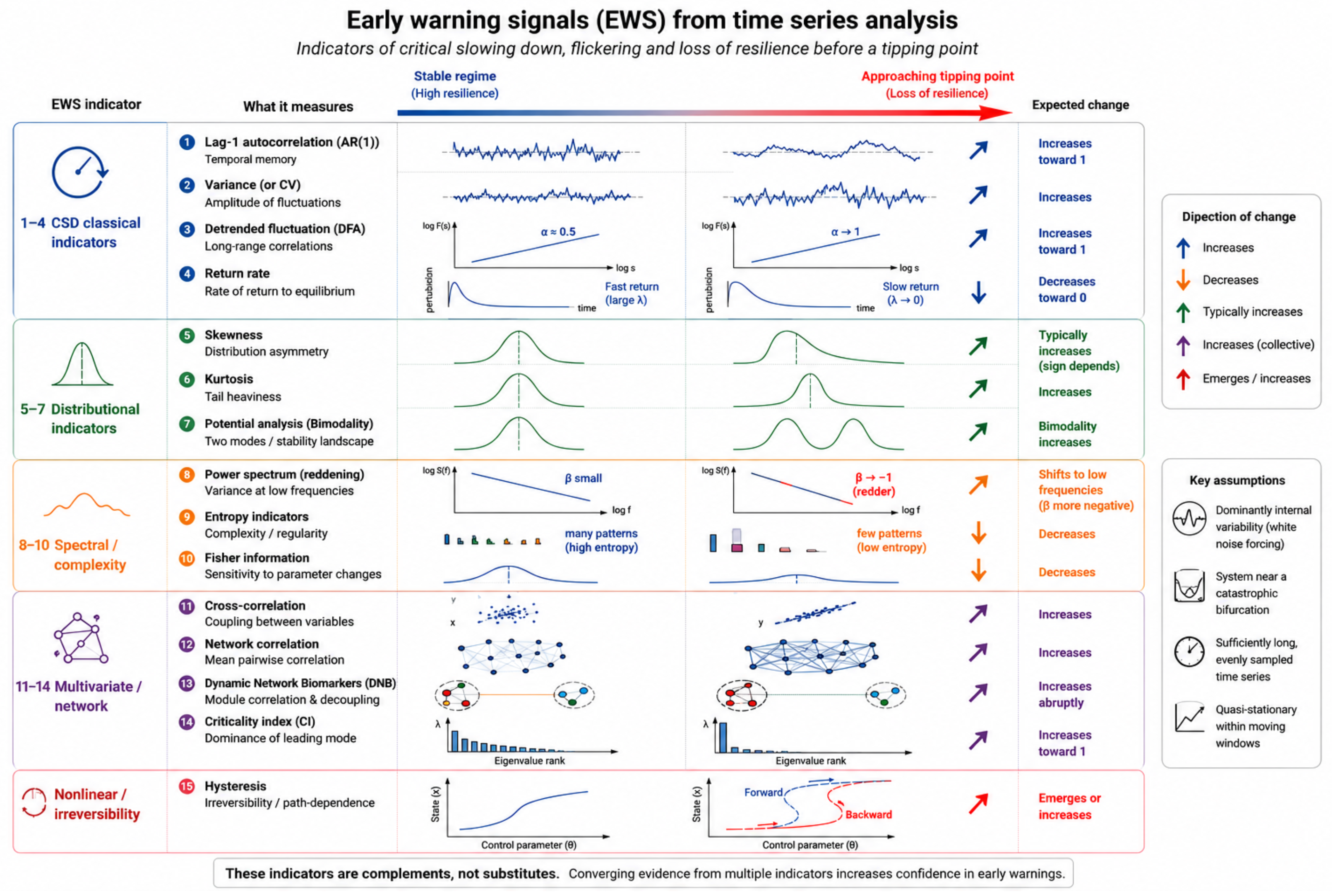
- ARIMA/AR() models with variable parameters: Fit an auto-regressive model to the series where the coefficients can change over time. Importantly, the integrated (I) component of ARIMA models also provides a principled approach to detrending the time series via differencing, removing non-stationarities prior to fitting. For example, an AR(1) model allows the coefficient to be estimated in each window, with an approach to 1 indicating a critical slowdown (very long return time) [38]. Extensions include threshold AR models, where different regimes are applied at different ranges of the variable.
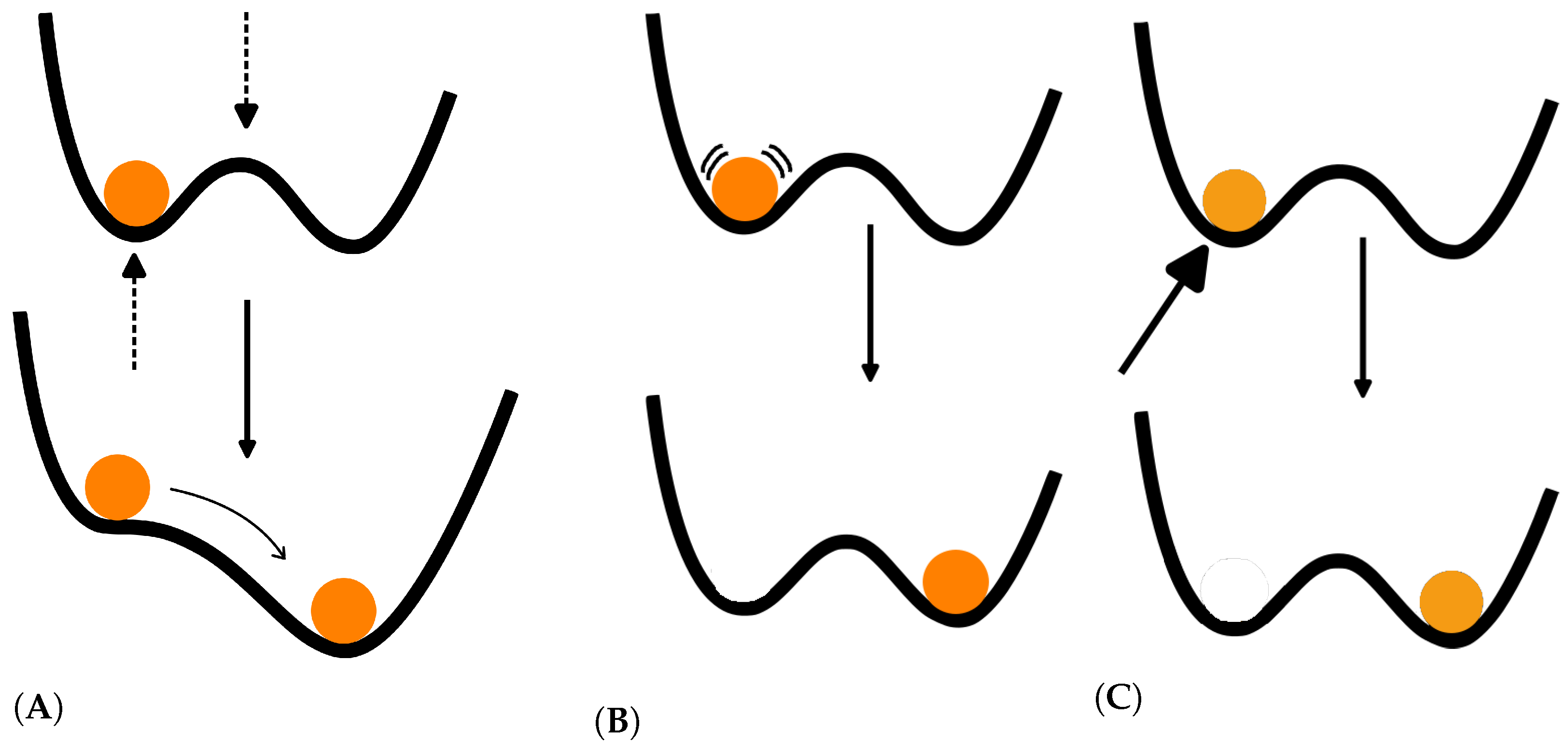
- Potential analysis (dynamic potential): This is a non-parametric approach that reconstructs the effective potential function of the system from the data distribution or a drift-diffusion estimate. The idea is to identify changes in the stability topography: for example, the appearance of a shallow or secondary minimum in the potential may signal a decrease in resilience. Tools such as potential analysis [89] detect multiple potential wells (indicating incipient alternative states) over time.
- Nonparametric drift–diffusion estimation. This approach consists of inferring the drift term and the diffusion term directly from the time series, assuming that the underlying dynamics follow a stochastic differential equation of the formwhere represents a stochastic noise term. As the system approaches a critical transition, the derivative of the drift —which is related to the dominant eigenvalue of the system—tends toward zero. Simultaneously, changes in the diffusion component may indicate emerging instabilities.Carpenter and Brock [74] developed a drift–diffusion–jump (DDJ) framework that uses nonparametric estimation to distinguish between signals driven by critical slowing down and those caused by flickering (noise-induced transitions) in ecological time series; their approach was further developed in [76] and implemented in the earlywarnings R package by Dakos et al. [38]. Although powerful, these methods require relatively long time-series data and rely on assumptions regarding the functional form of the system’s dynamics.
- Controlled experimental disturbances: In systems that allow it (e.g., an experimental lake or a greenhouse pasture), the recovery rate can be measured directly by applying minor disturbances and observing the response. A decrease in the observed return rate is the most direct signal of proximity to a tipping point. For example, Veraart et al. [96] measured, in an aquatic microcosm, that population recovery after minor disturbances became increasingly slower as the transition was approached, demonstrating a loss of resilience.
3.3.2. Machine Learning Approaches
- Classifiers trained on simulated data: Large sets of synthetic time series with and without critical transitions can be generated (using simulated ecological models under various conditions), and a classifier (e.g., a neural network) can be trained to distinguish “near-tipping” time series from stable time series. EWSNet, developed by Bury et al. [19], is a convolutional neural network trained in this way, which learns to identify combinations of signals in univariate time series and to predict the probability of an impending transition. In tests, EWSNet has detected transitions in complex simulated data and some real data better than traditional individual indicators.
- Models that integrate multiple indicators (“ensemble learning”): Brett & Rohani [77] proposed combining various statistical indicators (e.g., RA, variance) as explanatory variables in a machine learning model (e.g., random forests or logistic regression) to predict a regime change. The premise is that different signals provide complementary information, and a trained algorithm can weigh them optimally. These models address the problem of deciding a priori which indicator to use; instead, they learn from training data which indicators or thresholds are most reliable.
4. Applications
4.1. Grasslands, Savannas, and Arid Ecosystems
4.1.1. Theoretical Foundations and Feedback Mechanisms
4.1.2. Spatial Early Warning Signals
4.1.3. Remote Sensing Evidence and Temporal Indicators
4.1.4. Savanna–Forest Transitions
4.1.5. Trait-Based and Demographic Indicators
4.1.6. Case Studies and Empirical Evidence
- Sahel Greening and Degradation. The Sahel region has experienced dramatic vegetation changes over recent decades, including both degradation (1970s–1980s droughts) and partial recovery (‘re-greening’ since the 1990s). Analyses of satellite vegetation time series have revealed spatial heterogeneity in recovery patterns, with some areas showing sustained improvement while others remain degraded or continue declining [127,128]. Preliminary analyses suggest that pre-drought spatial vegetation patterns differed between resilient and degraded sites, though confounding factors (soil type, land use history, and topography) complicate interpretation.
- Australian Rangelands. Long-term monitoring data from Australian arid rangelands have revealed episodic vegetation state changes associated with drought and grazing pressure. Analyses of these transitions have documented hysteresis [129], conditions required for recovery exceed those that triggered collapse, supporting alternative stable state dynamics. Systematic analysis of whether EWSs preceded these documented transitions remains limited by data availability and the challenge of distinguishing gradual degradation from abrupt regime shifts.
- Mediterranean Shrublands. Mediterranean ecosystems have provided important case studies for spatial EWS research. Degradation gradients across environmental or land-use intensity gradients offer space-for-time substitution approaches, wherein sites at different degradation stages are compared to infer temporal dynamics [5]. These analyses have revealed systematic changes in spatial vegetation patterns along degradation gradients, supporting the potential utility of spatial EWSs [35], though true prospective tests of predictive capacity remain rare.
4.2. Lakes and Freshwater Aquatic Systems
4.3. Coral Reefs
4.3.1. Empirical Evidence and Detection Challenges
4.3.2. Disturbance-Mediated Transitions and Hybrid EWS Approaches
4.4. Marine Fisheries and Pelagic Ecosystems
4.4.1. Theoretical Basis for Tipping in Marine Systems
4.4.2. Empirical Evidence and Case Studies
- Atlantic cod and North Atlantic groundfish. (Retrospective.) The collapse of Northwest Atlantic cod stocks in the early 1990s has been subjected to multiple retrospective EWS analyses. Examination of stock assessment time series spanning 1960–1992 documented rising interannual variance in recruitment indices and increasing lag-1 autocorrelation in spawning stock biomass in the decade preceding collapse, consistent with CSD predictions [15,141]. However, Boettiger and Hastings [23] demonstrated that these apparent warning trends are statistically indistinguishable from noise expected under a null hypothesis of no approaching bifurcation when appropriate surrogate tests are applied. Because the analysis was conducted retrospectively on a series selected precisely because it ended in a known collapse, conditional sampling bias cannot be excluded as a partial explanation for the apparent signals [23,142]. The cod case therefore illustrates both the theoretical plausibility of fisheries’ EWSs and the inferential limitations that constrain their operational value when tested retrospectively without pre-specified null models.
- Baltic Sea food-web reorganization. (Retrospective; quasi-prospective.) The Baltic Sea has provided one of the most thoroughly analyzed multispecies case studies for EWSs in marine systems. Möllmann et al. [140] documented a major reorganization of the Baltic food web in the late 1980s, involving simultaneous regime shifts in cod, sprat, herring, and zooplankton communities driven by the interaction of fishing pressure and eutrophication. Subsequently, Lindegren et al. [143] applied CSD-based EWSs to multivariate Baltic monitoring data and demonstrated that rising variance and autocorrelation in aggregate community indicators—particularly zooplankton biomass and fish recruitment composites—anticipated the reorganization by three to five years. Crucially, this analysis was structured as a quasi-prospective evaluation: indicators were computed on data available up to a pre-specified decision point, with the transition used as the validation event rather than the analysis target. This design provides stronger evidence for predictive validity than a purely retrospective analysis, though it falls short of a true prospective test because the transition outcome was known when the study was designed. The Baltic case is presently the strongest available evidence for operational EWS performance in a marine multispecies context.
- North Pacific productivity regime shifts. (Retrospective.) Litzow and Mueter [107] assessed ecological regime shifts in the North Pacific, showing that abrupt, synchronized shifts in fish community structure were preceded by increasing temporal variance and spectral reddening in productivity indices. Hsieh et al. [108] showed that fishing pressure itself elevates interannual variability in exploited stocks, independently of proximity to a bifurcation. This finding creates a systematic false-positive risk specific to fisheries: the primary management action (fishing) directly inflates the primary EWS indicator (variance), a confounding effect with no direct analogue in lake, forest, or grassland applications. All analyses in this case were retrospective, relying on archived stock assessment records; no prospective or experimental evaluation has been conducted.
- Global stock assessment survey. (Retrospective.) Vert-Pre et al. [144] conducted the most comprehensive retrospective EWS analysis available, examining 230 fish stock time series from the RAM Legacy database for evidence of productivity regime shifts. Variance-based indicators correctly anticipated approximately half of documented collapses, but false-positive rates were substantial (approximately 40% of flagged stocks did not subsequently collapse). Anderson et al. [145] reached similar conclusions: EWSs in fisheries have meaningful but limited predictive power, particularly for stocks subject to externally driven regime shifts rather than endogenous bifurcation dynamics. The retrospective design of both studies, and the fact that the stock assessment records used were themselves model-derived rather than directly observed, introduce inferential layers that limit conclusions about genuine predictive validity.
- Pelagic plankton regime shifts. (Retrospective.) Hsieh et al. [108] documented that spectral reddening of climate–biological variability and rising variance in plankton indices preceded regime shifts in several pelagic systems, while Conversi et al. [109] provided a holistic synthesis demonstrating that synchronization of previously anti-phase population oscillations anticipated species-level collapses in open-ocean communities. Both analyses relied on long-term plankton monitoring archives (Continuous Plankton Recorder and equivalent programs), making them among the longest available marine time series. A distinctive feature of approaching pelagic regime shifts may therefore be increasing synchronization among previously independent population fluctuations: as the dominant eigenvalue approaches zero near a bifurcation, all system components become increasingly responsive to the same slow mode of variability, consistent with the multivariate CSD predictions developed in Section 5.2.1 However, the dominant tipping mechanism in pelagic systems involves rapid atmospheric forcing and inter-basin oceanographic teleconnections that are more consistent with R-tipping than B-tipping, and, variance and autocorrelation are expected to perform poorly under R-tipping dynamics. The empirical detection of spectral reddening in these systems may therefore reflect changing external forcing rather than genuine CSD, a distinction that retrospective analyses cannot easily resolve.
4.4.3. Implications for Predictive Validity
4.5. Forests
Remote Sensing Applications and Climate-Vegetation Feedbacks: EWS for Large-Scale Forest Collapse
5. Perspectives on the Use of EWS in Ecology
5.1. From Reactive Management to Anticipatory Risk Assessment
5.2. Methodological Advances in Time-Series-Based EWS
5.2.1. Multivariate and Network-Based Methods
5.2.2. Probabilistic and Bayesian Decision Frameworks
5.2.3. Machine Learning and Deep Learning
5.2.4. Non-Equilibrium Thermodynamic Indicators
5.2.5. Composite Indices and Multi-Indicator Synthesis
5.2.6. Mechanism-Guided and Generalized Modelling
5.2.7. State-Space and Geometric Indicators
5.3. Complementary Role of Spatial Indicators
5.4. Addressing Methodological Challenges
5.5. Emerging Applications and Cross-System Synthesis
5.6. Priority Directions for Future Research
6. Conclusions
Author Contributions
Funding
Data Availability Statement
Acknowledgments
Conflicts of Interest
Abbreviations
| EWS | Early Warning Signal |
| CSD | Critical Slowing Down |
| AR(1) | Lag-1 Autocorrelation |
References
- Scheffer, M.; Carpenter, S.; Foley, J.A.; Folke, C.; Walker, B. Catastrophic shifts in ecosystems. Nature 2001, 413, 591–596. [Google Scholar] [CrossRef] [PubMed]
- Lenton, T.M.; Held, H.; Kriegler, E.; Hall, J.W.; Lucht, W.; Rahmstorf, S.; Schellnhuber, H.J. Tipping elements in the Earth’s climate system. Proc. Natl. Acad. Sci. USA 2008, 105, 1786–1793. [Google Scholar] [CrossRef] [PubMed]
- Folke, C.; Carpenter, S.; Walker, B.; Scheffer, M.; Elmqvist, T.; Gunderson, L.; Holling, C.S. Regime shifts, resilience, and biodiversity in ecosystem management. Annu. Rev. Ecol. Evol. Syst. 2004, 35, 557–581. [Google Scholar] [CrossRef]
- Hughes, T.P.; Graham, N.A.; Jackson, J.B.; Mumby, P.J.; Steneck, R.S. Rising to the challenge of sustaining coral reef resilience. Trends Ecol. Evol. 2010, 25, 633–642. [Google Scholar] [CrossRef]
- Kéfi, S.; Rietkerk, M.; Alados, C.L.; Pueyo, Y.; Papanastasis, V.P.; ElAich, A.; de Ruiter, P.C. Spatial vegetation patterns and imminent desertification in Mediterranean arid ecosystems. Nature 2007, 449, 213–217. [Google Scholar] [CrossRef]
- Poincaré, H. L’Équilibre d’une masse fluide animée d’un mouvement de rotation. Acta Math. 1885, 7, 259–380. [Google Scholar] [CrossRef]
- Thom, R. Structural stability, catastrophe theory, and applied mathematics. SIAM Rev. 1977, 19, 189–201. [Google Scholar] [CrossRef]
- Zeeman, E.C. Catastrophe Theory. Sci. Am. 1976, 234, 65–83. [Google Scholar] [CrossRef]
- Zahler, R.S.; Sussmann, H.J. Claims and accomplishments of applied catastrophe theory. Nature 1977, 269, 759–763. [Google Scholar] [CrossRef]
- Van Hove, L. Time-Dependent Correlations between Spins and Neutron Scattering in Ferromagnetic Crystals. Phys. Rev. 1954, 95, 1374–1384. [Google Scholar] [CrossRef]
- Landau, L.D.; Khalatnikov, I.M. On the anomalous absorption of sound near a phase transition point of second order. Dokl. Akad. Nauk SSSR 1954, 96, 469–472. [Google Scholar]
- Hohenberg, P.C.; Halperin, B.I. Theory of dynamic critical phenomena. Rev. Mod. Phys. 1977, 49, 435–479. [Google Scholar] [CrossRef]
- Wissel, C. A universal law of the characteristic return time near thresholds. Oecologia 1984, 65, 101–107. [Google Scholar] [CrossRef]
- Holling, C.S. Resilience and stability of ecological systems. In Foundations of Socio-Environmental Research: Legacy Readings with Commentaries; Cambridge University Press: Cambridge, UK, 1973. [Google Scholar]
- Carpenter, S.R.; Brock, W.A. Rising variance: A leading indicator of ecological transition. Ecol. Lett. 2006, 9, 311–318. [Google Scholar] [CrossRef]
- Dakos, V.; Scheffer, M.; Van Nes, E.H.; Brovkin, V.; Petoukhov, V.; Held, H. Slowing down as an early warning signal for abrupt climate change. Proc. Natl. Acad. Sci. USA 2008, 105, 14308–14312. [Google Scholar] [CrossRef] [PubMed]
- Perretti, C.T.; Munch, S.B. Regime shift indicators fail under noise levels commonly observed in ecological systems. Ecol. Appl. 2012, 22, 1772–1779. [Google Scholar] [CrossRef] [PubMed]
- Clements, C.F.; Drake, J.M.; Griffiths, J.I.; Ozgul, A. Factors influencing the detectability of early warning signals of population collapse. Am. Nat. 2015, 186, 50–58. [Google Scholar] [CrossRef] [PubMed]
- O’Brien, D.A.; Deb, S.; Gal, G.; Thackeray, S.J.; Dutta, P.S.; Matsuzaki, S.i.S.; May, L.; Clements, C.F. Early warning signals have limited applicability to empirical lake data. Nat. Commun. 2023, 14, 7942. [Google Scholar] [CrossRef]
- Ashwin, P.; Wieczorek, S.; Vitolo, R.; Cox, P. Tipping points in open systems: Bifurcation, noise-induced and rate-dependent examples in the climate system. Philos. Trans. R. Soc. A Math. Phys. Eng. Sci. 2012, 370, 1166–1184. [Google Scholar] [CrossRef]
- Ritchie, P.; Sieber, J. Early-warning indicators for rate-induced tipping. Chaos Interdiscip. J. Nonlinear Sci. 2016, 26, 093116. [Google Scholar] [CrossRef]
- Hastings, A.; Wysham, D.B. Regime shifts in ecological systems can occur with no warning. Ecol. Lett. 2010, 13, 464–472. [Google Scholar] [CrossRef]
- Boettiger, C.; Hastings, A. Quantifying limits to detection of early warning for critical transitions. J. R. Soc. Interface 2012, 9, 2527–2539. [Google Scholar] [CrossRef]
- Boettiger, C.; Hastings, A. No early warning signals for stochastic transitions: Insights from large deviation theory. Proc. R. Soc. B Biol. Sci. 2013, 280, 20131372. [Google Scholar] [CrossRef]
- Mayer, A.L.; Pawlowski, C.W.; Cabezas, H. Fisher information and dynamic regime changes in ecological systems. Ecol. Model. 2006, 195, 72–82. [Google Scholar] [CrossRef]
- Karunanithi, A.T.; Cabezas, H.; Frieden, B.R.; Pawlowski, C.W. Detection of regime shifts in environmental data using Fisher information. Environ. Model. Softw. 2010, 25, 448–461. [Google Scholar]
- Quax, R.; Har-Shemesh, O.; Sloot, P.M. Quantifying synergistic information using intermediate stochastic variables. Entropy 2017, 19, 85. [Google Scholar] [CrossRef]
- Chen, S.; O’Dea, R.D.; Drake, J.M.; Epureanu, B.I. Eigenvalues of the covariance matrix as early warning signals for critical transitions in ecological systems. Sci. Rep. 2019, 9, 2571. [Google Scholar] [CrossRef] [PubMed]
- Weinans, E.; van Nes, E.H.; Dakos, V.; Scheffer, M. Evaluating the performance of multivariate indicators of resilience loss. Sci. Rep. 2021, 11, 9148. [Google Scholar] [CrossRef] [PubMed]
- Bury, T.M.; Sujith, R.; Pavithran, I.; Scheffer, M.; Lenton, T.M.; Anand, M.; Bauch, C.T. Deep learning for early warning signals of tipping points. Proc. Natl. Acad. Sci. USA 2021, 118, e2106140118. [Google Scholar] [CrossRef]
- Huang, Y.; Bathiany, S.; Ashwin, P.; Boers, N. Deep learning for predicting rate-induced tipping. Nat. Mach. Intell. 2024, 6, 1556–1565. [Google Scholar] [CrossRef]
- Chen, L.; Liu, R.; Liu, Z.P.; Li, M.; Aihara, K. Detecting early-warning signals for sudden deterioration of complex diseases by dynamical network biomarkers. Sci. Rep. 2012, 2, 342. [Google Scholar] [CrossRef]
- Aihara, K.; Liu, R.; Koizumi, K.; Liu, X.; Chen, L. Dynamical network biomarkers: Theory and applications. Gene 2022, 808, 145997. [Google Scholar] [CrossRef]
- Xu, L.; Patterson, D.; Levin, S.A.; Wang, J. Non-equilibrium early-warning signals for critical transitions in ecological systems. Proc. Natl. Acad. Sci. USA 2023, 120, e2218663120. [Google Scholar] [CrossRef]
- Kéfi, S.; Guttal, V.; Brock, W.A.; Carpenter, S.R.; Ellison, A.M.; Livina, V.N.; Seekell, D.A.; Scheffer, M.; Van Nes, E.H.; Dakos, V. Early Warning Signals of Ecological Transitions: Methods for Spatial Patterns. PLoS ONE 2014, 9, e92097. [Google Scholar] [CrossRef]
- Dakos, V.; Van Nes, E.H.; Donangelo, R.; Fort, H.; Scheffer, M. Spatial correlation as leading indicator of catastrophic shifts. Theor. Ecol. 2010, 3, 163–174. [Google Scholar] [CrossRef]
- Scheffer, M.; Bascompte, J.; Brock, W.A.; Brovkin, V.; Carpenter, S.R.; Dakos, V.; Held, H.; Van Nes, E.H.; Rietkerk, M.; Sugihara, G. Early-warning signals for critical transitions. Nature 2009, 461, 53–59. [Google Scholar] [CrossRef]
- Dakos, V.; Carpenter, S.R.; Brock, W.A.; Ellison, A.M.; Guttal, V.; Ives, A.R.; Kéfi, S.; Livina, V.; Seekell, D.A.; Van Nes, E.H.; et al. Methods for Detecting Early Warnings of Critical Transitions in Time Series Illustrated Using Simulated Ecological Data. PLoS ONE 2012, 7, e41010. [Google Scholar] [CrossRef] [PubMed]
- Clements, C.F.; Ozgul, A. Indicators of transitions in biological systems. Ecol. Lett. 2018, 21, 905–919. [Google Scholar] [CrossRef]
- George, S.V.; Kachhara, S.; Ambika, G. Early warning signals for critical transitions in complex systems. Phys. Scr. 2023, 98, 072001. [Google Scholar] [CrossRef]
- Dakos, V.; Boulton, C.A.; Buxton, J.E.; Abrams, J.F.; Arellano-Nava, B.; Armstrong McKay, D.I.; Bathiany, S.; Blaschke, L.; Boers, N.; Dylewsky, D.; et al. Tipping point detection and early warnings in climate, ecological, and human systems. Earth Syst. Dyn. 2024, 15, 1117–1135. [Google Scholar] [CrossRef]
- Rockström, J.; Steffen, W.; Noone, K.; Persson, Å.; Chapin, F.S.; Lambin, E.F.; Lenton, T.M.; Scheffer, M.; Folke, C.; Schellnhuber, H.J.; et al. A safe operating space for humanity. Nature 2009, 461, 472–475. [Google Scholar] [CrossRef]
- Beisner, B.E.; Haydon, D.T.; Cuddington, K. Alternative stable states in ecology. Front. Ecol. Environ. 2003, 1, 376–382. [Google Scholar] [CrossRef]
- Scheffer, M.; Hosper, S.H.; Meijer, M.L.; Moss, B.; Jeppesen, E. Alternative equilibria in shallow lakes. Trends Ecol. Evol. 1993, 8, 275–279. [Google Scholar] [CrossRef] [PubMed]
- Carpenter, S.R.; Ludwig, D.; Brock, W.A. Management of eutrophication for lakes subject to potentially irreversible change. Ecol. Appl. 1999, 9, 751–771. [Google Scholar] [CrossRef]
- Rietkerk, M.; Dekker, S.C.; De Ruiter, P.C.; van de Koppel, J. Self-organized patchiness and catastrophic shifts in ecosystems. Science 2004, 305, 1926–1929. [Google Scholar] [CrossRef] [PubMed]
- Mumby, P.J.; Hastings, A.; Edwards, H.J. Thresholds and the resilience of Caribbean coral reefs. Nature 2007, 450, 98–101. [Google Scholar] [CrossRef] [PubMed]
- Hirota, M.; Holmgren, M.; Van Nes, E.H.; Scheffer, M. Global Resilience of Tropical Forest and Savanna to Critical Transitions. Science 2011, 334, 232–235. [Google Scholar] [CrossRef]
- Staver, A.C.; Archibald, S.; Levin, S.A. The global extent and determinants of savanna and forest as alternative biome states. Science 2011, 334, 230–232. [Google Scholar] [CrossRef]
- Dakos, V.; Matthews, B.; Hendry, A.; Levine, J.; Loeuille, N.; Norberg, J.; Nosil, P.; Scheffer, M.; Meester, L.D. Ecosystem tipping points in an evolving world. Nat. Ecol. Evol. 2018, 3, 355–362. [Google Scholar] [CrossRef]
- Strogatz, S.H. Nonlinear Dynamics and Chaos: With Applications to Physics, Biology, Chemistry, and Engineering; Chapman and Hall/CRC: Boca Raton, FL, USA, 2024. [Google Scholar]
- Kuznetsov, Y.A. Numerical analysis of bifurcations. In Elements of Applied Bifurcation Theory; Springer: Berlin/Heidelberg, Germany, 2004; pp. 505–585. [Google Scholar]
- Zeeman, E.C. Catastrophe theory. In Proceedings of the Structural Stability in Physics: Proceedings of Two International Symposia on Applications of Catastrophe Theory and Topological Concepts in Physics Tübingen, Fed. Rep. of Germany, 2–6 May and 11–14 December 1978; Springer: Berlin/Heidelberg, Germany, 1979; pp. 12–22. [Google Scholar]
- Hughes, T.P.; Bellwood, D.R.; Folke, C.; Steneck, R.S.; Wilson, J. New paradigms for supporting the resilience of marine ecosystems. Trends Ecol. Evol. 2005, 20, 380–386. [Google Scholar] [CrossRef]
- Holling, C.S. Engineering resilience versus ecological resilience. Eng. Ecol. Constraints 1996, 31, 32. [Google Scholar]
- Walker, B.; Holling, C.S.; Carpenter, S.R.; Kinzig, A. Resilience, adaptability and transformability in social–ecological systems. Ecol. Soc. 2004, 9, 1–9. [Google Scholar] [CrossRef]
- Dakos, V.; Kéfi, S. Ecological resilience: What to measure and how. Environ. Res. Lett. 2022, 17, 043003. [Google Scholar] [CrossRef]
- May, R.M. Qualitative stability in model ecosystems. Ecology 1973, 54, 638–641. [Google Scholar] [CrossRef]
- Arnoldi, J.F.; Loreau, M.; Haegeman, B. Resilience, reactivity and variability: A mathematical comparison of ecological stability measures. J. Theor. Biol. 2016, 389, 47–59. [Google Scholar] [CrossRef]
- Van Nes, E.H.; Scheffer, M. Slow recovery from perturbations as a generic indicator of a nearby catastrophic shift. Am. Nat. 2007, 169, 738–747. [Google Scholar] [CrossRef]
- Meyer, K. A mathematical review of resilience in ecology. Nat. Resour. Model. 2016, 29, 339–352. [Google Scholar] [CrossRef]
- Mitra, C.; Kurths, J.; Donner, R.V. An integrative quantifier of multistability in complex systems based on ecological resilience. Sci. Rep. 2015, 5, 16196. [Google Scholar] [CrossRef]
- Dakos, V.; Carpenter, S.R.; Van Nes, E.H.; Scheffer, M. Resilience indicators: Prospects and limitations for early warnings of regime shifts. Philos. Trans. R. Soc. B Biol. Sci. 2015, 370, 20130263. [Google Scholar] [CrossRef]
- Gsell, A.S.; Scharfenberger, U.; Özkundakci, D.; Walters, A.; Hansson, L.A.; Janssen, A.B.G.; Nõges, P.; Reid, P.C.; Schindler, D.E.; Van Donk, E.; et al. Evaluating early-warning indicators of critical transitions in natural aquatic ecosystems. Proc. Natl. Acad. Sci. USA 2016, 113, E8089–E8095. [Google Scholar] [CrossRef]
- Kuehn, C. A mathematical framework for critical transitions: Bifurcations, fast–slow systems and stochastic dynamics. Phys. D. Nonlinear Phenom. 2011, 240, 1020–1035. [Google Scholar] [CrossRef]
- Hagstrom, G.I.; Levin, S.A. Phase transitions and the theory of early warning indicators for critical transitions. In How Worlds Collapse; Routledge: Abingdon, UK, 2023; pp. 358–374. [Google Scholar]
- Kéfi, S.; Dakos, V.; Scheffer, M.; van Nes, E.H.; Rietkerk, M. Early warning signals also precede non-catastrophic transitions. Oikos 2013, 122, 641–648. [Google Scholar] [CrossRef]
- Drake, J.M. Early warning signals of stochastic switching. Proc. R. Soc. B 2013, 280, 20130686. [Google Scholar] [CrossRef]
- Pomeau, Y.; Berre, M.L. Critical speed-up vs critical slow-down: A new kind of relaxation oscillation with application to stick-slip phenomena. arXiv 2011, arXiv:1107.3331. [Google Scholar]
- Peters, R.D.; Le Berre, M.; Pomeau, Y. Prediction of catastrophes: An experimental model. Phys. Rev. E—Stat. Nonlinear Soft Matter Phys. 2012, 86, 026207. [Google Scholar] [CrossRef][Green Version]
- Titus, M.; Watson, J. Critical speeding up as an early warning signal of stochastic regime shifts. Theor. Ecol. 2020, 13, 449–457. [Google Scholar] [CrossRef]
- Dakos, V.; Van Nes, E.H.; Scheffer, M. Flickering as an early warning signal. Theor. Ecol. 2013, 6, 309–317. [Google Scholar] [CrossRef]
- Bury, T.M.; Bauch, C.T.; Anand, M. Detecting and distinguishing tipping points using spectral early warning signals. J. R. Soc. Interface 2020, 17. [Google Scholar] [CrossRef]
- Carpenter, S.R.; Brock, W.A. Early warnings of unknown nonlinear shifts: A nonparametric approach. Ecology 2011, 92, 2196–2201. [Google Scholar] [CrossRef]
- Boettiger, C.; Hastings, A. Early warning signals and the prosecutor’s fallacy. Proc. R. Soc. B Biol. Sci. 2012, 279, 4734–4739. [Google Scholar] [CrossRef]
- Brock, W.A.; Carpenter, S.R. Early warnings of regime shift when the ecosystem structure is unknown. PLoS ONE 2012, 7, e45586. [Google Scholar] [CrossRef]
- Brett, T.S.; Rohani, P. Dynamical footprints enable detection of disease emergence. PLoS Biol. 2020, 18, e3000697. [Google Scholar] [CrossRef]
- Guttal, V.; Jayaprakash, C. Changing skewness: An early warning signal of regime shifts in ecosystems. Ecol. Lett. 2008, 11, 450–460. [Google Scholar] [CrossRef]
- Kleinen, T.; Held, H.; Petschel-Held, G. The potential role of spectral properties in detecting thresholds in the Earth system: Application to the thermohaline circulation. Ocean Dyn. 2003, 53, 53–63. [Google Scholar] [CrossRef]
- Livina, V.N.; Lenton, T.M. A modified method for detecting incipient bifurcations in a dynamical system. Geophys. Res. Lett. 2007, 34. [Google Scholar] [CrossRef]
- Wang, R.; Dearing, J.A.; Langdon, P.G.; Zhang, E.; Yang, X.; Dakos, V.; Scheffer, M. Flickering gives early warning signals of a critical transition to a eutrophic lake state. Nature 2012, 492, 419–422. [Google Scholar] [CrossRef]
- Ditlevsen, P.D.; Johnsen, S.J. Tipping points: Early warning and wishful thinking. Geophys. Res. Lett. 2010, 37. [Google Scholar] [CrossRef]
- Lenton, T.M.; Livina, V.N.; Dakos, V.; Van Nes, E.H.; Scheffer, M. Early warning of climate tipping points from critical slowing down: Comparing methods to improve robustness. Philos. Trans. R. Soc. A Math. Phys. Eng. Sci. 2012, 370, 1185–1204. [Google Scholar] [CrossRef]
- Hastings, A.; Abbott, K.C.; Cuddington, K.; Francis, T.; Gellner, G.; Lai, Y.C.; Morozov, A.; Petrovskii, S.; Scranton, K.; Zeeman, M.L. Transient phenomena in ecology. Science 2018, 361, eaat6412. [Google Scholar] [CrossRef]
- Lever, J.J.; van de Leemput, I.A.; Weinans, E.; Quax, R.; Dakos, V.; van Nes, E.H.; Bascompte, J.; Scheffer, M. Foreseeing the future of mutualistic communities beyond collapse. Ecol. Lett. 2020, 23, 2–15. [Google Scholar] [CrossRef]
- Patterson, A.C.; Strang, A.G.; Abbott, K.C. When and Where We Can Expect to See Early Warning Signals in Multispecies Systems Approaching Tipping Points: Insights from Theory. Am. Nat. 2021, 198, E12–E26. [Google Scholar] [CrossRef]
- Carpenter, S.; Brock, W. Early warnings of regime shifts in spatial dynamics using the discrete Fourier transform. Ecosphere 2010, 1, 1–15. [Google Scholar] [CrossRef]
- Seekell, D.A.; Carpenter, S.R.; Pace, M.L. Conditional heteroscedasticity as a leading indicator of ecological regime shifts. Am. Nat. 2011, 178, 442–451. [Google Scholar] [CrossRef]
- Livina, V.N.; Kwasniok, F.; Lenton, T.M. Potential analysis reveals changing number of climate states during the last 60 kyr. Clim. Past. 2010, 6, 77–82. [Google Scholar] [CrossRef]
- Liu, R.; Li, M.; Liu, Z.P.; Wu, J.; Chen, L.; Aihara, K. Identifying critical transitions of complex diseases based on a single sample. Bioinformatics 2014, 30, 1579–1586. [Google Scholar] [CrossRef]
- Liu, R.; Aihara, K.; Chen, L. Dynamical network biomarkers for identifying critical transitions and their driving networks of biologic processes. Quant. Biol. 2013, 1, 105–114. [Google Scholar] [CrossRef]
- Weinans, E.; Quax, R.; van Nes, E.H.; van de Leemput, I.A. Finding the direction of lowest resilience in multivariate complex systems. J. R. Soc. Interface 2019, 16, 20190629. [Google Scholar] [CrossRef]
- Clark, A.T.; Ye, H.; Isbell, F.; Deyle, E.R.; Cowles, J.; Tilman, G.D.; Sugihara, G. Spatial convergence as an early warning signal. Nature 2014, 505, 523–527. [Google Scholar]
- Scheffer, M.; Carpenter, S.R.; Lenton, T.M.; Bascompte, J.; Brock, W.; Dakos, V.; Van De Koppel, J.; Van De Leemput, I.A.; Levin, S.A.; Van Nes, E.H.; et al. Anticipating Critical Transitions. Science 2012, 338, 344–348. [Google Scholar] [CrossRef]
- Ashwin, P.; Bastiaansen, R.; Heydt, A.S.v.d.; Ritchie, P. Early warning skill, extrapolation and tipping for accelerating cascades. Proc. R. Soc. A Math. Phys. Eng. Sci. 2025, 481, 2321. [Google Scholar] [CrossRef]
- Veraart, A.J.; Faassen, E.J.; Dakos, V.; Van Nes, E.H.; Lürling, M.; Scheffer, M. Recovery rates reflect distance to a tipping point in a living system. Nature 2012, 481, 357–359. [Google Scholar] [CrossRef]
- Smith, T.; Boers, N. Reliability of resilience estimation based on multi-instrument time series. Earth Syst. Dyn. 2023, 14, 173–183. [Google Scholar] [CrossRef]
- Romanou, A.; Hegerl, G.C.; Seneviratne, S.I.; Abis, B.; Bastos, A.; Conversi, A.; Landolfi, A.; Kim, H.; Lerner, P.E.; Mekus, J.; et al. Extreme events contributing to tipping elements and tipping points. Surv. Geophys. 2025, 46, 375–420. [Google Scholar] [CrossRef]
- Hastings, A.; Petrovskii, S.; Lucarini, V.; Morozov, A. Tipping points in complex ecological systems. arXiv 2026, arXiv:2602.20702. [Google Scholar] [CrossRef]
- Chen, S.; Ghadami, A.; Epureanu, B.I. Practical guide to using Kendall’s τ in the context of forecasting critical transitions. R. Soc. Open Sci. 2022, 9, 211346. [Google Scholar] [CrossRef] [PubMed]
- Carpenter, S.R.; Cole, J.J.; Pace, M.L.; Batt, R.; Brock, W.A.; Cline, T.; Coloso, J.; Hodgson, J.R.; Kitchell, J.F.; Seekell, D.A.; et al. Early warnings of regime shifts: A whole-ecosystem experiment. Science 2011, 332, 1079–1082. [Google Scholar] [CrossRef] [PubMed]
- Veldhuis, M.P.; Gommers, M.I.; Olff, H.; Berg, M.P. Critical slowing down in savanna resilience detected from satellite data. Ecography 2022, 2022, e06-386. [Google Scholar] [CrossRef]
- Verbesselt, J.; Umlauf, N.; Hirota, M.; Holmgren, M.; Van Nes, E.H.; Herold, M.; Zeileis, A.; Scheffer, M. Remotely sensed resilience of tropical forests. Nat. Clim. Change 2016, 6, 1028–1031. [Google Scholar] [CrossRef]
- Boulton, C.A.; Lenton, T.M.; Boers, N. Pronounced loss of Amazon rainforest resilience since the early 2000s. Nat. Clim. Change 2022, 12, 271–278. [Google Scholar] [CrossRef]
- Scheffer, M.; Hirota, M.; Holmgren, M.; Van Nes, E.H.; Chapin, F.S. Thresholds for boreal biome transitions. Proc. Natl. Acad. Sci. USA 2012, 109, 21384–21389. [Google Scholar] [CrossRef]
- Biggs, R.; Carpenter, S.R.; Brock, W.A. Turning back from the brink: Detecting an impending regime shift in time to avert it. Proc. Natl. Acad. Sci. USA 2009, 106, 826–831. [Google Scholar] [CrossRef] [PubMed]
- Litzow, M.A.; Mueter, F.J. Assessing the ecological importance of climate regime shifts: An approach from the North Pacific Ocean. Phys. Oceanogr. 2013, 120, 110–119. [Google Scholar] [CrossRef]
- Hsieh, C.H.; Reiss, C.S.; Hunter, J.R.; Beddington, J.R.; May, R.M.; Sugihara, G. Fishing elevates variability in the abundance of exploited species. Nature 2006, 443, 859–862. [Google Scholar] [CrossRef]
- Conversi, A.; Dakos, V.; Gårdmark, A.; Ling, S.; Folke, C.; Mumby, P.J.; Greene, C.; Edwards, M.; Blenckner, T.; Casini, M.; et al. A holistic view of marine regime shifts. Philos. Trans. R. Soc. B Biol. Sci. 2015, 370, 20130279. [Google Scholar] [CrossRef]
- Boettiger, C.; Batt, R. Bifurcation or state tipping: Assessing transition type in a model trophic cascade. J. Math. Biol. 2020, 80, 143–155. [Google Scholar] [CrossRef]
- Callaway, R.M.; Brooker, R.W.; Choler, P.; Kikvidze, Z.; Lortie, C.J.; Michalet, R.; Paolini, L.; Pugnaire, F.I.; Newingham, B.; Aschehoug, E.T.; et al. Positive interactions among alpine plants increase with stress. Nature 2002, 417, 844–848. [Google Scholar] [CrossRef]
- Van de Koppel, J.; Rietkerk, M.; Weissing, F.J. Catastrophic vegetation shifts and soil degradation in terrestrial grazing systems. Trends Ecol. Evol. 1997, 12, 352–356. [Google Scholar] [CrossRef]
- Bestelmeyer, B.; Ellison, A.; Fraser, W.; Gorman, K.; Holbrook, S.; Laney, C.; Ohman, M.; Peters, D.; Pillsbury, F.; Rassweiler, A.; et al. Analysis of abrupt transitions in ecological systems. Ecosphere 2011, 2, 129. [Google Scholar] [CrossRef]
- Aguiar, M.R.; Sala, O.E. Patch structure, dynamics and implications for the functioning of arid ecosystems. Trends Ecol. Evol. 1999, 14, 273–277. [Google Scholar] [CrossRef]
- Deblauwe, V.; Couteron, P.; Bogaert, J.; Barbier, N. Determinants and dynamics of banded vegetation pattern migration in arid climates. Ecol. Monogr. 2012, 82, 3–21. [Google Scholar] [CrossRef]
- Meron, E. Pattern-formation approach to modelling spatially extended ecosystems. Ecol. Model. 2012, 234, 70–82. [Google Scholar] [CrossRef]
- Barbier, N.; Couteron, P.; Lejoly, J.; Deblauwe, V.; Lejeune, O. Self-organized vegetation patterning as a fingerprint of climate and human impact on semi-arid ecosystems. J. Ecol. 2006, 94, 537–547. [Google Scholar] [CrossRef]
- Deblauwe, V.; Barbier, N.; Couteron, P.; Lejeune, O.; Bogaert, J. The global biogeography of semi-arid periodic vegetation patterns. Glob. Ecol. Biogeogr. 2008, 17, 715–723. [Google Scholar] [CrossRef]
- Bastiaansen, R.; Jaïbi, O.; Deblauwe, V.; Eppinga, M.B.; Siteur, K.; Siero, E.; Mermoz, S.; Bouvet, A.; Doelman, A.; Rietkerk, M. Multistability of model and real dryland ecosystems through spatial self-organization. Proc. Natl. Acad. Sci. USA 2018, 115, 11256–11261. [Google Scholar] [CrossRef]
- Rietkerk, M.; Bastiaansen, R.; Banerjee, S.; van de Koppel, J.; Baudena, M.; Doelman, A. Evasion of tipping in complex systems through spatial pattern formation. Science 2021, 374, eabj0359. [Google Scholar] [CrossRef] [PubMed]
- Bastiaansen, R.; Doelman, A.; Eppinga, M.B.; Rietkerk, M. The effect of climate change on the resilience of ecosystems with adaptive spatial pattern formation. Ecol. Lett. 2020, 23, 414–429. [Google Scholar] [CrossRef] [PubMed]
- Forzieri, G.; Dakos, V.; McDowell, N.G.; Ramdane, A.; Cescatti, A. Emerging signals of declining forest resilience under climate change. Nature 2022, 608, 534–539. [Google Scholar] [CrossRef]
- Barlow, N.; Rangel Smith, C.; Van Stroud, S.; Abrams, J.; Boulton, C.; Buxton, J. Quantitatively monitoring the resilience of patterned vegetation in the Sahel. Glob. Change Biol. 2021, 28, 1035–1050. [Google Scholar] [CrossRef]
- Veldhuis, M.P.; Martinez-Garcia, R.; Deblauwe, V.; Dakos, V. Remotely-sensed slowing down in spatially patterned dryland ecosystems. Ecography 2022, 2022, e06139. [Google Scholar] [CrossRef]
- Clements, C.F.; Ozgul, A. Including trait-based early warning signals helps predict population collapse. Nat. Commun. 2016, 7, 10984. [Google Scholar] [CrossRef]
- Génin, A.; Majumder, S.; Sankaran, S.; Danet, A.; Guttal, V.; Schneider, F.D.; Kéfi, S. Monitoring ecosystem degradation using spatial data and the R package spatialwarnings. Methods Ecol. Evol. 2018, 9, 2067–2075. [Google Scholar] [CrossRef]
- Gonzalez, P.; Tucker, C.J.; Sy, H. On regreening and degradation in Sahelian watersheds. Proc. Natl. Acad. Sci. USA 2012, 109, 13168–13173. [Google Scholar] [CrossRef]
- Brandt, M.; Verger, A.; Diouf, A.A.; Baret, F.; Samimi, C. Local vegetation trends in the Sahel of Mali and Senegal using long time series FAPAR satellite products and field measurement (1982–2010). Remote Sens. 2014, 6, 2408–2434. [Google Scholar] [CrossRef]
- Watson, I.W.; Novelly, P.E.; Thomas, P.W.E. Transitions across thresholds of vegetation states in the grazed rangelands of Western Australia. Rangel. J. 2012, 34, 231–238. [Google Scholar] [CrossRef]
- O’Brien, D.A.; Deb, S.; Gal, G.; Thackeray, S.J.; Dutta, P.S.; Matsuzaki, S.i.S.; May, L.; Clements, C.F. Early warning signals are hampered by a lack of critical transitions in empirical lake data. bioRxiv 2023. [Google Scholar] [CrossRef]
- O’Brien, D.A.; Deb, S.; Sidheekh, S.; Krishnan, N.C.; Sharathi Dutta, P.; Clements, C.F. EWSmethods: An R package to forecast tipping points at the community level using early warning signals, resilience measures, and machine learning models. Ecography 2023, 2023, e06674. [Google Scholar] [CrossRef]
- Hughes, T.P. Catastrophes, phase shifts, and large-scale degradation of a Caribbean coral reef. Science 1994, 265, 1547–1551. [Google Scholar] [CrossRef] [PubMed]
- Bruno, J.F.; Sweatman, H.; Precht, W.F.; Selig, E.R.; Schutte, V.G. Assessing evidence of phase shifts from coral to macroalgal dominance on coral reefs. Ecology 2009, 90, 1478–1484. [Google Scholar] [CrossRef]
- Sura, S.A.; Lloyd-Smith, J.O.; Fong, P. Herbivore community function shapes resilience and bistability of coral reefs. PLoS Comput. Biol. 2025, 21, e1013221. [Google Scholar] [CrossRef]
- Deyoung, B.; Barange, M.; Beaugrand, G.; Harris, R.; Perry, R.I.; Scheffer, M.; Werner, F. Regime shifts in marine ecosystems: Detection, prediction and management. Trends Ecol. Evol. 2008, 23, 402–409. [Google Scholar] [CrossRef]
- Dakos, V.; Nes, E.H.v.; D’Odorico, P.; Scheffer, M. Robustness of variance and autocorrelation as indicators of critical slowing down. Ecology 2012, 93, 264–271. [Google Scholar] [CrossRef]
- Dai, L.; Vorselen, D.; Korolev, K.S.; Gore, J. Generic indicators for loss of resilience before a tipping point leading to population collapse. Science 2012, 336, 1175–1177. [Google Scholar] [CrossRef]
- Ortiz, J.C.; Wolff, N.H.; Anthony, K.R.; Devlin, M.; Lewis, S.; Mumby, P.J. Impaired recovery of the Great Barrier Reef under cumulative stress. Sci. Adv. 2018, 4, eaar6127. [Google Scholar] [CrossRef] [PubMed]
- Hutchings, J.A. Collapse and recovery of marine fishes. Nature 2000, 406, 882–885. [Google Scholar] [CrossRef] [PubMed]
- Möllmann, C.; Diekmann, R.; Müller-Karulis, B.; Kornilovs, G.; Plikshs, M.; Axe, P. Reorganization of a large marine ecosystem due to atmospheric and anthropogenic pressure: A discontinuous regime shift in the Central Baltic Sea. Glob. Change Biol. 2009, 15, 1377–1393. [Google Scholar] [CrossRef]
- Litzow, M.A.; Mueter, F.J.; Urban, J.D. Rising catch variability preceded historical fisheries collapses in Alaska. Ecol. Appl. 2013, 23, 1475–1487. [Google Scholar] [CrossRef]
- Litzow, M.A.; Cianelli, L. Early warning signals, nonlinearity, and signs of hysteresis in real ecosystems. Ecosphere 2016, 7, e01614. [Google Scholar] [CrossRef]
- Lindegren, M.; Dakos, V.; Gröger, J.P.; Gårdmark, A.; Kornilovs, G.; Otto, S.A.; Möllmann, C. Early detection of ecosystem regime shifts: A multiple method evaluation for management application. PLoS ONE 2012, 7, e38410. [Google Scholar] [CrossRef]
- Vert-Pre, K.A.; Amoroso, R.O.; Jensen, O.P.; Hilborn, R. Frequency and intensity of productivity regime shifts in marine fish stocks. Proc. Natl. Acad. Sci. USA 2013, 110, 1779–1784. [Google Scholar] [CrossRef]
- Anderson, S.C.; Branch, T.A.; Cooper, A.B.; Dulvy, N.K. Black-swan events in animal populations. Proc. Natl. Acad. Sci. USA 2017, 114, 3252–3257. [Google Scholar] [CrossRef]
- Johnstone, J.F.; Allen, C.D.; Franklin, J.F.; Frelich, L.E.; Harvey, B.J.; Higuera, P.E.; Mack, M.C.; Meentemeyer, R.K.; Metz, M.R.; Perry, G.L.; et al. Changing disturbance regimes, ecological memory, and forest resilience. Front. Ecol. Environ. 2016, 14, 369–378. [Google Scholar] [CrossRef]
- Reyer, C.P.; Brouwers, N.; Rammig, A.; Brook, B.W.; Epila, J.; Grant, R.F.; Holmgren, M.; Langerwisch, F.; Leuzinger, S.; Lucht, W.; et al. Forest resilience and tipping points at different spatio-temporal scales: Approaches and challenges. J. Ecol. 2015, 103, 5–15. [Google Scholar] [CrossRef]
- Carnicer, J.; Coll, M.; Ninyerola, M.; Pons, X.; Sanchez, G.; Penuelas, J. Widespread crown condition decline, food web disruption, and amplified tree mortality with increased climate change-type drought. Proc. Natl. Acad. Sci. USA 2011, 108, 1474–1478. [Google Scholar] [CrossRef]
- Camarero, J.J.; Gazol, A.; Sangüesa-Barreda, G.; Oliva, J.; Vicente-Serrano, S.M. To die or not to die: Early warnings of tree dieback in response to a severe drought. J. Ecol. 2015, 103, 44–57. [Google Scholar] [CrossRef]
- Cox, P.M.; Betts, R.; Collins, M.; Harris, P.P.; Huntingford, C.; Jones, C. Amazonian forest dieback under climate-carbon cycle projections for the 21st century. Theor. Appl. Climatol. 2004, 78, 137–156. [Google Scholar] [CrossRef]
- Zemp, D.C.; Schleussner, C.F.; Barbosa, H.M.; Hirota, M.; Montade, V.; Sampaio, G.; Staal, A.; Wang-Erlandsson, L.; Rammig, A. Self-amplified Amazon forest loss due to vegetation-atmosphere feedbacks. Nat. Commun. 2017, 8, 14681. [Google Scholar] [CrossRef]
- Ciemer, C.; Boers, N.; Hirota, M.; Kurths, J.; Müller-Hansen, F.; Oliveira, R.S.; Winkelmann, R. Higher resilience to climatic disturbances in tropical vegetation exposed to more variable rainfall. Nat. Geosci. 2019, 12, 174–179. [Google Scholar] [CrossRef]
- Lovejoy, T.E.; Nobre, C. Amazon tipping point. Sci. Adv. 2018, 4, eaat2340. [Google Scholar] [CrossRef]
- Hyland, S.L.; Faltys, M.; Hüser, M.; Lyu, X.; Gumbsch, T.; Esteban, C.; Bock, C.; Horn, M.; Moor, M.; Rieck, B.; et al. Early prediction of circulatory failure in the intensive care unit using machine learning. Nat. Med. 2020, 26, 364–373. [Google Scholar] [CrossRef]
- Samitas, A.; Kampouris, E.; Kenourgios, D. Machine learning as an early warning system to predict financial crisis. Int. Rev. Financ. Anal. 2020, 71, 101507. [Google Scholar] [CrossRef]
- Falmagne, G.; Stephenson, A.B.; Levin, S.A. Interpretable early warnings using machine learning in an online game-experiment. Proc. Natl. Acad. Sci. USA 2026, 123, e2503493122. [Google Scholar] [CrossRef]
- Lade, S.J.; Gross, T. Early Warning Signals for Critical Transitions: A Generalized Modeling Approach. PLoS Comput. Biol. 2012, 8, e1002360. [Google Scholar] [CrossRef]
- Hasselman, F. Early Warning Signals in Phase Space: Geometric Resilience Loss Indicators From Multiplex Cumulative Recurrence Networks. Front. Physiol. 2022, 13, 859127. [Google Scholar] [CrossRef]
- Rocha, J.C.; Peterson, G.D.; Biggs, R. Regime Shifts in the Anthropocene: Drivers, Risks, and Resilience. PLoS ONE 2015, 10, e0134639. [Google Scholar] [CrossRef]
- Lenton, T.M.; Milkoreit, M.; Willcock, S.; Abrams, J.F.; Armstrong McKay, D.I.; Buxton, J.E.; Donges, J.F.; Loriani, S.; Wunderling, N.; Alkemade, F.; et al. Global Tipping Points Report 2025; University of Exeter: Exeter, UK, 2025. [Google Scholar]
- Ives, A.R.; Dakos, V. Detecting dynamical changes in nonlinear time series using locally linear state-space models. Ecosphere 2012, 3, 1–15. [Google Scholar] [CrossRef]



| EWS Indicator | Mathematical Definition | Property Measured | Expected Change Before Transition | Limitations/Caveats |
|---|---|---|---|---|
| Lag-1 Autocorrelation (AR(1)) | Temporal memory at lag-1. Inversely related to the return rate: . | Increases toward 1 as the bifurcation approaches, reflecting critical slowing down [37,38]. | Sensitive to detrending method; false positives under non-stationary forcing; assumes linear dynamics near equilibrium. | |
| Variance | Amplitude of fluctuations (2nd central moment). Often reported as or . | Increases. Reduced stability amplifies perturbations; flickering also elevates variance before collapse [72,74]. | Confounded by changes in forcing magnitude; sensitive to outliers and noise non-stationarity. | |
| Skewness | Asymmetry of the distribution (3rd standardized moment). | Typically increases. Distribution becomes skewed toward the alternative regime. Flickering generates asymmetric tails. Sign depends on transition direction [72,78]. | Highly sensitive to outliers; sign interpretation requires knowledge of system geometry; needs large samples. | |
| Kurtosis | Tail heaviness (4th standardized moment). Measures frequency of extreme values vs. Gaussian. | Increases. Extreme fluctuations become more frequent; flickering produces heavy tails from stochastic jumps between attractors [72,78]. | Extremely sensitive to outliers; requires very large samples; 4th moment has high variance. | |
| Power Spectrum (Spectral Reddening) | Spectral exponent from log-log slope. | Variance distribution across frequencies. Summarized by exponent or low/high frequency power ratio. | Shifts toward low frequencies. Slow fluctuations dominate; spectrum reddens with (flicker noise) [16,79,87]. | Requires long, evenly sampled series; confounded by trends; spectral leakage bias. |
| Entropy Indicators | Permutation: Shannon: | Complexity and regularity. Low entropy = predictable dynamics; high entropy = random behavior. | Typically decreases. More correlated dynamics reduce ordinal pattern diversity, indicating fewer accessible states and loss of resilience [27]. | Depends on embedding parameters; may increase in some systems; interpretation is system-specific. |
| Detrended Fluctuation Analysis (DFA) | : DFA exponent (: white noise; : critical). | Long-range correlations; scaling of fluctuations across time scales. Related to Hurst exponent. | Increases toward 1.0, indicating memory across multiple temporal scales typical of critical dynamics [38,80]. | Requires very long series; sensitive to non-stationarities and detrending order; crossover effects complicate interpretation. |
| Return Rate | Or from recovery time. | Rate of return to equilibrium after perturbation. Direct measure of dominant eigenvalue. | Decreases toward zero—the direct manifestation of critical slowing down [13,60]. | Requires known sampling interval; assumes linear dynamics; experimental measurement needs controlled perturbations. |
| Conditional Heteroskedasticity | GARCH(1,1): | Time-varying volatility; measures whether variance clusters in time (volatility persistence). | Increases. Variance becomes more dependent on recent fluctuations; indicates persistent volatility [88]. | Requires long series; model selection is non-trivial; assumes parametric volatility form. |
| Potential Analysis (Bimodality) | suggests bimodality. | Shape of stability landscape; presence of alternative stable states. | Bimodality increases. Potential barrier between states decreases; distribution develops two modes [89]. | BC is a rough heuristic; potential reconstruction assumes quasi-static equilibrium; sensitive to bandwidth. |
| Cross-Correlation | Linear association between system variables; synchronization and coupling strength. | Increases. Components become more coupled as all variables slow down together and respond coherently [38]. | Requires multiple variables; sensitive to common drivers; does not distinguish direct from indirect coupling. | |
| Dynamic Network Biomarkers (DNB) | where denotes intra-module correlation, the standard deviation of the dominant module, and the correlation with other modules. | Detects modules of highly correlated variables whose collective dynamics diverge from the remainder of the system prior to transition. | Increases abruptly. A subset of variables becomes highly correlated internally, exhibiting elevated variance and decoupling from the rest of the system [32,90,91]. | Requires high-dimensional data (omics, networks); identification of the dominant module may be ambiguous; assumes modular system structure. |
| Criticality Index | where is the largest eigenvalue of the covariance matrix and the total variance. | Fraction of variance explained by the first principal component; measures dominance of a single collective mode. | Increases toward 1. System dynamics become dominated by a single collective mode, indicating loss of effective dimensionality [92,93]. | Sensitive to the number of variables; requires multivariate data; may be confounded by common external forcing. |
| Fisher Information | Empirical estimation via changes in probability distribution. | Sensitivity of the system to changes in control parameters; quantifies the degree of order within the system. | Decreases. Reduced capacity of the system to distinguish between states; loss of order and increased uncertainty prior to collapse [25,26]. | Empirical estimation requires discretization sensitive to bin selection; interpretation depends on the choice of control parameter. |
| Network Correlation | Mean pairwise correlation among n system variables. | Global synchronization; average degree of coupling among system components. | Increases. All components respond more coherently to forcing due to generalized critical slowing down [38,94]. | Does not distinguish direct from indirect correlation; sensitive to common drivers; requires multiple simultaneous time series. |
| Hysteresis | Difference between forward and backward trajectories in parameter space. | Irreversibility; path-dependence of system state. Indicates the presence of alternative stable states. | Emerges or increases. The system exhibits different transition thresholds depending on the direction of parameter change, confirming bistability [1,43]. | Requires experimental manipulation of the control parameter in both directions; difficult to detect in observational systems; requisite time scales may be prohibitive. |
| Ecosystem (Transition) | Observed Early Warning Signals | Key References |
|---|---|---|
| Shallow Lake (Eutrophication) | Increasing lag-1 autocorrelation (AR(1)) and standard deviation in water quality parameters; flickering dynamics (oscillations between clear and turbid states) observed years before definitive regime shift; bimodal distribution of nutrient indicators preceding final collapse. | Wang et al. [81] |
| Experimental Lake (Trophic Cascade) | Progressive increases in autocorrelation and variance of phytoplankton density; decreased return rate from small perturbations measured in situ (critical slowing down); increased skewness in water transparency distribution prior to transition. | Carpenter et al. [101] |
| Semiarid Grassland (Desertification) | Increased spatial variance in NDVI; vegetation patch patterns becoming more connected (indicating spatial synchronization); rising temporal autocorrelation in productivity indices; reduced resilience manifested as slower recovery following drought events. | Kéfi et al. [5]; Veldhuis et al. [102] |
| African Savanna (Herbivore Collapse) | Increased interannual variance in population counts; shifts in age structure (reduced proportion of juveniles); elevated correlation among population dynamics of different herbivore species (synchronized decline across taxa). | Dakos et al. [50] |
| Coral Reef (Algal Dominance) | Elevated temporal persistence (AR(1)) in coral cover monitoring data; increasing interannual variance in macroalgal density; sporadic episodes of transient algal dominance (flickering) before permanent regime establishment; decline in herbivorous fish diversity. | Mumby et al. [47]; Dakos et al. [63] |
| Tropical Forest (Amazon Savannization) | Rising autocorrelation and variance in NDVI, Vegetation Optical Depth (VOD), and evapotranspiration time-series; delayed recovery of vegetation greenness following droughts (critical slowing down detected via satellite); increased synchronization of fire activity across large areas; spatial flickering dynamics. | Verbesselt et al. [103]; Boulton et al. [104] |
| Boreal Forest (Post-Fire Collapse) | Repeated observations of reduced seedling density following fire events (declining resilience); increased variance among plots in regeneration rates; rising temporal autocorrelation in annual vegetation greenness indices prior to mass mortality events. | Carpenter and Brock [74]; Scheffer et al. [105] |
| Marine Fishery (Stock Collapse) | Increased interannual variability in recruitment; elevated autocorrelation in catch and biomass time-series; reduced resilience indices; demographic signals including decreasing proportion of young individuals years before collapse. | Biggs et al. [106]; Litzow et al. [107] |
| Pelagic Ocean (Plankton Regime Shift) | Spectral reddening of climate–biological variability (increased low-frequency power); rising variance in plankton indices in preceding decades; synchronization of previously anti-phase population oscillations before species collapse. | Hsieh et al. [108]; Conversi et al. [109] |
| Ecosystem (Section) | Dominant Mechanism (s) | Expected CSD Applicability | Principal Confounders |
|---|---|---|---|
| Shallow lakes—eutrophication (Section 4.2) | B (dominant); N, S (secondary) | High for slow nutrient loading; degraded by flickering and pulse loading | Seasonality; short records; non-stationary nutrient inputs; sensor changes |
| Coral reefs (Section 4.3) | S (dominant); B, N (secondary) | Low to moderate; classical CSD often absent before bleaching shocks | Acute thermal events; storm damage; disease outbreaks; spatial heterogeneity |
| Grasslands and drylands (Section 4.1) | B (vegetation–soil feedbacks); R (rapid climate forcing) | Moderate; spatial EWSs often more reliable than temporal | Non-stationary precipitation; land-use change; rising forcing variance (-inflation) |
| Marine fisheries and pelagic systems † (Section 4.4) | Full B/N/R/S range across cases | Heterogeneous; case-by-case (see Section 4.4) | Fishing inflates variance independently of [108]; ENSO/PDO forcing; model-derived stock data; Allee dynamics may produce CSU rather than CSD [71] |
| Forests—Amazon, boreal † (Section 4.5) | B (vegetation–climate feedbacks); R (rapid drying); S (fire, drought pulses) | Moderate at landscape scale via remote sensing; weak at stand scale | Long demographic timescales; lagged responses; fire–vegetation coupling; potential CSU under Allee-driven recruitment failure |
Disclaimer/Publisher’s Note: The statements, opinions and data contained in all publications are solely those of the individual author(s) and contributor(s) and not of MDPI and/or the editor(s). MDPI and/or the editor(s) disclaim responsibility for any injury to people or property resulting from any ideas, methods, instructions or products referred to in the content. |
© 2026 by the authors. Licensee MDPI, Basel, Switzerland. This article is an open access article distributed under the terms and conditions of the Creative Commons Attribution (CC BY) license.
Share and Cite
Alvarez-Martinez, R.; Miramontes, P. Early Warning Signals in Ecological Time-Series. Entropy 2026, 28, 628. https://doi.org/10.3390/e28060628
Alvarez-Martinez R, Miramontes P. Early Warning Signals in Ecological Time-Series. Entropy. 2026; 28(6):628. https://doi.org/10.3390/e28060628
Chicago/Turabian StyleAlvarez-Martinez, Roberto, and Pedro Miramontes. 2026. "Early Warning Signals in Ecological Time-Series" Entropy 28, no. 6: 628. https://doi.org/10.3390/e28060628
APA StyleAlvarez-Martinez, R., & Miramontes, P. (2026). Early Warning Signals in Ecological Time-Series. Entropy, 28(6), 628. https://doi.org/10.3390/e28060628