1. Introduction
In modern e-commerce platforms and sharing economy markets, dynamic pricing has become a core strategy through which platforms and sellers compete [
1]. By adjusting prices in response to demand fluctuations, inventory changes, and competitors’ actions, firms seek to maximize transaction volume and profitability. In practice, sellers increasingly rely on real-time pricing systems to respond quickly to changing market conditions. For example, pricing systems used by Amazon sellers and surge-pricing strategies adopted by Uber both rely on flexible price adjustments to improve profitability for platforms and sellers alike [
2].
Despite the short-term profitability gains brought by flexible pricing, determining the appropriate speed of price adjustment remains an important challenge. In practice, sellers often treat adjustment speed as a strategic decision variable and determine it endogenously. Faster adjustment enables sellers to respond more rapidly to demand changes and competitors’ pricing actions, thereby capturing short-term profit opportunities. However, excessively rapid adjustment may amplify price fluctuations and destabilize the market, ultimately harming long-run profitability [
3,
4]. As a result, sellers face a fundamental trade-off between flexibility and stability.
At the same time, platforms, as rule setters in the market, often impose constraints on price adjustment speeds to control market volatility [
5]. The upper bounds on adjustment speeds affect sellers’ pricing behavior and reflect the platform’s trade-off between market stability and competitiveness. However, such regulatory interventions are not without cost. Loose regulation may lead to excessive competition and heightened price volatility, whereas overly stringent regulation may suppress market vitality, reduce sellers’ incentives to compete, and even diminish overall platform revenue. Consequently, platforms face a similar trade-off problem: how to maintain market stability while preserving competition and improving social welfare through appropriate regulatory intensity.
Although existing studies have examined dynamic pricing, platform governance, duopoly competition, and complex systems from various perspectives [
3,
4,
5,
6,
7,
8,
9,
10], several important gaps remain. First, most dynamic pricing studies treat adjustment speed as an exogenous parameter and pay limited attention to why sellers endogenously increase pricing aggressiveness in response to profit incentives and market fluctuations [
6,
7]. Second, platform-governance research mainly focuses on commissions, ranking algorithms, information disclosure, and pricing authority, while paying insufficient attention to whether platforms should regulate sellers’ price adjustment speeds [
5]. Third, although the bounded-rationality and complex-systems literature has extensively analyzed local stability, bifurcation, and nonlinear dynamics in duopoly and supply-chain systems [
3,
4,
7,
9,
10], the adjustment process itself is usually treated as exogenously given. Existing studies rarely integrate endogenous adjustment speed, platform regulation, and adaptive control mechanisms into a unified analytical framework. Consequently, the literature still provides limited understanding of how profit-driven acceleration affects market stability, system complexity, and welfare outcomes in platform markets.
To address these gaps, this paper develops a platform-led discrete dynamic pricing model by integrating a Stackelberg game framework with bounded-rational adjustment mechanisms. In the model, sellers’ adjustment speeds evolve endogenously according to profit incentives, price fluctuations, and behavioral inertia. We first analyze how endogenous adjustment speed affects local stability and market dynamics. We then introduce platform-imposed upper bounds on adjustment speeds and examine whether regulation can restore stability and improve platform performance or social welfare. Finally, we incorporate entropy-based complexity measures and entropy-triggered feedback control mechanisms to evaluate how adaptive regulation can mitigate excessive volatility and stabilize the pricing system. Robustness analyses under alternative competition and commission settings further confirm the stability of the main findings.
Different from the existing discrete-time Stackelberg pricing literature [
3], this paper treats adjustment speed itself as an endogenous strategic state variable jointly shaped by profit incentives, behavioral inertia, and platform regulation. Existing studies typically regard adjustment speed as exogenously given and mainly focus on how fixed adjustment parameters affect system stability. In contrast, this paper explains how profit-driven acceleration may destabilize market dynamics and how platforms can govern adjustment behavior through speed caps and adaptive feedback control. These findings suggest that platform governance in algorithmic pricing environments should focus not only on pricing outcomes, but also on the dynamics of the pricing-adjustment process itself.
The remainder of the paper is organized as follows.
Section 2 reviews the related literature.
Section 3 presents the model setup and dynamic adjustment mechanism, and develops the platform-regulated duopoly game.
Section 4 derives the interior symmetric equilibrium and local stability conditions, analyzes how platform regulation restores stability.
Section 5 provides numerical simulations to illustrate the effects of different regulatory intensities on profits and market stability, and proposes a chaos control mechanism for the platform.
Section 6 concludes with key findings, managerial implications, and directions for future research.
3. Problem Description and Model Setup
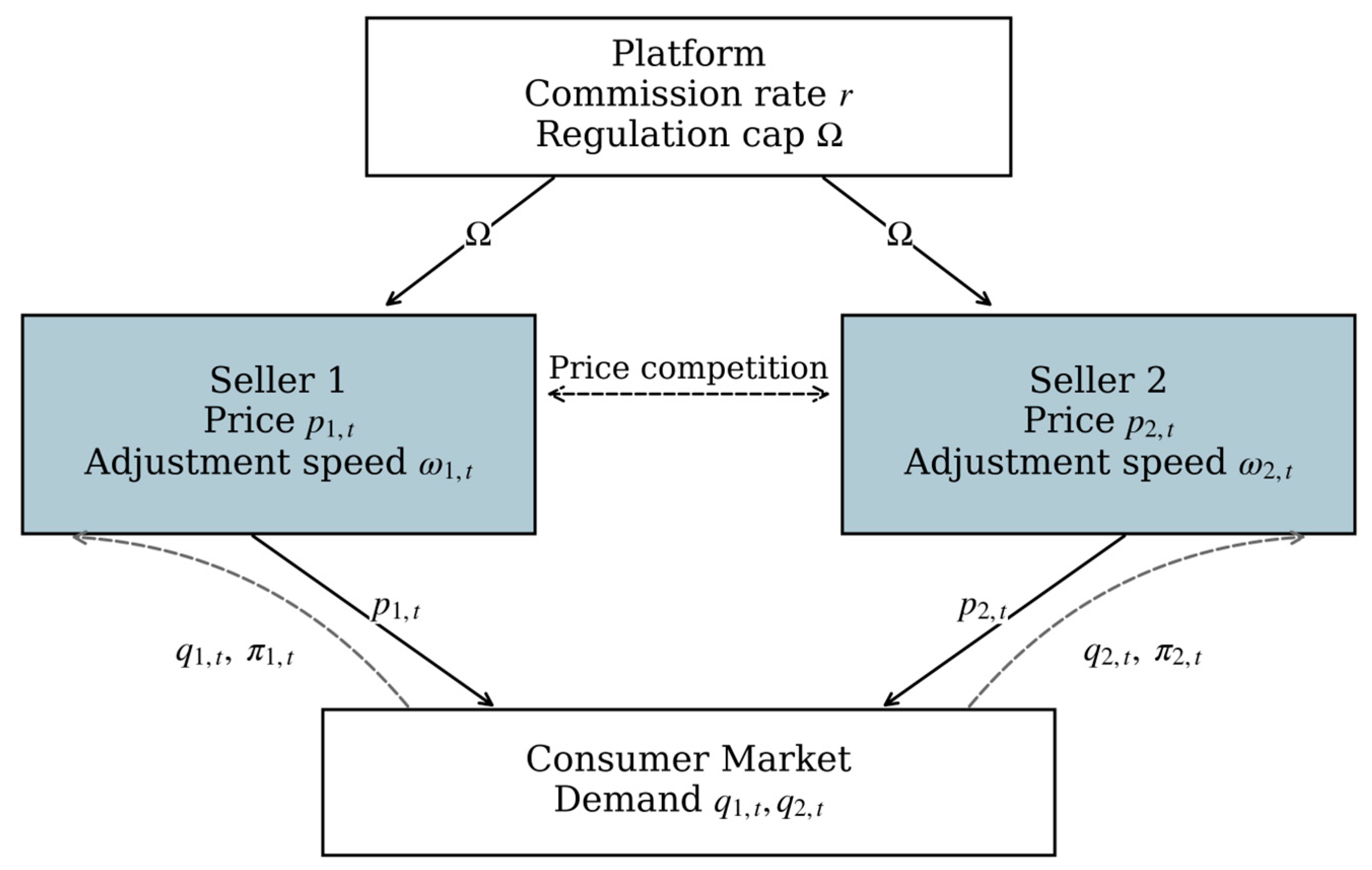
In the platform market studied here, a clear hierarchical structure exists between the platform and the sellers. As the market rule-setter, the platform first sets an upper bound on sellers’ price adjustment speeds. Given this constraint, two sellers offering substitutable products then compete on prices and dynamically adjust both their prices and adjustment speeds based on current profits and market feedback. This interaction can be modeled as a Stackelberg leader–follower game. Recognizing that sellers do not instantaneously achieve fully rational optimal decisions but adjust strategies iteratively in a boundedly rational manner, we develop a discrete-time dynamic competition model within this Stackelberg framework, as shown in
Figure 1.
The platform’s commission rate is treated as exogenous, reflecting pre-existing pricing rules. In contrast, the regulatory upper bound on price adjustment speeds is the key policy instrument the platform can actively adjust in the short run. Based on this setup, we next formulate sellers’ demand functions, the profit functions of all participants, and the discrete-time dynamic model describing the evolution of prices and adjustment speeds under platform regulation.
The variables and symbols used in the model are shown in
Table 1.
3.1. Demand Function and Consumer Surplus
Consider a market consisting of two sellers (indexed by
) and a platform. Let
denote the selling price of seller
at time
. The two sellers offer substitutable products, and the market demand is assumed to be linear. Accordingly, the demand functions faced by the two sellers can be expressed as:
Here,
represents the baseline market demand,
measures the sensitivity of demand to a seller’s own price, and
captures the degree of substitutability between the two products. To ensure the well-behavedness of the demand system, we assume that
, that is, the negative effect of a seller’s own price on demand is stronger than the positive effect of the rival’s price. The cross-price terms thus capture the competitive interaction between the two sellers.
Combining Equations (1) and (2), the inverse demand functions can be obtained as: , , where , , .
To provide a micro-foundation for the above demand structure, this paper introduces a standard quasi-linear quadratic utility function [
38,
39]:
Here,
denotes the numeraire good (i.e., residual income),
represents the baseline utility level,
captures the degree of diminishing marginal utility from own consumption, and
characterizes the interaction between the two products (i.e., substitutability or complementarity). Under this specification, the consumer’s marginal utilities satisfy:
,
, which are consistent with the inverse demand functions.
Under quasi-linear preferences, consumer surplus is equal to total utility minus total expenditure. Therefore, at time
, we have:
. Further simplification yields the consumer surplus as:
3.2. Profit Function and Social Welfare
The platform applies an ad valorem commission scheme, charging a proportion
of each seller’s sales revenue as commission. Each seller also incurs a constant unit production cost
per unit produced. Under these assumptions, the profit of seller
at time
is given by:
The platform collects commission revenue from the sales of both sellers while incurring a certain regulatory cost. Let
denote the platform’s regulatory intensity over sellers’ price adjustment speeds, that is, the upper bound imposed by the platform on the sellers’ price adjustment speeds. A larger
indicates a looser regulatory environment, whereas a smaller
implies stricter regulation. Similar to existing literature [
40,
41], we assume that the regulatory cost of the platform is a quadratic function:
Here,
is the regulatory cost coefficient. This specification implies that stricter regulation entails higher monitoring and enforcement costs.
Accordingly, the platform’s profit at time
is given by:
In addition, from the perspective of social welfare, commission revenue constitutes a transfer payment between sellers and the platform and therefore should not be double-counted. Moreover, dynamic pricing regulation may affect welfare through price stability, as excessive intertemporal price fluctuations can reduce market predictability and weaken consumer confidence. This is consistent with recent evidence that rate-stability regulation in insurance markets changes welfare by altering the trade-off between price stability and market outcomes [
42]. To capture this volatility externality in a parsimonious way, we define social welfare at time
as:
Here,
measures the intensity of price volatility, and
captures the social cost of excessive price fluctuations. The quadratic form is used as a reduced-form penalty for instability and volatility rather than as a structural estimate of consumer utility loss [
43]. At the symmetric equilibrium,
, so
equals zero and does not affect the equilibrium social welfare.
3.3. Discrete Dynamics Model Construction
For seller 1, the derivative of marginal profit with respect to price is given by:
Similarly, for seller 2, the derivative of marginal profit with respect to price is given by:
In platform markets, sellers typically do not solve a fully rational intertemporal optimization problem in each period. Instead, they adjust prices gradually based on current marginal profits. This behavioral rule is consistent with the bounded rationality assumption widely adopted in discrete-time dynamic duopoly models. Let
denote the price adjustment speed of seller
at time
. Then, the price of seller
at time
evolves according to the following rule:
Unlike the existing literature, which typically treats as an exogenous parameter, this paper assumes that the price adjustment speed itself is an endogenous variable that evolves over time. Specifically, when current profits are relatively high, sellers tend to increase their adjustment speed, reflecting greater confidence and more aggressive pricing behavior. However, excessively large price changes imply higher risks, which in turn incentivize sellers to slow down their adjustment speed in subsequent periods.
Accordingly, following standard formulations in the literature on bounded rationality and adaptive dynamic decision-making [
3,
4,
8], we model the evolution of the adjustment speed as:
Here,
denotes the baseline adjustment speed,
captures inertia in adjustment speed,
reflects the positive effect of profit on pricing aggressiveness, and
measures the dampening effect of price fluctuations on adjustment speed. Since
at the symmetric steady state, the volatility penalty term vanishes in equilibrium and therefore affects only off-equilibrium adjustment dynamics. The max operator ensures that adjustment speeds remain non-negative and economically feasible.
Since the platform imposes an upper bound
on the sellers’ price adjustment speeds, the actual adjustment speed adopted by the sellers is given by:
This rule implies that sellers may increase their adjustment speeds in response to market signals, but the actual speed cannot exceed the regulatory upper bound set by the platform. Combining the above equations, the overall dynamics of the system can be represented as:
Therefore, the system forms a four-dimensional discrete-time nonlinear dynamical system, with the state vector defined as . Within this framework, the platform shapes sellers’ pricing behavior by selecting the regulatory upper bound, while the sellers’ endogenous adjustment speeds influence both market stability and profitability. This model provides the foundation for the subsequent equilibrium characterization, stability analysis, and the study of how platform regulation affects sellers’ profits and overall market dynamics.
4. Equilibrium and Stability Analysis
To analyze dynamic competition under platform regulation, we first consider the interior symmetric equilibrium when the platform-imposed upper bound on adjustment speed is non-binding near the steady state. Given symmetric seller parameters and identical platform rules, we focus on characterizing this symmetric equilibrium and subsequently examine its local stability.
4.1. Interior Symmetric Nash Equilibrium and Conditions for Local Stability
Proposition 1. If , , and the resulting steady state satisfies and , then the system admits a unique interior symmetric equilibrium: where , , . Proposition 1 shows that in a duopolistic market with substitutable products, sellers following a boundedly rational adjustment mechanism eventually converge to a symmetric long-run behavior. This convergence ensures that the model is well-defined from an economic perspective. From the equilibrium expression, the price
is jointly determined by the underlying market structure parameters. In particular,
captures the compression effect of the platform’s commission on effective revenue, while the term
in the denominator reflects the “effective intensity” of market competition. As product substitutability (
) increases,
decreases, which in turn raises the equilibrium price level. This indicates that stronger substitution competition encourages sellers to raise prices to ease competitive pressure, creating an endogenous buffering mechanism. The proof is provided in
Appendix A.1.
Meanwhile, the steady-state adjustment speed clearly reveals the endogenous origin of pricing behavior: it is not only influenced by the baseline adjustment level, but is also closely related to profit levels and behavioral inertia. When profit is high or the inertia parameter is large, the sellers’ adjustment speeds are significantly amplified.
This structure lays the foundation for the subsequent stability analysis, showing that the steady-state adjustment speed is determined endogenously by market profitability and behavioral parameters, rather than being exogenously imposed.
Corollary 1. Under , we have , , .
Corollary 1 shows that, under
, the steady-state adjustment speed increases monotonically with the baseline adjustment level, profit sensitivity, and adjustment inertia. This implies that as long as the market remains profitable, sellers have an inherent incentive to choose higher steady-state adjustment speeds. The proof is provided in
Appendix A.2.
From an economic perspective, this corollary characterizes an endogenous evolution path of “profit–acceleration–instability.” Higher profits enhance sellers’ confidence in pricing (through ), strengthen their reliance on past strategies (through ), and amplify the existing adjustment pace (through ). The combined effect of these forces increases the endogenous steady-state adjustment speed, which may eventually push the system beyond the local stability boundary.
To examine stability at the equilibrium, we first derive the Jacobian matrix at the steady state:
Since is a block lower triangular matrix, its eigenvalues are determined by those of the diagonal blocks. The upper-left price block has eigenvalues and , while the lower-right block has eigenvalues and . Therefore, the stability of the equilibrium can be characterized by Proposition 2.
Proposition 2. Under , the interior symmetric equilibrium is locally asymptotically stable if and only if .
Proposition 2 characterizes the local stability condition conditional on a given steady-state adjustment speed
. The result shows that local stability depends critically on whether the endogenous steady-state adjustment speed remains within the stability region. Since
, the steady-state adjustment speed is not exogenously fixed, but depends on profit incentives, adjustment inertia, and the baseline level of algorithmic aggressiveness. Combined with Corollary 1, this suggests that stronger profit incentives increase the endogenous steady-state adjustment speed. If this speed exceeds the local stability threshold, the system may become unstable. The proposition therefore provides an analytical characterization of the local stability condition for a given steady-state adjustment speed. The proof is provided in
Appendix A.3.
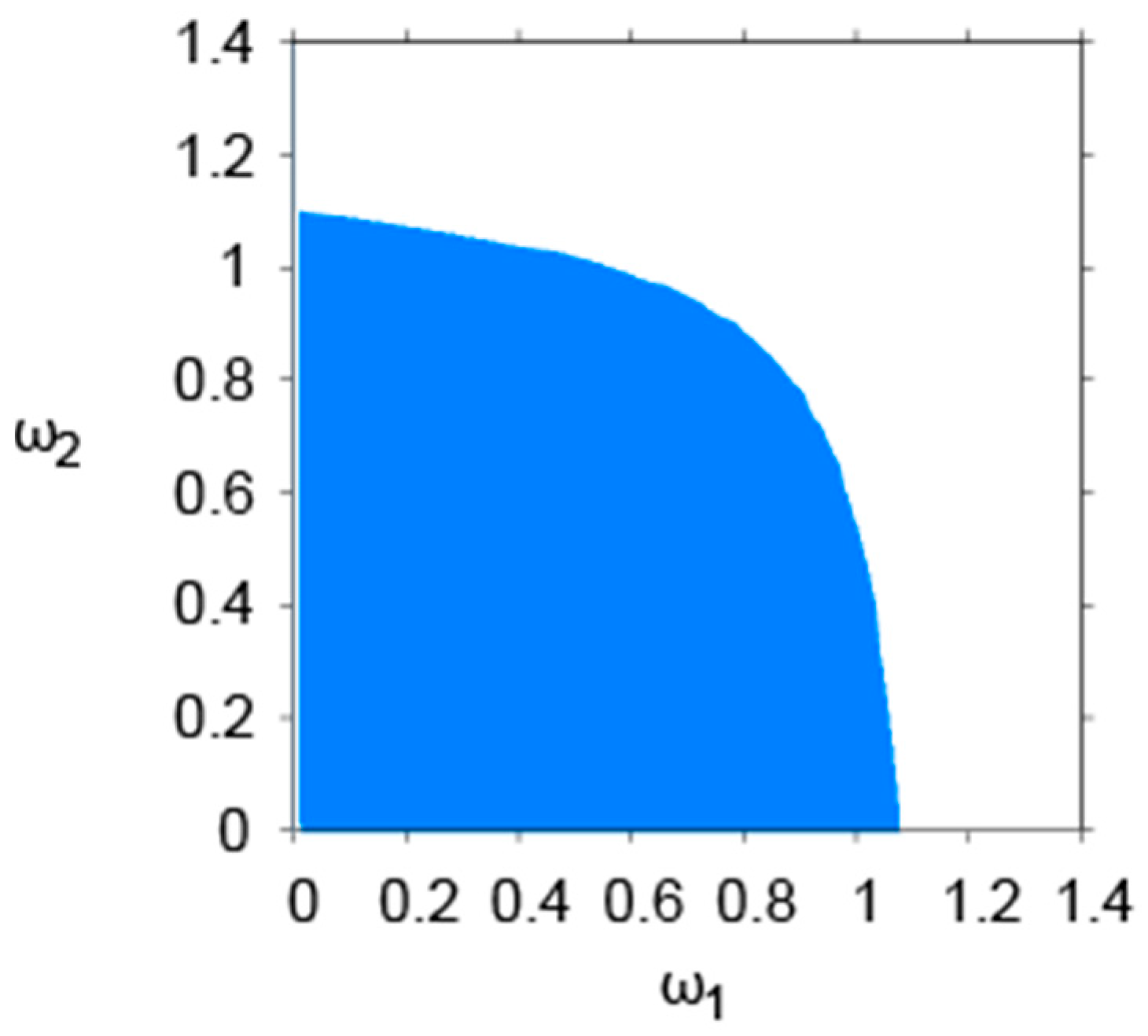
To present these theoretical results more intuitively and to illustrate the joint impact of the two sellers’ adjustment speeds on system stability,
Figure 2 further depicts the stability region in the
space. It can be observed that the stability region exhibits a distinctly nonlinear boundary. As the adjustment speeds
and
increase, the system gradually transitions from a stable state to an unstable one. This indicates that excessively high adjustment speeds tend to undermine system stability, whereas relatively low adjustment speeds help maintain a stable market environment. Moreover, the asymmetry of the stability region reflects the interaction between the two sellers’ pricing behaviors, suggesting that a change in one seller’s adjustment speed can affect the overall system stability through competitive dynamics.
4.2. Platform Regulation and Stability Restoration
Next, we consider the role of the platform’s speed cap . When the platform imposes regulation, the sellers’ actual adjustment speed becomes . If, in the absence of regulation, the sellers’ endogenous steady-state adjustment speed already exceeds the stability threshold, the platform can restore local stability by imposing a suitably chosen binding upper bound that truncates the actual adjustment speed to within the stable region. Let denote the interior steady-state adjustment speed in the absence of regulation.
Proposition 3. If in the absence of regulation , then there exists an effective binding upper bound
that can restore local asymptotic stability of the system. More specifically, as long as the platform is set as follows: then this upper bound is binding in the neighborhood of the steady state, and the system regains local stability. Proposition 3 shows that instability may emerge when the endogenous steady-state adjustment speed becomes excessively large relative to the local stability region. Since stronger profit incentives tend to increase adjustment aggressiveness, the equilibrium may eventually fall outside the stability region in the absence of regulation. By imposing an upper bound on adjustment speeds, the platform can effectively restrict the realized adjustment intensity within the stable region and thereby restore local stability. The proof is provided in
Appendix A.4.
In the preceding analysis, the platform influences sellers’ dynamic pricing behavior and system stability by setting an upper bound on price adjustment speeds. Since regulation can both curb excessive acceleration and reduce market volatility, while at the same time weakening normal price responsiveness and incurring additional regulatory costs, the platform’s profit-maximizing regulatory intensity does not necessarily coincide with the socially optimal level of regulation.
To this end, we define the platform’s long-run average profit
under a given
as:
Accordingly, the platform’s optimal regulatory intensity
is defined as:
Similarly, we define the system’s long-run average social welfare
under a given
, as well as the socially optimal regulatory intensity
, as:
among them,
. It is worth noting that the platform’s commission revenue essentially constitutes a transfer payment between the platform and the sellers, and therefore should not be double-counted in the calculation of social welfare.
Equations (16) and (18) can be rewritten as:
Section 5 uses numerical simulations to examine how seller profit-driven endogenous acceleration moves the system from stability to cyclical oscillations and complex dynamics. It also analyzes the effects of platform regulation on seller profits, platform profits, and social welfare. Because the introduction of nonlinear adjustment dynamics, entropy-triggered control, and volatility-related welfare costs makes analytical characterization of socially and platform-optimal regulation levels highly intractable, numerical simulations are used to evaluate governance outcomes under different regulation intensities.
5. Numerical Simulation Analysis
To verify the dynamic properties of the model and the results of the theoretical analysis, this paper conducts numerical simulations based on a set of representative parameters. The baseline parameter values are selected with three considerations. First, they satisfy the standard regularity conditions of a differentiated duopoly market [
34], including positive demand, positive seller profits, and the existence of an interior equilibrium. Second, they describe an economically meaningful platform market with moderate product substitutability and a non-extreme commission rate. Third, they allow the system to exhibit representative dynamic transitions from local stability to bifurcation and chaos, which are commonly examined in the bounded-rationality and complex-dynamics literature [
3,
4,
7].
Specifically, in the market demand function, the baseline market size is set to , and the own-price sensitivity coefficient is set to . These values normalize the demand scale and ensure that demand decreases at a moderate rate as sellers raise prices. The cross-price influence coefficient is set to , which captures a moderate degree of product substitutability while satisfying the standard condition . The unit production cost is set to to ensure positive operating margins around the interior equilibrium. The platform commission rate is set to , representing a moderate commission level that does not dominate sellers’ pricing incentives.
Regarding the adjustment-speed dynamics, the speed inertia parameter is set to , indicating that sellers partially rely on past adjustment behavior. The benchmark adjustment speed is set to , representing a relatively conservative pricing adjustment tendency in the absence of strong profit incentives. The profit-driven coefficient serves as the key bifurcation parameter and varies within the interval to characterize different levels of sellers’ sensitivity to profit signals. The price-fluctuation penalty coefficient is set to to reflect the adjustment risk associated with excessive price fluctuations. Under the baseline setting, the theoretical regulatory upper bound is fixed at . In the numerical experiments where regulation intensity is treated as a bifurcation parameter, varies over the interval to examine how different levels of platform regulation affect market stability. The selected parameter ranges guarantee numerical convergence and avoid economically meaningless outcomes such as negative demand or explosive divergence. The parameter configuration is not intended to match a specific empirical platform market, but rather to provide a stylized environment for illustrating the underlying dynamic mechanisms.
The initial states are set as and , and the initial values of the price adjustment rates are and , respectively. To eliminate the influence of the initial conditions on the results, a certain number of pre-iterations (burn-in) are first performed during the simulation, followed by recording the long-term dynamic behavior of the system.
5.1. Role of Pricing Aggressiveness
To examine the impact of profit-driven price aggressiveness on the dynamic evolution of the system, this paper uses parameter
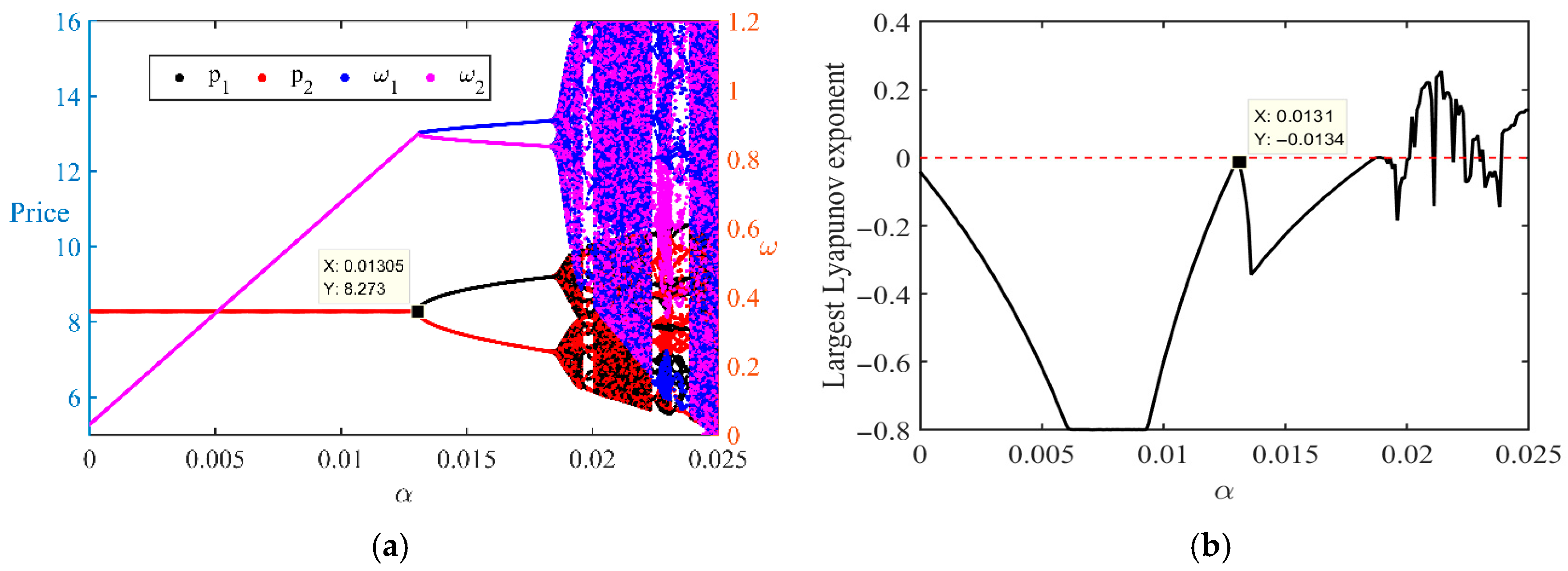
(pricing aggressiveness) as the bifurcation parameter to plot the price path and the maximum Lyapunov exponent, as shown in
Figure 3.
Figure 3a illustrates the evolution of price trajectories for seller 1 (
) and seller 2 (
) under different values of
, which captures the positive effect of profit on pricing aggressiveness. As
increases, the price paths gradually exhibit stronger fluctuations, and for higher values of
clear nonlinear patterns begin to emerge. In particular, when
approaches 0.013, the price trajectories display pronounced oscillations, followed by a relatively stable pattern thereafter. This indicates that as pricing aggressiveness (
) increases, price volatility increases, market competition intensifies, and market instability increases. The non-linear market fluctuations may be due to competitive pressure caused by excessively high pricing aggressiveness, leading to sharp price fluctuations in the short term. This phenomenon clearly demonstrates the positive impact of
on market pricing behavior; a higher
value means that sellers are more aggressive in pricing, thereby exacerbating market price volatility.
Figure 3b shows the variation of the Lyapunov exponent with respect to
. The Lyapunov exponent measures the stability of the system; a larger Lyapunov exponent indicates that the system is more likely to enter a chaotic state. As shown in
Figure 3b, when
approaches 0.013, the Lyapunov exponent increases significantly and exhibits pronounced oscillatory patterns around this value, indicating a substantial decline in system stability. This phenomenon suggests that when
is relatively high, the dynamic stability of the market system weakens and the system enters a chaotic state, with a substantial increase in the uncertainty of price fluctuations. The increase in
directly leads to a deterioration in system stability, making market behavior more unpredictable. This indicates that when pricing aggressiveness is excessively high, the market no longer maintains sufficient stability and is prone to falling into disorder and chaos.
In this context, pricing aggressiveness () not only affects the volatility of price trajectories but also influences overall market stability. Higher values of lead to greater price volatility and increased market uncertainty, which may pose significant risks for both platforms and sellers. Therefore, platforms should pay close attention to the control of pricing aggressiveness. In particular, when is excessively high, appropriate regulatory measures should be considered to prevent the market from falling into a chaotic and unstable state.
From an economic perspective, entropy measures the degree of uncertainty and unpredictability in market pricing dynamics. When the system remains stable, price trajectories are relatively regular and predictable, corresponding to lower entropy levels and stronger market coordination. In contrast, as profit-driven adjustment speeds push the system toward bifurcation or chaos, pricing trajectories become increasingly irregular and difficult to anticipate, reflecting the expansion of dynamic uncertainty in the market.
Different entropy measures capture different aspects of market complexity. Shannon entropy reflects the uncertainty of price distributions, permutation entropy captures the temporal irregularity of pricing trajectories, and joint entropy measures the overall coordination complexity across sellers. Therefore, entropy complements traditional stability indicators such as bifurcation diagrams and Lyapunov exponents by providing an economically meaningful perspective on market predictability, coordination difficulty, and platform governance effectiveness.
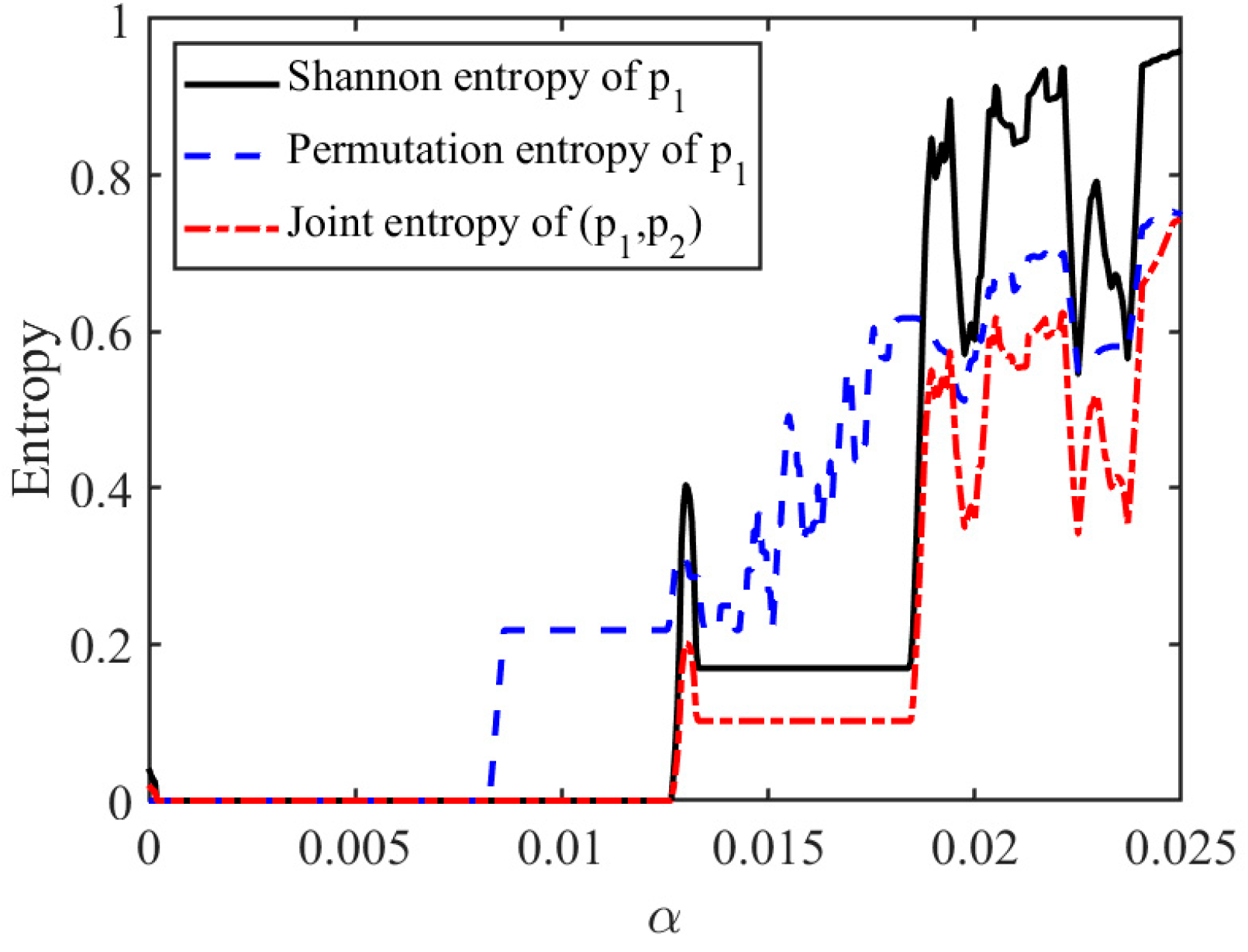
Figure 4 illustrates the evolution of Shannon entropy, permutation entropy, and joint entropy as the profit-driven parameter changes. It can be seen that in the lower
range, all three entropy values are close to 0, indicating that the system’s orbits are highly concentrated, price dynamics are relatively stable, and the system is in a low-complexity state. As
increases, the three entropy indices begin to rise significantly and remain at a high level in the higher range, indicating that the system gradually evolves from stable equilibrium to a periodic oscillation or even a chaotic state. The price orbits are more dispersed in the state space, and dynamic uncertainty is significantly enhanced.
Across the different entropy measures, permutation entropy begins to rise relatively earlier, indicating that it is more sensitive to changes in the temporal structural complexity of the price series. By contrast, Shannon entropy and joint entropy more directly capture the degree of dispersion in the system’s state distribution. Although the three entropy measures differ in their numerical levels, they exhibit a broadly consistent overall trend, suggesting that profit-driven pricing aggressiveness continuously increases system complexity.
The simultaneous increase in Shannon entropy, permutation entropy, and joint entropy suggests that the market becomes not only more volatile, but also more difficult to predict and coordinate. In particular, the rise in permutation entropy indicates that pricing trajectories gradually lose temporal regularity, while the increase in joint entropy reflects growing coordination complexity across competing sellers. Economically, this implies that excessive profit-driven acceleration weakens market predictability and increases the difficulty of platform governance. Therefore, entropy serves as a useful complement to bifurcation diagrams and the largest Lyapunov exponent by capturing the informational complexity embedded in platform pricing dynamics. It also provides a basis for the subsequent analysis of how platform regulation and feedback control mechanisms can suppress instability and reduce dynamic uncertainty.
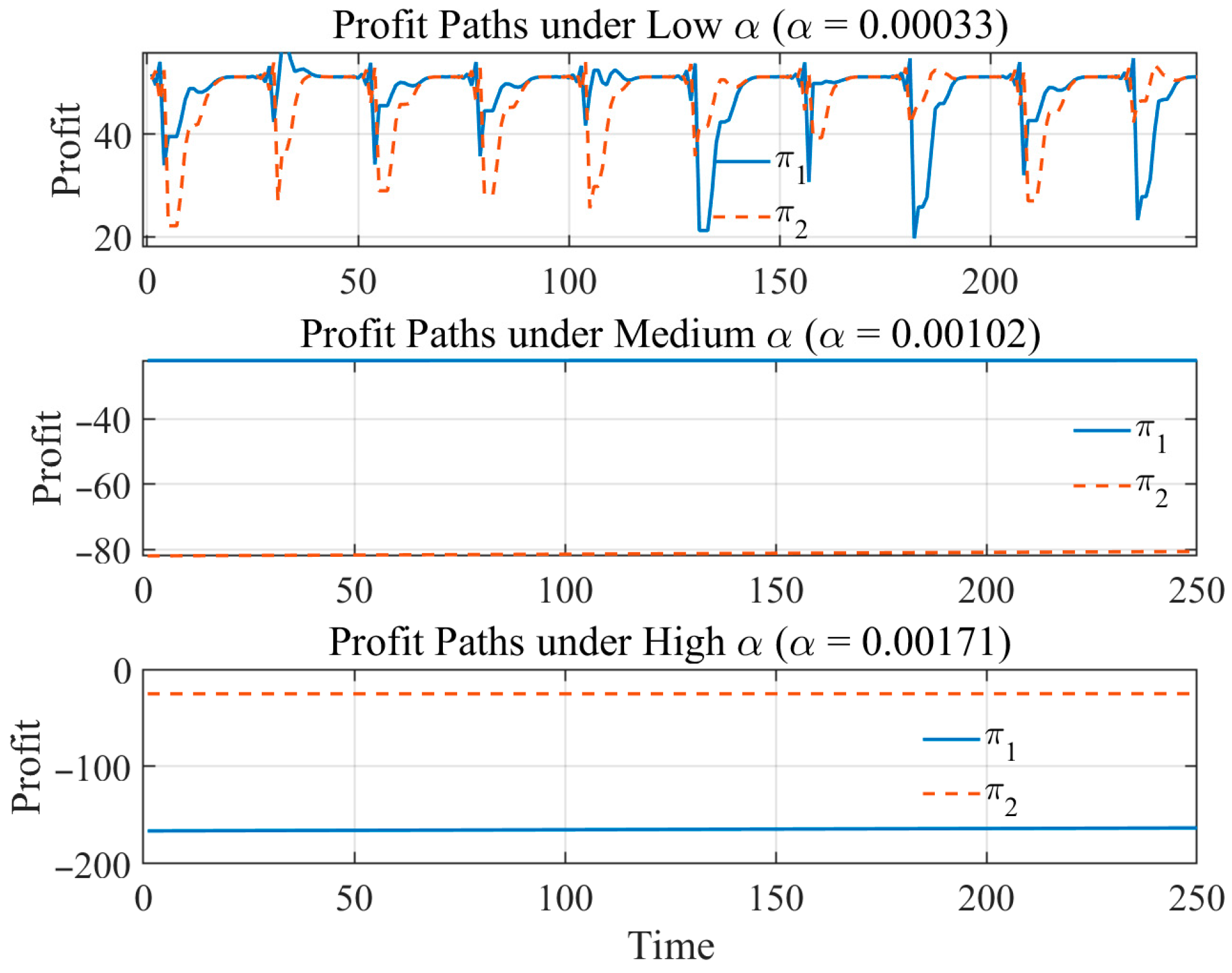
Figure 5 illustrates the dynamic evolution paths of the profits of the two sellers under different levels of pricing aggressiveness
, illustrating how higher pricing aggressiveness gradually pushes the market from a relatively stable profit regime toward a low-profit regime.
When is at a relatively low level, profits exhibit regular periodic fluctuations with limited amplitude and a clear repetitive structure. This indicates that under a relatively mild adjustment mechanism, price updates remain sufficiently moderate, and the system operates within a stable bounded fluctuation regime. At this stage, profit-driven adjustment plays a “fine-tuning” role that helps maintain market coordination and relatively stable profitability. When increases to a moderate level, the profit trajectories rapidly converge to a lower level and lose their original periodic structure. This suggests that excessively strong profit incentives induce over-adjustment in prices, causing sellers to deviate persistently from the high-profit region and thereby intensifying competition and compressing profit margins. In this stage, the role of profit signals shifts from facilitating gradual coordination to generating excessive pricing responses, resulting in deterioration of market performance. As increases further, the system enters an extremely low-profit regime and remains trapped at a persistently low level over the long run. Profits no longer exhibit noticeable fluctuations but instead converge to a low-profit state, indicating that excessive pricing aggressiveness may lead the market into a self-reinforcing pattern of over-adjustment and profit deterioration. At this stage, price adjustment no longer improves market coordination and instead prevents the market from returning to a high-profit operating region.
Therefore, pricing aggressiveness is not necessarily beneficial when excessively large; its effect on profits exhibits a clear nonlinear pattern. Relatively low levels of help maintain stable market responsiveness, whereas excessively high weakens profitability and pushes the system toward a persistently low-profit regime. These results suggest that profit-driven adjustment can play both a coordination-enhancing role and a profit-deterioration role, implying a trade-off between market responsiveness and long-run profitability.
5.2. Impact of Platform Regulation
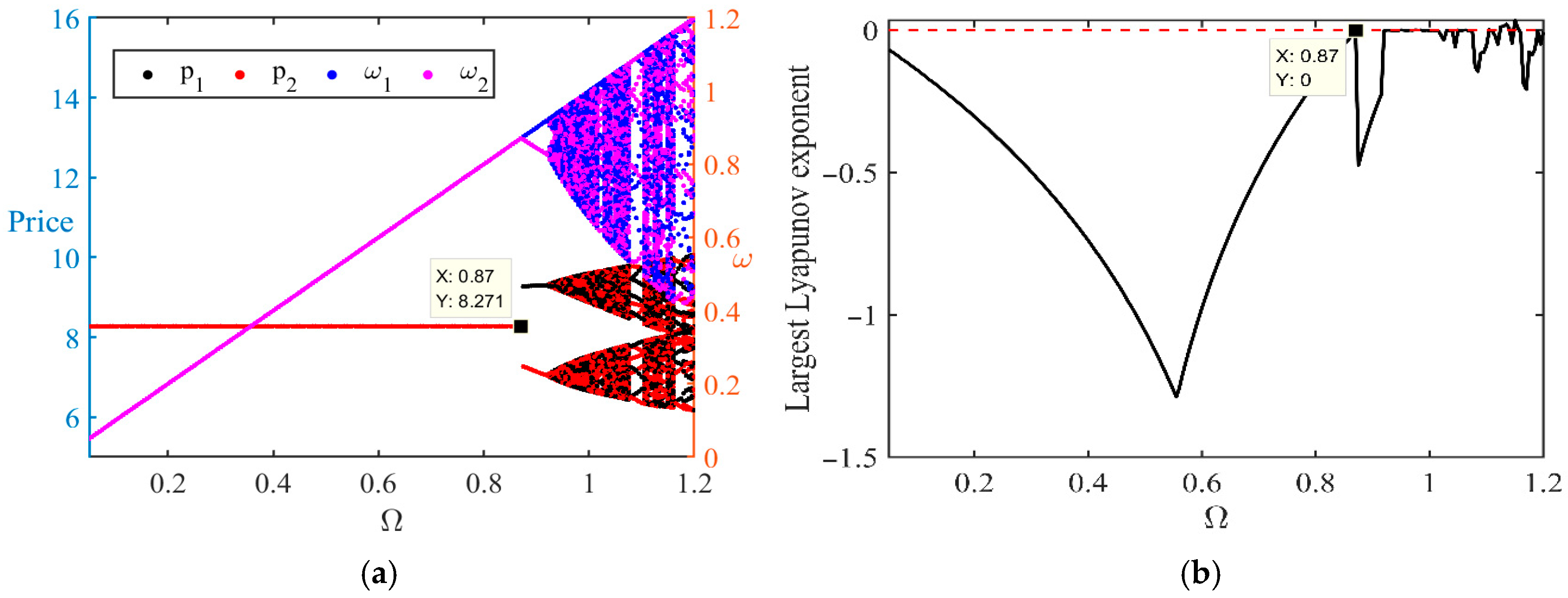
Figure 6 illustrates the relationship between price trajectories and the Lyapunov exponent, analyzing the impact of different values of Ω (the platform control parameter) on market dynamics.
Figure 6a presents the price trajectories of seller 1 (
) and seller 2 (
) under varying values of Ω It can be observed that as Ω increases, fluctuations in the price trajectories become more pronounced. In particular, when Ω approaches 0.87, the price paths exhibit clear nonlinear fluctuations. This indicates that as platform intervention in the market gradually weakens (i.e., when Ω is relatively high), market pricing becomes more sensitive and volatile, leading to sharp price fluctuations and increased uncertainty.
Figure 6b shows the variation of the Lyapunov exponent with respect to Ω. The Lyapunov exponent serves as a measure of system stability: as its value increases, the system becomes more likely to enter a chaotic state. From the figure, it can be seen that when Ω approaches 0.87, the Lyapunov exponent rises sharply, indicating a significant decline in system stability and the onset of chaos. Changes in Ω therefore have a substantial impact on market stability. Higher values of Ω imply weaker platform regulation, under which the market exhibits stronger nonlinear fluctuations and greater unpredictability, increasing risk for both sellers and the platform. In contrast, lower values of Ω indicate stronger platform control, under which price and profit trajectories are more stable and overall market stability is higher.
Therefore, the platform should exercise caution in selecting to avoid excessive deregulation that may lead to market instability. Overall, an appropriate choice of the platform control parameter is crucial for maintaining market stability and predictability. In particular, when the market experiences large fluctuations, moderate regulation may be necessary to ensure system stability.
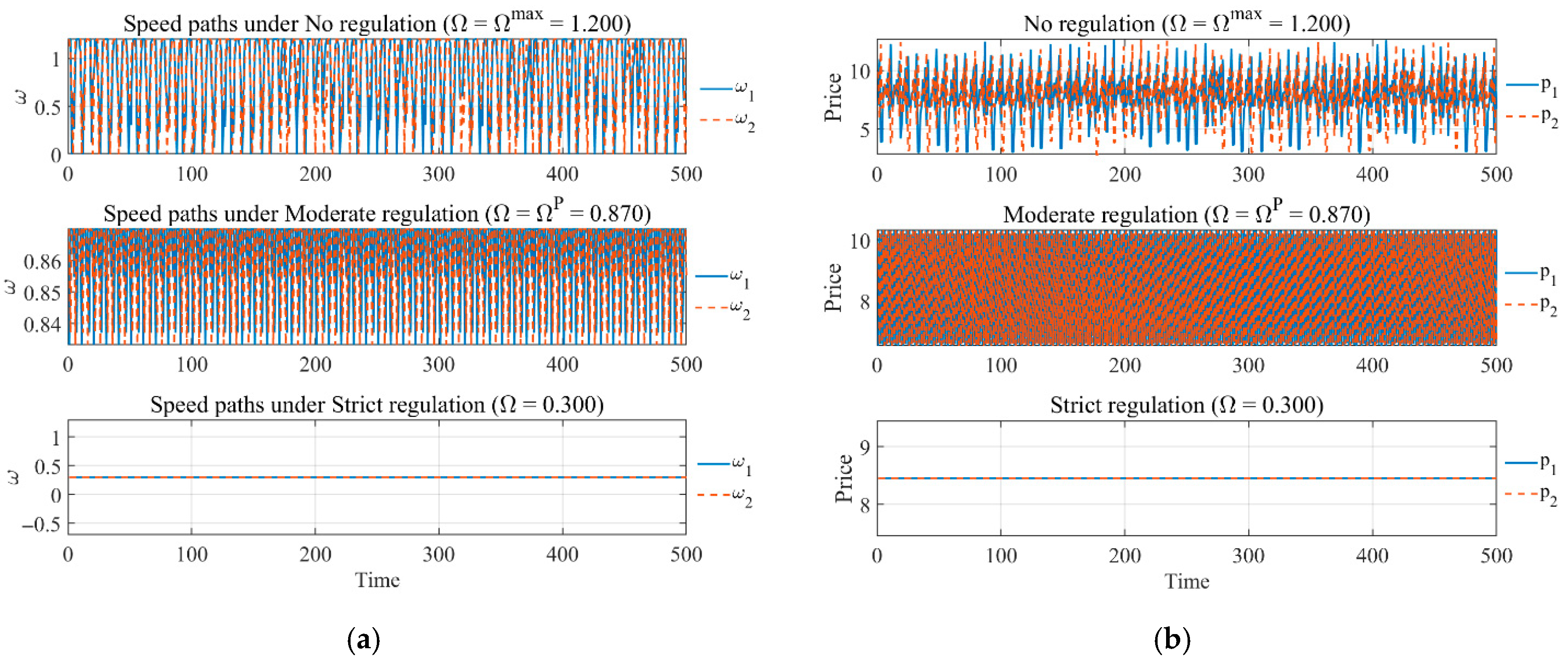
Figure 7 presents the price trajectories of sellers under three different regulatory scenarios: no regulation, moderate regulation, and strict regulation. In the absence of regulation, the value of
is at its maximum (i.e.,
=
= 1.200). In this case, the price paths exhibit high-frequency fluctuations and pronounced periodic variations, indicating that market prices are easily affected by excessive competition in the absence of regulation, leading to large fluctuations. As regulation is gradually strengthened (
=
= 0.870), price fluctuations decrease and tend to stabilize, and the price paths become smoother. This suggests that moderate regulation can effectively mitigate drastic price fluctuations and help maintain a certain level of market stability. Under strict regulation (
= 0.300), prices converge to a stable level and exhibit almost no variation, reflecting a high degree of price stability. For the market, although excessive regulation can suppress price fluctuations, it may also lead to price rigidity and reduce the flexibility of market responses.
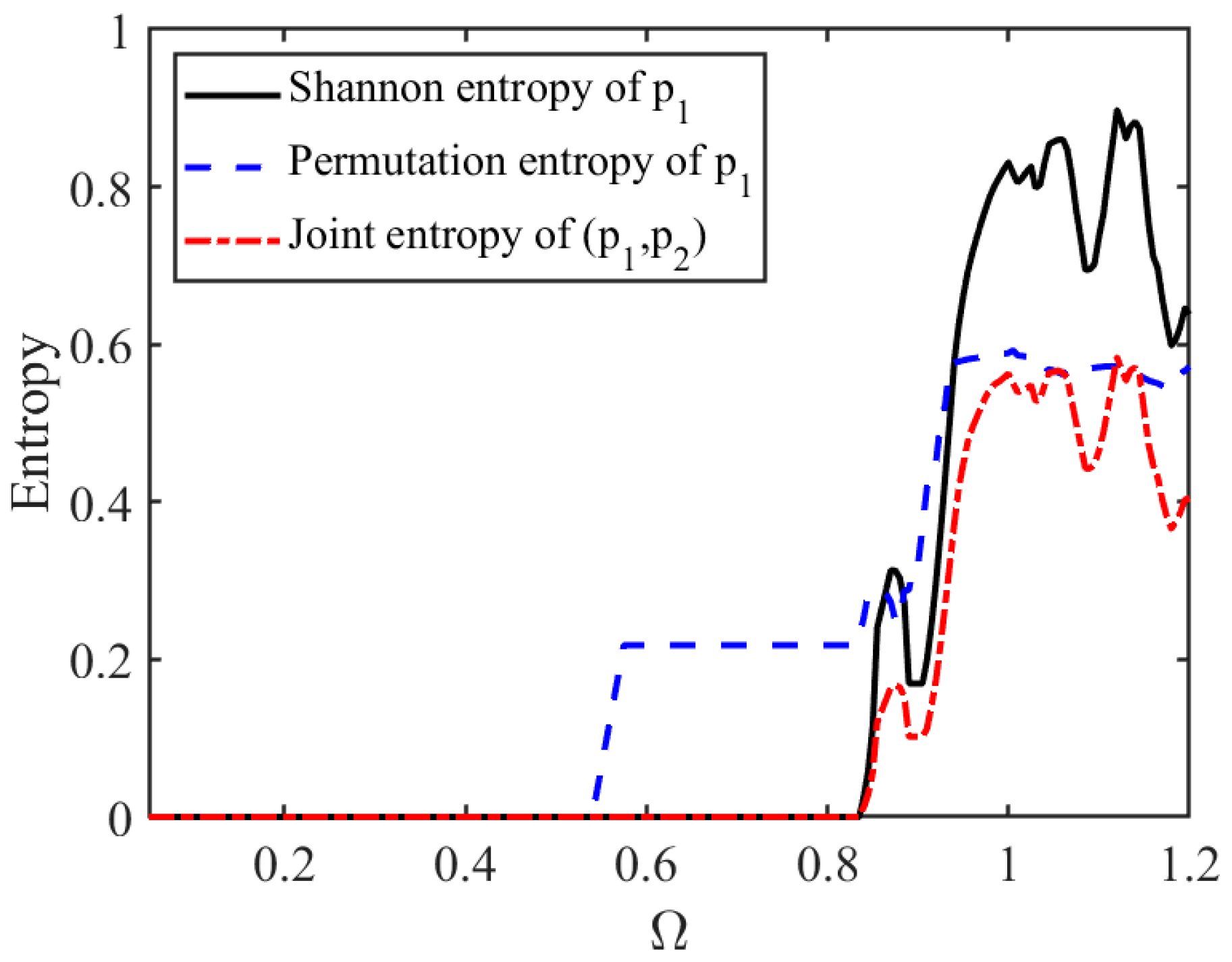
Figure 8 illustrates the evolution of three types of entropy measures with respect to the platform regulation upper bound
. It can be observed that within the lower range of
, Shannon entropy, permutation entropy, and joint entropy all remain at relatively low levels, indicating that under strict regulation, the system dynamics are relatively stable, price trajectories are concentrated, and overall complexity is low. As
gradually increases, all three entropy measures rise significantly and exhibit substantial fluctuations in the higher range, suggesting that as regulation is relaxed, system trajectories gradually disperse in the state space and dynamic uncertainty increases markedly. The consistent trends across the three entropy measures further indicate that platform regulation intensity has a significant impact on system complexity.
These results suggest that constraints on adjustment speed imposed by the platform not only stabilize the system but also reduce market complexity from an informational perspective. By limiting excessive acceleration in price adjustment, strong regulation effectively suppresses the disordered expansion of price dynamics and maintains the system at relatively low levels of Shannon entropy, permutation entropy, and joint entropy. This indicates that strong regulation not only improves the predictability of market price outcomes, but also enhances the temporal regularity of price evolution and reduces the coordination complexity among competing sellers, thereby mitigating dynamic uncertainty in the market. In contrast, relaxed regulation may lead to dispersed price dynamics, irregular pricing behavior, and greater coordination difficulty among market participants. Therefore, from the perspective of complexity governance, platforms need to strike a balance between flexibility and stability, avoiding excessive deregulation that may induce systemic instability.
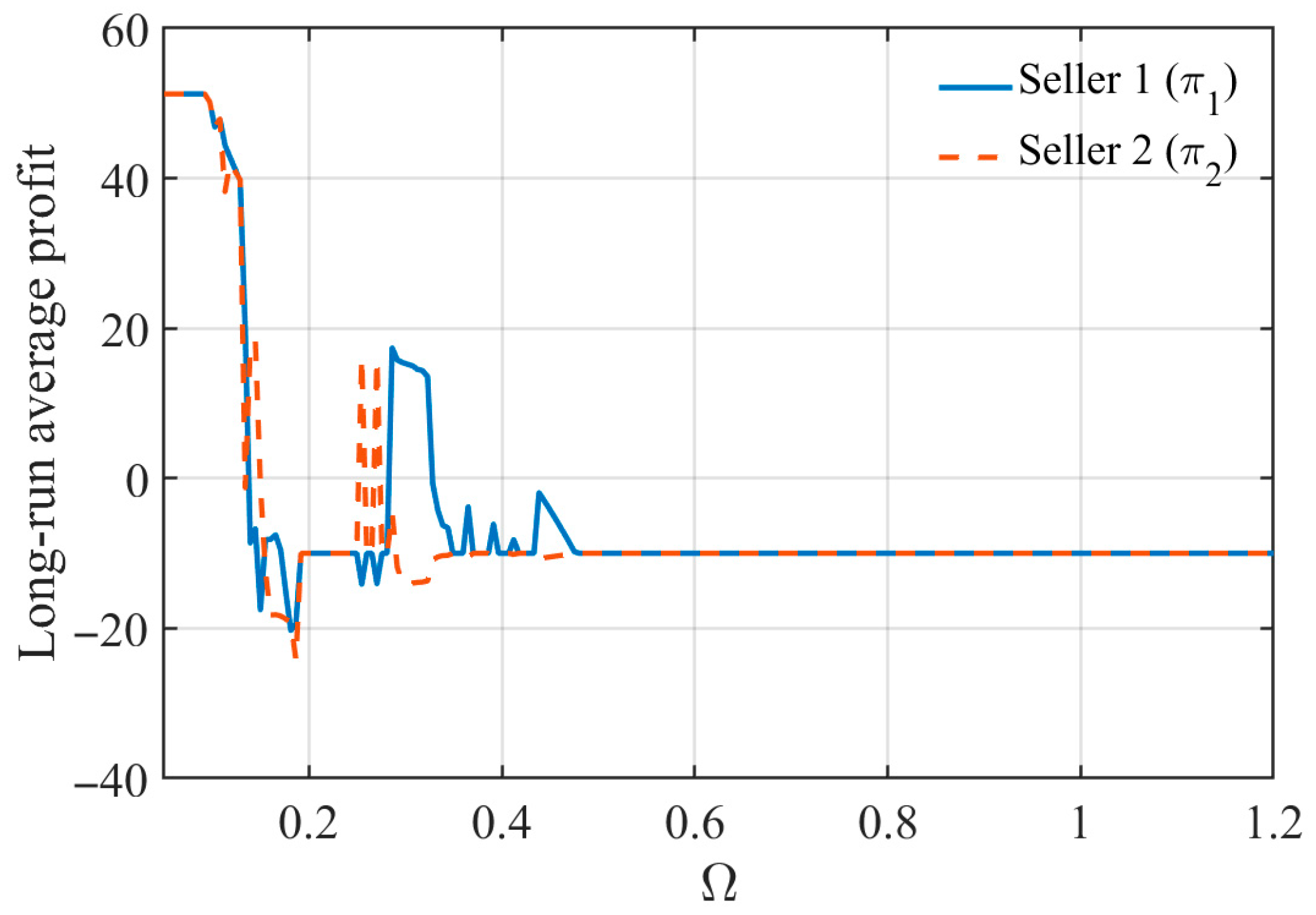
Figure 9 illustrates the relationship between seller profits and the platform-imposed regulation intensity
. The blue solid line and the red dashed line represent the long-run average profits of Seller 1 and Seller 2, respectively. The results indicate that regulation intensity has a substantial impact on profit dynamics and market outcomes.
When is relatively small, the platform imposes a strict upper bound on adjustment speeds, which effectively restrains excessive pricing responses and helps maintain relatively stable and high profit levels. As increases, the regulatory constraint gradually weakens, and seller profits begin to exhibit noticeable fluctuations and deterioration. In the intermediate region, excessive adjustment flexibility leads to intensified competition and unstable profit performance. When becomes sufficiently large, the system eventually converges to a persistently low-profit regime.
These results suggest that weakening regulation does not necessarily improve long-run market performance. Instead, excessive pricing flexibility may induce over-adjustment behavior and persistent profit deterioration. Therefore, platform regulation primarily plays a stabilizing role by preventing adjustment speeds from becoming excessively aggressive and by mitigating long-run profit collapse.
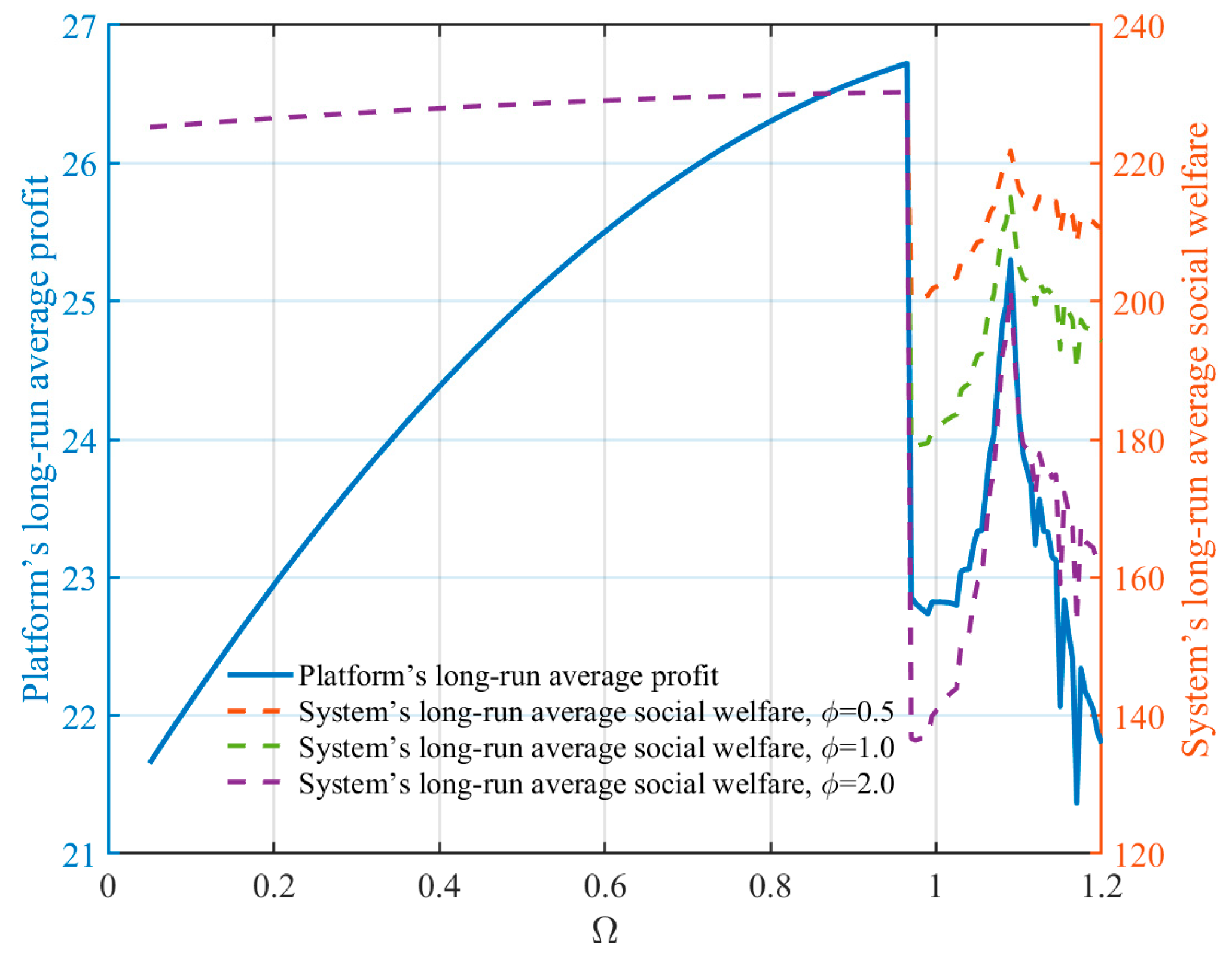
Figure 10 compares the platform objective and the volatility-adjusted social welfare objective under different regulation intensities. Since the welfare objective additionally incorporates producer surplus, consumer surplus, and volatility-related welfare losses, its numerical magnitude is naturally larger than that of the platform objective. Therefore, the two objectives are reported using separate vertical axes for visual comparison.
As the regulation intensity varies, both the platform objective and the welfare objective exhibit noticeable changes near the instability region. In particular, when regulation becomes excessively weak and the system approaches unstable pricing dynamics, both objectives decline due to intensified price fluctuations. Moreover, higher values of the volatility-cost parameter make the welfare objective more sensitive to market unpredictability.
These results suggest that excessive pricing volatility not only reduces platform profitability, but also generates welfare losses by weakening market predictability and increasing coordination difficulty among market participants. Therefore, appropriate regulation can help stabilize the pricing system and mitigate volatility, whereas overly weak regulation may push the market into a high-volatility and low-welfare regime.
5.3. Chaos Control
In the previous analysis, we have shown that when the profit-driven parameter or the adjustment speed exceeds a critical threshold, the system undergoes transitions from stability to periodic bifurcation and eventually to chaos. A natural question therefore arises: when the entire market falls into chaos, does the platform have effective means to control it?
Following the permutation-entropy approach of Bandt and Pompe [
44], we use (
) to characterize the temporal irregularity of recent pricing trajectories. Let
the normalized permutation-entropy indicator of recent pricing trajectories at time
, defined as
, where the entropy is computed over a rolling observation window of length
. The platform specifies a tolerance threshold
for pricing irregularity. When
, the pricing process is regarded as sufficiently regular and predictable, and no additional intervention is activated. When
indicating excessive irregularity in price evolution, the platform activates the speed-damping control mechanism to suppress further instability.
To mitigate profit-driven excessive acceleration, we adopt a feedback control approach from the economic chaos literature. A negative feedback term, based on the deviation of adjustment speed from a target level, is added to the adjustment-speed evolution equation. Combined with the upper bound on adjustment speed imposed by the platform, we construct a damping control mechanism based on endogenous adjustment speed [
45]. The basic idea is as follows: since the direct source of system instability is not the price variable itself, but rather the continuous increase in adjustment speed driven by profit incentives, which amplifies price jumps and competitive fluctuations, the key to chaos control does not lie in directly correcting price levels, but in imposing appropriate damping on endogenous adjustment speed so as to bring it back to the stable region. Based on this, we assume that in each period of speed updating, the platform or the sellers’ algorithm introduces a negative feedback control term according to the deviation between the current adjustment speed and the target speed, so as to suppress excessive acceleration behavior. Specifically, on the basis of the original updating rule, the evolution equation of the adjustment speed for seller
is modified as follows:
where
.
denotes the maximum feedback-control intensity, whereas the effective control strength
is endogenously activated according to the entropy-trigger condition.
denotes the target adjustment speed. From an economic perspective, the control term adjusts the system as follows. If the actual adjustment speed exceeds the target, the negative feedback reduces it in the next period. If the speed falls below the target, the feedback is relaxed, allowing normal market responses to proceed without excessive damping.
In the entropy-triggered control simulations, the rolling observation window length is set to (), which balances the identification of temporal irregularity and the responsiveness of the control mechanism. The entropy threshold is set to (). Since the normalized permutation entropy lies within the interval , this moderate threshold allows a certain degree of pricing flexibility while activating intervention once pricing trajectories become sufficiently irregular and difficult to predict.
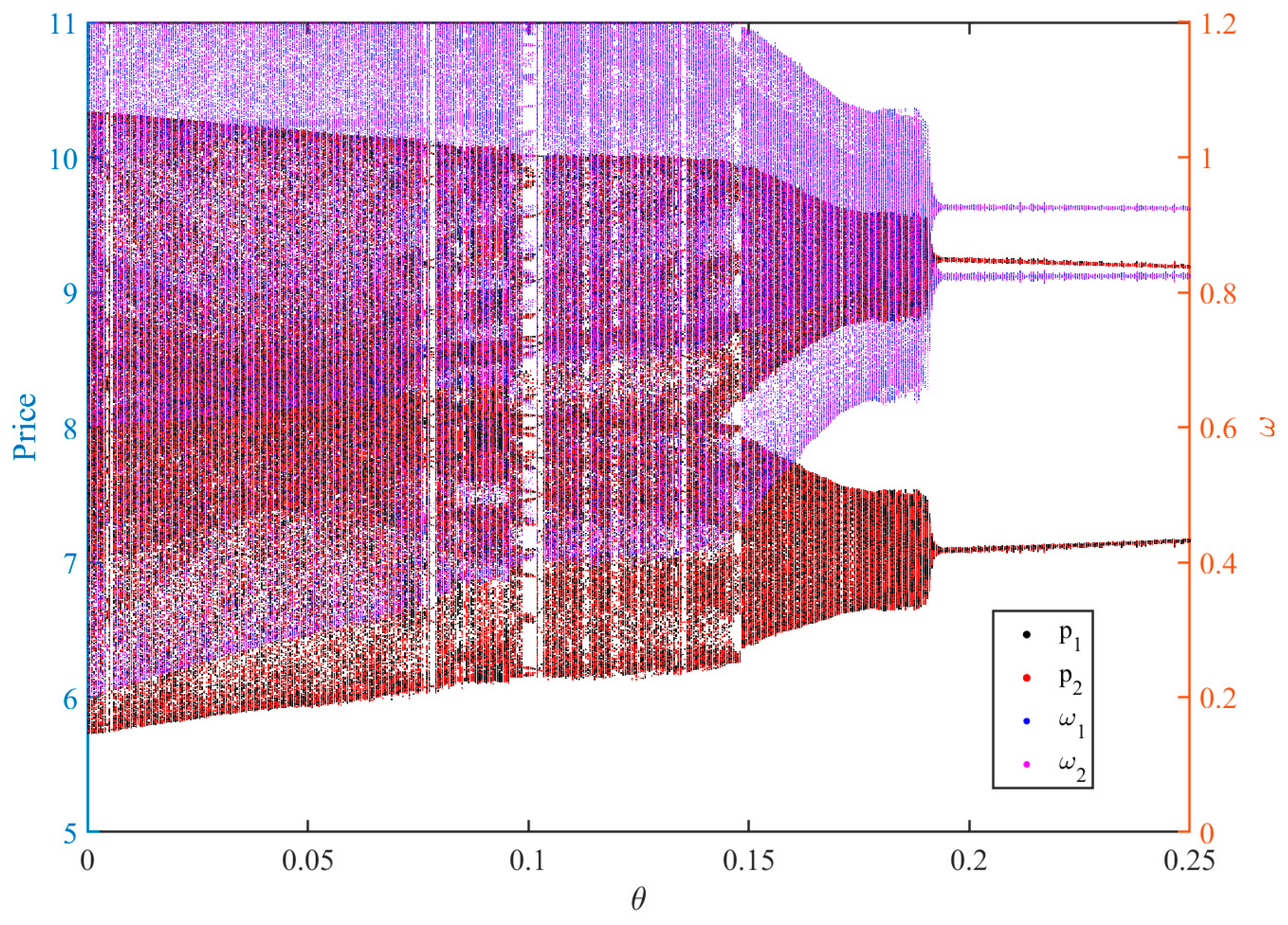
Figure 11 simultaneously depicts the chaotic control diagrams of the price variables
and the adjustment speed variables
with respect to the control strength
. When
is small, the left-hand side of the figure exhibits a highly dense and irregular cloud of points. Both the price and adjustment speed variables display evident non-periodic fluctuations, indicating that the system is in a typical chaotic state. At this stage, driven by profit incentives, sellers continuously increase their adjustment speeds, resulting in excessive jumps in price updates, and the market competition exhibits strong instability and unpredictability. As
gradually increases, the point cloud begins to contract and a clear layered structure emerges. The system undergoes an evolutionary path from high-period to low-period dynamics, suggesting that the control mechanism gradually weakens the original nonlinear amplification effect. With a further increase in
, both prices and adjustment speeds eventually converge to a single stable point, and the system restores local asymptotic stability.
Therefore, from the perspective of platform pricing-system design, platforms should treat “price-adjustment-speed control” as a core governance tool, rather than focusing solely on price levels themselves. Specifically, platforms can introduce an entropy-triggered adaptive regulation mechanism similar to that proposed in this paper at the algorithmic level. By continuously monitoring the temporal irregularity and unpredictability of pricing trajectories through entropy indicators, the platform can identify early signals of excessive market instability. Once the entropy level exceeds the platform’s tolerance threshold, the system can automatically impose damping on sellers’ adjustment speeds through algorithmic rules, thereby suppressing excessively aggressive pricing behavior and mitigating sharp short-term price fluctuations.
Such a mechanism represents a form of “soft regulation.” Rather than directly restricting sellers’ pricing freedom, it adaptively intervenes only when pricing dynamics become excessively irregular, allowing the market to retain a certain degree of flexibility while maintaining operation near the stable region. This result suggests that, in digital platform markets, regulating the dynamics and complexity of price adjustment may be more effective than directly constraining price levels themselves.
5.4. Robustness Checks
To examine whether the main findings depend on the baseline parameter configuration, this paper further conducts robustness checks by varying two key parameters: the substitution intensity and the platform commission rate . These two parameters are particularly important because determines the strength of market competition, while affects the distribution of transaction revenue between sellers and the platform.
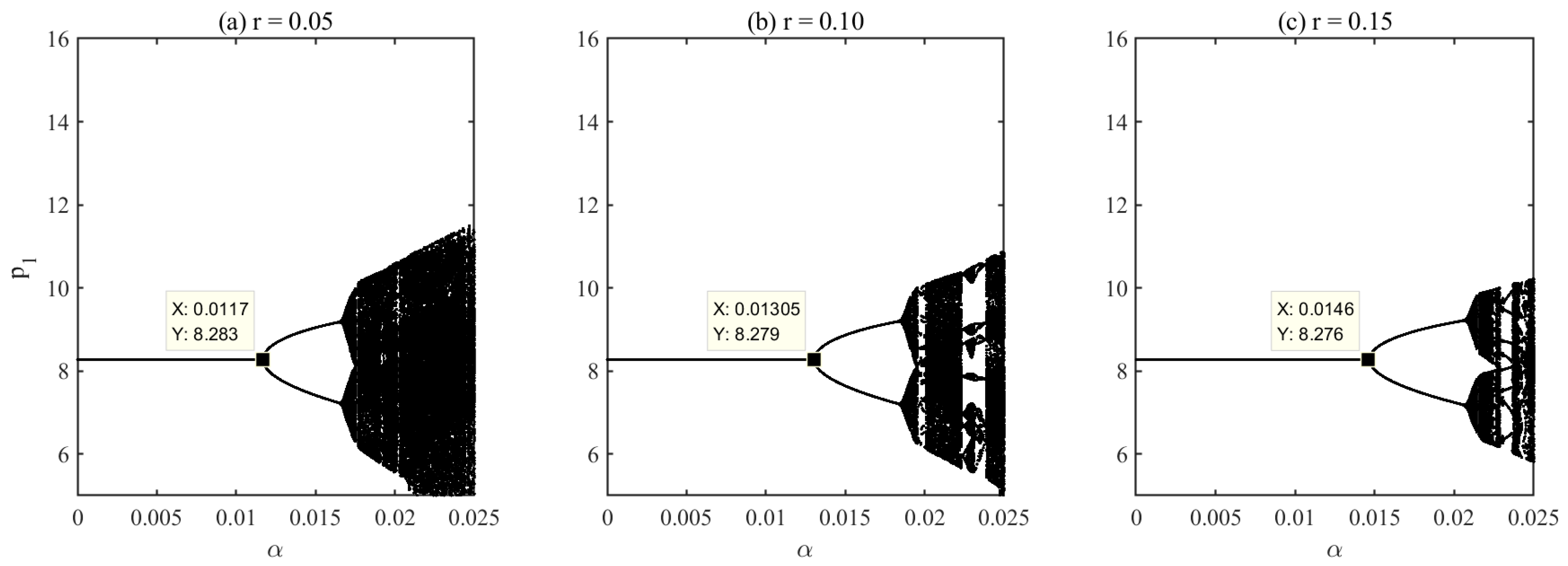
First, the substitution parameter is varied from the baseline value
to
and
.
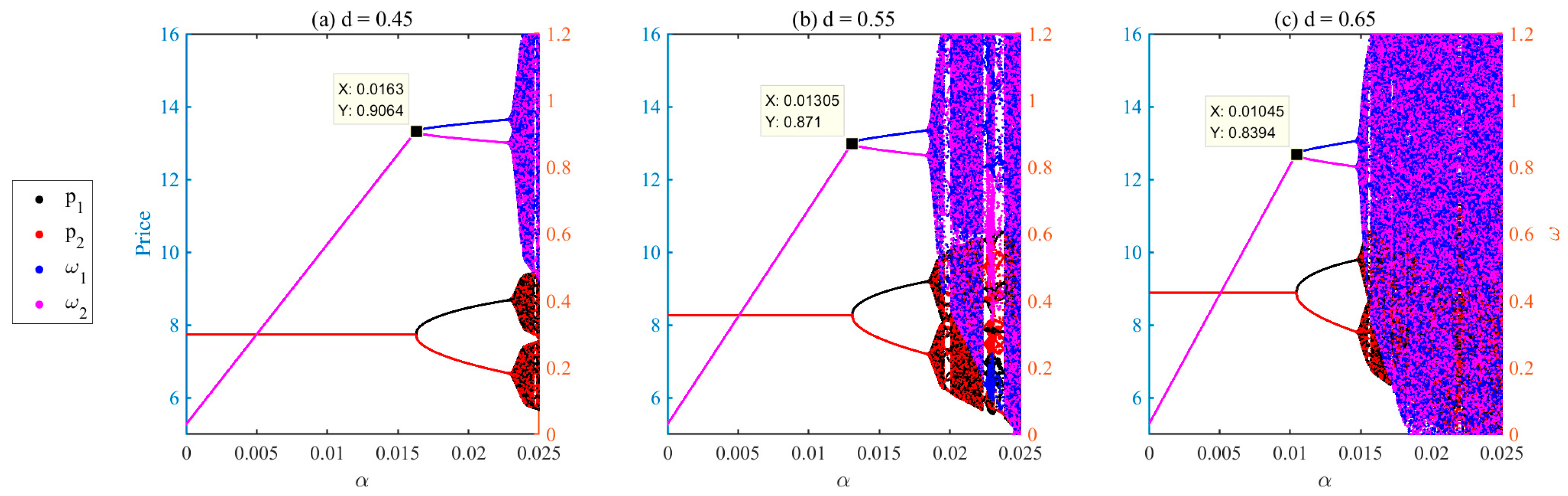
Figure 12 shows that increasing substitutability lowers the bifurcation threshold: instability emerges around
for
,
for
, and
for
. The qualitative dynamic mechanism remains unchanged. Higher substitutability strengthens competitive interaction, making the system more sensitive to profit-driven acceleration, whereas lower substitutability enlarges the stable region and delays bifurcations. Despite shifts in exact thresholds, the main conclusion holds: excessive endogenous adjustment speed amplifies price fluctuations and can destabilize the market.
Second, the platform commission rate is varied from the baseline value
to
and
.
Figure 13 presents the robustness results under these different rates. The results show that the commission rate shifts the precise bifurcation threshold, while the qualitative dynamic mechanism remains unchanged. Specifically, the bifurcation occurs at
when
, at
when
, and at
when
. Lower commission rates allow sellers to retain more revenue, strengthening profit-driven adjustment incentives and causing instability to emerge at lower pricing aggressiveness. In contrast, higher commission rates reduce effective incentives and delay the onset of instability. Despite changes in the exact bifurcation points, the main conclusions remain robust: endogenous adjustment speed continues to drive instability, and platform-imposed speed regulation effectively suppresses excessive fluctuations and restores system stability across different commission settings.
Although the precise bifurcation points vary with parameters, the main conclusions on endogenous acceleration, and market stability remain qualitatively robust.
6. Conclusions
This paper studies dynamic pricing in platform markets by developing a discrete-time model that integrates a Stackelberg game with bounded rational adjustment mechanisms. From a unified perspective of endogenous adjustment speed, platform regulation, and chaos control, we systematically examine the relationship between market stability and platform governance.
Our results show that adjustment speed is a key determinant of system stability. Even if the market starts in a stable region, profit-driven incentives can cause sellers to increase pricing aggressiveness. This may push the system beyond the stability threshold, resulting in periodic oscillations or chaotic dynamics and higher system complexity. This finding provides a behavioral explanation for the emergence of complex dynamics and extends the existing literature, which primarily attributes instability to exogenous parameter changes.
We further show that platform regulation can serve as an effective tool for restoring stability. By imposing an upper bound on adjustment speed, the platform can create a binding constraint near the steady state. This keeps the system within the stable region, reduces entropy, and limits dynamic uncertainty. However, regulation is not monotonically beneficial: moderate intervention helps balance stability and market responsiveness, whereas excessive regulation may dampen normal price adjustment mechanisms and reduce market efficiency.
In addition, our numerical analyses show that excessive pricing volatility can generate substantial welfare losses by reducing market predictability and increasing coordination difficulty among market participants. While the platform primarily determines its regulatory intensity based on profit considerations, social welfare additionally accounts for stability and volatility-related costs. This highlights the importance of designing regulatory mechanisms that balance market stability, pricing flexibility, and welfare objectives under dynamic conditions.
Building on these insights, we introduce an entropy-triggered adaptive feedback-control mechanism that stabilizes the system by monitoring the irregularity of pricing trajectories and activating damping only when excessive volatility is detected. This approach mitigates chaotic dynamics, preserves pricing flexibility, and reduces both entropy and market complexity. From a policy perspective, controlling the dynamics and complexity of price adjustments may be more effective for maintaining stable and efficient platform markets than imposing static price constraints.
From a policy and managerial perspective, the results suggest several implications for the governance of algorithmic pricing systems. First, platforms should not focus solely on static price levels, but also monitor the dynamics of price adjustment itself. Excessively aggressive adjustment speeds may amplify market instability and generate chaotic fluctuations, even when the underlying market environment remains unchanged. Second, rather than imposing rigid price controls, platforms may achieve better outcomes through adaptive regulation mechanisms that directly constrain excessive adjustment-speed acceleration while preserving normal market responsiveness. Third, entropy-based indicators can serve as early-warning signals of rising market complexity and instability, enabling platforms to implement intervention only when pricing dynamics become sufficiently irregular. Finally, because platform incentives may not fully internalize the welfare losses associated with excessive volatility and market instability, external regulatory oversight may still be necessary in highly algorithmic pricing environments.
The robustness analyses further demonstrate that these conclusions remain qualitatively consistent under alternative levels of product substitutability and platform commission rates, suggesting that the identified instability mechanism is not sensitive to a particular baseline parameter setting.
This study also has several limitations. First, the model focuses on a symmetric duopoly setting to preserve analytical tractability and to clearly characterize the interaction between endogenous adjustment speed, platform regulation, and system stability. In a multi-seller platform environment, the dimensionality of the dynamic system would increase substantially, and heterogeneous interactions among sellers may generate richer nonlinear dynamics, including asymmetric bifurcations, clustering behavior, and network spillover effects. Second, the current framework is primarily theoretical and simulation-based, without empirical calibration using real platform pricing data. In addition, although the model incorporates bounded rational adaptive pricing behavior, it does not explicitly consider forward-looking learning mechanisms or stochastic demand shocks. Future research may extend the framework by incorporating seller heterogeneity, learning dynamics, stochastic market environments, and empirical validation using real-world platform data to enhance external validity and practical applicability. In particular, a promising direction is to further investigate how different welfare structures, volatility externalities, and regulatory objectives influence the divergence between privately optimal and socially desirable platform governance policies in more complex market environments.