1. Introduction
Over the past few decades, machine learning has become a key driving force in both real-world applications and scientific research [
1,
2]. Meanwhile, the rapid growth of data-intensive and computation-heavy tasks has exposed the limitations of conventional von Neumann architectures. Owing to the physical separation of memory and processing units, such architectures suffer from inherent efficiency and scalability bottlenecks, thereby motivating the search for alternative computing paradigms [
3,
4]. Inspired by the mechanisms of brain-like information processing, neuromorphic computing [
5,
6] provides a new pathway toward efficient and parallel computation. As a physical device platform for such architectures, memristors [
7,
8] have become a major research focus because of their ability to emulate synaptic plasticity [
9,
10,
11]. To further overcome the performance bottlenecks of classical devices and exploit the advantages of quantum computing [
12], quantum memristors have drawn attention and been theoretically and experimentally explored in superconducting circuits [
13], trapped ions [
14], and photonic systems [
15], among other physical platforms. Among these, PQM have shown particularly prominent performance. They have not only been experimentally demonstrated [
16,
17], but have also been further applied to the construction of quantum reservoir computing systems [
18] for executing specific neuromorphic computing tasks, exhibiting significant development potential and broad application prospects.
Compared with other platforms, photonic quantum systems possess the inherent advantage of extremely weak interaction between photons and the environment [
19,
20]. However, their practical physical implementation is still constrained by hardware noise, such as coupling defects, measurement errors, and predominantly photon losses [
21]. Among these, photon loss, as the most common dissipation mechanism, can alter the history-dependent input–output relations of PQMs, degrading their signature pinched hysteresis loops and non-Markovian memory properties. Since device-level degradation directly affects the computational performance of the entire information-processing system, systematically investigating the dynamics of PQMs under incoherent evolution is of great importance for evaluating their practical application potential.
To address the above issues, this work investigates the effects of photon loss and phase fluctuations on PQM dynamics by employing the noisy gates approach, which integrates dissipative effects directly into the device evolution. At the device level, a single PQM is studied to characterize its history-dependent dynamics under these imperfections. Specifically, the analysis focuses on the deformations in the characteristic pinched hysteresis loops induced by different photon loss probabilities and phase noise levels, and further examines how these noise-induced effects evolve with the integration time. At the system level, a PQM network composed of two independent PQMs is constructed and employed in the NARMA2 time-series prediction task to evaluate the impact of photon loss on the network’s information-processing capability. Under noiseless conditions, the network achieves a normalized mean square error (NMSE) of 0.0448, whereas under photon loss conditions with , and 0.5, the NMSE increases to 0.1552, 0.2567, and 0.3056, respectively. Moreover, at a high photon loss probability of 0.5, we further examine the effect of increasing the integration time on the prediction performance. These results indicate that photon loss not only perturbs the non-Markovian dynamical behavior of individual devices, but also further weakens the representation and processing capability of the network, ultimately leading to degraded task performance. This work provides a theoretical basis for understanding and optimizing loss-tolerant PQM architectures in noisy environments.
2. Results
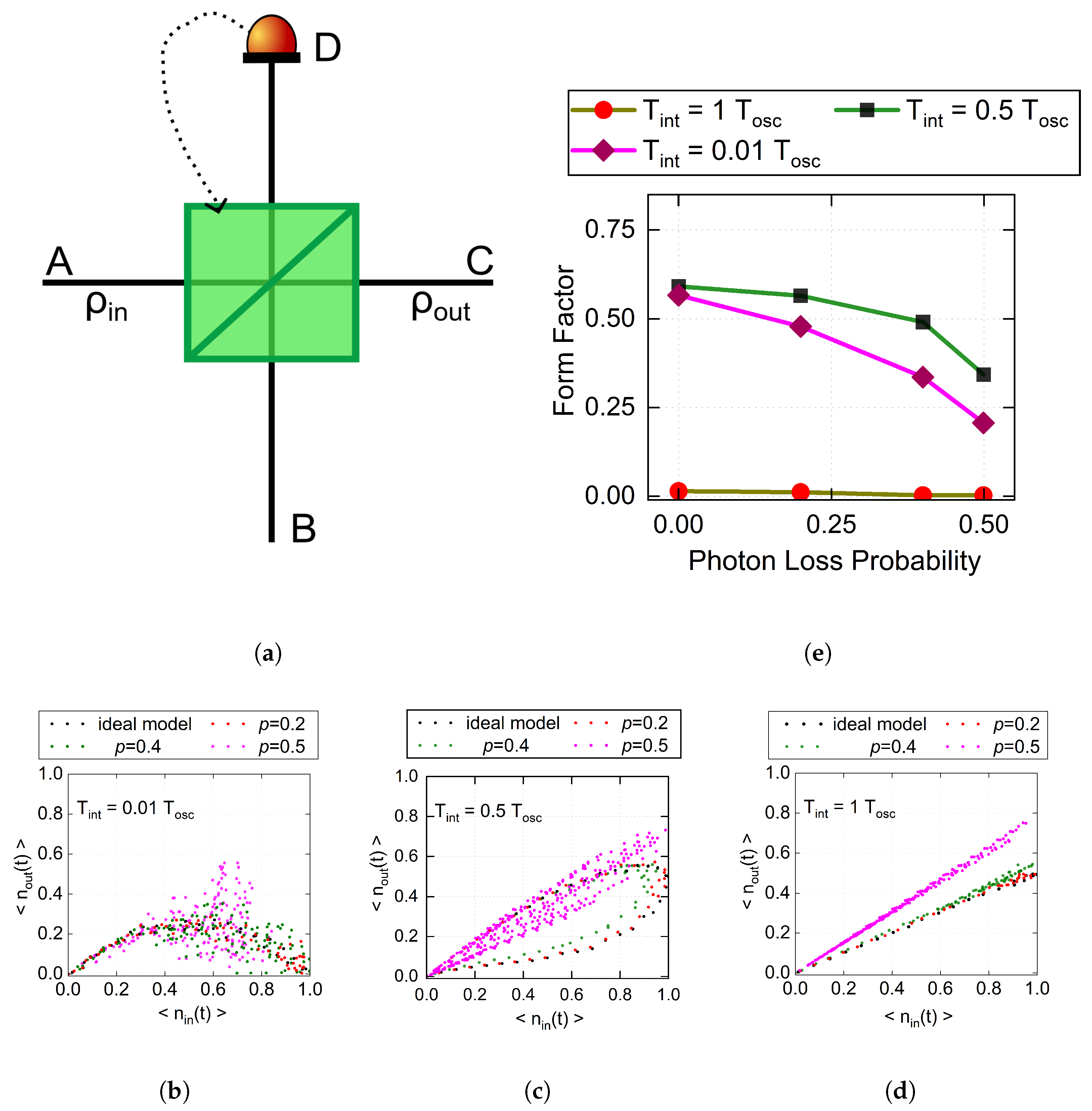
A PQM is a quantum system with memory whose response depends on its evolution history while preserving quantum coherence. In this work, the PQM is realized using tunable beam splitters, as shown in
Figure 1a. A single-photon state is injected into input port A, while the device reflectivity
is dynamically updated according to the measurement outcome at feedback port D. Let
,
, and
denote the mean photon numbers at input port A, output port C, and feedback port D, respectively. The input–output relationship of the device is given by
The mean photon number at the feedback port is given by
The dynamic update rule for the device reflectivity is given by
where
denotes the integration time, which determines the memory extent of the device. Since
depends on the past input within the integration window, the current response is history-dependent, giving rise to memristive behavior.
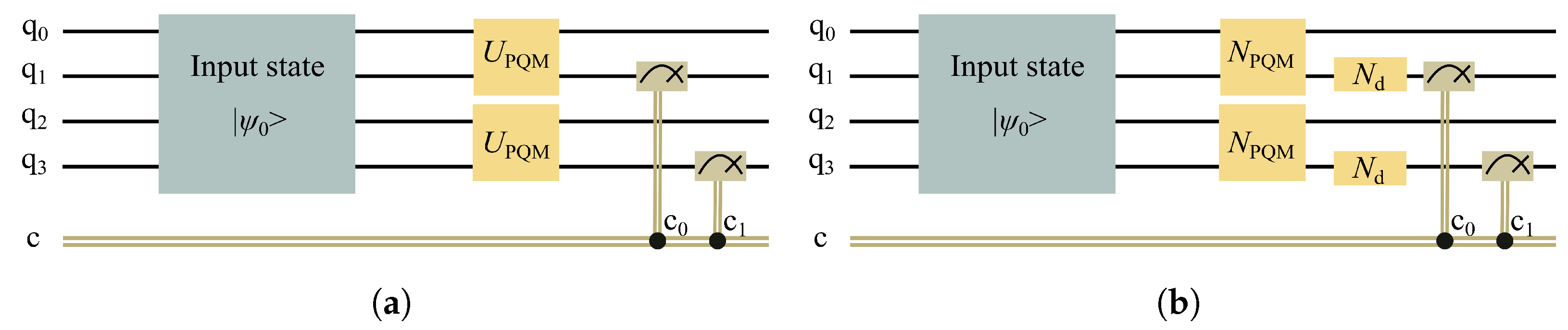
For numerical simulations, we implement the PQM circuit model on the Qiskit platform under noiseless conditions, as illustrated in
Figure 2a. In this ideal model, noise effects are neglected. As a result, the PQM can be regarded as a closed quantum system whose evolution is fully described by a unitary gate. Therefore, for an input state
, the output state is given by
where
denotes the evolution gate of the PQM.
To characterize the memristive behavior of the PQM, we apply a time dependent input state and study the corresponding system response for different integration times
. The input state is defined as
where
denotes the oscillation period of the input signal, and its accessible range is constrained by the actual response rate of the device.
and
denote the vacuum and single-photon Fock states in port
, respectively. The device dynamics are mainly determined by the ratio
[
17]. Therefore, different
values are chosen to probe the response of the PQM under different memory conditions, as illustrated in
Figure 1. These curves show that the system output depends not only on the instantaneous input but also on its history, which is the hallmark of memristive behavior. Specifically, when
, the response curve is linear, indicating a weaker memory effect, whereas for
and
, the response becomes nonlinear, corresponding to stronger memory effects.
However, in realistic open quantum systems [
22], quantum information processing is inevitably subject to various sources of noise. For photonic platforms, the relevant noise mainly arises from two aspects: first, photon loss caused by absorption or scattering during photon transmission and coupling in optical networks; second, imperfect detection efficiency inherent to single-photon detectors. Collectively, these effects deteriorate the performance of the quantum system.
To describe realistic quantum devices more faithfully, we adopt existing quantum noise modeling methods and map dissipative effects onto quantum noise channels in the evolution process [
23]. Actual hardware implementations will encounter additional non-idealities that may introduce discrepancies from our simulated results. For instance, imperfect photon indistinguishability and multi-photon emission from practical single-photon sources can degrade quantum interference visibility. Additionally, unmodeled hardware noise, such as detector dark counts, can inject false-positive signals into the feedback loop, while thermal crosstalk and phase fluctuations in integrated interferometers can cause deviations from the targeted unitary operations. In our analysis, additional hardware imperfections, such as detector dark counts and timing jitter, are considered negligible. State-of-the-art single-photon sources can achieve brightness levels in the megacounts per second (Mcps) regime [
24], whereas the dark-count rate of a typical superconducting nanowire single-photon detector is about 100 cps. Therefore, the contribution of dark counts is negligible. On the other hand, to accumulate efficient photon counts, the required integration time is on the order of milliseconds. Since the timing jitter is only about 50 ps, which is many orders of magnitude smaller than this integration timescale, its effect can also be neglected. Among these imperfections, in this work we focus on two representative factors, photon loss and phase fluctuations, and investigate their impacts on the PQM dynamics.
We first focus on photon loss. The gate matrices used to describe photon loss in this work are constructed following Ref. [
21]. Specifically, the lossy evolution in the PQM and the detection process are described by
and
, respectively.
where
controls the splitting ratio of the tunable beam splitter. The parameter
(
) is related to the corresponding photon loss probability
through
. Specifically,
denotes the photon loss probability during the PQM evolution, whereas
denotes the photon loss probability in the detection stage. In addition, W denotes the Wiener process, and averaging over W yields
. Similarly, by averaging on the processes
,
,
, and
, one obtains
, with
.
In numerical simulations we introduce a unified photon loss probability by setting . This simplification allows us to systematically examine the impact of photon loss on the system dynamics and task performance. In practical implementations, however, the loss probability at different stages can be calibrated independently according to the actual device loss and detector efficiency.
To assess how photon loss in realistic devices modifies the memristive properties exhibited by the PQM under noiseless conditions, we next construct a noisy PQM circuit model by employing the noisy-gates approach, which integrates dissipative effects directly into the device evolution. Specifically, the original PQM circuit architecture is retained, while each unitary gate is replaced by its corresponding noisy gate, as shown in
Figure 2b. In this way, photon loss and detection imperfections are incorporated into the circuit evolution in a consistent manner. Based on this noisy model, we perform noisy-circuit simulations on the Qiskit platform to investigate how photon loss affects the dynamical behavior of an individual PQM. The detailed simulation procedure is summarized in Algorithm 1. Briefly, for each sampled noise instance, the noiseless PQM circuit is mapped to a corresponding noisy circuit by replacing each gate
with its corresponding noisy gate
. The resulting noisy circuit produces an output state
, from which the density matrix is constructed as
. The final density matrix is then obtained by averaging over all sampled noise instances.
To investigate how photon loss affects the dynamical behavior of an individual PQM, we perform comparisons at a fixed integration time
, with the photon loss probability set to
,
, and
. In the simulations, the case
is implemented as
to remain within the applicability range of the present model. It should be noted that, following the formulation in Ref. [
21], the current model is restricted to the regime
. Accordingly, regimes with excessively strong photon loss are beyond the scope of the present study.
| Algorithm 1 Noisy-PQM Circuit Simulation. |
| Require: Initial state , a noiseless circuit composed by gates and number of samples |
| Ensure: Final density matrix |
| 1: for to do |
| 2: map a noisy circuit |
| 3: apply the noisy gates |
| 4: compute |
| 5: end for |
| 6: |
As shown in
Figure 1b,c for a fixed integration time, the area enclosed by the pinched hysteresis loop is used as an indicator of the memristive response, since it is closely related to the memory effect [
25]. As the photon loss probability increases, the enclosed loop area gradually decreases, indicating a progressive weakening of the nonlinear response of the PQM.
To further characterize this evolution and evaluate the potential memory content of the hysteresis loops, we employ the form factor [
26]:
where
A and
P denote the enclosed area and the perimeter of the hysteresis loop, respectively. Based on the hysteresis loops shown in
Figure 1,
Figure 1e summarizes the evolution of the form factor under different integration times and photon loss probabilities. As the photon loss probability increases, the form factor decreases monotonically, indicating a gradual reduction in the potential memory content of the hysteresis loops. This trend is particularly pronounced at shorter integration times. In particular, the form factor drops from 0.5912 to 0.3435 for
, and from 0.5666 to 0.2071 for
. These results indicate that photon loss significantly modifies the dynamical response of the PQM, with non-Markovian memory effects being more strongly suppressed at shorter integration times.
In addition to photon loss, we also consider the effect of phase fluctuations on the device dynamics. In the PQM considered here, the reflectivity
R is explicitly determined by the phase
in a way that
[
17]. Therefore, phase fluctuations introduced during the PQM evolution can modify reflectivity, the input–output relation, and the final output probability distribution. Here we focus on such phase fluctuations during the PQM evolution.
Following the phase-noise modeling adopted in previous work [
27], we describe the phase fluctuations by Gaussian noise. By combining Equation (
1) with the phase-dependent reflectivity relation
, the input–output relation in the presence of phase fluctuations can be expressed as
In this model the instantaneous value of
is given by a particular phase fluctuation
. Next we assume that the distribution of phase fluctuations reads:
where
is the width of the Gaussian distribution. To investigate the effect of phase fluctuations on the dynamics of a single PQM device, we employ a sampling-based noisy-evolution approach, as summarized in Algorithm 2. In each realization, a phase fluctuation
is sampled and incorporated into the PQM evolution gate
, yielding the output state
. The corresponding density matrix is then constructed as
. By averaging over
realizations, we obtain the final output density matrix
.
| Algorithm 2 Single-PQM Simulation Under Phase fluctuations. |
| Require: Initial state , PQM evolution gate , number of samples |
| Ensure: Finally output density matrix |
| 1: for to do |
| 2: sample a phase fluctuation from the Gaussian distribution |
| 3: compute |
| 4: compute |
| 5: end for |
| 6: |
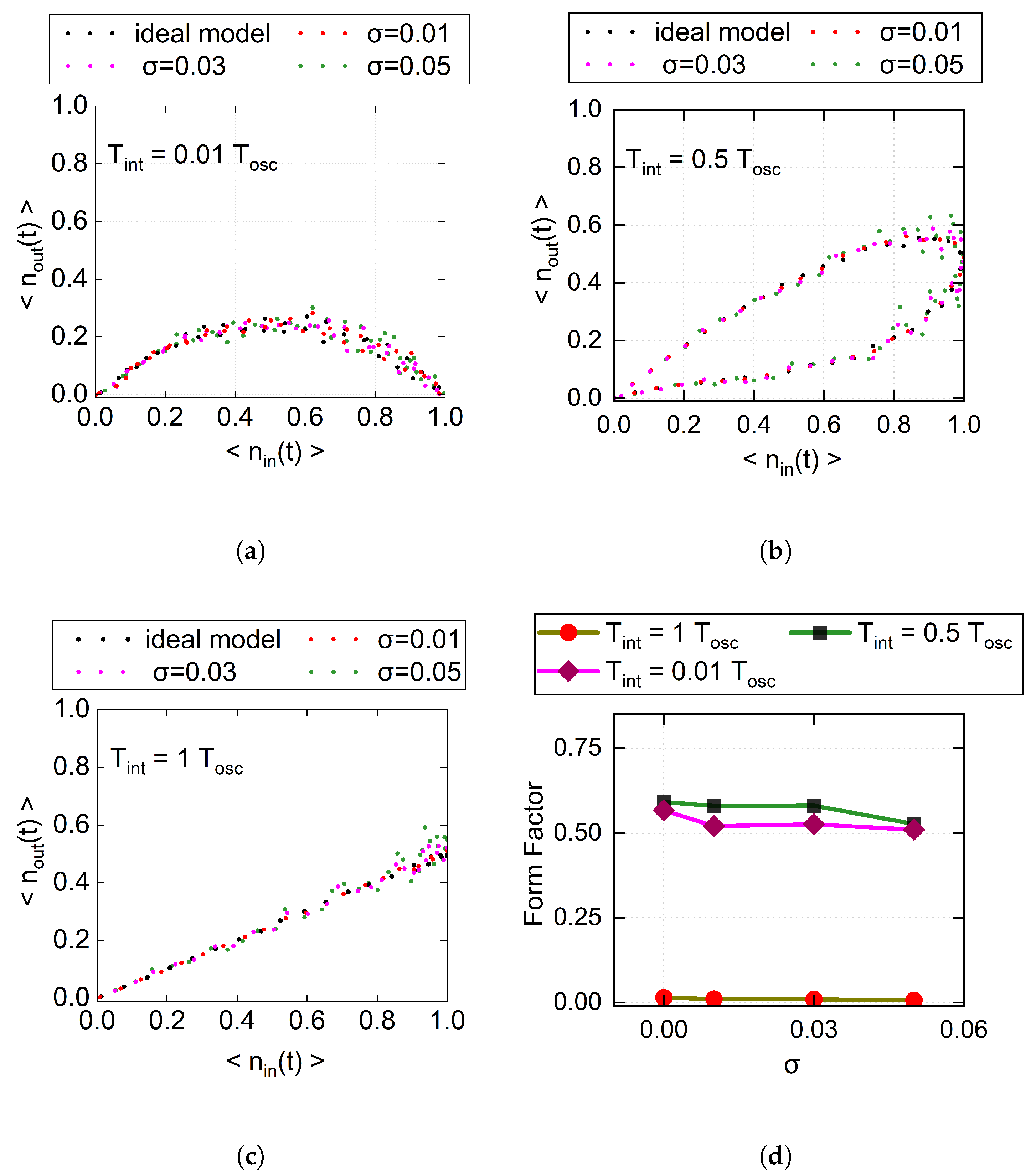
To investigate the effect of phase fluctuations on the device dynamics, we consider several representative values of the phase-noise standard deviation in the simulations, namely
0.01, 0.03, and 0.05 [
28].
Figure 3 shows the hysteresis loops under different integration times and phase noise levels. As
increases, the loop shape changes only slightly, indicating that the device dynamics remain relatively robust against phase fluctuations within the considered noise range. To quantify this behavior, we further analyze the form factor defined in Equation (
6), as summarized in
Figure 3d. For all integration times considered, the form factor exhibits only a weak dependence on
. In particular, for
, the form factor shows only a slight decrease, from about 0.5912 to 0.5068, as
increases from 0 to 0.05. Similarly, for
, it decreases from about 0.5666 to 0.5097. By contrast, for
, the form factor remains close to zero throughout the entire range of
. These results indicate that phase fluctuations only mildly modify the dynamical response of the PQM and lead to a limited reduction in the potential memory content of the hysteresis loops.
NARMA2 task. Based on the previous analysis of a single PQM under photon loss and phase perturbation conditions, we find that photon loss has a more pronounced impact on the device dynamics. To further investigate the impact of device-level degradation on system-level information-processing performance, we construct a network composed of two PQMs. Previous work has shown that even small PQM networks can achieve strong performance on time-series prediction tasks [
17]. We therefore use the NARMA2 task [
29], a standard benchmark for nonlinear time-series prediction, to evaluate the effect of photon loss on the nonlinear processing capability of the PQM network. In our framework, the PQM network is designed to provide the nonlinearity and memory required for temporal information processing, while the linear readout layer is introduced only as a minimal post-processing module to map the quantum features to the target output. This design allows us to separate the role of quantum dynamical processing from that of final output mapping more clearly. Therefore, the predictive capability in the NARMA2 task mainly reflects the information-processing capacity of the PQM network, while the classical readout primarily serves as an output-mapping layer. The NARMA2 task considered here,
depends on the current input
, the current output
, and the previous output
, and is given by
where
is a random input uniformly distributed over the interval
.
To enable the quantum system to perform this task, an effective classical-to-quantum data encoding mechanism is required. In this work, amplitude encoding is adopted to encode the classical information
. As shown in the schematic of a single PQM in
Figure 1a, port
serves as the input port. Accordingly, in the two-PQM network considered here, the classical input
is encoded into a two-qubit separable state, and the two qubits are then injected into input ports
and
of the two PQMs, respectively:
After the encoded information is fed into the quantum memristor network, quantum state tomography is performed at the output end, and the diagonal elements of the density matrix are extracted as the feature vector. The final prediction task is completed through a linear readout layer. In the linear readout layer, let there exist a weight matrix
for mapping the feature vector to the target output. The objective of the training process is to determine the optimal
by minimizing the error between the output vector and the true target vector. In this work, this procedure is implemented using linear regression. Specifically, the characteristic vectors obtained by inputting each training sample
at each time step are assembled into a response matrix
X, while the corresponding target outputs are arranged into a target matrix
. Then, the weight matrix
can be expressed as
The model performance is evaluated using NMSE [
30] as the primary metric, which is defined as
where
denotes the true output value of the
i-th sample in the test set, and
denotes the corresponding predicted value. This metric effectively characterizes the accuracy and robustness of the PQM model in the NARMA2 time-series prediction task and thus provides a quantitative benchmark for system optimization.
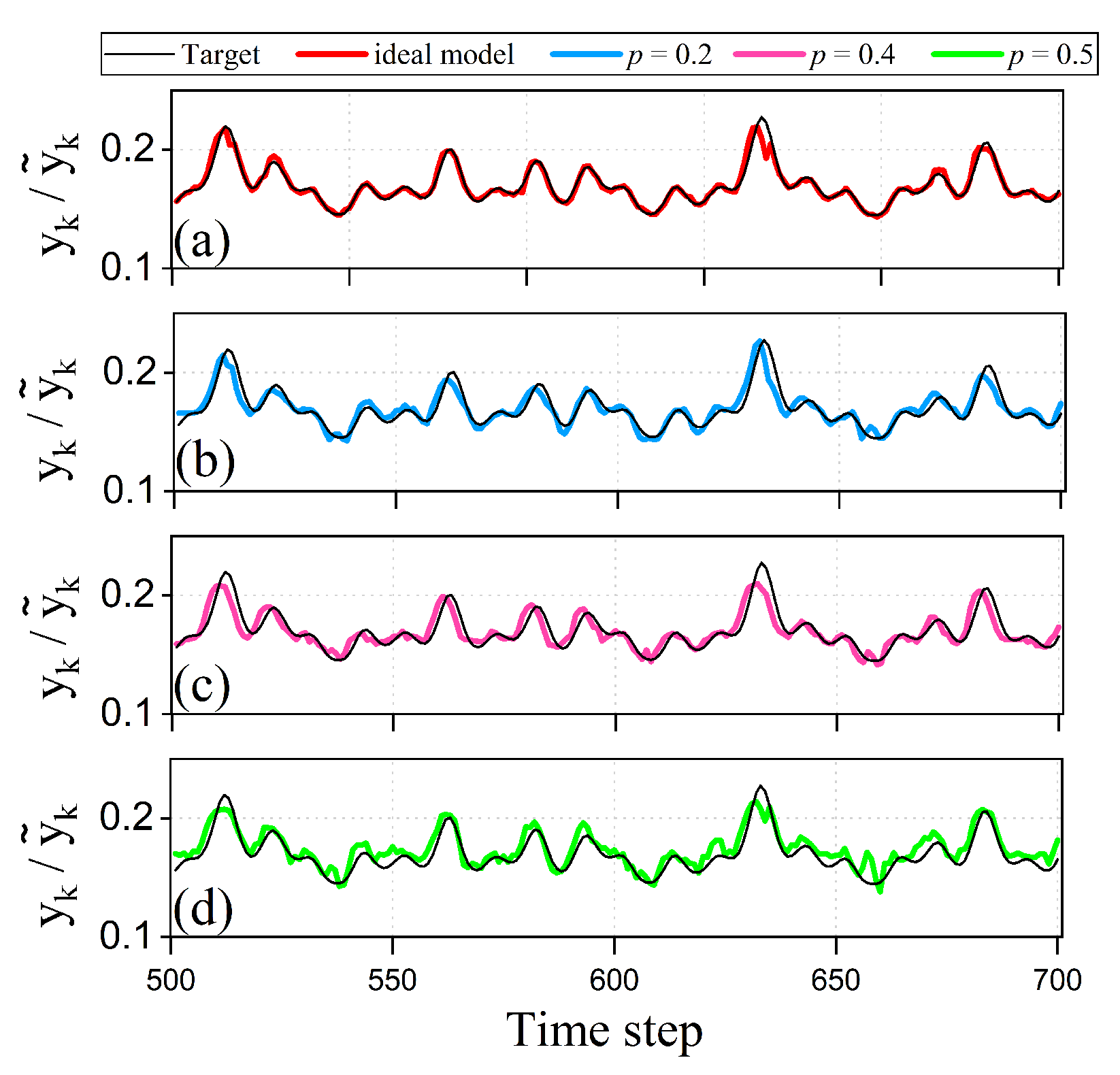
Figure 4 presents the prediction results of the PQM network on the NARMA2 task under both noiseless and photon loss conditions. The results show that the system performance is highly sensitive to photon loss, with a clear discrepancy between the prediction performance under noiseless and photon loss conditions. Under noiseless conditions, the PQM network can effectively preserve the nonlinear dynamic response and memory characteristics of the device, thereby exhibiting strong representational capability for the input samples, with an NMSE as low as 0.0448. In contrast, when photon loss is introduced, the prediction performance of the system deteriorates significantly. When the photon loss probability
p is set to 0.2, 0.4, and 0.5, the NMSE increases to 0.1552, 0.2567, and 0.3056, respectively. The results show that higher photon loss probabilities lead to large prediction errors, indicating that photon loss weakens the network’s ability to represent and process input information and thereby reduces its task execution accuracy. Combined with the previous analysis of the single-device dynamics, these findings indicate that photon loss not only impairs the dynamical response of individual PQMs but also weakens the representational capacity at the network level, ultimately reducing task execution accuracy.
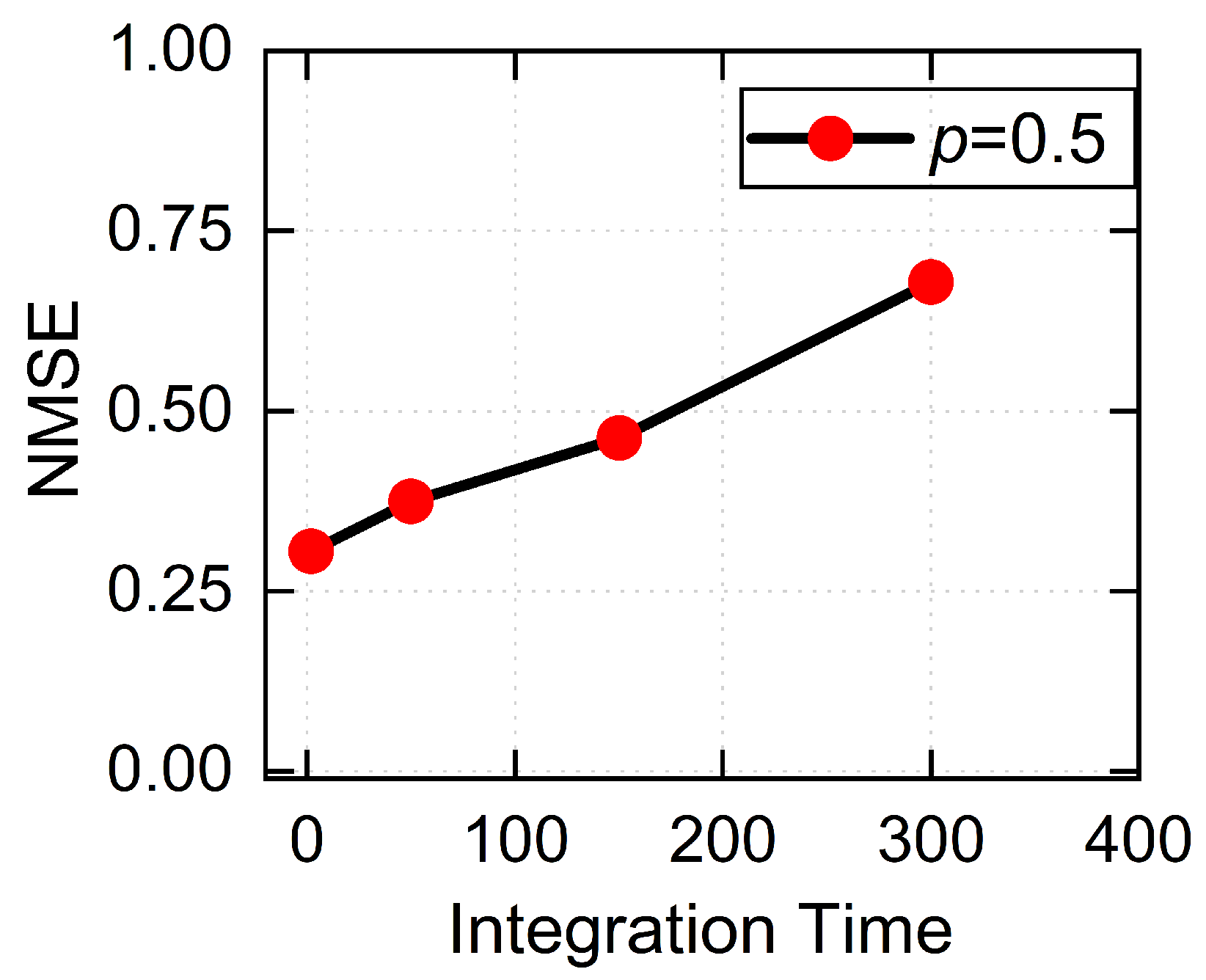
To further investigate the effect of integration time on task performance under strong photon loss, we examine the NARMA2 prediction error at a high photon loss probability,
, for different integration times. In the NARMA2 task,
is chosen relative to the temporal scale of the input signal sequence. As shown in
Figure 5, the NMSE shows an increasing trend as the integration time increases. Specifically, the NMSE rises from 0.3056 at
to 0.6792 at
. Since the NARMA2 task is commonly used to evaluate the nonlinear processing capability of a system, this result indicates that increasing the integration time under strong photon loss weakens the nonlinear processing capability of the PQM network and consequently degrades prediction performance.