Economic Entropy and the Cobb-Douglas Function: A Scientometric Analysis

 ,
,  , and
, and
Abstract
1. Introduction
2. Materials and Methods
3. Scienciometric Analysis
3.1. General Information
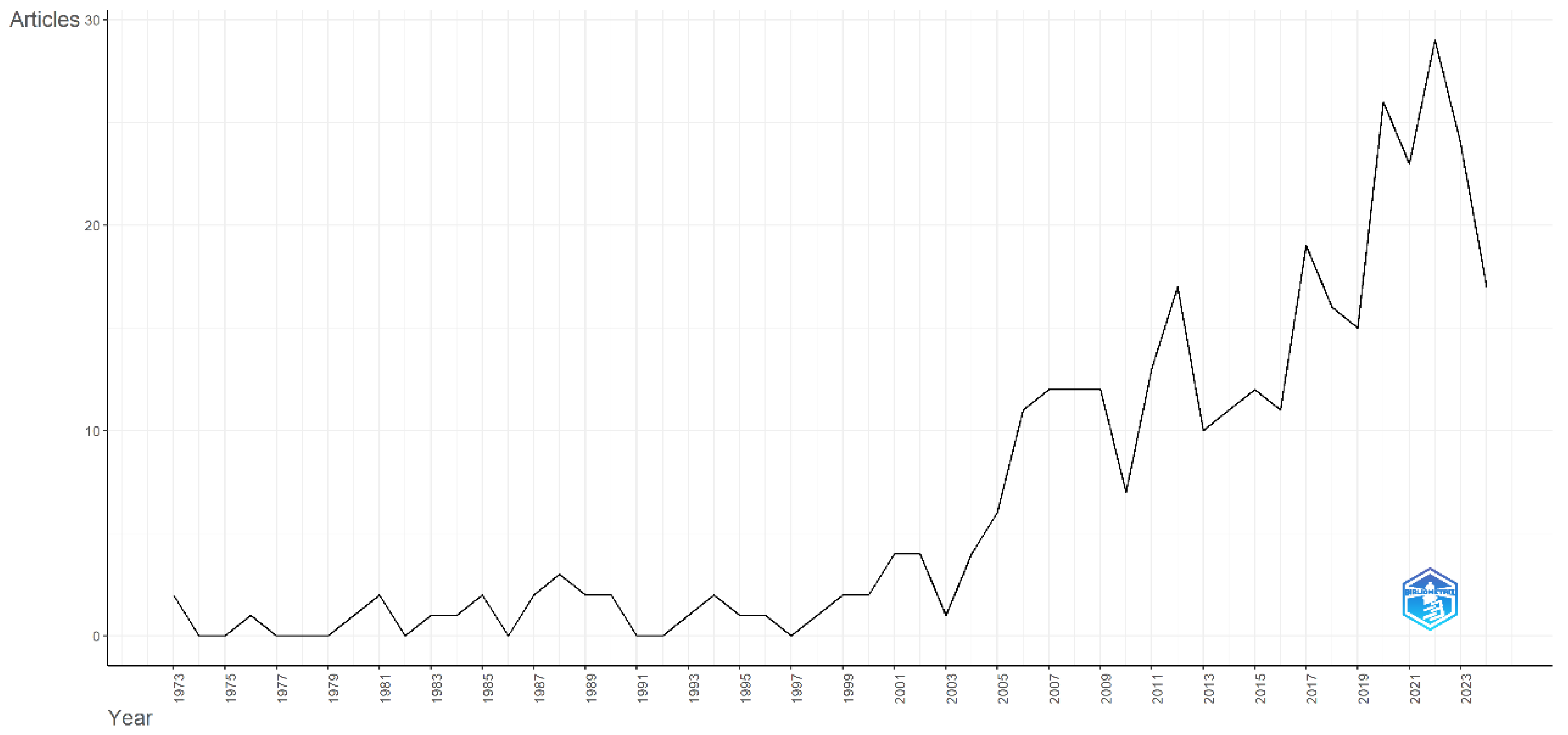
3.1.1. Annual Scientific Publication
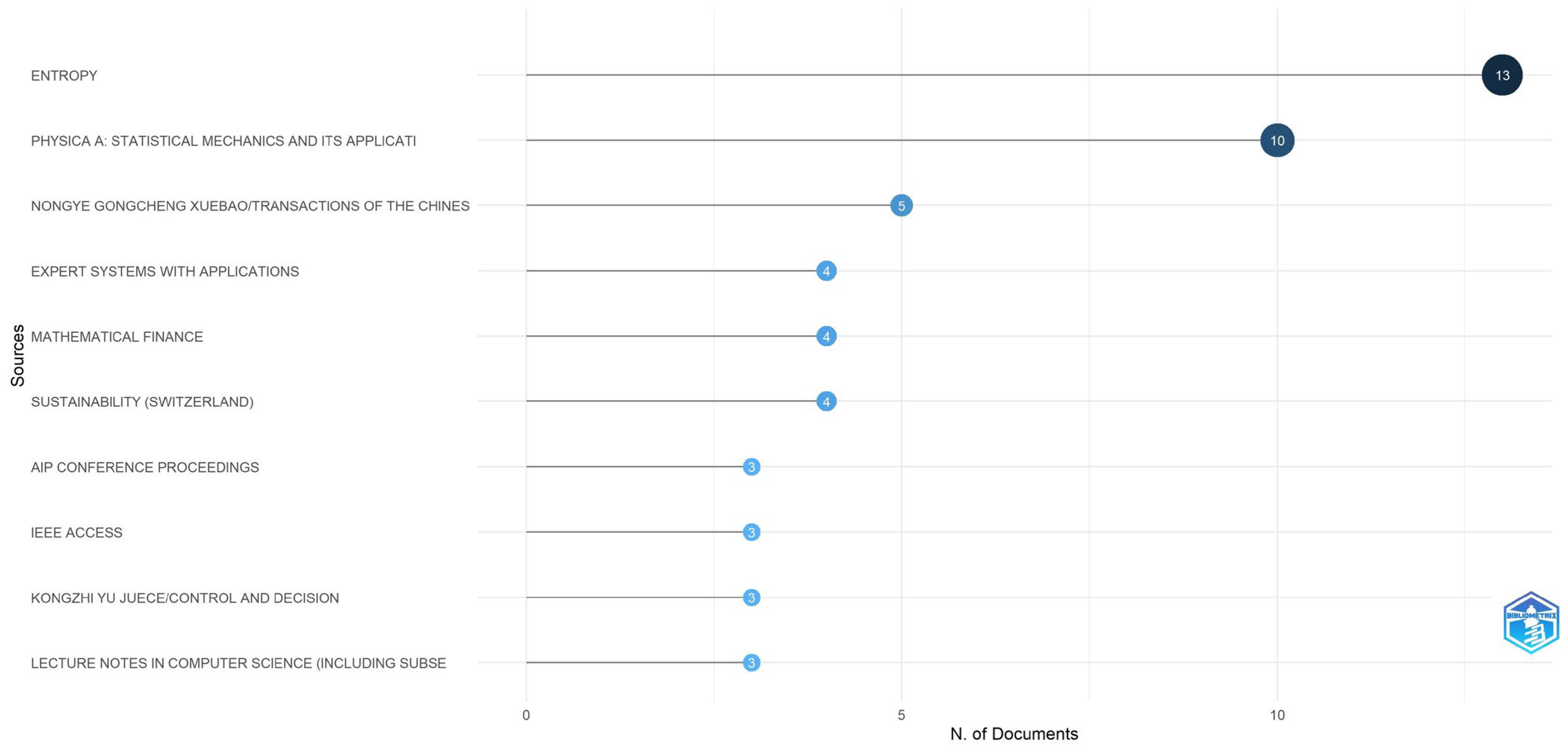
3.1.2. Most Relevant Journals
3.1.3. Most Cited Sources
3.2. Core Authors
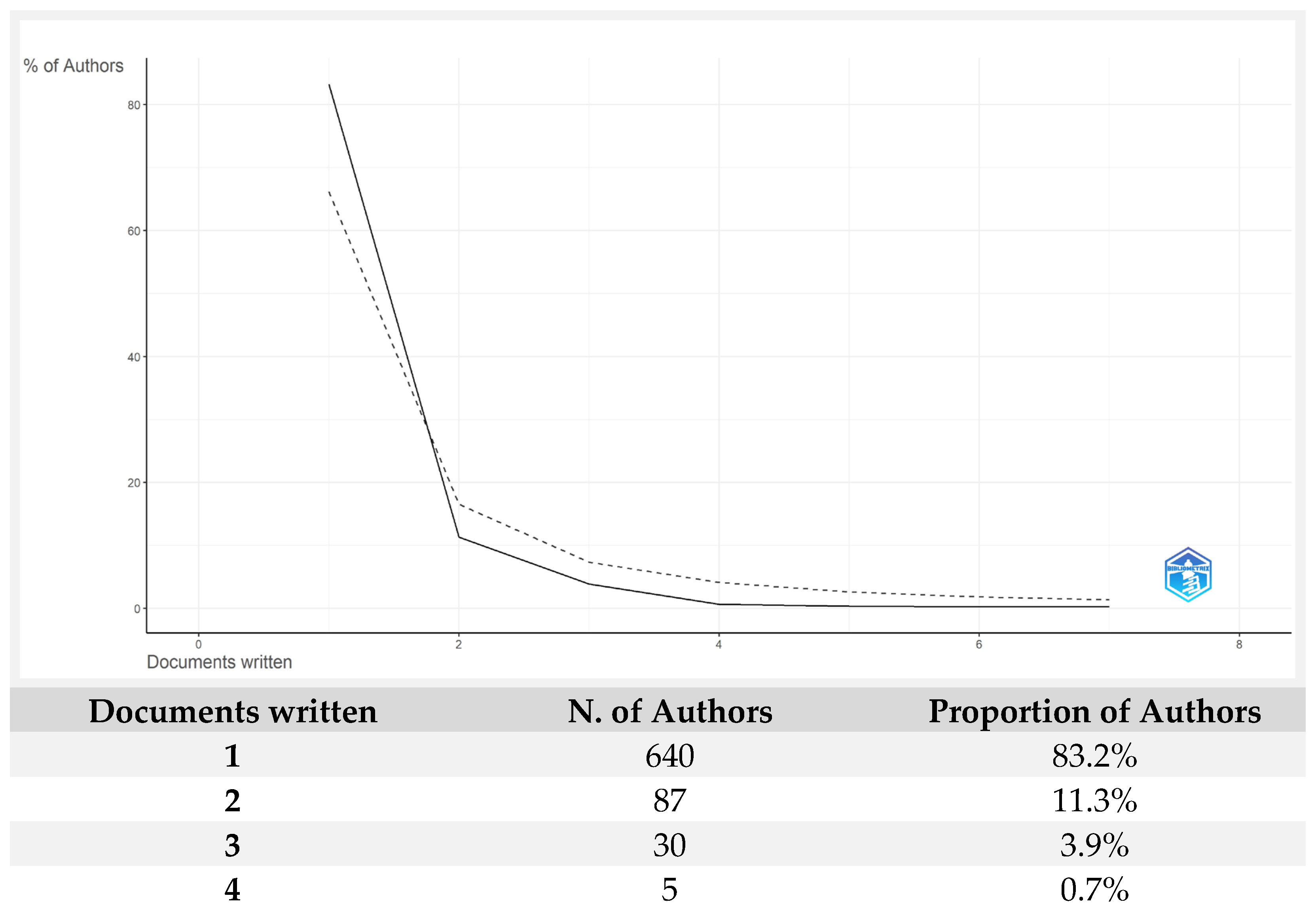
3.2.1. Authors’ Productivity
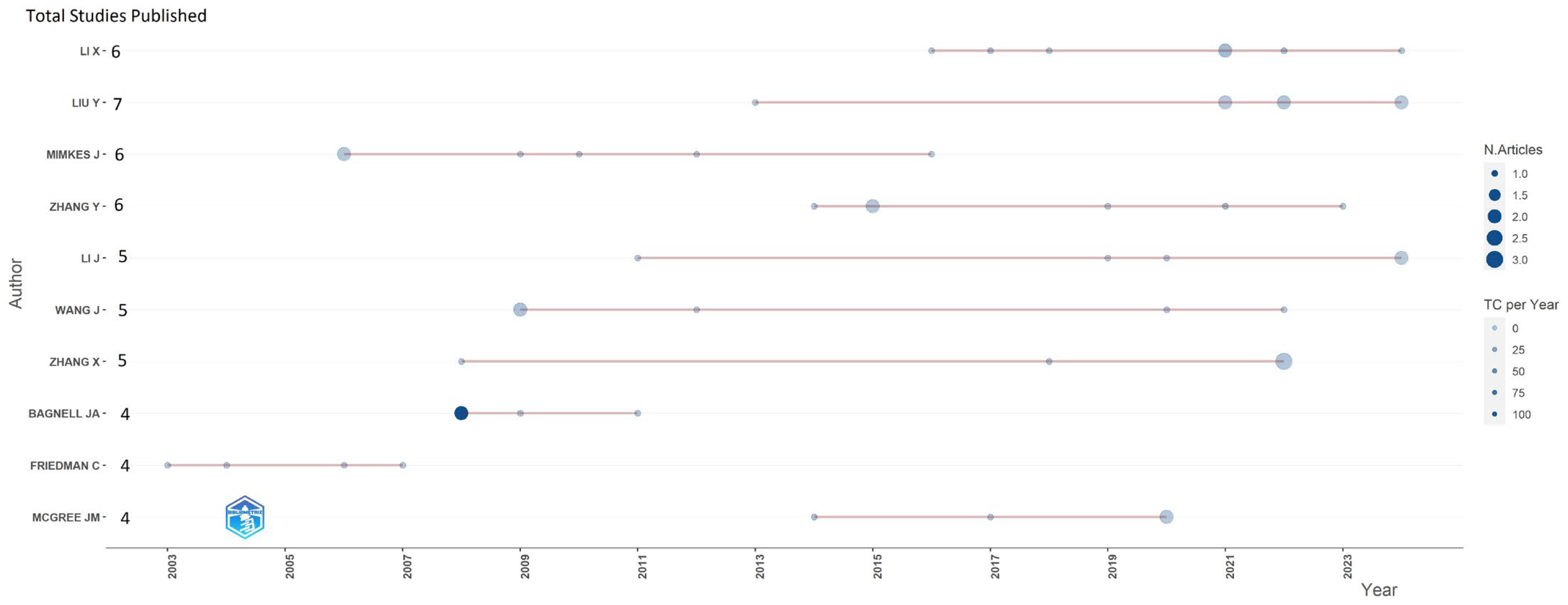
3.2.2. Authors’ Productivity over Time and Most Relevant Authors and Authors’ Impact
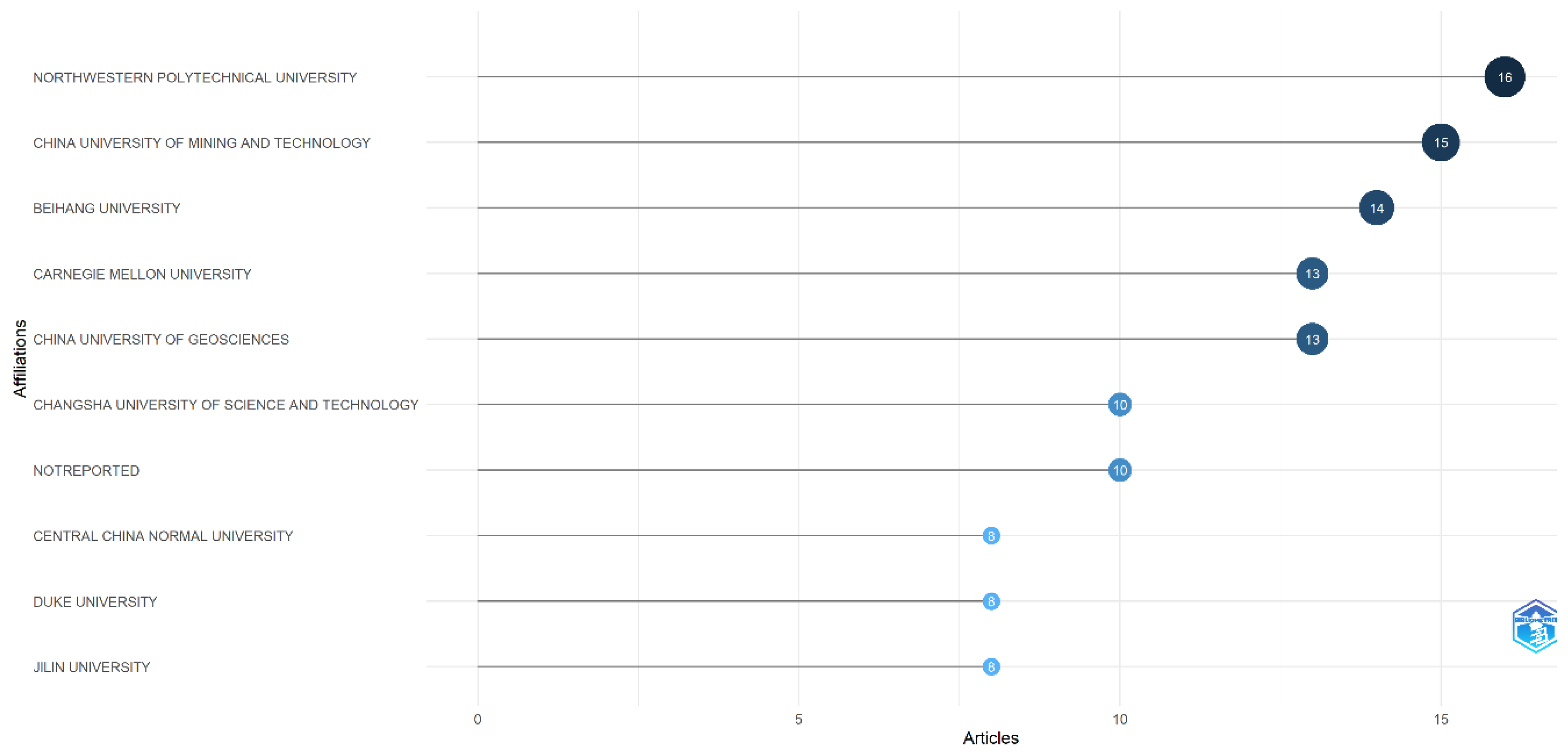
3.2.3. Most Relevant Author’s Affiliation
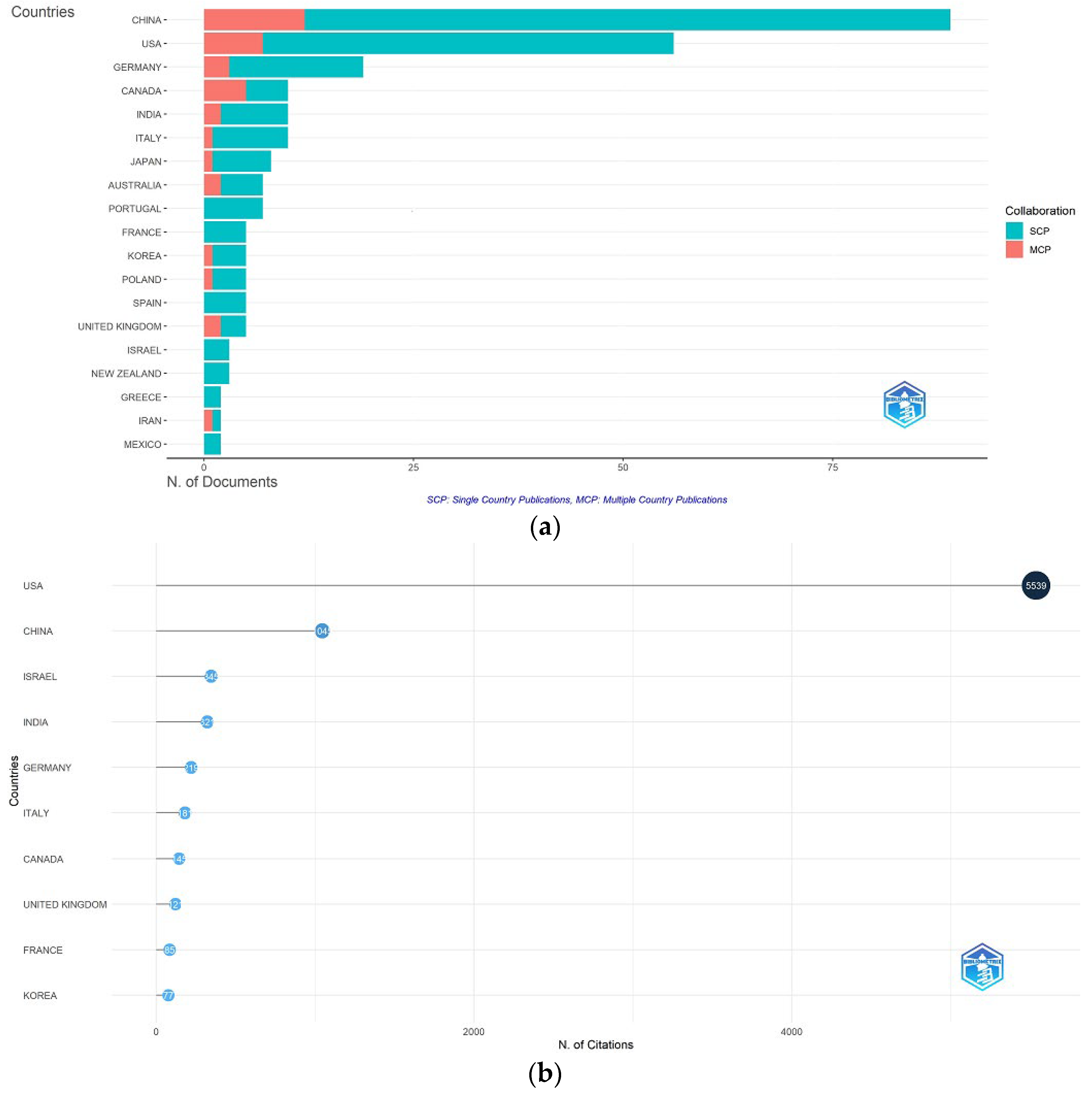
3.2.4. Author’s Country Analysis
3.3. Core Studies
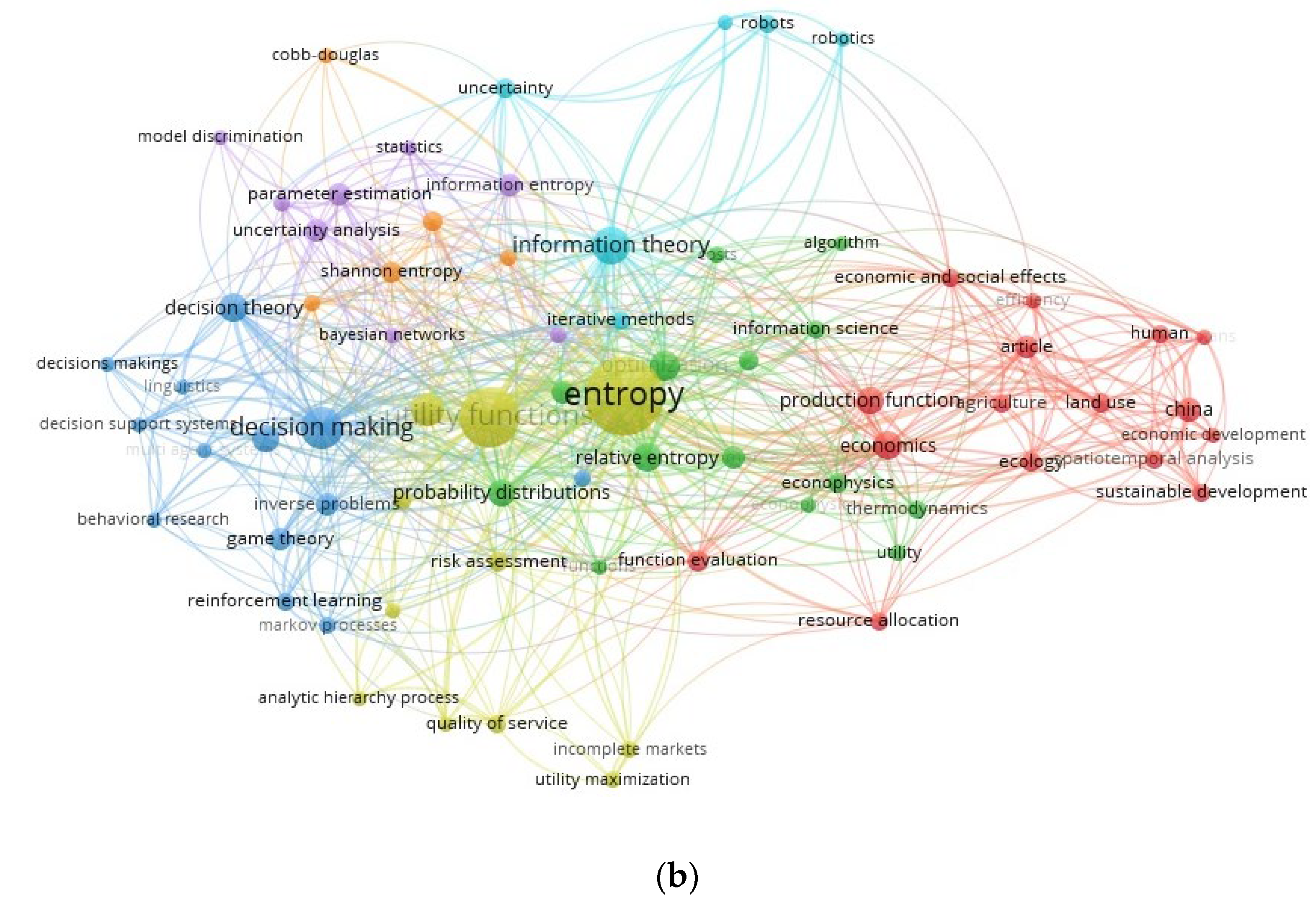
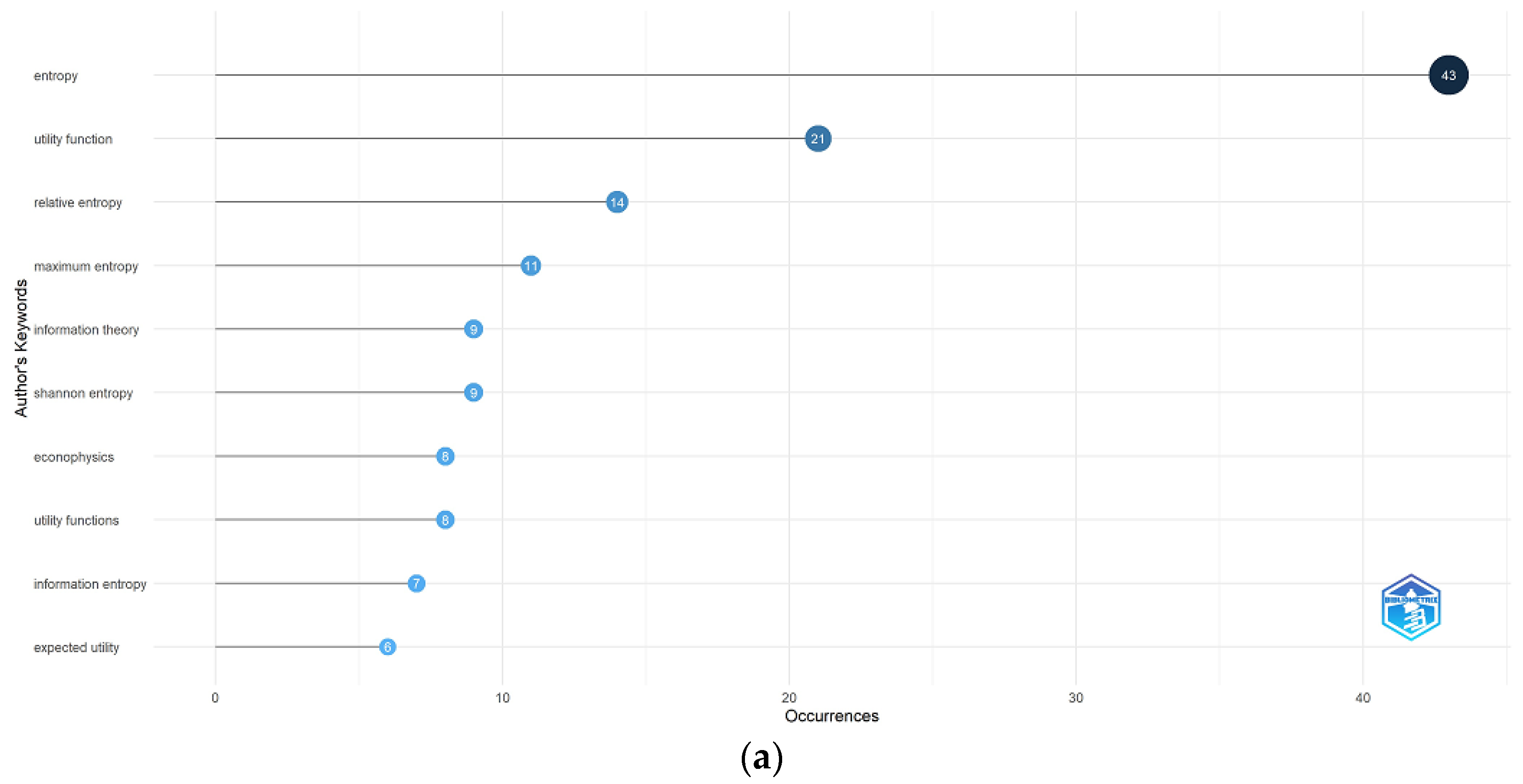
3.3.1. Co-Occurrence of Keywords Analysis
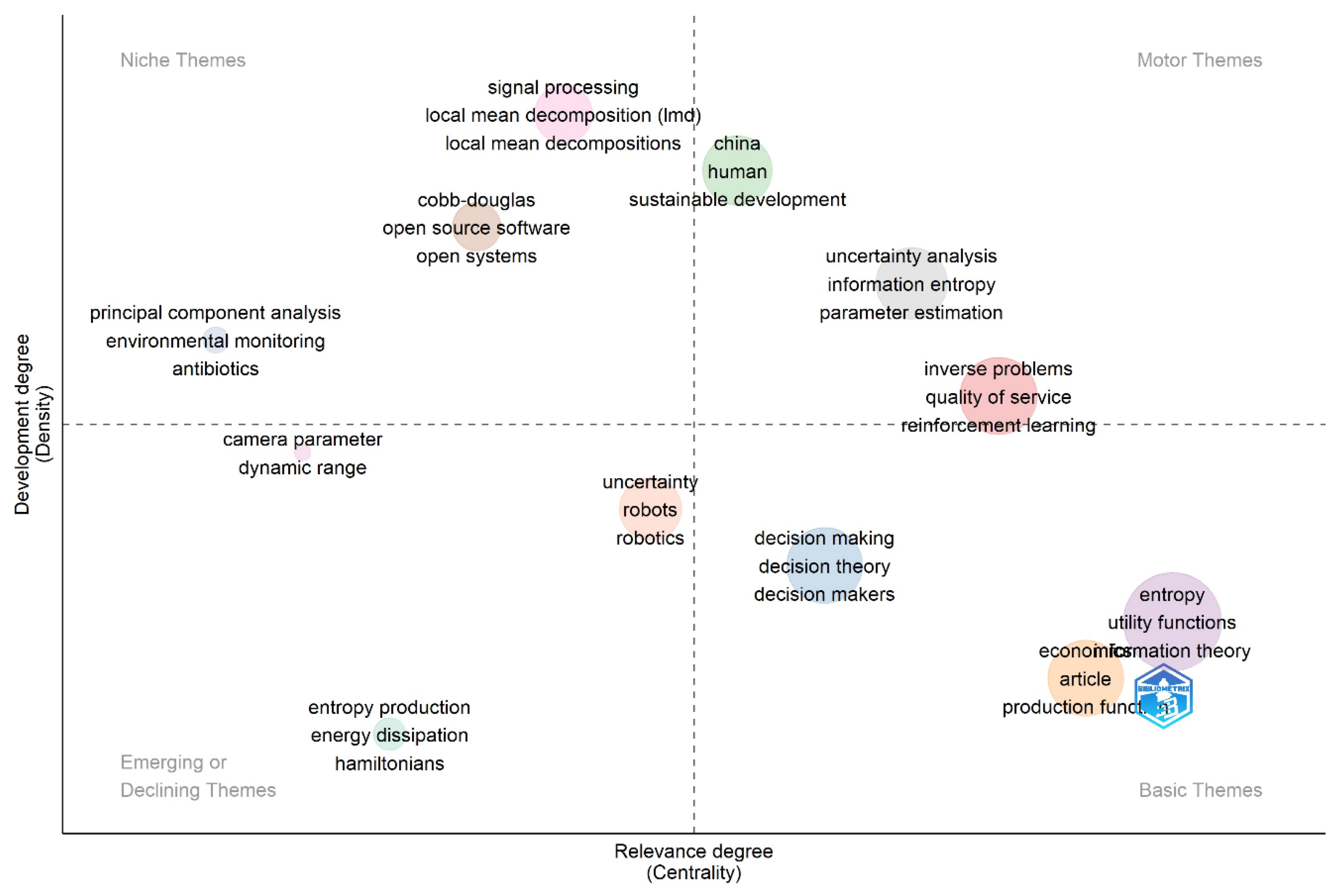
3.3.2. Thematic Map
3.3.3. Theories, Contributions and Trends
- -
- -
- Optimization in decision-making in complex environments: Methods based on entropy and cumulative prospect theory have been crucial for improving decision-making in multi-criteria scenarios. These approaches have enabled the application of robust models in supplier selection, network security evaluation, and classification of multi-attribute problems, optimizing decision-making accuracy and efficiency [87,110,111].
- -
- Utility and efficiency analysis through entropy: Entropy has been employed in evaluating utility and efficiency in various contexts, from agricultural production to maritime surveillance. These models optimize resource allocation and improve technical efficiency while providing a framework for analyzing decision-making under uncertainty and risk scenarios [112,113,114].
- -
- Applications of artificial intelligence and optimization in distributed systems: Advances in artificial intelligence and machine learning, together with entropy, have facilitated optimization in distributed systems, particularly in cooperative information search and efficient data transmission. These approaches have improved the detection of multiple targets in dynamic environments, with applications in fields such as robotics and image transmission [73,115,116].
3.4. Citation Network Analysis
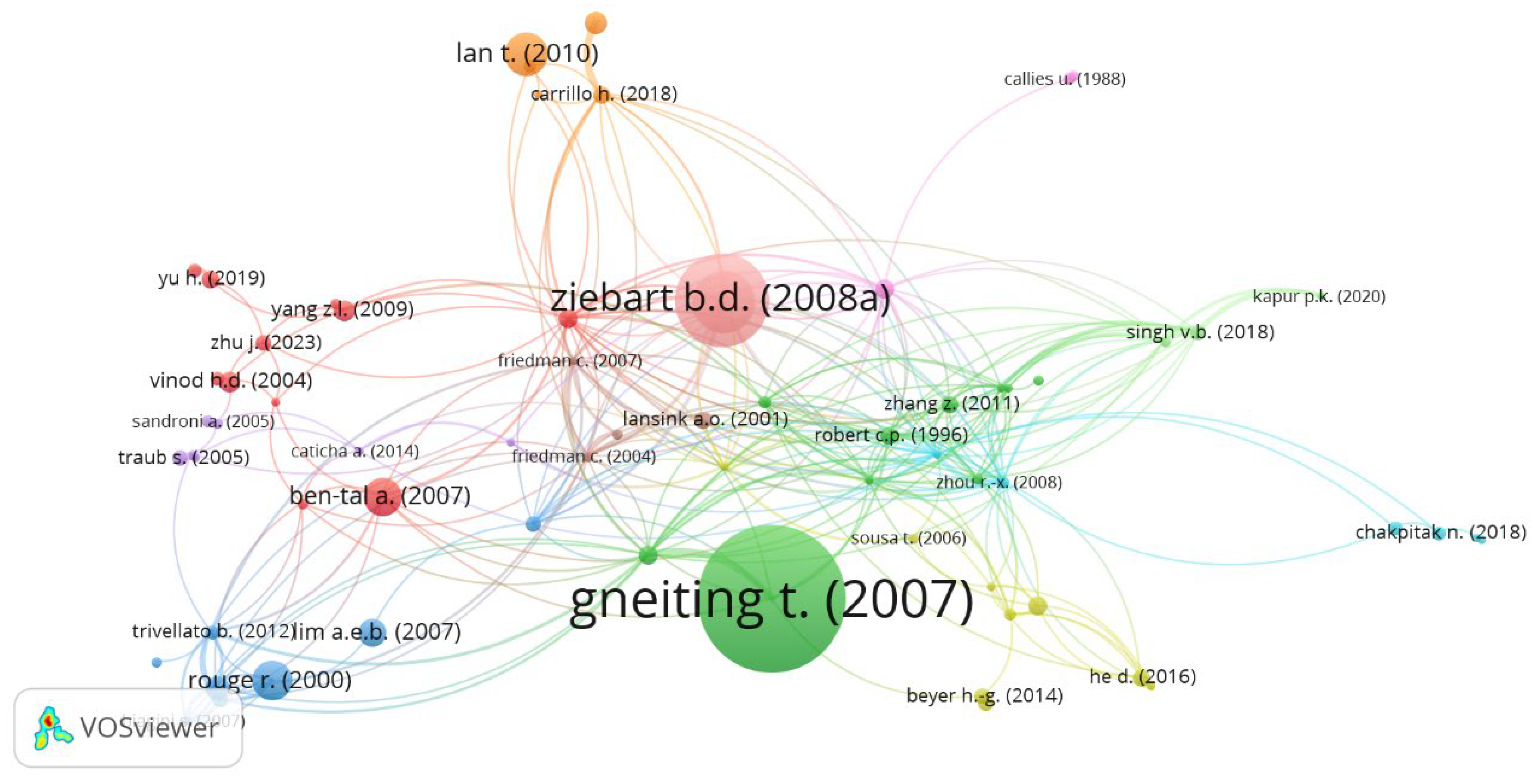
3.4.1. Bibliography Coupling
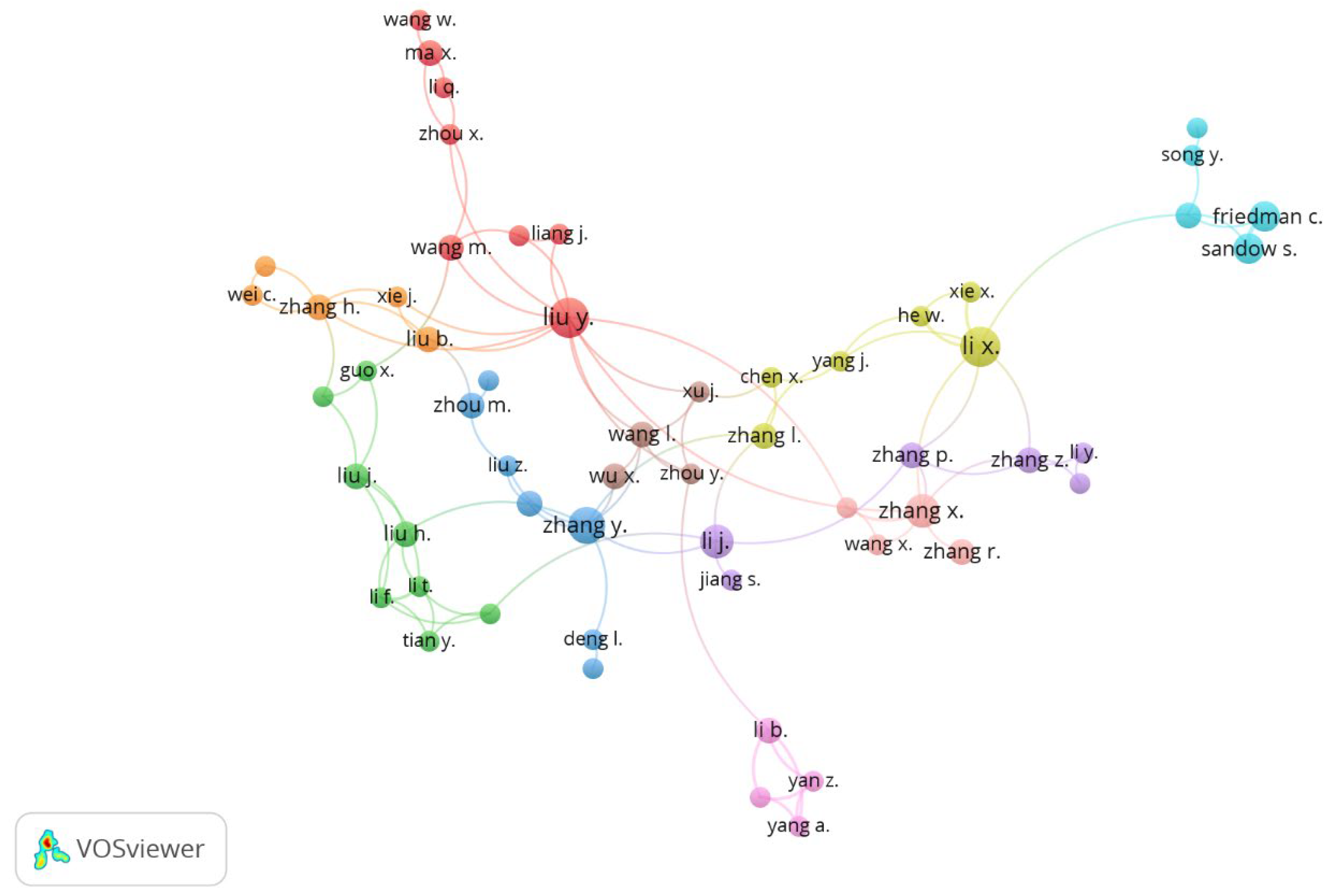
3.4.2. Co-Authorship Analysis
4. Discussion
5. Conclusions
Author Contributions
Funding
Data Availability Statement
Conflicts of Interest
References
- Mantegna, R.N.; Stanley, H.E. Scaling behaviour in the dynamics of an economic index. Nature 1995, 376, 46–49. [Google Scholar] [CrossRef]
- Shannon, C.E. A Mathematical Theory of Communication. Bell Syst. Tech. J. 1948, 27, 379–423. [Google Scholar] [CrossRef]
- Boltzmann, L. On the nature of gas molecules. Lond. Edinb. Dublin Philos. Mag. J. Sci. 1877, 3, 320. [Google Scholar] [CrossRef]
- Jaynes, E.T. Information Theory and Statistical Mechanics. Phys. Rev. 1957, 106, 620–630. [Google Scholar] [CrossRef]
- Cobb, C.W.; Douglas, P.H. A theory of Production. Am. Econ. Rev. 1928, 18, 139–165. [Google Scholar]
- Solow, R.M. Technical change and the aggregate production function. Rev. Econ. Stat. 1957, 39, 312–320. [Google Scholar] [CrossRef]
- Smirnov, R.G.; Wang, K. In search of a new economic model determined by logistic growth. Eur. J. Appl. Math. 2020, 31, 339–368. [Google Scholar] [CrossRef]
- Smirnov, R.G.; Wang, K. The Cobb-Douglas Production Function and the Old Bowley’s Law. Symmetry Integr. Geom. Methods Appl. 2024, 20, 45. [Google Scholar] [CrossRef]
- Donthu, N.; Kumar, S.; Mukherjee, D.; Pandey, N.; Lim, W.M. How to conduct a bibliometric analysis: An overview and guidelines. J. Bus. Res. 2021, 133, 285–296. [Google Scholar] [CrossRef]
- Zupic, I.; Čater, T. Bibliometric Methods in Management and Organization. Organ. Res. Methods 2015, 18, 429–472. [Google Scholar] [CrossRef]
- Lotka, A.J. The frequency distribution of scientific productivity. J. Wash. Acad. Sci. 1926, 16, 317–323. [Google Scholar]
- Chakrabarti, B.K.; Chakraborti, A.; Chatterjee, A. Econophysics and Sociophysics; Wiley: Weinheim, Germany, 2006. [Google Scholar] [CrossRef]
- Basurto-Flores, R.; Guzmán-Vargas, L.; Velasco, S.; Medina, A.; Hernandez, A.C. On entropy research analysis: Cross-disciplinary knowledge transfer. Scientometrics 2018, 117, 123–139. [Google Scholar] [CrossRef]
- Smith, E.; Foley, D.K. Classical thermodynamics and economic general equilibrium theory. J. Econ. Dyn. Control 2008, 32, 7–65. [Google Scholar] [CrossRef]
- Van Eck, N.; Waltman, L. VOSviewer Manual (VOSviewer); Univeristeit Leiden: Leiden, The Netherlands, 2020. [Google Scholar]
- Aria, M.; Cuccurullo, C. bibliometrix: An R-tool for comprehensive science mapping analysis. J. Informetr. 2017, 11, 959–975. [Google Scholar] [CrossRef]
- Farmer, J.D.; Foley, D. The economy needs agent-based modelling. Nature 2009, 460, 685–686. [Google Scholar] [CrossRef] [PubMed]
- Helbing, D. Thinking Ahead-Essays on Big Data, Digital Revolution, and Participatory Market Society; Springer: Cham, Switzerland, 2015; Volume 10. [Google Scholar]
- Gusenbauer, M.; Haddaway, N.R. Which academic search systems are suitable for systematic reviews or meta-analyses? Evaluating retrieval qualities of Google Scholar, PubMed, and 26 other resources. Res. Synth. Methods 2020, 11, 181–217. [Google Scholar] [CrossRef]
- van Eck, N.J.; Waltman, L. Software survey: VOSviewer, a computer program for bibliometric mapping. Scientometrics 2010, 84, 523–538. [Google Scholar] [CrossRef]
- Golob, T.F.; Gustafson, R.L.; Beckmann, M.J. An economic utility theory approach to spatial interaction. Pap. Reg. Sci. Assoc. 1973, 30, 159–182. [Google Scholar] [CrossRef]
- Gallegati, M. Beyond econophysics (not to mention mainstream economics). Eur. Phys. J. Spec. Top. 2016, 225, 3179–3185. [Google Scholar] [CrossRef]
- Georgescu-Roegen, N. The Entropy Law and the Economic Process in Retrospect. East. Econ. J. 1986, 12, 3–25. [Google Scholar]
- Rouge, R.; El Karoui, N. Pricing via utility maximization and entropy. Math. Financ. 2000, 10, 259–276. [Google Scholar] [CrossRef]
- Lence, S.H.; Miller, D.J. Estimation of multi-output production functions with incomplete data: A generalised maximum entropy approach. Eur. Rev. Agric. Econ. 1998, 25, 188–209. [Google Scholar] [CrossRef]
- Candeal, J.C.; De Miguel, J.R.; Induráin, E.; Mehta, G.B. On a Theorem of Cooper. J. Math. Anal. Appl. 2001, 258, 701–710. [Google Scholar] [CrossRef]
- Nayak, T.K.; Gastwirth, J.L. The use of diversity analysis to assess the relative influence of factors affecting the income distribution. J. Bus. Econ. Stat. 1989, 7, 453–460. [Google Scholar] [CrossRef]
- Shao, B.B.M.; Rao, H.R. A comparative analysis of information acquisition mechanisms for discrete resource allocation. IEEE Trans. Syst. Man Cybern. Part A Syst. Hum. 2001, 31, 199–209. [Google Scholar] [CrossRef]
- Hayes, R.M.; Borko, H. Mathematical models of information system use. Inf. Process. Manag. 1983, 19, 173–186. [Google Scholar] [CrossRef]
- Sgarro, A.; Dinu, L.P. Possibilistic Entropies and the Compression of Possibilistic Data. Int. J. Uncertain. Fuzziness Knowl. -Based Syst. 2002, 10, 635–653. [Google Scholar] [CrossRef]
- Powell, N.K. Mathematical Appreciation of the Production Function for a Manufacturing Organisation. A General Systems Approach. Model. Meas. Control C 1987, 10, 1–10. [Google Scholar]
- Jessop, A. Transport Planning and Operation: Models for Forecasting and Decision; Ellis Horwood; Wiley: Hoboken, NJ, USA, 1990. [Google Scholar]
- Rilett, L.R.; Park, D. Incorporating uncertainty and multiple objectives in real-time route selection. J. Transp. Eng. 2001, 127, 531–539. [Google Scholar] [CrossRef]
- Abbas, A.E. Maximum entropy utility. Oper. Res. 2006, 54, 277–290. [Google Scholar] [CrossRef]
- Gneiting, T.; Raftery, A.E. Strictly proper scoring rules, prediction, and estimation. J. Am. Stat. Assoc. 2007, 102, 359–378. [Google Scholar] [CrossRef]
- Zhou, M.; Liu, X.-B.; Yang, J.-B.; Chen, Y.-W.; Wu, J. Evidential reasoning approach with multiple kinds of attributes and entropy-based weight assignment. Knowl. Based. Syst. 2019, 163, 358–375. [Google Scholar] [CrossRef]
- Ziebart, B.D.; Maas, A.; Bagnell, J.A.; Dey, A.K. Human behavior modeling with maximum entropy inverse optimal control. In AAAI Spring Symposium—Technical Report; AAAI Press: Stanford, CA, USA, 2009; pp. 92–97. Available online: https://www.scopus.com/inward/record.uri?eid=2-s2.0-70350578934&partnerID=40&md5=2f179bed196048bab5ef0ea989e2b150 (accessed on 3 October 2024).
- Carrillo, H.; Dames, P.; Kumar, V.; Castellanos, J.A. Autonomous robotic exploration using a utility function based on Rényi’s general theory of entropy. Auton. Robot. 2018, 42, 235–256. [Google Scholar] [CrossRef]
- Xiao, R.; Lin, M.; Fei, X.; Li, Y.; Zhang, Z.; Meng, Q. Exploring the interactive coercing relationship between urbanization and ecosystem service value in the Shanghai–Hangzhou Bay Metropolitan Region. J. Clean. Prod. 2020, 253, 119803. [Google Scholar] [CrossRef]
- Ziebart, B.D.; Maas, A.; Bagnell, J.A.; Dey, A.K. Maximum entropy inverse reinforcement learning. In Proceedings of the National Conference on Artificial Intelligence, Chicago, IL, USA, 13–17 July 2008; pp. 1433–1438. Available online: https://www.scopus.com/inward/record.uri?eid=2-s2.0-57749097473&partnerID=40&md5=61341c8f0714559c0aca2270702cb233 (accessed on 3 October 2024).
- Ben-Tal, A.; Teboulle, M. An old-new concept of convex risk measures: The optimized certainty equivalent. Math. Financ. 2007, 17, 449–476. [Google Scholar] [CrossRef]
- Liang, G.; Yu, H. Network selection algorithm for heterogeneous wireless networks based on service characteristics and user preferences. EURASIP J. Wirel. Commun. Netw. 2018, 2018, 241. [Google Scholar] [CrossRef]
- Liao, J.; Sankar, L.; Tan, V.Y.F.; Calmon, F.P. Hypothesis testing in the high privacy limit. In Proceedings of the 54th Annual Allerton Conference on Communication, Control, and Computing, Allerton 2016, Monticello, IL, USA, 27–30 September 2016; Institute of Electrical and Electronics Engineers Inc.: New York, NY, USA, 2017; pp. 649–656. [Google Scholar] [CrossRef]
- Nesson, E.T.; Robinson, J.J. An information theory based framework for the measurement of population health. Econ. Hum. Biol. 2015, 17, 86–103. [Google Scholar] [CrossRef]
- Lim, A.E.B.; Shanthikumar, J.G. Relative entropy, exponential utility, and robust dynamic pricing. Oper. Res. 2007, 55, 198–214. [Google Scholar] [CrossRef]
- Nau, R.; Jose, V.R.; Winkler, R. Scoring rules, entropy, and imprecise probabilities. In Proceedings of the ISIPTA 2007—Proceedings of the 5th International Symposium on Imprecise Probability: Theories and Applications, Prague, Czech Republic, 16–19 July 2007; pp. 307–315. Available online: https://www.scopus.com/inward/record.uri?eid=2-s2.0-80054963768&partnerID=40&md5=947eae69de2b4c0429f09f44b3ae9259 (accessed on 16 April 2026).
- Friedman, C.; Huang, J.; Sandow, S. A utility-based approach to some information measures. Entropy 2007, 9, 1–26. [Google Scholar] [CrossRef]
- Trivellato, B. The minimal κ-entropy martingale measure. Int. J. Theor. Appl. Financ. 2012, 15, 1250038. [Google Scholar] [CrossRef]
- Wei, L.; Zhang, Y.; Wang, L.; Mi, X.; Wu, X.; Cheng, Z. Spatiotemporal evolution patterns of ‘production-living-ecological’ spaces and the coordination level and optimization of the functions in jilin province. Sustainability 2021, 13, 3192. [Google Scholar] [CrossRef]
- Chen, Y.-B.; Nevat, I.; Zhang, P.; Nagarajan, S.G.; Wei, H.-Y. Query-based sensors selection for collaborative wireless sensor networks with stochastic energy harvesting. IEEE Internet Things J. 2019, 6, 3031–3043. [Google Scholar] [CrossRef]
- Xie, X.; Li, X.; Fan, H.; He, W. Spatial analysis of production-living-ecological functions and zoning method under symbiosis theory of Henan, China. Environ. Sci. Pollut. Res. 2021, 28, 69093–69110. [Google Scholar] [CrossRef]
- Howitt, R.E.; Msangi, S. Entropy estimation of disaggregate production functions: An application to northern Mexico. Entropy 2014, 16, 1349–1364. [Google Scholar] [CrossRef]
- Ou, Z.; Liu, Y.; Liang, J.; Wang, Q.; Liao, D. Evaluation of Land Use Multifunctionality from the Perspective of production-Living-Ecology. IOP Conf. Ser. Earth Environ. Sci. 2021, 787, 012142. [Google Scholar] [CrossRef]
- Sequeira, T.N.; Gil, P.M.; Afonso, O. Endogenous growth and entropy. J. Econ. Behav. Organ. 2018, 154, 100–120. [Google Scholar] [CrossRef]
- Mimkes, J. Stokes integral of economic growth. Calculus and the Solow model. Phys. A Stat. Mech. Its Appl. 2010, 389, 1665–1676. [Google Scholar] [CrossRef]
- Richmond, P.; Mimkes, J.; Hutzler, S. Econophysics and Physical Economics; Oxford University Press: Cary, NC, USA, 2013. [Google Scholar]
- Rodríguez-Vález, J.; Pinilla, A.Á.; Sampedro, C.A.; Vázquez, E.F. The contribution of infrastructure to production: Estimation by maximum entropy. Rev. Econ. Apl. 2009, 17, 77–96. [Google Scholar]
- Kapur, P.K.; Panwar, S.; Kumar, V.; Singh, O. Entropy-Based Two-Dimensional Software Reliability Growth Modeling for Open-Source Software Incorporating Change-Point. Int. J. Reliab. Qual. Saf. Eng. 2020, 27, 2040009. [Google Scholar] [CrossRef]
- Kümmel, R. Energy as a factor of production and entropy as a pollution indicator in macroeconomic modelling. Ecol. Econ. 1989, 1, 161–180. [Google Scholar] [CrossRef]
- Mimkes, J. Differential Forms: A New Tool in Economics. In Complex Sciences; Springer: Berlin/Heidelberg, Germany, 2009; pp. 2029–2039. [Google Scholar] [CrossRef]
- Darooneh, A.H. Utility function from maximum entropy principle. Entropy 2006, 8, 18–24. [Google Scholar] [CrossRef]
- He, D.; Xu, J.; Chen, X. Information-theoretic-entropy based weight aggregation method in multiple-attribute group decision-making. Entropy 2016, 18, 171. [Google Scholar] [CrossRef]
- Geman, D.; Geman, H.; Taleb, N.N. Tail risk constraints and maximum entropy. Entropy 2015, 17, 3724–3737. [Google Scholar] [CrossRef]
- Marsili, M. On the multinomial logit model. Phys. A Stat. Mech. Its Appl. 1999, 269, 9–15. [Google Scholar] [CrossRef]
- Sousa, T.; Domingos, T. Equilibrium econophysics: A unified formalism for neoclassical economics and equilibrium thermodynamics. Phys. A Stat. Mech. Its Appl. 2006, 371, 492–512. [Google Scholar] [CrossRef]
- Pištěk, M.; Slanina, F. Diversity of scales makes an advantage: The case of the Minority Game. Phys. A Stat. Mech. Its Appl. 2011, 390, 2549–2561. [Google Scholar] [CrossRef][Green Version]
- Constantino, M.; da Costa, R.B.; Tabak, B.M. Modeling stochastic frontier based on vine copulas. Phys. A Stat. Mech. Its Appl. 2017, 486, 595–609. [Google Scholar] [CrossRef]
- McCauley, J.L. Futility of utility: How market dynamics marginalize Adam Smith. Phys. A Stat. Mech. Its Appl. 2000, 285, 506–538. [Google Scholar] [CrossRef]
- Tian, Y.; Jiang, G.; He, X.; Qu, Y.; Zhou, D. Internal land use structure difference analysis of rural settlements in Pinggu District, Beijing. Nongye Gongcheng Xuebao/Trans. Chin. Soc. Agric. Eng. 2019, 35, 263–273. [Google Scholar] [CrossRef]
- Zhang, F.; Huang, W.; Li, Q.; Wang, S.; Tan, G. Parameterized utility functions on interval-valued intuitionistic fuzzy numbers with two kinds of entropy and their application in multi-criteria decision making. Soft Comput. 2020, 24, 4667–4674. [Google Scholar] [CrossRef]
- Xie, X.; Li, X. Spatio-temporal evolution characteristics and influencing factors of ‘production-living-ecological’ functions in Henan Province, China. Nongye Gongcheng Xuebao/Trans. Chin. Soc. Agric. Eng. 2021, 37, 243–252. [Google Scholar] [CrossRef]
- Zhang, R.; Zhang, X. Spatiotemporal evolution and driving mechanism of rural multi-functions in the Yangtze River Delta. Nongye Gongcheng Xuebao/Trans. Chin. Soc. Agric. Eng. 2022, 38, 264–272. [Google Scholar] [CrossRef]
- Jang, H.; Park, M.; Oh, H. Improved Socialtaxis for information-theoretic source search using cooperative multiple agents in turbulent environments. Expert Syst. Appl. 2023, 225, 120033. [Google Scholar] [CrossRef]
- Li, Z.; Xie, J.; Liu, W.; Zhang, H.; Liu, B.; Liu, Y. Pareto-based bi-objective optimization for robust power allocation in hybrid MIMO phased-array radar system under air defense maneuvering tracking. Expert Syst. Appl. 2024, 235, 121248. [Google Scholar] [CrossRef]
- Bellini, F.; Frittelli, M. On the existence of minimax martingale measures. Math. Financ. 2002, 12, 1–21. [Google Scholar] [CrossRef]
- Owen, M.P.; Žitković, G. Optimal investment with an unbounded randon endowment and utility-based pricing. Math. Financ. 2009, 19, 129–159. [Google Scholar] [CrossRef]
- Bouchaud, J.-P.; Potters, M. Theory of Financial Risk and Derivative Pricing; Cambridge University Press: Cambridge, UK, 2003. [Google Scholar] [CrossRef]
- Yakovenko, V.M. Econophysics, Statistical Mechanics Approach to. In Encyclopedia of Complexity and Systems Science; Springer: New York, NY, USA, 2009; pp. 2800–2826. [Google Scholar] [CrossRef]
- Mimkes, J. A Thermodynamic Formulation of Social Science. In Econophysics and Sociophysics; Wiley: Hoboken, NJ, USA, 2006; pp. 279–309. [Google Scholar] [CrossRef]
- Sun, J.; Xiao, Q.; Wen, J.; Wang, F. Gas pipeline small leak aperture classification based on local mean decomposition envelope spectrum entropy and SVM. Jixie Gongcheng Xuebao/J. Mech. Eng. 2014, 50, 18–25. [Google Scholar] [CrossRef]
- Culnan, M.J. Mapping the Intellectual Structure of MIS, 1980–1985: A Co-Citation Analysis. MIS Q. 1987, 11, 341. [Google Scholar] [CrossRef]
- Bu, Y.; Waltman, L.; Huang, Y. A multidimensional framework for characterizing the citation impact of scientific publications. Quant. Sci. Stud. 2021, 2, 155–183. [Google Scholar] [CrossRef]
- Aksnes, D.W.; Langfeldt, L.; Wouters, P. Citations, Citation Indicators, and Research Quality: An Overview of Basic Concepts and Theories. Sage Open 2019, 9, 215824401982957. [Google Scholar] [CrossRef]
- Vinod, H.D. Ranking mutual funds using unconventional utility theory and stochastic dominance. J. Empir. Financ. 2004, 11, 353–377. [Google Scholar] [CrossRef]
- Carrillo, H.; Dames, P.; Kumar, V.; Castellanos, J.A. Autonomous robotic exploration using occupancy grid maps and graph SLAM based on Shannon and Rényi Entropy. In Proceedings of the IEEE International Conference on Robotics and Automation, Seattle, WA, USA, 26–30 May 2015; Institute of Electrical and Electronics Engineers Inc.: New York, NY, USA, 2015; pp. 487–494. [Google Scholar] [CrossRef]
- Salamon, P.; Nitzan, A. Finite time optimizations of a Newton’s law Carnot cycle. J. Chem. Phys. 1981, 74, 3546–3560. [Google Scholar] [CrossRef]
- Boukobza, E.; Tannor, D.J. Three-level systems as amplifiers and attenuators: A thermodynamic analysis. Phys. Rev. Lett. 2007, 98, 240601. [Google Scholar] [CrossRef]
- Lan, T.; Kao, D.; Chiang, M.; Sabharwal, A. An axiomatic theory of fairness in network resource allocation. In Proceedings of the IEEE INFOCOM, San Diego, CA, USA, 14–19 March 2010. [Google Scholar] [CrossRef]
- Liu, H.; Zhao, R.; Fang, H.; Cheng, F.; Fu, Y.; Liu, Y.-Y. Entropy-based consensus clustering for patient stratification. Bioinformatics 2017, 33, 2691–2698. [Google Scholar] [CrossRef]
- Mika, P. Ontologies Are Us: A Unified Model of Social Networks and Semantics. In Proceedings of the 4th International Semantic Web Conference, ISWC 2005, Galway, Ireland, 6–10 November 2005; pp. 522–536. [Google Scholar] [CrossRef]
- Zhang, M.; Wang, X.; Chen, X.; Song, Z.; Wang, Y.; Zhou, Y.; Zhang, D. A Scientometric Analysis and Visualization Discovery of Enhanced Recovery After Surgery. Front. Surg. 2022, 9, 894083. [Google Scholar] [CrossRef] [PubMed]
- Cobo, M.J.; López-Herrera, A.G.; Herrera-Viedma, E.; Herrera, F. An approach for detecting, quantifying, and visualizing the evolution of a research field: A practical application to the Fuzzy Sets Theory field. J. Informetr. 2011, 5, 146–166. [Google Scholar] [CrossRef]
- Gonzalez-Ruiz, J.D.; Marín-Rodríguez, N.J.; Weber, O. New insights on social finance research in the sustainable development context. Bus. Strategy Dev. 2024, 7, e342. [Google Scholar] [CrossRef]
- Golbaz, S.; Yaghmaeian, K.; Isazadeh, S.; Zamanzadeh, M. Environmental risk assessments of multiclass pharmaceutical active compounds: Selection of high priority concern pharmaceuticals using entropy-utility functions. Environ. Sci. Pollut. Res. 2021, 28, 59745–59770. [Google Scholar] [CrossRef]
- Chai, Z.; Huang, Z. Agglomeration, knowledge spillover and provincial Innovation—Evidences from mainland China. In Proceedings of China Private Economy Innovation International Forum 2007, Taizhou, China, 11–12 August 2007; American Scholars Press: Atlanta, GA, USA, 2007; pp. 119–128. Available online: https://www.scopus.com/inward/record.uri?eid=2-s2.0-77955119786&partnerID=40&md5=ab6b9efeb557b9ae1940fa0bbf4de100 (accessed on 16 April 2026).
- Singh, V.B.; Sharma, M. Prediction of the complexity of code changes based on number of open bugs, new feature and feature improvement. In Proceedings of the IEEE 25th International Symposium on Software Reliability Engineering Workshops, ISSREW 2014, Naples, Italy, 3–6 November 2014; Institute of Electrical and Electronics Engineers Inc.: New York, NY, USA, 2014; pp. 478–483. [Google Scholar] [CrossRef]
- Singh, V.B.; Sharma, M.; Pham, H. Entropy based software reliability analysis of multi-version open source software. IEEE Trans. Softw. Eng. 2018, 44, 1207–1223. [Google Scholar] [CrossRef]
- Sharma, M.; Pham, H.; Singh, V.B. Modeling and analysis of leftover issues and release time planning in multi-release open source software using entropy based measure. Comput. Syst. Sci. Eng. 2019, 34, 33–46. [Google Scholar] [CrossRef]
- Bisht, G.; Pal, A.K. Decision-Making Framework for Supplier Selection Using an Integrated Approach of Dempster–Shafer Theory and Maximum Entropy Principle. In Proceedings of the Artificial Intelligence: Theory and Applications, Bangalore, India, 11–12 August 2023; pp. 81–93. [Google Scholar] [CrossRef]
- Mimkes, J. Introduction to macro-econophysics and finance. Contin. Mech. Thermodyn. 2012, 24, 731–737. [Google Scholar] [CrossRef]
- Sharma, K.; Khurana, P. Growth and dynamics of Econophysics: A bibliometric and network analysis. Scientometrics 2021, 126, 4417–4436. [Google Scholar] [CrossRef]
- Mimkes, J. Are there common mathematical structures in economics and physics? Eur. Phys. J. Spec. Top. 2016, 225, 3275–3280. [Google Scholar] [CrossRef]
- Kullback, S.; Leibler, R.A. On Information and Sufficiency. Ann. Math. Stat. 1951, 22, 79–86. [Google Scholar] [CrossRef]
- Abe, S. Tsallis entropy: How unique? Contin. Mech. Thermodyn. 2004, 16, 237–244. [Google Scholar] [CrossRef]
- Frittelli, M. Introduction to a theory of value coherent with the no-arbitrage principle. Financ. Stoch. 2000, 4, 275–297. [Google Scholar] [CrossRef]
- Goll, T.; Rüschendorf, L. Minimax and minimal distance martingale measures and their relationship to portfolio optimization. Financ. Stoch. 2001, 5, 557–581. [Google Scholar] [CrossRef]
- Delbaen, F.; Biagini, S. Coherent Risk Measure; Scuola Normale Superiore: Pisa, Italy, 2000. [Google Scholar]
- Romer, P.M. Endogenous Technological Change. J. Political Econ. 1990, 98, S71–S102. [Google Scholar] [CrossRef]
- Lucas, R.E. On the mechanics of economic development. J. Monet. Econ. 1988, 22, 3–42. [Google Scholar] [CrossRef]
- Lei, F.; Cai, Q.; Wei, G.; Wei, C. PDHL-MARCOS method based on cumulative prospect theory for MAGDM and its application in network security evaluation. Int. J. Knowl. -Based Intell. Eng. Syst. 2024, 28, 359–387. [Google Scholar] [CrossRef]
- Özarslan, A.; Karakaya, G. Interactive Approaches to Multiple Criteria Sorting Problems: Entropy-Based Question Selection Methods. Int. J. Inf. Technol. Decis. Mak. 2023, 22, 279–312. [Google Scholar] [CrossRef]
- Sütçü, M. Disutility Entropy in Multi-attribute Utility Analysis. Comput. Ind. Eng. 2022, 169, 108189. [Google Scholar] [CrossRef]
- Anneken, M.; Markgraf, S.; Robert, S.; Beyerer, J. Learning of Utility Functions for the Behaviour Analysis in Maritime Surveillance Tasks. In Modellierung (Companion); Fraunhofer Verlag: Stuttgart, Germany, 2020; pp. 130–143. [Google Scholar]
- Autchariyapanitkul, K.; Srisirisakulchai, J.; Kunasri, K.; Ayusuk, A. Technical efficiency in rice production at farm level in northern Thailand: A stochastic frontier with maximum entropy approach. Thai J. Math. 2017, 15, 121–132. [Google Scholar]
- Xiao, H.; Cui, R.; Xu, D.; Li, Y. MPC-based cooperative multiagent search for multiple targets using a Bayesian framework. J. Field Robot. 2024, 41, 2630–2649. [Google Scholar] [CrossRef]
- O’Donoghue, B. Variational bayesian reinforcement learning with regret bounds. Adv. Neural Inf. Process. Syst. 2021, 34, 28208–28221. [Google Scholar]
- Kessler, M.M. Bibliographic coupling between scientific papers. Am. Doc. 1963, 14, 10–25. [Google Scholar] [CrossRef]
- Friedman, C.; Sandow, S. Model performance measures for expected utility maximizing investors. Int. J. Theor. Appl. Financ. 2003, 6, 355–401. [Google Scholar] [CrossRef]
- Friedman, C.; Sandow, S. Learning probabilistic models: An expected utility maximization approach. J. Mach. Learn. Res. 2004, 4, 257–291. [Google Scholar] [CrossRef]
- Caticha, A.; Golan, A. An entropic framework for modeling economies. Phys. A Stat. Mech. Its Appl. 2014, 408, 149–163. [Google Scholar] [CrossRef]
- Newman, M.E.J. Scientific collaboration networks. I. Network construction and fundamental results. Phys. Rev. E 2001, 64, 016131. [Google Scholar] [CrossRef] [PubMed]
- Liu, Y.; Xu, J.; Zhou, Y.; Muhtar, A.; Wang, L. Spatiotemporal Differentiation of the Coupling and Coordination of Production-Living-Ecology Functions in Hubei Province Based on the Global Entropy Value Method. Int. J. Environ. Res. Public Health 2022, 19, 6062. [Google Scholar] [CrossRef] [PubMed]
- Xu, K.; Shen, M.; Liu, H.; Liu, J.; Li, F.; Li, T. Achieving Optimal Traffic Engineering Using a Generalized Routing Framework. IEEE Trans. Parallel Distrib. Syst. 2016, 27, 51–65. [Google Scholar] [CrossRef]
- Zhuo, R.; Yu, B.; Zeng, J.; Guo, X.; Wang, M. Change and mechanism of influence of rural territorial functions in major agricultural areas of china: A case study of the jianghan plain. Prog. Geogr. 2020, 39, 56–68. [Google Scholar] [CrossRef]
- Chen, C.; Xiong, B.; Huang, J.; Mo, Y.; Li, X. Rolling bearing fault diagnosis based on LMD and ICA. Jixie Qiangdu/J. Mech. Strength 2016, 38, 922–926. [Google Scholar]
- Li, X.; Hu, Y.; Zio, E.; Kang, R. A Bayesian Optimal Design for Accelerated Degradation Testing Based on the Inverse Gaussian Process. IEEE Access 2017, 5, 5690–5701. [Google Scholar] [CrossRef]
- Zhang, Y.; Tang, B.; Liu, Z.; Chen, R. An adaptive demodulation approach for bearing fault detection based on adaptive wavelet filtering and spectral subtraction. Meas. Sci. Technol. 2015, 27, 025001. [Google Scholar] [CrossRef]
- Chambers, R.G.; Ray, S.C. Neoclassical Production Economics: An Introduction. In Handbook of Production Economics; Springer Nature: Singapore, 2022; pp. 3–48. [Google Scholar] [CrossRef]
- Samuelson, P.A. Maximum Principles in Analytical Economics. Am. Econ. Rev. 1972, 62, 249–262. [Google Scholar]







| Description | Results | Description | Results |
|---|---|---|---|
| MAIN INFORMATION ABOUT DATA | Authors of single-authored docs | 61 | |
| Timespan | 1973:2024 | AUTHORS COLLABORATION | |
| Sources (Journals, Books, etc.) | 265 | Single-authored docs | 72 |
| Documents | 345 | Co-Authors per Doc | 2.8 |
| Annual Growth Rate % | 4.29 | International co-authorships % | 15.94 |
| Document Average Age | 10.6 | DOCUMENT TYPES | |
| Average citations per doc | 29.37 | article | 256 |
| References | 11,434 | book | 2 |
| DOCUMENT CONTENTS | book chapter | 7 | |
| Keywords Plus (ID) | 2094 | conference paper | 72 |
| Author’s Keywords (DE) | 1096 | conference review | 2 |
| AUTHORS | retracted | 1 | |
| Authors | 769 | review | 5 |
| Element | h Index | g Index | Total Citations | Number Publications | Top Category Scimago |
|---|---|---|---|---|---|
| Entropy | 7 | 11 | 134 | 13 | Q2 |
| Physica A: Statistical Mechanics And Its Applications | 7 | 10 | 114 | 10 | Q2 |
| Nongye Gongcheng Xuebao/Transactions Of The Chinese Society of Agricultural Engineering | 5 | 5 | 49 | 5 | Q2 |
| Mathematical Finance | 4 | 4 | 608 | 4 | Q1 |
| Sustainability (Switzerland) | 4 | 4 | 74 | 4 | Q1 |
| Ieee Access | 3 | 3 | 97 | 3 | Q1 |
| Operations Research | 3 | 3 | 228 | 3 | Q1 |
| Autonomous Robots | 2 | 2 | 59 | 2 | Q1 |
| Econometric Reviews | 2 | 2 | 12 | 2 | Q1 |
| Econophysics And Sociophysics: Trends And Perspectives | 2 | 2 | 271 | 2 | Book |
| Authors | Articles | Articles Fractionalized |
|---|---|---|
| Li X | 7 | 1.80 |
| Liu Y | 7 | 2.57 |
| Mimkes J | 6 | 6.00 |
| Zhang Y | 6 | 1.37 |
| Li J | 5 | 1.38 |
| Wang J | 5 | 2.08 |
| Zhang X | 5 | 1.57 |
| Bagnell Ja | 4 | 1.08 |
| Friedman C | 4 | 1.83 |
| Mcgree Jm | 4 | 2.00 |
| Country | TC | Average Article Citations |
|---|---|---|
| Israel | 345 | 115.00 |
| USA | 5539 | 98.90 |
| Colombia | 50 | 50.00 |
| Austria | 38 | 38.00 |
| India | 321 | 32.10 |
| United Kingdom | 121 | 24.20 |
| Italy | 181 | 18.10 |
| Thailand | 35 | 17.50 |
| France | 85 | 17.00 |
| Korea | 77 | 15.40 |
| No. | Authors | Source | Year | Total Citation | Type |
|---|---|---|---|---|---|
| 1 | Gneiting & Raftery (2007) [35] | Strictly proper scoring rules, prediction, and estimation | 2007 | 3158 | Article |
| 2 | Ziebart et al. (2008) [40] | Maximum entropy inverse reinforcement learning | 2008 | 1286 | Conference paper |
| Ziebart et al.(2008) [40] | Maximum Entropy Inverse Reinforcement Learning | 2008 | 563 | Conference paper | |
| 3 | Lan T et al. (2010) [88] | An axiomatic theory of fairness in network resource allocation | 2010 | 279 | Conference paper |
| 4 | Chakrabarti B.K. (2006) [12] | Econophysics and Sociophysics: Trends and Perspectives | 2006 | 258 | Book |
| 5 | Rouge & El Karoui (2000) [24] | Pricing via utility maximization and entropy | 2000 | 244 | Article |
| 6 | Ben-Tal & Teboulle (2007) [41] | An old-new concept of convex risk measures: The optimized certainty equivalent | 2007 | 227 | Article |
| 7 | Salamon P & Nitzan (1981) [86] | Finite time optimizations of a Newton’s law Carnot cycle | 1981 | 217 | Article |
| 8 | Xiao R et al. (2020) [39] | Exploring the interactive coercing relationship between urbanization and ecosystem service value in the Shanghai Hangzhou Bay Metropolitan Region | 2020 | 155 | Article |
| 9 | Zhou M et al. (2019) [36] | Evidential reasoning approach with multiple kinds of attributes and entropy-based weight assignment | 2019 | 121 | Article |
| 10 | Lim & Shanthikumar (2007) [45] | Relative entropy, exponential utility, and robust dynamic pricing | 2007 | 112 | Article |
| 11 | Bellini & Frittelli (2002) [75] | On the existence of minimax martingale measures | 2002 | 95 | Article |
| 12 | Carrillo H et al. (2015) [85] | Autonomous robotic exploration using occupancy grid maps and graph SLAM based on Shannon and Rényi Entropy | 2015 | 73 | Conference paper |
| 13 | Liu H et al. (2017) [89] | Entropy-based consensus clustering for patient stratification | 2017 | 72 | Article |
| 14 | Boukobza & Tannor (2007) [87] | Three-level systems as amplifiers and attenuators: A thermodynamic analysis | 2007 | 70 | Article |
| 15 | Vinod (2004) [84] | Ranking mutual funds using unconventional utility theory and stochastic dominance | 2004 | 69 | Article |
Disclaimer/Publisher’s Note: The statements, opinions and data contained in all publications are solely those of the individual author(s) and contributor(s) and not of MDPI and/or the editor(s). MDPI and/or the editor(s) disclaim responsibility for any injury to people or property resulting from any ideas, methods, instructions or products referred to in the content. |
© 2026 by the authors. Licensee MDPI, Basel, Switzerland. This article is an open access article distributed under the terms and conditions of the Creative Commons Attribution (CC BY) license.
Share and Cite
Betancur-Hinestroza, I.C.; Marín-Rodríguez, N.J.; Caro-Lopera, F.J.; Velásquez Sierra, É.A. Economic Entropy and the Cobb-Douglas Function: A Scientometric Analysis. Entropy 2026, 28, 480. https://doi.org/10.3390/e28050480
Betancur-Hinestroza IC, Marín-Rodríguez NJ, Caro-Lopera FJ, Velásquez Sierra ÉA. Economic Entropy and the Cobb-Douglas Function: A Scientometric Analysis. Entropy. 2026; 28(5):480. https://doi.org/10.3390/e28050480
Chicago/Turabian StyleBetancur-Hinestroza, Isabel Cristina, Nini Johana Marín-Rodríguez, Francisco J. Caro-Lopera, and Éver Alberto Velásquez Sierra. 2026. "Economic Entropy and the Cobb-Douglas Function: A Scientometric Analysis" Entropy 28, no. 5: 480. https://doi.org/10.3390/e28050480
APA StyleBetancur-Hinestroza, I. C., Marín-Rodríguez, N. J., Caro-Lopera, F. J., & Velásquez Sierra, É. A. (2026). Economic Entropy and the Cobb-Douglas Function: A Scientometric Analysis. Entropy, 28(5), 480. https://doi.org/10.3390/e28050480