A Simple Understanding of Quantum Electrodynamics Using Bohmian Trajectories: Detecting Non-Ontic Photons



Abstract
1. Introduction
1.1. What Are Electromagnetic Fields?
1.2. What Are Photons?
1.3. Measuring Photon and Light Properties
2. Classical Light–Matter Hamiltonian
2.1. Matter
2.2. Electromagnetic Field(s)
2.3. Minimal Coupling Hamiltonian
2.4. Mode Decomposition
2.4.1. Electromagnetic Energy
2.4.2. Light–Matter Interaction
3. Canonical Quantization
3.1. Quantization of Matter
3.2. Quantization of the Electromagnetic Field
3.3. The Schrödinger Equation
4. Bohmianization
5. Born Rule and Statistical Predictions
6. Photon Partition Noise
6.1. Simulation of a Non-Measured Light–Matter System
6.1.1. Model Without Measuring Apparatus
6.1.2. Numerical Results Without Measuring Apparatus
6.2. Simulation of a Measured Light–Matter System
6.2.1. Model with Measuring Apparatus
6.2.2. Numerical Results with Measuring Apparatus
7. Conclusions
Author Contributions
Funding
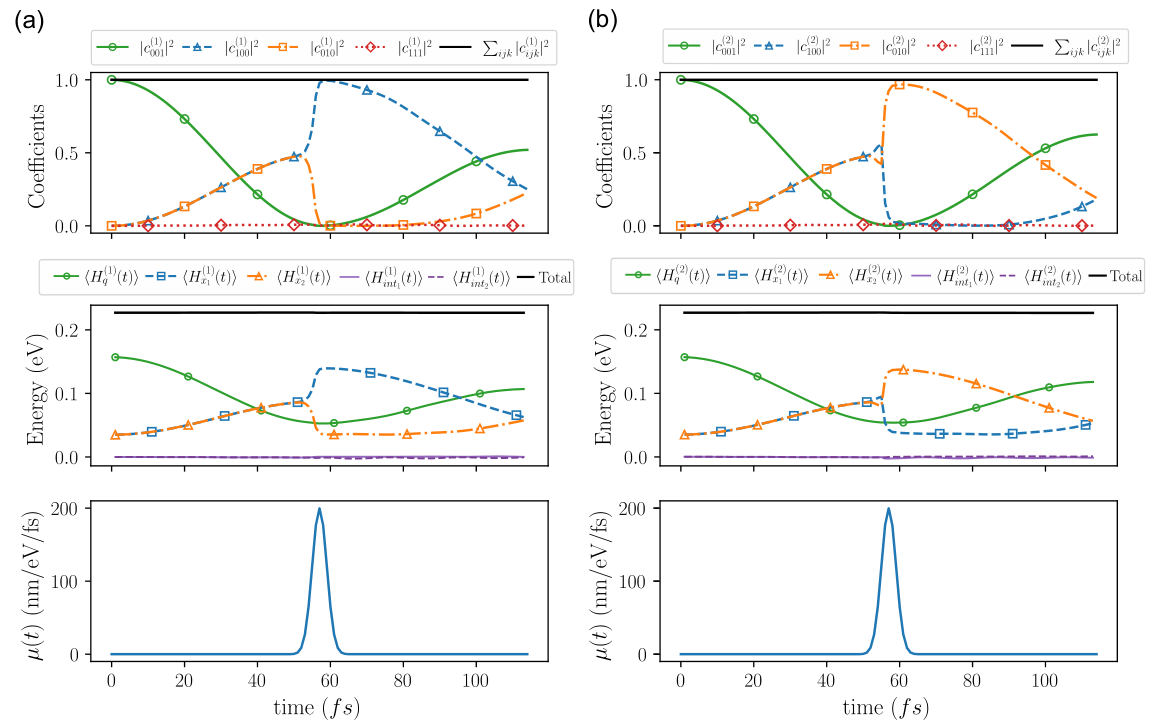
Data Availability Statement
Acknowledgments
Conflicts of Interest
Appendix A. Creation and Annihilation in Fock Space
Appendix B. Schrödinger Equation for Two Electrons and One Electromagnetic Mode
Appendix C. Schrödinger Equation for Two Electrons, One Electromagnetic Mode and Two Pointers
Appendix D. Computation of the Bohmian Trajectories
| 1 | Typically, a quantum system with particles is described within a Hilbert space with degrees of freedom. More generally, a quantum system with a variable particle-number is formulated in Fock space [26]. |
| 2 | It is relevant to mention that Goldstein et al. [28] explored the possibility that not all particles need to be real; in their approach, certain degrees of freedom, such as those associated with radiation, are not assigned positions as beables, yet the theory still reproduces all empirical predictions. The numerical results in this paper can be understood as a concrete example of the result of [28]. |
| 3 | A possible direction for extending this proposal to relativistic scenarios is indicated in Lienert [37] where particles interact directly along light cones at the quantum level, using multi-time wave functions to maintain relativistic consistency. |
| 4 | Certainly, the word ontic can have slightly different meanings. Even a law can be defined as a nomological element that is part of the ontology of a theory. In this paper, however, we will use the term “ontic element of a physical theory” to refer to something that is considered physically real, in the same sense that particles are considered in classical mechanics. For an element of a physical theory that is not considered physically real in this sense, we will refer to it as non-ontic. For example, in classical mechanics, the center of mass—defined as a sum of the positions of the particles—is not ontic, even though the particles themselves are ontic. In the literature, what we call ontic in this paper is often referred to as the primitive ontology of the theory [38]. |
| 5 | One can imagine photons and electrons as billiard balls satisfying conservation of energy and momentum when colliding. In the process, the photon can be created or annihilated. However, this simple model cannot account for interference and other intrinsically quantum electrodynamic phenomena [27]. |
| 6 | The word particle is commonly used in quantum field theory. It certainly does not mean an entity with well-defined positions at all time, but something different and compatible with its definition of excitation of the quantum electromagnetic field. In any case, the word particle for the photon still suggests some type of onticity for the photon in the sense of an additional dimension in Hilbert (or Fock) space. |
| 7 | A completely different approach, in which the ontic variables are fields rather than particles and the detected entities are ontic fields, can also be defended [56]. |
| 8 | As time evolves, in classical mechanics, the system follows a trajectory in the -dimensional phase space that corresponds to a set of trajectories in physical space, one for each particle. These trajectories are regarded as ontic elements of the classical mechanics theory, describing the actual motion of matter. |
| 9 | |
| 10 | |
| 11 | The units of are the square root of a volume multiplied by volt-second and divided by meter. |
| 12 | If refractive index varies spatially, the equation remains which is an eigenvalue problem for . |
| 13 | At this point the reader can argue that such new degrees of freedom, , used to describe the electromagnetic fields are somehow arbitrary. By selecting different we will have different degrees of freedom. This is true and it would be problematic if we pretend to give some type of ontological status to the photons, but this is not the case in this paper. The analogy with the center of mass for describing particles is pertinent here. The degree of freedom of the center of mass defined is not an ontic element, but it can be used as a useful degree of freedom to solve the problem. |
| 14 | |
| 15 | We compute ; we use and the Helmholtz equation, Equation (17), to get . |
| 16 | The classical Poisson bracket, in general, for a pair of classical observables and , is defined as |
| 17 | In quantum mechanics, observables are represented by Hermitian operators. The commutator of two operators and is defined as . |
| 18 | For example, the classical observables satisfy , but this equivalence is not true for its quantum version because and are different. This problem will appear in the quantum version of (24) with the terms and , but in the Coulomb gauge, this issue will not be problematic. |
| 19 | It is a straightforward procedure to show , where the quantum state in the position representation is . |
| 20 | In quantum mechanics is a differential operator, so operator ordering matters when it acts on position-dependent functions such as . Acting on a wavefunction , one finds , where we have used the Coulomb gauge, . |
| 21 | For matter, the quantum operators of position and momentum are unambiguously defined as and , respectively, since measurement outcomes (i.e., pointer readings) are ultimately encoded in the position of matter rather than in its velocity. In contrast, for the electromagnetic mode variables, there is an ambiguity in determining which quantum operator should act multiplicatively and which as a derivative, since these variables are not directly measured. Throughout this paper, we adopt the following convention for the electromagnetic mode variables: q is taken as a multiplicative operator and as a derivative operator. For the numerical simulations, the Bohmian velocities computed in Appendix D are derived from the simplified Hamiltonian given in (59), where the matter–light interaction (within the dipole approximation) is expressed in terms of the electric field , which is proportional to q rather than to s. The resulting simplification of the numerical implementation is the only argument used to justify our original choice of electromagnetic field operators throughout the paper. The only exception is in the derivation of the continuity equation in (40) and in the Bohmian velocities in this Section 4, where we adopt the opposite convention, namely, s as a multiplicative operator and as a derivative operator. This latter choice is motivated by the fact that the light–matter interaction appears through the vector potential in (34), which is proportional to s rather than to q as seen in (16). With this convention, the corresponding expressions are significantly simplified (thus, in the expressions of the Bohmian velocity below, q should be understood as s). It can be demonstrated that the ambiguity in the choice of operators associated with the electromagnetic mode variables has no net effect on the matter (electron) dynamics. |
| 22 | It is important to realize that this continuity equation in (44) refers to a set of trajectories, each corresponding to a different experiment. In contrast, the continuity equation in (3) referred to a set of trajectories within a single experiment. The fact that trajectories associated with experiments that are not actually performed still influence a given experiment is at the heart of quantum theory. |
| 23 | The delta function can only be correctly interpreted when integrated over a region of configuration space. |
| 24 | In realistic experimental scenarios, exact disjointness is not required; it suffices that the supports be approximately disjoint, which guarantees an adequate level of distinguishability between the pointer states. |
| 25 | The other branches are empty wave functions in the sense that there is no Bohmian trajectory on their supports. As long as the global evolution remains under the Markovian regime—notice that a realistic macroscopic pointer deals with degrees of freedom—we can assume that such an empty wave function in the -dimensional configuration space will never interfere again with the non-empty wave function (53). |
| 26 | In principle, one could attempt to prepare an initial wave function sharply peaked around a configuration, . In that case, all preparations would satisfy and . However, such -wave functions are not prepared as initial quantum states in laboratories since they are ill-defined because they require arbitrarily large energies. |
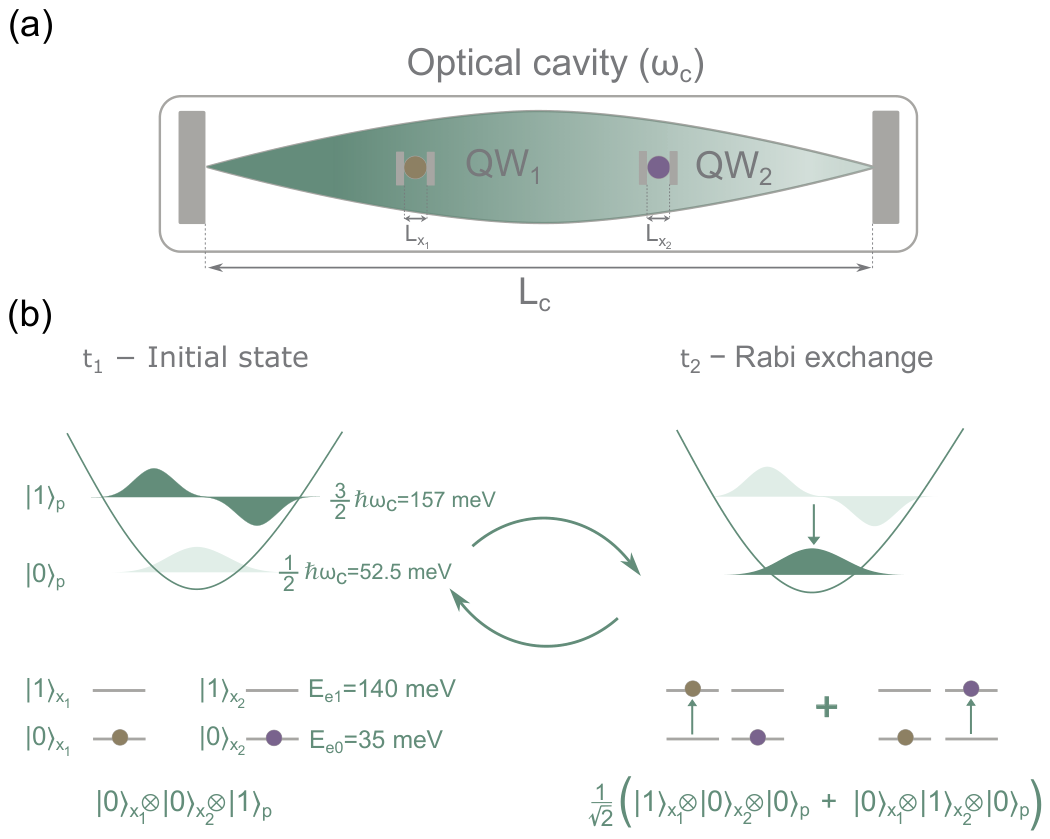
| 27 | Many more particles are involved in this experiment (in particular those of the matter particles required to create the optical cavity and the quantum wells) that are not included in the simulation. Following the discussion in the introduction, one can argue that the interaction of the other non-simulated particles with the two simulated electrons is effectively incorporated through the electromagnetic field and , and the potential barriers of the quantum wells and optical cavity. |
| 28 | The concept of effective electron mass allows electrons in the semiconductor forming the quantum well to be treated as quasi-free particles, incorporating the influence of the periodic lattice without explicitly modeling the atomic structure. The value is characteristic of Indium Gallium Arsenide, a material widely used in quantum well structures for high-speed electronic and photonic applications. |
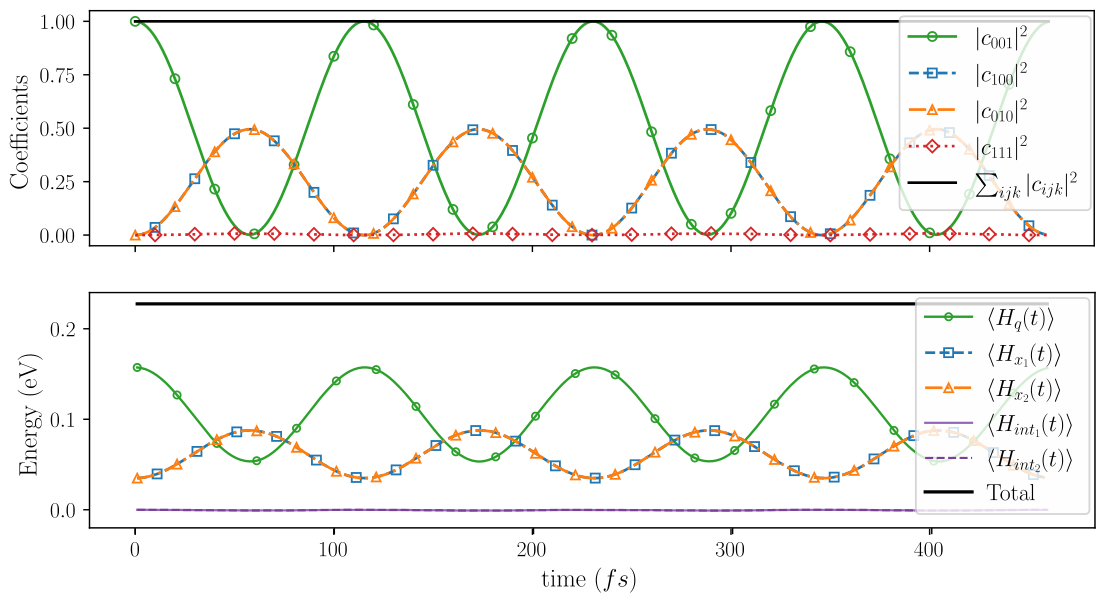
| 29 | Notice that the energy associated with the interaction terms in the Hamiltonian is almost negligible due to the small value of in the strong light–matter coupling regime considered in this work. For larger values of , corresponding to the ultra-strong coupling regime, the situation could be quite different. |
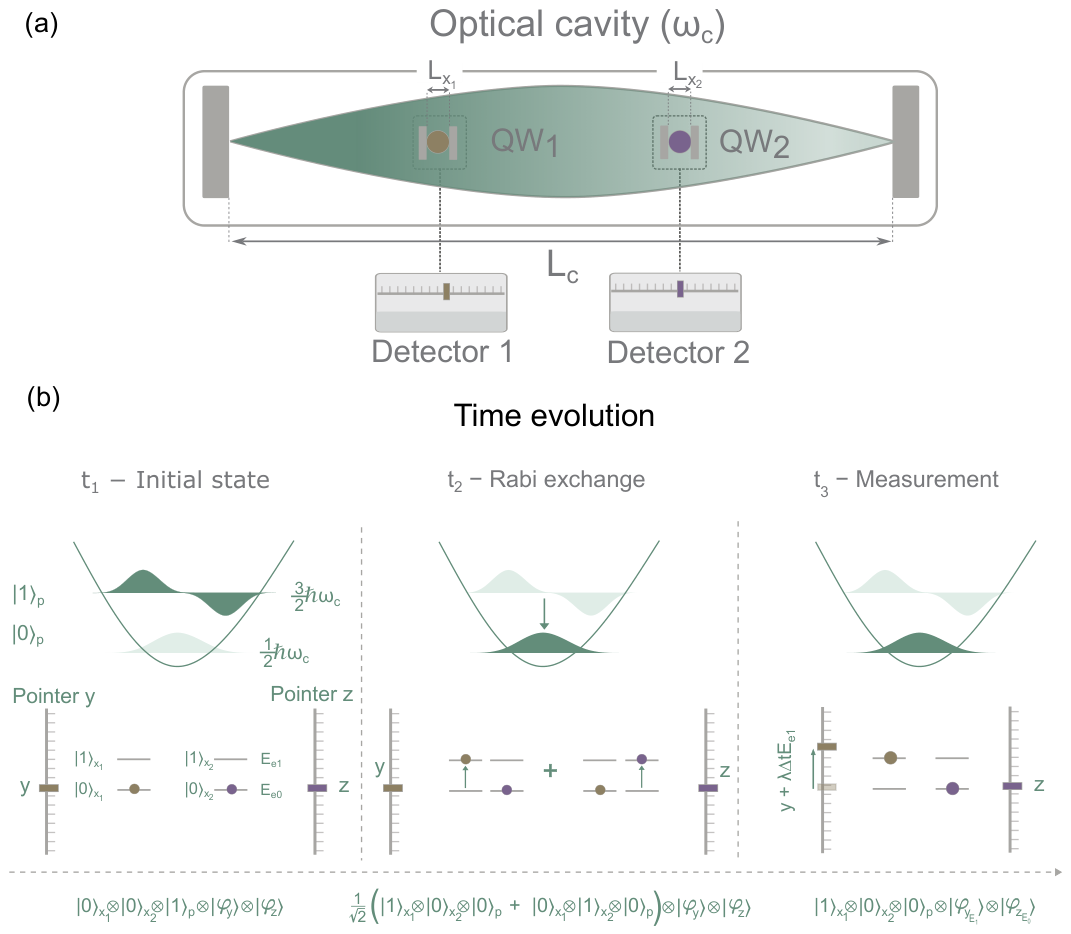
| 30 | The measurement duration must be chosen much smaller than the Rabi period in order to ensure that the measurement is performed near the desired quantum state. If the measurement time were comparable to the Rabi period, the interaction would probe the system throughout its dynamical evolution, leading to a less well-defined measurement outcome. On the other hand, the measurement cannot be made arbitrarily short. An idealized Dirac-delta-like interaction would induce unphysical features in the Bohmian trajectories, such as divergent velocities at the instant of measurement. |
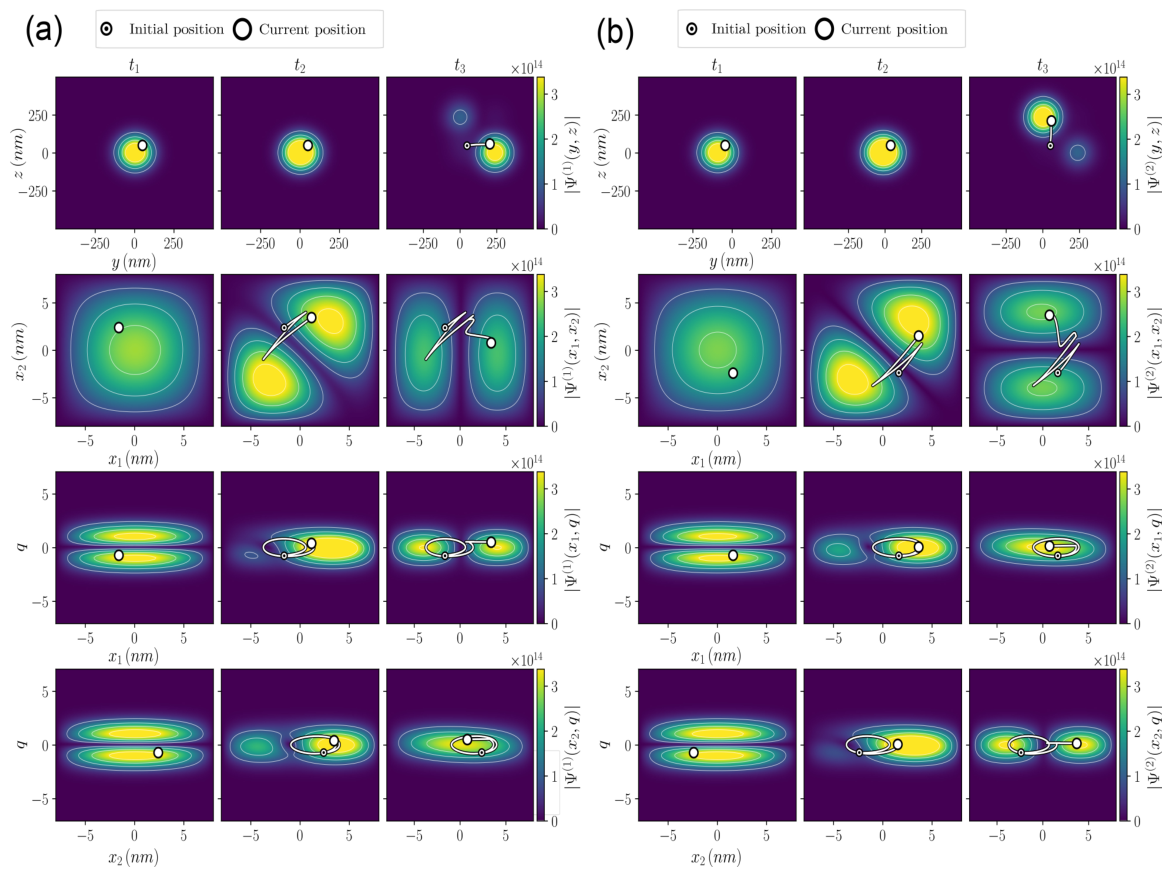
| 31 | The measurement itself can be regarded as a preparation procedure that sets new initial conditions for the system, different from the state used in the non-measured simulations. After the measurement (i.e., preparation), the coherent evolution of the light–matter system with Rabi oscillations occurs again. |
| 32 | Of course, if one prefers to ignore the detailed discussion of the roles played by and in breaking the superposition, one may still explain the detection of the photon by invoking a (non-unitary and stochastic) fundamental collapse process such as or , depending on the outcome of “God’s dice”. Although the mathematical description of such a collapse is certainly simpler, it appears far less satisfactory from a fundamental point of view. |
| 33 | Throughout the simulation, the dynamics are restricted to the sub-space , which contains states with an odd number of excitations. The structure of the Hamiltonian therefore prevents transitions to states such as , , or . In principle, the state belongs to the same parity sector and is dynamically allowed. However, transitions such as require deep strong coupling, which occurs only when the interaction term becomes comparable in magnitude to the free Hamiltonian contributions. In that deep strong regime (not considered in this paper), energy stored in the interaction can be redistributed to the rest of the system. Importantly, this behavior remains fully consistent with energy conservation and arises purely from the unitary dynamics of the model. |
| 34 | Even the creation and annihilation of electrons can be interpreted as a semantic description of a change in the electron’s energy from a negative value (in the Dirac sea) to a positive one, or vice versa, within a “persistent particle ontology” as described in [65] or when the “Dirac sea is taken seriously” as proposed in [29]. |
References
- Bohm, D. A Suggested Interpretation of the Quantum Theory in Terms of “Hidden” Variables. I. Phys. Rev. 1952, 85, 166–179. [Google Scholar] [CrossRef]
- Bell, J.S. Speakable and Unspeakable in Quantum Mechanics, 1st ed.; Cambridge University Press: Cambridge, UK, 1987. [Google Scholar]
- Holland, P.R. The Quantum Theory of Motion, 1st ed.; Cambridge University Press: Cambridge, UK, 1993. [Google Scholar]
- Dürr, D.; Teufel, S. Bohmian Mechanics, 1st ed.; Springer: Berlin/Heidelberg, Germany, 2009. [Google Scholar]
- Bohm, D.; Hiley, B.J. The Undivided Universe, 1st ed.; Routledge: London, UK, 1993. [Google Scholar]
- Kaloyerou, P.N. The Causal Interpretation of the Electromagnetic Field. Phys. Rep. 1994, 224, 287–358. [Google Scholar] [CrossRef]
- Norsen, T. Foundations of Quantum Mechanics: An Exploration of the Physical Meaning of Quantum Theory, 1st ed.; Springer: Cham, Switzerland, 2017. [Google Scholar]
- Everett, H., III. “Relative State” Formulation of Quantum Mechanics. Rev. Mod. Phys. 1957, 29, 454–462. [Google Scholar] [CrossRef]
- Ghirardi, G.C.; Rimini, A.; Weber, T. Unified dynamics for microscopic and macroscopic systems. Phys. Rev. D 1986, 34, 470–491. [Google Scholar] [CrossRef]
- Oriols, X.; Mompart, J. Applied Bohmian Mechanics: From Nanoscale Systems to Cosmology, 2nd ed.; Jenny Stanford Publishing: Singapore, 2019. [Google Scholar]
- Oriols, X. Quantum-trajectory approach to time dependent transport in mesoscopic systems with electron–electron interactions. Phys. Rev. Lett. 2007, 98, 066803. [Google Scholar] [CrossRef]
- Marian, D.; Zanghì, N.; Oriols, X. Weak values from displacement currents in multiterminal electron devices. Phys. Rev. Lett. 2016, 116, 110404. [Google Scholar] [CrossRef]
- Ferry, D.K.; Oriols, X.; Weinbub, J. Quantum Transport in Semiconductor Devices: Simulation Using Particles, 1st ed.; IOP Publishing: Bristol, UK, 2023. [Google Scholar]
- Wyatt, R.E. Quantum Dynamics with Trajectories: Introduction to Quantum Hydrodynamics, 1st ed.; Springer: New York, NY, USA, 2005. [Google Scholar]
- Sanz, Á.S.; Miret-Artés, S. A Trajectory Description of Quantum Processes. I. Fundamentals, 1st ed.; Springer: Berlin/Heidelberg, Germany, 2012. [Google Scholar]
- Sanz, Á.S.; Miret-Artés, S. A Trajectory Description of Quantum Processes. II. Applications, 1st ed.; Springer: Berlin/Heidelberg, Germany, 2014. [Google Scholar]
- Sanz, A.S.; Miret-Artés, S. Quantum Phase Analysis with Quantum Trajectories: A Step Towards the Creation of a Bohmian Thinking. Am. J. Phys. 2012, 80, 525–533. [Google Scholar] [CrossRef]
- Deckert, D.-A.; Kellers, L.; Norsen, T.; Struyve, W. Comparison of the Mean Field and Bohmian Semi-Classical Approximations to the Rabi Model. Int. J. Mod. Phys. B 2021, 35, 2150270. [Google Scholar] [CrossRef]
- Bell, J.S. Beables for Quantum Field Theory; CERN: Geneva, Switzerland, 1984. [Google Scholar]
- Dürr, D.; Goldstein, S.; Tumulka, R.; Zanghì, N. Bohmian Mechanics and Quantum Field Theory. Phys. Rev. Lett. 2004, 93, 090402. [Google Scholar] [CrossRef]
- Dürr, D.; Goldstein, S.; Tumulka, R.; Zanghì, N. Bell-type Quantum Field Theories. J. Phys. A Math. Gen. 2005, 38, R1–R43. [Google Scholar] [CrossRef]
- Bohm, D. A Suggested Interpretation of the Quantum Theory in Terms of “Hidden” Variables. II. Phys. Rev. 1952, 85, 180–193. [Google Scholar] [CrossRef]
- Struyve, W. Pilot-wave theory and quantum fields. Rep. Prog. Phys. 2010, 73, 106001. [Google Scholar] [CrossRef]
- Bohm, D.; Hiley, B.J.; Kaloyerou, P.N. An ontological basis for the quantum theory. Phys. Rep. 1987, 144, 321–375. [Google Scholar] [CrossRef]
- Belinfante, F.J. A Survey of Hidden-Variables Theories, 1st ed.; Pergamon Press: Oxford, UK; New York, NY, USA, 1973. [Google Scholar]
- Sebens, C.T. The fundamentality of fields. Synthese 2022, 200, 380. [Google Scholar] [CrossRef]
- Catani, L.; Leifer, M.; Schmid, D.; Spekkens, R.W. Why interference phenomena do not capture the essence of quantum theory. Quantum 2023, 7, 1119. [Google Scholar] [CrossRef]
- Goldstein, S.; Taylor, J.; Tumulka, R.; Zanghì, N. Are all particles real? Stud. Hist. Philos. Sci. Part B Stud. Hist. Philos. Mod. Phys. 2005, 36, 103–112. [Google Scholar] [CrossRef][Green Version]
- Colin, S.; Struyve, W. A Dirac Sea Pilot-Wave Model for Quantum Field Theory. J. Phys. A Math. Theor. 2007, 40, 7309–7341. [Google Scholar] [CrossRef]
- Lazarovici, D. Against fields. Eur. J. Philos. Sci. 2018, 8, 145–170. [Google Scholar] [CrossRef]
- Deckert, D.-A. Electrodynamic Absorber Theory: A Mathematical Study. Doctoral Thesis, Ludwig-Maximilians-Universität München, Munich, Germany, 2009. [Google Scholar]
- Schwarzschild, K. Nachrichten von der Gesellschaft der Wissenschaften zu Göttingen; Weidmanndsche Buchhandlung: Berlin, Germany, 1903; Volume 128, pp. 132–141. [Google Scholar]
- Tetrode, H. On the interaction of the universe. An extension of classical dynamics. Z. Phys. 1922, 10, 317–328. [Google Scholar] [CrossRef]
- Fokker, A.D. An invariant variational principle for the motion of several electrically charged particles. Z. Phys. 1929, 58, 386–393. [Google Scholar] [CrossRef]
- Wheeler, J.A.; Feynman, R.P. Interaction with the absorber as the mechanism of radiation. Rev. Mod. Phys. 1945, 17, 157–181. [Google Scholar] [CrossRef]
- Wheeler, J.A.; Feynman, R.P. Classical electrodynamics in terms of direct interparticle action. Rev. Mod. Phys. 1949, 21, 425–433. [Google Scholar] [CrossRef]
- Lienert, M. Direct interaction along light cones at the quantum level. J. Phys. A Math. Theor. 2018, 51, 435302. [Google Scholar] [CrossRef]
- Allori, V.; Goldstein, S.; Tumulka, R.; Zanghì, N. On the Common Structure of Bohmian Mechanics and the Ghirardi–Rimini–Weber Theory. Br. J. Philos. Sci. 2008, 59, 353–389. [Google Scholar] [CrossRef]
- De Coulomb, C.A. Mémoire sur L’électricité et le Magnétisme; Histoire de l’Académie Royale des Sciences: Paris, France, 1785. [Google Scholar]
- Ampère, A.-M. Théorie Mathématique des Phénomènes Électrodynamiques Uniquement Déduite de L’expérience; Méquignon-Marvis: Paris, France, 1826. [Google Scholar]
- Assis, A.K.T. Weber’s Electrodynamics; Kluwer Academic Publishers: Dordrecht, The Netherlands, 1994. [Google Scholar]
- Faraday, M. Experimental Researches in Electricity; Royal Society of London: London, UK, 1839. [Google Scholar]
- Maxwell, J.C. A Treatise on Electricity and Magnetism, 1st ed.; Oxford University Press: Oxford, UK, 1873. [Google Scholar]
- Dirac, P.A.M. The Quantum Theory of the Emission and Absorption of Radiation. Proc. R. Soc. A 1927, 114, 243. [Google Scholar] [CrossRef]
- Feynman, R.P. QED: The Strange Theory of Light and Matter, 1st ed.; Princeton University Press: Princeton, NJ, USA, 1985. [Google Scholar]
- Planck, M. On the Law of Distribution of Energy in the Normal Spectrum. Ann. Phys. 1901, 4, 553. [Google Scholar] [CrossRef]
- Einstein, A. On a Heuristic Viewpoint Concerning the Production and Transformation of Light. Ann. Phys. 1905, 17, 132. [Google Scholar] [CrossRef]
- Lewis, G.N. The Conservation of Photons. Nature 1926, 118, 874. [Google Scholar] [CrossRef]
- Scully, M.O.; Zubairy, M.S. Quantum Optics, 1st ed.; Cambridge University Press: Cambridge, UK, 1997. [Google Scholar]
- Weinberg, S. The Quantum Theory of Fields, 1st ed.; Cambridge University Press: Cambridge, UK, 1995. [Google Scholar]
- Banks, T. Modern Quantum Field Theory: A Concise Introduction, 1st ed.; Cambridge University Press: Cambridge, UK, 2008. [Google Scholar]
- Loudon, R. The Quantum Theory of Light, 3rd ed.; Oxford University Press: Oxford, UK, 2000. [Google Scholar]
- Peskin, M.; Schroeder, D. An Introduction to Quantum Field Theory, 1st ed.; Westview Press: Boulder, CO, USA, 1995. [Google Scholar]
- Oriols, X. Time Derivatives of Weak Values. Sci. Rep. 2025, 15, 45707. [Google Scholar] [CrossRef]
- Kocsis, S.; Braverman, B.; Ravets, S.; Stevens, M.J.; Mirin, R.P.; Shalm, L.K.; Steinberg, A.M. Observing the Average Trajectories of Single Photons in a Two-Slit Interferometer. Science 2011, 332, 1170–1173. [Google Scholar] [CrossRef]
- Struyve, W.; Westman, H. A minimalist pilot-wave model for quantum electrodynamics. Proc. R. Soc. A 2006, 463, 3115–3129. [Google Scholar] [CrossRef]
- Bell, J.S. Against ‘Measurement’. Phys. World 1990, 3, 33–40. [Google Scholar] [CrossRef]
- Maudlin, T. Three Measurement Problems. Topoi 1995, 14, 7–15. [Google Scholar] [CrossRef]
- Jackson, J.D. Classical Electrodynamics, 3rd ed.; Wiley: New York, NY, USA, 1998. [Google Scholar]
- Grynberg, G.; Aspect, A.; Fabre, C. Introduction to Quantum Optics: From the Semi-Classical Approach to Quantized Light, 1st ed.; Cambridge University Press: Cambridge, UK, 2011. [Google Scholar]
- Cohen-Tannoudji, C.; Dupont-Roc, J.; Grynberg, G. Photons and Atoms: Introduction to Quantum Electrodynamics, 1st ed.; Wiley: New York, NY, USA, 1989. [Google Scholar]
- Albert, D.Z. Quantum Mechanics and Experience, 1st ed.; Harvard University Press: Cambridge, MA, USA, 1992. [Google Scholar]
- Norsen, T. Bohmian Conditional Wave Functions (and the status of the quantum state). J. Phys. Conf. Ser. 2016, 701, 012003. [Google Scholar] [CrossRef]
- Dürr, D.; Goldstein, S.; Zanghì, N. Quantum equilibrium and the origin of absolute uncertainty. J. Stat. Phys. 1992, 67, 843–907. [Google Scholar] [CrossRef]
- Deckert, D.-A.; Esfeld, M.; Oldofredi, A. A persistent particle ontology for quantum field theory in terms of the Dirac sea. Br. J. Philos. Sci. 2019, 70, 747–770. [Google Scholar] [CrossRef]
- Seoane, J.J.; Destefani, C.F.; Cartoixà, X.; Oriols, X. QC-SLIM: Quantum and Classical Simulation of Light and Matter. Available online: https://europe.uab.es/qcslim/ (accessed on 14 April 2026).



Disclaimer/Publisher’s Note: The statements, opinions and data contained in all publications are solely those of the individual author(s) and contributor(s) and not of MDPI and/or the editor(s). MDPI and/or the editor(s) disclaim responsibility for any injury to people or property resulting from any ideas, methods, instructions or products referred to in the content. |
© 2026 by the authors. Licensee MDPI, Basel, Switzerland. This article is an open access article distributed under the terms and conditions of the Creative Commons Attribution (CC BY) license.
Share and Cite
Seoane, J.J.; Benali, A.; Oriols, X. A Simple Understanding of Quantum Electrodynamics Using Bohmian Trajectories: Detecting Non-Ontic Photons. Entropy 2026, 28, 474. https://doi.org/10.3390/e28040474
Seoane JJ, Benali A, Oriols X. A Simple Understanding of Quantum Electrodynamics Using Bohmian Trajectories: Detecting Non-Ontic Photons. Entropy. 2026; 28(4):474. https://doi.org/10.3390/e28040474
Chicago/Turabian StyleSeoane, Juan José, Abdelilah Benali, and Xavier Oriols. 2026. "A Simple Understanding of Quantum Electrodynamics Using Bohmian Trajectories: Detecting Non-Ontic Photons" Entropy 28, no. 4: 474. https://doi.org/10.3390/e28040474
APA StyleSeoane, J. J., Benali, A., & Oriols, X. (2026). A Simple Understanding of Quantum Electrodynamics Using Bohmian Trajectories: Detecting Non-Ontic Photons. Entropy, 28(4), 474. https://doi.org/10.3390/e28040474