Article

Chaotic Characteristics Analysis of a Strongly Dissipative Nonlinearly Coupled Chaotic System and Its Application in DNA-Encoded RGB Image Encryption


1
College of Mathematics and Big Data, Guizhou Education University, Guiyang 550018, China
2
College of Big Data and Information Engineering, Guizhou University, Guiyang 550025, China
3
Guizhou Key Laboratory of Artificial Intelligence and Brain-Inspired Computing, Guizhou Education University, Guiyang 550018, China
4
College of Computer Science and Electronic Engineering, Hunan University, Changsha 410082, China
*
Author to whom correspondence should be addressed.
Entropy 2026, 28(4), 413; https://doi.org/10.3390/e28040413
Submission received: 6 February 2026 / Revised: 27 March 2026 / Accepted: 31 March 2026 / Published: 4 April 2026
(This article belongs to the Special Issue Nonlinear Dynamics of Complex Systems)

Abstract

This paper proposes a novel four-dimensional strongly dissipative nonlinearly coupled hyperchaotic system, investigates its dynamical characteristics, and demonstrates its applicability through Deoxyribonucleic Acid (DNA)-encoded RGB image encryption. First, a four-dimensional nonlinearly coupled hyperchaotic system with strong dissipativity is constructed. Nonlinear dynamics analysis methods, including phase trajectory diagrams, Lyapunov exponent spectra, and bifurcation diagrams, are employed to thoroughly reveal the system’s complex dynamical evolution mechanisms. The analysis indicates that the system not only possesses a wide range of chaotic parameters but also exhibits rich phenomena of multiple coexisting attractors, demonstrating a high degree of multistability. This characteristic offers potential advantages for image encryption, as it increases the diversity of dynamical behaviors and enhances sensitivity to initial conditions. The physical realizability of the chaotic behavior is further verified through an analog circuit implementation. Consequently, the system supports the design of encryption algorithms with larger key spaces, stronger resistance to phase space reconstruction, and improved pseudo-randomness, making it particularly suitable for applications with extremely high security requirements. Subsequently, leveraging the highly random chaotic sequences generated by this system, combined with various DNA coding rules and operations, the RGB image components are scrambled and diffused for encryption. Security analysis demonstrates that the algorithm effectively passes examinations across multiple dimensions, including histogram analysis, information entropy, adjacent pixel correlation, Number of Pixel Change Rate (NPCR), Unified Average Changing Intensity (UACI), and The Peak Signal-to-noise Ratio (PSNR). It achieves favorable encryption results, significantly enhances image resistance against attacks, and provides a reliable technical solution for the secure transmission of remote sensing and military images.

1. Introduction

The rapid advancement of remote sensing imaging technology has driven pivotal technological breakthroughs in satellite observation. Satellites can now capture the full spectral range from ultraviolet and visible light to infrared instantaneously and acquire terabyte-level high-resolution images, thus furnishing continuous, multi-scale and highly time-sensitive aerospace information support for meteorological forecasting, disaster early warning, climate change research, national defense reconnaissance and other relevant fields [1,2]. However, high-resolution remote sensing images are highly susceptible to security attacks such as eavesdropping, tampering and forgery during satellite ground transmission, cloud storage and cross-domain sharing [3]. Traditional symmetric and public-key encryption algorithms can hardly meet their security protection requirements. To this end, it is imperative to combine the inherent characteristics of remote sensing data streams, integrate the pseudo-randomness of hyperchaotic systems, the sparse sampling robustness of compressive sensing and the physical noise fingerprints of satellite imaging, and construct a new paradigm for high-resolution remote sensing image encryption with low power consumption, high throughput, quantum resistance and support for real-time on-board operation, so as to meet the urgent demand for remote sensing data security in diverse scenarios including medical emergency response, educational and scientific research, intellectual property protection, and national security [4,5,6].
As a key branch of nonlinear dynamics, chaos theory has been widely applied in the field of remote sensing imaging security due to the complexity and unpredictability of its system behaviors as well as its extreme sensitivity to initial conditions. High-dimensional hyperchaotic systems possess more abundant dynamic evolution characteristics and multi-stability, thus providing a brand-new technical approach for the on-orbit encryption processing of remote sensing images. Consequently, a growing number of studies have applied the characteristics of chaotic systems to the design of encryption algorithms for remote sensing images. In recent years, numerous image encryption schemes based on chaotic mapping have been proposed by scholars, and such encryption technologies have now been extensively adopted [7,8,9,10]. Some scholars have significantly improved the scrambling and diffusion efficiency of hyperspectral remote sensing images by constructing a fusion framework of a five-dimensional hyperchaotic system and an optical neural network [11,12,13]; others have embedded absolute-value memristors into a four-dimensional hyperchaotic system to develop a parallel compressive sensing encryption framework suitable for remote sensing images [14,15,16]. In addition, certain cryptographic systems are developed by fusing multiple chaotic systems, and chaotic cryptography technology has also been effectively applied in the encryption of remote sensing images [17,18]. Researchers have combined quantum long short-term memory (QLSTM) networks [19], three-level radial diffusion, transformation techniques and other methods with chaotic cryptography technology, further enhancing the security of the encryption system. Wang et al. proposed a quantum image encryption algorithm based on the improved Lorenz chaotic sequence of the quantum long short-term memory (QLSTM) network [20]. This algorithm takes the ultra-high-dimensional and unpredictable chaotic sequence generated by QLSTM as the pseudo-random data source to drive the three-level radial diffusion and generalized Arnold-W transformation under the quantum NCQI model, realizing high-intensity scrambling and diffusion of the gray values and positions of quantum images, thereby improving the encryption security of single chaotic systems. Other researchers have adopted technologies such as compressive sensing and combined them with chaotic system environments to achieve the integrated compression and encryption of remote sensing images. Du Yang et al. proposed an optical image encryption algorithm based on a four-dimensional memristor hyperchaotic system (4D-MHS) and compressive sensing [21]. This algorithm takes the complex sequence with high dimensionality and a large key space, output by the newly constructed memristor hyperchaotic system, as a pseudo-random number generator to drive the compressive sensing measurement matrix and the entire scrambling-diffusion process, which significantly improves the brute-force attack resistance and image reconstruction quality of the algorithm.
In this study, a novel four-dimensional strongly dissipative nonlinearly coupled hyperchaotic system is proposed and systematically investigated. The dynamical properties are analyzed through phase portraits, Lyapunov exponent spectra, bifurcation diagrams, and multistability characteristics, and physical realizability is further validated through circuit implementation. The generated chaotic sequences are subsequently employed to construct a DNA-encoded RGB image encryption scheme. By combining chaotic scrambling, diffusion operations, and hash-assisted key generation, the proposed encryption framework achieves strong security and robustness against common attacks. The main contribution of this work lies in the construction and analysis of the new hyperchaotic system, whereas RGB image encryption serves as an application example demonstrating its practical effectiveness.

2. 4D System Description and Characteristic Analysis

2.1. System Model

The classical Lü system is a three-dimensional autonomous chaotic system [22]. This system is dissipative and extremely sensitive to initial conditions and parameters; furthermore, it can be extended to a hyperchaotic system without equilibrium points. All attractors are hidden and coexist in multiple states, making it suitable for image encryption and secure communication. The mathematical model is given by:
x ˙ = a ( y x ) y ˙ = x z + c y z ˙ = x y b z
Based on the advantages of the above-mentioned system, a new four-dimensional hyperchaotic system is proposed by introducing a new state variable w:
x = a 2 y + z ω y = x b ω z = c x y z ω = y 3 ω
In a = 1.6, b = 2.25, c = 1.2, initial value (x(0), y(0), z(0), w(0)) = (2, 0, 0, 0) system in state of chaos.
Several four-dimensional hyperchaotic systems derived from the classical Lü system have been reported in the literature. Representative examples include the system proposed by Pang and Liu [23], which extends the Lü system to four dimensions by introducing a linear controller while preserving the original linear structure a(yx). Another example is the fractional-order hyperchaotic Lorenz system employed by Wang et al. [24] for image encryption, where the system parameters and derivative order are embedded to enhance security; however, their focus is on application rather than reconstruction of the dynamical structure itself. More recently, Ding et al. [25] proposed a four-dimensional hyperchaotic system for local encryption of vector map data, emphasizing spatial hierarchical indexing and parallel encryption strategies.
While these systems generate hyperchaos by introducing an additional feedback state or nonlinear controller, they largely retain the original Lü-family dynamical framework—particularly the linear structure a(yx) and relatively simple coupling mechanisms. In contrast, the present model does not simply append a fourth state to the original Lü equations; instead, it fundamentally reconstructs the coupling structure. This is achieved by replacing the linear term a(yx) with a2y, introducing nonlinear cross-coupling through , and incorporating a cubic nonlinearity y3 in the new variable’s dynamics. These modifications result in stronger nonlinear interactions and more complex dynamical behavior. Therefore, while inspired by the classical Lü system, the proposed system represents a distinct direction in Lü-type evolution—shifting from linear extension to nonlinear reconstruction—and is more appropriately viewed as a Lü-inspired four-dimensional hyperchaotic system rather than a direct extension.
Compared with existing four-dimensional chaotic systems, the proposed system in Equation (2) introduces a new coupling structure that enhances its dynamical complexity. The originality of this system lies in three aspects: First, the term in the first equation establishes a multiplicative coupling between the state variables z and ω, which is rarely observed in conventional 4D systems that typically employ linear coupling. Second, the fourth equation introduces a cubic nonlinearity y3, which intensifies the nonlinear characteristics and facilitates the generation of hyperchaotic behavior. Third, unlike most systems that rely on simple linear feedback, the proposed system incorporates nonlinear interactions among multiple variables, leading to richer dynamical behaviors such as multiple scroll attractors and higher Lyapunov exponents. To the best of our knowledge, such a combination of nonlinear terms and coupling structure has not been reported in the previous literature, thereby establishing the originality of Equation (2).

2.1.1. Fixed-Point Analysis

Accordingly, the fixed points satisfy:
a 2 y + z ω = 0 x b ω = 0 c x y z = 0 y 3 ω = 0
From x b ω = 0 and y 3 ω = 0 , one obtains:
x = b y 3 , ω = y 3
Substituting these expressions into c x y z = 0 yields,
z = c b y 4
Further substituting ω = y 3 and z = c b y 4 into a 2 y + ( c b y 4 ) y 3 = 0 gives:
a 2 y + ( c b y 4 ) y 3 = 0
y ( a 2 + c y 2 b y 6 ) = 0 .
Let u = y 2 u 0 . Then the equilibrium-point equation can be reduced to
b u 3 c u a 2 = 0 .
Therefore, one equilibrium point is
E 0 = ( 0 , 0 , c , 0 )
If u denotes the positive real root of b u 3 c u a 2 = 0 , then the other two symmetric equilibrium points can be written as:
E ± = ± b u 3 / 2 , ± u , c b u 2 , ± u 3 / 2
For the representative parameter set a = 1.6, b = 2.25, and c = 1.2, the equation:
2.25 u 3 1.2 u 2.56 = 0
has the positive real root: u 1.21298467 ,
Accordingly, the three equilibrium points are obtained as:
E 0 = ( 0 , 0 , 1.2 , 0 ) E + ( 3.005837 , 1.101356 , 2.110497 , 1.335928 ) E ( 3.005837 , 1.101356 , 2.110497 , 1.335928 ) .
The Jacobian matrix of the system is:
J ( x , y , z , ω ) = 0 a 2 ω z 1 0 0 b y x 1 0 0 3 y 2 0 1
At the equilibrium point E0, the Jacobian matrix becomes:
J ( E 0 ) = 0 a 2 0 c 1 0 0 b 0 0 1 0 0 0 0 1
Its eigenvalues are: λ 1 , 2 = ± a , λ 3 , 4 = 1 , 1 .
For a = 1.6, the eigenvalues are λ = {1.6, −1.6, −1, −1}. Hence, E0 is an unstable saddle point.
For the two nonzero equilibrium points E+ and E, the eigenvalues are numerically obtained as:
λ 1 , 2 0.342116 ± 2.592439 i , λ 3 , 4 1.342116 ± 1.138666 i .
Since both E+ and E have a pair of eigenvalues with positive real parts, these two equilibrium points are also unstable. Therefore, under the above parameter setting, all equilibrium points of the proposed system are unstable.

2.1.2. Dissipativity Analysis

To characterize the dissipative nature of the system, the divergence of the associated vector field is evaluated as:
f = x ˙ x + y ˙ y + z ˙ z + ω ˙ ω = i x ˙ i x i
For the proposed system, the divergence is a negative constant:
f = 0 + 0 1 1 = 2 < 0
According to Liouville’s theorem, the evolution of an infinitesimal phase-space volume element V(0) satisfies:
V ( t ) = V ( 0 ) exp 0 t f d τ = V ( 0 ) e 2 t
Hence, the phase-space volume contracts exponentially at a uniform rate, indicating that the system is strongly dissipative. This strong dissipativity implies that all trajectories are ultimately confined to a bounded region and are attracted to an attracting set, thereby providing a necessary foundation for the formation of strange attractors and other complex long-term dynamics.
The system contains multiple nonlinear terms and multiplicative coupling components, demonstrating strong nonlinear interaction among state variables. In particular, bilinear coupling terms (e.g., -xy) represent inter-variable feedback and energy exchange, while multiplicative coupling terms (e.g., zw) introduce parametric-like modulation that enhances stretching-and-folding behavior in phase space. Moreover, the cubic nonlinearity in ω = y 3 ω makes w a first-order tracking (inertial) response to y3, and the resulting feedback of w into other state equations further reinforces closed-loop coupling and complex evolution. Collectively, these nonlinear coupling effects endow the system with rich bifurcation structures and the potential to exhibit chaotic dynamics.

2.2. Analysis of System Nonlinear Characteristics

2.2.1. Two-Dimensional Phase Diagram

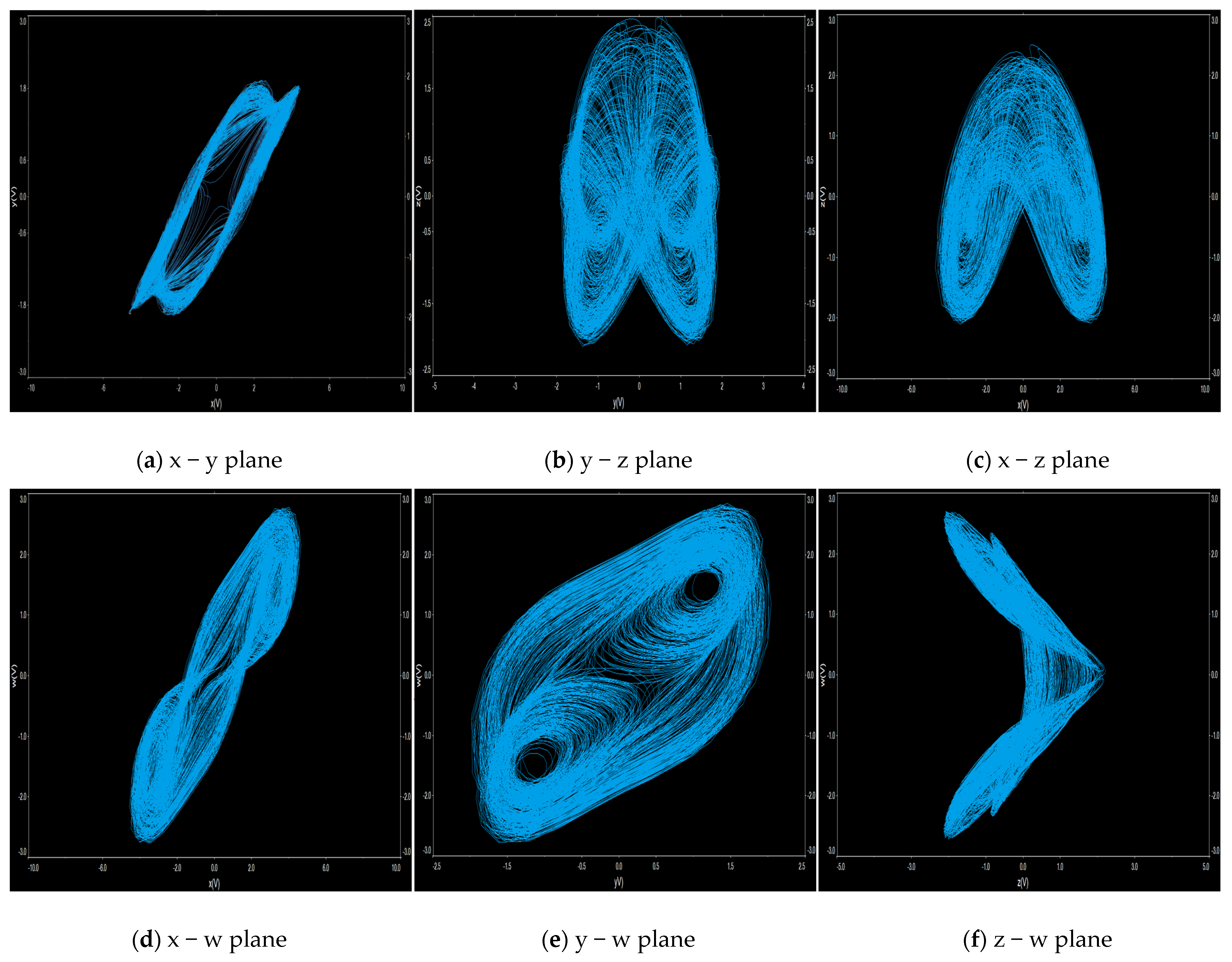
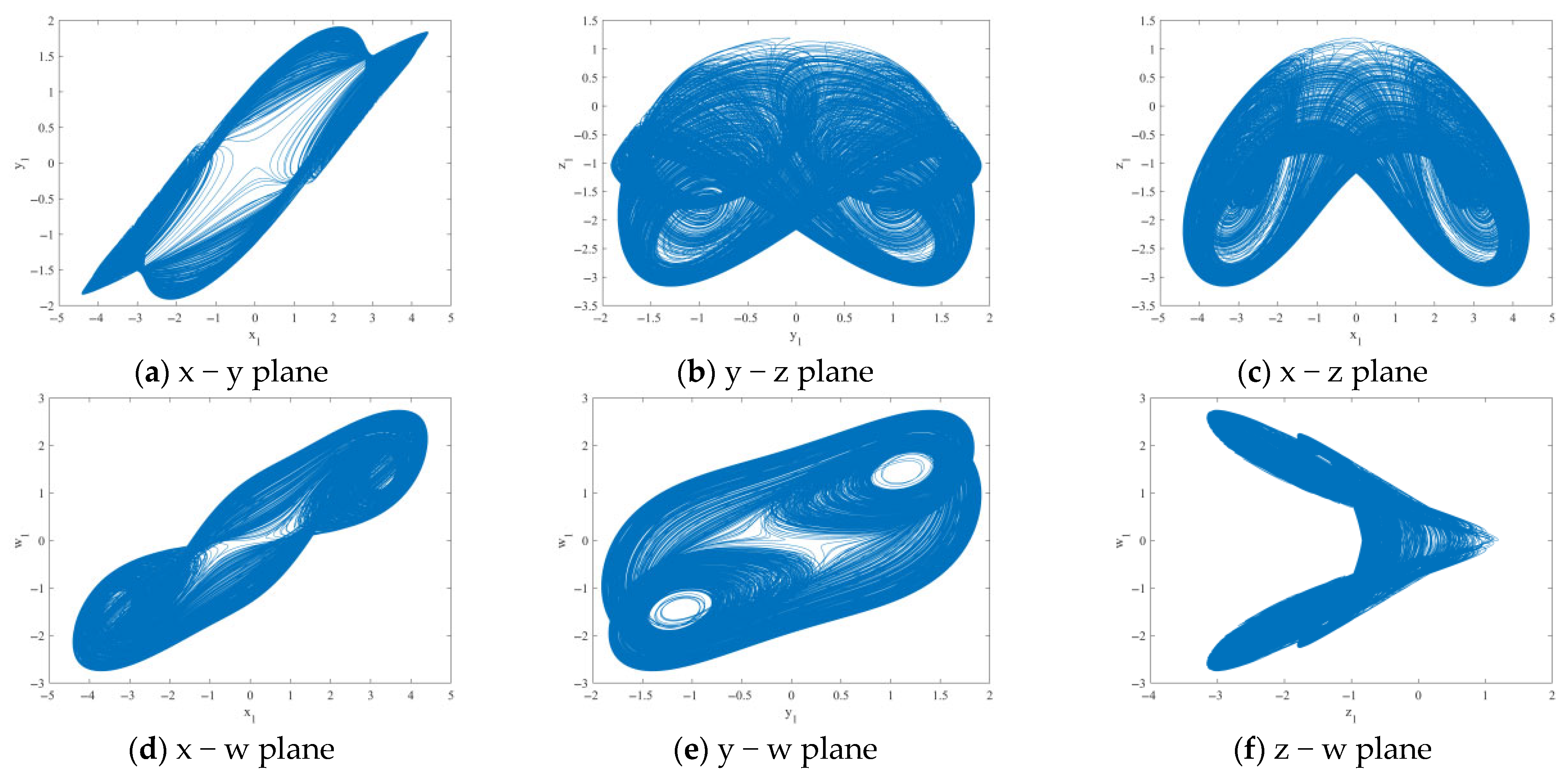
Phase portrait analysis is an effective means of directly observing the dynamical behavior of nonlinear systems. Therefore, researchers often construct phase portraits to visually determine system working status and dynamical characteristics, enabling rapid identification of system behavior without complex numerical calculations. This study is conducted under the conditions a = 1.6, b = 2.25, c = 1.2 with initial conditions (x(0), y(0), z(0), w(0)) = (2, 0, 0, 0). Figure 1 shows the two-dimensional phase diagram of the system.

2.2.2. Lyapunov Exponential Spectrum and Kaplan–Yorke Dimension Analysis

  • Lyapunov exponential spectrum
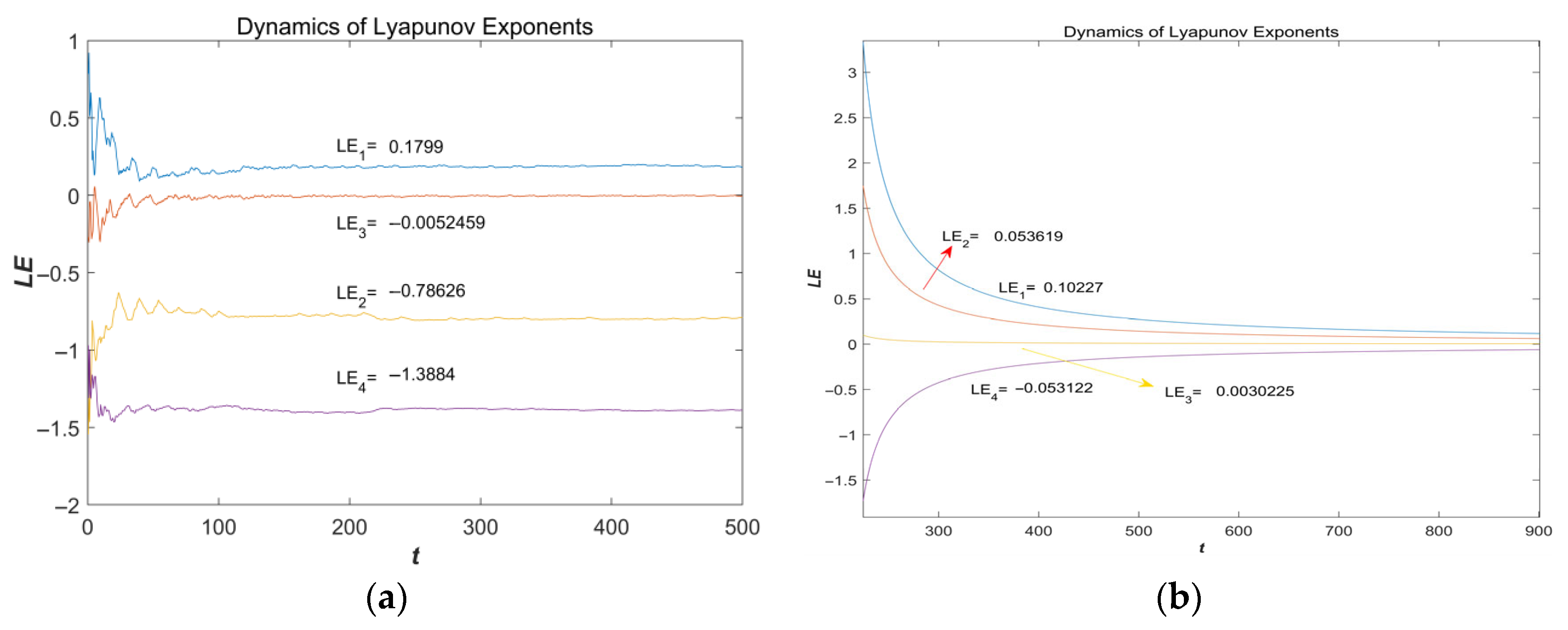
Figure 2a presents the Lyapunov exponent spectrum of the proposed system for a = 1.5, b = 2.25, c = 1.2 with initial conditions (x(0), y(0), z(0), ω(0)) = (2, 0, 0, 0). The obtained Lyapunov exponents are LE1 = 0.1799, LE2 = −0.78626, LE3 = −0.0052459, and LE4 = −1.3884. Since LE1 is positive, nearby trajectories diverge exponentially along at least one direction in the phase space, indicating sensitive dependence on initial conditions. Meanwhile, LE2 and LE4 are negative and LE3 is approximately zero, which is consistent with the behavior of continuous-time chaotic systems, where one exponent is typically close to zero. In addition, the sum of the Lyapunov exponents is negative, implying that the system is dissipative and that the overall motion is contracting in phase space, so trajectories remain bounded and evolve on an attractor—one of the key characteristics of dissipative chaotic systems.
Figure 2b shows the Lyapunov exponent spectrum for a = 0.5, b = 0.5, c = 2.5 with the same initial conditions (2, 0, 0, 0). The computed exponents are LE1 = 0.10227, LE2 = 0.052619, LE3 = 0.0030225, and LE4 = −0.053122. In this case, LE1 and LE2 are positive, LE3 remains very close to zero, and LE4 is negative. This indicates that under certain conditions, the system is capable of exhibiting hyperchaotic characteristics. This confirms that the system expands along at least two directions in phase space, leading to more complex dynamical behavior and a richer attractor structure.
2.
Kaplan–Yorke Dimension Analysis
The Kaplan–Yorke dimension is a commonly used measure to estimate the fractal dimension of a chaotic attractor from its Lyapunov exponent spectrum. For a continuous-time dynamical system, after sorting the Lyapunov exponents in descending order as λ1 ≥ λ2 ≥ … ≥ λn, the Kaplan–Yorke dimension is defined as:
D K Y = k + i = 1 k λ i | λ k + 1 |
where k is the largest integer satisfying i = 1 k λ i 0 . A fractional value of DKY indicates the fractal nature of the attractor, and a higher dimension implies richer dynamical complexity.
Based on the Lyapunov exponents presented, we computed the Kaplan–Yorke dimensions for two representative parameter sets.
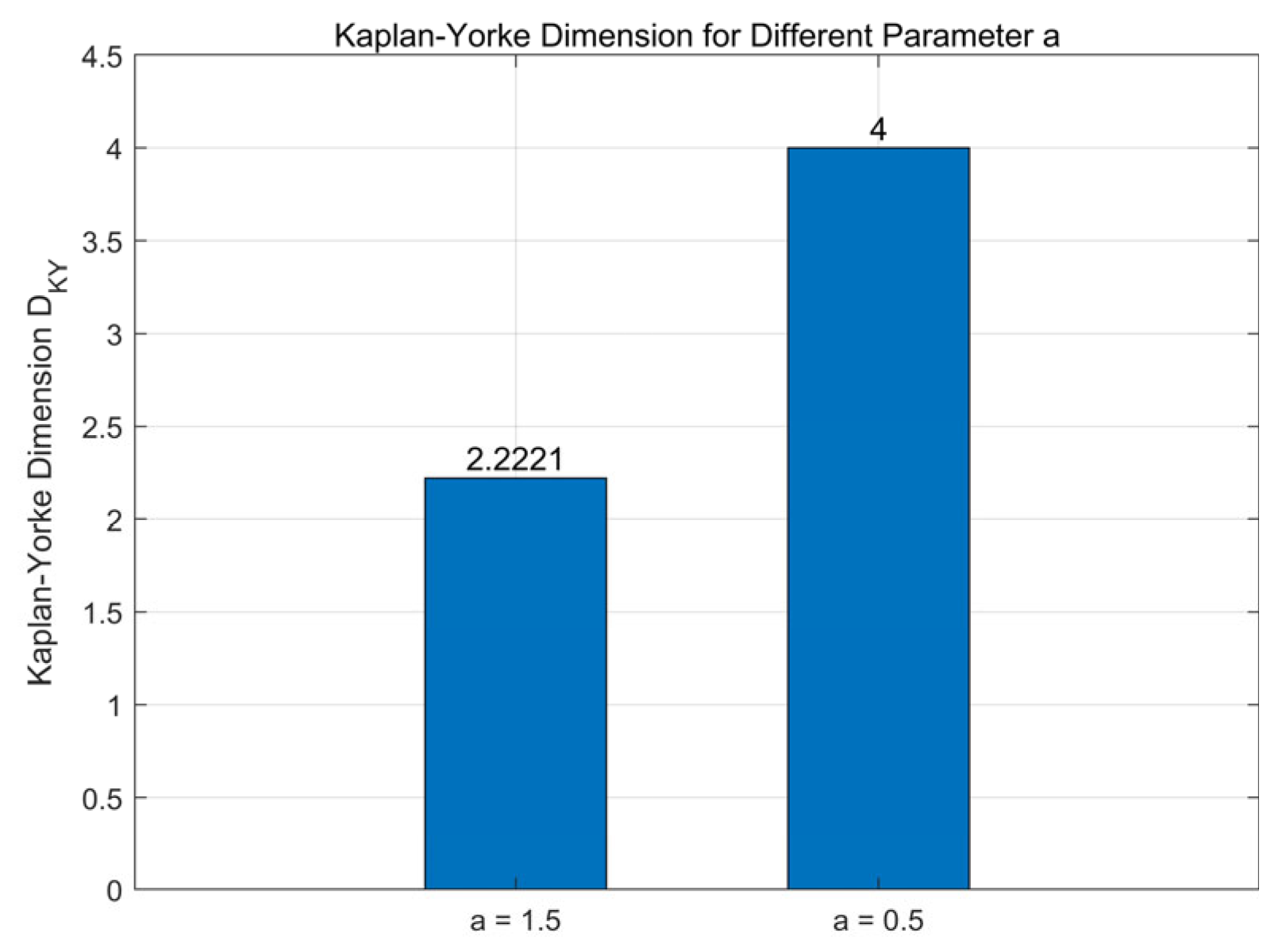
For (a = 1.5, b = 2.25, c = 1.2), we obtained DKY = 2.2221; (a = 0.5, b = 0.5, c = 2.5), we obtained DKY = 4.
Figure 3 presents a bar chart comparing the Kaplan–Yorke dimensions for these two cases. Both dimensions are fractional and exceed two, confirming that the attractor possesses a fractal structure and exhibits chaotic or hyperchaotic behavior. Notably, when a = 0.5, the Kaplan–Yorke dimension reaches a value of 4 in one of the cases, which is a key characteristic of conservative hyperchaotic systems, further confirming the hyperchaotic nature of the proposed system. These results further verify the rich dynamical behaviors of the proposed system and demonstrate its capability to generate highly complex chaotic sequences suitable for image encryption applications.

2.2.3. Bifurcation Diagram

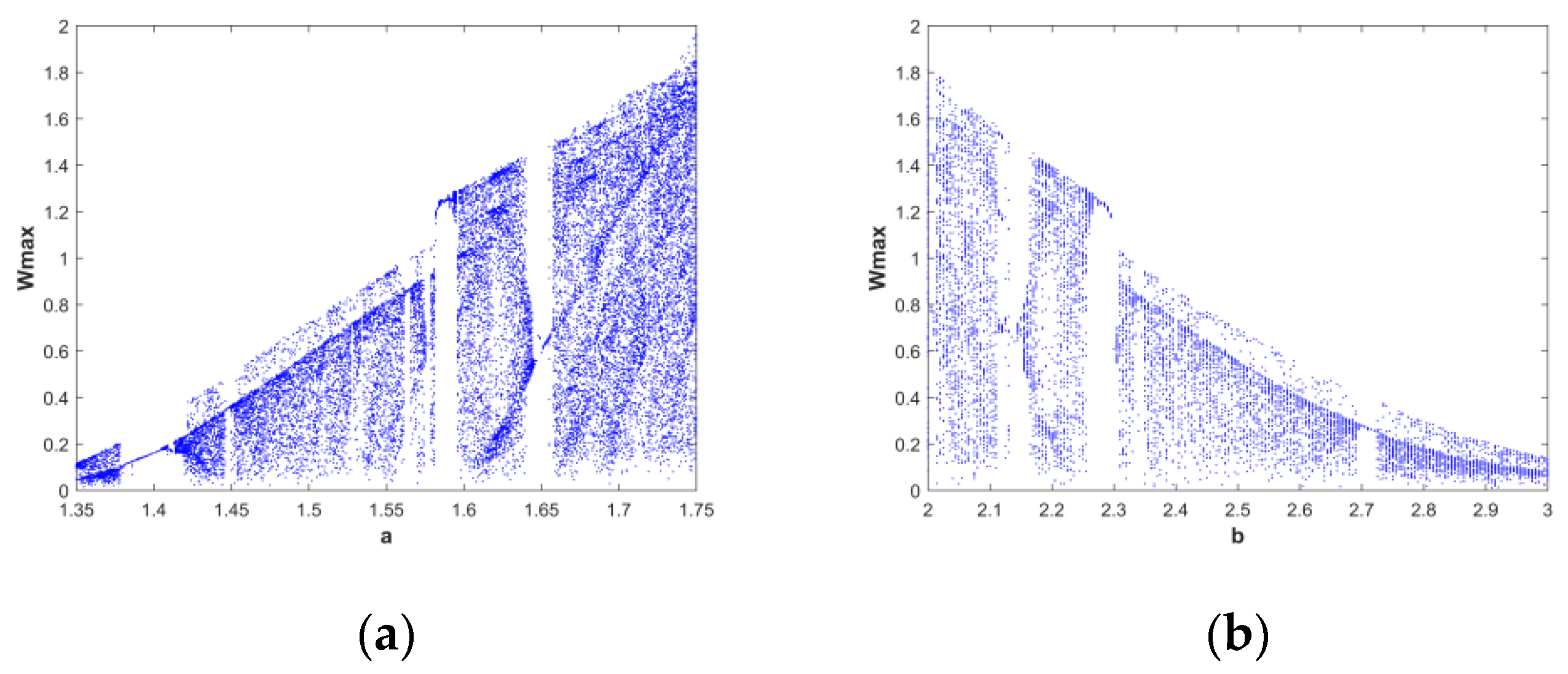
The bifurcation diagram a-wmax of the system with parameter a ∈ [1.35, 1.75], fixed parameters b = 2.25, c = 1.2 and initial conditions (x(0), y(0), z(0), w(0)) = (2, 0, 0, 0) is shown in Figure 4a. The bifurcation diagram shows a distinct chaotic—non-chaotic—chaotic state… At a ∈ [1.6, 1.64], b = 2.25, the system is in a chaotic state. The bifurcation diagram b-wmax obtained by the system with parameters b ∈ [2, 3], a = 1.6, c = 1.2, and the initial conditions (x(0), y(0), z(0), w(0)) = (2, 0, 0, 0) is shown in Figure 4b. As the value of b keeps increasing, the chaotic complexity of the system becomes lower and lower. It is a significant chaotic state when the system parameter b ∈ [2.2, 2.25] and a = 1.6.

2.2.4. Poincare Cross-Sectional View

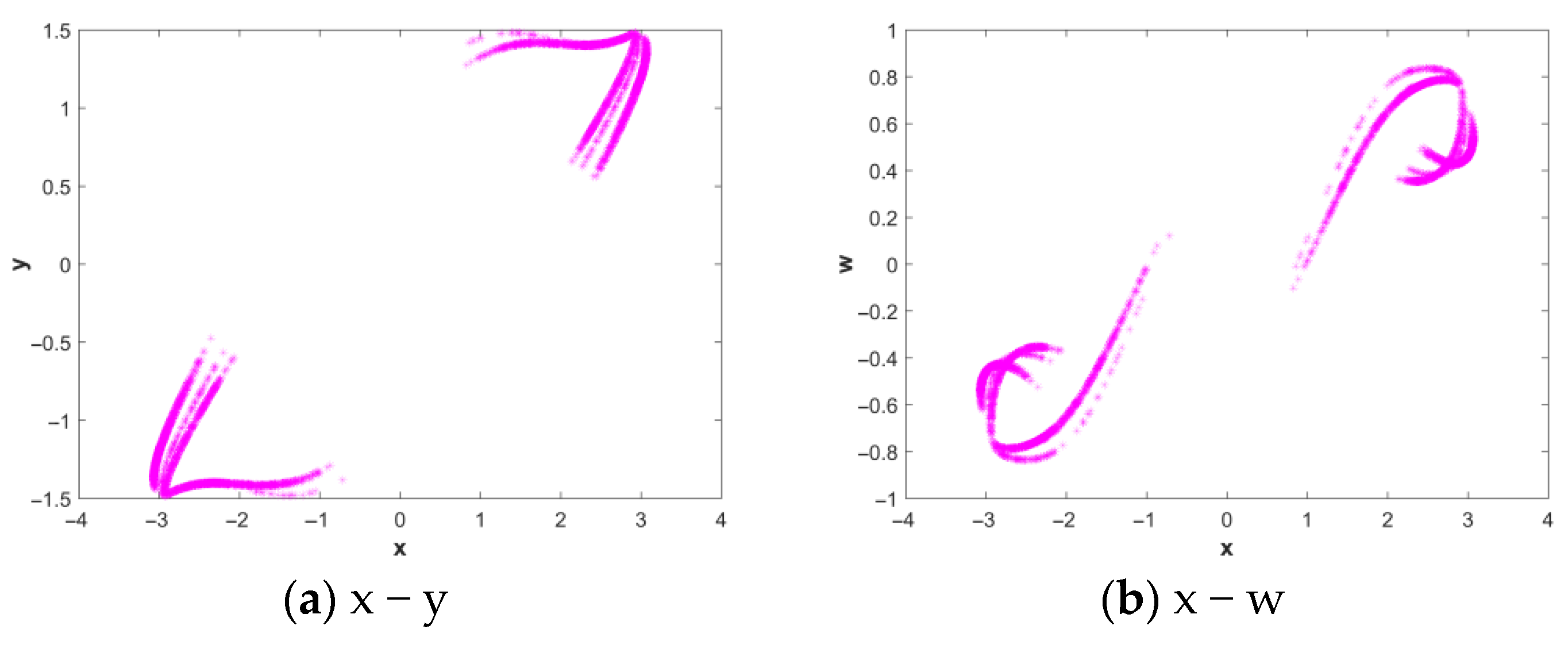
Figure 5 shows that the Poincare diagrams obtained for a = 1.6, b = 2.25, c = 1.2 and the initial conditions (x(0), y(0), z(0), w(0)) = (2, 0, 0, 0) are the Poincare diagrams of the proposed system (a) x − y, (b) x − w, where (a) is the Poincare graph of the x − y plane, and (b) is the Poincare graph of the x − w plane. The Poincare section shows a series of dense points with fractal structures in clusters, so the motion is chaotic.

2.2.5. Chaotic Transient

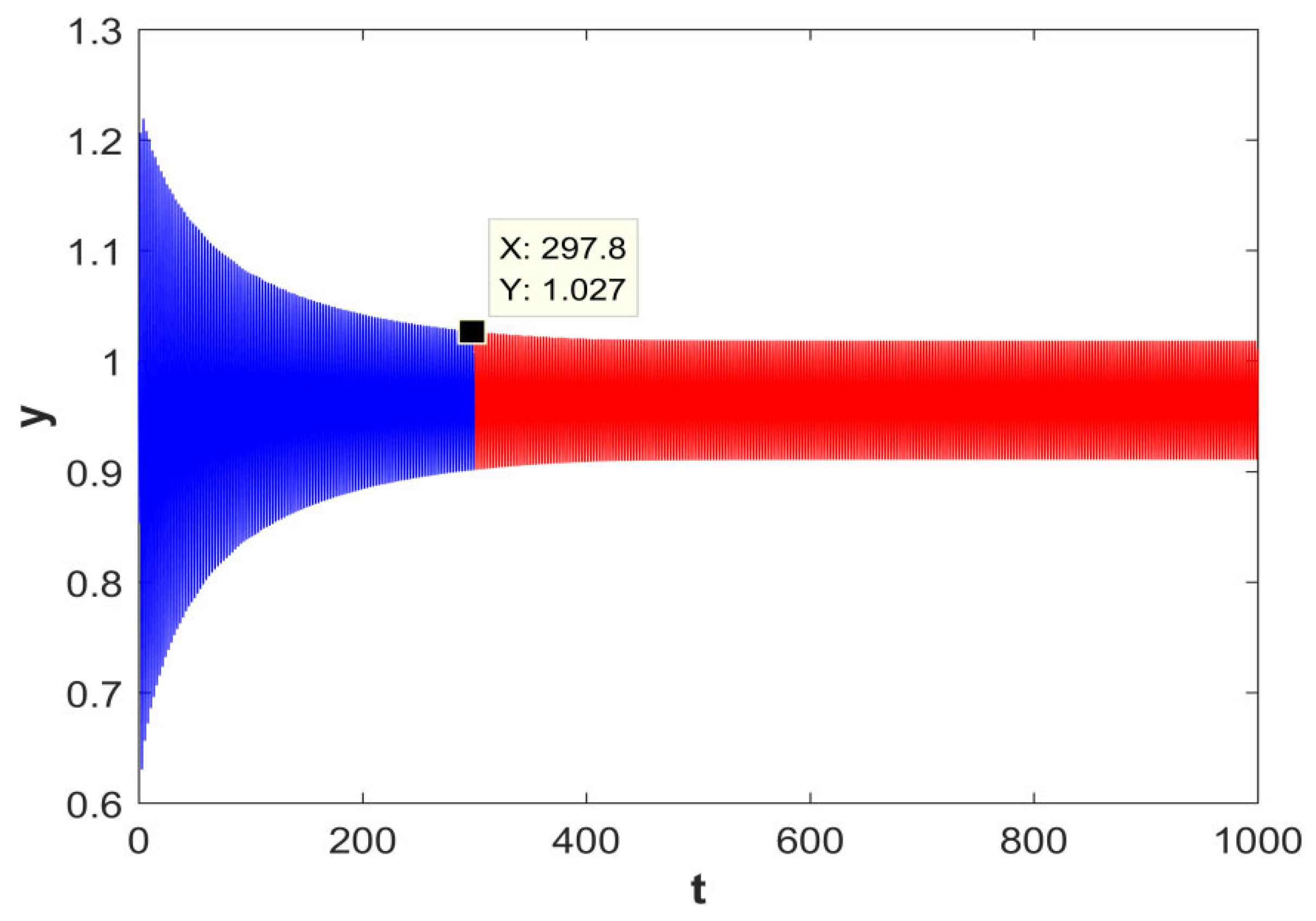
With the above parameter setting, the system displays a typical transient-chaos phenomenon: it behaves chaotically for a short time and then rapidly converges to a periodic orbit, an equilibrium point, or another attractor. This “chaos first, then sudden change” evolution indicates an unstable transition in the system dynamics.
Specifically, the parameters are set to (a = 1.2), (b = 2.7), and (c = 0.8), with initial conditions ((x(0), y(0), z(0), w(0)) = (2, 1, 0, 1)). The total simulation duration is 1000 s. As shown in Figure 6, the time series can be clearly divided into two stages, revealing an evident temporal difference between the chaotic regime and the subsequent periodic regime. According to the coordinates of the transition point marked in the figure, the system evolves in a chaotic state over (t ∈ (0, 297.8)), and then switches abruptly to a stable periodic state over (t ∈ (297.8, 1000)).

2.2.6. Multiple Attractors

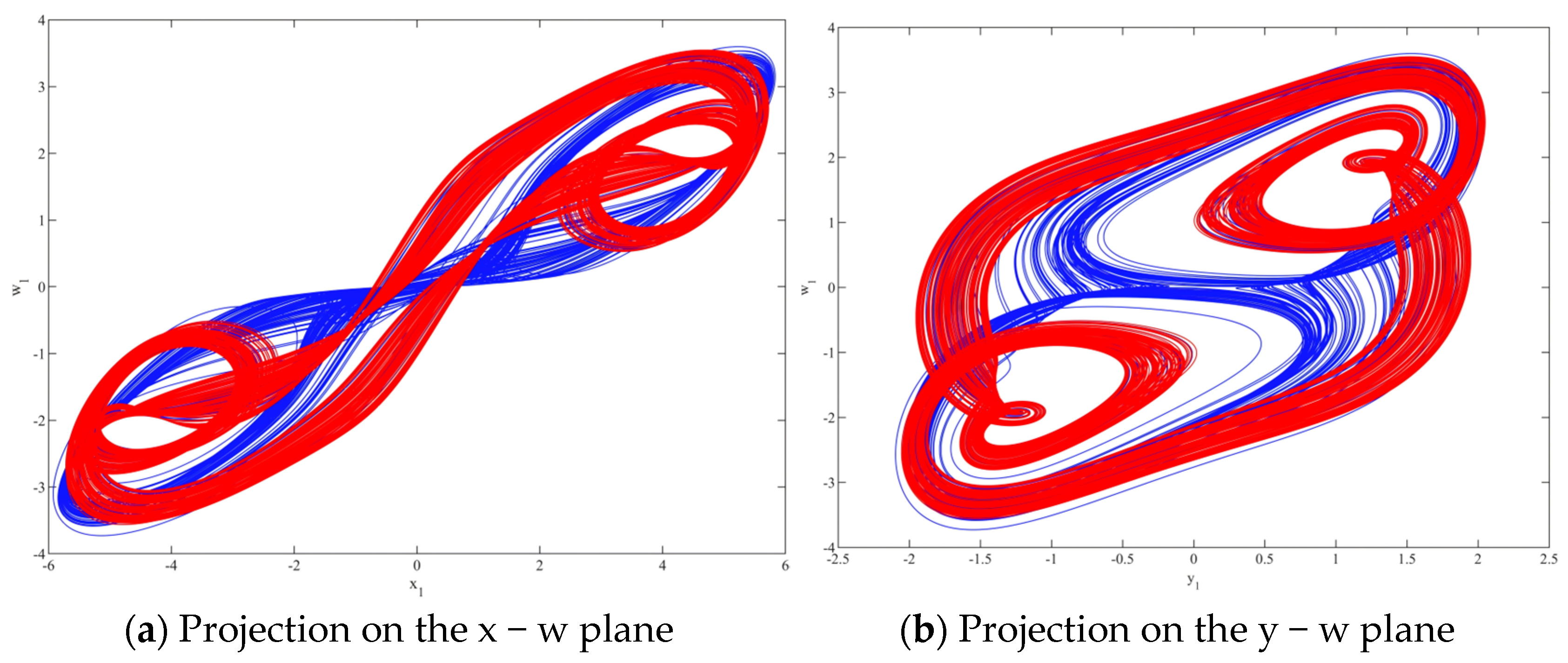
Based on the system parameters (a = 1.6, b = 2.25 and c = 3), Figure 7 illustrates the attractor projections on the x − w and y − w phase planes. In Figure 7, the blue trajectory (hidden attractor) is generated from the initial condition (2, 0, 0, 0), whereas the red trajectory is obtained from (0, 0.17, 0, 0). With changes in the system states and their corresponding parameter settings, the attractor trajectories exhibit pronounced transitions, indicating significant qualitative shifts in the system dynamics. Although the parameter variations are not symmetric, within a certain range, adjusting the parameters can produce attractor phase portraits with different scales while preserving similar trajectory patterns. In addition, when the first three components of the initial condition are fixed, varying only the fourth component for the red trajectory does not noticeably affect the resulting attractor, highlighting the system’s robustness and adaptability to perturbations in the initial state. Overall, these observations suggest that the system possesses multistability and is capable of generating multiple complex attractors that can coexist under the same parameter set.

2.2.7. Spectral Entropy Analysis

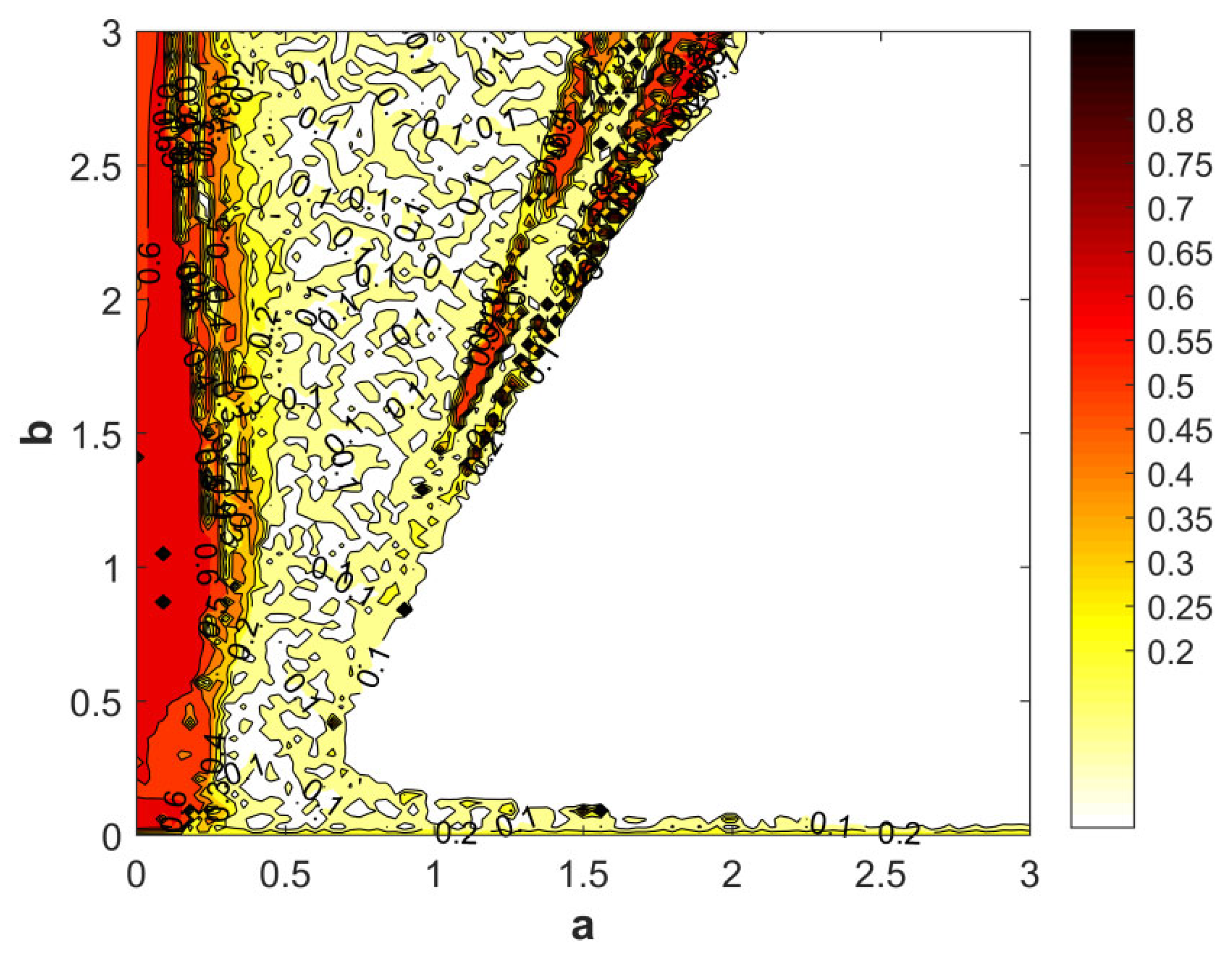
Spectral entropy (SE) plots are widely used in signal processing and nonlinear dynamics as a visual measure of complexity, capturing variations in a system’s chaotic intensity and information entropy across different parameter settings or time scales. With parameters fixed at (a ∈ [0, 3]) and (b ∈ [0, 3]), and (c = 1.2), the corresponding spectral entropy contour map is shown in Figure 8. In the figure, the dark-red regions exhibit SE values of approximately 0.8 and are broadly scattered, indicating a pronounced chaotic regime. The red regions correspond to SE values around 0.6 and display a more concentrated distribution, suggesting quasi-periodic behavior. The yellow regions, with SE values near 0.2, are highly continuous and concentrated, reflecting a periodic state. Overall, the spectral entropy varies with the parameter, implying that as the parameter increases, the system gradually loses entropy and becomes more regular: chaotic behavior weakens while stability is enhanced.

2.3. Circuit Design and Implementation

We will define a time variable τ , let τ = τ 0 t , τ 0 = 1 / R C . The new equation is obtained as follows:
d x d τ = 1 R C ( a 2 y z w ) d y d τ = 1 R C ( x b w ) d z d τ = 1 R C ( c x y z ) d w d τ = 1 R C ( y 3 w )
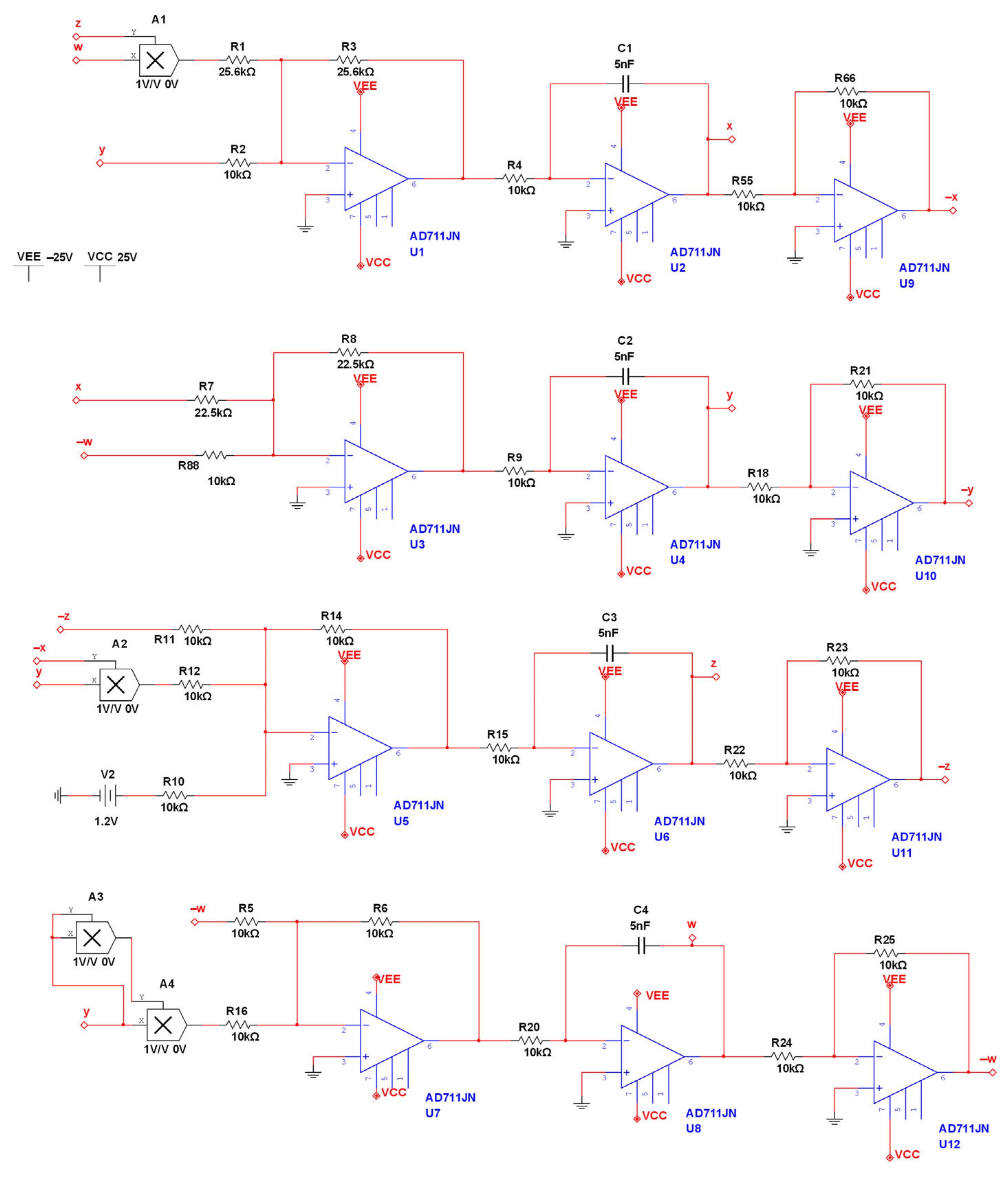
Based on the mathematical model of the system formula and in accordance with Kirchhoff’s law, we obtained the corresponding circuit schematic diagram as shown in Figure 9. In the schematic diagram, we used 12 AD711JN operational amplifiers, 4 MULTIPLIER multipliers, 25 linear resistors, 4 capacitors and a power supply (±25 V) (Analog Devices, Wilmington, MA, USA). For a = 1.6, b = 2.25, c = 1.2, according to circuit theory knowledge, the values of each component in the circuit are:
R_i = 10 kΩ, 4, 55, 66, 88, 9, 18, 21, 11, 10, 12, 14, 15, 22, 23, 5, 16, 6, 20, 24, 25(I = 2);
R_i = 25.6 kΩ(i = 1, 3, 7, 8), C_i = 5nF(i = 1, 2, 3, 4).
We use the software of Multisim 14.0 to build circuits. The experimental results are shown in Figure 10a–f. When a = 1.6, it is consistent with the numerical simulation results shown in the phase diagram.

3. Based on Hyperchaotic Systems and DNA-Encoded Telemetry Graph Encryption Algorithms

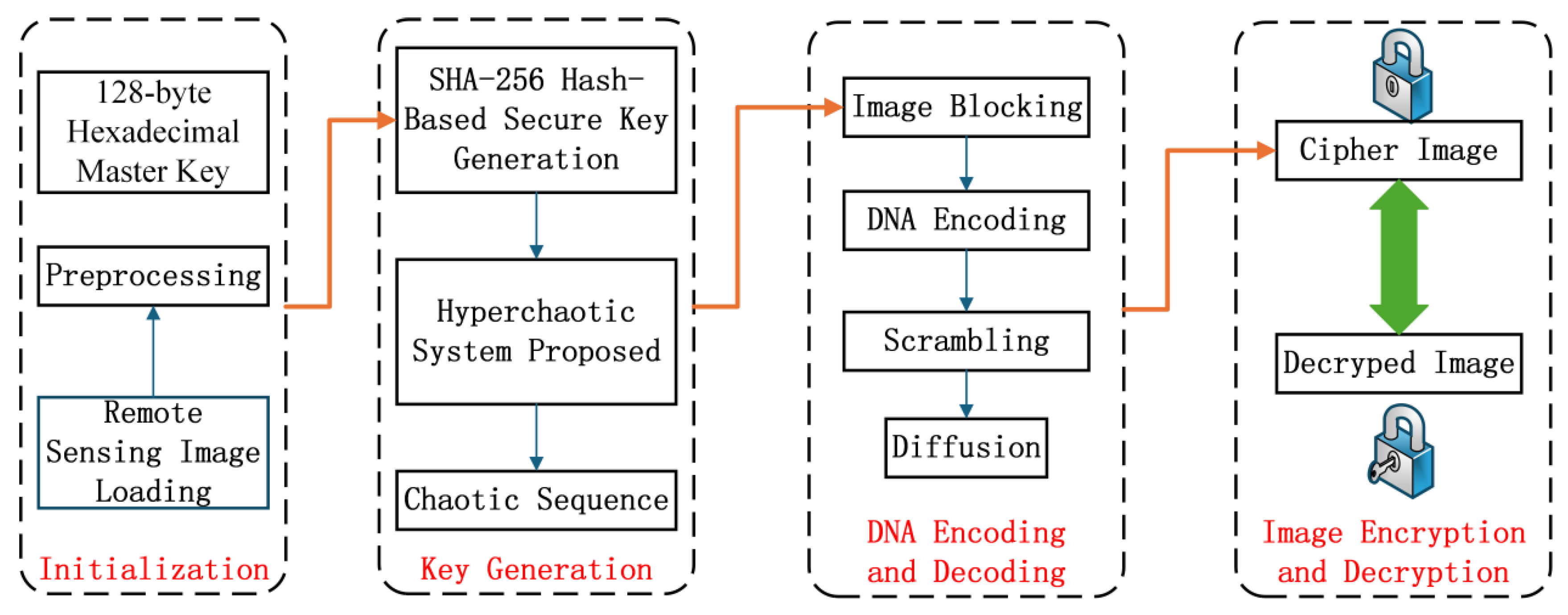
By integrating the proposed four-dimensional hyperchaotic system with DNA encoding and Secure Hash Algorithm 256 (SHA-256) hash technology, a highly secure encryption and decryption scheme tailored for remote sensing images is realized. The algorithm initiates with the preprocessing of a 128-byte hexadecimal master key, from which a cryptographically robust key is derived via the SHA-256 hash function; this key subsequently drives the hyperchaotic system to generate high-entropy chaotic sequences for cryptographic operations. The encryption pipeline encompasses image blocking, DNA encoding, scrambling (position permutation), and pixel diffusion, synergistically enhancing confusion and diffusion properties to resist cryptanalytic attacks. The decryption process reverses these procedures—including DNA decoding, inverse scrambling, and inverse diffusion—to ensure lossless recovery of the original remote sensing image. Figure 11 depicts the algorithm flowchart, and detailed elaboration of each phase is provided in subsequent sections.

3.1. Data Initialization and Image Preprocessing

In the key and image loading stage, a 128-bit hexadecimal key is first defined. This key serves as the core credential for encryption and decryption processes, providing the initial security parameter for the entire system. Subsequently, the original RGB image is loaded through the image reading function. Unlike traditional two-dimensional images, RGB images are multi-channel. Functions are employed to determine the numbers of rows (M), columns (N), and channels, thereby clarifying the basic dimensional information. Generally, the image comprises three channels: R, G, and B. To meet the processing requirements of subsequent encryption algorithms, the original image is converted into double-precision format, and data from each channel are extracted as the plaintext for encryption, laying the foundation for subsequent operations.

3.2. Key Generation

3.2.1. Hash Algorithm

In the key processing stage, the system binds image features with the key through multi-level hash operations, generating a 256-bit hash value with strong randomness [26]. The final key is produced through base conversion and XOR operations. The specific steps are as follows:
Step 1: Calculate the feature values of the image
Perform summation operations on the rows, columns, and diagonals of the image. Sum the image matrix by rows to obtain the column vector SumRow and sum the image matrix by columns to obtain the row vector SumCol, which is then transposed to a column vector. Use spdiags and rot90 to extract the diagonal elements of the image and sum them. The formula is:
S u m R o w = j = 1 N PlainImg ( i , j ) M × 1 , i [ 1 , M ] S u m C o l = i = 1 M PlainImg ( i , j ) 1 × N , j [ 1 , N ] S u m D i a g = ( spdiags ( rot 90 ( PlainImg ) ) )
Among them, PlainImg(i, j) represents the pixel values of the i-th row and j-th column of the image, rot90 indicates a 90° rotation of the image, and spdiags indicates the extraction of diagonal elements.
Step 2: Multi-level hash mixing
The first level first calculates the Message-Digest Algorithm 5 (MD5) hash for the row sum, column sum, and diagonal sum (SumDiag), respectively. The second level concatenates three MD5 hash values and calculates the SHA-256 hash to obtain the hash value of a 256-bit binary number.
Step 3: Base system conversion
Convert the 128-bit hexadecimal master key to a binary sequence and convert every 8 bits of binary to a decimal number to obtain the decimal array HEXD (with 16 elements). Then perform the same transformation on the 256-bit hash value obtained in Step 2 to obtain the decimal array HashD (with 32 elements). To solve the inconsistency in the length of the two arrays, we extend HEXD to 32 elements by repeated concatenation to align its dimension with HashD before performing subsequent operations.
Dimension alignment preprocessing: Since the number of elements in HEXD (16 elements) is inconsistent with that in HashD (32 elements), we extend HEXD to 32 elements by repeating and concatenating it twice, so that its dimension is consistent with HashD. After the dimension alignment, the XOR operation can be performed normally.
Step 4: XOR mixing generates the final key KeyD
Perform the XOR operation on the two decimal arrays in Step 3, and the formula is as follows:
K e y D = H E X D H a s h D
Step 5: Extract the key feature KeyF
The global eigenvalues are calculated through bitwise XOR, and the formula is as follows:
K e y F = K e y D 1 K e y D 2 K e y D n
In Equation the variable n represents the total number of segmented keys KeyD involved in the bitwise XOR operation. Its value is jointly determined by the algorithm design and the input data dimension: in the proposed scheme of this paper, n is equal to the number of key segments generated by the iteration of the chaotic system, or equivalently the dimensional length of the hash output result. It indicates that all n segmented keys are sequentially subjected to bitwise XOR operation and finally merged to obtain the global feature key KeyF.

3.2.2. Generation of Chaotic Sequences

The four-dimensional hyperchaotic system proposed in this paper has undergone extensive analysis and verification in preceding sections. It is a high-dimensional chaotic system exhibiting complex dynamical behavior, extreme sensitivity to initial conditions (butterfly effect), and generating sequences with favorable pseudo-randomness. Consequently, this system is employed to generate pseudo-random sequences. The differential equations of Equation (2) are described as:
d x d t = a 2 y + z ω d y d t = x b ω d z d t = c x y z d ω d t = y 3 ω
Among them, a = 1.6, b = 2.25, and c = 1.2.
The next step is to discretize the iterative formula, which can be achieved through Euler discretization:
x ( i ) = α 2 y ( i 1 ) + z ( i 1 ) ω ( i 1 ) y ( i ) = x ( i 1 ) b ω ( i 1 ) z ( i ) = c x ( i 1 ) y ( i 1 ) z ( i 1 ) ω ( i ) = y ( i 1 ) 3 ω ( i 1 )
The global key feature value KeyF is mixed and calculated with the decimal key segment data dk extracted from the master key to generate the initial value. The mixing formula is as follows:
x ( 1 ) = k = 1 8 d k K e y F 256 y ( 1 ) = k = 9 16 d k K e y F 256 z ( 1 ) = k = 17 24 d k K e y F 256 ω ( 1 ) = k = 25 32 d k K e y F 256
During chaotic sequence generation, state variable values produced by system iteration may be unevenly distributed. Normalizing the value range maps the chaotic sequence to the interval [0, 1), while an amplification factor prevents decimal precision loss and ensures uniformity and randomness in subsequent quantization. The formula is as follows:
x norm ( i ) = ( x ( i ) × 10 4 ) x ( i ) × 10 4 y norm ( i ) = ( y ( i ) × 10 4 ) y ( i ) × 10 4 z norm ( i ) = ( z ( i ) × 10 4 ) z ( i ) × 10 4 ω norm ( i ) = ( ω ( i ) × 10 4 ) ω ( i ) × 10 4
Here, it indicates rounding down.
The normalized value is used to quantify the generated key stream key:
k e y = mod 4 × x norm ( i ) y norm ( i ) z norm ( i ) ω norm ( i ) , 4
Among them, key ∈ {0, 1, 2, 3}, corresponding to the DNA bases encoding A, C, G, and T.

3.3. DNA Encoding and Decoding Algorithm

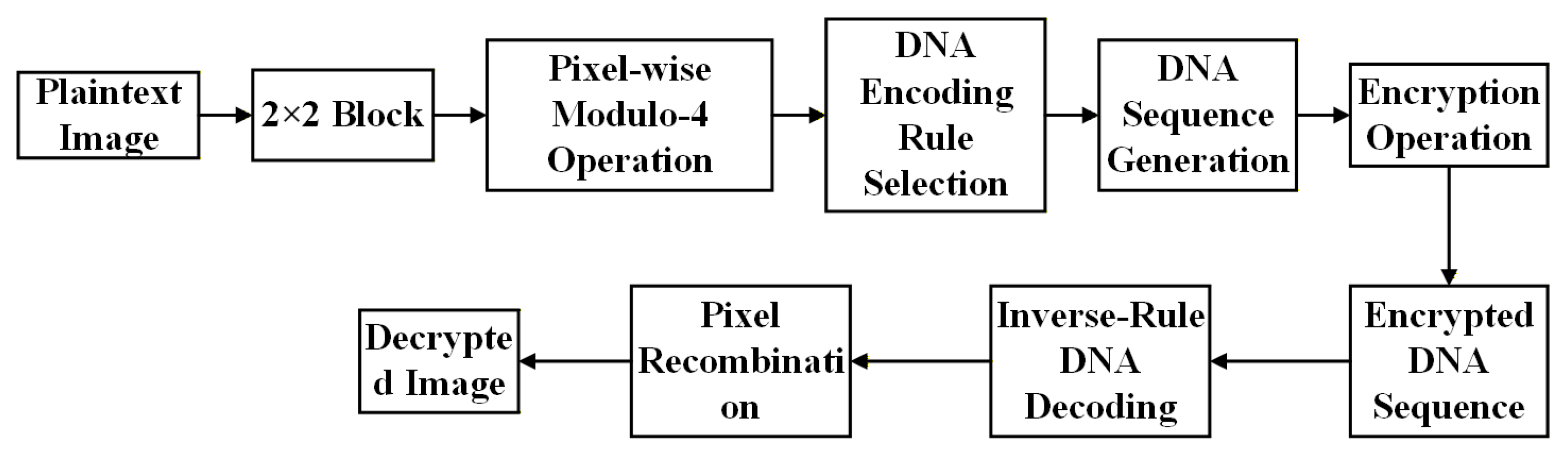
DNA-based image encryption is a technique that first maps pixel values of digital images into DNA base sequences (A, C, G, T), then employs DNA operation rules and chaotic systems to perform scrambling and diffusion and finally decodes sequences back to pixel values. This process comprises four key stages: block processing, dynamic rule selection, base mapping, and diffusion. The algorithm flowchart is shown in Figure 12.

3.3.1. Base Coding Rules

The core of DNA encoding and decoding is to map binary data to a combination of four bases. Since each base can represent two-bit binary information (00, 01, 10, 11), there are multiple possible mapping relationships. Theoretically, there are a total of 4! = 24 possible combinations of the four bases, but in practical applications, 8 standard coding rules are usually adopted, as shown in Table 1.

3.3.2. Encoding Process

DNA encoding is the process of converting plaintext data slices into DNA sequences, that is, encrypting the image and dividing the M × N image matrix into 2 × 2 sub-blocks:
Among them, px,y represent the pixel values of the original image at the coordinates (x,y). For a 512 × 512 image, 65,536 DNA-encoded blocks will be generated.
B i , j = p 2 i , 2 j p 2 i , 2 j + 1 p 2 i + 1 , 2 j p 2 i + 1 , 2 j + 1 , 0 i < M 2 0 j < N 2
According to Table 1, the system has predefined 8 DNA coding rules, and the rule selection formula is provided:
R u l e I D = mod K e y F , 8 + 1
According to the rule formula, encode each pixel value p:
D N A ( p ) = A , if   mod ( p , 4 ) = 0 T , if   mod ( p , 4 ) = 1 C , if   mod ( p , 4 ) = 2 G , if   mod ( p , 4 ) = 3

3.3.3. Decoding Process

This process can be understood as the reverse process of DNA encoding, reversing the DNA sequence back to pixel values. First, convert the DNA sequence into a numerical map and then reverse map it according to the rules used during encryption to obtain the following formula:
p = 0 , if   D N A = A 1 , if   D N A = T 2 , if   D N A = C 3 , if   D N A = G
Then convert the obtained quaternary sequence into decimal pixel values and reorganize the data image through rules.

4. Performance Analysis of Image Encryption Algorithms

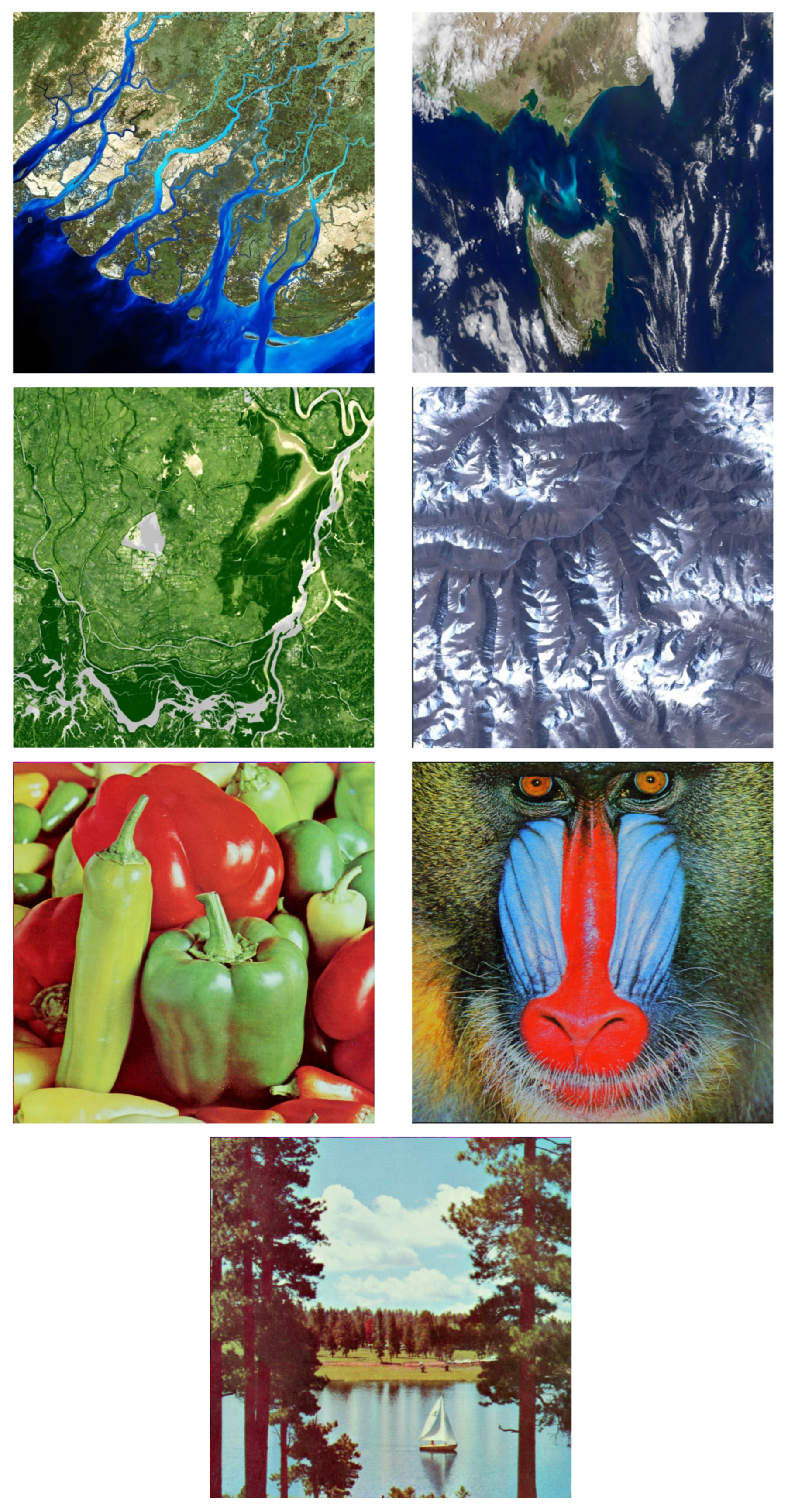
To verify the effectiveness and performance of the above-mentioned algorithm, this paper will conduct an analysis from several aspects such as histogram, information entropy, correlation, NPCR, UACI, and PSNR. Firstly, the images are encrypted through the above algorithm. The resolutions of the original images, including Sea, Meteorology, Vegetation, Land, Pepper, Baboon, and Sailboat, are all 512 × 512. The image data sources are all publicly available data on the Internet. The unprocessed original images are shown in Figure 13:

4.1. Histogram Analysis

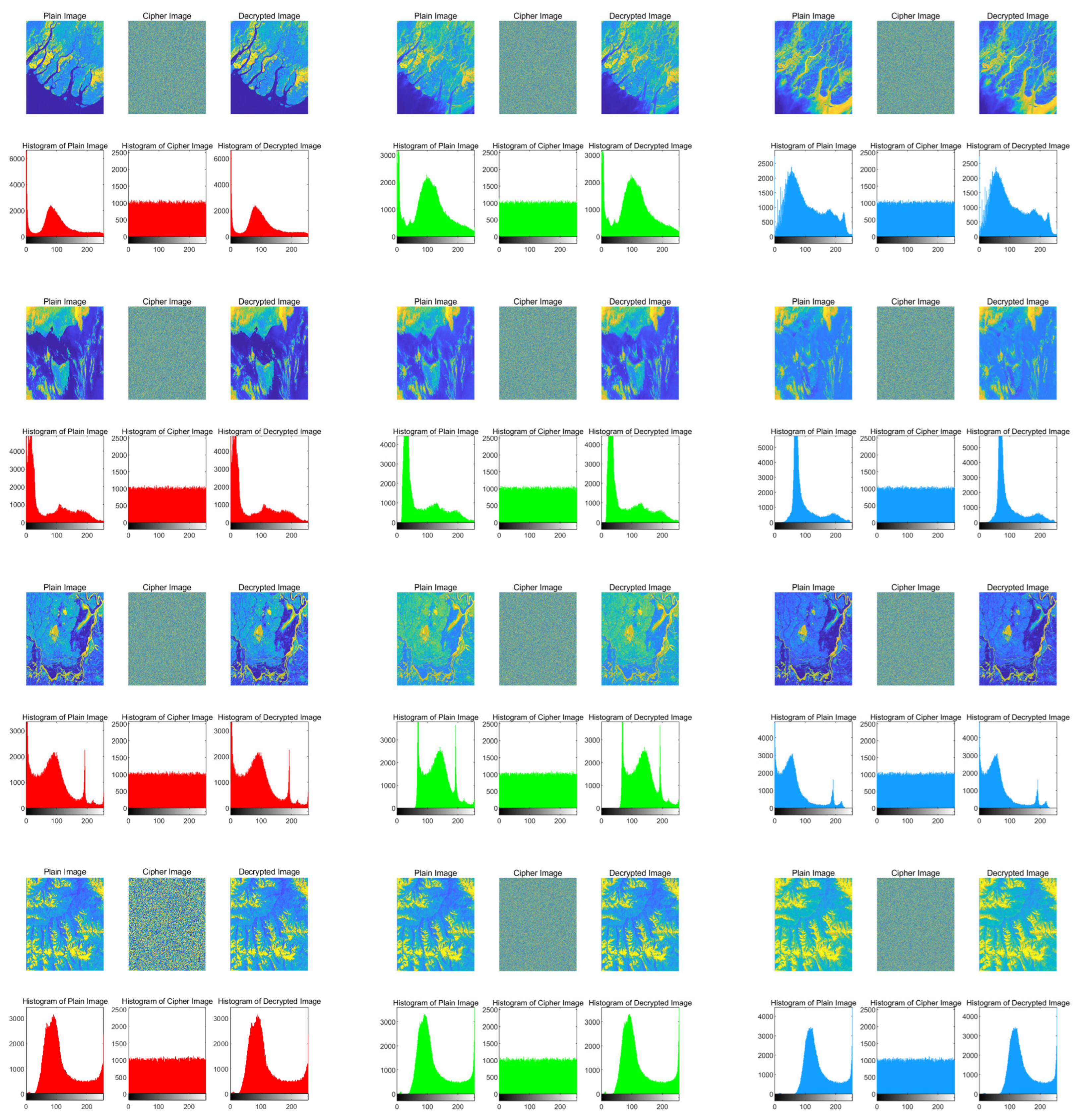
A histogram is a statistical tool that reflects data distribution patterns, visually displaying the distribution of quality characteristics and facilitating overall analysis. Generally, histograms of encrypted images should be uniformly distributed, whereas those of original images exhibit non-uniform distributions. Therefore, this study performs histogram calculations on original, encrypted, and decrypted images of the following RGB image groups. First, each image is separated into three channels: R, G, and B, as shown in Figure 14. The figure demonstrates that pixel value distributions of encrypted images are relatively uniform, while histogram distributions of decrypted images are highly similar to those of original images. This indicates that the proposed algorithm resists statistical attacks and restores images effectively.

4.2. Correlation Analysis

There is a high degree of correlation among pixels in plaintext images. Through encryption algorithms, this correlation can be reduced. Ideally, the encryption correlation should be 0, that is, the closer the correlation is to 0, the better the effect. Suppose N i = 1 , 2 , , N pairs of adjacent pixels are randomly selected in the image. The calculation formula for the correlation coefficient between the gray value u = u i and v = v i is as follows:
r x y = cov u , v D u D v cov u , v = 1 N i = 1 N x i E u y i E v D u = 1 N i = 1 N u i E u 2 E u = 1 N i = 1 N u i
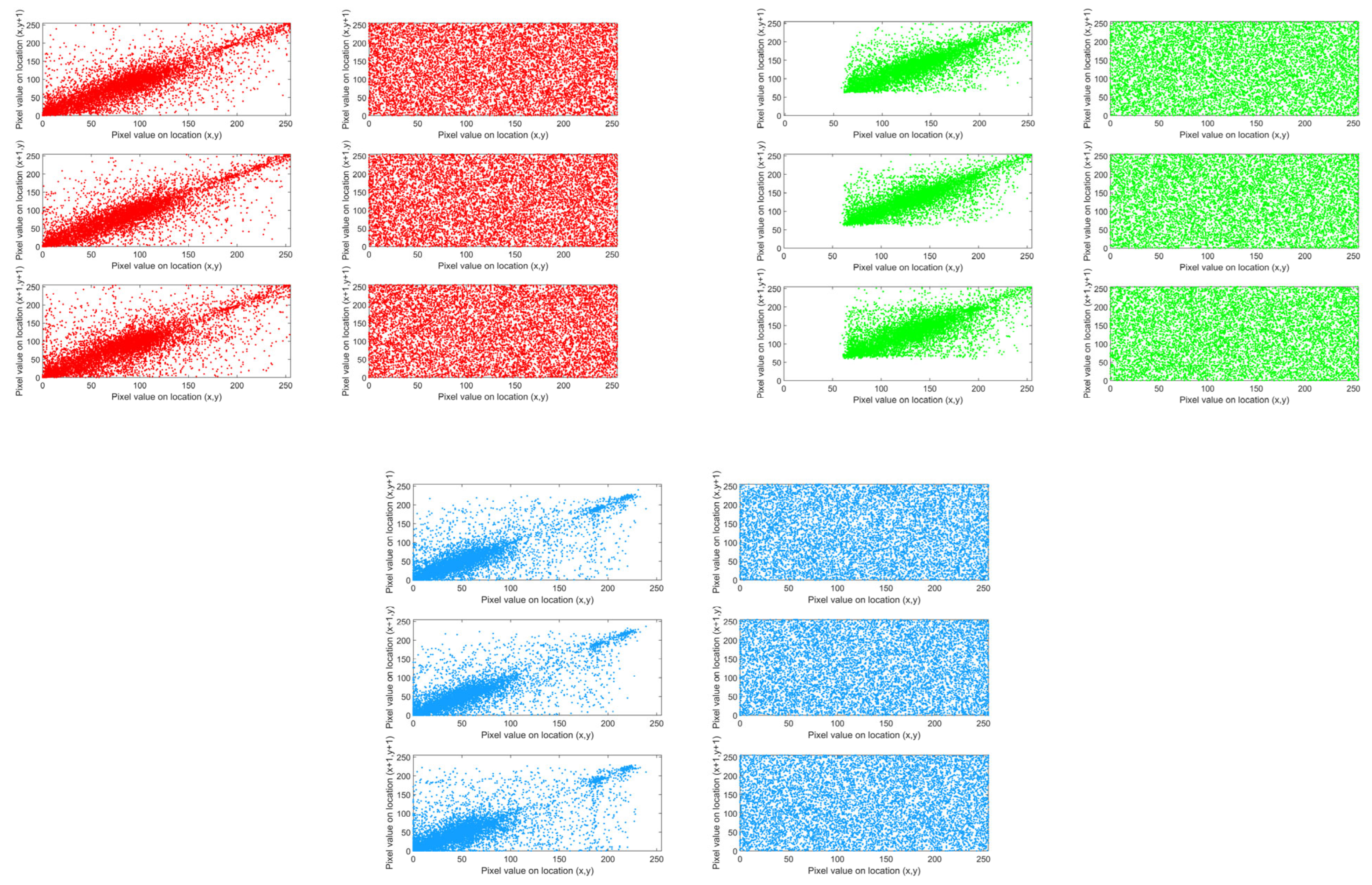
Based on the above formula, the images before and after encryption were calculated and analyzed. Taking the Vegetation image as an example, the correlations of these pixels in three directions (horizontal, vertical and diagonal) were studied. Figure 15 clearly shows the changes in the correlation of adjacent pixels before and after image encryption in the R, G, and B channels in these three directions. The analysis results clearly indicate that the unencrypted original image shows strong pixel correlation in the horizontal, vertical, and diagonal directions. After encryption, the correlations in all three directions decreased significantly.
Table 2 provides a detailed comparison of correlation coefficients for the images (Ocean, Climate, Vegetation, Land, Pepper, Baboon, and Sailboat) before and after encryption across three dimensions: horizontal, vertical, and diagonal. The data demonstrate that correlation coefficients in all directions approach 1 prior to encryption, indicating highly regular and predictable pixel distributions. However, after encryption using the proposed chaotic system, these coefficients are significantly reduced, approaching 0. This indicates that correlations in all directions have been effectively disrupted, and pixel distributions tend toward randomness, resisting statistical inference. The significant reduction in correlation coefficients demonstrates that the chaotic system effectively disrupts pixel correlations and enhances image randomness, thereby preventing information leakage.

4.3. Information Entropy Analysis

Image information entropy is a key indicator for quantifying the richness of image information. It is based on the concept of entropy in information theory and is used to evaluate the randomness and uncertainty of the distribution of image pixel values. This indicator reflects the complexity of the information contained in the image by analyzing the statistical characteristics of the grayscale or color values of the image: the higher the entropy value, the more uniform the distribution of pixel values, and the richer the information contained in the image. The lower the entropy value, the more concentrated the displayed pixel values tend to be, and the higher the information redundancy. Its calculation process consists of four core steps: (1) Establishing a probability distribution model of pixel values; (2) Calculate the amount of information at each gray level; (3) Obtain the expected value of the amount of information; (4) The final calculation is carried out through the Shannon entropy formula, where P(xi) represents the occurrence probability of each gray level. This indicator has significant application value in fields such as image encryption, compression and quality assessment.
H ( X ) = i = 1 n p ( x i ) log 2 p ( x i )
As shown in Table 3, comparison of information entropy before and after encryption reveals a clear trend: encrypted images exhibit significantly higher entropy than original images. This indicates that the encryption process effectively enhances uniformity in pixel value distribution, thereby increasing information capacity. Increased entropy is an important indicator of encryption quality, as it reflects uncertainty and randomness, playing a crucial role in preventing information leakage and enhancing security. The entropy values achieved by the proposed algorithm are significantly superior to those of existing schemes reported in the literature. Consequently, attackers can hardly capture useful information from statistical features, providing stronger security protection for image data.

4.4. Analysis of Differential Attack

Differential attack is an important technique in cryptanalysis. Its core principle involves compromising the encryption mechanism by observing response characteristics of the encryption system to subtle input data modifications. In image encryption, this attack manifests as the attacker deliberately modifying local pixels (typically single or a few pixels) of the original image and inferring statistical characteristics of the encryption algorithm by comparing differences between images before and after encryption.
To quantitatively evaluate encryption algorithm resistance to differential attacks, researchers have proposed two key indicators:
(1)
Pixel change Rate (NPCR): This indicator precisely calculates the proportion of changes in the corresponding pixel values of the image before and after encryption. The higher the NPCR value, the stronger the sensitivity of the encryption algorithm to input changes, and the better the algorithm’s ability to resist differential attacks.
(2)
Uniform Attack Coefficient Index (UACI): As a supplementary indicator to NPCR, UACI not only examines the proportion of pixel value changes but also comprehensively considers the amplitude of pixel value changes and the degree of alteration in the overall image structure, thereby providing a more comprehensive security assessment.
The ideal values of NPCR and UACI are 0.9961 and 0.3346, respectively, and the specific calculation formulas are as follows:
NPCR = 1 M × N i = 1 M j = 1 N D ( i , j ) × 100 %
UACI = 1 M × N i = 1 M j = 1 N | C 1 ( i , j ) C 2 ( i , j ) | 255 × 100 %
Table 4 compares the NPCR and UACI values of different images (Sea, Meteorology, Vegetation, Land, Pepper, Baboon, and Sailboat) under 1-bit and 2-bit differential attacks. The results show that the NPCR values of all images in the RGB three channels are close to the ideal value of 0.9961, indicating that the encryption algorithm is highly sensitive to input changes and has strong diffusivity. The UACI value is stable at around 0.334, close to the theoretical optimal value of 0.3346, indicating that the algorithm can evenly distribute the intensity of pixel variation and effectively resist differential attacks. It is worth noting that the NPCR and UACI modified by 2-bit are comparable to those of 1-bit, and in some cases, the values are even better, further verifying the robustness of the algorithm against larger disturbances. Overall, this encryption scheme demonstrates excellent resistance to differential attacks in both attack modes, meeting strict security requirements.
Table 5 shows the NPCR and UACI values of other encryption algorithms. Compared with the algorithm proposed in this paper, both NPCR and UACI have their own advantages and disadvantages. However, the algorithm proposed in this paper is relatively close to the ideal values under both parameters, with balanced performance.

4.5. Analysis of Clipping Attack and Salt-and-Pepper Noise Attack

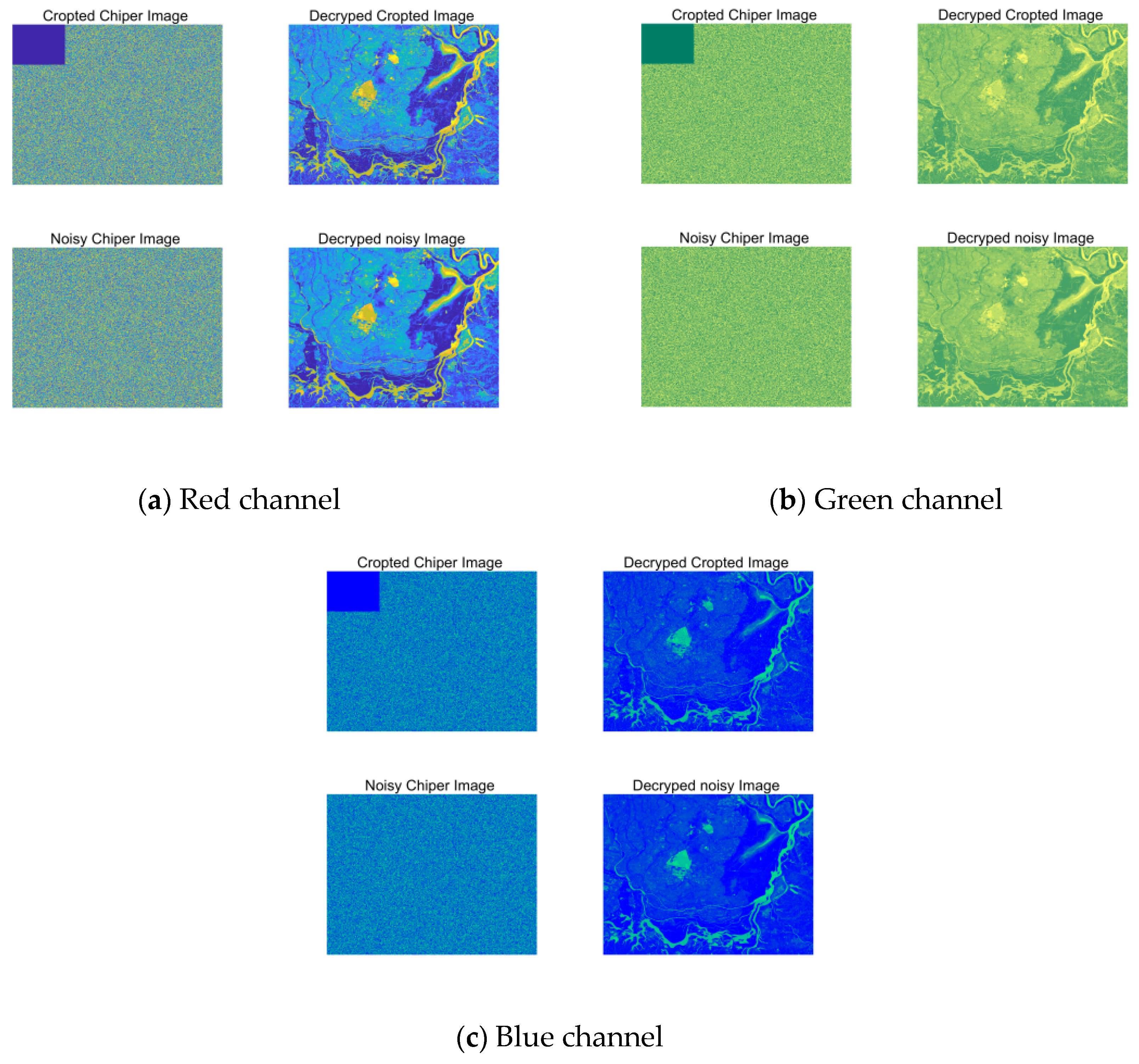
Cropping attack is a structured occlusion attack. Its essence involves artificially inducing local integrity damage to image data by applying spatial domain masking operations to the ciphertext. Specifically, attackers force pixel values in specific ciphertext regions to zero according to a preset cropping ratio, thereby simulating data packet loss or malicious tampering during transmission or storage. The core of this attack lies in testing the redundant protection capability of the encryption algorithm for image structural information—that is, whether the decryption process can restore recognizable original content by exploiting the algorithm’s diffusion mechanism and key sensitivity when prominent ciphertext regions are removed.
Salt-and-pepper noise attack is a random impulse interference attack. Its mechanism involves injecting sparsely distributed extreme impulse noise into the ciphertext to simulate sudden channel errors or sensor failures. Mathematically, this attack is represented as a random process driven by a probability density function, where the noise density parameter directly determines the spatial distribution of contaminated pixels.
The peak signal-to-noise ratio (PSNR) is an objective metric for measuring image or signal quality. It assesses quality loss by comparing differences between the original and reconstructed images. PSNR serves here as a quantitative indicator of anti-noise performance: higher values indicate stronger ability to suppress random impulse interference and higher decrypted image fidelity. This study conducts simulation experiments using a cropping attack with ratio 1/16 and salt-and-pepper noise attack with density parameter 0.005. The results are shown in Figure 16, demonstrating that the proposed encryption algorithm effectively resists cropping and salt-and-pepper noise attacks, with more significant effectiveness observed under salt-and-pepper noise conditions.
To better verify the performance of the algorithm, the PSNR value will be calculated through a formula for comparison. The specific formula is as follows:
M S E = 1 m × n i = 1 m j = 1 n ( P ( i , j ) D ( i , j ) ) 2
P S N R = 10 × log 10 255 2 M S E
The above formula is implemented through the mean square error (MSE), where P(i, j) represents the pixel values of the original image and D(i, j) represents the pixel values of the reconstructed image. MSE reflects the overall difference between two images. The smaller the value, the higher the similarity. The calculation results are shown in Table 6. It can be seen that under salt-and-pepper noise attack, the PSNR value of the image can be guaranteed to be above 30 db, indicating that the image can resist salt-and-pepper noise attack well. Under the clipping attack, although the PSNR drops, it basically remains around 20 db, and the algorithm can resist the clipping attack to a certain extent.

4.6. Decryption Process and Key Handling

In the proposed encryption scheme, the generation of the key stream depends on the hash code of the plain image, which is computed using SHA-256 via the HashSumRowSumCol function. This hash code is combined with the user-provided key (KeyHex) to produce the final KeyImage used for encryption (see Section 3). However, during decryption, the receiver does not have access to the original plain image and therefore cannot recompute the same hash code. To address this issue, we adopt a practical key handling strategy: the key stream itself, together with the auxiliary parameters, is saved during encryption and securely transmitted to the receiver. Specifically, after encryption, we store the following variables in a .mat file.
At the receiver side, these variables are loaded from the .mat file and directly passed to the Decryption function. The decryption algorithm then applies the inverse operations to recover the plain image from the ciphertext, without ever needing the original hash. This approach ensures correct decryption while maintaining security, because the key stream itself is derived from the plaintext hash and the secret key, and it is assumed to be transmitted over a secure channel.
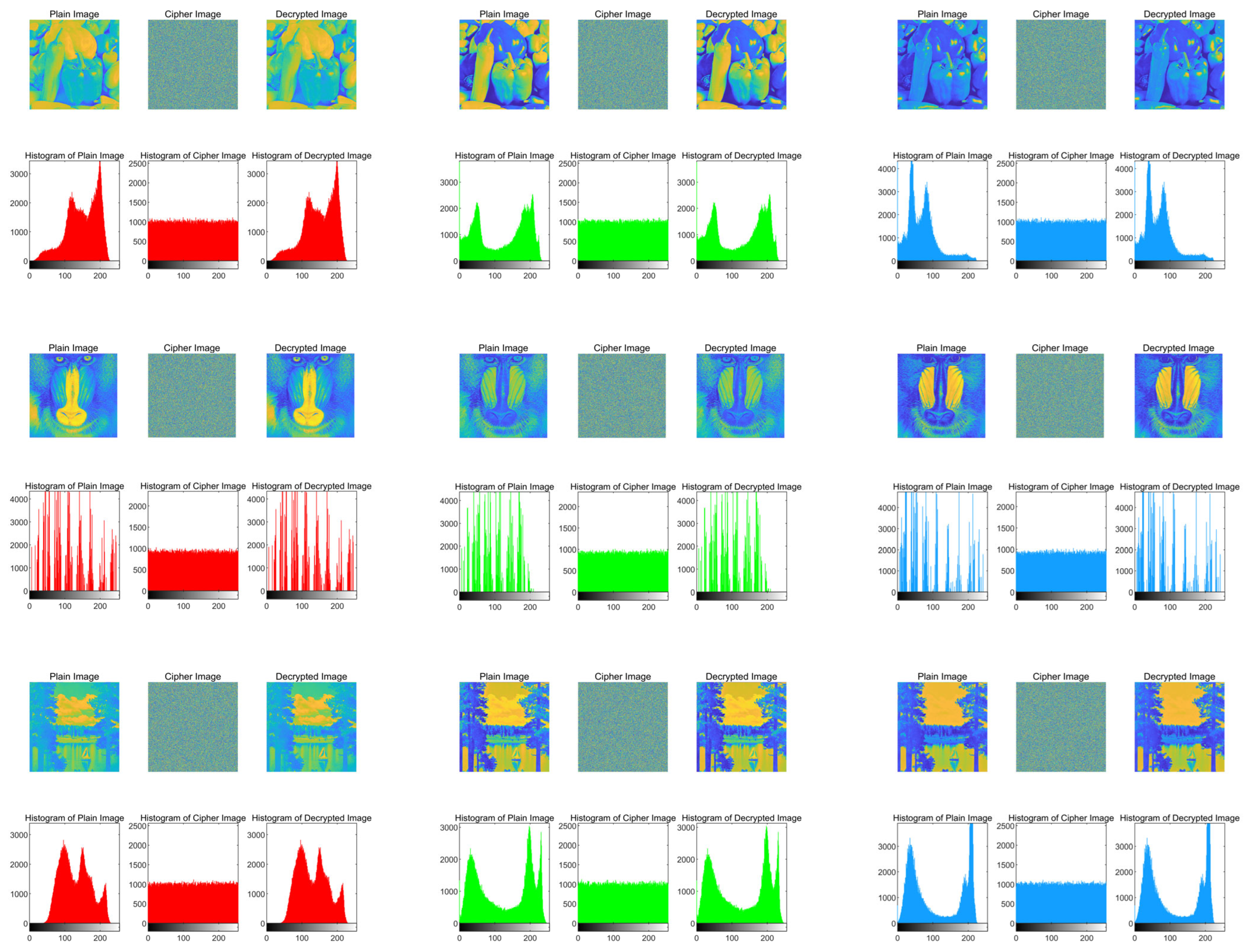
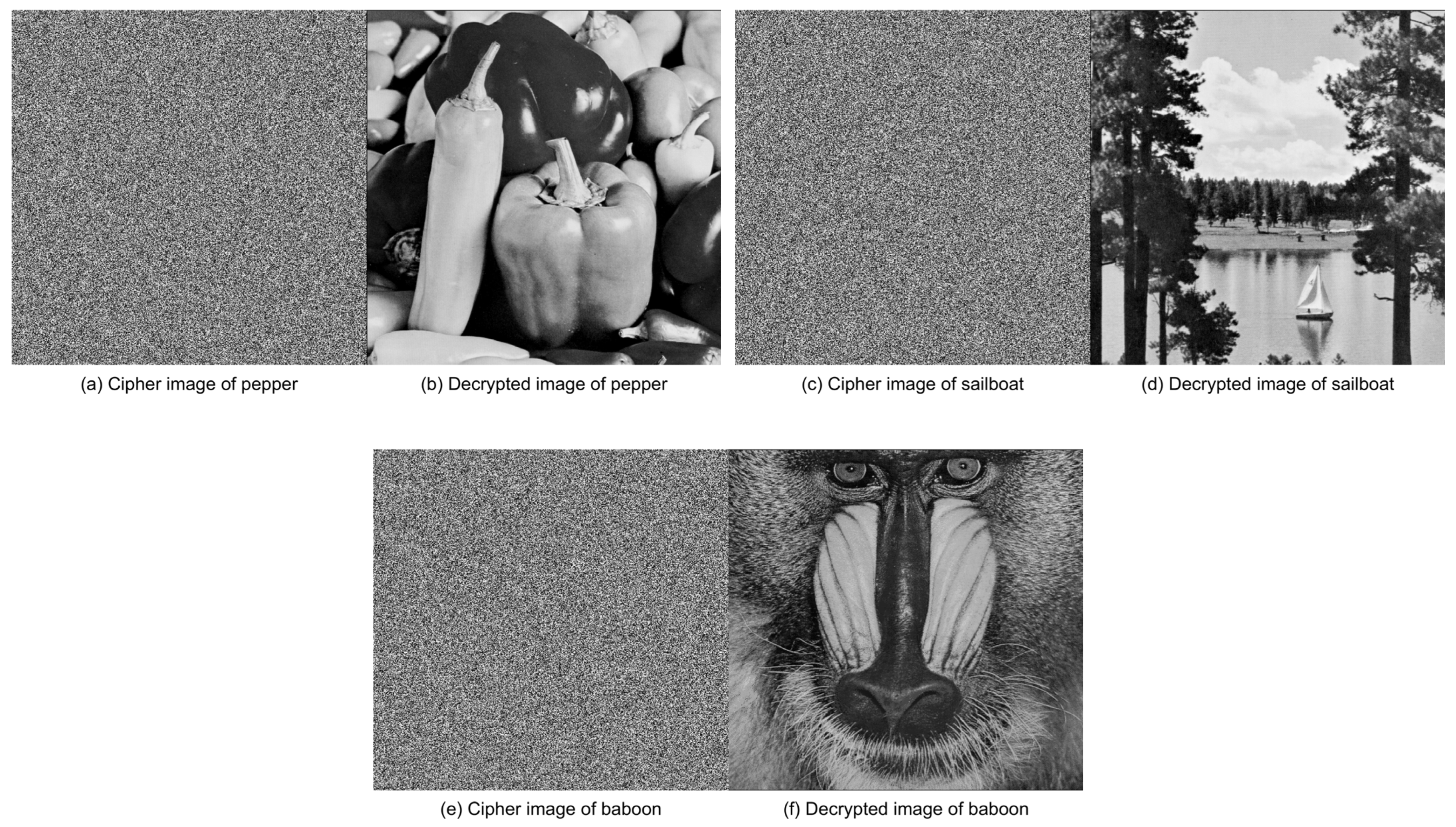
We have validated this procedure on three standard test images: pepper, sailboat, and baboon. For simplicity, only the green channel (G) of each color image is processed; the other two channels can be treated analogously. Figure 17 shows the cipher and decryption results for these three images. As can be observed, each decrypted image is visually identical to its original plain version, confirming the correctness of the decryption process. These experimental results demonstrate that our key handling method successfully recovers the plain image at the receiver side without requiring the original hash.

5. Conclusions

This paper presents a strongly dissipative, nonlinearly coupled four-dimensional hyperchaotic system and applies it to RGB image encryption. The dynamical properties of the proposed system are systematically investigated through fixed-point analysis, dissipativity analysis, phase portraits, Lyapunov exponents, Kaplan–Yorke dimension analysis, bifurcation analysis, Poincare sections, chaotic transients, attractors, and spectral entropy. Simulation results verify that the system exhibits hyperchaotic behavior within a specified parameter range and displays complex nonlinear dynamic characteristics. Notably, spectral entropy analysis quantifies the high randomness of the system, establishing a direct correlation between its dynamic complexity and cryptographic security. The uniform spectral distribution of the system contributes to evenly distributed ciphertext histograms and near-ideal information entropy in the encrypted results, thereby strengthening resistance to spectral analysis and pattern-based attacks. To verify practical implementability, an analog circuit is designed in Multisim 14.0, and circuit-level simulations further confirm the feasibility and effectiveness of the proposed system. Beyond hardware validation, this circuit implementation demonstrates robust performance under finite-precision conditions and component tolerances, confirming that the system maintains hyperchaotic behavior in physical realizations and exhibits potential for high-speed hardware-based encryption—critical for large-scale remote sensing image processing. Four chaotic sequences generated by the system under given initial conditions, combined with hash values and DNA encoding rules, are utilized for RGB image encryption. Performance evaluations based on histogram distribution, information entropy, adjacent pixel correlation, NPCR, UACI, and PSNR show that the encrypted images feature uniformly distributed histograms, entropy values close to 8, and significantly reduced spatial correlation. In addition, the experimental results of NPCR and UACI are consistent with their theoretical expectations. Robustness tests indicate that image cropping generally causes noticeable quality degradation, while the proposed scheme maintains relatively good visual fidelity under salt-and-pepper noise. Overall, the multi-dimensional validation—covering dynamic analysis, circuit implementation, and security performance evaluation—confirms that the proposed method can effectively resist statistical attacks, greatly increase the difficulty of plaintext recovery from cipher images, and provide an integrated and practical solution for secure RGB image encryption.

Author Contributions

Z.Y.: Conceptualization, design of the work, methodology, formal analysis, data analysis, drafting the work, validation, software, project administration, supervision; Z.T.: Data acquisition, reviewing the work, software; B.W.: Methodology, data curation, writing; W.W.: Methodology, data curation, writing; N.P.: Methodology, validation, review and editing; Y.W.: Methodology, data curation; Q.F.: Software, data curation; X.Z.: Software, data curation; Y.J.: Methodology; L.Y.: Data curation; L.T.: Writing; F.Y.: Writing. All authors have read and agreed to the published version of the manuscript.

Funding

This work is supported by the Guizhou Provincial Basic Research Program (Natural Science) Youth Guidance Project under Grant No. QianKeHe Basic-[2024] Youth 040; the Guizhou Provincial Basic Research Program (Natural Science) General Project under Grant No. Qiankehe Basic-MS[2025]078; the Guizhou Provincial Science and Technology Program (Guizhou Science and Technology Cooperation Talent Project) under Grant No. KJZY(2025)044.

Data Availability Statement

The original data presented in the study are openly available in: www.srdatac.com (accessed on 15 February 2026); https://earthobservatory.nasa.gov/ (accessed on 15 February 2026); https://www.o-map.cn/demo/dth20200512-ndvi.html (accessed on 15 February 2026); https://www.sasclouds.com/english/home (accessed on 15 February 2026).

Conflicts of Interest

The authors declare no conflicts of interest.

References

  1. Slagter, B.; Fesenmyer, K.; Hethcoat, M.; Belair, E.; Ellis, P.; Kleinschroth, F.; Pea-Claros, M.; Herold, M.; Reiche, J. Monitoring road development in Congo Basin forests with multi-sensor satellite imagery and deep learning. Remote Sens. Environ. 2024, 315, 114200. [Google Scholar] [CrossRef]
  2. Niu, T.; Liu, Y.; Gao, L. A novel multi remote sensing image encryption scheme exploiting modified zigzag transformation and S-Box. Phys. Scr. 2025, 100, 015272. [Google Scholar] [CrossRef]
  3. Wang, Y.; Zhang, Q.; Gao, R.; Xin, X.; Xie, R.; Jiang, J.; Tian, F.; Li, X.; Wang, F.; Tian, Q. Secure key real-time update and dynamic DNA encryption for CO-OFDM-PON based on a hybrid 5-D chaos. Opt. Express 2023, 31, 42961–42975. [Google Scholar] [CrossRef]
  4. Xiong, L.; Wang, Y.; An, X. Analysis of a time-dependent memristor-based chaotic system and its application in image encryption. Phys. Scr. 2024, 99, 065230. [Google Scholar] [CrossRef]
  5. Kumar, D.; Sudhav, K.; Ranjithkumar, R. A one-round medical image encryption algorithm based on a combined chaotic key generator. Med. Biol. Eng. Comput. 2023, 61, 205–227. [Google Scholar] [CrossRef]
  6. Stramondo, S.; Bignami, C.; Chini, M.; Pierdicca, N.; Tertulliani, A. Satellite radar and optical remote sensing for earthquake damage detection: Results from different case studies. Int. J. Remote Sens. 2006, 27, 4433–4447. [Google Scholar] [CrossRef]
  7. Mou, D.; Dong, Y. Color image encryption algorithm based on novel dynamic DNA encoding and chaotic system. Phys. Scr. 2024, 99, 065201. [Google Scholar] [CrossRef]
  8. Gao, Q.; Zhang, X. Multiple-image encryption algorithm based on a new composite chaotic system and 3D coordinate matrix. Chaos Solitons Fractals 2024, 189, 115587. [Google Scholar] [CrossRef]
  9. Wang, J.; Zhang, R.; Liu, J. Partial-privacy image encryption algorithm based on time-varying delayed exponentially controlled chaotic system. Nonlinear Dyn. 2024, 112, 10633–10659. [Google Scholar] [CrossRef]
  10. Zhang, X.; Liu, G.; Niu, Y.; Zou, C. Color image encryption scheme based on a single attractor hyperchaotic system and Go rules. Nonlinear Dyn. 2025, 113, 13885–13911. [Google Scholar] [CrossRef]
  11. Zhang, X.; Liu, M.; Niu, Y. Facial image encryption scheme based on improved 4-D hyperchaotic system. J. Supercomput. 2025, 81, 454. [Google Scholar] [CrossRef]
  12. Deng, Y.; Tian, X.; Chen, Z.; Xiao, Y.; Xiao, Y. An image encryption algorithm based on a novel two-dimensional hyperchaotic map and difference algorithm. Nonlinear Dyn. 2025, 113, 3801–3828. [Google Scholar] [CrossRef]
  13. Abed, K.A.; Al-Azzawi, S.F.; Qasim, O.S. Electronic circuit and image encryption using a novel simple 4D hyperchaotic system. Phys. Scr. 2024, 100, 015210. [Google Scholar] [CrossRef]
  14. Zhou, S.; Qiu, Y.; Wang, X.; Zhang, Y. Novel image cryptosystem based on new 2D hyperchaotic map and dynamical chaotic S-box. Nonlinear Dyn. 2023, 111, 9571–9589. [Google Scholar] [CrossRef]
  15. Liu, X. Integrate encryption of multiple images based on a new hyperchaotic system and Baker map. Multimed. Syst. 2024, 30, 247. [Google Scholar] [CrossRef]
  16. Tian, J.; Zhang, X.; Liu, M.; Jin, S.; Shi, D.; Yang, S. Remote sensing image encryption algorithm based on DNA convolution. J. Supercomput. 2025, 81, 566. [Google Scholar] [CrossRef]
  17. Yan, F.; Shen, Y.; Zou, T.; Wu, Z.; Su, Y. A novel spectrogram visual security encryption algorithm based on block compressed sensing and five-dimensional chaotic system. Nonlinear Dyn. 2023, 111, 9607–9628. [Google Scholar] [CrossRef]
  18. Gao, Y.; Liu, J.; Zhang, B.; Chen, S. Image encryption algorithm based on four-dimensional memristor hyperchaotic system and parallel compressive sensing. Nonlinear Dyn. 2024, 112, 20381–20400. [Google Scholar] [CrossRef]
  19. Wang, W.-J.; Jiang, M.-M.; Wang, S.-M.; Qu, Y.-J.; Ma, H.-Y.; Qiu, T.-H. Quantum image chaos encryption scheme based on quantum long-short term memory network. Acta Phys. Sin. 2023, 72, 120301. [Google Scholar] [CrossRef]
  20. Wang, C.; Song, L. An image encryption scheme based on chaotic system and compressed sensing for multiple application scenarios. Inf. Sci. 2023, 642, 119166. [Google Scholar] [CrossRef]
  21. Du, Y.; Long, G.Q.; Jiang, D.H.; Chai, X.; Han, J. Optical image encryption algorithm based on a new four-dimensional memristive hyperchaotic system and compressed sensing. Chin. Phys. B 2023, 32, 114203. [Google Scholar] [CrossRef]
  22. Hassan, S.A.; Raja, M.J.A.A.; Chang, C.-Y.; Shu, C.-M.; Shoaib, M.; Kiani, A.K.; Raja, M.A.Z. Nonlinear chaotic Lorenz-Lü-Chen fractional order dynamics: A novel machine learning expedition with deep autoregressive exogenous neural networks. Chaos Solitons Fractals 2024, 189, 115620. [Google Scholar] [CrossRef]
  23. Pang, S.; Liu, Y. A new hyperchaotic system from the Lü system and its control. J. Comput. Appl. Math. 2011, 235, 2775–2789. [Google Scholar] [CrossRef]
  24. Wang, Z.; Huang, X.; Li, Y.X.; Song, X.N. A new image encryption algorithm based on the fractional-order hyperchaotic Lorenz system. Chin. Phys. B 2013, 22, 010504. [Google Scholar] [CrossRef]
  25. Ding, C.; Tang, J.; Deng, M.; Liu, H.; Mei, X. A local encryption method for large-scale vector maps based on spatial hierarchical index and 4D hyperchaotic system. Int. J. Geogr. Inf. Sci. 2024, 38, 2272–2300. [Google Scholar] [CrossRef]
  26. Singh, D.; Kaur, H.; Verma, C.; Kumar, N.; Illés, Z. A novel 3-D image encryption algorithm based on SHA-256 and chaos theory. Alex. Eng. J. 2025, 122, 564–577. [Google Scholar] [CrossRef]
  27. Xu, L.; Chen, Y.; Qin, Y.; Yang, Z. A Mixed Chaotic Image Encryption Method Based on Parallel Rotation Scrambling in Rubik’s Cube Space. Entropy 2025, 27, 574. [Google Scholar] [CrossRef]
  28. Huang, L.; Huang, Q.; Chen, H.; Cai, S.; Xiong, X.; Yang, J. A Novel One-Dimensional Chaotic System for Image Encryption in Network Transmission Through Base64 Encoding. Entropy 2025, 27, 513. [Google Scholar] [CrossRef]
  29. Zhang, G.; Zhao, Y.; Zheng, Y.; Shen, Y.; Huang, J. A Fast Image Encryption Scheme Based on a Four-Dimensional Variable-Parameter Hyperchaotic Map and Cyclic Shift Strategy. Mathematics 2025, 13, 1497. [Google Scholar] [CrossRef]
  30. Mirzajani, S.; Moafimadani, S.S.; Roohi, M. A new encryption algorithm utilizing dna subsequence operations for color images. AppliedMath 2024, 4, 1382–1403. [Google Scholar] [CrossRef]
  31. Wang, S.; Pan, J.; Cui, Y.; Chen, Z.; Zhan, W. Fast color image encryption algorithm based on DNA coding and multi-chaotic systems. Mathematics 2024, 12, 3297. [Google Scholar] [CrossRef]
  32. Zhang, Y.; Zeng, J.; Yan, W.; Ding, Q. RBFNN-PSO Intelligent Synchronisation Method for Sprott B Chaotic Systems with External Noise and Its Application in an Image Encryption System. Entropy 2024, 26, 855. [Google Scholar] [CrossRef]
  33. Malik, D.S.; Shah, T.; Tehsin, S.; Nasir, I.M.; Fitriyani, N.L.; Syafrudin, M. Block cipher nonlinear component generation via hybrid pseudo-random binary sequence for image encryption. Mathematics 2024, 12, 2302. [Google Scholar] [CrossRef]
  34. Basiri, S.; Matin, F.L.; Naseri, M. Innovative Quantum Encryption Method for RGB Images Based on Bit-Planes and Logistic Maps. Computation 2025, 13, 56. [Google Scholar] [CrossRef]
  35. Zhou, M.; Li, X.; Du, W.; Li, J.; Wei, Z. Pixel-Level and DNA-Level Image Encryption Method Based on Five-Dimensional Hyperchaotic System. Entropy 2025, 27, 1221. [Google Scholar] [CrossRef]
  36. Xie, X.; Zhang, K.; Zheng, B.; Ning, H.; Zhou, Y.; Peng, Q.; Li, Z. A CML-ECA Chaotic Image Encryption System Based on Multi-Source Perturbation Mechanism and Dynamic DNA Encoding. Symmetry 2025, 17, 1042. [Google Scholar] [CrossRef]
  37. Mursidah, I.; MT, S.; Madenda, S.; Harmanto, S. Implementation of MS Circle Map in Digital Image Encryption. Appl. Sci. 2025, 15, 6998. [Google Scholar] [CrossRef]
  38. Wang, P.; Ding, L. Research on variable parameter color image encryption based on five-dimensional tri-valued memristor chaotic system. Entropy 2024, 26, 536. [Google Scholar] [CrossRef]
  39. Wang, P.; Xiang, Y.; Huang, L. A Novel Image Encryption Scheme Based on a Quantum Logistic Map, Hyper-Chaotic Lorenz Map, and DNA Dynamic Encoding. Electronics 2025, 14, 2092. [Google Scholar] [CrossRef]
  40. You, Z.; Liu, J.; Zhang, T.; Xu, Y. Coupled Sub-Feedback Hyperchaotic Dynamical System and Its Application in Image Encryption. Electronics 2025, 14, 1914. [Google Scholar] [CrossRef]
  41. Huang, L.; Ding, C.; Bao, Z.; Chen, H.; Wan, C. A DNA Encoding Image Encryption Algorithm Based on Chaos. Mathematics 2025, 13, 1330. [Google Scholar] [CrossRef]
  42. Hazzazi, M.M.; Baowidan, S.A.; Yousaf, A.; Adeel, M. An innovative algorithm based on chaotic maps amalgamated with bit-level permutations for robust S-box construction and its application in medical image privacy. Symmetry 2024, 16, 1070. [Google Scholar] [CrossRef]
  43. Xu, J.; Zhao, B.; Wu, Z. Research on Color Image Encryption Algorithm Based on Bit-Plane and Chen Chaotic System. Entropy 2022, 24, 186. [Google Scholar] [CrossRef] [PubMed]
Figure 1. The two-dimensional phase diagram obtained when parameters a = 1.6, b = 2.25, and c = 1.2, and the initial conditions (x(0), y(0), z(0), w(0)) = (2, 0, 0, 0).
Entropy 28 00413 g001
Figure 2. Lyapunov exponent spectrum (LEs) of the system. (a) The Lyapunov exponent spectrum (LEs) obtained with parameters a = 1.5, b = 2.25, and c = 1.2, and the initial conditions (x(0), y(0), z(0), w(0)) = (2, 0, 0, 0); (b) The Lyapunov exponent spectrum (LEs) obtained with parameters a = 0.5, b = 0.5, c = 2.5, and the initial conditions (x(0), y(0), z(0), w(0)) = (2, 0, 0, 0).
Entropy 28 00413 g002
Figure 3. Kaplan–Yorke dimensions for Different Parameter a = 1.5 and a = 0.5.
Entropy 28 00413 g003
Figure 4. Bifurcation diagram system. (a) a − Wmax; (b) b − Wmax.
Entropy 28 00413 g004
Figure 5. Poincare diagrams.
Entropy 28 00413 g005
Figure 6. Transient state diagram.
Entropy 28 00413 g006
Figure 7. The projections of (2, 0, 0, 0) (blue) and (0, 0.17, 0, 0) (red) on the x − w and y − w planes under the condition of the same parameters but different initial values.
Entropy 28 00413 g007
Figure 8. The chaotic characteristic graph based on spectral entropy complexity obtained with parameters a ∈ [0, 3], b ∈ [0, 3], c = 1.2 and the initial conditions (x(0), y(0), z(0), w(0)) = (2, 0, 0, 0).
Entropy 28 00413 g008
Figure 9. Schematic diagram of the chaotic circuit.
Entropy 28 00413 g009
Figure 10. Simulation phase diagram of the analog circuit.
Entropy 28 00413 g010
Figure 11. Flowchart of the encryption algorithm.
Entropy 28 00413 g011
Figure 12. Flowchart of the DNA Encoding and Decoding Algorithm.
Entropy 28 00413 g012
Figure 13. Original images Sea, Meteorology, Vegetation, Land, Pepper, Baboon, and Sailboat (512 × 512).
Entropy 28 00413 g013
Figure 14. A histogram that separates the RGB three channels of Sea, Meteorology, Vegetation, and Land images. The red histogram represents the R channel in RGB; the green histogram represents the G channel in RGB; the blue histogram represents the B channel in RGB.
Entropy 28 00413 g014aEntropy 28 00413 g014b
Figure 15. The correlation graph of the RGB channels in the Vegetation image.The red correlation graph represents the R channel in RGB; the green correlation graph represents the G channel in RGB; the blue correlation graph represents the B channel in RGB.
Entropy 28 00413 g015
Figure 16. Analysis of cropping attacks and noise attacks under the RGB three channels of the Vegetation image.
Entropy 28 00413 g016
Figure 17. Encryption and decryption results for three test images. (a) Cipher image of pepper; (b) Decrypted image of pepper; (c) Cipher image of sailboat; (d) Decrypted image of sailboat; (e) Cipher image of baboon; (f) Decrypted image of baboon. Only the green channel of each color image is processed.
Entropy 28 00413 g017
Table 1. DNA Base Coding Rules Table.
Number00011011
0ATCG
1ATGC
2ACTG
3ACGT
4AGTC
5AGCT
6TACG
7TAGC
Table 2. Correlation coefficients of the image in the horizontal, vertical, and diagonal directions.
Test DiagramLayersOriginal ImageEncrypted Image
HorizontalVerticalDiagonalHorizontalVerticalDiagonal
SeaR0.91220.90540.8643−0.00800.01780.0218
G0.91880.90830.87280.00140.0022−0.0099
B0.90480.90010.85370.00310.00990.0051
MeteorologyR0.94890.97380.94540.01740.0066−0.0055
G0.94750.97320.94070.0134−0.01320.0217
B0.90880.95060.9006−0.0063−0.01420.0254
VegetationR0.85280.87020.78000.00910.01670.0023
G0.83450.84750.7576−0.00210.00480.0048
B0.84360.85710.7705−0.0007−0.01540.0061
LandR0.93160.93590.9010−0.0061−0.02230.0126
G0.91400.93690.8791−0.02350.0098−0.0052
B0.91000.92500.87670.00150.00050.0106
pepperR0.94790.96970.9403−0.0058−0.0152−0.0230
G0.98440.98620.9765−0.0018−0.00280.0063
B0.96780.97250.95470.00330.0156−0.0017
baboonR0.91640.88090.8736−0.0062−0.0062−0.0043
G0.86850.76750.7399−0.0134−0.0125−0.0060
B0.90410.86280.83630.01380.0122−0.0102
sailboatR0.95440.95820.94280.0156−0.0070−0.0185
G0.97070.96750.9546−0.00230.00950.0020
B0.96370.96550.9440−0.00310.00210.0139
Table 3. Image Information Entropy.
ImagesLayersPlainImage EntropyCipherImage Entropy
SeaR6.9490167.999310
G7.6643457.999241
B7.7572467.999282
MeteorologyR7.0878257.999314
G7.1173437.999274
B6.5860427.999305
VegetationR7.5449507.999353
G7.1755947.999401
B6.9932607.999358
LandR7.4480447.999258
G7.3512277.999222
B7.0653697.999262
PepperR7.3388277.999309
G7.4962537.999329
B7.0583067.999206
BaboonR6.4998197.999237
G6.4445007.999249
B6.2709027.999096
SailboatR7.3123877.999323
G7.6461077.999186
B7.2137277.999339
Ref. [27]R7.26827.9992
Ref. [28]-7.44557.9991
Ref. [29]-7.23617.9991
Ref. [30]-7.14287.1998
Ref. [31]R7.70677.9992
Ref. [32]-7.73197.9920
Ref. [32]. pepper-7.66987.9920
Ref. [33]. baboon-7.665496657.99893469
Ref. [33]. pepper-7.749646987.99910385
Ref. [34]. pepper--7.9989
Ref. [34]. baboon--7.9990
Ref. [35]. sailboatR7.75707.9992
Table 4. NPCR and UACI of the algorithm proposed in this paper.
ImagesLayers1 bit Change2 bit Change
NPCRUACINPCRUACI
SeaR0.9961590.3344590.9962310.334990
G0.9964260.3344360.9960290.334548
B0.9961590.3349560.9960060.334492
MeteorologyR0.9962690.3349360.9961850.334539
G0.9959220.3347960.9960710.334580
B0.9961430.3342360.9961360.334427
VegetationR0.9958880.3340210.9960780.334328
G0.9960020.3347090.9960250.334193
B0.9959680.3345770.9960020.334541
LandR0.9962920.3340180.9961510.334805
G0.9963760.3343260.9959340.333778
B0.9963990.3344020.9961660.334525
PepperR0.9962200.3337540.9960820.334220
G0.9960170.3355510.9960520.335558
B0.9960780.3349740.9960710.335046
BaboonR0.9961750.3343530.9959040.335250
G0.9960460.3340360.9960620.333882
B0.9961920.3352120.9961290.333640
SailboatR0.9960100.3342880.9959790.334640
G0.9962310.3343800.9962040.334976
B0.9961430.3349630.9960590.334914
Table 5. NPCR and UACI of Other Algorithms.
NPCRUACI
Ref. [36]0.9961460.335341
Ref. [37]0.996080.343827
Ref. [38]0.9961030.334692
Ref. [39]0.9961540.311348
Ref. [40]. R0.9958950.292090
Ref. [41]0.9963260.334924
Ref. [42]0.9972230.408491
Ref. [43]. pepper.R0.9958650.335472
Ref. [43]. baboon.B0.9957850.334114
Ref. [32]. pepper.R0.99370.3342
Ref. [34]. pepper.G0.999010.33732
Ref. [34]. baboon.R0.996530.31543
Ref. [35]. sailboat0.9959820.334524
Table 6. PSNR under Clipping Attack and Salt-and-Pepper Noise Attack.
ImagesLayersCropping AttackSalt and Pepper Noise Attack
PSNRPSNR
SeaR19.91771031.220322
G20.33906831.248301
B19.81991531.106182
MeteorologyR19.17673330.337105
G19.40443930.183326
B20.88029031.914344
VegetationR19.92537530.838594
G21.28500332.048803
B19.07489130.057004
LandR20.54815731.410940
G20.65690831.708639
B20.66500731.723709
PepperR20.57699731.418529
G19.45736130.829900
B19.66854630.699319
BaboonR19.79163931.446047
G19.98914331.220487
B19.16016030.695485
SailboatR21.60630532.079772
G19.27875330.075009
B19.17176330.257243
Disclaimer/Publisher’s Note: The statements, opinions and data contained in all publications are solely those of the individual author(s) and contributor(s) and not of MDPI and/or the editor(s). MDPI and/or the editor(s) disclaim responsibility for any injury to people or property resulting from any ideas, methods, instructions or products referred to in the content.