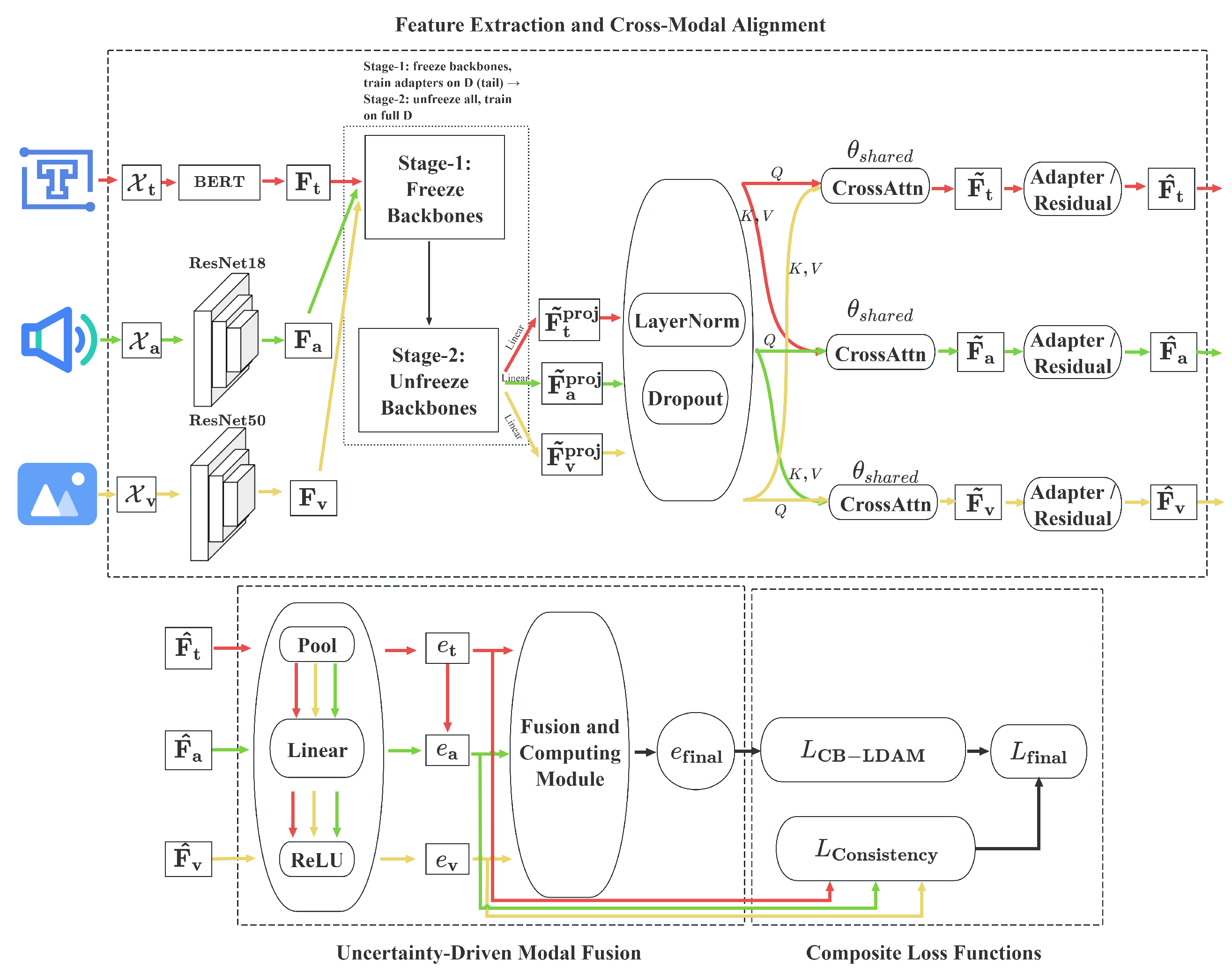
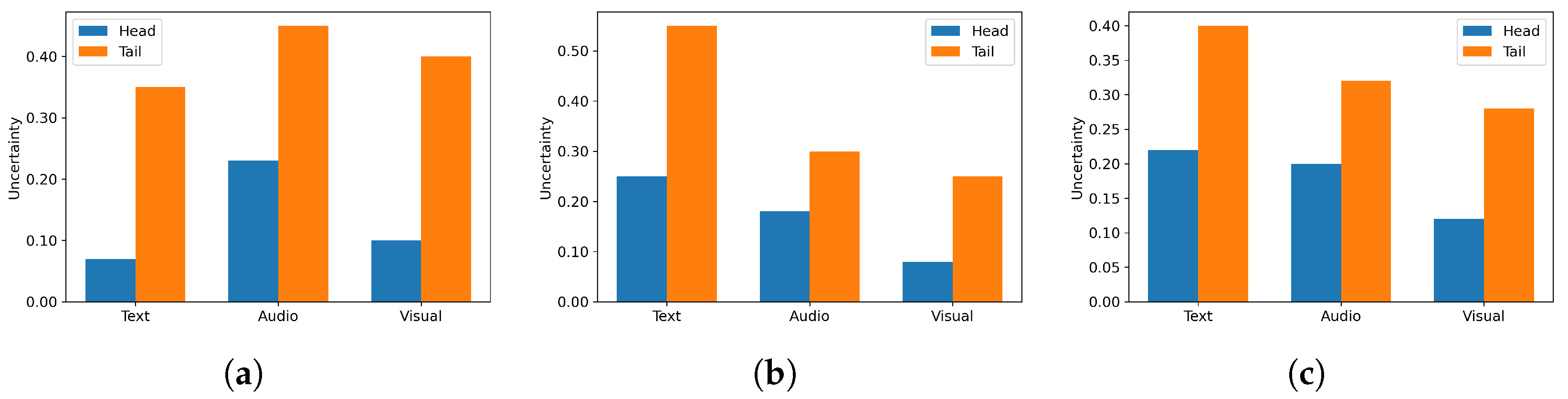
We address class overlap and fuzzy boundaries in long-tailed data by enforcing cross-modal consistency that aligns modality specific evidence for the same instance and by letting fusion favor signals that agree, which sharpens decision margins for rare classes. EMA fairness increases tail evidence, consistency mechanism reduces conflict and stabilizes gating, and gated fusion filters unreliable modalities and sharpens the signal, together forming a positive feedback loop that improves accuracy and calibration in multimodal long-tail classification. The following subsections detail the formulations and implementation aspects of each stage, covering the network architecture, uncertainty estimation, loss function design, and overall training procedure.
3.1. Feature Extraction and Cross-Modal Alignment
Let
,
, and
denote the raw text, audio, and visual inputs, respectively. The textual input
is encoded using a BERT-base encoder with a maximum of
tokens [
36]; we retain token-level representations
. For audio, 16 kHz audio is converted to Mel-frequency cepstral coefficients (MFCCs) and processed by a 1D ResNet-18; we retain frame-level features
. For video, frames are uniformly sampled and passed through an ImageNet-pretrained ResNet-50; we retain per-frame (or patch) features
for alignment, while temporal averaging is reserved for ablations.
Before projection, each modality feature
resides in its own dimensional space. After a linear projection into the shared space, we obtain
, followed by LayerNorm and dropout.
where
,
,
is ReLU, and
is the bottleneck dimension. The output is denoted by
.
and
project to and from the bottleneck
r, with biases
and
.
Specifically, we retain modality-specific backbones (BERT/ResNet) to extract unimodal features, and then introduce a Transformer-based cross-modal alignment encoder [
37] that operates on the projected features from all modalities. This alignment encoder is shared across modalities (parameter tying) and learns cross-modal dependencies, thereby reducing redundancy and improving computational efficiency without replacing the unimodal backbones.
To align the different modalities, we introduce a shared Cross-Attn module. In the original design, each modality performs independent Cross-Attn operations for alignment, but to simplify the structure and improve efficiency, we reuse a single set of Cross-Attn parameters and apply the same block once per modality (one pass per modality as query). This shared-parameter attention allows information exchange between modalities in a unified manner, reducing parameter count and minimizing computational overhead.
Each modality-specific representation
is first projected into a shared representation space of dimensionality
d via a linear transformation, resulting in
. The shared Cross-Attn mechanism then aligns the modalities as follows:
At inference time, we adopt an on-demand skipping strategy to reduce unnecessary computations. If all available modalities are confident and mutually consistent, we skip the shared Cross-Attn operation, thus reducing the computational cost. Confidence and agreement are computed from per-modality evidence heads applied before the shared Cross-Attn. During training, however, we always perform the shared Cross-Attn operation to preserve alignment capacity and ensure stable gradients. Instead, the fusion stage uses computed from the aligned-and-adapted features .
This approach simplifies the architecture by avoiding the need for separate attention mechanisms for each modality. The shared Cross-Attn mechanism processes all modalities through a unified attention mechanism, reducing the number of operations and memory usage while maintaining efficient cross-modal interaction.
To efficiently fuse multimodal features, we apply the lightweight bottleneck adapter defined above to each aligned representation:
where the adapter uses a two-layer bottleneck
with parameters
and
(see the adapter block above). This preserves the residual shape and enables parameter-efficient modulation in the shared space
d.
Training is performed in two stages:
Stage 1—Tail Specialization. The backbone networks are frozen, and only the adapters and classification heads are trained on the tail samples , enabling the adapters to specialize in tail-class cues. This stage isolates tail-class representations before joint optimization.
Stage 2—Global Fine-Tuning. The entire network is unfrozen and jointly optimized on the entire dataset. Crucially, the EMA-based fairness regularizer remains active to protect tail-class gradients. By dynamically amplifying the loss contribution of under-performing classes, the EMA mechanism counteracts the tendency of head-class gradients to dominate the optimization landscape. This explicitly prevents the catastrophic forgetting of tail-specialized features learned in Stage 1, ensuring that the tail-specific knowledge is integrated rather than overwritten during end-to-end fine-tuning.
During alignment, we retain the pre-trained initialization of each modality’s backbone, preserving its domain-specific representational power. The adapter modules and cross-attention mechanisms refine multimodal representations, bridging modality gaps while minimally perturbing the pre-trained features. This design ensures a fair comparison with existing multimodal methods, while allowing the evidential fusion module to fully exploit discriminative information from each modality.
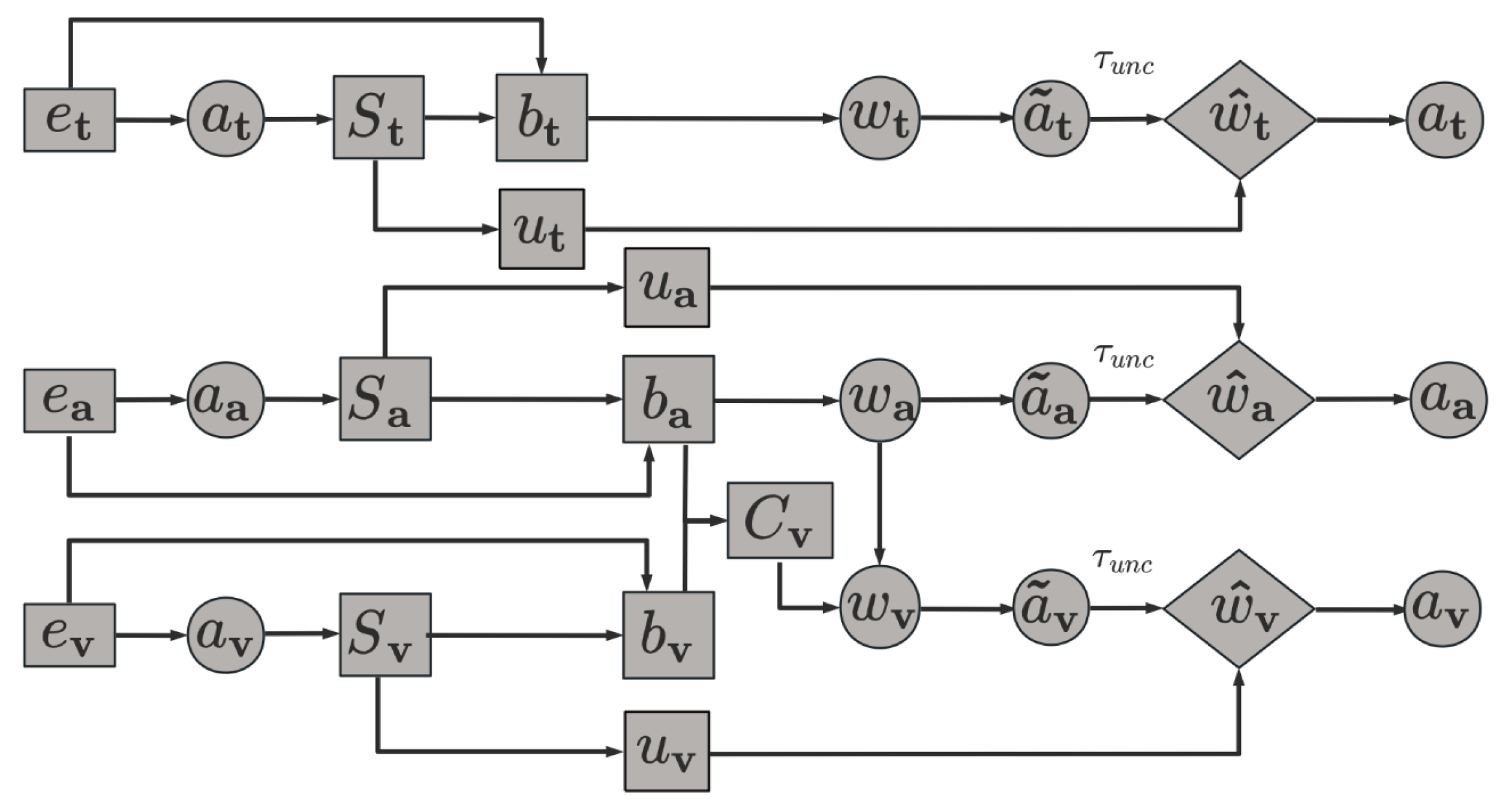
After obtaining the aligned multimodal features
, UMuLT performs evidential reasoning to estimate the uncertainty of each modality and adaptively adjusts its contribution to the final prediction. Fusion and normalization are computed only over available modalities (masked sums); missing modalities are excluded from all sums and normalizations rather than treated as zero evidence. Thus the algorithm handles both synchronized and asynchronous inputs. The module framework is shown in
Figure 2.
It is worth noting that, if the text modality alone is confident and decisive, meaning its evidential uncertainty is low and the gap between its top-1 and top-2 classes is large, we return the text-only prediction and skip computing audio and video. This early exit reduces latency and FLOPs on the audio/video backbones without affecting accuracy. During training we always compute all modalities to keep gradients consistent. The consistency objective drives modality representations to converge on a common class in ambiguous regions and discourages divergent cues, which reduces boundary ambiguity without extra heuristics.
3.2. Evidence Computation and Uncertainty Quantification
The aligned features are pooled along the sequence dimension to produce a global feature vector. This vector is then passed through a linear transformation and a ReLU activation to obtain the evidence vector .
Based on the evidential DST formulation [
38], the Dirichlet parameters and the uncertainty mass are as follows:
where
represents the uncertainty mass, the belief mass
is:
For cross-modal similarity or conflict, we use unit-mass beliefs
To strictly quantify the information volume and conflict contained within the evidence, we introduce Belief Entropy as a measure of epistemic uncertainty. Given the mass function
m, the Belief Entropy
is defined as:
The term represents the potential cardinality of the proposition A, effectively penalizing non-specific evidence. While Shannon entropy collapses when handling the set of all classes (i.e., complete ignorance), reaches its maximum in such states, correctly reflecting high epistemic uncertainty.
This metric serves as the theoretical basis for our fusion strategy, as it allows the system to identify modalities with high information confusion. For cases where (complete ignorance), we set the belief vector to a uniform distribution and rely on the evidential entropy to down-weight the modality.
3.3. Entropy-Aware Evidential Fusion
To enhance the robustness of fusion, we introduce a conflict-aware sequential weighting mechanism. For each modality
m (except the first in the processing order), we measure conflict with its preceding modality
by
where
is the standard inner product on the probability simplex. A smaller
indicates higher agreement between modalities.
We then accumulate raw modality weights so that both higher uncertainty and higher conflict reduce a modality’s influence:
where
denote the fixed processing sequence adopted in this work: Text → Audio → Visual. This order is selected based on the generally higher semantic stability of textual features compared to audio-visual signals. In multimodal sentiment analysis and classification tasks, textual data typically exhibits the highest semantic density and lowest aleatoric uncertainty, serving as a robust semantic anchor [
39]. Conversely, visual signals often contain significant background noise and redundant information, leading to higher epistemic uncertainty, particularly in long-tailed classes.
The raw modality weights
,
, and
are first normalized using a temperature-controlled softmax over the set of available modalities
to compute preliminary fusion weights
:
where
is a hyperparameter that controls the sharpness of the weight distribution. A lower
produces a sharper distribution, effectively selecting the single most reliable modality, whereas a higher
encourages a smoother, more democratic integration of multi-source information.
The system then applies an uncertainty-gating mechanism. If the evidential entropy
exceeds a predefined threshold
, the weight is adjusted using a decay factor
:
After the gating operation, each modality is assigned an adjusted weight
. An exponential decay function, parameterized by modality uncertainty, is then applied to further normalize
and compute the final fusion weight
:
where
assigns higher weights to modalities with lower uncertainty (
small), allowing the model to favor more reliable modalities at a fine-grained level. The constant
serves as a smoothing term to avoid division by zero in the normalization process.
It should be noted that the two normalization steps are complementary rather than conflicting. The first normalization integrates uncertainty and conflict information to produce an initial weight distribution, whereas the second refines this distribution by incorporating gating and exponential decay. This two-step design reflects a trade-off between computational simplicity and fusion effectiveness.
We turn complementarity into action by mapping per-modality evidence and uncertainty into adaptive trust and weights. Low uncertainty and low inter-modal conflict raise a modality’s weight, while the gate suppresses unreliable signals, so reliable and consistent cues dominate the fused evidence, which helps rare classes.
Finally, the fusion coefficient
is applied to each modality, and a weighted summation is performed over the modality-specific evidence vectors to obtain the final fused evidence vector:
Under this uncertainty-driven dynamic fusion scheme, the model can make robust decisions even in the presence of unreliable or conflicting modality information: noisy modalities are suppressed, tail-class information is preserved from being overshadowed, and complementary gains across modalities are effectively exploited. The following section introduces a loss function specifically designed to align with this fusion strategy.
3.4. Composite Loss Functions
To ensure equitable contributions across modalities, we propose a composite loss function comprising three components: a Class-Balanced Label-Distribution Aware Margin (CB-LDAM) loss, an EMA-based fairness regularizer, and a cross-modal consistency term.
For a training sample
i with true label
, let
denote the number of training samples in class
. We adopt the LDAM loss [
32] to enlarge the decision margins for tail classes. Specifically, the margin reduction for class
is defined as
:
where
is a hyperparameter of LDAM margin scale. When
is small,
becomes large, implying that a greater quantity is subtracted from the logit of class
. Consequently, the model must produce a higher raw score for tail classes to be correctly classified, effectively enlarging their decision margins and reducing misclassification caused by class imbalance.
Next, a class frequency weight
is introduced for sample
i, calculated from the frequency of class
using the formulation of the effective number of samples:
where
is the number of training samples in class
, and
is a hyperparameter. This formulation assigns larger weights to tail classes and smaller weights to head classes, thereby improving generalization across all classes.
Combining the above margin adjustment and class frequency weight, we first construct the margin-adjusted logits:
where
is the indicator function. The posterior probability of the correct class is
where
denotes the
k-th component of the fused evidence vector
. In this work, we improve the original definition of LDAM, subtracting the class-dependent margin only from the target class to avoid weakening the margin effect that would result from adjusting all logits simultaneously.
Finally, the class-balanced LDAM loss for sample
i becomes
where the outer term
amplifies the loss contribution of tail class samples, while the inner term
, modified by subtracting the class margin
, requires the model to have higher confidence for tail classes in order to achieve the same predicted probability. This effectively enlarges the decision boundaries between classes of different frequencies.
Although the above
already balances the loss contributions of different classes to some extent, its weight
is statically defined and cannot reflect the real-time variation in class-wise difficulty during training. To address this, we introduce an EMA mechanism to dynamically smooth and track the training loss of each class, thereby automatically adjusting each class’s weight in the total loss. This forms an implicit fairness regularization constraint. For the
k-th class in training epoch
p, the EMA of the loss is calculated as:
where
is the number of samples for
k-th class in the current mini-batch
, and
is a smoothing coefficient controlling temporal weighting.
Since the fused evidence is , the EMA-derived class weights rescale the class-wise gradients that update . Higher tail evidence lowers and, via the gating , increases the contribution of reliable modalities to tail classes.
After obtaining the EMA loss
for each class, we further compute a fairness weight
to reallocate the relative contribution of each class in the total loss:
where
denotes the mean EMA loss across all classes, and
is a sensitivity coefficient controlling how strongly weight discrepancies are amplified based on loss disparities. If the EMA loss of class
k exceeds the average, it indicates that the model is learning this class less effectively.
Compared to static or manually tuned methods, this EMA-based scheme adaptively adjusts to evolving class-wise performance during training, thereby improving tail-class recognition. Intuitively, instantaneous batch losses are susceptible to noise arising from sampling randomness. The EMA mechanism functions as a temporal low-pass filter, smoothing out these high-frequency fluctuations to reveal the intrinsic learning difficulty of each class. Consequently, this enables the model to dynamically prioritize classes that exhibit persistent under-fitting, effectively shifting the re-weighting strategy from a static count-based prior to a dynamic performance-based adaptation.
To enforce consistent representations across modalities, we introduce a regularization term that penalizes discrepancies between the evidence vectors of different modalities for the same instance:
where
denotes the evidence vector extracted from modality
m for sample
i. This pairwise (no-duplicate) formulation avoids double-counting modality pairs.
The consistency term aligns for the same sample and class, shrinking the conflict used in prefix weighting (recall ). This suppresses spurious inter-modal disagreements and stabilizes the uncertainty-gated weights across modalities.
This loss penalizes the discrepancies between evidence distributions across different modalities for the same sample: the loss remains small only when modalities m and n produce similar evidence for sample i. By minimizing , the model is encouraged to reduce cross-modal inconsistency, driving the representations of each modality for the same sample to evolve in a similar discriminative direction. This helps to avoid abnormal embedding bias in a specific modality caused by insufficient data.
Moreover, this alignment implicitly provides a supervisory signal to individual modality branches. By enforcing consistency between and the evidence from other modalities, which eventually forms the strongly supervised , ensures the reliability of when used independently for the early exit mechanism during inference.
Fusion turns complementarity into calibrated evidence, and the fairness and consistency terms convert that evidence into larger and cleaner gradients for rare classes, which improves decision margins without extra resampling. During training, the fairness weight amplifies rare class gradients while the consistency term pulls per-modality predictions toward agreement, which stabilizes gating and yields cleaner fused evidence in overlapping classes.
The overall training objective of UMuLT integrates all components as follows:
- (1)
Classification loss: Compute the CB-LDAM loss for all training samples. Update the EMA loss for each class based on current statistics and calculate the corresponding fairness weight , and apply it to the classification loss of that class.
- (2)
For each sample i, obtain the fairness-weighted classification loss using its ground-truth class .
- (3)
Consistency regularization: Add the cross-modal consistency term , weighted by the balancing coefficient , to form the final objective function.
Finally, the total loss for each training batch is:
where
is a predefined regularization coefficient that balances the relative importance between the classification loss and the consistency regularization term.
From the derivation of the composite loss, this design improves overall accuracy while allocating sufficient attention to tail classes and mitigating bias or conflicts during multimodal fusion. In subsequent experiments, the contribution of each module to the final performance is further examined through ablation studies.
The class probabilities are calculated by applying the softmax function to the fused evidence:
and the final predicted output: