Geometric Aspects of Entanglement

 , , , and
Abstract
1. Introduction
2. What Is Quantum Entanglement?
3. Pure-State Entanglement Distance
3.1. Properties of Entanglement Distance
- , and if and only if is fully separable;
- E is invariant under LU transformation;
- E does not increase under local operation and classical communications (LOCC);
- E is additive for tensor products.
- From (22) it follows that , since . Therefore, implies for each . The reduced density matrix of the -th subsystem, , obtained by tracing over the degrees of freedom of the remaining subsystems, can be written as . Hence, implies . Since , it follows that for each . This condition is satisfied if and only if the state is fully separable.
- For a given LU operator U, which has the form with a unitary operator acting on the -th party, one finds that . This proves the statement.
- Let us suppose that a local measurement is performed on a single qubit ; without loss of generality, we may take . If denotes the normalized state vector before the measurement, then denotes the normalized state vector after the measurement, corresponding to the outcome for the qubit along the direction . We denote the corresponding eigenstate of the measured qubit by . The associated outcome probability is . The post-measurement state vector is given byIt results inThe reduced density matrix of the -th qubit is given byFor , one obtainsTherefore, from (22) we findThe two-qubit reduced density matrix of the 0-th and the -th qubits, with , is given byBy direct calculation, one can verify thatThis proves that, for ,This completes the proof of Claim iii.
- In the case of a state product of two states , the metric tensor can be set as diagonal blocksand one hasThe generalization to multiple tensor products follows straightforwardly.
3.2. Comparison Between the Concurrence and the Entanglement Distance
3.3. Comparison Between the Entanglement Entropy and the Entanglement Distance
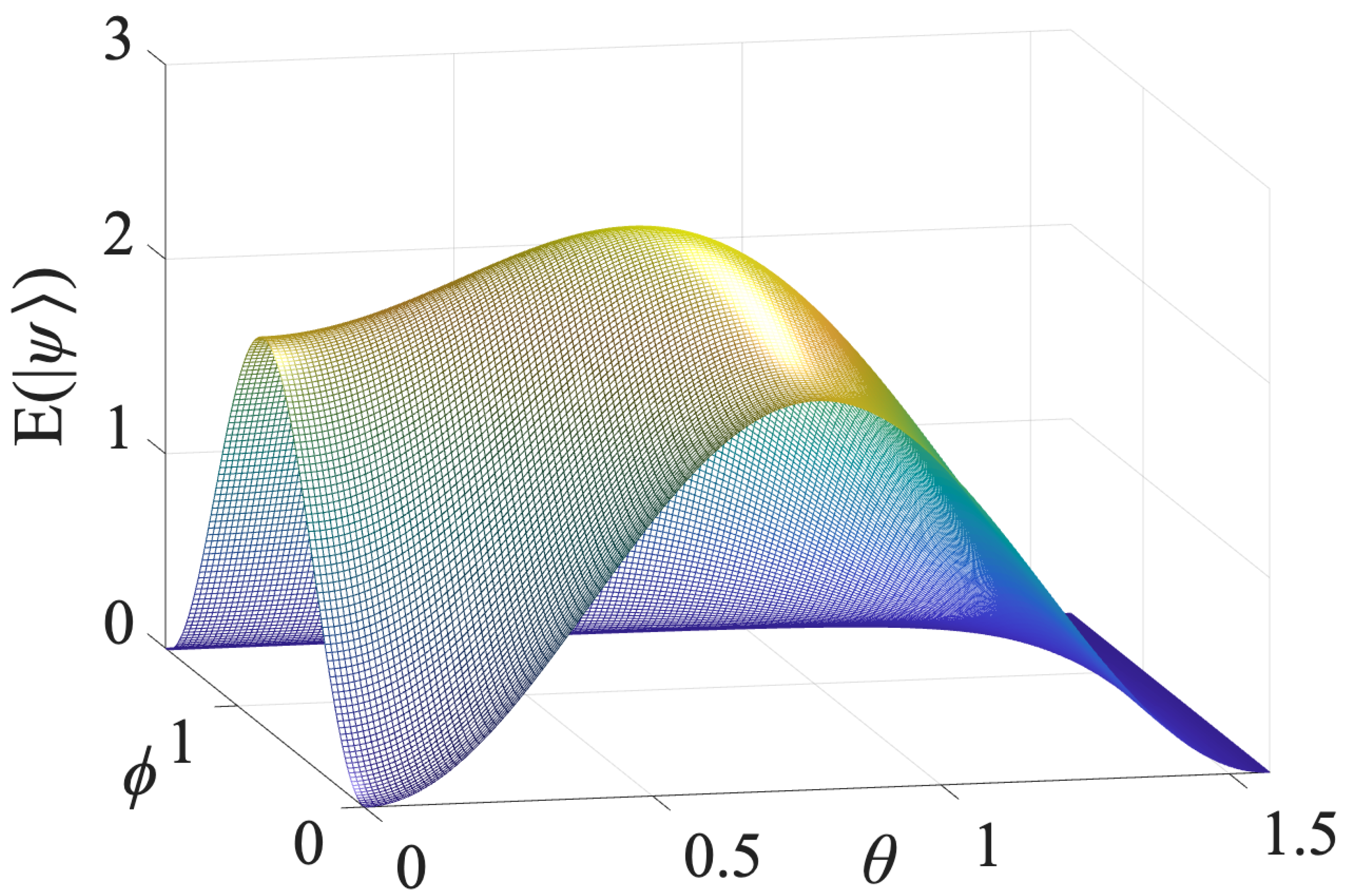
4. Example: Calculation of the Entanglement Distance
5. Concluding Remarks
Author Contributions
Funding
Data Availability Statement
Acknowledgments
Conflicts of Interest
References
- Gühne, O.; Toth, G. Entanglement detection. Phys. Rep. 2009, 474, 1–75. [Google Scholar] [CrossRef] [Scilit]
- Nourmandipour, A.; Vafafard, A.; Mortezapour, A.; Franzosi, R. Entanglement protection of classically driven qubits in a lossy cavity. Sci. Rep. 2021, 11, 16259. [Google Scholar] [CrossRef] [Scilit]
- Vafafard, A.; Nourmandipour, A.; Franzosi, R. Multipartite stationary entanglement generation in the presence of dipole-dipole interaction in an optical cavity. Phys. Rev. A 2022, 105, 052439. [Google Scholar] [CrossRef] [Scilit]
- Sperling, J.; Walmsley, I.A. Entanglement in macroscopic systems. Phys. Rev. A 2017, 95, 062116. [Google Scholar] [CrossRef] [Scilit]
- Giovannetti, V.; Mancini, S.; Vitali, D.; Tombesi, P. Characterizing the entanglement of bipartite quantum systems. Phys. Rev. A 2003, 67, 022320. [Google Scholar] [CrossRef] [Scilit]
- Vesperini, A.; Bel-Hadj-Aissa, G.; Franzosi, R. Entanglement and quantum correlation measures for quantum multipartite mixed states. Sci. Rep. 2023, 13, 2852. [Google Scholar] [CrossRef] [Scilit] [PubMed]
- Horodecki, R.; Horodecki, P.; Horodecki, M.; Horodecki, K. Quantum entanglement. Rev. Mod. Phys. 2009, 81, 865–942. [Google Scholar] [CrossRef] [Scilit]
- Popescu, S.; Rohrlich, D. Thermodynamics and the measure of entanglement. Phys. Rev. A 1997, 56, R3319–R3321. [Google Scholar] [CrossRef] [Scilit]
- Wootters, W.K. Entanglement of Formation of an Arbitrary State of Two Qubits. Phys. Rev. Lett. 1998, 80, 2245–2248. [Google Scholar] [CrossRef] [Scilit]
- Bennett, C.H.; DiVincenzo, D.P.; Smolin, J.A.; Wootters, W.K. Mixed-state entanglement and quantum error correction. Phys. Rev. A 1996, 54, 3824–3851. [Google Scholar] [CrossRef] [Scilit]
- Bennett, C.H.; Brassard, G.; Popescu, S.; Schumacher, B.; Smolin, J.A.; Wootters, W.K. Purification of Noisy Entanglement and Faithful Teleportation via Noisy Channels. Phys. Rev. Lett. 1996, 76, 722–725. [Google Scholar] [CrossRef] [Scilit] [PubMed]
- Horodecki, M.; Horodecki, P.; Horodecki, R. Mixed-State Entanglement and Distillation: Is there a “Bound” Entanglement in Nature? Phys. Rev. Lett. 1998, 80, 5239–5242. [Google Scholar] [CrossRef] [Scilit]
- Vedral, V.; Plenio, M.B.; Rippin, M.A.; Knight, P.L. Quantifying Entanglement. Phys. Rev. Lett. 1997, 78, 2275–2279. [Google Scholar] [CrossRef] [Scilit]
- Adesso, G.; Bromley, T.R.; Cianciaruso, M. Measures and applications of quantum correlations. J. Phys. A Math. Theor. 2016, 49, 473001. [Google Scholar] [CrossRef] [Scilit]
- Dür, W.; Vidal, G.; Cirac, J.I. Three qubits can be entangled in two inequivalent ways. Phys. Rev. A 2000, 62, 062314. [Google Scholar] [CrossRef] [Scilit]
- Briegel, H.J.; Raussendorf, R. Persistent Entanglement in Arrays of Interacting Particles. Phys. Rev. Lett. 2001, 86, 910–913. [Google Scholar] [CrossRef] [Scilit]
- Eisert, J.; Briegel, H.J. Schmidt measure as a tool for quantifying multiparticle entanglement. Phys. Rev. A 2001, 64, 022306. [Google Scholar] [CrossRef] [Scilit]
- Roszak, K. Measure of qubit-environment entanglement for pure dephasing evolutions. Phys. Rev. Res. 2020, 2, 043062. [Google Scholar] [CrossRef] [Scilit]
- Coffman, V.; Kundu, J.; Wootters, W.K. Distributed entanglement. Phys. Rev. A 2000, 61, 052306. [Google Scholar] [CrossRef] [Scilit]
- Carvalho, A.R.R.; Mintert, F.; Buchleitner, A. Decoherence and Multipartite Entanglement. Phys. Rev. Lett. 2004, 93, 230501. [Google Scholar] [CrossRef] [Scilit] [PubMed]
- Vesperini, A.; Franzosi, R. Entanglement, Quantum Correlators, and Connectivity in Graph States. Adv. Quantum Technol. 2024, 7, 2300264. [Google Scholar] [CrossRef] [Scilit]
- De Simone, L.; Franzosi, R. Entanglement in directed graph states. J. Phys. A Math. Gen. 2025, 58, 415302. [Google Scholar] [CrossRef] [Scilit]
- De Simone, L.; Franzosi, R. Entanglement in Quantum Systems Based on Directed Graphs. Adv. Quantum Technol. 2025, 9, e00514. [Google Scholar] [CrossRef] [Scilit]
- Gnatenko, K.P.; Susulovska, N.A. Geometric measure of entanglement of multi-qubit graph states and its detection on a quantum computer. Europhys. Lett. 2022, 136, 40003. [Google Scholar] [CrossRef] [Scilit]
- Gnatenko, K.; Laba, H.; Tkachuk, V. Geometric properties of evolutionary graph states and their detection on a quantum computer. Phys. Lett. A 2022, 452, 128434. [Google Scholar] [CrossRef] [Scilit]
- Gnatenko, K.P. Evaluation of variational quantum states entanglement on a quantum computer by the mean value of spin. arXiv 2023, arXiv:2301.03885. [Google Scholar] [CrossRef] [Scilit]
- Gnatenko, K. Entanglement of multi-qubit states representing directed networks and its detection with quantum computing. Phys. Lett. A 2024, 521, 129815. [Google Scholar] [CrossRef] [Scilit]
- Gnatenko, K.P. Studies of properties of bipartite graphs with quantum programming. Phys. Lett. A 2026, 566, 131191. [Google Scholar] [CrossRef] [Scilit]
- Gori, M.; Sarkis, M.; Tkatchenko, A. Multipartite Gaussian entanglement measure with applications to graph states and bosonic field theory. J. Phys. A Math. Theor. 2025, 58, 495304. [Google Scholar] [CrossRef] [Scilit]
- Cocchiarella, D.; Scali, S.; Ribisi, S.; Nardi, B.; Bel-Hadj-Aissa, G.; Franzosi, R. Entanglement distance for arbitrary M-qudit hybrid systems. Phys. Rev. A 2020, 101, 042129. [Google Scholar] [CrossRef] [Scilit]
- Vesperini, A.; Bel-Hadj-Aissa, G.; Capra, L.; Franzosi, R. Unveiling the geometric meaning of quantum entanglement: Discrete and continuous variable systems. Front. Phys. 2024, 19, 51204. [Google Scholar] [CrossRef] [Scilit]
- Shimony, A. Degree of Entanglement. Ann. N. Y. Acad. Sci. 1995, 755, 675–679. [Google Scholar] [CrossRef] [Scilit]
- Wei, T.C.; Goldbart, P.M. Geometric measure of entanglement and applications to bipartite and multipartite quantum states. Phys. Rev. A 2003, 68, 042307. [Google Scholar] [CrossRef] [Scilit]
- Marian, P.; Marian, T.A.; Scutaru, H. Bures distance as a measure of entanglement for two-mode squeezed thermal states. Phys. Rev. A 2003, 68, 062309. [Google Scholar] [CrossRef] [Scilit]
- Marian, P.; Marian, T.A. Hellinger distance as a measure of Gaussian discord. J. Phys. A Math. Theor. 2015, 48, 115301. [Google Scholar] [CrossRef] [Scilit]
- Braunstein, S.L.; Caves, C.M. Statistical distance and the geometry of quantum states. Phys. Rev. Lett. 1994, 72, 3439–3443. [Google Scholar] [CrossRef] [Scilit]
- Frydryszak, A.M.; Samar, M.I.; Tkachuk, V.M. Quantifying geometric measure of entanglement by mean value of spin and spin correlations with application to physical systems. Eur. Phys. J. D 2017, 71, 233. [Google Scholar] [CrossRef] [Scilit]
- Pezzé, L.; Smerzi, A. Entanglement, Nonlinear Dynamics, and the Heisenberg Limit. Phys. Rev. Lett. 2009, 102, 100401. [Google Scholar] [CrossRef] [Scilit]
- Hyllus, P.; Laskowski, W.; Krischek, R.; Schwemmer, C.; Wieczorek, W.; Weinfurter, H.; Pezzé, L.; Smerzi, A. Fisher information and multiparticle entanglement. Phys. Rev. A 2012, 85, 022321. [Google Scholar] [CrossRef] [Scilit]
- Tóth, G. Multipartite entanglement and high-precision metrology. Phys. Rev. A 2012, 85, 022322. [Google Scholar] [CrossRef] [Scilit]
- Tóth, G.; Apellaniz, I. Quantum metrology from a quantum information science perspective. J. Phys. A Math. Theor. 2014, 47, 424006. [Google Scholar] [CrossRef] [Scilit]
- Scali, S.; Franzosi, R. Entanglement estimation in non-optimal qubit states. Ann. Phys. 2019, 411, 167995. [Google Scholar] [CrossRef] [Scilit]
- Provost, J.P.; Vallee, G. Riemannian structure on manifolds of quantum states. Commun. Math. Phys. 1980, 76, 289–301. [Google Scholar] [CrossRef] [Scilit]
- Gibbons, G. Typical states and density matrices. J. Geom. Phys. 1992, 8, 147–162. [Google Scholar] [CrossRef] [Scilit]
- Brody, D.C.; Hughston, L.P. Geometric quantum mechanics. J. Geom. Phys. 2001, 38, 19–53. [Google Scholar] [CrossRef] [Scilit]
- Vesperini, A. Correlations and projective measurements in maximally entangled multipartite states. Ann. Phys. 2023, 457, 169406. [Google Scholar] [CrossRef] [Scilit]
- Vidal, G. Entanglement monotones. J. Mod. Opt. 2000, 47, 355–376. [Google Scholar] [CrossRef]
- Wootters, W.K. Entanglement of Formation and Concurrence. Quantum Info. Comput. 2001, 1, 27–44. [Google Scholar] [CrossRef] [Scilit]
- Gnonfin, H.; Gouba, L. The Separability Problem in Two Qubits Revisited. Symmetry 2023, 15, 2089. [Google Scholar] [CrossRef] [Scilit]

Disclaimer/Publisher’s Note: The statements, opinions and data contained in all publications are solely those of the individual author(s) and contributor(s) and not of MDPI and/or the editor(s). MDPI and/or the editor(s) disclaim responsibility for any injury to people or property resulting from any ideas, methods, instructions or products referred to in the content. |
© 2026 by the authors. Licensee MDPI, Basel, Switzerland. This article is an open access article distributed under the terms and conditions of the Creative Commons Attribution (CC BY) license.
Share and Cite
De Simone, L.; Capra, L.; Vesperini, A.; Rossi, L.; Di Cairano, L.; Franzosi, R. Geometric Aspects of Entanglement. Entropy 2026, 28, 299. https://doi.org/10.3390/e28030299
De Simone L, Capra L, Vesperini A, Rossi L, Di Cairano L, Franzosi R. Geometric Aspects of Entanglement. Entropy. 2026; 28(3):299. https://doi.org/10.3390/e28030299
Chicago/Turabian StyleDe Simone, Lucio, Lorenzo Capra, Arthur Vesperini, Leonardo Rossi, Loris Di Cairano, and Roberto Franzosi. 2026. "Geometric Aspects of Entanglement" Entropy 28, no. 3: 299. https://doi.org/10.3390/e28030299
APA StyleDe Simone, L., Capra, L., Vesperini, A., Rossi, L., Di Cairano, L., & Franzosi, R. (2026). Geometric Aspects of Entanglement. Entropy, 28(3), 299. https://doi.org/10.3390/e28030299