1. Introduction
The black-hole information problem remains one of the central conceptual challenges at the interface between quantum mechanics and gravitation. In Hawking’s semiclassical picture, an initially pure state collapsing to form a black hole evolves into a mixed state of nearly thermal radiation, apparently violating unitarity [
1]. The tension arises because the standard quantum description of closed systems demands that the global evolution be unitary, preserving the purity of the global state, whereas the effective description of Hawking radiation suggests an irreversible loss of information.
Over the last decades, a variety of proposals have been put forward to reconcile these two viewpoints. Some approaches modify the semiclassical dynamics or the near-horizon structure of spacetime; others exploit nonlocal correlations or invoke subtle aspects of quantum gravity. More recently, the development of the “island formula” and quantum extremal surfaces has provided a framework in which the entanglement entropy of Hawking radiation can exhibit the Page-curve behavior expected from unitary evaporation models [
2,
3,
4]. In these accounts, the fine-grained entanglement entropy of the radiation initially grows, reaches a maximum near the Page time, and subsequently decreases back to zero, as the black hole evaporates, restoring the purity of the global state.
Most discussions of the information problem, including those based on Page curves and island constructions, focus on entropic quantities as the main diagnostic of information flow. This is natural, given that the paradox is often phrased in terms of the entropy increase and decrease. However, from the point of view of quantum statistical description, a density matrix contains more structure than a single entropic number. Even at the level of second-order statistics, the spectrum of and its matrix structure encode not only how “pure” the state is but also where that purity resides: in the level populations (diagonal entries) or in the coherences (off-diagonal correlations) in a given physically meaningful intrinsic basis for which the real part of the density matrix is diagonal, while the off-diagonal elements are pure imaginary.
In a different context, namely classical polarization optics and general density-matrix analysis, previous work has shown that it is often useful to decompose the global purity of a state into distinct contributions associated with populations and coherences [
5]. In that work, a normalized global purity index
for an
n-dimensional density matrix was complemented by two auxiliary indices
and
, capturing, respectively, the asymmetry of the intrinsic populations and the asymmetry due to intrinsic coherences (or correlations). For general
n, these indices obey a relation of the form
which, in the two-dimensional case, reduces to the simple Euclidean decomposition
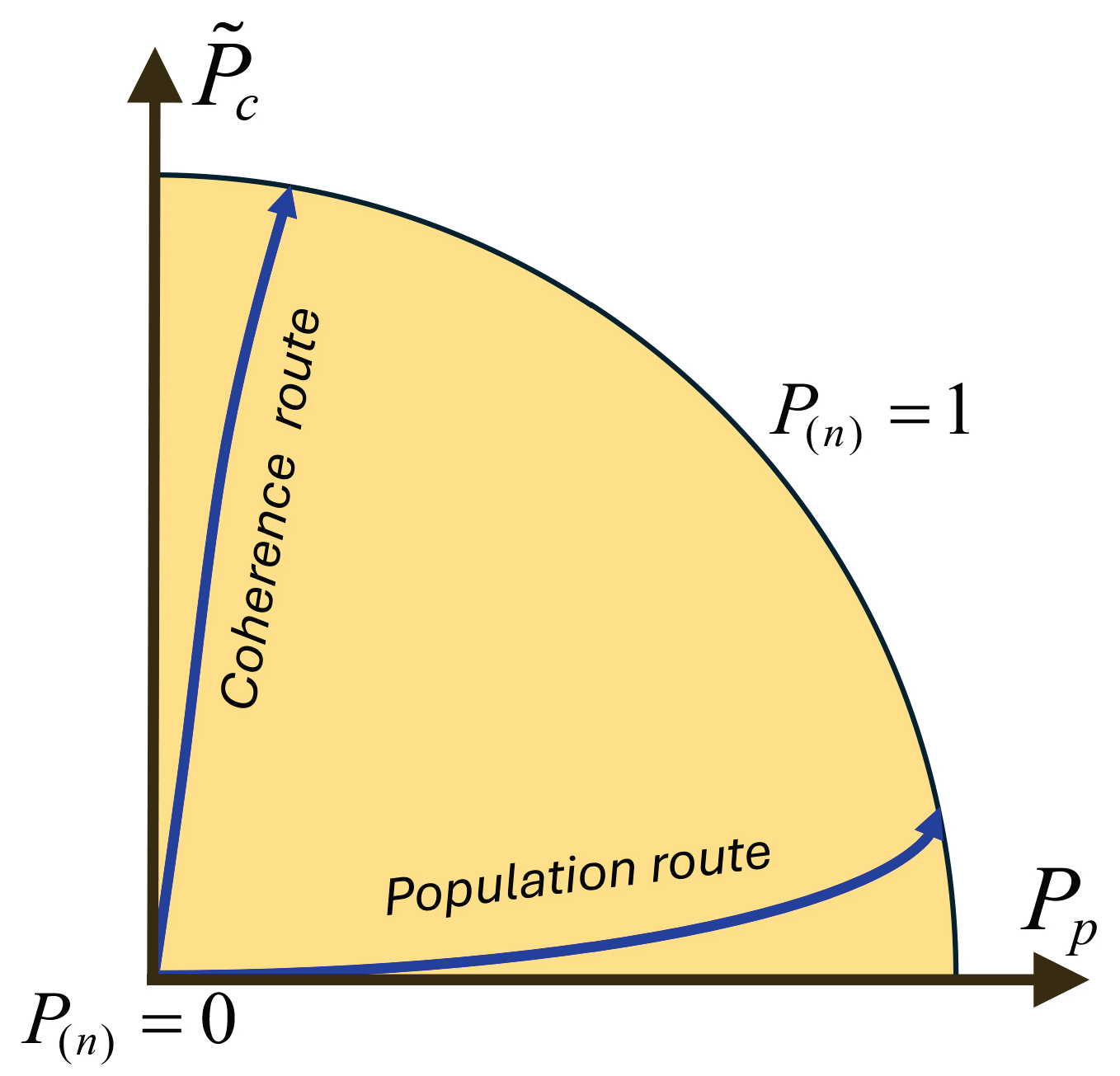
Geometrically, each state can be represented by a point in the
plane, with the global purity
playing the role of the radial coordinate and the relative weights of
and
determining the angular coordinate. This “population–coherence plane”, which is easily generalized to
n dimensions, offers a compact way of visualizing how purity is distributed within a density matrix.
The present work explores how this population–coherence decomposition of purity can sharpen our description of the black-hole information problem. Instead of asking only whether the entropy of Hawking radiation increases or decreases with time, we ask two related questions. First, when the radiation becomes purer at late times, is that purity stored primarily in the intrinsic level populations or in intrinsic coherences? Second, to what extent can a state be locally thermal in its energy populations while still being globally pure?
These questions become particularly pressing in the context of unitary evaporation scenarios. If we require that the global evolution be unitary, then the late-time radiation must be nearly pure. At the same time, if we insist that local measurements in the energy basis see a spectrum that remains close to thermal throughout the evaporation process, then the diagonal of the radiation density matrix should not deviate strongly from a thermal distribution. Under these conditions, it is natural to suspect that any recovery of information must manifest in the off-diagonal structure of the density matrix, that is, in the intrinsic coherences.
The population–coherence framework provides precise language to express this intuition. In particular, we distinguish two limiting cases: a population-dominated route to purity, in which carries most of the global purity and the density matrix is close to diagonal in the chosen basis, so that information is encoded mainly in anisotropic level populations leading to significant deviations from a thermal spectrum; a coherence-dominated route to purity, in which carries most of while remains small, so that the populations remain nearly thermal, and the information is stored in nontrivial coherences and correlations that are invisible to measurements probing only the diagonal of .
Our goal in this paper is to show that, within a standard Page-type model of evaporation and under the assumption of locally thermal populations, the late-time recovery of purity must follow a coherence-dominated route. We do this at two levels. First, in the simplest two-level setting, we construct explicit families of states with the same eigenvalues but opposite purity structure: one family with purity entirely in populations and another with purity entirely in coherences. This illustrates in the clearest possible way that global purity and spectrum do not uniquely determine how information is encoded. Second, we consider a many-qubit Page-type model in which the black hole and radiation form a bipartite pure state with varying Hilbert-space dimensions. Using known results on typical reduced states in large dimensions, we analyze how the indices and behave, as the radiation subsystem grows, and the black hole shrinks.
The analysis reveals a simple but important feature: in the large-dimension regime of a Page-type model, and if the radiation populations in the energy basis are constrained to remain close to thermal, the population purity index remains small, while the coherence purity index must grow and eventually account for almost all the global purity of the late-time radiation. In the geometric representation (with ), the typical trajectory of the radiation state starts near the origin (maximally mixed), stays close to it around the Page time, and then moves towards the upper point of the unit circle , indicating a coherence-dominated route to purity.
Although our main technical analysis is performed within the standard static Page model, we argue in the Discussion (
Section 5) that the conclusion—the necessity of a coherence-dominated route under the assumption of locally thermal populations—is robust and expected to hold in more realistic dynamical models of evaporation that exhibit quantum chaotic scrambling.
Summarizing our main conclusion, we show that, in Page-type evaporation models with locally thermal radiation populations, the late-time recovery of purity is necessarily coherence-dominated: the population index remains small, while the coherence index grows to carry essentially all the purity. In the plane, this corresponds to trajectories ending near , in contrast to population-dominated routes near .
Our conclusions are explicitly derived within a Page-type setting without an explicit Hamiltonian. We therefore regard the coherence-dominated route identified here as a robust kinematic feature of unitary evaporation under locally featureless populations, rather than as a complete dynamical model of black-hole evaporation.
The paper is organized as follows.
Section 2 recalls the definition of the global purity index
and the associated population and coherence indices
and
for generic density matrices, emphasizing their interpretation and the basic decomposition (
1).
Section 3 analyzes the two-dimensional case in detail, constructing explicit examples of population-dominated and coherence-dominated routes to purity and introducing the
plane as a simple geometric representation.
Section 4 applies these ideas to a standard Page-type evaporation model with
N qubits, derives the typical behavior of the radiation purity, and shows that, under locally thermal populations, the late-time purity must be carried by the coherence index
.
Section 5 concludes with a discussion of how this framework complements entropic analyses of the information problem, outlines possible extensions to more elaborate models of quantum gravity and to higher-order descriptors of statistical structure, and examines the robustness of our conclusions in dynamical evaporation scenarios.
5. Discussion
The analysis presented in this work suggests that the population–coherence decomposition of purity provides a useful complementary perspective on the black-hole information problem. Rather than focusing solely on entropic quantities, we have examined how the global purity of the Hawking radiation can be split into contributions from level populations and coherences on a physically meaningful basis and how these contributions evolve in simple models of evaporation.
At the most elementary level, the two-level examples of
Section 3 already capture an important conceptual point: even when the eigenvalues of a density matrix, and thus its entropy and global purity, are fixed, the internal structure of the density matrix can differ substantially. One family of states can realize purity almost entirely through population asymmetry (
,
), while another family with the same eigenvalues can realize the same purity through coherences (
,
). In the
representation, these correspond to orthogonal routes in the population–coherence plane. This demonstrates that knowing how pure the radiation is does not tell us how the information is encoded—whether in emission probabilities or in correlations.
The Page-type model of
Section 4 extends this insight to a many-body setting that captures the essential kinematics of black-hole evaporation. In such a model, the black hole and radiation form a bipartite pure state with varying Hilbert-space dimensions, and the average purity of the radiation follows a Page-like behavior: nearly zero at early times, minimal around the Page time, and approaching unity as the black hole evaporates. When we supplement this picture with the requirement that the radiation remain locally thermal in its energy populations, the population purity index
is constrained to remain small throughout the evolution. Under these conditions, the late-time recovery of global purity
can only be achieved via an increase in the coherence index
. In the
plane, with
as introduced in
Section 2, this corresponds to a trajectory that starts at the origin and ends near
: a coherence-dominated route to purity.
This observation does not, by itself, solve the information problem. It does, however, make more precise a qualitative idea that is often invoked in discussions of unitary evaporation: that the late-time radiation must carry information in subtle correlations rather than in its local spectrum. The indices and provide a way to quantify this statement. Population-dominated scenarios, in which information reappears primarily through large deviations from a thermal distribution of emission probabilities, would correspond to trajectories that end near and are therefore incompatible with the assumption of locally thermal populations. Coherence-dominated scenarios, in which the spectrum remains nearly thermal while purity is restored, correspond instead to trajectories approaching , as in the Page-type model with locally thermal diagonals.
From this viewpoint, the population–coherence plane can be regarded as a kind of phase diagram of information recovery routes. Different proposals for resolving the information problem—whether they rely on modified near-horizon physics, nonlocal interactions, or quantum-gravity-induced correlations—can, in principle, be mapped to different regions and trajectories in this plane, depending on how they partition purity between and . This suggests that the pair may serve as a useful diagnostic for comparing and classifying evaporation models, much as entanglement entropies and Page curves are used today.
5.1. Robustness Beyond the Static Page Model: Dynamics, Scrambling, and Toy Models
The analysis of
Section 4 relied on the canonical Page model, in which the global state at each step is drawn from the Haar-random ensemble. While this approach correctly captures the kinematic constraints of unitary evolution in a bipartite system with changing dimensions, it does not prescribe a specific dynamical law for the emission process. A natural question is therefore whether the coherence-dominated route to purity is an artifact of this equilibrium ensemble or a robust outcome of more realistic time-dependent evaporation dynamics.
A growing body of work indicates that the key features of the Page model—in particular, the Page curve for entanglement entropy—emerge naturally from chaotic unitary dynamics that scrambles information efficiently. In models of black-hole evaporation based on random unitary circuits [
6,
7,
8] or on fast-scrambling Hamiltonians [
9], the reduced state of the radiation at a given time is statistically indistinguishable from that of a Haar-random state, provided the dynamics is sufficiently scrambling and the black hole has thermalized internally. The underlying mechanism is that rapid scrambling effectively “resets” the black-hole interior to a typical state after each emission, thereby justifying the use of random ensembles for time-averaged properties. Consequently, the statistical arguments leading to Equations (53) and (55)—the strong concentration of diagonal populations and the collective buildup of off-diagonal contributions—are expected to hold in any chaotic dynamical model that reproduces the Page curve. Under the same physical requirement of locally thermal populations, the late-time purity must therefore still be carried predominantly by
.
This expectation is further supported by explicit toy models of quantum gravity in low dimensions. In Jackiw–Teitelboim (JT) gravity coupled to matter, the evaporation process can be described microscopically by a deterministic (though complex) unitary evolution of a boundary theory [
3,
4]. The celebrated island formula, which yields the Page curve for entanglement entropy, emerges from a gravitational path integral that sums over spacetime geometries with replica wormholes. Although a direct computation of
and
in such models is technically challenging, the gravitational prescription implies that the radiation density matrix, in the regime where a quantum extremal surface (island) dominates, is well approximated by a thermal density matrix corrected by entanglement across the wormhole [
3,
4,
10], schematically the structure of a state with small
but substantial
, for example via replica wormholes inducing correlations between radiation and interior degrees of freedom that, for the reduced radiation state, manifest as intrinsic coherences (a nonzero antisymmetric part
N in the IRB form of
). In the language developed in this paper, such correlations can be viewed as precisely the kind of intrinsic off-diagonal (purely imaginary in the IRB) structure that increases the coherence index
while leaving the population index
nearly unchanged. This provides suggestive evidence that the coherence-dominated route is not a mere artifact of random averaging, but a generic consequence of unitary evaporation that is consistent with semiclassical gravity, and that semiclassical island formulas and replica-wormhole corrections offer concrete realizations of such coherence-dominated routes in gravitational settings.
It is instructive, however, to consider scenarios where the coherence-dominated route might be modified. In systems with weak scrambling, integrable dynamics, or symmetries that protect population anisotropies, the trajectory in the plane could deviate significantly from the vertical path. For example, in a free (non-interacting) emission model, information might escape through systematic deviations in the energy spectrum, leading to a more horizontal trajectory. The population–coherence plane can thus serve as a diagnostic tool to classify evaporation models according to their scrambling strength and dynamical properties. A concrete numerical study of in random unitary circuit models—where the evolution can be followed step by step—would be a valuable future direction to quantify these deviations and to identify regimes where population effects become non-negligible.
The coherence-dominated conclusion hinges on restricting the diagonal structure of the radiation in a physically preferred basis (typically the energy basis) to remain close to thermal (or, more generally, close to locally featureless/equiprobable populations in the intrinsic sense). The motivation is semiclassical: Hawking’s calculation predicts that each outgoing mode is approximately thermal when coarse-grained, and many unitary toy models of evaporation reproduce Page-curve behavior while keeping local spectra close to thermal as a consequence of efficient scrambling and conservation laws. In our language, this is precisely the regime where stays small.
If local radiation is not thermal, the formalism and decomposition remain valid, but the endpoint in the plane need not approach . Instead, deviations from thermality allow part of the recovered global purity to be carried by population anisotropy, i.e., trajectories can interpolate between coherence-dominated and population-dominated routes. Thus, the present framework makes transparent how much purity recovery can be attributed to non-thermal diagonals (via ) versus genuinely off-diagonal correlations (via ).
In summary, while the static Page model offers the clearest analytic window, the physical heart of the argument—that a large chaotic environment (the black hole) enforces locally thermal diagonals, while unitarity forces global purity to be recovered via coherences—is inherently dynamical. The population–coherence decomposition therefore provides a refined lens to investigate not only whether information returns in a given model of quantum gravity but also how it returns.
5.2. Thermal Reference States and Energy-Resolved Extensions
In the analysis above, the Page model has been treated as an “energy-free” kinematic framework: the Hilbert space of the radiation is a tensor product of qubit spaces, but no explicit Hamiltonian or energy spectrum has been introduced. In this setting, the natural reference state for the diagonal of is the uniform distribution, and small values of simply express that the populations are close to equiprobable in the chosen basis. This is sufficient for our purposes here, since the argument only requires that the diagonal be nearly featureless, so that the recovery of purity must proceed via the intrinsic off-diagonal (purely imaginary in the IRB) structure quantified by .
In more realistic models of black-hole radiation, however, the Hilbert space comes equipped with a Hamiltonian
H and an associated thermal (Gibbs) state
which is diagonal in the energy eigenbasis with non-uniform populations
. With the convention adopted in this paper,
measures deviations from the uniform distribution
; so, a genuine thermal state at finite temperature has
and is, in this sense, “pure by populations”. Physically, however, what matters in such energy-resolved models is not the deviation from uniformity but the deviation from the thermal reference distribution
.
This suggests a natural extension of the present framework in which the role of benchmark state is played by a fixed reference density matrix
, typically chosen as
or as a microcanonical state on a suitable energy window. One can then consider the difference
and decompose its structure into population and coherence parts in the energy basis: the diagonal of
measures deviations of the actual populations from those of the reference state, while the off-diagonal entries capture coherences between different energy levels. In such a setting, it would be natural to define “thermal” population and coherence indices, say
and
, which quantify, respectively, the population anisotropy relative to
and the amount of coherence in the energy basis. These “thermal” indices are distinct from the intrinsic indices
defined via the IRB rotation (
Section 2); they coincide only when the energy basis approximately diagonalizes
.
A fully developed version of this idea would involve choosing an appropriate normalization for
and, ideally, constructing a relative purity measure that decomposes as
with
a suitably rescaled coherence index. In such a scheme, a strictly thermal state would be characterized by
and
, while deviations from thermal behavior would be encoded in non-zero values of these indices.
The present work has deliberately focused on the simpler energy-free Page model, for which the uniform state plays the role of reference and the original indices suffice to distinguish population- and coherence-dominated routes to purity. A detailed development of thermal reference indices in energy-resolved evaporation models—including explicit Hamiltonians, greybody factors, and frequency-resolved radiation—is left for future work. Such an extension would provide a more realistic setting in which to test whether the coherence-dominated route identified here persists when the full energy structure of the Hawking spectrum is taken into account.
An important open technical aspect in this direction is the choice of normalization for and . Unlike the uniform reference case, where the maximal values of the indices are fixed by the dimension alone, a non-uniform thermal reference introduces an additional scale set by its spectrum. Ensuring that the resulting thermal indices remain bounded (for instance, between 0 and 1) and admit a clean decomposition of a suitably defined relative purity will require a careful analysis of the allowed deviations from . We leave this normalization problem, together with explicit model studies, for future work.
5.3. Connection with Island Formulas and Entanglement Wedges
Modern treatments of the information problem express Page-curve behavior in terms of quantum extremal surfaces and islands, building on the quantum extremal surface prescription of Engelhardt and Wall [
11] and its applications to evaporating black holes and entanglement wedge reconstruction [
3,
4,
10]. It would be interesting to investigate whether, in models where island calculations can be performed, the microscopic reduced states of the radiation (or suitable coarse-grained versions thereof) exhibit the population–coherence structures described here. In particular, one could ask whether the onset of an island corresponds to a qualitative change in the coherence index
, or in the angular parameter
in the
plane.
In modern gravitational computations of the Page curve, the restoration of unitarity is often attributed to nontrivial saddle points (replica wormholes) and the emergence of islands in the entanglement wedge. From the present viewpoint, such mechanisms can be interpreted as generating nonlocal correlations that purify the radiation while leaving its coarse-grained local spectrum approximately thermal. This is naturally captured as a growth of the intrinsic coherence sector quantified by . Likewise, in random unitary circuit models with conservation laws, the local reduced states can remain close to thermal, while purification proceeds through increasingly structured many-body correlations, again corresponding to a coherence-dominated trajectory in the plane.
For the definition and operational meaning of
—including its interpretation as a second-order (density-matrix) diagnostic and its distinction from higher-order scrambling probes such as out-of-time-order correlators (OTOCs)—we refer the reader to
Section 2.2.
Recent laboratory analogs of horizon physics may offer settings where coherence structure is experimentally more accessible than in astrophysical situations. For instance, phase-space horizons in surface-gravity water waves and shallow-water analog black holes have been demonstrated in Refs. [
12,
13]. It would be interesting to explore whether a population–coherence decomposition of reconstructed density matrices (or mode covariance matrices) can help diagnose where information-like signatures reside in such analog systems.
5.4. Multipartite Structure and Early/Late Radiation
In the present work, the radiation has been treated as a single subsystem. A more refined analysis would partition it into early and late radiation or into angular or frequency sectors and study how purity and coherence are distributed among these sub-blocks. This could help clarify how information is shared between early and late Hawking quanta and whether certain sectors are particularly responsible for carrying coherence-dominated purity.
5.5. Higher-Order Statistical Descriptors
The index is a second-order quantity, depending on . In previous work on polarization and statistical optics, higher-order descriptors (e.g., fourth-order moments or combined indices such as ) have proven useful for refining the characterization of fluctuations and non-Gaussianity. Extending the population–coherence decomposition to such higher-order descriptors could provide additional insight into the fine structure of the radiation state, and perhaps distinguish between different coherence-dominated scenarios that look similar at second order.
5.6. No-Go Statements and Constraints
Finally, the decomposition suggests the possibility of formulating simple inequalities that any unitary evaporation model must satisfy. For instance, if one imposes that for all k (a quantitative expression of “almost thermal populations”), then any late-time purity close to unity implies a lower bound on . Exploring such constraints in concrete models could lead to no-go statements for classes of semiclassical approximations that fail to generate sufficient coherence asymmetry.
For instance, if for some
, one enforces
at all stages of evaporation, then for any final purity
, one must have
whenever
, so that the right-hand side is real and positive. Even such simple constraints already quantify the minimal coherence asymmetry required for a given level of information recovery under nearly thermal populations.
In summary, the population–coherence decomposition does not replace entropic methods or island calculations, but rather complements them by providing a spectral and structural refinement of what it means for the radiation to “become pure again”. It exposes the internal organization of purity within the density matrix and offers a compact geometric language—the plane—to describe different routes by which information may return. We hope that this framework will prove useful as a diagnostic tool in future studies of black-hole evaporation and, more generally, in the analysis of complex quantum systems where the distinction between population- and coherence-based information is physically meaningful.