Event-Driven Spiking Neural Networks for Private Vehicle Parking Prediction

Abstract
1. Introduction
- Most existing SNN models are built upon standard Leaky Integrate-and-Fire (LIF) neurons with fixed decay parameters. Such neurons lack the flexibility to capture the heterogeneous inter-event intervals observed in mobility data (ranging from minutes to days). In event-driven processing, standard neurons decay by event counts alone, equating long parking durations with short stops and causing outdated historical states to persist unnecessarily.
- Many SNN models rely on rate-based spike counting. In latency-sensitive scenarios where the number of simulation steps is limited, spike-count-based readouts introduce severe quantization effects, significantly degrading the accuracy of continuous values prediction.
- Current SNN models often lack effective, event-driven mechanisms to selectively regulate information flow across channels based on external context (e.g., weather, holiday) without breaking the sparse computing paradigm.
- To effectively handle the challenge of irregular intervals, we propose a Time-Adaptive Leaky Integrate-and-Fire (TA-LIF) neuron. Unlike standard neurons with fixed decay, TA-LIF employs a lookup table (LUT)-based mechanism with logarithmic discretization. This design explicitly couples neuronal memory decay with physical time gaps, effectively capturing long-term regularities across varying timescales without incurring the computational overhead of transcendental functions.
- To mitigate quantization errors in regression, we introduce an accumulate-based readout (ABR) strategy. It mitigates the precision bottleneck of discrete spike counting by utilizing the continuous accumulated response of the readout neurons as the final output. Furthermore, this approach unifies classification and regression representations, enabling high-precision duration prediction even under minimal simulation steps.
- To enable selective information regulation, we design a Spiking Contextual Gating (SCG) module. It constructs a lightweight gating strategy that modulates spiking information flow based on environmental context to avoid expensive computational costs. Specifically, it generates dynamic binary masks to perform selective feature filtering, functionally replacing heavy matrix multiplications with lightweight sparse masking.
2. Related Work
2.1. Deep Learning for Mobility Prediction
2.2. Spiking Neural Networks for Spatio-Temporal Data
3. Preliminaries
3.1. Problem Definition
3.2. Spiking Neuron Dynamics
4. Methodology
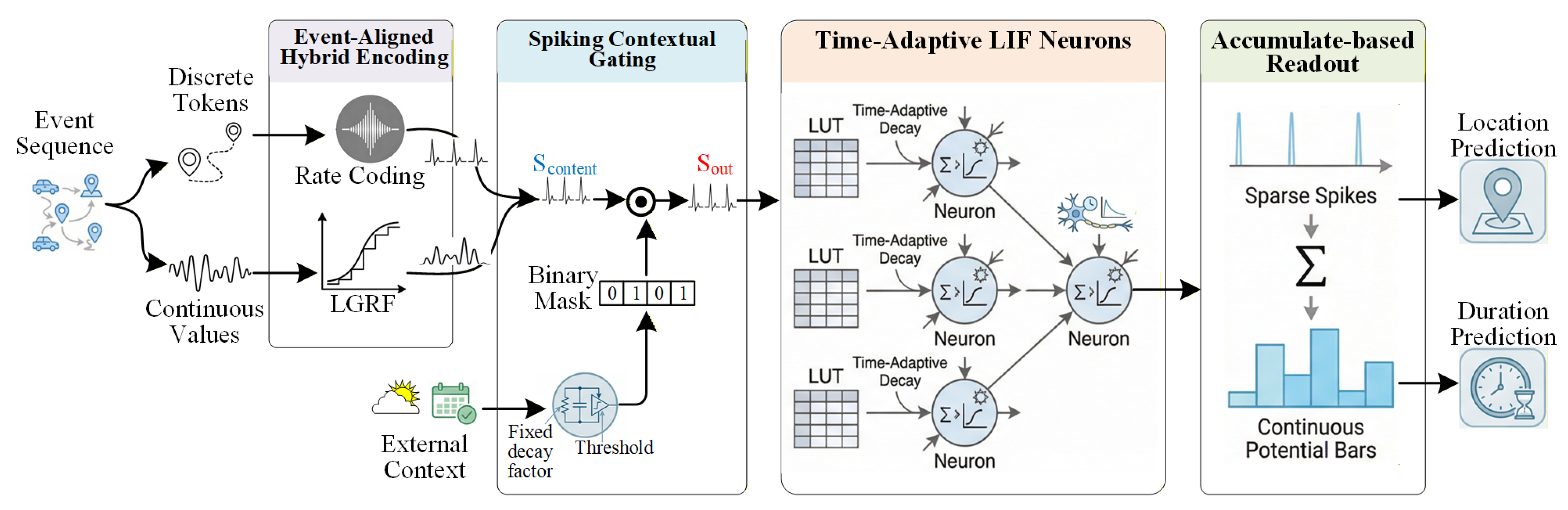
- 1.
- Event-Aligned Hybrid Encoding: It transforms heterogeneous raw data into spike-compatible formats.
- 2.
- Spiking Contextual Gating: It fuses environmental context (weather, holiday) to selectively modulate spatial preferences via lightweight gating.
- 3.
- TA-LIF Neuron: It dynamically adjusts neuronal memory based on physical time gaps to capture long-term regularity via the LUT-based mechanism.
- 4.
- Accumulate-based Readout: It performs high-precision regression and classification with minimized quantization error.
4.1. Event-Aligned Hybrid Encoding
4.1.1. Discrete Semantics
4.1.2. Continuous Dynamics via Learnable Gaussian Receptive Fields
4.2. Time-Adaptive LIF Neuron
4.2.1. Dynamics
4.2.2. Efficient Decay via Learnable LUT
4.3. Spiking Contextual Gating
4.4. Accumulate-Based Readout Strategy
4.5. Training and Optimization
4.5.1. Surrogate Gradient Learning
4.5.2. Loss Function
5. Experiments
5.1. Experimental Setup
5.1.1. Datasets and Preprocessing
5.1.2. Baselines
- Markov [5]: A first-order Markov chain that calculates the transition probabilities between regions based on historical trajectories.
- DeepRP [7]: A GRU-based model with specific regularizers for location prediction.
- iTransformer [16]: The representative Transformer architecture.
- Time-LSTM [17]: A variant of LSTM to model time intervals explicitly.
- ODE-RNN [18]: A continuous-time RNN model that uses Neural ODEs to model the hidden state evolution between observations.
- THP [19]: It incorporates the intensity modeling of Hawkes Processes into a Transformer architecture to capture event dynamics.
- TCJA-SNN [11]: It proposes temporal-channel joint attention to recalibrate features in both dimensions cooperatively.
- iSpikformer [12]: A fully spiking Transformer adapted for time-series forecasting, utilizing spike-driven self-attention.
- TS-LIF [13]: A temporal segment LIF neuron with dual compartments designed to capture multi-scale temporal dynamics.
5.1.3. Implementation Details
5.1.4. Evaluation Metrics
5.2. Overall Performance Comparison
- Spark achieves superior performance compared to statistical, RNN, and continuous-time baselines. The Markov baseline yields the worst results on both tasks, as first-order transitions are insufficient to capture the complex dependencies in private vehicle mobility. DeepRP outperforms the statistical Markov model, verifying the capability of RNNs to capture sequential dependencies. However, DeepRP lags behind Time-LSTM, which confirms that explicitly incorporating time intervals into the memory gating mechanism is essential for modeling irregular mobility sequences, where uniform time steps are an invalid assumption. ODE-RNN and THP achieve highly competitive results, which verifies that modeling the continuous evolution of hidden states or event intensities is theoretically well-suited for asynchronous parking events. Spark outperforms all the aforementioned baselines, with this improvement attributed to the robustness of the proposed TA-LIF neuron. Spark’s LUT-based decay mechanism acts as a form of discrete regularization. It learns a stable, non-parametric decay profile that captures the underlying temporal laws without being overly sensitive to stochastic noise in the raw timestamps.
- Among the SNN baselines, Spark achieves the best performance in both tasks. Specifically, existing SNN baselines (e.g., TCJA-SNN and TS-LIF) rely on fixed decay factors, which result in inadequate decay of membrane potential during long parking intervals and thus lead to the retention of irrelevant historical noise. In contrast, Spark employs a learnable LUT mechanism to explicitly couple the leakage rate with physical time. This unique design enables Spark to adaptively reset neuronal states after long gaps and filter out outdated context information. Furthermore, Spark introduces the accumulate-based readout strategy, which integrates discrete spike trains into continuous accumulated values in the final non-spiking layer, instead of relying on discrete spike count statistics. This approach allows Spark to generate high-precision continuous outputs, which is particularly advantageous for the parking duration estimation task.
- Spark achieves results comparable to iTransformer with a mere 0.3% performance relative gap in Top-1 Accuracy and an MAE relative gap within 1.5%. This validates that Spark can capture complex spatial dependencies as effectively as global self-attention mechanisms.
- Spark exhibits strong generalization and avoids overfitting in prediction. It achieves consistent excellent performance on three datasets using identical hyperparameters, indicating it learns transferable temporal patterns rather than fitting local geography. Additionally, its event-driven sparsity serves as a form of intrinsic regularization analogous to dynamic dropout, which prevents over-reliance on specific features, and the synchronous decrease in training and validation losses under a strict chronological train–test split confirms that its strong generalization arises from genuine temporal laws rather than data leakage or overfitting.
5.3. Efficiency Analysis
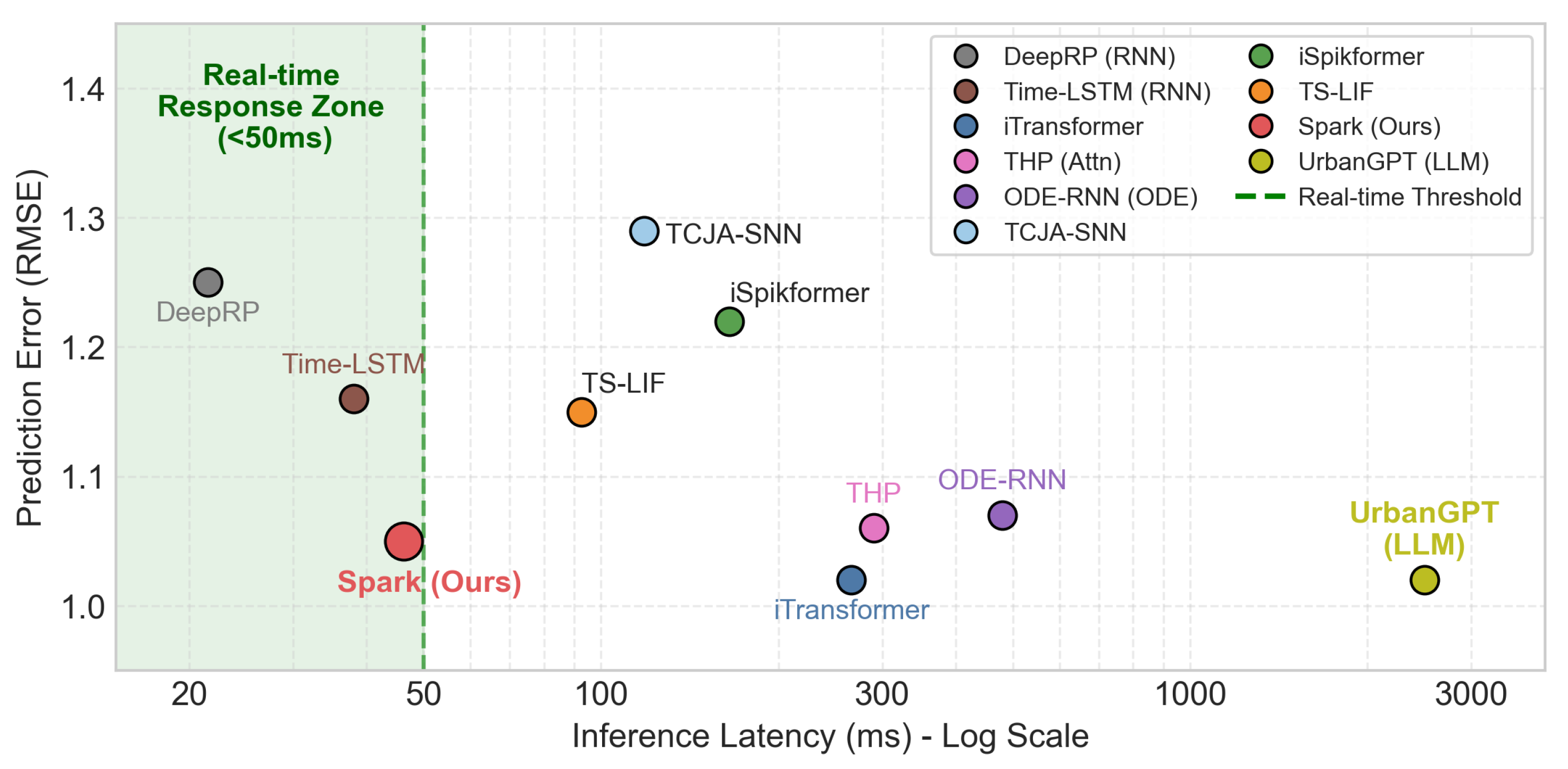
- DeepRP achieves the lowest inference latency of 23.5 ms due to its simple, single-step recurrence dynamics. However, its limited capacity to model long-term dependencies results in a higher prediction error.
- While ODE-RNN achieves high prediction accuracy, it exhibits the highest latency (>400 ms per sequence). This is primarily due to the numerical differential equation solver, which requires multiple iterative evaluations to integrate the hidden state over time. Similarly, THP suffers from quadratic complexity due to its attention mechanism. Such high latency exceeds the response time requirements for seamless user interaction in smart cockpits.
- iTransformer provides the highest precision but at a prohibitive cost of 265.8 ms per sequence. This latency exceeds the threshold typically required for seamless real-time interaction in vehicular systems.
- UrbanGPT achieves the lowest RMSE of 1.02, benefiting from its strong pre-trained semantic reasoning and deep contextual understanding. However, its inference latency exceeds 2500 ms on edge CPUs, which is two orders of magnitude slower than the real-time constraint. This qualitative comparison highlights that while LLMs excel in contextual understanding, they remain computationally infeasible for latency-sensitive smart cockpit loops.
- Spark achieves an inference latency of 46.2 ms, primarily due to its event-driven architecture with recurrent neuronal dynamics, which avoids the heavy matrix computations of attention mechanisms used in SNN Transformers, while maintaining a low simulation step count. Although this is approximately the latency of the RNN baseline, it remains within the Real-Time Response Zone in our setting (typically <50 ms). The results indicate that Spark achieves a favorable trade-off between accuracy and latency.
- Spark maintains a lightweight parameter scale (1.28 M), which is comparable to the GRU-based DeepRP (1.25 M) and significantly smaller than the attention-based iTransformer (3.42 M). This confirms that Spark’s superior prediction accuracy does not rely on over-parameterization but stems from the effective modeling of irregular temporal dynamics via the TA-LIF neurons. Furthermore, while ANN baselines exhibit 100% activation density due to dense matrix multiplication, Spark’s event-driven nature (4.8% density) drastically reduces the energy footprint.
- Although ODE-RNNs are theoretically adept at handling irregular intervals, they incur prohibitive computational costs (52.0 M FLOPs) due to the iterative nature of numerical solvers. In contrast, Spark captures similar continuous dynamics via the lookup table (LUT) mechanism with negligible overhead, achieving a reduction in energy consumption.
- Among the spiking baselines, Spark achieves the lowest operation count and memory usage. For instance, iSpikformer, while powerful, inherits the heavy parameterization of Transformers (3.15 M params) and higher memory usage (42.0 MB). Spark outperforms these SNN baselines with a leaner architecture, validating the efficiency of the proposed SCG masking and accumulate-based readout strategies.
5.4. Ablation Study
- Effectiveness of TA-LIF: Replacing the standard fixed-decay LIF with our Time-Adaptive LIF resulted in a 7.9% improvement in the Acc@1 metric and 13.9% reduction in RMSE. This validates that TA-LIF can effectively address the temporal dynamics mismatch between simulation steps and physical time.
- Effectiveness of SCG: Introducing the SCG module improves accuracy by an additional 2.9% and reduces RMSE from 1.42 to 1.26. This result indicates that the auxiliary context provides crucial gating signals that effectively filter spatial preferences rather than acting as random noise.
- Effectiveness of ABR: Incorporating the ABR strategy reduces RMSE from 1.65 to 1.35. This confirms our hypothesis that rate-based spike counting induces severe quantization errors in regression tasks. The continuous-valued accumulation effectively mitigates this limitation.
5.5. Analysis of Modeling Mechanisms
5.5.1. Analysis of Time Discretization Strategies
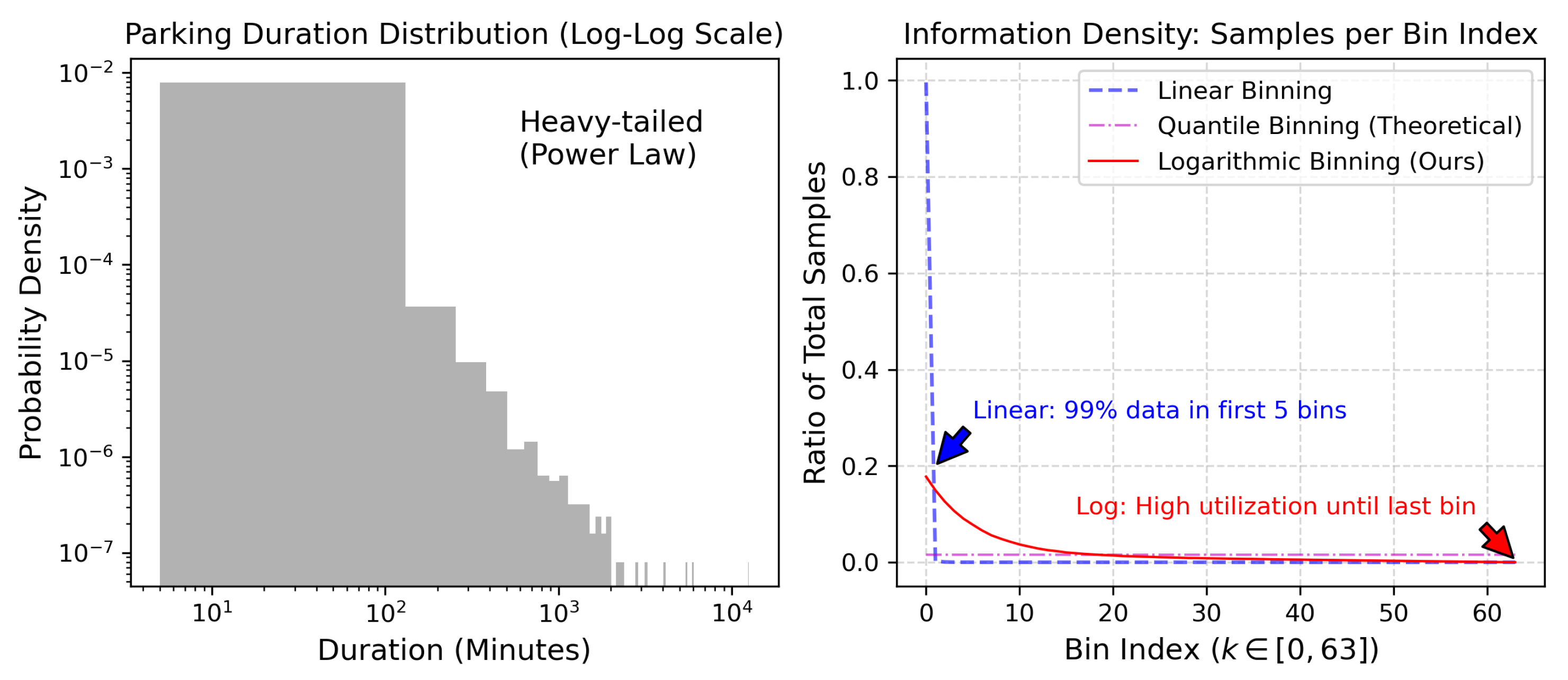
- 1.
- Linear Binning: Dividing the maximum time window into equal-width bins.
- 2.
- Quantile Binning: Using adaptive boundaries such that each bin contains an equal number of training samples (theoretical maximum entropy).
5.5.2. Analysis of Logarithmic Base Strategies
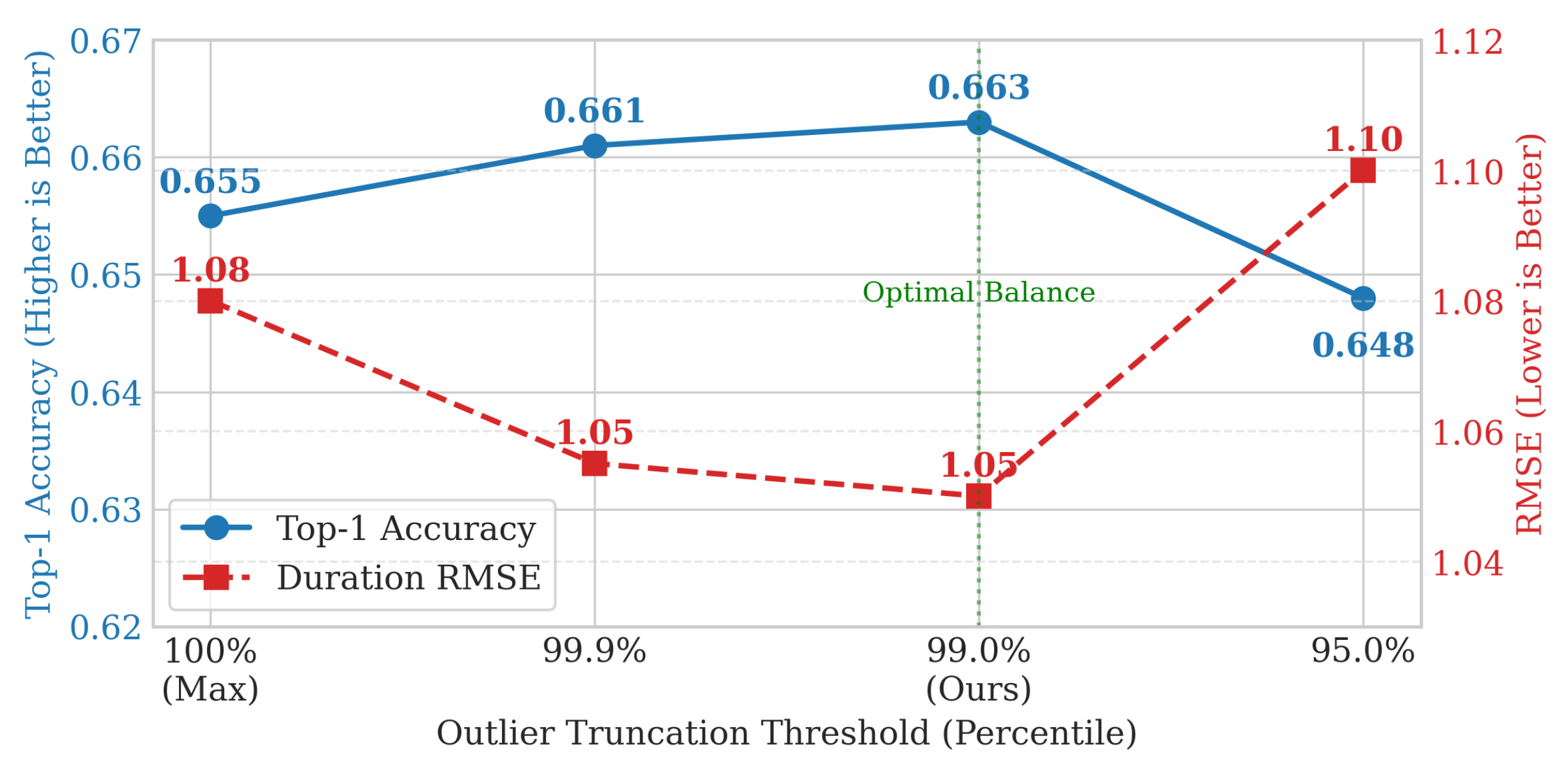
- Using the raw maximum () yields suboptimal performance (RMSE 1.08), this is because heavy-tailed outliers distort the bin allocation, leaving short-term intervals under-represented. Truncating at the 99th percentile significantly improves performance (RMSE 1.05), as it refines the granularity for the majority of data.
- Aggressively truncating at the 95th percentile degrades performance (RMSE rises to 1.10). This indicates that the “rare long gaps” (the top 1–5%) still contain valuable information regarding long-term periodicity (e.g., weekly or monthly patterns).
5.5.3. Analysis of Accumulate-Based Readout Strategies
- With a strong decay (), the RMSE degrades significantly to 1.22. In our low-latency setting (), temporal decay excessively suppresses early spikes (e.g., a spike at contributes only to the final output), reducing the effective signal magnitude and dynamic range required for high-precision regression.
- The mild decay () also yields suboptimal results (RMSE 1.11). Since the temporal dependencies are already explicitly captured by the preceding TA-LIF neurons, introducing additional temporal filtering at the readout layer creates redundancy and disrupts the learned representation. Thus, the uniform integration of ABR proves to be the robust approach for minimizing residual quantization errors.
5.5.4. Analysis of Handling Irregular Temporal Dynamics
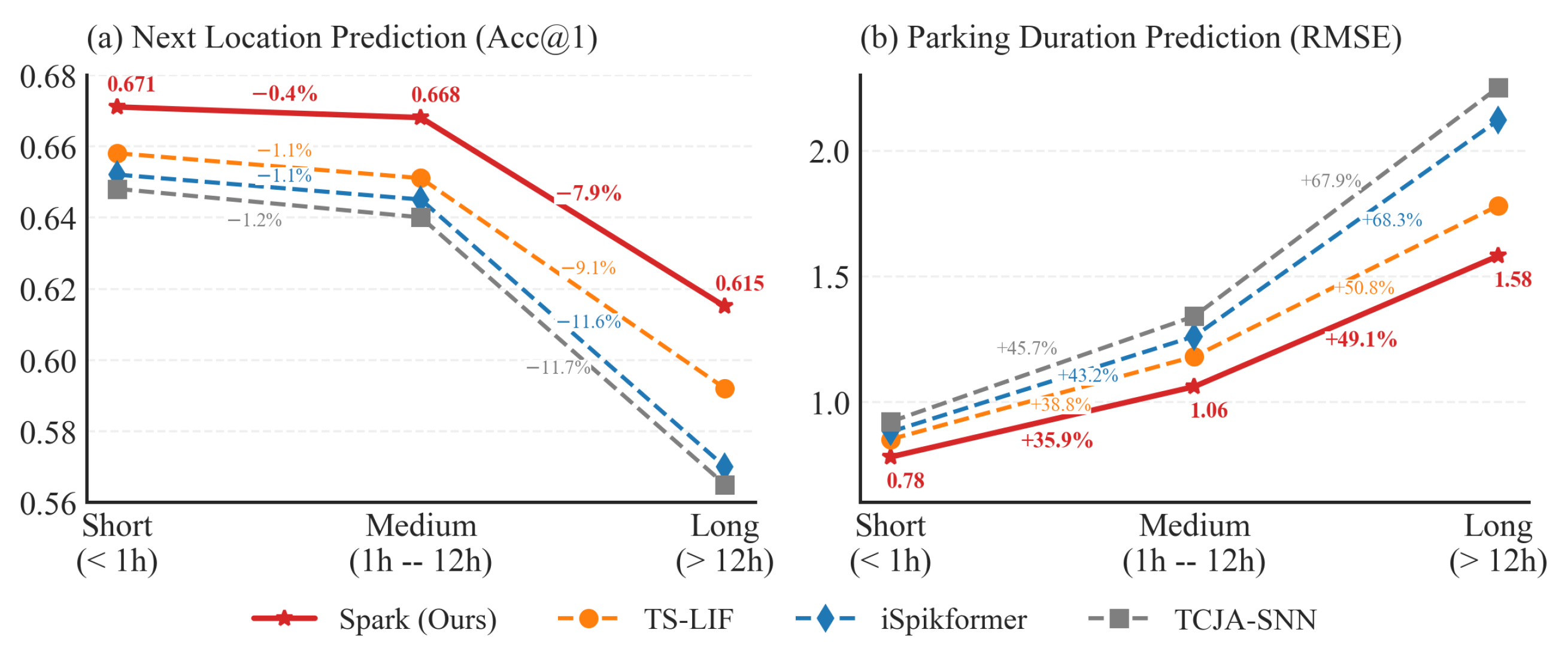
- With the increase of time interval, the performance of all models is obviously decreased. This is consistent with the inherent increase in entropy in human mobility, where long-term behaviors exhibit higher randomness compared to short-term transitions. As the time interval increases, the uncertainty of behavior also increases greatly, making it more difficult to predict.
- Compared with the baselines, Spark’s performance in both tasks was least affected by time interval duration compared to the baselines. As the time interval increased from short to long, the performance of the baselines in both tasks showed a significant decline. The reason for this phenomenon is that the memory decay in the baselines depends solely on event counts, which cannot adapt to the dynamic variations in physical time intervals. Consequently, the networks retain noisy historical context information, which subsequently impacts subsequent task performance. Thanks to the TA-LIF neurons and LUT-based mechanism, Spark explicitly links neuronal leak rates to physical time intervals, dynamically adjusting information retention levels based on physical time gaps. In this way, Spark can effectively reset the state of neurons even after a long time interval, which not only reduces the interference of invalid noise, but also ensures the effective processing of the current task information by the network.
5.6. General Parameter Sensitivity
5.6.1. Sensitivity to Simulation Steps T
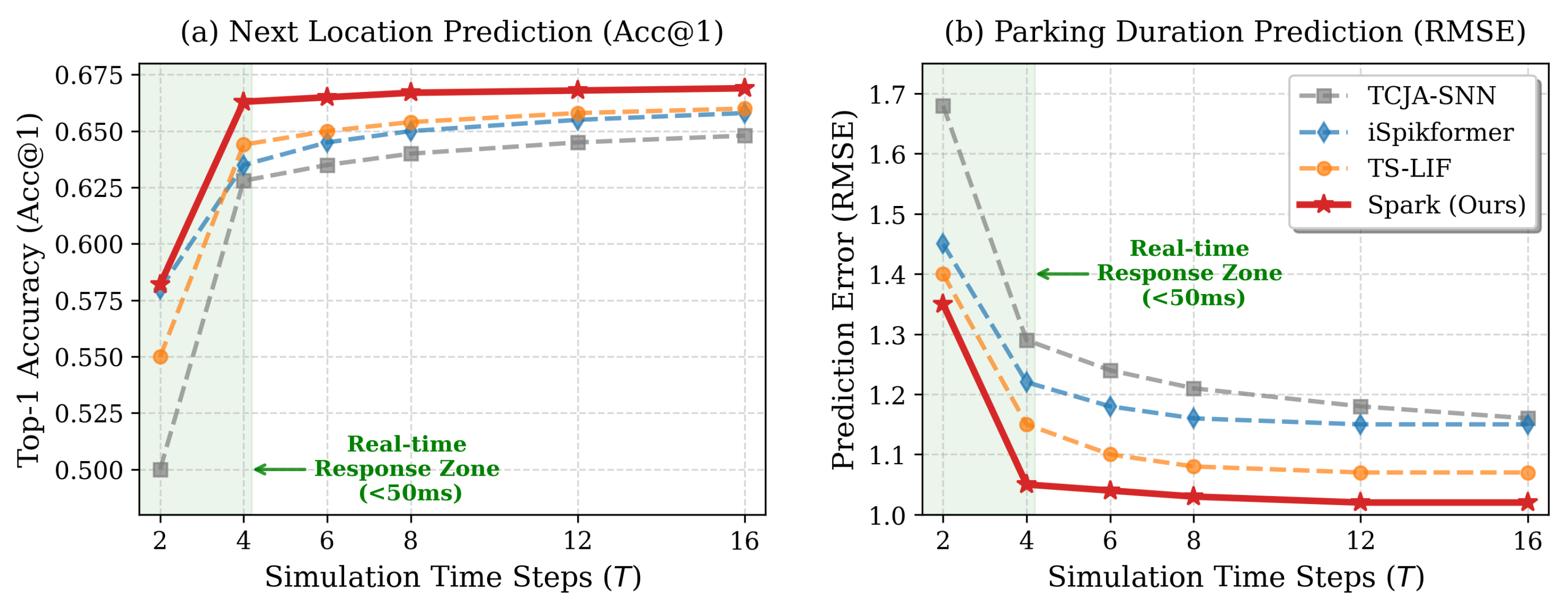
- All models suffer from significant performance degradation when T is restricted to 2. This phenomenon is primarily caused by the physical constraint of signal propagation depth in deep SNNs. Spikes require a minimum temporal window to propagate through multiple layers, and extremely short windows prevent the recurrent dynamics from effectively integrating historical context.
- Spark demonstrates the fastest convergence capability. When T increases to 4, Spark significantly outperforms baselines, reducing RMSE to 1.05 and achieving a Top-1 Accuracy of 0.663. This advantage stems from the proposed accumulate-based readout strategy. Unlike rate-coded baselines that require larger T to reduce quantization error for continuous regression, Spark leverages the continuous accumulated membrane potential in the final layer. This allows Spark to achieve high-precision regression and classification even under limited simulation steps, satisfying the Real-Time Response Zone requirements (<50 ms) without compromising accuracy.
- As T further increases from 6 to 16, the performance of rate-coded baselines gradually improves, narrowing the gap with Spark. For instance, iSpikformer achieves an RMSE of 1.10 at , approaching Spark’s performance. This confirms that with sufficient latency budget, rate coding can eventually approximate high-precision values. However, Spark’s performance stabilizes after , suggesting that the remaining error is dominated by the inherent aleatoric uncertainty of human mobility rather than model representational capacity. While increasing T yields marginal gains for baselines, it linearly escalates inference latency and energy consumption. Spark maintains its optimal performance–efficiency balance at , whereas baselines require more computational resources to reach comparable accuracy. Therefore, Spark remains the superior choice for resource-constrained vehicular edge scenarios.
5.6.2. Sensitivity to LUT Size K
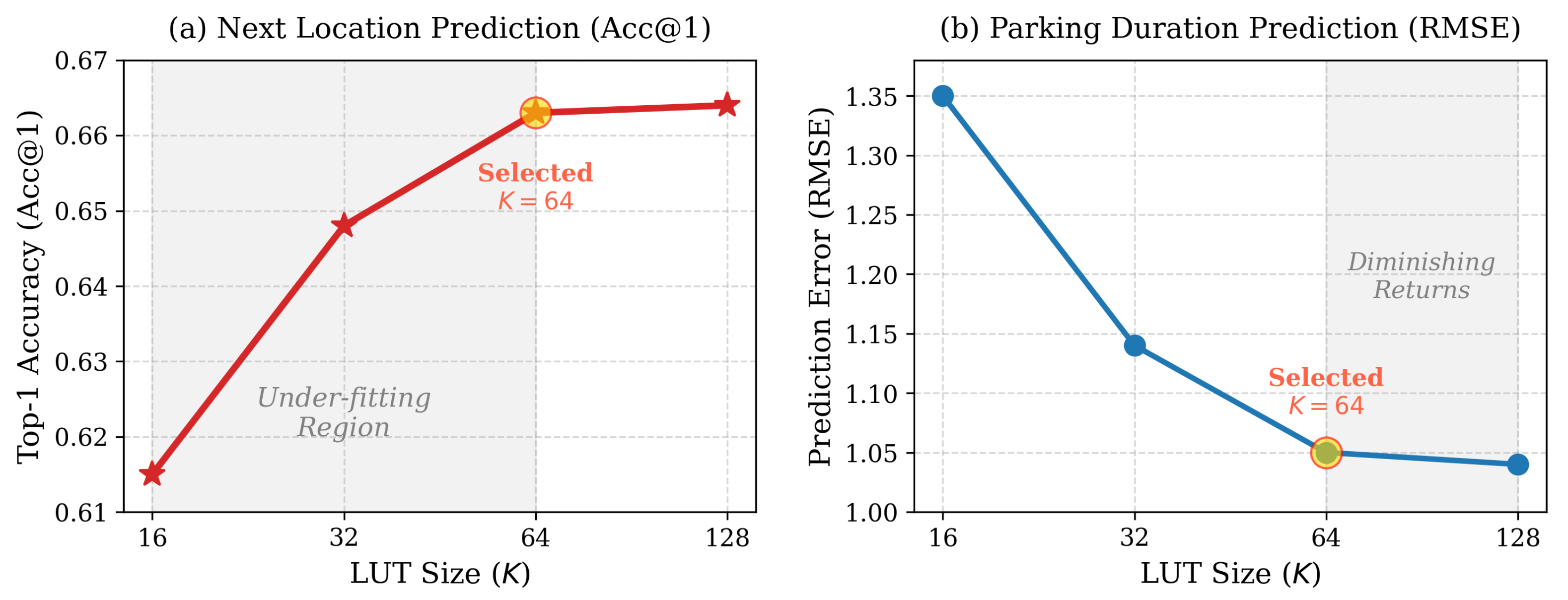
- Setting a small K leads to suboptimal performance in both metrics. Specifically, at , Acc@1 is suppressed at 0.615, and RMSE remains high at 1.35. This is caused by severe “quantization aliasing” under the logarithmic mapping strategy, where distinct physical intervals are mapped to the same decay parameter. This ambiguity forces the neuron to learn an averaged decay rate that fits neither scenario effectively, resulting in the loss of fine-grained temporal context required for both classification and regression.
- As K increases to 64, we observe a rapid performance gain, with Acc@1 reaching 0.659 and RMSE dropping to 1.09. At this resolution, the LUT provides sufficient granularity to distinguish subtle temporal patterns, such as decoupling short-term interactions from long-term periodicities. The TA-LIF neuron successfully matches precise leakage rates to varying time gaps, preserving user spatial preferences while minimizing regression errors.
- Further increasing K to 128 yields negligible marginal improvements (Acc@1 ≈ 0.660, RMSE ≈ 1.08). This saturation suggests that the temporal information gain has reached its limit. Theoretically, as K becomes large, the discretization granularity becomes excessively fine relative to the data density. Under a finite training dataset, this results in sparse activations for specific bins in the learnable vector , preventing sufficient gradient updates. Moreover, the remaining error is largely attributed to the aleatoric uncertainty inherent in human mobility. Consequently, we select as the default configuration to balance model complexity and predictive accuracy.
5.6.3. Sensitivity to Optimization Parameters
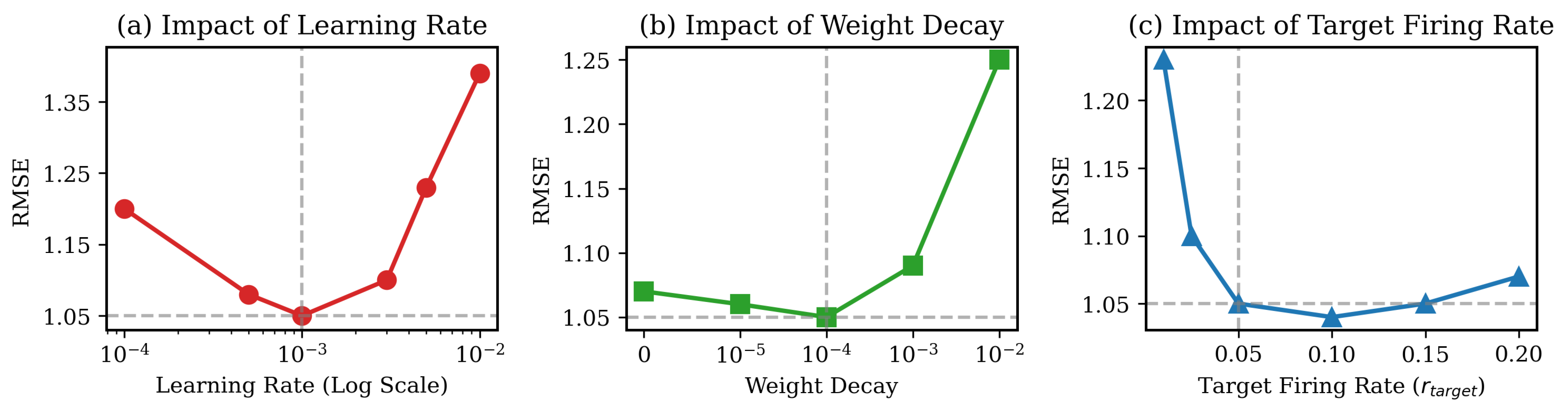
- Learning Rate (): As observed in Figure 8a, the model achieves optimal convergence with . A smaller learning rate (e.g., ) leads to under-fitting within the fixed training epochs, while an aggressive rate () destabilizes the surrogate gradient optimization, causing loss oscillation. This suggests that effectively balances convergence speed and stability.
- Weight Decay: Figure 8b indicates that Spark is relatively robust to weight decay variations in the range . This stability can be attributed to the inherent regularization effects of the discrete spike generation and the dropout mechanism in the SCG module. We select to prevent weight explosion without suppressing the representational capacity required for long-tail regression.
- Target Firing Rate (): The choice of presents a critical trade-off between information capacity and sparsity. As shown in Figure 8c, an extremely low rate (<0.02) results in performance degradation due to vanishing gradients—neurons remain silent and fail to propagate error signals through time. Conversely, increasing beyond yields negligible accuracy gains but significantly increases energy consumption. Consequently, we set to maximize energy efficiency while maintaining sufficient information flow for high-precision prediction.
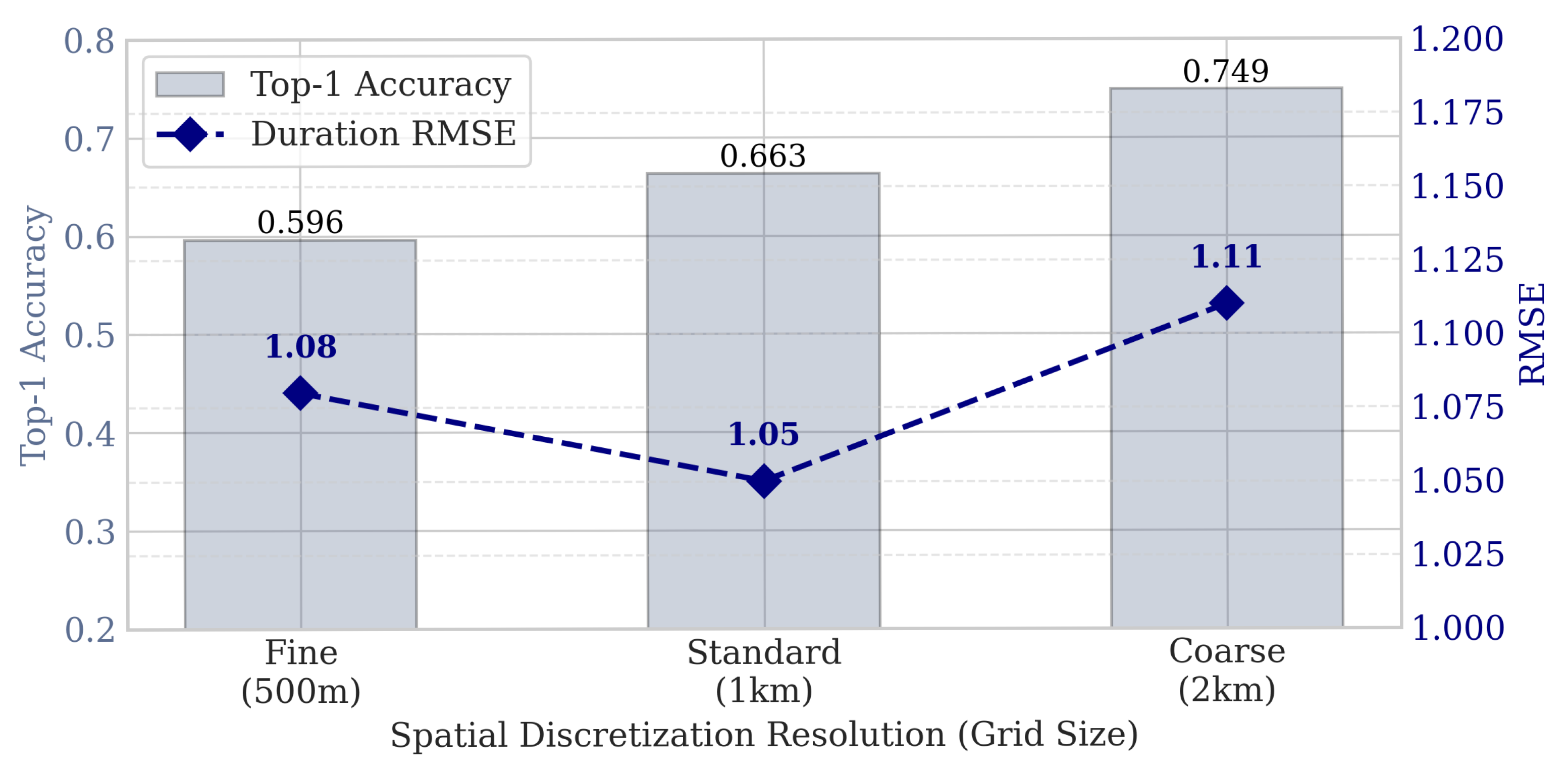
5.6.4. Sensitivity to Spatial Discretization
5.7. Discussion
- MPC excels in physical control but cannot model subjective human intent, whereas Spark learns implicit decision rules from data. MPC uses explicit differential equations (e.g., kinematic bicycle models) to optimize future states, which works well for physics-based control but struggles with high-entropy human behaviors driven by subjective preferences. As a data-driven approximator, Spark captures these implicit rules directly from historical data without predefined cost functions.
- Spark offers stronger long-range temporal scalability than fixed-horizon MPC. MPC uses a fixed prediction horizon (e.g., 100 ms steps), which leads to excessive computational cost when predicting long parking durations from minutes to days. In contrast, Spark’s event-driven TA-LIF neurons decouple memory from simulation steps, efficiently modeling long time intervals without extra overhead.
- Spark is more suitable for edge computing than MPC due to low latency and linear complexity. MPC relies on iterative solvers (e.g., quadratic programming) at each step, creating high computational load for vehicular edge devices. Spark uses sparse spike-based accumulation with linear complexity, achieving real-time inference (46.2 ms) for resource-constrained smart cockpit systems.
6. Conclusions
Author Contributions
Funding
Data Availability Statement
Acknowledgments
Conflicts of Interest
References
- Chen, J.; Jiang, W.; Wu, J.; Li, K.; Li, K. Dynamic Personalized POI Sequence Recommendation with Fine-Grained Contexts. ACM Trans. Internet Technol. 2023, 23, 1–28. [Google Scholar] [CrossRef] [Scilit]
- Long, W.; Xiao, Z.; Wang, D.; Jiang, H.; Chen, J.; Li, Y.; Alazab, M. Unified spatial-temporal neighbor attention network for dynamic traffic prediction. IEEE Trans. Veh. Technol. 2023, 72, 1515–1529. [Google Scholar] [CrossRef] [Scilit]
- Liu, C.; Xiao, Z.; Long, W.; Li, T.; Jiang, H.; Li, K. Vehicle trajectory data processing, analytics, and applications: A survey. ACM Comput. Surv. 2025, 57, 1–36. [Google Scholar] [CrossRef] [Scilit]
- Gonzalez, M.C.; Hidalgo, C.A.; Barabasi, A.L. Understanding individual human mobility patterns. Nature 2008, 453, 779–782. [Google Scholar] [CrossRef] [Scilit] [PubMed]
- Mathew, W.; Raposo, R.; Martins, B. Predicting future locations with hidden Markov models. In UbiComp ’12: Proceedings of the 2012 ACM Conference on Ubiquitous Computing, Pittsburgh, PA, USA, 5–8 September 2012; Association for Computing Machinery: New York, NY, USA, 2012; pp. 911–918. [Google Scholar]
- Feng, J.; Li, Y.; Zhang, C.; Sun, F.; Meng, F.; Guo, A.; Jin, D. Deepmove: Predicting human mobility with attentional recurrent networks. In WWW ’18: Proceedings of the 2018 World Wide Web Conference, Lyon, France, 23–27 April 2018; International World Wide Web Conferences Steering Committee: Geneva, Switzerland, 2018; pp. 1459–1468. [Google Scholar]
- Long, W.; Li, T.; Xiao, Z.; Wang, D.; Zhang, R.; Regan, A.C.; Chen, H.; Zhu, Y. Location Prediction for Individual Vehicles via Exploiting Travel Regularity and Preference. IEEE Trans. Veh. Technol. 2022, 71, 4718–4731. [Google Scholar] [CrossRef] [Scilit]
- Wu, H.; Xu, J.; Wang, J.; Long, M. Autoformer: Decomposition transformers with auto-correlation for long-term series forecasting. In NIPS ’21: Proceedings of the 35th International Conference on Neural Information Processing Systems, Online, 6–14 December 2021; Curran Associates Inc.: Red Hook, NY, USA, 2021; Volume 34, pp. 22419–22430. [Google Scholar]
- Maass, W. Networks of spiking neurons: The third generation of neural network models. Neural Netw. 1997, 10, 1659–1671. [Google Scholar] [CrossRef] [Scilit]
- Wang, Y.; Shi, K.; Lu, C.; Liu, Y.; Zhang, M.; Qu, H. Spatial-Temporal Self-Attention for Asynchronous Spiking Neural Networks. In IJCAI ’23: Proceedings of the Thirty-Second International Joint Conference on Artificial Intelligence, Macao, China, 19–25 August 2023; Curran Associates, Inc.: Red Hook, NY, USA, 2023; pp. 3085–3093. [Google Scholar]
- Zhu, R.J.; Zhang, M.; Zhao, Q.; Deng, H.; Duan, Y.; Deng, L.J. TCJA-SNN: Temporal-Channel Joint Attention for Spiking Neural Networks. IEEE Trans. Neural Netw. Learn. Syst. 2025, 36, 5112–5125. [Google Scholar] [CrossRef] [Scilit] [PubMed]
- Lv, C.; Wang, Y.; Han, D.; Zheng, X.; Huang, X.; Li, D. Efficient and Effective Time-Series Forecasting with Spiking Neural Networks. In Proceedings of the 41st International Conference on Machine Learning (ICML), Vienna, Austria, 21–27 July 2024; pp. 1–14. [Google Scholar]
- Feng, S.; Feng, W.; Gao, X.; Zhao, P.; Shen, Z. TS-LIF: A Temporal Segment Spiking Neuron Network for Time Series Forecasting. In Proceedings of the International Conference on Learning Representations (ICLR), Singapore, 24–28 April 2025; pp. 1–21. [Google Scholar]
- Yang, S.; Liu, J.; Zhao, K. GETNext: Trajectory flow map enhanced transformer for next POI recommendation. In SIGIR ’22: Proceedings of the 45th International ACM SIGIR Conference on Research and Development in Information Retrieval, Madrid, Spain, 11–15 July 2022; Association for Computing Machinery: New York, NY, USA, 2022; pp. 1144–1153. [Google Scholar]
- Zhu, Y.; Ye, Y.; Zhang, S.; Zhao, X.; Yu, J. DiffTraj: Generating gps trajectory with diffusion probabilistic model. In Proceedings of the Advances in Neural Information Processing Systems, New Orleans, LA, USA, 10–16 December 2023; Curran Associates, Inc.: Red Hook, NY, USA, 2023; Volume 36, pp. 65168–65188. [Google Scholar]
- Liu, Y.; Hu, T.; Zhang, H.; Wu, H.; Wang, S.; Ma, L.; Long, M. iTransformer: Inverted Transformers are Effective for Time Series Forecasting. In Proceedings of the Twelfth International Conference on Learning Representations (ICLR), Vienna, Austria, 7–11 May 2024; pp. 1–25. [Google Scholar]
- Zhu, Y.; Li, H.; Liao, Y.; Wang, B.; Guan, Z.; Liu, H.; Cai, D. What to Do Next: Modeling User Behaviors by Time-LSTM. In IJCAI’17: Proceedings of the 26th International Joint Conference on Artificial Intelligence, Melbourne, Australia, 19–25 August 2017; AAAI Press: Washington, DC, USA, 2017; pp. 3602–3608. [Google Scholar]
- Rubanova, Y.; Chen, R.T.Q.; Duvenaud, D.K. Latent Ordinary Differential Equations for Irregularly-Sampled Time Series. In Proceedings of the Advances in Neural Information Processing Systems (NeurIPS), Vancouver, BC, Canada, 8–14 December 2019; Volume 32, pp. 1–11. [Google Scholar]
- Zuo, S.; Jiang, H.; Li, Z.; Martin, T.; Suk, H.; Zhao, T. Transformer Hawkes Process. In ICML’20: Proceedings of the 37th International Conference on Machine Learning, Online, 13–18 July 2020; JMLR: Norfolk, MA, USA, 2020; pp. 11692–11702. [Google Scholar]
- Li, Z.; Xia, L.; Tang, J.; Xu, Y.; Shi, L.; Xia, L.; Yin, D.; Huang, C. UrbanGPT: Spatio-temporal large language models. In KDD ’24: Proceedings of the 30th ACM SIGKDD Conference on Knowledge Discovery and Data Mining, Barcelona, Spain, 25–29 August 2024; Association for Computing Machinery: New York, NY, USA, 2024; pp. 5351–5362. [Google Scholar]
- Masquelier, T.; Thorpe, S.J. Unsupervised Learning of Visual Features through Spike Timing Dependent Plasticity. PLoS Comput. Biol. 2007, 3, e311. [Google Scholar] [CrossRef] [Scilit] [PubMed]
- Bilal, M.; Tariq, O.; Ahmed, H. NOS-Gate: Queue-Aware Streaming IDS for Consumer Gateways under Timing-Controlled Evasion. arXiv 2026, arXiv:2601.00389. [Google Scholar]
- Fang, W.; Chen, Y.; Ding, J.; Yu, Z.; Masquelier, T.; Chen, D.; Huang, L.; Zhou, H.; Li, G.; Tian, Y. SpikingJelly: An open-source machine learning infrastructure platform for spike-based intelligence. Sci. Adv. 2023, 9, eadi1480. [Google Scholar] [CrossRef] [Scilit] [PubMed]
- Horowitz, M. 1.1 Computing’s energy problem (and what we can do about it). In Proceedings of the 2014 IEEE International Solid-State Circuits Conference Digest of Technical Papers (ISSCC), San Francisco, CA, USA, 9-13 February 2014; IEEE: Piscataway, NJ, USA, 2014; pp. 10–14. [Google Scholar]
- Newman, M.E. Power laws, Pareto distributions and Zipf’s law. Contemp. Phys. 2005, 46, 323–351. [Google Scholar] [CrossRef] [Scilit]
- Camacho, E.F.; Bordons, A.C. Model Predictive Control; Springer Science & Business Media: Berlin/Heidelberg, Germany, 2013. [Google Scholar]
- Schwarting, W.; Alonso-Mora, J.; Rus, D. Planning and decision-making for autonomous vehicles. Annu. Rev. Control. Robot. Auton. Syst. 2018, 1, 187–210. [Google Scholar] [CrossRef] [Scilit]




| City | Time Period | Vehicles | Raw GPS Points | Parking Events | Location Classes |
|---|---|---|---|---|---|
| Shanghai | January 2023–January 2024 | 5246 | 332,568,498 | 3,824,512 | 4820 |
| Shenzhen | January 2023–January 2024 | 7831 | 418,316,988 | 5,712,390 | 3950 |
| Changsha | January 2023–January 2024 | 5071 | 365,469,915 | 3,698,045 | 2765 |
| Dataset | Metric | Markov | DeepRP | Time-LSTM | ODE-RNN | THP | iTransformer | TCJA-SNN | Spark (Ours) |
|---|---|---|---|---|---|---|---|---|---|
| Shanghai | Acc@1 | 0.663± 0.002 | |||||||
| Acc@5 | 0.861± 0.003 | ||||||||
| RMSE | 1.050± 0.010 | ||||||||
| MAE | 0.700± 0.010 | ||||||||
| Shenzhen | Acc@1 | 0.668± 0.002 | |||||||
| Acc@5 | 0.870± 0.003 | ||||||||
| RMSE | 1.060± 0.010 | ||||||||
| MAE | 0.720± 0.010 | ||||||||
| Changsha | Acc@1 | 0.656± 0.002 | |||||||
| Acc@5 | 0.858± 0.003 | ||||||||
| RMSE | 1.040± 0.010 | ||||||||
| MAE | 0.720± 0.010 |
| Model | Category | Params (M) | Inference Cost | Memory (MB) | Density (%) | |
|---|---|---|---|---|---|---|
| Ops (M) | Energy (μJ) | |||||
| DeepRP | RNN | 1.25 | 2.40 | 11.04 | 14.5 | 100.0 |
| Time-LSTM | RNN | 1.38 | 2.85 | 13.11 | 16.2 | 100.0 |
| ODE-RNN | Continuous | 1.42 | 52.00 | 239.20 | 32.4 | 100.0 |
| iTransformer | Transformer | 3.42 | 14.50 | 66.70 | 48.6 | 100.0 |
| TCJA-SNN | SNN | 1.32 | 0.45 | 0.41 | 18.2 | 6.2 |
| iSpikformer | SNN | 3.15 | 0.92 | 0.83 | 42.0 | 5.5 |
| Spark (Ours) | SNN | 1.28 | 0.38 | 0.34 | 16.8 | 4.8 |
| TA-LIF | SCG | Acc. Readout | Acc@1 | RMSE |
|---|---|---|---|---|
| × | × | × | (+0.0%) | (−0.0%) |
| × | × | ✓ | (+4.5%) | (−18.2%) |
| ✓ | × | × | (+7.9%) | (−13.9%) |
| ✓ | ✓ | × | (+10.8%) | (−23.6%) |
| ✓ | ✓ | ✓ | (+13.9%) | (−36.4%) |
| Readout Strategy | Decay | Update Rule | Acc@1 | RMSE |
|---|---|---|---|---|
| Leaky Readout (Strong) | 0.5 | 0.635 | 1.22 | |
| Leaky Readout (Mild) | 0.9 | 0.652 | 1.11 | |
| ABR (Ours) | 1.0 | 0.663 | 1.05 |
| Model | Readout Strategy (RMSE) | Spark (Ours) | |
|---|---|---|---|
| Standard | With ABR (Fair) | ||
| TCJA-SNN | 1.29 | 1.18 | 1.05 |
| TS-LIF | 1.15 | 1.10 | |
Disclaimer/Publisher’s Note: The statements, opinions and data contained in all publications are solely those of the individual author(s) and contributor(s) and not of MDPI and/or the editor(s). MDPI and/or the editor(s) disclaim responsibility for any injury to people or property resulting from any ideas, methods, instructions or products referred to in the content. |
© 2026 by the authors. Licensee MDPI, Basel, Switzerland. This article is an open access article distributed under the terms and conditions of the Creative Commons Attribution (CC BY) license.
Share and Cite
Long, W.; Chen, J. Event-Driven Spiking Neural Networks for Private Vehicle Parking Prediction. Entropy 2026, 28, 253. https://doi.org/10.3390/e28030253
Long W, Chen J. Event-Driven Spiking Neural Networks for Private Vehicle Parking Prediction. Entropy. 2026; 28(3):253. https://doi.org/10.3390/e28030253
Chicago/Turabian StyleLong, Wangchen, and Jie Chen. 2026. "Event-Driven Spiking Neural Networks for Private Vehicle Parking Prediction" Entropy 28, no. 3: 253. https://doi.org/10.3390/e28030253
APA StyleLong, W., & Chen, J. (2026). Event-Driven Spiking Neural Networks for Private Vehicle Parking Prediction. Entropy, 28(3), 253. https://doi.org/10.3390/e28030253