A Dynamic Hybrid Weighting Framework for Teaching Effectiveness Evaluation in Multi-Criteria Decision-Making: Integrating Interval-Valued Intuitionistic Fuzzy AHP and Entropy Triggering



Abstract
1. Introduction
2. Hierarchical Criteria System Construction for MCDM
2.1. Indicator Selection and Quantification Criteria
- (1)
- Expert Selection: Experts were selected based on professional authority, requiring either no less than 10 years of experience in building electrical engineering projects or no less than 8 years of teaching experience in higher education. The expert panel consisted of both academic faculty members and industry practitioners.
- (2)
- Preliminary Indicator Screening: Based on an extensive literature review and curriculum objectives, 14 secondary indicators were initially identified. A five-point Likert scale [18] was employed to assess the importance of each indicator, and experts were encouraged to provide supplementary suggestions.
- (3)
- Consensus Evaluation: Kendall’s coefficient of concordance (W) [19] was used to evaluate the consistency of expert opinions, with a threshold of W ≥ 0.7 indicating high consensus. Indicators with a coefficient of variation (CV) ≤ 0.25 were retained; otherwise, adjustments were made in subsequent rounds.
- (4)
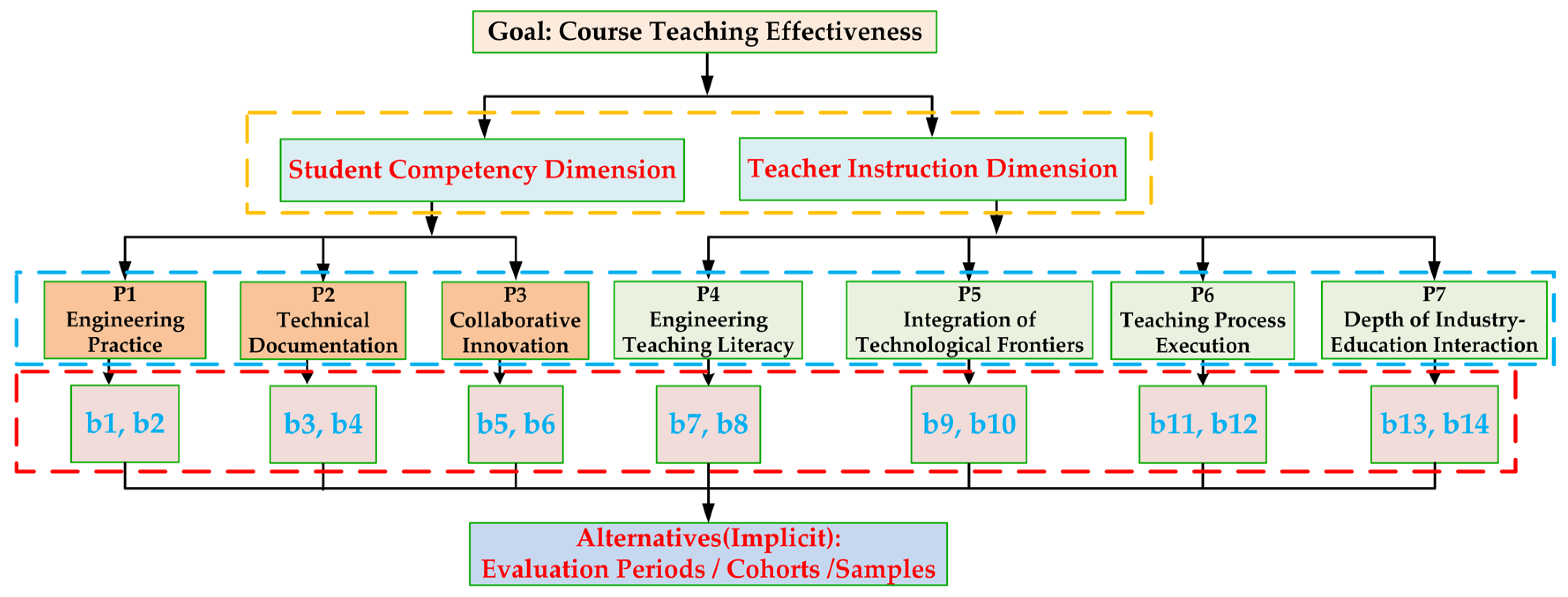
- Finalization of Indicators: Indicators exhibiting persistently low consensus were removed based on expert feedback, resulting in a stable evaluation framework comprising seven first-level indicators and fourteen secondary indicators.
2.1.1. Student Competency Dimension
- (1)
- Engineering Practice Competency (P1): Evaluates hands-on engineering skills through secondary indicators such as Power Distribution System Debugging (b1) and Lighting Scheme Implementation (b2).
- (2)
- Technical Documentation Competency (P2): Assesses standardized technical communication abilities via indicators including Electrical Design Documentation Standards (b3) and Energy Efficiency Assessment Report (b4).
- (3)
- Collaborative Innovation Competency (P3): Emphasizes interdisciplinary collaboration and system integration capabilities, represented by Smart Construction Collaboration (b5) and Smart Control System Integration (b6).
2.1.2. Teacher Instruction Dimension
- (1)
- Engineering Teaching Literacy (P4): Measures the ability to translate engineering experience into effective teaching resources, using Industry Case Updates (b7) and On-site Teaching Capability (b8).
- (2)
- Integration of Technological Frontiers (P5): Evaluates the incorporation of emerging technologies into curricula through Smart Lighting Technology (b9) and Green Building Standards (b10).
- (3)
- Teaching Process Execution (P6): Assesses instructional standardization via Blended Virtual Experiments (b11) and Safety Standard Penetration (b12).
- (4)
- Depth of Industry–Education Interaction (P7): Reflects the effectiveness of university–enterprise collaboration using Corporate Mentor Involvement (b13) and Engineering Ethics Care (b14).
2.2. Enhanced Interval-Valued Intuitionistic Fuzzy AHP Weight Determination
2.2.1. Theoretical Foundation of Interval-Valued Intuitionistic Fuzzy Sets
- (1)
- Conceptual Evolution from Fuzzy Sets to Interval-Valued Intuitionistic Fuzzy Sets
- (2)
- Core Mathematical Definitions
2.2.2. Expert Judgment Modeling and IVIFN Scale
- (1)
- Expert Judgment Matrix Construction
- (2)
- Operationalization Using the IVIFN Semantic Scale
- (3)
- Output for Subsequent Processing
2.2.3. Aggregation of Group Opinions
2.2.4. Defuzzification and Consistency Verification
3. Design of a Dynamic Entropy-Triggered Weight Correction Mechanism
3.1. Data Standardization and Information Entropy Analysis
- (1)
- When ej > 0.7 and CVj > 0.3, it is identified as a high-dispersion indicator;
- (2)
- When ej < 0.3 and CVj < 0.1, it is identified as a low-controversy indicator.
3.2. Entropy-Triggered Dynamic Weight Fusion
4. Data Collection and Preprocessing
4.1. Multi-Source Data Collection Framework
4.2. Sample Composition and Timeline
- (1)
- Sample-based data were collected from n = 127 valid samples, representing multiple evaluation stages within the considered decision period. These data provide quantitative measurements for secondary indicators derived from questionnaires, experimental records, and platform logs.
- (2)
- Expert judgment data were obtained from k = 10 domain experts selected according to predefined experience criteria. The expert panel comprises both academic specialists and industry practitioners to ensure balanced coverage of theoretical and practical perspectives.
4.3. Data Preprocessing and Standardization Procedures
- (1)
- Subjective Assessment Data
- (2)
- Objective Performance Data
5. Model Implementation and Computational Outcomes
5.1. Generation of Initial Weights via Enhanced IVIF-AHP
5.2. Entropy-Triggered Dynamic Weight Adjustment
5.3. Hierarchical Fuzzy Comprehensive Evaluation
5.3.1. Evaluation Set and Grade Quantification
5.3.2. Membership Estimation and Fuzzy Relation Matrices
5.3.3. Two-Level Fuzzy Synthesis and Defuzzification
5.4. Computational Results, Comparative Behavior, and Robustness Discussion
5.4.1. Weight Redistribution Under Entropy Triggering
5.4.2. Output Sensitivity and Stability
5.4.3. Comparative Behavior Against Static Baselines
6. Results and Discussion
6.1. Comparative Performance and Diagnostic Precision
6.2. Validation Through Intervention and Measurable Improvement
6.3. Comprehensive Discussion: Mechanism, Robustness, and Generalizability
- (1)
- Operational Mechanism of the Dynamic Fusion
- (2)
- Inherent Stability and Robustness
- (3)
- Methodological Contributions and Generalizability
7. Conclusions
- (1)
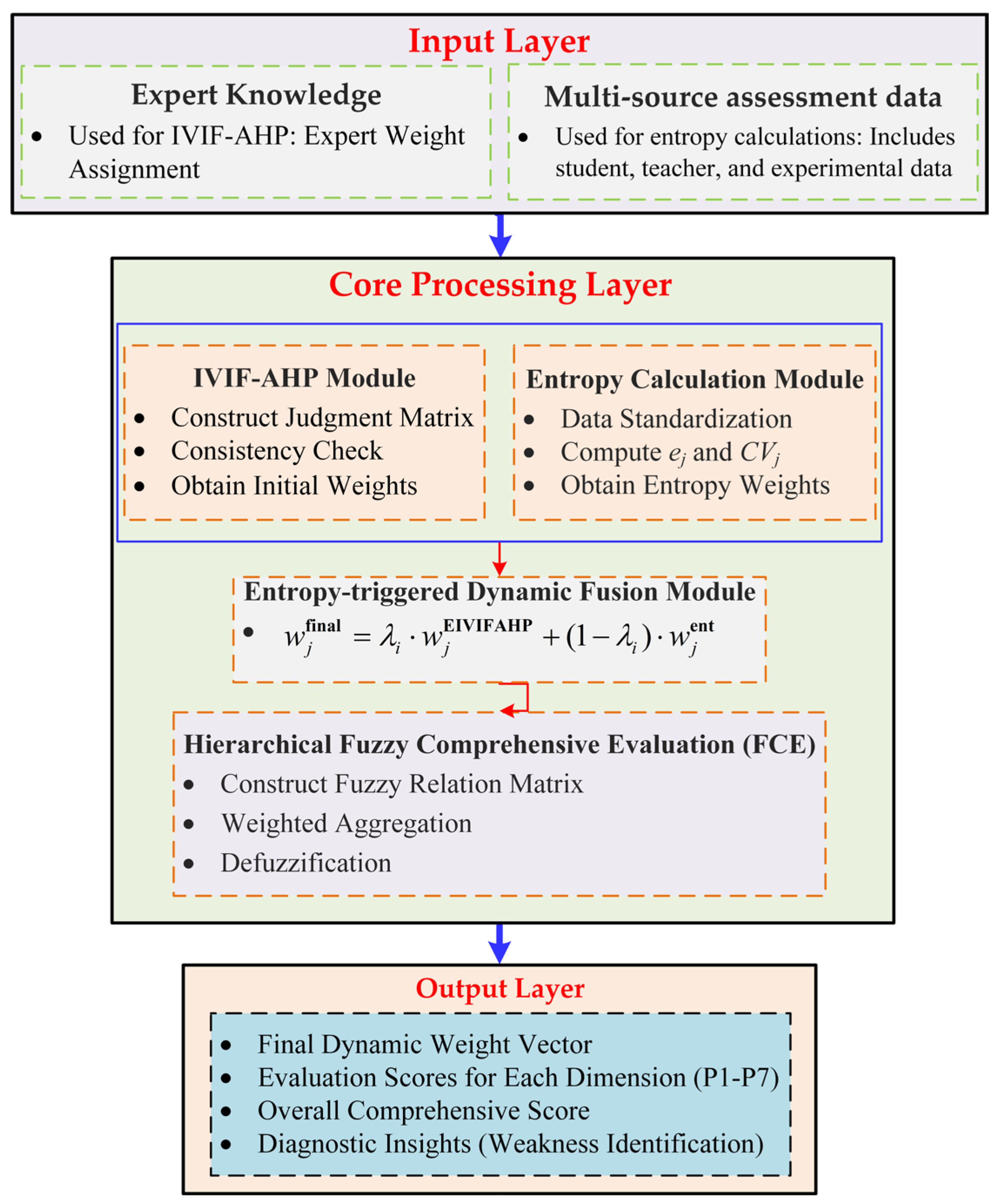
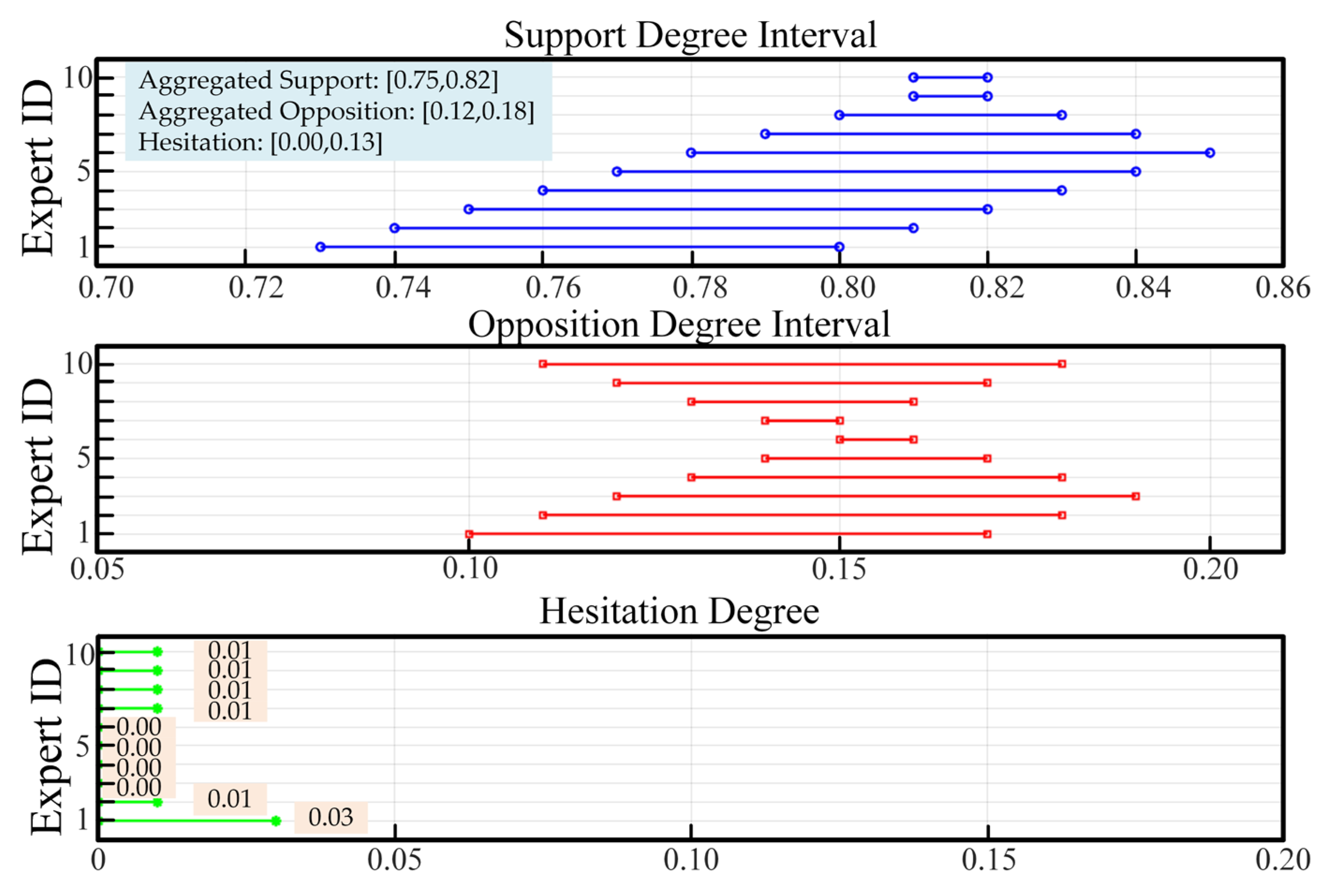
- A hierarchical decision framework was constructed in which expert judgments are modeled using interval-valued intuitionistic fuzzy numbers, enabling explicit representation of support, opposition, and hesitation in pairwise comparisons.
- (2)
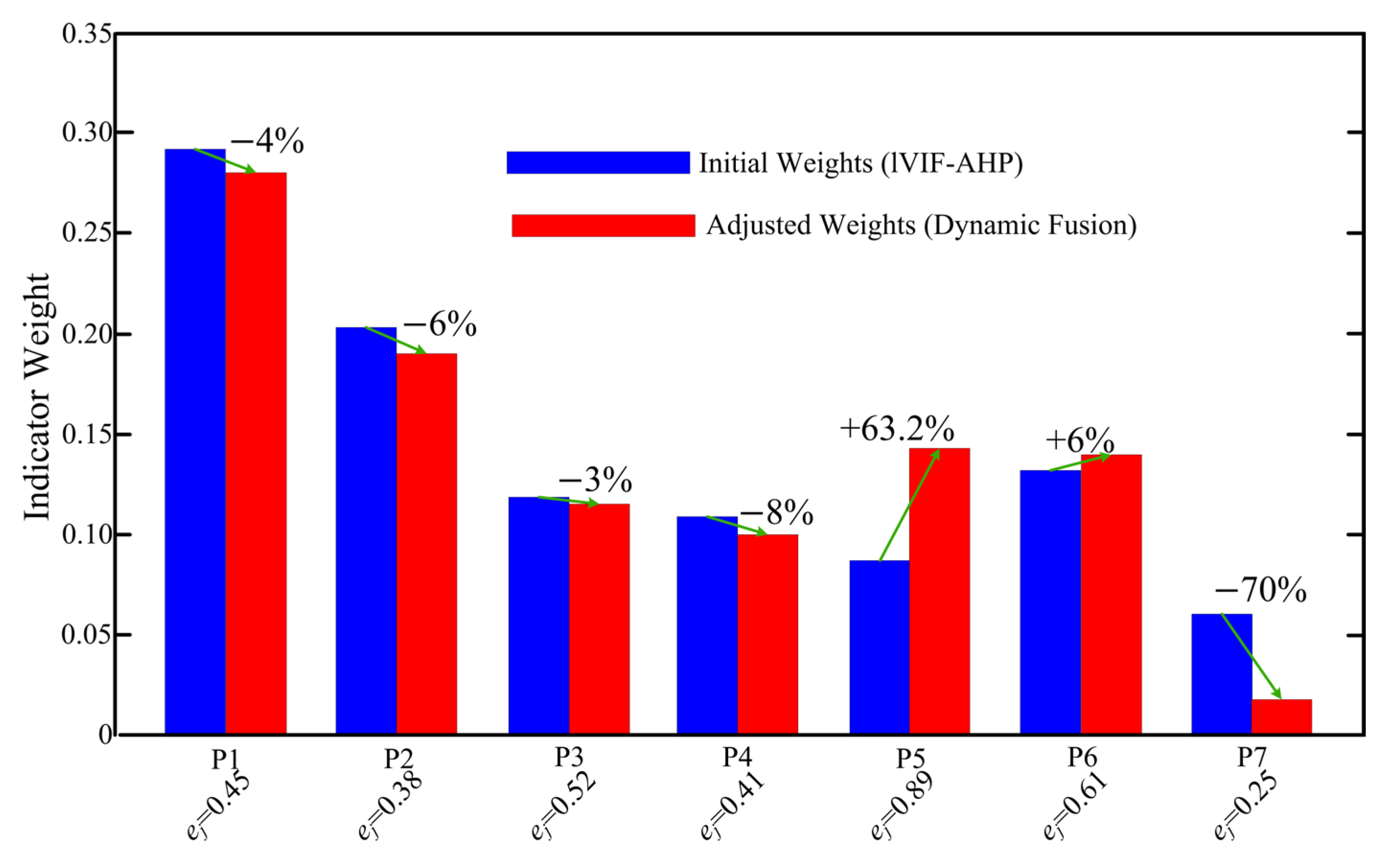
- An entropy-triggered correction mechanism was introduced to dynamically regulate the fusion ratio between subjective and objective weights at the indicator level, allowing the evaluation model to adaptively respond to actual dispersion in teaching and learning data while maintaining numerical stability.
- (3)
- A hierarchical fuzzy aggregation process was employed to ensure consistent and interpretable information synthesis across multiple decision layers. The resulting aggregation pipeline exhibits robustness with respect to bounded perturbations in both weight vectors and membership distributions.
Author Contributions
Funding
Institutional Review Board Statement
Data Availability Statement
Conflicts of Interest
Abbreviations
| MCDM | Multi-Criteria Decision-Making |
| AHP | Analytic Hierarchy Process |
| IVIF-AHP | Interval-Valued Intuitionistic Fuzzy Analytic Hierarchy Process |
| IVIFN | Interval-Valued Intuitionistic Fuzzy Number |
| FCE | Fuzzy Comprehensive Evaluation |
| KNN | K-Nearest Neighbors |
| WAA | Weighted Arithmetic Averaging |
| BEI | Building Electrical and Intelligent Engineering |
| BPSDT | Building Power Supply and Distribution Technology |
References
- Saaty, T.L. Decision making with the analytic hierarchy process. Int. J. Serv. Sci. 2008, 1, 83–98. [Google Scholar] [CrossRef]
- Liang, J. “OBE” Concept for new training mode of electronic information science and technology professionals under big data analysis. Comput. Intell. Neurosci. 2022, 2022, 8075708. [Google Scholar] [CrossRef]
- Garg, H.; Agarwal, N.; Tripathi, A. Entropy based multi-criteria decision making method under fuzzy environment and unknown attribute weights. Glob. J. Technol. Optim. 2015, 6, 13–20. [Google Scholar]
- Li, W.; Lu, Y.; Fan, C.; Heng, Y.; Zhu, X. Multicriteria group decision making based on intuitionistic normal cloud and cloud distance entropy. Entropy 2022, 24, 1396. [Google Scholar] [CrossRef] [PubMed]
- Ayan, B.; Abacıoğlu, S.; Basilio, M.P. A comprehensive review of the novel weighting methods for multi-criteria decision-making. Information 2023, 14, 285. [Google Scholar] [CrossRef]
- Ishizaka, A.; Labib, A. Analytic hierarchy process and expert choice: Benefits and limitations. OR Insight 2009, 22, 201–220. [Google Scholar] [CrossRef]
- Liu, Y.; Eckert, C.M.; Earl, C. A review of fuzzy AHP methods for decision-making with subjective judgements. Expert Syst. Appl. 2020, 161, 113738. [Google Scholar] [CrossRef]
- Kukreja, V. Hybrid fuzzy AHP–TOPSIS approach to prioritizing solutions for inverse reinforcement learning. Complex Intell. Syst. 2023, 9, 493–513. [Google Scholar]
- Mukhametzyanov, I. Specific character of objective methods for determining weights of criteria in MCDM problems: Entropy, CRITIC and SD. Decis. Mak. Appl. Manag. Eng. 2021, 4, 76–105. [Google Scholar] [CrossRef]
- Sitorus, F.; Brito-Parada, P.R. A multiple criteria decision making method to weight the sustainability criteria of renewable energy technologies under uncertainty. Renew. Sustain. Energy Rev. 2020, 127, 109891. [Google Scholar] [CrossRef]
- Mizrak, F.; Polat, L.; Tasar, S.A. Applying entropy weighting and 2-tuple linguistic T-spherical fuzzy MCDM: A case study of developing a strategic sustainability plan for Istanbul Airport. Sustainability 2024, 16, 11104. [Google Scholar] [CrossRef]
- Mardani, A.; Jusoh, A.; Nor, K.; Khalifah, Z.; Zakwan, N.; Valipour, A. Multiple criteria decision-making techniques and their applications—A review of the literature from 2000 to 2014. Econ. Res.-Ekon. Istraž. 2015, 28, 516–571. [Google Scholar] [CrossRef]
- Sahoo, S.K.; Goswami, S.S. A comprehensive review of multiple criteria decision-making (MCDM) methods: Advancements, applications, and future directions. Decis. Mak. Adv. 2023, 1, 25–48. [Google Scholar] [CrossRef]
- Şahin, M. A comprehensive analysis of weighting and multicriteria methods in the context of sustainable energy. Int. J. Environ. Sci. Technol. 2021, 18, 1591–1616. [Google Scholar] [CrossRef]
- Odu, G.O. Weighting methods for multi-criteria decision making technique. J. Appl. Sci. Environ. Manag. 2019, 23, 1449–1457. [Google Scholar] [CrossRef]
- Nasa, P.; Jain, R.; Juneja, D. Delphi methodology in healthcare research: How to decide its appropriateness. World J. Methodol. 2021, 11, 116. [Google Scholar] [CrossRef]
- Zhang, Z. Construction of mathematical modeling for teaching evaluation index system based on the delphi AHP method. Sci. Program. 2022, 2022, 7744067. [Google Scholar] [CrossRef]
- Koo, M.; Yang, S.W. Likert-type scale. Encyclopedia 2025, 5, 18. [Google Scholar] [CrossRef]
- Franceschini, F.; Maisano, D. Aggregating multiple ordinal rankings in engineering design: The best model according to the Kendall’s coefficient of concordance. Res. Eng. Des. 2021, 32, 91–103. [Google Scholar] [CrossRef]
- Zadeh, L.A. Fuzzy sets. Inf. Control 1965, 8, 338–353. [Google Scholar] [CrossRef]
- Xiong, F.; Abbas, W.; Hussain, A.; Ullah, K.; Yin, S.; Zhang, N.; Elashiry, M.I. Decision Algorithm With Interval-Valued Intuitionistic Fuzzy Hamy Mean Aggregation Operators for Assessment of Agricultural Education Practice. IEEE Access 2024, 12, 65685–65705. [Google Scholar] [CrossRef]
- Kokoç, M.; Ersöz, S. A literature review of interval-valued intuitionistic fuzzy multi-criteria decision-making methodologies. Oper. Res. Decis. 2021, 31, 89–116. [Google Scholar] [CrossRef]
- Hsu, M.C.; Lee, H.S. Applying AHP-IFNs-DEMATEL in establishing a supplier selection model: A case study of offshore wind power companies in taiwan. Energies 2023, 16, 4481. [Google Scholar] [CrossRef]
- Abdullah, L.; Najib, L. A new preference scale of intuitionistic fuzzy analytic hierarchy process in multi-criteria decision making problems. J. Intell. Fuzzy Syst. 2014, 26, 1039–1049. [Google Scholar] [CrossRef]
- Zheng, J.; Dong, M. Interval-valued intuitionistic fuzzy multi-attribute decision-making based on entropy and bidirectional projection. Int. J. Comput. Intell. Syst. 2025, 18, 39. [Google Scholar] [CrossRef]
- Fan, C.; Fu, Q.; Song, Y.; Lu, Y.; Li, W.; Zhu, X. A new model of interval-valued intuitionistic fuzzy weighted operators and their application in dynamic fusion target threat assessment. Entropy 2022, 24, 1825. [Google Scholar] [CrossRef]
- Shannon, C.E. A mathematical theory of communication. ACM SIGMOBILE Mob. Comput. Commun. Rev. 2001, 5, 3–55. [Google Scholar] [CrossRef]
- Wang, C.-N.; Le, T.Q.; Chang, K.-H.; Dang, T.-T. Measuring Road Transport Sustainability Using MCDM-Based Entropy Objective Weighting Method. Symmetry 2022, 14, 1033. [Google Scholar] [CrossRef]
- Zhao, Y.; Jaafar, M. Integrated Delphi-entropy framework for sustainable rural tourism: Evidence from Shaanxi Province, China (2018–2023). Front. Sustain. Tour. 2025, 4, 1733705. [Google Scholar] [CrossRef]
- Halder, R.K.; Uddin, M.N.; Uddin, M.A.; Aryal, S.; Khraisat, A. Enhancing K-nearest neighbor algorithm: A comprehensive review and performance analysis of modifications. J. Big Data 2024, 11, 113. [Google Scholar] [CrossRef]



| Dimension | First-Level Indicators | Secondary Indicators | Engineering Competency Observation Points | Data Sources |
|---|---|---|---|---|
| Student | Engineering Practice Competency (P1) | Power Distribution System Debugging (b1) | Transformer Selection Accuracy, Short-Circuit Current Calculation Compliance Rate, Feasibility of Relay Protection Scheme | Lab Report/Simulation Results |
| Lighting Scheme Implementation (b2) | Illuminance Simulation Compliance Rate (GB50034-2024), Effectiveness of Energy-Saving Control Strategy, Rationality of Emergency Lighting System Configuration | Design Drawings/Energy Consumption Data | ||
| Technical Documentation Competency (P2) | Electrical Design Documentation Standards (b3) | GB/T50786 Drafting Standard Coverage, Completeness of Design Description, Logical Rigor of Calculation Sheets | Coursework/Industry Mentor Evaluation | |
| Energy Efficiency Assessment Report (b4) | Accuracy of LPD (Lighting Power Density) Calculation, Proportion of Renewable Energy Solutions, Depth of Economic Analysis | Project Report | ||
| Collaborative Innovation Competency (P3) | Smart Construction Collaboration (b5) | CAD Model Conflict Resolution Rate, Team Task Contribution, Completeness of Collaboration Platform Logs | Collaboration Platform Data | |
| Smart Control System Integration (b6) | Success Rate of Lighting-AC Joint Debugging, IoT Device Communication Stability, Fault Diagnosis Response Speed | Training Platform Records | ||
| Teacher | Engineering Teaching Literacy (P4) | Industry Case Updates (b7) | Proportion of annual real engineering cases, penetration rate of latest corporate standards | Syllabus/Courseware |
| On-site Teaching Capability (b8) | Frequency of substation field teaching, completeness of equipment operation demonstrations | Teaching logs/Student feedback | ||
| Integration of Technological Frontiers (P5) | Smart Lighting Technology (b9) | Proportion of class hours on new technologies like LiFi/visible light communication, depth of intelligent control algorithms | Lesson plan review | |
| Green Building Standards (b10) | Integration of LEED/green building evaluation standards, weight of carbon-neutral design solutions | Course project analysis | ||
| Teaching Process Execution (P6) | Blended Virtual Experiments (b11) | Number of digital twin simulation experiments, compliance rate of physical equipment operation safety standards | Experiment records/Monitoring videos | |
| Safety Standard Penetration (b12) | Coverage rate of electric shock first aid drills, pass rate of high-voltage operation procedure assessments | Assessment results | ||
| Depth of Industry-Education Interaction (P7) | Corporate Mentor Involvement (b13) | Class hours taught by industry experts, number of real projects converted into teaching cases | Corporate teaching records/Project certifications | |
| Engineering Ethics Care (b14) | Intensity of safety standard awareness training (frequency of accident case analysis), assessment of professional responsibility | Ethics tests/Behavioral observations |
| Scale Level | Scale Meaning | Interval-Valued Intuitionistic Fuzzy Number | Hesitancy Interval | Reciprocal Scale |
|---|---|---|---|---|
| 1 | Equally Important | ([0.50,0.50], [0.50,0.50]) | [0.00,0.00] | ([0.50,0.50], [0.50,0.50]) |
| 2 | Between 1~3 | ([0.35,0.45], [0.30,0.50]) | [0.05,0.20] | ([0.30,0.50], [0.35,0.45]) |
| 3 | Slightly Important | ([0.55,0.65], [0.20,0.30]) | [0.05,0.25] | ([0.20,0.30], [0.55,0.65]) |
| 4 | Between 3~5 | ([0.60,0.70], [0.15,0.25]) | [0.05,0.25] | ([0.15,0.25], [0.60,0.70]) |
| 5 | Moderately Important | ([0.70,0.80], [0.10,0.20]) | [0.00,0.20] | ([0.10,0.20], [0.70,0.80]) |
| 6 | Between 5~7 | ([0.75,0.85], [0.05,0.15]) | [0.00,0.20] | ([0.05,0.15], [0.75,0.85]) |
| 7 | Strongly Important | ([0.80,0.90], [0.05,0.10]) | [0.00,0.15] | ([0.05,0.10], [0.80,0.90]) |
| 8 | Between 7~9 | ([0.85,0.95], [0.02,0.05]) | [0.00,0.13] | ([0.02,0.05], [0.85,0.95]) |
| 9 | Extremely Important | ([0.90,0.95], [0.00,0.05]) | [0.00,0.10] | ([0.00,0.05], [0.90,0.95]) |
| Data Category | Acquisition Method | Sample Size | Secondary Indicators Covered | Data Standardization Method |
|---|---|---|---|---|
| Student subjective evaluation | Anonymous electronic questionnaire | Valid questionnaires | b3, b5, b9, b14 | Range Method and Reverse Scoring Correction |
| Objective competency indicators | Experiment reports/Collaboration platform logs | 127 reports/logs | b1, b2, b6, b11, b12 | Boxplot Outlier Removal |
| Teaching process records | Teaching archives/Industry cooperation certification | Full-semester materials | b7, b8, b10, b13 | Manual Review and Cross-Verification |
| Expert observational assessment | Industry expert scoring sheets | 10 experts | All 14 secondary indicators | EIVIF-AHP Aggregation |
| First-Level Indicators | Weight | Rank | Engineering Significance |
|---|---|---|---|
| Engineering Practice Competency (P1) | 0.291 | 1 | Core Skills Have the Highest Weight |
| Technical Documentation Competency (P2) | 0.203 | 2 | Standardized Expression Plays a Key Role |
| Collaborative Innovation Competency (P3) | 0.118 | 5 | Reflects the Importance of Teamwork |
| Engineering Teaching Literacy (P4) | 0.109 | 6 | Foundation of Teacher’s Industry Experience |
| Integration of Technological Frontiers (P5) | 0.087 | 7 | New Technology Penetration Needs Strengthening |
| Teaching Process Execution (P6) | 0.132 | 3 | Teaching Implementation Process Carries Weight |
| Depth of Industry–Education Interaction (P7) | 0.060 | 4 | Enterprise Participation Needs Improvement |
| Level | Score Range | Assigned Value | Engineering Competency Mapping |
|---|---|---|---|
| E1 (Excellent) | 90–100 | 95 | Fully meets industry standards |
| E2 (Good) | 80–89 | 85 | Meets core requirements |
| E3 (Medium) | 70–79 | 75 | Partial optimization needed |
| E4 (Pass) | 50–69 | 60 | Meets the minimum teaching objectives |
| E5 (Fail) | 0–49 | 30 | Fails educational quality requirements |
| Model | Comprehensive Score | Depth of Industry-Academia Interaction (P7) Score | Uncertainty Quantification Capability |
|---|---|---|---|
| EIVIF-AHP and EWFCE model | 90.38 | 76.2 | Supports hesitation degree calculation |
| Traditional Expert Scoring Method | 94.25 | 88.7 | Ignores expert disagreements |
| Indicator | 2022 Score | 2023 Score | Δ (95% CI) | p-Value |
|---|---|---|---|---|
| Smart Lighting Tech (b9) | 78.5 ± 12.3 | 86.2 ± 8.7 | 7.7 (4.2–11.3) | 0.003 |
| Engineering Ethics (b14) | 76.8 ± 10.5 | 84.1 ± 7.9 | 7.3 (3.8–10.8) | 0.004 |
| Industry Case Updates (b7) | 82.3 ± 9.4 | 88.6 ± 6.2 | 6.3 (2.9–9.7) | 0.012 |
Disclaimer/Publisher’s Note: The statements, opinions and data contained in all publications are solely those of the individual author(s) and contributor(s) and not of MDPI and/or the editor(s). MDPI and/or the editor(s) disclaim responsibility for any injury to people or property resulting from any ideas, methods, instructions or products referred to in the content. |
© 2026 by the authors. Licensee MDPI, Basel, Switzerland. This article is an open access article distributed under the terms and conditions of the Creative Commons Attribution (CC BY) license.
Share and Cite
Lu, C.; Zhang, Y. A Dynamic Hybrid Weighting Framework for Teaching Effectiveness Evaluation in Multi-Criteria Decision-Making: Integrating Interval-Valued Intuitionistic Fuzzy AHP and Entropy Triggering. Entropy 2026, 28, 241. https://doi.org/10.3390/e28020241
Lu C, Zhang Y. A Dynamic Hybrid Weighting Framework for Teaching Effectiveness Evaluation in Multi-Criteria Decision-Making: Integrating Interval-Valued Intuitionistic Fuzzy AHP and Entropy Triggering. Entropy. 2026; 28(2):241. https://doi.org/10.3390/e28020241
Chicago/Turabian StyleLu, Chengling, and Yanxue Zhang. 2026. "A Dynamic Hybrid Weighting Framework for Teaching Effectiveness Evaluation in Multi-Criteria Decision-Making: Integrating Interval-Valued Intuitionistic Fuzzy AHP and Entropy Triggering" Entropy 28, no. 2: 241. https://doi.org/10.3390/e28020241
APA StyleLu, C., & Zhang, Y. (2026). A Dynamic Hybrid Weighting Framework for Teaching Effectiveness Evaluation in Multi-Criteria Decision-Making: Integrating Interval-Valued Intuitionistic Fuzzy AHP and Entropy Triggering. Entropy, 28(2), 241. https://doi.org/10.3390/e28020241