Internet Penetration and Leisure Activity Entropy: A Macro-Micro Integrated Analysis


Abstract
1. Introduction
2. Theoretical Model Construction
2.1. Shannon’s Information Entropy Theory and the Information Entropy of Leisure Activities
2.2. Core Mechanisms and Research Hypotheses
2.2.1. Micro Level Internet Penetration and Leisure Entropy
2.2.2. Macro-Level Internet Penetration and Leisure Entropy
2.2.3. Macro–Micro Linking Mechanism
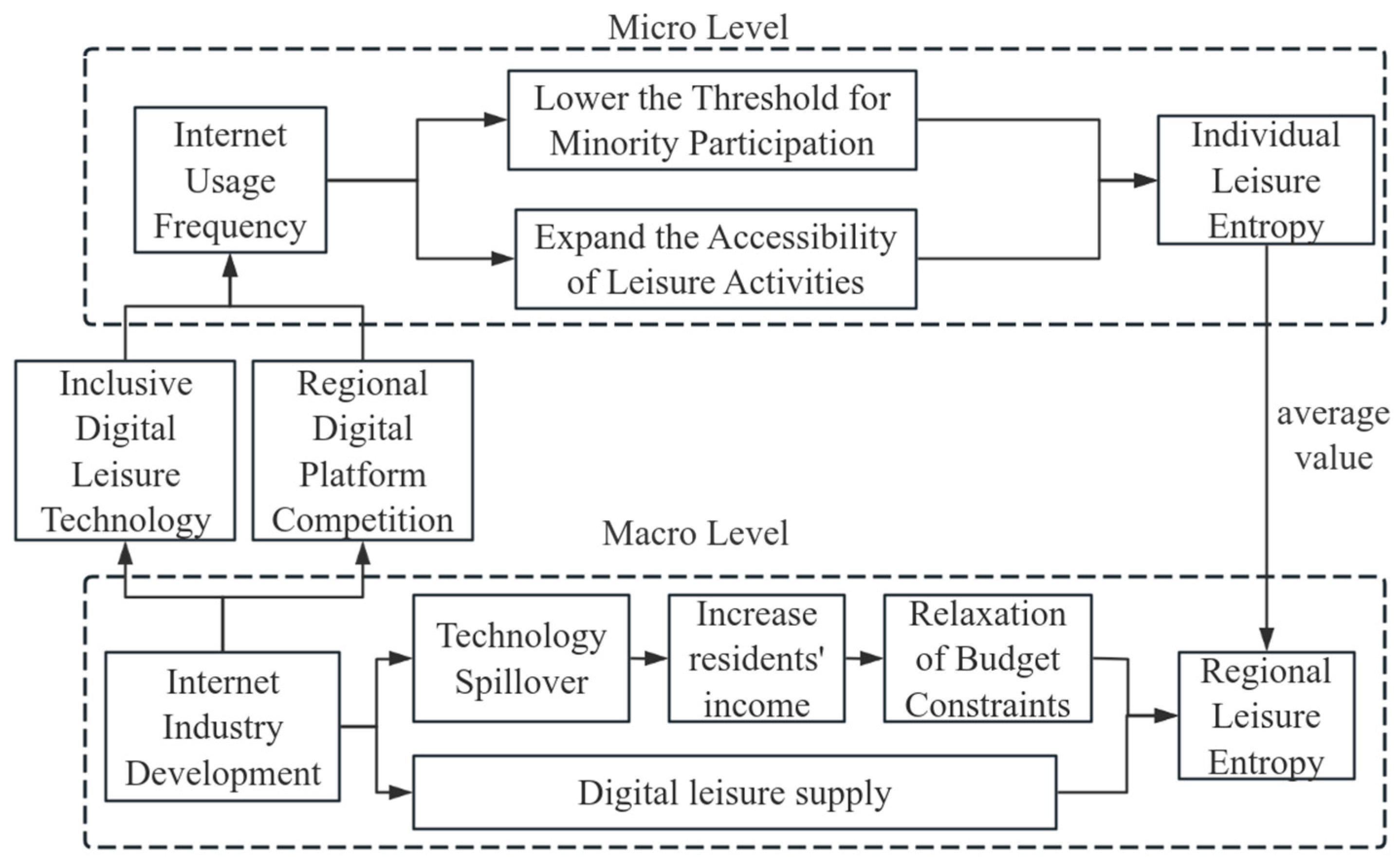
2.2.4. Theoretical Framework Integration
3. Materials and Methods
3.1. Overall Research Design
3.2. Data Collection and Processing
3.2.1. Data Source
- Micro-level individual data
- Macro Regional Data
3.2.2. Variable Measurement and Operationalization
- Core Explanatory Variable: Internet Penetration
- Core explanatory variable: Leisure activity entropy
- Control variable
- Replacement of variables
3.3. Model and Algorithm Description
3.3.1. Baseline Regression Model
- Macro Benchmark Model
- Micro benchmark model
3.3.2. Nonlinear Model
3.3.3. Mediation Effect Model
3.3.4. Endogeneity Test
4. Results
4.1. Stylized Facts Analysis
4.1.1. Descriptive Statistics of Variables
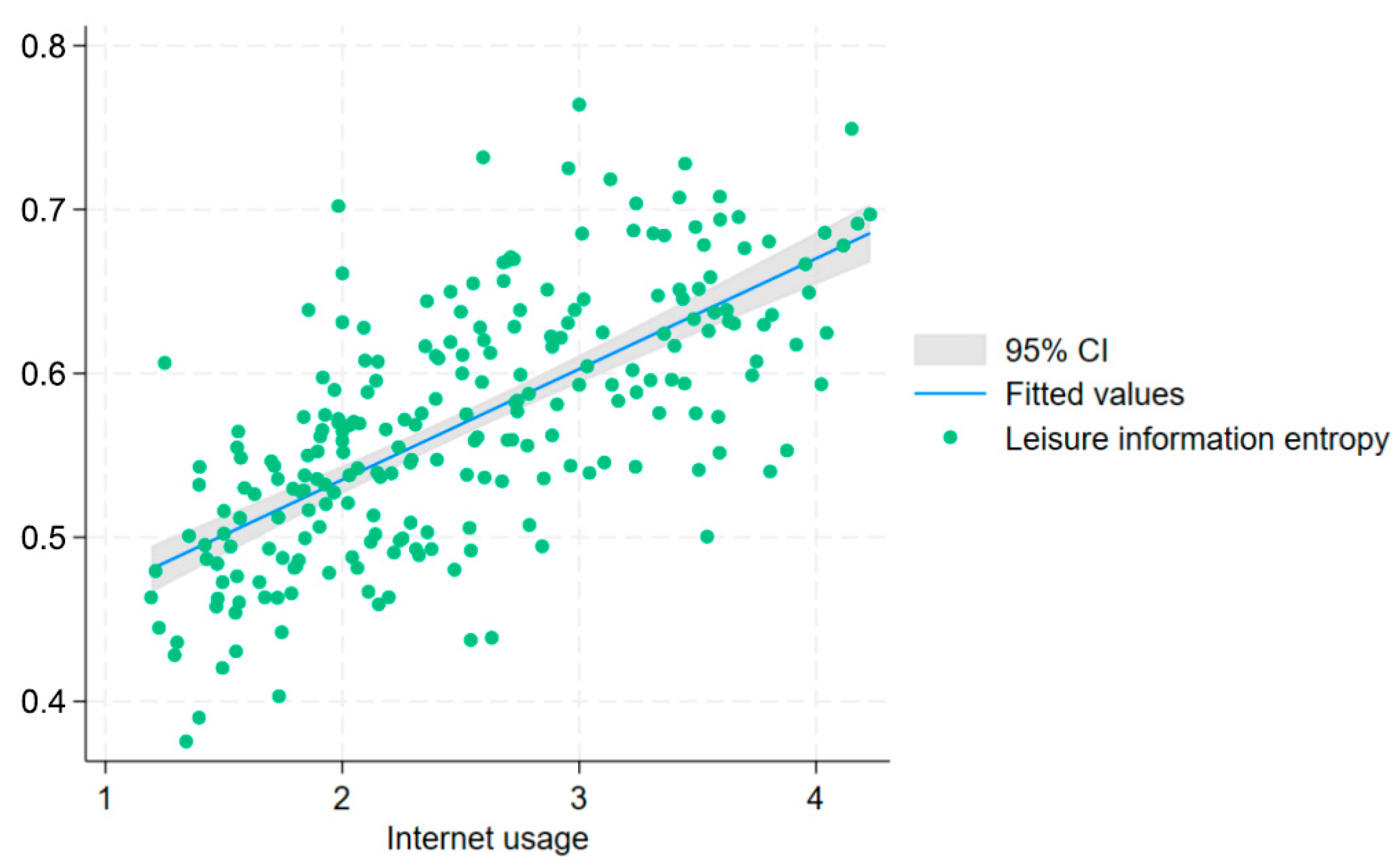
4.1.2. Preliminary Analysis of the Relationship Between Internet Penetration Rate and Regional Leisure Entropy
4.2. Micro-Level
4.3. Macro-Level
4.4. Robustness Test and Endogenous Test
4.5. Macro–Micro Linkage Mechanism Pathway
4.6. Further Analysis
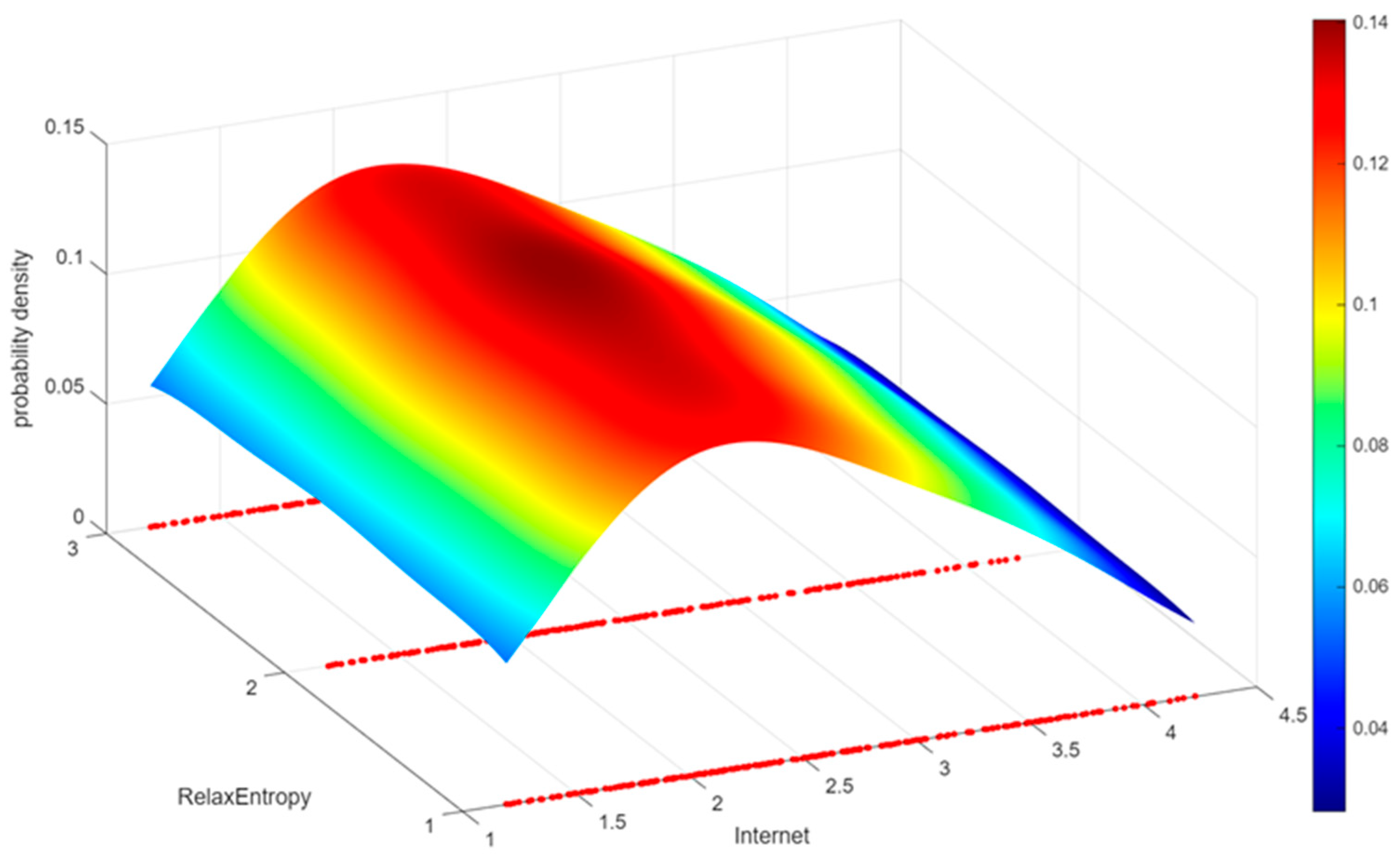
4.6.1. The Inverted U-Shaped Impact of Internet Penetration at the Macro-Level
4.6.2. The Impact of Internet Penetration on the Entropy Values of Different Types of Leisure Activities
5. Discussion
6. Conclusions
Author Contributions
Funding
Data Availability Statement
Acknowledgments
Conflicts of Interest
Appendix A. Theoretical Derivation Process
Appendix A.1. Micro Individual Behavior Decision Model
Appendix A.1.1. Improved Utility Function
Appendix A.1.2. Constraint Conditions
Appendix A.1.3. Optimal Decision Making and Lagrange Multiplier Derivation
Appendix A.1.4. Key Proposition and Mechanism Explanation
Appendix A.2. Macroeconomic Growth Model
Appendix A.2.1. Composite Well-Being Output Function
Appendix A.2.2. Production Functions and Technological Progress
Appendix A.2.3. Capital Accumulation and Steady-State Analysis
Appendix A.2.4. Macro Propositions and Mechanistic Explanations
Appendix A.3. Macro–Micro Linkage Model
References
- Einboden, R. The Post-Fordist Sexual Contract: Working and Living in Contingency Lisa Adkins and Maryanne Dever (Eds). Fem. Psychol. 2018, 29, 437–441. [Google Scholar] [CrossRef]
- Simsek, K.Y. Leisure Time Internet Usage Habits: Generational and Country Comparison. Manag. Sport Leis. 2025, 1–16. [Google Scholar] [CrossRef]
- Wood, L.; Hoeber, O.; Snelgrove, R.; Hoeber, L.R.N. Computer Science Meets Digital Leisure: Multiple Perspectives on Social Media and eSport Collaborations. J. Leis. Res. 2019, 50, 425–437. [Google Scholar] [CrossRef]
- Fancourt, D.; Aughterson, H.; Finn, S.; Walker, E.; Steptoe, A. How Leisure Activities Affect Health: A Narrative Review and Multi-Level Theoretical Framework of Mechanisms of Action. Lancet Psychiatry 2021, 8, 329–339. [Google Scholar] [CrossRef]
- Wen, J.W.; Zheng, C.; Ye, Z.D.; Xin, T.; Long, G.L. Stable States with Nonzero Entropy under Broken PT Symmetry. Phys. Rev. Res. 2021, 3, 013256. [Google Scholar] [CrossRef]
- Churchill, S.L.; Clark, V.L.P.; Prochaska-Cue, K.; Creswell, J.W.; Ontai-Grzebik, L. How Rural Low-Income Families Have Fun: A Grounded Theory Study. J. Leis. Res. 2007, 39, 271–294. [Google Scholar] [CrossRef]
- Lamberti, G.; López-Sintas, J.; Belbeze, P.L. The Impact of Internet Use on Leisure: Gender and Age Heterogeneity in Young People. J. Leis. Res. 2023, 54, 581–601. [Google Scholar] [CrossRef]
- López-Sintas, J.; García-Álvarez, M.E.; Hernández-López, A.G. In and out of Everyday Life through Film Experiences: An Analysis of Two Social Spaces as Leisure Frames. Leis. Stud. 2016, 36, 565–578. [Google Scholar] [CrossRef]
- Näsi, M.; Räsänen, P.; Sarpila, O.T. ICT Activity in Later Life: Internet Use and Leisure Activities amongst Senior Citizens in Finland. Eur. J. Ageing 2011, 9, 169–176. [Google Scholar] [CrossRef]
- Sintas, J.L.; Belbeze, M.P.L.; Lamberti, G. Socially Patterned Strategic Complementarity between Offline Leisure Activities and Internet Practices among Young People. Leis. Sci. 2020, 45, 24–45. [Google Scholar] [CrossRef]
- Beutel, M.E.; Brähler, E.; Glaesmer, H.D.; Kuss, D.J.; Wölfling, K.; Müller, K.W. Regular and Problematic Leisure-Time Internet Use in the Community: Results from a German Population-Based Survey. Cyberpsychol. Behav. Soc. Netw. 2011, 14, 291–296. [Google Scholar] [CrossRef]
- Zhou, R.G.; Fong, P.S.W.; Tan, P. Internet Use and Its Impact on Engagement in Leisure Activities in China. PLoS ONE 2014, 9, e89598. [Google Scholar] [CrossRef] [PubMed]
- Valdemoros-San-Emeterio, M.-Á.; Sanz-Arazuri, E.; Ponce-de-León-Elizondo, A. Digital leisure and perceived family functioning in youth of upper Secondary Education. Comunicar 2017, 25, 99–108. [Google Scholar] [CrossRef]
- Shannon, C.E. A Mathematical Theory of Communication. Bell Syst. Tech. J. 1948, 27, 379–423. [Google Scholar] [CrossRef]
- Abellán, J.; Pérez-Lara, A.; Moral-García, S. A Variation of the Algorithm to Achieve the Maximum Entropy for Belief Functions. Entropy 2023, 25, 867. [Google Scholar] [CrossRef] [PubMed]
- Gencaga, D.; Knuth, K.; Rossow, W. A Recipe for the Estimation of Information Flow in a Dynamical System. Entropy 2015, 17, 438–470. [Google Scholar] [CrossRef]
- Verdoolaege, G. Regression of Fluctuating System Properties: Baryonic Tully–Fisher Scaling in Disk Galaxies. In Springer Proceedings in Mathematics & Statistics; Springer International Publishing: Cham, Swizerland, 2018; pp. 77–87. [Google Scholar] [CrossRef]
- Barakazi, E. The Role of Technological Innovations in Diversification of Recreational Activities: Interview with Chatgpt. J. Gastron. Hosp. Travel 2023, 6, 1639–1649. [Google Scholar] [CrossRef]
- Aguiar, M.; Hurst, E. Measuring trends in leisure: The allocation of time over five decades. Q. J. Econ. 2007, 122, 969–1006. [Google Scholar] [CrossRef]
- Lee, Y.K. Gender differences in leisure: From the relationship between leisure type-time and time use satisfaction in Korea. World Leis. J. 2023, 65, 79–100. [Google Scholar] [CrossRef]
- Tsaur, S.H.; Yen, C.H.; Chen, Y.T. Can leisure crafting enhance leisure engagement? The role of time structure and leisure type. Leis. Stud. 2021, 40, 747–763. [Google Scholar] [CrossRef]
- Howard, D.R. Multivariate relationships between leisure activities and personality. Research Quarterly. Am. Alliance Health Phys. Educ. Recreat. 1976, 47, 226–237. [Google Scholar] [CrossRef]
- Zhang, A. Research on the Impact Mechanism of Residents’ Leisure Participation in China: Data Application Based on CGSS2006. Hum. Geogr. 2013, 28, 120–125+139. [Google Scholar] [CrossRef]
- Yue, J.; Hao, H.; Yeo, Y.H. Leisure patterns and happiness among Chinese older adults: The moderating effect of age. Front. Psychol. 2025, 16, 1540489. [Google Scholar] [CrossRef] [PubMed]
- Jia, K.; Yuan, F.; Gan, K.P.; Yang, Y.N. How does educational attainment affect self-rated health among middle-aged and older adults in China? The role of leisure participation and Hukou system. BMC Public Health 2025, 25, 2030. [Google Scholar] [CrossRef]
- Paternostro, D. Leisure in a Technical Age: Bernard Stiegler and Josef Pieper on the Problem of Living. Logos J. Cathol. Thought Cult. 2024, 27, 125–145. [Google Scholar] [CrossRef]
- Kokash, H.A. Cultural Moderation in Virtual Reality Tourism: Comparing Satisfaction and Travel Intentions Between Individualistic and Collectivist Orientations. J. China Tour. Res. 2025, 1–32. [Google Scholar] [CrossRef]
- Gallistl, V.; Nimrod, G. Media-based leisure and wellbeing: A study of older internet users. Leis. Stud. 2020, 39, 251–265. [Google Scholar] [CrossRef]
- Graham, R. The stylisation of internet life? Predictors of internet leisure patterns using digital inequality and status group perspectives. Sociol. Res. Online 2008, 13, 27–39. [Google Scholar] [CrossRef]
- Abdul, K.N.B.; Nordin, N.L.A.; Mohd, R.H.; Griffiths, M.D. Prevalence of internet gaming disorder and its association with loneliness and leisure boredom among Malaysian gamers during the COVID-19 pandemic. J. Muslim Ment. Health 2025, 18, 3. [Google Scholar] [CrossRef]
- Leigh, M.A. A Dynamic Attribute Satiation Model of Variety-Seeking Behavior. J. Consum. Res. 1982, 9, 141–150. [Google Scholar] [CrossRef]
- Hicks, J.R.; Allen, R.G.D. A Reconsideration of the Theory of Value. Part I. Economica 1934, 1, 52–76. [Google Scholar] [CrossRef]
- Chen, Y.; Li, Y.; Zhao, M.; Li, B.; Dong, Y. Network analysis of the relationship between internet gaming motives, internet gaming disorder, and leisure satisfaction. Personal. Individ. Differ. 2024, 234, 112952. [Google Scholar] [CrossRef]
- Mohammad, J.; Quoquab, F.; Halimah, S.; Thurasamy, R. Workplace internet leisure and employees’ productivity: The mediating role of employee satisfaction. Internet Res. 2019, 29, 725–748. [Google Scholar] [CrossRef]
- Sen, A. Equality of What? In Tanner Lectures on Human Values; Cambridge University Press: Cambridge, UK, 1980; pp. 21–24. [Google Scholar]
- Pospíšil, J.; Pospíšilová, H.; Trochtová, L. The Catalogue of Leisure Activities: A New Structured Values and Content Based Instrument for Leisure Research Usable for Social Development and Community Planning. Sustainability 2022, 14, 2657. [Google Scholar] [CrossRef]
- Krafft, J.; Salies, E. The diffusion of ADSL and costs of switching Internet providers in the broadband industry: Evidence from the French case. Res. Policy 2008, 37, 706–719. [Google Scholar] [CrossRef]
- Muttitanon, W.; Samanchuen, T. Internet cost reduction using internet exchange point: A case study of internet network of Thailand. Wirel. Pers. Commun. 2020, 115, 3177–3198. [Google Scholar] [CrossRef]
- Kong, S.H.; Li, H.Z.; Yu, Z.Y. A Review of Studies on the Mechanisms of Cultural Heritage Influencing Subjective Well-Being. Sustainability 2024, 16, 10955. [Google Scholar] [CrossRef]
- Oshio, T.K.S.; Shimizutani, S. Comparing Age-Happiness Relationships between Japan and Europe. J. Econ. Ageing 2025, 32, 100606. [Google Scholar] [CrossRef]
- Tang, L.; Luo, X.F.; Yu, W.Z.; Huang, Y.Z. The Effect of Political Participation and Village Support on Farmers Happiness. J. Chin. Political Sci. 2020, 25, 639–661. [Google Scholar] [CrossRef]
- Nishi, A.; German, C.A.; Iwamoto, S.K.; Christakis, N.A. Status Invisibility Alleviates the Economic Gradient in Happiness in Social Network Experiments. Nat. Ment. Health 2023, 1, 990–1000. [Google Scholar] [CrossRef]
- Guerin, D.W.; Preston, K.S.J.; Gottfried, A.W.; Oliver, P.H.; Gottfried, A.E.; Ramos, M.C.; Alvarez, S.L. Temperament in Middle Childhood: Relation to Childhood Happiness and to Happiness and Health Entering Middle Adulthood. J. Happiness Stud. 2025, 26, 146. [Google Scholar] [CrossRef]
- Zhang, W.; Zhang, K.Q.; Wu, L.-H.; Tsay, R.-M. Religious Involvement, Education, and Subjective Well-Being Among Older Adults in Taiwan. J. Relig. Health 2025, 64, 2386–2402. [Google Scholar] [CrossRef] [PubMed]
- Iso-Ahola, S.E. The Social Psychology of Leisure and Recreation; William C Brown Pub: Dubuque, IA, USA, 1980; Available online: https://scispace.com/papers/the-social-psychology-of-leisure-and-recreation-40lhfvlyth (accessed on 14 December 2025).
- Lee, K.J.J.; Cho, S.; Kim, E.K.; Hwang, S. Do More Leisure Time and Leisure Repertoire Make Us Happier? An Investigation of the Curvilinear Relationships. J. Happiness Stud. 2020, 21, 1727–1747. [Google Scholar] [CrossRef]
- Alshakhsi, S.M.H.; Chemnad, K.; Almourad, M.B.; Altuwairiqi, M.; McAlaney, J.; Ali, R. Problematic Internet Usage: The Impact of Objectively Recorded and Categorized Usage Time, Emotional Intelligence Components and Subjective Happiness about Usage. Heliyon 2022, 8, e11055. [Google Scholar] [CrossRef]
- Yoo, J. Attitude toward Leisure, Satisfaction with Leisure Policy, and Happiness Are Mediated by Satisfaction with Leisure Activities. Sci. Rep. 2022, 12, 11723. [Google Scholar] [CrossRef]
- Sato, K. A Two-Level Constant-Elasticity-of-Substitution Production Function. Rev. Econ. Stud. 1967, 34, 201. [Google Scholar] [CrossRef]
- Haley, J.D.; Williams, A.N.; Perez, R.J.; Robbins, C.K. Learning and (Dis)Connection: Graduate Students’ Experiences Seeking Diversity, Equity and Inclusion Education and Engagement Opportunities. Stud. Grad. Postdr. Educ. 2023, 15, 82–95. [Google Scholar] [CrossRef]
- Alić, A.; Činjarević, M.R.M. Influence of Movie-Related Online Consumer Reviews on Movie Choice: Are There Generational Differences in Processing Information Cues? Arts Mark 2024, 14, 150–171. [Google Scholar] [CrossRef]
- Solow, R.M. A Contribution to the Theory of Economic Growth. Q. J. Econ. 1956, 70, 65. [Google Scholar] [CrossRef]
- Diener, E. Subjective well-being. Psychol. Bull. 1984, 95, 542–575. [Google Scholar] [CrossRef]
- Cobb, C.W.; Douglas, P.H. A Theory of Production. Am. Econ. Rev. 1928, 1, 139–165. [Google Scholar]
- Romer, P.M. Endogenous Technological Change. J. Political Econ. 1990, 98, S71–S102. [Google Scholar] [CrossRef]
- Nam, S. The Republic of Kakao Goes on Hiatus: The Public Cost of Platform Monopolies in South Korea. Commun. Public 2024, 9, 84–99. [Google Scholar] [CrossRef]



| Variable Name | Micro Data | Macro Data | ||
|---|---|---|---|---|
| Mean | Standard Deviation | Mean | Standard Deviation | |
| 2.560 | 1.672 | |||
| Ii | 198.499 | 494.797 | ||
| 0.570 | 0.210 | |||
| ESr | 0.569 | 0.076 | ||
| Year | 1965.160 | 16.002 | 1965.596 | 4.398 |
| Education | 4.020 | 1.617 | 3.966 | 0.581 |
| Income | 32,839.600 | 155,609.695 | 30,624.127 | 22,021.524 |
| Politics | 1.410 | 0.988 | 1.403 | 0.167 |
| Health | 3.580 | 1.067 | 3.550 | 0.263 |
| Happiness | 3.860 | 0.827 | 3.876 | 0.176 |
| Social status | 4.240 | 1.701 | 4.256 | 0.374 |
| Religious | 1.502 | 1.323 | 1.886 | 1.184 |
| pre-Income | 20,024.461 | 9674.546 | ||
| GDP | 25,186.772 | 19,610.016 | ||
| People | 4705.207 | 2685.057 | ||
| Sample size | 62,837 | 234 | ||
| Variable | Regression Results Without Controlled Variables | Regression Results with Controlled a Portion of the Control Variables | Regression Results with Controlled Variables | ||||||
|---|---|---|---|---|---|---|---|---|---|
| Coeff. | t | p. | Coeff. | t | p. | Coeff. | t | p. | |
| constant | 0.000 | 0.003 | 1.000 | 0.000 | 0.000 | 1.000 | 0.000 | 0.000 | 1.000 |
| 0.552 | 0.003 | 0.000 | 0.371 | 87.741 | 0.000 | 0.372 | 87.826 | 0.000 | |
| Year | 0.012 | 2.821 | 0.005 | 0.015 | 3.595 | 0.000 | |||
| Education | 0.246 | 60.570 | 0.000 | 0.248 | 61.063 | 0.000 | |||
| Income | 0.008 | 2.481 | 0.013 | 0.008 | 2.373 | 0.018 | |||
| Politics | 0.054 | 15.833 | 0.000 | 0.053 | 15.710 | 0.000 | |||
| Social status | 0.092 | 28.209 | 0.000 | 0.083 | 24.697 | 0.000 | |||
| Health | 0.07 | 20.187 | 0.000 | 0.063 | 18.119 | 0.000 | |||
| Religious | 0.035 | 11.236 | 0.000 | ||||||
| Happiness | 0.033 | 9.850 | 0.000 | ||||||
| R2 | 0.305 | 0.382 | 0.384 | ||||||
| Variable | Regression Results Without Controlled Variables | Regression Results with Controlled a Portion of the Control Variables | Regression Results with Controlled Variables | ||||||
|---|---|---|---|---|---|---|---|---|---|
| Voeff. | t | p | coeff. | t | p. | Voeff. | t | p | |
| Constant | 0.000 | 0.000 | 1.000 | 0.000 | 0.000 | 1.000 | 0.000 | 0.000 | 1.000 |
| 0.247 | 3.877 | 0.000 | 0.114 | 2.114 | 0.036 | 0.107 | 2.032 | 0.043 | |
| Year | 0.231 | 5.606 | 0.000 | 0.243 | 6.053 | 0.000 | |||
| Education | 0.637 | 11.205 | 0.000 | 0.556 | 9.415 | 0.000 | |||
| Income | 0.066 | 1.201 | 0.231 | 0.066 | 1.251 | 0.212 | |||
| Politics | 0.107 | 2.131 | 0.034 | 0.184 | 3.523 | 0.001 | |||
| Social status | −0.096 | −1.991 | 0.048 | 0.232 | 5.775 | 0.000 | |||
| Health | −0.120 | −2.906 | 0.004 | −0.077 | −1.844 | 0.067 | |||
| pre-Income | −0.096 | −1.991 | 0.048 | −0.102 | −2.129 | 0.034 | |||
| GDP | 0.016 | 0.169 | 0.866 | 0.036 | 0.394 | 0.694 | |||
| People | −0.025 | −0.364 | 0.716 | −0.072 | −1.079 | 0.282 | |||
| Happiness | −0.137 | −3.634 | 0.000 | ||||||
| Religious | −0.091 | −2.304 | 0.022 | ||||||
| R2 | 0.061 | 0.751 | 0.77 | ||||||
| Variable | Regression Results Without Controlled Variables | Regression Results with Controlled Variables | ||||
|---|---|---|---|---|---|---|
| Coeff. | t | p | Coeff. | t | p | |
| Constant | 0.000 | 0.000 | 1.000 | 0.000 | 0.000 | 1.000 |
| 0.289 | 75.729 | 0.000 | 0.115 | 22.903 | 0.000 | |
| Year | 0.085 | 17.165 | 0.000 | |||
| Education | 0.164 | 34.153 | 0.000 | |||
| Religious | −0.006 | −1.640 | 0.101 | |||
| Income | 0.008 | 2.018 | 0.044 | |||
| Politics | 0.054 | 13.291 | 0.000 | |||
| Happiness | −0.018 | −4.416 | 0.000 | |||
| Social status | 0.059 | 14.893 | 0.000 | |||
| Health | 0.072 | 17.325 | 0.000 | |||
| R2 | 0.084 | 0.133 | ||||
| Variable | Robustness Test 1 | Robustness Test 2 | ||||
|---|---|---|---|---|---|---|
| Coeff. | t | p. | Coeff. | t | p. | |
| constant | 0 | 0.624 | 0.534 | 0 | 1.014 | 0.313 |
| Ii1 | 0.13 | 1.676 | 0.097 | |||
| Ii2 | 0.18 | 2.131 | 0.034 | |||
| Year | 0.152 | 2.406 | 0.017 | 0.253 | 4.678 | 0 |
| Education | 0.342 | 3.618 | 0 | 0.45 | 5.058 | 0 |
| Religious | −0.232 | −4.211 | 0 | −0.017 | −0.324 | 0.747 |
| Income | 0.171 | 2.318 | 0.021 | 0.136 | 2.234 | 0.028 |
| Politics | 0 | 0.001 | 0.999 | 0.257 | 3.597 | 0 |
| Happiness | −0.425 | −8.508 | 0 | −0.157 | −3.561 | 0.001 |
| Social status | 0.105 | 1.886 | 0.061 | 0.212 | 4.029 | 0 |
| Health | 0.195 | 3.369 | 0.001 | −0.01 | −0.178 | 0.859 |
| pre-Income | −0.076 | −1.257 | 0.21 | −0.125 | −2.148 | 0.034 |
| GDP | 0.069 | 0.563 | 0.574 | 0.066 | 0.48 | 0.632 |
| People | 0.239 | 2.608 | 0.01 | −0.136 | −1.411 | 0.161 |
| R2 | 0.628 | 0.843 | ||||
| Variable | —> | —> | —> | |||||||||
|---|---|---|---|---|---|---|---|---|---|---|---|---|
| Coeff. | p | LLCI | ULCI | Coeff. | p | LLCI | ULCI | Coeff. | p | LLCI | ULCI | |
| Constant | 0.000 | 1.000 | −0.048 | 0.048 | 0.000 | 1.000 | −0.063 | 0.063 | 0.000 | 1.000 | −0.063 | 0.063 |
| Ii | −0.156 | 0.000 | −0.234 | −0.078 | 0.107 | 0.043 | 0.003 | 0.211 | 0.140 | 0.010 | 0.033 | 0.246 |
| 0.210 | 0.019 | 0.035 | 0.384 | |||||||||
| Year | 0.390 | 0.000 | 0.330 | 0.449 | 0.244 | 0.000 | 0.164 | 0.323 | 0.162 | 0.002 | 0.058 | 0.266 |
| Education | 0.397 | 0.000 | 0.310 | 0.485 | 0.556 | 0.000 | 0.440 | 0.673 | 0.473 | 0.000 | 0.338 | 0.608 |
| Income | 0.107 | 0.007 | 0.029 | 0.185 | 0.066 | 0.212 | −0.038 | 0.170 | 0.044 | 0.413 | −0.061 | 0.148 |
| Politics | −0.005 | 0.892 | −0.082 | 0.072 | 0.184 | 0.001 | 0.081 | 0.286 | 0.185 | 0.000 | 0.083 | 0.287 |
| Social status | 0.050 | 0.098 | −0.009 | 0.110 | 0.232 | 0.000 | 0.153 | 0.311 | 0.221 | 0.000 | 0.143 | 0.300 |
| Happiness | −0.012 | 0.675 | −0.068 | 0.044 | −0.137 | 0.000 | −0.211 | −0.063 | −0.135 | 0.000 | −0.208 | −0.061 |
| Health | −0.053 | 0.092 | −0.114 | 0.009 | −0.077 | 0.067 | −0.158 | 0.005 | −0.066 | 0.115 | −0.147 | 0.016 |
| pre-Income | 0.191 | 0.000 | 0.120 | 0.262 | −0.102 | 0.034 | −0.196 | −0.008 | −0.142 | 0.005 | −0.241 | −0.043 |
| GDP | 0.377 | 0.000 | 0.240 | 0.513 | 0.036 | 0.694 | −0.146 | 0.219 | −0.042 | 0.663 | −0.234 | 0.150 |
| People | −0.165 | 0.001 | −0.263 | −0.066 | −0.072 | 0.282 | −0.203 | 0.059 | −0.037 | 0.582 | −0.170 | 0.096 |
| Religious | −0.110 | 0.000 | −0.168 | −0.052 | −0.091 | 0.022 | −0.168 | −0.013 | −0.067 | 0.094 | −0.147 | 0.012 |
| R2 | 0.871 | 0.771 | 0.776 | |||||||||
| Effect Type | Effect | se | t | p | LLCI | ULCI |
|---|---|---|---|---|---|---|
| Direct effect | 0.140 | 0.054 | 2.587 | 0.010 | 0.033 | 0.246 |
| Indirect effect | −0.033 | 0.018 | −0.076 | −0.005 | ||
| Total effect | 0.107 | 0.053 | 2.032 | 0.043 | 0.003 | 0.211 |
| Variable | Regression Results Without Controlled Variables | Regression Results with Controlled Variables | ||||
|---|---|---|---|---|---|---|
| Coeff. | t | p | Coeff. | t | p | |
| Constant | 0.077 | 1.037 | 0.301 | 0.066 | 1.702 | 0.090 |
| Ii | 0.545 | 3.423 | 0.001 | 0.400 | 3.560 | 0.000 |
| −0.078 | −1.924 | 0.056 | −0.066 | −2.938 | 0.004 | |
| Year | 0.249 | 6.283 | 0.000 | |||
| Education | 0.538 | 9.222 | 0.000 | |||
| Religious | −0.099 | −2.564 | 0.011 | |||
| Income | 0.088 | 1.677 | 0.095 | |||
| Political | 0.189 | 3.682 | 0.000 | |||
| Happiness | −0.121 | −3.239 | 0.001 | |||
| Social Hierarchy | 0.222 | 5.598 | 0.000 | |||
| Health | −0.080 | −1.947 | 0.053 | |||
| pre-Income | −0.085 | −1.787 | 0.075 | |||
| GDP | −0.058 | −0.602 | 0.548 | |||
| People | −0.046 | −0.701 | 0.484 | |||
| R2 | 0.084 | 0.779 | ||||
| Variable | Social-Oriented Leisure | Relaxation-Oriented Leisure | Learning-Oriented Leisure | ||||||
|---|---|---|---|---|---|---|---|---|---|
| Coeff. | t | p | Coeff. | t | p | Coeff. | t | p | |
| Constant | 0.000 | 0.000 | 1.000 | 0.000 | 0.000 | 1.000 | 0.000 | 0.000 | 1.000 |
| 0.056 | 10.465 | 0.000 | 0.123 | 23.368 | 0.000 | 0.221 | 50.227 | 0.000 | |
| Year | 0.016 | 3.033 | 0.002 | −0.204 | −39.226 | 0.000 | −0.025 | −5.834 | 0.000 |
| Religious | 0.007 | 1.889 | 0.059 | 0.026 | 6.607 | 0.000 | 0.027 | 8.185 | 0.000 |
| Education | −0.013 | −2.545 | 0.011 | 0.066 | 13.091 | 0.000 | 0.353 | 83.507 | 0.000 |
| Income | −0.002 | −0.460 | 0.646 | −0.009 | −2.260 | 0.024 | 0.010 | 2.907 | 0.004 |
| Politics | 0.020 | 4.642 | 0.000 | 0.013 | 3.152 | 0.002 | 0.132 | 37.265 | 0.000 |
| Happiness | 0.075 | 17.010 | 0.000 | −0.031 | −7.167 | 0.000 | 0.029 | 8.001 | 0.000 |
| Health | 0.042 | 9.862 | 0.000 | 0.093 | 22.426 | 0.000 | 0.034 | 9.776 | 0.000 |
| Social status | 0.067 | 15.995 | 0.000 | 0.019 | 4.498 | 0.000 | 0.062 | 17.851 | 0.000 |
| R2 | 0.025 | 0.046 | 0.333 | ||||||
Disclaimer/Publisher’s Note: The statements, opinions and data contained in all publications are solely those of the individual author(s) and contributor(s) and not of MDPI and/or the editor(s). MDPI and/or the editor(s) disclaim responsibility for any injury to people or property resulting from any ideas, methods, instructions or products referred to in the content. |
© 2026 by the authors. Licensee MDPI, Basel, Switzerland. This article is an open access article distributed under the terms and conditions of the Creative Commons Attribution (CC BY) license.
Share and Cite
Li, H.; Dai, J. Internet Penetration and Leisure Activity Entropy: A Macro-Micro Integrated Analysis. Entropy 2026, 28, 209. https://doi.org/10.3390/e28020209
Li H, Dai J. Internet Penetration and Leisure Activity Entropy: A Macro-Micro Integrated Analysis. Entropy. 2026; 28(2):209. https://doi.org/10.3390/e28020209
Chicago/Turabian StyleLi, Hanzun, and Jianhua Dai. 2026. "Internet Penetration and Leisure Activity Entropy: A Macro-Micro Integrated Analysis" Entropy 28, no. 2: 209. https://doi.org/10.3390/e28020209
APA StyleLi, H., & Dai, J. (2026). Internet Penetration and Leisure Activity Entropy: A Macro-Micro Integrated Analysis. Entropy, 28(2), 209. https://doi.org/10.3390/e28020209