1. Introduction
Neural systems display rhythmic synchronization and structured correlations that are often interpreted as signatures of directed information flow [
1,
2,
3,
4]. The neuronal microtubule cytoskeleton, an intracellular network of protein polymers, has been proposed to play a significant role beyond mere structural support and axonal transport, acting as a potential substrate for propagating and processing information within the neuron. In contrast to the rapid turnover observed in many dividing cells, neuronal microtubules contain a substantial stable fraction, as well as long-lived polymer domains. Experimentally, stable microtubule populations in neurons can persist for hours, coexisting with more labile populations that remodel on much shorter timescales [
5,
6,
7]. This relative stability is crucial for maintaining neuronal morphology and supporting long-distance transport, and it motivates exploring whether microtubule-embedded molecular networks could support structured correlation routing. Motivated by a general perspective on correlation and information routing, we turn to molecular networks in microtubules where optical interactions can be quantified with microscopic detail.
Microtubules contain dense arrays of aromatic amino acids, with tryptophan providing strong ultraviolet absorption and large transition dipoles that support collective optical effects. Recent experiments using tryptophan autofluorescence lifetimes have already demonstrated electronic energy migration over several nanometers along microtubules [
8]. Complementary experimental and theoretical work reports ultraviolet superradiance in biological assemblies with extended tryptophan networks, suggesting that ordered cytoskeletal structures can sustain cooperative emission [
9,
10,
11,
12]. For microtubules specifically, analyses based on effective non-Hermitian Hamiltonians predict superradiant and subradiant excitonic eigenstates that arise from radiative coupling to the electromagnetic field [
13,
14,
15,
16,
17,
18]. These observations raise time-resolved questions with biological relevance. How are correlations generated and redistributed among chromophores on picosecond–nanosecond (ps-ns) timescales, how rapidly are they exported radiatively, and how do structure, size, and disorder shape the balance between internal redistribution and emission?
Beyond these radiative and optical considerations, several studies have already treated microtubules as quantum information channels. Shirmovsky and collaborators modeled single-excitation migration along microtubule tryptophan chains and showed that the propagation speed of the excited state and the associated entanglement transfer can lie in the range of axonal conduction velocities, suggesting that tryptophan networks may mediate quantum-assisted signaling [
19,
20,
21]. Related work on the quantum relaxation of tubulin dipole networks quantified decoherence times under dissipative dynamics and explored Markovian versus non-Markovian regimes in microtubules [
22,
23,
24]. Other approaches include waveguide QED models in which tryptophans and surrounding water act as qubits coupled to guided modes in microtubules [
25] and proposals that employ error-correcting surface codes or mitotic spindle entanglement to link microtubules with objective reduction-type mechanisms [
26,
27]. In contrast to these tunneling- and spin-based schemes, the present work focuses on radiative coupling to the electromagnetic field, larger ordered tryptophan assemblies, and a systematic comparison of distinct initial states to assess how microtubule geometry and disorder shape correlation generation, redistribution, and loss.
A more physically consistent open-system approach may provide a natural framework for addressing these questions. Accordingly, instead of using a non-Hermitian effective Hamiltonian, we describe radiative loss with a Markovian Lindblad master equation, so the dynamics remain completely positive while retaining the usual decay channel [
28,
29,
30,
31,
32,
33,
34,
35,
36,
37]. Within this framework, we model networks of tryptophan chromophores using site-specific positions and dipole orientations, and we track information flow by following population redistribution along with correlation-oriented metrics. In particular, we quantify the information carried by coherent excitation delocalization by monitoring the
norm of coherence [
38,
39]. We further evaluate a basis-independent measure of coherence [
40], called correlated coherence [
41], which captures how much of this information is shared between microtubule substructures, and we use the logarithmic negativity as an entanglement measure [
42,
43].
Related open-system exciton-transport analyses in pigment–protein complexes, particularly the Fenna–Matthews–Olson (FMO) complex, provide a useful point of comparison for our tryptophan-network results: in both cases, the interplay of coherent couplings, dissipation, and disorder shapes how excitation delocalizes, how quickly coherences decay, and whether environmentally assisted dynamics enhance transport. Representative experimental and theoretical studies of coherence and open-system transport in FMO and related light-harvesting networks include Refs. [
34,
35,
44,
45,
46].
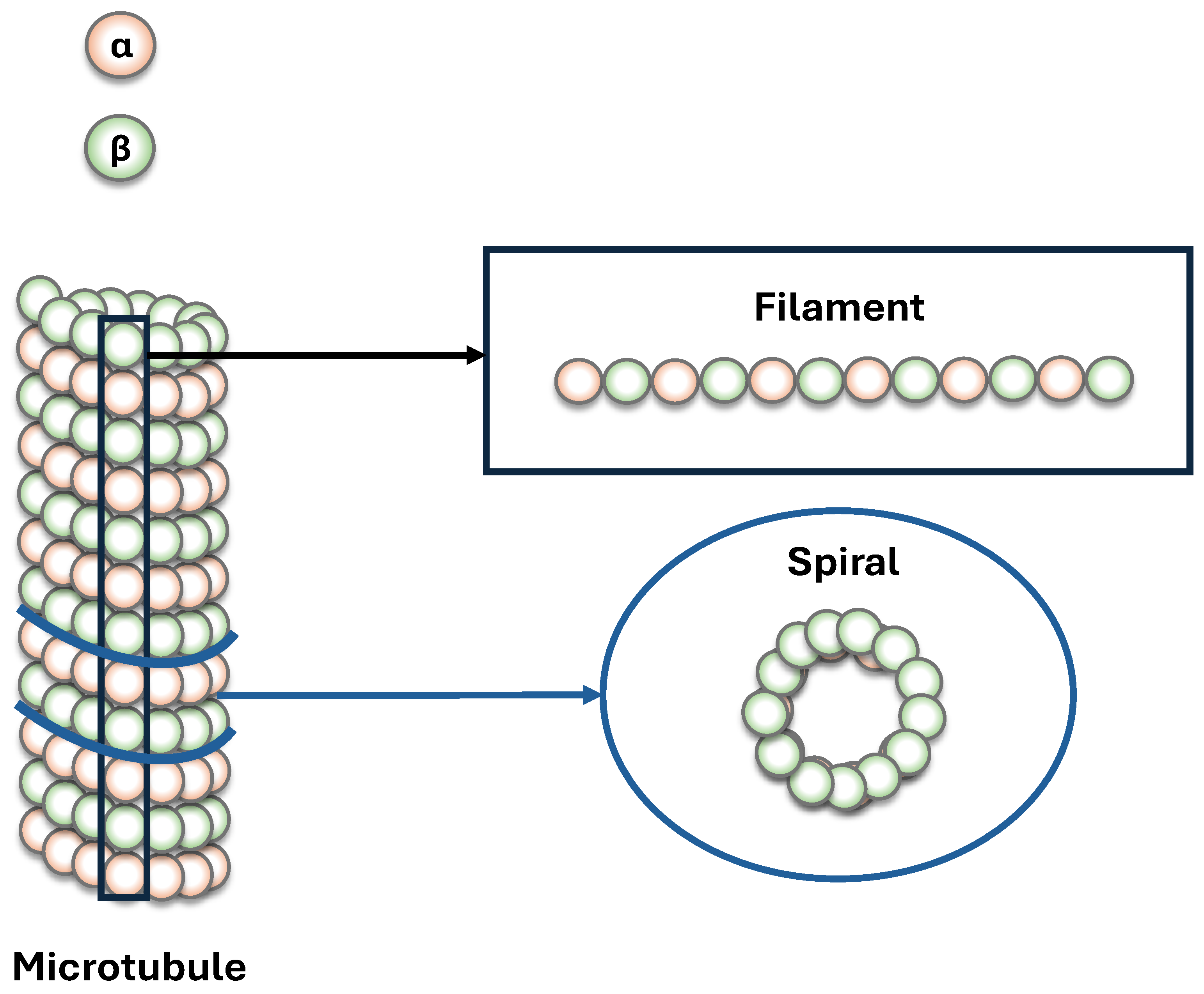
Our analysis probes initial conditions that represent distinct routes for correlation propagation. We consider preparations aligned with superradiant and subradiant sectors of the effective generator, a fully coherent uniform superposition across sites, a fully mixed uniform distribution, and site-localized injections that mimic single-photon absorption. We then examine how embedding a single tubulin into dimers and microtubule segments containing one or more spirals (where a spiral denotes one circumferential turn consisting of 13 tubulin dimers in our construction; see
Appendix A) redirects correlation pathways, and how scaling to larger ordered assemblies or introducing static energetic disorder (random diagonal site-energy fluctuations) and structural disorder (MD-sampled geometric variability) modulates outward emission versus internal retention. We evolve the system with a trace-preserving Lindblad master equation with time-independent rates constructed from the collective radiative decay matrix, and we compare these dynamics with those generated by an effective non-Hermitian generator. We also quantify the degree of non-Markovianity using a dedicated measure of information backflow on reduced subsystems. This approach connects collective radiative physics to information flow in cytoskeletal chromophore networks, identifying the structural and dynamical settings under which microtubules transiently preserve nonclassical correlations.
In neurons, microtubules form long-lived cytoskeletal tracks and regulatory scaffolds whose properties and interactions are shaped by microtubule-associated proteins and by the tubulin code (isotypes and post-translational modifications) [
47,
48]. In this cellular context, our model does not assume that ultraviolet excitations directly implement neuronal computation; rather, it shows that if localized excitation events occur (e.g., photon absorption or oxidative chemistry on aromatic residues), then the resulting dynamics are strongly initial-state-dependent. This initial-state dependence can be interpreted as state-selective routing between fast bright channels (rapid export) and slower dark channels (transient retention), providing a concrete way to connect site specificity to testable downstream microtubule-dependent effects and timescales.
The article is organized as follows.
Section 2 describes the model and methods;
Section 3 presents the results; and
Section 4 discusses the findings and summarizes the study’s implications.
2. Model and Methods
As a starting point for describing the dynamics of radiatively coupled dipoles, we first consider a non-Hermitian effective Hamiltonian formalism:
which has become widely used in recent literature [
12,
13] because it captures both coherent interactions and radiative decay. Here,
denotes on-site excitation energies,
We choose
nm to match the dominant near-UV absorption/excitation band used for tryptophan-rich proteins (A
280), so that
corresponds to the radiative wavelength scale relevant for Trp transitions.
and
G represent the coherent dipole–dipole coupling and radiative decay matrices:
Diagonalizing
yields complex eigenvalues:
where
is the mode energy and
is its radiative decay rate. Superradiant and subradiant states correspond to modes with high and low
, respectively.
While insightful, this approach fails to preserve the trace of the density operator, i.e., it does not guarantee once radiative decay to the ground state is incorporated, and is therefore inadequate for a consistent description of open quantum dynamics in the presence of decoherence. We therefore extract and from the above framework and proceed with a Lindblad master equation description.
2.1. Hamiltonian and Dipole Coupling Terms
The full system Hamiltonian used in the Lindblad framework retains the same coherent interaction structure, expressed in the site basis using spin-1/2 excitation creation and excitation annihilation operators:
Here,
and
are the excitation creation and annihilation operators for site
n in the two-level (single-excitation) representation. The interaction strength
between dipoles
n and
m is given by:
where
is the transition dipole moment of site
n,
is the unit vector from
n to
m,
is the center-to-center separation between dipoles, and
with
.
2.2. Decay Matrix and Lindblad Formalism
The collective radiative decay matrix
G is similarly computed:
The open quantum system dynamics are then described using the Lindblad master equation:
where
is the system density matrix and
are collapse (jump) operators encoding radiative losses; the term “collapse” reflects the quantum-trajectory picture in which application of
corresponds to an emission event that conditionally updates the system state.
To define
, we diagonalize the decay matrix:
with
V containing the eigenvectors
of
G. The collapse operators are then constructed as:
This Lindblad-based treatment guarantees trace preservation and consistent thermodynamic behavior while incorporating the same dipole-mediated interactions as the effective non-Hermitian model. In practice, we enforce trace preservation by including an explicit ground (sink) state and radiative jump operators that transfer population from the excitonic manifold to ; thus, emission reduces the excited-state population without removing total probability from the enlarged state space. The transition to this formalism thus enables a more accurate and physically complete simulation of quantum dynamics in radiatively interacting systems.
3. Results
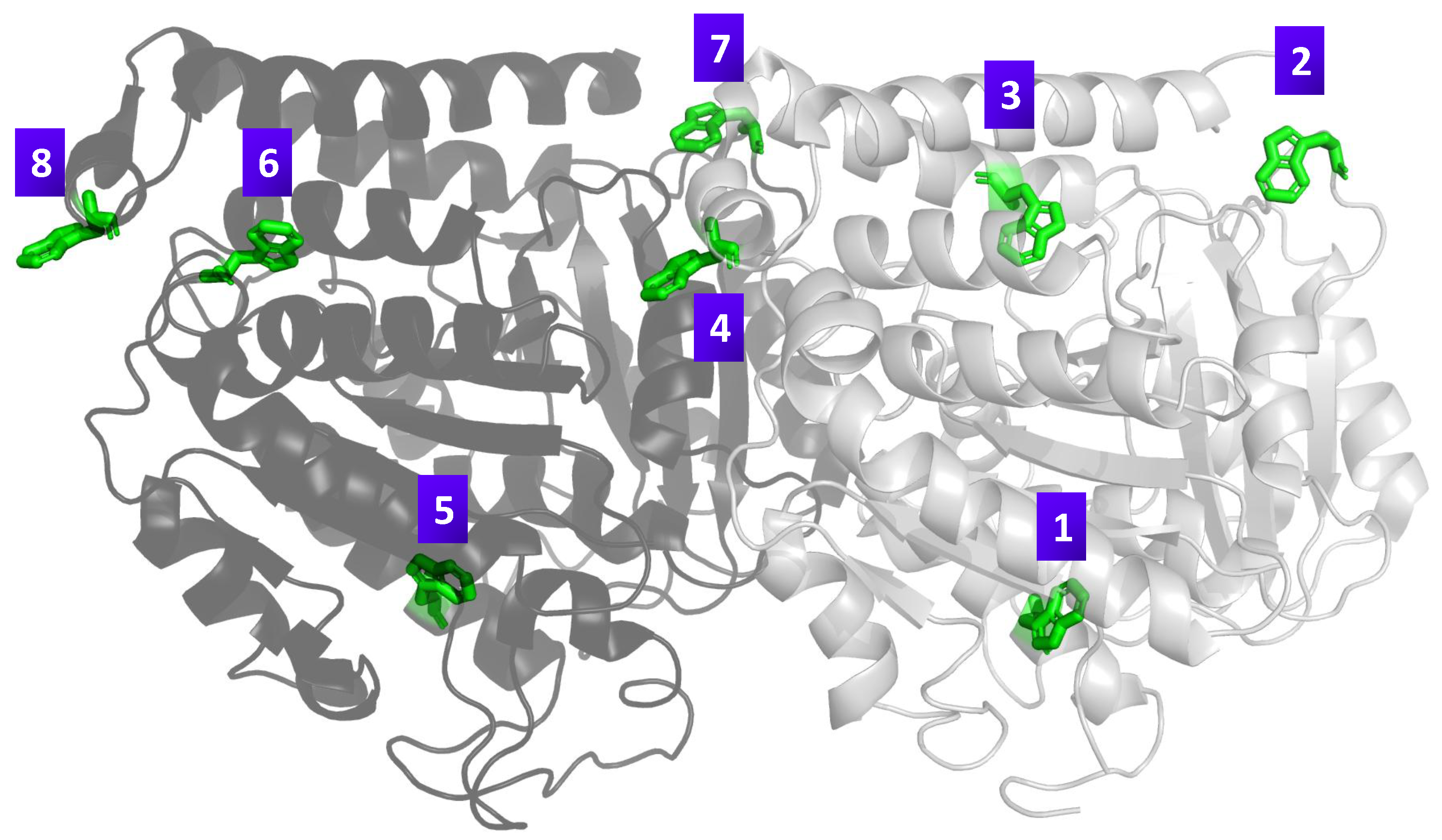
In this section, we report excitation dynamics in networks of eight tryptophan chromophores (see
Figure 1) embedded in a tubulin environment. The evolution is modeled with a Lindblad master equation built from an effective non-Hermitian generator that includes radiative loss, using site-specific positions and dipole orientations from structural data (see
Appendix A). Simulations are performed in QuTiP [
49].
We consider five initial preparations that probe distinct routes for information flow: (i) superradiant eigenstates of
; (ii) subradiant eigenstates of
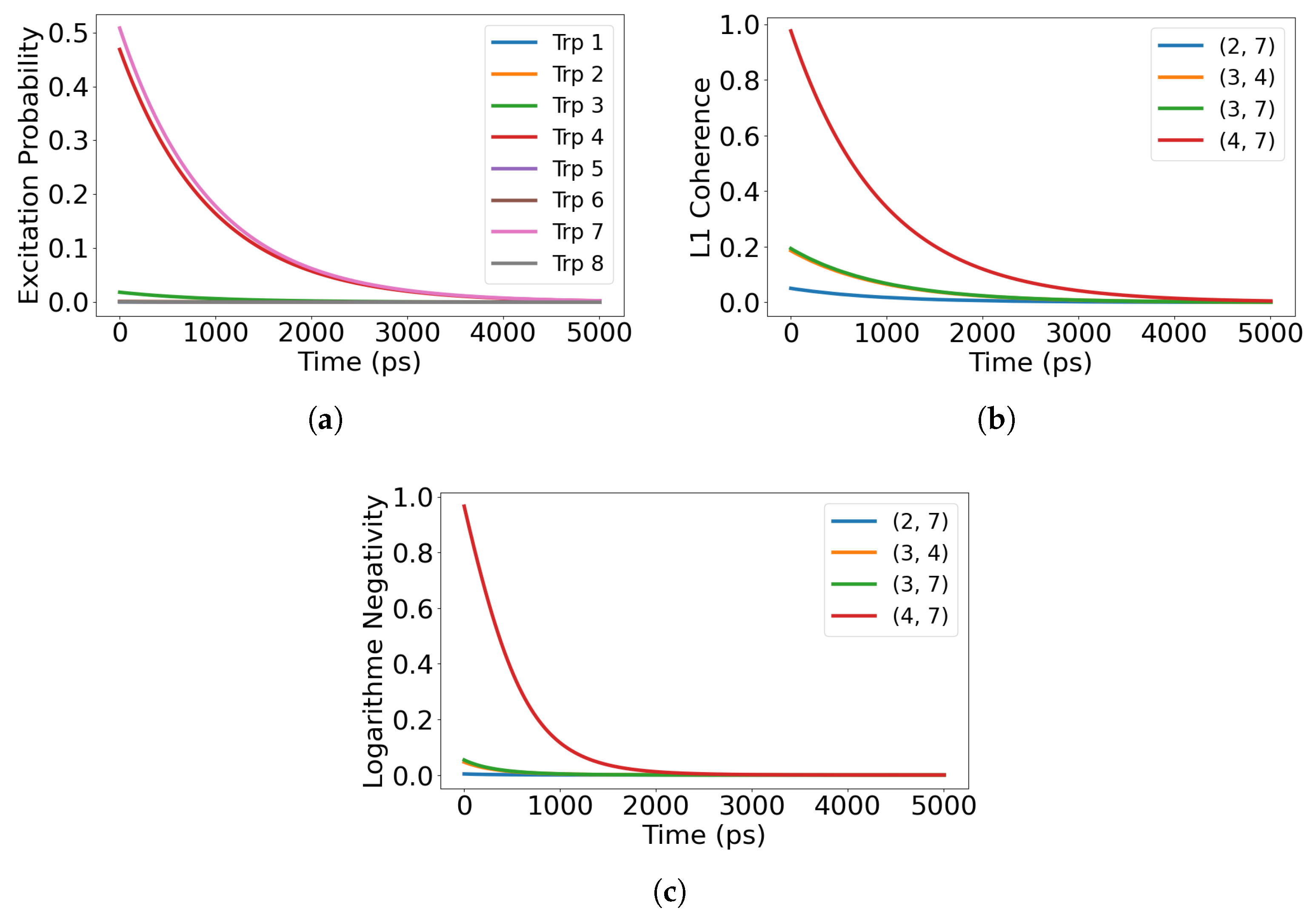
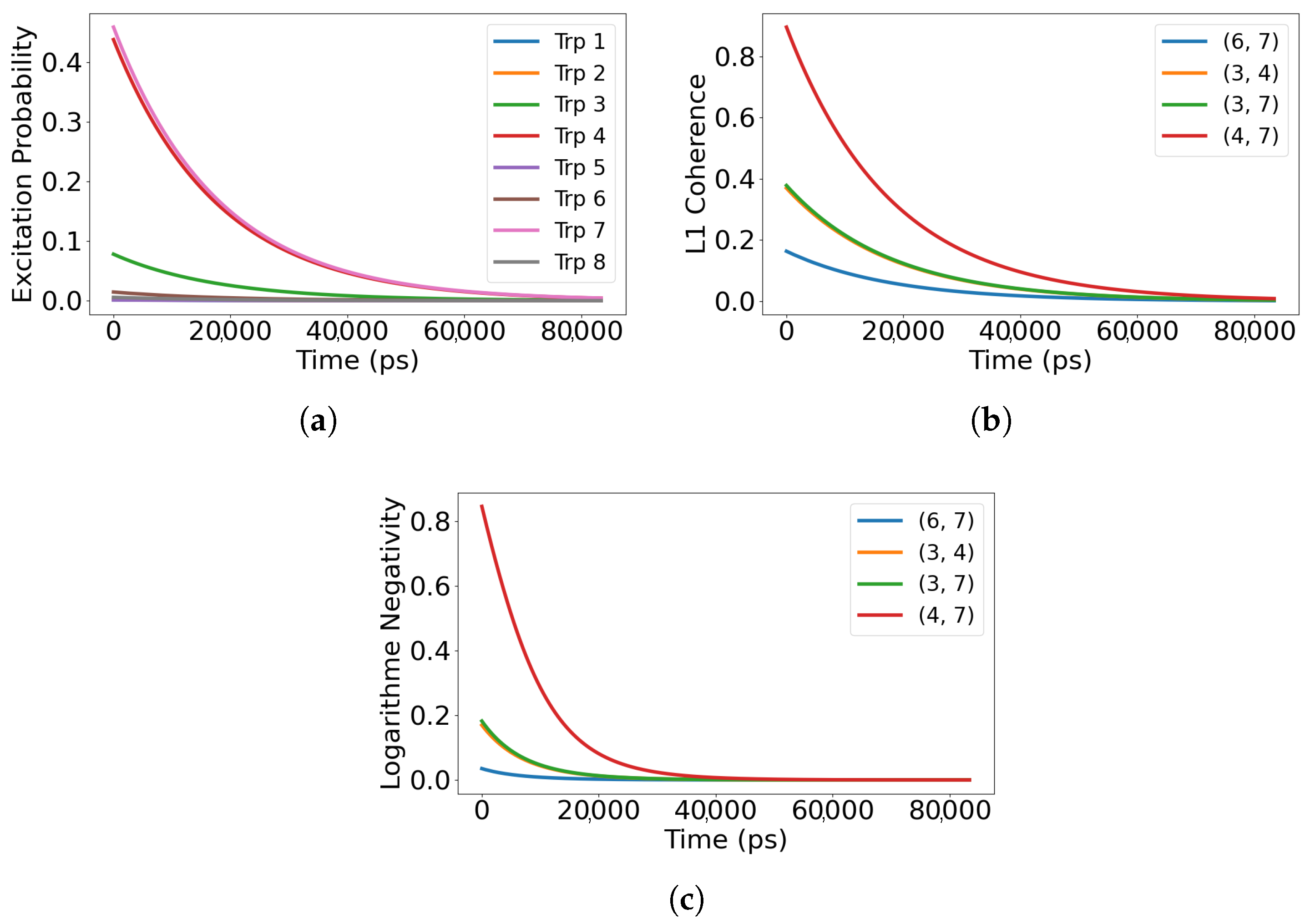
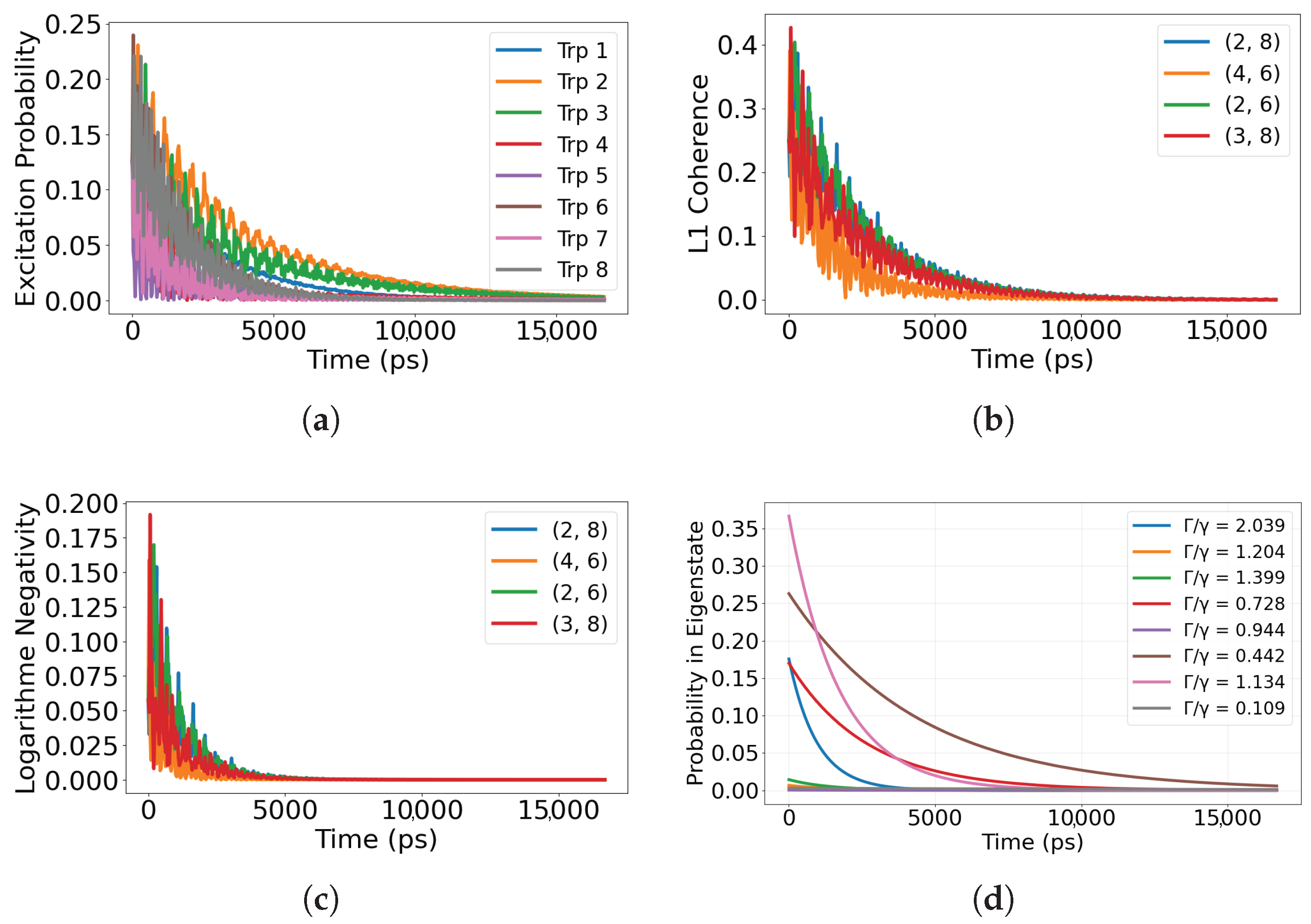
; (iii) a maximally coherent single excitation with uniform phase across the sites; (iv) a maximally mixed single excitation over the sites; and (v) a localized single site excitation. For the single-dimer 8-site network, the Lindblad simulations reported here span ps to tens of ns (e.g., 0–5 ns in
Figure 2, 0–80 ns in
Figure 3, and 0–15 ns in
Figure 4 and
Figure 5), as set by the time axes in each figure. We report site-resolved populations together with quantum correlation measures, including the
norm of coherence, pairwise coherence among chromophores, and logarithmic negativity as an entanglement witness. When we refer to a chromophore pair
, the indices label the tryptophan site numbers Trp
i and Trp
j defined in
Figure 1. Definitions and computational details for these measures are provided in
Appendix C.
Throughout the results, we track how correlations are generated, routed, and dissipated across the network and how preparation and geometry shape the directionality and persistence of nonclassical information flow.
3.1. Dynamics from the Superradiant Eigenstate
When the system is initialized in the superradiant eigenstate of the non-Hermitian Hamiltonian, corresponding to the mode with the highest radiative decay rate, the excitation undergoes rapid collective dissipation. As shown in
Figure 2a, site populations decay almost synchronously, reflecting strong collective coupling to the radiation field. In this regime, the primary channel for information flow is outward: energy and correlations are efficiently transferred to the environment rather than redistributed within the network.
The evolution of correlations is illustrated in
Figure 2b, where the
norm of coherence for the four most correlated chromophore pairs drops sharply within the first ∼
ps (about 1 ns) and is largely extinguished over the 0–5 ns window shown (0–5000 ps). The coherence carried by inter-site correlations is radiated away together with the excitation, indicating that the information flow is dominated by rapid leakage rather than internal exchange. The ns-scale lifetime of off-diagonal terms in the density matrix demonstrates that collective enhancement of emission occurs at the cost of retaining local or pairwise correlations.
Figure 2c shows the corresponding logarithmic negativity. Entanglement appears briefly at early times as the excitation delocalizes, but it vanishes quickly as the system relaxes through the radiative channel. This transient entanglement marks a brief surge in correlation exchange before the information is lost to the environment. Overall, the superradiant eigenstate behaves as a fast exporting channel of quantum information, maximizing collective emission but minimizing internal retention of nonclassical correlations.
3.2. Dynamics from the Subradiant Eigenstate
In contrast to the superradiant preparation, initializing the system in the most subradiant eigenstate of the non-Hermitian Hamiltonian yields a much slower release of excitation. As shown in
Figure 3a, populations remain within the network for tens of nanoseconds (0–80 ns, i.e., 0–
ps in the plotted window), which indicates strong suppression of radiative loss. In this setting, the dominant direction of information flow is internal rather than outward, with excitations and correlations circulating among chromophores before any leakage to the environment.
Correlation dynamics follow the same pattern. In
Figure 3b, the
norm for the four most strongly correlated chromophore pairs remains elevated throughout the full 0–80 ns window shown, demonstrating that off-diagonal terms in the density matrix persist even under weak decay. This persistence reflects sustained internal exchange of phase and amplitude information across the network.
Figure 3c reports the logarithmic negativity for the same pairs. Entanglement remains stable with only gradual attenuation and a clear oscillatory structure, consistent with recurrent redistribution of correlations within the subspace protected from radiation. Taken together, these trends identify the subradiant eigenstate as an internal retention channel for quantum information, where population, coherence, and entanglement are preserved and recirculated within the network rather than being quickly exported to the environment.
3.3. Uniformly Shared Initial Excitation
To explore how spatial distribution of the initial excitation shapes correlation dynamics and information flow, we compare two limiting cases: a fully coherent delocalized state and a completely incoherent mixed state, each uniformly involving all eight tryptophan chromophores.
3.3.1. Fully Coherent Initial State
We first consider a symmetric and fully coherent initial state where the excitation is delocalized equally across all sites,
with
denoting an excitation localized on the
jth chromophore.
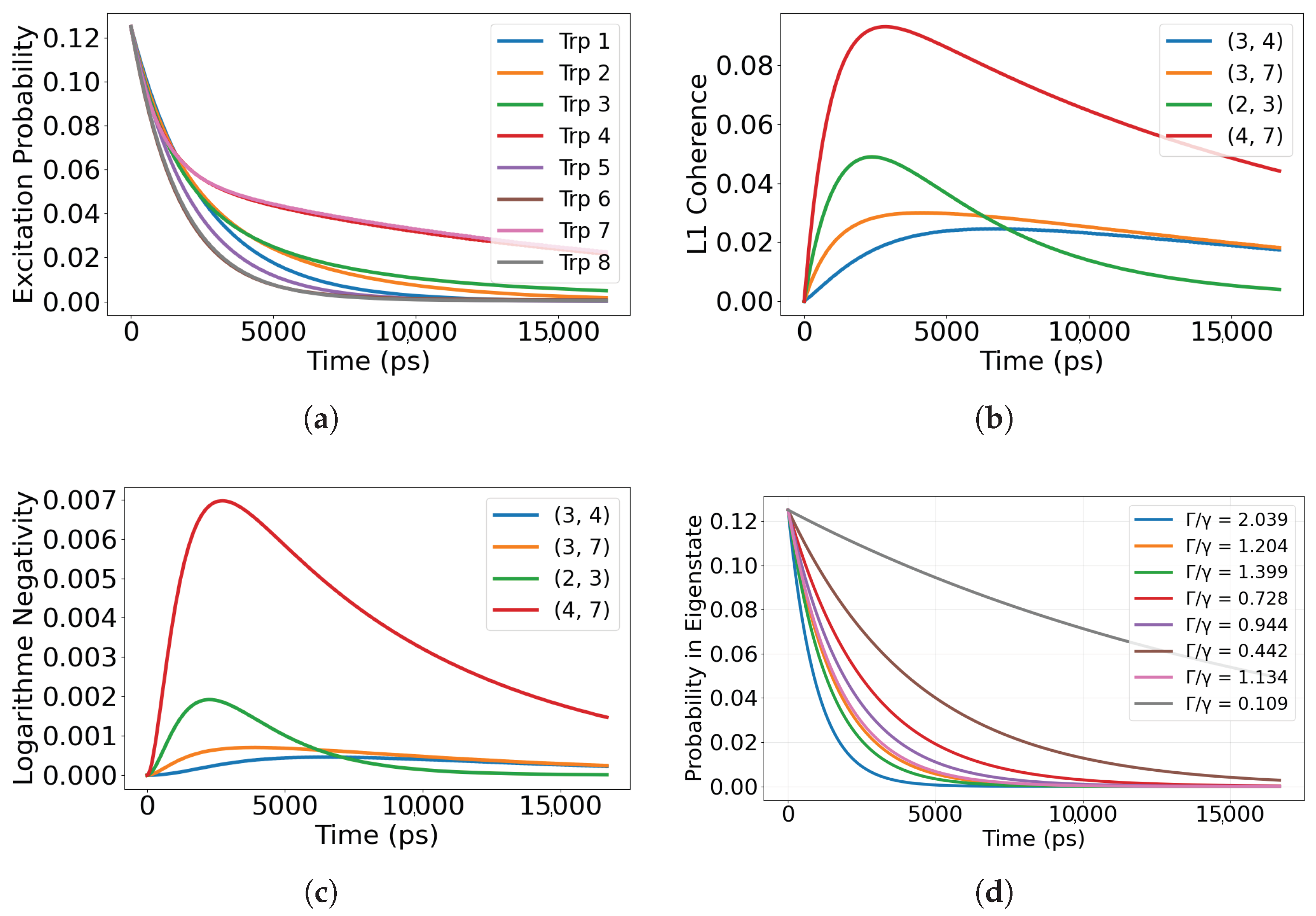
The resulting dynamics, shown in
Figure 4, reveal that correlations propagate through the network as oscillatory information flow between sites. In
Figure 4a, population exchange displays clear interference patterns rather than simple exponential loss, indicating that coherent delocalization enables partial protection from radiative decay through destructive interference.
The correlation measures in
Figure 4b show that the
norm for selected chromophore pairs remains high over the full 0–15 ns window shown (0–15,000 ps), confirming that internal information exchange persists even as total excitation diminishes. Entanglement, shown in
Figure 4c through logarithmic negativity, rises rapidly and then decays slowly over the same 0–15 ns window, indicating sustained quantum information sharing across multiple chromophore pairs.
Population projections onto the eigenstates of the non-Hermitian Hamiltonian (
Figure 4d) show that while both superradiant and subradiant components are initially populated, the dynamics naturally channel population toward subradiant sectors. This gradual self-selection redistributes information flow toward correlation-preserving subspaces, where coherence and entanglement remain protected under radiative loss.
3.3.2. Fully Incoherent Mixed State
As a contrasting limit, we consider a maximally mixed initial state where excitation is equally distributed across all sites but carries no initial phase correlation,
The corresponding dynamics, shown in
Figure 5, demonstrate that the absence of initial coherence prevents any internal information circulation. In
Figure 5a, populations decay monotonically and nearly uniformly across all sites, with no evidence of interference mediated redistribution. The
norm in
Figure 5b remains near zero, confirming that no new coherent correlations are generated during the evolution. Likewise, the logarithmic negativity in
Figure 5c stays negligible, indicating that entanglement does not emerge spontaneously in the absence of coherent phase relations.
The eigenstate population projections in
Figure 5d show that both superradiant and subradiant components are initially populated, but without phase coherence, the dynamics do not preferentially channel excitation into the subradiant manifold. Information flow therefore proceeds primarily outward into the environment, resulting in rapid loss of population and vanishing internal correlations. This highlights that coherence is a prerequisite for sustained correlation transport and retention of quantum information within the microtubule network.
3.4. Site-Localized Initial Excitations
To reflect biologically plausible conditions, we examine dynamics when the system is prepared with a single excitation localized on each of the eight tryptophan sites in turn. This mimics natural events in which a photon is absorbed by one chromophore and seeds a site-specific initial state, or in which reactive oxygen species generate localized electronic excitations on aromatic residues under oxidative stress conditions [
10].
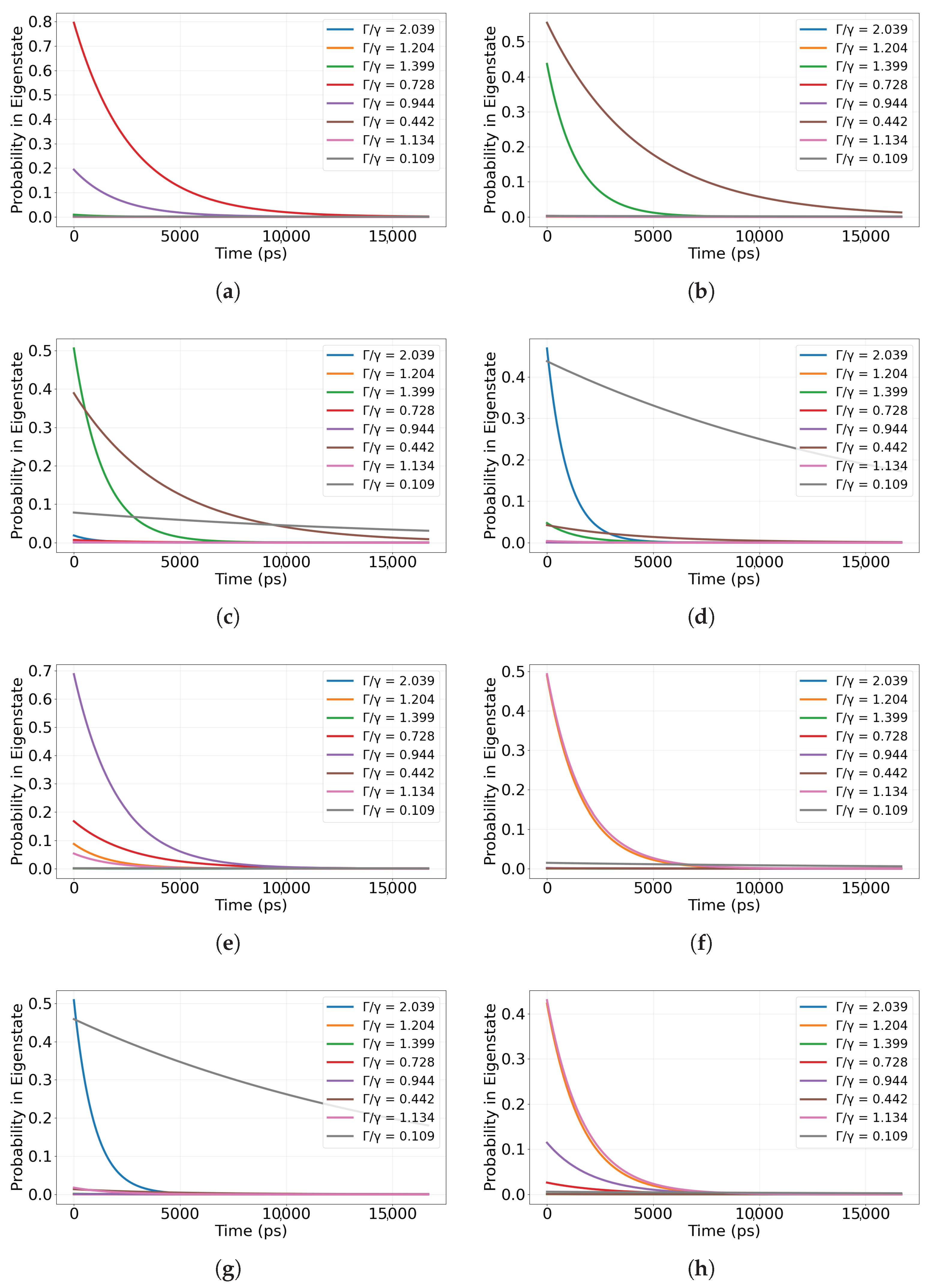
The population traces for all eight preparations are shown in
Figure 6a–h. (The time axis in
Figure 6 spans the same ps–ns window used for the single-dimer simulations, enabling direct comparison of faster vs. slower leakage across sites.) The temporal behavior depends strongly on the injection site. Preparations at Trp4 or Trp7 yield markedly slower population decay, while preparations at Trp1 or Trp5 relax more rapidly. This site dependence reveals different couplings to radiative channels. Localized states with larger overlap on subradiant sectors of the non-Hermitian spectrum retain population internally for longer, whereas those aligned with superradiant sectors export excitation quickly.
In terms of information flow, a localized injection sets the initial direction for correlation propagation. Sites such as Trp4 and Trp7 not only slow population leakage but also promote internal redistribution of phase and amplitude information before loss to the environment. In contrast, injections at Trp1 or Trp5 favor outward flow, leaving little time for correlations to circulate within the network. Decomposition of each preparation into radiative and protected components therefore acts as a site-selective router that steers both energy and correlations along distinct pathways.
These observations show that spatial location controls access to long-lived correlation-preserving subspaces. Consequently, site-specific excitation can select quantum lifetimes and shape the balance between internal correlation transport and external emission, a principle that may be relevant for natural light harvesting and for targeted control strategies in bio-inspired excitonic platforms. More specifically, the injection residue sets the overlap with bright versus dark radiative sectors, biasing the dynamics toward rapid export or transient retention; in vivo, this bias could be shaped by oxidation hotspots, local binding environments, and tubulin-state regulation [
8,
48,
51,
52,
53].
3.5. Coherence Transfer from One Tubulin to a Spiral
In the previous subsection, we analyzed dynamics within a single tubulin dimer. Here, we keep the same focal dimer and the same initial preparations, but progressively change its environment: first by placing it in a two-tubulin system, and then in microtubule segments containing one and two spirals. In our construction, a “spiral” denotes one circumferential turn of the microtubule lattice consisting of 13 dimers around the cylinder; microtubule segments with additional spirals are formed by stacking successive turns along the longitudinal axis (see
Figure 7). For the spiral calculations (systems larger than a single dimer), the time evolution is performed on national high-performance computing systems provided by the Digital Research Alliance of Canada. For each embedding, we track the four largest pairwise
coherences within the focal tubulin, labeled by site indices
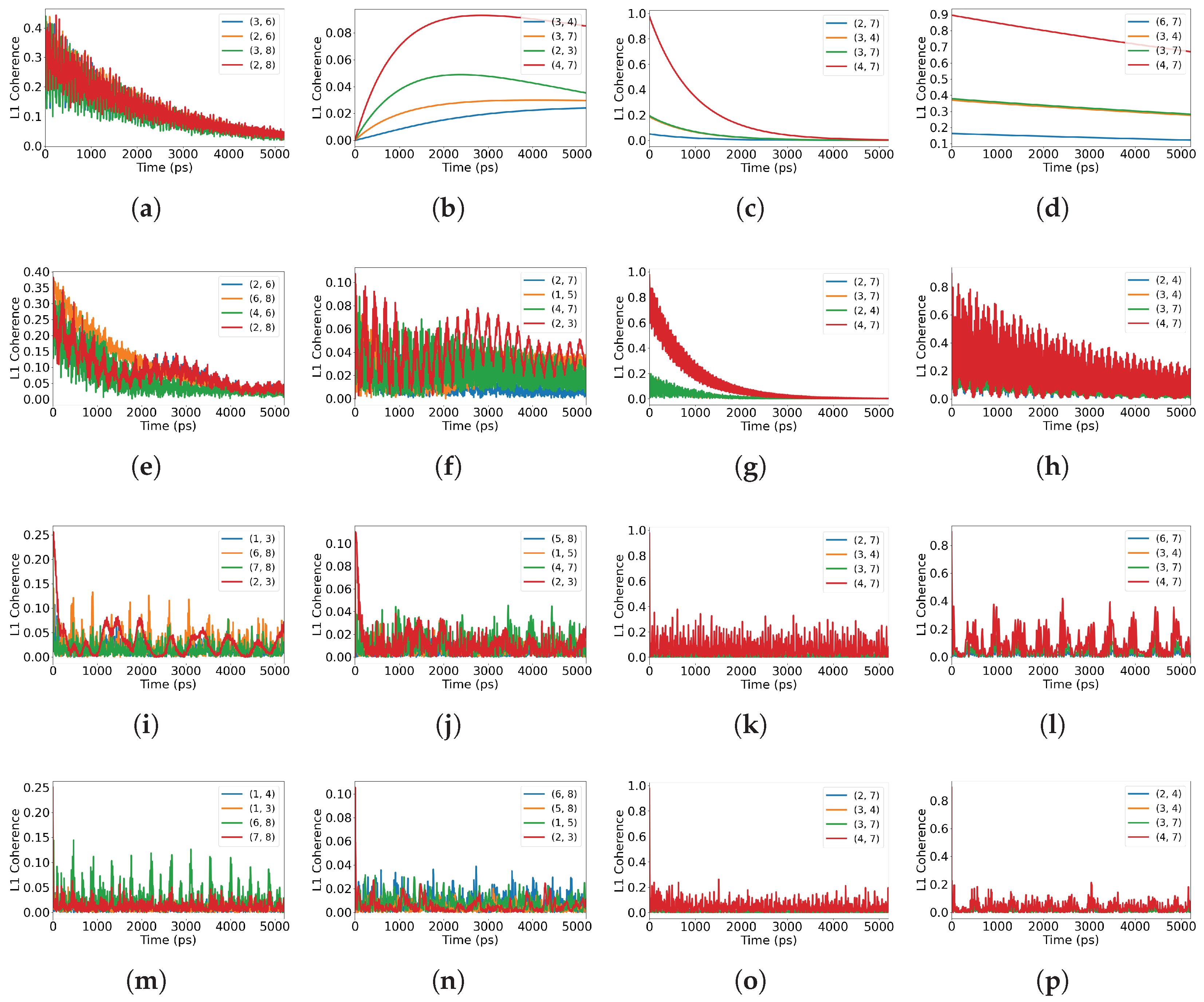
, to resolve how embedding redirects correlation pathways and alters information flow.
Embedding reshapes the balance between the internal circulation of correlations and outward loss. As shown in
Figure 8, the identity of the maximally coherent site pairs changes with embedding, indicating that opening the system to a larger environment redistributes correlations across additional channels. As the environment grows (single → dimer → spiral), coherence amplitudes within the focal tubulin generally decrease and exhibit more pronounced oscillations, reflecting exchange with surrounding degrees of freedom. Small systems retain a strong dependence on the initial preparation, whereas larger embeddings tend to compress these differences and produce more similar oscillatory patterns across preparations.
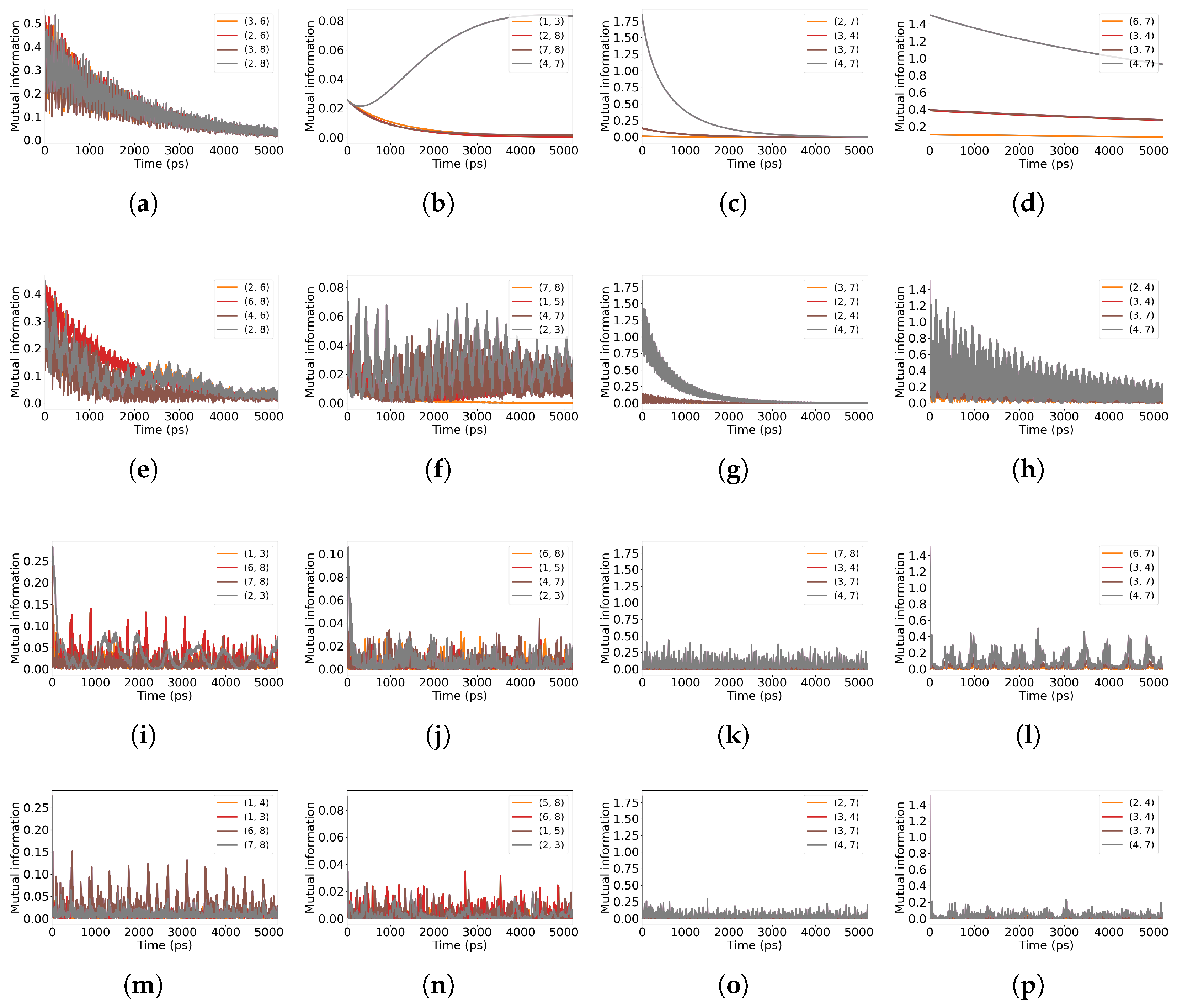
We observe the same qualitative trends when repeating the analysis with mutual information (see
Appendix D,
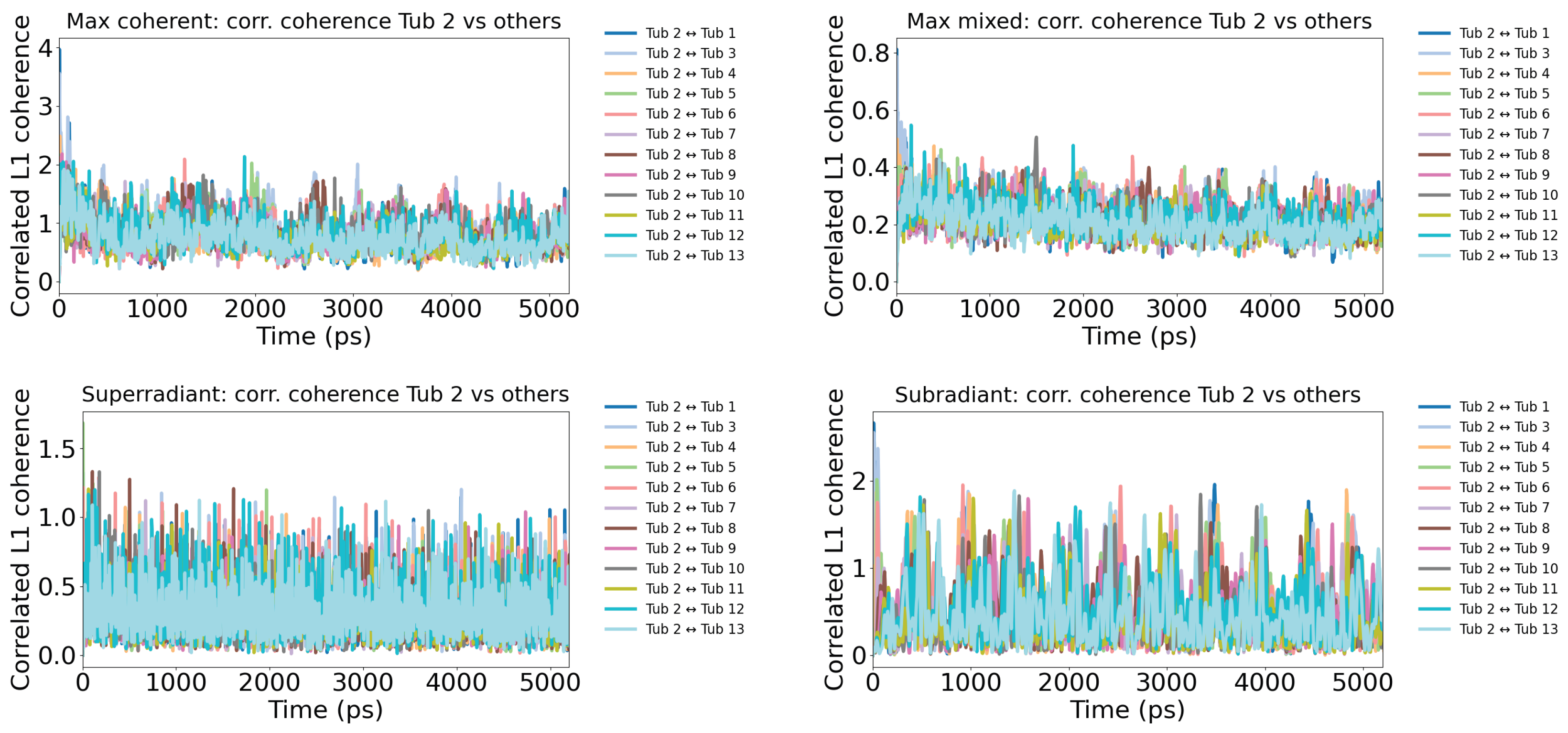
Figure A1). Evidence for correlation sharing across distinct tubulins is further shown in
Appendix D,
Figure A2, where inter-tubulin coherence correlations are present for each initial state.
3.6. Time-Resolved Non-Markovian Backflow on Two Tubulin Subsystems (Single Spiral)
Building on
Section 3.5, where embedding a single tubulin within larger structures redistributed coherence pathways, we now examine whether the surrounding tubulins act as a structured reservoir that can store and then return information to a local subsystem. Here, environment means the other tubulins around the initially prepared tubulin: its partner in a dimer and, in the spiral case, the remaining tubulins. In vivo, tubulin is embedded in an aqueous solvent and hydration shell; such solvent-mediated effects are not included explicitly in the present radiative-loss model and are left for future extensions [
54,
55].
We consider a single spiral of 13 tubulins, each with eight tryptophans. For every neighbor
of the initially prepared tubulin
, we form the two-tubulin subsystem
and study its dynamics within the single-excitation manifold while tracing out the other 11 tubulins. Memory effects are quantified via the trace distance backflow of Ref. [
56]. Let
denote single-excitation basis states on individual tryptophans, with index sets
and
. All other tubulins start in the global ground state
. We use normalized uniform superpositions over a full tubulin,
which represent single excitations delocalized over the eight tryptophans of
or
and are orthogonal in the single-excitation space. Two orthogonal pairs, both confined to
, are propagated under the same Liouvillian: a population contrast pair
versus
, and a phase contrast pair
. During the evolution, excitations that leave
into the remainder of the spiral are traced out. Non-Markovian information backflow is indicated by revivals of the trace distance
which quantifies the operational distinguishability of the two reduced states of
(larger
means they can be more easily told apart by an optimal measurement). For CP-divisible (Markovian) reduced dynamics,
is contractive and cannot increase; therefore, intervals with
indicate information backflow from the traced-out tubulins into the subsystem [
56,
57]. The associated scalar non-Markovianity for
is the total positive variation
reported for both initial pairs.
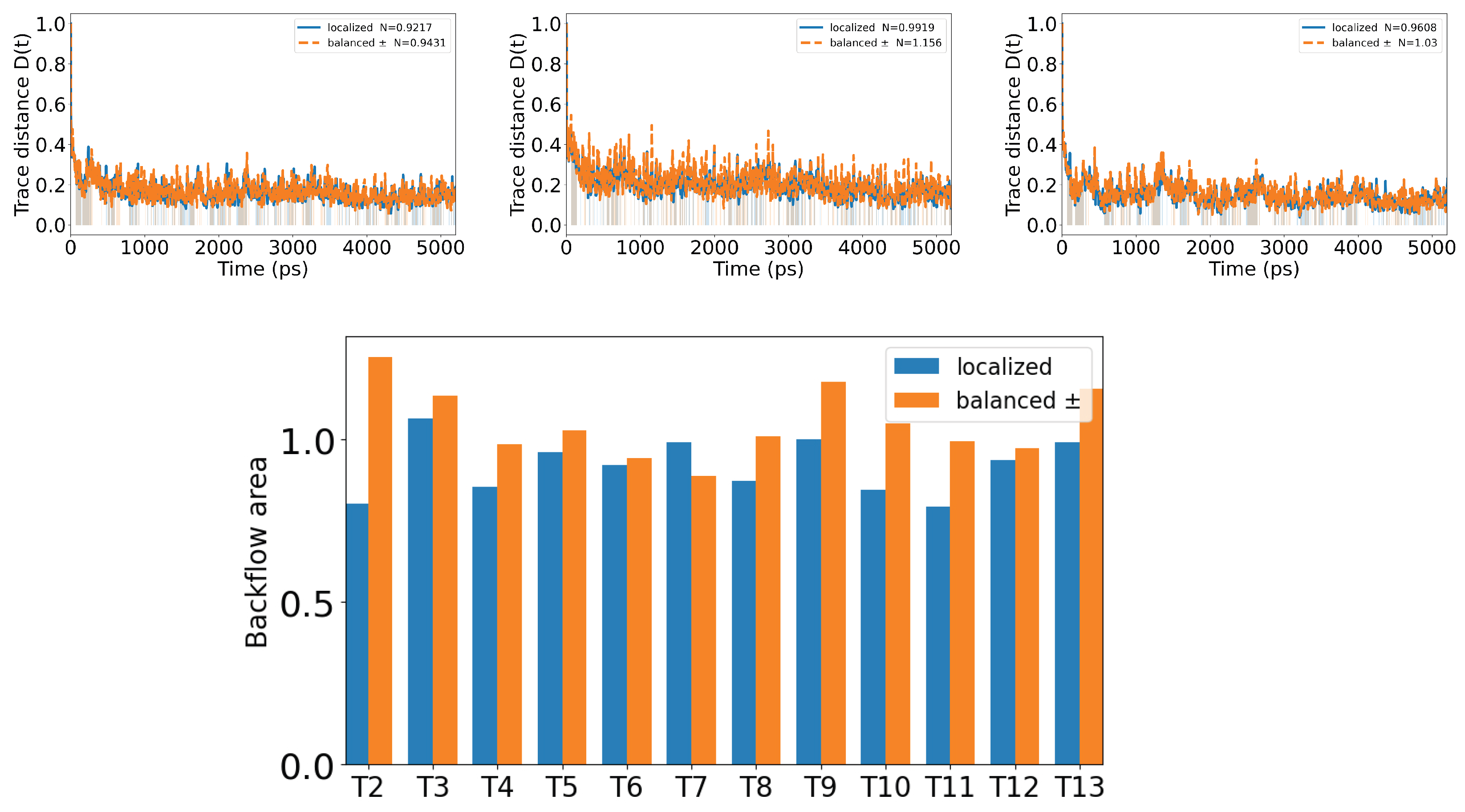
As shown in
Figure 9,
exhibits revivals for every neighbor tested, yielding nonzero
across
. Specific neighbors (notably
,
,
) show larger responses, consistent with geometry-dependent couplings in the spiral. The phase contrast preparation generally produces stronger backflow than the population contrast pair, which points to a leading role for coherence and phase revivals rather than pure population exchange.
Information backflow is relevant for neuronal microtubules because it shows that correlations are not irreversibly lost to surrounding tubulins; the dimer or spiral can transiently store and return population and coherence to a local subsystem. In ordered bundles inside neurons, such structured reservoir effects could provide mesoscale temporal correlations (i.e., intermediate-time memory effects in the reduced subsystem dynamics due to transient information backflow from the surrounding tubulin network) that could in principle influence intracellular signaling and excitonic energy migration by buffering and synchronizing fluctuations. A testable consequence is that the backflow measure should vary systematically with local geometry, energetic detuning, temperature or ionic conditions, and the initial phase structure.
3.7. Transition to Larger Assemblies
The previous sections examined how embedding a single tubulin within a dimer or a spiral redistributes coherence and can produce information backflow. We now extend the analysis to larger microtubule assemblies arranged as filaments and as ideal spirals with up to 100 spirals, in order to connect local behavior with system-level trends. For these sizes, direct simulation with the Lindblad master equation is not practical, so we use the effective non-Hermitian Hamiltonian in Equation (
1) to access eigenmodes and their radiative decay rates. The section proceeds in two steps. First, we quantify pairwise correlated coherence for superradiant and subradiant eigenstates across ordered and disordered structures. Second, we extract radiative lifetimes and analyze how superradiant speedup and subradiant protection scale with size and depend on disorder.
3.7.1. Correlated Coherence Across Microtubule Structures
We compute the pairwise correlated coherence (based on the
norm) between Trp sites for the superradiant and subradiant eigenstates. This is evaluated across 100 spiral microtubule configurations constructed either from repeated 1JFF structural units or from randomly selected tubulin dimers taken from molecular dynamics simulations (see
Appendix A).
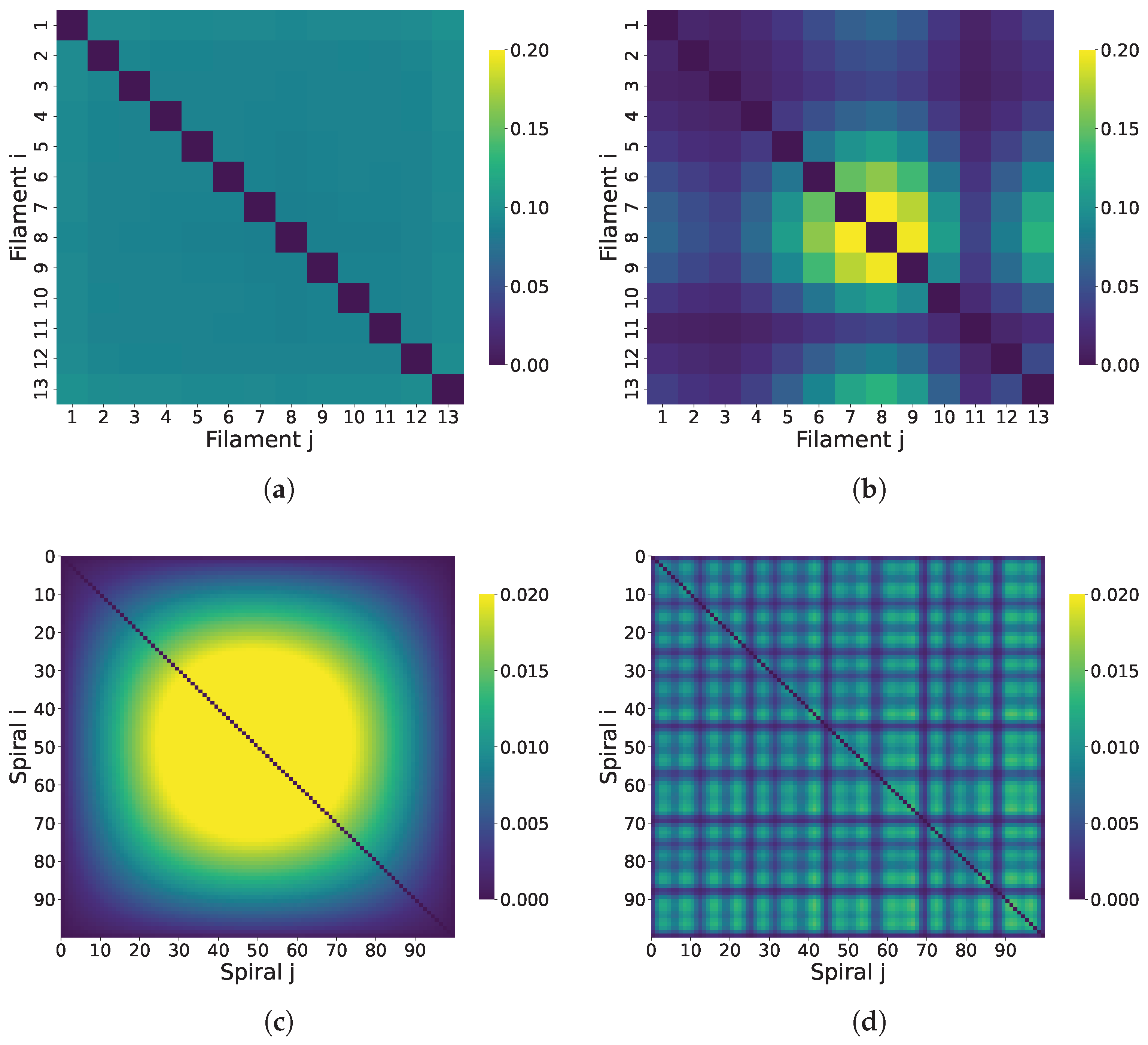
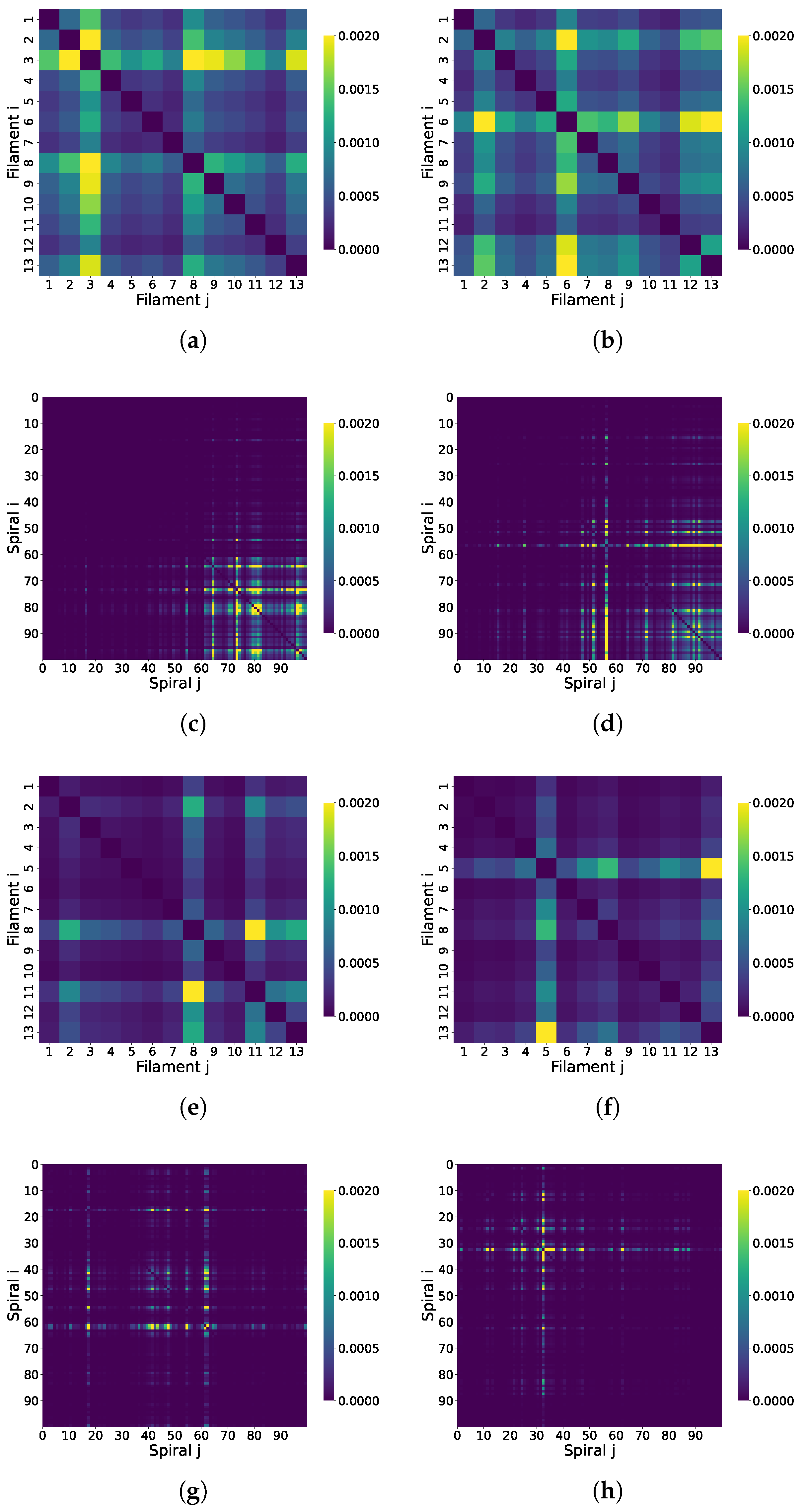
For the large microtubule segments, correlated coherence is evaluated between two composite subsystems (each subsystem being a collection of Trp sites) rather than between individual chromophores. Specifically, we consider two geometric partitions: (i) spiral–spiral coherence, where each spiral contains 13 tubulins and therefore 104 Trp sites, and (ii) filament–filament coherence, where each filament subsystem contains 100 tubulins and therefore 800 Trp sites. We then compute correlated coherence between all pairs of such subsystems across the assembly, producing the matrices shown in
Figure 10 and
Figure 11. We compute the pairwise correlated coherence (based on the
norm) between composite subsystems defined by collections of Trp sites for the superradiant and subradiant eigenstates.
Figure 10 and
Figure 11 highlight the impact of symmetry and disorder on coherence in microtubule systems. In the symmetric microtubule constructed by repeating the 1JFF PDB structure (
Figure 10), coherence in the superradiant state is broadly distributed across the entire lattice, indicating long-range delocalization. In contrast,
Figure 11 demonstrates that introducing disorder, either through spatial variability by randomly sampling tubulin dimers from a molecular dynamics simulation (
Figure 11a–d) or through static diagonal noise in the Hamiltonian (
Figure 11e–h), substantially disrupts this coherence. In both cases, the superradiant coherence becomes localized and fragmented, confirming that both structural and energetic disorder suppress long-range quantum coherence in the system.
3.7.2. Lifetimes of Subradiant and Superradiant States
To characterize the radiative behavior of the system, we compute the physical decay rates (in cm−1) from the imaginary part of the eigenvalues of the non-Hermitian effective Hamiltonian.
The corresponding radiative lifetimes
(in seconds) are obtained using the spectroscopic relation:
where
is the speed of light.
We identify:
: the lifetime of the most superradiant state (corresponding to the maximum decay rate ),
: the lifetime of the most subradiant state (corresponding to the minimum decay rate ).
These lifetimes provide direct insight into the extent of radiative enhancement or suppression in different structural configurations.
We emphasize that the lifetimes reported here are defined within the Markovian radiative-loss model used throughout the paper. Concretely,
is extracted from the imaginary part of the eigenvalues of the effective non-Hermitian generator associated with collective emission, which corresponds to a memoryless (time-independent) coupling to the electromagnetic bath and therefore yields exponential decay envelopes for each collective mode. The non-Markovian behavior discussed in
Section 3.6 is of a different origin: it appears when we trace out part of a finite, structured tubulin environment and analyze reduced dynamics on a subsystem, which can exhibit information backflow even if the global radiative decay model is Markovian. Under static or structural disorder, the lifetime curves in this section should therefore be interpreted as quantifying how disorder reshapes bright–dark rate separation within the Markovian radiative model (e.g., by reducing collectivity and localizing bright components), while subsystem-level memory effects may still occur due to the structured embedding.
We first consider a microtubule constructed by repeating the 1JFF tubulin unit. We then incorporate static disorder into the model by modifying the site energies in the unperturbed Hamiltonian as follows:
where
W is the disorder strength in cm
−1, and
is a uniformly distributed random variable within the range
Finally, we consider structural disorder by constructing a microtubule from molecular dynamics data, where tubulin units are randomly positioned.
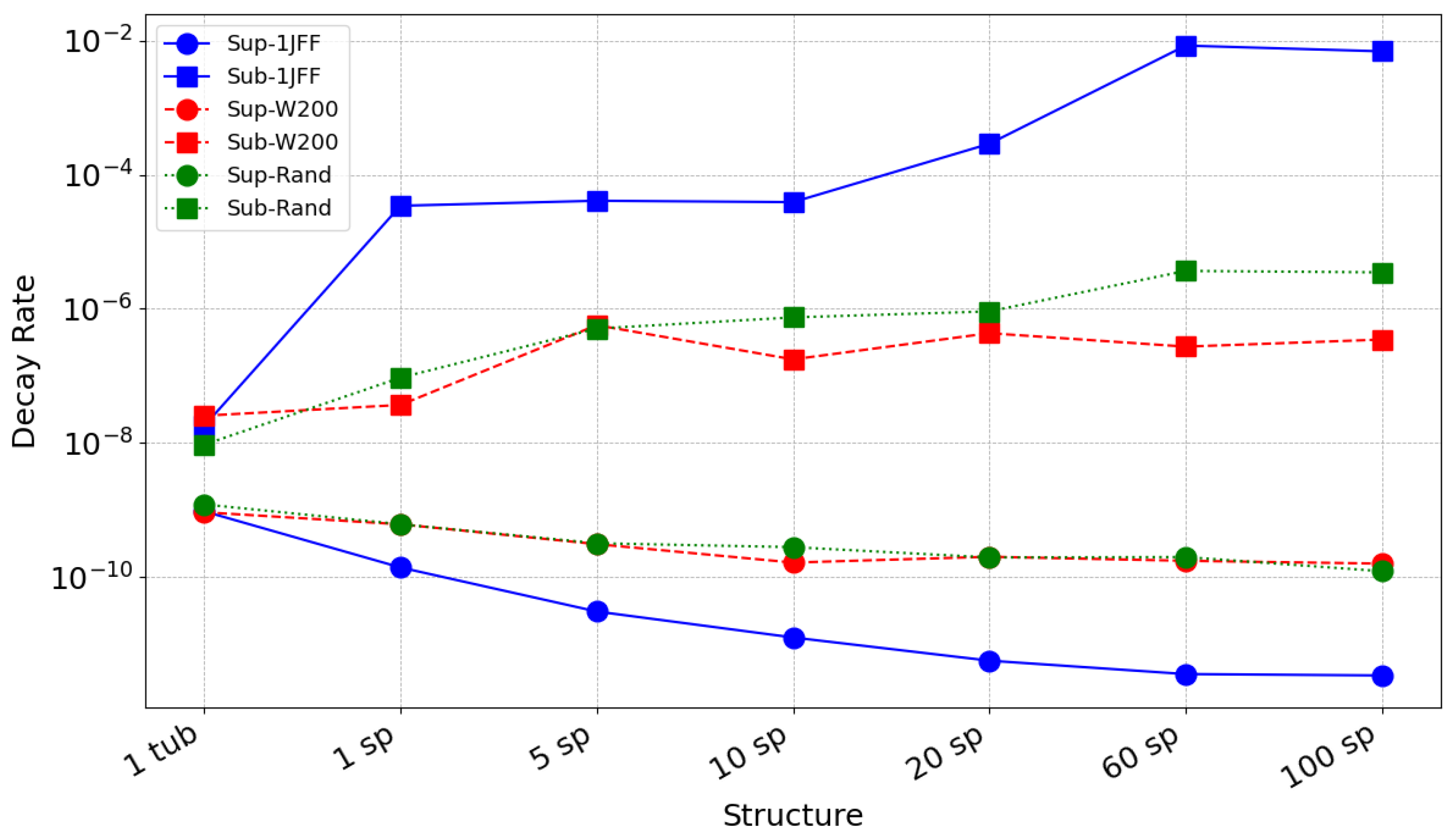
As seen in
Figure 12, increasing the system size in the absence of disorder strongly enhances superradiance (shorter lifetimes) and subradiance (longer lifetimes). For example, the superradiant lifetime decreases significantly while the subradiant one can reach the millisecond range. This shows how cooperative radiative effects intensify with structural size.
However, when either static or structural disorder is introduced, the overall trend remains, but the difference between the smallest and largest structures becomes much smaller, particularly for the superradiant states. For these, the gain in radiative acceleration from one tubulin to 100 spirals becomes marginal, on the order of microseconds. Subradiant states are comparatively more robust, still reaching lifetimes several orders of magnitude longer than superradiant states even under disorder.
This indicates that disorder tends to reduce the contrast between radiative lifetimes and that superradiant states are more sensitive to imperfections than subradiant ones.
4. Discussion and Conclusions
We have investigated excitation dynamics in tryptophan networks of tubulin using a Lindblad master equation constructed from an effective non-Hermitian generator with radiative loss and explicit site geometry. By comparing five well defined preparations and tracking site-resolved populations together with quantum information metrics, we showed how preparation, geometry, and environment size jointly control the fate of correlations. Progressively embedding a single -tubulin into a pair of coupled tubulins, then into a single spiral, and finally into a two-spiral assembly redistributes the leading coherences within the focal tubulin, lowers their amplitudes, and introduces oscillatory exchange with the surrounding tubulins. Within a single spiral, two tubulin subsystems exhibit non-Markovian backflow detected by revivals of the trace distance, with a stronger response for phase contrast preparations. Scaling up to large ordered assemblies with the non-Hermitian eigenmode analysis confirmed the complementary roles of superradiant export and subradiant retention, and revealed a clear sensitivity to symmetry and disorder. Ordered structures sustain long-range correlated coherence and widen the gap between bright and dark lifetimes, whereas static energetic and structural disorder localize the superradiant component, suppress long-range coherence, and reduce lifetime contrast while leaving subradiant protection comparatively robust.
Taken together, these results identify microtubule tryptophan networks as structured reservoirs in which symmetry, spatial arrangement, and initial phase determine whether information is rapidly broadcast through bright channels or preferentially stored in dark subspaces [
58,
59]. The use of quantum information tools provides a compact and operational language for this partition of roles. The
norm and correlated coherence resolve where coherence is shared, the trace distance quantifies memory through backflow, and the spectral widths of the effective generator organize radiative lifetimes across scale. This joint dynamical and spectral picture offers a coherent framework for discussing amplification, buffering, and timing in biological excitonic networks.
Biologically, our initial-state comparison does not imply that microtubules must use quantum correlations for neural processing; rather, it shows that a structured tryptophan network can route dynamics differently depending on how an excitation is prepared (localized vs delocalized, and with different relative phases), biasing the evolution toward rapid export (bright channels) or transient retention (dark subspaces). In cells, plausible sources of site-specific preparation include localized absorption events and redox/ROS-driven chemistry on aromatic residues [
51,
52]. Any downstream coupling, if present, would most plausibly be indirect, through changes in dissipation patterns or local interaction landscapes that regulate established microtubule functions (transport, MAP binding, and tubulin-code-dependent modulation) [
48,
53,
60]. This motivates future work that links bright-versus-dark routing to specific biochemical readouts and experimentally measurable conditions.
Relatedly, the trace-distance revivals reported in
Section 3.6 indicate short-time memory effects in reduced tubulin subsystems, suggesting that nearby excitation events in a finite spiral need not behave as independent memoryless decays [
56,
57].
Our results also connect naturally to earlier proposals that treat microtubules as quantum information channels. In those works, excitation migration and quantum relaxation in tryptophan chains and dipole networks were shown to support entanglement transfer and biologically relevant coherence times [
19,
20,
21,
22,
23,
24] (here, “biologically relevant” is used in a limited operational sense: persistence of population/coherence in protected subspaces over timescales that could, in principle, overlap with downstream molecular degrees of freedom evolving on ns–ms scales). Here, we add a complementary radiative perspective, showing that, even in the presence of collective emission, structured tryptophan networks can transiently store and redistribute correlations, with symmetry and preparation determining whether they behave more like broadcasting channels or short-term quantum buffers.
Two timescales should be distinguished. First, coherent redistribution within a local Trp network occurs on the ps–ns scale set by dipole couplings (
Section 3.1,
Section 3.2,
Section 3.3 and
Section 3.4). Second, the radiative lifetimes of collective eigenmodes can extend to much longer scales in ordered assemblies (
Section 3.7.2), while disorder tends to localize bright components and compress lifetime contrasts. By “functional relevance”, we therefore do not claim a specific cellular mechanism; rather, we provide a concrete timescale-matching criterion: whether retention of population/coherence in subradiant (dark) sectors overlaps with the timescales of molecular state variables that could be sensitive to local excitation or electrostatic reorganization (e.g., conformational microstate occupancy, binding/unbinding kinetics of interaction partners, or chemically mediated state changes). This framing can guide experiments aimed at testing whether, and under what structural conditions, optical excitations couple measurably to downstream microtubule-associated dynamics, including in neuronal contexts where microtubules can be comparatively stable.
The present model characterizes relaxation following an impulsive, single-excitation preparation under radiative loss. In living systems, nonequilibrium biochemical inputs (e.g., energy release associated with GTP hydrolysis, redox/ROS chemistry, or enzymatic activity) could act as a driver, either indirectly by modulating site energies/couplings or, in a phenomenological description, by maintaining excited-state population out of equilibrium. Within the Lindblad framework, such driving can be included either (i) as incoherent pumping through additional jump operators (e.g.,
with pump rate
), or (ii) as coherent driving through an added Hamiltonian term (with
the coherent drive amplitude/Rabi frequency), e.g.,
. Incoherent pumping sustains nonequilibrium populations but typically introduces additional dephasing, so it does not necessarily extend coherence unless the pumping selectively populates (or repeatedly refills) symmetry-protected dark/subradiant subspaces; coherent driving can maintain phase relations but corresponds to a distinct physical regime (e.g., an external optical field). In the limit of rare, localized injection events, the driven dynamics can often be approximated by mixtures over the localized preparations already studied in
Section 3.4. These extensions provide a clear next step for assessing how continuous energy throughput reshapes the balance between superradiant export and subradiant retention, particularly in the presence of disorder.
There are also clear theoretical next steps. Extending the master equation to include non-radiative decay, structured dephasing, and explicit vibronic coupling would refine the link between geometry and memory. Beyond the single excitation manifold, many-body effects and exciton–exciton interactions could be addressed with stochastic Liouville or time-nonlocal kernels to assess the stability of backflow and subradiant protection under crowding. On the structural side, graph-based analyses of eigenmodes and coherence pathways, together with ensemble averaging over realistic static and dynamic disorder, can connect microscopic organization to emergent timescales. Finally, casting the dynamics in information theoretic terms such as coherence length, channel distinguishability, and resource conversion rates may help compare microtubule networks with other biological light responsive systems within a unified quantitative language.
In summary, master equation dynamics augment static spectral analysis and reveal how geometry, preparation, and environment size regulate the balance between export and retention of quantum information in tubulin-based networks. The combination of non-Hermitian eigenmode structure with quantum information metrics yields a versatile toolbox for biological systems, clarifying when coherence is delocalized, when it is protected, and when memory effects reshape the local flow of information.