Wigner Distribution Sets Universal Lower Bound for Quantum Advantage in Gaussian Boson Sampling


Abstract
1. Introduction: Physical Nature and Complexity Dimension of the Quantum Resource That Provides Quantum Advantage over Classical Computers
2. Lower Bound for the Complexity Dimension of the Quantum Resource: Loewner Order
2.1. The Basic Idea: The Boson Number in the Squeezed Vacuum Hidden in the Wigner Distribution
2.2. Proof of Wigner Universal Lower Bound for Quantum Complexity of the Covariance Matrix
3. Quantum Complexity of Gaussian Boson Sampling: Numerical Convex Optimization vs. Universal Wigner Lower Bound
3.1. Numerical Protocol, Sampling Design, and Diagnostic Conventions
3.1.1. Forward Model Implemented in the Code
3.1.2. Physicality Checks and Numerical Tolerances
3.1.3. Quantum-Resource Boson Number from Euclidean Eigenvalues of Wigner Distribution
3.1.4. Semidefinite Programming (SDP) Decomposition Solved in the Implementation
3.1.5. Primary Tightness Metrics and Sign Conventions
3.1.6. Transmission Metrics and Heterogeneity Statistics
3.1.7. Additive vs. Multiplicative Profile Noise
3.1.8. Target-Mean Enforcement
3.1.9. Sampling Modes
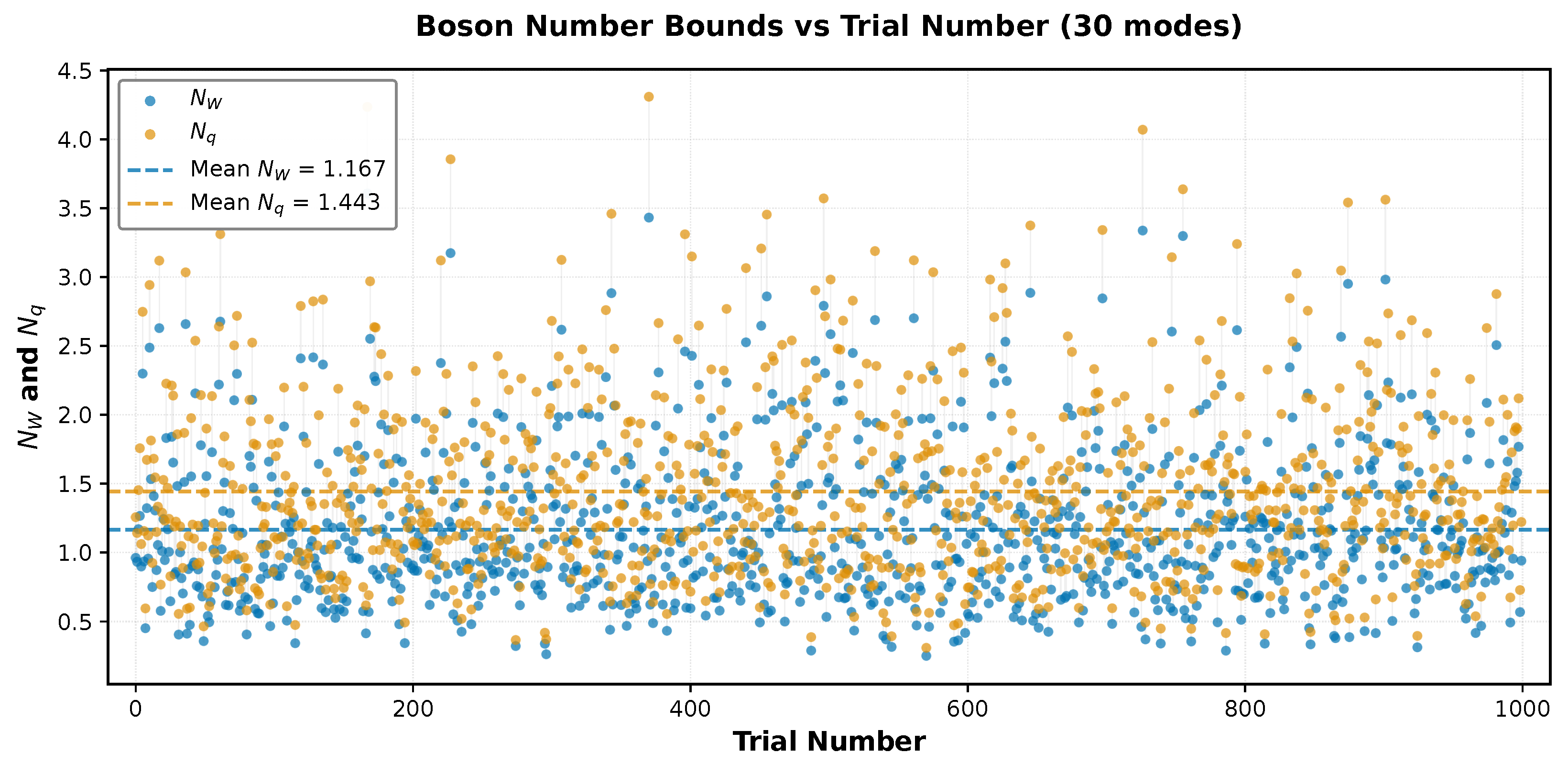
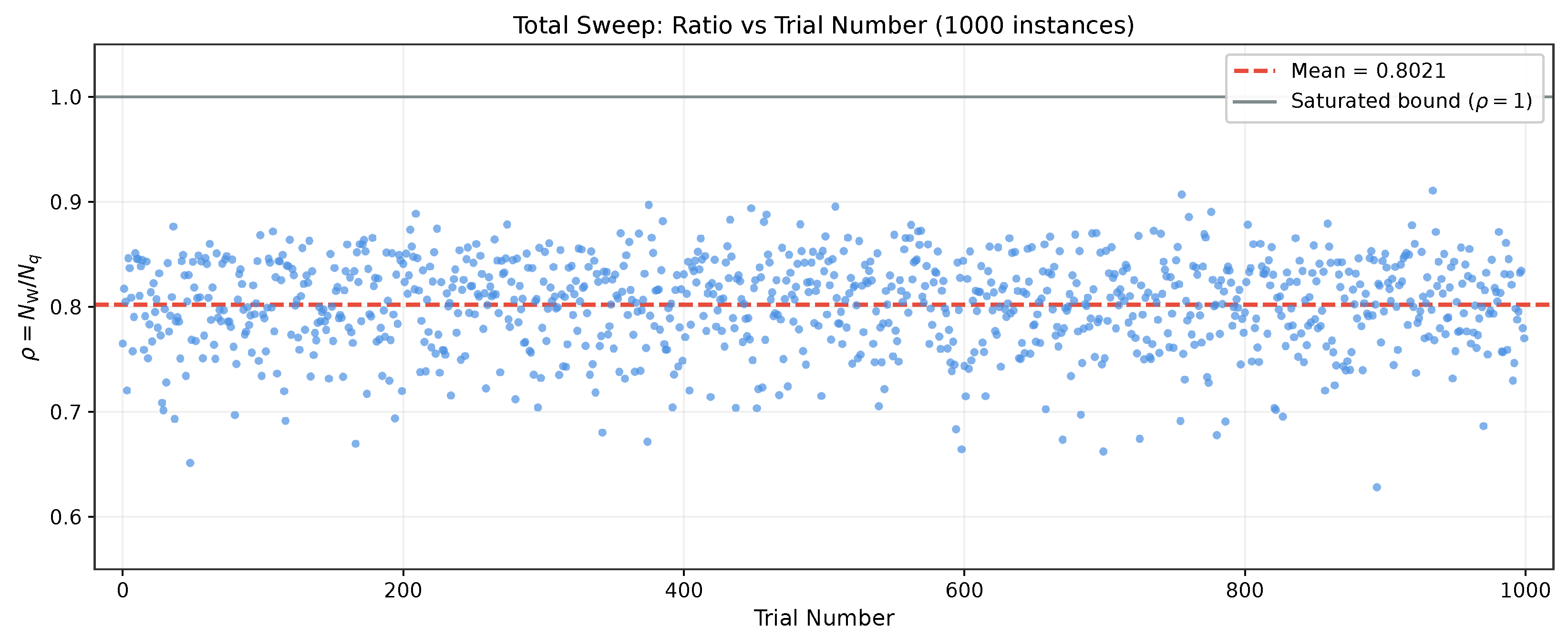
3.2. Fluctuations in GBS Quantum Computational Complexity Within Large Ensembles of Unitaries
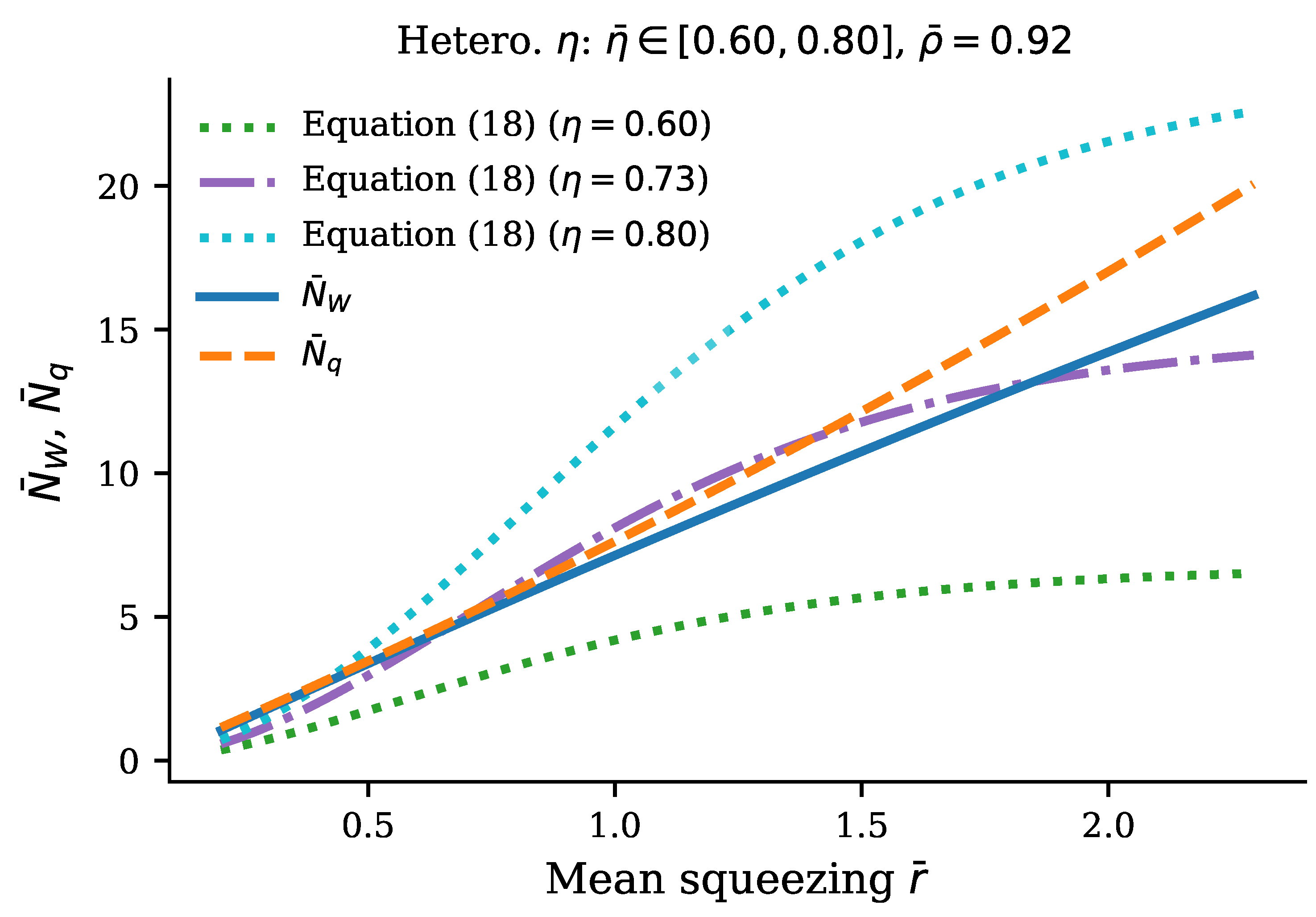
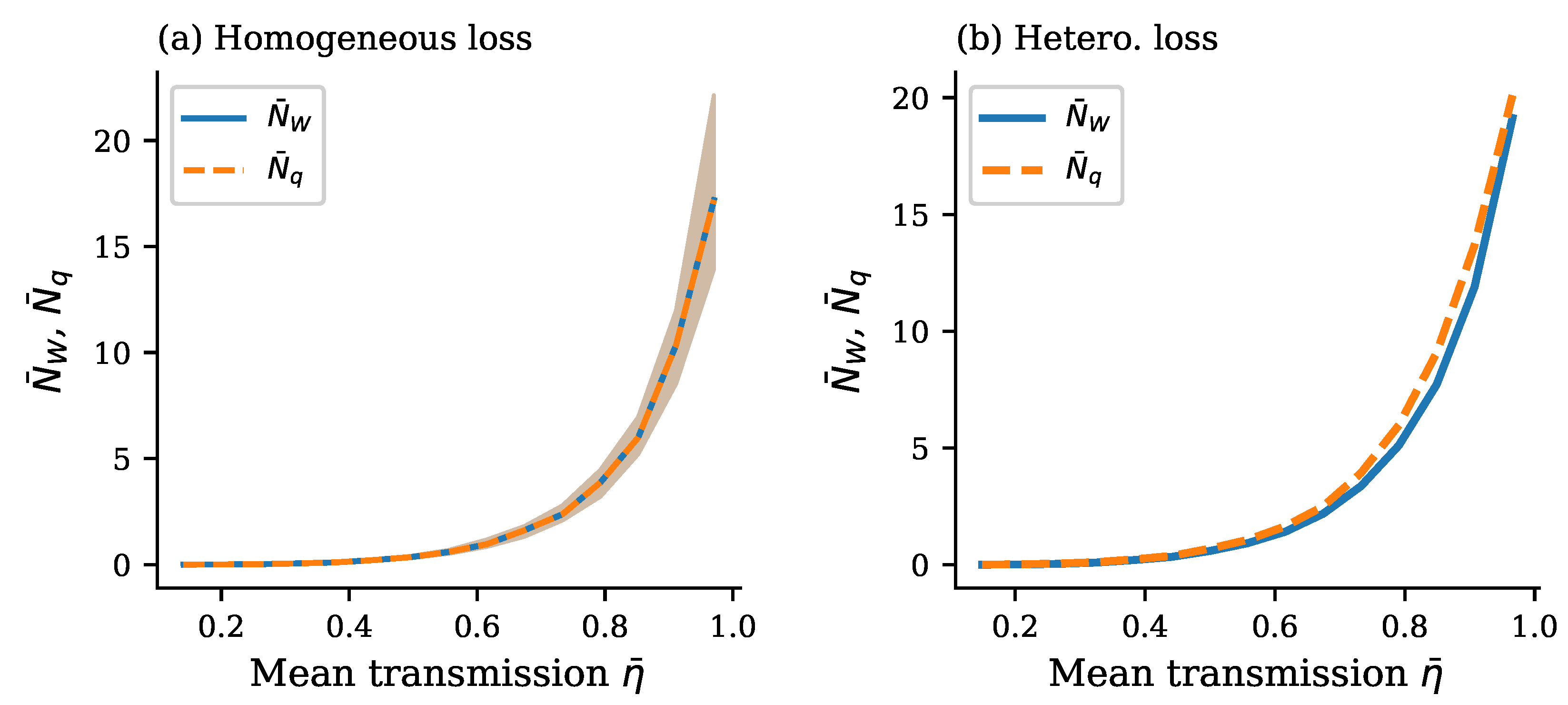
3.2.1. Validation of the Analytical Solution in Equation (18) and Exact Equality in the Case of the Homogeneous Loss Profile }
3.2.2. General Case of a Heterogeneous Loss Profile }
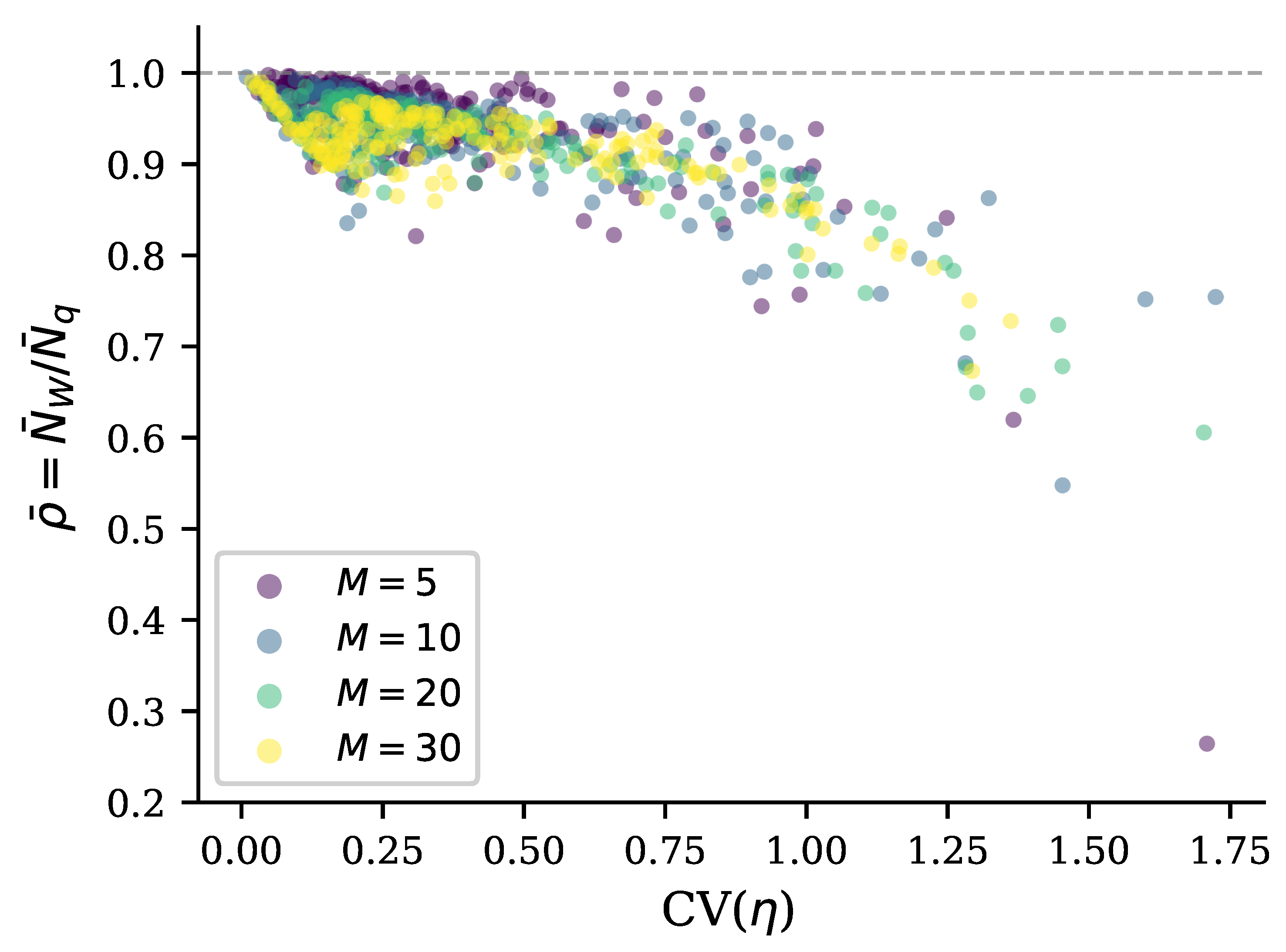
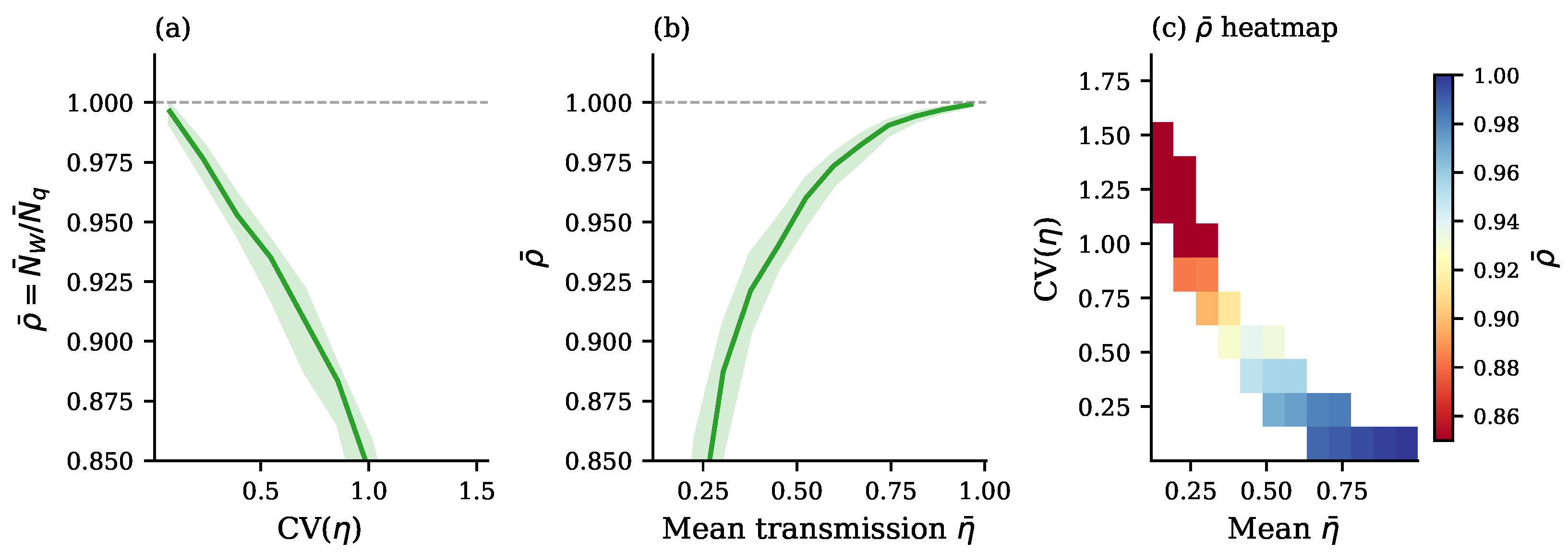
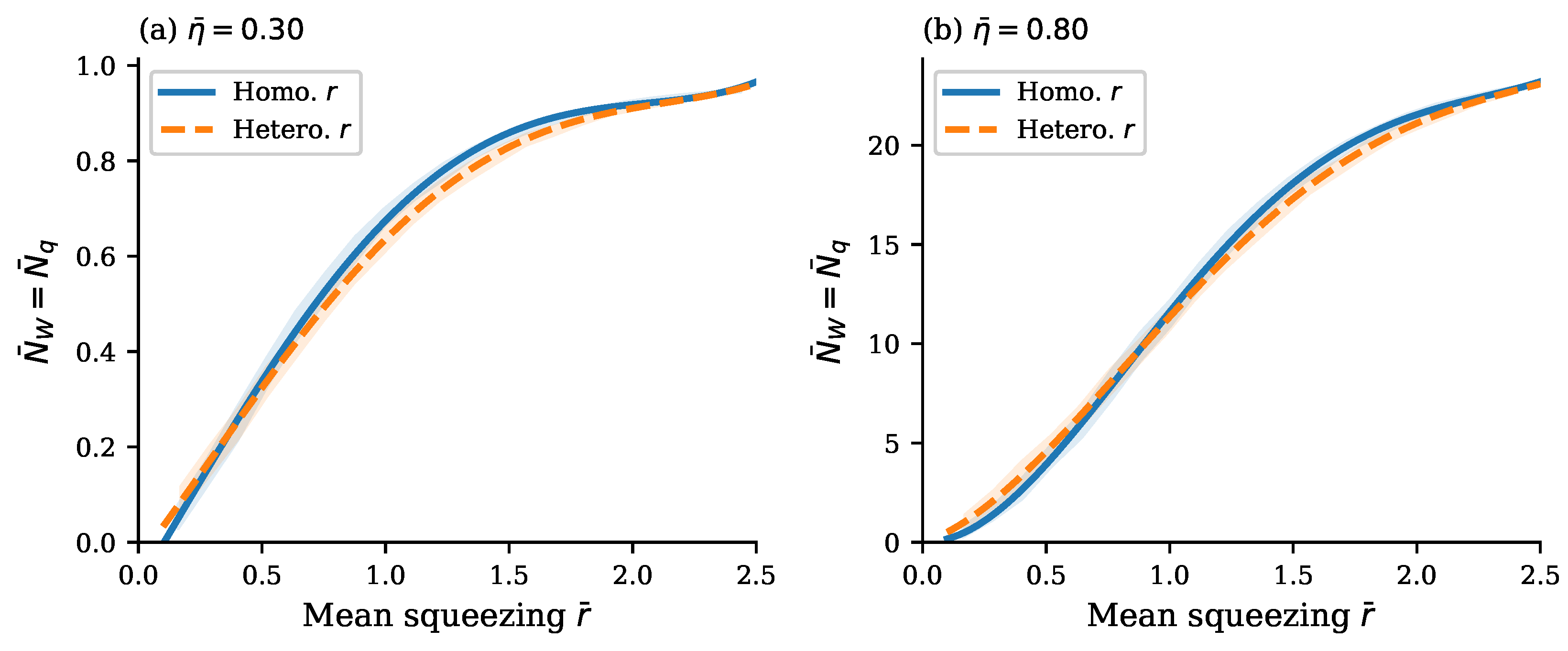
3.3. Dependence of GBS Quantum Complexity on the Mode Losses
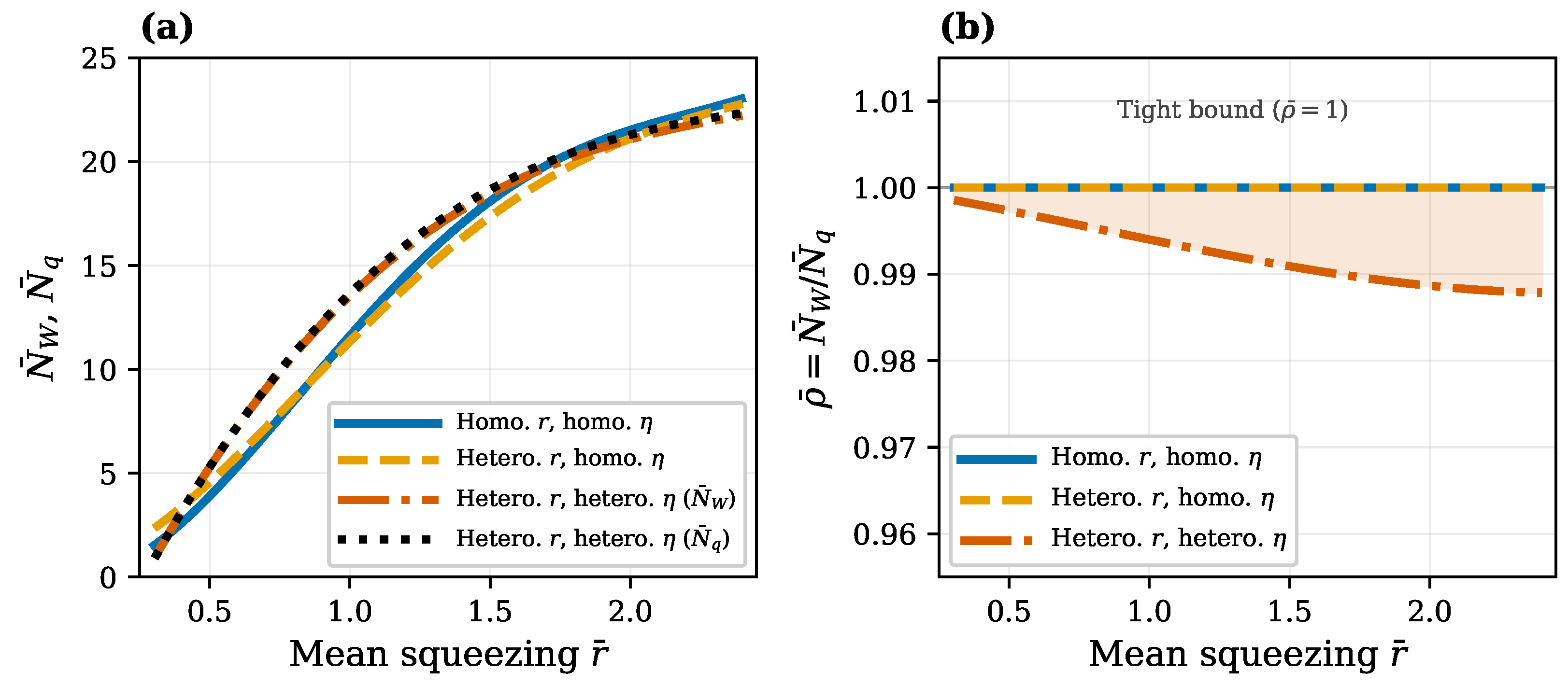
3.4. Two Models of Loss Variability: Additive vs. Multiplicative Noise at Fixed Nominal Level
3.5. Dependence of GBS Quantum Complexity on the Mode Squeezing: The Jensen Effect
3.6. Dependence of GBS Quantum Complexity on the Number of Modes
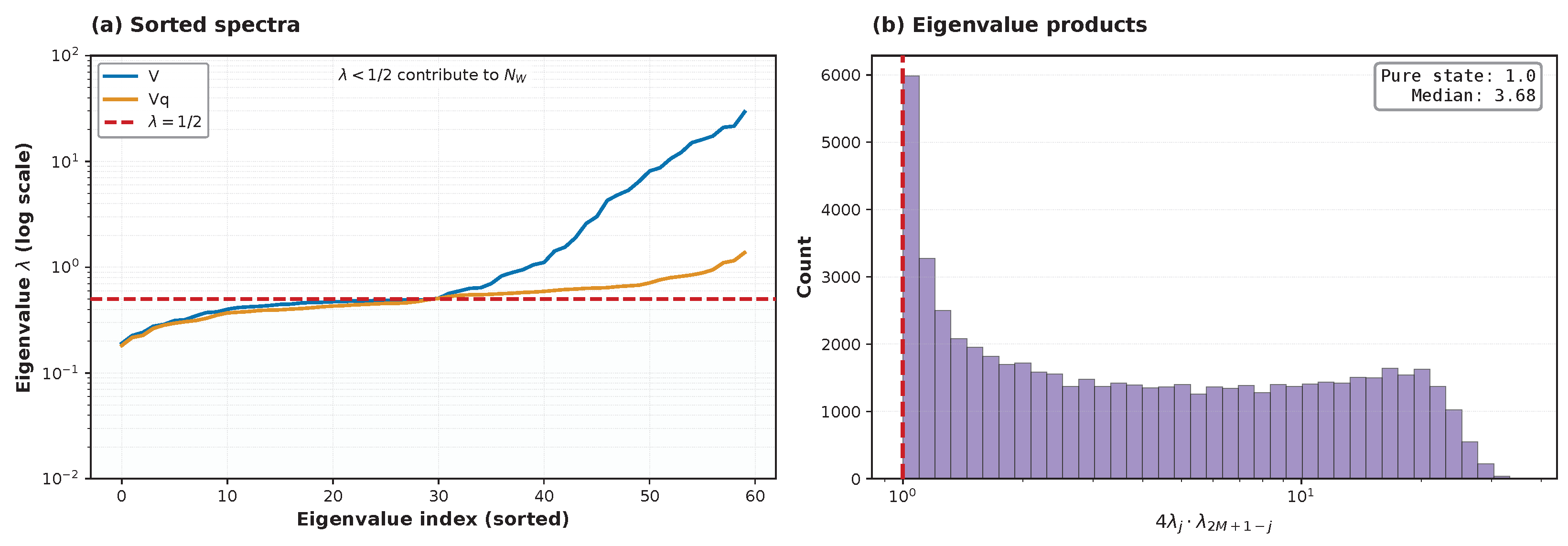
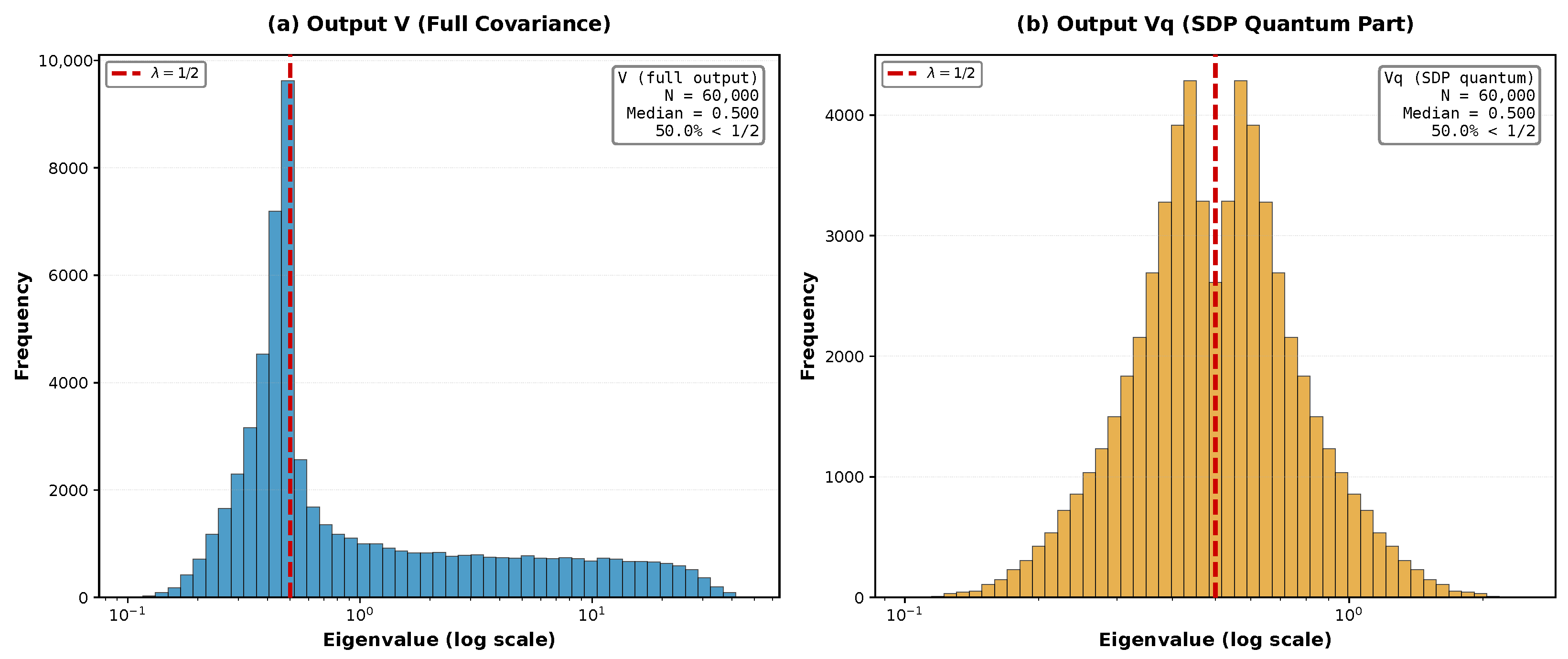
3.7. Spectrum of Eigenvalues and Spectral Asymmetry of the Covariance Matrix
3.7.1. Asymmetry Between Sub-Vacuum, , and Super-Vacuum, , Sectors
3.7.2. The Smallest–Largest Pairing of Eigenvalues: Squeezed Bosons vs. Classical Bosons
4. Upper Bound for the Complexity Dimension of the Quantum Resource
5. Conclusions
- (i)
- Finding a procedure for the explicit analytical construction of the quantum resource’s modes, starting from the eigenvectors of the covariance matrix by constructing their conjugated pair’s counterparts via the symplectic Gram–Schmidt procedure [30] applied to the sub-vacuum, nonclassical sector of the eigenvectors ordered in ascending order of their eigenvalues, , as per Equation (10).
- (ii)
- Comparison of the squeezed modes of the quantum complexity resource against quasiparticles and eigen-squeezed modes arising in the Bloch-Messiah or Williamson decomposition of the covariance matrix.
- (iii)
- Finding a protocol for constructing fully optimized classical part of the covariance matrix decomposition in Equation (8) via consecutive nullification of all covariance matrix eigenvalues related to the sub-vacuum, nonclassical sector by moving an appropriate part of the covariance matrix V into the quantum resource’s part .
Author Contributions
Funding
Data Availability Statement
Conflicts of Interest
References
- Harrow, A.W.; Montanaro, A. Quantum computational supremacy. Nature 2017, 549, 203. [Google Scholar] [CrossRef] [Scilit]
- Yung, M.-H.; Gao, X.; Huh, J. Universal bound on sampling bosons in linear optics and its computational implications. Natl. Sci. Rev. 2019, 6, 719–729. [Google Scholar] [CrossRef] [Scilit] [PubMed]
- Dalzell, A.M.; Harrow, A.W.; Koh, D.E.; La Placa, R.L. How many qubits are needed for quantum computational supremacy? Quantum 2020, 4, 264. [Google Scholar] [CrossRef] [Scilit]
- Zhong, H.S.; Wang, H.; Deng, Y.H.; Chen, M.C.; Peng, L.C.; Luo, Y.H.; Qin, J.; Wu, D.; Ding, X.; Hu, Y.; et al. Quantum computational advantage using photons. Science 2020, 370, 1460–1463. [Google Scholar] [CrossRef] [Scilit]
- Movassagh, R. The hardness of random quantum circuits. Nat. Phys. 2023, 19, 1719–1724. [Google Scholar] [CrossRef] [Scilit]
- Yu, S.; Zhong, Z.-P.; Fang, Y.; Patel, R.B.; Li, Q.-P.; Liu, W.; Li, Z.; Xu, L.; Sagona-Stophel, S.; Mer, E.; et al. A universal programmable Gaussian boson sampler for drug discovery. Nat. Comput. Sci. 2023, 3, 839–848. [Google Scholar] [CrossRef] [Scilit]
- Serafini, A. Quantum Continuous Variables: A Primer of Theoretical Methods, 2nd ed.; CRC Press: Boca Raton, FL, USA, 2023. [Google Scholar]
- Aaronson, S.; Arkhipov, A. The computational complexity of linear optics. Theory Comput. 2013, 9, 143–252. [Google Scholar] [CrossRef]
- Brod, D.J.; Galvão, E.F.; Crespi, A.; Osellame, R.; Spagnolo, N.; Sciarrino, F. Photonic implementation of boson sampling: A review. Adv. Photonics 2019, 1, 034001. [Google Scholar]
- Lund, A.P.; Laing, A.; Rahimi-Keshari, S.; Rudolph, T.; O’Brien, J.L.; Ralph, T.C. Boson Sampling from a Gaussian State. Phys. Rev. Lett. 2014, 113, 100502. [Google Scholar] [CrossRef] [Scilit] [PubMed]
- Hamilton, C.S.; Kruse, R.; Sansoni, L.; Barkhofen, S.; Silberhorn, C.; Jex, I. Gaussian boson sampling. Phys. Rev. Lett. 2017, 119, 170501. [Google Scholar] [CrossRef] [Scilit]
- Kruse, R.; Hamilton, C.S.; Sansoni, L.; Barkhofen, S.; Silberhorn, C.; Jex, I. Detailed study of Gaussian boson sampling. Phys. Rev. A 2019, 100, 032326. [Google Scholar] [CrossRef] [Scilit]
- Kocharovsky, V.V.; Kocharovsky, V.V.; Tarasov, S.V. Atomic boson sampling in a Bose–Einstein-condensed gas. Phys. Rev. A 2022, 106, 063312. [Google Scholar] [CrossRef] [Scilit]
- Kocharovsky, V.V.; Kocharovsky, V.V.; Shannon, W.D.; Tarasov, S.V. Towards the simplest model of quantum supremacy: Atomic boson sampling in a box trap. Entropy 2023, 25, 1584. [Google Scholar] [CrossRef] [Scilit]
- Kocharovsky, V.V. Hybrid Boson Sampling. Entropy 2024, 26, 926. [Google Scholar] [CrossRef] [Scilit]
- Kocharovsky, V.V.; Kocharovsky, V.V.; Tarasov, S.V. The Hafnian Master Theorem. Linear Algebra Appl. 2022, 651, 144–161. [Google Scholar] [CrossRef] [Scilit]
- Kocharovsky, V.V. Universal nature of quantum supremacy. J. Phys. Conf. Ser. 2024, 2894, 012002. [Google Scholar] [CrossRef] [Scilit]
- Troyansky, L.; Tishby, N. Permanent uncertainty: On the quantum evaluation of the determinant and the permanent of a matrix. In Proceedings of the 4th Workshop on Physics and Computation (PhysComp’96), Boston, MA, USA, 22–24 November 1996. [Google Scholar]
- Scheel, S. Permanents in linear optical networks. arXiv 2004, arXiv:quant-ph/0406127. [Google Scholar] [CrossRef] [Scilit]
- Caianiello, E.R. On quantum field theory, I: Explicit solution of Dyson’s equation in electrodynamics without use of Feynman graphs. Nuovo Cimento 1953, 10, 1634–1652. [Google Scholar] [CrossRef] [Scilit]
- Madsen, L.S.; Laudenbach, F.; Askarani, M.F.; Rortais, F.; Vincent, T.; Bulmer, J.F.F.; Miatto, F.M.; Neuhaus, L.; Helt, L.G.; Collins, M.J.; et al. Quantum computational advantage with a programmable photonic processor. Nature 2022, 606, 75–81. [Google Scholar] [CrossRef] [Scilit] [PubMed]
- Zhong, H.-S.; Deng, Y.-H.; Qin, J.; Wang, H.; Chen, M.-C.; Peng, L.-C.; Luo, Y.-H.; Wu, D.; Gong, S.-Q.; Su, H.; et al. Phase-Programmable Gaussian Boson Sampling Using Stimulated Squeezed Light. Phys. Rev. Lett. 2021, 127, 180502. [Google Scholar] [CrossRef] [Scilit]
- Deng, Y.-H.; Gong, S.-Q.; Gu, Y.-C.; Zhang, Z.-J.; Liu, H.-L.; Su, H.; Tang, H.-Y.; Xu, J.-M.; Jia, M.-H.; Chen, M.-C.; et al. Solving graph problems using Gaussian boson sampling. Phys. Rev. Lett. 2023, 130, 190601. [Google Scholar] [CrossRef] [Scilit]
- Deshpande, A.; Mehta, A.; Vincent, T.; Quesada, N.; Hinsche, M.; Ioannou, M.; Madsen, L.; Lavoie, J.; Qi, H.; Eisert, J.; et al. Quantum computational advantage via high-dimensional Gaussian boson sampling. Sci. Adv. 2022, 8, eabi7894. [Google Scholar] [CrossRef] [Scilit]
- Quesada, N.; Arrazola, J.M.; Killoran, N. Gaussian boson sampling using threshold detectors. Phys. Rev. A 2018, 98, 062322. [Google Scholar] [CrossRef] [Scilit]
- Zhong, H.-S.; Peng, L.-C.; Li, Y.; Hu, Y.; Li, W.; Qin, J.; Wu, D.; Zhang, W.; Li, H.; Zhang, L.; et al. Experimental Gaussian Boson sampling. Sci. Bull. 2019, 64, 511–515. [Google Scholar] [CrossRef] [Scilit] [PubMed]
- Wang, H.; Qin, J.; Ding, X.; Chen, M.-C.; Chen, S.; You, X.; He, Y.-M.; Jiang, X.; You, L.; Wang, Z.; et al. Boson Sampling with 20 input photons and a 60-mode interferometer in a 1014-dimensional Hilbert space. Phys. Rev. Lett. 2019, 123, 250503. [Google Scholar] [CrossRef] [Scilit] [PubMed]
- Kocharovsky, V.V. Boson Sampling from a Multimode Cavity Containing Bose-Einstein Condensate. In 2025 IEEE International Conference on Quantum Computing and Engineering (QCE); IEEE: Piscataway, NJ, USA, 2025; pp. 1063–1068. [Google Scholar] [CrossRef] [Scilit]
- Oh, C.; Liu, M.; Alexeev, Y.; Fefferman, B.; Jiang, L. Classical algorithm for simulating experimental Gaussian boson sampling. Nat. Phys. 2024, 20, 1461–1468. [Google Scholar] [CrossRef] [Scilit]
- Silva, A.C. Lectures on Symplectic Geometry; Springer: Berlin/Heidelberg, Germany, 2008. [Google Scholar]




Disclaimer/Publisher’s Note: The statements, opinions and data contained in all publications are solely those of the individual author(s) and contributor(s) and not of MDPI and/or the editor(s). MDPI and/or the editor(s) disclaim responsibility for any injury to people or property resulting from any ideas, methods, instructions or products referred to in the content. |
© 2026 by the authors. Licensee MDPI, Basel, Switzerland. This article is an open access article distributed under the terms and conditions of the Creative Commons Attribution (CC BY) license.
Share and Cite
Kocharovsky, V.V.; Kalra, K. Wigner Distribution Sets Universal Lower Bound for Quantum Advantage in Gaussian Boson Sampling. Entropy 2026, 28, 188. https://doi.org/10.3390/e28020188
Kocharovsky VV, Kalra K. Wigner Distribution Sets Universal Lower Bound for Quantum Advantage in Gaussian Boson Sampling. Entropy. 2026; 28(2):188. https://doi.org/10.3390/e28020188
Chicago/Turabian StyleKocharovsky, Vitaly V., and Kunwar Kalra. 2026. "Wigner Distribution Sets Universal Lower Bound for Quantum Advantage in Gaussian Boson Sampling" Entropy 28, no. 2: 188. https://doi.org/10.3390/e28020188
APA StyleKocharovsky, V. V., & Kalra, K. (2026). Wigner Distribution Sets Universal Lower Bound for Quantum Advantage in Gaussian Boson Sampling. Entropy, 28(2), 188. https://doi.org/10.3390/e28020188