Entropy-Guided Regime Switching for Railway Passenger Flow Forecasting: An Adaptive EA-ARIMA-Informer Framework


Abstract
1. Introduction
- A multi-entropy characterization scheme combining sample entropy, permutation entropy, transfer entropy, and approximate entropy to quantify passenger flow complexity across multiple dimensions.
- A Conditional Entropy Growth Factor (CEGF) that enables interpretable regime detection and serves as the basis for adaptive model switching.
- An adaptive dual-path framework, EA-ARIMA-Informer, uses real-time entropy diagnostics to switch forecasting emphasis between ARIMA and Informer, capturing state-dependent linear (trend/seasonality) and nonlinear patterns while balancing accuracy and interpretability.
2. Related Work
2.1. Evolution of Passenger Flow Forecasting Architectures from Statistical Methods to Deep Learning
2.2. Information Entropy as a Mathematical Framework for Complexity Characterization
2.3. Hybrid Forecasting Models and Regime Identification
2.4. Research Gaps and Contributions
3. Entropy-Based Characterization of Railway Passenger Flow Time Series
3.1. Theoretical Foundation of Information Entropy
3.2. An Information-Theoretic Perspective on the Railway Passenger Flow System
3.2.1. Passenger Flow as an Information Source
3.2.2. Information Dynamics of Temporal Evolution
3.3. Entropy Feature Extraction for Railway Passenger Flow System
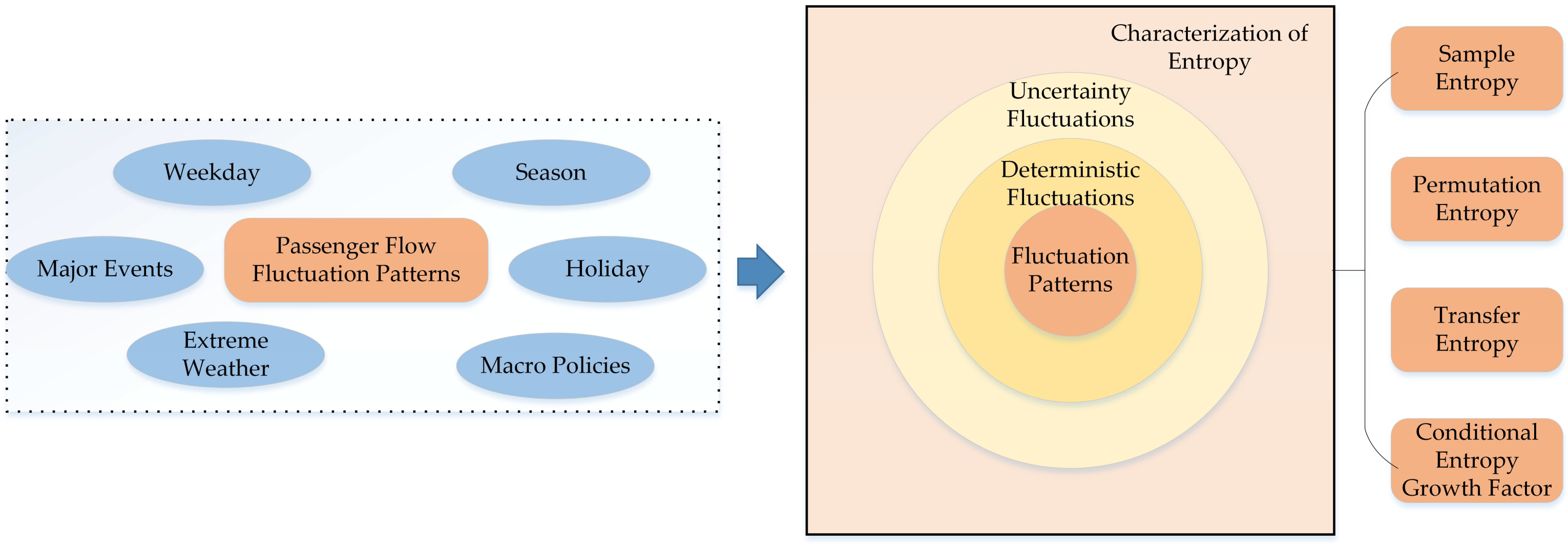
3.3.1. Entropy Feature Extraction Framework
3.3.2. Sample Entropy and Flow Regularity
3.3.3. Permutation Entropy and Dynamic Flow Patterns
3.3.4. Transfer Entropy and Event Flow Causality
3.3.5. CEGF and Regime Detection
4. The EA-ARIMA-Informer Framework for Railway Passenger-Flow Forecasting
4.1. Overall Architecture of the Entropy-Guided Prediction Framework
4.2. Limitations of Conventional Methods
4.2.1. ARIMA
4.2.2. Informer
4.3. The EA-ARIMA-Informer Framework
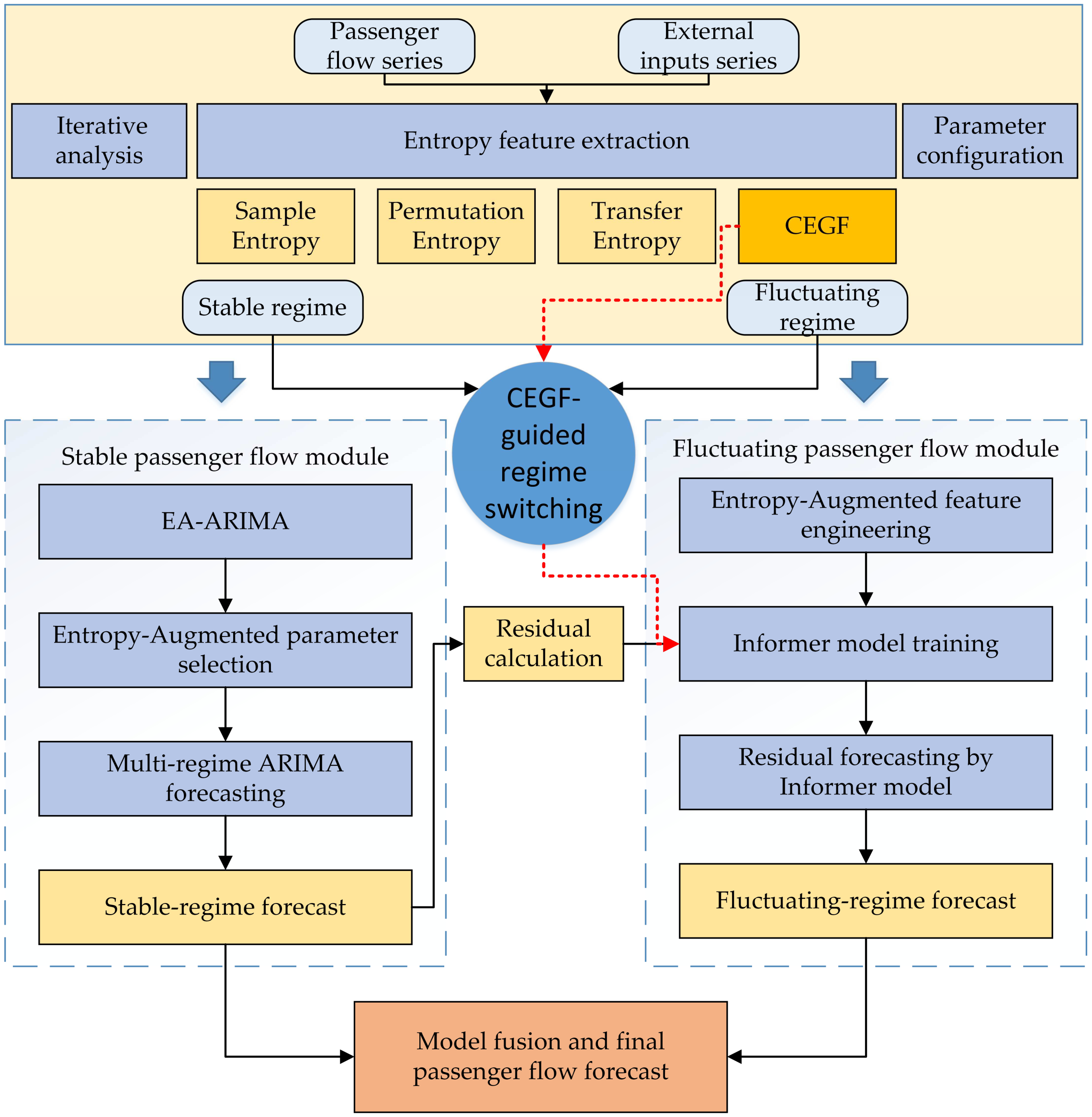
4.3.1. Overall Architecture
4.3.2. Entropy Computation and Feature Fusion
4.3.3. State-Dependent Model Switching with Entropy Guidance
4.3.4. Evaluation Metrics
5. Experiments and Results
5.1. Data Description
5.2. Entropy-Based Characteristics of Railway Passenger Flows
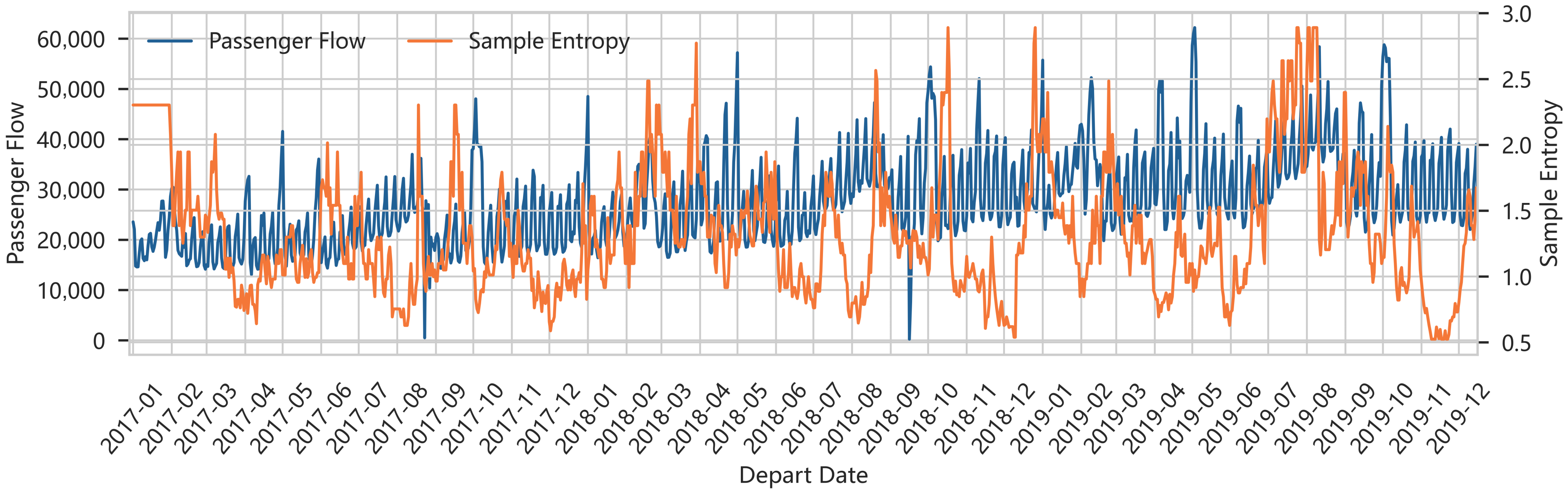
5.2.1. Sample Entropy and Overall Predictability
5.2.2. Permutation Entropy and Holiday Pattern Consistency
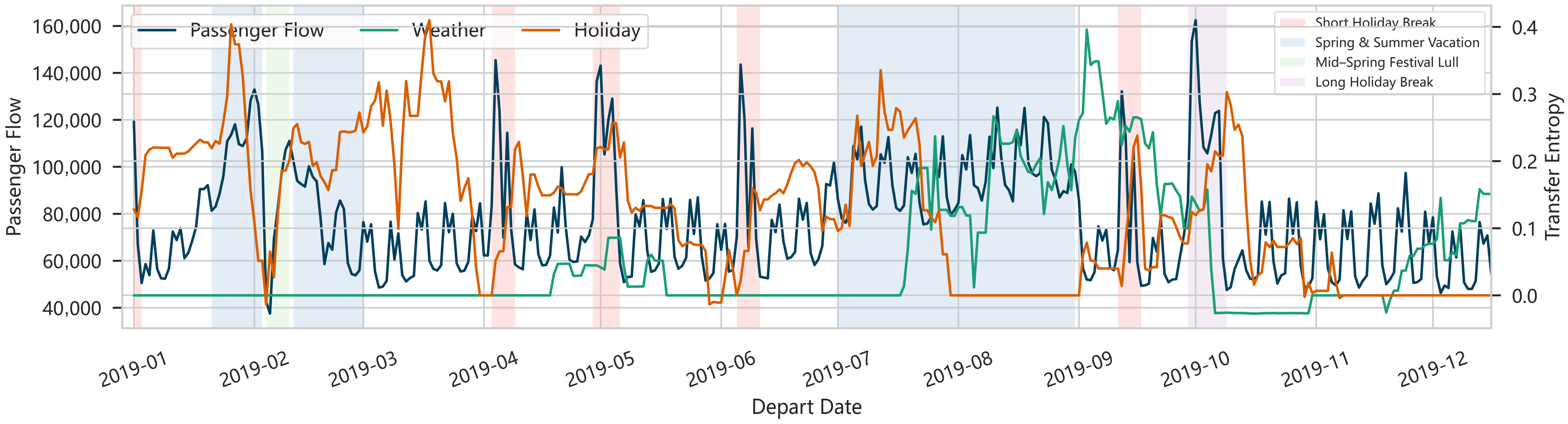
5.2.3. Transfer Entropy and Event Disturbances
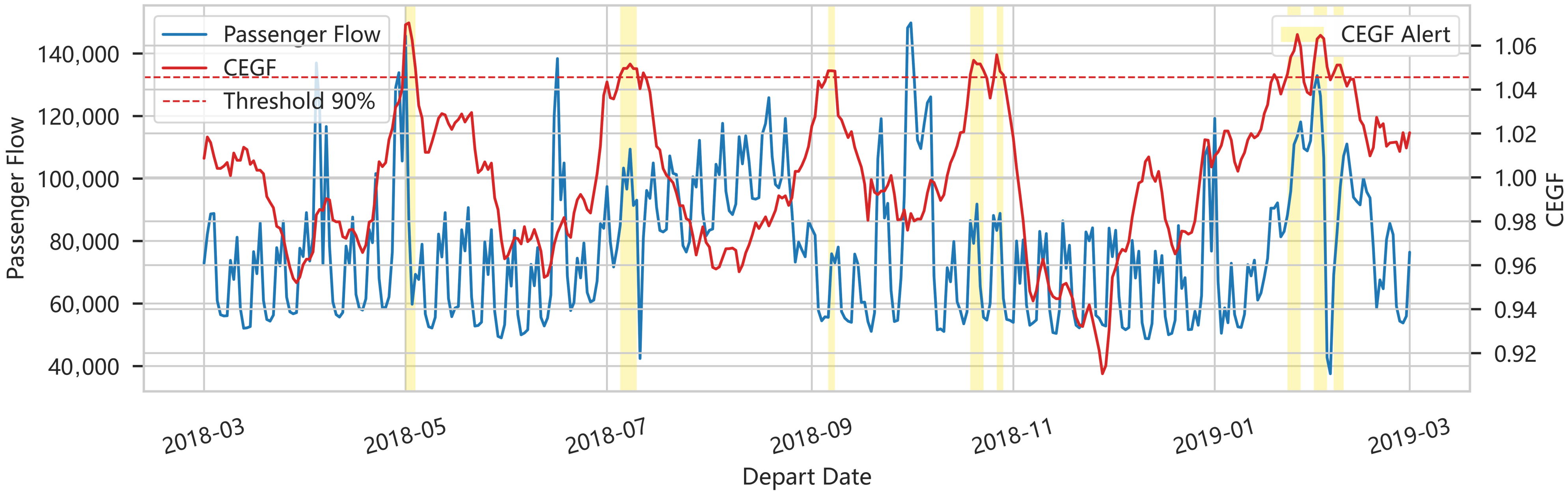
5.2.4. Conditional Entropy Growth Factor and Regime Detection
5.3. Validation of the EA-ARIMA-Informer Framework
5.3.1. Experimental Design
5.3.2. Training Configuration
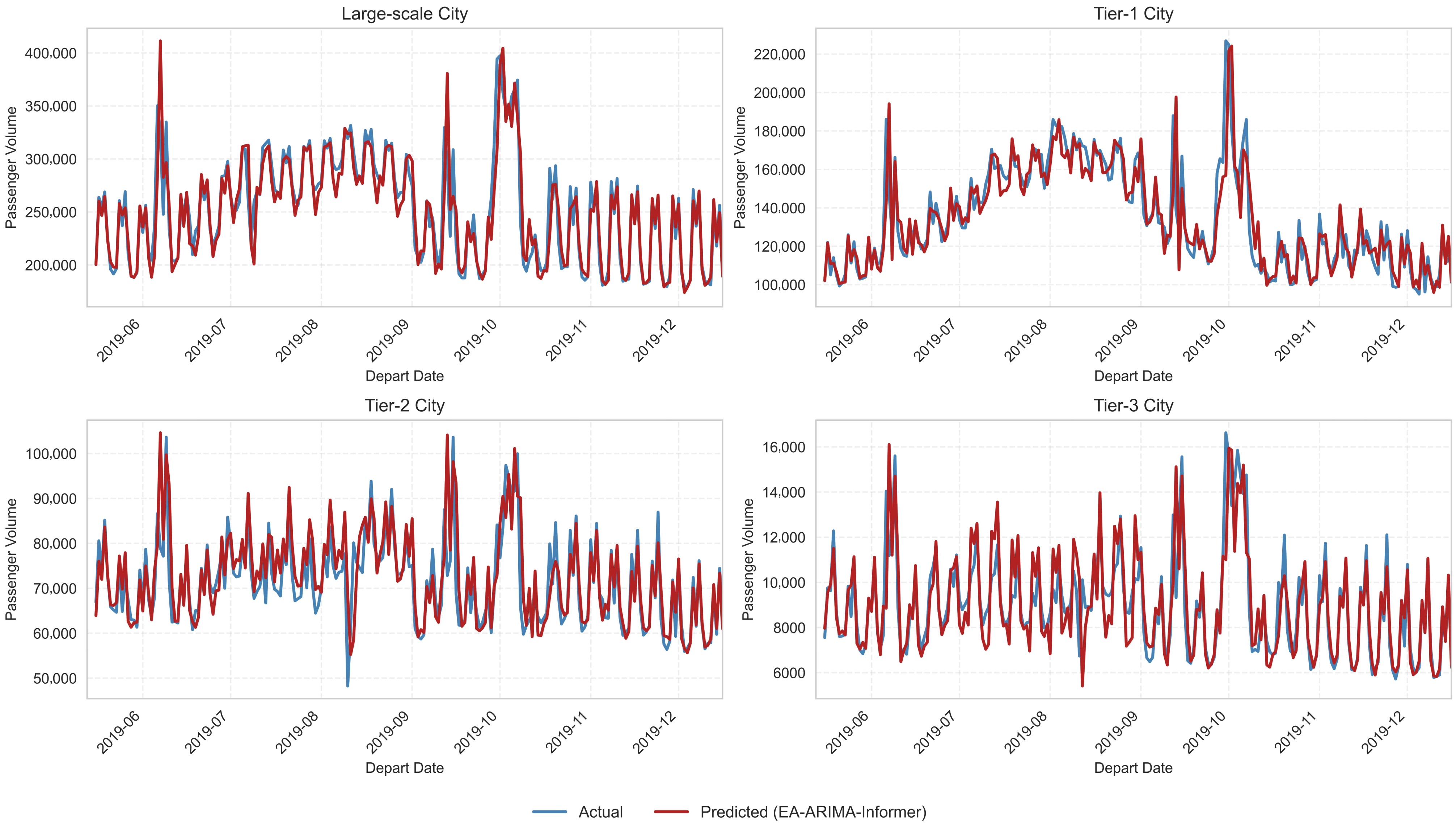
5.3.3. Overall Forecasting Performance
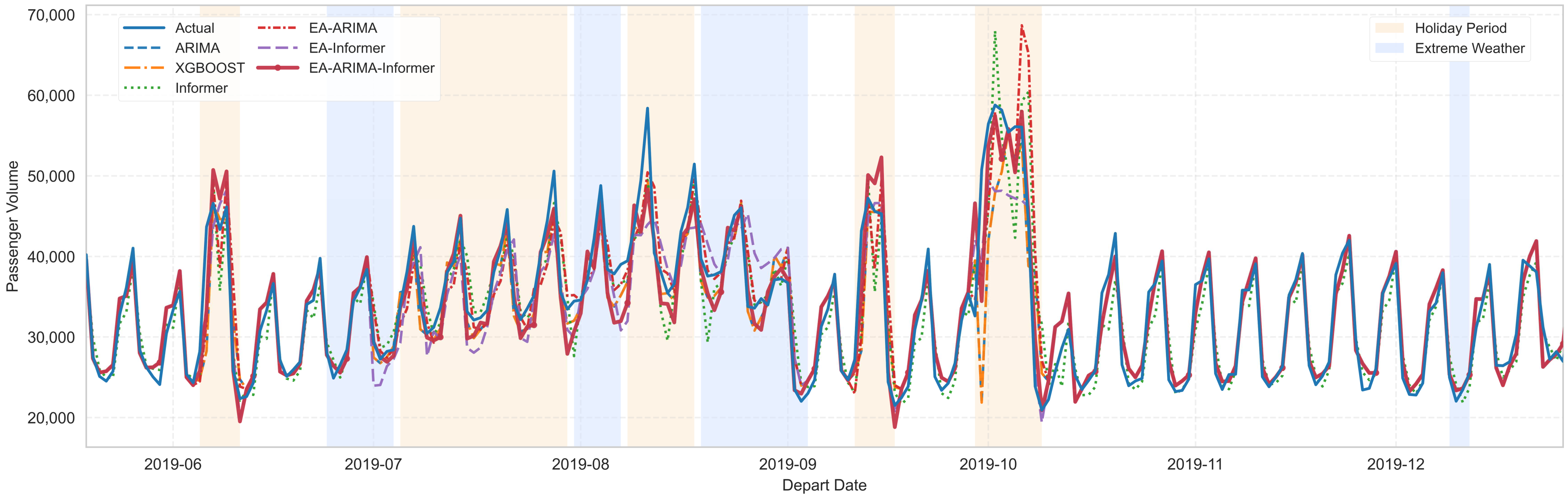
5.3.4. Comparison with Benchmark Methods
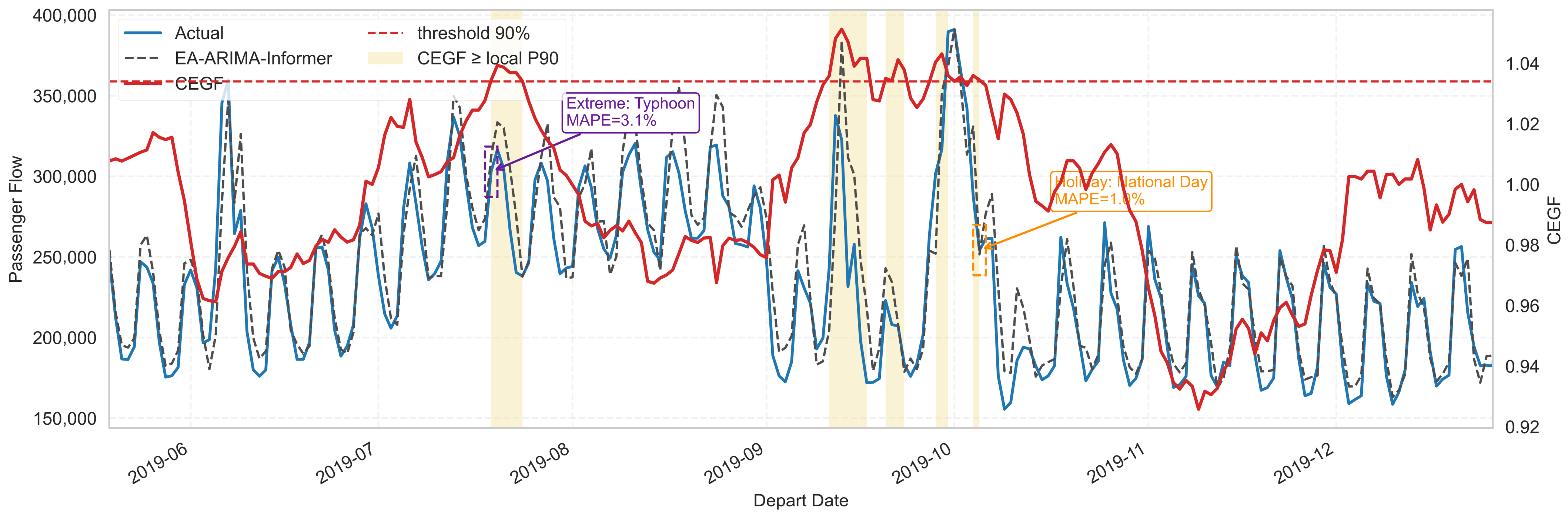
5.3.5. Role of Entropy and Switching Mechanism
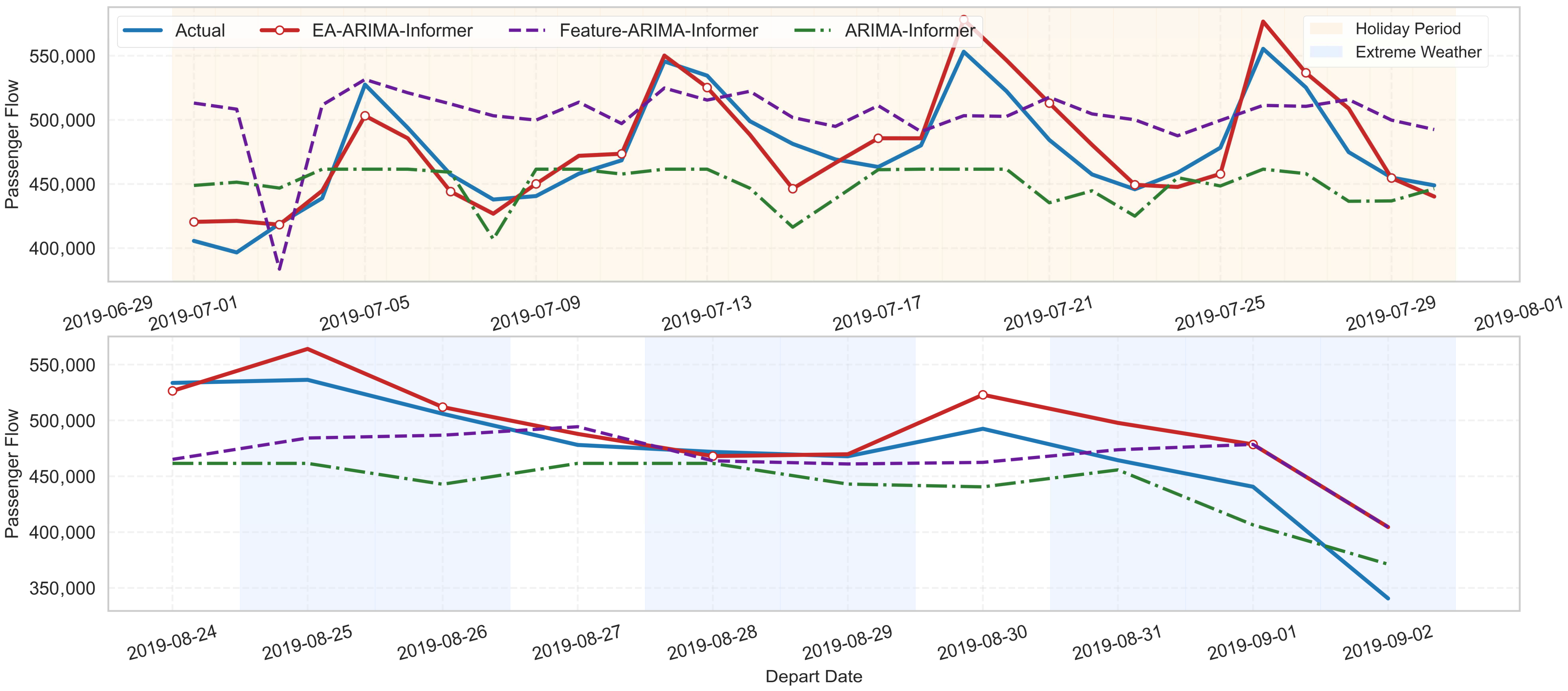
5.3.6. Ablation Study
- (1)
- ARIMA-Informer, which represents a direct hybrid without entropy. In this configuration, ARIMA and Informer are jointly trained but without explicit regime identification.
- (2)
- Feature-ARIMA-Informer, where entropy features are added to the inputs, but no CEGF-driven switching is applied. This variant relies solely on feature augmentation.
- (3)
- EA-ARIMA-Informer (full), in which both entropy feature extraction and CEGF-based state recognition and gating are enabled.
5.4. Discussion
5.4.1. Entropy as an Interpretable Lens for Passenger Flow Complexity
5.4.2. Asymmetric Challenges of Holiday Surges Versus Extreme Weather Disruptions
5.4.3. Synergistic Benefits of the Hybrid Architecture and Regime Switching
5.4.4. Implications for Operational Deployment
6. Conclusions
Author Contributions
Funding
Data Availability Statement
Conflicts of Interest
References
- Wen, K.; Zhao, G.; He, B.; Ma, J.; Zhang, H. A Decomposition-Based Forecasting Method with Transfer Learning for Railway Short-Term Passenger Flow in Holidays. Expert Syst. Appl. 2022, 189, 116102. [Google Scholar] [CrossRef]
- Li, W.; Sui, L.; Zhou, M.; Dong, H. Short-Term Passenger Flow Forecast for Urban Rail Transit Based on Multi-Source Data. EURASIP J. Wirel. Commun. Netw. 2021, 2021, 9. [Google Scholar] [CrossRef]
- Ma, M.; Liu, J.; Cao, J. Short-Term Forecasting of Railway Passenger Flow Based on Clustering of Booking Curves. Math. Probl. Eng. 2014, 2014, 707636. [Google Scholar] [CrossRef]
- Zhang, J.; Yang, Y.; Yang, L.; Gao, Z. Joint Short-Term Origin-Destination Demand Prediction for Multimodal Transport Systems. IEEE Trans. Pattern Anal. Mach. Intell. 2026, 48, 2458–2475. [Google Scholar] [CrossRef]
- Lu, Y.; Wang, J. Short-Term Passenger Flow Forecasting for Rail Transit Inte-Grating Multi-Scale Decomposition and Deep Attention Mechanism. Sustainability 2025, 17, 8880. [Google Scholar] [CrossRef]
- Li, D.; Du, S.; Hou, Y. Long-Term Passenger Flow Forecasting for Rail Transit Based on Complex Networks and Informer. Sensors 2024, 24, 6894. [Google Scholar] [CrossRef]
- Du, B.; Peng, H.; Wang, S.; Bhuiyan, M.Z.A.; Wang, L.; Gong, Q.; Liu, L.; Li, J. Deep Irregular Convolutional Residual LSTM for Urban Traffic Passenger Flows Prediction. IEEE Trans. Intell. Transp. Syst. 2020, 21, 972–985. [Google Scholar] [CrossRef]
- Hao, X.; Zhong, X.; Yang, J.; Sun, S.; Zhang, J. Multi-Task Learning-Based High-Speed Railway Inflow and Outflow Prediction with Large Language Models. Transp. Transp. Sci. 2025, 1–26. [Google Scholar] [CrossRef]
- Wei, Z.; Shan, X. Research on Forecast Method of Railway Passenger Flow Demand in Pre-Sale Period. IOP Conf. Ser. Mater. Sci. Eng. 2019, 563, 052080. [Google Scholar] [CrossRef]
- Zhang, G.P. Time Series Forecasting Using a Hybrid ARIMA and Neural Network Model. Neurocomputing 2003, 50, 159–175. [Google Scholar] [CrossRef]
- Yu, S.; Luo, A.; Wang, X. Railway Passenger Flow Forecasting by Integrating Passenger Flow Relationship and Spatiotemporal Similarity. Intell. Autom. Soft Comput. 2023, 37, 1877–1893. [Google Scholar] [CrossRef]
- Yang, Y.; Chen, Z.; Gao, Y.; Wang, Z.; Ding, Z.; Wu, J. Network Traffic Forecasting with Transfer Learning-Based Algorithm for Long Continuous Missing Data. Expert Syst. Appl. 2026, 298, 129484. [Google Scholar] [CrossRef]
- Zhou, S.; Song, C.; Wang, T.; Pan, X.; Chang, W.; Yang, L. A Short-Term Hybrid TCN-GRU Prediction Model of Bike-Sharing Demand Based on Travel Characteristics Mining. Entropy 2022, 24, 1193. [Google Scholar] [CrossRef] [PubMed]
- Yang, F.; Shuai, C.; Qian, Q.; Wang, W.; He, M.; He, M.; Lee, J. Predictability of Short-Term Passengers’ Origin and Destination Demands in Urban Rail Transit. Transportation 2023, 50, 2375–2401. [Google Scholar] [CrossRef]
- Wei, T.; Yang, X.; Xu, G.; Shi, F. Medium-Term Forecast of Daily Passenger Volume of High Speed Railway Based on DLP-WNN. Railw. Sci. 2023, 2, 121–139. [Google Scholar] [CrossRef]
- Tsai, T.-H. A Self-Learning Advanced Booking Model for Railway Arrival Forecasting. Transp. Res. Part C Emerg. Technol. 2014, 39, 80–93. [Google Scholar] [CrossRef]
- Shapovalova, Y.; Baştürk, N.; Eichler, M. Multivariate Count Data Models for Time Series Forecasting. Entropy 2021, 23, 718. [Google Scholar] [CrossRef]
- Katambire, V.N.; Musabe, R.; Uwitonze, A.; Mukanyiligira, D. Forecasting the Traffic Flow by Using ARIMA and LSTM Models: Case of Muhima Junction. Forecasting 2023, 5, 616–628. [Google Scholar] [CrossRef]
- Dou, F.; Jia, L.; Wang, L.; Xu, J.; Huang, Y. Fuzzy Temporal Logic Based Railway Passenger Flow Forecast Model. Comput. Intell. Neurosci. 2014, 2014, 950371. [Google Scholar] [CrossRef]
- Shi, Z.; Zhang, N.; Schonfeld, P.M.; Zhang, J. Short-Term Metro Passenger Flow Forecasting Using Ensemble-Chaos Support Vector Regression. Transp. A Transp. Sci. 2020, 16, 194–212. [Google Scholar] [CrossRef]
- Chuwang, D.D.; Chen, W.; Zhong, M. Short-Term Urban Rail Transit Passenger Flow Forecasting Based on Fusion Model Methods Using Univariate Time Series. Appl. Soft Comput. 2023, 147, 110740. [Google Scholar] [CrossRef]
- Vivas, E.; Allende-Cid, H.; Salas, R. A Systematic Review of Statistical and Machine Learning Methods for Electrical Power Forecasting with Reported MAPE Score. Entropy 2020, 22, 1412. [Google Scholar] [CrossRef] [PubMed]
- Lu, W.; Zhang, Y.; Li, P.; Wang, T. Mul-DesLSTM: An Integrative Multi-Time Granularity Deep Learning Prediction Method for Urban Rail Transit Short-Term Passenger Flow. Eng. Appl. Artif. Intell. 2023, 125, 106741. [Google Scholar] [CrossRef]
- He, Y.; Li, L.; Zhu, X.; Tsui, K.L. Multi-Graph Convolutional-Recurrent Neural Network (MGC-RNN) for Short-Term Forecasting of Transit Passenger Flow. IEEE Trans. Intell. Transp. Syst. 2022, 23, 18155–18174. [Google Scholar] [CrossRef]
- Deng, S.; Du, J.; Zhang, J.; Wang, X. Deep Learning Approach for Short-Term Entry Passenger Flow Forecasting in Urban Rail Transit Stations. Eng. Appl. Artif. Intell. 2026, 163, 112989. [Google Scholar] [CrossRef]
- Ye, J.; Zhao, J.; Ye, K.; Xu, C. How to Build a Graph-Based Deep Learning Architecture in Traffic Domain: A Survey. IEEE Trans. Intell. Transp. Syst. 2022, 23, 3904–3924. [Google Scholar] [CrossRef]
- Wang, Y.; Zhang, Z.; Pi, S.; Zhang, H.; Pi, J. Dual-Gated Graph Convolutional Recurrent Unit with Integrated Graph Learning (DG3L): A Novel Recurrent Network Architecture with Dynamic Graph Learning for Spatio-Temporal Predictions. Entropy 2025, 27, 99. [Google Scholar] [CrossRef]
- Lu, W.; Zhang, Y.; Vu, H.L.; Xu, J.; Li, P. A Novel Integrative Prediction Framework for Metro Passenger Flow. J. Intell. Transp. Syst. 2025, 1–26. [Google Scholar] [CrossRef]
- Guan, H.; Dai, Z.; Guan, S.; Zhao, A. A Neutrosophic Forecasting Model for Time Series Based on First-Order State and Information Entropy of High-Order Fluctuation. Entropy 2019, 21, 455. [Google Scholar] [CrossRef]
- Ponce-Flores, M.; Frausto-Solís, J.; Santamaría-Bonfil, G.; Pérez-Ortega, J.; González-Barbosa, J.J. Time Series Complexities and Their Relationship to Forecasting Performance. Entropy 2020, 22, 89. [Google Scholar] [CrossRef]
- Bajić, D.; Japundžić-Žigon, N. On Quantization Errors in Approximate and Sample Entropy. Entropy 2021, 24, 73. [Google Scholar] [CrossRef]
- Li, Y.; Fujita, H.; Li, J.; Liu, C.; Zhang, Z. Tensor Approximate Entropy: An Entropy Measure for Sleep Scoring. Knowl.-Based Syst. 2022, 245, 108503. [Google Scholar] [CrossRef]
- Li, G.; Knoop, V.L.; Van Lint, H. Estimate the Limit of Predictability in Short-Term Traffic Forecasting: An Entropy-Based Approach. Transp. Res. Part C Emerg. Technol. 2022, 138, 103607. [Google Scholar] [CrossRef]
- Ruiz Reina, M.Á. Entropy Method for Decision-Making: Uncertainty Cycles in Tourism Demand. Entropy 2021, 23, 1370. [Google Scholar] [CrossRef] [PubMed]
- Li, J.; Li, W.; Lian, G. Optimal Aggregate Size of Traffic Sequence Data Based on Fuzzy Entropy and Mutual Information. Sustainability 2022, 14, 14767. [Google Scholar] [CrossRef]
- Pan, Y.A.; Guo, J.; Chen, Y.; Cheng, Q.; Li, W.; Liu, Y. A Fundamental Diagram Based Hybrid Framework for Traffic Flow Estimation and Prediction by Combining a Markovian Model with Deep Learning. Expert Syst. Appl. 2024, 238, 122219. [Google Scholar] [CrossRef]
- Zhang, J.; Mao, S.; Zhang, S.; Yin, J.; Yang, L.; Gao, Z. EF-Former for Short-Term Passenger Flow Prediction during Large-Scale Events in Urban Rail Transit Systems. Inf. Fusion 2025, 117, 102916. [Google Scholar] [CrossRef]
- Yang, Y.; Zhang, J.; Yang, L.; Yang, Y.; Li, X.; Gao, Z. Short-Term Passenger Flow Prediction for Multi-Traffic Modes: A Transformer and Residual Network Based Multi-Task Learning Method. Inf. Sci. 2023, 642, 119144. [Google Scholar] [CrossRef]
- Tian, Y.; Wang, D.; Zhou, G.; Wang, J.; Zhao, S.; Ni, Y. An Adaptive Hybrid Model for Wind Power Prediction Based on the IVMD-FE-Ad-Informer. Entropy 2023, 25, 647. [Google Scholar] [CrossRef]
- Ouedraogo, I.A.; Oki, E. A Green and Robust Optimization Strategy for Energy Saving Against Traffic Uncertainty. IEEE J. Sel. Areas Commun. 2016, 34, 1405–1416. [Google Scholar] [CrossRef]
- Qian, W.; Zhao, Y.; Zhang, D.; Chen, B.; Zheng, K.; Zhou, X. Towards a Unified Understanding of Uncertainty Quantification in Traffic Flow Forecasting. IEEE Trans. Knowl. Data Eng. 2024, 36, 2239–2256. [Google Scholar] [CrossRef]
- Zhang, Y.; Chen, Y.; Wang, Z.; Xin, D. TMFO-AGGRU: A Graph Convolutional Gated Recurrent Network for Metro Passenger Flow Forecasting. IEEE Trans. Intell. Transp. Syst. 2024, 25, 2893–2907. [Google Scholar] [CrossRef]
- Zou, D.; Wang, S.; Li, X.; Peng, H.; Wang, Y.; Liu, C.; Sheng, K.; Zhang, B. MultiSPANS: A Multi-Range Spatial-Temporal Transformer Network for Traffic Forecast via Structural Entropy Optimization, 2023. In Proceedings of the WSDM ’24: The 17th ACM International Conference on Web Search and Data Mining, Merida, Mexico, 4–8 March 2024. [Google Scholar]
- Shannon, C.E. A Mathematical Theory of Communication. Bell Syst. Tech. J. 1948, 27, 379–423. [Google Scholar] [CrossRef]
- Richman, J.S.; Moorman, J.R. Physiological Time-Series Analysis Using Approximate Entropy and Sample Entropy. Am. J. Physiol.-Heart Circ. Physiol. 2000, 278, H2039–H2049. [Google Scholar] [CrossRef]
- Bandt, C.; Pompe, B. Permutation Entropy: A Natural Complexity Measure for Time Series. Phys. Rev. Lett. 2002, 88, 174102. [Google Scholar] [CrossRef]
- Schreiber, T. Measuring Information Transfer. Phys. Rev. Lett. 2000, 85, 461–464. [Google Scholar] [CrossRef]
- Wulff, S.S. Time Series Analysis: Forecasting and Control, 5th Edition. J. Qual. Technol. 2017, 49, 418–419. [Google Scholar] [CrossRef]
- Zhou, H.; Zhang, S.; Peng, J.; Zhang, S.; Li, J.; Xiong, H.; Zhang, W. Informer: Beyond Efficient Transformer for Long Sequence Time-Series Forecasting. In Proceedings of the Thirty-Fifth AAAI Conference on Artificial Intelligence, Virtual, 2–9 February 2021. [Google Scholar]



| Attribute | Classification | ||||||
|---|---|---|---|---|---|---|---|
| Name | Qingming | Labor Day | National Day | Dragon Boat | Mid-Autumn | New Year’s Day | Spring Festival |
| Number of Vacation Days | 3 | 3~5 | 7~8 | 3 | 3 | 3 | 7~9 |
| Attribute | Classification | ||||||
|---|---|---|---|---|---|---|---|
| Name | Typhoon | Earthquake | Blizzard | Moderate to Heavy Snow | Heavy Rain | Freezing Rain | Strong Winds |
| Impact Level | High | High | High | Medium | Medium | Medium | Medium |
| Category | Parameter | Value |
|---|---|---|
| Sample Entropy | Window length | 30 |
| Embedding dimension | 2 | |
| Tolerance ratio | ||
| Permutation Entropy | Order | 3 |
| Delay | 1 | |
| Transfer Entropy | Method | histogram-based and 10 bins |
| Lag order | 1 | |
| CEGF | Computation mode | ratio |
| Threshold | 90% | |
| EA-ARIMA (low entropy) | Order | (2, 0, 1) |
| EA-ARIMA (high entropy) | Order | (1, 1, 2) |
| Informer | Encoder layers | 5 |
| Hidden units | 128 | |
| Attention heads | 4 | |
| Head dimension | 32 | |
| Activation function | ReLU | |
| Learning rate | 0.0001 | |
| Optimizer | Adam |
| City Level | Overall | Workday | Holiday | Extreme |
|---|---|---|---|---|
| Large-scale City | 4.39% | 3.45% | 6.33% | 4.11% |
| Tier-1 City | 4.26% | 3.66% | 5.43% | 6.16% |
| Tier-2 City | 5.08% | 4.63% | 7.42% | 7.74% |
| Tier-3 City | 7.82% | 6.83% | 9.76% | 8.22% |
| City Level | Method | MAPE | RMSE |
|---|---|---|---|
| Large-scale City | ARIMA | 9.39% | 47,879.56 |
| XGBOOST | 6.20% | 31,571.70 | |
| Informer | 6.43% | 32,739.28 | |
| EA-ARIMA | 5.09% | 23,516.37 | |
| EA-Informer | 4.79% | 22,139.45 | |
| EA-ARIMA-Informer | 4.39% | 20,928.52 | |
| Tier-1 City | ARIMA | 6.46% | 17,219.00 |
| XGBOOST | 6.47% | 17,247.93 | |
| Informer | 6.49% | 16,027.18 | |
| EA-ARIMA | 4.57% | 10,686.56 | |
| EA-Informer | 4.28% | 11,049.47 | |
| EA-ARIMA-Informer | 4.26% | 10,701.42 | |
| Tier-2 City | ARIMA | 9.31% | 6005.64 |
| XGBOOST | 7.28% | 5583.78 | |
| Informer | 7.58% | 5633.06 | |
| EA-ARIMA | 5.68% | 3727.54 | |
| EA-Informer | 5.48% | 3364.10 | |
| EA-ARIMA-Informer | 5.08% | 3307.39 | |
| Tier-3 City | ARIMA | 15.95% | 3532.29 |
| XGBOOST | 13.75% | 3389.74 | |
| Informer | 12.87% | 3313.24 | |
| EA-ARIMA | 10.52% | 2577.54 | |
| EA-Informer | 9.71% | 2399.43 | |
| EA-ARIMA-Informer | 7.82% | 2121.18 |
| City Level | ARIMA-Informer | Feature-ARIMA-Informer | EA-ARIMA-Informer | |||
|---|---|---|---|---|---|---|
| MAPE | RMSE | MAPE | RMSE | MAPE | RMSE | |
| Large-scale City | 6.41% | 44,193.56 | 5.79% | 30,206.05 | 4.64% | 27,954.60 |
| Tier-1 City | 6.45% | 16,945.03 | 5.89% | 16,989.30 | 5.85% | 16,472.83 |
| Tier-2 City | 11.43% | 4999.67 | 10.44% | 5151.70 | 8.33% | 5406.27 |
| Tier-3 City | 10.51% | 3223.86 | 10.36% | 3447.80 | 7.42% | 3244.04 |
Disclaimer/Publisher’s Note: The statements, opinions and data contained in all publications are solely those of the individual author(s) and contributor(s) and not of MDPI and/or the editor(s). MDPI and/or the editor(s) disclaim responsibility for any injury to people or property resulting from any ideas, methods, instructions or products referred to in the content. |
© 2026 by the authors. Licensee MDPI, Basel, Switzerland. This article is an open access article distributed under the terms and conditions of the Creative Commons Attribution (CC BY) license.
Share and Cite
Tan, S.; Shan, X.; Wei, Z.; Zhao, S.; Wu, J. Entropy-Guided Regime Switching for Railway Passenger Flow Forecasting: An Adaptive EA-ARIMA-Informer Framework. Entropy 2026, 28, 182. https://doi.org/10.3390/e28020182
Tan S, Shan X, Wei Z, Zhao S, Wu J. Entropy-Guided Regime Switching for Railway Passenger Flow Forecasting: An Adaptive EA-ARIMA-Informer Framework. Entropy. 2026; 28(2):182. https://doi.org/10.3390/e28020182
Chicago/Turabian StyleTan, Silun, Xinghua Shan, Zhengzheng Wei, Shuo Zhao, and Jinfei Wu. 2026. "Entropy-Guided Regime Switching for Railway Passenger Flow Forecasting: An Adaptive EA-ARIMA-Informer Framework" Entropy 28, no. 2: 182. https://doi.org/10.3390/e28020182
APA StyleTan, S., Shan, X., Wei, Z., Zhao, S., & Wu, J. (2026). Entropy-Guided Regime Switching for Railway Passenger Flow Forecasting: An Adaptive EA-ARIMA-Informer Framework. Entropy, 28(2), 182. https://doi.org/10.3390/e28020182