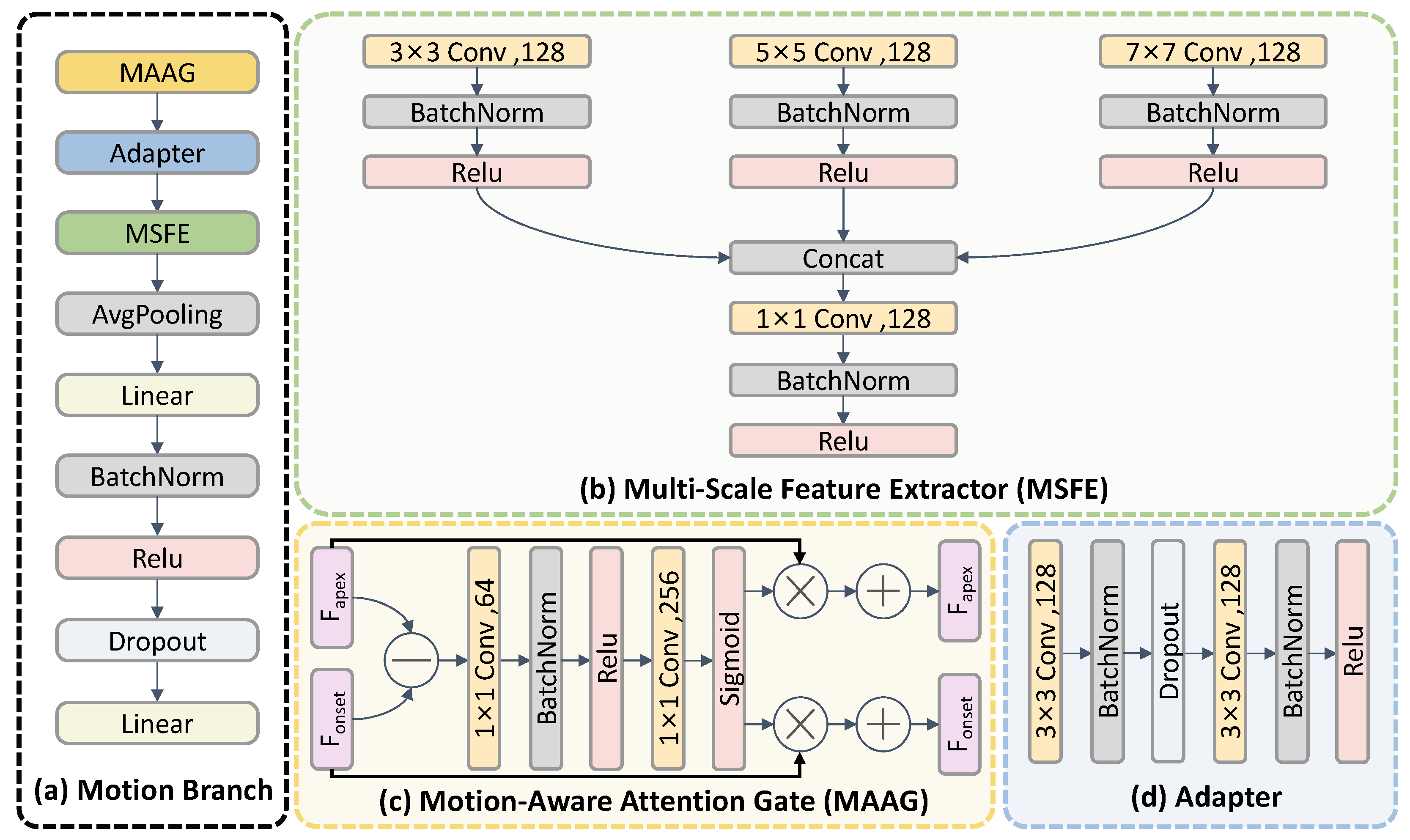
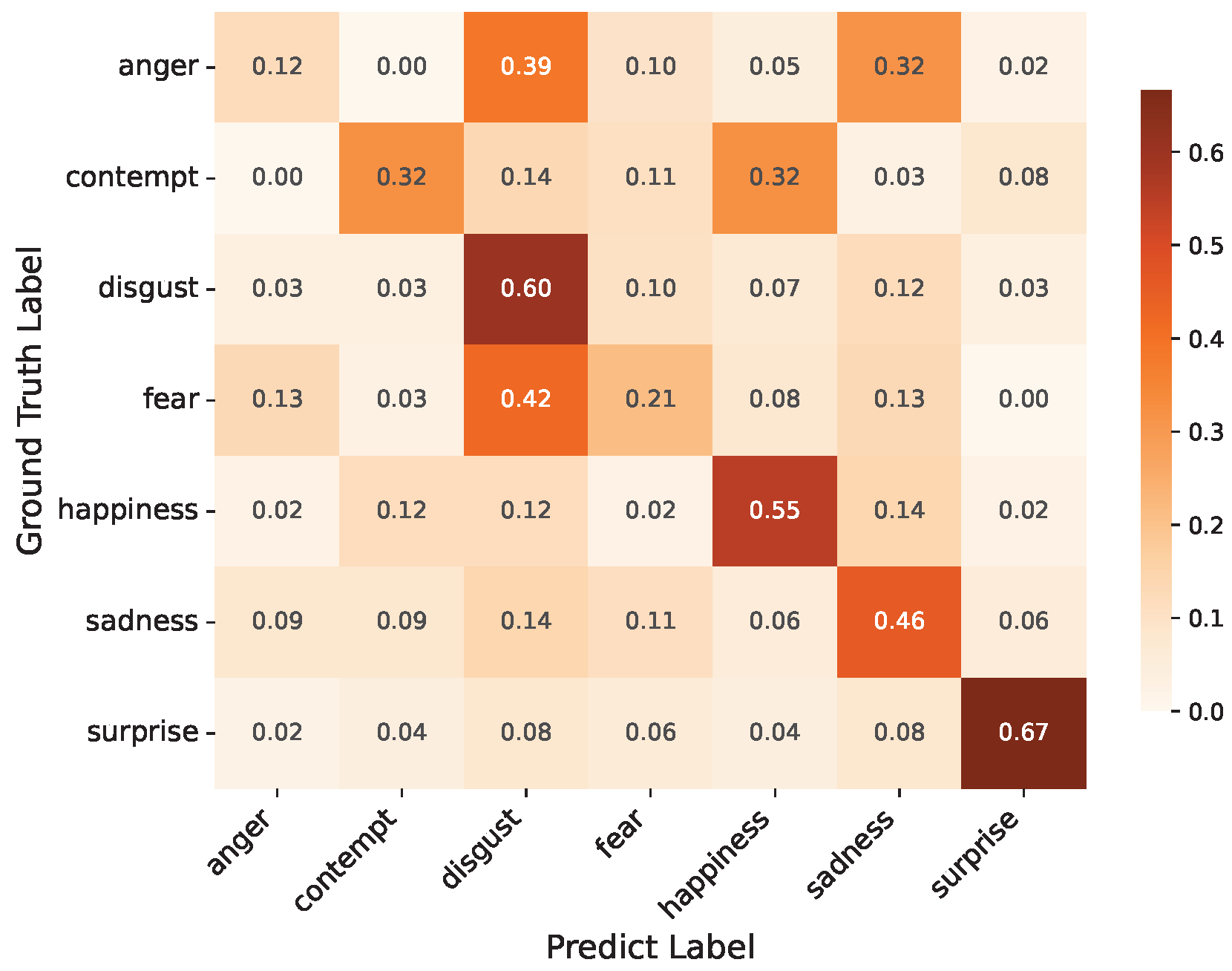
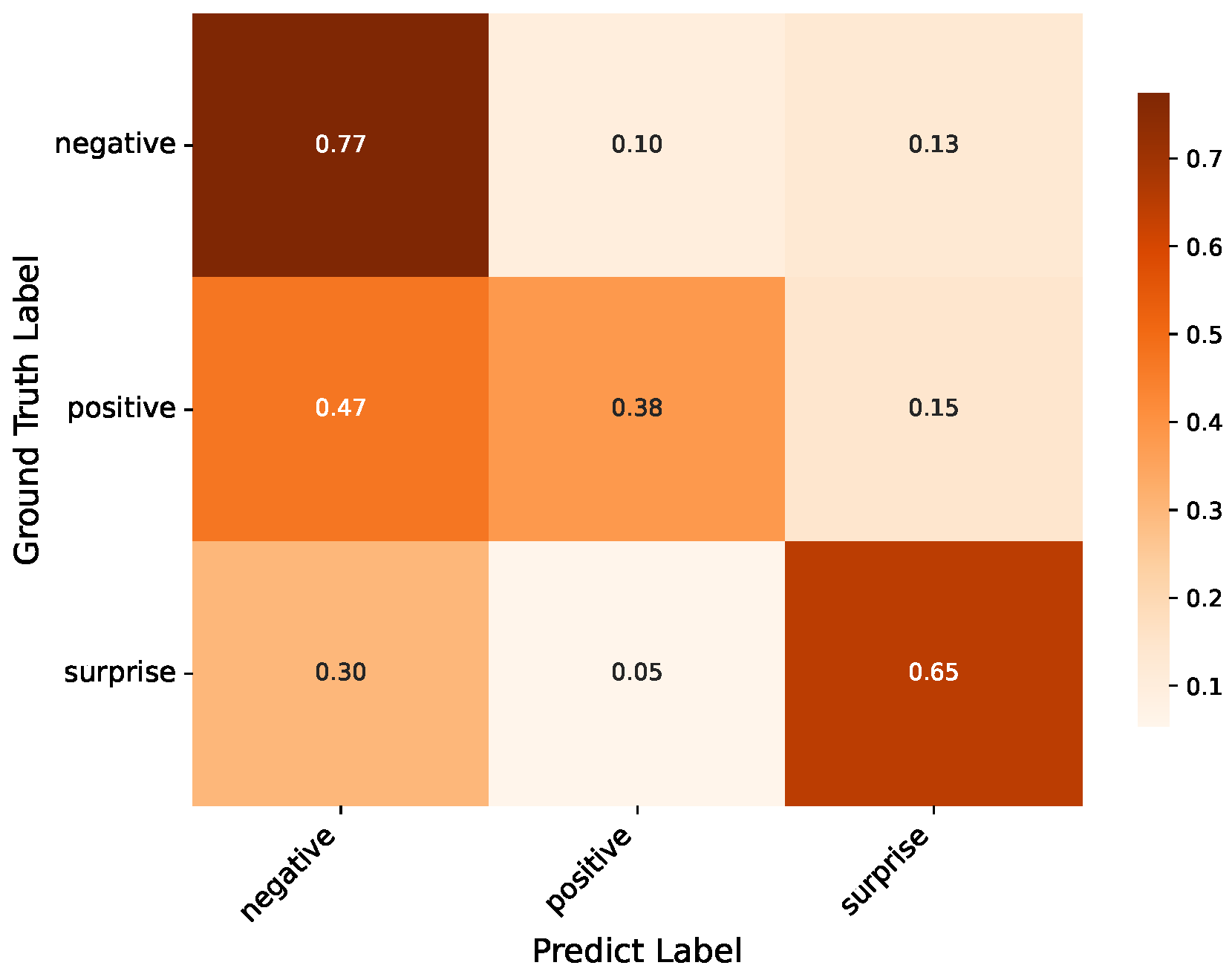
Learnable Feature Disentanglement with Temporal-Complemented Motion Enhancement for Micro-Expression Recognition


Abstract
1. Introduction
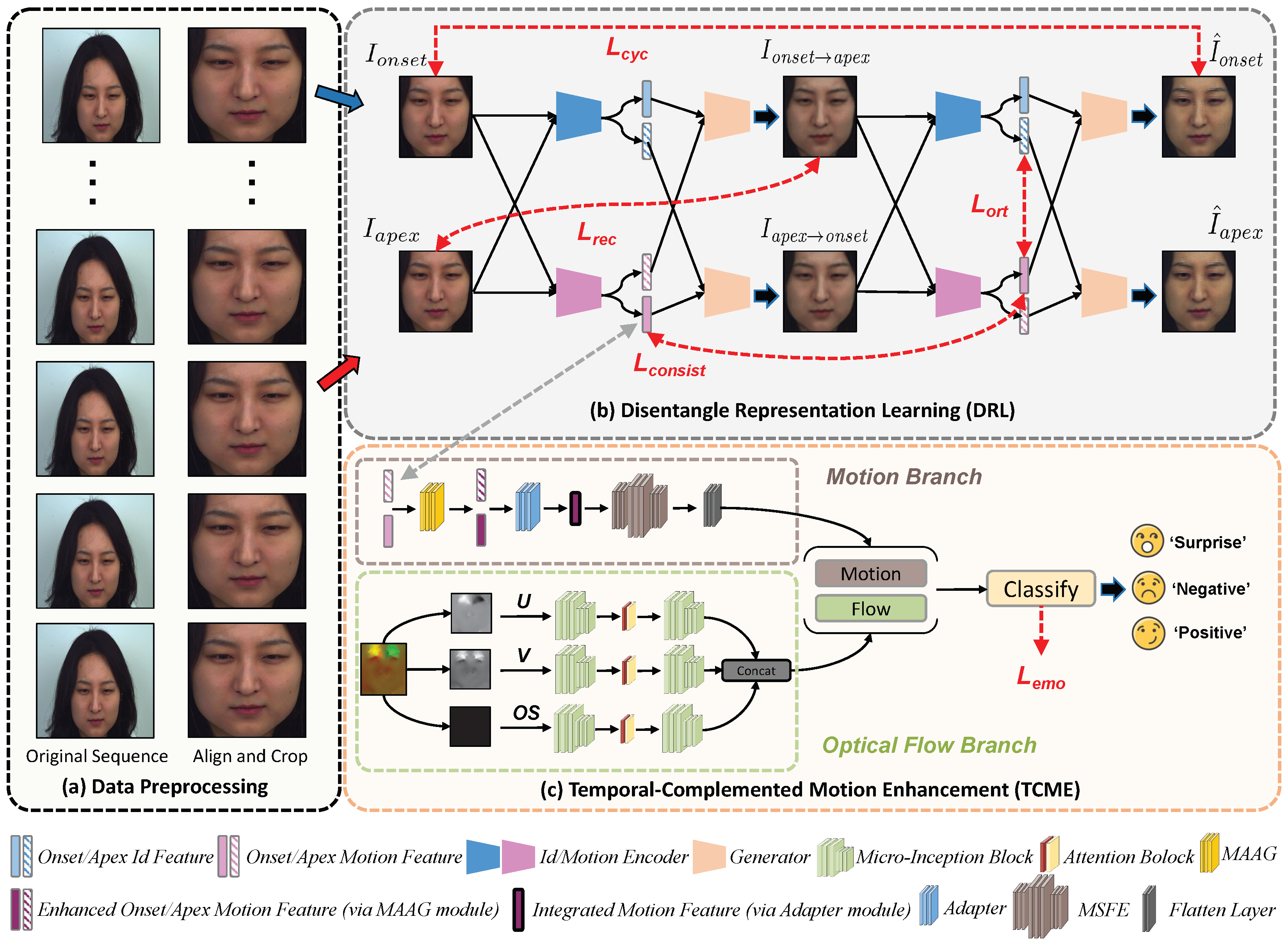
- Based on the Bruce–Young model of facial cognition, we propose a learnable feature disentanglement paradigm for MER, realized through a plug-and-play Disentangled Representation Learning (DRL) module that can be integrated into arbitrary MER networks. It dynamically isolates identity-invariant motion features from appearance information, effectively mitigating feature entanglement.
- We design a Temporal-Complemented Motion Enhancement (TCME) module that enriches purified spatial motion features with optical-flow-based temporal cues, enabling a comprehensive and fine-grained modeling of micro-expression spatiotemporal patterns.
- To ensure effective and unified optimization of the entire network, we introduce a Synergistic Disentanglement Objectives (SDO) scheme that jointly optimizes soft orthogonality, reconstruction, cycle, consistency, identity-aware contrastive, and emotion classification losses. Combined with our multi-stage training strategy, we effectively separate emotion-related motion features and individual-specific identity characteristics while avoiding the loss of subtle motion cues of MEs.
- Extensive experiments on CAS(ME)3 and DFME benchmarks demonstrate state-of-the-art cross-subject performance, validating the effectiveness and generalization of our learnable disentanglement and temporal enhancement framework.
2. Related Works
2.1. Micro-Expression Recognition
2.2. Feature Disentanglement
3. Proposed Method
3.1. Disentangle Representation Learning Module
3.1.1. Identity and Motion Encoder
3.1.2. Face Reconstruction Generator
3.2. Synergistic Disentanglement Objectives
3.2.1. Soft Orthogonality Constraint
3.2.2. Reconstruction Constraint
3.2.3. Cycle Reconstruction Constraint
3.2.4. Consistency Constraint
3.2.5. Identity-Aware Contrastive Constraint
3.2.6. Emotion Classification Constraint
3.3. Temporal-Complemented Motion Enhancement Module
3.3.1. Motion Branch
3.3.2. Optical Flow Branch
4. Experiments
4.1. Databases
4.2. Evaluation Protocols and Metrics
4.3. Configuration
4.4. Training Details
4.5. Comparison to State-of-the-Art Methods
4.6. Ablation Experiments
4.6.1. DRL Module Ablation Study Analysis
4.6.2. Optical Flow Branch Structure Analysis
4.6.3. TCME Module Ablation Study Analysis
4.6.4. Multi-Loss Function Ablation Experiment
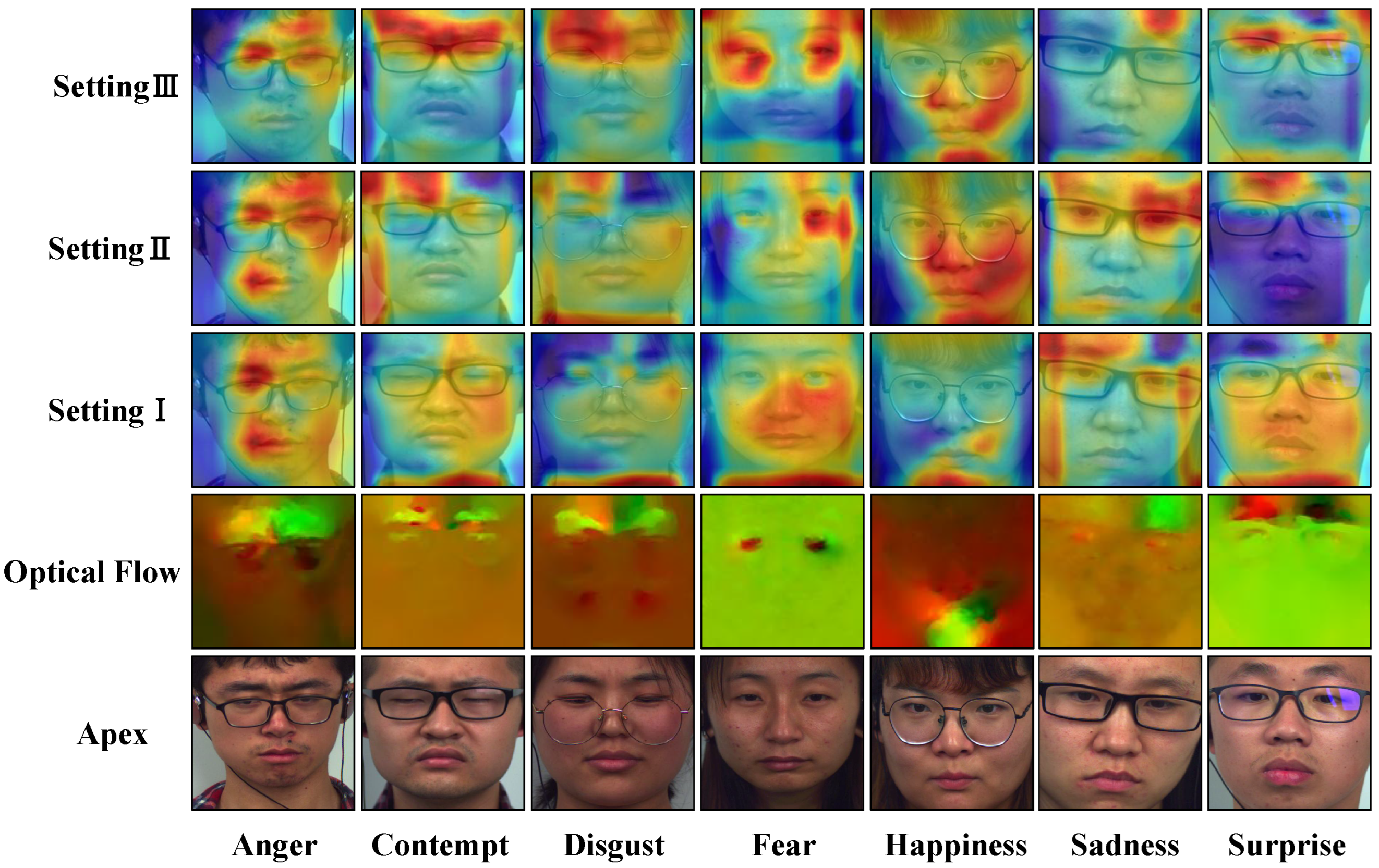
4.7. Interpretability Analysis
4.8. Model Complexity Analysis
5. Discussion
6. Conclusions
Author Contributions
Funding
Institutional Review Board Statement
Informed Consent Statement
Data Availability Statement
Conflicts of Interest
References
- Ekman, P.; Friesen, W.V. Nonverbal leakage and clues to deception. Psychiatry 1969, 32, 88–106. [Google Scholar] [CrossRef]
- Li, Y.T.; Wei, J.S.; Liu, Y.; Kauttonen, J.; Zhao, G.Y. Deep learning for micro-expression recognition: A survey. IEEE Trans. Affect. Comput. 2022, 13, 2028–2046. [Google Scholar] [CrossRef]
- Ojala, T.; Pietikainen, M.; Maenpaa, T. Multiresolution gray-scale and rotation invariant texture classification with local binary patterns. IEEE Trans. Pattern Anal. Mach. Intell. 2002, 24, 971–987. [Google Scholar] [CrossRef]
- Wang, S.-J.; Yan, W.-J.; Li, X.B.; Zhao, G.Y.; Zhou, C.-G.; Fu, X.L.; Yang, M.H.; Tao, J.H. Micro-Expression Recognition Using Color Spaces. IEEE Trans. Image Process. 2015, 24, 6034–6047. [Google Scholar] [CrossRef]
- Wang, Y.D.; See, J.; Phan, R.C.-W.; Oh, Y.-H. Lbp with six intersection points: Reducing redundant information in lbp-top for micro-expression recognition. In Proceedings of the Asian Conference on Computer Vision, Singapore, 1–5 November 2014; Springer: Berlin/Heidelberg, Germany, 2014; pp. 525–537. [Google Scholar]
- Ben, X.Y.; Jia, X.T.; Yan, R.; Zhang, X.; Meng, W.X. Learning effective binary descriptors for micro-expression recognition transferred by macro-information. Pattern Recognit. Lett. 2018, 107, 50–58. [Google Scholar] [CrossRef]
- Liu, Y.-J.; Zhang, J.-K.; Yan, W.-J.; Wang, S.-J.; Zhao, G.Y.; Fu, X.L. A Main Directional Mean Optical Flow Feature for Spontaneous Micro-Expression Recognition. IEEE Trans. Affect. Comput. 2016, 7, 299–310. [Google Scholar] [CrossRef]
- Liong, S.-T.; See, J.; Phan, R.C.-W.; Le Ngo, A.C.; Oh, Y.-H.; Wong, K.S. Subtle expression recognition using optical strain weighted features. In Proceedings of the Asian Conference on Computer Vision, Singapore, 1–5 November 2014; Springer: Berlin/Heidelberg, Germany, 2014; pp. 644–657. [Google Scholar]
- Liong, S.-T.; Gan, Y.S.; See, J.; Khor, H.-Q.; Huang, Y.-C. Shallow Triple Stream Three-dimensional CNN (STSTNet) for Micro-expression Recognition. In Proceedings of the 2019 14th IEEE International Conference on Automatic Face & Gesture Recognition (FG 2019), Lille, France, 14–18 May 2019; pp. 1–5. [Google Scholar]
- Zhou, L.; Mao, Q.R.; Xue, L.Y. Dual-Inception Network for Cross-Database Micro-Expression Recognition. In Proceedings of the 2019 14th IEEE International Conference on Automatic Face & Gesture Recognition (FG 2019), Lille, France, 14–18 May 2019; IEEE: Piscataway, NJ, USA, 2019; pp. 1–5. [Google Scholar]
- Lei, L.; Chen, T.; Li, S.G.; Li, J.F. Micro-expression Recognition Based on Facial Graph Representation Learning and Facial Action Unit Fusion. In Proceedings of the 2021 IEEE/CVF Conference on Computer Vision and Pattern Recognition Workshops (CVPRW), Nashville, TN, USA, 19–25 June 2021; IEEE: Piscataway, NJ, USA, 2021; pp. 1571–1580. [Google Scholar]
- Chen, B.Y.; Zhang, Z.H.; Liu, N.; Tan, Y.; Liu, X.Y.; Chen, T. Spatiotemporal convolutional neural network with convolutional block attention module for micro-expression recognition. Information 2020, 11, 380. [Google Scholar] [CrossRef]
- Gajjala, V.R.; Reddy, S.P.T.; Mukherjee, S.; Dubey, S.R. MERANet: Facial micro-expression recognition using 3D residual attention network. In Proceedings of the Twelfth Indian Conference on Computer Vision, Graphics and Image Processing, Jodhpur, India, 19–22 December 2021; pp. 1–10. [Google Scholar]
- Liu, G.Q.; Huang, S.C.; Wang, G.; Li, M.X. EMRNet: Enhanced micro-expression recognition network with attention and distance correlation. Artif. Intell. Rev. 2025, 58, 176. [Google Scholar] [CrossRef]
- Wang, Z.F.; Zhang, K.H.; Luo, W.H.; Sankaranarayana, R. Htnet for micro-expression recognition. Neurocomputing 2024, 602, 128196. [Google Scholar] [CrossRef]
- Zhai, Z.J.; Zhao, J.H.; Long, C.J.; Xu, W.J.; He, S.J.; Zhao, H.J. Feature representation learning with adaptive displacement generation and transformer fusion for micro-expression recognition. In Proceedings of the IEEE/CVF Conference on Computer Vision and Pattern Recognition, Vancouver, BC, Canada, 17–24 June 2023; pp. 22086–22095. [Google Scholar]
- Sun, B.; Cao, S.M.; He, J.; Yu, L.J. Two-stream attention-aware network for spontaneous micro-expression movement spotting. In Proceedings of the 2019 IEEE 10th International Conference on Software Engineering and Service Science (ICSESS), Beijing, China, 18–20 October 2019; pp. 702–705. [Google Scholar]
- Liu, N.; Liu, X.Y.; Zhang, Z.H.; Xu, X.M.; Chen, T. Offset or onset frame: A multi-stream convolutional neural network with CapsuleNet module for micro-expression recognition. In Proceedings of the 2020 5th International Conference on Intelligent Informatics and Biomedical Sciences (ICIIBMS), Okinawa, Japan, 18–20 November 2020; pp. 236–240. [Google Scholar]
- Kumar, A.J.R.; Bhanu, B. Micro-expression classification based on landmark relations with graph attention convolutional network. In Proceedings of the IEEE/CVF Conference on Computer Vision and Pattern Recognition, Nashville, TN, USA, 19–25 June 2021; pp. 1511–1520. [Google Scholar]
- Huang, X.H.; Wang, S.-J.; Liu, X.; Zhao, G.Y.; Feng, X.Y.; Pietikäinen, M. Discriminative spatiotemporal local binary pattern with revisited integral projection for spontaneous facial micro-expression recognition. IEEE Trans. Affect. Comput. 2017, 10, 32–47. [Google Scholar] [CrossRef]
- Li, J.T.; Wang, S.-J.; Wang, Y.; Zhou, H.L.; Fu, X.L. Parallel Spatiotemporal Network to recognize micro-expression. Neurocomputing 2025, 636, 129891. [Google Scholar] [CrossRef]
- Bruce, V.; Young, A. Understanding face recognition. Br. J. Psychol. 1986, 77, 305–327. [Google Scholar] [CrossRef]
- Li, Y.; Liu, M.L.; Cui, Z.; Ding, Y.; Zong, Y.; Zheng, W.M.; Shan, S.G.; Guan, C.T. Decoupled Doubly Contrastive Learning for Cross Domain Facial Action Unit Detection. IEEE Trans. Image Process. 2025, 34, 2067–2080. [Google Scholar] [CrossRef]
- Higgins, I.; Amos, D.; Pfau, D.; Racaniere, S.; Matthey, L.; Rezende, D.; Lerchner, A. Towards a definition of disentangled representations. arXiv 2018, arXiv:1812.02230. [Google Scholar] [CrossRef]
- Huang, X.H.; Wang, S.-J.; Zhao, G.Y.; Piteikainen, M. Facial Micro-Expression Recognition Using Spatiotemporal Local Binary Pattern with Integral Projection. In Proceedings of the 2015 IEEE International Conference on Computer Vision Workshop (ICCVW), Santiago, Chile, 7–13 December 2015; IEEE: Piscataway, NJ, USA, 2015; pp. 1–9. [Google Scholar]
- Li, J.T.; Yap, M.H.; Cheng, W.-H.; See, J.; Hong, X.P.; Li, X.B.; Wang, S.-J. FME’21: 1st Workshop on Facial Micro-Expression: Advanced Techniques for Facial Expressions Generation and Spotting. In Proceedings of the 29th ACM International Conference on Multimedia (MM ’21), Virtual Event, China, 20–24 October 2021; pp. 5700–5701. [Google Scholar]
- Ekman, P.; Friesen, W.V. Facial Action Coding System. 1978. Available online: https://psycnet.apa.org/doiLanding?doi=10.1037%2Ft27734-000 (accessed on 25 January 2026). [CrossRef]
- Chen, B.; Liu, K.-H.; Xu, Y.; Wu, Q.-Q.; Yao, J.-F. Block Division Convolutional Network with Implicit Deep Features Augmentation for Micro-Expression Recognition. IEEE Trans. Multimed. 2022, 25, 1345–1358. [Google Scholar] [CrossRef]
- Li, Y.T.; Huang, X.H.; Zhao, G.Y. Micro-expression action unit detection with spatial and channel attention. Neurocomputing 2021, 436, 221–231. [Google Scholar] [CrossRef]
- Cai, W.H.; Zhao, J.L.; Yi, R.; Yu, M.J.; Duan, F.Q.; Pan, Z.K.; Liu, Y.-J. Mfdan: Multi-level flow-driven attention network for micro-expression recognition. IEEE Trans. Circuits Syst. Video Technol. 2024, 34, 12823–12836. [Google Scholar] [CrossRef]
- Wang, S.-J.; Yan, W.-J.; Zhao, G.Y.; Fu, X.L.; Zhou, C.-G. Micro-expression recognition using robust principal component analysis and local spatiotemporal directional features. In Proceedings of the European Conference on Computer Vision, Zurich, Switzerland, 6–12 September 2014; Springer: Berlin/Heidelberg, Germany, 2014; pp. 325–338. [Google Scholar]
- Liong, S.-T.; See, J.; Wong, K.S.; Phan, R.C.-W. Less is More: Micro-expression Recognition from Video using Apex Frame. Signal Process. Image Commun. 2018, 62, 82–92. [Google Scholar] [CrossRef]
- Li, J.T.; Zhou, H.L.; Qian, Y.; Dong, Z.Z.; Wang, S.-J. Micro-expression recognition using dual-view self-supervised contrastive learning with intensity perception. Neurocomputing 2025, 619, 129142. [Google Scholar] [CrossRef]
- See, J.; Yap, M.H.; Li, J.T.; Hong, X.P.; Wang, S.-J. MEGC 2019—The second facial micro-expressions grand challenge. In Proceedings of the 2019 14th IEEE International Conference on Automatic Face & Gesture Recognition (FG 2019), Lille, France, 14–18 May 2019; pp. 1–5. [Google Scholar]
- Aberman, K.; Wu, R.D.; Lischinski, D.; Chen, B.Q.; Cohen-Or, D. Learning character-agnostic motion for motion retargeting in 2D. arXiv 2019, arXiv:1905.01680. [Google Scholar] [CrossRef]
- Reed, S.E.; Zhang, Y.; Zhang, Y.T.; Lee, H. Deep visual analogy-making. Adv. Neural Inf. Process. Syst. 2015, 28. [Google Scholar]
- Chen, X.; Duan, Y.; Houthooft, R.; Schulman, J.; Sutskever, I.; Abbeel, P. InfoGAN: Interpretable representation learning by information maximizing generative adversarial nets. Adv. Neural Inf. Process. Syst. 2016, 29. [Google Scholar]
- Higgins, I.; Matthey, L.; Pal, A.; Burgess, C.; Glorot, X.; Botvinick, M.; Mohamed, S.; Lerchner, A. beta-VAE: Learning basic visual concepts with a constrained variational framework. In Proceedings of the 5th International Conference on Learning Representations, Toulon, France, 24–26 April 2017; pp. 57–67. [Google Scholar]
- He, Y.H.; Xu, Z.L.; Ma, L.; Li, H.F. Micro-expression spotting based on optical flow features. Pattern Recognit. Lett. 2022, 163, 57–64. [Google Scholar] [CrossRef]
- Zach, C.; Pock, T.; Bischof, H. A duality based approach for realtime tv-l 1 optical flow. In Proceedings of the Joint Pattern Recognition Symposium, Heidelberg, Germany, 12–14 September 2007; Springer: Berlin/Heidelberg, Germany, 2007; pp. 214–223. [Google Scholar]
- Li, J.T.; Qian, Y.; Zhao, L.; Wang, S.-J. FED-PsyAU: Privacy-Preserving Micro-Expression Recognition via Psychological AU Coordination and Dynamic Facial Motion Modeling. arXiv 2025, arXiv:2507.20557. [Google Scholar]
- Li, J.T.; Dong, Z.Z.; Lu, S.Y.; Wang, S.-J.; Yan, W.-J.; Ma, Y.H.; Liu, Y.; Huang, C.B.; Fu, X.L. CAS(ME)3: A Third Generation Facial Spontaneous Micro-Expression Database with Depth Information and High Ecological Validity. IEEE Trans. Pattern Anal. Mach. Intell. 2022, 45, 2782–2800. [Google Scholar] [CrossRef]
- Zhao, S.R.; Tang, H.Y.; Mao, X.L.; Liu, S.F.; Zhang, Y.M.; Wang, H.; Xu, T.; Chen, E.H. DFME: A New Benchmark for Dynamic Facial Micro-Expression Recognition. IEEE Trans. Affect. Comput. 2024, 15, 1371–1386. [Google Scholar] [CrossRef]
- Zhao, S.R.; Tang, H.Y.; Mao, X.L.; Liu, S.F. Dynamic Micro-Expression Automatic Recognition Challenge on the Fourth Chinese Conference on Affective Computing. Available online: https://mea-lab-421.github.io/CCAC-page/ (accessed on 10 July 2024).
- Krizhevsky, A.; Sutskever, I.; Hinton, G.E. ImageNet classification with deep convolutional neural networks. Adv. Neural Inf. Process. Syst. 2012, 25. [Google Scholar] [CrossRef]
- Xia, Z.Q.; Peng, W.; Khor, H.-Q.; Feng, X.Y.; Zhao, G.Y. Revealing the invisible with model and data shrinking for composite-database micro-expression recognition. IEEE Trans. Image Process. 2020, 29, 8590–8605. [Google Scholar] [CrossRef]
- Zhao, S.R.; Tao, H.Q.; Zhang, Y.S.; Xu, T.; Zhang, K.; Hao, Z.K.; Chen, E.H. A two-stage 3D CNN based learning method for spontaneous micro-expression recognition. Neurocomputing 2021, 448, 276–289. [Google Scholar] [CrossRef]
- Zhou, L.; Mao, Q.R.; Huang, X.H.; Zhang, F.F.; Zhang, Z.H. Feature Refinement: An expression-specific feature learning and fusion method for micro-expression recognition. Pattern Recognit. 2022, 122, 108275. [Google Scholar] [CrossRef]
- Li, H.T.; Sui, M.Z.; Zhu, Z.Q.; Zhao, F. MMNet: Muscle motion-guided network for micro-expression recognition. arXiv 2022, arXiv:2201.05297. [Google Scholar]
- Nguyen, X.-B.; Duong, C.N.; Li, X.; Gauch, S.; Seo, H.-S.; Luu, K. Micron-BERT: BERT-Based Facial Micro-Expression Recognition. In Proceedings of the IEEE/CVF Conference on Computer Vision and Pattern Recognition (CVPR), Vancouver, BC, Canada, 18–22 June 2023; pp. 1482–1492. [Google Scholar]
- Fu, L.Y.; Wu, X.C.; Huang, D.L.; Yin, X.Y. FAMNet: Integrating 2D and 3D Features for Micro-expression Recognition via Multi-task Learning and Hierarchical Attention. arXiv 2025, arXiv:2508.13483. [Google Scholar]
- Hatamizadeh, A.; Kautz, J. Mambavision: A hybrid mamba-transformer vision backbone. In Proceedings of the Computer Vision and Pattern Recognition Conference, Nashville, TN, USA, 11–15 June 2025; pp. 25261–25270. [Google Scholar]
- Zhang, Z.Y.; Zhao, S.R.; Liu, S.F.; Yin, S.K.; Mao, X.L.; Xu, T.; Chen, E.H. MELLM: Exploring LLM-Powered Micro-Expression Understanding Enhanced by Subtle Motion Perception. arXiv 2025, arXiv:2505.07007. [Google Scholar]
- Selvaraju, R.R.; Cogswell, M.; Das, A.; Vedantam, R.; Parikh, D.; Batra, D. Grad-CAM: Visual explanations from deep networks via gradient-based localization. In Proceedings of the IEEE International Conference on Computer Vision, Venice, Italy, 22–29 October 2017; pp. 618–626. [Google Scholar]





| Dataset | Task | Total | Distribution of Labels |
|---|---|---|---|
| CAS(ME)3 | 3-class (part A) | 699 | Negative (457) Positive (55) Surprise (187) |
| DFME | 7-class (train) | 1856 | Anger (161) Contempt (100) Disgust (548) Fear (265) Happiness (206) Sadness (278) Surprise (298) |
| 7-class (test A) | 474 | Anger (39) Contempt (34) Disgust (129) Fear (62) Happiness (63) Sadness (46) Surprise (101) | |
| 7-class (test B) | 299 | Anger (41) Contempt (37) Disgust (58) Fear (38) Happiness (42) Sadness (35) Surprise (48) |
| Methods | Year | UF1 ↑ | UAR ↑ |
|---|---|---|---|
| AlexNet [45] | 2012 | 0.2570 | 0.2634 |
| STSTNet [9] | 2019 | 0.3795 | 0.3792 |
| RCN-A [46] | 2020 | 0.3928 | 0.3893 |
| MERSiam [47] | 2021 | 0.3184 | 0.3532 |
| FGRL [11] | 2021 | 0.3333 | 0.2636 |
| FR [48] | 2022 | 0.3493 | 0.3413 |
| MMNet [49] | 2022 | 0.3706 | 0.3646 |
| BDCNN [28] | 2022 | 0.5050 | 0.5164 |
| Micro-BERT [50] | 2023 | 0.5604 | 0.6125 |
| HTNet [15] | 2024 | 0.5767 | 0.5415 |
| FAMNet [51] | 2025 | 0.4342 | 0.5100 |
| Ours | - | 0.5868 | 0.6012 |
| Methods | Year | Test Set | UF1 ↑ | UAR ↑ |
|---|---|---|---|---|
| FR [48] | 2022 | 0.3410 | 0.3686 | |
| Wang et al. [44] | 2024 | 0.4067 | 0.4074 | |
| He et al. [44] | 2024 | 0.4123 | 0.4210 | |
| HTNet [15] | 2024 | Test A | 0.3736 | 0.3821 |
| MambaVision-B [52] | 2024 | 0.4002 | 0.4064 | |
| MELLM [53] | 2024 | 0.3578 | 0.3732 | |
| Ours | - | 0.4260 | 0.4261 | |
| FR [48] | 2022 | 0.2875 | 0.3228 | |
| Wang et al. [44] | 2024 | 0.3534 | 0.3661 | |
| He et al. [44] | 2024 | 0.4016 | 0.4008 | |
| HTNet [15] | 2024 | Test B | 0.4076 | 0.4062 |
| MambaVision-B [52] | 2024 | 0.3929 | 0.3858 | |
| MELLM [53] | 2024 | 0.3162 | 0.3424 | |
| Ours | - | 0.4113 | 0.4188 |
| Setting | Motion Encoder | ID Encoder | Generator | UF1 ↑ | UAR ↑ |
|---|---|---|---|---|---|
| I | ✓ | 0.5409 | 0.5563 | ||
| II | ✓ | ✓ | 0.5699 | 0.5817 | |
| III | ✓ | ✓ | ✓ | 0.5868 | 0.6012 |
| Setting | UF1 ↑ | UAR ↑ |
|---|---|---|
| Single Stream | 0.5654 | 0.5817 |
| Triple Stream | 0.5868 | 0.6012 |
| Setting | Motion Branch | Optical Flow Branch | UF1 ↑ | UAR ↑ |
|---|---|---|---|---|
| I | 0.5034 | 0.5076 | ||
| II | ✓ | 0.5439 | 0.5634 | |
| III | ✓ | ✓ | 0.5868 | 0.6012 |
| Setting | UF1 ↑ | UAR ↑ | |||||
|---|---|---|---|---|---|---|---|
| I | ✓ | 0.5574 | 0.5725 | ||||
| II | ✓ | ✓ | 0.5710 | 0.5879 | |||
| III | ✓ | ✓ | ✓ | 0.5768 | 0.5929 | ||
| IV | ✓ | ✓ | ✓ | ✓ | 0.5780 | 0.5936 | |
| V | ✓ | ✓ | ✓ | ✓ | ✓ | 0.5868 | 0.6012 |
| Method | #Params (M) |
|---|---|
| STSTNet | 0.0017 |
| BDCNN | 6.56 |
| Feature Refinement (FR) | 10.90 |
| HTNet | 140.63 |
| LFD-TCMEN (w/o OF) | 5.49 |
| LFD-TCMEN (Single-OF) | 6.30 |
| LFD-TCMEN (Triple-OF, Ours) | 7.92 |
Disclaimer/Publisher’s Note: The statements, opinions and data contained in all publications are solely those of the individual author(s) and contributor(s) and not of MDPI and/or the editor(s). MDPI and/or the editor(s) disclaim responsibility for any injury to people or property resulting from any ideas, methods, instructions or products referred to in the content. |
© 2026 by the authors. Licensee MDPI, Basel, Switzerland. This article is an open access article distributed under the terms and conditions of the Creative Commons Attribution (CC BY) license.
Share and Cite
Qian, Y.; Huang, S.; Qu, K. Learnable Feature Disentanglement with Temporal-Complemented Motion Enhancement for Micro-Expression Recognition. Entropy 2026, 28, 180. https://doi.org/10.3390/e28020180
Qian Y, Huang S, Qu K. Learnable Feature Disentanglement with Temporal-Complemented Motion Enhancement for Micro-Expression Recognition. Entropy. 2026; 28(2):180. https://doi.org/10.3390/e28020180
Chicago/Turabian StyleQian, Yu, Shucheng Huang, and Kai Qu. 2026. "Learnable Feature Disentanglement with Temporal-Complemented Motion Enhancement for Micro-Expression Recognition" Entropy 28, no. 2: 180. https://doi.org/10.3390/e28020180
APA StyleQian, Y., Huang, S., & Qu, K. (2026). Learnable Feature Disentanglement with Temporal-Complemented Motion Enhancement for Micro-Expression Recognition. Entropy, 28(2), 180. https://doi.org/10.3390/e28020180