A Partitioned Finite Difference Method for Heat Transfer with Moving Line and Plane Heat Sources

Abstract
1. Introduction
2. Construction of the Finite Difference Scheme
- (i)
- If the line segment does not intersect the plane , we setIn this case, the second derivative of u with respect to t is bounded on , and the local truncation error of this discretization is .
- (ii)
- If the line segment intersects the plane at point , we construct the following auxiliary function:It is easy to see that has a continuous first derivative with respect to t, its second derivative is bounded on , and we haveApplying a finite difference discretization to , we obtainWe setwhich yields a local truncation error of .
- (i)
- If the line segment does not intersect the plane , we setIn this case, the third derivative of u with respect to x is bounded on , and the local truncation error is .
- (ii)
- If the line segment intersects the plane at point (when , an additional condition is required), we construct the following auxiliary function:It is easy to see that has a continuous second derivative with respect to x, its third derivative is bounded on , and we haveApplying a central difference scheme to discretize , we obtainWe setThis yields a local truncation error of .
- (iii)
- If the line segment intersects the plane at point (when , an additional condition is required), we construct the following auxiliary function:It is easy to see that has a continuous second derivative with respect to x, its third derivative is bounded on , and we haveApplying a central difference scheme to discretize , we obtainWe setThis yields a local truncation error of .
- (i)
- If the line segment does not intersect the plane , we setThe local truncation error is .
- (ii)
- If the line segment intersects the plane at point (when , an additional condition is required), we setThe local truncation error is .
- (iii)
- If the line segment intersects the plane at point (when , an additional condition is required), we setThe local truncation error is .
3. Numerical Tests
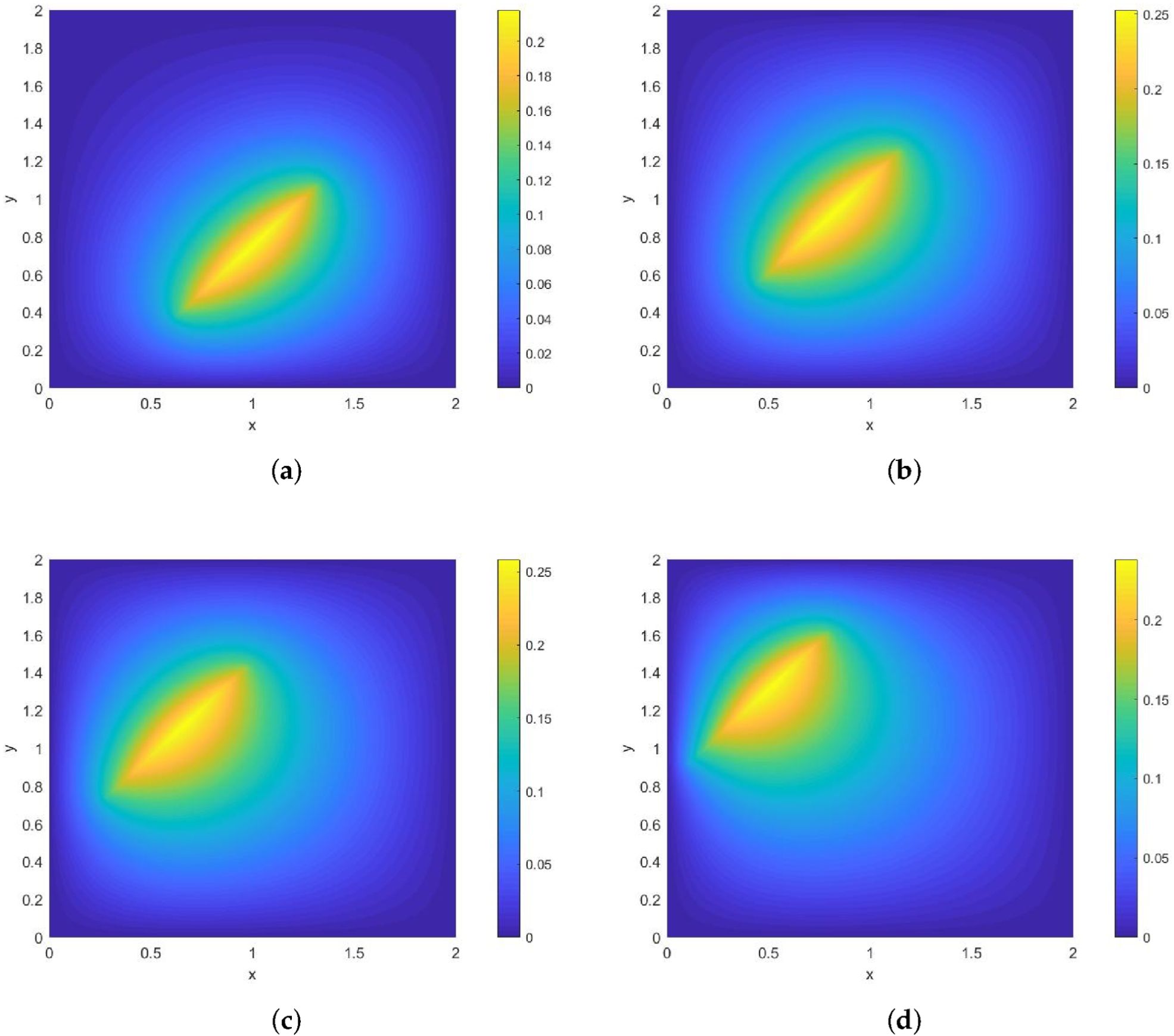
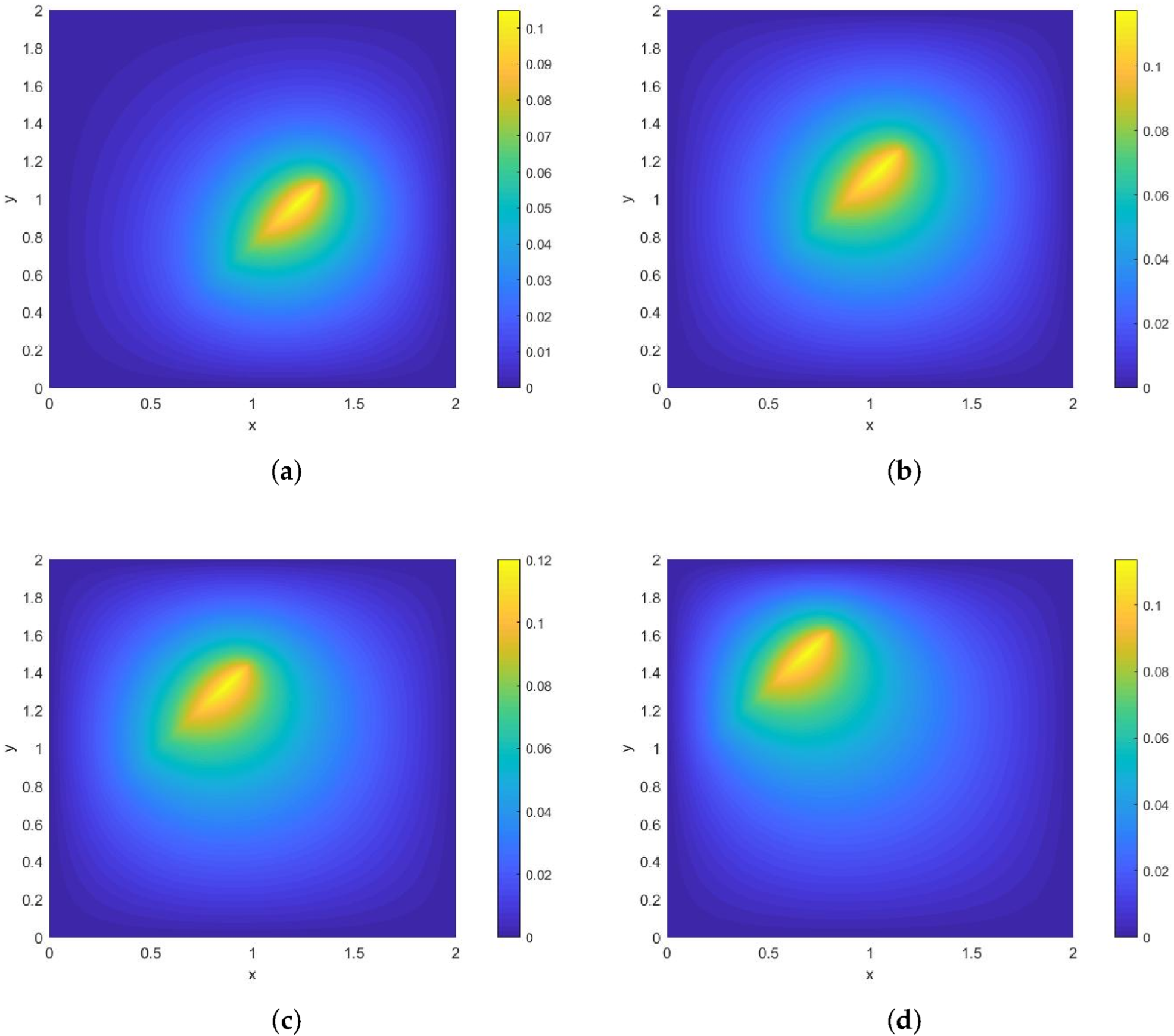
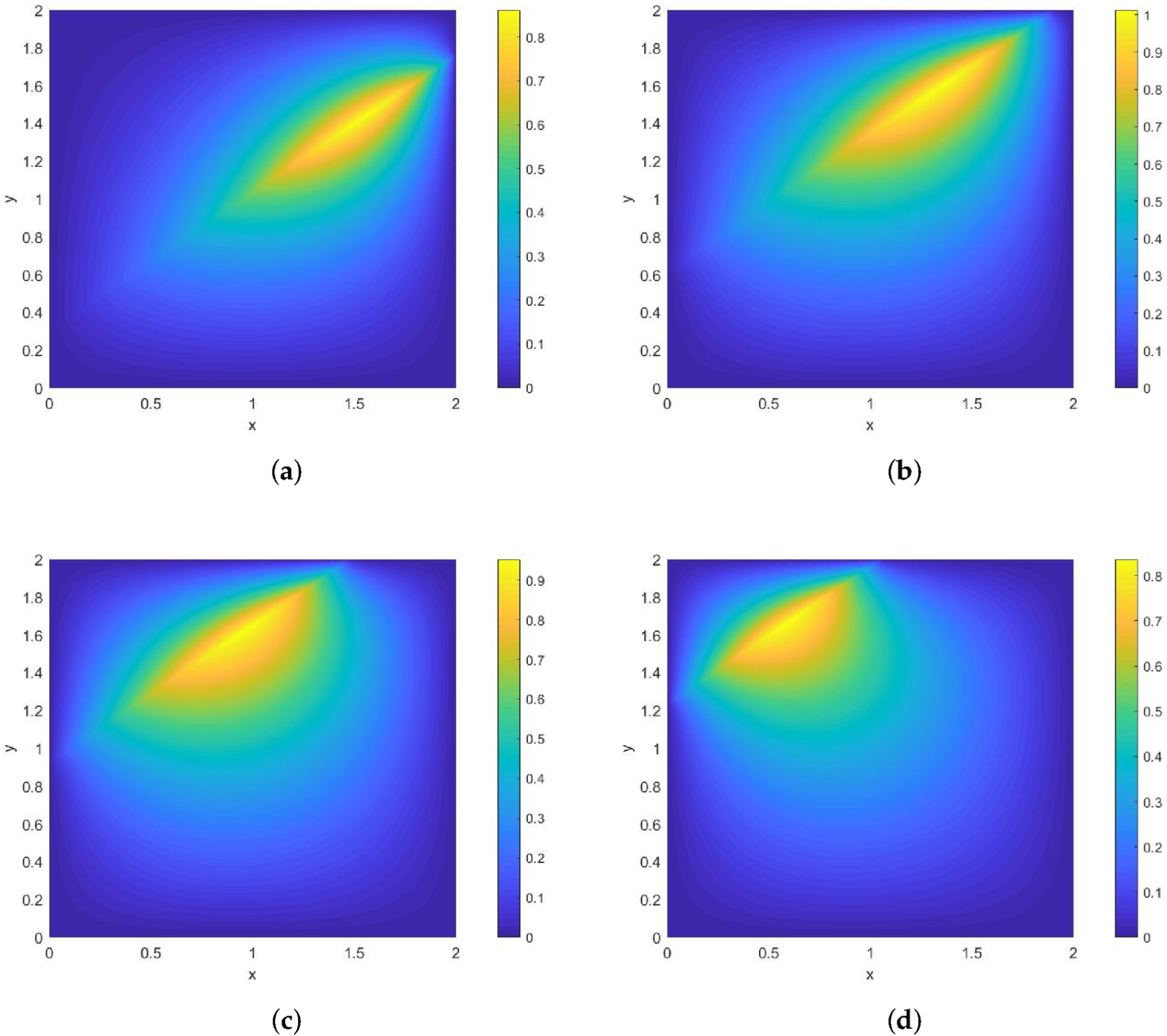
3.1. Two-Dimensional Problems
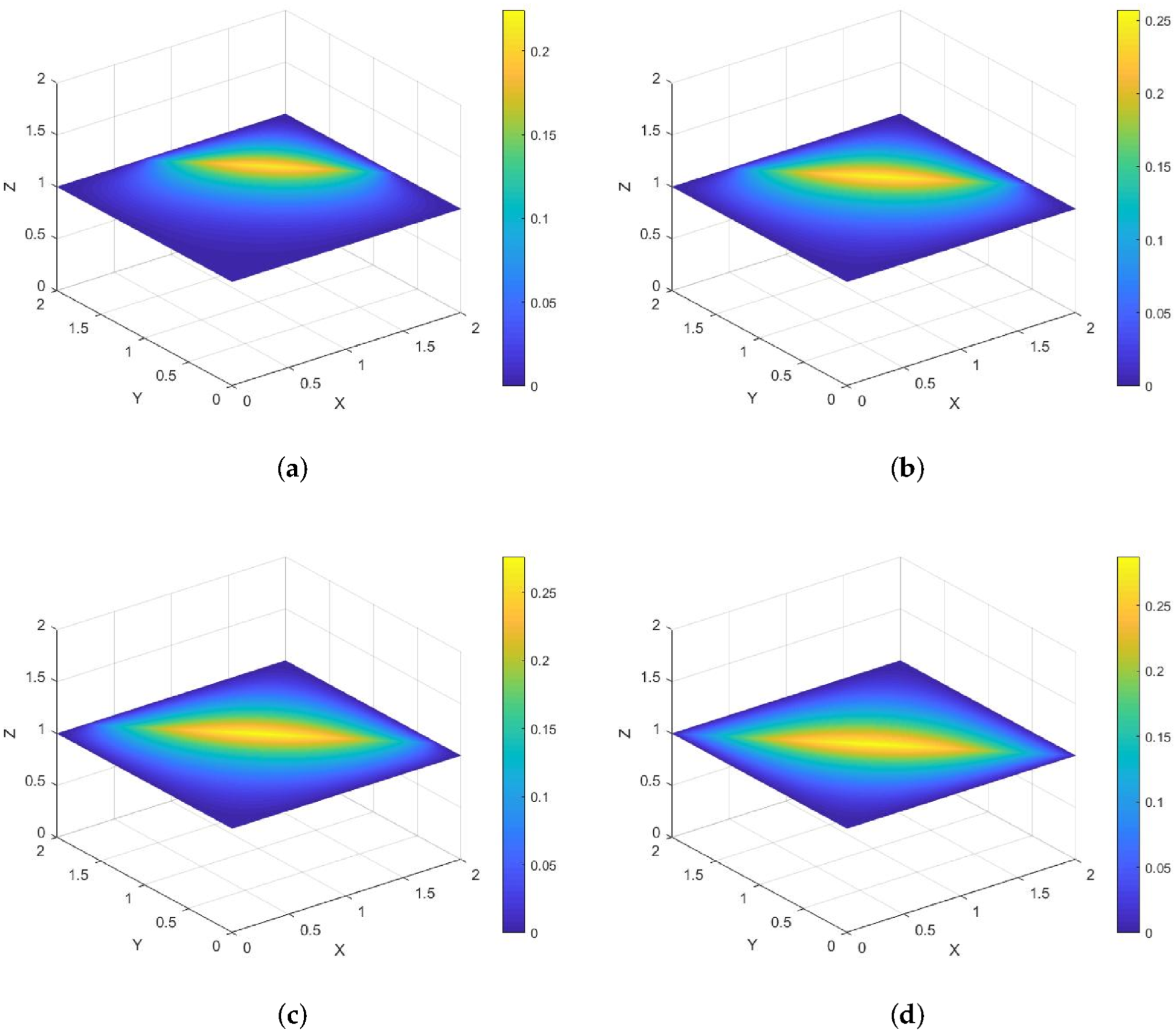
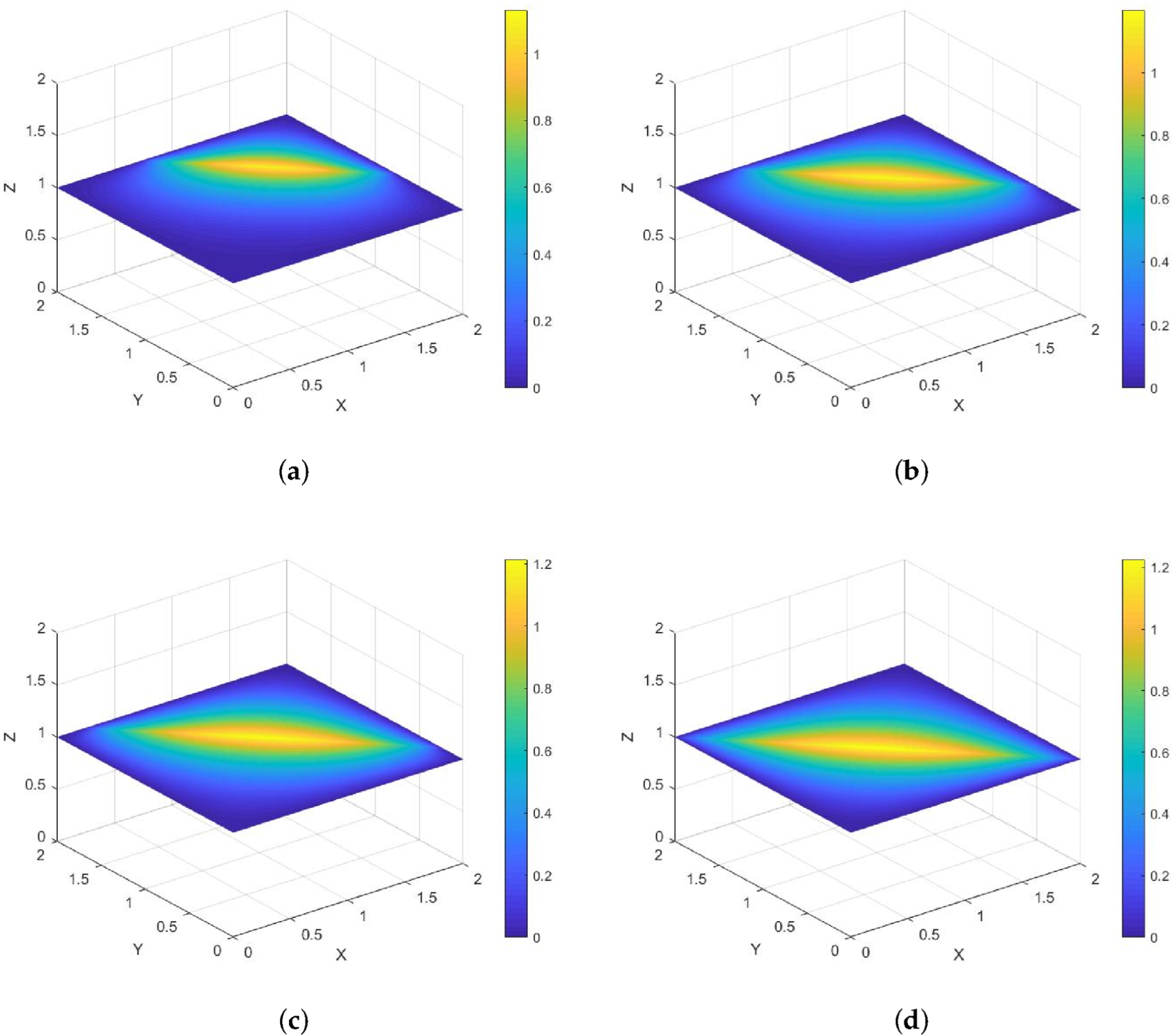
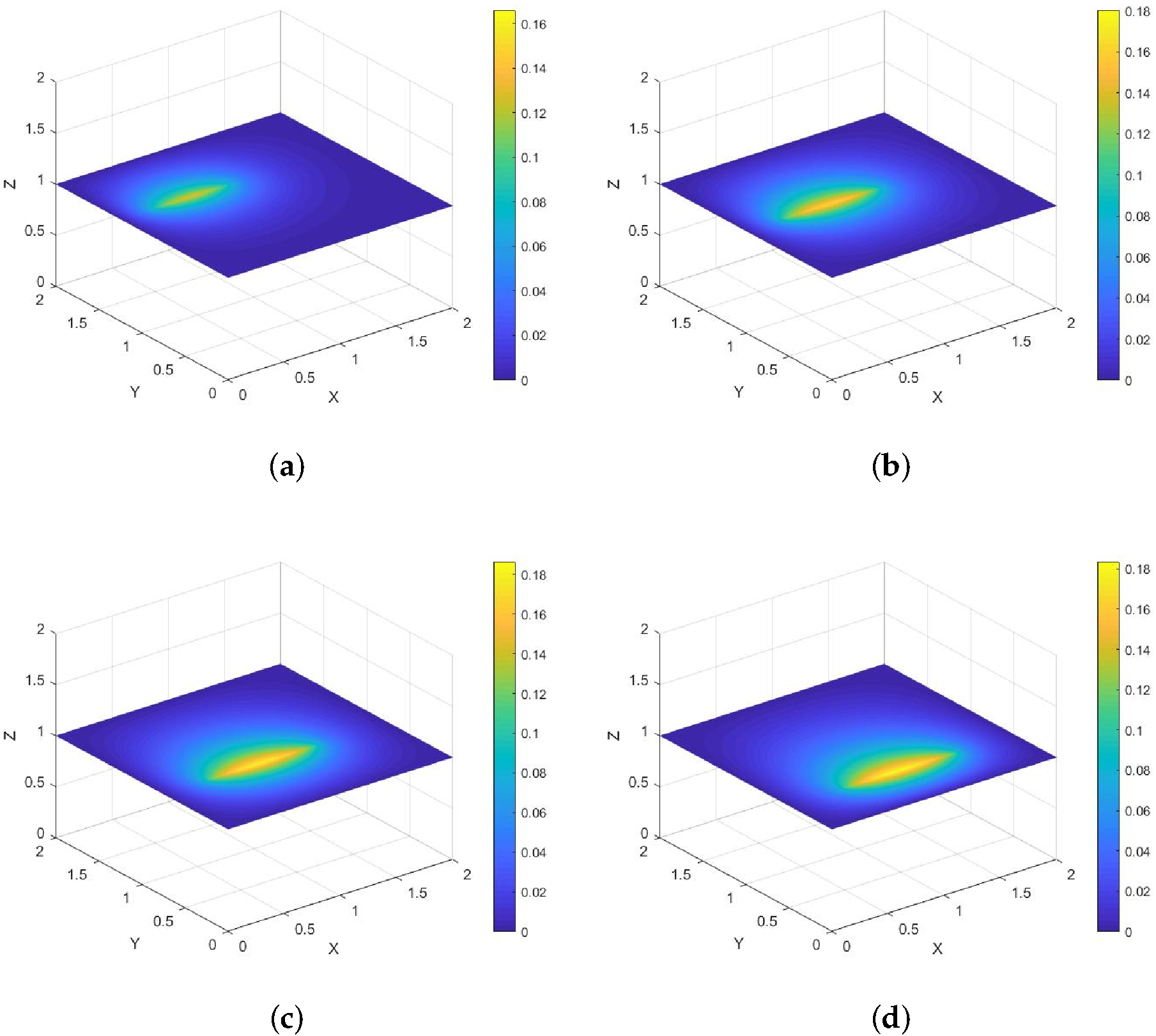
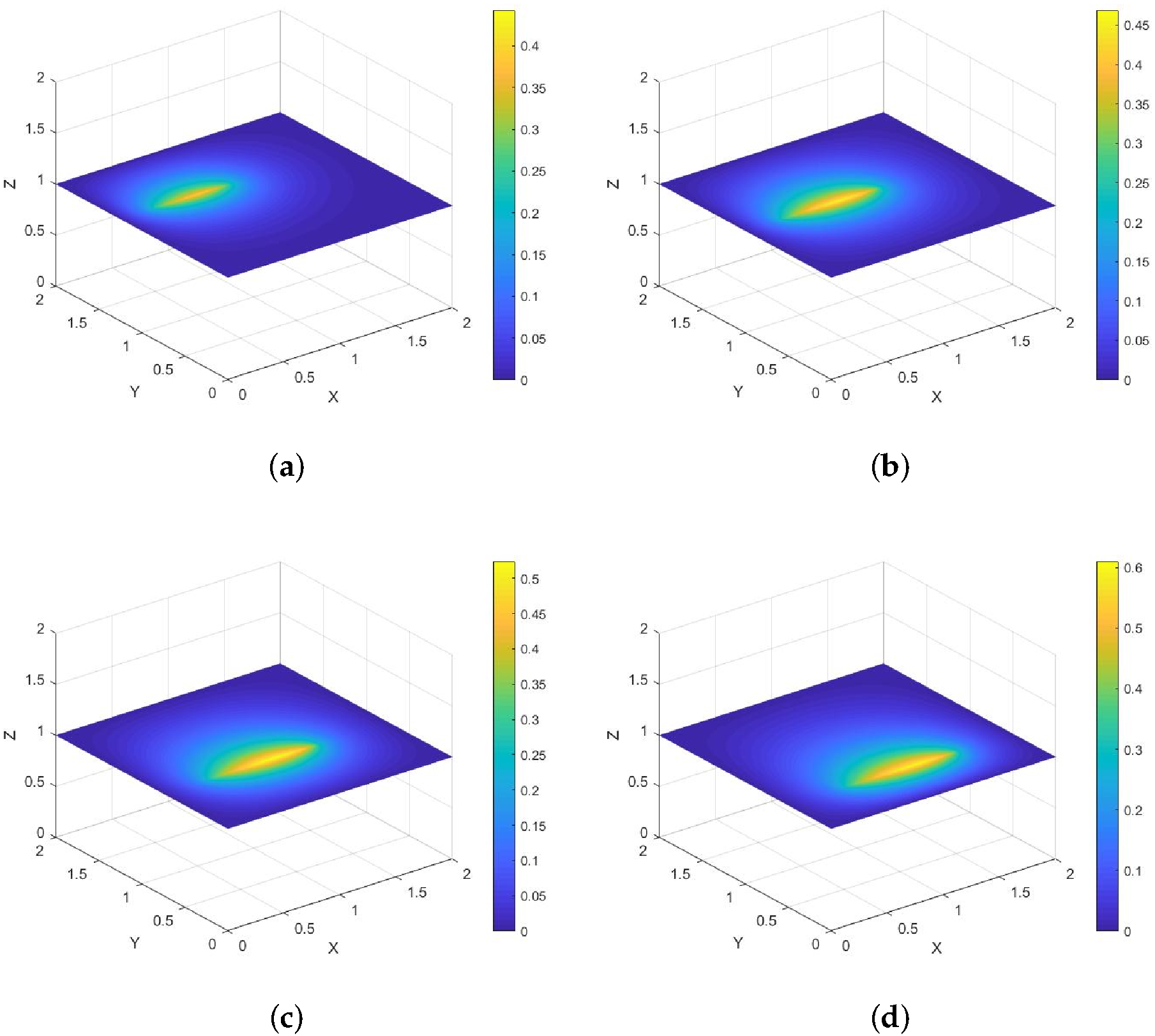
3.2. Three-Dimensional Problems
4. Conclusions
Author Contributions
Funding
Data Availability Statement
Conflicts of Interest
References
- Mackwood, A.P.; Crafer, R.C. Thermal modelling of laser welding and related processes: A literature review. Opt. Laser Technol. 2005, 37, 99–115. [Google Scholar] [CrossRef]
- Huang, Y.; Khamesee, M.B.; Toyserkani, E. A comprehensive analytical model for laser powder-fed additive manufacturing. Addit. Manuf. 2016, 12, 90–99. [Google Scholar] [CrossRef]
- Zhang, Q.; Xie, J.; Gao, Z.; London, T.; Griffiths, D.; Oancea, V. A metallurgical phase transformation framework applied to SLM additive manufacturing processes. Mater. Des. 2019, 166, 107618. [Google Scholar] [CrossRef]
- Bikcora, C.; Weiland, S.; Coene, W.M.J. Thermal deformation prediction in reticles for extreme ultraviolet lithography based on a measurement-dependent low-order model. IEEE Trans. Semicond. Manuf. 2014, 27, 104–117. [Google Scholar] [CrossRef]
- Ravi, A.K.; Deshpande, A.; Hsu, K.H. An in-process laser localized pre-deposition heating approach to inter-layer bond strengthening in extrusion based polymer additive manufacturing. J. Manuf. Process. 2016, 24, 179–185. [Google Scholar] [CrossRef]
- Sroka, R.; Stepp, H.; Hennig, G.; Brittenham, G.; Rhm, A.; Lilge, L. Medical laser application: Translation into the clinics. J. Biomed. Opt. 2015, 20, 61110. [Google Scholar] [CrossRef]
- Sassaroli, E.; Li, K.C.P.; O’Neill, B.E. Numerical investigation of heating of a gold nanoparticle and the surrounding microenvironment by nanosecond laser pulses for nanomedicine applications. Phys. Med. Biol. 2009, 54, 5541–5560. [Google Scholar] [CrossRef]
- Trujillo, M.; Rivera, M.; Molina, J.; Berjano, E. Analytical thermal-optic model for laser heating of biological tissue using the hyperbolic heat transfer equation. Math. Med. Biol. 2009, 26, 187–200. [Google Scholar] [CrossRef] [PubMed]
- Rosenthal, D. The Theory of Moving Sources of Heat and Its Application to Metal Treatments. Trans. Am. Soc. Mech. Eng. 1946, 68, 849–865. [Google Scholar]
- Jaeger, J.C. Moving sources of heat and the temperature at sliding contacts. Proc. R. Soc. N. S. W. 1942, 76, 203. [Google Scholar] [CrossRef]
- Hou, Z.B.; Komanduri, R. General solutions for stationary/moving plane heat source problems in manufacturing and tribology. Int. J. Heat Mass Transf. 2000, 43, 1679–1698. [Google Scholar] [CrossRef]
- Woo, H.G.; Cho, H.S. Three-dimensional temperature distribution in laser surface hardening processes. Proc. Inst. Mech. Eng. Part B J. Eng. Manuf. 1999, 213, 695–712. [Google Scholar] [CrossRef]
- Cheng, P.J.; Lin, S.C. An analytical model for the temperature field in the laser forming of sheet metal. J. Mater. Process. Technol. 2000, 101, 260–267. [Google Scholar] [CrossRef]
- Mirkoohi, E.; Seivers, D.E.; Garmestani, H.; Liang, S.Y. Heat source modeling in selective laser melting. Materials 2019, 12, 2052. [Google Scholar] [CrossRef] [PubMed]
- Araya, G.; Gutierrez, G. Analytical solution for a transient, three-dimensional temperature distribution due to a moving laser beam. Int. J. Heat Mass Transf. 2006, 49, 4124–4131. [Google Scholar] [CrossRef]
- Fereidouni, M.; Hoa, S.V. An analytical approach for three-dimensional thermal analysis of moving heat source on orthotropic solid. J. Thermoplast. Compos. Mater. 2025, 39, 140–171. [Google Scholar] [CrossRef]
- Zubair, S.M.; Chaudhry, M.A. A unified approach to closed-form solutions of moving heat-source problems. Heat Mass Transf. 1998, 33, 415–424. [Google Scholar] [CrossRef]
- Álvarez-Hostos, J.C.; Ullah, Z.; Storti, B.; Tourn, B.A.; Zambrano-Carrillo, J.A. Solving heat conduction problems with a moving heat source in arc welding processes via an overlapping nodes scheme based on the improved element-free Galerkin method. Int. J. Heat Mass Transf. 2022, 192, 122940. [Google Scholar] [CrossRef]
- Álvarez-Hostos, J.C.; Ullah, Z.; Storti, B.; Tourn, B.A.; Zambrano-Carrillo, J.A. An overset improved element-free Galerkin-finite element method for the solution of transient heat conduction problems with concentrated moving heat sources. Comput. Methods Appl. Mech. Eng. 2024, 418, 116574. [Google Scholar] [CrossRef]
- Bian, P.; Shao, X.; Du, J. Finite element analysis of thermal stress and thermal deformation in typical part during SLM. Appl. Sci. 2019, 9, 2231. [Google Scholar] [CrossRef]
- He, K.; Yang, Q.; Xiao, D.; Li, X. Analysis of thermo-elastic fracture problem during aluminium alloy MIG welding using the extended finite element method. Appl. Sci. 2017, 7, 69. [Google Scholar] [CrossRef]
- Reséndiz-Flores, E.O.; Saucedo-Zendejo, F.R. Two-dimensional numerical simulation of heat transfer with moving heat source in welding using the finite pointset method. Int. J. Heat Mass Transf. 2015, 90, 239–245. [Google Scholar] [CrossRef]
- Pham, X.T. Two-dimensional Rosenthal moving heat source analysis using the meshless element free Galerkin method. Numer. Heat Transf. Part A Appl. 2013, 63, 807–823. [Google Scholar] [CrossRef]
- Champagne, O.; Pham, X.T. Numerical simulation of moving heat source in arc welding using the Element-free Galerkin method with experimental validation and numerical study. Int. J. Heat Mass Transf. 2020, 154, 119633. [Google Scholar] [CrossRef]
- Hu, Z.; Liu, Z. Heat conduction simulation of 2D moving heat source problems using a moving mesh method. Adv. Math. Phys. 2020, 2020, 6067854. [Google Scholar] [CrossRef]
- Mohammadi, M.; Hematiyan, M.R.; Khosravifard, A. Boundary element analysis of 2D and 3D thermoelastic problems containing curved line heat sources. Eur. J. Comput. Mech. 2016, 25, 147–164. [Google Scholar] [CrossRef]
- Hematiyan, M.R.; Mohammadi, M.; Aliabadi, M.H. Boundary element analysis of two-and three-dimensional thermo-elastic problems with various concentrated heat sources. J. Strain Anal. Eng. Des. 2011, 46, 227–242. [Google Scholar] [CrossRef]
- Zenhari, S.; Hematiyan, M.R.; Khosravifard, A. Comparison of the Boundary Element Method and the Method of Fundamental Solutions for Analysis of Potential and Elasticity Problems in Convex and Concave Domains. WIT Trans. Eng. Sci. 2023, 135, 79–95. [Google Scholar]
- Karami, G.; Hematiyan, M.R. A boundary element method of inverse non-linear heat conduction analysis with point and line heat sources. Commun. Numer. Methods Eng. 2000, 16, 191–203. [Google Scholar] [CrossRef]
- Shiah, Y.C.; Guao, T.L.; Tan, C.L. Two-dimensional BEM thermoelastic analysis of anisotropic media with concentrated heat sources. Comput. Model. Eng. Sci. 2005, 7, 321. [Google Scholar]
- Mohammadi, M.; Hematiyan, M.R.; Khosravifard, A. Analysis of two-and three-dimensional steady-state thermo-mechanical problems including curved line/surface heat sources using the method of fundamental solutions. Eur. J. Comput. Mech. 2019, 28, 51–80. [Google Scholar]
- Mohammadi, M. The method of fundamental solutions for two-and three-dimensional transient heat conduction problems involving point and curved line heat sources. Iran. J. Sci. Technol. Trans. Mech. Eng. 2021, 45, 993–1005. [Google Scholar] [CrossRef]
- Mohammadi, M.; Hematiyan, M.R.; Shiah, Y. An efficient analysis of steady-state heat conduction involving curved line/surface heat sources in two/three-dimensional isotropic media. J. Theor. Appl. Mech. 2018, 56, 1123–1137. [Google Scholar] [CrossRef]
- Ma, J.; Jiang, Y. Moving mesh methods for blowup in reaction–diffusion equations with traveling heat source. J. Comput. Phys. 2009, 228, 6977–6990. [Google Scholar] [CrossRef]





| q | 1 | |||||
|---|---|---|---|---|---|---|
| 16 | 7.73 | 1.29 | — | 2.50 | 5.54 | — |
| 32 | 1.80 | 3.68 | 2.09 | 5.69 | 1.26 | 2.13 |
| 64 | 4.60 | 9.52 | 1.97 | 1.50 | 5.72 | 1.91 |
| 128 | 1.15 | 1.92 | 1.99 | 3.76 | 1.17 | 2.00 |
| 256 | 2.97 | 3.78 | 1.95 | 9.52 | 9.56 | 1.98 |
| q | 1 | |||||
|---|---|---|---|---|---|---|
| 16 | 9.35 | 1.34 | — | 2.95 | 7.20 | — |
| 32 | 1.82 | 5.62 | 2.35 | 6.01 | 3.27 | 2.29 |
| 64 | 3.80 | 2.59 | 2.26 | 1.26 | 1.54 | 2.24 |
| 128 | 8.37 | 1.24 | 2.18 | 2.79 | 7.47 | 2.18 |
| 256 | 1.84 | 6.14 | 2.17 | 5.80 | 3.68 | 2.26 |
| 1 | ||||||
|---|---|---|---|---|---|---|
| 16 | 5.43 | 1.30 | — | 4.68 | 1.62 | — |
| 32 | 2.48 | 6.04 | 1.13 | 1.73 | 5.40 | 1.43 |
| 64 | 4.92 | 6.70 | 2.33 | 3.33 | 6.28 | 2.37 |
| 128 | 1.24 | 3.82 | 1.97 | 8.75 | 3.76 | 1.92 |
| 256 | 3.76 | 2.32 | 1.73 | 2.65 | 2.35 | 1.72 |
| q | 1 | |||||
|---|---|---|---|---|---|---|
| 16 | 5.46 | 4.69 | — | 2.94 | 2.55 | — |
| 32 | 1.56 | 2.42 | 1.80 | 8.44 | 1.36 | 1.80 |
| 64 | 4.11 | 1.26 | 1.92 | 2.22 | 7.31 | 1.92 |
| 128 | 1.05 | 6.52 | 1.97 | 5.69 | 3.83 | 1.96 |
| q | 1 | |||||
|---|---|---|---|---|---|---|
| 16 | 8.84 | 1.52 | — | 3.37 | 6.48 | — |
| 32 | 1.73 | 8.28 | 2.35 | 6.33 | 3.64 | 2.41 |
| 64 | 7.42 | 4.86 | 1.22 | 2.46 | 2.20 | 1.35 |
| 128 | 9.79 | 2.82 | 2.92 | 3.37 | 1.26 | 2.87 |
Disclaimer/Publisher’s Note: The statements, opinions and data contained in all publications are solely those of the individual author(s) and contributor(s) and not of MDPI and/or the editor(s). MDPI and/or the editor(s) disclaim responsibility for any injury to people or property resulting from any ideas, methods, instructions or products referred to in the content. |
© 2026 by the authors. Licensee MDPI, Basel, Switzerland. This article is an open access article distributed under the terms and conditions of the Creative Commons Attribution (CC BY) license.
Share and Cite
Li, J.; Jiang, Y. A Partitioned Finite Difference Method for Heat Transfer with Moving Line and Plane Heat Sources. Entropy 2026, 28, 179. https://doi.org/10.3390/e28020179
Li J, Jiang Y. A Partitioned Finite Difference Method for Heat Transfer with Moving Line and Plane Heat Sources. Entropy. 2026; 28(2):179. https://doi.org/10.3390/e28020179
Chicago/Turabian StyleLi, Jun, and Yingjun Jiang. 2026. "A Partitioned Finite Difference Method for Heat Transfer with Moving Line and Plane Heat Sources" Entropy 28, no. 2: 179. https://doi.org/10.3390/e28020179
APA StyleLi, J., & Jiang, Y. (2026). A Partitioned Finite Difference Method for Heat Transfer with Moving Line and Plane Heat Sources. Entropy, 28(2), 179. https://doi.org/10.3390/e28020179