Cyber Risk Management of API-Enabled Financial Crime in Open Banking Services


Abstract
1. Introduction
Structural Changes Induced by Open Banking
- Open-banking regulation has accelerated the emergence of platform-based financial ecosystems characterised by increased data sharing and third-party participation.
- These ecosystems generate novel and interdependent risk exposures for commercial banks that are not adequately captured by conventional risk-management approaches.
- The multidimensional and dynamic nature of open-banking risks necessitates an integrated risk-assessment framework that explicitly accounts for feedback effects and cross-actor dependencies.
- Multi-method modelling approaches are more effective than static, single-method techniques for evaluating risk propagation and mitigation in open-banking environments.
2. Literature Review
2.1. Open Banking as a Platform-Based Financial Ecosystem
2.2. Regulatory and Governance Challenges in Open Banking
2.3. Risk Exposure in API-Enabled Financial Systems
2.4. Methodological Approaches to Interdependent Risk Modelling
2.5. Research Gap
3. Open-Banking Risks, Measures and Mitigations
3.1. Categorisation of Open-Banking Risks
- Technical Risks: These are risks linked to the design, security, interoperability, and resilience of open banking technology, particularly APIs, authentication systems, and integration with legacy infrastructure, such as variance in API standards across jurisdictions [46]; insecure fallback mechanisms such as screen scraping [36,47]; poor reliability of bank APIs, with high error rates and downtime [46]; clunky and inconsistent strong customer authentication [48]; and dependency risks from API aggregators [49].
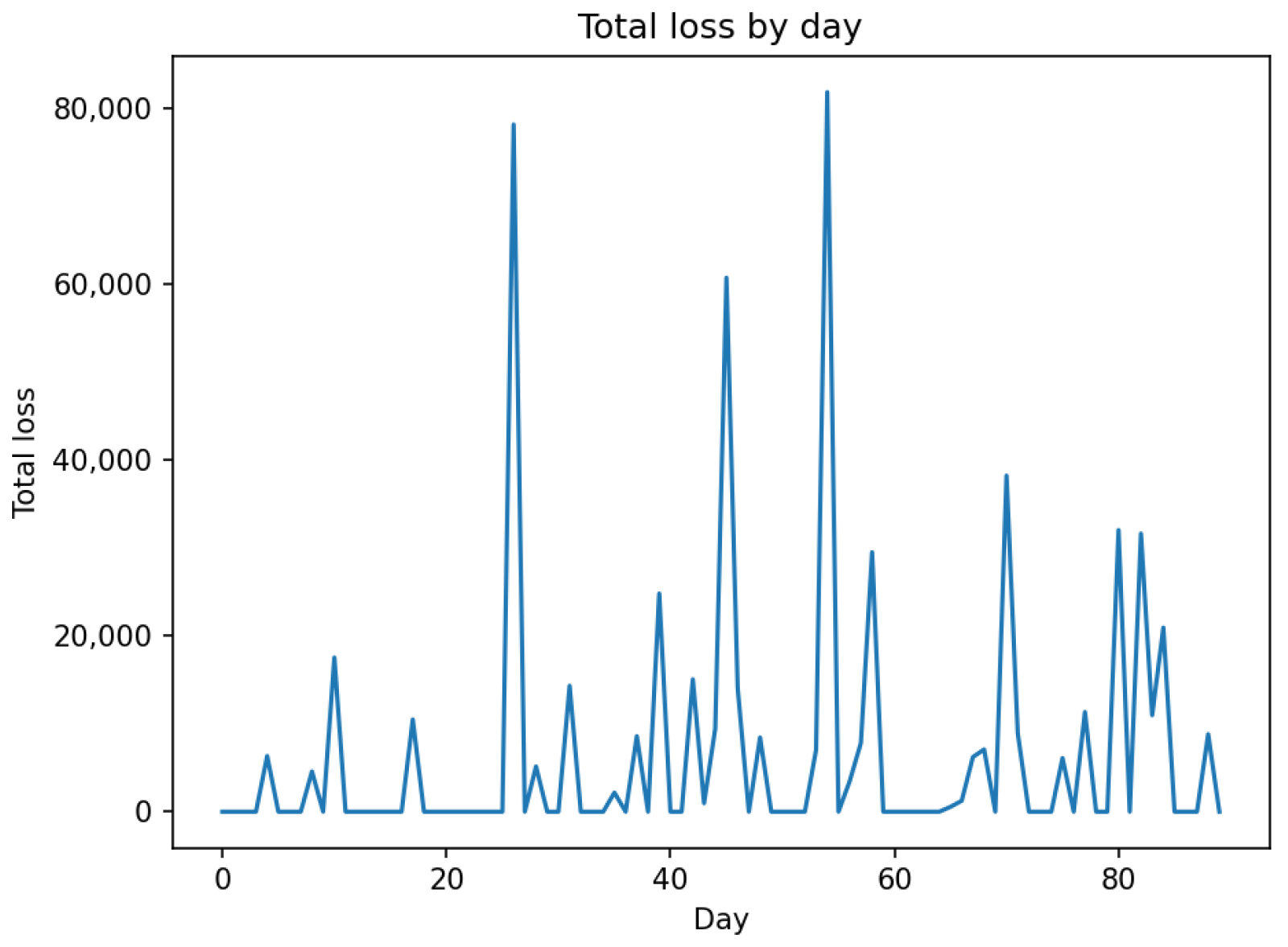
- Financial Crime and Data Risks: These are risks related to fraud, identity theft, data misuse, and other financial crimes that arise from increased data flows and third-party access enabled by open banking. They capture both technological vulnerabilities (such as insecure access and weak authentication) and behavioural risks (such as misuse of customer data by unauthorised or malicious actors). Examples include insecure fallback mechanisms such as screen scraping, which increases risks of impersonation, fraud, and data breaches [36,47]; consumer data being misused beyond the intended scope of consent [35]; systemic exposure to fraud as more third parties gain access to sensitive financial data [50]; and risks in credit markets where shared borrower data may enable exploitative practices, leaving consumers worse off [51]. In this paper, this category is operationalised through simulated credential-compromise shocks, fraud event generation at third-party providers, and the resulting distribution of financial losses.
- Social Risks: These are risks arising from consumer behaviour, trust, adoption, and inclusion, reflecting how individuals interact with open-banking ecosystems, such as low consumer engagement and high loyalty penalties due to inertia [52]; confusion and frustration from complex consent and authentication flows [35]; reputational damage to incumbents from third-party failures [53]; and digital literacy and inclusion gaps, particularly for vulnerable or rural populations [50,52].
- Economic Risks: These are risks tied to the financial and competitive consequences of open banking, including disintermediation, market structure shifts, and systemic volatility, such as disintermediation of banks and loss of bundling advantages [53]; excessive market power of BigTech and API aggregators [36,49]; high compliance and transformation costs with uncertain returns [54]; systemic risks from synchronised consumer behaviour through automated services [50]; and perverse outcomes in credit markets where all borrowers are worse off while industry profits rise [51].
- Regulatory and Legal Risks: These are risks emerging from contradictions, ambiguities, and fragmentation in regulatory and legal frameworks governing open banking, notably PSD2 and GDPR, such as conflicting definitions of consent and portability in PSD2–GDPR interaction [35]; liability asymmetries where banks bear responsibility for TPP failures [47]; fragmented API standards and uneven enforcement across jurisdictions undermining interoperability [24,46]; and regulatory arbitrage between heavily regulated banks and lightly regulated fintechs [50].
- Ethical and Governance Risks: These are risks concerning fairness, accountability, and transparency in open-banking ecosystems, including how data and market power are governed, such as ethical concerns around treating consumers as “data vectors” [54]; profiling and algorithmic discrimination in credit and insurance [50,55]; erosion of meaningful consent where consumers cannot understand or resist data use [35]; and governance tensions where platform operators or aggregators dictate access and competition [46].
3.2. Risk Measures in Open Banking
3.2.1. Operational Risk Measures
- 1.
- API uptime: API uptime measures the proportion of time that banking APIs are operational and accessible. Low uptime undermines reliability and discourages adoption [46].
- 2.
- API Error Rate: the error rate indicates the proportion of failed API responses relative to total calls [46].
- 3.
- 4.
- Security and Operational Incident Rate: measures the frequency of reportable ICT or operational incidents related to open banking services [24].
- 5.
- 6.
- Unauthorised Transaction Loss Rate: captures the value of financial losses due to unauthorised transactions as a proportion of total transaction value [47].
- 7.
- 8.
- 9.
- Composite Digital-Risk Indicator (CDRI): a composite index aggregating different technical, operational, and compliance risks into one score [57].where are weights and are standardised risk indicators.
3.2.2. Liquidity Risk Measures
3.2.3. Credit Risk Measures
3.2.4. Solvency (Bankruptcy) Risk Measures
3.3. Mitigation Strategies to Curb Open-Banking Risks
- 1.
- Technical risk mitigation: Technical exposures in open banking are primarily addressed through the deployment of secure, standardised APIs, the mandated move away from insecure practices such as screen scraping, and the adoption of Strong Customer Authentication (SCA) together with common-and-secure communication protocols [36,47]. These controls are embedded in PSD2/RTS interpretations and accompanying cybersecurity frameworks, as well as national implementation playbooks [24,60]. To reduce fragmentation and uplift baseline resilience, scholars and policymakers further recommend harmonised API specifications and oversight (such as performance/availability parity for TPP interfaces), coupled with certification and conformance regimes [46,61]. Banks are urged to ensure reliable integration between legacy cores and OB layers, invest in rigorous partner testing and platform curation, and adopt continuous monitoring (transaction/device analytics) and recognised standards such as ISO/IEC 27001 and PCI DSS [49,62,63]. Conceptual mappings of the field reinforce that regulation, platformisation, and data sharing jointly shape these technical safeguards [24,64,65].
- 2.
- Financial-crime and data-risk mitigation: Financial-crime and data-protection risks are mitigated through modernised, risk-based AML/KYC programs and the automation of screening, due diligence and ongoing monitoring with RegTech, alongside privacy-by-design safeguards (encryption, least privilege, access control) [64,66,67]. Clear licensing/accreditation and supervision of third-party providers, plus alignment with PSD2/GDPR and cybersecurity standards, reduce exposure to weakly governed actors and lower data misuse risk [24,36]. Evidence from PayTech development underscores the complementary role of supportive—but supervised—innovation tools such as regulatory sandboxes [48].
- 3.
- Social (consumer-protection) risk mitigation: Consumer risks are curbed by transparent, revocable consent; plain-language privacy statements; and user-centric consent journeys that reduce information asymmetries and build trust [36,58,67]. Foundational EU payment rules—liability limits for unauthorised use, single point of contact, and accessible dispute resolution—remain central to consumer protection as data sharing expands [68,69]. Sectoral studies highlight the importance of financial/digital literacy initiatives and trustworthy, permissioned data handling to enable safe adoption and sustained engagement [55,65,70].
- 4.
- Economic and market-structure risk mitigation: Market risks are mitigated by interoperable API standards that lower entry barriers, balanced monetisation models for sustainable API provisioning, and active platform governance that preserves quality while enabling innovation [16,46,49,61,63]. Formal analyses of credit competition under borrower data ownership show that voluntary sign-up equilibria, endogenous participation thresholds, borrower heterogeneity, and differentiated screening technologies can temper adverse selection and stabilise welfare [51]. Empirical and policy work further recommend incremental/experimental adoption, attention to technology spending discipline, and alignment of digital bets with banks’ diversification profiles to avoid fragility [55,59,71]. Cross-country evidence points to heterogeneous effects on traditional lending and PayTech growth, reinforcing the need for calibrated implementation [48,72].
- 5.
- Regulatory and compliance risk mitigation: Regulatory levers include harmonised legal frameworks that reconcile data protection, payments, and competition; clear liability allocation; mandatory licensing/supervision of TPPs [36,46,61,68,69]; and central coordination of standards and interoperability. PSD2/RTS provide the backbone for SCA, secure communications, interface obligations, and incident handling; complementary guidance ties these obligations to recognised cybersecurity frameworks and auditing practices [24,47,60]. National and EU-level policy also highlights sandboxes and supervisory dialogue to surface risks early without stifling innovation [48,55].
- 6.
- Ethics and governance risk mitigation: Ethical and governance concerns are managed through structured partner selection (such as, hybrid multi-criteria decision models), expert-weighted decision processes, and transparent platform rules for onboarding, certification, and quality control [49,62,63]. Privacy, identity, and accountability debates (such as SSI and data rights) motivate governance mechanisms that align incentives, deter discriminatory outcomes, and ensure effective enforcement for persistent non-compliance [55,66,73]. Collectively, these measures seek to balance innovation with rights, fairness, and societal trust across open-banking ecosystems [16,65].
3.4. Impacts of PSD2 and Similar Regulations on Banks and TPPs
- 1.
- Banks (Account Servicing Payment Service Provider (ASPSPs)): For banks (ASPSPs), PSD2 formalises “access-to-account” (XS2A) and requires dedicated or adapted secure interfaces plus Strong Customer Authentication (SCA), Common/Secure Communication, and incident reporting, which widens the security perimeter and compels investments in authentication, access control, monitoring, and resilience engineering [24,47] Standardisation choices shape operational risk: the UK’s prescriptive open-banking profiles and governance reduced interoperability frictions, whereas the EU’s more market-led approach produced uneven API quality that banks must mitigate via testing/certification, fallback interfaces, and robust third-party risk management [36,46,50]. Liability and reimbursement rules—together with the phasing-out of credential sharing/screen scraping—reallocate legal and reputational exposure and drive upgrades to fraud detection, dispute handling, auditability, and consent-lifecycle controls [47,68]. Because PSD2 sits alongside the GDPR, banks also face “legal knots” around lawful processing, minimisation, and consent scope, necessitating privacy-by-design, stronger due diligence over TPPs, and clearer disclosures [35,67]. Beyond compliance, mandated data mobility erodes incumbents’ information advantages and intensifies competition, so many banks pivot toward platform orchestration (“re-intermediation”) with tighter partner vetting and service-quality assurance, supported by RegTech and risk-based analytics to contain rising compliance costs [36,49]. Cross-border passporting and emerging open-finance proposals further expand oversight and interoperability challenges, reinforcing governance upgrades and operational risk controls [52,61].
- 2.
- Third-party providers (TPPs): For third-party providers (TPPs), PSD2’s licensing and supervision of account-information and payment-initiation services formalise market entry while imposing SCA/CSC, secure-interface use, and explicit, revocable consent aligned with GDPR principles of lawfulness, minimisation, and transparency [47,52]. Heterogeneous bank APIs and fragmented implementations translate into integration and reliability risks that TPPs address through interoperability tooling, certification, resilience practices, and clear compliance artefacts, even as policy discussions move toward common technical standards and sustainable API-monetisation models [36,46,50,61]. Access to consented transaction data can enhance screening and pricing but introduces “winner’s-curse” and adverse-selection frictions, prompting investments in rigorous data science, portfolio-risk controls, and trustworthy consent/user-experience design [51]. Privacy economics also implies that opt-in regimes may favour incumbents with established relationships, raising TPP acquisition costs and heightening the need for transparent notices and robust security to build trust [35,73]. Finally, supervisory tools such as regulatory sandboxes help TPPs test innovations under controlled conditions, while broader governance expectations, such as vendor management, auditability, and clear liability pathways, anchor operational resilience and consumer protection as the ecosystem scales [48,55].
4. Conceptual Framework of the Hybrid Model
4.1. System Dynamics (SD)
- 1.
- Users (number of active users)where t—time, R—Reliability (variable), —Control Maturity Index (variable). It was assumed that the rate of increase in the number of users depends on the level of system reliability, while the friction resulting from excessive levels of control affects the rate of decline in the number of users.Auxiliary:—convex penalty function from stronger controls. The function Friction is assumed to be zero when the control maturity index C is below 0.5 and becomes active above.Parameters:—user adoption rate; —the addressable market (ceiling) for open-banking active users; —sensitivity of users to friction.
- 2.
- Reliability (level of trust)where , C—Control Maturity Index (variable). Credibility increases with the level of service and decreases with the intensity of incidents.Auxiliaries:—quality/latency impact of controls; slightly lowering the service level if the control is too strong (C exceeds the value of 0.9).—incident intensity; in the above equation, it is divided by the number of active users to get a fair, size-neutral exposure; it is defined by the following formulawhere A—base attack/contact factor; —API call volume; —lowers incidents due to control maturity C (); —seasonality/weekday factor.—traffic volume is given by the following formula:Parameters:—translation of service quality into trust growth/recovery;—sensitivity of trust to incident exposure;—calls/user/day;—marginal traffic lift per unit of (variable).
- 3.
- Control MaturityIt is the combined capability across prevention, detection, and response for risks specific to open banking (API abuse, consent misuse, PISP (Payment Initiation Service Provider) fraud, scraping, DoS, supply-chain exploits). The single factor keeps the causal loop diagram readable and allows us to run broad policy “what-ifs” quickly.Control Maturity Index C increases due to expenses on protecting the open-banking system and at the same time is subject to a natural weakening process.AuxiliariesB—budget stock available to security/controls.—the portion of B actually deployed into controls per unit time (could be capped).—concave gain function (diminishing returns).Parameters:—conversion rate from spend to maturity uplift; —constant drift; .
- 4.
- Incident BacklogThe number of incidents increases proportionally to the intensity , which is defined in Equation (3). The ability to resolve incidents depends on the level of control .Auxiliaries:—incident intensity;—resolution rate (increase with C).Parameters:.
- 5.
- Budgetwhere —a fixed per-day amount; here, as a first approximation, we assume that the budget is fed by a constant value. Similarly, expenditure was limited to cover control activities. In the future, for a more developed model, the constant value may be replaced by a variable and expenses may also include other items.
- 6.
- Third-Party Providers (TPP)—a count of active TPPsThe increase in the number of active TPPs is mitigated by the ‘Friction’ level. In turn, the reduction in the number of active TPPs is triggered when the incident rate exceeds a pre-determined comfort level.Auxiliaries—lower onboarding due to stronger controls.Parameters:—baseline onboarding rate (TPPs/day); —pausing partnerships rate when operations are strained; —service/operational comfort threshold.
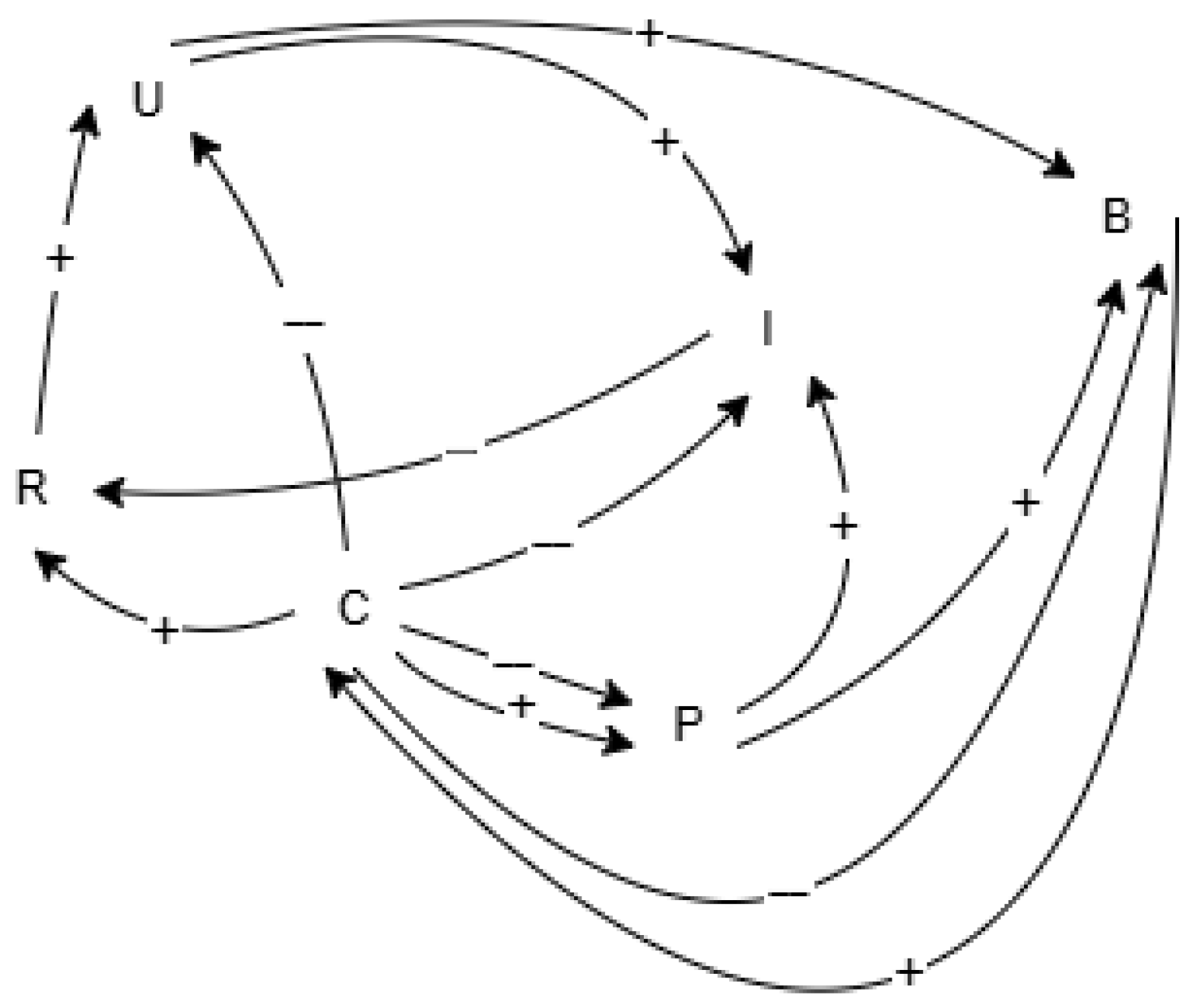
4.1.1. Feedback Loops
Reinforcing Loops
- (R1)
- User and Reputation Reinforcement by Investment
- (R2)
- TPP Reinforcement by Investment
- (R3)
- Growth by Risk Control
Balancing Loops
- (B1)
- Incidents Balancing Loop
- (B2)
- Balance by Friction
4.2. Agent-Based Modelling (ABM)
4.2.1. Time and Agents
- B banks indexed by ;
- P third-party providers (TPPs) indexed by ;
- attackers represented as a single aggregate process with intensity multiplier and leak indicator .
4.2.2. Network Structure
- 1.
- Transaction Load Allocation: for traffic allocation, each TPP has an exposure proportional to its degree, normalised by the total number of connections:where is the TPP’s degree (number of connected banks).
- 2.
- Attack Attempts: given attack intensity , the number of fraud attempts faced by TPP p is modelled as,where attack intensity is given byHere, k—calibrating factor that depends on the scale of daily calls and puts the mean attempts into a numerically sensible 0.1–10 range before shocks. —attacker intensity multiplier is a continuous knob to sweep overall attacker pressure (scenario shock), —leak indicator multiplies attempts when a credential leak/wave is “on”, —a leak multiplier (e.g., ).
- 3.
- Attack Success Probability: the probability that a single attack will be successful is given by a linear dependence on the control maturity index , which is determined in the SD module. We assume this probability is limited to the interval . The single-digit realised incidents/day per TPP under baseline attempt rates are consistent with early-stage operational data and with the SD incident scale.
- 4.
- Realised Fraud: the number of successful fraud events is
- 5.
- Fraud Rate (Per 10,000 Calls): to compare TPP performance regardless of load, we propose the formulaif , otherwise .
- 6.
- Throttling Decision: a TPP is throttled if its fraud rate exceeds a threshold ;andcounts the number of throttled TPPs.
- 7.
- Adaptive Reallocation: throttled TPPs lose a traffic share fraction on the next day;followed by normalisation:
- 8.
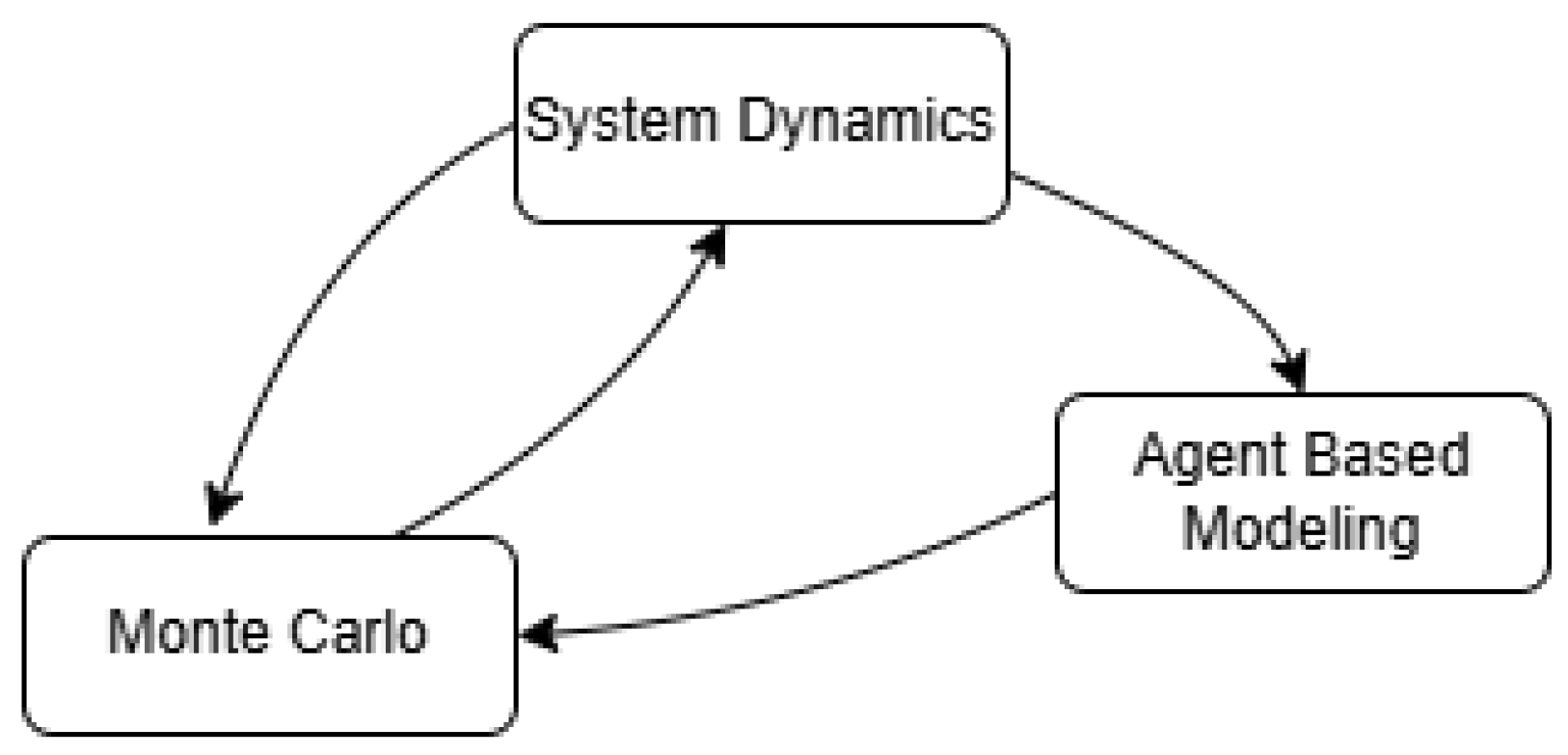
- Aggregated Fraud:which feeds back into the SD layer and into a Monte Carlo loss model.
- 9.
- Parameter Feedback Update:Control maturity and reliability from the SD layer affect attack intensity and success rates;Here, is decreasing in C (improved controls reduce success probability), while increases with R (higher reliability attracts more adversarial focus).
4.3. Monte Carlo Model
4.3.1. Severity Process
4.3.2. Frequency Process
4.3.3. Compound Loss Process
- draws from ;
- draws from ,
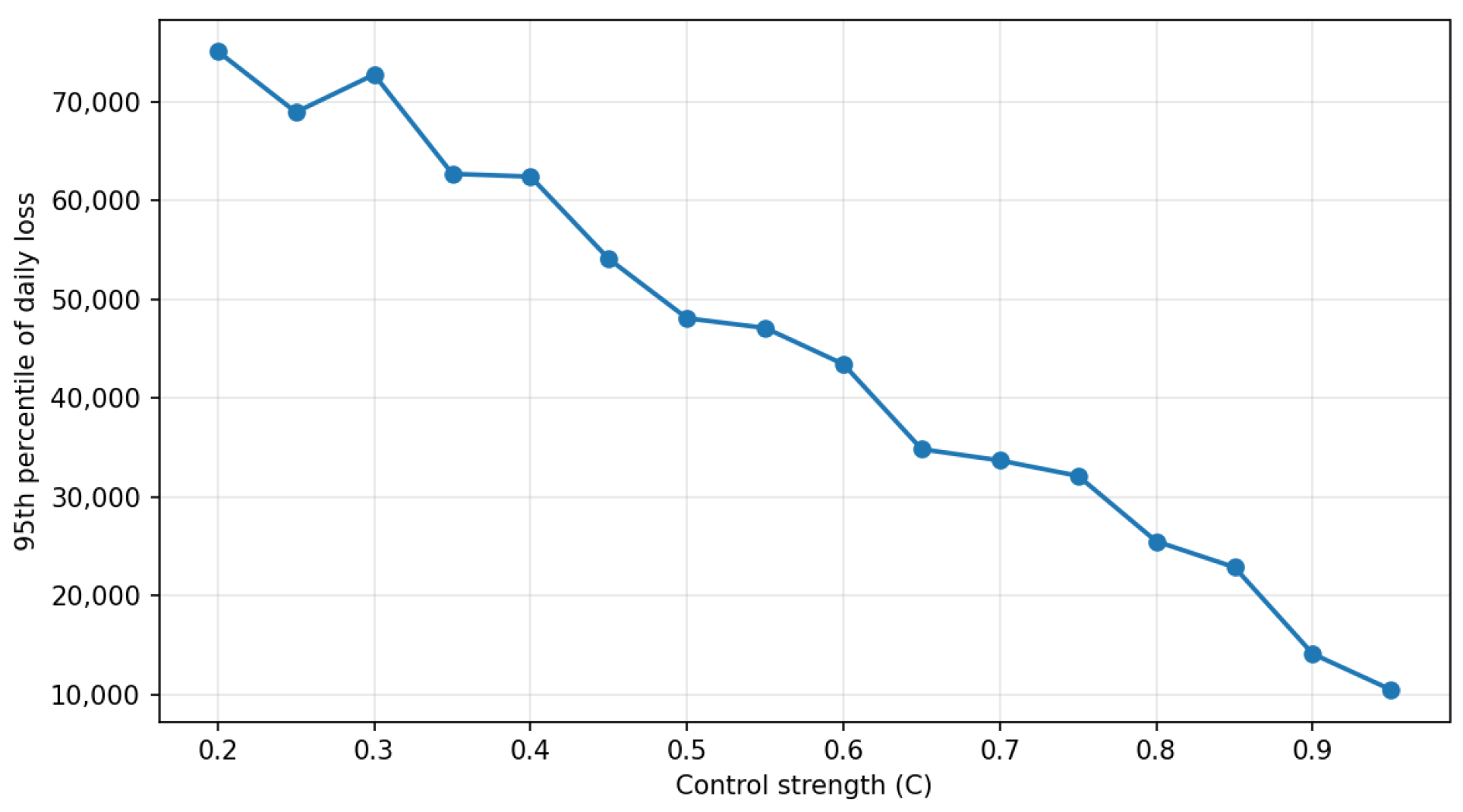
4.3.4. Risk Measure Estimation
- Value-at-Risk (VaR).
- Expected Shortfall (ES).
5. Simulation Methods, Parameters, and Justification
- Time and integration.
5.1. SD Module
5.1.1. Users, See Equation (1)
5.1.2. Reliability, See Equation (2)
5.1.3. Incident Intensity, See Equation (3)
5.1.4. API Volume, See Equation (4)
5.1.5. Control Maturity, See Equation (5)
5.1.6. Incident Backlog, See Equation (6)
5.1.7. Budget, See Equation (7)
5.1.8. TPP, See Equation (8)
5.2. ABM Module
Agents and Network Structure
- 1.
- Transaction Load Allocation: no additional parameters to set.
- 2.
- Attack Attempts: —coincides with daily calls that can be 105–106 per TPP, —baseline scale, —no surge by default, —triples attempts when a credential leak/wave is “on”.
- 3.
- Attack Success Probability: no additional parameters to set.
- 4.
- Realised Fraud: no additional parameters to set.
- 5.
- Fraud Rate (Per 10,000 Calls): no additional parameters to set.
- 6.
- Throttling Decision: the threshold and the number of TPPs that exceed the threshold is calculated (can be reported as KPI).
- 7.
- Adaptive Reallocation: at the initial stage of simulation, no changes are made to the allocation.
- 8.
- Aggregated Fraud: no additional parameters to set.
- 9.
- Parameter Feedback Update: this option is currently unused; it may be implemented in a more advanced model.
5.3. Monte Carlo Module
6. Model Verification and Validation
6.1. Conceptual Model Validity
6.2. Computerised Model Verification
6.3. Operational Validity
6.4. Data Validity and Confidence Level
7. Initial Model Testing
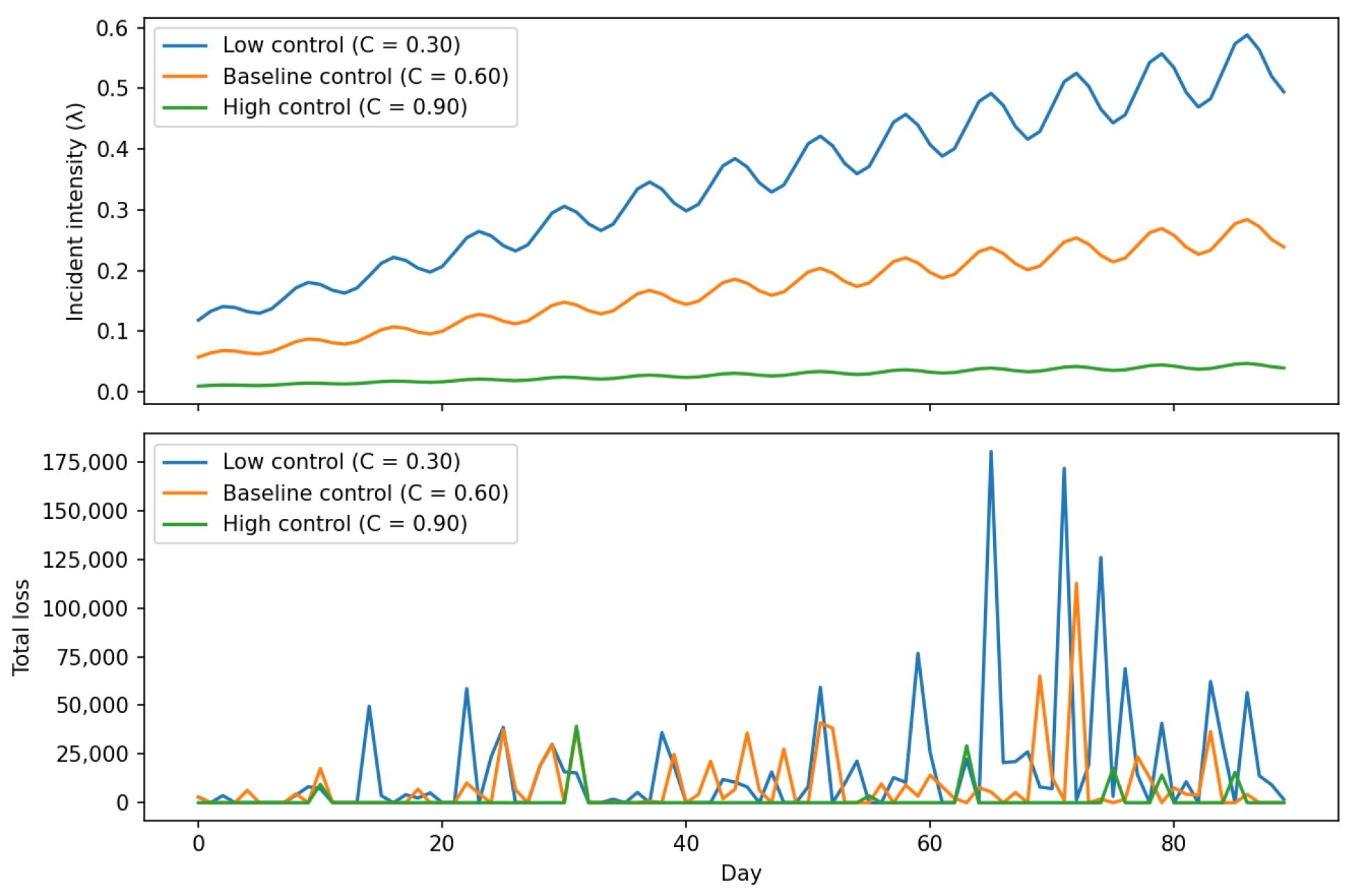
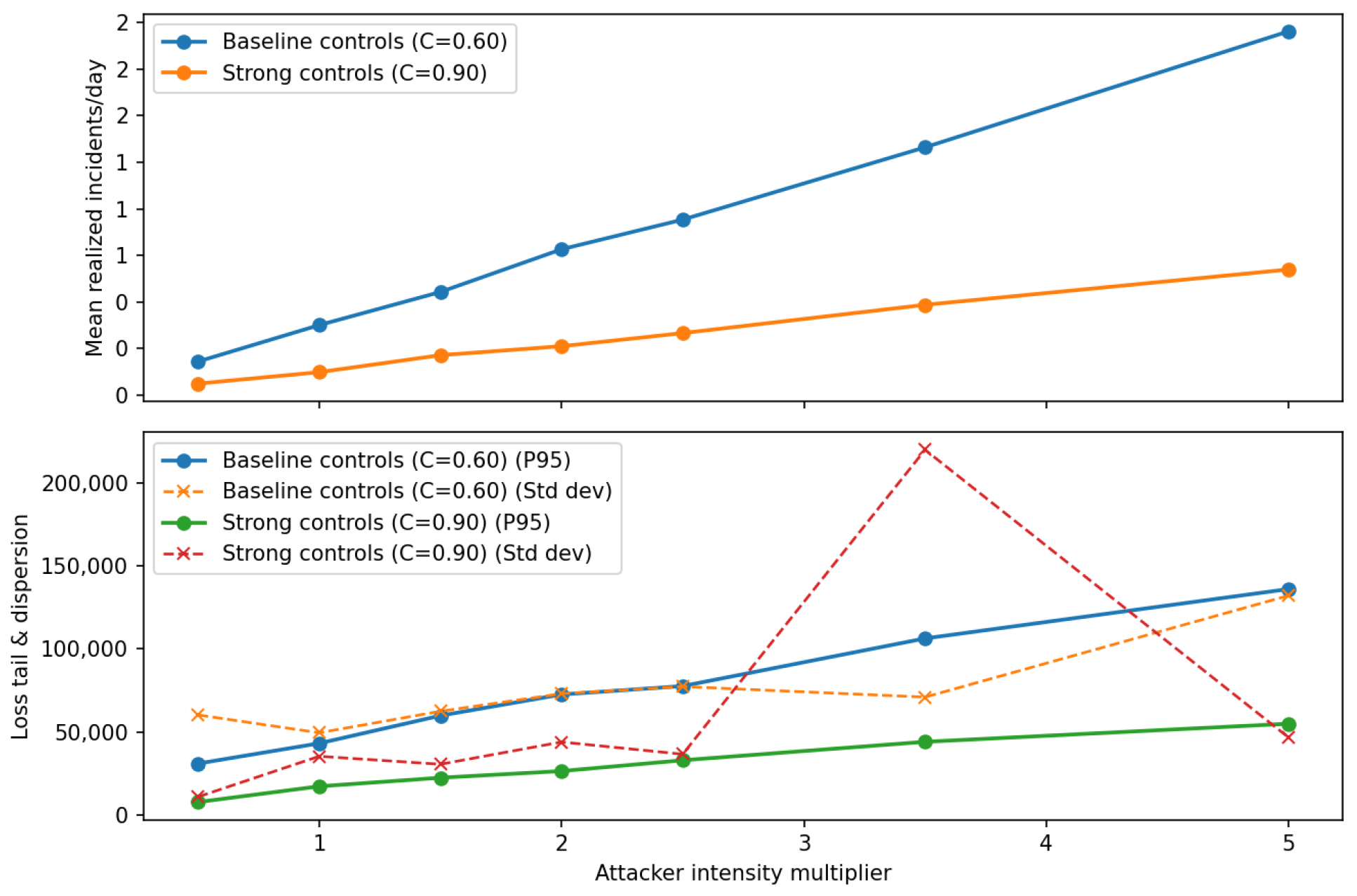
8. Discussion and Future Research Directions
9. Conclusions
Author Contributions
Funding
Data Availability Statement
Conflicts of Interest
Appendix A

| Symbol | Domain | Meaning |
|---|---|---|
| U | Number of active users. | |
| Potential market size. | ||
| R | Reliability index. | |
| Baseline/target reliability. | ||
| C | Control maturity level. | |
| I | Incident backlog. | |
| B | Operational/control budget. | |
| P | Number of third-party providers (TPPs). | |
| Maximum possible TPPs. | ||
| L | Loss reserves. | |
| User adoption rate. | ||
| User attrition coefficient. | ||
| Baseline friction in user journey. | ||
| Friction increase per unit C. | ||
| Reliability improvement rate. | ||
| Reliability erosion per incident backlog. | ||
| Decay of reliability toward . | ||
| Baseline service level. | ||
| Service level gain per unit C. | ||
| Control maturity improvement rate. | ||
| Control obsolescence rate. | ||
| Investment proportionality factor. | ||
| Baseline incident resolution rate. | ||
| Resolution improvement per unit C. | ||
| A | Scaling factor for incident intensity. | |
| Sensitivity to residual risk . | ||
| S | Scenario/stress multiplier. | |
| M | Exposure/monitoring multiplier. | |
| Baseline transactions per user. | ||
| TPP saturation parameter. | ||
| Baseline business inflow. | ||
| User-driven inflow coefficient. | ||
| TPP-driven inflow coefficient. | ||
| Reserve-allocation rate. | ||
| Cost of maintaining controls. | ||
| Cost of handling incidents. | ||
| Adjustment speed toward target VaR. | ||
| Baseline VaR component. | ||
| VaR sensitivity to incident intensity. | ||
| VaR sensitivity to incident backlog. | ||
| Loss per incident intensity. | ||
| Loss per incident backlog. | ||
| Target Value-at-Risk. |
| Symbol | Domain | Meaning |
|---|---|---|
| Bank–TPP connection matrix. | ||
| Traffic-weight matrix. | ||
| Connection probability. | ||
| Total transaction volume on day k. | ||
| Transaction load of TPP j. | ||
| Traffic share of TPP j. | ||
| Attack intensity coefficient. | ||
| Baseline attack success probability. | ||
| Traffic sensitivity of attack success. | ||
| Fraud threshold for throttling. | ||
| Traffic fraction removed on throttling. | ||
| Number of loss events. | ||
| Poisson rate for event frequency. | ||
| Event intensity (Poisson mode). | ||
| Loss severity of event i. | ||
| Total loss on day t. | ||
| M | Number of Monte Carlo iterations. | |
| Lognormal location parameter. | ||
| Lognormal scale parameter. | ||
| Baseline severity intercept. | ||
| Sensitivity to . | ||
| Severity reduction per unit C. | ||
| q | Confidence level for VaR/ES. |
References
- European Union. Directive 2007/64/EC on Payment Services in the Internal Market (Payment Services Directive). Official Journal of the European Union. 2007, L319. Available online: https://eur-lex.europa.eu/eli/dir/2007/64/oj/eng (accessed on 1 November 2025).
- European Union. Directive (EU) 2015/2366 on Payment Services in the Internal Market (PSD2). Official Journal of the European Union. 2015, L337. Available online: https://eur-lex.europa.eu/eli/dir/2015/2366/oj/eng (accessed on 1 November 2025).
- Supervision, B.C.B. Report on Open Banking and Application Programming Interfaces; Technical Report; Bank for International Settlements: Basel, Switzerland, 2019. [Google Scholar]
- Authority, E.B. Guidelines on the Security Measures for Operational and Security Risks of Payment Services Under PSD2. EBA Final Report. 2018. Available online: https://www.eba.europa.eu/guidelines-security-measures-operational-and-security-risks-under-psd2 (accessed on 22 July 2025).
- OECD. Digital Finance: Trends, Policy Issues and Risks; Technical Report; Organisation for Economic Co-operation and Development: Paris, France, 2023. [Google Scholar]
- Kong Inc. Open Banking: A Guide to APIs, Regulations and Fintech. Blog Post on Open Banking and API-Based Architectures. 2025. Available online: https://konghq.com (accessed on 26 November 2025).
- Tink AB. Money Manager: Personal Finance Management Powered by Open Banking. Product Documentation and Marketing Materials. 2024. Available online: https://tink.com (accessed on 26 November 2025).
- BBVA. solarisBank: A New Way of Doing Open Banking. BBVA Digital Banking Article. 2019. Available online: https://www.bbva.com/en/solarisbank-a-new-way-of-doing-open-banking/ (accessed on 26 November 2025).
- Hong Kong Institute of Bankers. FinTech Focus: What is Banking-as-a-Service (BaaS)? 2025. Available online: https://www.hkib.org/ (accessed on 26 November 2025).
- OpenPayd. Embedded Finance: Research Report. Industry Report on Embedded Finance Adoption. 2021. Available online: https://www.openpayd.com (accessed on 26 November 2025).
- Shopify Inc. Introducing Shopify Balance: Business Banking for Merchants. Press Release and Product Description for Shopify Balance. 2022. Available online: https://news.shopify.com (accessed on 26 November 2025).
- Competition and Markets Authority. Banking Customer Satisfaction Survey Results. CMA Retail Banking Service-Quality Survey Results. 2025. Available online: https://www.gov.uk/government/news/how-does-your-bank-rank-cma-releases-satisfaction-survey-ratings (accessed on 26 November 2025).
- Lee, P. UK Challenger Banks Top Customer Satisfaction Survey. Euromoney 2024. Feature Article on CMA Survey Results and Challenger-Bank Competition. Available online: https://www.euromoney.com/article/2dnv6pp1ho0k9trls70u8/banking/uk-challenger-banks-top-customer-satisfaction-survey/ (accessed on 1 August 2025).
- OECD. Data Portability in Open Banking: Privacy and Other Cross-Cutting Issues; OECD Digital Economy Papers; Organisation for Economic Co-operation and Development: Paris, France, 2023. [Google Scholar]
- Reimsbach-Kounatze, C.; Molnar, A. The Impact of Data Portability on User Empowerment, Innovation, and Competition; OECD Going Digital Toolkit Notes No. 25; OECD: Paris, France, 2024. [Google Scholar] [CrossRef]
- Colangelo, G.; Khandelwal, P. The Many Shades of Open Banking: A Comparative Analysis of Rationales and Models. Internet Policy Rev. 2025, 14, 10-14763. [Google Scholar] [CrossRef]
- Financial Conduct Authority. The Potential Competition Impacts of Big Tech Entry and Expansion in Retail Financial Services; Technical Report; Financial Conduct Authority: London, UK, 2023. [Google Scholar]
- Malczyk, S. 10 Embedded Finance Examples: Real-World Use Cases. Miquido Blog Post on Embedded Finance Use Cases. 2025. Available online: https://www.miquido.com/blog/embedded-finance-examples/ (accessed on 26 November 2025).
- Ulan Software. Top 9 Embedded Finance Examples and How They Work. Blog Article Describing Embedded Finance Patterns and Examples. 2025. Available online: https://ulansoftware.com/blog/embedded-finance-examples-how-they-work (accessed on 26 November 2025).
- Polski Standard Płatności. BLIK for You. Official BLIK Information Page. 2025. Available online: https://www.blik.com/en (accessed on 26 November 2025).
- Wikimedia Foundation. Blik—Polish Mobile Payment System. Encyclopaedia Entry on the BLIK Payment System. 2025. Available online: https://en.wikipedia.org/wiki/Blik (accessed on 26 November 2025).
- Zetzsche, D.A.; Arner, D.W.; Buckley, R.P.; Weber, R.H. The Evolution and Future of Data-Driven Finance in the EU. Common Mark. Law Rev. 2020, 57, 331–360. [Google Scholar] [CrossRef]
- IMF. Digitalization and the Future of Finance; Technical Report; International Monetary Fund: Washington, DC, USA, 2022. [Google Scholar]
- Gounari, M.; Stergiopoulos, G.; Pipyros, K.; Gritzalis, D. Harmonizing Open Banking in the European Union: An Analysis of PSD2 Compliance and Interrelation with Cybersecurity Frameworks and Standards. Int. Cybersecur. Law Rev. 2024, 5, 79–120. [Google Scholar] [CrossRef]
- Azura, Y.T.Y.; Azad, M.A.; Ahmed, Y. An Integrated Cyber Security Risk Management Framework for Online Banking Systems. J. Bank. Financ. Technol. 2025, 9, 85–104. [Google Scholar] [CrossRef]
- Barroso, M.; Laborda, J. Digital Transformation and the Emergence of the Fintech Sector: Systematic Literature Review. Digit. Bus. 2022, 2, 100028. [Google Scholar] [CrossRef]
- Akyildirim, E.; Corbet, S.; Mukherjee, A.; Ryan, M. Global perspectives on open banking: Regulatory impacts and market response. J. Int. Financ. Mark. Inst. Money 2025, 101, 102159. [Google Scholar] [CrossRef]
- Vives, X. Digital Disruption in Banking. Annu. Rev. Financ. Econ. 2019, 11, 243–272. [Google Scholar] [CrossRef]
- Boot, A.W.A.; Hoffmann, P.; Laeven, L.; Ratnovski, L. FinTech: What’s Old, What’s New? J. Financ. Stab. 2021, 53, 100836. [Google Scholar] [CrossRef]
- Thakor, A.V. Fintech and Banking: What Do We Know? J. Financ. Intermediation 2020, 41, 100833. [Google Scholar] [CrossRef]
- Tiwana, A.; Konsynski, B.; Bush, A.A. Platform Evolution: Coevolution of Platform Architecture, Governance, and Environmental Dynamics. Inf. Syst. Res. 2010, 21, 675–687. [Google Scholar] [CrossRef]
- Eaton, B.; Elaluf-Calderwood, S.; Sørensen, C.; Yoo, Y. Distributed Tuning of Boundary Resources: The Case of Apple’s iOS Service System. MIS Q. 2015, 39, 217–243. [Google Scholar] [CrossRef]
- Karhu, K.; Gustafsson, R.; Lyytinen, K. Exploiting and Defending Open Digital Platforms with Boundary Resources: Android’s Five Platform Forks. Inf. Syst. Res. 2018, 29, 479–497. [Google Scholar] [CrossRef]
- Zetzsche, D.A.; Buckley, R.P.; Arner, D.W.; Barberis, J. From FinTech to TechFin: The Regulatory Challenges of Data-Driven Finance. N. Y. Univ. J. Law Bus. 2017, 14, 393. [Google Scholar] [CrossRef]
- Ferretti, F. Open Banking: Gordian Legal Knots in the Uncomfortable Cohabitation between the PSD2 and the GDPR. Eur. Rev. Priv. Law 2022, 30, 73–102. [Google Scholar] [CrossRef]
- Colangelo, G. Open Banking Goes to Washington: Lessons from the EU on Regulatory-Driven Data Sharing Regimes. Comput. Law Secur. Rev. 2024, 54, 106018. [Google Scholar] [CrossRef]
- Aldasoro, I.; Gambacorta, L.; Giudici, P.; Leach, T. Operational and Cyber Risks in the Financial Sector; BIS Working Papers 840; Bank for International Settlements: Basel, Switzerland, 2020. [Google Scholar]
- European Banking Authority. Seventh Set of Issues Raised by the EBA Working Group on APIs Under PSD2. 2021. Available online: https://www.eba.europa.eu/sites/default/files/document_library/News%20and%20Press/Press%20Room/Press%20Releases/2021/1022210/Seventh%20set%20of%20issues%20raised%20by%20the%20EBA%20WG%20on%20APIs.pdf (accessed on 20 October 2021).
- Aldasoro, I.; Gambacorta, L.; Giudici, P.; Leach, T. The drivers of cyber risk. J. Financ. Stab. 2020, 50, 100814. [Google Scholar] [CrossRef]
- Danielsson, J.; Valenzuela, M.; Zer, I. Learning from History: Volatility and Financial Crises. Rev. Financ. Stud. 2018, 31, 2774–2805. [Google Scholar] [CrossRef]
- Farmer, J.D.; Kleinnijenhuis, A.M.; Nahai-Williamson, P.; Wetzer, T. Foundations of System-Wide Financial Stress Testing with Heterogeneous Institutions; Staff Working Paper 861; Bank of England: England, UK, 2020. [Google Scholar]
- Farmer, J.D.; Foley, D. The Economy Needs Agent-Based Modelling. Nature 2009, 460, 685–686. [Google Scholar] [CrossRef]
- Poledna, S.; Thurner, S. Elimination of Systemic Risk in Financial Networks by Means of a Systemic Risk Transaction Tax. Sci. Rep. 2016, 6, 22178. [Google Scholar] [CrossRef]
- European Central Bank. Cyber Risk and the Financial System; Occasional Paper 228; European Central Bank: Frankfurt am Main, Germany, 2019. [Google Scholar]
- Bank for International Settlements. Sound Practices: Implications of Fintech Developments for Banks and Bank Supervisors; Technical Report; Bank for International Settlements: Basel, Switzerland, 2021. [Google Scholar]
- Dinçkol, D.; Ozcan, P.; Zachariadis, M. Regulatory standards and consequences for industry architecture: The case of UK Open Banking. Res. Policy 2023, 52, 104760. [Google Scholar] [CrossRef]
- Wolters, P.; Jacobs, B. The Security of Access to Accounts under the PSD2. Comput. Law Secur. Rev. 2019, 35, 29–41. [Google Scholar] [CrossRef]
- Polasik, M.; Huterska, A.; Iftikhar, R.; Mikula, Š. The Impact of Payment Services Directive 2 on the PayTech Sector Development in Europe. J. Econ. Behav. Organ. 2020, 178, 385–401. [Google Scholar] [CrossRef]
- Zachariadis, M.; Ozcan, P. The API Economy and Digital Transformation in Financial Services: The Case of Open Banking; Technical Report 2016-001; SWIFT Institute: La Hulpe, Belgium, 2017. [Google Scholar]
- Frei, C. Open Banking: Opportunities and Risks. In The Fintech Disruption: How Financial Innovation Is Transforming the Banking Industry; Walker, T., Nikbakht, E., Kooli, M., Eds.; Palgrave Macmillan: Berlin, Germany, 2023; pp. 167–189. [Google Scholar] [CrossRef]
- He, Z.; Huang, J.; Zhou, J. Open banking: Credit market competition when borrowers own the data. J. Financ. Econ. 2023, 147, 449–474. [Google Scholar] [CrossRef]
- Preziuso, M.; Koefer, F.; Ehrenhard, M. Open banking and inclusive finance in the European Union: Perspectives from the Dutch stakeholder ecosystem. Financ. Innov. 2023, 9, 11. [Google Scholar] [CrossRef]
- Gozman, D.; Hedman, J.; Sylvest, K. Open Banking: Emergent Roles, Risks & Opportunities. In ECIS 2018, Proceedings of the 26th European Conference on Information Systems. Association for Information Systems, Portsmouth, UK, 23–28 June 2018; AIS Electronic Library (AISeL): Atlanta, GA, USA, 2018. [Google Scholar]
- Grassi, L.; Figini, N.; Fedeli, L. How does a data strategy enable customer value? The case of FinTechs and traditional banks under the open finance framework. Financ. Innov. 2022, 8, 75. [Google Scholar] [CrossRef]
- Petralia, K.; Philippon, T.; Rice, T.; Véron, N. Banking Disrupted? Financial Intermediation in an Era of Transformational Technology; Number 22 in Geneva Reports on the World Economy; Centre for Economic Policy Research: London, UK, 2019. [Google Scholar]
- Basel Committee on Banking Supervision. Operational Risk. Bank for International Settlements. 2023. Available online: https://www.bis.org/basel_framework/chapter/OPE/10.htm (accessed on 21 July 2025).
- Kasiewicz, S.; Woźniak, J. Podróż Banków do Nowego Modelu Zarządzania Ryzykiem; Perspektywa 2035 Roku; Warszawski Instytut Bankowości: Warszawa, Poland, 2024. [Google Scholar]
- Desiraju, K.; Mishra, A.N.; Sengupta, P. Customer Perceptions on Open Banking Apps: Insights Using Structural Topic Modeling. J. Retail. Consum. Serv. 2024, 81, 104029. [Google Scholar] [CrossRef]
- Khattak, M.A.; Ali, M.; Azmi, W.; Rizvi, S.A.R. Digital Transformation, Diversification and Stability: What Do We Know About Banks? Econ. Anal. Policy 2023, 78, 837–848. [Google Scholar] [CrossRef]
- Donnelly, M. Payments in the Digital Market: Evaluating the Contribution of Payment Services Directive II. Comput. Law Secur. Rev. 2016, 32, 827–839. [Google Scholar] [CrossRef]
- Morvan, A.S. A European Open Finance Framework by 2024. SSRN Working Paper. SSRN 3732405. 2020. Available online: https://ssrn.com/abstract=3732405 (accessed on 21 July 2025).
- Daiy, A.K.; Shen, K.Y.; Huang, J.Y.; Lin, T.M.Y. A Hybrid MCDM Model Based on the Best-Worst Method and Fuzzy Set Theory for Evaluating Open Banking Business Partners. Mathematics 2021, 9, 587. [Google Scholar] [CrossRef]
- Zachariadis, M.; Ozcan, P. Open Banking: How Platforms and the API Economy Change Competition in Financial Services. In Global Fintech: Financial Innovation in the Connected World; Shrier, D.L., Pentland, A., Eds.; MIT Press: Cambridge, MA, USA, 2022; pp. 57–72. [Google Scholar]
- Wang, S.; Asif, M.; Shahzad, M.F.; Ashfaq, M. Data Privacy and Cybersecurity Challenges in the Digital Transformation of the Banking Sector. Comput. Secur. 2024, 147, 104051. [Google Scholar] [CrossRef]
- Briones de Araluze, G.K.; Cassinello Plaza, N. Open banking: A bibliometric analysis-driven definition. PLoS ONE 2022, 17, e0275496. [Google Scholar] [CrossRef]
- Filippi, P.D.; McCarthy, K. GDPR and PSD2: Self-Sovereign Identity, Privacy, and Innovation. In The RegTech Book: The Financial Technology Handbook for Investors, Entrepreneurs and Visionaries in Regulation; Barberis, J., Arner, D.W., Buckley, R.P., Eds.; Wiley: Chichester, UK, 2019; pp. 219–223. [Google Scholar]
- Dorfleitner, G.; Hornuf, L.; Kreppmeier, J. Promise Not Fulfilled: FinTech, Data Privacy, and the GDPR. Electron. Mark. 2023, 33, 33. [Google Scholar] [CrossRef]
- Bollen, R.A. European Regulation of Payment Services—The Story So Far. J. Int. Bank. Law Regul. 2007, 18, 451. [Google Scholar]
- Bollen, R.A. A Review of Recent Developments in European Payment System Regulation (Including the Proposed Payment Services Directive). J. Bank. Financ. Law Pract. 2008, 19, 47. [Google Scholar]
- Bąk, E. Zarządzanie usługami otwartej bankowości (Open Banking) przez polskie banki akcyjne. Manag. Qual. ZarząDzanie I Jakość 2023, 4, 1–18. [Google Scholar]
- Ding, Q.; He, W. Digital Transformation, Monetary Policy and Risk-Taking of Banks. Financ. Res. Lett. 2023, 56, 103986. [Google Scholar] [CrossRef]
- Fang, J.; Zhu, J. The Impact of Open Banking on Traditional Lending in the BRICS. Financ. Res. Lett. 2023, 58, 104300. [Google Scholar] [CrossRef]
- Acquisti, A.; Taylor, C.; Wagman, L. The Economics of Privacy. J. Econ. Lit. 2016, 54, 442–492. [Google Scholar] [CrossRef]
- Jorion, P. Value at Risk: The New Benchmark for Managing Financial Risk, 3rd ed.; McGraw-Hill: New York, NY, USA, 2007. [Google Scholar]
- Crouhy, M.; Galai, D.; Mark, R. The Essentials of Risk Management; McGraw-Hill: New York, NY, USA, 2006. [Google Scholar]
- Cassidy, R.; Singh, N.S.; Schiratti, P.; Semwanga, A.; Binyaruka, P.; Sachingongu, P.; Chama-Chiliba, C.M.; Chalabi, Z.; Borghi, J.; Blanchet, K. Mathematical modelling for health systems research: A systematic review of System Dynamics and Agent-Based models. BMC Health Serv. Res. 2019, 19, 845. [Google Scholar] [CrossRef]
- Nava Guerrero, G.C.; Schwarz, P.; Slinger, J. A recent overview of the integration of System Dynamics and Agent-Based Modelling and Simulation. In Proceedings of the 34th International Conference of the System Dynamics Society, Delft, The Netherlands, 17–21 July 2016. [Google Scholar]
- Alp, İ.E.; Arnold, D.; Herzog, M.; Kuhlenkötter, B. Multimethod Simulation for the Risk Management of Product–Service Systems. Procedia CIRP 2023, 118, 92–97. [Google Scholar] [CrossRef]
- Howick, S.; Megiddo, I. A framework for conceptualising hybrid system dynamics and agent-based simulation models. Eur. J. Oper. Res. 2024, 315, 1153–1166. [Google Scholar] [CrossRef]
- Hong, L.J.; Hu, Z.; Liu, G. Monte Carlo Methods for Value-at-Risk and Conditional Value-at-Risk: A Review. ACM Trans. Model. Comput. Simul. 2011, 21, 1–37. [Google Scholar] [CrossRef]
- Vuković, D. Operational Risk Models and the Use of Monte Carlo Simulation. J. Oper. Risk 2015, 10, 1–22. [Google Scholar]
- Sargent, R.G. Verification and Validation of Simulation Models. In Proceedings of the 2010 Winter Simulation Conference, Baltimore, MD, USA, 5–8 December 2010; pp. 166–183. [Google Scholar] [CrossRef]
- HE, Z.; Song, Q.; Lian, J.; Liu, Y. Towards Standardizing Validation Practices in Agent-Based Modeling: A Hierarchical ABM Validation Framework. ACM Trans. Model. Comput. Simul. 2025, 36, 1–25. [Google Scholar] [CrossRef]
- Xie, W.; Zhang, H.; Wang, H. Operational Risk Assessment of Commercial Banks’ Value at Risk Based on Loss Distribution Approach. Systems 2025, 13, 76. [Google Scholar] [CrossRef]
- Shevchenko, P.V.; Peters, G.W. Loss Distribution Approach for Operational Risk Capital Modelling under Basel II: Combining Different Data Sources for Risk Estimation. J. Gov. Regul. 2013, 2, 33–45. [Google Scholar] [CrossRef]
- Maillart, T.; Sornette, D. Heavy-Tailed Distribution of Cyber-Risks. Eur. Phys. J. B 2010, 75, 357–364. [Google Scholar] [CrossRef]
- Edwards, B.; Hofmeyr, S.; Forrest, S. Hype and Heavy Tails: A Closer Look at Data Breaches. J. Cybersecur. 2016, 2, 3–14. [Google Scholar] [CrossRef]




| Category | Symbol | Default |
|---|---|---|
| Adoption and Volume | 0.006 | |
| 3.0 | ||
| 0.1 | ||
| Incidents | A | |
| 1.3 | ||
| Controls | 0.02 | |
| 0.002 | ||
| Detection | ||
| Trust | 0.02 | |
| 0.01 | ||
| Budget | 1000 (per day) | |
| TPP | 0.02 | |
| 0.005 | ||
| 20 |
| Scenario | SCA Level | TPP/min Limit | User/min Limit | Anomaly Threshold | On-Boarding Threshold |
|---|---|---|---|---|---|
| Default | Strong | 600 | 30 | 0.92 | 0.75 |
| Shock | Strong | 600 | 30 | 0.92 | 0.75 |
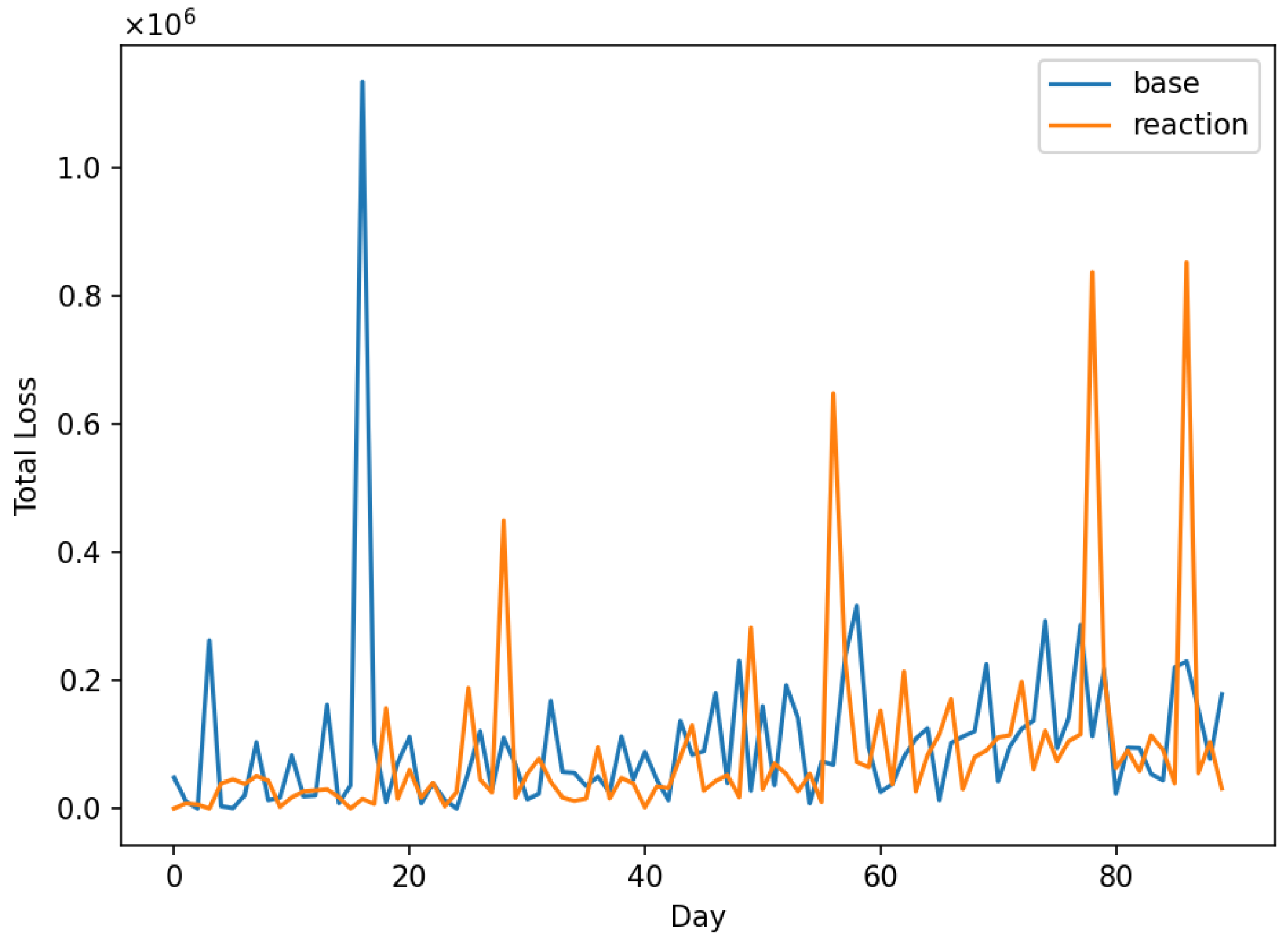
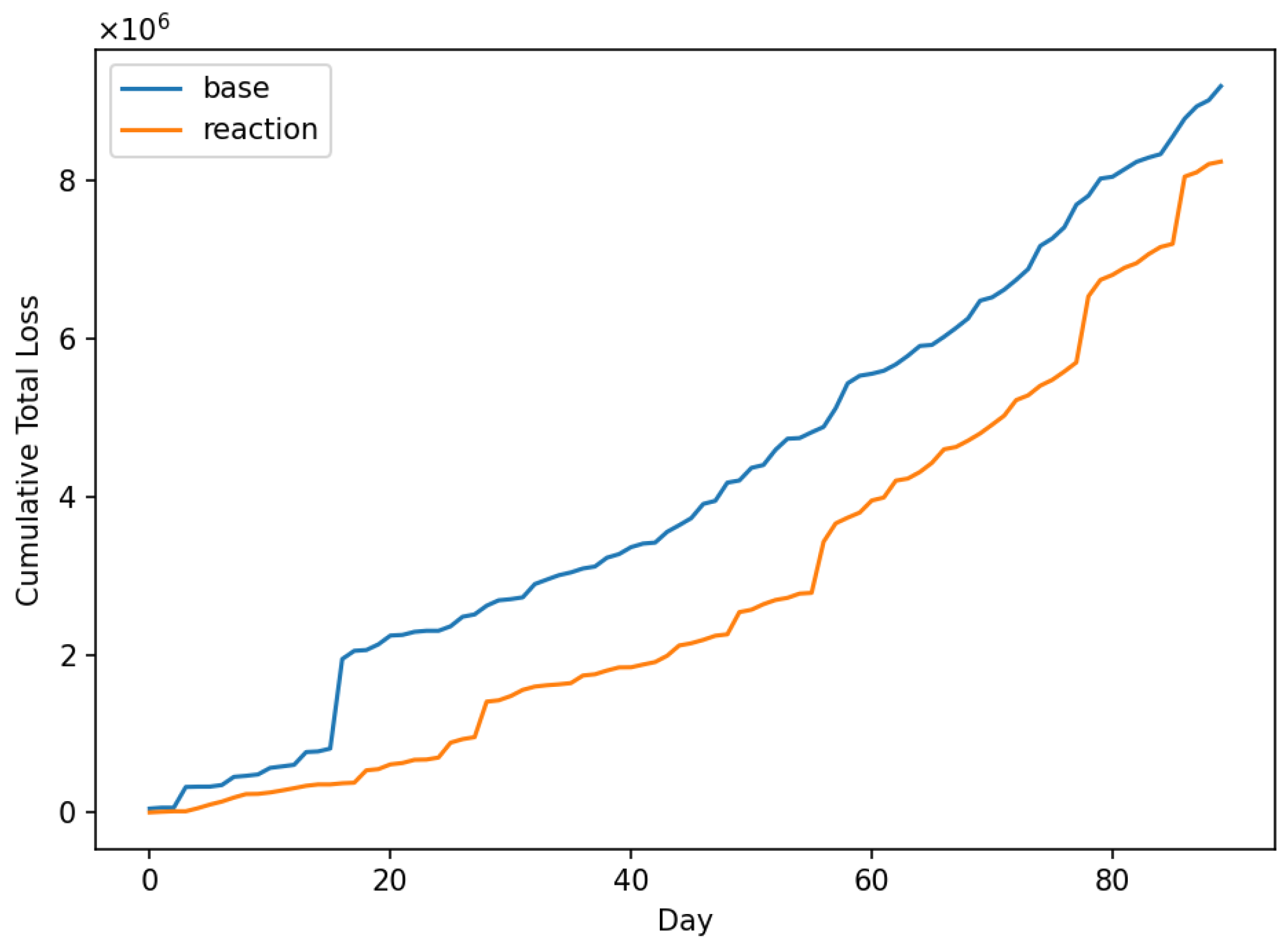
| Reaction | Strong | 300 | 10 | 0.94 | 0.90 |
| Scenario | Attacker Multiplier | Credential Leak Active |
|---|---|---|
| Default | 1 | No |
| Shock | 3.5 | Yes |
| Reaction | 3.5 | Yes |
Disclaimer/Publisher’s Note: The statements, opinions and data contained in all publications are solely those of the individual author(s) and contributor(s) and not of MDPI and/or the editor(s). MDPI and/or the editor(s) disclaim responsibility for any injury to people or property resulting from any ideas, methods, instructions or products referred to in the content. |
© 2026 by the authors. Licensee MDPI, Basel, Switzerland. This article is an open access article distributed under the terms and conditions of the Creative Commons Attribution (CC BY) license.
Share and Cite
Ojehomon, O.G.; Cichorska, J.; Michnik, J. Cyber Risk Management of API-Enabled Financial Crime in Open Banking Services. Entropy 2026, 28, 163. https://doi.org/10.3390/e28020163
Ojehomon OG, Cichorska J, Michnik J. Cyber Risk Management of API-Enabled Financial Crime in Open Banking Services. Entropy. 2026; 28(2):163. https://doi.org/10.3390/e28020163
Chicago/Turabian StyleOjehomon, Odion Gift, Joanna Cichorska, and Jerzy Michnik. 2026. "Cyber Risk Management of API-Enabled Financial Crime in Open Banking Services" Entropy 28, no. 2: 163. https://doi.org/10.3390/e28020163
APA StyleOjehomon, O. G., Cichorska, J., & Michnik, J. (2026). Cyber Risk Management of API-Enabled Financial Crime in Open Banking Services. Entropy, 28(2), 163. https://doi.org/10.3390/e28020163