Mathematical and Algorithmic Advances in Machine Learning for Statistical Process Control: A Systematic Review


Abstract
1. Introduction
1.1. The Evolution of Statistical Process Control
1.2. Complex Industrial Data in Industry 4.0
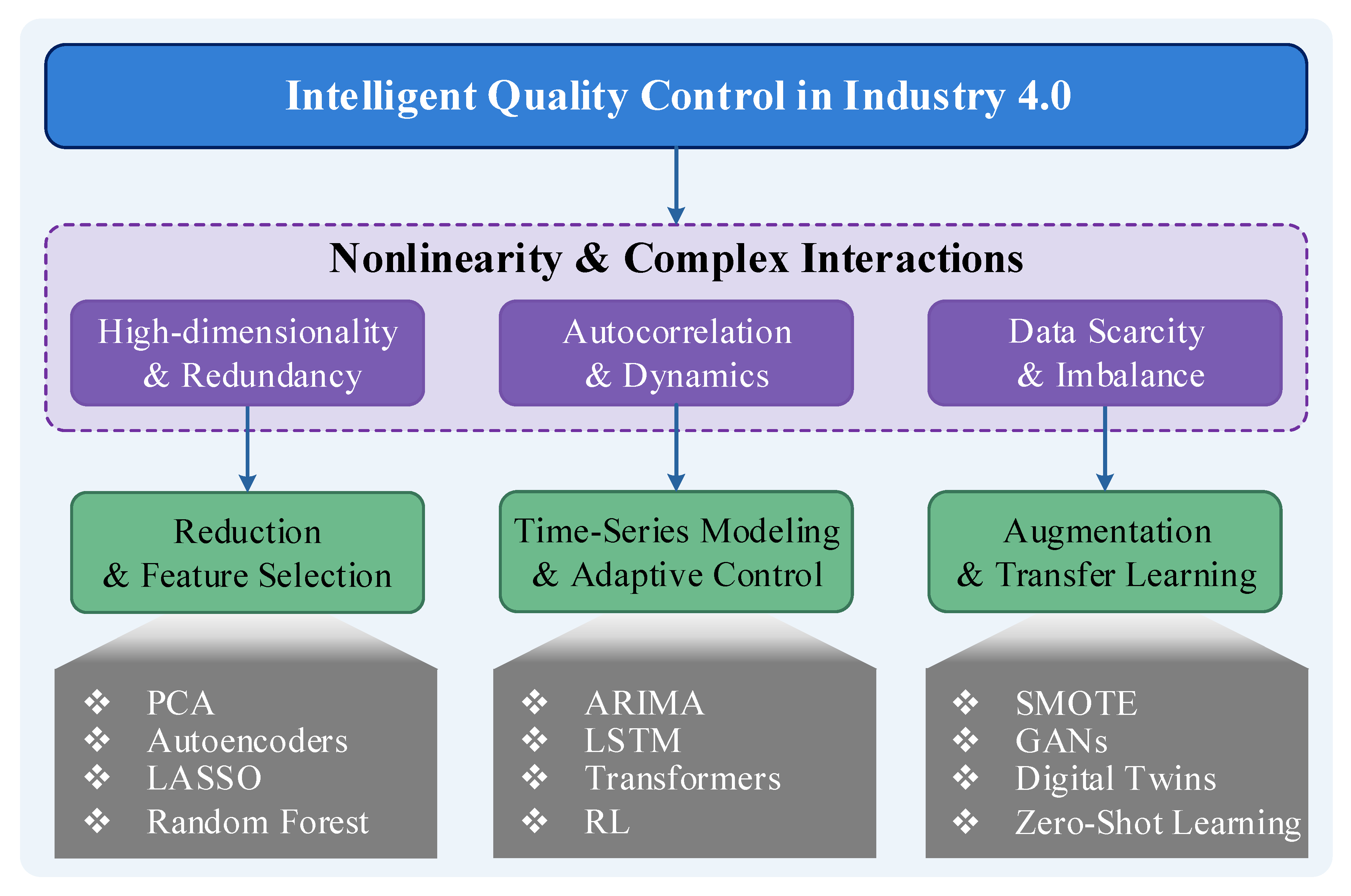
- High-dimensionality and Redundancy: Processes are now monitored by hundreds or even thousands of variables, including high-resolution images and spectral data. This leads to the “curse of dimensionality”, where traditional multivariate charts become insensitive and computationally expensive, while many variables are often highly correlated and redundant [5].
- Autocorrelation and Non-stationarity: High-frequency data collection inherently introduces strong temporal dependencies (autocorrelation) within the data streams. Furthermore, processes may exhibit non-stationary behavior due to tool wear, environmental changes, or shifting operational setpoints, violating the i.i.d. assumption central to classical SPC [6,7].
- Data Scarcity and Imbalance: While overall data volume is large, data corresponding to specific fault conditions or rare events are often scarce. This class imbalance makes it difficult for traditional models to learn effective representations for anomaly detection, a critical task in quality control [8,9].
1.3. Limitations of Classical SPC in Handling Complex Data
1.4. Research Gap and Contributions of This Survey
1.5. Scope and Organization of the Paper
2. Methodology and Systematic Literature Search
2.1. Search Strategy and Databases
- For Section 3 (High-Dimensionality): The query was augmented with terms such as ‘(“high dimensional” OR “multivariate” OR “image-based” OR “multi-sensor” OR “feature selection” OR “dimensionality reduction” OR “PCA” OR “autoencoder”)’.
- For Section 4 (Autocorrelation): We used additional keywords like ‘(“time series” OR “autocorrelated” OR “dynamic” OR “non-stationary” OR “LSTM” OR “recurrent neural network” OR “residual chart”)’.
- For Section 5 (Data Scarcity): The search included terms such as ‘(“imbalanced data” OR “rare event” OR “anomaly detection” OR “few-shot” OR “zero-shot” OR “transfer learning” OR “SMOTE” OR “generative adversarial network”)’.
2.2. Inclusion and Exclusion Criteria
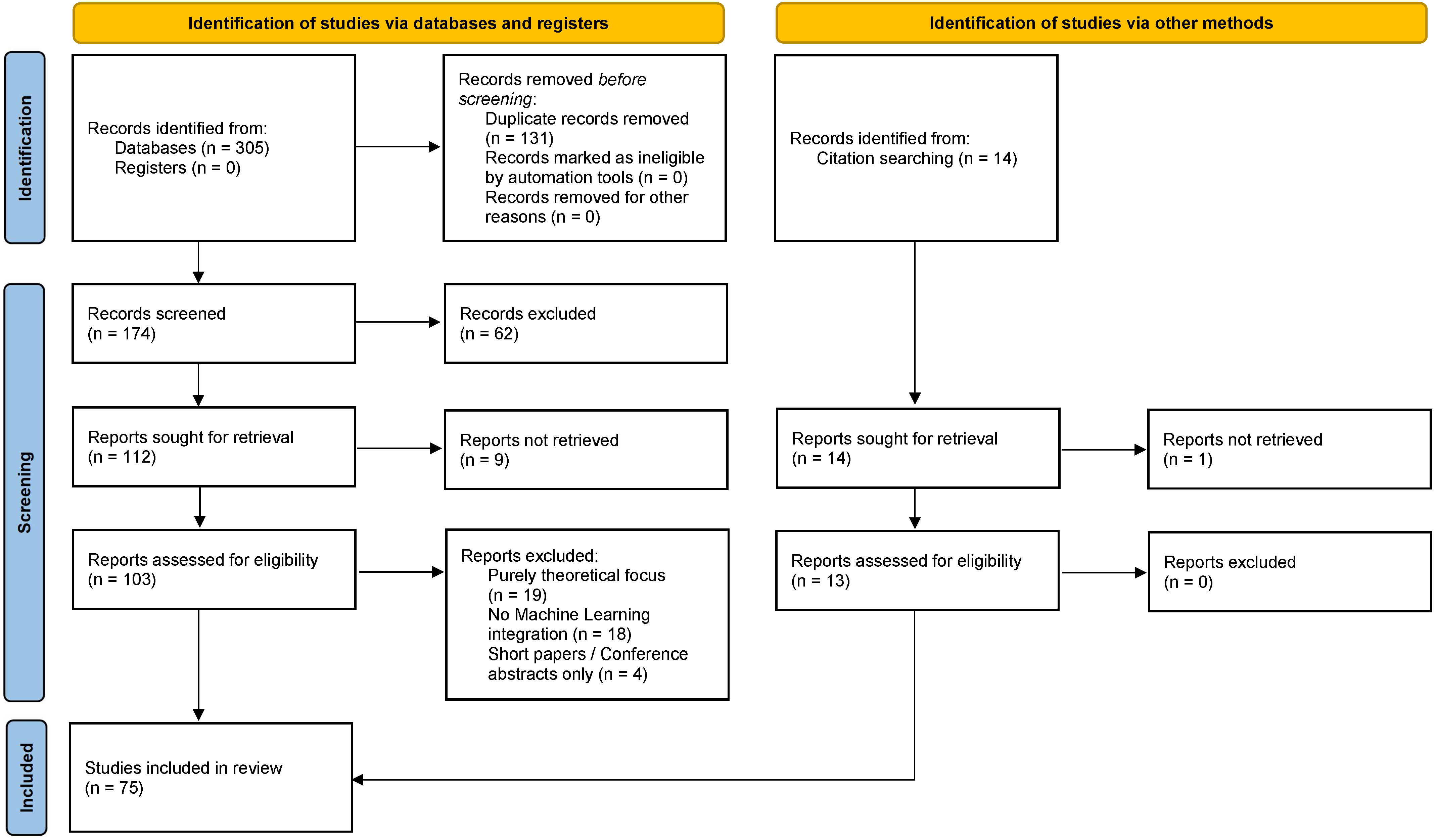
- The primary focus was on the application of one or more ML algorithms to an SPC problem.
- The context was related to industrial, manufacturing, or process monitoring.
- The study provided sufficient methodological detail or empirical results.
- Articles where ML or SPC was only mentioned peripherally.
- Studies focused purely on traditional SPC methods without ML integration.
- Short conference abstracts or non-peer-reviewed articles.
2.3. Study Selection and PRISMA Flow
2.4. Quality Assessment of Included Studies
- 1.
- Clarity of Problem Definition: Was the specific SPC problem being addressed clearly defined, along with the industrial context?
- 2.
- Methodological Rigor and Transparency: Was the ML algorithm and its integration with SPC described in sufficient detail to allow for replication? Were the experimental setup, data sources, and evaluation metrics clearly stated?
- 3.
- Validation and Generalizability: Was the proposed methodology validated using appropriate datasets (e.g., real-world industrial data or realistic simulations)? Were the results discussed in terms of their practical implications and generalizability?
2.5. A Taxonomy of Complex Data Challenges in SPC
3. Methodologies for High-Dimensional and Redundant Data
3.1. Mathematical Challenge: The “Curse of Dimensionality” in Process Monitoring
3.2. Feature Extraction and Dimensionality Reduction
3.2.1. Linear Methods
3.2.2. Nonlinear Methods
3.3. Feature Selection and Regularization
3.4. Tree-Based and Graph-Based Monitoring Approaches
3.4.1. Isolation Forests for Anomaly Detection
3.4.2. Graph Neural Networks
3.5. Establishing Control Limits: Non-Parametric Thresholding
4. Methodologies for Autocorrelated and Dynamic Processes
4.1. Mathematical Challenge: Violation of the i.i.d. Assumption
4.2. Time-Series Forecasting and Residual Analysis
4.2.1. Time-Series Models
4.2.2. Recurrent Neural Networks and Variants
4.3. State-Space Models and Adaptive Control
4.4. Spatio-Temporal Process Monitoring
5. Methodologies for Data Scarcity and Imbalance
5.1. Mathematical Challenge: Learning from Few or Unrepresentative Samples
5.2. Data Augmentation and Generative Models
5.2.1. Over-Sampling Techniques
5.2.2. Generative Adversarial Networks
5.3. Digital Twins for Synthetic Data Generation
5.4. Knowledge Transfer and Low-Shot Learning Paradigms
5.4.1. Domain Adaptation via Transfer Learning
5.4.2. Strategies for Minimal Data: Zero-Shot and Few-Shot Learning
6. Discussion and Open Challenges
6.1. Synthesis of Findings: The Power of Hybridization
6.2. Explainability for Trustworthy SPC
- Using inherently interpretable models (e.g., decision trees, linear models) where possible, even if it involves a slight trade-off in performance [61].
- Employing post-hoc explanation techniques (e.g., SHapley Additive exPlanations (SHAP), Local Interpretable Model-agnostic Explanations (LIME)) to provide feature importance scores for black-box model predictions [62].
- Developing novel neuro-symbolic approaches that combine the learning power of neural networks with the logical reasoning of symbolic AI [63].
6.3. Comparative Analysis of Nonlinear Frameworks
6.4. Limitations of Current ML-Based SPC
6.5. Scalability and Real-Time Implementation
- Distributed and Federated Learning (FL): For large-scale, multi-factory settings, distributed learning frameworks are essential. FL, in particular, offers a privacy-preserving approach where models are trained locally on distributed data without the need to centralize sensitive information, which is crucial when dealing with non-i.i.d. data across different sites [68,69].
6.6. Human-in-the-Loop: Synergizing ML with Domain Expertise
7. Conclusions and Future Prospects
- 1.
- Unified Hybrid Architectures: How can we optimally combine dimensionality reduction (e.g., AEs) with temporal modeling (e.g., LSTMs) and non-parametric thresholding into a single, end-to-end differentiable pipeline? Research should focus on joint optimization of these components rather than sequential training.
- 2.
- Physics-Informed Machine Learning (PIML): Moving beyond purely data-driven models, how can physical laws (e.g., thermodynamics in additive manufacturing) be incorporated into the loss functions of ML models? This is critical to ensure that synthetic data generated by GANs and anomaly scores are physically consistent and interpretable.
- 3.
- Trustworthy and Explainable Deployment: How can we quantify the uncertainty of ML-based control charts in real time? Research is needed into probabilistic DL methods (e.g., Bayesian Neural Networks) that provide confidence intervals alongside anomaly scores, fostering operator trust.
- 4.
- Dynamic Adaptation and Lifelong Learning: How can monitoring systems update their control limits in real time to accommodate natural process aging (drift) without catastrophic forgetting of previous fault signatures? Developing lightweight online learning algorithms for edge deployment is a key technical pathway.
Author Contributions
Funding
Data Availability Statement
Conflicts of Interest
References
- Montgomery, D.C. Introduction to Statistical Quality Control, 7th ed.; John Wiley & Sons: New York, NY, USA, 2009. [Google Scholar]
- Woodall, W.H.; Montgomery, D.C. Some current directions in the theory and application of statistical process monitoring. J. Qual. Technol. 2014, 46, 78–94. [Google Scholar] [CrossRef]
- Jagatheesaperumal, S.K.; Rahouti, M.; Ahmad, K.; Al-Fuqaha, A.; Guizani, M. The duo of artificial intelligence and big data for industry 4.0: Applications, techniques, challenges, and future research directions. IEEE Internet Things J. 2021, 9, 12861–12885. [Google Scholar] [CrossRef]
- Xu, J.; Kovatsch, M.; Mattern, D.; Mazza, F.; Harasic, M.; Paschke, A.; Lucia, S. A review on AI for smart manufacturing: Deep learning challenges and solutions. Appl. Sci. 2022, 12, 8239. [Google Scholar] [CrossRef]
- Yeganeh, A.; Johannssen, A.; Chukhrova, N. The partitioning ensemble control chart for on-line monitoring of high-dimensional image-based quality characteristics. Eng. Appl. Artif. Intell. 2024, 127, 107282. [Google Scholar] [CrossRef]
- Qiu, P.; Li, W.; Li, J. A new process control chart for monitoring short-range serially correlated data. Technometrics 2020, 62, 71–83. [Google Scholar] [CrossRef]
- Yeganeh, A.; Shongwe, S.C.; Nadi, A.A.; Ghuchani, M.M. Monitoring bivariate autocorrelated process using a deep learning-based control chart: A case study on the car manufacturing industry. Comput. Ind. Eng. 2025, 199, 110725. [Google Scholar] [CrossRef]
- Chu, H.; Dong, Y.; Cheng, Q.; Yan, J.; Zhao, Y.; Cao, J.; Zhang, C.; Chen, X. Pattern recognition of control charts based on data feature enhancement and ensemble learning of classifiers for dimensional accuracy of products. Int. J. Prod. Res. 2024, 1–20. [Google Scholar] [CrossRef]
- Li, Y.; Dai, W.; Yu, S.; He, Y. Concurrent control chart pattern recognition in manufacturing processes based on zero-shot learning. ISA Trans. 2024, 154, 228–241. [Google Scholar] [CrossRef] [PubMed]
- Kim, C.K.; Lee, S. Kernel-based composite control chart for nonlinear conditionally heteroscedastic time series. Knowl.-Based Syst. 2025, 325, 113839. [Google Scholar] [CrossRef]
- Liao, R.; He, Y.; Feng, T.; Yang, X.; Dai, W.; Zhang, W. Mission Reliability-Driven Risk-Based Predictive Maintenance Approach of Multistate Manufacturing System. Reliab. Eng. Syst. Saf. 2023, 236, 109273. [Google Scholar] [CrossRef]
- Yang, X.; He, Y.; Liao, R.; Cai, Y.; Dai, W. Mission Reliability-Centered Opportunistic Maintenance Approach for Multistate Manufacturing Systems. Reliab. Eng. Syst. Saf. 2024, 241, 109693. [Google Scholar] [CrossRef]
- Jiang, W.; Tsui, K.L.; Woodall, W.H. A new SPC monitoring method: The ARMA chart. Technometrics 2000, 42, 399–410. [Google Scholar] [CrossRef]
- Zaman, B.; Riaz, M.; Butt, N.R. Memory control chart based on machine learning technique for efficient process monitoring. Comput. Ind. Eng. 2025, 201, 110894. [Google Scholar] [CrossRef]
- Visconti, P.; Rausa, G.; Del-Valle-Soto, C.; Velázquez, R.; Cafagna, D.; De Fazio, R. Machine learning and IoT-based solutions in industrial applications for Smart Manufacturing: A critical review. Future Internet 2024, 16, 394. [Google Scholar] [CrossRef]
- Colosimo, B.M.; Jones-Farmer, L.A.; Megahed, F.M.; Paynabar, K.; Ranjan, C.; Woodall, W.H. Statistical Process Monitoring from Industry 2.0 to Industry 4.0: Insights into Research and Practice. Technometrics 2024, 66, 507–530. [Google Scholar] [CrossRef]
- Page, M.J.; McKenzie, J.E.; Bossuyt, P.M.; Boutron, I.; Hoffmann, T.C.; Mulrow, C.D.; Shamseer, L.; Tetzlaff, J.M.; Akl, E.A.; Brennan, S.E.; et al. The PRISMA 2020 statement: An updated guideline for reporting systematic reviews. BMJ 2021, 372, n71. [Google Scholar] [CrossRef] [PubMed]
- Ahmed, F.; Mahmood, T.; Riaz, M.; Abbas, N. Comprehensive Review of High-Dimensional Monitoring Methods: Trends, Insights, and Interconnections. Qual. Technol. Quant. Manag. 2025, 22, 727–751. [Google Scholar] [CrossRef]
- Wang, Y.; Ma, X.; Qian, P. Wind turbine fault detection and identification through PCA-based optimal variable selection. IEEE Trans. Sustain. Energy 2018, 9, 1627–1635. [Google Scholar] [CrossRef]
- Bamdad, S. Leveraging machine learning and decision analytics for sustainable and resilient environmental monitoring in metal processing industries: A step towards Industry 5.0. Int. J. Prod. Res. 2025, 1–27. [Google Scholar] [CrossRef]
- Mahmood, T.; Riaz, M.; Abbas, N.; Ahmed, F. Advanced Real-Time Monitoring Techniques for High-Dimensional Data Streams in Industrial Two-Sample Analysis. Prod. Eng. 2025, 19, 1177–1193. [Google Scholar] [CrossRef]
- Yao, C.; Yang, Y.; Yin, K.; Yang, J. Traffic anomaly detection in wireless sensor networks based on principal component analysis and deep convolution neural network. IEEE Access 2022, 10, 103136–103149. [Google Scholar] [CrossRef]
- Khaw, K.W.; Chew, X.; Yeong, W.C.; Lim, S.L. Optimal design of the synthetic control chart for monitoring the multivariate coefficient of variation. Chemom. Intell. Lab. Syst. 2019, 186, 33–40. [Google Scholar] [CrossRef]
- Haq, A.; Munir, T.; Khoo, M.B.C. Dual multivariate CUSUM mean charts. Comput. Ind. Eng. 2019, 137, 106028. [Google Scholar] [CrossRef]
- Attouri, K.; Mansouri, M.; Hajji, M.; Bouzrara, K. Efficient Fault Detection in Nonlinear Industrial Process: A Reduced Kernel PCA-based Spectral Clustering Approach. In Proceedings of the 2025 International Conference for Artificial Intelligence, Applications, Innovation and Ethics (AI2E), Muscat, Oman, 3–5 February 2025; pp. 1–6. [Google Scholar] [CrossRef]
- Müller, N.M.; Roschmann, S.; Khan, S.; Sperl, P.; Böttinger, K. Shortcut detection with variational autoencoders. In Proceedings of the 2024 International Joint Conference on Neural Networks (IJCNN), Yokohama, Japan, 30 June–5 July 2024; IEEE: Piscataway, NJ, USA, 2024; pp. 1–7. [Google Scholar]
- Marconato, E.; Passerini, A.; Teso, S. Interpretability is in the mind of the beholder: A causal framework for human-interpretable representation learning. Entropy 2023, 25, 1574. [Google Scholar] [CrossRef]
- McKinney, M.; Garland, A.; Cillessen, D.; Adamczyk, J.; Bolintineanu, D.; Heiden, M.; Fowler, E.; Boyce, B.L. Unsupervised multimodal fusion of in-process sensor data for advanced manufacturing process monitoring. J. Manuf. Syst. 2025, 78, 271–282. [Google Scholar] [CrossRef]
- Mattera, G.; Mattera, R.; Otto, P. Hybrid Statistical Process Monitoring of Wire Arc Additive Manufacturing with Frequency-Informed Deep Learning. Qual. Reliab. Eng. Int. 2025, 41, 3334–3349. [Google Scholar]
- Ali, H.; Safdar, R.; Zhou, Y.; Yao, Y.; Yao, L.; Zhang, Z.; Rasool, M.H.; Gao, F. Robust statistical industrial fault monitoring: A machine learning-based distributed CCA and low frequency control charts. Chem. Eng. Sci. 2024, 299, 120460. [Google Scholar] [CrossRef]
- Wu, C.; Wang, D.; Luo, M.; Huang, W.; Si, Z. Nonparametric monitoring of high-dimensional processes via EWMA control charts based on random forest learning. Comput. Ind. Eng. 2025, 204, 111111. [Google Scholar] [CrossRef]
- Mukhtiar, F.; Zaman, B.; Butt, N.R. Enhanced process monitoring using machine learning-based control charts for poisson-distributed data. Eng. Appl. Artif. Intell. 2025, 157, 111227. [Google Scholar] [CrossRef]
- Zhou, W.; Xie, Y.; Zheng, Z. A multivariate finite horizon production control chart for monitoring the food production process. Qual. Technol. Quant. Manag. 2025, 22, 1086–1111. [Google Scholar] [CrossRef]
- Yeganeh, A.; Chukhrova, N.; Johannssen, A.; Fotuhi, H. A network surveillance approach using machine learning based control charts. Expert Syst. Appl. 2023, 219, 119660. [Google Scholar] [CrossRef]
- Wang, J.; Liu, L. A new multivariate control chart based on the isolation forest algorithm. Qual. Eng. 2024, 36, 390–406. [Google Scholar] [CrossRef]
- Li, Z.; Shi, J.; Van Leeuwen, M. Graph neural networks based log anomaly detection and explanation. In Proceedings of the 2024 IEEE/ACM 46th International Conference on Software Engineering: Companion Proceedings, Lisbon, Portugal, 14–20 April 2024; pp. 306–307. [Google Scholar]
- Bao, D.; Wang, Y.; Li, S. Dynamic Graph Embedding PCA to Extract Spatio–Temporal Information for Fault Detection. IEEE Trans. Ind. Inform. 2025, 21, 1714–1723. [Google Scholar] [CrossRef]
- Curato, I.V.; Furat, O.; Proietti, L.; Ströh, B. Mixed moving average field guided learning for spatio-temporal data. Electron. J. Stat. 2025, 19, 519–592. [Google Scholar] [CrossRef]
- Zhou, Y.; Jin, R.; Qiu, P. Machine Learning Control Charts for Monitoring Spatio-Temporal Data Streams. Qual. Reliab. Eng. Int. 2025, 41, 2373–2384. [Google Scholar] [CrossRef]
- Chen, S.; Yu, J. Deep recurrent neural network-based residual control chart for autocorrelated processes. Qual. Reliab. Eng. Int. 2019, 35, 2687–2708. [Google Scholar] [CrossRef]
- Khaldi, R.; El Afia, A.; Chiheb, R.; Tabik, S. What is the best RNN-cell structure to forecast each time series behavior? Expert Syst. Appl. 2023, 215, 119140. [Google Scholar] [CrossRef]
- Tayeh, T.; Aburakhia, S.; Myers, R.; Shami, A. An attention-based ConvLSTM autoencoder with dynamic thresholding for unsupervised anomaly detection in multivariate time series. Mach. Learn. Knowl. Extr. 2022, 4, 350–370. [Google Scholar] [CrossRef]
- Zhang, Z.; Wu, Z.; Rincon, D.; Christofides, P.D. Real-time optimization and control of nonlinear processes using machine learning. Mathematics 2019, 7, 890. [Google Scholar] [CrossRef]
- Lin, R.; Luo, Y.; Wu, X.; Chen, J.; Huang, B.; Su, H.; Xie, L. Surrogate empowered Sim2Real transfer of deep reinforcement learning for ORC superheat control. Appl. Energy 2024, 356, 122310. [Google Scholar] [CrossRef]
- Zaman, B.; Khan, N. Adaptive CUSUM control chart utilizing supervised learning for monitoring the process location parameter: A case study application. Qual. Reliab. Eng. Int. 2025, 41, 2032–2050. [Google Scholar] [CrossRef]
- Tauqeer, F.; Riaz, M.; Zaman, B.; Arshad, I.A. A Simulation-Based Bayesian Multivariate Adaptive EWMA Framework with Hybrid Score Functions for Monitoring Water Quality. J. Stat. Comput. Simul. 2025, 1–45. [Google Scholar] [CrossRef]
- Abbas, T.; Albogamy, F.R.; Abid, M. A Machine Learning Approach to Adaptive EWMA Control Charts: Insights from Cardiac Surgery Data. Qual. Reliab. Eng. Int. 2025, 41, 2567–2575. [Google Scholar] [CrossRef]
- Taconeli, C.A. Dual-Rank Ranked Set Sampling. J. Stat. Comput. Simul. 2024, 94, 29–49. [Google Scholar] [CrossRef]
- Biyyapu, N.; Veerapaneni, E.J.; Surapaneni, P.P.; Vellela, S.S.; Vatambeti, R. Designing a Modified Feature Aggregation Model with Hybrid Sampling Techniques for Network Intrusion Detection. Clust. Comput. 2024, 27, 5913–5931. [Google Scholar] [CrossRef]
- Zhang, J.; Ding, R.; Ban, M.; Dai, L. PKU-GoodsAD: A supermarket goods dataset for unsupervised anomaly detection and segmentation. IEEE Robot. Autom. Lett. 2024, 9, 2008–2015. [Google Scholar] [CrossRef]
- Li, Y.; Vasconcelos, N. Repair: Removing representation bias by dataset resampling. In Proceedings of the IEEE/CVF Conference on Computer Vision and Pattern Recognition, Long Beach, CA, USA, 15–20 June 2019; pp. 9572–9581. [Google Scholar]
- dos Santos, C.H.; Campos, A.T.; Montevechi, J.A.B.; de Carvalho Miranda, R.; Costa, A.F.B. Digital Twin simulation models: A validation method based on machine learning and control charts. Int. J. Prod. Res. 2024, 62, 2398–2414. [Google Scholar] [CrossRef]
- Mih, A.N.; Cao, H.; Pickard, J.; Wachowicz, M.; Dubay, R. TransferD2: Automated Defect Detection Approach in Smart Manufacturing using Transfer Learning Techniques. In Proceedings of the 2023 IEEE International Conference on Omni-Layer Intelligent Systems (COINS), Berlin, Germany, 23–25 July 2023; IEEE: Piscataway, NJ, USA, 2023; pp. 1–8. [Google Scholar]
- Aburakhia, S.; Tayeh, T.; Myers, R.; Shami, A. Similarity-based predictive maintenance framework for rotating machinery. In Proceedings of the 2022 5th International Conference on Communications, Signal Processing, and Their Applications (ICCSPA), Cairo, Egypt, 27–29 December 2022; IEEE: Piscataway, NJ, USA, 2022; pp. 1–6. [Google Scholar]
- Ratner, A.; Hancock, B.; Dunnmon, J.; Sala, F.; Pandey, S.; Ré, C. Training complex models with multi-task weak supervision. In Proceedings of the AAAI Conference on Artificial Intelligence, Honolulu, HI, USA, 27 January–1 February 2019; Volume 33, pp. 4763–4771. [Google Scholar]
- Shang, Y.; Lu, C.; Li, L.; He, S. Self-Starting Monitoring Schemes for Small-Sample Poisson Profiles Based on Transfer Learning. Comput. Ind. Eng. 2024, 192, 110262. [Google Scholar] [CrossRef]
- Chu, K.; Liu, R.; Duan, G. A Gray Correlation Based Bayesian Network Model for Fault Source Diagnosis of Multistage Process—Small Sample Manufacturing System. Adv. Eng. Inform. 2023, 56, 101918. [Google Scholar] [CrossRef]
- Wang, F.K.; Mamo, T. Hybrid approach for remaining useful life prediction of ball bearings. Qual. Reliab. Eng. Int. 2019, 35, 2494–2505. [Google Scholar] [CrossRef]
- Kruschel, S.; Hambauer, N.; Weinzierl, S.; Zilker, S.; Kraus, M.; Zschech, P. Challenging the performance-interpretability trade-off: An evaluation of interpretable machine learning models. Bus. Inf. Syst. Eng. 2025, 1–25. [Google Scholar] [CrossRef]
- Alpaydin, E. Introduction to Machine Learning, 4th ed.; MIT Press: London, UK, 2020. [Google Scholar]
- Wei, D.; Nair, R.; Dhurandhar, A.; Varshney, K.R.; Daly, E.; Singh, M. On the safety of interpretable machine learning: A maximum deviation approach. Adv. Neural Inf. Process. Syst. 2022, 35, 9866–9880. [Google Scholar]
- Qian, X.; Zhang, C.; Yella, J.; Huang, Y.; Huang, M.C.; Bom, S. Soft sensing model visualization: Fine-tuning neural network from what model learned. In Proceedings of the 2021 IEEE International Conference on Big Data (Big Data), Orlando, FL, USA, 15–18 December 2021; IEEE: Piscataway, NJ, USA, 2021; pp. 1900–1908. [Google Scholar]
- Lu, Z.; Afridi, I.; Kang, H.J.; Ruchkin, I.; Zheng, X. Surveying neuro-symbolic approaches for reliable artificial intelligence of things. J. Reliab. Intell. Environ. 2024, 10, 257–279. [Google Scholar] [CrossRef]
- Shahzad, F.; Huang, Z.; Memon, W.H. Process Monitoring Using Kernel PCA and Kernel Density Estimation-Based SSGLR Method for Nonlinear Fault Detection. Appl. Sci. 2022, 12, 2981. [Google Scholar] [CrossRef]
- Marsh, I.; Paladi, N.; Abrahamsson, H.; Gustafsson, J.; Sjöberg, J.; Johnsson, A.; Sköldström, P.; Dowling, J.; Monti, P.; Vruna, M.; et al. Evolving 5G: ANIARA, an edge-cloud perspective. In Proceedings of the 18th ACM International Conference on Computing Frontiers, Virtual, 11–13 May 2021; pp. 206–207. [Google Scholar]
- Miro-Panades, I.; Tain, B.; Christmann, J.F.; Coriat, D.; Lemaire, R.; Jany, C.; Martineau, B.; Chaix, F.; Waltener, G.; Pluchart, E.; et al. SamurAI: A versatile IoT node with event-driven wake-up and embedded ML acceleration. IEEE J. Solid-State Circuits 2022, 58, 1782–1797. [Google Scholar]
- Jena, S.; Pulkit, A.; Singh, K.; Banerjee, A.; Joshi, S.; Ganesh, A.; Singh, D.; Bhavsar, A. Unified anomaly detection methods on edge device using knowledge distillation and quantization. In Proceedings of the International Workshop on Reproducible Research in Pattern Recognition, Kolkata, India, 1 December 2024; Springer: Berlin/Heidelberg, Germany, 2024; pp. 60–81. [Google Scholar]
- Savazzi, S.; Nicoli, M.; Bennis, M.; Kianoush, S.; Barbieri, L. Opportunities of federated learning in connected, cooperative, and automated industrial systems. IEEE Commun. Mag. 2021, 59, 16–21. [Google Scholar] [CrossRef]
- Hsieh, K.; Phanishayee, A.; Mutlu, O.; Gibbons, P. The non-iid data quagmire of decentralized machine learning. In Proceedings of the International Conference on Machine Learning, PMLR, Virtual, 13–18 July 2020; pp. 4387–4398. [Google Scholar]
- Liu, R.; Mu, P.; Yuan, X.; Zeng, S.; Zhang, J. A general descent aggregation framework for gradient-based bi-level optimization. IEEE Trans. Pattern Anal. Mach. Intell. 2022, 45, 38–57. [Google Scholar]
- Chen, H.; Ye, Y.; Xiao, M.; Skoglund, M. Asynchronous parallel incremental block-coordinate descent for decentralized machine learning. IEEE Trans. Big Data 2022, 9, 1252–1259. [Google Scholar] [CrossRef]
- Mager, F.; Baumann, D.; Herrmann, C.; Trimpe, S.; Zimmerling, M. Scaling beyond bandwidth limitations: Wireless control with stability guarantees under overload. ACM Trans. Cyber-Phys. Syst. 2022, 6, 20. [Google Scholar] [CrossRef]
- Karkaria, V.; Goeckner, A.; Zha, R.; Chen, J.; Zhang, J.; Zhu, Q.; Cao, J.; Gao, R.X.; Chen, W. Towards a Digital Twin Framework in Additive Manufacturing: Machine Learning and Bayesian Optimization for Time Series Process Optimization. J. Manuf. Syst. 2024, 75, 322–332. [Google Scholar] [CrossRef]
- Haindl, P.; Buchgeher, G.; Khan, M.; Moser, B. Towards a reference software architecture for human-ai teaming in smart manufacturing. In Proceedings of the ACM/IEEE 44th International Conference on Software Engineering: New Ideas and Emerging Results, Pittsburgh, PA, USA, 21–29 May 2022; pp. 96–100. [Google Scholar]
- Wang, B.; Zheng, P.; Yin, Y.; Shih, A.; Wang, L. Toward human-centric smart manufacturing: A human-cyber-physical systems (HCPS) perspective. J. Manuf. Syst. 2022, 63, 471–490. [Google Scholar] [CrossRef]


| Data Challenge | Methodology | Key Algorithms & References | Strengths | Limitations |
|---|---|---|---|---|
| High-Dimensionality & Redundancy | Dimensionality Reduction; Feature Selection; Graph Learning | PCA/PLS [20]; AE/VAE [27,28]; Random Forest [31]; GNN [36]; Isolation Forest [35] | Handles multicollinearity; Extracts latent patterns; Robust to noise; Captures topological dependencies (GNN). | Loss of physical interpretability (AE); Linear assumptions fail on manifolds (PCA); Computationally intensive. |
| Autocorrelation & Dynamic Processes | Residual Analysis; Time-Series Forecasting; Adaptive Control | ARIMA [6]; LSTM/GRU/RNN [7,40]; Reinforcement Learning (RL) [44]; Adaptive CUSUM [45]; Kernel Methods [10] | Models temporal dependencies; Reduces false alarms; Adapts to non-stationarity and dynamic shifts. | Training complexity (RNN); Model selection difficulty (ARIMA); Data hungry (RL); “Black-box” nature. |
| Data Scarcity & Imbalance | Data Augmentation; Generative Models; Transfer Learning | SMOTE [8]; GANs [50]; Digital Twins [29]; Transfer Learning [53]; Zero/Few-Shot Learning [9] | Balances class distribution; Enables cold-start monitoring; Generates diverse synthetic scenarios. | Synthetic data fidelity issues; Mode collapse (GANs); Risk of negative transfer; Simulation–reality gap. |
Disclaimer/Publisher’s Note: The statements, opinions and data contained in all publications are solely those of the individual author(s) and contributor(s) and not of MDPI and/or the editor(s). MDPI and/or the editor(s) disclaim responsibility for any injury to people or property resulting from any ideas, methods, instructions or products referred to in the content. |
© 2026 by the authors. Licensee MDPI, Basel, Switzerland. This article is an open access article distributed under the terms and conditions of the Creative Commons Attribution (CC BY) license.
Share and Cite
Qiao, Y.; Han, T.; Wu, Z.; Jin, G.; Zhang, Q.; Xu, Q. Mathematical and Algorithmic Advances in Machine Learning for Statistical Process Control: A Systematic Review. Entropy 2026, 28, 151. https://doi.org/10.3390/e28020151
Qiao Y, Han T, Wu Z, Jin G, Zhang Q, Xu Q. Mathematical and Algorithmic Advances in Machine Learning for Statistical Process Control: A Systematic Review. Entropy. 2026; 28(2):151. https://doi.org/10.3390/e28020151
Chicago/Turabian StyleQiao, Yulong, Tingting Han, Zixing Wu, Ge Jin, Qian Zhang, and Qin Xu. 2026. "Mathematical and Algorithmic Advances in Machine Learning for Statistical Process Control: A Systematic Review" Entropy 28, no. 2: 151. https://doi.org/10.3390/e28020151
APA StyleQiao, Y., Han, T., Wu, Z., Jin, G., Zhang, Q., & Xu, Q. (2026). Mathematical and Algorithmic Advances in Machine Learning for Statistical Process Control: A Systematic Review. Entropy, 28(2), 151. https://doi.org/10.3390/e28020151