Generalized Legendre Transforms Have Roots in Information Geometry †


Abstract
1. Introduction
- ;
- .
2. Generalized Legendre Transforms as Ordinary Legendre Transforms
3. An Information-Geometric Interpretation of Generalized Legendre Transforms
- The cumulant function of a natural exponential family [16,32]: Let be a measurable space with a sample space , σ algebra Ω, and a positive measure μ (e.g., counting or Lebesgue measure). An exponential family is a set of probability measures , whereis the natural parameter space. is strictly log-convex [32], and hence is strictly convex (and differentiable). In this case, the convex conjugate amounts to the negative Shannon or differential entropy [33] , where is the Shannon entropy (when μ is the counting measure) or the differential entropy (when μ is the Lebesgue measure).
- The negative Shannon entropy of a mixture family [16]: A mixture family is a set of probability measuresparameterized by a normalized positive weight vector (the standard -dimensional simplex) such that the functions are linearly independent. The function is strictly convex and differentiable (see [34] for a proof). In this case, the convex conjugate is the cross-entropy of with the mixture , where .
- The characteristic function of a regular cone [19] (i.e., convex and pointed cone): Let be a regular cone and be its dual cone. We define , where is the characteristic function . One can further build generalized Wishart exponential families on the cones [35]. (Note that Massieu [36] introduced the concept of characteristic functions and their convex conjugates in thermodynamics in the 19th century.) See also the barrier functions (logarithms of characteristic functions) on convex cones for interior point methods [37].
- The Guillemin potential of a (Delzant) polytope [38] which recovers the negative Shannon entropy when considering the standard simplex.
4. Conclusions
Funding
Data Availability Statement
Conflicts of Interest
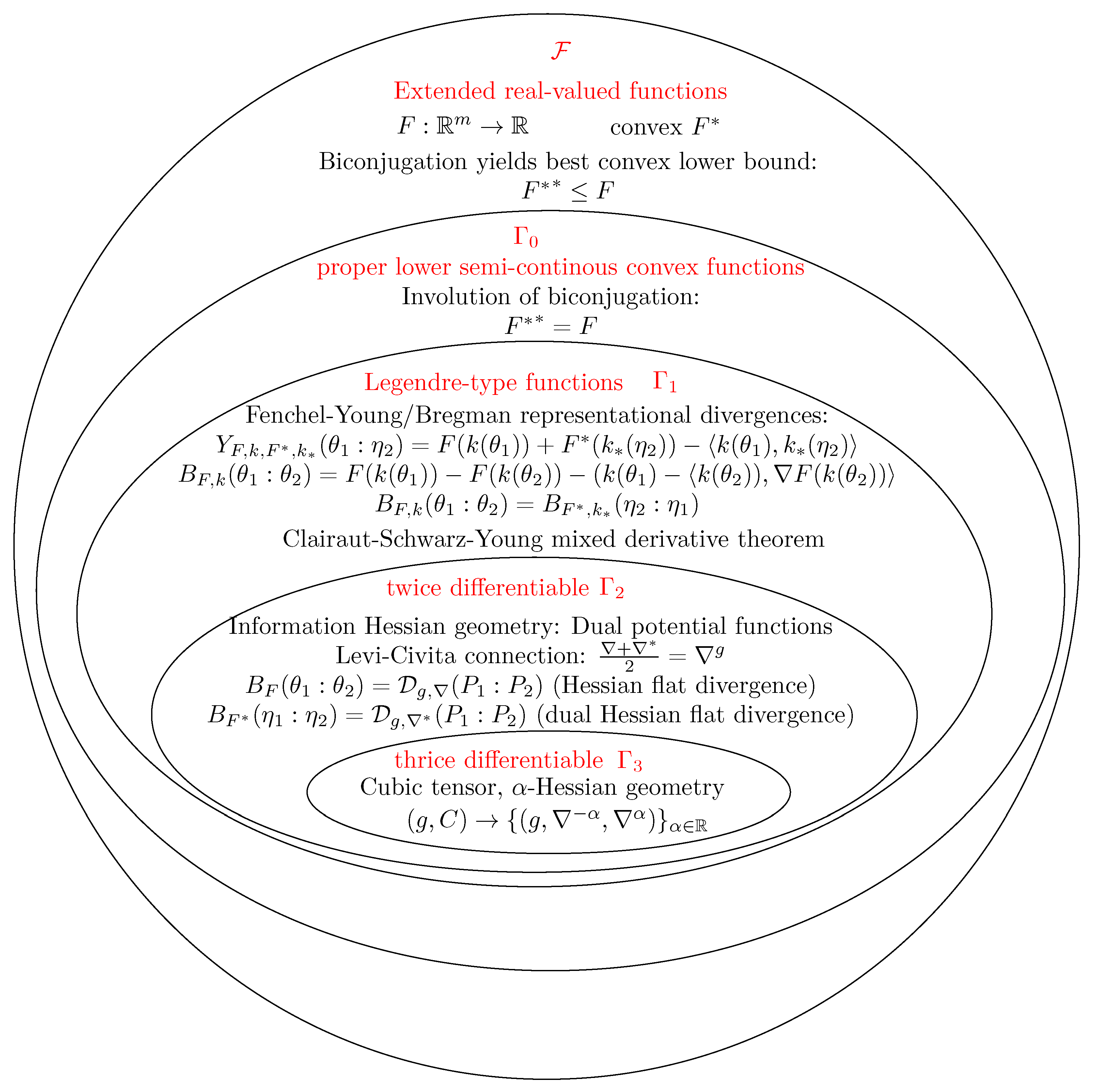
Appendix A. Legendre-Type Functions
- Θ is a non-empty open effective domain;
- F is strictly convex and differentiable on Θ;
- F becomes infinitely steep close to boundary points of its effective domain:
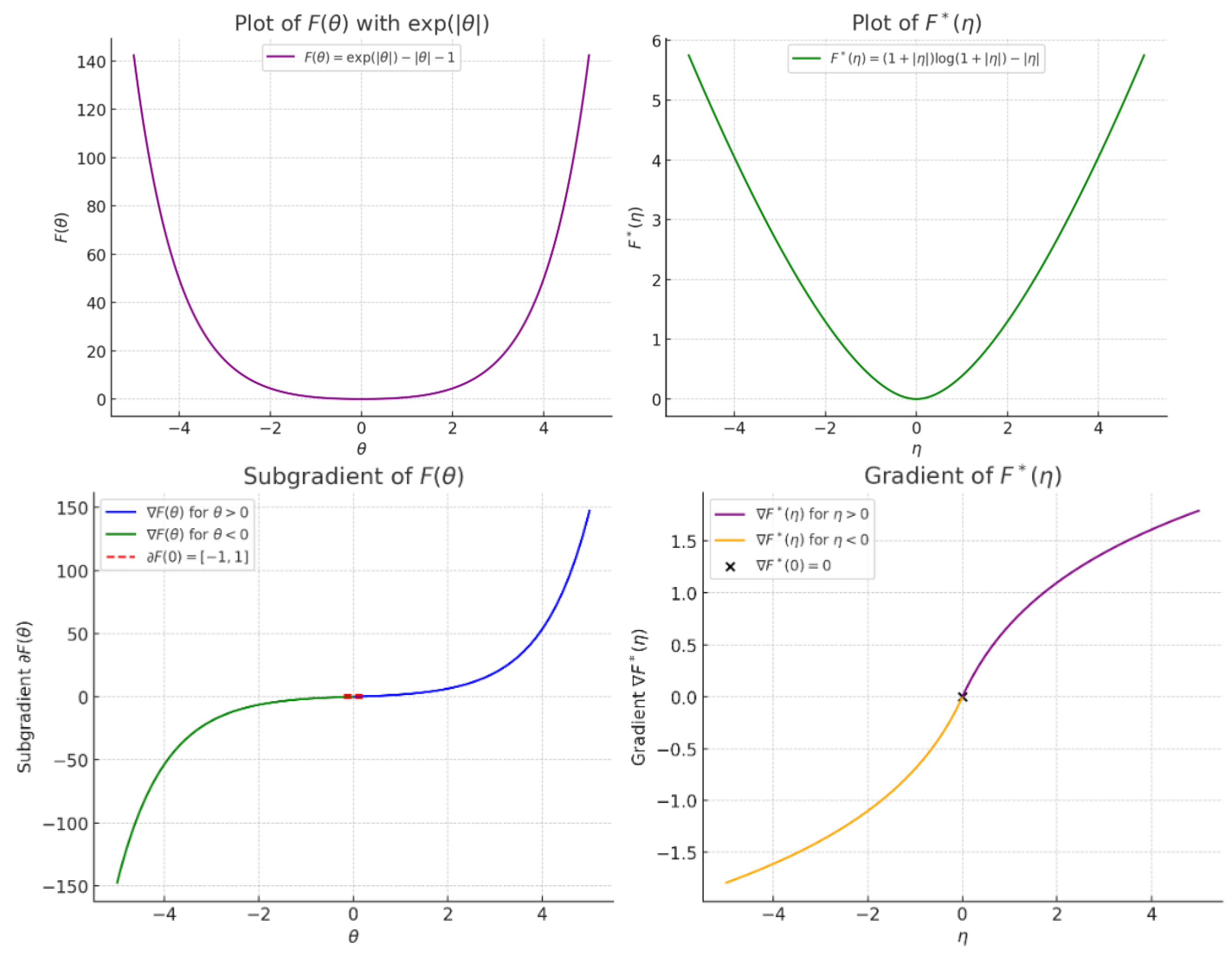
Appendix B. Some Examples of Convex Conjugates

References
- Bauschke, H.H.; Lucet, Y. What is… a Fenchel conjugate? Not. AMS 2012, 59, 44–46. [Google Scholar] [CrossRef]
- Legendre, A.M. Nouvelles méthodes pour la détermination des orbites des comètes; Firmin Didot: Paris, France, 1805. [Google Scholar]
- Hamilton, W.R. On a General Method in Dynamics. In Philosophical Transactions of the Royal Society of London; Cambridge University: Cambridge, UK, 1834; pp. 247–308. [Google Scholar]
- Gibbs, J.W. Elementary Principles of Statistical Mechanics; Yale University Press: New Haven, CT, USA, 1902. [Google Scholar]
- Callen, H.B. Thermodynamics and an Introduction to Thermostatistics; John Wiley & Sons: Hoboken, NJ, USA, 1985. [Google Scholar]
- Weinberg, S. The Quantum Theory of Fields; Cambridge University Press: Cambridge, UK, 1995; Volume 2. [Google Scholar]
- Mas-Colell, A.; Whinston, M.D.; Green, J.R. Microeconomic Theory; Oxford University Press: New York, NY, USA, 1995; Volume 1. [Google Scholar]
- Rockafellar, R.T. Convex Analysis. Princet. Math. Ser. 1970, 28, 470. [Google Scholar]
- Correa, R.; Hantoute, A.; López, M.A. Fundamentals of Convex Analysis and Optimization; Springer: Berlin/Heidelberg, Germany, 2023. [Google Scholar]
- Möllenhoff, T.; Khan, M.E. SAM as an Optimal Relaxation of Bayes. In Proceedings of the The Eleventh International Conference on Learning Representations, Kigali, Rwanda, 1–5 May 2023; ICLR: Appleton, WI, USA, 2023. [Google Scholar]
- Artstein-Avidan, S.; Milman, V. A characterization of the concept of duality. Electron. Res. Announc. 2007, 14, 42–59. [Google Scholar]
- Artstein-Avidan, S.; Milman, V. The concept of duality in convex analysis, and the characterization of the Legendre transform. Ann. Math. 2009, 169, 661–674. [Google Scholar] [CrossRef]
- Fenchel, W. On Conjugate Convex Functions. Can. J. Math. 1949, 1, 73–77. [Google Scholar] [CrossRef]
- Fenchel, W. On conjugate convex functions. In Traces and Emergence of Nonlinear Programming; Springer: Berlin/Heidelberg, Germany, 2013; pp. 125–129. [Google Scholar]
- Böröczky, K.J.; Schneider, R. A characterization of the duality mapping for convex bodies. Geom. Funct. Anal. 2008, 18, 657–667. [Google Scholar] [CrossRef]
- Amari, S.i. Information Geometry and Its Applications; Springer: Berlin/Heidelberg, Germany, 2016; Volume 194. [Google Scholar]
- Ay, N.; Jost, J.; Vân Lê, H.; Schwachhöfer, L. Information Geometry; Springer: Berlin/Heidelberg, Germany, 2017; Volume 64. [Google Scholar]
- Rockafellar, R.T. Conjugates and Legendre transforms of convex functions. Can. J. Math. 1967, 19, 200–205. [Google Scholar] [CrossRef]
- Shima, H. The Geometry of Hessian Structures; World Scientific: Singapore, 2007. [Google Scholar]
- Amari, S.i.; Nagaoka, H. Methods of Information Geometry; American Mathematical Society: Providence, RI, USA, 2000; Volume 191. [Google Scholar]
- Morales, P.A.; Korbel, J.; Rosas, F.E. Geometric structures induced by deformations of the Legendre transform. Entropy 2023, 25, 678. [Google Scholar] [CrossRef] [PubMed]
- Leok, M.; Zhang, J. Connecting information geometry and geometric mechanics. Entropy 2017, 19, 518. [Google Scholar] [CrossRef]
- Naudts, J.; Zhang, J. Legendre duality: From thermodynamics to information geometry. Inf. Geom. 2024, 7, 623–649. [Google Scholar] [CrossRef]
- Attouch, H.; Wets, R.J.B. Isometries for the Legendre-Fenchel transform. Trans. Am. Math. Soc. 1986, 296, 33–60. [Google Scholar] [CrossRef][Green Version]
- Nock, R.; Nielsen, F.; Amari, S.I. On conformal divergences and their population minimizers. IEEE Trans. Inf. Theory 2015, 62, 527–538. [Google Scholar] [CrossRef]
- Nielsen, F.; Nock, R. The dual Voronoi diagrams with respect to representational Bregman divergences. In Proceedings of the Sixth International Symposium on Voronoi Diagrams (ISVD), Copenhagen, Denmark, 23–26 June 2009; IEEE: New York, NY, USA, 2009; pp. 71–78. [Google Scholar]
- Amari, S.i. α-Divergence is unique, belonging to both f-divergence and Bregman divergence classes. IEEE Trans. Inf. Theory 2009, 55, 4925–4931. [Google Scholar] [CrossRef]
- Csiszar, I. Why least squares and maximum entropy? An axiomatic approach to inference for linear inverse problems. Ann. Stat. 1991, 19, 2032–2066. [Google Scholar] [CrossRef]
- Murata, N.; Takenouchi, T.; Kanamori, T.; Eguchi, S. Information geometry of U-Boost and Bregman divergence. Neural Comput. 2004, 16, 1437–1481. [Google Scholar] [CrossRef] [PubMed]
- Hennequin, R.; David, B.; Badeau, R. Beta-divergence as a subclass of Bregman divergence. IEEE Signal Process. Lett. 2010, 18, 83–86. [Google Scholar] [CrossRef]
- Dikmen, O.; Yang, Z.; Oja, E. Learning the information divergence. IEEE Trans. Pattern Anal. Mach. Intell. 2014, 37, 1442–1454. [Google Scholar] [CrossRef] [PubMed]
- Barndorff-Nielsen, O. Information and Exponential Families: In Statistical Theory; John Wiley & Sons: Hoboken, NJ, USA, 2014. [Google Scholar]
- Nielsen, F.; Nock, R. Entropies and cross-entropies of exponential families. In Proceedings of the 2010 IEEE International Conference on Image Processing, Hong Kong, China, 26–29 September 2010; IEEE: New York, NY, USA, 2010; pp. 3621–3624. [Google Scholar]
- Nielsen, F.; Hadjeres, G. Monte Carlo information-geometric structures. In Geometric Structures of Information; Springer: Berlin/Heidelberg, Germany, 2018; pp. 69–103. [Google Scholar]
- Graczyk, P.; Ishi, H.; Mamane, S. Wishart exponential families on cones related to tridiagonal matrices. Ann. Inst. Stat. Math. 2019, 71, 439–471. [Google Scholar] [CrossRef]
- Massieu, F. Thermodynamique: Mémoire sur les Fonctions Caractéristiques des Divers Fluides et sur la Théorie des Vapeurs; Académie des Sciences de L’Institut National de France: Paris, France, 1876; Volume 22. [Google Scholar]
- Güler, O. Barrier functions in interior point methods. Math. Oper. Res. 1996, 21, 860–885. [Google Scholar] [CrossRef]
- Fujita, H. The generalized Pythagorean theorem on the compactifications of certain dually flat spaces via toric geometry. Inf. Geom. 2024, 7, 33–58. [Google Scholar] [CrossRef]

Disclaimer/Publisher’s Note: The statements, opinions and data contained in all publications are solely those of the individual author(s) and contributor(s) and not of MDPI and/or the editor(s). MDPI and/or the editor(s) disclaim responsibility for any injury to people or property resulting from any ideas, methods, instructions or products referred to in the content. |
© 2025 by the author. Licensee MDPI, Basel, Switzerland. This article is an open access article distributed under the terms and conditions of the Creative Commons Attribution (CC BY) license.
Share and Cite
Nielsen, F. Generalized Legendre Transforms Have Roots in Information Geometry. Entropy 2026, 28, 44. https://doi.org/10.3390/e28010044
Nielsen F. Generalized Legendre Transforms Have Roots in Information Geometry. Entropy. 2026; 28(1):44. https://doi.org/10.3390/e28010044
Chicago/Turabian StyleNielsen, Frank. 2026. "Generalized Legendre Transforms Have Roots in Information Geometry" Entropy 28, no. 1: 44. https://doi.org/10.3390/e28010044
APA StyleNielsen, F. (2026). Generalized Legendre Transforms Have Roots in Information Geometry. Entropy, 28(1), 44. https://doi.org/10.3390/e28010044