


Machine Learning-Based Prediction Framework for Complex Neuromorphic Dynamics of Third-Order Memristive Neurons at the Edge of Chaos


Abstract
1. Introduction
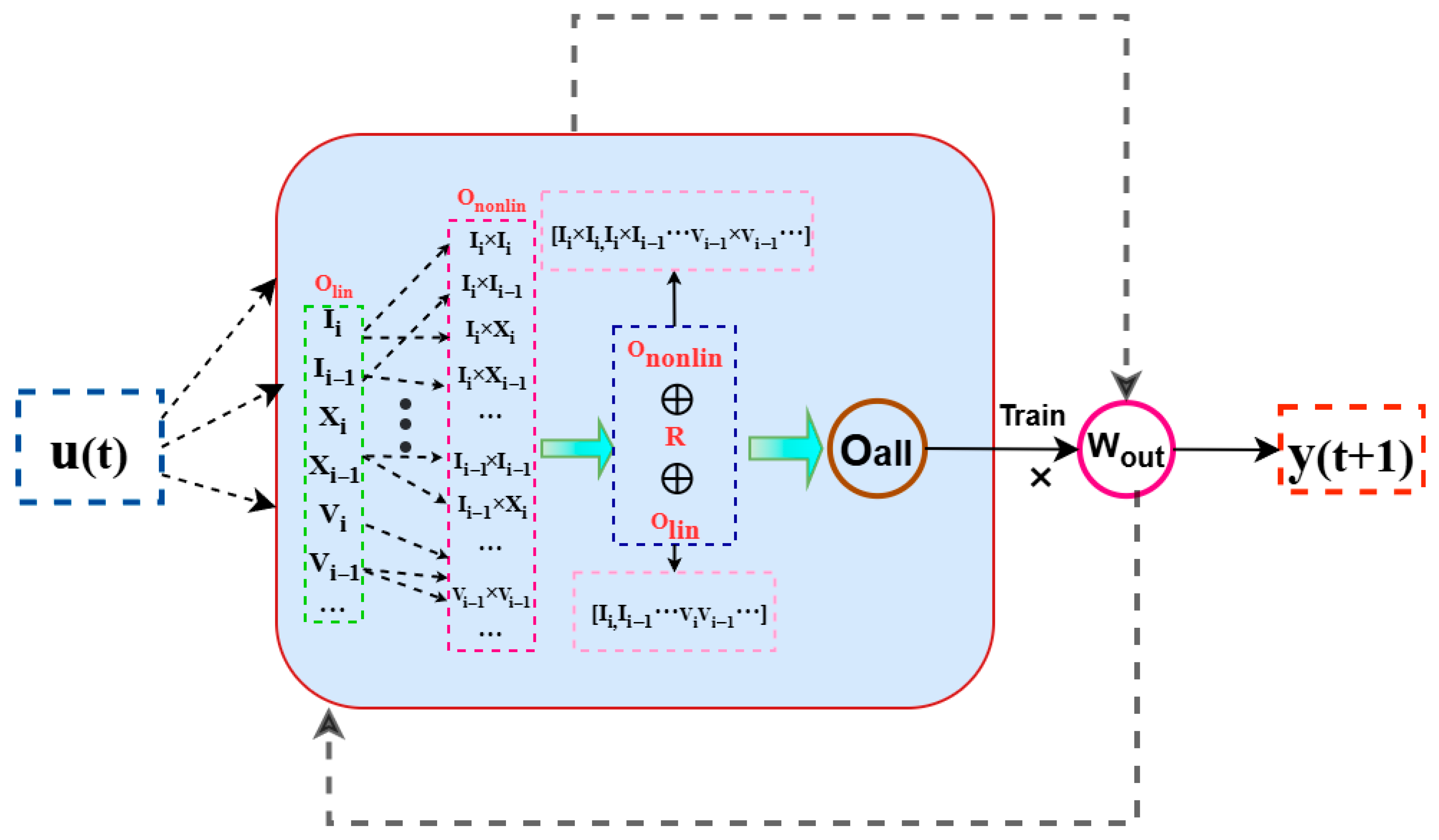
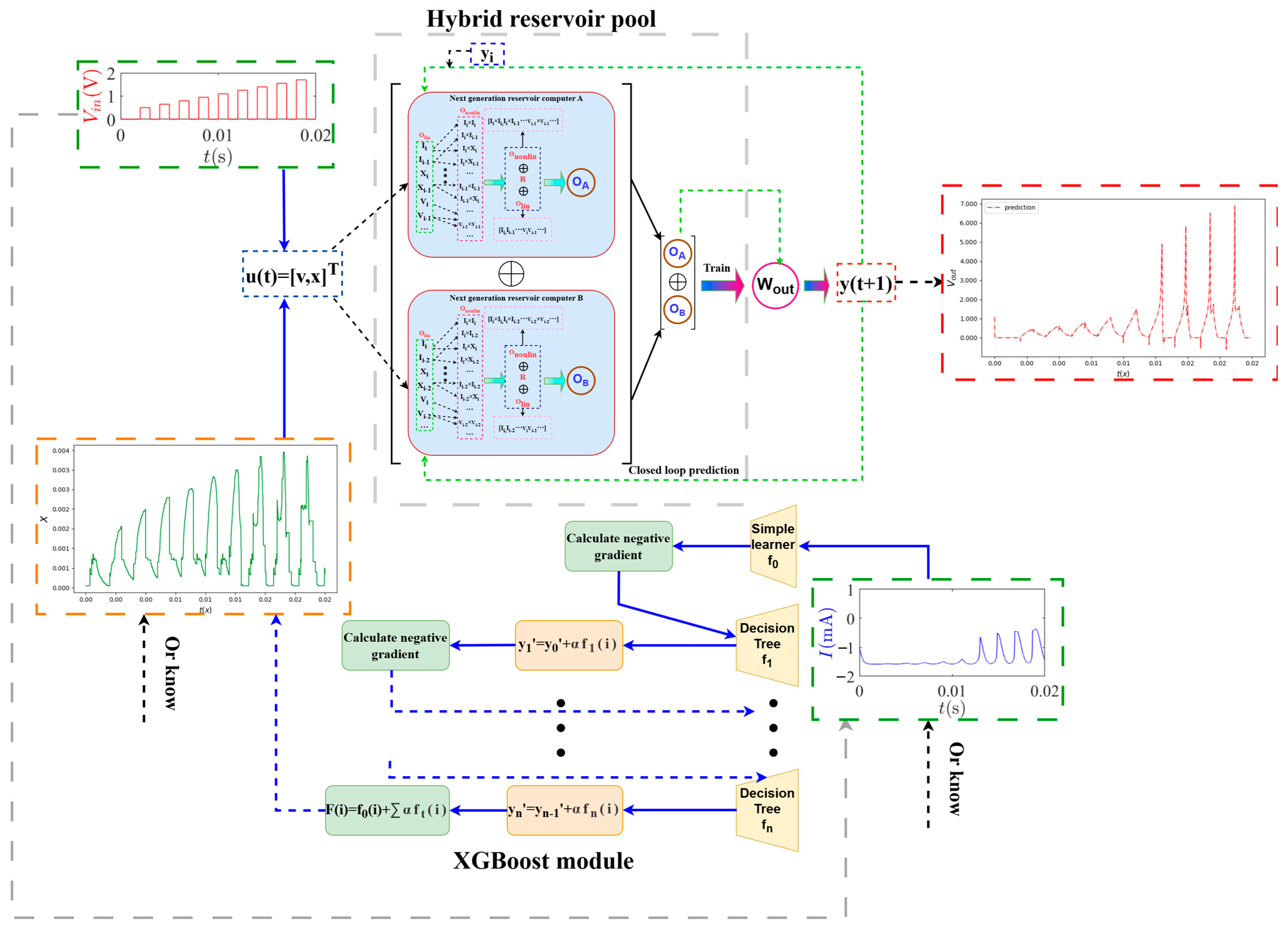
- A novel hybrid machine learning framework integrating improved Next-Generation. Reservoir Computing (MNGRC) with XGBoost regression is proposed for predicting complex neuromorphic dynamics of third-order memristive neurons operating near the edge of chaos. The core innovation lies in the dual-path prediction architecture specifically designed for partial state observability scenarios.
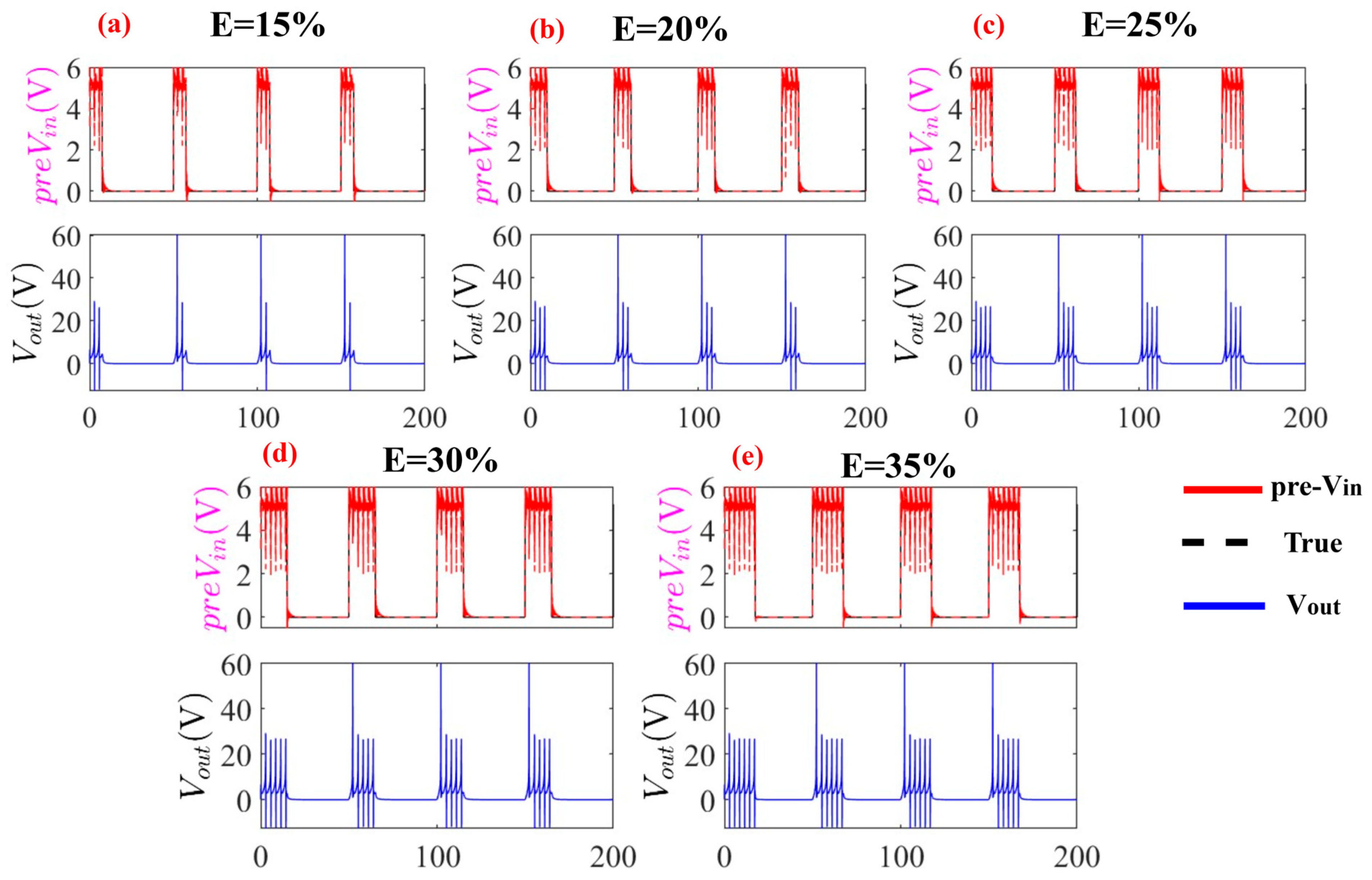
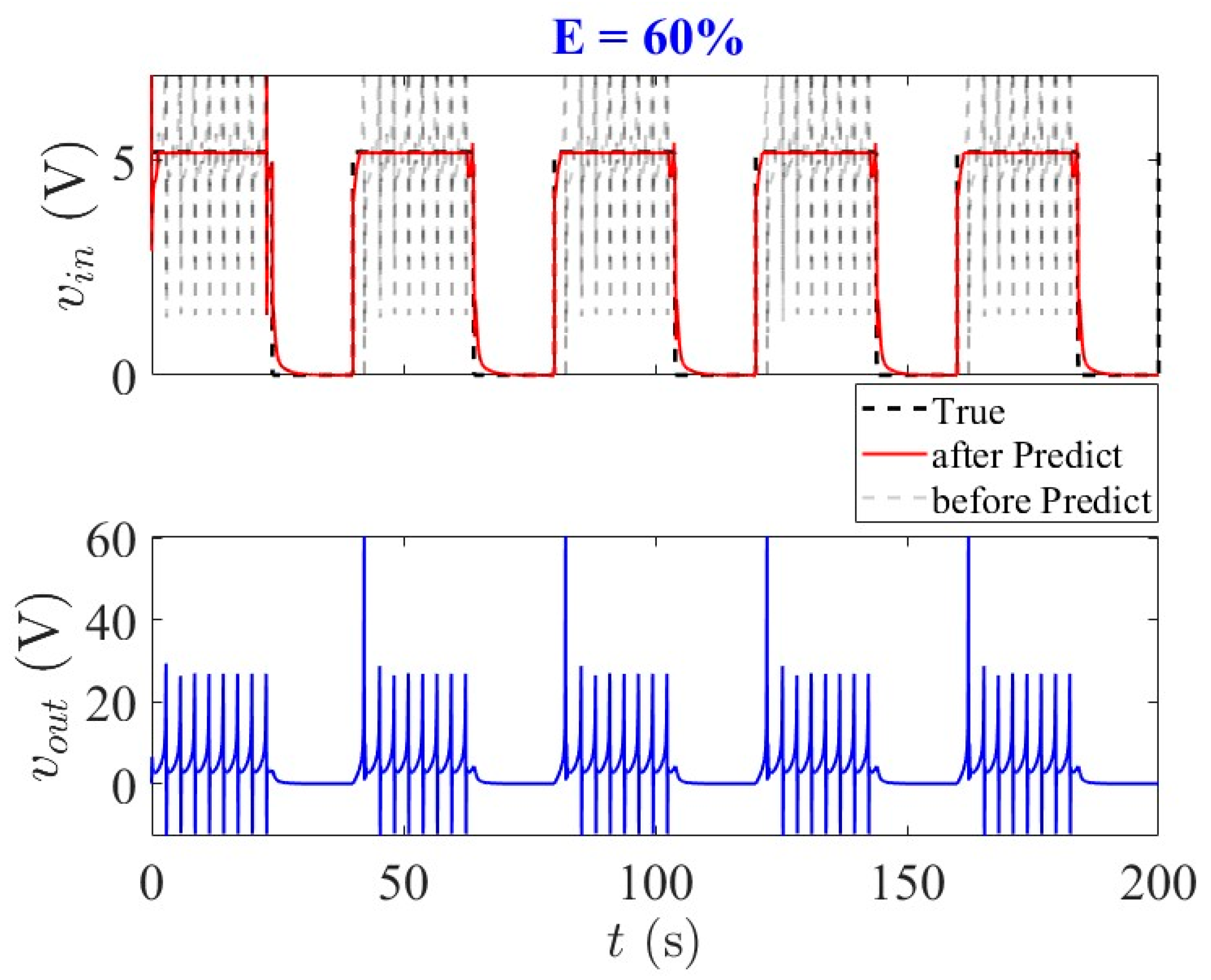
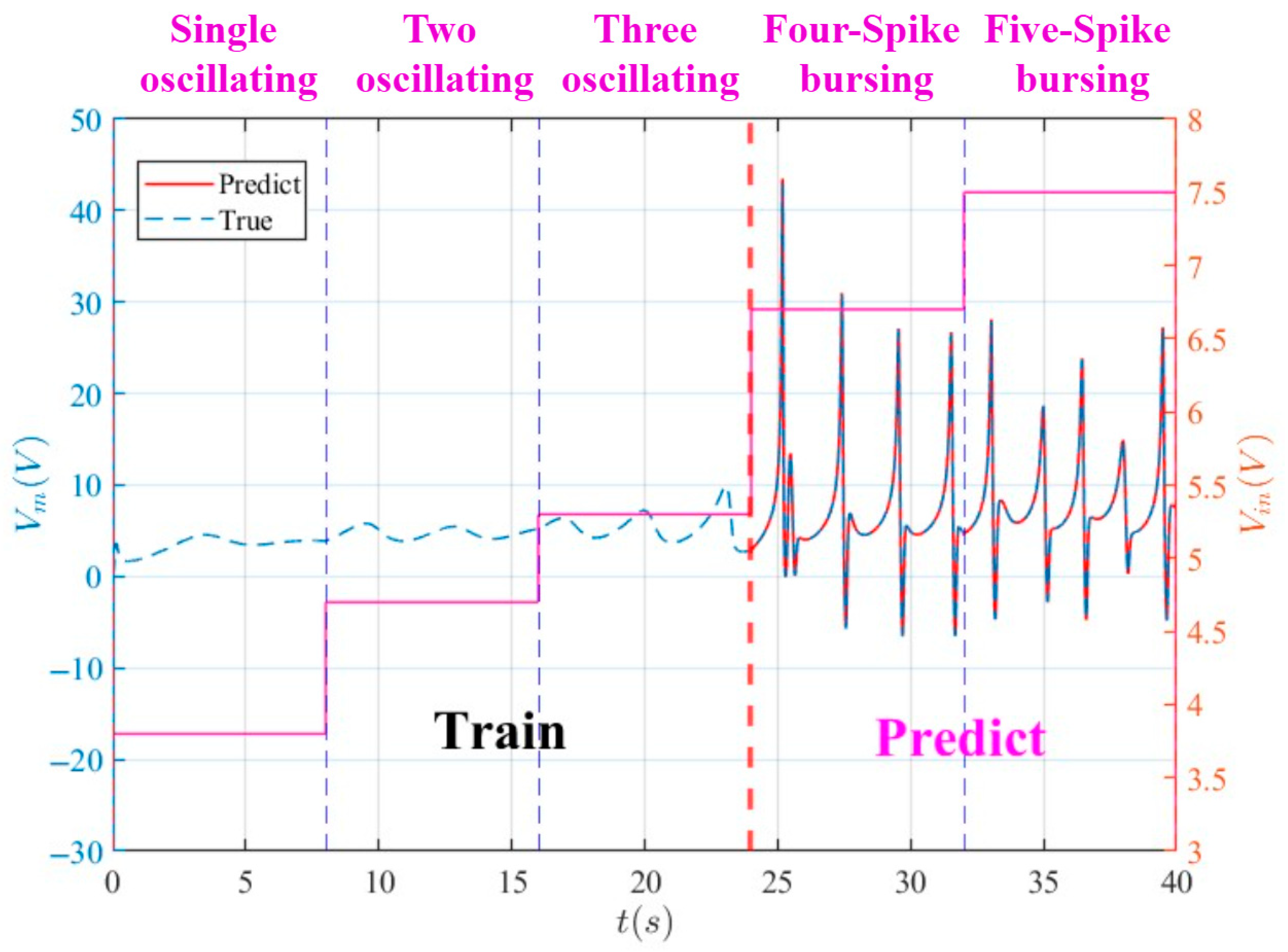
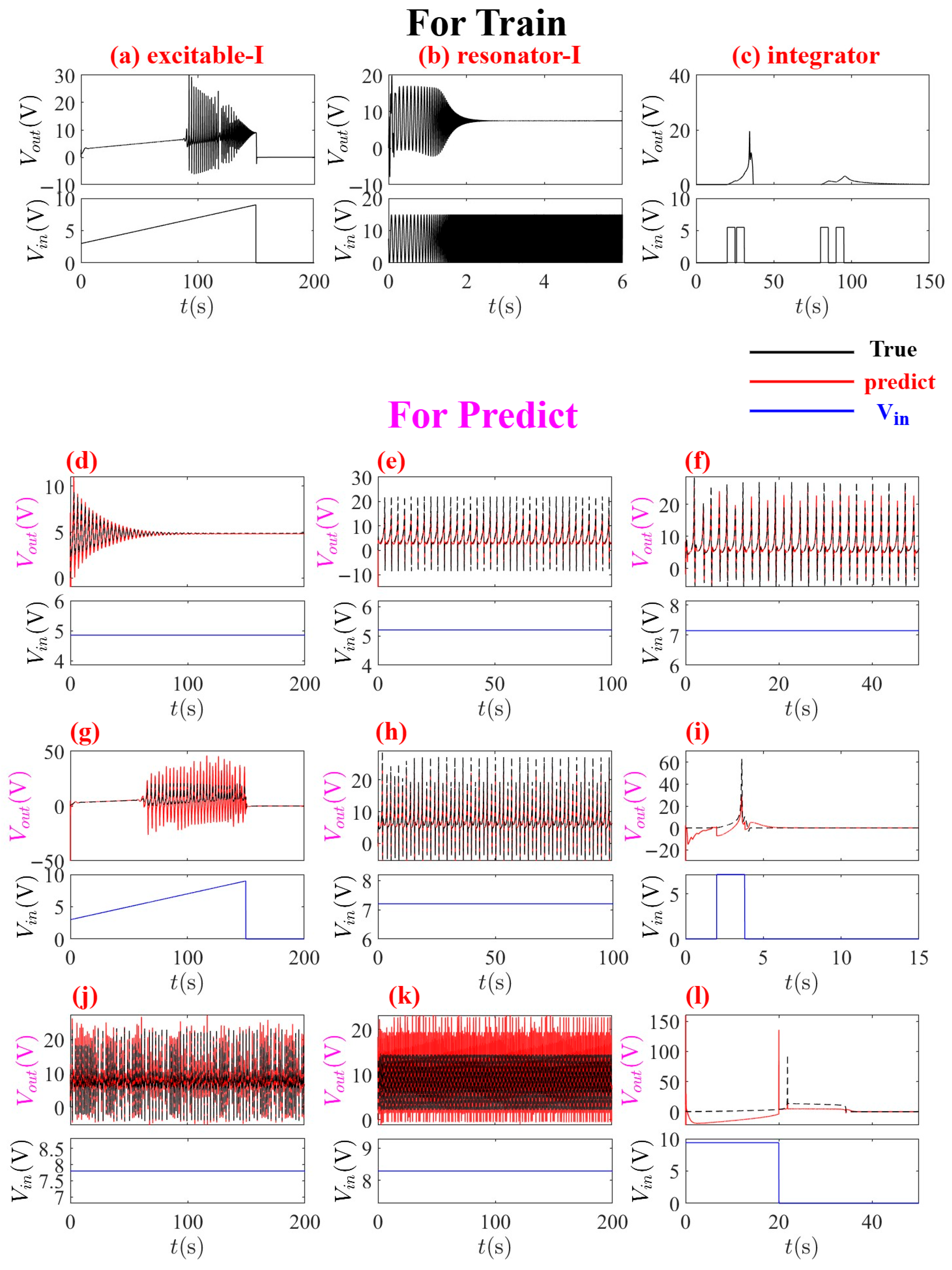
- By training exclusively on a single periodic spiking behavior, our MNGRC architecture successfully captures the fundamental dynamics necessary to predict transitions between qualitatively different states, including the shift from periodic spiking to chaotic oscillations and the critical transition across supercritical Hopf bifurcation boundaries between self-sustained oscillations and stable resting states.
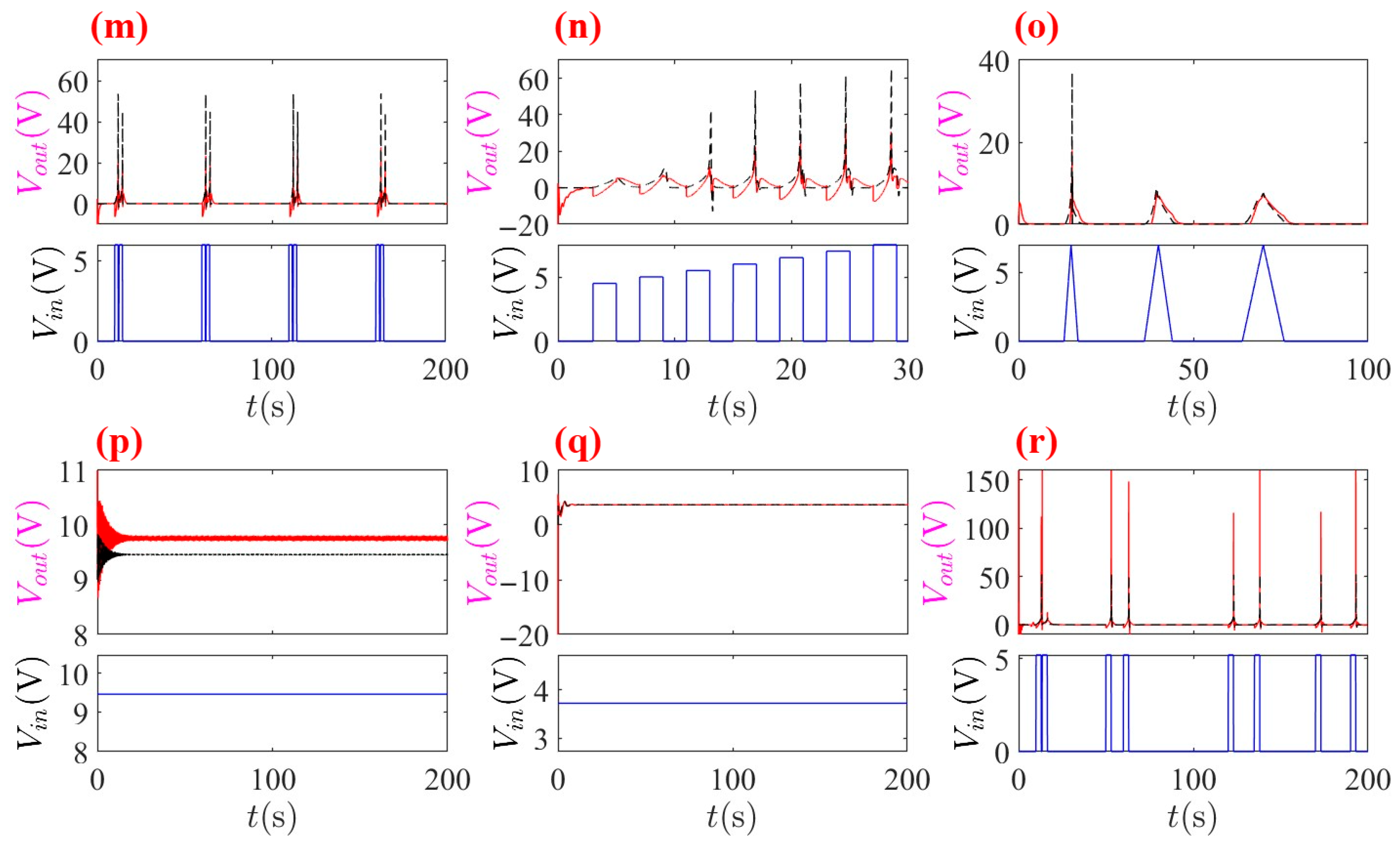
- The framework represents an advance by predicting 18 neuromorphic behaviors based on partial state variables, overcoming the previous limitation which depended on complete system state measurements.
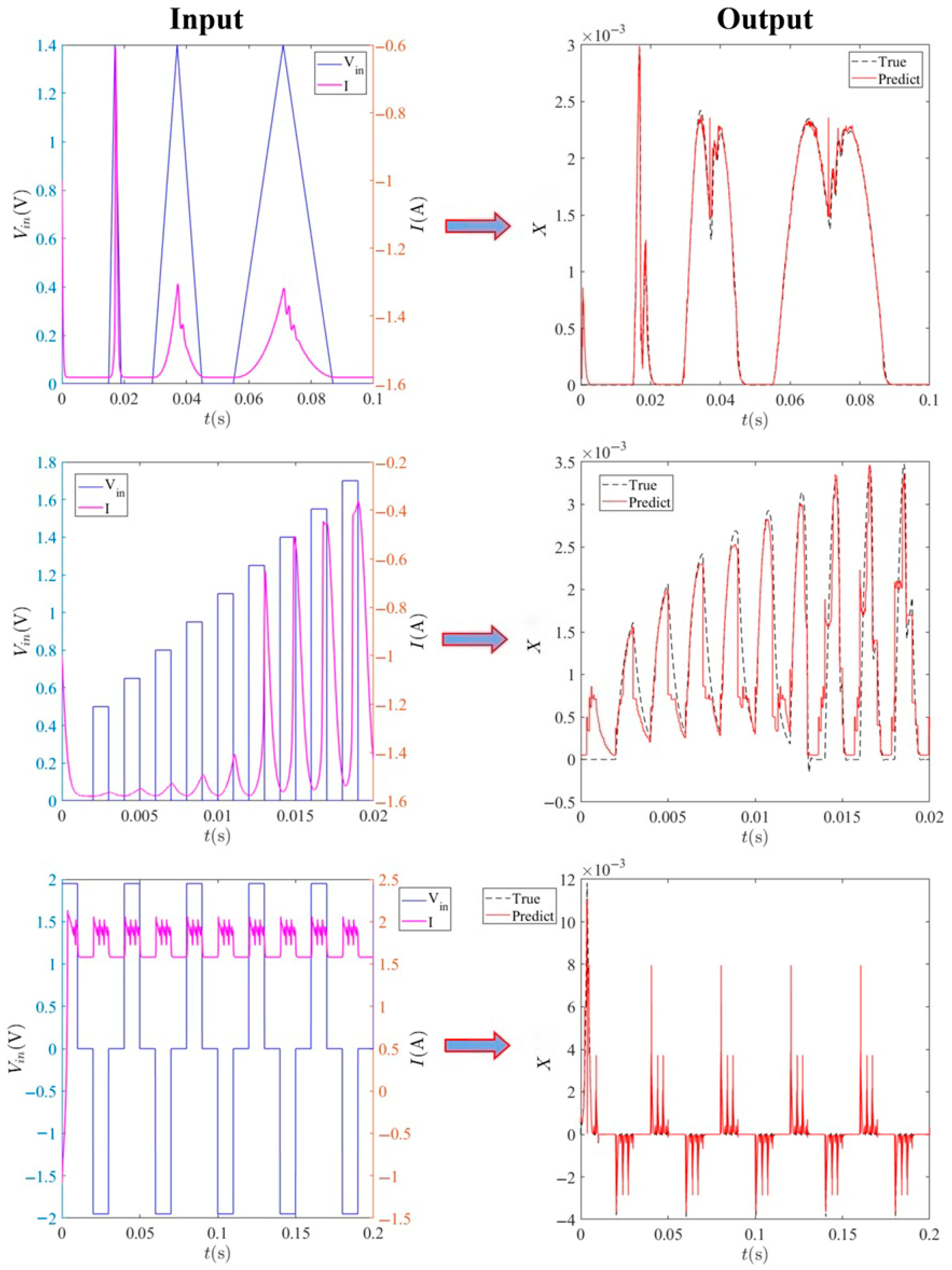
- The framework effectively solves the inverse problem by determining required input stimuli from observed neuronal responses.
2. Materials and Methods
2.1. Next-Generation Reservoir Computer
2.2. eXtreme Gradient Boosting
2.3. Machine Learning Prediction Framework
3. Results
3.1. Prediction of Chaotic Dynamic Behavior of Third Order Memristor Neuron
3.2. Prediction of 18 Forms of Patterns
4. Discussion
4.1. XGBoost-Based Inference of Latent States from Partial Observations
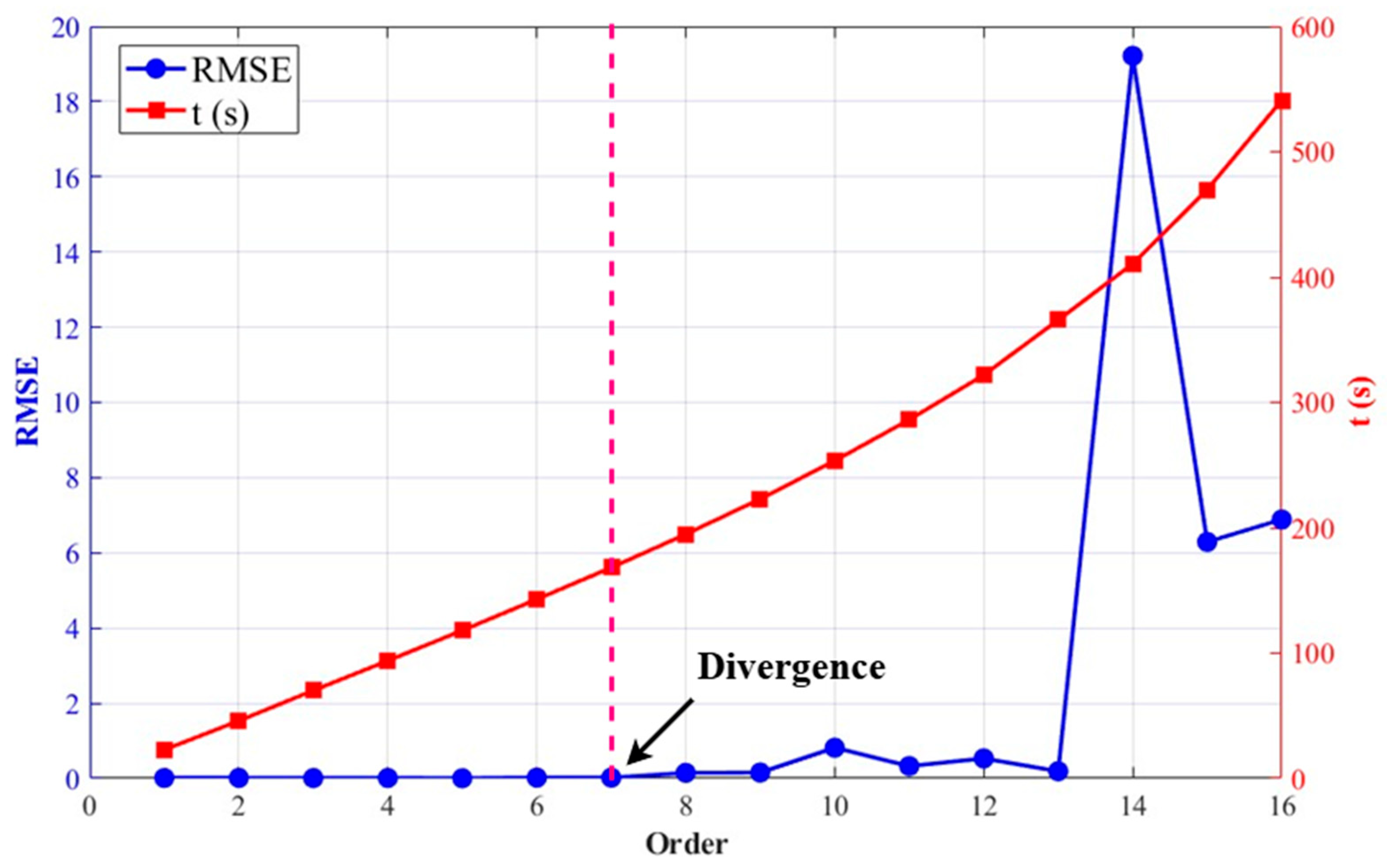
4.2. Discussion on Parameter Selection
5. Conclusions
Author Contributions
Funding
Institutional Review Board Statement
Data Availability Statement
Acknowledgments
Conflicts of Interest
Appendix A
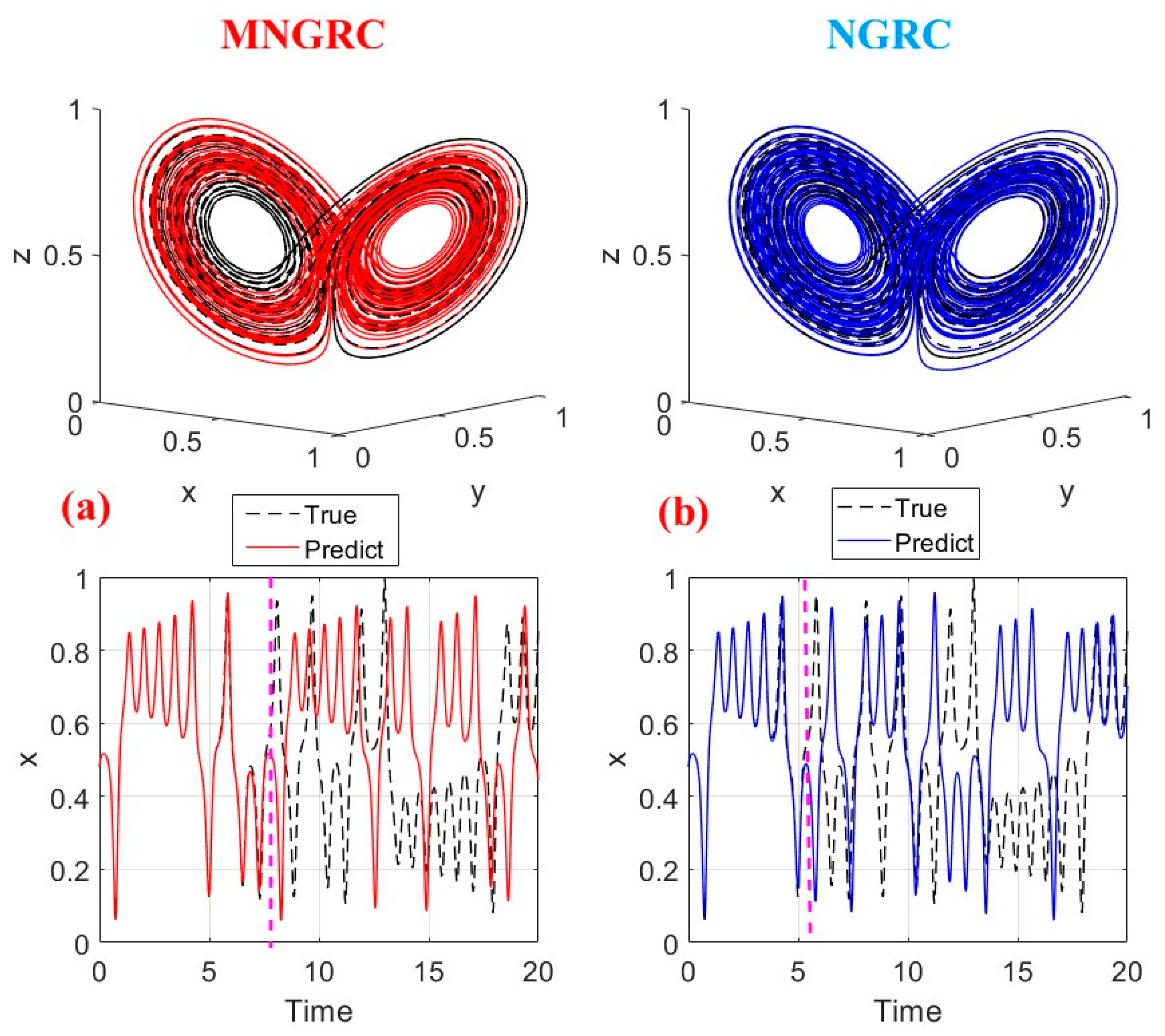
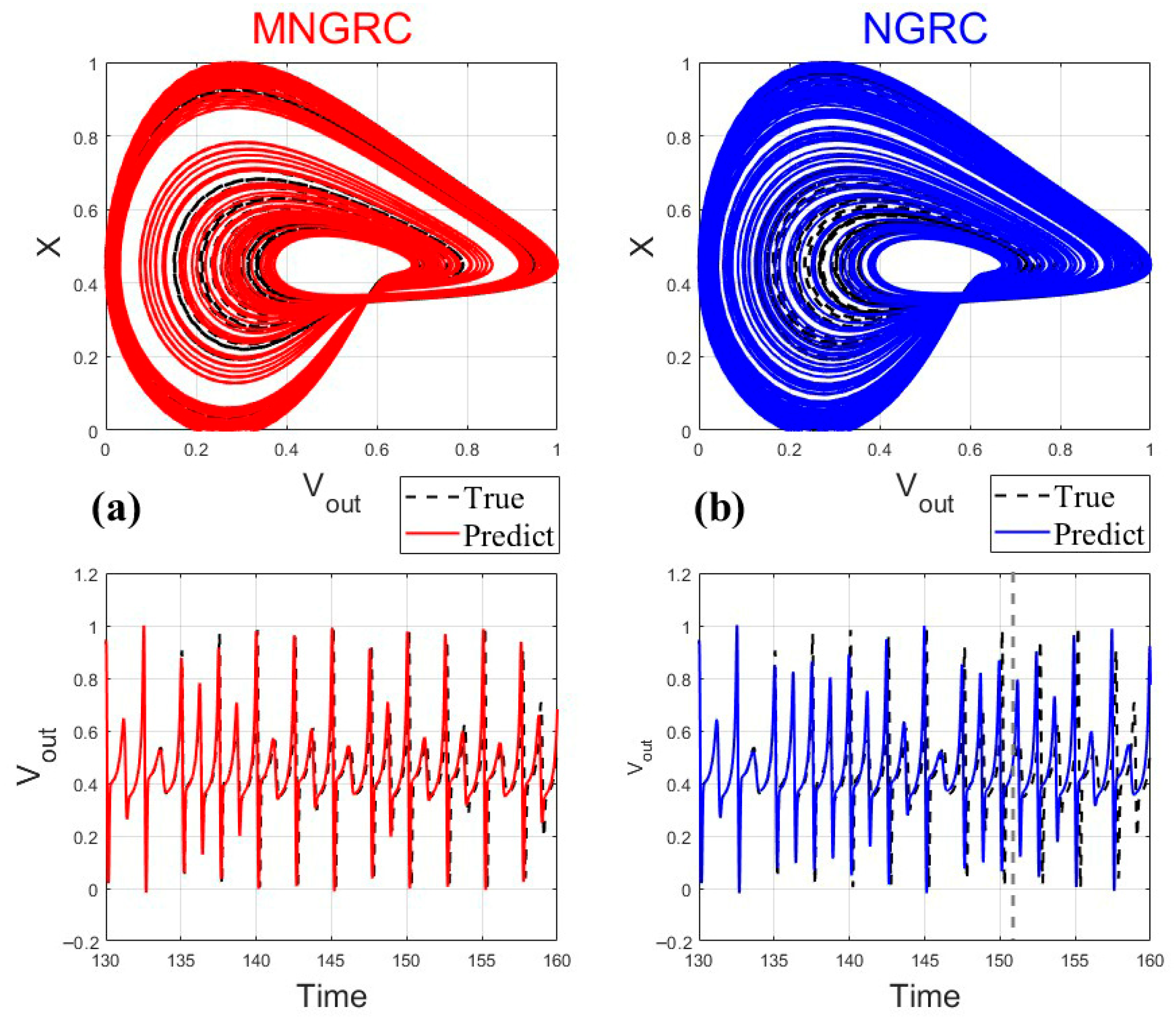

| Lorenz/Memristor Neuron | MNGRC | NGRC |
|---|---|---|
| Effective Lyapunov time | 7.07/10.08 | 3.71/7.37 |
| RMSE | 0.22/0.27 | 0.24/0.31 |
| Pearson correlation coeffcient | 0.112/0.12 | 0.118/0.04 |
| time (s) | 7.84/16.78 | 5.24/11.20 |
| delay of inputs (k) | k = 2 | |
| Order of the monomials (p) | p = 3 | |
| Strides (s) | s = 1 | |
| Ridge (L2) |
References
- Waldrop, M.M. The chips are down for Moore‘s law. Nature 2016, 530, 144–147. [Google Scholar] [CrossRef]
- Merolla, P.A.; Arthur, J.V.; Alvarez-Icaza, R.; Cassidy, A.S.; Sawada, J. A million spiking-neuron integrated circuit with a scalable communication network and interface. Science 2014, 345, 668–673. [Google Scholar] [CrossRef]
- Chua, L.O. If it‘s pinched it’s a memristor. Semicond. Sci. Technol. 2014, 29, 104001. [Google Scholar] [CrossRef]
- Yu, F.; Kong, X.; Yao, W.; Zhang, J.; Cai, S.; Lin, H. Dynamics Analysis, Synchronization and FPGA Implementation of Multiscroll Hopfield Neural Networks with Non-Polynomial Memristor. Chaos Solitons Fractals 2024, 179, 114440. [Google Scholar] [CrossRef]
- He, S.; Yu, F.; Guo, R.; Zheng, M.; Tang, T.; Jin, J. Dynamic Analysis and FPGA Implementation of a Fractional-Order Memristive Hopfield Neural Network with Hidden Chaotic Dual-Wing Attractors. Fractal Fract. 2025, 9, 561. [Google Scholar] [CrossRef]
- Schölzel, C. Nonlinear Measures for Dynamical Systems. Zenodo 2019. [Google Scholar] [CrossRef]
- Stasenko, S.V.; Mikhaylov, A.N.; Fedotov, A.A.; Smirnov, V.A.; Kazantsev, V.B. Astrocyte control bursting mode of spiking neuron network with memristor-implemented plasticity. Chaos Solitons Fractals 2024, 181, 114648. [Google Scholar] [CrossRef]
- Mayford, M.; Siegelbaum, S.A.; Kandel, E.R. Synapses and memory storage. Cold Spring Harb. Perspect. Biol. 2012, 4, a005751. [Google Scholar] [CrossRef]
- Liang, Y.; Wang, G.; Chen, G. S-Type Locally Active Memristor-Based Periodic and Chaotic Oscillators. IEEE Trans. Circuits Syst. I 2020, 67, 5139–5152. [Google Scholar] [CrossRef]
- Lai, Q.; Qin, M. Dynamic Analysis and Synchronization Control of Extremely Simple Cyclic Memristive Chaotic Neural Network. J. Electron. Inf. Technol. 2025, 47, 3262–3273. [Google Scholar] [CrossRef]
- Lin, H.; Wang, C.; Yu, F.; Hong, Q.; Xu, C.; Sun, Y. A Triple-Memristor Hopfield Neural Network with Space Multi-Structure Attractors and Space Initial-Offset Behaviors. IEEE Trans. Cybern. 2025; in press. [Google Scholar] [CrossRef]
- Song, Z.; Shen, B.; Zhang, Y.; Yan, S. Spiking and bursting discharge behaviors in a memristor-based oscillator: Analysis and circuit implementation. Phys. Scr. 2023, 98, 045212. [Google Scholar] [CrossRef]
- Feng, W.; Zhang, K.; Zhang, J.; Zhao, X.; Chen, Y.; Cai, B.; Zhu, Z.; Wen, H.; Ye, C. Integrating Fractional-Order Hopfield Neural Network with Differentiated Encryption: Achieving High-Performance Privacy Protection for Medical Images. Fractal Fract. 2025, 9, 426. [Google Scholar] [CrossRef]
- Qian, K.; Xiao, Y.; Wei, Y.; Liu, D.; Wang, Q.; Feng, W. A Robust Memristor-Enhanced Polynomial Hyper-Chaotic Map and Its Multi-Channel Image Encryption Application. Micromachines 2023, 14, 2090. [Google Scholar] [CrossRef]
- Feng, W.; Tang, Z.; Zhao, X.; Qin, Z.; Chen, Y.; Cai, B. State-Dependent Variable Fractional-Order Hyperchaotic Dynamics in a Coupled Quadratic Map: A Novel System for High-Performance Image Protection. Fractal Fract. 2025, 9, 792. [Google Scholar] [CrossRef]
- Huang, L.; Jin, P.; Zang, H.; Fu, H.; Lei, T.; Wang, G. A new third-order memristive neuron and its complex neuromorphic dynamics near the edge of chaos. Chaos Solitons Fractals 2025, 195, 116271. [Google Scholar] [CrossRef]
- Yan, L.; Luo, T.; Liu, Y.; Li, Z.; Liu, W. Effects of Non-Volatility of Memristor on the Synchronizability of Memristor-Coupled Heterogeneous Neurons. Chaos 2025, 35, 093108. [Google Scholar] [CrossRef]
- Liang, Y.; Chen, S.; Lu, Z.; Wang, G.; Iu, H.H.C. A new compact model for third-order memristive neuron with box-shaped hysteresis and dynamics analysis. IEEE Trans. Circuits Syst. II Express Briefs 2023, 42, 3352–3364. [Google Scholar] [CrossRef]
- Jin, P.P.; Wang, G.Y.; Liang, Y.; Iu, H.H.C.; Chua, L.O. Neuromorphic dynamics of Chua corsage memristor. IEEE Trans. Circuits Syst. I Regul. Pap. 2021, 68, 4419–4432. [Google Scholar] [CrossRef]
- Kumar, S.; Williams, R.S.; Wang, Z.W. Third-order nanocircuit elements for neuromorphic engineering. Nature 2020, 585, 518–523. [Google Scholar] [CrossRef]
- Yang, Y.; Zhang, X.; Chen, P.; Cheng, L.; Li, C.; Ding, Y.; Liu, Q. Memristive Hodgkin–Huxley neurons with diverse firing patterns for high-order neuromorphic computing. Adv. Intell. Syst. 2024, 7, 2400383. [Google Scholar] [CrossRef]
- Liang, Y.; Wang, S.C.; Dong, Y.J.; Lu, Z.; Wang, G. Locally-active memristors-based reactance-less oscillator. IEEE Trans. Circuits Syst. II Express Briefs 2023, 70, 321–325. [Google Scholar] [CrossRef]
- Chen, T.; Guestrin, C. XGBoost: A scalable tree boosting system. In Proceedings of the 22nd ACM SIGKDD International Conference on Knowledge Discovery and Data Mining, San Francisco, CA, USA, 13–17 August 2016; pp. 785–794. [Google Scholar]
- Mikhaeil, J.; Monfared, Z.; Durstewitz, D. On the difficulty of learning chaotic dynamics with rnns. Adv. Neural Inf. Process. Syst. 2022, 35, 11297–11312312. [Google Scholar]
- Torres, J.F.; Hadjout, D.; Sebaa, A.; Martínez-Álvarez, F.; Troncoso, A. Deep learning for time series forecasting: A survey. Big Data 2021, 9, 3–21. [Google Scholar] [CrossRef]
- Ayers, D.; Lau, J.; Amezcua, J.; Carrassi, A.; Ojha, V. Supervised machine learning to estimate instabilities in chaotic systems: Estimation of local Lyapunov exponents. Q. J. R. Meteorol. Soc. 2023, 149, 1236–1262. [Google Scholar] [CrossRef]
- Han, M.; Xi, J.; Xu, S.; Yin, F.L. Prediction of chaotic time series based on the recurrent predictor neural network. IEEE Trans. Signal Process. 2004, 52, 3409–3416. [Google Scholar] [CrossRef]
- Song, J.; Meng, D.; Wang, Y. Analysis of chaotic behavior based on phase space reconstruction methods. In Proceedings of the 2013 Sixth International Symposium on Computational Intelligence and Design, Hangzhou, China, 28–29 December 2013; pp. 414–417. [Google Scholar]
- Tsai, Y.T.; Zeng, Y.R.; Chang, Y.S. Air pollution forecasting using RNN with LSTM. In Proceedings of the 2018 IEEE 16th International Conference on Dependable, Autonomic and Secure Computing, Athens, Greece, 12–15 August 2018; pp. 1074–1079. [Google Scholar]
- Soures, N.; Merkel, C.; Kudithipudi, D.; Thiem, C.; McDonald, N. Reservoir computing in embedded systems: Three variants of the reservoir algorithm. IEEE Consum. Electron. Mag. 2017, 6, 67–73. [Google Scholar] [CrossRef]
- Haynes, N.D.; Soriano, M.C.; Rosin, D.P.; Fischer, I.; Gauthier, D.J. Reservoir computing with a single time-delay autonomous Boolean node. Phys. Rev. E 2015, 91, 020801. [Google Scholar] [CrossRef]
- Pathak, J.; Hunt, B.; Girvan, M.; Lu, Z.; Ott, E. Model-free prediction of large spatiotemporally chaotic systems from data: A reservoir computing approach. Phys. Rev. Lett. 2018, 120, 024102. [Google Scholar] [CrossRef]
- Rafayelyan, M.; Dong, J.; Tan, Y.; Krzakala, F.; Gigan, S. Large-scale optical reservoir computing for spatiotemporal chaotic systems prediction. Phys. Rev. X 2020, 10, 041037. [Google Scholar] [CrossRef]
- Xiao, R.; Kong, L.W.; Sun, Z.K.; Lai, Y.C. Predicting amplitude death with machine learning. Phys. Rev. E 2021, 104, 014205. [Google Scholar] [CrossRef]
- Kong, L.W.; Fan, H.W.; Grebogi, C.; Lai, Y.C. Machine learning prediction of critical transition and system collapse. Phys. Rev. Res. 2021, 3, 013090. [Google Scholar] [CrossRef]
- Kong, L.W.; Fan, H.; Grebogi, C.; Lai, Y.C. Emergence of transient chaos and intermittency in machine learning. J. Phys. Complex. 2021, 2, 035014. [Google Scholar] [CrossRef]
- Gauthier, D.J.; Bollt, E.; Griffith, A.; Barbosa, W.A. Next generation reservoir computing. Nat. Commun. 2021, 12, 5564. [Google Scholar] [CrossRef]
- Ratas, I.; Pyragas, K. Application of next-generation reservoir computing for predicting chaotic systems from partial observations. Phys. Rev. E 2024, 109, 064215. [Google Scholar] [CrossRef]
- Du, Y.; Li, Q.; Fan, H.; Zhan, M.; Xiao, J.; Wang, X. Inferring attracting basins of power system with machine learning. Phys. Rev. Res. 2024, 6, 013181. [Google Scholar] [CrossRef]
- Zhang, Y.; Cornelius, S.P. Catch-22s of reservoir computing. Phys. Rev. Res. 2023, 5, 033213. [Google Scholar] [CrossRef]
- Yan, M.; Huang, C.; Bienstman, P.; Tino, P.; Lin, W.; Sun, J. Emerging opportunities and challenges for the future of reservoir computing. Nat. Commun. 2024, 15, 2056. [Google Scholar] [CrossRef]
- Zhang, Y.; Roque dos Santos, E.; Zhang, H.; Cornelius, S.P. How more data can hurt: Instability and regularization in next-generation reservoir computing. Chaos 2025, 35, 073102. [Google Scholar] [CrossRef]
- Yang, L.; Pang, S.; Zhang, Y.; Sun, X.; Kong, Y.; Zhang, Y.C. Improved next generation reservoir computing with time decay factor and kernel function. Chaos Solitons Fractals 2025, 198, 116514. [Google Scholar] [CrossRef]
- Larcher, J.H.K.; Stefenon, S.F.; dos Santos Coelho, L.; Mariani, V.C. Enhanced multi-step streamflow series forecasting using hybrid signal decomposition and optimized reservoir computing models. Expert Syst. Appl. 2024, 255, 124856. [Google Scholar] [CrossRef]
- Chen, W.; Gao, J.; Yan, Z.; Xiao, J. Proper choice of hyperparameters in reservoir computing of chaotic maps. J. Phys. A Math. Theor. 2023, 56, 415702. [Google Scholar] [CrossRef]
- Fleddermann, L.; Herzog, S.; Parlitz, U. Enhancing reservoir predictions of chaotic time series by incorporating delayed values of input and reservoir variables. Chaos 2025, 35, 026110. [Google Scholar] [CrossRef]
- Nakajima, K.; Fischer, I. Reservoir Computing; Springer: Singapore, 2021; Volume 81, pp. 60–135. [Google Scholar] [CrossRef]
- Chepuri, R.; Amzalag, D.; Antonsen, T.M.; Girvan, M. Hybridizing traditional and next-generation reservoir computing to accurately and efficiently forecast dynamical systems. Chaos 2024, 34, 063138. [Google Scholar] [CrossRef]
- Wu, K.; Politis, D.N. Bootstrap prediction inference of nonlinear autoregressive models. J. Time Ser. Anal. 2024, 45, 800–822. [Google Scholar] [CrossRef]
- Kent, R.M.; Barbosa, W.A.S.; Gauthier, D.J. Controlling chaotic maps using next-generation reservoir computing. Chaos 2024, 34, 023120. [Google Scholar] [CrossRef]
- Trovain, N.; Pedrelli, L.; Dinh, T.T.; Hinaut, X. ReservoirPy: An efficient and user-friendly library to design echo state networks. In Proceedings of the Artificial Neural Networks and Machine Learning—ICANN, Bratislava, Slovakia, 15–18 September 2020; Springer: Cham, Switzerland, 2020; pp. 494–505. [Google Scholar]
- Syarif, I.; Prugel-Bennett, A.; Wills, G. SVM parameter optimization using grid search and genetic algorithm to improve classification performance. TELKOMNIKA 2016, 14, 1502–1509. [Google Scholar] [CrossRef]
- Yuanyuan, S.; Yongming, W.; Lili, G.; Zhongsong, M.; Shan, J. The comparison of optimizing SVM by GA and grid search. In Proceedings of the 2017 13th IEEE International Conference on Electronic Measurement & Instruments, Yangzhou, China, 16–18 November 2017; pp. 354–360. [Google Scholar]
- Zhou, J.; Pei, L.; Zheng, Z. Next-generation reservoir computing water quality prediction model based on the whale optimization algorithm. Int. J. Dyn. Control 2025, 13, 132. [Google Scholar] [CrossRef]
- Barbosa, W.A.S.; Gauthier, D.J. Learning spatiotemporal chaos using next-generation reservoir computing. Chaos 2022, 32, 093109. [Google Scholar] [CrossRef]
- Colbrook, M.J.; Roman, B.; Hansen, A.C. How to compute spectra with error control. Phys. Rev. Lett. 2019, 122, 250201. [Google Scholar] [CrossRef]
- Duan, X.Y.; Ying, X.; Leng, S.Y.; Kurths, J.; Lin, W.; Ma, H. Embedding theory of reservoir computing and reducing reservoir network using time delays. Phys. Rev. Res. 2023, 5, L022041. [Google Scholar] [CrossRef]
- Zhao, J.; Wang, Q.; Rong, W.; Zeng, J.; Ren, Y.; Chen, H. Permeability Prediction of Carbonate Reservoir Based on Nuclear Magnetic Resonance (NMR) Logging and Machine Learning. Energies 2024, 17, 1458. [Google Scholar] [CrossRef]
- Chang, D.M.; Hsu, T.C.; Yang, C.T.; Yang, J. A Data Factor Study for Machine Learning on Heterogenous Edge Computing. Appl. Sci. 2023, 13, 3405. [Google Scholar] [CrossRef]
- Ibrahim, B.; Rabelo, L.; Sarmiento, A.T.; Gutierrez-Franco, E. A Holistic Approach to Power Systems Using Innovative Machine Learning and System Dynamics. Energies 2023, 16, 5225. [Google Scholar] [CrossRef]
- Risal, S.; Singh, N.; Yao, Y.; Sun, L.; Risal, S.; Zhu, W. Accelerating Elastic Property Prediction in Fe-C Alloys through Coupling of Molecular Dynamics and Machine Learning. Materials 2024, 17, 601. [Google Scholar] [CrossRef] [PubMed]
| Hyperparameter | NGRC A | NGRC B |
|---|---|---|
| delay of inputs (k) | 2 | 2 |
| Order of the monomials (p) | 4 | 4 |
| Strides (s) | 1 | 2 |
| Ridge (L2) | / |
| Hyperparameter | MNGRC | XGBoost |
|---|---|---|
| Time (s) | 3.367 | 0.289 |
| RMSE (average) | 1.003 | 2.117 |
| Hyperparameter | NGRCA | NGRCB |
|---|---|---|
| delay of inputs (k) | 2 | 2 |
| Order of the monomials (p) | 2 | 2 |
| Strides (s) | 1 | 2 |
| Ridge (L2) | / |
| Neuromorphic Behavior | Vin (V) | L (H) | C (F) | Initial Value () |
|---|---|---|---|---|
| (a) Excitable-I | ~ | 0.08 | 0.04 | (0,0,0) |
| (b) Resonator | 0.08 | 0.04 | (0,0,0) | |
| (c) integrator | 5.51 | 0.9 | 0.59 | (1,0,0) |
| (d) Resting | 4.85 | 0.08 | 0.04 | (0,0,0) |
| (e) Period-I spiking | 5.2 | 0.08 | 0.04 | (0,0,0) |
| (f) Period-II spiking | 7.15 | 0.08 | 0.04 | (0,0,0) |
| (g) Excitable-II | ~ | 0.1 | 0.7 | (0,0,0) |
| (h) Phasic Spiking | ~ | 0.08 | 0.04 | (0,0,0) |
| (i) DAP | 7.15 | 0.08 | 0.04 | (0,0,0) |
| (j) Chaos spiking | 7.8 | 0.08 | 0.04 | (0,0,0) |
| (k) Self-sustaining Oscillations | 8.29 | 0.08 | 0.016 | (0,0,0) |
| (l) spike latency | 3.99 | 3.99 | 0.012 | (0.2,0.2,0) |
| (m) Periodic bursting | 7 | 0.08 | 0.04 | (0,0,0) |
| (n) all or none | ~ | 0.08 | 0.04 | (0,0,0) |
| (o) Accommodation | ~ | 0.04 | 0.01 | (0.1,0,0.1) |
| (p) Subthreshold oscillation | 9.46 | 0.08 | 0.04 | (0,0,0) |
| (q) Phasic oscillation | 3.723 | 0.08 | 0.04 | (0,0,0) |
| (r) Refractory period | ~ | 0.08 | 0.04 | (0,0,0) |
| Hyperparameter | XGBoost | MNGRC |
|---|---|---|
| Time (s) | 0.248 | 1.981 |
| RMSE | 0.79 | 0.93 |
Disclaimer/Publisher’s Note: The statements, opinions and data contained in all publications are solely those of the individual author(s) and contributor(s) and not of MDPI and/or the editor(s). MDPI and/or the editor(s) disclaim responsibility for any injury to people or property resulting from any ideas, methods, instructions or products referred to in the content. |
© 2025 by the authors. Licensee MDPI, Basel, Switzerland. This article is an open access article distributed under the terms and conditions of the Creative Commons Attribution (CC BY) license.
Share and Cite
Luo, T.; Yan, L.; Liu, W. Machine Learning-Based Prediction Framework for Complex Neuromorphic Dynamics of Third-Order Memristive Neurons at the Edge of Chaos. Entropy 2026, 28, 42. https://doi.org/10.3390/e28010042
Luo T, Yan L, Liu W. Machine Learning-Based Prediction Framework for Complex Neuromorphic Dynamics of Third-Order Memristive Neurons at the Edge of Chaos. Entropy. 2026; 28(1):42. https://doi.org/10.3390/e28010042
Chicago/Turabian StyleLuo, Tao, Lin Yan, and Weiqing Liu. 2026. "Machine Learning-Based Prediction Framework for Complex Neuromorphic Dynamics of Third-Order Memristive Neurons at the Edge of Chaos" Entropy 28, no. 1: 42. https://doi.org/10.3390/e28010042
APA StyleLuo, T., Yan, L., & Liu, W. (2026). Machine Learning-Based Prediction Framework for Complex Neuromorphic Dynamics of Third-Order Memristive Neurons at the Edge of Chaos. Entropy, 28(1), 42. https://doi.org/10.3390/e28010042

