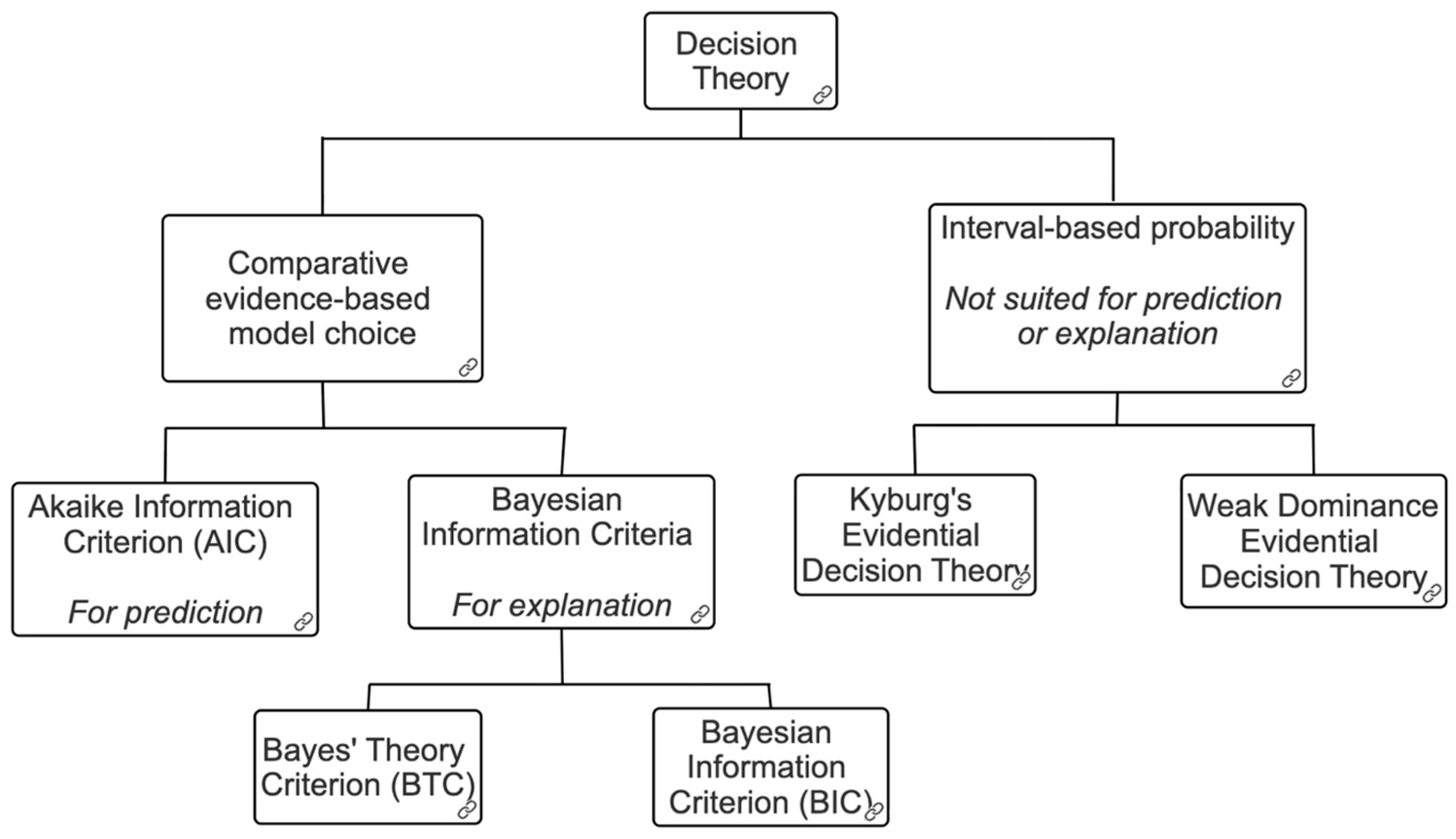
Comparative Evidence-Based Model Choice: A Sketch of a Theory


Abstract
1. Statement of the Theory
2. Introduction to the CEMC
2.1. Desiderata for an Evidence Function
- (a)
- Evidence should be a data-based estimate of the relative distance between two models and a data-generating mechanism.
- (b)
- Evidence should be a continuous function of data. This is tantamount to saying that there is no threshold that must be passed before something will be regarded as evidence.
- (c)
- The reliability of evidential statements should be quantifiable.
- (d)
- Evidence should be public and not private or personal.
- (e)
- Evidence should be portable, i.e., it should be transferable from one person to another.
- (f)
- Evidence should be accumulable in some manner. If two data sets relate to the same pair of models, then the evidence should be combined regarding the models in question. Any evidence gathered should bear on any future inferences regarding the models in question.
- (g)
- Evidence should not depend on the personal idiosyncrasies of model formulation. We mean by this that evidence function must be both scale- and transformation-invariant.
- (h)
- Model consistency is important. We need to distinguish two types of consistency as one is conceptually different from the other. They are (i) the population parameter consistency and (ii) the goal of minimizing the prediction error rate. Population parameter consistency stands for the fact that M + W → 0 as n →∞. M is the probability that the generating process will produce data (of a certain sample size n) that leads to strong but misleading evidence. W is the probability that the generating process will produce data (of a certain sample size n) that leads to weak evidence—that is, evidence that does not strongly indicate one model or the other. M and W error probabilities are roughly comparable to Type I and Type II errors. However, they are better than Type I and Type II errors as they both go to 0 as sample size increases. It means that evidence for the true model/parameter is maximized at the true value only if the true model is in the model set or is the best projection into the model set if it is not. In other words, it ensures that, with enough data, the estimator will provide a reliable and accurate estimate of the population estimator. Another way to consider consistency is to focus on the goal for which an evidential measure is devised. The goal minimizing the prediction error rate is the other way of satisfying the consistency desideratum; a measure serves the goal both reliably and accurately if it minimizes the prediction error rate of a model. It means that the Akaikean Information Criterion (AIC) [14] selects models that have good approximations, even if they are not necessarily the true model.
2.2. Prediction Goal
2.3. Explanation Goal
2.4. Epistemic Utility
- (i)
- Distance-to-truth function (non-Bayesian, model-theoretic):
- (ii)
- Evidence-strength function (non-probabilistic) is defined as
- (a)
- measures the strength of evidence for model M,
- (b)
- measures the model’s distance from the truth, and
- (c)
- is any function increasing in evidence strength and decreasing in distance to truth. No Bayesian subjective credences or probabilistic structures appear anywhere in this formulation.
2.5. Objective Probability via Empirical Frequency
2.6. Statistical Tools
2.7. Goals, Varieties of Evidence Functions, and Their Performance Capabilities
3. Two Goals and Statistical Model Selection Criteria
3.1. Bayes’ Theorem Criteria (BTC)
3.2. Akaikean Information Criterion (AIC)
3.3. Bayesian Information Criterion (BIC)
3.4. A Comparison Between AIC and BTC and Two Goals of CEMC
3.5. Kepler’s Search for Planetary Laws and Bayesian Information Criteria
- Circle:
- Ellipse:
- Ovoid:
4. Revisiting Model Selection Criteria and Their Two Goals Served in One Criterion
5. Evidential Interval-Based Decision-Theoretic Accounts
5.1. Kyburg’s Evidential Decision Theory
- (i)
- S is known in K to be equivalent to a sentence of the form “a is an element of set b.”
- (ii)
- “a is an element of c” is a sentence in K.
- (iii)
- The proportion of cs that are bs is known in K in the interval [p, q].
- (iv)
- Relative to K, a is a random member of c with respect to b.
The decision maker should reject any choice ai for which there exists an act aj whose minimum expected utility exceeds the maximum expected utility of ai.
5.2. The Weak Dominance Evidential Decision Principle
J weakly dominates I if choosing J always yields at least as good an outcome as I, and there exists at least one scenario where J yields a strictly better outcome than I.
Ordering Relationship of the Decision Rule
- If two intervals are disjoint and , choose the act corresponding to .
- If intervals are not disjoint and have the same maximum, choose the act with the higher minimum.
- If intervals are not disjoint and have the same minimum, choose the act with the higher maximum.
6. Conclusions
Author Contributions
Funding
Data Availability Statement
Conflicts of Interest
References
- Savage, L.J. The Foundations of Statistical Inference; Dover: New York, NY, USA, 1962. [Google Scholar]
- Jeffrey, R. The Logic of Decision, 2nd ed.; University of Chicago Press: Chicago, IL, USA, 1990. [Google Scholar]
- Ahmed, A. Evidence, Decision, and Causality; Cambridge University Press: Cambridge, UK, 2014. [Google Scholar]
- Pettigrew, R. Accuracy, and the Laws of Credence; Oxford University Press: Oxford, UK, 2016. [Google Scholar]
- Weirich, P. Rational Choice Using Imprecise Probabilities, and Utilities; Oxford University Press: Oxford, UK, 2021. [Google Scholar]
- Neyman, J.; Pearson, E. On The Use And Interpretation Of Certain Test Criteria For Purposes Of Statistical Inference. Biometrika 1928, 20A, 263–294. [Google Scholar] [PubMed]
- Neyman, J.; Pearson, E. On the problem of the most efficient tests of statistical hypotheses. Philos. Trans. R. Soc. Lond. Ser. A 1933, 231, 289–337. [Google Scholar]
- Kyburg, H.E. The Logical Foundations of Statistical Inference; Springer: Berlin/Heidelberg, Germany, 1974. [Google Scholar]
- Kyburg, H.E.; Teng, C.M. Uncertain Inference; Cambridge University Press: Cambridge, UK, 2001. [Google Scholar]
- Lele, S.R. Evidence Functions and the Optimality of the Law of Likelihood. In The Nature of Scientific Evidence: Statistical, Philosophical, and Empirical Considerations; The University of Chicago Press: Chicago, IL, USA, 2004. [Google Scholar]
- Taper, M.L.; Lele, S. Evidence, Evidence Functions, and Error Probabilities, Handbook of Philosophy of Statistics; Bandyopadhyay, P.S., Forster, M.R., Eds.; Elsevier: Amsterdam, The Netherlands, 2011. [Google Scholar]
- Jerde, C.L.; Kraskura, K.; Eliason, E.J.; Csik, S.R.; Stier, A.C.; Taper, M.L. Strong Evidence for an Intraspecific Metabolic Scaling Coefficient Near 0.89 in Fish. Front. Physiol. 2019, 10, 1166. [Google Scholar] [CrossRef] [Scilit] [PubMed]
- Taper, M.L.; Ponciano, J.M.; Dennis, B. Editorial: Entropy, Statistical Evidence, and Scientific Inference: Evidence Functions in Theory and Applications. Entropy 2022, 24, 1273. [Google Scholar] [CrossRef] [Scilit] [PubMed]
- Akaike, H. A Bayesian Analysis of the Minimum AIC Procedure, Annals of the Institute of Statistical Mathematics. Ann. Inst. Statist. Math. 1978, 30, 9–14. [Google Scholar] [CrossRef] [Scilit]
- Schwarz, G. Estimating the Dimension of a Model. Ann. Stat. 1978, 6, 461–464. [Google Scholar] [CrossRef] [Scilit]
- Bozdogan, H. Model selection and Akaike’s information criterion (AIC): The general theory and its analytical extensions. Psychometrika 1987, 52, 345–370. [Google Scholar] [CrossRef] [Scilit]
- Hannan, E.J.; Quinn, B.G. The Determination of the Order of an Autoregression. J. R. Stat. Soc. Ser. B (Methodol.) 1979, 41, 190–195. [Google Scholar] [CrossRef] [Scilit]
- Burnham, K.P.; Anderson, D.R. Model Selection and Mutli-Model Inference: A Practical Information-Theoretic Approach, 2nd ed.; Springer: New York, NY, USA, 2002. [Google Scholar]
- Taper, M.L. Model identification from many candidates. In The Nature of Scientific Evidence: Statistical, Philosophical, and Empirical Considerations; Taper, M.L., Lele, S.R., Eds.; University of Chicago Press: Chicago, IL, USA, 2004. [Google Scholar]
- Hurvich, C.M.; Tsai, C. Regression and time series model selection in small samples. Biometrika 1989, 76, 297–307. [Google Scholar] [CrossRef]
- Aho, K.; Derryberry, D.; Peterson, T. Model selection for ecologists: The worldviews of AIC and BIC. Ecology 2014, 95, 631–636. [Google Scholar] [CrossRef] [Scilit] [PubMed]
- Bandyopadhyay, P.S.; Brittan, G. Logical consequence and beyond: A look at model selection in statistics. In Logical Consequence; Wood, J., Hepburn, H.B., Eds.; Hermes Science: Oxford, UK, 2001; pp. 1–17. [Google Scholar]
- Bandyopadhyay, P.; Boik, R.; Basu, P. The Curve Fitting Problem: A Bayesian Approach. Philos. Sci. 1996, 63, S264–S272. [Google Scholar] [CrossRef] [Scilit]
- Forster, M.; Sober, E. How to Tell when Simple, More Unified, or Less Ad Hoc Theories will Provide More Accurate Predictions. Br. J. Philos. Sci. 1994, 45, 1–35. [Google Scholar] [CrossRef] [Scilit]
- Stephenson, B. Kepler’s Physical Astronomy; Springer: Berlin/Heidelberg, Germany, 2012. [Google Scholar]
- Aitchison, J. Goodness of Prediction Fit. Biometrika 1975, 62, 547–554. [Google Scholar] [CrossRef]
- San Martini, A.; Spezzaferri, F. A Predictive Model Selection Criterion. J. R. Stat. Soc. 1984, 46, 296–303. [Google Scholar] [CrossRef] [Scilit]
- Reschenhofer, E. Prediction with Vague Knowledge. Commun. Stat.-Theory Methods 1996, 25, 601–608. [Google Scholar] [CrossRef] [Scilit]
- Forster, M.R. Model selection in science: The problem of language variance. Br. J. Philos. Sci. 1999, 50, 83–102. [Google Scholar] [CrossRef] [Scilit]
- Bandyopadhyay, P. Pragmatic Bayesianism: Belief, Evidence, Prediction, Decision; MIT Press: Cambridge, MA, USA, 2026; forthcoming. [Google Scholar]
- Bandyopadhyay, P.S. Constructive Empiricism: From a Theory of Empirical Adequacy to a Theory of Acceptance. Ph.D. Thesis, University of Rochester, Rochester, NY, USA, 1995. [Google Scholar]


| Variable | Month | ||||||||
|---|---|---|---|---|---|---|---|---|---|
| Oct. | Nov. | Dec. | Jan. | Feb. | Mar. | Apr. | May | June | |
| x | 15.6 | 26.8 | 37.4 | 36.4 | 35.5 | 18.6 | 15.3 | 7.9 | 0.0 |
| Y | 5.2 | 6.1 | 8.7 | 8.5 | 8.8 | 4.9 | 4.5 | 2.5 | 1.1 |
| Approach | General Criterion | Prior | Likelihood (Log Scale) | Applied to Sue Data | ||
|---|---|---|---|---|---|---|
| BTC | −4.75 | −5.30 | −5.55 | |||
| BIC | −5.15 | −6.11 | −6.77 | |||
| AIC | −5.06 | −5.92 | −6.47 | |||
Disclaimer/Publisher’s Note: The statements, opinions and data contained in all publications are solely those of the individual author(s) and contributor(s) and not of MDPI and/or the editor(s). MDPI and/or the editor(s) disclaim responsibility for any injury to people or property resulting from any ideas, methods, instructions or products referred to in the content. |
© 2025 by the authors. Licensee MDPI, Basel, Switzerland. This article is an open access article distributed under the terms and conditions of the Creative Commons Attribution (CC BY) license.
Share and Cite
Bandyopadhyay, P.S.; Shetty, S.; Brittan, G., Jr. Comparative Evidence-Based Model Choice: A Sketch of a Theory. Entropy 2026, 28, 13. https://doi.org/10.3390/e28010013
Bandyopadhyay PS, Shetty S, Brittan G Jr. Comparative Evidence-Based Model Choice: A Sketch of a Theory. Entropy. 2026; 28(1):13. https://doi.org/10.3390/e28010013
Chicago/Turabian StyleBandyopadhyay, Prasanta S., Samidha Shetty, and Gordon Brittan, Jr. 2026. "Comparative Evidence-Based Model Choice: A Sketch of a Theory" Entropy 28, no. 1: 13. https://doi.org/10.3390/e28010013
APA StyleBandyopadhyay, P. S., Shetty, S., & Brittan, G., Jr. (2026). Comparative Evidence-Based Model Choice: A Sketch of a Theory. Entropy, 28(1), 13. https://doi.org/10.3390/e28010013