1. Introduction and the Model
The percolation model [
1] is a classical paradigm in Statistical Physics for describing a binary disordered system, and together with the Ising model its constitutes the simplest model [
2] for randomly mixed systems. While by their very nature these systems are mathematical/geometrical structures, nevertheless, in the past fifty years the rapid progress in the development of new algorithms has opened the way to a large variety of applications, ranging from randomly mixed crystals [
3,
4] to fluid flow in porous media [
5,
6], gelation and polymerization [
7,
8], porosity and adsorption [
9,
10], and more recently networks [
11,
12,
13], studying their robustness [
14], the spreading of diseases in epidemics [
15,
16], the spreading of rumors and gossip on social media [
17,
18,
19,
20,
21], the spreading of crises and innovations in economic networks [
22], and a large variety of other fields not possible to enumerate here. Recently [
23,
24], a crude percolation model was proposed by us to study the depletion of key chemical elements in the vicinity of cancerous tumor cells, which results in hampering the effectiveness of crucial therapies for the curing of cancer. That model presented preliminary findings on how the percolation phase transition changes with the depletion of these elements. Near and around the area of a tumor there is the so-called microenvironment (TME), an area that is strongly affected by the tumor and is characterized by a change in the normal density of constituents, producing a density gradient and degrading the results of applied therapies, such as chemotherapy and radiation. The center of mass of the tumor containing the tumor cells can then proceed more easily to metastasis, which is very precarious for the living organism. Specifically, in the TME the tumor is able to affect the oxygen content, which results in the depletion of
or hypoxia [
25,
26,
27,
28], the concentration of extracellular potassium ions, leading to excess of
or hyperkalemia [
29,
30,
31], and its acidity, i.e., increase in
or lowering of pH [
32,
33,
34].
It is therefore important to explore in detail the constituents and concentration of the above species in the TME, its mass distribution, and its gradient density, as they all have important implications for understanding the tumor biology and the subsequent medical treatment. The important factor therefore is the gradient density of these constituents, as a function of distance from the center of the tumor. Thus, chemotherapy treatment may be effective only at the TME periphery and beyond because the drug cannot easily progress into the tumor center, as it may be hampered by the TME’s acidity. Similarly due to hypoxia, the depletion at the center of a tumor will differ from that at its periphery. Such depletion, while always reducing the efficiency of any radiation therapy, may also affect its combination with chemotherapy. Additionally, the distribution of the TME’s hyperkalemia may affect the success of immunochemistry.
In the current work we propose to study the interplay of the concentration gradient between the tumor core and the TME periphery using the percolation model. Notably, the information on the distributions of the molecular species discussed above may elucidate the importance of the different therapy options, i.e., whether radiation or chemotherapy is appropriate, or a combination therapy of these two, or even if surgery would be the most appropriate route. Imaging is also used to visualize, detect, diagnose, and monitor tumors within the body, and together with therapy its is often affected by tumor penetration difficulty, either by the drug or by the imaging contrast agent [
35].
The percolation system is defined as a geometrical structure made of two components that are randomly mixed. In the case of a lattice, we consider the lattice sites as being either empty or occupied. Similarly, an analogous situation is if the bonds connecting pairs of sites exist or not. One could correspond the presence or absence of lattice sites with that of the molecular species discussed above. We use the probability
p to designate if a site is occupied or not, with
p being in the range
. Thus,
signifies a totally empty lattice, while
corresponds to a fully occupied lattice. Occupied sites that are adjacent (nearest neighbors) form clusters of sites. Initially the lattice is empty (
). Sites start to become occupied when
p increases, and clusters of sites are formed. The basic characteristic is that the system undergoes a sudden phase transition characterized by a sharp change in the connectivity of the system that depends entirely on the probability
p. This transition is characterized by a critical value of the parameter
p, which is called
, and it is defined as the point where for the first time a large spanning cluster is formed with occupied sites at opposite ends of the lattice. Such a transition is a second-order phase transition, and it is characterized by several properties, as indicated by a series of critical exponents that have been investigated in detail in the past [
36]. In this context, the probability
p acts as the control parameter of the system. The order parameter is defined as the probability
that a site belongs to the spanning cluster, which determines the state of the system. In the classical percolation model, all sites are characterized by the same probability
p of being occupied, uniformly distributed across the entire lattice. In the present work we define a new model in which
p (the probability for a site to be occupied) is not uniform in the entire lattice but depends on the distance from a particular lattice point, with this point typically being the center of the lattice. This is done so in our effort to imitate the tumor microenvironment, for which we want a concentration gradient with respect to the central point. Our motive emanates from our effort to build a model in which a central point plays a key role in allowing neighboring sites to be occupied or not, depending on their distance from it. A real situation can be visualized in a tumor system in which the tumor itself is able to modify the concentration of key elements in its close neighborhood, such as
and
, by reacting with them and depleting their needed concentration for the therapy to be effective in killing the tumor cells.
In the current study we start with a fully occupied lattice and then use an inverse percolation model. We start to randomly remove sites, but now instead of using the probability p, which is the same for the entire lattice, we define q as the probability that a given site will be removed from the lattice, which now depends on the distance from a certain point. We choose the center of the lattice as the “tumor cell” and we set at the lattice center. The removal probability q decreases linearly with the distance from the center, reaching a boundary value denoted by the parameter at the perimeter of the lattice.
2. Methodology
We start with a two-dimensional square lattice of size . Initially, the lattice is fully occupied (). Our goal is to remove sites, one by one, until we reach the critical percolation threshold, defined as the first moment when the largest connected cluster ceases to exist upon the removal of the last site. This point is commonly known as the red-bond point. In the classical site percolation (where sites are removed at random), the critical threshold is well-known, , and is defined as the point where a connected cluster spans the lattice from one side to the opposite (top to bottom or right to left).
In this new model, a spatial bias is introduced in the site removal process. Sites are chosen at random to be inspected for possible removal. The probability of removal, q, is no longer uniform but depends on the site’s distance from the center of the lattice. The model is governed by the parameter , which represents the boundary value of the removal probability at the lattice perimeter. Specifically, the removal probability is a function of the distance d from the center such that at the origin and scales linearly to at the boundary.
The probability of removal
at a site located at a distance
d from the lattice center is calculated using the linear gradient
where
is the distance from the center to the perimeter of the lattice,
d is the distance from the center to the site, and
is the boundary parameter.
To further understand the dynamics described by Equation (
1), it is instructive to analyze the extreme conditions of the function
and their corresponding physical meanings. In the limit where
, the removal probability becomes constant across the entire lattice,
for all
d, representing a scenario where the infection is so aggressive that it leads to a uniform and instantaneous removal of all sites. Conversely, the case
represents the maximum possible spatial gradient; here, removal is certain at the center (
) but the probability vanishes at the perimeter (
), modeling a localized tumor where the infection’s impact diminishes completely at the boundaries. Furthermore, for any value of
, the center of the lattice (
) remains the primary source of the process with
, while at the perimeter (
), the probability is identically
, confirming that
acts as a control parameter that adjusts the intensity of the infection’s spatial decay. The distance
d between a point
and the center
of the square lattice can be measured in several ways, and the choice of metric may impact the geometry of the iso-probability contours. These include the following ways: (1) the maximum norm metric (
), (2) the Euclidean distance (
norm), and (3) the Manhattan distance (
metric or taxicab geometry) [
37]. For completeness we will briefly describe each one of them and schematically show their properties
- (1)
Maximum norm metric ()
The geometric locus of the iso-probabilities (points with the same
q) forms a square.
- (2)
Euclidean distance ( norm)
The iso-probabilities form circles.
- (3)
Manhattan distance ( metric)
The iso-probabilities form a diamond shape (square rotated by 45 degrees).
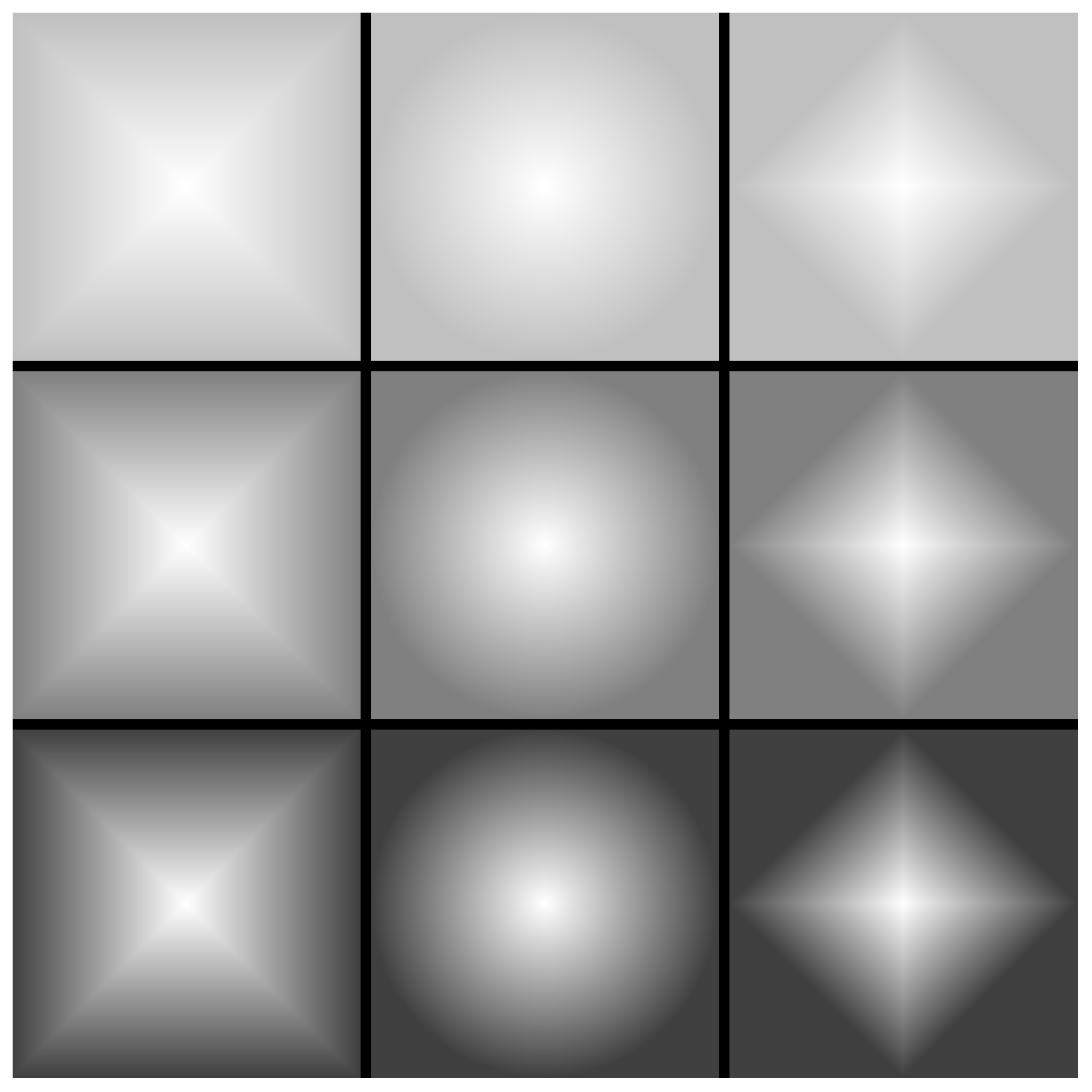
The spatial distribution of the removal probability and the resulting geometry of the lattice are illustrated in
Figure 1. This figure showcases how the choice of distance metric (
,
, and
) reshapes the iso-probability contours, effectively altering the ’footprint’ of the infection. In the first column (
), the contours maintain a square symmetry, whereas the Euclidean metric (
) produces circular patterns, and the Manhattan metric (
) results in diamond-shaped contours. Moving from the top to the bottom rows, we observe the effect of decreasing the boundary parameter
. As
is reduced, the gradient between the center (
) and the perimeter becomes steeper. Visually, the central lighter regions represent areas with a high probability of site removal (
), while the darker peripheral regions indicate a higher probability of sites remaining occupied
. This visualization confirms that for lower
values, the ’survival probability’ of the cells increases significantly as we move toward the lattice edges, effectively confining the most intense part of the removal process to the core of the structure.
The choice of metric defines the shape of the region with the same removal probability. In the current work we will use the maximum norm metric ( metric), although we do not expect significant differences using any of the other two ways.
The metric was chosen as the primary focus because its square iso-probability contours align perfectly with the boundaries of the square lattice used in our simulations. This alignment allows for a more straightforward interpretation of the boundary parameter and its effect on the global connectivity of the system.
By varying , we effectively modulate the boundary conditions of the infection process. This parameter determines the steepness of the probability gradient between the center and the perimeter. Specifically, lower values of correspond to a more pronounced spatial decay of the removal probability, thereby increasing the likelihood of site survival as we move toward the lattice boundaries.
The simulation proceeds as follows: Initially, a specific value for the boundary parameter
is assigned for the entire duration of the realization. In each step, a lattice location
is randomly chosen. If the site is already empty, a new location is chosen. If the site is occupied, its corresponding removal probability
is calculated based on its distance
d from the center, using the fixed value of
in Equation (
1). A uniformly distributed random number
is generated and compared with the probability
. If
, the site is removed (becomes empty); otherwise, the site remains occupied. The process continues with the next randomly selected location. Following every successful site removal, the lattice is tested for the existence of the percolating cluster (spanning connectivity). This process continues until the red-bond point is found for the given realization.
In order to avoid checking to see if the spanning cluster has broken down after each site removal, which is very time-consuming, a two-stage method is used. First, a Coarse Search Phase is conducted where sites are removed in groups until non-percolation is detected. The Hoshen–Kopelman [
1,
2,
4] algorithm is used effectively for fast cluster identification and percolation detection. Following the loss of spanning connectivity, a Fine Search Phase (Binary Search) is applied to the interval of the last removed sites. This binary approach precisely locates the minimum number of sites that must be restored (or, conversely, the maximum number that can be removed) to maintain connectivity, thus accurately defining the critical threshold for the specific
and realization. To ensure statistical convergence and minimize fluctuations, we perform
independent realizations for each set of parameters and average the resulting values. Exactly at the critical point, various quantities are calculated, such as the critical concentration
, the size of the maximum cluster
, and various cluster moments, in order to fully characterize the percolation transition under the influence of the spatial probability gradient.
3. Results
We first vary the
value, and we calculate the value of the critical percolation threshold point. In
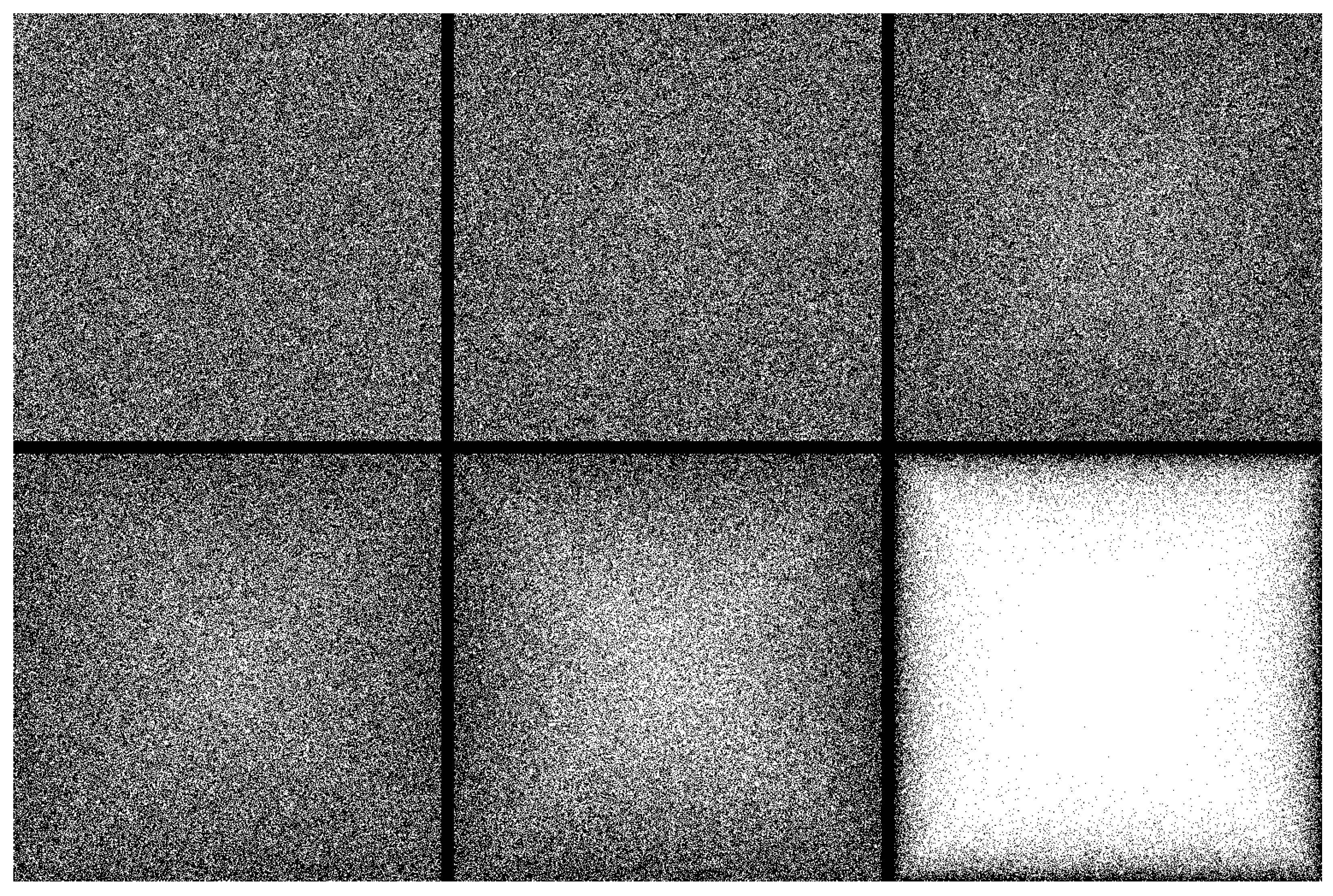
Figure 2 we show schematics of typical realizations of the lattice for several different
values.
The top-left panel of
Figure 2, representing
, corresponds to the classical percolation, which results in the well-known value of
. As
is reduced we see in the several plots of
Figure 2 that the lattice starts to become empty in the middle, while the area close to the perimeter is still relatively more occupied, as is expected in this model. The corresponding spanning clusters for the same
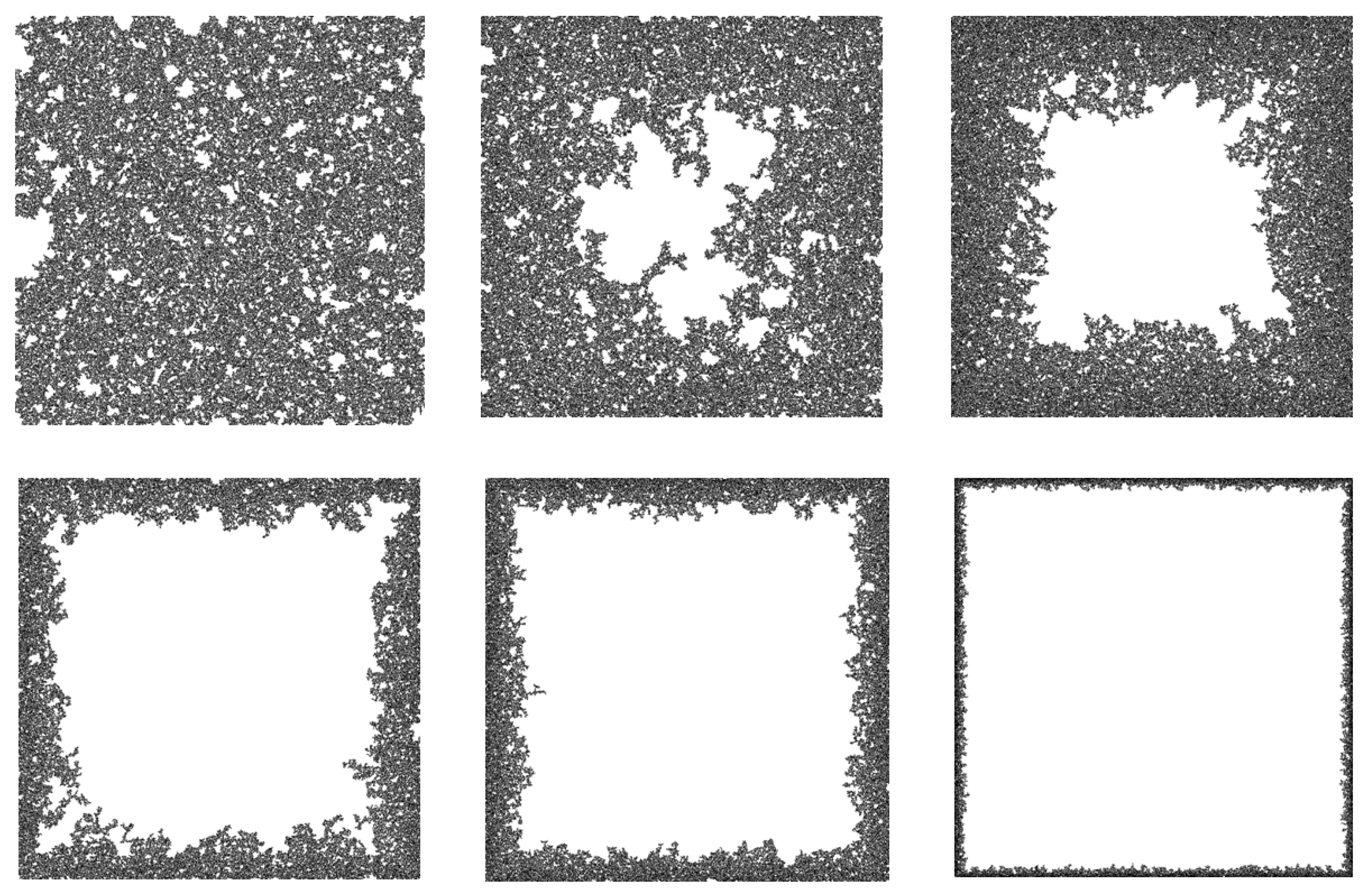
values are given in
Figure 3, where only the largest cluster is shown, verifying the results of the previous figure.
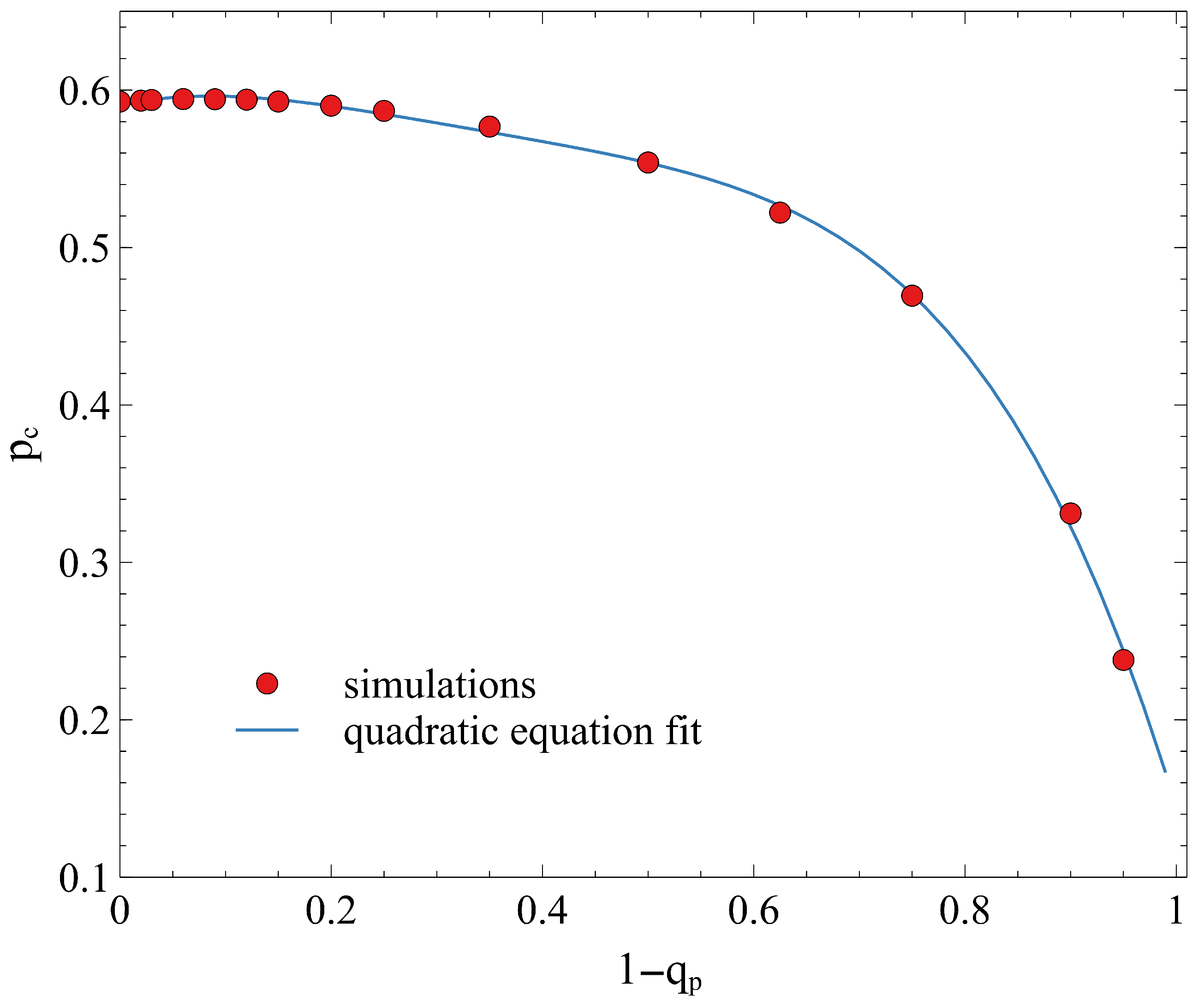
The actual value of
is plotted in
Figure 4 as a function of
. Here we actually plot the value of
, which corresponds to the non-removal probability, so that at the value
we recover the
value of
. We observe a small decrease in the
value in the range up to
and a much sharper decrease in the range
in a parabolic-like curve. This suggests that the presence of a highly protected perimeter (
) allows the percolating cluster to survive even at lower overall occupation probabilities. In the extreme case where
, the removal probability
becomes uniform throughout the entire lattice. Under this condition, the spatial gradient vanishes, and every site is removed with certainty, leading to a completely vacant lattice. This represents the absolute upper bound of the infection process, where the system cannot sustain any connectivity. While we tried several fittings for the points of
Figure 4, the reduction in
follows a non-linear trend that is accurately captured by a fourth-order polynomial fit, as detailed in
Figure 4.
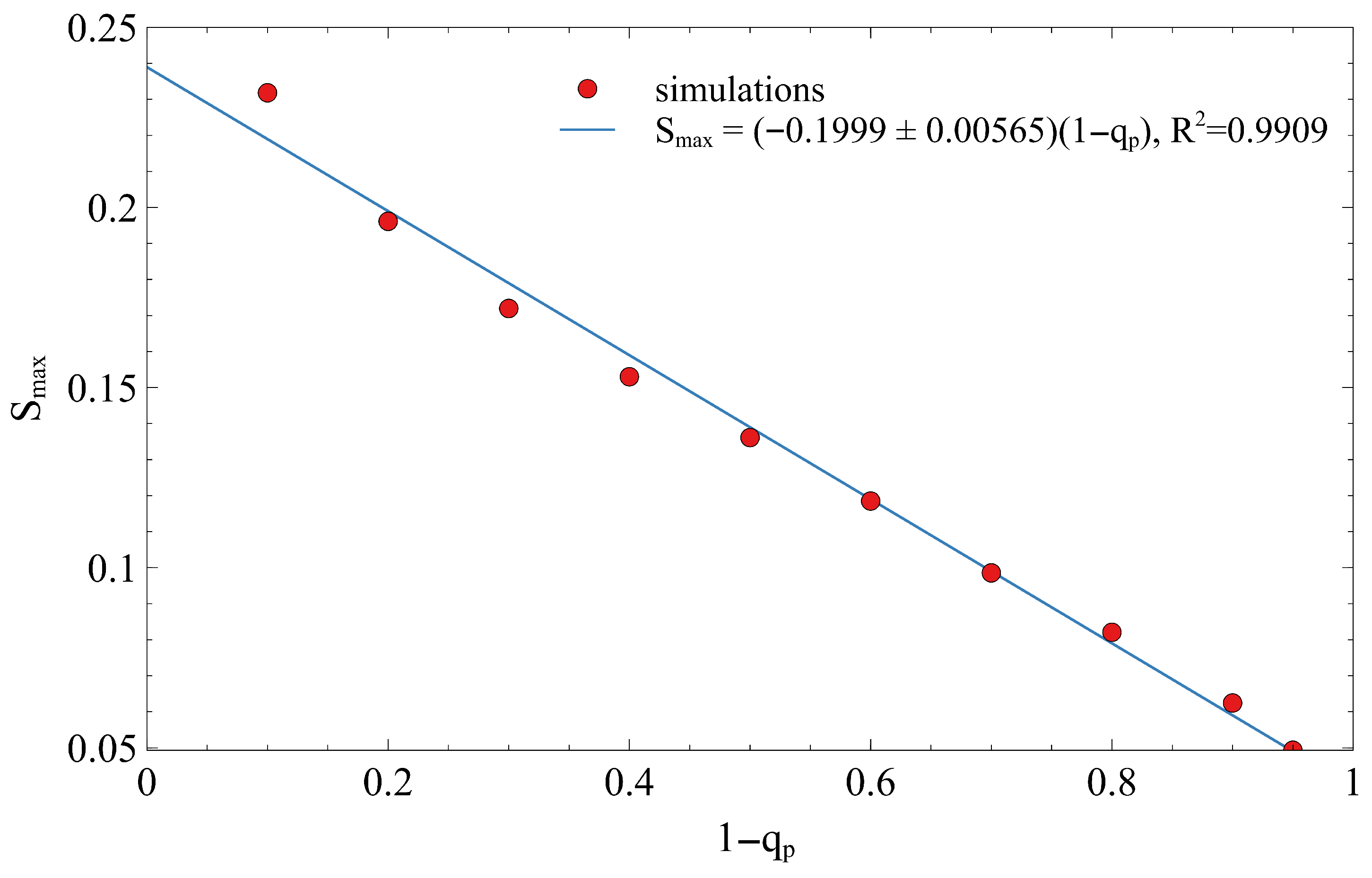
We next calculate the relative size of the largest connected cluster,
(normalized by the total number of sites), at the critical threshold
.
Figure 5 illustrates that the maximum cluster size,
, decreases linearly as a function of
. The line has a negative slope (approximately
), indicating a clear linear relationship. This linear dependence, described by the relation
, suggests that as the perimeter sites become less likely to be removed (higher
), the relative size of the largest connected cluster at the critical point decreases. The spatial inhomogeneity forces the spanning cluster to highly constrained regions closer to the center (
), effectively reducing the maximum cluster size that the lattice can support before fragmentation.
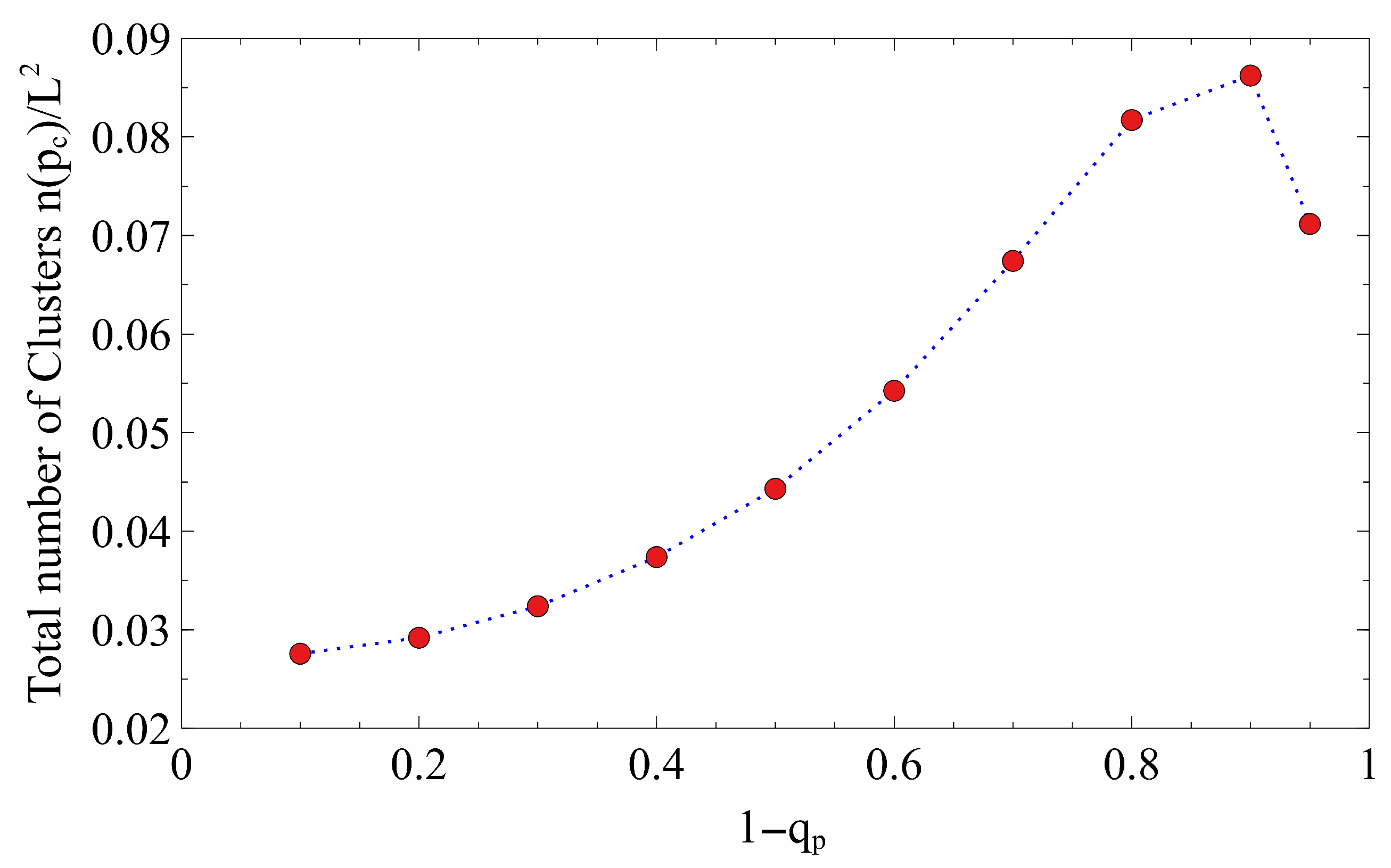
The total number of non-percolating clusters (normalized by the total number of sites),
, was then calculated at the critical point
for each
value.
Figure 6 shows that
increases as
increases, reaching a maximum near
, and then falls sharply at higher values. We observe a parabolic-like behavior for most of the
range. The subsequent sharp decrease is consistent with the rapid drop in
observed in
Figure 4. The overall increase in the number of clusters indicates that the gradient in
q promotes fragmentation and the creation of numerous small, isolated clusters at the critical point, especially when the perimeter is highly protected (low
).
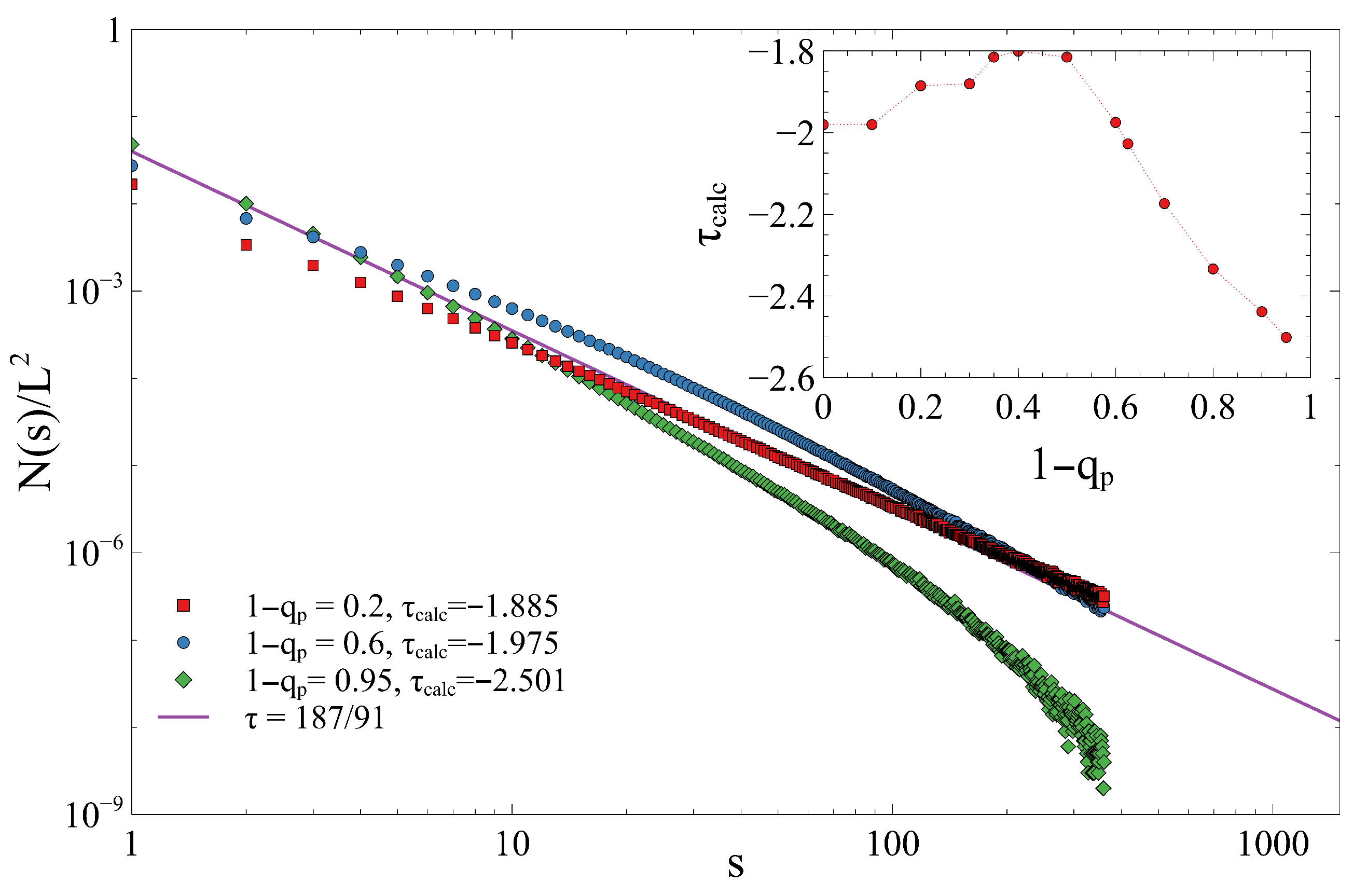
The distribution of cluster sizes,
(the number of clusters of size
s), is crucial for characterizing the universality class of the transition, as it typically follows a power law:
.
Figure 7 (in a log–log plot) confirms that the cluster size distribution follows a power law for all tested values of
. The calculated exponent,
, varies significantly with the parameter
. For the classical 2D random percolation, the exponent is
. The inset of
Figure 7 shows that
starts close to the theoretical value for
, reaches a minimum near
, and then increases sharply for large
, indicating a significant deviation from the classical percolation universality class due to the
q-gradient. This suggests that the spatial inhomogeneity introduced by the gradient is strong enough to change the effective critical exponents, implying that the gradient percolation model may belong to a different universality class than random percolation.