Article

Improved NB Model Analysis of Earthquake Recurrence Interval Coefficient of Variation for Major Active Faults in the Hetao Graben and Northern Marginal Region

1
Institute of Geophysics, China Earthquake Administration, Beijing 100081, China
2
Nuclear and Radiation Safety Center, Ministry of Ecology and Environment, Beijing 100082, China
*
Author to whom correspondence should be addressed.
Entropy 2026, 28(1), 107; https://doi.org/10.3390/e28010107
Submission received: 16 December 2025 / Revised: 11 January 2026 / Accepted: 14 January 2026 / Published: 16 January 2026

Abstract

This study presents an improved Nishenko–Buland (NB) model to address systematic biases in estimating the coefficient of variation for earthquake recurrence intervals based on a normalizing function T T a v e . Through Monte Carlo simulations, we demonstrate that traditional NB methods significantly underestimate the coefficient of variation when applied to limited paleoseismic datasets, with deviations reaching between 30 and 40% for small sample sizes. We developed a linear transformation and iterative optimization approach that corrects these statistical biases by standardizing recurrence interval data from different sample sizes to conform to a common standardized distribution. Application to 26 fault segments across 15 major active faults in the Hetao graben system yields a corrected coefficient of variation of α = 0.381, representing a 24% increase over the traditional method (α0 = 0.307). This correction demonstrates that conventional approaches systematically underestimate earthquake recurrence variability, potentially compromising seismic hazard assessments. The improved model successfully eliminates sampling bias through iterative convergence, providing more reliable parameters for probability distributions in renewal-based earthquake forecasting.

1. Introduction

Based on the elastic rebound theory [1], after a major earthquake occurs on a fault, sufficient energy must accumulate before the next major earthquake can occur. To describe this quasi-periodicity, Utsu, Rikitake, and Hagiwara proposed a renewal model [2,3,4]. Based on paleoseismic and historical earthquake data, researchers have proposed various probability distributions for the renewal model, including the biexponential distribution [2], the Gaussian distribution [3], the lognormal distribution [5], the Weibull distribution and gamma distribution [6], and the Brownian Passage Time (BPT) distribution [7,8].
For an active fault, if sufficient recurrence interval data are available, the probability distribution of major earthquake recurrence can be directly determined through statistical analysis. However, due to the extended recurrence intervals of earthquakes, most active faults only have limited recurrence interval data, which are insufficient for establishing reliable distributions or estimating distribution parameters.
When recurrence interval data for an individual fault are inadequate, assuming that multiple faults within a region of similar seismic background exhibit consistent variability and analogous distribution patterns becomes a practical alternative. Nishenko and Buland introduced a normalizing function T T a v e , where T a v e represents the observed average recurrence interval for a specific fault or fault segment, and T denotes an individual recurrence interval [5]. Utilizing this normalizing function T T a v e enables the integration of recurrence interval data from multiple distinct faults, allowing for the collective statistical analysis to derive a generic distribution pattern or coefficient of variation.
In recent years, the Nishenko–Buland (NB) model has continued to be widely applied in earthquake prediction and seismic hazard analysis as a statistical tool for determining the probability distribution of major earthquake recurrence intervals. The application of the NB model enables relatively accurate assessment of recurrence time intervals for high-magnitude earthquakes [9,10,11,12,13].
However, the NB model presents a significant limitation: the mean value T a v e of limited recurrence intervals on a fault does not equal the true average recurrence interval, potentially introducing substantial bias in results derived from T T a v e statistics [14]. Furthermore, different sample sizes of recurrence intervals yield varying degrees of deviation between the T T a v e derived distribution and the actual distribution.
To conduct a statistical analysis of this bias, we employed the commonly used Brownian Passage Time (BPT) distribution as an example to quantify the deviation in the coefficient of variation between T T a v e -derived distributions under different interval numbers and the actual distributions.
Subsequently, based on this bias analysis, we propose an improved NB model that employs linear transformation to correct the deviation between small-sample statistics and actual distributions. This approach ensures that data from different recurrence interval sample sizes conform to the same distribution, thereby yielding an unbiased generic coefficient of variation.
Finally, this study focuses on 15 major faults along the northern margin of the Hetao graben as research subjects. Assuming that the major earthquake recurrence of these 15 faults all follow a BPT distribution with a uniform coefficient of variation, we apply the proposed improved NB model to derive a generic coefficient of variation value through statistical analysis.

2. Theory and Methods for Improving the NB Model

2.1. Problems in the Traditional NB Model

Nishenko and Buland introduced a normalizing function T T a v e to integrate recurrence interval data from multiple faults, enabling the statistical derivation of a generic coefficient of variation. The NB model addresses the issue of insufficient data on individual faults and provides a reliable probability distribution. However, the mean value ( T a v e ) of limited recurrence intervals on a fault does not equal the true mean recurrence interval, which may lead to deviations in both the distribution pattern and coefficient of variation α of T T a v e from the actual distribution [14]. Furthermore, the deviation may vary depending on the sample size of recurrence intervals.
To address this issue, we employ a Monte Carlo simulation to quantify and analyze the sampling bias inherent in coefficient of variation estimation.
Our Monte Carlo simulation employs a robust numerical framework to generate synthetic BPT-distributed recurrence intervals. To generate random variates conforming to the BPT distribution, we implement an inverse transform sampling method: (1) Generate a uniform random number U from the interval [0, 1]. (2) Numerically solve the equation U = F(T), where F(T) denotes the cumulative distribution function (CDF) of the BPT distribution. (3) The solution T represents a BPT-distributed random variate with parameters μ and α. (4) Each simulation scenario (characterized by specific α0 and sample size n) comprises 100,000 independent replications to ensure statistical stability, with convergence verified by calculating 95% confidence intervals for the estimated coefficient of variation.
Given an original BPT distribution with a predefined coefficient of variation α0, we generate multiple datasets through iterative random sampling, with each dataset comprising n recurrence interval samples (n > 1). We subsequently evaluate the systematic deviation between the empirically derived coefficient of variation α, calculated from the T T a v e statistics of the n samples, and the true coefficient of variation α0.
Based on paleoseismic and historical earthquake data, researchers have proposed various probability distributions for the renewal model. The BPT model offers a more explicit physical interpretation and is widely employed for recurrence probability assessments in probabilistic seismic hazard assessment [15]. Therefore, this study assumes that the recurrence probability distribution follows a BPT distribution.
The BPT model, introduced by Ellsworth et al. and Matthews et al., is grounded in Reid’s elastic rebound theory [7,8]. It assumes that tectonic stress accumulates steadily but is influenced by random fluctuations, that earthquakes occur once stress reaches a critical threshold, and that stress resets to a fixed lower limit following each event. Its probability density function is expressed as follows:
f ( T ) = μ 2 π α 2 T 3 e ( T μ ) 2 2 μ α 2 T
where T represents the variable for recurrence intervals, μ is the average recurrence interval of large earthquakes on active faults, and α is the coefficient of variation in the recurrence interval. This coefficient of variation α reflects the variability of the recurrence intervals for large earthquakes and can be obtained via the statistical analysis of large amounts of recurrence data.
First, assuming conformity to the BPT distribution and given a coefficient of variation value α0, recurrence interval data can be randomly generated using the Monte Carlo method. Since the normalized T T a v e is dimensionless, it is only necessary to set the coefficient of variation α0 for the BPT distribution, while the μ value can be set arbitrarily. In each simulation, the randomly generated recurrence interval data is set to n (n > 1). Through numerous simulations (e.g., 100,000 iterations), the deviation between the coefficient of variation α obtained from T T a v e statistics and the actual coefficient of variation α0 can be determined when the recurrence interval sample size is n.
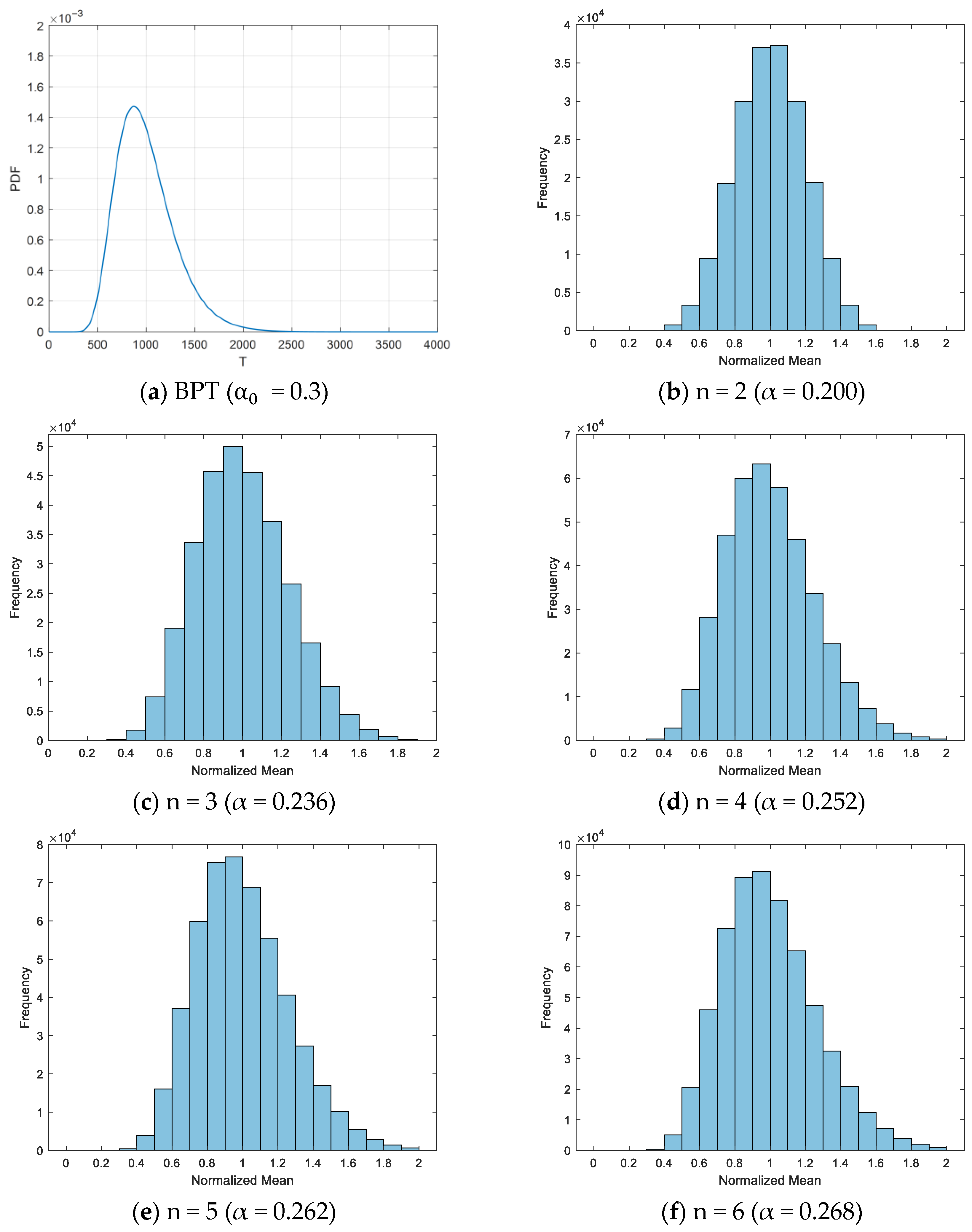
Figure 1 presents the results for an initial distribution with α0 = 0.3 and recurrence interval sample sizes n of 2, 3, 4, 5, and 6, yielding coefficient of variation values α of 0.200, 0.236, 0.252, 0.262, and 0.268, respectively, based on T T a v e statistics. The statistical results demonstrate that the coefficient of variation in the distribution obtained from small-sample T T a v e statistics exhibits significant deviation from the actual coefficient of variation, with smaller sample sizes producing larger deviations.
Second, considering that different coefficient of variation values may also contribute to the deviation between the coefficient of variation obtained from T T a v e statistics based on small samples and the actual coefficient of variation, this study further selected six different initial coefficients of variation (α0): 0.1, 0.2, 0.3, 0.4, 0.5, and 0.6. For each α0 value, 100,000 simulations were performed to investigate the deviation between the coefficient of variation (α) of the BPT distribution derived from T T a v e statistics based on different small sample sizes and the true values.
Table 1 presents the deviations between the BPT distribution coefficient of variation (α) obtained from T T a v e statistics and the true values (α0) under different initial coefficient of variation scenarios. The results in Table 1 demonstrate that the deviation between the coefficient of variation (α) of the BPT distribution derived from T T a v e statistics based on small samples and the actual value (α0) is influenced not only by the sample size but also by the value of the true coefficient of variation (α0). Specifically, smaller actual coefficients of variation (α0) correspond to smaller relative deviations of α from α0.

2.2. Improvement of the NB Model

According to the statistical results shown in Figure 1, the coefficient of variation in the T T a v e distribution obtained from small sample statistics exhibits substantial deviation from the actual variation, with this deviation becoming more pronounced as the sample size decreases.
When recurrence interval sample sizes differ across multiple faults, and the T T a v e from different sample sizes do not follow the same distribution, they cannot be statistically combined, as non-identical distributions violate the assumptions of joint statistical analysis. Consequently, the traditional NB method introduces a significant statistical bias.
To eliminate this bias, this study proposes a linear transformation approach that corrects each T T a v e data point to ensure they conform to the same distribution with identical means and coefficients of variation, thereby eliminating the statistical bias inherent in the traditional NB method.
To adjust a distribution with mean = 1 and coefficient of variation = α to a distribution with mean = 1 and coefficient of variation = α0, the following linear transformation can be applied.
Let X be the original variable and Y be the target variable, then the transformation formula is as follows:
Y = a × X + b
where a = original coefficient of variation/new coefficient of variation = α0/α; b = new mean − a × original mean = 1 − a.
The linear transformation defined in Equation (2) is mathematically justified for the BPT distribution through the following theoretical framework. Similar to the traditional standardization method based on T T a v e —where the T T a v e distribution does not strictly conform to the BPT distribution—our proposed standardization method employing linearly transformed T T a v e values also represents an approximation.
It is important to acknowledge that the BPT distribution lacks shape invariance under linear transformations (unlike the Gaussian distribution). Theoretically, applying Y = aX + b alters the skewness of the distribution, which could potentially affect probability calculations. However, our Monte Carlo validation demonstrates that this shape distortion has negligible impact on practical probability estimation for the following reasons: (1) the BPT distribution’s skewness is already modest in the typical range of coefficients of variation (α < 0.7) relevant to seismic applications; (2) our transformation preserves the two most statistically significant parameters—the mean recurrence interval and coefficient of variation—which dominate the tail probability calculations critical for hazard assessment.
Specifically, the linear transformation Y = aX + b preserves the essential distributional characteristics by maintaining these two fundamental parameters. This preservation of key statistical properties, combined with the minimal impact of shape distortion on probability calculations, renders the proposed approach both practically viable and methodologically sound.
For a random variable X with mean E [ X ] = 1 and coefficient of variation CV( X ) = α, the linear transformation Y = aX + b yields the following:
E[Y] = aE[X] + b = a(1) + (1 − a) = 1
Var(Y) = a2Var(X) = a2α2
CV ( Y ) = V a r ( Y ) / E [ Y ] = a α / 1 = ( α 0 / α ) · α = α 0
This demonstrates that the transformation successfully standardizes the mean to 1 and the coefficient of variation to the target value α0.
Example:
In Figure 1, the initial distribution has a coefficient of variation of 0.300. With a sample size of 3, the Monte Carlo simulation yields a coefficient of variation of 0.236. Therefore, to adjust the T T a v e distribution to achieve a coefficient of variation of 0.300, each T T a v e value requires a linear transformation. Thus, a = 0.300/0.236 ≈ 1.271; b = 1 − 1.271 × 1 = −0.271. The transformation formula becomes Y = 1.271X − 0.271.
To eliminate the influence of variance heterogeneity between different groups, standardization processing is applied to each group of data, ensuring all variables possess identical means and coefficients of variation before conducting T T a v e -based statistical analysis.

2.3. Iterative Optimization Method

As shown in Table 1, the deviation between the coefficient of variation α derived from the BPT distribution of T T a v e based on different small samples and the actual value α0 is not only related to the sample size, but also to the magnitude of the actual distribution’s coefficient of variation α0.
In other words, for different actual coefficients of variation, the ratio a between the new coefficient of variation and the original coefficient of variation varies. Since the actual coefficient of variation is unknown, we can only initially set a possible coefficient of variation and then continuously optimize the parameter a through an iterative approach to improve the statistical results based on small-sample T T a v e .
Therefore, we propose an iterative optimization method with the following algorithmic procedure:
Step 1: Initialization Set the initial value of α to α0.
Through the traditional NB method, obtain an initial coefficient of variation α0 based on actual T T a v e statistics.
Step 2: Standardization transformation
Employ the Monte Carlo method to statistically determine the deviation ratio a between the new and original coefficients of variation under different sample conditions. Then apply Equation (2) to perform a linear transformation on all actual T T a v e data according to their respective sample sizes, yielding a new coefficient of variation α1.
Step 3: Parameter update
Use α1 as the new initial value of α and employ the Monte Carlo method to statistically determine the deviation ratio a between the new and original coefficients of variation under different sample conditions. Then apply Equation (2) to perform a linear transformation on all actual T T a v e data according to their respective sample sizes, obtaining a new coefficient of variation α2.
Step 4: Convergence criterion
Calculate |αk+1 − αk|. If |αk+1 − αk| > 0.0005, repeat Step 3. If |αk+1 − αk| ≤ 0.0005, terminate the iteration. The threshold of 0.0005 is chosen to ensure the coefficient of variation is accurate to three decimal places. Where αk represents the k-th iteration result, and αk+1 represents the (k + 1)-th iteration result. Through continuous iteration, an optimized coefficient of variation α can be obtained.
It is acknowledged that this constitutes an empirical iterative method rather than a theoretically guaranteed algorithm. Nevertheless, the stability and convergence of this method have been empirically observed in the present study’s simulations, supported by the following properties.
Statistical robustness: The 100,000-replication Monte Carlo simulations at each iteration yield standard errors < 0.001 for coefficient of variation estimates, preventing oscillatory behavior attributable to sampling noise.
Empirically observed error reduction: In our simulations, each iteration was consistently observed to reduce the systematic bias between the empirically observed distribution and the target distribution with the true (unknown) coefficient of variation α. While not mathematically proven, this monotonic convergence pattern was stable across all simulation scenarios examined in this study.

3. Paleoseismic Data of Major Faults Along the Northern Margin of the Hetao Graben and Application of the Improved NB Model

3.1. Fault Systems and Seismic Data in the Study Area

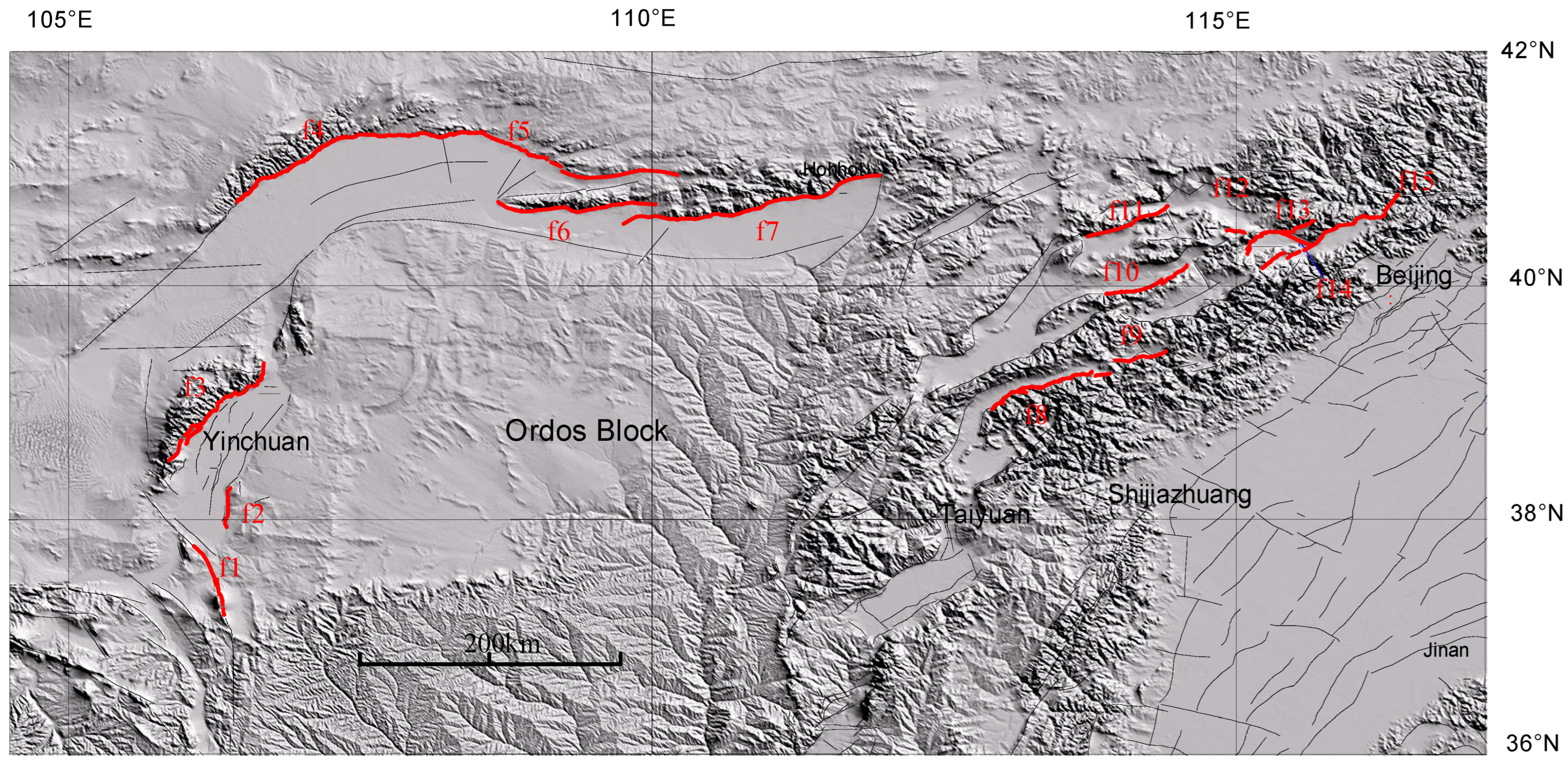
This study focuses on the Hetao Graben and its northern margin (105–117° E, 38.5–42° N; Figure 2). Situated along the northern edge of the Ordos Block, this region represents a transitional zone between the North China Craton and the Alxa Block and is characterized by comparable tectonic evolutionary histories and seismic activity patterns.
The regional active fault system primarily comprises NE–NEE trending structures, including the Yinchuan Graben and Hetao Graben, along with conjugate NW-trending faults [16,17]. The controlling boundary faults include the Langshan Piedmont Fault, Wulashan Piedmont Fault, Baotou Fault, Daqingshan Piedmont Fault, and the northern margin fault of the Yanfan Basin. These fault zones represent active tectonic structures since the Quaternary, exhibiting similar normal fault characteristics and extensional tectonic features.
Seismic activity in this region displays distinct zonal distribution patterns, primarily concentrated along active fault zones. The area has experienced significant historical earthquakes, including the 1739 M 8.0 Pingluo earthquake and the 1888 M 6.0 Wulate earthquake. Currently, the region maintains relatively high levels of small-to-moderate seismic activity [18]. Focal mechanism solutions predominantly show normal faulting, reflecting consistent regional stress field conditions.
Based on the similar geological and structural background, unified geodynamic environment, and consistent seismic activity patterns, earthquake data from different fault zones within this region can be integrated for comprehensive statistical analysis. This provides a reliable database for investigating the overall seismic activity patterns of the Hetao Graben system.
Fifteen faults within the Hetao rift zone and its northern marginal region contain relatively comprehensive paleoseismic records. However, the completeness of paleoseismic data varies significantly among different fault segments. Therefore, establishing robust paleoseismic data screening criteria is essential for reliable assessment of major earthquake recurrence probabilities.
The paleoseismic data screening protocol employed in this study adheres to the following criteria: (1) Priority is given to the most recently published authoritative paleoseismic investigations; (2) Events lacking either upper or lower age constraints are excluded from recurrence interval calculations due to excessive temporal uncertainty; (3) Only seismic events consistent with quasi-periodic characteristic earthquake models are considered; (4) Paleoseismic sequences on faults with relatively small upper magnitude limits (<M7.0) are not considered, as such faults are unlikely to produce surface ruptures; (5) Paleoseismic events occurring during intervals characterized by evident record gaps or disputed paleoseismic completeness are excluded from the analysis.

3.2. Application of the Improved NB Model and Calculation of the Coefficient of Variation

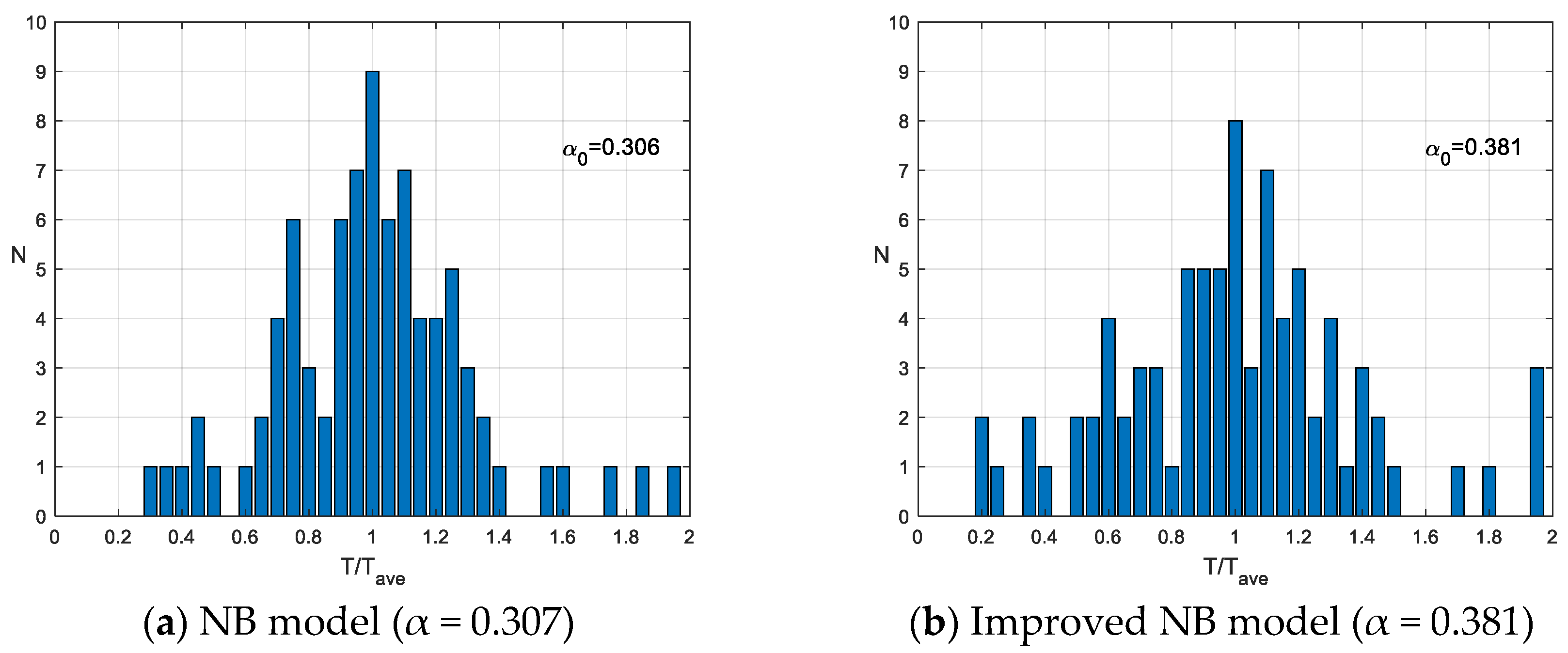
Based on paleoseismic data from 26 fault segments across 15 major fault zones within the Hetao Graben and its northern marginal region (Table 2), statistical analysis of T T a v e using the NB method yields a general coefficient of variation α0 = 0.307 (Figure 3a). The paleoseismic dating data in Table 2 exhibit substantial uncertainties. The NB model statistics employed in this study do not account for such uncertainties; instead, they directly adopt the midpoint values of the dating ranges. This dating uncertainty falls within the category of epistemic uncertainty. To properly propagate paleoseismic dating uncertainties in subsequent recurrence probability calculations, quantitative approaches such as logic tree analysis or Bayesian inference could be implemented to provide a more comprehensive assessment of the reliability of probabilistic forecasts.
Subsequently, following the improved BPT model proposed in this study, iterative optimization was performed on the statistical results. The iterative process is shown in Table 3, where convergence to α = 0.381 was achieved after four iterations (Figure 3b). The final statistical distribution is presented in Figure 1b, with the horizontal axis representing the linearly transformed T T a v e values. The results demonstrate that the improved NB model proposed in this study, incorporating linear transformation of T T a v e and iterative optimization, yields a coefficient of variation α = 0.381, which is substantially larger than the coefficient of variation α0 = 0.307 obtained through the conventional NB method. In the traditional NB approach, the statistical analysis of T T a v e based on small samples exhibits significant bias in estimating the coefficient of variation in actual recurrence intervals, leading to substantial underestimation of the coefficient of variation.
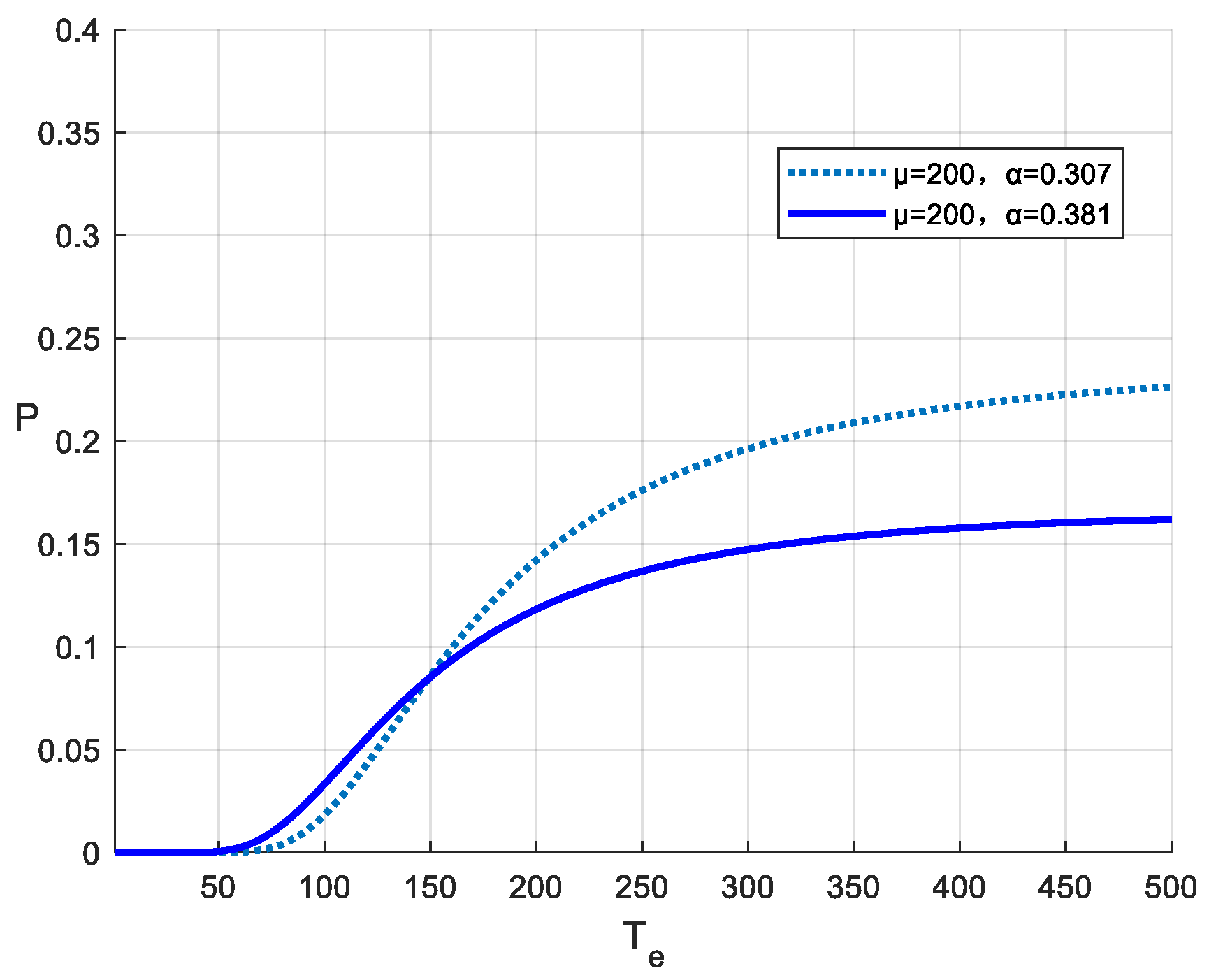
To examine the influence of different methods for estimating the coefficient of variation (α) on earthquake occurrence probability calculations, this study presents a simple computational example. Earthquake recurrence probabilities were calculated for a future time period using the BPT distribution with μ = 200 years and ΔT = 10 years, employing α = 0.307 and α = 0.381, respectively. The results reveal that using 0.75μ as a threshold, the probability curve with α = 0.381 yields higher values before this point, whereas the curve with α = 0.307 produces higher probabilities beyond it (Figure 4). This demonstrates that substantial differences exist in earthquake occurrence probability estimates between the improved NB model proposed in this study and the conventional NB model. Furthermore, sensitivity analyses indicate that these differences vary with different combinations of μ and ΔT, with the crossover point typically occurring within the range of 0.7–0.8μ.

4. Discussions

4.1. Statistical Bias Correction and Model Performance

The improved NB model successfully addresses the systematic bias introduced by small sample sizes. Our Monte Carlo simulations demonstrate that the coefficient of variation derived from T T a v e statistics exhibits substantial deviation from true values, with deviations ranging from 30 to 40% for samples of 2–3 intervals. This bias correction is particularly significant given that most active faults worldwide possess limited paleoseismic records [8,25]. The iterative optimization approach ensures convergence to an unbiased coefficient of variation (α = 0.381 versus α0 = 0.307 for the traditional NB method), representing a 24% increase that reflects the true variability of earthquake recurrence intervals.

4.2. Methodological Limitations

The proposed methodology is theoretically applicable to any fault system where the fundamental assumptions of the renewal model hold, including the quasi-periodic behavior and stress accumulation-release cycles [1]. However, several limitations must be acknowledged. Not all fault systems exhibit the characteristic earthquake behavior required for renewal models, as some demonstrate complex, non-periodic rupture patterns influenced by fault interactions, triggered seismicity, or variable stress loading rates [26]. Additionally, the assumption of BPT distribution uniformity across different fault segments may oversimplify the complexity of earthquake systems, where factors such as fault geometry, stress heterogeneity, and multi-fault interactions can introduce significant variations in recurrence patterns. Consequently, applying a uniform distribution model may fail to reflect fault-to-fault heterogeneity, potentially leading to systematic biases in seismic hazard assessment. Finally, the method’s reliability remains contingent upon the quality and completeness of paleoseismic records, which are often incomplete due to preservation bias and limited temporal coverage.

4.3. Scientific Significance and Implications for Seismic Hazard Assessment

This study represents a significant methodological advancement in earthquake probability modeling by providing a statistically robust framework for coefficient of variation estimation in data-limited environments. The corrected coefficient of variation (α = 0.381) for the Hetao Graben system aligns well with global estimates for continental normal fault systems, which typically range from 0.3 to 0.5 [7]. The improved NB model enhances the reliability of probabilistic seismic hazard assessments by eliminating systematic biases that previously led to conservative risk estimates. This advancement is particularly valuable for regions with limited instrumental seismic records but rich paleoseismic histories, such as continental intraplate settings.

4.4. Future Research Directions and Model Development

Future research should focus on expanding the database of high-quality paleoseismic records to enable more refined statistical analyses across diverse tectonic settings and fault characteristics. Investigation of coefficient of variation dependencies on fault-specific parameters such as slip rate, maximum magnitude, fault length, and structural complexity would enhance model sophistication [27,28]. The development of hierarchical Bayesian approaches could better accommodate uncertainties in paleoseismic age determinations and provide more robust parameter estimation frameworks. Additionally, incorporating machine learning techniques and big data analytics may reveal previously unrecognized patterns in earthquake recurrence variability. Extension of the methodology to other probability distributions beyond BPT, including mixed distributions that account for both characteristic and non-characteristic earthquake behavior, represents another promising avenue for methodological advancement.

5. Conclusions

This study presents a significant methodological advancement in earthquake probability modeling through the development of an improved Nishenko–Buland (NB) model that addresses critical statistical biases inherent in traditional approaches. Our research successfully identifies and corrects systematic underestimation of coefficient of variation values when applying the conventional NB method to limited paleoseismic datasets. Through extensive Monte Carlo simulations, we demonstrated that small sample sizes introduce substantial deviations between observed and true coefficients of variation, with deviations ranging from 30 to 40% for datasets containing only 2–3 recurrence intervals. The magnitude of this bias is not only dependent on sample size but also correlates with the true coefficient of variation value, necessitating the iterative optimization approach we developed.
The application of our improved NB model to 26 fault segments across 15 major active faults in the Hetao Graben system yields a corrected coefficient of variation of α = 0.381, representing a 24% increase over the traditional NB method result (α0 = 0.307). This correction demonstrates that conventional approaches systematically underestimate earthquake recurrence variability, potentially leading to overconfident probability estimates in seismic hazard assessments. The linear transformation and iterative optimization procedures ensure that recurrence interval data from different sample sizes conform to the same statistical distribution, eliminating the bias that previously compromised joint statistical analyses. Our methodology successfully converges within four iterations, providing a robust and computationally efficient solution for coefficient of variation estimation in data-limited environments.
The corrected coefficient of variation value (α = 0.381) for the Hetao Graben system aligns well with global estimates for continental normal fault systems and provides critical input parameters for probabilistic seismic hazard assessment in this seismically active region. This finding has profound implications for earthquake risk evaluation and seismic safety considerations, as accurate variability estimates are essential for reliable probability calculations and appropriate risk mitigation strategies. The improved model addresses a fundamental limitation in renewal-based earthquake forecasting by providing unbiased statistical parameters that better reflect the true quasi-periodic nature of characteristic earthquakes along active fault systems.
The broader scientific significance of this research extends beyond regional applications to provide a standardized framework for coefficient of variation determination in any tectonic setting where sufficient paleoseismic data exist. The methodology is particularly valuable for continental intraplate regions and other seismically active areas with limited instrumental records but rich paleoseismic histories. Future applications of this improved NB model will enhance the reliability of long-term earthquake probability assessments worldwide, contributing to more accurate seismic hazard models and ultimately supporting evidence-based seismic risk management strategies. The theoretical framework developed here establishes a foundation for further refinements in earthquake recurrence modeling and represents a crucial step toward eliminating statistical biases that have long affected probabilistic seismic hazard assessment methodologies.

Author Contributions

Conceptualization, X.G. and J.L.; methodology, X.G. and J.L.; software, X.G. and J.L.; validation, X.G. and J.L.; formal analysis, X.G.; investigation, X.G.; data curation, X.G.; writing—original draft preparation, X.G.; writing—review and editing, X.G. and J.L.; supervision, J.L.; project administration, J.L.; funding acquisition, J.L. All authors have read and agreed to the published version of the manuscript.

Funding

This study was funded by National Key R&D Program of China (2022YFC3003502).

Institutional Review Board Statement

Not applicable.

Informed Consent Statement

Not applicable.

Data Availability Statement

All data used in this paper came from published sources listed in the references.

Conflicts of Interest

The authors declare no conflicts of interest.

References

  1. Reid, H.F. The Mechanics of the Earthquake, The California Earthquake of April 18, 1906; State Earthquake Investigation Commission, Carnegie Institution of Washington: Washington, DC, USA, 1910; Volume 2, pp. 16–18. [Google Scholar]
  2. Utsu, T. Large Earthquakes near Hokkaido and the Expectancy of the Occurrence of a Large Earthquake of Nemuro; Report of the Coordinating Committee for Earthquake Prediction; Coordinating Committee for Earthquake Prediction: Tsukuba, Japan, 1972; Volume 7, pp. 7–13. [Google Scholar]
  3. Rikitake, T. Probability of an earthquake occurrence as estimated from crustal strain. Tectonophysics 1974, 23, 299–312. [Google Scholar] [CrossRef]
  4. Hagiwara, Y. Probability of Earthquake Occurrence as Obtained from a Weibull Distribution Analysis of Crustal Stain. Tectonophysics 1974, 23, 313–318. [Google Scholar] [CrossRef]
  5. Nishenko, S.P.; Buland, R.A. A generic recurrence interval distribution for earthquake forecasting. Bull. Seismol. Soc. Am. 1987, 77, 1382–1399. [Google Scholar]
  6. Utsu, T. Estimation of Parameters for Recurrence Models of Earthquakes; Bulletin of the Earthquake Research Institute, University of Tokyo: Tokyo, Japan, 1984; Volume 59, pp. 53–66. [Google Scholar]
  7. Ellsworth, W.L.; Matthews, M.V.; Nadeau, R.M.; Nishenko, S.P.; Reasenberg, P.A.; Simpson, R.W. A Physically Based Earthquake Recurrence Model for Estimation of Long-Term Earthquake Probabilities; US Geological Survey Open-File Report; U.S. Geological Survey: Reston, VA, USA, 1999; pp. 99–522. [CrossRef]
  8. Matthews, M.V. A Brownian Model for Recurrent Earthquakes. Bull. Seismol. Soc. Am. 2002, 92, 2233–2250. [Google Scholar] [CrossRef]
  9. Nas, M.; Bayrak, Y.; Mpapka, E.; Tsapanos, T.M. Conditional earthquake probabilities along the North Anatolian fault zone based on inverse Gaussian against lognormal distribution. J. Seismol. 2024, 28, 1389–1420. [Google Scholar] [CrossRef]
  10. Xu, W.; Wu, J.; Gao, M. Temporal distribution model and occurrence probability of M ≥ 6.5 earthquakes in North China Seismic Zone. Nat. Hazards 2023, 119, 125–141. [Google Scholar] [CrossRef]
  11. Sreejaya, K.P.; Podili, B.; Raghukanth, S.T.G. Physics-based probabilistic seismic hazard assessment using synthetic ground motions: Application to the stable continental region of India. J. Seismol. 2024, 28, 1247–1265. [Google Scholar] [CrossRef]
  12. Pasari, S.; Verma, H. Recurrence statistics of M ≥ 6 earthquakes in the Nepal Himalaya: Formulation and relevance to future earthquake hazards. Nat. Hazards 2024, 120, 7725–7748. [Google Scholar] [CrossRef]
  13. Neely, J.S.; Salditch, L.; Spencer, B.D.; Stein, S. A More Realistic Earthquake Probability Model Using Long-Term Fault Memory. Bull. Seismol. Soc. Am. 2022, 113, 843–855. [Google Scholar] [CrossRef]
  14. Guo, X.; Pan, H. A method for computing the aperiodicity parameter of the strong earthquake recurrence interval. Acta Seismol. Sin. 2015, 37, 411–419. [Google Scholar] [CrossRef]
  15. Field, E.H.; Biasi, G.P.; Bird, P.; Dawson, T.E.; Felzer, K.R.; Jackson, K.M.; Johnson, T.H.; Jordan, T.H.; Madden, C.; Michael, A.J.; et al. Long-term time-dependent probabilities for the third uniform California earthquake rupture forecast (UCERF3). Bull. Seism. Soc. Am. 2015, 105, 511–543. [Google Scholar] [CrossRef]
  16. Deng, Q.D.; Zhang, P.Z.; Ran, Y.K.; Yang, X.P.; Min, W.; Chu, Q.Z. Basic characteristics of active tectonics of China. Sci. China Ser. D Earth Sci. 2002, 32, 1020–1030. [Google Scholar] [CrossRef]
  17. Zhang, P.Z.; Deng, Q.D.; Zhang, G.M.; Ma, J.; Gan, W.J.; Min, W.; Mao, F.Y.; Wang, Q. Active tectonic blocks and strong earthquakes in the continent of China. Sci. China Ser. D Earth Sci. 2003, 33, 12–20. [Google Scholar] [CrossRef]
  18. Pan, B. Study on Seismic Hazard of Major Active Fault Zones in the Northern Margin of Hetao Rift Zone. Ph.D. Thesis, China University of Geosciences (Beijing), Beijing, China, 2012. [Google Scholar]
  19. Min, W.; Zhang, P.Z.; Deng, Q.D. Primary research of regional paleoearthquake recurrence. Acta Seismol. Sin. 2000, 22, 163–170. [Google Scholar]
  20. Chai, Z.Z.; Liao, Y.H.; Zhang, W.X.; Xu, W.J.; Shen, X.H.; Tian, Q.J. Late quaternary pleoearthquakes and their rupture features along the Lingwu fault. Seismol. Geol. 2001, 23, 15–23. [Google Scholar]
  21. Chen, L.C. Paleoearthquakes, the Law of Strong Earthquake Recurrence and Potential Sites for the Occurrence of Future Strong Earthquakes in the Hetao Fault-Depression Zone. Ph.D. Thesis, Institute of Geology, China Earthquake Administration, Beijing, China, 2002. [Google Scholar]
  22. Ran, Y.K.; Zhang, P.Z.; Chen, L.C. Study on the completeness of late Quaternary paleoearthquakes along the Daqingshan piedmont fault in Hetao fault-depression zone. Earth Sci. Front. 2003, 10, 207–216. [Google Scholar]
  23. Liu, J.; Wang, L.M. Using active fault data to evaluate long-term earthquake risk in Fenwei earthquake zone. Acta Seismol. Sin. 1996, 18, 427–435. [Google Scholar] [CrossRef]
  24. Ran, Y.K. Detailed Paleoseismic Studies at Several Typical Sites in China and Discussion on Great Earthquake Recurrence Behavior. Ph.D. Thesis, Institute of Geology, China Earthquake Administration, Beijing, China, 1997. [Google Scholar]
  25. Parsons, T. Monte Carlo method for determining earthquake recurrence parameters from short paleoseismic catalogs: Example calculations for California. J. Geophys. Res. Solid Earth 2008, 113, B3. [Google Scholar] [CrossRef]
  26. Ben-Zion, Y. Collective Behavior of Earthquakes and Faults: Continuum-Discrete Transitions, Evolutionary Changes and Corresponding Dynamic Regimes. Rev. Geophys. 2008, 46, RG4006. [Google Scholar] [CrossRef]
  27. Wesnousky, S.G. The Gutenberg-Richter or characteristic earthquake distribution, which is it? Bull. Seismol. Soc. Am. 1994, 84, 1940–1959. [Google Scholar] [CrossRef]
  28. Stirling, M.; Goded, T.; Berryman, K.; Litchfield, N. Selection of earthquake scaling relationships for seismic-hazard analysis. Bull. Seismol. Soc. Am. 2013, 103, 2993–3011. [Google Scholar] [CrossRef]
Figure 1. BPT Distribution vs. T T a v e Distribution Derived from Small Sample Data.
Entropy 28 00107 g001
Figure 2. Active faults in the Hetao Graben and northern margin (f1: Luoshan eastern piedmont fault; f2: Yellow River–Lingwu fault; f3: Helanshan eastern piedmont fault; f4: Langshan piedmont fault; f5: Seertenshan piedmont fault; f6: Wulashan piedmont fault; f7: Daqingshan piedmont fault; f8: Wutaishan northern piedmont fault; f9: Taibai–Weishan northern piedmont fault; f10: Yangyuan Basin southern margin fault; f11: Yanggao–Tianzhen northern margin fault; f12: Xuanhua Basin southern margin fault; f13: Huai-Zhuo Basin northern margin fault; f14: Xinbaoan–Shacheng fault; f15: Yanfan Basin northern margin fault).
Entropy 28 00107 g002
Figure 3. T T a v e distributions based on traditional and improved NB models.
Entropy 28 00107 g003
Figure 4. Comparison of earthquake occurrence probabilities over the next 10 years between the conventional BPT and improved BPT models. Te represents the elapsed time since the last major earthquake.
Entropy 28 00107 g004
Table 1. Relationship between the coefficient of variation α of the BPT distribution derived from T T a v e statistics and the initial coefficient of variation α0.
Sample Size of Intervalsα0 = 0.1α0 = 0.2α0 = 0.3α0 = 0.4α0 = 0.5α0 = 0.6
2α = 0.702α0α = 0.689α0α = 0.665α0α = 0.637α0α = 0.610α0α = 0.582α0
3α = 0.814α0α = 0.802α0α = 0.783α0α = 0.763α0α = 0.734α0α = 0.707α0
4α = 0.862α0α = 0.854α0α = 0.837α0α = 0.820α0α = 0.798α0α = 0.775α0
5α = 0.894α0α = 0.884α0α = 0.871α0α = 0.855α0α = 0.837α0α = 0.816α0
6α = 0.911α0α = 0.904α0α = 0.896α0α = 0.880α0α = 0.864α0α = 0.846α0
Table 2. Paleoseismic data for 15 active faults in the Hetao Graben and northern margin.
No.FaultSegmentPaleoseismic EventsNumber of Intervals T T a v e Sources
f1Luoshan eastern piedmont fault E1: 8200 ± 600
E2: 5020 ± 70
E3: 3331 ± 92
E4: 464
31.2326
0.6547
1.1128
[19]
f2Yellow River–Lingwu faultLingwu segmentE1: 27,150 ± 778
E2: 20,000
E3: 13,070 ± 60
E4: 10,586 ± 50
E5: 6000
41.3522
1.3106
0.4698
0.8673
[20]
f3Helanshan eastern piedmont fault E1: 8240 ± 170
E2: 6330 ± 80
E3: 4760 ± 80
E4: 2675 ± 70
E5: 286
40.9605
0.7895
1.0485
1.2014
[19]
f4Langshan piedmont faultEastern Xibulong segmentE1: 3990
E2: 3655
E3: 2990
E4: 2380
30.6242
1.2391
1.1366
[21]
f5Seertenshan piedmont faultDashetai segmentE1: 31,690 ± 1770
E2: 23,000 ± 1320
E3: 15,420 ± 870
E4: 7440 ± 440
31.0751
0.9377
0.9872
[21]
Wulanhudong segmentE1: 25,130 ± 1430
E2: 14,570 ± 820
E3: 11,660 ± 650
E4: 7220 ± 400
31.7688
0.4874
0.7437
f6Wulashan piedmont faultGongmiaozi–Heshunzhuang segmentE1: 7215 ± 255
E2: 5935 ± 45
E3: 3645 ± 55
E4: 1655 ± 185
30.6919
1.2378
1.0703
[21]
Heshunzhuang–Baotou segmentE1: 23,860 ± 1000
E2: 17,425 ± 970
E3: 16,500 ± 600
E4: 13,400 ± 600
E5: 11,850 ± 830
E6: 8385 ± 470
E7: 4130 ± 78
61.9569
0.2813
0.9427
0.4714
1.0537
1.2940
f7Daqingshan piedmont faultTumd Right Banner segmentE1: 10,309 ± 991
E2: 8760 ± 500
E3: 4545 ± 466
E4: 3650 ± 280
E5: 1176
40.6784
1.8461
0.3920
1.0835
[22]
Tumd Left Banner segmentE1: 11,000
E2: 9000
E3: 7000
E4: 4000
E5: 2000
40.8889
0.8889
1.3333
0.8889
Hohhot segmentE1: 18,750 ± 750
E2: 16,970 ± 960
E3: 14,650 ± 670
E4: 11,820 ± 690
E5: 9450 ± 260
E6: 6830 ± 260
E7: 4500 ± 230
60.7495
0.9768
1.1916
0.9979
1.1032
0.9811
f8Wutaishan northern piedmont faultEastern segmentE1: 6500
E2: 4000
E3: 1480
20.9960
1.0040
[23]
f9Taibai–Weishan northern piedmont faultCentral segmentE1: 7230
E2: 3600
E3: 390
21.0614
0.9386
[18]
f10Yangyuan Basin southern margin faultSegment AE1: 20,220
E2: 15,680
E3: 14,247
E4: 8565
E5: 3800
41.1060
0.3491
1.3842
1.1608
[18]
Segment BE1: 15,845
E2: 10,950
E3: 8970
E4: 6650
31.5971
0.6460
0.7569
f11Yanggao–Tianzhen northern margin faultWestern segmentE1: 9365
E2: 8760
E3: 7972
20.8686
1.1314
[18]
Eastern segmentE1: 14,512
E2: 12,520
E3: 10,405
E4: 6007
30.7026
0.7460
1.5513
f12Xuanhua Basin southern margin fault E1: 8540
E2: 7080
E3: 5310
20.9040
1.0960
[24]
f13Huai–Zhuo Basin northern margin faultNorthern segmentE1: 20,500 ± 1180
E2: 14,500 ± 710
E3: 6700 ± 600
E4: <1310
30.9068
1.1788
0.9144
[23]
Southern segmentE1: 18,750 ± 1400
E2: 16,970 ± 700
E3: 14,650 ± 2100
E4: 11,820
E5: 9450 ± 400
E6: 6830 ±500
E7: <2865
50.7466
0.9732
1.1871
0.9941
1.0990
f14Xinbaoan–Shacheng fault E1: 23,205 ± 905
E2: 16,025 ± 615
E3: 8159 ± 500
E4: <7619 ± 95
20.9544
1.0456
[24]
f15Yanfan Basin northern margin faultLangshan–Fangjiachong segmentE1: 19,850 ± 750
E2: 10,505 ± 497
E3: 4900 ± 400
21.2502
0.7498
[24]
Fangjiachong–Hanhaozhuang segmentE1: 19,850 ± 750
E2: 16,000 ± 1300
E3: 10,505 ± 497
E4: 6599 ± 155
E5: 541
40.7976
1.1383
0.8092
1.2550
Hanhaozhuang–Xinzhuangpu segmentE1: 19,850 ± 750
E2: 13,600 ± 1000
E3: 6599 ± 155
20.9433
1.0567
Yanwanggou–Shuigou segmentE1: 32,050 ± 1050
E2: 21,400 ± 900
E3: 10,500 ± 300
20.9884
1.0116
Langshan–Sangying segmentE1: 27,640 ± 680
E2: 13,950 ± 550
E3: 6850 ± 650
E4: <3663 ± 165
21.3170
0.6830
Table 3. Iterative optimization process for statistical determination of coefficient of variation based on T T a v e .
Iteration StepInitial α0α/α0
(2 Interval)
α/α0
(3 Interval)
α/α0
(4 Interval)
α/α0
(5 Interval)
α/α0
(6 Interval)
Resulting
α
10.3060.6640.7820.8380.8710.8940.374
20.3740.6470.7690.8260.8620.8840.380
30.3800.6460.7660.8250.8590.8820.381
40.3810.6440.7660.8240.8580.8830.381
Disclaimer/Publisher’s Note: The statements, opinions and data contained in all publications are solely those of the individual author(s) and contributor(s) and not of MDPI and/or the editor(s). MDPI and/or the editor(s) disclaim responsibility for any injury to people or property resulting from any ideas, methods, instructions or products referred to in the content.