

Transfer Irreversibilities in the Lenoir Cycle: FTT Design Criteria with

 , , ,
, , ,
Abstract
1. Introduction
2. Thermodynamic Description of the Irreversible Lenoir Cycle
2.1. Working Fluid and Thermodynamic Properties
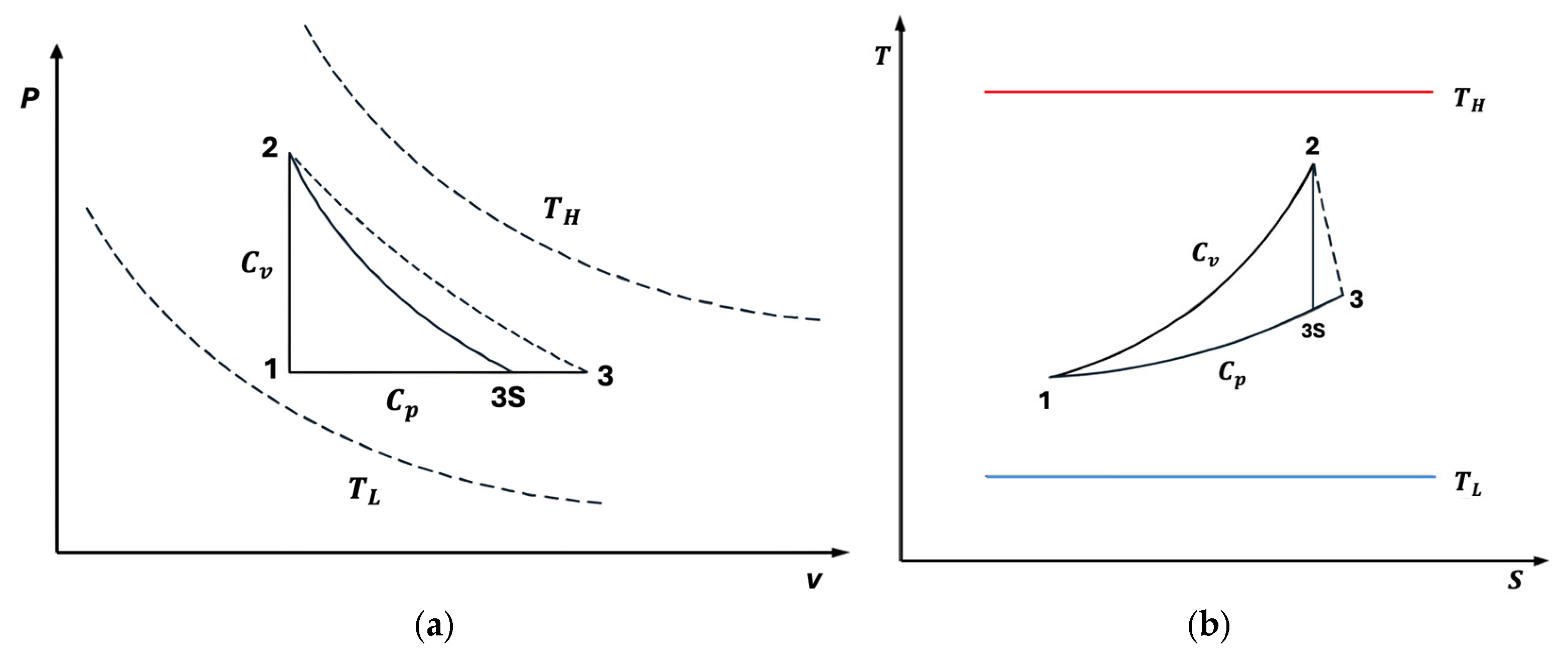
2.2. Physical Structure of the Lenoir Cycle in Steady Flow
2.3. Heat Exchangers with the ε–NTU Model
2.4. Entropy Production and the Origin of Thermal Irreversibility
3. Objective Functions
3.1. Bounded Ecological Function Regime
3.2. Second Law Efficiency
3.3. Efficient Power Regime
4. Numerical Results
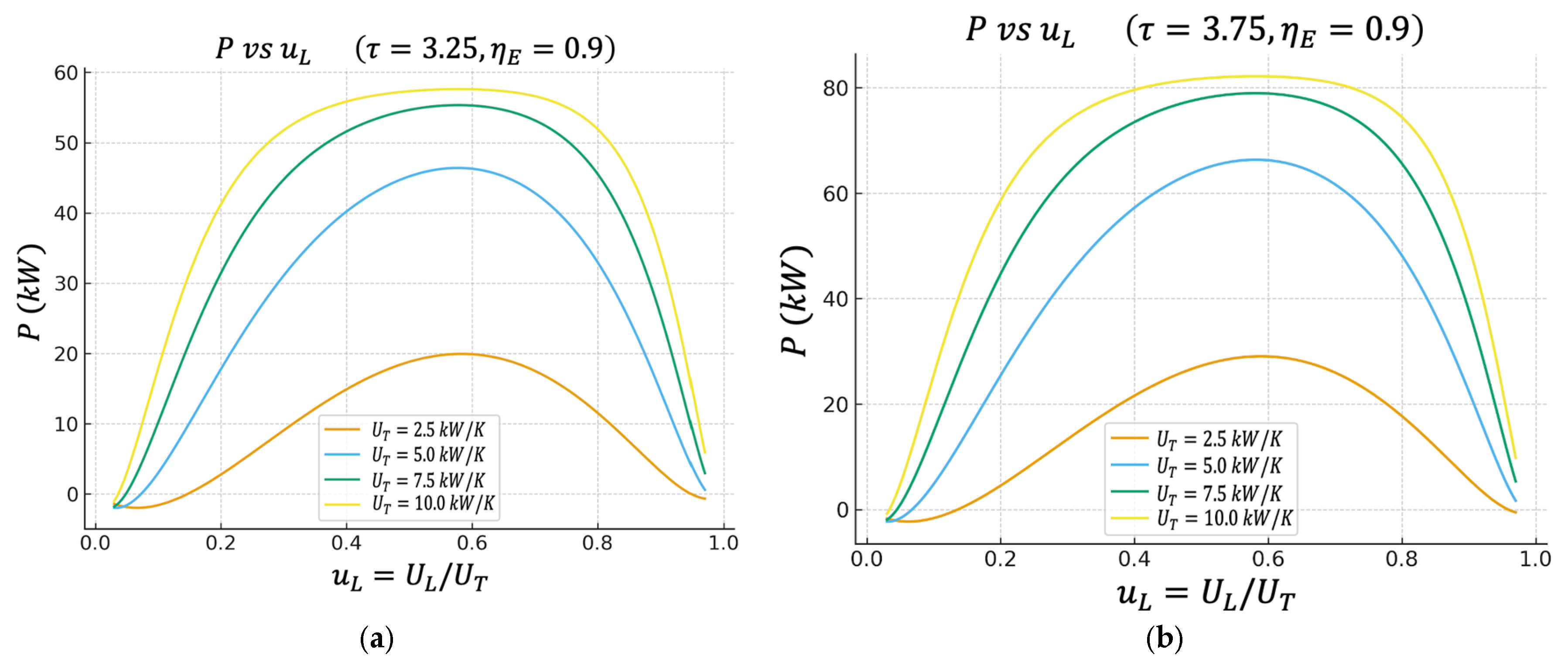
4.1. Net Power (P) vs. Fraction of Conductance on the Cold Side
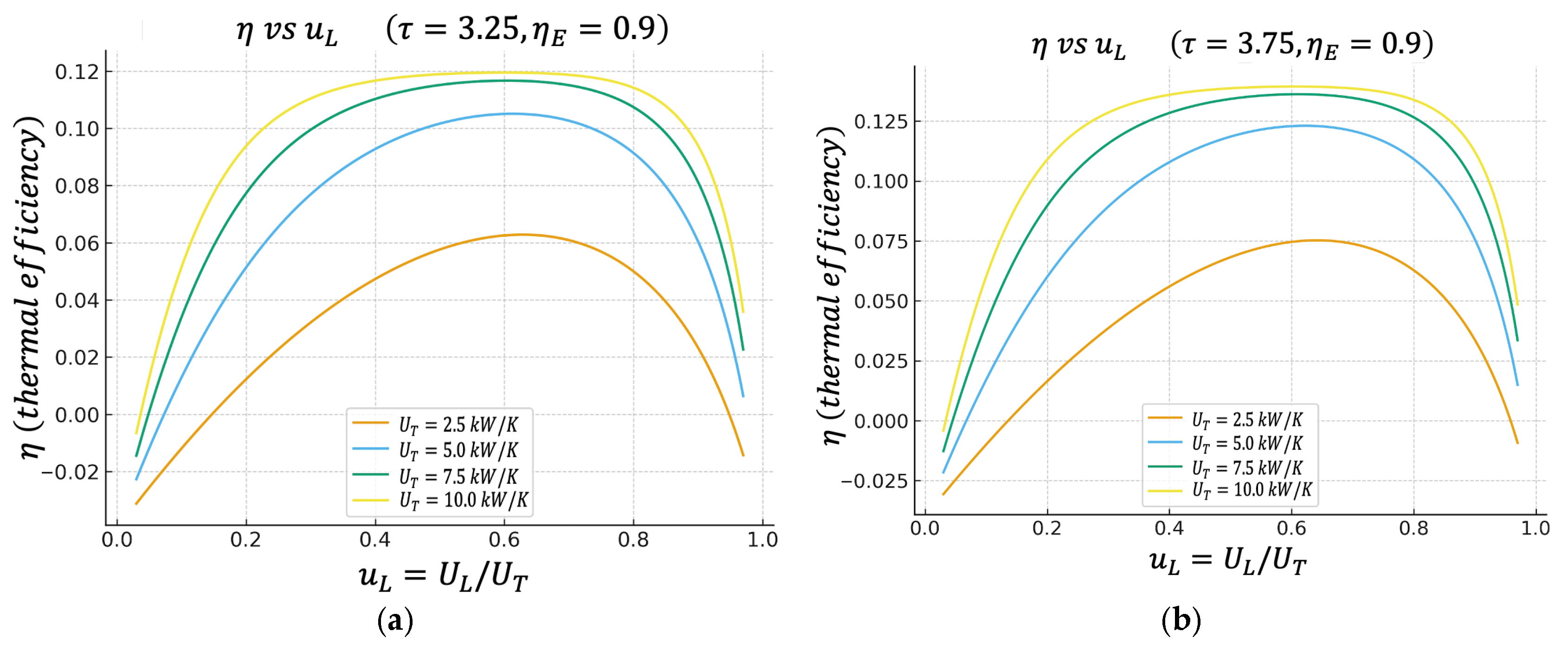
4.2. Thermal Efficiency η Versus
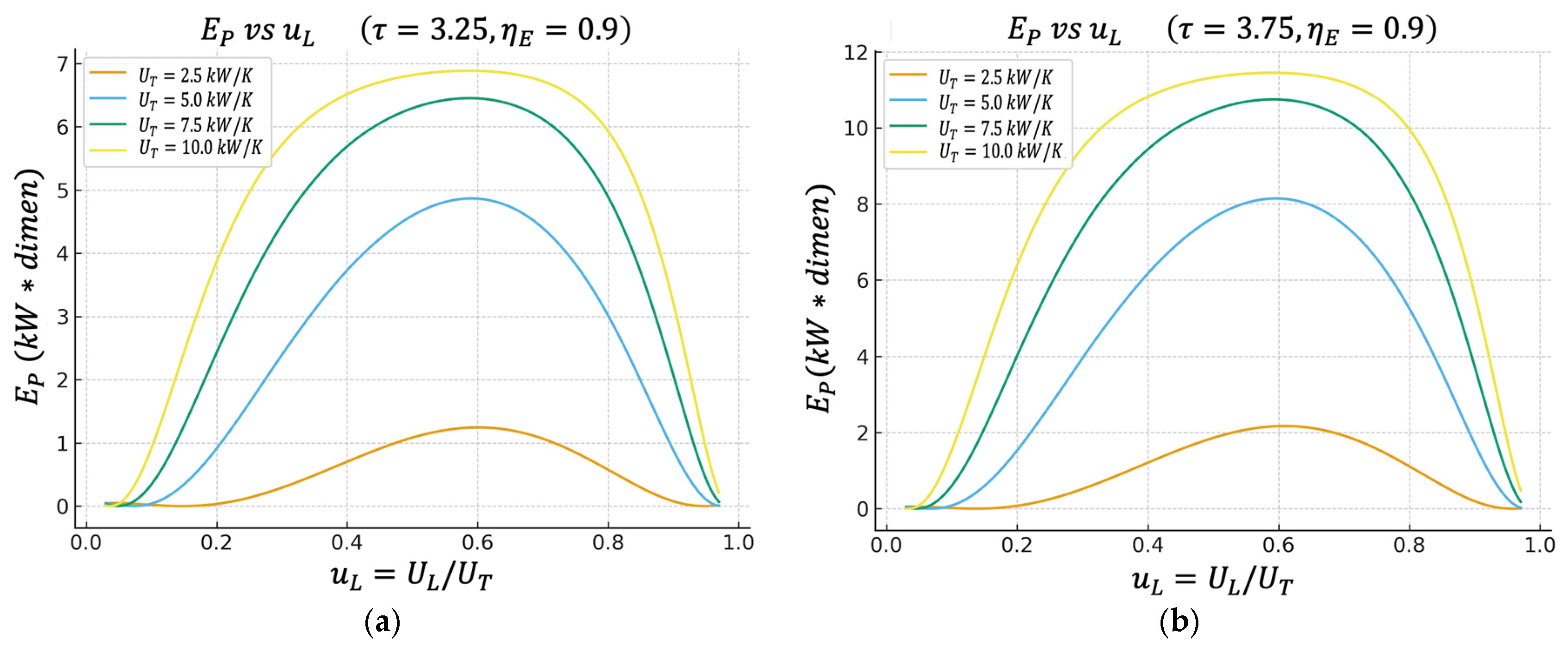
4.3. Efficient Power Regime Versus
4.4. Bounded Ecological Function Regime Versus
4.5. Second Law Efficiency Regime Versus
5. Conclusions
Author Contributions
Funding
Institutional Review Board Statement
Data Availability Statement
Acknowledgments
Conflicts of Interest
References
- Curzon, F.; Ahlborn, B. Efficiency of a Carnot engine at maximum power output. Am. J. Phys. 1975, 43, 22–24. [Google Scholar] [CrossRef]
- Berry, R.S.; Salamon, P.; Andresen, B. How it all began. Entropy 2020, 22, 908. [Google Scholar] [CrossRef] [PubMed]
- Andresen, B.; Salamon, P.; Berry, R.S. Thermodynamics in finite time: Extremals for imperfect engines. J. Chem. Phys. 1997, 66, 157. [Google Scholar] [CrossRef]
- Bejan, A. Models of power plants that generate minimum entropy while operating at maximum power. Am. J. Phys. 1996, 64, 1054. [Google Scholar] [CrossRef]
- Feidt, M. The history and perspectives of efficiency at maximum power of the Carnot engine. Entropy 2017, 19, 369. [Google Scholar] [CrossRef]
- Sieniutycz, S.; Salamon, P. Finite-Time Thermodynamics and Thermoeconomics; Taylor & Francis: New York, NY, USA, 1990. [Google Scholar]
- De Vos, A. Endoreversible Thermodynamics of Solar Energy Conversion; Oxford University Press: Oxford, UK, 1992. [Google Scholar]
- Bejan, A. Entropy generation minimization: The new thermodynamics of finite size devices and finite-time processes. J. Appl. Phys. 1996, 79, 1191–1218. [Google Scholar] [CrossRef]
- Hoffmann, K.H.; Burzler, J.M.; Shubert, S. Endoreversible thermodynamics. J. Non-Equilib. Thermodyn. 1997, 22, 311–355. [Google Scholar]
- Wu, C.; Chen, L.; Chen, J. (Eds.) Recent Advances in Finite Thermodynamics; Nova Science: New York, NY, USA, 1999. [Google Scholar]
- Velasco, S.; Roco, J.M.M.; Medina, A.; Hernández, A.C. A generalization of the ecological optimization criterion. Phys. Rev. E 2000, 61, 5578–5581. [Google Scholar]
- Barranco Jiménez, M.A.; Pacheco Paez, J.C.; Angulo Brown, F. Optimization of heat engines using different heat transfer laws by means of the method of saving functions, X International Congress of Physics Engineering (X CIIF) 2020. J. Phys. Conf. Ser. 2021, 1723, 012066. [Google Scholar]
- Novikov, I. The efficiency of atomic power stations (A review). J. Nucl. Energy II 1958, 7, 125–128. [Google Scholar] [CrossRef]
- Sullivan, C. Newton’s law of cooling. A critical assessment. Am. J. Phys. 1990, 58, 956–960. [Google Scholar] [CrossRef]
- Agrawal, D.C. A simplified version of the Curzon–Ahlborn engine. Eur. J. Phys. 2009, 30, 1173–1179. [Google Scholar] [CrossRef]
- Yan, Z.; Chen, J.; Andresen, B. Finite time thermodynamic optimization of the power output and efficiency for a finite-time Carnot cycle. J. Appl. Phys. 1990, 68, 3740–3744. [Google Scholar]
- Angulo-Brown, F. An ecological optimization criterion for finite-time heat engines. J. Appl. Phys. 1991, 69, 7465–7469. [Google Scholar] [CrossRef]
- Yasunaga, T.; Ikegami, Y. Finite-Time Thermodynamic Model for Evaluating Heat. Entropy 2020, 22, 211. [Google Scholar] [CrossRef]
- Chen, L.; Zhou, J.; Sun, F.; Wu, C. Ecological performance optimization of a thermoacoustic heat engine. Rev. Mex. Física 2010, 56, 386–393. [Google Scholar]
- Levario-Medina, S.; Arias-Hernández, L.A. The PΦ-Compromise Function as a criterion of merit to optimize irreversible thermal engines. arXiv 2019, arXiv:1908.11861. [Google Scholar]
- Hoffmann, K.H. Recent Developments in Finite Time Thermodynamics. Tech. Mech. 2002, 22, 14–25. [Google Scholar]
- Hoffmann, K.H.; Andresen, B.B.; Salamon, P. Finite-time thermodynamics tools to analyze dissipative processes. In Proceedings of the 240 Conference: Science’s Great Challenges; Advances in Chemical Physics; Wiley: New York, NY, USA, 2014; Volume 157, pp. 57–67. [Google Scholar]
- Hoffmann, K.H. Endoreversible Thermodynamics. In Proceedings of the 18th Joint European Thermodynamics Conference (JETC 2025), Belgrade, Serbia, 26–30 May 2025. [Google Scholar]
- Chimal-Eguía, J.C.; Páez-Hernández, R.T.; Pacheco-Páez, J.C.; Saldana-Pérez, M.; Ladino-Luna, D. Linear Irreversible Thermodynamics: A Glance at Thermoelectricity and the Biological Scaling Laws. Entropy 2023, 25, 1575. [Google Scholar] [CrossRef]
- Chen, L.; Tang, C.; Feng, H.; Ge, Y. Power, Efficiency, Power Density and Ecological Function Optimization for an Irreversible Modified Regenerative Brayton Cycle (isothermal heating). Energies 2020, 13, 5133. [Google Scholar] [CrossRef]
- Tang, C.Q.; Chen, L.; Feng, H.; Ge, Y. Four-Objective Optimizations for an Improved Irreversible Closed Modified Simple Brayton Cycle. Entropy 2021, 23, 282. [Google Scholar] [CrossRef] [PubMed]
- Rojas-Gamboa, D.A.; Rodríguez, J.I.; Gonzalez-Ayala, J.; Angulo-Brown, F. Ecological efficiency of finite-time thermodynamics. Phys. Rev. E 2018, 98, 022130. [Google Scholar] [CrossRef] [PubMed]
- Chimal-Eguía, J.C. FTT variational: MPO, EF, PD. Entropy 2012, 14, 2611–2627. [Google Scholar] [CrossRef]
- Pacheco-Paez, J.C.; Angulo-Brown, F.; Barranco-Jiménez, M.A. Thermoeconomic Optimization of an Irreversible Novikov Plant Model under Different Regimes of Performance. Entropy 2017, 19, 118. [Google Scholar] [CrossRef]
- Antar, M.A. Thermoeconomic Considerations in the Optimum Allocation of Heat Exchanger Inventory. ASME J. Energy Resour. Technol. 2002, 124, 28–35. [Google Scholar] [CrossRef]
- Barranco-Jiménez, M.A. Finite-time thermoeconomic optimization of a non-endoreversible heat engine model. Rev. Mex. Física 2009, 55, 211–220. [Google Scholar]
- Valencia-Ortega, G.; Levario-Medina, S.; Barranco-Jiménez, M.A. The role of internal irreversibilities in the performance and stability of Power Plant Models Working at Maximum ϵ-Ecological Function. J. Non-Equilib. Thermodyn. 2021, 46, 413–429. [Google Scholar] [CrossRef]
- Juárez-Huerta, V.H.; Sánchez-Salas, N.; Chimal-Eguia, J.C. Optimization Criteria and Efficiency of a Thermoelectric Generator. Entropy 2022, 24, 1812. [Google Scholar] [CrossRef]
- Lichty, C. Combustion Engine Processes; McGraw-Hill: New York, NY, USA, 1967. [Google Scholar]
- Georgiou, D.P. Useful work and the thermal efficiency in the ideal Lenoir with regenerative preheating. J. Appl. Phys. 2008, 88, 5981–5986. [Google Scholar] [CrossRef]
- Shen, X.; Chen, L.G.; Ge, Y.L.; Sun, F.R. Finite-time thermodynamic analysis for endoreversible Lenoir cycle coupled to constant-temperature heat reservoirs. Int. J. Energy Environ. 2017, 8, 272–278. [Google Scholar]
- Ahmadi, M.H.; Nazari, M.A.; Feidt, M. Thermodynamic analysis and multi-objective optimisation of endoreversible Lenoir heat engine cycle based on the thermo-economic performance criterion. Int. J. Ambient Energy 2019, 40, 600–609. [Google Scholar] [CrossRef]
- Wang, R.; Ge, Y.; Chen, L.; Feng, H.; Wu, Z. Power and Thermal Efficiency Optimization of an Irreversible Steady-Flow Lenoir Cycle. Entropy 2021, 23, 425. [Google Scholar] [CrossRef]



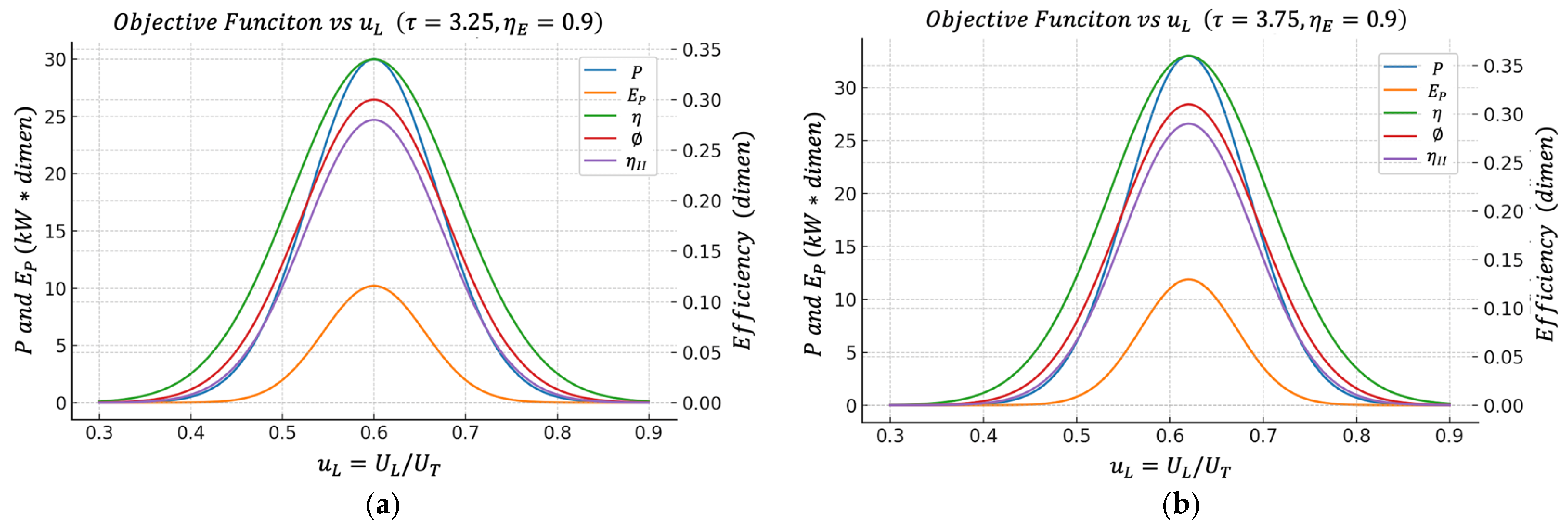
| 3.25 | 2.5 | 0.9 | 0.584 | 19.928 | 0.627 | 0.062 | 0.601 |
| 3.25 | 5 | 0.9 | 0.575 | 46.394 | 0.614 | 0.105 | 0.592 |
| 3.25 | 7.5 | 0.9 | 0.579 | 55.342 | 0.605 | 0.117 | 0.588 |
| 3.25 | 10 | 0.9 | 0.579 | 57.625 | 0.601 | 0.120 | 0.588 |
| 3.75 | 2.5 | 0.9 | 0.588 | 29.057 | 0.640 | 0.075 | 0.610 |
| 3.75 | 5 | 0.9 | 0.578 | 66.340 | 0.622 | 0.123 | 0.597 |
| 3.75 | 7.5 | 0.9 | 0.579 | 78.950 | 0.610 | 0.136 | 0.592 |
| 3.75 | 10 | 0.9 | 0.579 | 82.167 | 0.610 | 0.139 | 0.588 |
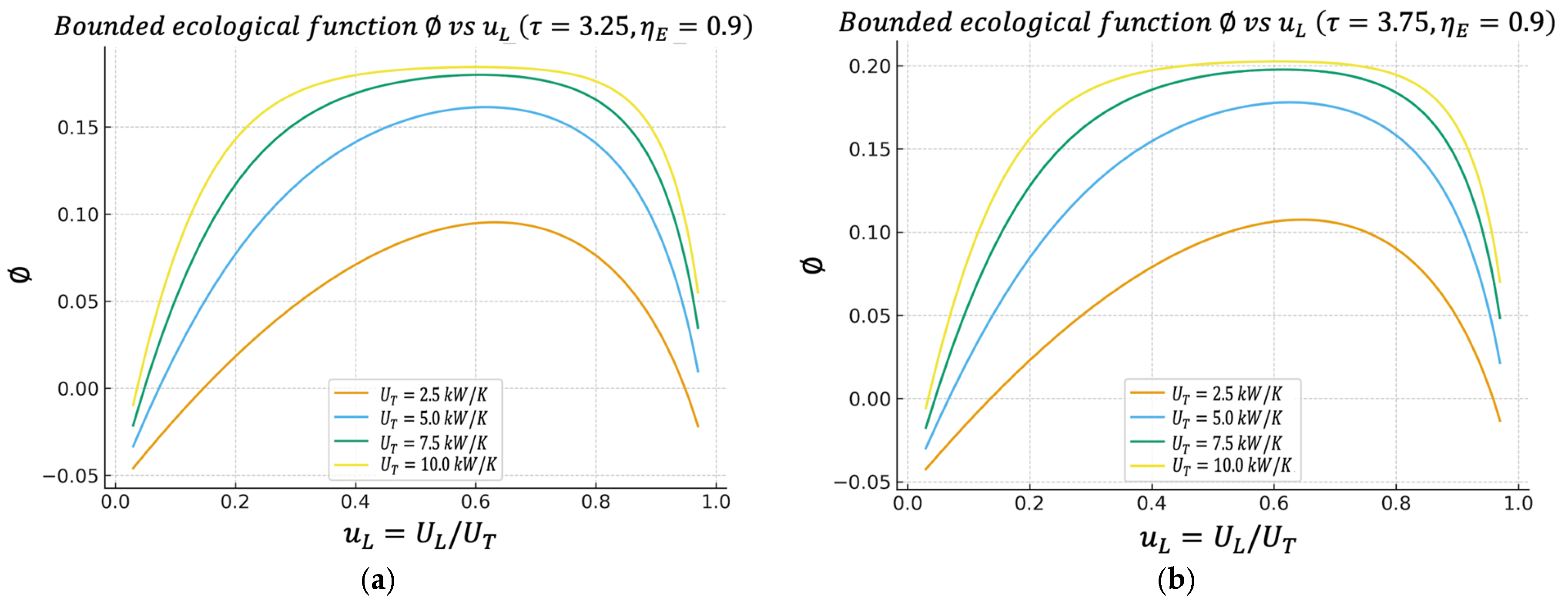
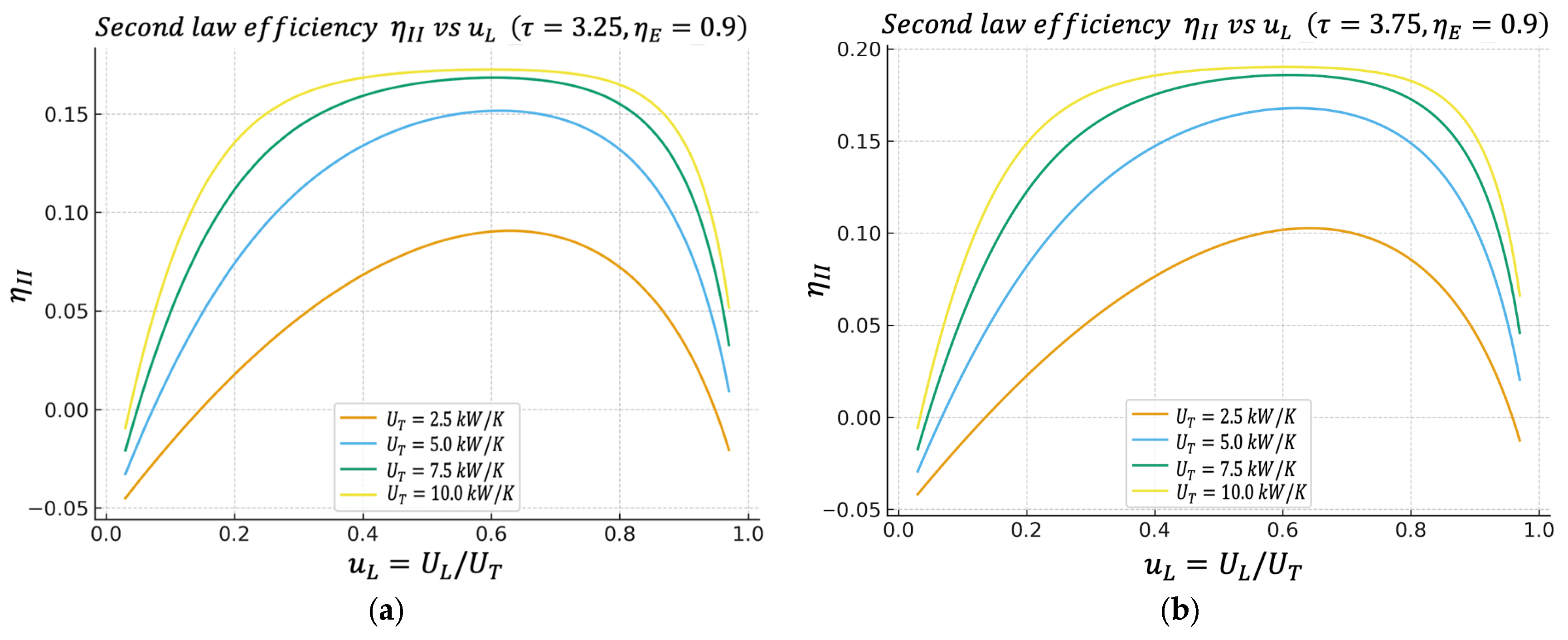
| 3.25 | 2.5 | 0.9 | 1.244 | 0.631 | 0.095 | 0.627 | 0.091 |
| 3.25 | 5 | 0.9 | 4.864 | 0.618 | 0.161 | 0.614 | 0.152 |
| 3.25 | 7.5 | 0.9 | 6.453 | 0.605 | 0.180 | 0.605 | 0.169 |
| 3.25 | 10 | 0.9 | 6.885 | 0.601 | 0.184 | 0.601 | 0.173 |
| 3.75 | 2.5 | 0.9 | 2.168 | 0.644 | 0.107 | 0.640 | 0.103 |
| 3.75 | 5 | 0.9 | 8.141 | 0.627 | 0.178 | 0.622 | 0.168 |
| 3.75 | 7.5 | 0.9 | 10.747 | 0.614 | 0.198 | 0.609 | 0.186 |
| 3.75 | 10 | 0.9 | 11.454 | 0.605 | 0.203 | 0.605 | 0.190 |
Disclaimer/Publisher’s Note: The statements, opinions and data contained in all publications are solely those of the individual author(s) and contributor(s) and not of MDPI and/or the editor(s). MDPI and/or the editor(s) disclaim responsibility for any injury to people or property resulting from any ideas, methods, instructions or products referred to in the content. |
© 2025 by the authors. Licensee MDPI, Basel, Switzerland. This article is an open access article distributed under the terms and conditions of the Creative Commons Attribution (CC BY) license (https://creativecommons.org/licenses/by/4.0/).
Share and Cite
Páez-Hernández, R.T.; Pacheco-Paez, J.C.; Chimal-Eguía, J.C.; Ladino-Luna, D.; Contreras-Sánchez, J.
Transfer Irreversibilities in the Lenoir Cycle: FTT Design Criteria with
Páez-Hernández RT, Pacheco-Paez JC, Chimal-Eguía JC, Ladino-Luna D, Contreras-Sánchez J.
Transfer Irreversibilities in the Lenoir Cycle: FTT Design Criteria with
Páez-Hernández, Ricardo T., Juan Carlos Pacheco-Paez, Juan Carlos Chimal-Eguía, Delfino Ladino-Luna, and Javier Contreras-Sánchez.
2025. "Transfer Irreversibilities in the Lenoir Cycle: FTT Design Criteria with
Páez-Hernández, R. T., Pacheco-Paez, J. C., Chimal-Eguía, J. C., Ladino-Luna, D., & Contreras-Sánchez, J.
(2025). Transfer Irreversibilities in the Lenoir Cycle: FTT Design Criteria with