Three-Basis Loop-Back QKD: A Passive Architecture for Secure and Scalable Quantum Mobile Networks


Abstract
1. Introduction
2. The Loop-Back QKD Protocol
2.1. Operational Steps
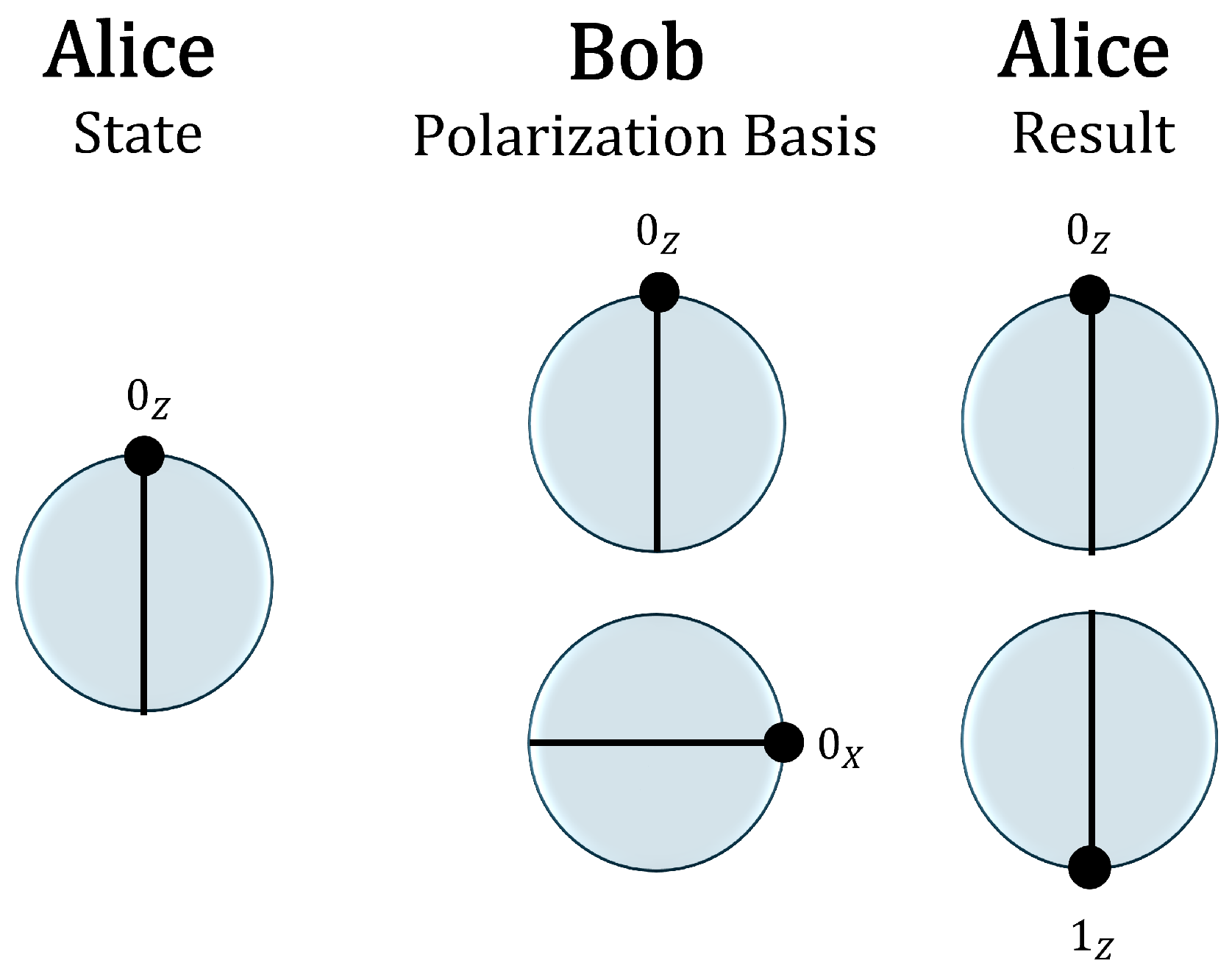
- Parameter Agreement. Alice and Bob agree on two mutually unbiased polarization bases, and , which are associated with logical bits 0 and 1, respectively. They also synchronize timing, detector thresholds, and any classical authentication mechanisms.
- State Preparation (Alice). For each transmission round, Alice randomly selects a preparation basis and prepares a quantum state uniformly chosen from . The state is then launched into the quantum channel toward Bob.
- Random Polarization (Bob). Upon reception, Bob chooses at random his polarization basis . He applies the corresponding polarization operation to the incoming state and immediately reflects it back to Alice through the same optical path. Bob performs no quantum measurement; his role is purely passive and reflective.
- Return and Measurement (Alice). The pulse travels back through the same optical fiber. Alice measures the returned photon in her original preparation basis , obtaining one of the two possible outcomes within that basis.
- Inference Rule. If the measurement result is orthogonal to the prepared state, Alice infers that Bob’s basis was opposite to hers (). Conversely, if the measurement coincides with the original state, she concludes that . Only the former case (orthogonal outcome) is kept for key generation.
- Public Announcement and Sifting. Alice publicly announces only the indices of successful rounds (those with orthogonal outcomes). Bob retains the corresponding rounds in which he used the opposite basis. Both parties now share an implicit bit value determined by Bob’s chosen basis:
- Raw Key Formation. After multiple repetitions of the above procedure, the subset of successful rounds forms the raw key sequence shared between Alice and Bob. Subsequent stages such as error correction, parameter estimation, and privacy amplification are applied later to obtain the final secret key.
2.2. BB84-Equivalent Loop-Back
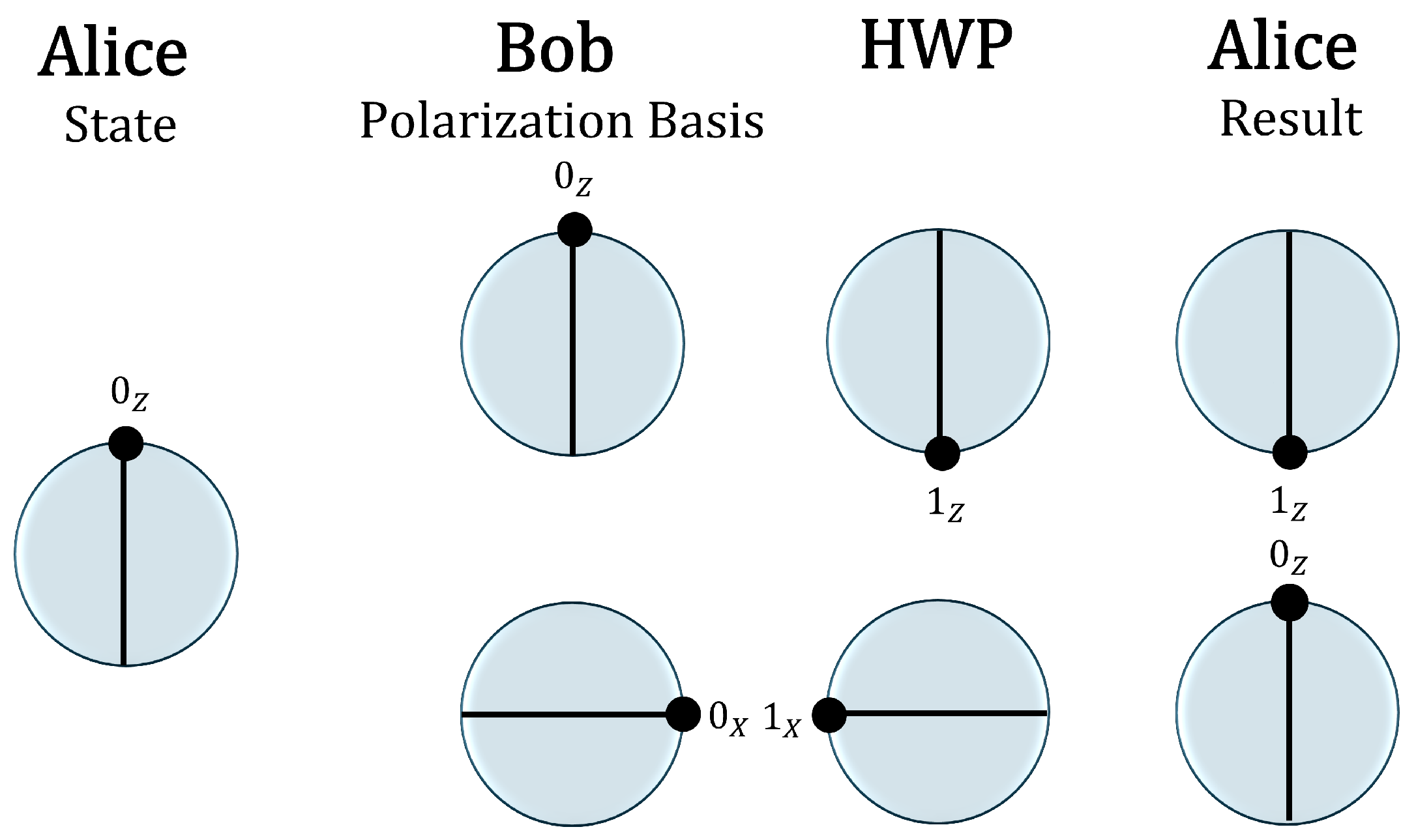
- BB84 standard: Success occurs when Alice and Bob choose the same basis. The probability of success is , and after the sifting process, the key is obtained.
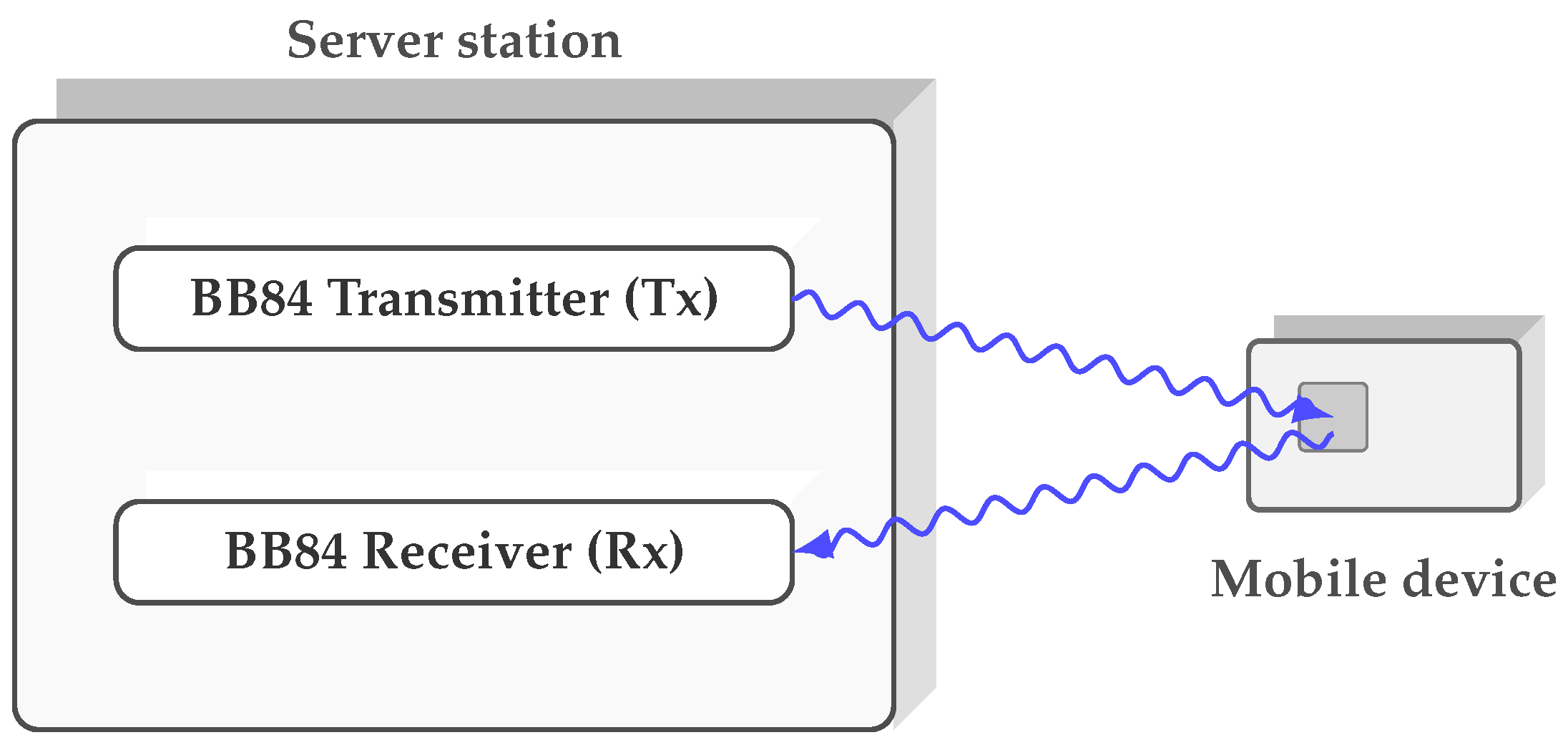
- Equivalent Loop-Back: Success occurs when Alice and Bob choose the same basis and, additionally, the measured state matches the state sent by Alice. It is important to note that both the transmitter (Tx) and receiver (Rx) are located at Alice’s station. In this scenario, Alice can infer the basis selected by Bob (mobile). The effective probability of success is , which is equivalent to the expected yield after discarding events in which the state does not match. Therefore, the adjustment system in the BB84-equivalent Loop-Back QKD requires minimal modifications compared to the standard BB84 system.
3. The Three-Basis Loop-Back QKD Protocol
Operational Steps
- Parameter Agreement. Alice and Bob agree on the three mutually unbiased polarization bases , each associated with a distinct logical label:They synchronize timing, detector thresholds, and classical authentication parameters as in the two-basis configuration.
- State Preparation (Alice). In each transmission round, Alice randomly selects a preparation basis and prepares a quantum state uniformly chosen from the corresponding basis . The photon is then sent through the quantum channel to Bob.
- Random Polarization (Bob). Upon reception, Bob randomly selects his polarization basis with uniform probability . He applies the corresponding polarization transformation to the incoming state and immediately reflects it back toward Alice through the same optical path. Bob performs no quantum measurement; his role remains purely passive.
- Return and Measurement (Alice). The photon travels back through the same optical fiber. Alice measures it in her original basis , obtaining one of the two possible outcomes in that basis.
- Inference Rule. If the measurement result is orthogonal to the state she initially sent, Alice infers that Bob’s basis was different from hers (). In this case, Bob’s chosen basis must belong to the plane orthogonal to her own preparation basis.
- Public Announcement and Sifting. To enable basis identification without revealing it directly, Bob publicly announces a pair of bases selected from , ensuring that his actual basis is one of the two in the announced pair. Among these three possible pairs, exactly one does not include Alice’s basis and is therefore ambiguous. If the announced pair excludes , the round is discarded. If the announced pair includes and Alice’s measurement result was orthogonal, the round is retained for key generation, as Alice can unambiguously determine Bob’s basis.
- Raw Key Formation. The retained rounds form the raw key, with bit values assigned according to Bob’s basis using the mappingSubsequent stages of error correction and privacy amplification are applied to distill the final secret key.
4. Channel Error Analysis
4.1. Two-Basis Configuration
4.2. Three-Basis Configuration
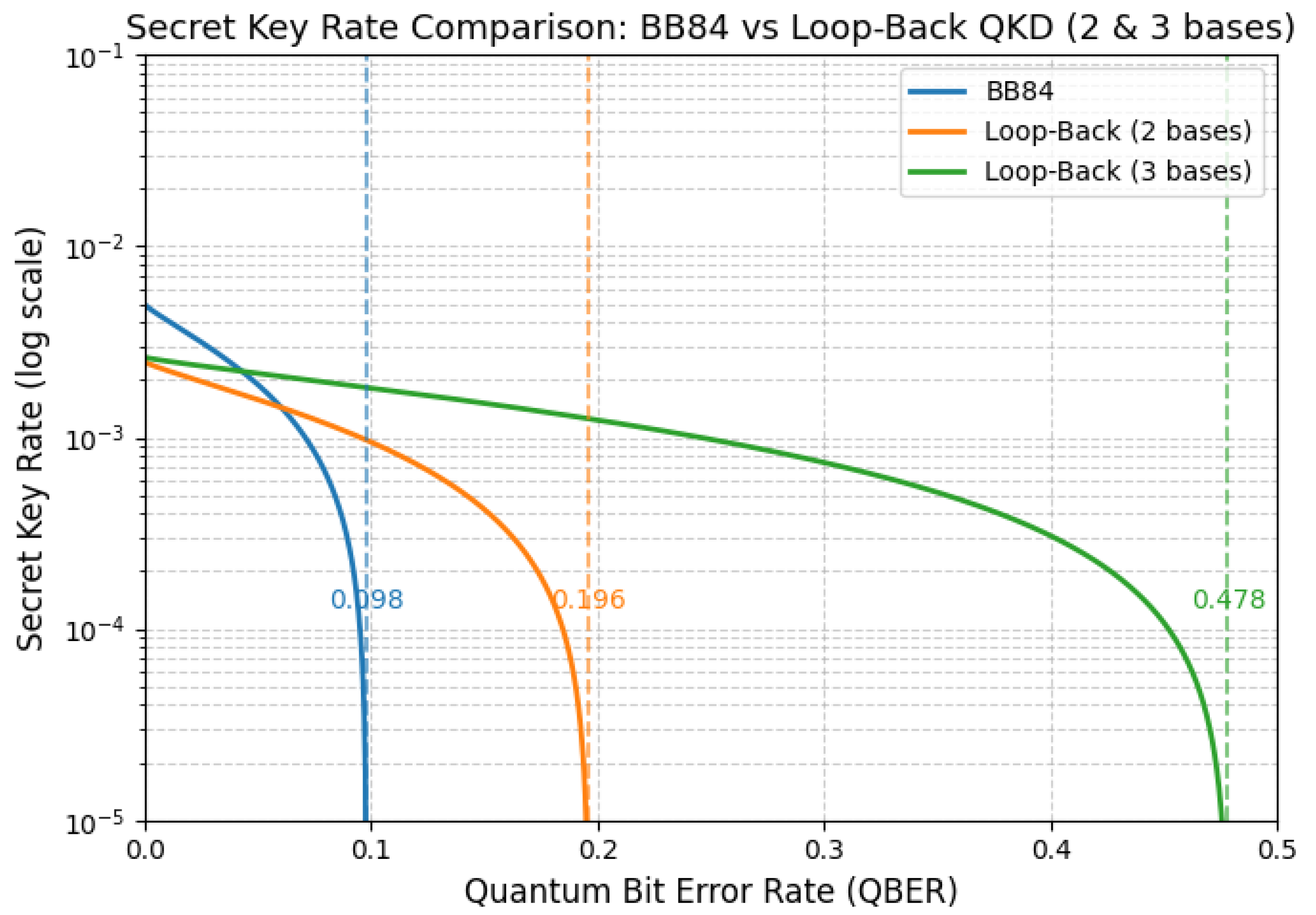
4.3. Comparative Discussion
5. Error Thresholds
5.1. Two-Basis Configuration
5.2. Three-Basis Configuration
6. Security Analysis
6.1. Operational and Conceptual Paradigm
6.2. Security Implications
6.3. Intrinsic Security Properties of the Loop-Back Protocol
- Resistance to Man-in-the-Middle (MiTM) Attacks
- Resistance to Photon Number Splitting (PNS) Attacks
- Protection Against Side-Channel Attacks
- Limitations and Practical Considerations
7. Advances and Perspectives
8. Conclusions
Author Contributions
Funding
Data Availability Statement
Conflicts of Interest
Appendix A. Branch Analysis of the MiTM Attack

| Bob Basis | Bob Operation | Eve (Second) | Alice (Z Outcome) | Probability |
|---|---|---|---|---|
| X | ||||
| Y | ||||
| Y | ||||
| Z | ||||
| Z | ||||
References
- Wiesner, S. Conjugate coding. ACM Sigact News 1983, 15, 78–88. [Google Scholar] [CrossRef]
- Horodecki, K.; Stankiewicz, M. Semi-device-independent quantum money. New J. Phys. 2020, 22, 023007. [Google Scholar] [CrossRef]
- Lizama-Perez, L.A.; López-Romero, J. Loop-Back Quantum Key Distribution (QKD) for Secure and Scalable Multi-Node Quantum Networks. Symmetry 2025, 17, 521. [Google Scholar] [CrossRef]
- Bennett, C.H.; Brassard, G. ‘Quantum cryptography: Public key distribution and coin tossing’. In Proceedings of the IEEE International Conference on Computers, Systems & Signal Processing, Bangalore, India, 10–12 December 1984; pp. 175–179. [Google Scholar]
- Pirandola, S.; Andersen, U.L.; Banchi, L.; Berta, M.; Bunandar, D.; Colbeck, R.; Englund, D.; Gehring, T.; Lupo, C.; Ottaviani, C.; et al. Advances in quantum cryptography. Adv. Opt. Photonics 2020, 12, 1012–1236. [Google Scholar] [CrossRef]
- Diamanti, E.; Lo, H.K.; Qi, B.; Yuan, Z. Practical challenges in quantum key distribution. Npj Quantum Inf. 2016, 2, 1–12. [Google Scholar] [CrossRef]
- Bennett, C.H. Quantum cryptography using any two nonorthogonal states. Phys. Rev. Lett. 1992, 68, 3121. [Google Scholar] [CrossRef] [PubMed]
- Anghel, C.; Istrate, A.; Vlase, M. A comparison of several implementations of b92 quantum key distribution protocol. In Proceedings of the 2022 26th International Conference on System Theory, Control and Computing (ICSTCC), Sinaia, Romania, 19–21 October 2022; IEEE: Piscataway, NJ, USA, 2022; pp. 374–379. [Google Scholar]
- Bruß, D. Optimal eavesdropping in quantum cryptography with six states. Phys. Rev. Lett. 1998, 81, 3018. [Google Scholar] [CrossRef]
- Gottesman, D.; Lo, H.K. Proof of security of quantum key distribution with two-way classical communications. IEEE Trans. Inf. Theory 2003, 49, 457–475. [Google Scholar] [CrossRef]
- Lo, H.K.; Curty, M.; Qi, B. Measurement-device-independent quantum key distribution. Phys. Rev. Lett. 2012, 108, 130503. [Google Scholar] [CrossRef]
- Tamaki, K.; Lo, H.K.; Fung, C.H.F.; Qi, B. Phase encoding schemes for measurement-device-independent quantum key distribution with basis-dependent flaw. Phys. Rev. A—Atomic Mol. Opt. Phys. 2012, 85, 042307. [Google Scholar] [CrossRef]
- Lucamarini, M.; Yuan, Z.L.; Dynes, J.F.; Shields, A.J. Overcoming the rate–distance limit of quantum key distribution without quantum repeaters. Nature 2018, 557, 400–403. [Google Scholar] [CrossRef]
- Liu, Y.; Zhang, W.J.; Jiang, C.; Chen, J.P.; Zhang, C.; Pan, W.X.; Ma, D.; Dong, H.; Xiong, J.M.; Zhang, C.J.; et al. Experimental twin-field quantum key distribution over 1000 km fiber distance. Phys. Rev. Lett. 2023, 130, 210801. [Google Scholar] [CrossRef]
- Shor, P.W. Polynomial-time algorithms for prime factorization and discrete logarithms on a quantum computer. SIAM Rev. 1999, 41, 303–332. [Google Scholar] [CrossRef]
- Bernstein, D.J. Post-quantum cryptography. In Encyclopedia of Cryptography, Security and Privacy; Springer: Berlin/Heidelberg, Germany, 2025; pp. 1846–1847. [Google Scholar]
- Yin, J.; Cao, Y.; Li, Y.H.; Liao, S.K.; Zhang, L.; Ren, J.G.; Cai, W.Q.; Liu, W.Y.; Li, B.; Dai, H.; et al. Satellite-based entanglement distribution over 1200 kilometers. Science 2017, 356, 1140–1144. [Google Scholar] [CrossRef] [PubMed]
- Ren, J.G.; Xu, P.; Yong, H.L.; Zhang, L.; Liao, S.K.; Yin, J.; Liu, W.Y.; Cai, W.Q.; Yang, M.; Li, L.; et al. Ground-to-satellite quantum teleportation. Nature 2017, 549, 70–73. [Google Scholar] [CrossRef]
- Liao, S.K.; Cai, W.Q.; Handsteiner, J.; Liu, B.; Yin, J.; Zhang, L.; Rauch, D.; Fink, M.; Ren, J.G.; Liu, W.Y.; et al. Satellite-relayed intercontinental quantum network. Phys. Rev. Lett. 2018, 120, 030501. [Google Scholar] [CrossRef]
- Zavitsanos, D.; Ntanos, A.; Stathopoulos, T.; Raptakis, A.; Setaki, F.; Lyberopoulos, G.; Kouloumentas, C.; Giannoulis, G.; Avramopoulos, H. Feasibility analysis of QKD integration in real-world FTTH access networks. J. Light. Technol. 2023, 42, 4–11. [Google Scholar] [CrossRef]
- Wabnig, J.; Bitauld, D.; Li, H.; Laing, A.; O’brien, J.; Niskanen, A. Demonstration of free-space reference frame independent quantum key distribution. New J. Phys. 2013, 15, 073001. [Google Scholar] [CrossRef]
- Tian, X.H.; Yang, R.; Liu, H.Y.; Fan, P.; Zhang, J.N.; Gu, C.; Chen, M.; Hu, M.; Lu, F.Y.; Zhu, C.; et al. Experimental demonstration of drone-based quantum key distribution. Phys. Rev. Lett. 2024, 133, 200801. [Google Scholar] [CrossRef] [PubMed]
- Bourgoin, J.P.; Higgins, B.L.; Gigov, N.; Holloway, C.; Pugh, C.J.; Kaiser, S.; Cranmer, M.; Jennewein, T. Free-space quantum key distribution to a moving receiver. Opt. Express 2015, 23, 33437–33447. [Google Scholar] [CrossRef] [PubMed]
- Devetak, I.; Winter, A. Distillation of secret key and entanglement from quantum states. Proc. R. Soc. A Math. Phys. Eng. Sci. 2005, 461, 207–235. [Google Scholar] [CrossRef]
- Qiao, H.; Chen, X.Y. Simulation of BB84 Quantum Key Distribution in depolarizing channel. In Proceedings of the 14th Youth Conference on Communication, Dalian, China, 24–26 July 2009; pp. 123–129. [Google Scholar]
- Slimen, I.B.; Trabelsi, O.; Rezig, H.; Bouallègue, R.; Bouallègue, A. Stop conditions of BB84 protocol via a depolarizing channel (quantum cryptography). J. Comput. Sci. 2007, 3, 424–429. [Google Scholar] [CrossRef]
- Gisin, N.; Ribordy, G.; Tittel, W.; Zbinden, H. Quantum cryptography. Rev. Mod. Phys. 2002, 74, 145. [Google Scholar] [CrossRef]
- Ding, Y.Y.; Chen, H.; Wang, S.; He, D.Y.; Yin, Z.Q.; Chen, W.; Zhou, Z.; Guo, G.C.; Han, Z.F. Polarization variations in installed fibers and their influence on quantum key distribution systems. Opt. Express 2017, 25, 27923–27936. [Google Scholar] [CrossRef] [PubMed]
- Lucamarini, M.; Mancini, S. Secure deterministic communication without entanglement. Phys. Rev. Lett. 2005, 94, 140501. [Google Scholar] [CrossRef] [PubMed]
- Pavičić, M. How secure are two-way ping-pong and LM05 QKD protocols under a man-in-the-middle attack? Entropy 2021, 23, 163. [Google Scholar] [CrossRef]
- Lydersen, L.; Wiechers, C.; Wittmann, C.; Elser, D.; Skaar, J.; Makarov, V. Hacking commercial quantum cryptography systems by tailored bright illumination. Nat. Photonics 2010, 4, 686–689. [Google Scholar] [CrossRef]
- Boström, K.; Felbinger, T. Deterministic secure direct communication using entanglement. Phys. Rev. Lett. 2002, 89, 187902. [Google Scholar] [CrossRef]
- Muller, A.; Herzog, T.; Huttner, B.; Tittel, W.; Zbinden, H.; Gisin, N. “Plug and play” systems for quantum cryptography. Appl. Phys. Lett. 1997, 70, 793–795. [Google Scholar] [CrossRef]


| Aspect | Model/Scenario | Implication for Loop-Back QKD |
|---|---|---|
| Channel depolarization | Isotropic depolarizing channel with error probability e per one-way use | Depolarization is mapped into an effective QBER () or (). The resulting thresholds and quantify the enhanced tolerance to symmetric polarization noise with respect to one-way DV-QKD. |
| Photon-number effects | Weak coherent pulses with Poissonian statistics and PNS-type strategies | Loop-Back shares the usual vulnerabilities of WCP-based DV-QKD to photon-number-splitting attacks. Standard decoy-state methods can be incorporated, as in BB84, to bound Eve’s information on multi-photon components; this aspect is not fundamentally modified by the Loop-Back geometry. |
| Side channels at the remote node | Power/timing leakage and bright-light or Trojan-horse probes on Bob’s module | By removing single-photon detectors and key-dependent post-processing from Bob, Loop-Back suppresses dominant detector side channels at the remote node. The EOM operated at constant low power reduces timing leakage, while standard countermeasures such as optical isolation and power monitoring remain necessary against bright-light and Trojan-horse attacks. |
| Implementation scope | Misalignment, dark counts, timing jitter and finite-size statistics | Practical imperfections are treated as additional contributions to the QBER on top of the depolarizing model and are expected to affect Loop-Back and one-way DV-QKD in a comparable way for similar hardware. The reported error thresholds are therefore asymptotic benchmarks under symmetric collective attacks; a full finite-size and device-level analysis is left for future work. |
Disclaimer/Publisher’s Note: The statements, opinions and data contained in all publications are solely those of the individual author(s) and contributor(s) and not of MDPI and/or the editor(s). MDPI and/or the editor(s) disclaim responsibility for any injury to people or property resulting from any ideas, methods, instructions or products referred to in the content. |
© 2025 by the authors. Licensee MDPI, Basel, Switzerland. This article is an open access article distributed under the terms and conditions of the Creative Commons Attribution (CC BY) license (https://creativecommons.org/licenses/by/4.0/).
Share and Cite
Lizama-Pérez, L.A.; Morales-Calvo, P. Three-Basis Loop-Back QKD: A Passive Architecture for Secure and Scalable Quantum Mobile Networks. Entropy 2025, 27, 1249. https://doi.org/10.3390/e27121249
Lizama-Pérez LA, Morales-Calvo P. Three-Basis Loop-Back QKD: A Passive Architecture for Secure and Scalable Quantum Mobile Networks. Entropy. 2025; 27(12):1249. https://doi.org/10.3390/e27121249
Chicago/Turabian StyleLizama-Pérez, Luis Adrián, and Patricia Morales-Calvo. 2025. "Three-Basis Loop-Back QKD: A Passive Architecture for Secure and Scalable Quantum Mobile Networks" Entropy 27, no. 12: 1249. https://doi.org/10.3390/e27121249
APA StyleLizama-Pérez, L. A., & Morales-Calvo, P. (2025). Three-Basis Loop-Back QKD: A Passive Architecture for Secure and Scalable Quantum Mobile Networks. Entropy, 27(12), 1249. https://doi.org/10.3390/e27121249