1. Introduction
In 2015, at the UN Climate Change Conference (COP21), 196 parties signed the historic Paris Agreement, which set long-term goals for all nations to limit global warming to below 2 °C over pre-industrial levels [
1]. More recently, however, the Intergovernmental Panel on Climate Change (IPCC) has stressed that in order to prevent the more severe impacts of climate change, the temperature increase must be limited to 1.5 °C above pre-industrial levels [
2], requiring a reduction of greenhouse gas emissions by 45% from 2010 levels by 2030 and the achievement of net-zero by 2050 [
3]. At COP28, in 2023, the first global stocktake was conducted to assess progress towards the Paris Agreement targets, and the key findings concluded that global emissions are not on target with the mitigation pathway consistent with the global temperature goal and that significantly more ambitious mitigation plans need to be developed and implemented to accelerate the reduction of emissions across all sectors [
4].
While the path to limiting warming to 1.5 °C remains primarily driven by a reduction in emissions through behavioral changes and technological advancements and deployment, there is a growing acknowledgment of the critical role of negative emission technologies in achieving net-zero [
5,
6]. In particular, carbon dioxide (CO
2) removal strategies will be essential for offsetting the remaining emissions in sectors where a complete reduction is prohibitively challenging, such as in the aviation and heavy industries [
5]. Furthermore, CO
2 removal strategies, which are still relatively new technologies, will be able to play a more significant role as the processes become more efficient and mitigation strategies begin to reach their maximum potential [
6]. Thus, research, development, and the commercialization of carbon removal is of current importance so that the technology can be deployed at scale in the near term [
6].
Carbon dioxide capture can take place in two forms: point source capture, which involves collecting carbon directly from the source of emission and direct air capture (DAC), whereby carbon is removed from ambient air. Generally, DAC is more energy-intensive and, therefore, more expensive than post-combustion point source capture, primarily due to the low concentration of CO
2 in the atmosphere compared to emission sources such as flue gases [
7]. Despite this, DAC remains a promising and potentially vital technology. An analysis of the methods of decarbonization of US natural gas power revealed that DAC is more applicable than post-combustion capture for power plants, which have a lower capacity or barriers to retrofitting and is the cheaper capture method for about one-third of all power plant emissions [
8]. DAC also has the significant advantage of being capable of off-setting both past and present emissions and emissions from mobile sources. Additionally, since DAC plants do not need to be built at the source of emissions, they can be strategically located in areas with widely available renewable energy sources or in close proximity with CO
2 storage or processing facilities. There is also some suggestion that DAC could be used in the development of an anthropogenic chemical carbon cycle, in which carbon emissions are captured and then recycled for use in fuels or other products [
9,
10].
As of 2022, there were 19 actively operating DAC plants collectively capturing approximately 10,000 tonnes of CO
2 per year with an average cost of between USD 250–USD 600 per tonne of CO
2 [
5,
11]. While these figures offer a promising start, they are well below the gigaton capacity and USD 100 per ton cost that will need to be realized in order for the technology to have a meaningful climate impact by 2050 [
11].
There are a variety of methods of DAC, including collection using physical and chemical adsorption, electrochemical methods, electrodialysis, membranes, mineral carbonation, cryogenics, and photocatalytic CO
2 conversion. Each method has technical, economic, and environmental considerations [
12], however, technologies using reversible sorbents are the most widely investigated and the only method currently used in commercial plants [
13].
The adsorption technologies utilize a cyclical process with two steps. First, the CO
2 molecules in the air are collected on the surface of the sorbent material, which can be a liquid or solid. Then, once the material has reached capacity, the CO
2 molecules are released through a regeneration process. The method of CO
2 recovery depends on the type of sorbent material with currently utilized methods, including changes in temperature and pressure [
14] and a change in moisture [
15,
16] for solid sorbents, and a series of chemical processes for liquid sorbents [
17]. The use of liquid sorbents has been pursued and proven successful [
17], and has advantages such as low cost and continuous operation; however, the energy requirements and system complexity are typically higher due to the chemical separation process and higher regeneration temperatures than solid sorbents [
18,
19].
Climeworks is a global leader in DAC technology. They are currently operating the world’s largest direct air capture and storage plant, which has a capacity of up to 4000 tonnes per year, and are in the process of launching a new plant with a capacity of up to 36,000 tonnes per year [
20]. The Climeworks technology uses a temperature vacuum swing adsorption process. During the adsorption process, fans are used to pull air through the collectors, which contain a porous solid sorbent material. Carbon dioxide in the air reacts chemically with the sorbent and binds to the material. If there is humidity in the air drawn into the collector, co-adsorption of water molecules will also occur. Once the material reaches saturation, the collector closes, and the desorption process begins. A vacuum system drops the pressure in the collector, and the sorbent material is heated to 100 °C. At these conditions, the equilibrium capacity of the material is significantly reduced, and thus, the CO
2, and if present, the water molecules, are released from the material and removed from the collector by the vacuum system. The outflowing gas steam is cooled in order to induce condensation of any water that is present, separating it from the CO
2. When the desorption phase finishes, the sorbent material is cooled, and the collector reopens to the environment to begin another adsorption phase [
20]. The collected concentrated CO
2 is sequestered using a mineralization process conducted by Carbfix, a partner organization [
21]. In the available research, the sorbent material used is APDES-NFC-FD, which is a chemisorbent composed of amine-functionalized nanofibrillated cellulose [
22]; however, other materials have also been investigated for use in TVS DAC applications, such as amine-functionalized silica or alumina, carbonate on silica, and anionic resin [
18].
Direct air capture technologies are relatively well-examined in the literature, and there exists a variety of sources detailing specific processes [
23,
24], analyzing the effectiveness of different sorbents materials [
13,
25], and reviewing the technical and economic characteristics of different methods [
12,
26,
27,
28]; however, the literature on the specific TVS process that is used by Climeworks is less comprehensive. The available work is primarily limited to research published by individuals associated with Climeworks and a handful of papers that are written by non-associated authors but are in reference to the Climeworks data. The experimental work includes validation and analysis of the TVS process using two different sorbent materials, analysis and modeling of the adsorption isotherms, study of stability of the adsorption material, and an evaluation of the co-adsorption of CO
2 and H
2O [
29,
30,
31,
32].
In complement to the experimental research, there is also literature on the development of mathematical models of the adsorption and desorption processes and theoretical analysis of the TVS method. Wurzbacher et al. [
33] developed a comprehensive heat and mass transfer model of the desorption process and Deschamps et al. [
34] used a mass and energy balance model in Aspen Adsorption software to evaluate the performance of the TVS technology at an industrial scale. Leonzio et al. [
35] developed a mathematical model describing the adsorption and desorption processes, using it to carry out a comparative analysis of the energy requirements, removal capacities, and costs for several sorbent materials.
The current research on the TVS adsorption process for DAC includes limited but detailed experimental results and complex and comprehensive theoretical models; however, there exists a gap in the research to understand the process on a more general and fundamental level. Much of the existing work is specific to particular process set-ups and often, due to the proprietary nature of the technology does not provide full transparency of the input parameters and equations.
A full thermodynamic evaluation of adsorption-based DAC must account for the desorption stage of the process, which relies on thermal energy supply. However, in this contribution, we are interested only in the adsorption phase.
In the following, we present a simple and easy-to-apply adsorption model that provides insight into the general adsorption process without the need for detailed and accurate information about the specifics of a particular sorbent material. Specifically, we present an instructive model for the CO2 adsorption step in TVS DAC systems, where non-dimensionalization identifies a handful of key parameters for evaluation, namely, as material parameters for the characteristic timescale for adsorption and the dimensionless adsorption capacity ; as a physical parameter, the sorbent layer thickness L; and as process parameters, the air flow velocity v and the charging duration .
Mathematical analysis of the set of adsorption equations reveals traveling wave solutions, which are characterized by the wave parameter , that is the ratio of capacity parameter and dimensionless flow speed . The same parameter governs the initial boundary value problem describing the charging of the sorbent. Thus, the rather general question for the best charging process reduces to two specific questions, namely, which value of and which charging duration to chose. While large flow speeds, that is small , yield faster charging, they require significantly more pump work; hence, one must consider the trade-off between the charging rate and work requirements.
The present model and its discussion provide a concise understanding of adsorption-based DAC processes, as it allows a systematic evaluation with few well-defined parameters. Specifically, the evaluation of the characteristic material properties , of the sorbent, together with the choices for process parameters and provides insight into the challenges and possibilities of these processes.
The remainder of this contribution proceeds as follows: In
Section 2 we present the adsorption model, which is akin to a combustion model for reactive flow. Non-dimensionalization allows us to identify the relevant scales and corresponding dimensionless parameters. Their values are identified from available data [
36]. Traveling wave solutions are found in
Section 3, which identifies the wave parameter
as the main process parameter. The charging processes are discussed in detail in
Section 4 and are based on numerical solutions as well as wave solutions. The charging rate and duration and the corresponding work requirement are analyzed in detail. In
Section 5, we explore the optimal system and process conditions, including an estimate of the required size of impactful adsorption-based DAC facilities. The paper ends with our conclusions.
The results presented below extend and refine preliminary work in the honours thesis of EKL [
37].
4. Charging Processes
4.1. Initial Boundary Value Problem
The charging process of the sorbent is the solution of our dimensionless model
for the case that initially no CO
2 is in the domain, and all adsorption sites are free, that is
Only one boundary condition is required, which is the (dimensionless) mole fraction of incoming air at
:
Airflow velocity is the only process parameter, while the capacity is a material parameter; note that the value of depends on the time- and length-scale, which are properties of the material.
The numerical solution to this problem is straightforward: we used the NDSolve function of Wolfram Mathematica.
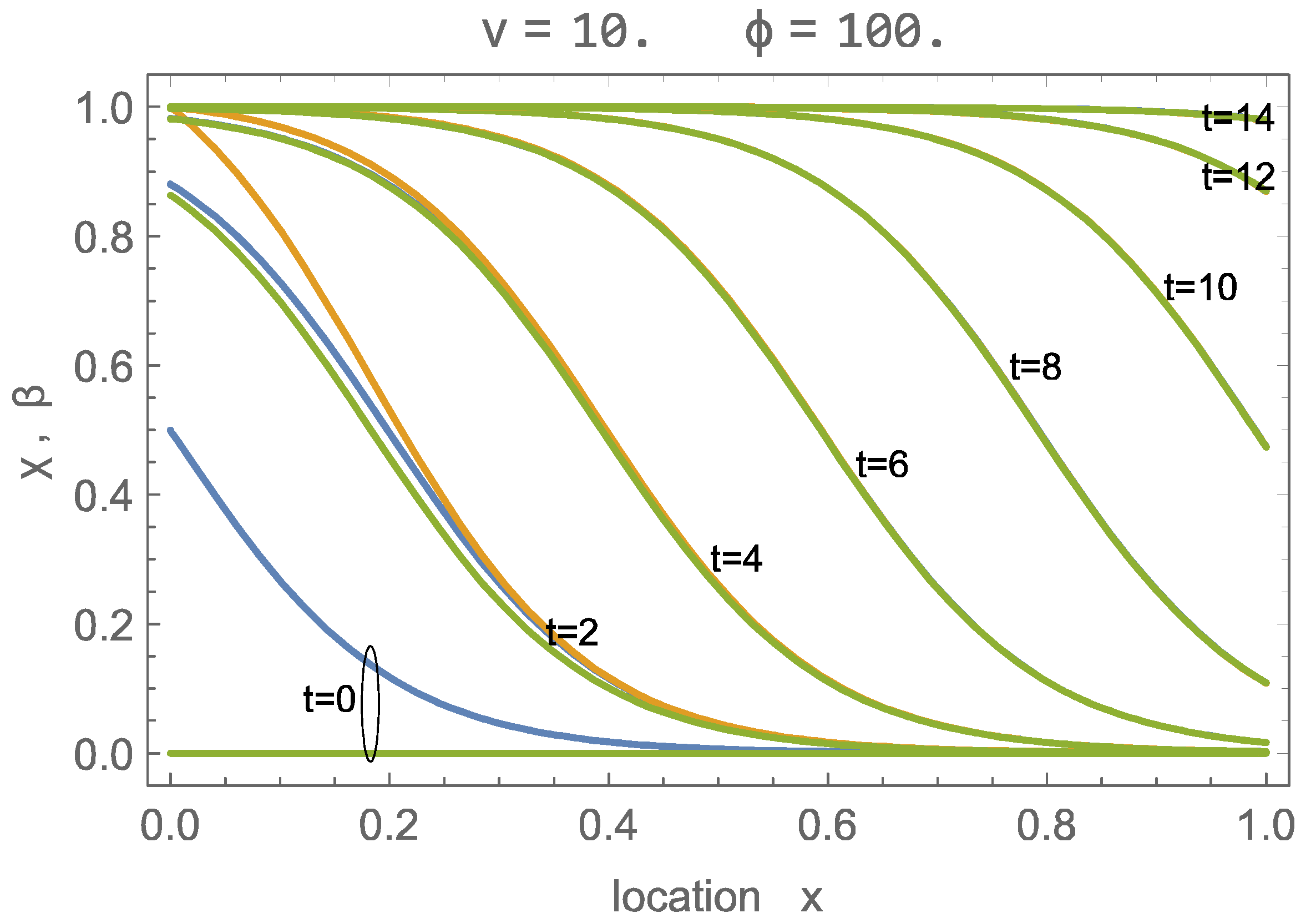
Figure 2 shows, for
,
, or
, and the curves for
(orange) and
(green) over the domain at various times, as well as the wave solution (blue), where the wave shift
was adjusted to provide agreement at larger times.
Figure 2 shows initial differences between
and
, as well as their wave solutions. However, as the process proceeds, the numerical solution develops into the traveling wave solution, with all three curves agreeing well for times
. The flow velocity
is relatively slow so that all CO
2 is adsorbed soon after entering. At time
, the adsorption sites are almost fully occupied.
A further evaluation shows that the shift
in the wave solution is independent of the parameter values. Specifically, we found that a shift of zero gives excellent long-time agreement with numerical solutions for all values at the parameters. With this, at the beginning of the process, the wave structure is centered at the inlet (
),
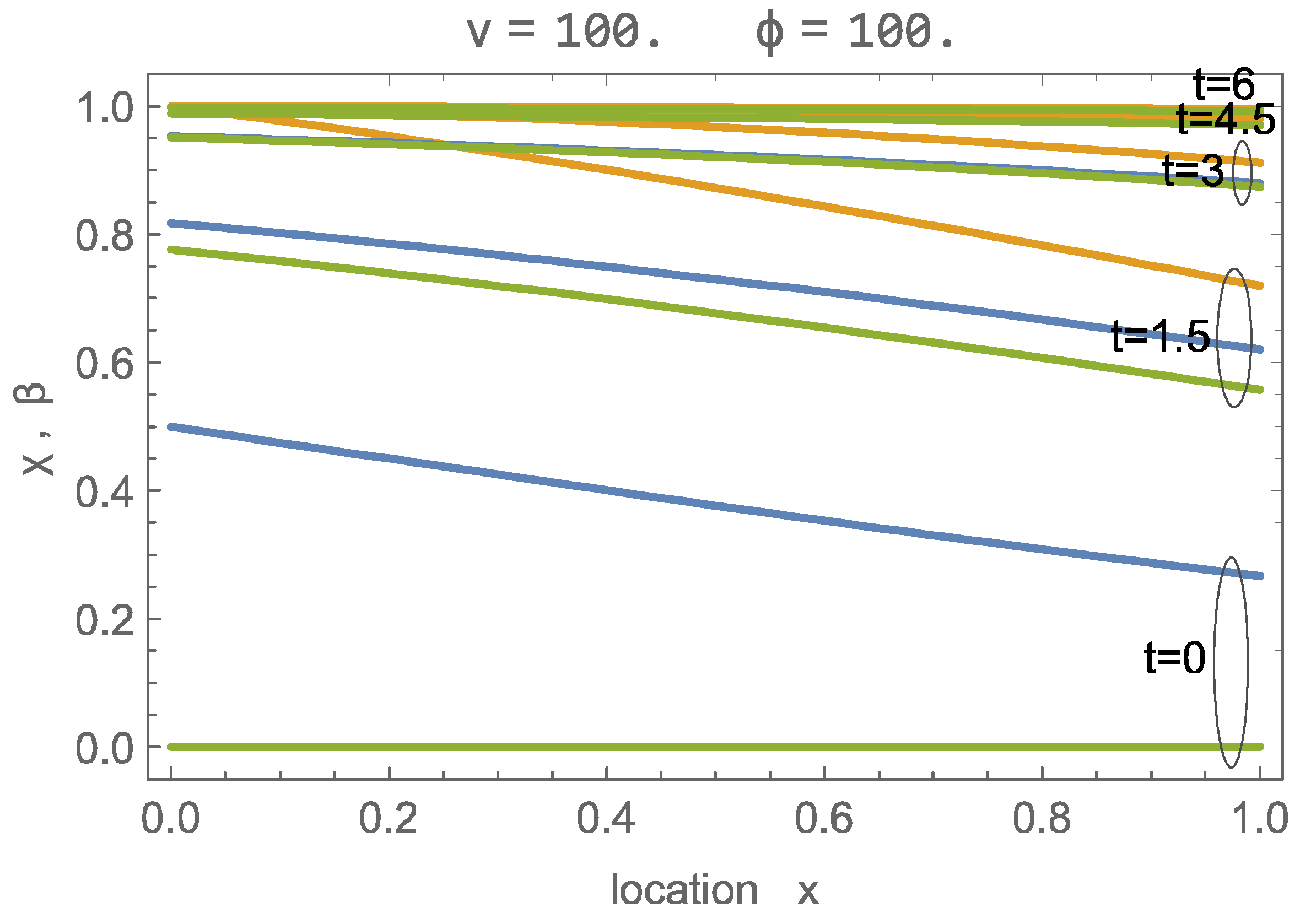
Figure 3 shows the numerical and wave solutions for a fast charging process, at
, for which the signal width is considerably wider than the domain. Due to the large velocity, an abundance of CO
2 is provided so that adsorption occurs at all locations simultaneously, and all sites are filled at about
. While the wave solution deviates in the early stages, from
forward, the agreement is quite good.
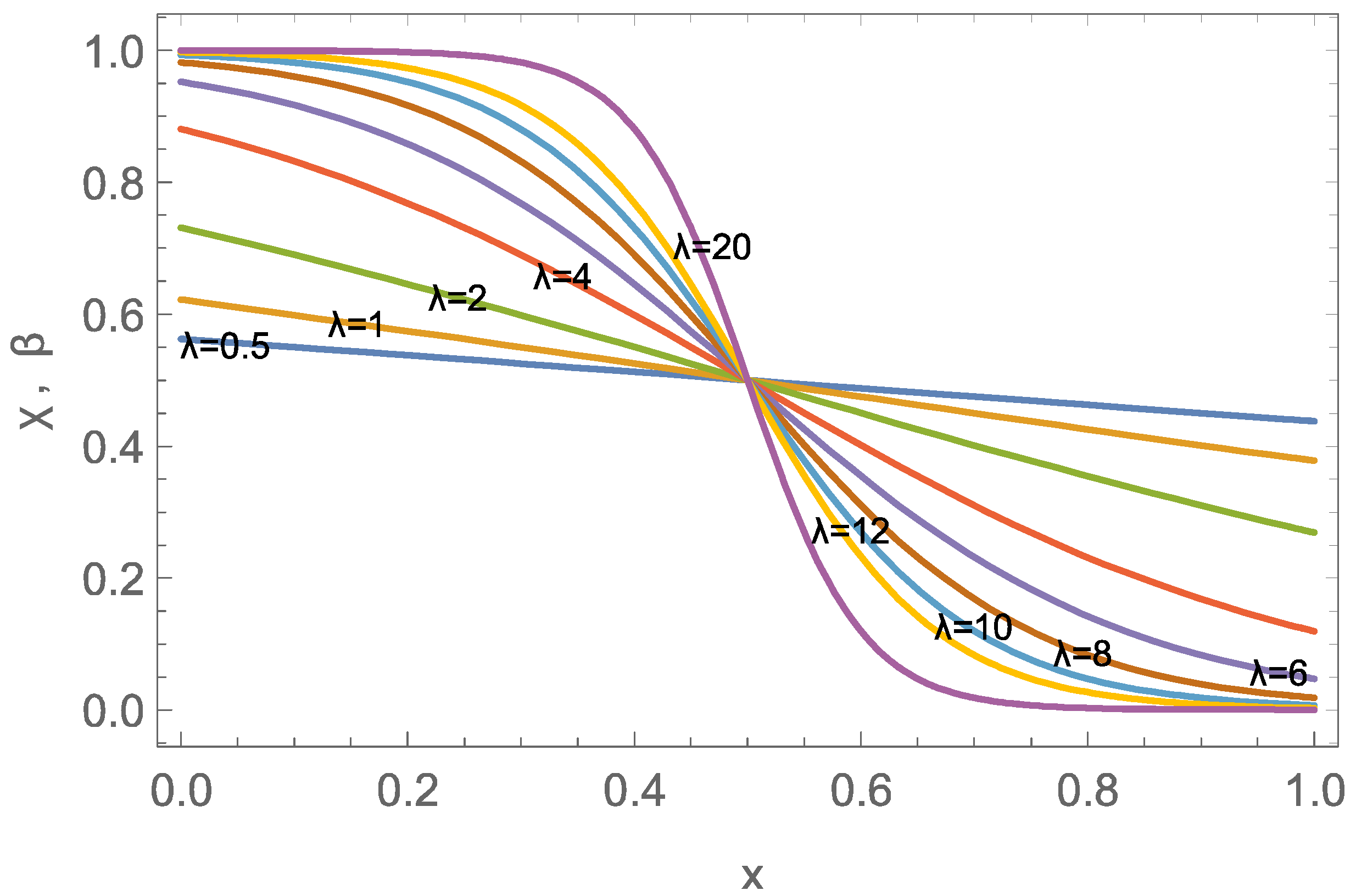
For the results above, we have given the values of velocity and capacity separately. A notable outcome of our evaluation is that the solution behavior—numerical or wave solution—is determined only by the value of the wave parameter , which is inversely proportional to the width of fully developed waves. Thus, in the following, we will not refer to the individual values for , but only to the values of the wave parameter , which is one of two process parameters to describe the charging of a sorbent; the other will be identified as the charging duration .
4.2. Charging Duration
We proceed with the discussion of the required process duration to fill the adsorption sites to a certain level.
The CO
2 accumulation, which is the relative amount of CO
2 collected at time
t, is the space average (with
in the dimensionless formulation),
For the wave solution, the corresponding integral
can be solved to give the CO
2 accumulation as an explicit function of time
t and wave parameter
,
As can be seen already in
Figure 2 and
Figure 3, the wave solution does not properly predict the early stages of charging, as reflected in the non-zero values of
, which can be as large as 0.5 for
.
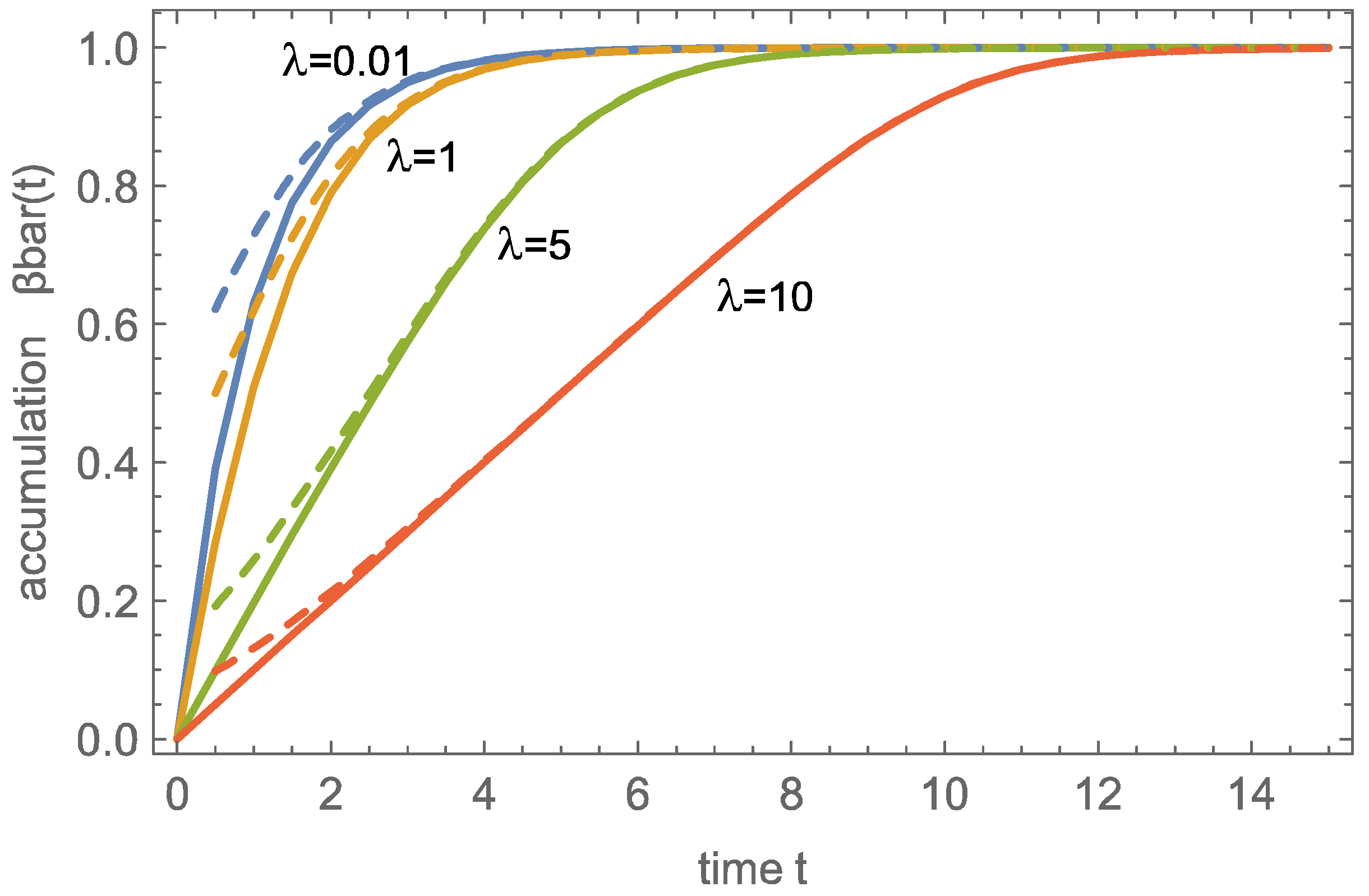
Figure 4 shows the accumulation over time for four values of
, comparing the numerical result (continuous) with the wave solution (dashed), again with good agreement for larger times as well as larger accumulations
. For larger
, the accumulation results from the fully developed wave traveling through the domain, which leads to the linear charging behavior that is clearly visible for
.
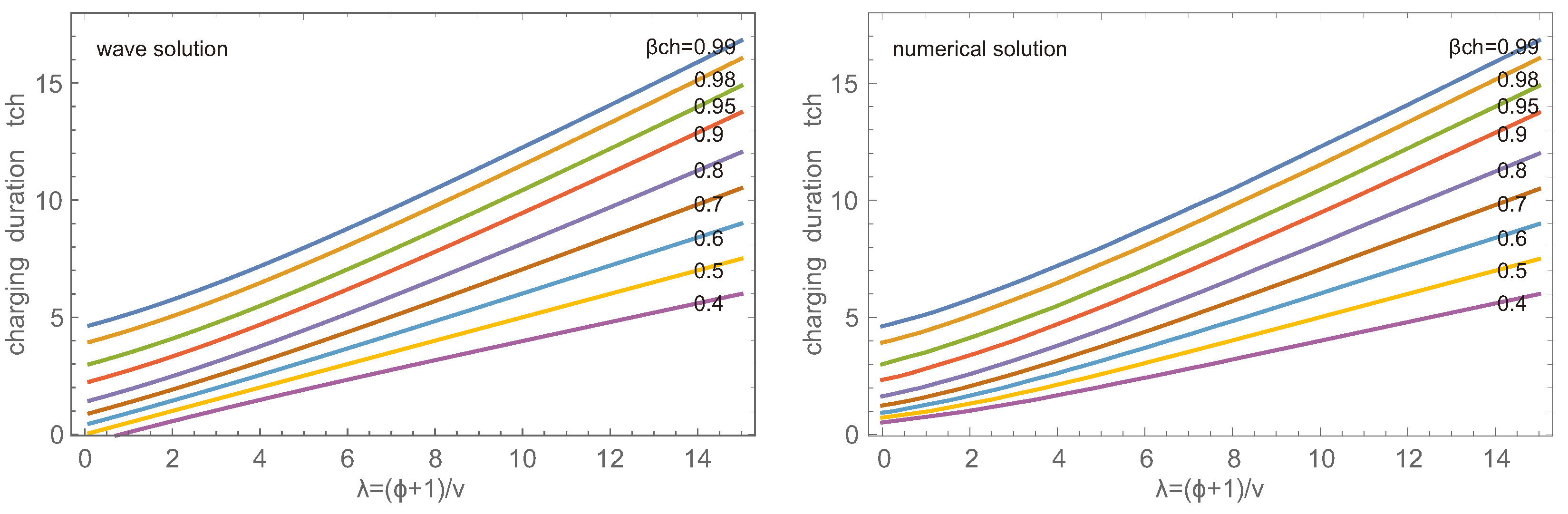
An important question for applications is how long the process should run to make the best use of the sorbent material. We define the charging duration as the time required to reach a desired accumulation value .
The wave solution allows a quick evaluation of the charging time, which is found from the inversion of (
49) as
Accordingly, the charging duration increases with
as well as with the desired value
, as shown in
Figure 5 for the wave and numerical solution. Note that for the wave solution
since the wave solution does not match the proper initial condition
. Thus the durations for small
and small
differ between wave and numerical solutions, while they agree well for larger
and
. The plot gives a clear indication that charging to a large accumulation takes particularly long. Accordingly, in applications, one will not aim to charge to, say, 98%, but rather to a lower value and run the charge-desorption cycle more often.
4.3. Overall Charging Rate
For the best use of the sorbent in applications, one will be interested in large accumulations
and short charging duration
, that is, the large overall charging rates
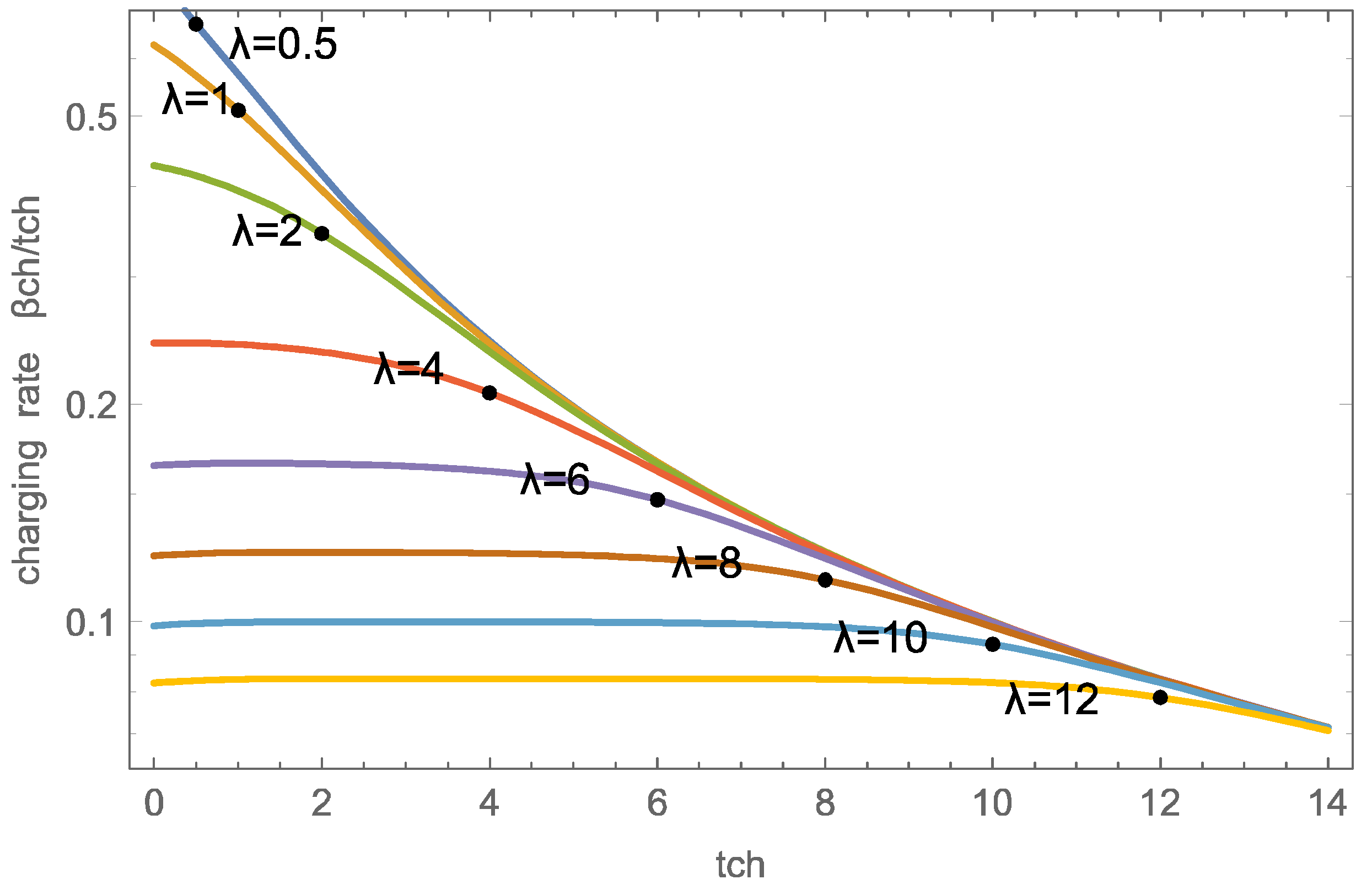
Figure 6 shows the charging rate
as a function of charging time
for the wave parameters
in a logarithmic scale. For larger durations, the overall rate
decreases, hence it is advantageous to not fully charge the sorbent, but rather terminate charging earlier, and charge more often.
For smaller
, that is large velocities, the wave width is larger than the domain, hence, as depicted in
Figure 3, charging is distributed through the domain, with short charging durations yielding large rates.
For
, the charging rates are initially flat due to the wave-dominated charging process depicted in
Figure 2. The exiting wave is centered at the domain exit (
) for
; hence the charging rate decreases around that time.
Not surprisingly, the figure indicates significantly higher charging rates for smaller , that is, a faster airflow. As will be discussed below, large velocities require considerably larger pump work and, thus, are not favorable for efficiency processes.
The dots in the figure indicate , which appears to be a meaningful charging duration for all cases. Indeed, there would be little gain in charging with until , which gives almost the same overall rate as charging with until , but requires significantly more pump work to maintain the large flow velocity .
Table 2 shows accumulations
and overall rates
for the case
for the numerical and wave solutions, which agree well for
.
Notably, in particular for small , it is advantageous to not charge the sorbent to large accumulation, but rather to a lower accumulation (e.g., for ) and more often.
4.4. Breakthrough Curve
We note that the accumulation
is not accessible from direct measurements. Nevertheless, it can be determined from the breakthrough curve, i.e., the ratio of CO
2 mole fractions in the exiting and entering airflows [
35], which both can be measured; in our dimensionless variables the breakthrough curve is given by
since
, which is due to the definition of
and the boundary condition (
45). To proceed, we recall the space integrated conservation of
(
18),
For any meaningful adsorption material, the capacity is large,
, and we have seen that
for larger
t. Hence, with
and the definition (
47) of the accumulation, we can approximate the conservation law as
Integration over the duration of the process, with
, yields the accumulation at time
t as
where
Hence, the accumulation
can be determined from the time integration of the breakthrough curve and the wave parameter
, which must be determined from other measurements.
4.5. Excess Air
The capacity parameter depends only on the material; hence, it is unaffected by the process parameters. From the previous discussion, it is evident that smaller values of the wave parameter , that is, larger flow speeds , are advantageous since they yield faster charging; hence, a better turn-around of charge–discharge processes and a better use of the sorbent. Next, we explore the relation between the faster flow and the total amount of air required, which, indeed, grows with increasing speed.
When
, some CO
2 leaves the domain, which implies that excess airflow is required to provide the unused CO
2. Since work is required to force air through the porous sorbent, a larger air requirement is undesirable. To quantify excess air, we consider the amount of CO
2 collected relative to the CO
2 inflow with air, that is, the relative air usage over the charging duration
, defined as the ratio of accumulated CO
2 to the inflow:
where
is the time integral over the mole fraction at the inlet.
With (
55) and (
51), the air usage is directly related to the charging rate and the wave parameter,
With the suggested charging duration , the air usage equals dimensionless accumulation, . Depending on the value of , air usage can be as small as 33% for , that is, for large velocities .
4.6. Pump Work
Low air usage implies that considerable pump work must be used to push (or pull) excess air through the sorbent since not all CO2 in the air can be collected. We proceed with determining the pump work required per mole of captured gas.
The pumping power to push a gas (i.e., air) through a porous medium of cross section
A is given by the product of volume flow
and pressure difference across the thickness
L of the material:
The pressure difference is given by the Ergun equation [
42]
where
and
are the mass density and viscosity of air, respectively,
The superficial velocity with the void fraction
, and permeability
k and inertial permeability
are given as
with
being the particle diameter of the sorbent.
The total work for pumping air through for the charging duration
is, with
,
The total amount of CO
2 collected at time
in the sorbent material of volume
is
where
is the number of adsorption sites per mass of material, and
is the mass in the volume
.
With the reference work
the pump work per mole of CO
2 adsorbed assumes the compact form
where
is the dimensionless pump work required for charging the sorbent, which is inversely proportional to the overall charging rate
:
with the dimensionless inertial parameter
Table 3 shows the data for the material considered by Climeworks [
36], as well as the resulting values for reference work
and inertial parameter
.
The dimensionless work
depends on the charging rate
and wave parameter
.
Table 4 shows the air usage factor and the dimensionless work for the charging rates of
Table 2 (with
).
The work required for the reversible separation of CO
2 from air is in the order of
[
38]. The work for pumping is consumed by friction in the pores; hence, it must be considered as an irreversible loss [
19,
38,
39]. For the example material, the reference value
is about one-fifth of the reversible separation work. With the data in
Table 4, the actual pumping work
for
is 1.43 times the overall reversible separation work. The behavior is strongly non-linear, with only 16% of the reversible work at
.
Notably, the reference work (
66) depends quadratically on sorbent thickness
L; hence, it can be reduced significantly by using thinner layers of material.
5. Optimal System and Process Conditions
The discussion in the previous sections revealed the main parameters and process conditions to explore the fast and efficient adsorption of CO2 from air in porous sorbents.
Specifically, one must distinguish between the material, physical, and process parameters, which will be discussed below.
External parameters that cannot be changed and thus will not be discussed further are as follows: environmental temperature T, air mole density , atmospheric CO2 mole fraction , air viscosity , and gas constant .
5.1. Material Parameters
One might state the goal of DAC as collecting CO2 from the air in compact facilities at high adsorption rates.
Compact facilities demand sorbents with a high density of adsorption sites, that is, large values of
[unit:
], which can be separated into the demand for high material mass density
and the high mass-specific number of adsorption sites
. The latter is measured through the capacity parameter
(
12), which compares the number of adsorption sites relative to the number of CO
2 molecules in air-filled pores,
A high capacity is desirable for compactness; hence, the sorbent should have a large internal surface area and large site density
The rate of adsorption is given through the reference time
that sets the timescale for DAC processes. Revisiting our above line of arguments, this scale is effectively set in the equation for the number density of unoccupied adsorption sites
when permanently exposed to air with a full CO
2 load, which in dimensional form is the simple decay equation
This definition allows us to estimate the relevant timescale for any adsorption material or model.
For large adsorption rates, the reference time
should be as small as possible. In our simple yet instructive model, we identified the timescale as (
11)
With the site density being large for high capacity, small requires a large adsorption probability factor . Equivalent statements will be possible for more elaborate adsorption models, which lie outside the scope of this examination.
For typical materials, is measured in hours, and a typical charging duration is measured in multiples of ; hence, the turnover times for adsorption–desorption cycles are rather long. Materials with shorter associated timescales are desperately needed.
5.2. Physical Parameters
The actual size of the system is given through the sorbent volume . With the volume flow of air entering as , the volume flow is proportional to the sorbent cross-section , which thus sets the overall size of the system.
The sorbent thickness
L defines the length scale. In our evaluation, it appears to non-dimensionalize velocity
v (see next section), and in the reference work (
66)
With work proportional to , a reduction of layer thickness has a strong influence on reducing pump work.
5.3. Process Parameters
With the material chosen and system geometry set, the only available process parameters are the dimensionless air velocity or, alternatively, the wave parameter , and the charging rate or, alternatively, the charging duration .
As our discussion of charging processes has revealed, for efficient operation, these parameters are not independent. Specifically, when the wave parameter
is chosen, a charging time not too different from
yields good use of the material; see
Figure 6 and
Table 2.
With this, only the wave parameter
remains to be chosen. With decreasing
, both, the charging rate
and the pump work
are increasing; see
Table 2 and
Table 4, hence, there is no unique value of
obtainable from an optimization. One has to choose an appropriate value to strike a balance between the contradictory demands of the large charging rate and small pump work.
While we refrained from a detailed discussion of the desorption part of the overall DAC process, a short comment is in order here. Desorption is a thermal process where the sorbent is heated to a suitable temperature (of the order of 100 °C). Heating and subsequent cooling of the sorbent is an inherently irreversible process, and the best use of the supplied heat will be made when the accumulation is relatively high.
With work increasing quadratically for small
, the adsorption rate decreasing with large
, and a desire for relatively large accumulation, we believe that the target value should lie in the range of
for which the charging rate assumes values in the range
and the accumulation is in the range of 70–90%. For the sample material and process of Ref. [
36], we find
, which is at the upper end of our recommendation.
We emphasize that for small layer thickness L, the reference work will be small as well; hence, the wave parameter can be smaller for large charging rates without demanding too much work.
Table 5 summarizes the recommendations in compact form.
5.4. Physical Size
To close our arguments, we have a brief look at the required size for large-scale DAC facilities. Aiming for a real global impact, we consider CO
2 removal of
per person, which is
. Assuming the capacity of a single plant similar in size to CarbonEngineering’s proposal [
17,
19] at
, this requires 10,000 plants (which is one plant per 800,000 people).
We ask for the mass of sorbent
required for one of these plants. The dimensional overall removal rate is
where the factor
results from the assumption that the time for desorption is
of the time required for adsorption, so that five of six unit times are used for charging.
We evaluate this for the sample material from the Climeworks patent [
36], as listed in
Table 1 and
Table 3. Choosing
with
, we find the required mass of the sorbent as
which fills the volume
corresponding to a cube with an edge length of
.
With a layer thickness of
, the cross-section for the inflow is
Obviously, all numbers are scaled with the characteristic time
; hence, a decrease of
, that is, using materials with a faster intake of CO
2 is essential.
Using the above numbers, we find a sorbent volume of for Climeworks’ 4000 t/year Orca plant, and for their 36,000 t/year Mammoth plant.
These estimates do not account for the adsorption of moisture from the air, which reduces the number of sites available for CO2 molecules.
The data used here, as extracted from Ref. [
36], are probably outdated, but we were not able to find data for newer materials for further evaluation. Certainly, the above numbers provide some idea of the significant physical size of the facilities that direct air capture of CO
2 demands.