Article

Organizational Labor Flow Networks and Career Forecasting

1
Department of Computational and Data Sciences, George Mason University, Fairfax, VA 22030, USA
2
United States Army Acquisition Support Center (USAASC), 9900 Belvoir Road, Fort Belvoir, VA 22060, USA
*
Author to whom correspondence should be addressed.
These authors contributed equally to this work.
Entropy 2023, 25(5), 784; https://doi.org/10.3390/e25050784
Submission received: 28 February 2023 / Revised: 21 April 2023 / Accepted: 1 May 2023 / Published: 11 May 2023
(This article belongs to the Special Issue Recent Trends and Developments in Econophysics)

Abstract

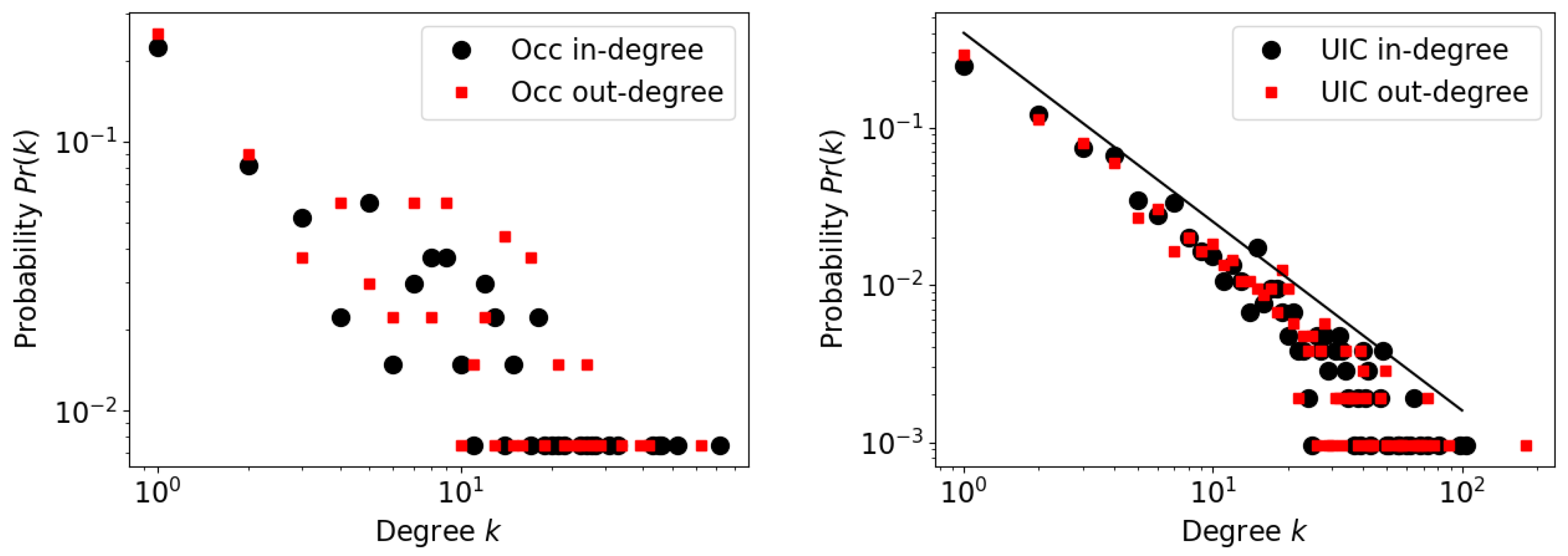
The movement of employees within an organization is a research area of great relevance in a variety of fields such as economics, management science, and operations research, among others. In econophysics, however, only a few initial incursions have been made into this problem. In this paper, based on an approach inspired by the concept of labor flow networks which capture the movement of workers among firms of entire national economies, we construct empirically calibrated high-resolution networks of internal labor markets with nodes and links defined on the basis of different descriptions of job positions, such as operating units or occupational codes. The model is constructed and tested for a dataset from a large U.S. government organization. Using two versions of Markov processes, one without and another with limited memory, we show that our network descriptions of internal labor markets have strong predictive power. Among the most relevant findings, we observe that the organizational labor flow networks created by our method based on operational units possess a power law feature consistent with the distribution of firm sizes in an economy. This signals the surprising and important result that this regularity is pervasive across the landscape of economic entities. We expect our work to provide a novel approach to study careers and help connect the different disciplines that currently study them.
Keywords: labor flow networks; firm-size distribution; career studies; career sequences; manpower analysis labor flow networks; firm-size distribution; career studies; career sequences; manpower analysis