Dynamic Weight Strategy of Physics-Informed Neural Networks for the 2D Navier–Stokes Equations

Abstract
1. Introduction
2. Preliminaries
2.1. Partial Differential Equations
2.2. Fully Connected Neural Networks
2.3. Optimization Method
3. Methodology
3.1. Dynamic Weights Strategy for Physics-Informed Neural Networks
| Algorithm 1: Dynamic weights strategy for PINNs |
3.2. A Brief Note on the Errors Involved in the dwPINNs Methodology
3.3. Advantages of Dynamic Weight Strategy for Physics-Informed Neural Networks
- 1.
- The optimization error can be reduced by using the dynamic weight strategy for physics-informed neural networks. During training, each part of the loss function can be dropped more evenly, and the loss can become smaller and converge faster.
- 2.
- This method can reduce the generalization error by increasing the weights of hard-to-train points during training. It also makes the error of such hard-to-train points smaller.
4. Numerical Examples
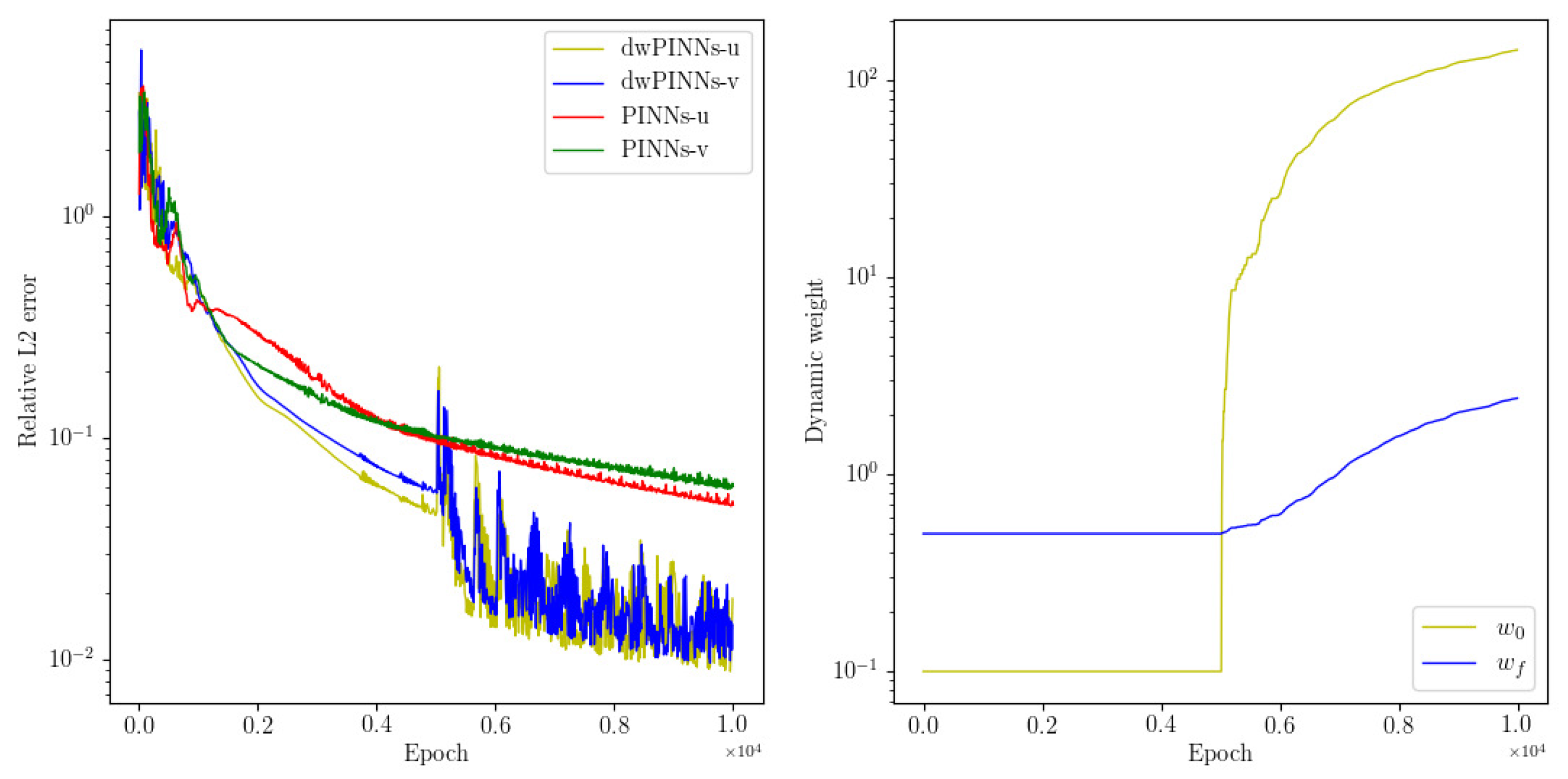
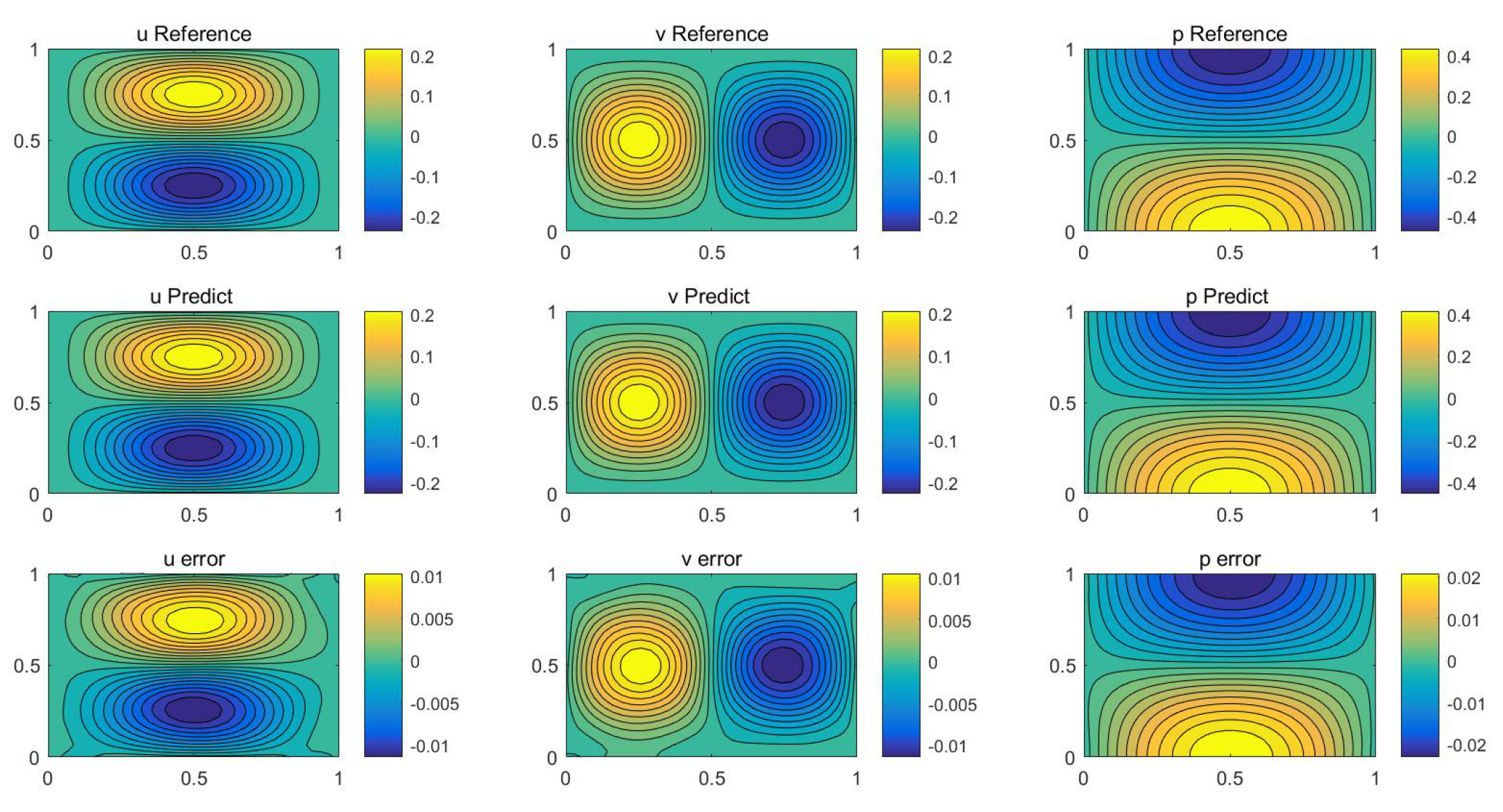
4.1. Navier–Stokes Equations with Analytic Solution
4.2. Comparison of the Different PINNs Methods for 2D Navier–Stokes Equations
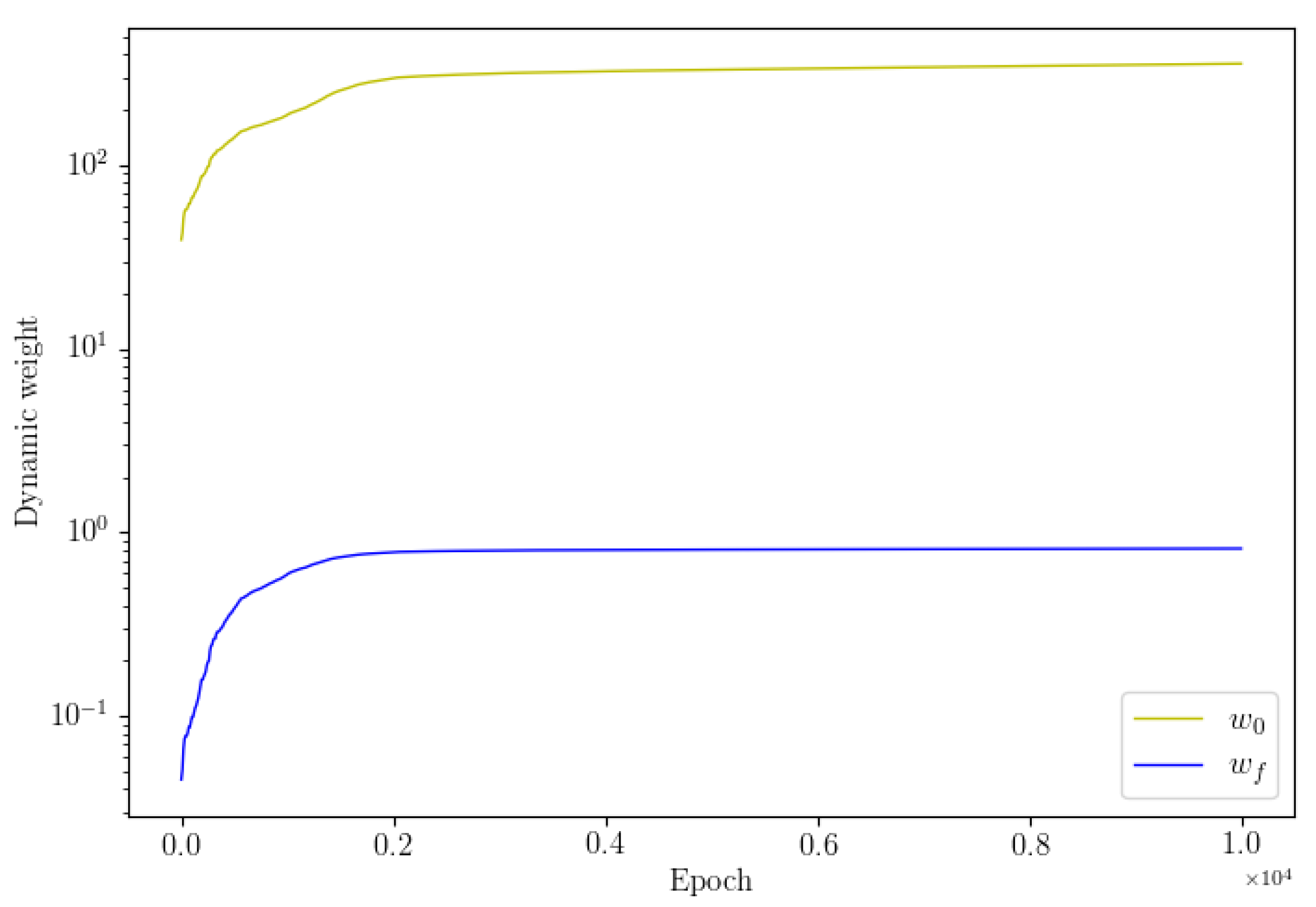
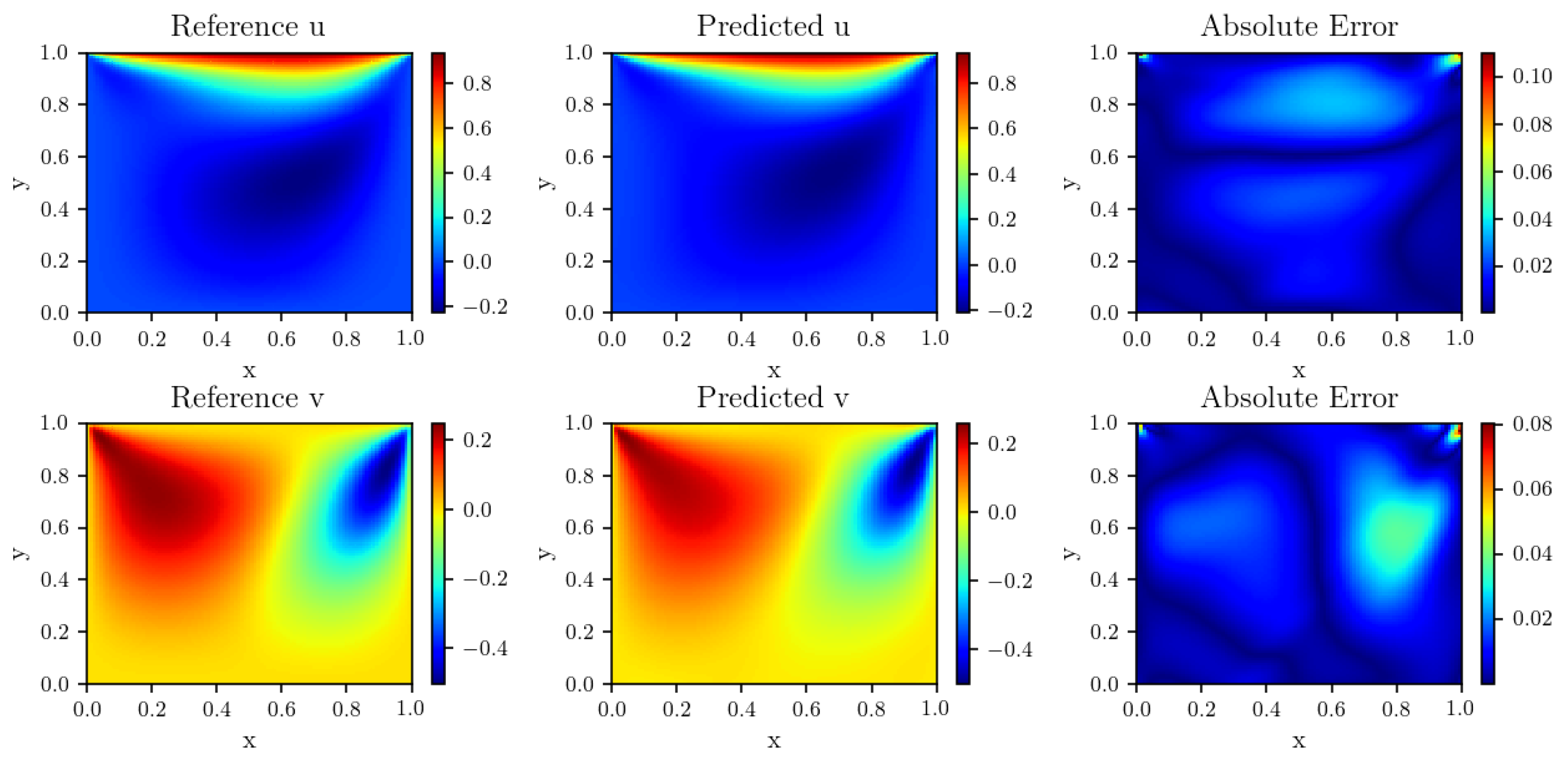
4.3. Inverse Problem: Two-Dimensional Navier-Stokes Equations
5. Conclusions
Author Contributions
Funding
Acknowledgments
Conflicts of Interest
References
- Huang, P.; Feng, X.; He, Y. Two-level defect-correction Oseen iterative stabilized finite element methods for the stationary Navier–Stokes equations. Appl. Math. Model. 2013, 37, 728–741. [Google Scholar] [CrossRef] [Scilit]
- Feng, X.; Li, R.; He, Y.; Liu, D. P1-Nonconforming quadrilateral finite volume methods for the semilinear elliptic equations. J. Sci. Comput. 2012, 52, 519–545. [Google Scholar] [CrossRef] [Scilit]
- Feng, X.; He, Y. H1-Super-convergence of center finite difference method based on P1-element for the elliptic equation. Appl. Math. Model. 2014, 38, 5439–5455. [Google Scholar] [CrossRef] [Scilit]
- Elia, M.D.; Perego, M.; Yeneziani, A. A variational data assimilation procedure for the incompressible four equations in hemodynamics. J. Sci. 2012, 52, 340–359. [Google Scholar]
- Baker, N.; Alexander, F.; Bremer, T.; Hagberg, A.; Kevrekidis, Y.; Najm, H.; Parashar, M.; Patra, A.; Sethian, J.; Wild, S.; et al. Workshop Report on Basic Research Needs for Scientific Machine Learning: Core Technologies for Artificial Intelligence; USDOE Office of Science (SC): Washington, DC, USA, 2019. [Google Scholar]
- Hornik, K.; Stinchcombe, M.; White, H. Multilayer feedforward networks are universal approximators. Neural Netw. 1989, 2, 359–366. [Google Scholar] [CrossRef] [Scilit]
- Abadi, M.; Barham, P.; Chen, J.; Chen, Z.; Davis, A.; Dean, J.; Devin, M.; Ghemawat, S.; Irving, G.; Isard, M.; et al. TensorFlow: A System for Large-Scale Machine Learning. In Proceedings of the 12th USENIX Symposium on Operating Systems Design and Implementation (OSDI 16), Savannah, GA, USA, 2–4 November 2016; pp. 265–283. [Google Scholar]
- Baydin, A.G.; Pearlmutter, B.A.; Radul, A.A.; Siskind, J.M. Automatic differentiation in machine learning: A survey. J. Mach. Learn. Res. 2018, 18, 1–43. [Google Scholar]
- Raissi, M.; Perdikaris, P.; Karniadakis, G.E. Physics-informed neural networks: A deep learning framework for solving forward and inverse problems involving nonlinear partial differential equations. J. Comput. Phys. 2019, 378, 686–707. [Google Scholar] [CrossRef] [Scilit]
- Wight, C.L.; Zhao, J. Solving allen-cahn and cahn-hilliard equations using the adaptive physics informed neural networks. arXiv 2020, arXiv:2007.04542. [Google Scholar]
- Jagtap, A.D.; Kharazmi, E.; Karniadakis, G.E. Conservative physics-informed neural networks on discrete domains for conservation laws: Applications to forward and inverse problems. Comput. Method. Appl. Mech. Eng. 2019, 365, 113028. [Google Scholar] [CrossRef] [Scilit]
- Mao, Z.; Jagtap, A.D.; Karniadakis, G.E. Physics-informed neural network for high-speed flows. Comput. Method. Appl. Mech. Eng. 2020, 360, 112789. [Google Scholar] [CrossRef] [Scilit]
- Jagtap, A.D.; Karniadakis, G.E. Extended Physics-Informed Neural Networks (XPINNs): A Generalized Space-Time Domain Decomposition Based Deep Learning Framework for Nonlinear Partial Differential Equations. Commun. Comput. Phys. 2020, 28, 2002–2041. [Google Scholar]
- Yang, L.; Zhang, D.; Karniadakis, G.E. Physics-informed generative adversarial networks for stochastic differential equations. SIAM J. Sci. Comput. 2020, 42, A292–A317. [Google Scholar] [CrossRef] [Scilit]
- Raissi, M. Forward-backward stochastic neural networks: Deep learning of high-dimensional partial differential equations. arXiv 2018, arXiv:1804.07010. [Google Scholar]
- Zhang, D.; Lu, L.; Guo, L.; Karniadakis, G.E. Quantifying total uncertainty in physics-informed neural networks for solving forward and inverse stochastic problems. J. Comput. Phys. 2019, 397, 108850. [Google Scholar] [CrossRef] [Scilit]
- Zhang, D.; Guo, L.; Karniadakis, G.E. Learning in modal space: Solving time-dependent stochastic PDEs using physics-informed neural networks. SIAM J. Sci. Comput. 2020, 42, A639–A665. [Google Scholar] [CrossRef] [Scilit]
- Wang, S.; Teng, Y.; Perdikaris, P. Understanding and mitigating gradient flow pathologies in physics-informed neural networks. SIAM J. Sci. Comput. 2021, 43, A3055–A3081. [Google Scholar] [CrossRef] [Scilit]
- Elhamod, M.; Bu, J.; Singh, C.; Redell, M.; Ghosh, A.; Podolskiy, V.; Lee, W.C.; Karpatne, A. CoPhy-PGNN: Learning physics-guided neural networks with competing loss functions for solving eigenvalue problems. ACM Trans. Intell. Syst. Technol. 2020. [Google Scholar] [CrossRef] [Scilit]
- Wang, S.; Yu, X.; Perdikaris, P. When and why PINNSs fail to train: A neural tangent kernel perspective. J. Comput. Phys. 2022, 449, 110768. [Google Scholar] [CrossRef] [Scilit]
- Mcclenny, L.; Braga-Neto, U. Self-Adaptive Physics-Informed Neural Networks using a Soft Attention Mechanism. In Proceedings of the AAAI-MLPS 2021, Stanford, CA, USA, 22–24 March 2021. [Google Scholar]
- Lu, L.; Meng, X.; Mao, Z.; Karniadakis, G.E. DeepXDE: A deep learning library for solving differential equations. SIAM Rev. 2021, 63, 208–228. [Google Scholar] [CrossRef] [Scilit]
- Wang, F.; Jiang, M.; Qian, C.; Yang, S.; Li, C.; Zhang, H.; Wang, X.; Tang, X. Residual attention network for image classification. In Proceedings of the IEEE Conference on Computer Vision and Pattern Recognition, Honolulu, HI, USA, 21–26 July 2017; pp. 3156–3164. [Google Scholar]
- Dissanayake, M.; Phan-Thien, N. Neural-network-based approximations for solving partial differential equations. Commun. Numer. Methods Eng. 1994, 10, 195–201. [Google Scholar] [CrossRef] [Scilit]
- Barakat, A.; Bianchi, P. Convergence and dynamical behavior of the ADAM algorithm for nonconvex stochastic optimization. SIAM J. Optim. 2021, 31, 244–274. [Google Scholar] [CrossRef] [Scilit]
- Li, J.; Cheng, J.H.; Shi, J.Y.; Huang, F. Brief introduction of back propagation (BP) neural network algorithm and its improvement. In Advances in Computer Science and Information Engineering; Springer: Berlin/Heidelberg, Germany, 2012; pp. 553–558. [Google Scholar]
- Kingma, D.; Ba, J. Adam: A Method for Stochastic Optimization. Comput. Sci. 2014. [Google Scholar] [CrossRef] [Scilit]
- Liu, D.C.; Nocedal, J. On the limited memory bfgs method for large scale optimization. Math. Program 1989, 45, 503–528. [Google Scholar] [CrossRef] [Scilit]
- Cybenko, G. Approximation by superpositions of a sigmoidal function. Math. Control Signal Syst. 1989, 2, 303–314. [Google Scholar] [CrossRef] [Scilit]

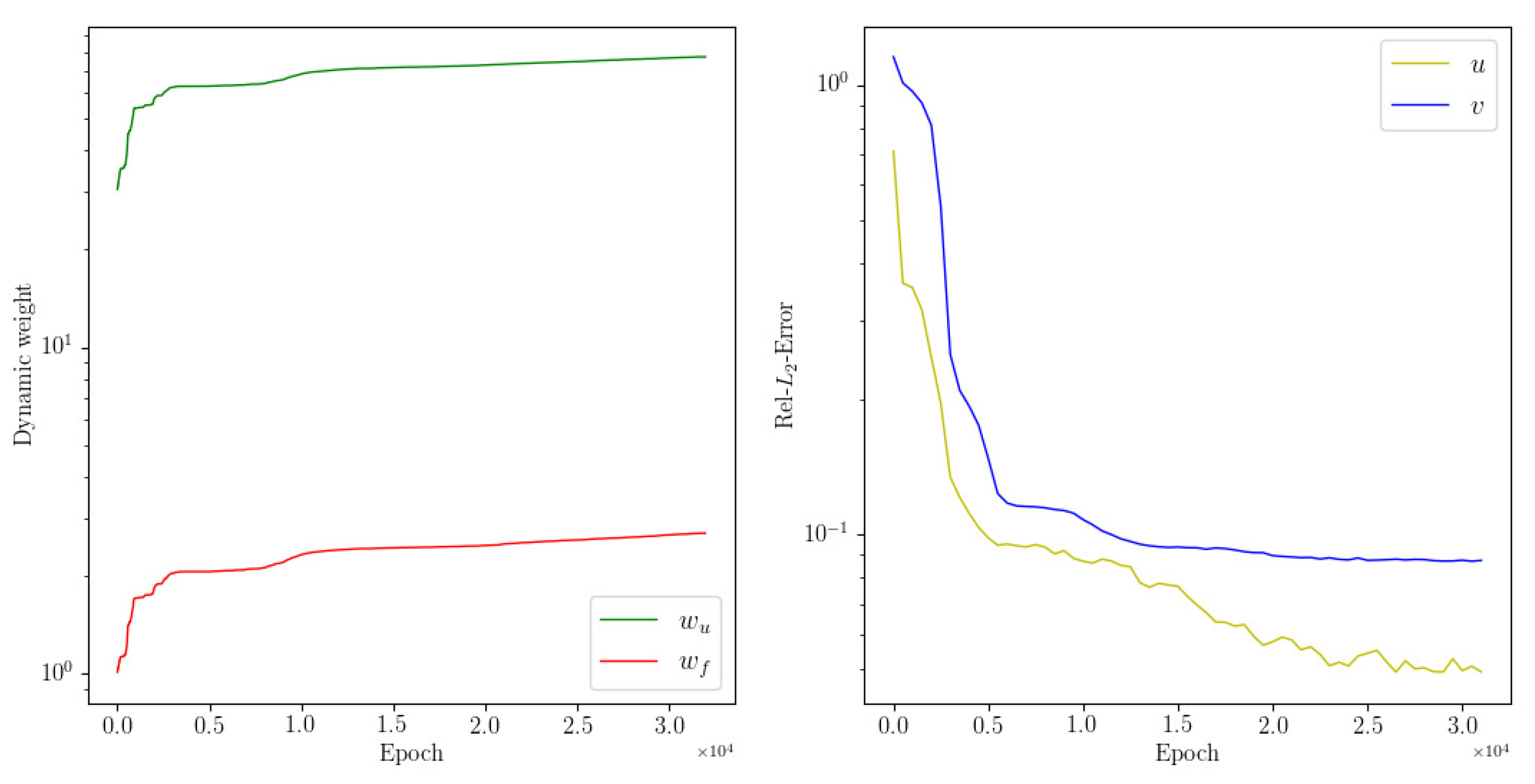
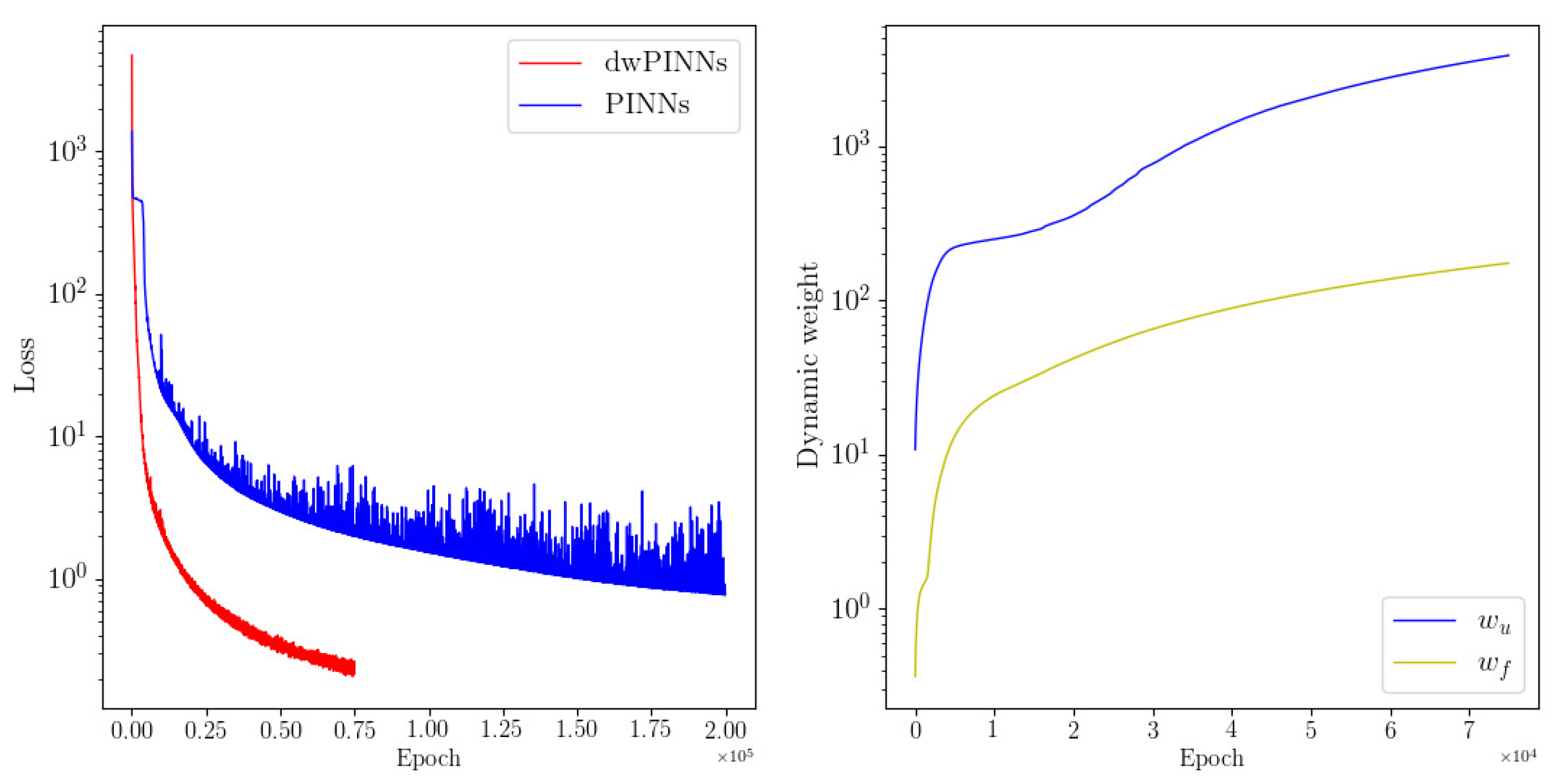
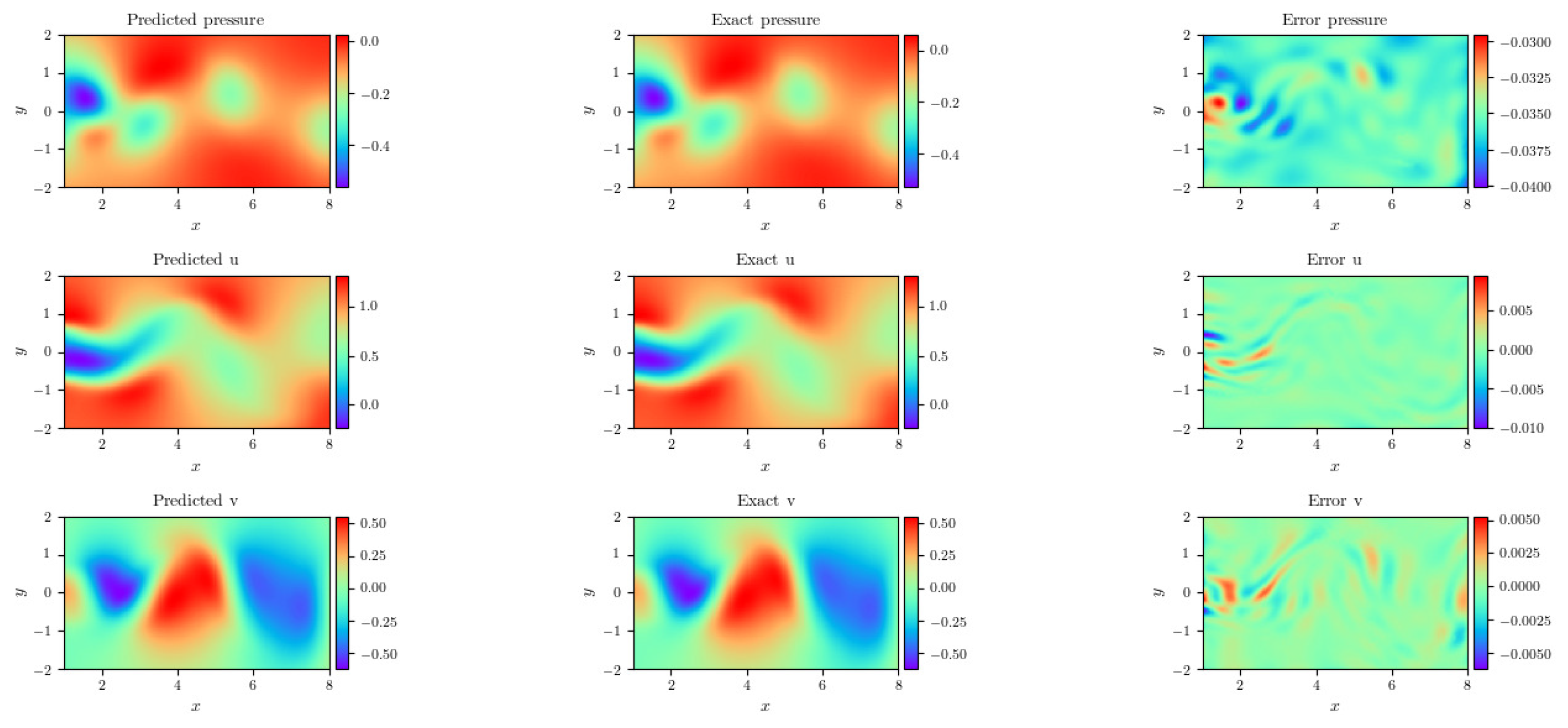

| Error u | Error v | Error p | Training Time (s) | |
|---|---|---|---|---|
| dwPINNs | 5412.53 | |||
| PINNs | 5314.67 |
| dwPINNs | PINNs | SAPINNs | Learning Rate Annealing for PINNs | |
|---|---|---|---|---|
| Relative L2 error |
| 2000 | 4000 | 8000 | 10,000 | |
|---|---|---|---|---|
| 200 | ||||
| 1000 | ||||
| 3000 |
| 20 | 30 | 40 | 50 | |
|---|---|---|---|---|
| 2 | ||||
| 3 | ||||
| 4 |
| u | v | Training Time (s) | |||
|---|---|---|---|---|---|
| dwPINNs (clean) | 0.06% | 0.9% | 30,574 | ||
| dwPINNs ( noise) | 0.23% | 2.1% | 30,575 | ||
| PINNs | 0.99% | 2.30% | 51,475 |
Publisher’s Note: MDPI stays neutral with regard to jurisdictional claims in published maps and institutional affiliations. |
© 2022 by the authors. Licensee MDPI, Basel, Switzerland. This article is an open access article distributed under the terms and conditions of the Creative Commons Attribution (CC BY) license (https://creativecommons.org/licenses/by/4.0/).
Share and Cite
Li, S.; Feng, X. Dynamic Weight Strategy of Physics-Informed Neural Networks for the 2D Navier–Stokes Equations. Entropy 2022, 24, 1254. https://doi.org/10.3390/e24091254
Li S, Feng X. Dynamic Weight Strategy of Physics-Informed Neural Networks for the 2D Navier–Stokes Equations. Entropy. 2022; 24(9):1254. https://doi.org/10.3390/e24091254
Chicago/Turabian StyleLi, Shirong, and Xinlong Feng. 2022. "Dynamic Weight Strategy of Physics-Informed Neural Networks for the 2D Navier–Stokes Equations" Entropy 24, no. 9: 1254. https://doi.org/10.3390/e24091254
APA StyleLi, S., & Feng, X. (2022). Dynamic Weight Strategy of Physics-Informed Neural Networks for the 2D Navier–Stokes Equations. Entropy, 24(9), 1254. https://doi.org/10.3390/e24091254