Article

Crooks Fluctuation Theorem for Single Polymer Dynamics in Time-Dependent Flows: Understanding Viscoelastic Hysteresis

by
Yuecheng Zhou
1,2,†,‡,
Folarin Latinwo
3,‡ and
Charles M. Schroeder
1,2,3,*
1
Department of Materials Science and Engineering, University of Illinois at Urbana-Champaign, Urbana, IL 61801, USA
2
Beckman Institute for Advanced Science and Technology, University of Illinois at Urbana-Champaign, Urbana, IL 61801, USA
3
Department of Chemical and Biomolecular Engineering, University of Illinois at Urbana-Champaign, Urbana, IL 61801, USA
*
Author to whom correspondence should be addressed.
Current address: Department of Chemistry, Stanford University, Stanford, CA 94305, USA.
These authors contributed equally to this work.
Entropy 2022, 24(1), 27; https://doi.org/10.3390/e24010027
Submission received: 22 November 2021 / Revised: 18 December 2021 / Accepted: 21 December 2021 / Published: 24 December 2021
(This article belongs to the Special Issue Modeling and Simulation of Complex Fluid Flows)

Abstract

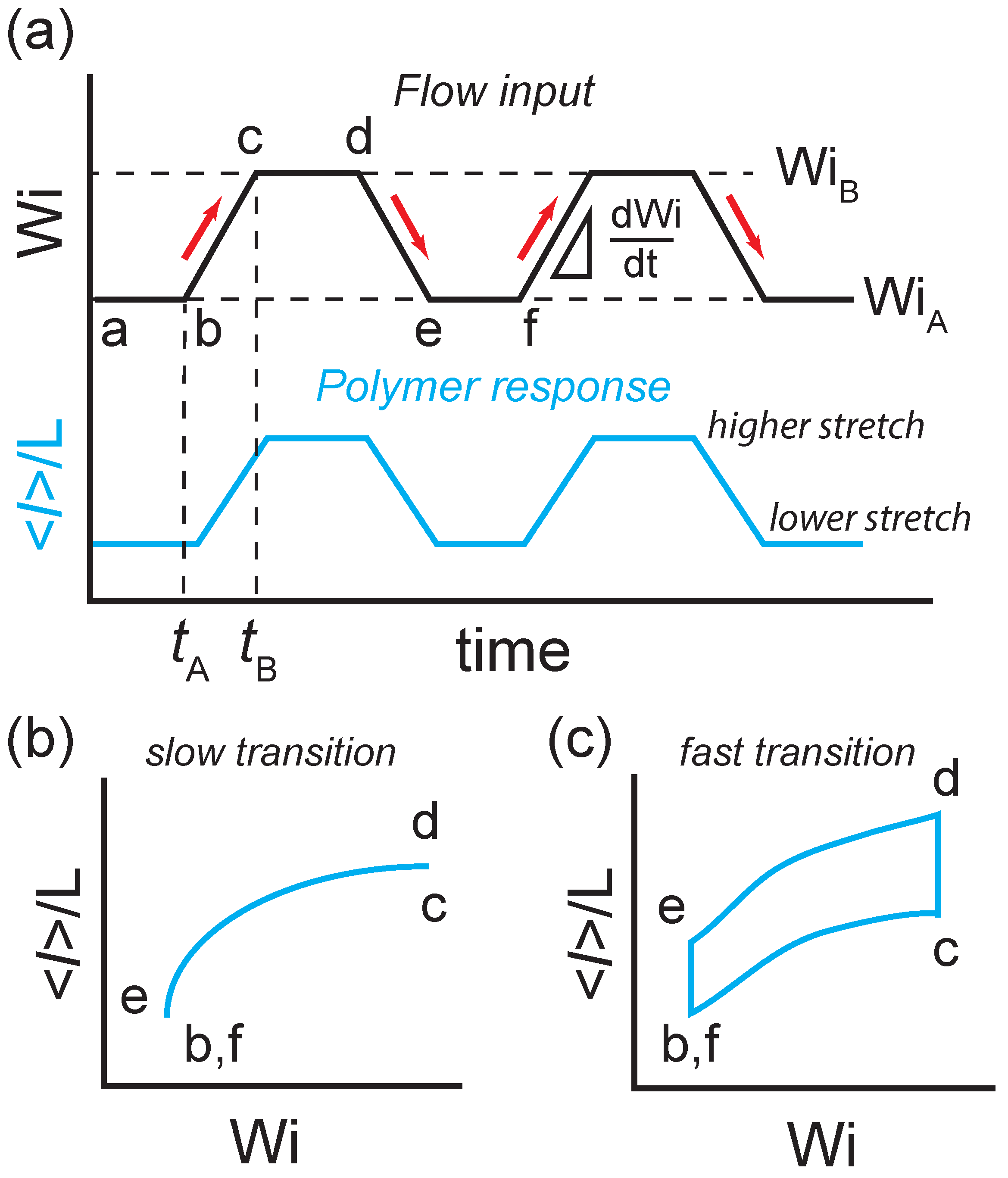
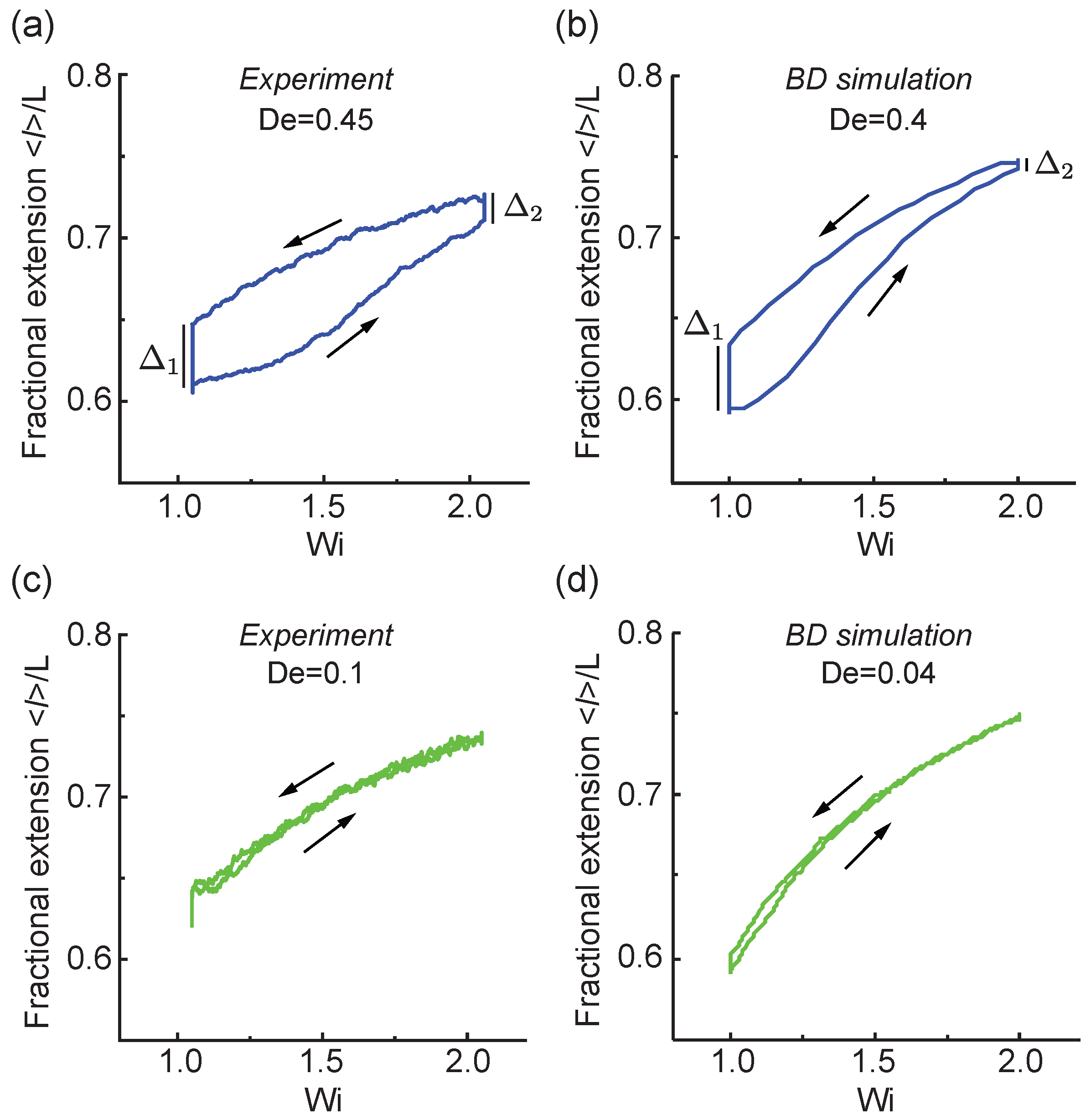
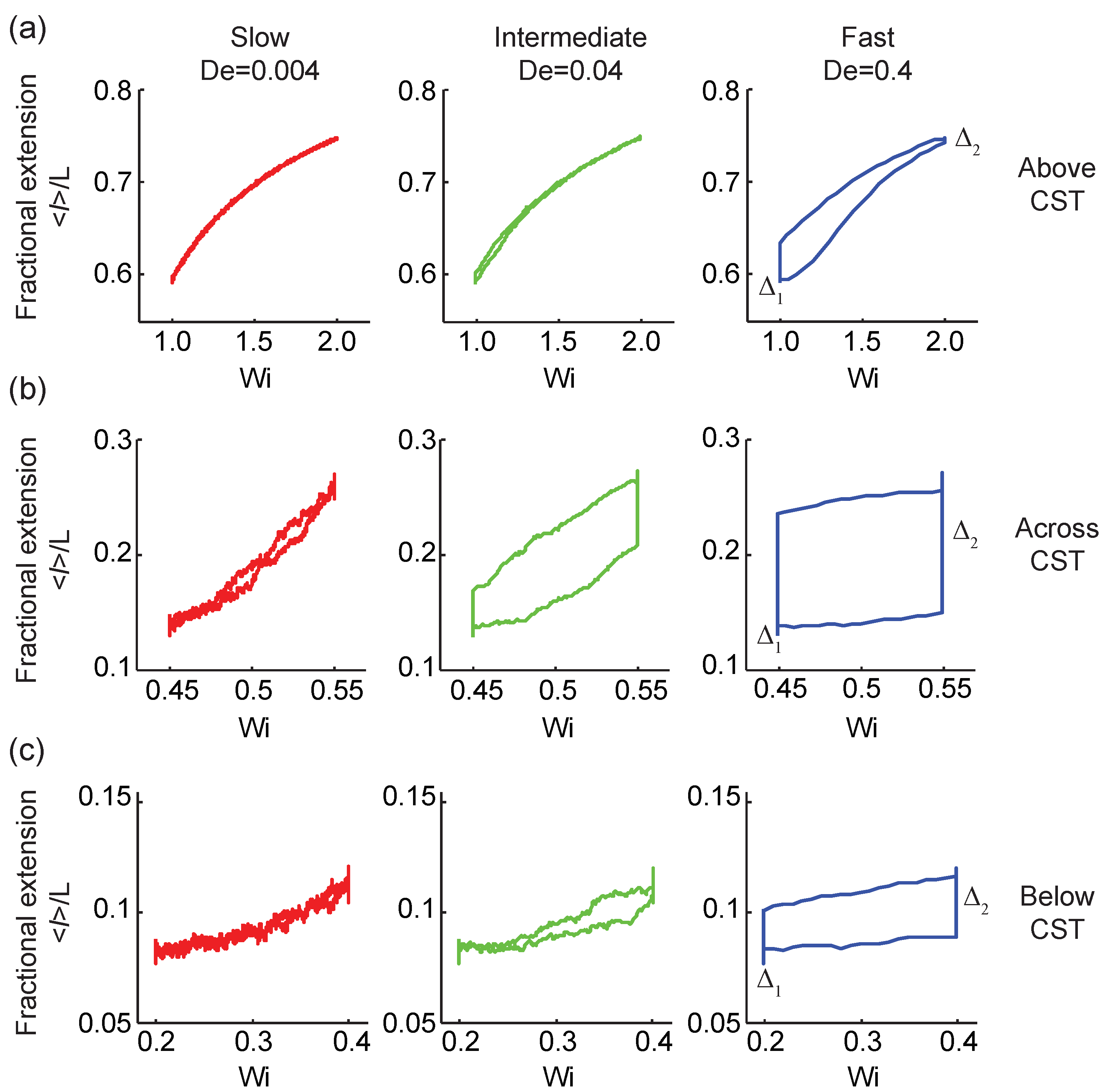
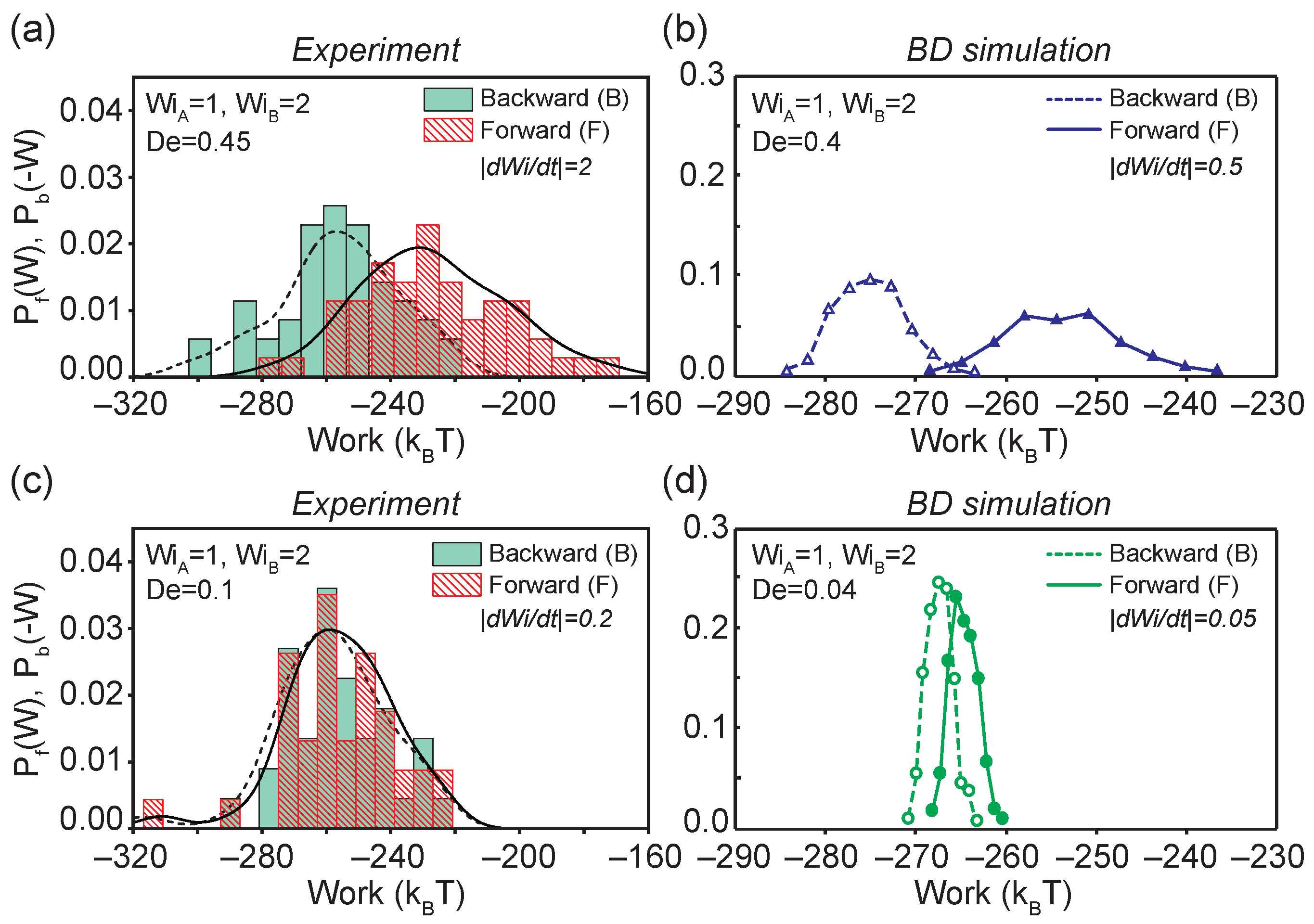
Nonequilibrium work relations have fundamentally advanced our understanding of molecular processes. In recent years, fluctuation theorems have been extensively applied to understand transitions between equilibrium steady-states, commonly described by simple control parameters such as molecular extension of a protein or polymer chain stretched by an external force in a quiescent fluid. Despite recent progress, far less is understood regarding the application of fluctuation theorems to processes involving nonequilibrium steady-states such as those described by polymer stretching dynamics in nonequilibrium fluid flows. In this work, we apply the Crooks fluctuation theorem to understand the nonequilibrium thermodynamics of dilute polymer solutions in flow. We directly determine the nonequilibrium free energy for single polymer molecules in flow using a combination of single molecule experiments and Brownian dynamics simulations. We further develop a time-dependent extensional flow protocol that allows for probing viscoelastic hysteresis over a wide range of flow strengths. Using this framework, we define quantities that uniquely characterize the coil-stretch transition for polymer chains in flow. Overall, generalized fluctuation theorems provide a powerful framework to understand polymer dynamics under far-from-equilibrium conditions.
Keywords: fluctuation theorems; nonequilibrium thermodynamics; polymer dynamics; conformation hysteresis; viscoelasticity fluctuation theorems; nonequilibrium thermodynamics; polymer dynamics; conformation hysteresis; viscoelasticity