Article

Action and Entropy in Heat Engines: An Action Revision of the Carnot Cycle
1
School of Life and Environmental Sciences, Sydney Institute of Agriculture, University of Sydney, Sydney, NSW 2006, Australia
2
Faculty of Information Technologies (FIT), University of Mostar, 88000 Mostar, Bosnia and Herzegovina
*
Author to whom correspondence should be addressed.
Entropy 2021, 23(7), 860; https://doi.org/10.3390/e23070860
Submission received: 10 May 2021 / Revised: 28 June 2021 / Accepted: 1 July 2021 / Published: 5 July 2021
(This article belongs to the Special Issue Entropy: The Scientific Tool of the 21st Century)

Abstract

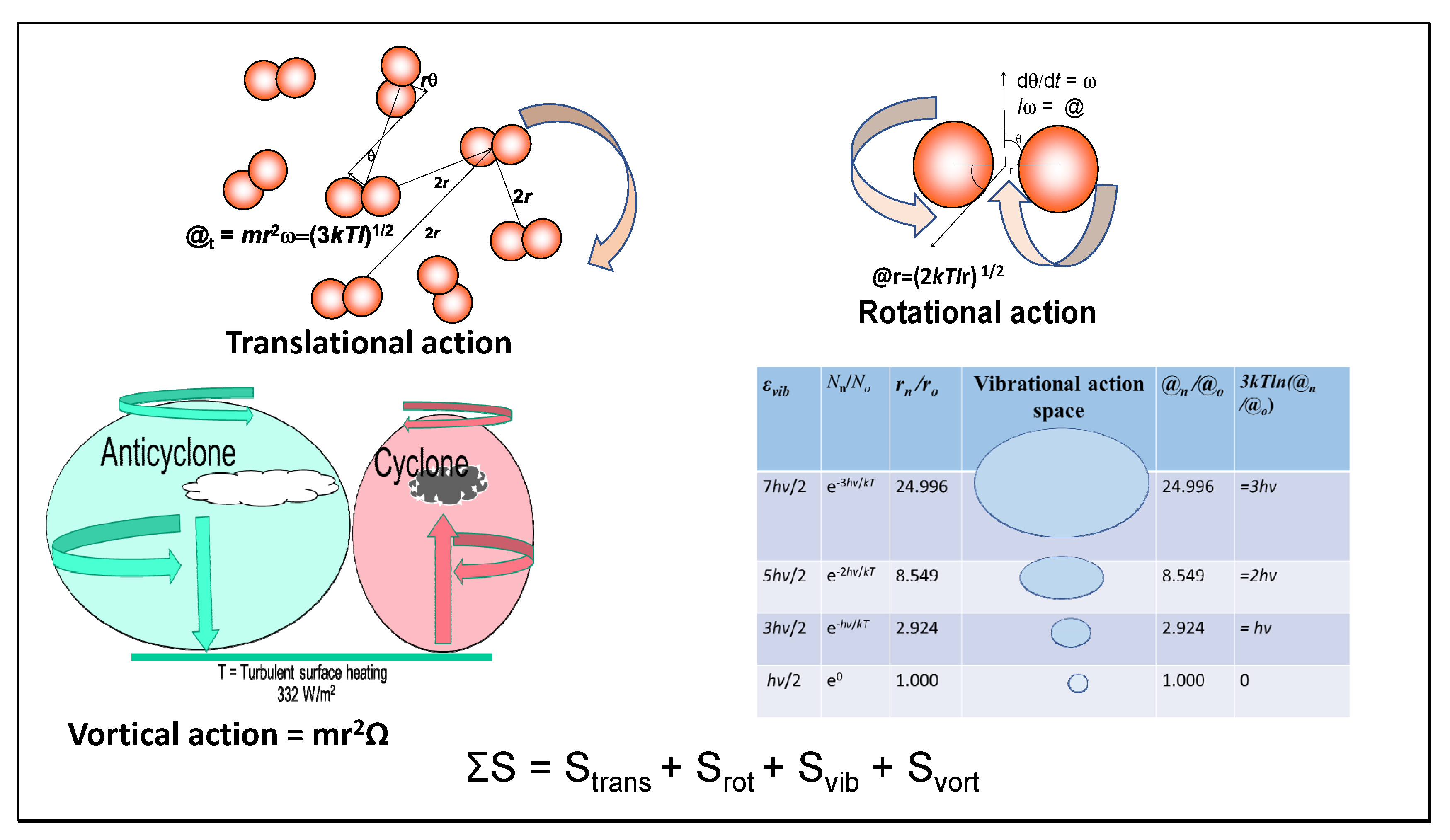
Despite the remarkable success of Carnot’s heat engine cycle in founding the discipline of thermodynamics two centuries ago, false viewpoints of his use of the caloric theory in the cycle linger, limiting his legacy. An action revision of the Carnot cycle can correct this, showing that the heat flow powering external mechanical work is compensated internally with configurational changes in the thermodynamic or Gibbs potential of the working fluid, differing in each stage of the cycle quantified by Carnot as caloric. Action (@) is a property of state having the same physical dimensions as angular momentum (mrv = mr2ω). However, this property is scalar rather than vectorial, including a dimensionless phase angle (@ = mr2ωδφ). We have recently confirmed with atmospheric gases that their entropy is a logarithmic function of the relative vibrational, rotational, and translational action ratios with Planck’s quantum of action ħ. The Carnot principle shows that the maximum rate of work (puissance motrice) possible from the reversible cycle is controlled by the difference in temperature of the hot source and the cold sink: the colder the better. This temperature difference between the source and the sink also controls the isothermal variations of the Gibbs potential of the working fluid, which Carnot identified as reversible temperature-dependent but unequal caloric exchanges. Importantly, the engine’s inertia ensures that heat from work performed adiabatically in the expansion phase is all restored to the working fluid during the adiabatic recompression, less the net work performed. This allows both the energy and the thermodynamic potential to return to the same values at the beginning of each cycle, which is a point strongly emphasized by Carnot. Our action revision equates Carnot’s calorique, or the non-sensible heat later described by Clausius as ‘work-heat’, exclusively to negative Gibbs energy (−G) or quantum field energy. This action field complements the sensible energy or vis-viva heat as molecular kinetic motion, and its recognition should have significance for designing more efficient heat engines or better understanding of the heat engine powering the Earth’s climates.
Keywords: Carnot cycle; caloric; specific heat; entropy; Gibbs potential; vortical entropy; reversible cycle; working fluid; quantum field; relative action; heat engine Carnot cycle; caloric; specific heat; entropy; Gibbs potential; vortical entropy; reversible cycle; working fluid; quantum field; relative action; heat engine