Fuzzy Entropy-Based Spatial Hotspot Reliability



Abstract
1. Introduction
2. Preliminaries
2.1. The EFCM Algorithm
| Algorithm 1: EFCM. |
| 1. Set m, ε, η, the initial number of clusters C(0) |
| 2. β ← 1, S* ← 0, S*prev ← 1 |
| 3. Initialize randomly the partition matrix U and the centers vi |
| 4. Repeat |
| 5. For i = 1 to C //calculate centers and radius of clusters |
| 6. Calculate the center of the ith cluster vi by (4) |
| 7. Calculate the radius of the ith cluster ri by (12) |
| 8. ri ← ri ∙ β/C //enlarge the radius of the i-th cluster |
| 9. For i = 1 to C //calculate new partition matrix |
| 10. For j = 1 to N |
| 11. Calculate the membership degree component uij by (14) |
| 12. For i = 1 to C 1 //Find the two most similar clusters |
| 13. For k = i + 1 to C |
| 14. Calculate Sik by (15) |
| 15. If Sik > S* Then |
| 16. S* ← Sik |
| 17. If |S* − S*prev| < η |
| 18. α = 1/(C 1) |
| 19. If S* > α //merge the two most similar clusters |
| 20. For j = i + 1 to N |
| 21. uij ← uij + ukj |
| 22. Remove the kth row from U |
| 23. C← C 1 |
| 24. Else |
| 25. β ← min(C, β + 1) |
| 26. Until |
| 27. Return the partition matrix and the volume prototypes of the final C Clusters |
2.2. De Luca & Termini Fuzzy Entropy and the Measure of Fuzziness
- h(1) = 0
- h(u) = h(1 u)
- h is monotonically increasing in in [0, ½]
- h is monotonically decreasing in in [½, 1]
3. The Proposed Framework
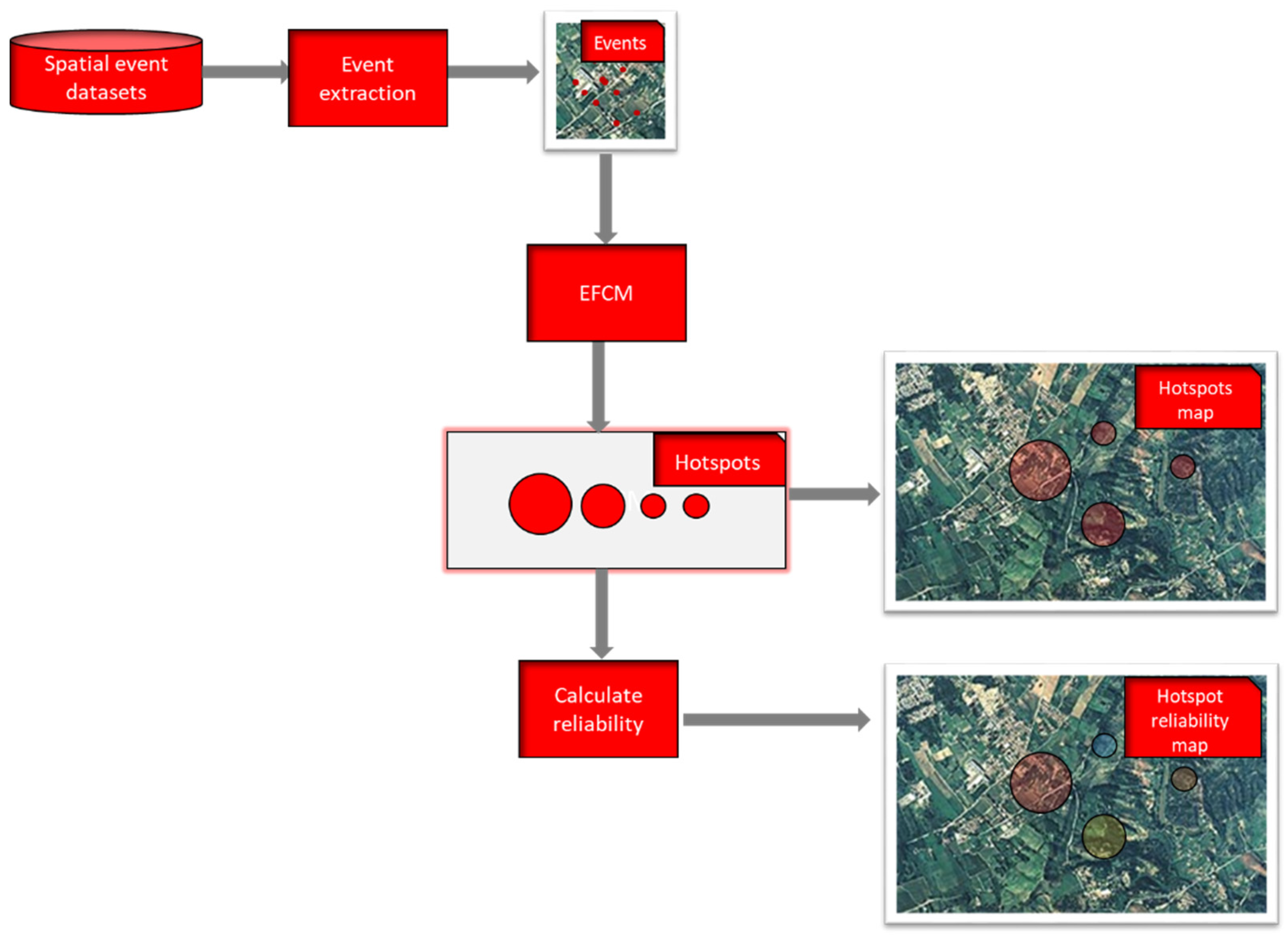
| Algorithm 2: Hotspots reliability evaluation. |
| 1. Extract the dataset of event X = {x1, …, xN} ⊂ R2 |
| 2. Execute EFCM (X) |
| 3. For i = 1 to C |
| 4. H ← 0 |
| 5. For j = 1 to N |
| 6. Hi ← Hi + h(uij)//where the Equation (11) is applied for the function h(u) |
| 7. H ← H/N |
| 8. Ri ← 1 − H |
| 9. Return the centers vi, the radius ri and the reliability Ri i = 1, …, C |
4. Test Results
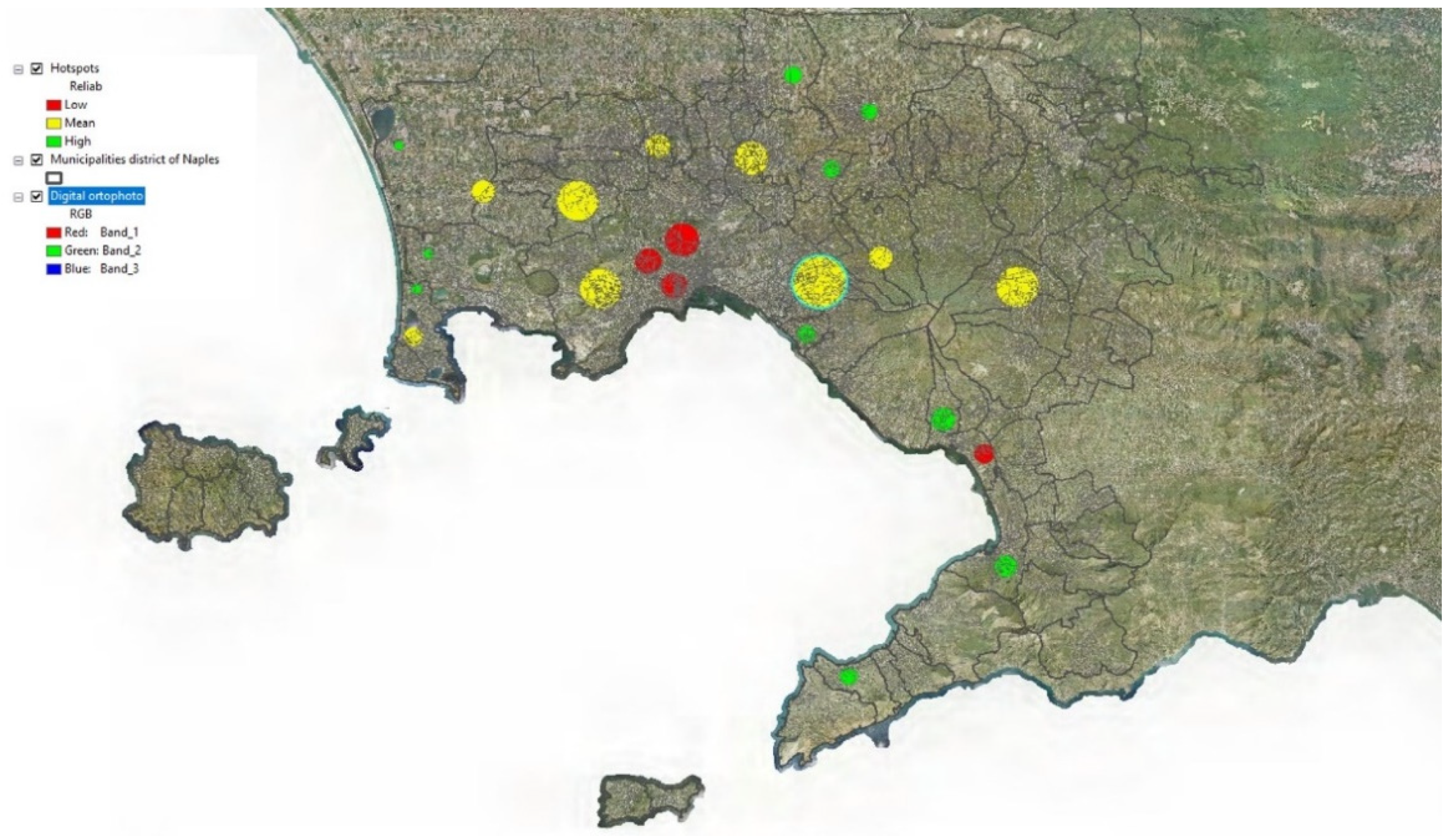
- -
- Low, which includes hotspots with reliability less than 0.45
- -
- Mean, which includes hotspots with reliability between 0.45 and 0.6
- -
- High, which includes hotspots with reliability greater than 0.6
5. Final Considerations
Author Contributions
Funding
Institutional Review Board Statement
Informed Consent Statement
Data Availability Statement
Conflicts of Interest
References
- MacQueen, J.B. Some Methods for Classification and Analysis of Multivariate Observations. In Proceedings of the fifth Berkeley Symposium on Mathematical Statistics and Probability; Le Cam, L.M., Neyman, J., Eds.; University of California Press: Oakland CA, USA, 1967; Volume 1, pp. 281–297. [Google Scholar]
- Levine, N. CrimeStat: A Spatial Statistical Program for the Analysis of Crime Incidents. In Encyclopedia of GIS; Shekhar, S., Xiong, H., Zhou, X., Eds.; Springer: Berlin/Heidelberg, Germany, 2010. [Google Scholar]
- Vadrevu, K.V.; Csiszar, I.; Ellicott, E.; Giglio, L.; Badarinath, K.V.S.; Vermote, E.; Justice, C. Hotspot Analysis of Vegetation Fires and Intensity in the Indian Region. IEEE J. Sel. Top. Appl. Earth Obs. Remote Sens. 2013, 6, 224–228. [Google Scholar] [CrossRef] [Scilit]
- Hajela, G.; Chawla, M.; Rasool, A. A Clustering Based Hotspot Identification Approach For Crime Prediction. Procedia Comput. Sci. 2020, 167, 1462–1470. [Google Scholar] [CrossRef] [Scilit]
- Khairani, N.A.; Sutoyo, E. Application of K-Means Clustering Algorithm for Determination of Fire-Prone Areas Utilizing Hotspots in West Kalimantan Province. Int. J. Adv. Data Inf. Syst. 2020, 1, 9–16. [Google Scholar] [CrossRef] [Scilit]
- Kaufman, L.; Rousseeuw, P.J. Finding Groups in Data: An Introduction to Cluster Analysis, 2nd ed.; John Wiley & Sons: Hoboken, NJ, USA, 2005; 342p, ISBN 978-0471735786. [Google Scholar]
- Tabarej, M.S.; Minz, S. Rough-Set Based Hotspot Detection in Spatial Data. In Advances in Computing and Data Sciences. ICACDS 2019. Communications in Computer and Information Science; Singh, M., Gupta, P., Tyagi, V., Flusser, J., Ören, T., Kashyap, R., Eds.; Springer: Singapore, 2019; Volume 1046. [Google Scholar]
- Bezdek, J.C. Pattern Recognition with Fuzzy Objective Function Algorithms; Plenum Press: New York, NY, USA, 1981; 272p, ISBN 978-0306406713. [Google Scholar]
- Bezdek, J.C.; Ehrlich, R.; Full, W. The fuzzy C-means Clustering Algorithm. Comput. Geosci. 1984, 10, 191–203. [Google Scholar] [CrossRef] [Scilit]
- Bezdek, J.C.; Pal, S.K. Fuzzy Models for Pattern Recognition: Methods that Search for Structure in Data; IEEE Press: New York, NY, USA, 1992; 544p, ISBN 978-0780304222. [Google Scholar]
- Grubesic, T.H. On the Application of Fuzzy Clustering for Crime HotSpot Detection. J. Quant. Criminol. 2006, 22, 77–105. [Google Scholar] [CrossRef] [Scilit]
- Kaur, R.; Sehera, S.S. Analyzing and Displaying of Crime Hotspots using Fuzzy Mapping Method. Int. J. Comput. Appl. 2014, 103, 25–28. [Google Scholar] [CrossRef] [Scilit]
- Ansari, M.Y.; Prakash, A. Application of Spatio-temporal Fuzzy C-Means Clustering for Crime Spot Detection. Def. Sci. J. 2018, 68, 374–380. [Google Scholar] [CrossRef] [Scilit]
- Win, K.N.; Chen, J.; Chen, Y.; Fournier-Viger, P. PCPD: A Parallel Crime Pattern Discovery System for Large-Scale Spatio-temporal Data Based on Fuzzy Clustering. Int. J. Fuzzy Syst. 2019, 21, 1961–1974. [Google Scholar] [CrossRef] [Scilit]
- Bandyopadhyaya, R.; Mitra, S. Fuzzy Cluster–Based Method of Hotspot Detection with Limited Information. J. Transp. Saf. Secur. 2015, 7, 307–323. [Google Scholar] [CrossRef] [Scilit]
- Besag, J.; Newell, J. The detection of clusters in rare diseases. J. R. Stat. Soc. A 1991, 154, 143–155. [Google Scholar] [CrossRef] [Scilit]
- Devroye, L.; Rugosi, G. Combinatorial Methods in Density Estimation; Springer: Berlin/Heidelberg, Germany, 2001; 208p, ISBN 978-0387951171. [Google Scholar]
- Chaney, S.; Ratcliffe, J. GIS and Crime Mapping Chap. 6, Identifying Crime Hotspots; John Wiley & Sons: Hoboken, NJ, USA, 2013; 402p, ISBN 978-0-470-86099-1. [Google Scholar]
- Lin, Y.-P.; Chu, H.-J.; Wu, C.-F.; Chang, T.-K.; Chen, C.-Y. Hotspot Analysis of Spatial Environmental Pollutants Using Kernel Density Estimation and Geostatistical Techniques. Int. J. Environ. Res. Public Health 2011, 8, 75–88. [Google Scholar] [CrossRef] [Scilit] [PubMed]
- Harirforoush, H.; Bellalite, L. A New Integrated GIS-based Analysis to Detect Hotspots: A Case Study of the City of Sherbrooke. Accid. Anal. Prev. 2019, 130, 62–74. [Google Scholar] [CrossRef] [Scilit] [PubMed]
- Di Martino, F.; Sessa, S. The Extended Fuzzy C-means Algorithm for Hotspots in Spatio-temporal GIS. Expert Syst. Appl. 2011, 38, 11829–11836. [Google Scholar] [CrossRef] [Scilit]
- Kaymak, U.; Setnes, M. Fuzzy Clustering with Volume Prototype and Adaptive Cluster Merging. IEEE Trans. Fuzzy Syst. 2002, 10, 705–712. [Google Scholar] [CrossRef] [Scilit]
- Di Martino, F.; Sessa, S.; Barillari, E.S.; Barillari, M.S. Spatio-temporal Hotspots and Application on a Disease Analysis Case via GIS. Soft Comput. 2014, 18, 2377–2384. [Google Scholar] [CrossRef] [Scilit]
- Di Martino, F.; Sessa, S.; Mele, R.; Barillari, U.E.; Barillari, M.R. WebGIS Based on Spatio-temporal Hotspots: An Application to Oto-laryngo-pharyngeal Diseases. Soft Comput. 2015, 20, 2135–2147. [Google Scholar]
- Di Martino, F.; Pedrycz, W.; Sessa, S. Hierarchical Granular Hotspots Detection. Soft Comput. 2020, 24, 1357–1376. [Google Scholar] [CrossRef] [Scilit]
- De Luca, A.; Termini, S. Entropy and energy measures of fuzzy sets. In Advances in Fuzzy Set Theory and Applications; Gupta, M.M., Ragade, R.K., Yager, R.R., Eds.; North-Holland: Amsterdam, The Netherlands, 1979; pp. 321–338. [Google Scholar]
- De Luca, A.; Termini, S. A Definition of Non-probabilistic Entropy in the Setting of Fuzzy Sets Theory. Inf. Control 1972, 20, 301–312. [Google Scholar] [CrossRef] [Scilit]
- Di Martino, F.; Sessa, S. A New Validity Index Based on Fuzzy Energy and Fuzzy Entropy Measures in Fuzzy Clustering Problems. Entropy 2020, 22, 1200. [Google Scholar] [CrossRef] [Scilit] [PubMed]
- Cardone, B.; Di Martino, F. A Novel Fuzzy Entropy-Based Method to Improve the Performance of the Fuzzy C-Means Algorithm. Electronics 2020, 9, 554. [Google Scholar] [CrossRef] [Scilit]
- Jenks, G.F. The Data Model Concept in Statistical Mapping. Int. Yearb. Cartogr. 1967, 7, 186–190. [Google Scholar]

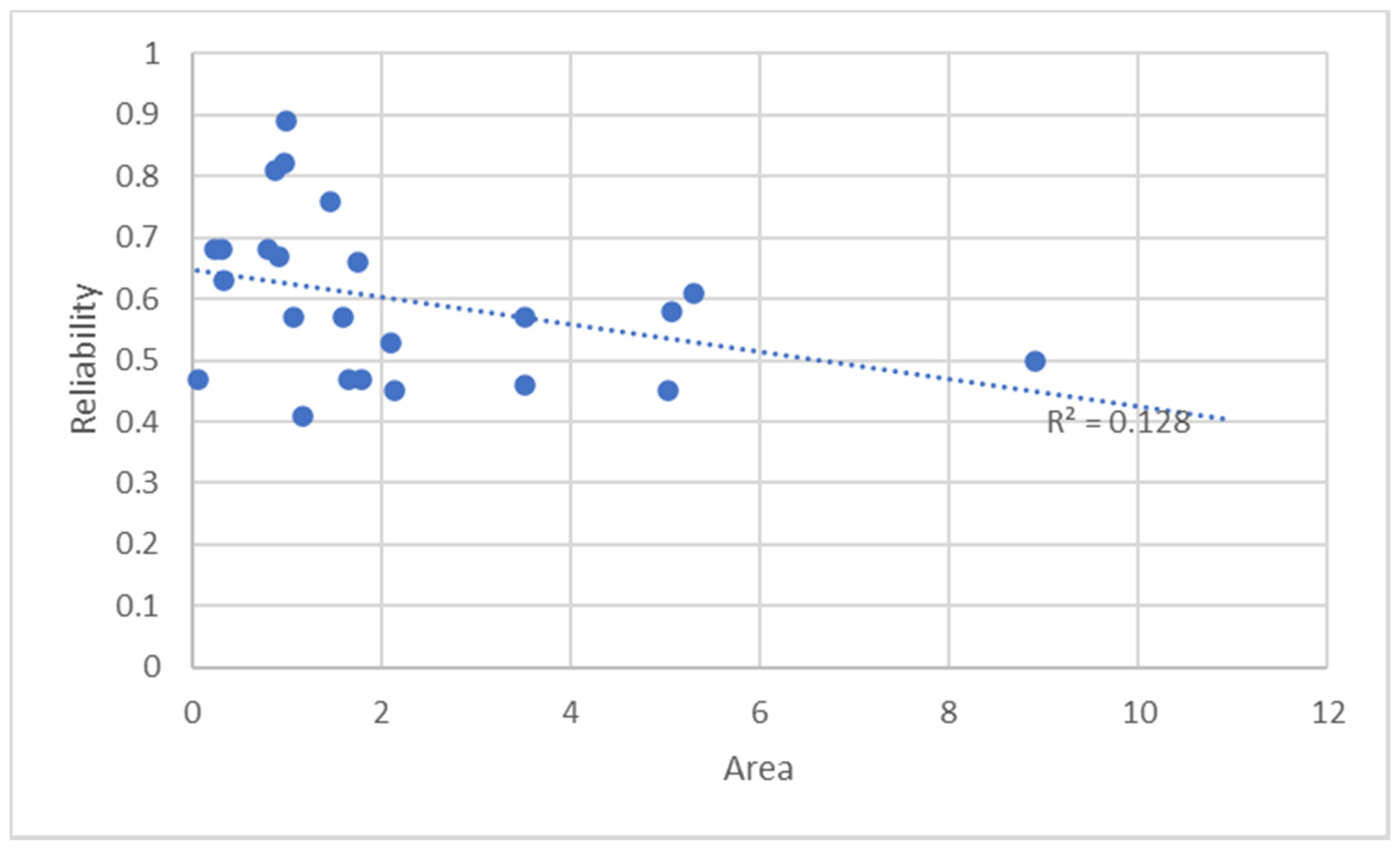


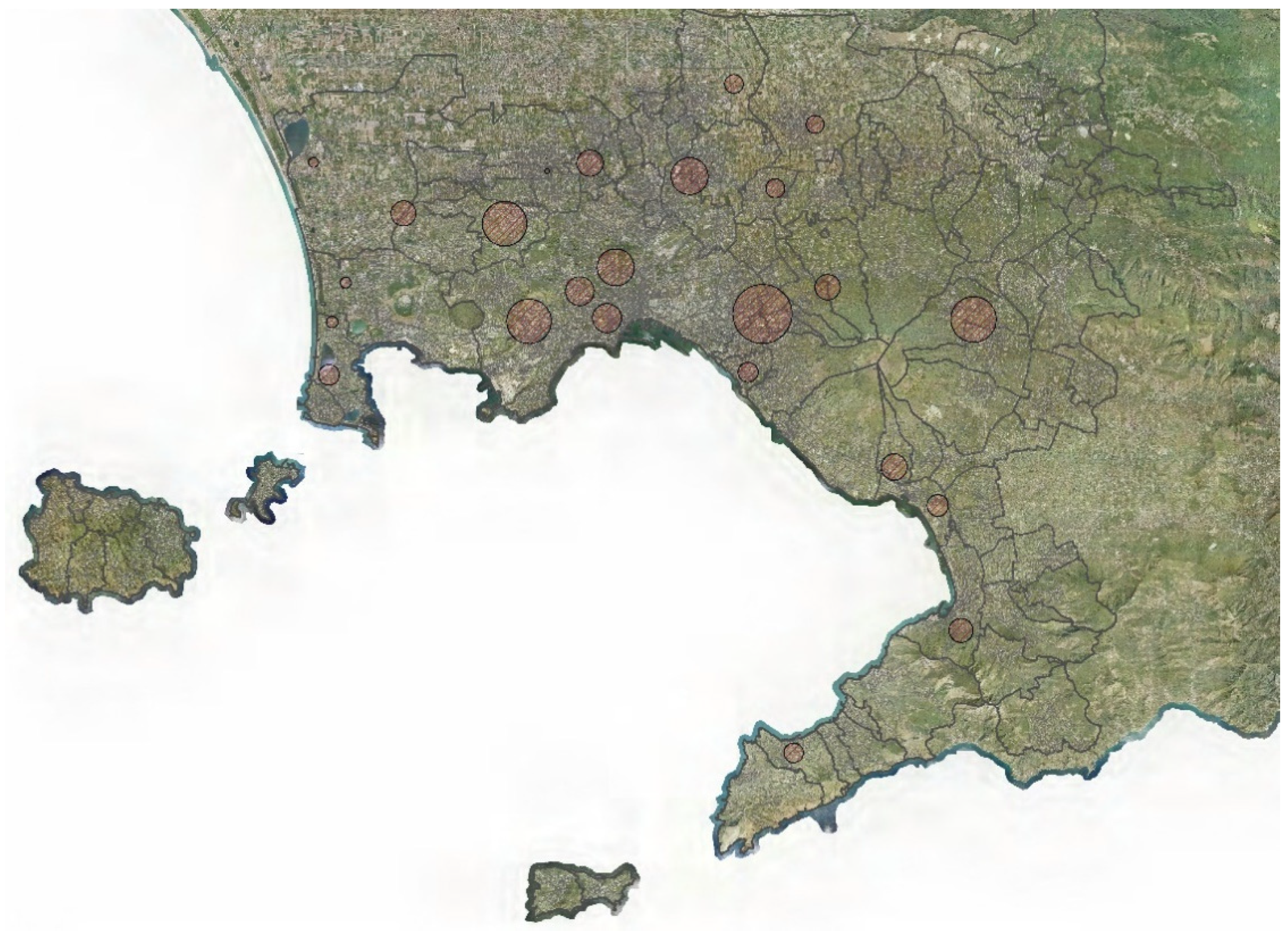
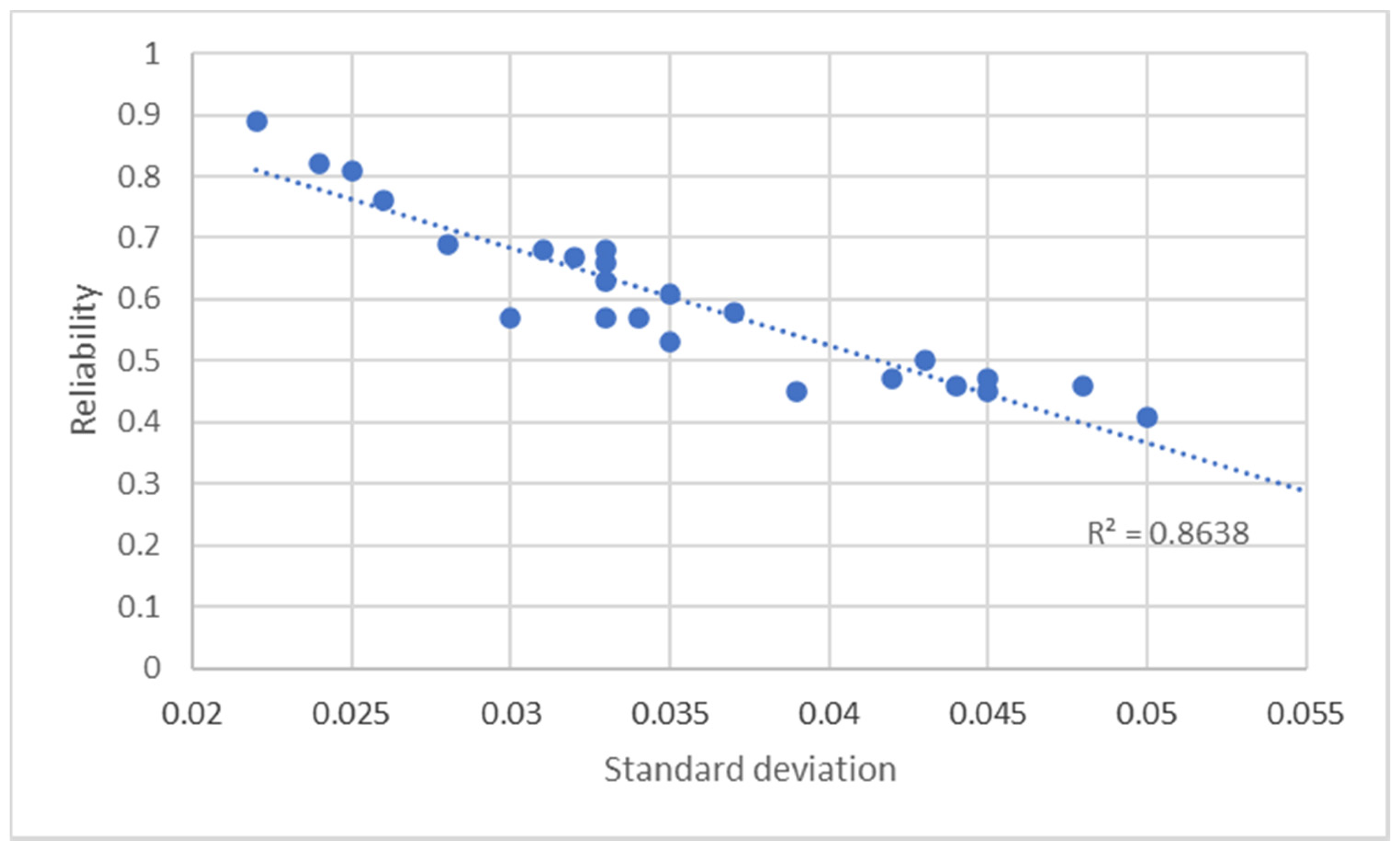
| ID | Area (km2) | Standard dev. | Reliability |
|---|---|---|---|
| 01 | 0.06 | 0.045 | 0.47 |
| 02 | 0.24 | 0.028 | 0.69 |
| 03 | 0.31 | 0.031 | 0.68 |
| 04 | 0.34 | 0.033 | 0.63 |
| 05 | 0.81 | 0.033 | 0.68 |
| 06 | 0.89 | 0.025 | 0.81 |
| 07 | 0.92 | 0.032 | 0.67 |
| 08 | 0.97 | 0.024 | 0.82 |
| 09 | 1.00 | 0.022 | 0.89 |
| 10 | 1.08 | 0.033 | 0.57 |
| 11 | 1.18 | 0.050 | 0.41 |
| 12 | 1.47 | 0.026 | 0.76 |
| 13 | 1.59 | 0.034 | 0.57 |
| 14 | 1.66 | 0.044 | 0.42 |
| 15 | 1.76 | 0.033 | 0.66 |
| 16 | 1.79 | 0.042 | 0.43 |
| 17 | 2.10 | 0.035 | 0.53 |
| 18 | 2.14 | 0.039 | 0.47 |
| 19 | 3.51 | 0.030 | 0.57 |
| 20 | 3.52 | 0.048 | 0.46 |
| 21 | 5.03 | 0.045 | 0.43 |
| 22 | 5.07 | 0.037 | 0.58 |
| 23 | 5.30 | 0.035 | 0.61 |
| 24 | 8.91 | 0.043 | 0.50 |
| ID | Reliability | Reliability Class | Expert Evaluation |
|---|---|---|---|
| 01 | 0.47 | Mean | Mean |
| 02 | 0.69 | High | High |
| 03 | 0.68 | High | High |
| 04 | 0.63 | High | Mean |
| 05 | 0.68 | High | Mean |
| 06 | 0.81 | High | High |
| 07 | 0.67 | High | Mean |
| 08 | 0.82 | High | High |
| 09 | 0.89 | High | High |
| 10 | 0.57 | Mean | Mean |
| 11 | 0.41 | Low | Low |
| 12 | 0.76 | High | High |
| 13 | 0.57 | Mean | High |
| 14 | 0.43 | Low | Low |
| 15 | 0.66 | High | Mean |
| 16 | 0.42 | Low | Low |
| 17 | 0.53 | Mean | Mean |
| 18 | 0.47 | Mean | Mean |
| 19 | 0.57 | Mean | Mean |
| 20 | 0.46 | Mean | Mean |
| 21 | 0.43 | Low | Low |
| 22 | 0.58 | Mean | Mean |
| 23 | 0.61 | Mean | High |
| 24 | 0.50 | Mean | Mean |
Publisher’s Note: MDPI stays neutral with regard to jurisdictional claims in published maps and institutional affiliations. |
© 2021 by the authors. Licensee MDPI, Basel, Switzerland. This article is an open access article distributed under the terms and conditions of the Creative Commons Attribution (CC BY) license (https://creativecommons.org/licenses/by/4.0/).
Share and Cite
Di Martino, F.; Sessa, S. Fuzzy Entropy-Based Spatial Hotspot Reliability. Entropy 2021, 23, 531. https://doi.org/10.3390/e23050531
Di Martino F, Sessa S. Fuzzy Entropy-Based Spatial Hotspot Reliability. Entropy. 2021; 23(5):531. https://doi.org/10.3390/e23050531
Chicago/Turabian StyleDi Martino, Ferdinando, and Salvatore Sessa. 2021. "Fuzzy Entropy-Based Spatial Hotspot Reliability" Entropy 23, no. 5: 531. https://doi.org/10.3390/e23050531
APA StyleDi Martino, F., & Sessa, S. (2021). Fuzzy Entropy-Based Spatial Hotspot Reliability. Entropy, 23(5), 531. https://doi.org/10.3390/e23050531