Abstract
The Lyapunov exponent is primarily used to quantify the chaos of a dynamical system. However, it is difficult to compute the Lyapunov exponent of dynamical systems from a time series. The entropic chaos degree is a criterion for quantifying chaos in dynamical systems through information dynamics, which is directly computable for any time series. However, it requires higher values than the Lyapunov exponent for any chaotic map. Therefore, the improved entropic chaos degree for a one-dimensional chaotic map under typical chaotic conditions was introduced to reduce the difference between the Lyapunov exponent and the entropic chaos degree. Moreover, the improved entropic chaos degree was extended for a multidimensional chaotic map. Recently, the author has shown that the extended entropic chaos degree takes the same value as the total sum of the Lyapunov exponents under typical chaotic conditions. However, the author has assumed a value of infinity for some numbers, especially the number of mapping points. Nevertheless, in actual numerical computations, these numbers are treated as finite. This study proposes an improved calculation formula of the extended entropic chaos degree to obtain appropriate numerical computation results for two-dimensional chaotic maps.
1. Introduction
The Lyapunov exponent (LE) is a widely used measure for quantifying the chaos of a dynamical system. However, it is generally incomputable for time series. Therefore, some estimation methods for the Lyapunov exponent of a time series have been suggested in previous studies [1,2,3,4,5,6]. However, it is well-known that estimating the Lyapunov exponent for a time series is difficult.
The entropic chaos degree (ECD) was introduced to measure the chaos of a dynamical system in the field of information dynamics [7]. The ECD is directly computable, even for time series data obtained from dynamical systems. Some researchers have sought to characterize certain chaotic behaviors using the ECD [8,9,10]. Recently, it was demonstrated that the modified ECD coincides with the Lyapunov exponent for a one-dimensional chaotic map under typical chaotic conditions [11,12]. Moreover, the extended entropic chaos degree (EECD) was shown to be the sum of all the Lyapunov exponents of a multidimensional chaotic map under typical chaotic conditions [13]. However, it was assumed that the number of mapping points and the number of all components of equipartition of the domain are infinity. In actual computations, these numbers are treated as finite numbers. In this study, I aim to formulate a calculation such that the EECD is also equal to the sum of all the Lyapunov exponents of two-dimensional typical chaotic maps in actual numerical computations.
In this study, I propose an improved calculation formula of the EECD for multidimensional chaotic maps. Moreover, I apply the improved calculation formula of the EECD to two-dimensional typical chaotic maps.
2. Entropic Chaos Degree
In this section, I briefly review the definition of the ECD for a difference equation system,
where f represents a map such that ().
Let represent an initial value and represent a finite partition of I such that
Next, the probability distribution at time n and joint distribution at time n and associated with the difference equation are expressed as follows:
where represents the characteristic function of a set A.
The ECD D of the orbit is then defined in [7] as follows:
where
represents the conditional probability from the component of to the component of .
Further, the ECD is denoted as without n if the orbit does not depend on time n. Moreover, the ECD is denoted as without f if the map f does not produce the orbit .
The ECD is larger than the Lyapunov exponent for a one-dimensional chaotic map [12].
At the end of this section, I discuss the relation between the ECD and the metric entropy. For sufficiently large M, there exists a probability measure on I without depending on n. Let be a measure space with . For provided measurable partitions and of X, the conditional entropy of with respect to is defined in [14] by
If is a measurable transformation preserving a probability measure on I then, for sufficiently large M, I have
In the last inequality, I used the property such that if is a refinement of , then for every partition , where and .
Then the metric entropy of T with respect to and a measurable partition has the following property [14].
Therefore, I obtain
for sufficiently large M.
3. Extended Entropic Chaos Degree
In this section, it is assumed that
Let the -equipartitions of I be
For any component of , I divide another component into -equipartitions of smaller components, such that
For each , the function is defined as follows:
Using the function , for any two components of the initial partition , the function is defined as follows:
The EECD is provided in [13] as follows:
where .
Note that the EECD becomes the CD, as shown in Equation (1), only if for any two components and of the initial partition .
First, the following theorem concerning the periodic orbit is presented [13].
Theorem 1.
Letrepresent sufficiently large natural numbers. If map f creates a stable periodic orbit with period T, the following equality holds.
Second, I briefly review the relationship between the EECD and the Lyapunov exponent in a chaotic dynamical system. Let a map f be a piecewise function on . For any , , I consider an approximate Jacobian matrix as follows:
Let represent the eigenvalues of .
Then, the following properties are assumed to be satisfied.
Assumption 1.
For sufficiently large natural numbers, L and M, I assume that the following conditions are satisfied.
- (1) Points inare uniformly distributed over.
- (2) Then,is obtained for any.
Next, the following theorem is presented [13].
Theorem 2.
For any, Assumption 1 is assumed to be satisfied. Then, the following is obtained.
where
andrepresent the Lyapunov spectrum of a map f.
Theorem 2 implies that if the points on any are uniformly distributed, then the EECD becomes the sum of all the Lyapunov exponents of the map f in the limits at infinity of M, L, and .
At the end of this section, I discuss the relationship between the EECD and the metric entropy. For sufficiently large M, a probability measure exists on I without depending on n. If is a measurable transformation preserving a probability measure on I, then for sufficiently large M and , I have
Here, m is the Lebesgue measure on .
Because , I have
for sufficiently large .
4. Improvement of Calculation Formula of the Extended Entropic Chaos Degree
In Theorem 2, it is assumed that the values of L, M, and are equal to infinity. However, in actual numerical computations, these numbers are treated as finite numbers. I propose an improved calculation formula of the EECD to obtain appropriate numerical computation results.
First, I consider improving a calculation formula of the EECD when the map f creates a stable periodic orbit. If the map f creates a stable periodic orbit, then, for any component with , there exists a component such that
It follows that
From Equation (7), I obtain
Now, for any component , let us consider such that . Let be the number of such that , that is,
where
When the map f creates a stable periodic orbit, I set
I then have
Thus, when the map f creates a stable periodic orbit, I use
to calculate the EECD.
Second, I consider improving a calculation formula of the EECD when the map f does not create a periodic orbit. For any sufficiently large natural numbers, L and M, let us assume the conditions (1) and (2) in Assumption 1. Let m be the Lebesgue measure on and be the invariant measure of f. Then, I obtain
Here, the second approximation (Equation (9)) uses the following:
Then, I directly obtain the following:
Now, for any set ,
The variance–covariance matrix to all points on X is given by
where
Let be eigenvalues of such that . For any sufficiently large natural numbers, L and M, I have
From Equations (10) and (11), when the map f does not create a periodic orbit, I use
as the calculation formula of the EECD.
Let be the eigenvector corresponding to the eigenvalue , and
In actual numerical computations, let us consider subsets of such that
Now, I assume that all points on are almost uniformly distributed over , such that
for any subsets of . Then, I obtain
Moreover, I denote the eigenvalues of such that by . Then, I have
Here, is the density function of and is the Lyapunov spectrum of f.
In the sequel, I use
as the calculation formulas of the EECD.
5. Numerical Computation Results of the EECD for Two-Dimensional Chaotic Maps
In this section, I apply the improved calculation formulas (Equation (12)) of the EECD to two-dimensional typical chaotic maps. In the sequel, I set M = 1,000,000 and 1000. (In principle, the double type in C language is used in numerical computations. However, the floating-point type with its 1024-bit mantissa is used in numerical calculations of eigenvalues of the variance–covariance matrix by GMP (GNU Multi-Precision Library).)
Let us consider the generalized baker’s map as a simple two-dimensional dissipative chaotic map such that the Jacobian matrix does not depend on .
The generalized baker’s map is defined by
where and .
The generalized baker’s map for corresponds to the following operations: first, the unit square is stretched times in the direction and compressed times in the direction; second, the right part protruding from the unit square is cut vertically and stacked on the top of the left part. The first operation is called “stretching” and the second operation is called “folding”. These two operations are essential basic elements for producing chaotic behaviors.
5.1. Numerical Computation Results of the EECD for Generalized Baker’s Map
The Jacobian matrix of the baker’s map is expressed as follows:
Thus, depends only on the parameter a. The dynamics produced by the baker’s map is dissipative for because .
For , I obtain
Thus, the expansion rate in the stretching of the baker’s map is and the contraction rate in the folding of the baker’s map is . I then consider the orbit produced by the generalized baker’s map , as follows:
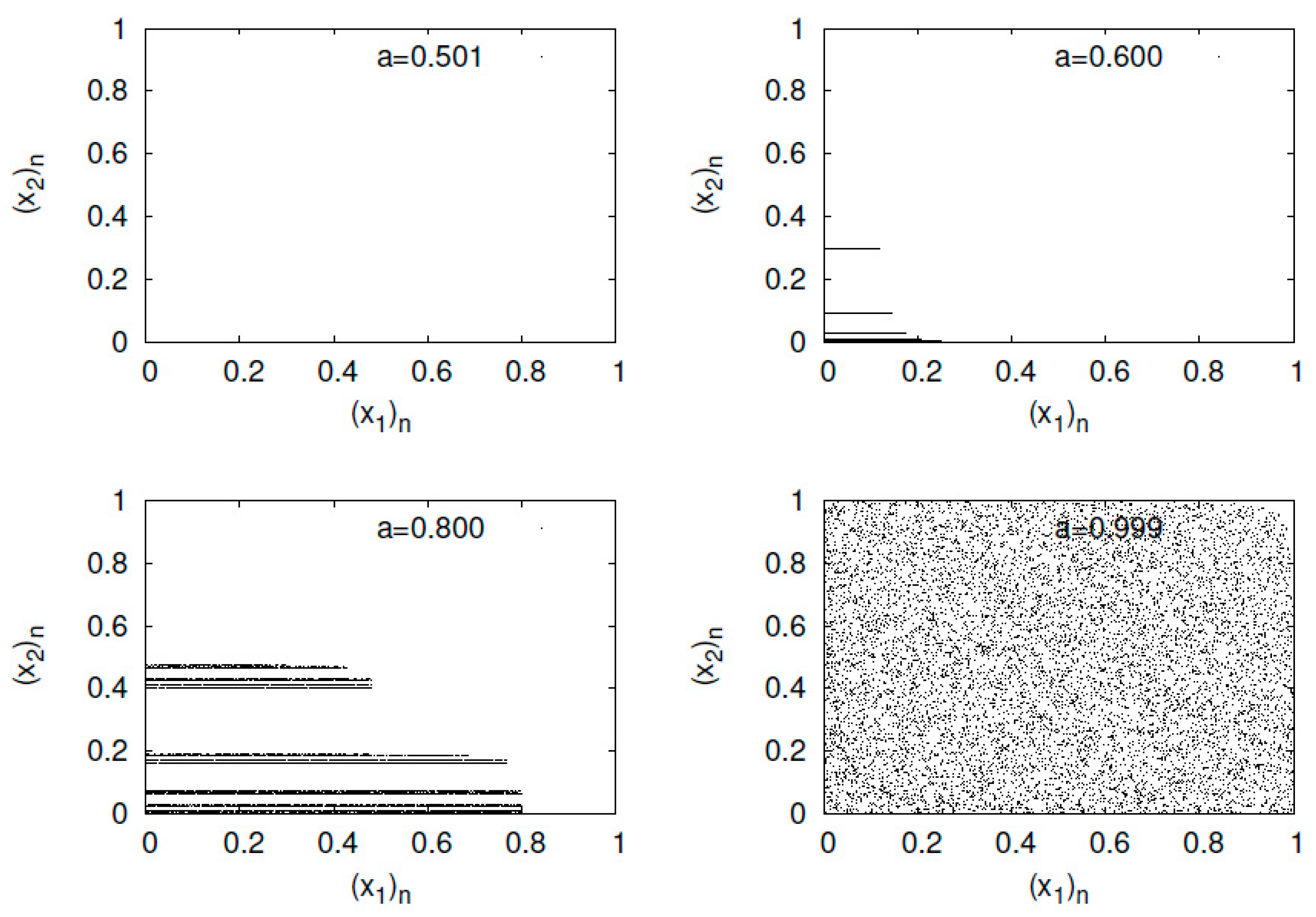
First, I present typical orbits of the baker’s map in Figure 1. As the parameter a increases, the spread of points is mapped from a linear distribution to the entire unit square.
Figure 1.
versus for the generalized baker’s map .
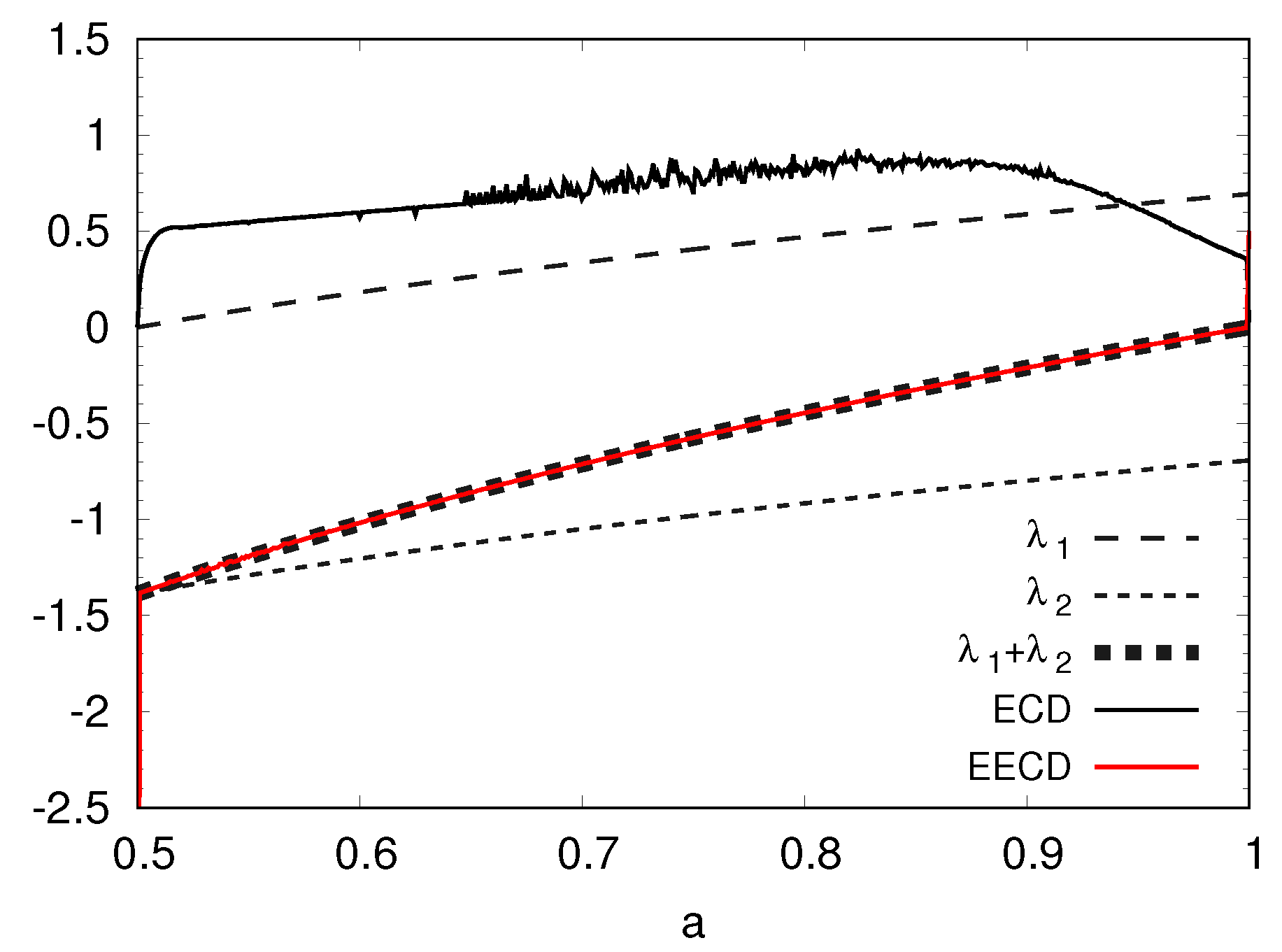
Second, I present the numerical computation results of the LEs , the total sum of the LEs, the ECD D, and the EECD of the baker’s map in Figure 2. Figure 2 shows that the EECD takes approximately the exact value of the total sum of the LEs for the generalized baker’s map .
Figure 2.
, , , D, versus a for the generalized baker’s map .
In general, the orthogonal basis of can be changed by f. In the sequel, for a two-dimensional chaotic map f, I consider the average expansion rate in the stretching of f as and the average contraction rate in the folding of f as , where are the LEs of f such that .
5.2. Numerical Computation Results of the EECD for Tinkerbell Map
Let us consider the Tinkerbell map as a two-dimensional dissipative chaotic map such that the Jacobian matrices and depend on and the parameter a.
The Tinkerbell map is defined by
where .
For , I obtain the following:
The Jacobian matrix of the Tinkerbell map is expressed as follows:
Thus, depends on and the parameter a.
I then consider the orbit produced by the Tinkerbell map as follows:
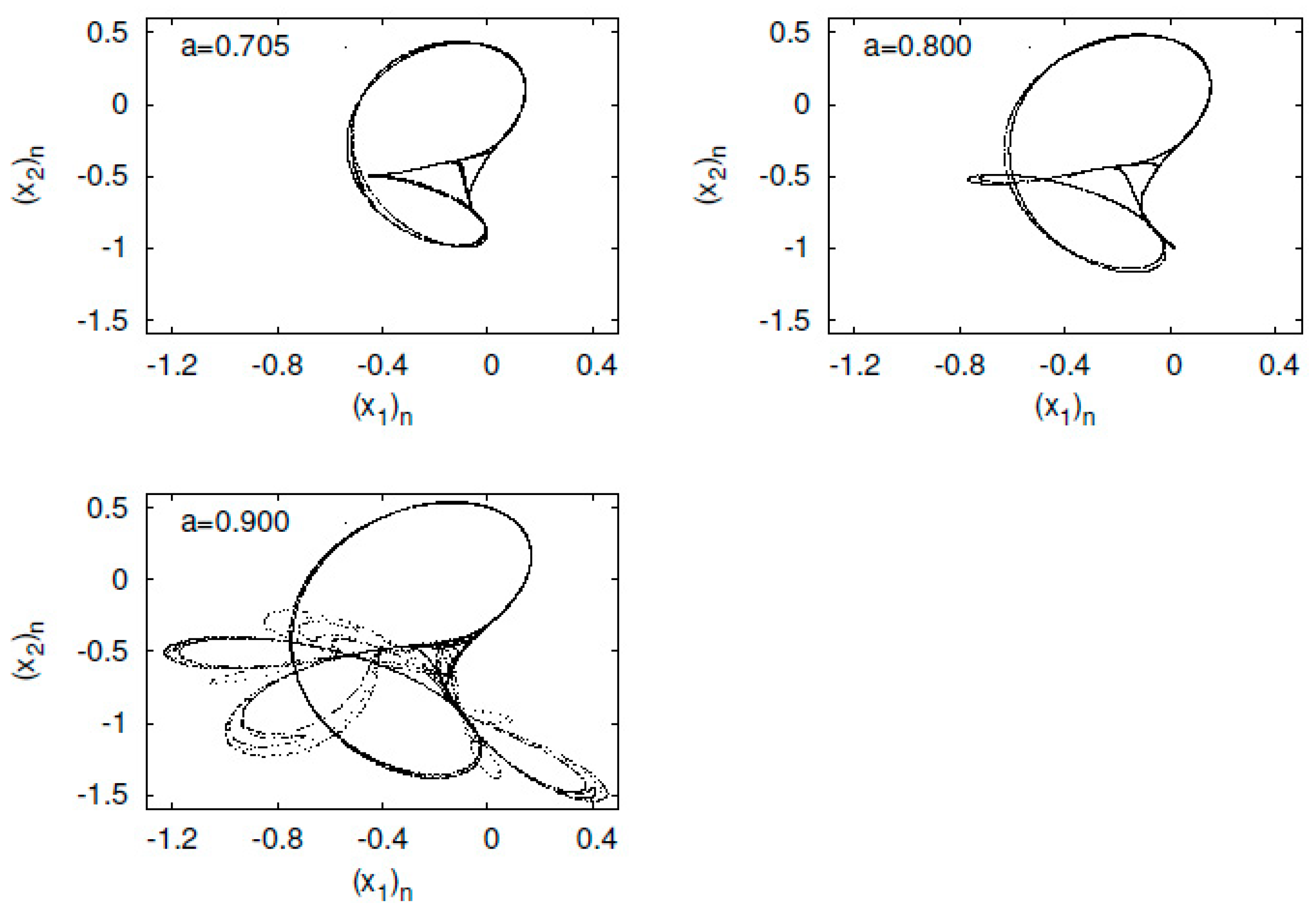
First, I present typical orbits of the Tinkerbell map in Figure 3. The orbit of the Tinkerbell map constructs a strange attractor at . The map is named the Tinkerbell map because the shape of the attractor produced by the Tinkerbell map looks like the movement of a fairy named Tinker Bell, who appears in a Disney film.
Figure 3.
versus for the Tinkerbell map .
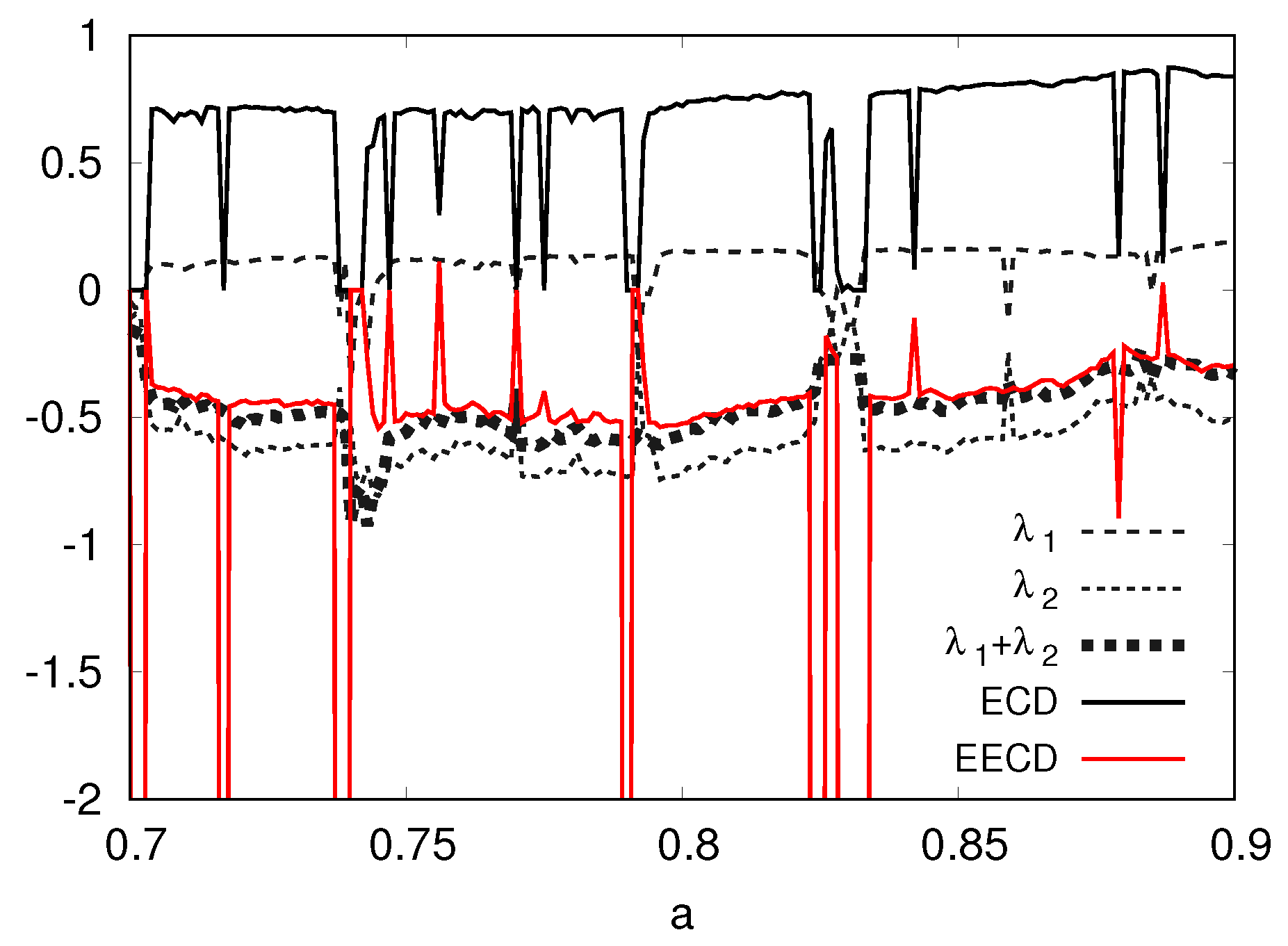
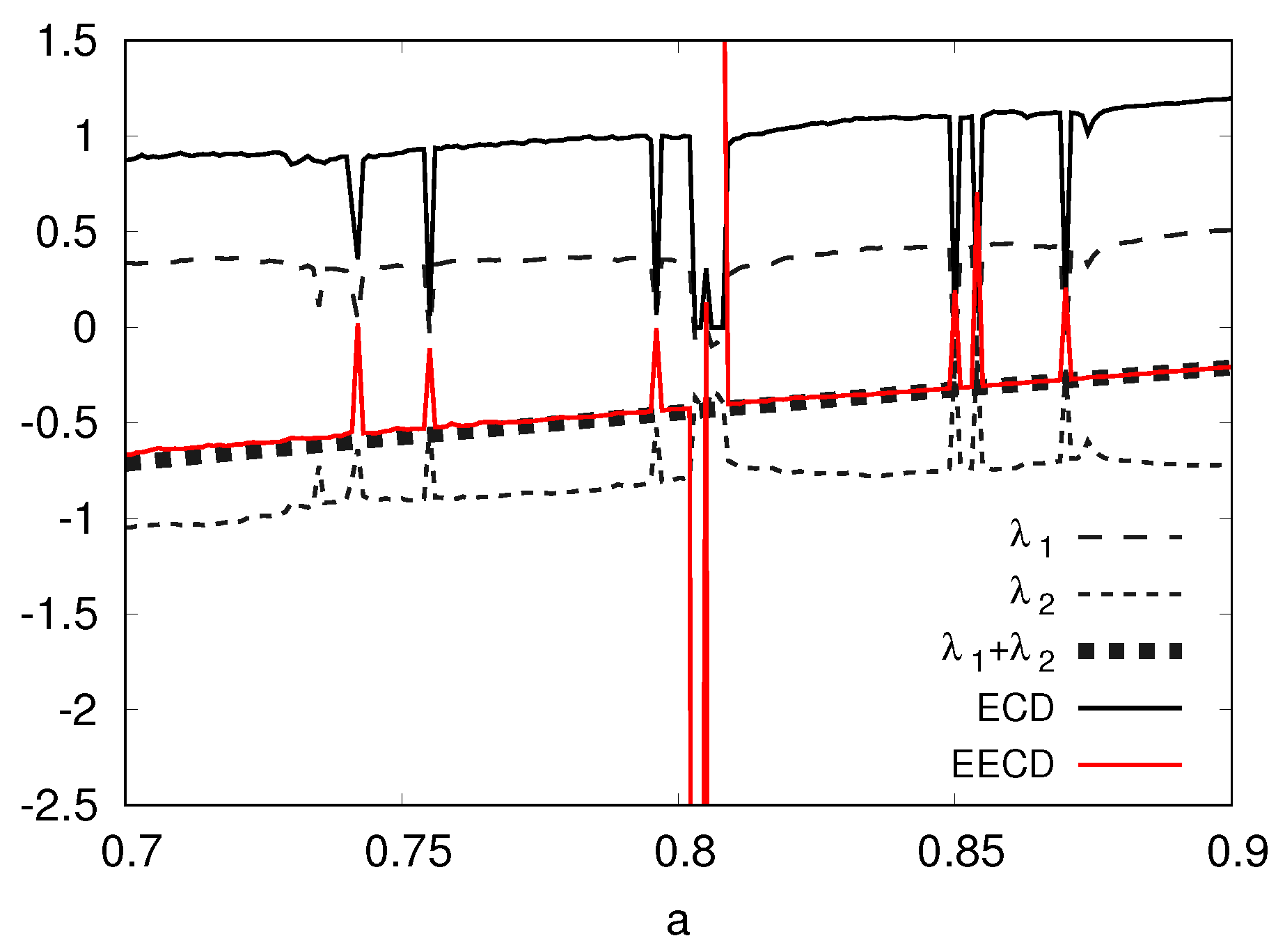
Second, I present the numerical computation results of the LEs , the total sum of the LEs, the ECD D, and the EECD of the Tinkerbell map in Figure 4. Figure 4 shows that the EECD takes almost the same value as the total sum of the LEs for the Tinkerbell map at most a for . However, the Tinkerbell map creates a stable periodic orbit at several a’s. Then the EECD takes a different value from the total sum of LEs for the Tinkerbell map because I use (Equation (8)) as the calculation formula of the EECD .
Figure 4.
, D, versus a for the Tinkerbell map .
5.3. Numerical Computation Results of the EECD for Ikeda Map
Let us consider the Ikeda map as a two-dimensional dissipative chaotic map such that the Jacobian matrix depends on and the parameter a but that does not depend on .
The modified Ikeda map is given as the complex map in [15,16]
The Ikeda map is defined as a real two-dimensional example of Equation (23) by
where
and .
For , I obtain the following:
The Jacobian matrix of the Ikeda map is expressed as follows:
where
Thus, depends on and the parameter a. The dynamics produced by the Ikeda map are dissipative for because .
I then consider the orbit produced by the Ikeda map as follows:
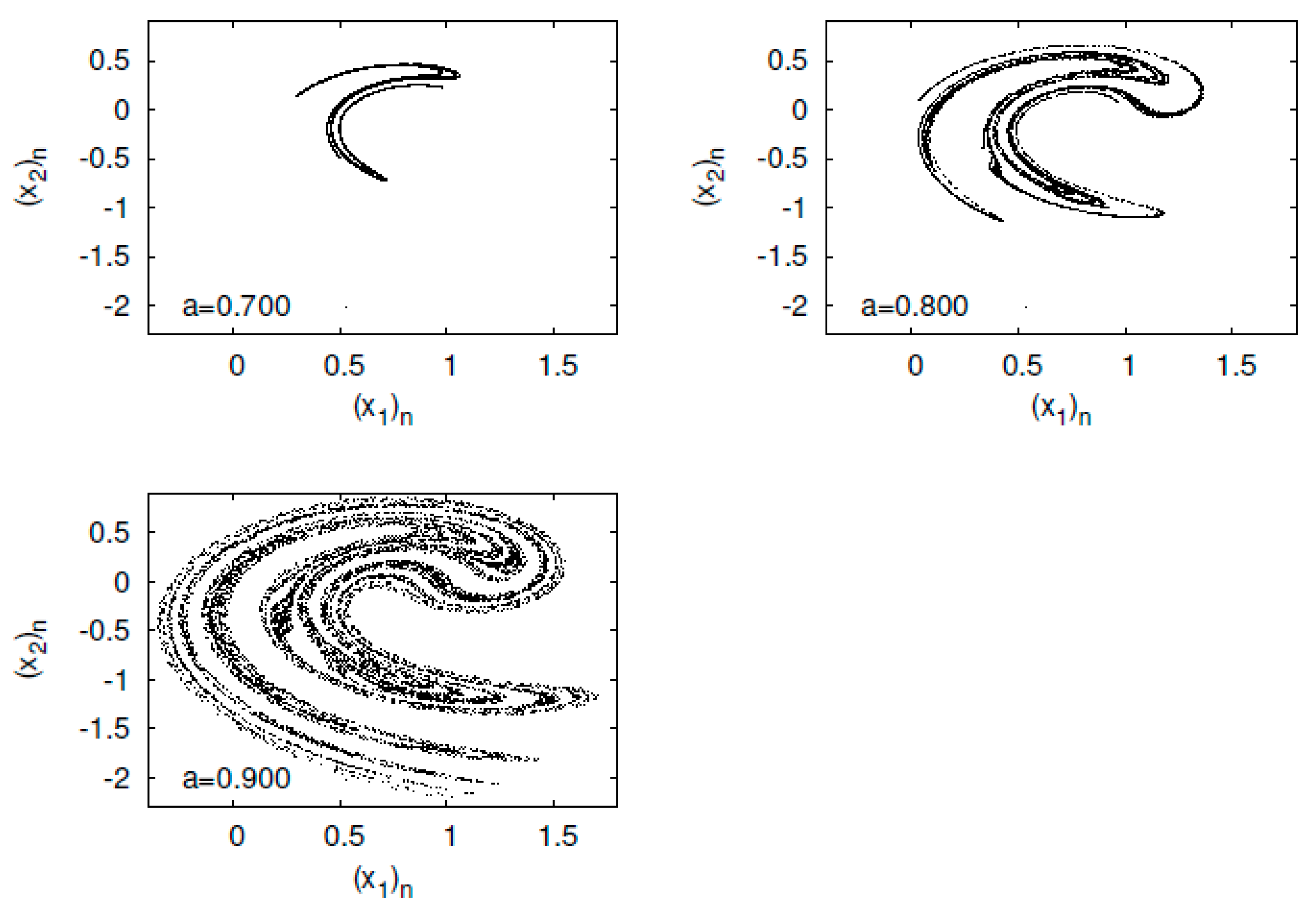
First, I present typical orbits of the Ikeda map in Figure 5. As the parameter a increases, the attractor constructed by the Ikeda map becomes larger. Regarding plots, the Ikeda map might be conjugated to a Hénon map [17].
Figure 5.
versus for the Ikeda map .
Second, let us assume that is transformed to by on . For the Ikeda map , using the chain rule and at any , I have
Therefore, I obtain
where are the LEs of the Ikeda map such that .
I present the numerical computation results of the LEs , the total sum of the LEs, the ECD D, and the EECD of the Ikeda map in Figure 6. Figure 6 shows that the EECD takes almost the same value as the total sum of the LEs for the Ikeda map at almost a for . However, the Ikeda map creates a stable periodic orbit at several a’s. Then the EECD takes a different value from the total sum of LEs for the Ikeda map because I use (Equation (8)) as the calculation formula of the EECD .
Figure 6.
, D, versus a for the Ikeda map .
5.4. Numerical Computation Results of the EECD for Hénon Map
Let us consider the Hénon map as a two-dimensional dissipative chaotic map such that the Jacobian matrix depends on and the parameter b but that the Jacobian does not depend on .
The Hénon map is expressed as follows:
where .
For , I obtain the following:
In the sequel, we rewrite .
The Jacobian matrix of the Hénon map is expressed as follows:
Thus, depends on and the parameter b. The dynamics produced by the Hénon map are dissipative for because .
I then consider the orbit produced by the Hénon map as follows:
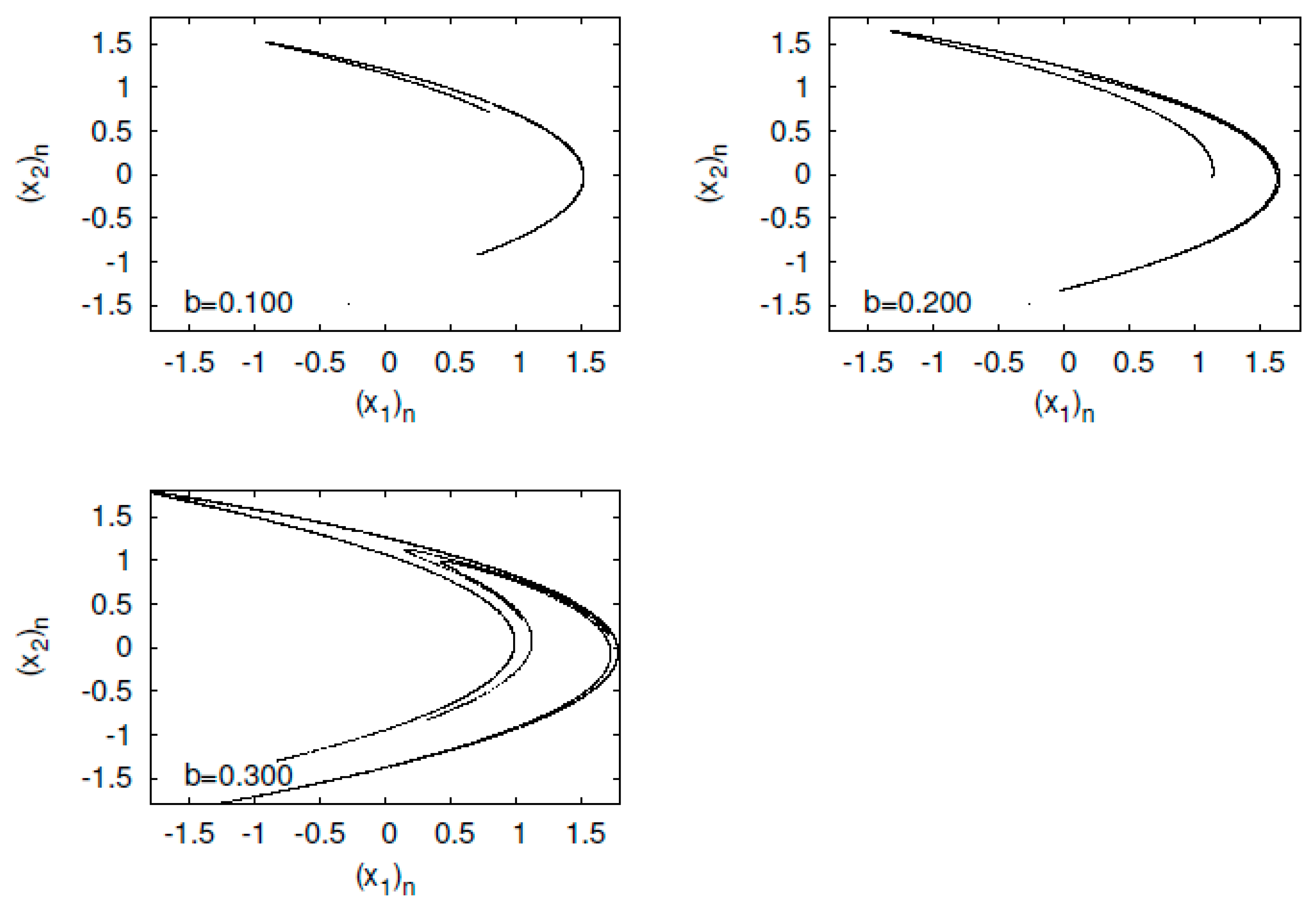
First, I present typical orbits of the Hénon map in Figure 7. The orbit of the Hénon attractor has a fractal structure. Expanding a strip region, I find that innumerable parallel curves reappear in the strip.
Figure 7.
versus for the Hėnon map .
Second, let us assume that is transformed to by on . For the Hénon map , using the chain rule and at any , I have
Therefore, I obtain
where are the LEs of the Hénon map such that .
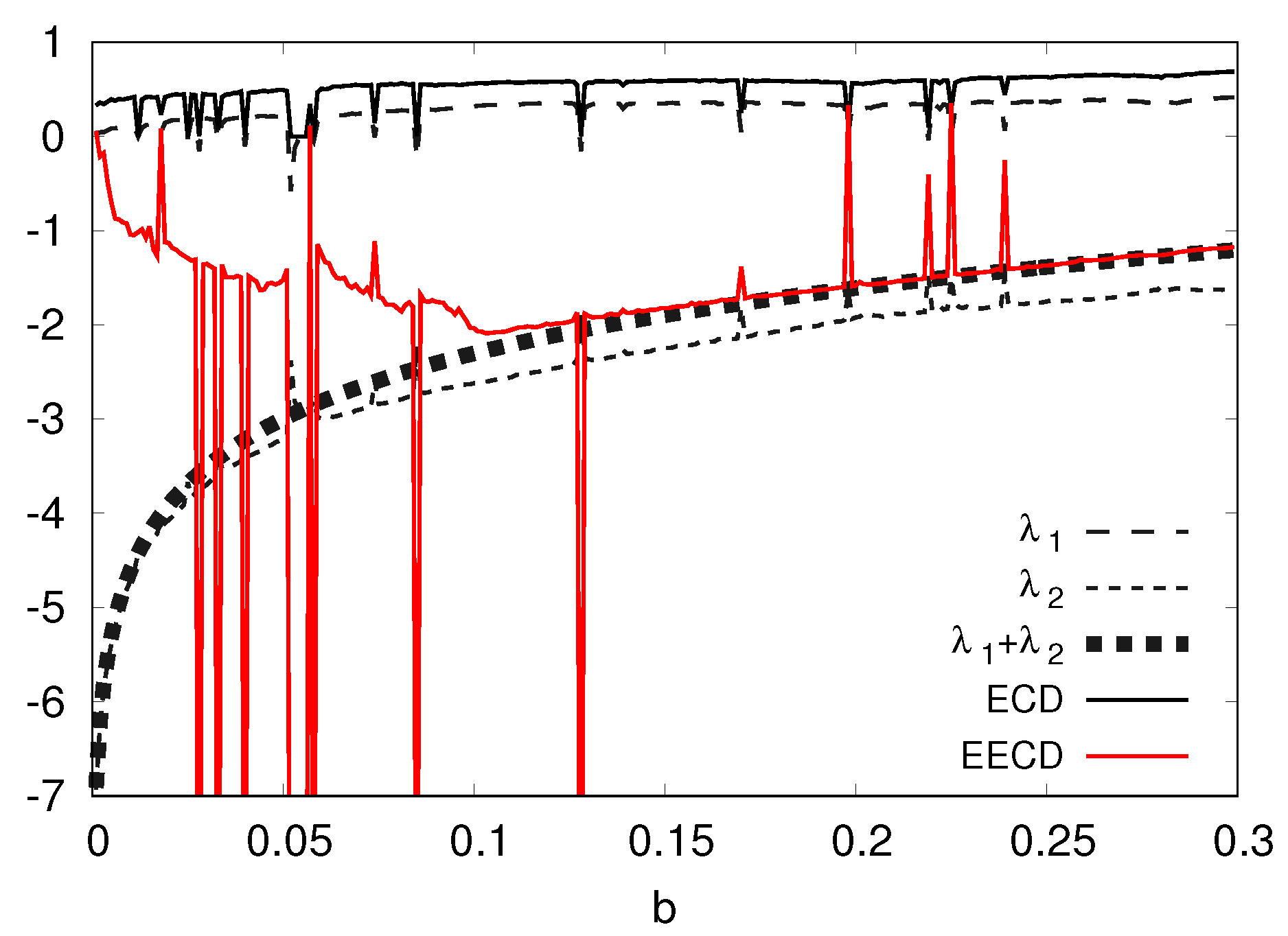
I present the numerical computation results of the LEs , the total sum of the LEs, the ECD D, and the EECD for the Hénon map in Figure 8. Figure 8 shows that the EECD takes a value almost equal to the total sum of the LEs for the Hénon map at most b for . However, the EECD takes a different value from the total sum of LEs for the Hénon map , even though the Hénon map does not create a periodic orbit at many bs for . Here, the absolute value of the negative LE is much larger than the absolute value of the positive LE .
Figure 8.
, D, versus a for the Hėnon map .
Now, let be the autocorrelation function to all points on a component . I consider the average of such that
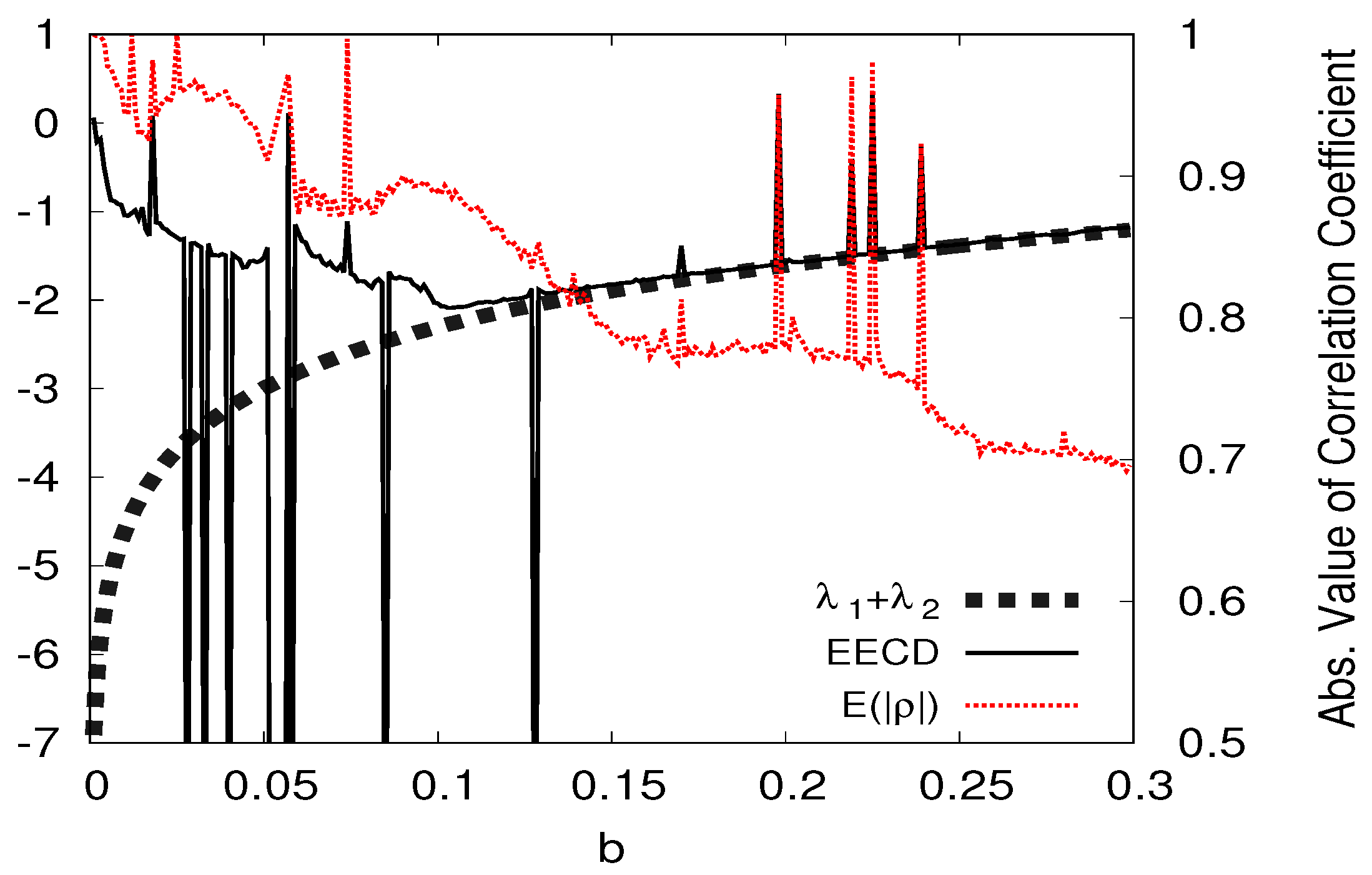
I present the numerical computation results of the total sum of the LEs, the EECD , and the average of for the Hénon map in Figure 9.
Figure 9.
, , versus a for the Hėnon map .
Here, at , the denominator of the right side of Equation (11) is given by
where is the eigenvalue of the variance–covariance matrix to all points on .
Let and be the variances and covariance of all points on , respectively. Then, I have
Therefore, if the absolute value of is equal to 1, then I have
Thus, it becomes difficult to estimate by Equation (11) when the absolute value of is approximately 1. Therefore, the EECD takes a different value from the total sum of the LEs when is near 1.
5.5. Numerical Computation Results of the EECD for Standard Map
Let us consider the standard map as a two-dimensional conservative chaotic map such that the Jacobian matrix depends on and the parameter K.
The standard map is defined as follows:
where .
The Jacobian matrix of the standard map is expressed as follows:
Thus, depends on and the parameter K. The dynamics produced by the standard map become conservative because .
I then consider the orbit produced by the standard map as follows:
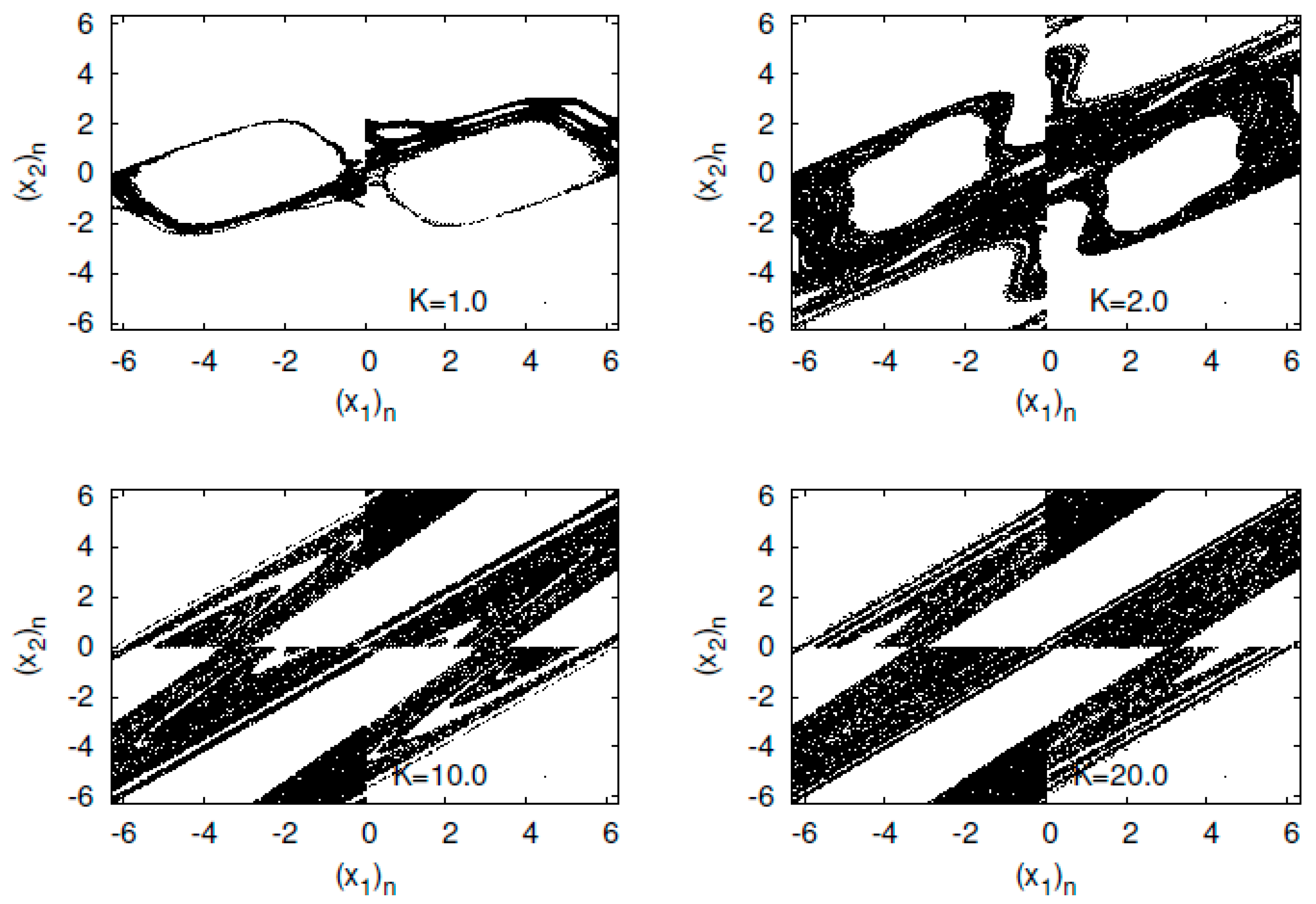
First, I present typical orbits of the standard map with initial point in Figure 10.
Figure 10.
versus for the standard map .
The standard map consists of the Poincaré’s surface of the section of the kicked rotator. The map has a linear structure around . However, as K increases, the map produces a nonlinear structure and chaos for an appropriate initial condition.
Second, let us assume that is transformed to by on . For the standard map , using the chain rule and , I have
Therefore, I obtain
where are the LEs of the standard map such that .
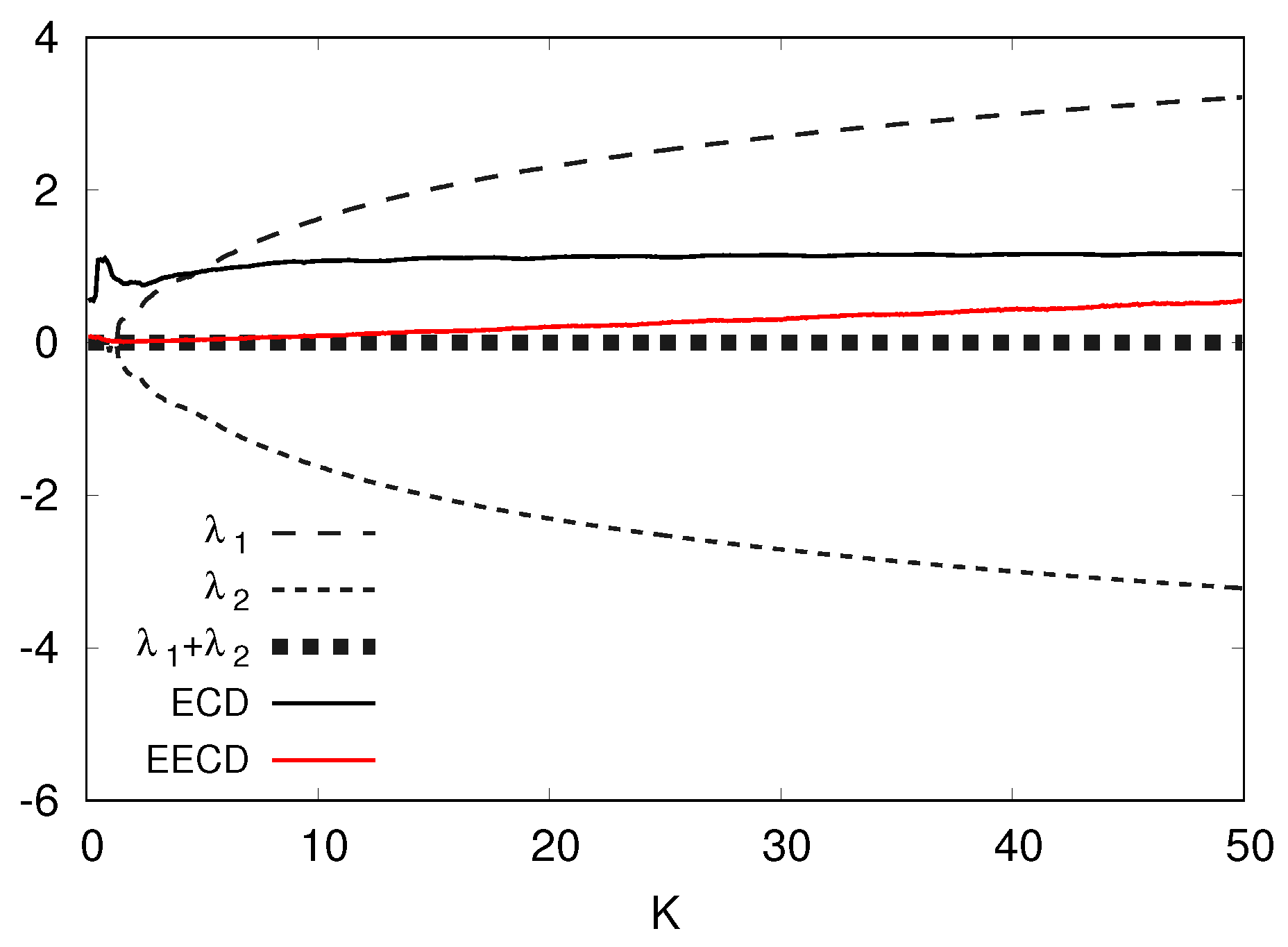
I present the numerical computation results of the LEs , the total sum of the LEs, the ECD D, and the EECD for the standard map in Figure 11. Figure 11 shows that as K increases, the difference between the EECD and the total sum of LEs for the standard map increases. In other words, as the positive LE increases, the difference between the EECD and the total sum of the LE increases.
Figure 11.
, D, versus K for the standard map .
Now, I consider symmetric difference equations such that
Here, Equation (39) can arise as a discretization of with [18].
Introducing new variables , , Equation (39) can be written as
This mapping is equivalent to the standard map Equation (35).
Moreover, let R be an involution such that . Then, I have
Using and , I obtain
which signifies that the standard map is reversible with respect to the involution R.
Equation (40) is area preserving as well as reversible, as is common with area-preserving maps [19]. Since the standard map is reversible, two Lyapunov exponents of become and such that by Theorem 3.2 in [20].
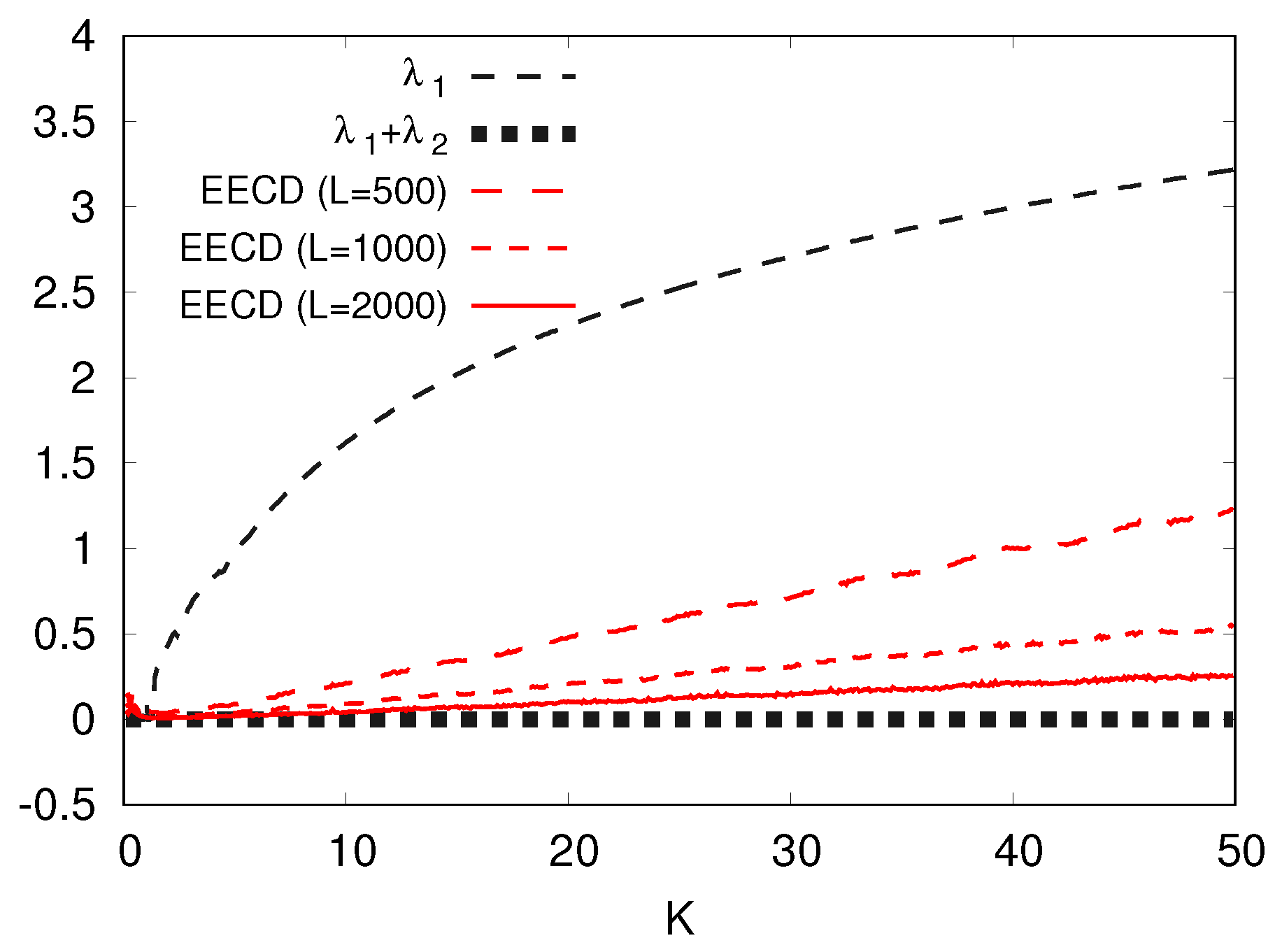
Let us consider increasing and decreasing L of the EECD. I represent the numerical computation results of the EECD at for the standard map in Figure 12. Figure 12 shows that as L increases, the EECD goes to the total sum of the LEs for the standard map .
Figure 12.
, , at several Ls versus K for the standard map .
6. Conclusions
In this study, I have focused on improving the calculation formula of the EECD and applied the improved calculation formula of the EECD to two-dimensional typical chaotic maps. I have shown that the EECD is almost equal to the total sum of the LEs for their chaotic maps in many cases. However, for the two cases, the EECD was different from the total sum of the LEs even though the map did not create a periodic orbit.
The first case occurs when the absolute value of the negative LE is much larger than the absolute value of the positive LE. Evidently, for the Hénon map , the EECD takes a much larger value than the total sum of the LE at many a’s for . Then, the average of the absolute value of the autocorrelation function to all points on component was approximately one. Here, it becomes difficult to estimate by Equation (11). Therefore, the EECD takes a different value from the total sum of the LEs when is approximately one.
The second case occurs notably when the positive LE takes a large value. Evidently, for the standard map , as the parameter K increases, the difference between the EECD and the total sum of the LE increases. In other words, as the positive LE increases, the difference between the EECD and the total sum of the LEs also increases. Here, I have shown the possibility of reducing the above difference by increasing L, where is the number of equipartitions of .
I have applied the improved calculation formulas of the EECD to two-dimensional chaotic maps. However, in future works, I will discuss applying the improved calculation formulas of the EECD to higher-dimensional chaotic dynamics.
Funding
This research received no external funding.
Institutional Review Board Statement
Not applicable.
Informed Consent Statement
Not applicable.
Data Availability Statement
Not applicable.
Acknowledgments
The author is very grateful to the referees for their helpful comments and suggestions. This work was supported by JSPS KAKENHI Grant Number 21K12063.
Conflicts of Interest
The authors declare no conflict of interest.
References
- Eckmann, J.P.; Kamphorst, S.O.; Ruelle, D.; Ciliberto, S. Lyapunov exponents from time series. Phys. Rev. A 1986, 34, 4971–4979. [Google Scholar] [CrossRef] [PubMed]
- Rosenstein, M.T.; Collins, J.J.; De Luca, C.J. A practical method for calculating largest Lyapunov exponents from small data sets. Phys. D: Nonlinear Phenom. 1993, 65, 117–134. [Google Scholar] [CrossRef]
- Sato, S.; Sano, M.; Sawada, Y. Practical methods of measuring the generalized dimension and the largest Lyapunov exponent in high dimensional chaotic systems. Prog. Theor. Phys. 1987, 77, 1–5. [Google Scholar] [CrossRef]
- Sano, M.; Sawada, Y. Measurement of the Lyapunov spectrum from a chaotic time series. Phys. Let. A 1995, 209, 327–332. [Google Scholar] [CrossRef] [PubMed]
- Wright, J. Method for calculating a Lyapunov exponent. Phys. Rev. A 1984, 29, 2924–2927. [Google Scholar] [CrossRef]
- Wolf, A.; Swift, J.B.; Swinney, H.L.; Vastano, J.A. Determining Lyapunov exponents from a time series. Phys. D Nonlinear Phenom. 1985, 16D, 285–317. [Google Scholar] [CrossRef]
- Ohya, M. Complexities and their applications to characterization of chaos. Int. J. Theor. Phys. 1998, 37, 495–505. [Google Scholar] [CrossRef]
- Inoue, K.; Ohya, M.; Sato, K. Application of chaos degree to some dynamical systems. Chaos Solitons Fractals 2000, 11, 1377–1385. [Google Scholar] [CrossRef]
- Inoue, K.; Ohya, M.; Volovich, I. Semiclassical properties and chaos degree for the quantum baker’s map. J. Math. Phys. 2002, 43, 734–755. [Google Scholar] [CrossRef]
- Inoue, K.; Ohya, M.; Volovich, I. On a combined quantum baker’s map and its characterization by entropic chaos degree. Open Syst. Inf. Dyn. 2009, 16, 179–194. [Google Scholar] [CrossRef]
- Mao, T.; Okutomi, H.; Umeno, K. Investigation of the difference between Chaos Degree and Lyapunov exponent for asymmetric tent maps. JSIAM Lett. 2019, 11, 61–64. [Google Scholar] [CrossRef]
- Mao, T.; Okutomi, H.; Umeno, K. Proposal of improved chaos degree based on interpretation of the difference between chaos degree and Lyapunov exponent. Trans. JSIAM 2019, 29, 383–394. (In Japanese) [Google Scholar]
- Inoue, K.; Mao, T.; Okutomi, H.; Umeno, K. An extension of the entropic chaos degree and its positive effect. Jpn. J. Ind. Appl. Math. 2021, 38, 611–624. [Google Scholar] [CrossRef]
- Barreira, L. Ergodic Theory, Hyperbolic Dynamics and Dimension Theory; Springer: Berlin/Heidelberg, Germany, 2012. [Google Scholar]
- Ikeda, K. Multiple-valued stationary state and its instability of the transmitted light by a ring cavity system. Opt. Commun. 1979, 30, 257–261. [Google Scholar] [CrossRef]
- Ikeda, K.; Daido, H.; Akimoto, O. Optical Turbulence: Chaotic Behavior of Transmitted Light from a Ring Cavity. Phys. Rev. Lett. 1980, 45, 709–712. [Google Scholar] [CrossRef]
- Wang, Q.; Oksasoglu, A. Rank one chaos: Theory and applications. Int. J. Bifurc. Chaos 2008, 18, 1261–1319. [Google Scholar] [CrossRef]
- Lamb, J.S.W.; Roberts, A.G. Time-reversal symmetry in dynamical systems: A survey. Phys. D 1998, 112, 1–39. [Google Scholar] [CrossRef]
- Roberts, J.A.G.; Quispel, G.R.W. Chaos and time-reversal symmetry. Order and chaos in reversible dynamical systems. Phys. Rep. 1992, 216, 63–177. [Google Scholar] [CrossRef]
- Bessa, M.; Carvalho, M.; Rodrigues, A. Generic area-preserving reversible diffeomorphisms. Nonlinearity 2015, 28, 1695–1720. [Google Scholar] [CrossRef][Green Version]
Publisher’s Note: MDPI stays neutral with regard to jurisdictional claims in published maps and institutional affiliations. |
© 2021 by the author. Licensee MDPI, Basel, Switzerland. This article is an open access article distributed under the terms and conditions of the Creative Commons Attribution (CC BY) license (https://creativecommons.org/licenses/by/4.0/).