
Study of Kinetic Freeze-Out Parameters as a Function of Rapidity in pp Collisions at CERN SPS Energies
 ,
,  ,
,  ,
,
Abstract
:1. Introduction
2. Formalism and Method
3. Results and Discussions
4. Summary and Conclusions
Author Contributions
Funding
Data Availability Statement
Acknowledgments
Conflicts of Interest
Ethical Approval
References
- Becattini, F.; Heinz, U.W. Thermal hadron production in p p and p anti-p collisions. Z. Phys. C 1997, 76, 269, Erratum in 1997, 76, 578. [Google Scholar] [CrossRef] [Green Version]
- Li, L.L.; Liu, F.H.; Waqas, M.; Al-Yusufi, R.; Mujear, A. Excitation functions of related parameters from transverse momentum (mass) spectra in high energy collisions. Adv. High Energy Phys. 2020, 2020, 5356705. [Google Scholar] [CrossRef]
- Li, L.L.; Liu, F.H. Kinetic Freeze-Out Properties from Transverse Momentum Spectra of Pions in High Energy Proton-Proton Collisions. Physics 2020, 2, 277–308. [Google Scholar] [CrossRef]
- Waqas, M.; Liu, F.H.; Li, L.L.; Alfanda, H.M.U. Effective (kinetic freeze-out) temperature, transverse flow velocity and kinetic freeze-out volume in high energy collisions. Nucl. Sci. Tech. 2020, 31, 109. [Google Scholar] [CrossRef]
- Waqas, M.; Liu, F.H. Initial, Effective, And kinetic freeze-out temperatures from transverse momentum spectra in high-energy proton(deuteron)–nucleus and nucleus–nucleus collisions. Eur. Phys. J. Plus 2020, 135, 147. [Google Scholar] [CrossRef]
- Waqas, M.; Liu, F.H.; Wazir, Z. Dependence of temperatures and kinetic freeze-out volume on centrality in Au-Au and Pb-Pb collisions at high energy. Adv. High Energy Phys. 2020, 2020, 8198126. [Google Scholar] [CrossRef]
- Waqas, M.; Peng, G.X.; Wazir, Z. Decoupling of non-strange, strange and multi-strange particles from the system in Cu-Cu, Au-Au and Pb-Pb collisions at high energies. arXiv 2021, arXiv:2107.07840. [Google Scholar]
- Puglisi, A.; Sarracino, A.; Vulpiani, A. emperature in and out of equilibrium: A review of concepts, tools and attempts. Phys. Rep. 2017, 709, 1. [Google Scholar] [CrossRef] [Green Version]
- Waqas, M.; Liu, F.H.; Fakhraddin, S.; Rahim, M.A. Possible scenarios for single, double, or multiple kinetic freeze-out in high energy collisions. Indian J. Phys. 2019, 93, 1329–1343. [Google Scholar] [CrossRef] [Green Version]
- Waqas, M.; Li, B.C. Kinetic freeze-out temperature and transverse flow velocity in Au-Au collisions at RHIC-BES energies. Adv. High Energy Phys. 2020, 2020, 1787183. [Google Scholar] [CrossRef] [Green Version]
- Thakur, D.; Tripathy, S.; Garg, P.; Sahoo, R.; Cleymans, J. Indication of Differential Kinetic Freezeout at RHIC and LHC Energies. Acta Phys. Polon. Supp. 2016, 9, 329. [Google Scholar] [CrossRef] [Green Version]
- Khuntia, A.; Sharma, H.; Tiwari, S.K.; Sahoo, R.; Cleymans, J. Radial flow and differential freeze-out in proton–proton collisions at s = 7 TeV at the LHC. Eur. Phys. J. A 2019, 55, 3. [Google Scholar] [CrossRef]
- Waqas, M.; Peng, G.X.; Liu, F.-H. An evidence of triple kinetic freezeout scenario observed in all centrality intervals in Cu-Cu, Au-Au and PbPb collisions at high energies. J. Phys. G 2021, 48, 075108. [Google Scholar] [CrossRef]
- Shao, M.; Yi, L.; Tang, Z.; Chen, H.; Li, C.; Xu, Z. Examine the species and beam-energy dependence of particle spectra using Tsallis Statistics. J. Phys. G 2010, 37, 085104. [Google Scholar] [CrossRef]
- Lao, H.L.; Liu, F.H.; Li, B.C.; Duan, M.Y. Kinetic freeze-out temperatures in central and peripheral collisions: Which one is larger? Nucl. Sci. Tech. 2018, 29, 82. [Google Scholar] [CrossRef] [Green Version]
- Waqas, M.; Peng, G.X. Study of Proton, Deuteron, and Triton at 54.4 GeV. Adv. High Energy Phys. 2021, 2021, 6674470. [Google Scholar] [CrossRef]
- Kumar, L.; STAR Collaboration. Systematics of kinetic freeze-out properties in high energy collisions from STAR. Nucl. Phys. A 2014, 931, 1114. [Google Scholar] [CrossRef] [Green Version]
- Waqas, M.; Liu, F.H.; Wang, R.Q.; Siddique, I. Energy scan/dependence of kinetic freeze-out scenarios of multi-strange and other identified particles in central nucleus-nucleus collisions. Eur. Phys. J. A 2020, 56, 188. [Google Scholar] [CrossRef]
- Waqas, M.; Peng, G.X.; Liu, F.H.; Wazir, Z. Effects of coalescence and isospin symmetry on the freezeout of light nuclei and their anti-particles. arXiv 2021, arXiv:2105.01300. [Google Scholar]
- Schnedermann, E.; Sollfrank, J.; Heinz, U.W. Thermal phenomenology of hadrons from 200-A/GeV S+S collisions. Phys. Rev. C 1993, 48, 2462–2475. [Google Scholar] [CrossRef] [Green Version]
- Abelev, B.I.; Aggarwal, M.M.; Ahammed, Z.; Anderson, B.D.; Arkhipkin, D.; Averichev, G.S.; Bai, Y.; Balewski, J.; Barannikova, O.; Barnby, L.S.; et al. Systematic Measurements of Identified Particle Spectra in pp, d+ Au and Au+Au Collisions from STAR. Phys. Rev. C 2009, 79, 034909. [Google Scholar] [CrossRef]
- Ristea, O.; Jipa, A.; Ristea, C.; Esanu, T.; Calin, M.; Barzu, A.; Scurtu, A.; Abu-Quoad, I. Study of the freeze-out process in heavy ion collisions at relativistic energies. J. Phys. Conf. Ser. 2013, 420, 012041. [Google Scholar] [CrossRef]
- Tang, Z.; Xu, Y.; Ruan, L.; van Buren, G.; Wang, F.; Xu, Z. Spectra and radial flow at RHIC with Tsallis statistics in a Blast-Wave description. Phys. Rev. C 2009, 79, 051901. [Google Scholar] [CrossRef] [Green Version]
- Takeuchi, S.; Murase, K.; Hirano, T.; Huovinen, P.; Nara, Y. Effects of hadronic rescattering on multistrange hadrons in high-energy nuclear collisions. Phys. Rev. C 2015, 92, 044907. [Google Scholar] [CrossRef] [Green Version]
- Abelev, B.I.; Aggarwal, M.M.; Ahammed, Z.; Alakhverdyants, A.V.; Anderson, B.D.; Arkhipkin, D.; Averichev, G.S.; Balewski, J.; Barannikova, O.; Barnby, L.S.; et al. Identified particle production, azimuthal anisotropy, and interferometry measurements in Au+Au collisions at s(NN)**(1/2) = 9.2- Ge. Phys. Rev. C 2010, 81, 024911. [Google Scholar] [CrossRef]
- Heinz, U.W. Concepts of heavy ion physics. arXiv 2004, arXiv:hep-ph/0407360. [Google Scholar]
- Heiselberg, H.; Levy, A.M. Elliptic flow and HBT in noncentral nuclear collisions. Phys. Rev. C 1999, 59, 2716. [Google Scholar] [CrossRef] [Green Version]
- Wei, H.R.; Liu, F.H.; Lacey, R.A. Kinetic freeze-out temperature and flow velocity extracted from transverse momentum spectra of final-state light flavor particles produced in collisions at RHIC and LHC. Eur. Phys. J. A 2016, 52, 102. [Google Scholar] [CrossRef] [Green Version]
- Lao, H.-L.; Wei, H.-R.; Liu, F.-H.; Lacey, R.A. An evidence of mass-dependent differential kinetic freeze-out scenario observed in Pb-Pb collisions at 2.76 TeV. Eur. Phys. J. A 2016, 52, 203. [Google Scholar] [CrossRef] [Green Version]
- Cleymans, J.; Worku, D. Relativistic Thermodynamics: Transverse Momentum Distributions in High-Energy Physics. Eur. Phys. J. A 2012, 48, 160. [Google Scholar] [CrossRef]
- Zheng, H.; Zhu, L.L. Comparing the Tsallis Distribution with and without Thermodynamical Description in p + p Collisions. Adv. High Energy Phys. 2016, 2016, 9632126. [Google Scholar] [CrossRef] [Green Version]
- Wei, H.-R.; Liu, F.-H.; Lacey, R.A. Disentangling random thermal motion of particles and collective expansion of source from transverse momentum spectra in high energy collisions. J. Phys. G 2016, 43, 125102. [Google Scholar] [CrossRef] [Green Version]
- Aduszkiewicz, A.; Ali, Y.; Andronov, E.; Antićić, T.; Baatar, B.; Baszczyk, M.; Bhosale, S.; Blondel, A.; Bogomilov, M.; Brandin, A.; et al. Measurements of π±, K±, p and spectra in proton–proton interactions at 20, 31, 40, 80 and 158 GeV/c with the NA61/SHINE spectrometer at the CERN SPS. Eur. Phys. J. C 2017, 77, 671. [Google Scholar] [CrossRef]
- Adam, J.; Adamova, D.; Aggarwal, M.M.; Rinella, G.A.; Agnello, M.; Agrawal, N.; Ahammed, Z.; Ahmad, S.; Ahn, S.U.; Aiola, S.; et al. Enhanced production of multi-strange hadrons in high-multiplicity proton–proton collisions. Nat. Phys. 2017, 13, 535. [Google Scholar]





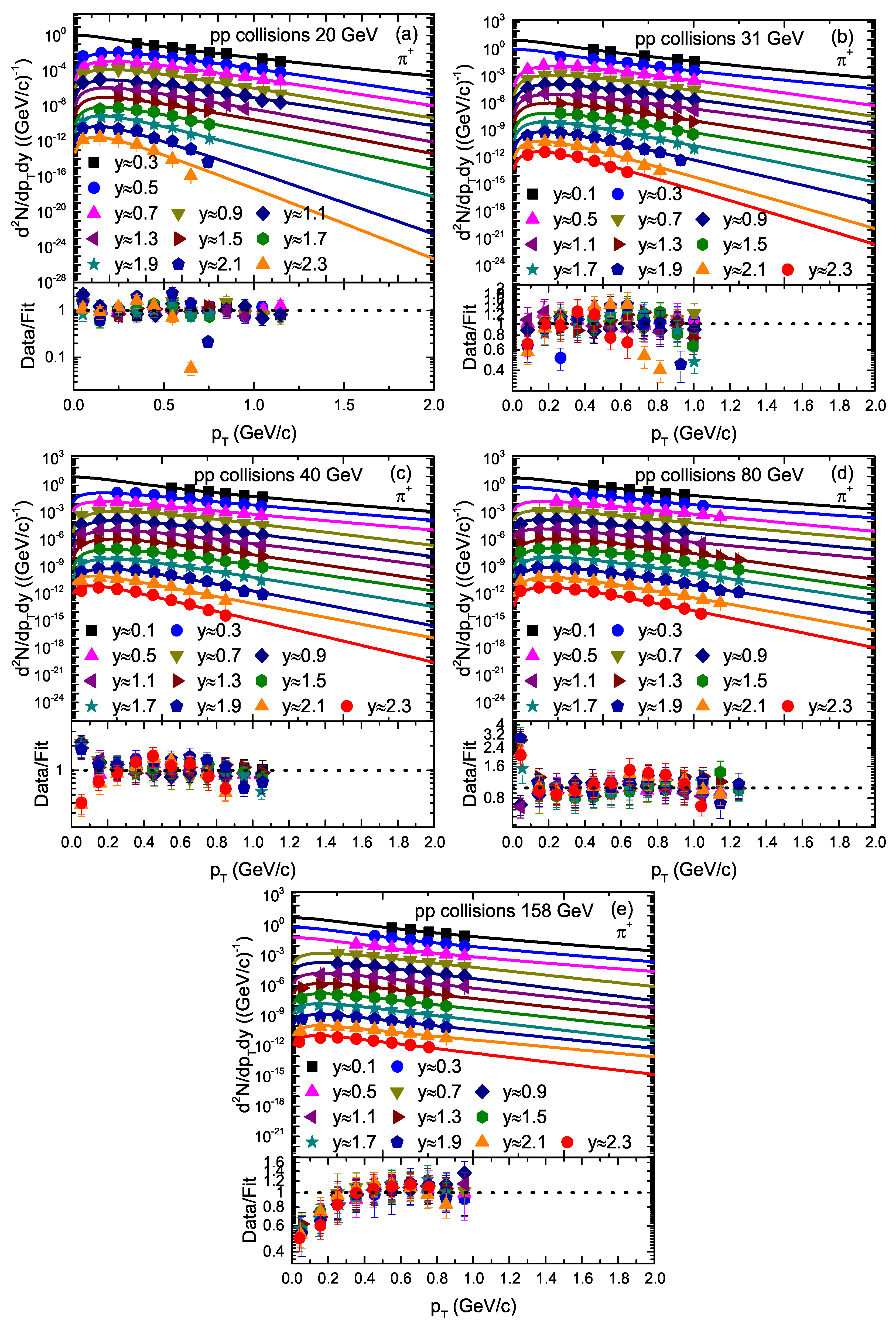
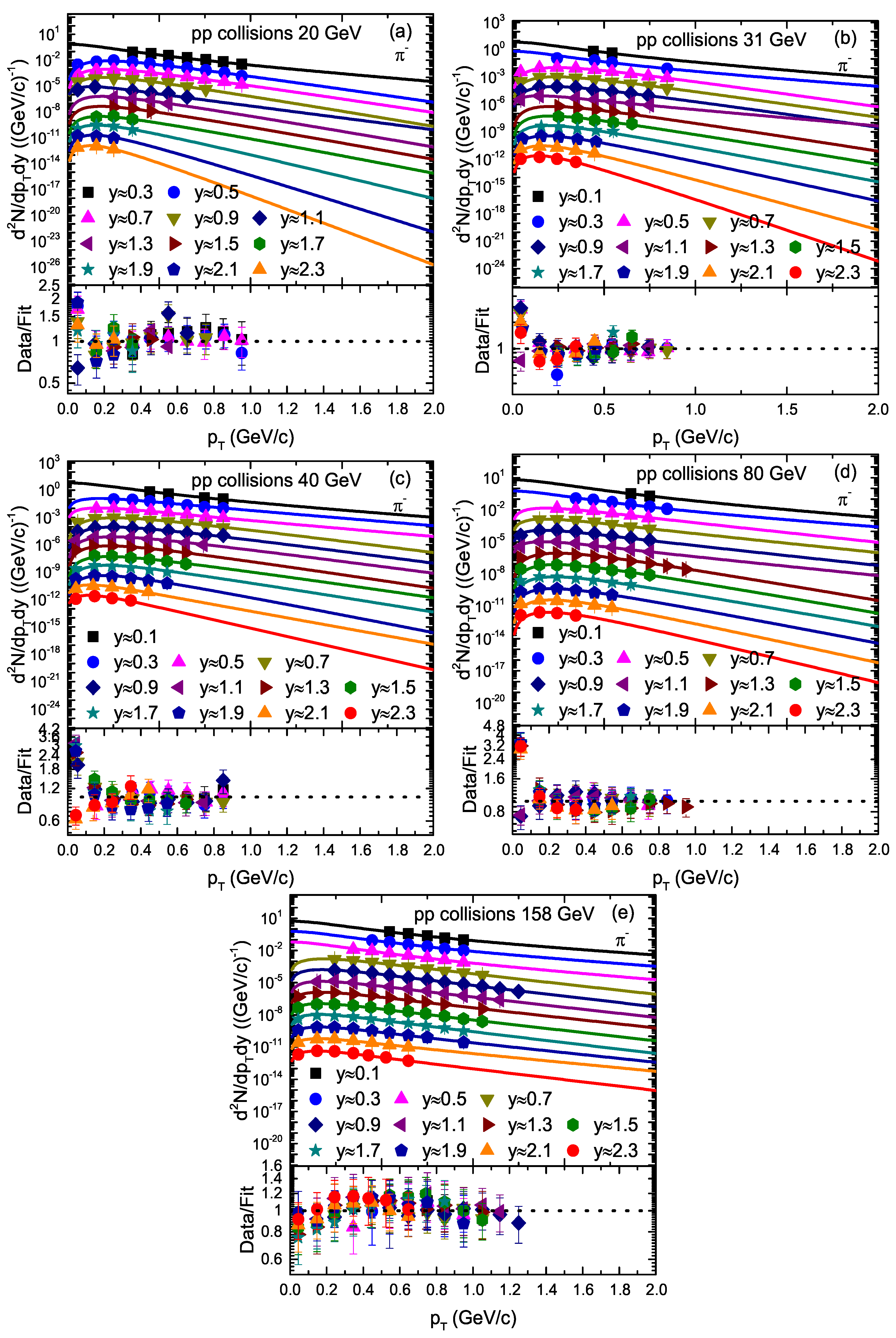
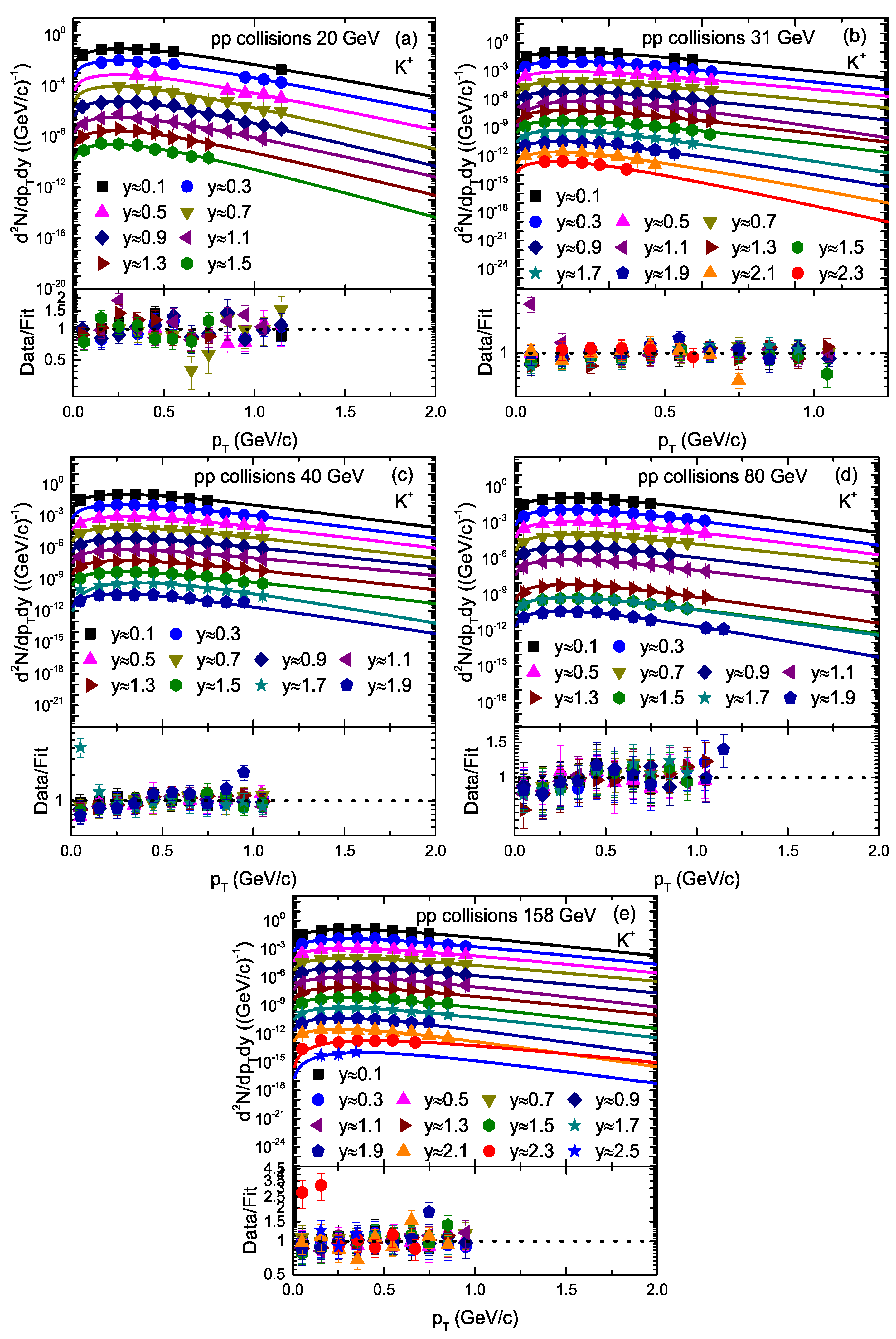
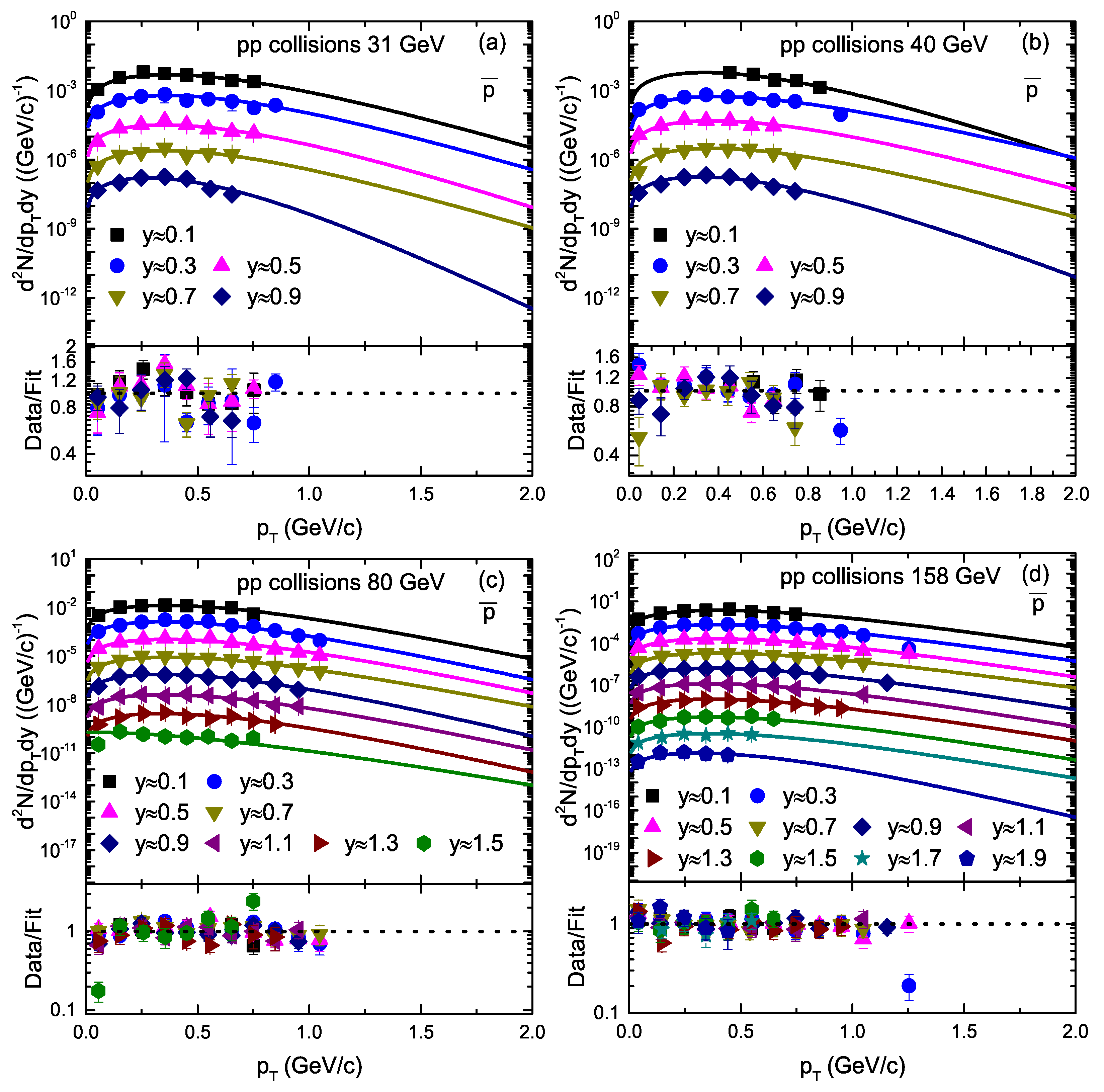
| Collisions | Rapidity | Particle | (GeV) | (c) | /dofs | ||
|---|---|---|---|---|---|---|---|
| Figure 1 | y = 0.3 | 5/4 | |||||
| p-p | y = 0.5 | – | 4/8 | ||||
| 20 GeV | y = 0.7 | – | 3.5/8 | ||||
| y = 0.9 | – | 9/8 | |||||
| y = 1.1 | – | 11/7 | |||||
| y = 1.3 | – | 4/4 | |||||
| y = 1.5 | – | 1/2 | |||||
| y = 1.7 | – | 9/3 | |||||
| y = 1.9 | – | 5/4 | |||||
| y = 2.1 | – | 118/4 | |||||
| y = 2.3 | – | 120/3 | |||||
| Figure 2 | y = 0.3 | 3/3 | |||||
| p-p | y = 0.5 | – | 6/5 | ||||
| 20 GeV | y = 0.7 | – | 3/6 | ||||
| y = 0.9 | – | 7/4 | |||||
| y = 1.1 | – | 8/2 | |||||
| y = 1.3 | – | 3/0 | |||||
| y = 1.5 | – | 0.2/- | |||||
| y = 1.7 | – | 1/- | |||||
| y = 1.9 | – | 1/- | |||||
| y = 2.1 | – | 10/- | |||||
| y = 2.3 | – | 1/- | |||||
| Figure 1 | y = 0.1 | 0.1/1 | |||||
| p-p | y = 0.3 | – | 21/4 | ||||
| 31 GeV | y = 0.5 | – | 1.5/7 | ||||
| y = 0.7 | – | 2/7 | |||||
| y = 0.9 | – | 2/7 | |||||
| y = 1.1 | – | 2/6 | |||||
| y = 1.3 | – | 3.5/5 | |||||
| y = 1.5 | – | 8/5 | |||||
| y = 1.7 | – | 31/6 | |||||
| y = 1.9 | – | 25/6 | |||||
| y = 2.1 | – | 80/5 | |||||
| y = 2.3 | – | 10/3 | |||||
| Figure 2 | y = 0.1 | 0.2/- | |||||
| p-p | y = 0.3 | – | 16/- | ||||
| 31 GeV | y = 0.5 | – | 8/5 | ||||
| y = 0.7 | – | 11/5 | |||||
| y = 0.9 | – | 10/4 | |||||
| y = 1.1 | – | 2/3 | |||||
| y = 1.3 | – | 0.3/1 | |||||
| y = 1.5 | – | 3.5/1 | |||||
| y = 1.7 | – | 6/1 | |||||
| y = 1.9 | – | 6/1 | |||||
| y = 2.1 | – | 10/1 | |||||
| y = 2.3 | – | 9/- | |||||
| Figure 1 | y = 0.1 | 0.1/2 | |||||
| p-p | y = 0.3 | – | 3/5 | ||||
| 40 GeV | y = 0.5 | – | 3.5/6 | ||||
| y = 0.7 | – | 14/7 | |||||
| y = 0.9 | – | 10/7 | |||||
| y = 1.1 | – | 6/7 | |||||
| y = 1.3 | – | 4/7 | |||||
| y = 1.5 | – | 3/6 | |||||
| y = 1.7 | – | 21/7 | |||||
| y = 1.9 | – | 20/7 | |||||
| y = 2.1 | – | 58/5 | |||||
| y = 2.3 | – | 41/5 | |||||
| Figure 2 | y = 0.1 | 0.6/- | |||||
| p-p | y = 0.3 | – | 1/3 | ||||
| 40 GeV | y = 0.5 | – | 2/4 | ||||
| y = 0.7 | – | 7/5 | |||||
| y = 0.9 | – | 7/5 | |||||
| y = 1.1 | – | 14/4 | |||||
| y = 1.3 | – | 10/3 | |||||
| y = 1.5 | – | 4/2 | |||||
| y = 1.7 | – | 17/2 | |||||
| y = 1.9 | – | 14/2 | |||||
| y = 2.1 | – | 12/1 | |||||
| y = 2.3 | – | 73/- | |||||
| Figure 1 | y = 0.1 | 0.2/2 | |||||
| p-p | y = 0.3 | – | 1/4 | ||||
| 80 GeV | y = 0.5 | – | 1/6 | ||||
| y = 0.7 | – | 0.4/5 | |||||
| y = 0.9 | – | 5/6 | |||||
| y = 1.1 | – | 7/7 | |||||
| y = 1.3 | – | 14/9 | |||||
| y = 1.5 | – | 11/9 | |||||
| y = 1.7 | – | 6/9 | |||||
| y = 1.9 | – | 15/9 | |||||
| y = 2.1 | – | 13/8 | |||||
| y = 2.3 | – | 17/7 | |||||
| Figure 2 | y = 0.1 | 1/- | |||||
| p-p | y = 0.3 | – | 1/2 | ||||
| 80 GeV | y = 0.5 | – | 1/2 | ||||
| y = 0.7 | – | 1/3 | |||||
| y = 0.9 | – | 4/4 | |||||
| y = 1.1 | – | 4/4 | |||||
| y = 1.3 | – | 17/6 | |||||
| y = 1.5 | – | 16/4 | |||||
| y = 1.7 | – | 16/3 | |||||
| y = 1.9 | – | 9/2 | |||||
| y = 2.1 | – | 14/2 | |||||
| y = 2.3 | – | 15/- | |||||
| Figure 1 | y = 0.1 | 0.3/1 | |||||
| p-p | y = 0.3 | – | 0.4/2 | ||||
| 158 GeV | y = 0.5 | – | 1/3 | ||||
| y = 0.7 | – | 0.5/4 | |||||
| y = 0.9 | – | 4/4 | |||||
| y = 1.1 | – | 5/5 | |||||
| y = 1.3 | – | 16/5 | |||||
| y = 1.5 | – | 13/5 | |||||
| y = 1.7 | – | 21/5 | |||||
| y = 1.9 | – | 19/5 | |||||
| y = 2.1 | – | 26/5 | |||||
| y = 2.3 | – | 42/4 | |||||
| Figure 2 | y = 0.1 | 0.4/1 | |||||
| p-p | y = 0.3 | – | 0.1/2 | ||||
| 158 GeV | y = 0.5 | – | 1.5/3 | ||||
| y = 0.7 | – | 1/4 | |||||
| y = 0.9 | – | 1/7 | |||||
| y = 1.1 | – | 2/7 | |||||
| y = 1.3 | – | 3/6 | |||||
| y = 1.5 | – | 3.5/7 | |||||
| y = 1.7 | – | 5/6 | |||||
| y = 1.9 | – | 2/5 | |||||
| y = 2.1 | – | 1/3 | |||||
| y = 2.3 | – | 1/3 | |||||
| Figure 3 | y = 0.1 | 6/3 | |||||
| p-p | y = 0.3 | – | 5/5 | ||||
| 20 GeV | y = 0.5 | – | 7/2 | ||||
| y = 0.7 | – | 27/6 | |||||
| y = 0.9 | – | 5/8 | |||||
| y = 1.1 | – | 15/7 | |||||
| y = 1.3 | – | 8/4 | |||||
| y = 1.5 | – | 12/4 | |||||
| Figure 4 | y = 0.1 | 10/6 | |||||
| p-p | y = 0.3 | – | 6/5 | ||||
| 20 GeV | y = 0.5 | – | 3/2 | ||||
| y = 0.7 | – | 8/2 | |||||
| y = 0.9 | – | 5/4 | |||||
| y = 1.1 | – | 8/2 | |||||
| y = 1.3 | – | 2/- | |||||
| y = 1.5 | – | 2/- | |||||
| Figure 3 | y = 0.1 | 1.5/5 | |||||
| p-p | y = 0.3 | – | 1/7 | ||||
| 31 GeV | y = 0.5 | – | 0.2/4 | ||||
| y = 0.7 | – | 4.5/7 | |||||
| y = 0.9 | – | 5/7 | |||||
| y = 1.1 | – | 15/7 | |||||
| y = 1.3 | – | 12/7 | |||||
| y = 1.5 | – | 9/7 | |||||
| y = 1.7 | – | 9/6 | |||||
| y = 1.9 | – | 4.5/5 | |||||
| y = 2.1 | – | 33/4 | |||||
| y = 2.3 | – | 1/1 | |||||
| Figure 4 | y = 0.1 | 1.5/3 | |||||
| p-p | y = 0.3 | – | 5/4 | ||||
| 31 GeV | y = 0.5 | – | 0.4/2 | ||||
| y = 0.7 | – | 2/4 | |||||
| y = 0.9 | – | 4.5/4 | |||||
| y = 1.1 | – | 6/3 | |||||
| y = 1.3 | – | 1/3 | |||||
| y = 1.5 | – | 0.4/1 | |||||
| y = 1.7 | – | 5/- | |||||
| y = 1.9 | – | 0.2/- | |||||
| Figure 3 | y = 0.1 | 6/7 | |||||
| p-p | y = 0.3 | – | 1.5/6 | ||||
| 40 GeV | y = 0.5 | – | 9/7 | ||||
| y = 0.7 | – | 3/7 | |||||
| y = 0.9 | – | 3/7 | |||||
| y = 1.1 | – | 4/7 | |||||
| y = 1.3 | – | 5/7 | |||||
| y = 1.5 | – | 6/7 | |||||
| y = 1.7 | – | 11/7 | |||||
| y = 1.9 | – | 19/6 | |||||
| Figure 4 | y = 0.1 | 2/5 | |||||
| p-p | y = 0.3 | – | 1/4 | ||||
| 40 GeV | y = 0.5 | – | 11/5 | ||||
| y = 0.7 | – | 3/5 | |||||
| y = 0.9 | – | 1/4 | |||||
| y = 1.1 | – | 2/4 | |||||
| y = 1.3 | – | 2/3 | |||||
| y = 1.5 | – | 2/2 | |||||
| y = 1.7 | – | 5/2 | |||||
| y = 1.9 | – | 2.5/- | |||||
| y = 2.1 | – | 0.1/- | |||||
| Figure 3 | y = 0.1 | 1.5/5 | |||||
| p-p | y = 0.3 | – | 2/7 | ||||
| 80 GeV | y = 0.5 | – | 1.5/7 | ||||
| y = 0.7 | – | 1.5/6 | |||||
| y = 0.9 | – | 2/5 | |||||
| y = 1.1 | – | 2/7 | |||||
| y = 1.3 | – | 8/7 | |||||
| y = 1.5 | – | 2/7 | |||||
| y = 1.7 | – | 4/6 | |||||
| y = 1.9 | – | 4/6 | |||||
| Figure 4 | y = 0.1 | 1.5/5 | |||||
| p-p | y = 0.3 | – | 1/4 | ||||
| 80 GeV | y = 0.5 | – | 2/4 | ||||
| y = 0.7 | – | 0.4/4 | |||||
| y = 0.9 | – | 2/4 | |||||
| y = 1.1 | – | 16/5 | |||||
| y = 1.3 | – | 5/5 | |||||
| y = 1.5 | – | 0.7/2 | |||||
| y = 1.7 | – | 6.5/ | |||||
| y = 1.9 | – | 2/- | |||||
| y = 2.1 | – | 0.2/- | |||||
| Figure 3 | y = 0.1 | 2/6 | |||||
| p-p | y = 0.3 | – | 1/6 | ||||
| 158 GeV | y = 0.5 | – | 1/6 | ||||
| y = 0.7 | – | 0.5/6 | |||||
| y = 0.9 | – | 1/6 | |||||
| y = 1.1 | – | 2/6 | |||||
| y = 1.3 | – | 1/5 | |||||
| y = 1.5 | – | 2/5 | |||||
| y = 1.7 | – | 2/5 | |||||
| y = 1.9 | – | 5.5/4 | |||||
| y = 2.1 | – | 11/5 | |||||
| y = 2.3 | – | 13/3 | |||||
| y = 2.5 | – | 1.5/- | |||||
| Figure 4 | y = 0.1 | 1/6 | |||||
| p-p | y = 0.3 | – | 0.3/5 | ||||
| 158 GeV | y = 0.5 | – | 0.5/6 | ||||
| y = 0.7 | – | 1/5 | |||||
| y = 0.9 | – | 1/7 | |||||
| y = 1.1 | – | 3/7 | |||||
| y = 1.3 | – | 11/6 | |||||
| y = 1.5 | – | 2/6 | |||||
| y = 1.7 | – | 30/4 | |||||
| y = 1.9 | – | 1/3 | |||||
| y = 2.1 | – | 37/2 | |||||
| y = 2.3 | – | 2/1 | |||||
| y = 2.5 | – | 4/- | |||||
| Figure 5 | y = 0.1 | 8/5 | |||||
| p-p | y = 0.3 | – | 20/5 | ||||
| 31 GeV | y = 0.5 | – | 10/4 | ||||
| y = 0.7 | – | 12/3 | |||||
| y = 0.9 | – | 8/3 | |||||
| Figure 5 | y = 0.1 | 3/1 | |||||
| p-p | y = 0.3 | – | 22/5 | ||||
| 40 GeV | y = 0.5 | – | 11/3 | ||||
| y = 0.7 | – | 19/4 | |||||
| y = 0.9 | – | 7/4 | |||||
| Figure 5 | y = 0.1 | 36/7 | |||||
| p-p | y = 0.3 | – | 10/7 | ||||
| 80 GeV | y = 0.5 | – | 5/7 | ||||
| y = 0.7 | – | 4/7 | |||||
| y = 0.9 | – | 12/6 | |||||
| y = 1.1 | – | 10/6 | |||||
| y = 1.3 | – | 14/5 | |||||
| y = 1.5 | – | 277/4 | |||||
| Figure 5 | y = 0.1 | 4.5/8 | |||||
| p-p | y = 0.3 | – | 107/8 | ||||
| 158 GeV | y = 0.5 | – | 7/8 | ||||
| y = 0.7 | – | 3/7 | |||||
| y = 0.9 | – | 3/6 | |||||
| y = 1.1 | – | 2/5 | |||||
| y = 1.3 | – | 13/6 | |||||
| y = 1.5 | – | 2/3 | |||||
| y = 1.7 | – | 3/2 | |||||
| y = 1.9 | – | 4/1 |
Publisher’s Note: MDPI stays neutral with regard to jurisdictional claims in published maps and institutional affiliations. |
© 2021 by the authors. Licensee MDPI, Basel, Switzerland. This article is an open access article distributed under the terms and conditions of the Creative Commons Attribution (CC BY) license (https://creativecommons.org/licenses/by/4.0/).
Share and Cite
Waqas, M.; Chen, H.-M.; Peng, G.-X.; Haj Ismail, A.A.K.; Ajaz, M.; Wazir, Z.; Shehzadi, R.; Jamal, S.; AbdelKader, A. Study of Kinetic Freeze-Out Parameters as a Function of Rapidity in pp Collisions at CERN SPS Energies. Entropy 2021, 23, 1363. https://doi.org/10.3390/e23101363
Waqas M, Chen H-M, Peng G-X, Haj Ismail AAK, Ajaz M, Wazir Z, Shehzadi R, Jamal S, AbdelKader A. Study of Kinetic Freeze-Out Parameters as a Function of Rapidity in pp Collisions at CERN SPS Energies. Entropy. 2021; 23(10):1363. https://doi.org/10.3390/e23101363
Chicago/Turabian StyleWaqas, Muhammad, Huai-Min Chen, Guang-Xiong Peng, Abd Al Karim Haj Ismail, Muhammad Ajaz, Zafar Wazir, Ramoona Shehzadi, Sabiha Jamal, and Atef AbdelKader. 2021. "Study of Kinetic Freeze-Out Parameters as a Function of Rapidity in pp Collisions at CERN SPS Energies" Entropy 23, no. 10: 1363. https://doi.org/10.3390/e23101363
APA StyleWaqas, M., Chen, H.-M., Peng, G.-X., Haj Ismail, A. A. K., Ajaz, M., Wazir, Z., Shehzadi, R., Jamal, S., & AbdelKader, A. (2021). Study of Kinetic Freeze-Out Parameters as a Function of Rapidity in pp Collisions at CERN SPS Energies. Entropy, 23(10), 1363. https://doi.org/10.3390/e23101363