1. Introduction
Supervised learning is an important technique used to train machine learning models that are deployed in multiple real-world applications [
1]. In a supervised classification problem, data instances with ground truth labels are used for training a model that can predict the labels of unseen data instances. Therefore, the performance of a supervised learning model depends on the quality and quantity of training data, often requiring a huge labeling effort. Usually, the labeling of data instances is done by humans. Labeling large amounts of data leads to a huge cost in both time and money. The labeling cost is significantly high when the labeling task needs to be done by domain experts. For example, potential tumors in medical images can be labeled only by qualified doctors [
2,
3].
With ever-increasing amounts of data, active learning (AL) is gaining the attention of researchers as well as practitioners as a way to reduce the effort spent on labeling data instances. Usually, a fraction of data instances are selected randomly and their labels are queried from an oracle (e.g., human labelers). This set of labeled instances are used for training the classifier. This process is known as
passive learning [
4] as the training data is selected at the beginning of the training process and it is assumed to stay fixed. An alternative approach is to iteratively select a small set of training instances, retrieve their labels, and update the training set. Then, the classification model is retrained using the acquired labeled instances and this process is repeated until a good level of performance (e.g., accuracy) is achieved. This process is known as
active learning [
5]. The objective of AL can be expressed as acquiring instances that maximize model performance. An
acquisition function evaluates the informativeness of each unlabeled instance and selects the most informative ones. As quantifying the informativeness of an instance is not straightforward, a multitude of approaches have been proposed in AL literature [
5]. For example, selecting the instance the model is most uncertain about is a commonly used acquisition function [
6].
In this paper, we study the problem of applying AL for classifying nodes of an attributed graph (The term “network” is used as an alternative term in the literature. We use the term graph since the usage of the term network can be confused with neural networks in this paper.). This task is known as node classification. Reducing the number of labeled nodes required in node classification can benefit a variety of practical applications such as in recommender systems [
7,
8] and text classification [
9] by selecting only the most informative nodes for labeling. Parisot et al. [
3] demonstrated the importance of representing the associations between brain scan images of different subjects as a graph for the task of predicting if a subject has Alzheimer’s disease. Features extracted from images are represented as node attributes. This is an example for a node classification problem where labeling is expensive as labeling a brain scan image is time-consuming and it can only be done by medical experts.
Node classification is an important task in learning from relational data. The objective of this problem is to predict the labels of unlabeled nodes given a partially labeled graph. Different approaches have been used for node classification including iterative classification algorithm (ICA) [
10], label propagation [
11], and Gaussian random fields (GRF) [
12]. Approaching node classification as a semisupervised problem has contributed to state-of-the-art in classification performance [
13,
14,
15]. In a semisupervised learning problem, the learning algorithm can utilize the features of all data instances including the unlabeled ones. Only the labels of unlabeled instances are not known. Semisupervised learning is a technique that utilizes unlabeled data to improve the label efficiency. Combining AL with semisupervised learning can increase the label efficiency further [
16]. Graph neural network (GNN) models have achieved state-of-the-art performance in node classification [
17].
Similar to other neural network-based models, GNN models are sensitive to the choice of hyperparameters. The common hyperparameters of a GNN model are learning rate, number of hidden layers, and the size of hidden units of each hidden layer. Unlike model parameters, the hyperparameters are not directly optimized to improve the model performance. Finding the most suitable set of values for hyperparameters is known as hyperparameter tuning. It is usually performed based on the performance of the model on a separate held-out labeled set known as the validation set. It is possible to leave a fraction of labeled data as the validation set when labeled data is abundant. However, in a label scarce setting, it is realistic to use all the available labeled instances for training the model. Therefore, we further reduce the size of the labeled set by not using a validation set and using fixed standard values for hyperparameters.
With the recent popularity of GNNs, several surveys on GNNs have been done [
17,
18,
19]. These works provide a comprehensive overview of recent developments in graph representation learning and its applications. Surveys on AL research have been done separately [
20,
21]. However, as far as the authors know, a survey and a systematic comparison of existing AL approaches for the task of node classification have not been done yet. Moreover, only a handful of graph datasets are used for benchmarking such models. Most of the benchmark graphs are similar as they come from the same domain. In this paper, we study commonly used AL acquisition functions on the problem of node classification using a multitude of graph datasets belonging to different domains. As shown in previous work [
22], the performance of AL algorithms is not consistent across different datasets.
Our main contributions are
we discuss the importance of performing AL experiments in a more realistic setting where an additional labeled dataset is not used for hyperparameter tuning;
we perform a thorough evaluation of existing AL algorithms on the task of node classification of attributed graphs in a more realistic setting; and
with empirical evidence on an extensive set of graphs with different characteristics, we highlight that graph properties should be considered in selecting an AL approach.
3. Active Learning for Graph Classification Problems
Compared to application of AL on other types of data such as image and text data, only a limited number of AL models has been developed for graph data. Previous work on applying AL on graph data [
38,
39,
40] is tightly coupled with earlier classification models such as Gaussian random fields, in which the features of nodes are not being used. Therefore, selecting query nodes uniformly in random coupled with a recent GNN model can easily outperform such AL models. AL models which utilize recent GNN architectures [
41,
42] are limited. Moreover, a comprehensive comparison of AL algorithms proposed for other domains of data has not been done yet.
In
Table 1, we provide an extensive comparison of the literature on AL approaches proposed for node classification. We compare each work with respect to the following attributes.
AL approach
Classifier: Classification model used for predicting the label of a node
Attributes: Whether the node classifier uses node attributes
Adaptive: Whether the active learner is updated based on the newly labeled instances
Labels: Whether the active learner uses node labels in making a decision
In addition to generic approaches proposed for AL, there have been a few works that are specifically designed for graph-structured data. These algorithms use graph-specific metrics for selecting nodes for labeling. In addition to the attributes of data instances, graph topology provides useful information. For example, the degree centrality of a node represents how a particular data instance is connected with others.
Table 1 demonstrates that most of the previous AL approaches proposed for node classification do not use the node attribute information. Moreover, some works [
40,
43] ignore the label information as well.
3.1. Active Learning Framework
In this problem, we start with an extremely small set of labeled instances. We are given a query budget
K such that we are allowed to query
K number of nodes to retrieve their labels. In each acquisition step, we select a node and retrieve its label from an oracle (e.g., a human labeler). The GNN model is retrained using the training set including the newly labeled instance. We repeat this process
K times. The basic framework is shown in Algorithm 1. Here,
is any node classification algorithm with parameters
and we can use different acquisition functions (e.g., uncertainty sampling or QBC) as
g.
| Algorithm 1 Active learning for node classification. |
Input: Graph , Query budget K, Initial labels Output: An improved model for to do Select the best unlabeled instance with an acquisition function g Retrieve its label Update label set Retrain the model end for Return
|
3.2. The Importance of Exploration
After each acquisition step, the classifier is trained on a limited number of labeled instances, which in turn are selected by the active learner. Therefore, the selected labeled instances tend to bias towards instances evaluated to be “informative” by the active learner. Therefore, the distribution of labeled instances is often different from the true underlying distribution. The active learner cannot observe the consequences of selecting an instance which has lower “informativeness”. This leads the active learner to converge to policies that are not able to generalize for unlabeled data. This problem is amplified by the lack of hyperparameter tuning. A simple approach to overcome this limitation is to query a few instances in addition to the ones maximizing our selection criteria. This step is known as “exploration” while selecting the instance maximizing the criteria is “exploitation”. For example, if our criterion is model entropy, the exploration step involves acquiring labels of a few instances which do not have the maximum entropy. Intuitively, an active learner should perform more exploration initially, so it can have a better view of the true distribution of data.
This problem is known as the
exploration vs.
exploitation trade-off in sequential decision-making problems. Solving this trade-off requires the learner to acquire potentially suboptimal instances (i.e., exploration) in addition to the optimal ones. This problem is studied under the framework of multi-armed bandits (MAB) problems [
46]. In a MAB problem, a set of actions are given and selecting an action results in observing a reward drawn from a distribution that is unknown to the learner. The problem is to select a sequence of actions that maximize the cumulative reward. A multitude of approaches is used in solving online learning problems modeled as MAB problems.
-greedy, upper confidence bounds (UCB) [
47], and Thompson sampling [
48] are a few of the frequently used techniques.
We compare the performance of each active learner using two different exploration techniques: -greedy and count-based exploration.
3.2.1. -Greedy
-greedy is used as the simplest method of introducing exploration into an MAB algorithm. In the case of AL, with probability
the active learner randomly selects an unlabeled instance for querying its label. The most informative instance is selected by an acquisition function with probability
. A key problem with this approach is that, as each unlabeled instance is selected with uniform probability, some of the labeled instances can be wasteful. This phenomena is known as
undirected exploration [
49].
3.2.2. Count-Based Exploration
In MAB problems, count-based exploration addresses the problem of undirected exploration by assigning a larger probability to actions that have been selected fewer times compared to the remaining actions. Based on the principle of optimism in the face of uncertainty, a count-based exploration algorithm computes an upper confidence bound (UCB) [
47] and selects the action corresponding to the maximum UCB. We adopt the notion of count-based exploration as the number of labeled nodes in the neighborhood of an unlabeled node. We define the exploration term of an instance
i as the logarithm of the number of unlabeled neighboring nodes of
i. This term encourages the learner to sample nodes from neighborhoods with less number of labeled nodes. As this term and the informative metric used in the acquisition function (e.g., entropy) are on different scales, we normalize both of these quantities into
range and get
and
, respectively. We linearly combine these normalized quantities to get the criterion for acquiring nodes as
where the exploration coefficient
is a hyperparameter that balances exploration and exploitation. Setting
to 0 corresponds to pure exploration disregarding the feedback of the classifier. On the other hand,
is equivalent to pure exploitation selecting a node based only on the uncertainty sampling (e.g., entropy).
5. Results and Discussion
5.1. Performance Comparison of AL Approaches
In this section, we compare the performance of acquisition functions which use only a single type of approach.
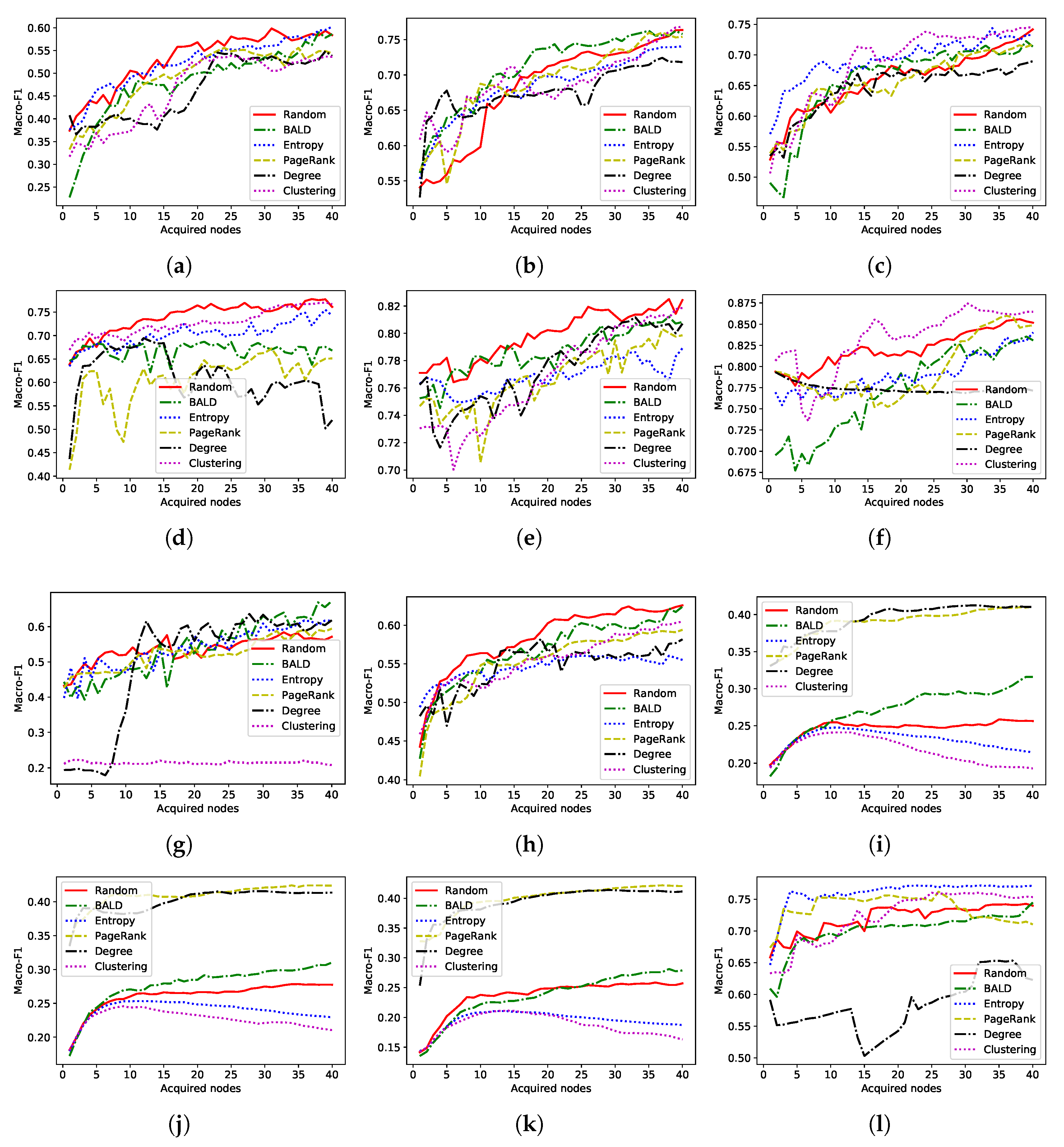
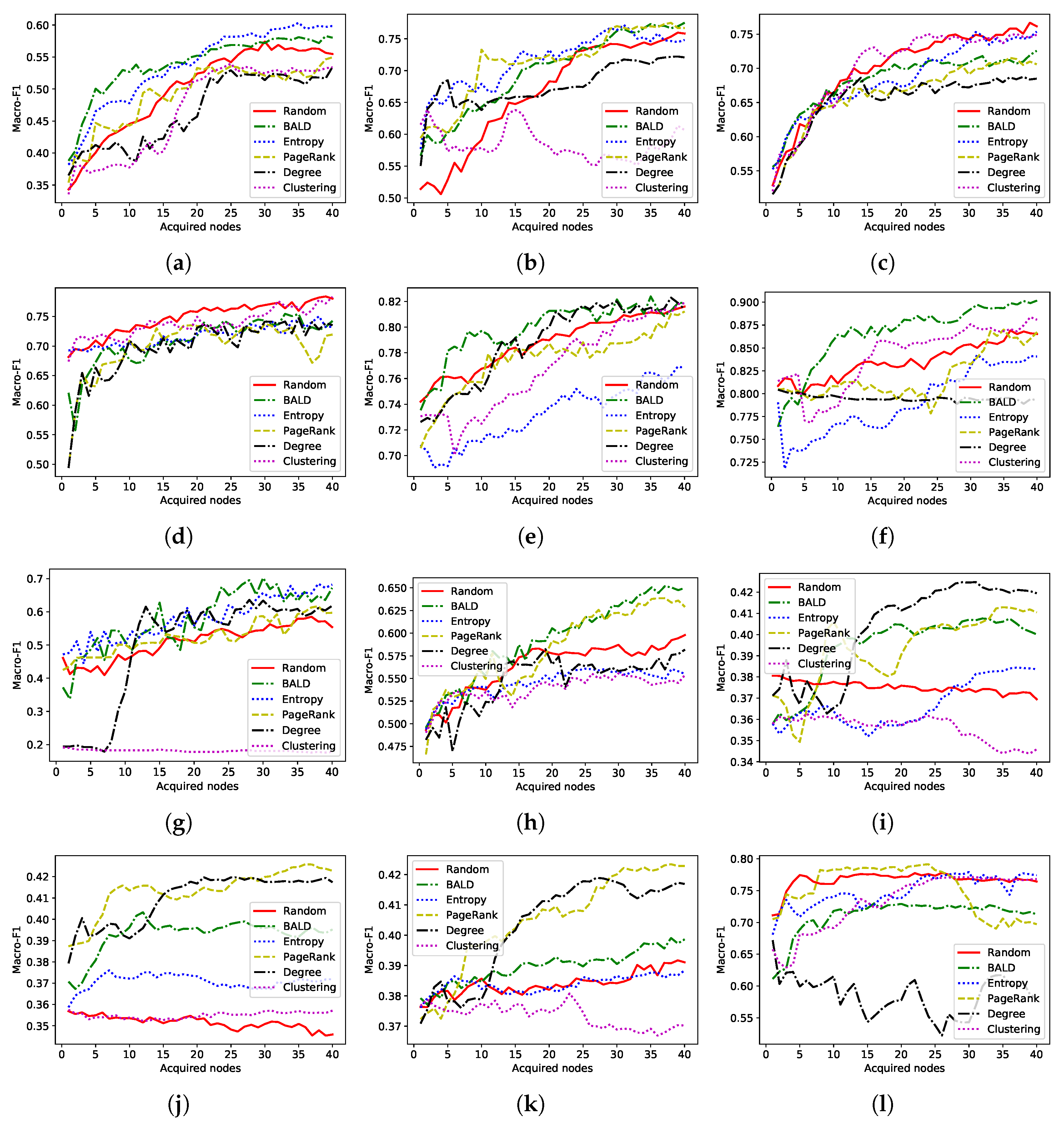
Figure 1 and
Figure 2 show how the performance of the node classification model varies with the number of acquisitions.
As shown in previous works, AGE [
41], the current state-of-the-art AL algorithm, performs well on citation networks (CiteSeer, CORA, and PubMed). However, the performance of this algorithm is suboptimal on other datasets such as Wiki-CS. The citation datasets possess similar characteristics. For example, average degree centrality of them is in the same range as shown in
Table 2. Therefore, selecting AL algorithms based on their performance on a handful of graphs from the same domain may result in suboptimal algorithms.
5.2. Comparison of Exploration Strategies
In this experiment, we run uncertainty sampling algorithms: BALD and entropy with
-greedy and count-based exploration terms. In the count-based exploration policy, we set the exploration coefficient
to
. In
Table 3 and
Table 4, we present the performance of GCN and SGC classifiers when 40 nodes are acquired using each of the acquisition functions. Entropy-Count and BALD-Count correspond to max entropy sampling and BALD policy combined with count-based exploration term. The values in bold indicate that the performance of an algorithm is significantly better (at 5% significance level) than the rest of the algorithms on that dataset. We calculate the statistical significance between the performance of two algorithms using paired t-test. If no single algorithm is significantly better than the rest, all statistically significant values are marked in bold. We summarize the results in
Table 5 and show the best performing AL algorithm along with the classifier. Uncertainty-based acquisition functions, when combined with the count-based exploration term (Entropy-Count and BALD-Count), achieve the best performance on average on four datasets. It highlights that encouraging the active learner to select nodes in less explored neighborhoods is effective than selecting a node in random as the exploration step (
-greedy).
5.3. Running Time
Table 6 shows the execution time each algorithm spends to acquire a set of 40 unlabeled instances on average. AGE, the current state-of-the-art, is several magnitudes slower compared to the rest of the algorithms. The clustering step performed to compute the information gain is responsible for the additional time. The time complexity of this step grows
with the number of vertices
n of a graph making AGE not suitable for large attributed graphs. For example, the AGE algorithm is 80 times slower than random sampling for the Amazon Computers graph but achieves inferior performance. Additionally, the SGC model can be trained in a relatively less time compared to the GCN model and this difference is significant for larger graphs such as Wiki-CS and co-authorship graphs. However, in AL problems, the time spent for selecting an unlabeled example is a minor concern since the labeling time is more valued.
5.4. Discussion
As shown in
Table 5, the performance of acquisition functions is diverse such that no single approach can be considered the best for all datasets. Sampling nodes based on graph properties leads to good performance depending on the graph structure. We make several key observations on how average clustering coefficient and label assortativity of a graph impact the performance of AL acquisition functions as following.
Graphs with high level of clustering. Amazon computers, co-authorship graphs, and Wiki-CS graphs have larger average clustering coefficients. For these datasets, sampling the node with the largest clustering coefficient outperforms sampling with other node centrality measures.
Graphs with medium level of clustering. CiteSeer, CORA, Github, and PPI graphs possess a medium level of average clustering in the range of 0.1 to 0.2. On CORA, CiteSeer, and Github datasets uncertainty-based acquisition functions and their variants obtain the best performance. However, the performance of PPI graphs is quite different since their label assortativity values are significantly low compared to all other datasets.
Graphs with low level of clustering. Pubmed and the disease graphs have the lowest average clustering coefficients. In most cases, the use of clustering coefficient to select the nodes for querying lead to suboptimal results. However, sampling with clustering coefficient on PubMed dataset obtained good performance when the GCN model was used as the node classifier.
Graphs with low label assortativity. Out of all graph datasets, PPI graphs exhibit the lowest label assortativity. As most of the graphs used in node classification literature exhibit high label assortativity, commonly used node classification models are build on the assumption that neighbors of a node may have the same label. Therefore, such models are not confident in predicting the labels of unlabeled nodes, specially when the training data is scarce. On PPI graphs, we observe that performing AL by sampling the query nodes based on PageRank and degree centrality contributes to the best performing models. However, one limitation in calculating the label assortativity is that node labels need to be known beforehand. When we are given an unlabeled graph, one way to overcome this problem is we can use similar labeled graphs belonging to the same domain to approximate the label assortativity.
6. Conclusions
In this paper, we studied the application of the active learning framework as a method to make node classification on attributed graphs label efficient. We have performed an empirical evaluation of state-of-the-art active learning algorithms on the node classification task using twelve real-world attributed graphs belonging to different domains. In our experiments, we initiate the active learner with an extremely small number of labeled instances. Additionally, we assumed a more realistic setting in which the learner does not use a separate validation set. Our results highlight that no single acquisition function can be performs consistently well on all datasets and the performance of acquisition functions depend on graph properties. We further show that selecting an acquisition function based on the performance on a handful of attributed graphs with similar characteristics result in suboptimal algorithms. Notably, our results point that SGC, a simpler variant of GNN performs better and efficiently on most datasets compared to more complex GNN models.
A key takeaway of this research is that AL is beneficial in reducing the labeling cost of semisupervised node classification models and the choice of an AL acquisition function depends on the properties of the graph data at hand. Using an extensive set of graph datasets with a wide variety of characteristics, we showed that there is no single algorithm that works across different graph datasets possessing different graph properties. We further made the observation that using node PageRank and degree centrality of nodes achieve the best performance on graphs with low label assortativity.
Moreover, the current state-of-the-art active learning algorithm (AGE) [
41] uses a combination of multiple acquisition functions and it is several magnitudes slower than all other acquisition functions that were used in this paper. Therefore, it is not suitable for large real-world attributed graphs. Lack of hyperparameter tuning and a minuscule number of training instances lead to classifiers that cannot generalize well for unlabeled data. We expressed this problem as balancing the exploration-vs.-exploitation trade-off and propose introducing an exploration term into acquisition functions. We evaluated the performance of two exploration terms using multiple real-world graph datasets. The introduction of this exploration term into existing uncertainty-based acquisition functions make their performance competitive with the current state-of-the-art AL algorithm for node classification on some datasets. As future work, we would like to explore how AL can be utilized for other graph-related learning tasks.