1. Introduction
In the lossy compression problem, logarithmic loss is a criterion allowing a “soft” reconstruction of the source, a departure from the classical setting of a deterministic reconstruction. In this setting, the reconstruction alphabet is the set of probability distributions over the source alphabet. More precisely, let
x be the source symbol from the source alphabet
, and
be the reconstruction symbol which is the probability measure on
. Then the logarithmic loss is given by
Clearly, if the reconstruction has a small probability on the true source symbol x, the amount of loss will be large.
Although logarithmic loss plays a crucial role in the theory of learning and prediction, relatively little work has been done in the context of lossy compression, notwithstanding the two-encoder multi-terminal source coding problem under logarithmic loss [
1,
2], or recent work on the single-shot approach to lossy source coding under logarithmic loss [
3]. Note that lossy compression under logarithmic loss is closely related to the information bottleneck method [
4,
5,
6]. In this paper, we focus on universal properties of logarithmic loss in the context of successive refinement.
Successive refinement is a network lossy compression problem where one encoder wishes to describe the source to two decoders [
7,
8]. Instead of having two separate coding schemes, the successive refinement encoder designs a code for the decoder with a weaker link, and sends extra information to the second decoder on top of the message of the first decoder. In general, successive refinement coding cannot do as well as two separate encoding schemes optimized for the respective decoders. However, if we can achieve the point-to-point optimum rates using successive refinement coding, we say the source is successively refinable.
Although necessary and sufficient conditions of successive refinability is known [
7,
8], proving (or disproving) successive refinability of the source is not a simple task. Equitz and Cover [
7] found a discrete source that is not successively refinable using Gerrish problem [
9]. Chow and Berger found a continuous source that is not successively refinable using Gaussian mixture [
10]. Lastras and Berger showed that all sources are nearly successively refinable [
11]. However, still only a few sources are known to be successively refinable. In this paper, we show that any discrete memoryless source is successively refinable as long as the weaker link employs logarithmic loss, regardless of the distortion criterion used for the stronger link.
In the second part of the paper, we show that this result can be useful to design a lossy compression algorithm with low complexity. Recently, the idea of successive refinement is applied to reduce the complexity of point-to-point lossy compression algorithm. Venkataramanan et al. proposed a new lossy compression for Gaussian source where the codewords are linear combination of sub-codewords [
12]. No and Weissman also proposed a low-complexity lossy compression algorithm for Gaussian source using extreme value theory [
13]. Both algorithms are successively describing source and achieve low complexity. Roughly speaking, successive refinement algorithm provides a smaller size of codebook. For example, the naive random coding scheme has a codebook of size
when the blocklength is
n and the rate is
R. On the other hand, if we can design a successive refinement scheme with half rate in the weaker link, then the size of codebook is
each. Thus, the overall codebook size is
. The above idea can be generalized to successive refinement scheme with
L decoders [
12,
14]
The universal property of logarithmic loss in successive refinement implies that, for any point-to-point lossy compression of discrete memoryless source, we can insert a virtual intermediate decoder (weaker link) under logarithmic loss without losing any rates at the actual decoder (stronger link). As we discussed, this property allows us to design a lossy compression algorithm with low-complexity for any discrete source and distortion pair. Note that previous works only focused on specific source and distortion pair such as binary source with Hamming distortion.
The remainder of the paper is organized as follows. In
Section 2, we revisit some of the known results pertaining to logarithmic loss.
Section 3 is dedicated to successive refinement under logarithmic loss in the weaker link. In
Section 4, we propose a low complexity compression scheme that can be applied to any discrete lossy compression problem. Finally, we conclude in
Section 5.
Notation: denotes an n-dimensional random vector while denotes a specific possible realization of the random vector . denotes a support of random variable X. Also, Q denotes a random probability mass function while q denotes a specific probability mass function. We use natural logarithm and nats instead of bits.
2. Preliminaries
2.1. Successive Refinability
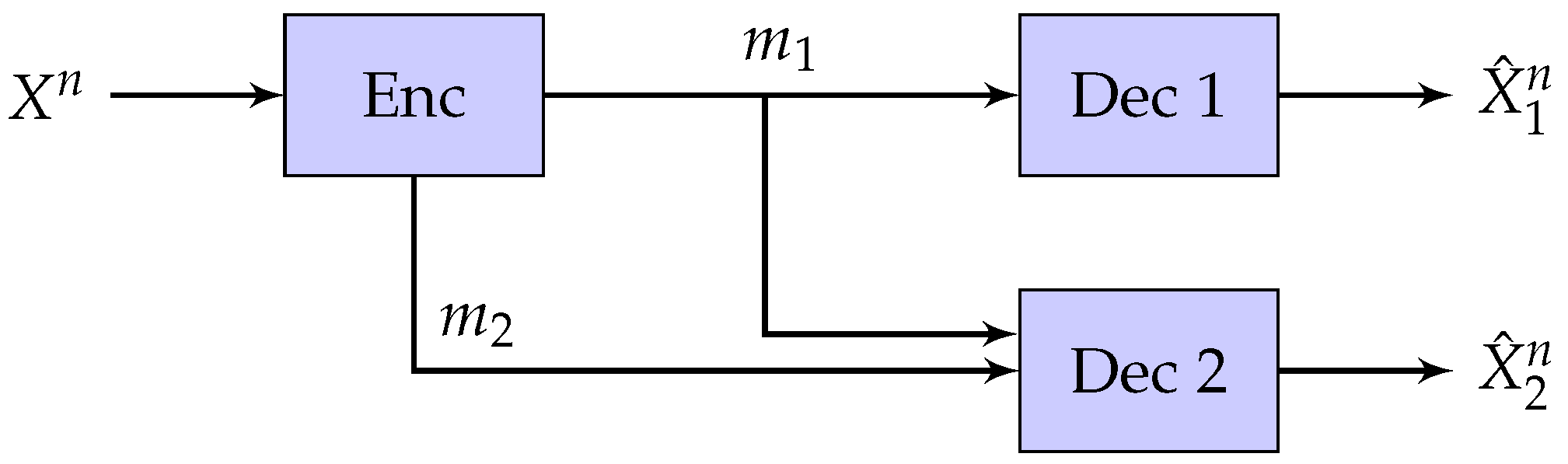
In this section, we review the successive refinement problem with two decoders. Let the source
be i.i.d. random vector with distribution
. The encoder wants to describe
to two decoders by sending a pair of messages
where
for
. The first decoder reconstructs
based only on the first message
. The second decoder reconstructs
based on both
and
. The setting is described in
Figure 1.
Let
be a distortion measure for
i-th decoder. The rates of code
are simply defined as
An -successive refinement code is a coding scheme with block length n and excess distortion probability where rates are and target distortions are . Since we have two decoders, the excess distortion probability is defined by .
Definition 1. A rate-distortion tuple is said to be achievable if there is a family of , -successive refinement code where For some special cases, both decoders can achieve the point-to-point optimum rates simultaneously.
Definition 2. Let denote the rate-distortion function of the i-th decoder for . If the rate-distortion tuple is achievable, then we say the source is successively refinable at . If the source is successively refinable at for all , then we say the source is successively refinable.
The following theorem provides a necessary and sufficient condition of successive refinable sources.
Theorem 1 ([7,8]). A source is successively refinable at if and only if there exists a conditional distribution such that forms a Markov chain andfor . Note that the above results of successive refinability can easily be generalized to the case of k decoders.
2.2. Logarithmic Loss
Let
be a set of discrete source symbols (
), and
be the set of probability measures on
. Logarithmic loss
is defined by
for
and
. Logarithmic loss between
n-tuples is defined by
i.e., the symbol-by-symbol extension of the single letter loss.
Let
be the discrete memoryless source with distribution
. Consider the lossy compression problem under logarithmic loss where the reconstruction alphabet is
. The rate-distortion function is given by
The following lemma provides a property of the rate-distortion function achieving conditional distribution.
Lemma 1. The rate-distortion function achieving conditional distribution satisfiesfor almost every . Conversely, if satisfies (1) and (2), then it is a rate-distortion function achieving conditional distribution, i.e., The key idea is that we can replace
Q by
, and have lower rate and distortion, i.e.,
which directly implies (
1).
Interestingly, since the rate-distortion function in this case is a straight line, a simple time sharing scheme achieves the optimal rate-distortion trade-off. More precisely, the encoder losslessly compresses only the first fraction of the source sequence components. Then, the decoder perfectly recovers those losslessly compressed components and uses as its reconstruction for the remaining part. The resulting scheme obviously achieves distortion D with rate .
Furthermore, this simple scheme directly implies successive refinability of the source. For , suppose the encoder losslessly compresses the first fraction of the source. Then, the first decoder can perfectly reconstruct fraction of the source with the message of rate and distortion while the second decoder can achieve distortion with rate . Since both decoders can achieve the best rate-distortion pair, it follows that any discrete memoryless source under logarithmic loss is successively refinable.
We can formally prove successive refinability of discrete memoryless source under logarithmic loss using Theorem 1. I.e., by finding random probability mass functions
that satisfy
where
forms a Markov chain.
Let
be a deterministic probability mass function (pmf) in
that has a unit mass at
x. In other words,
Then, consider random pmfs
. Since the support of
and
is finite, we can define the following conditional pmfs.
It is not hard to show that the above conditional pmfs satisfies (
3) and (
4).
4. Toward Lossy Compression with Low Complexity
As we mentioned in Remark 1, the choice of joint distribution
in the proof of Theorem 2 is not unique. In this section, we propose another joint distribution
that satisfies the conditions for successive refinability. It naturally suggests a new lossy compression algorithm which we will discuss in
Section 4.3.
4.1. Rate-Distortion Achieving Joint Distribution: Small
Recall that
. We first consider the case where
is not too large so that
is close to
. We will clarify this later. For simplicity, we further assume that
. Consider a random variable
with the following pmf for some
If it is clear from context, we simply use
for the sake of notation. We further define a random variable
Y that is independent to
Z such that
, where
denotes a sum modulo
s. This can be achieved by following pmf and conditional pmf.
If
, we have
. Also, it is clear that
increases as
increases. Since we assume that
is not too large, there exists
such that
. We will discuss about the case of general
in
Section 4.2. The joint distribution of
is given by
We are now ready to define the Markov chain. Let
and
for all
where
. For simplicity, we assume that
and
are not the same for all
. Since
is a one-to-one mapping, we have
Furthermore, forms a Markov chain since forms a Markov chain. Thus, the above construction of joint distribution satisfies the conditions for successive refinability.
4.2. Rate-Distortion Achieving Joint Distribution: General
The joint distribution in the previous section only works for small
. It is because
has a natural upper-bound from (
5) which is
. In this section, we generalize the proof in the previous section for general
. The key observation is that if we pick the maximum
, then
. This implies that we can focus on the smaller set of reconstruction alphabet
.
Let
, and define random variables
recursively. More precisely, we define the random variable
based on
for
.
where
Similar to the definition of
Y, we assume
and
are independent, and
denotes modulo
k sum. Each time step, the alphabet size of
decreases by one. Thus, we have
, and therefore
with probability 1. Furthermore, we have
For
, there exists
k such that
. Thus, there exists
Y that satisfies
and
for some
. This implies that
Similar to the previous section, we assume that if . Then, we can set which satisfies the conditions for successive refinability.
4.3. Iterative Lossy Compression Algorithm
The joint distribution from the previous section naturally suggests a simple successive refinement scheme. Consider the lossy compression problem where the source is i.i.d. and the distortion measure is . Let D be the target distortion, and be the rate of the scheme where is the rate-distortion function. Let be the rate-distortion achieving distribution.
For block length
n, we propose a new lossy compression scheme that mimics successive refinement with
decoders. Similar to the previous section, let
and
We further let for that satisfy . Now, we are ready to describe our coding scheme. Generate a sub-codebook where each sequence is generated according to i.i.d. for all m. Similarly, generate sub-codebooks for where each sequence is generated according to i.i.d. for all m.
Upon observing
, the encoder finds
that minimizes
where the distortion measure
is defined as follows.
Note that is simply the logarithmic loss between x and .
Similarly, for
, the encoder iteratively finds
that minimizes
where
Upon receiving
, the decoder reconstructs
Suppose
, and
. Similar to [
12,
14], this scheme has two main advantages compare to naive random coding scheme. First, the number of codewords in the proposed scheme is
, while the naive scheme requires
codewords. Also, in each iteration, the encoder finds the best codeword among
sub-codewords. Thus, the overall complexity is
as well. On the other hand, the naive scheme requires
complexity.
Remark 3. The proposed scheme constructs from binary sequences. The reconstruction after each stage can be viewed aswhere . Thus, the decoder starts from binary sequence , and the alphabet size increases by 1 at each iteration. After -th iteration, it reaches the final reconstruction where the size of alphabet is s.