Article

Symmetry, Entropy, Diversity and (Why Not?) Quantum Statistics in Society

Institut National de Sciences Appliquées, 20 Avenue des Buttes de Coësmes CS 70839, CEDEX 7, F35708 Rennes, France
Entropy 2019, 21(2), 144; https://doi.org/10.3390/e21020144
Submission received: 7 November 2018 / Revised: 27 December 2018 / Accepted: 28 January 2019 / Published: 3 February 2019

Abstract

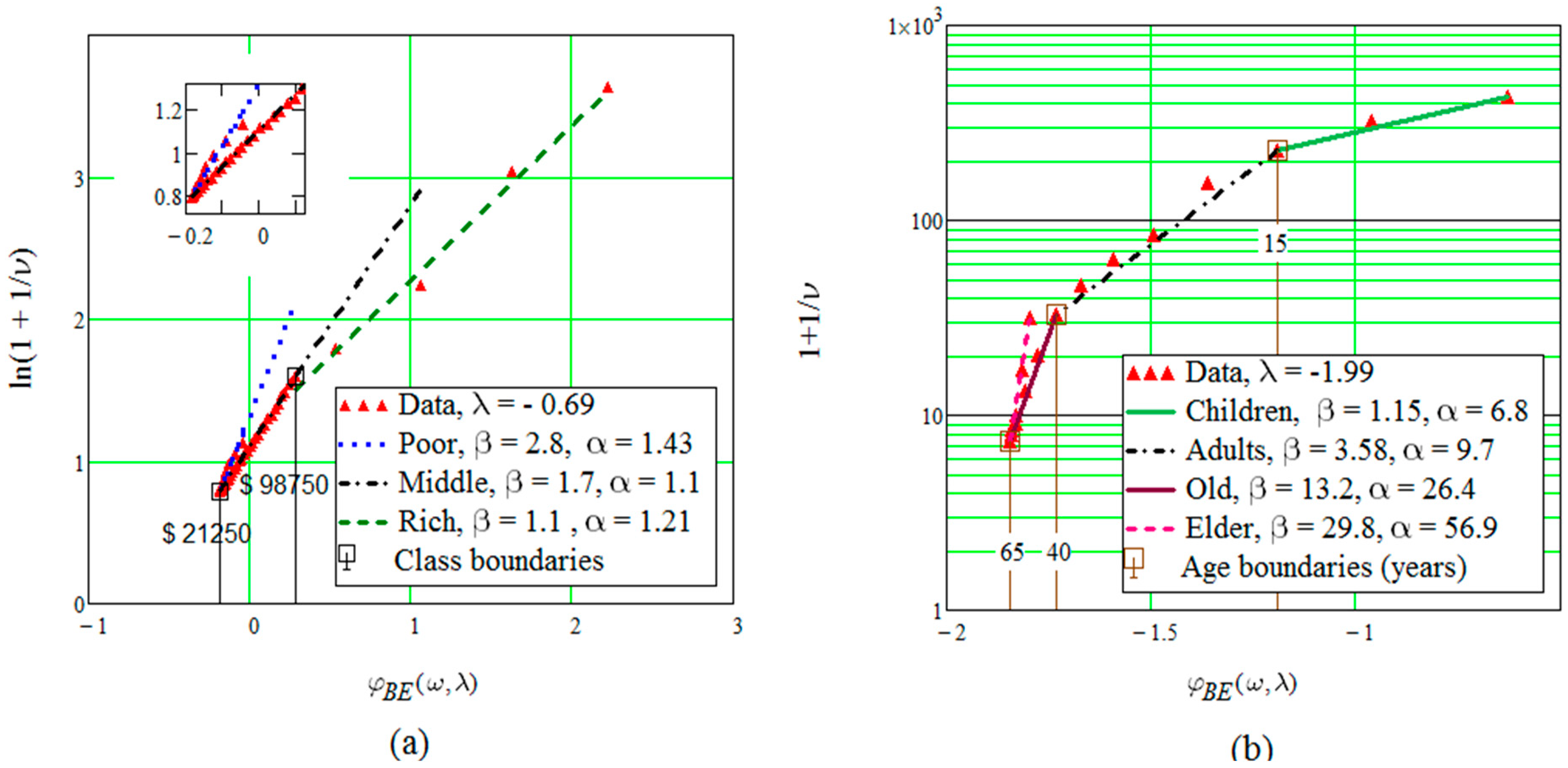
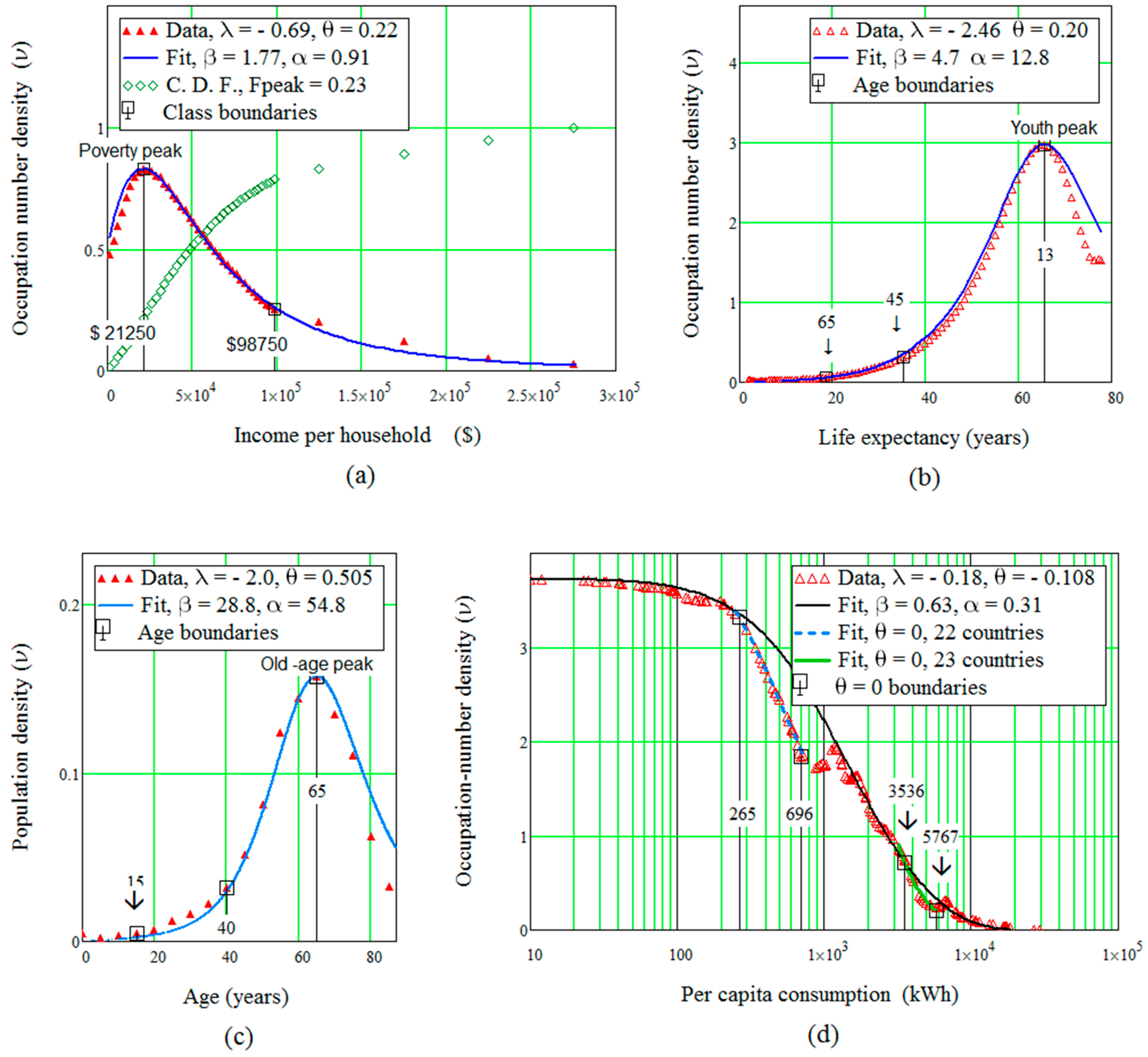
We describe society as an out-of-equilibrium probabilistic system: in it, N individuals occupy W resource states and produce entropy S over definite time periods. The resulting thermodynamics are however unusual, because a second entropy, H , measures inequality or diversity―a typically social feature―in the distribution of available resources. A symmetry phase transition takes place at Gini values 1 / 3 , where realistic distributions become asymmetric. Four constraints act on S : N and W , and new ones, diversity and interactions between individuals; the latter are determined by the coordinates of a single point in the data, the peak. The occupation number of a job is either zero or one, suggesting Fermi–Dirac statistics for employment. Contrariwise, an indefinite number of individuals can occupy a state defined as a quantile of income or of age, so Bose–Einstein statistics may be required. Indistinguishability rather than anonymity of individuals and resources is thus needed. Interactions between individuals define classes of equivalence that happen to coincide with acceptable definitions of social classes or periods in human life. The entropy S is non-extensive and obtainable from data. Theoretical laws are compared to empirical data in four different cases of economic or physiological diversity. Acceptable fits are found for all of them.
Keywords: entropy production; quantum-like systems; econophysics; indistinguishability; inequality; non-extensive entropy entropy production; quantum-like systems; econophysics; indistinguishability; inequality; non-extensive entropy