1. Introduction
A large variety of complex systems can be analyzed by constructing a model that relies on some network structure [
1,
2,
3,
4]. The model may be dynamical, meaning that the values of some (state) variables do change with time and, depending on the nature of such variables, we can have different types of network models. The first type corresponds to dynamic graphs that follow evolution laws defined explicitly on the network [
5,
6,
7,
8]; the second type gathers dynamical systems where the state variables are defined on a network [
9,
10]; finally, the third type refers to co-evolution models that combine evolving networks and dynamical systems. In the first and third type, the underlying network structure changes with time, defining a time-varying or evolving network [
11,
12]. In the present work, we first characterize the basic features of some simple models of evolving networks whose evolution does not depend on network structure; the time evolution of these features serves as a reference baseline signature of the behavior of simple models. Then, a model that makes use of network structure is proposed to reflect some real network characteristics. The analysis of this model shows several regimes that indicate a sophisticated behavior; for some regime, the network reaches a high clustering coefficient/link density ratio [
13] (when compared to the ratio values of baseline signatures), a common feature in many real networks.
The paper is organized as follows:
Section 2 presents the general framework for Dynamic Network Models and their characterization via some basic features, whereas entropy measures are shown in
Section 3.
Section 4 analyzes some simple evolution models whose basic features’ time evolution serves as a behavior reference baseline. More elaborated evolution models that depend on network structure are studied in
Section 5. Simulations of
Section 6 comparatively illustrate the time evolution of the different features for the proposed models. Finally, concluding remarks are summarized in
Section 7.
2. Characterization of Network Sequences via Basic Features
Following [
12], discrete-time network evolution over time can be generally defined by a random sequence or trajectory
, where each
can take values
g from
, being
the set of all possible networks. The analysis of
can be framed by considering it as a stochastic process, whose full characterization may be very complex. In the following, we present some basic features that help for a partial characterization of such stochastic process.
Time Evolution of Network Features
In some cases, we may be interested in the evolution of some quantifiable properties or features,
f, of the network, defined as follows (see [
14] for details):
where
is the function that computes such quantifiable property (number of links, number of triangles, connectivity, degree of nodes, entropy of degree distribution, etc.) in graph
g.
Note that, when is endowed with a probability space, then, under some regularity assumptions on f, this function defines a random vector. Therefore, the sequence defines a vector stochastic process that can be analyzed using standard stochastic process techniques. In the following analysis, we will focus on several of these properties such as the number of links, number of triangles, the connectivity and the degree distribution entropy (a scalar summary of the distribution vector). Since for these cases , the study will boil down to the analysis of scalar stochastic processes. A basic analysis would estimate, for instance, the deterministic sequence of expected values .
In the following section, we focus on different entropy measures that can also be employed for characterizing the stochastic process .
3. Entropy Measures for Stochastic Processes
The stochastic process
is an indexed sequence of random variables, which can be completely characterized until time instant
by its joint probability distribution
This joint distribution may be quite complex to study and, therefore, we may acquiesce in characterizing part of it. For instance, if we consider
for a fixed time
, this snapshot of the process, also called a cross sectional variable, can be represented by a “static” model such as the ones studied in [
14], fully characterized by the marginal distribution of
. Accordingly, when considering entropy measures for characterizing a stochastic process, different distributions associated with such process can be considered, as developed below.
3.1. Snapshot Entropy and Entropy of Network Features
The simplest approach focuses on the entropy analysis of cross sectional variables
. Hence, one can define the snapshot entropy of index
i,
, of a stochastic process as the entropy of the
i-th variable
of the process
When considering a network feature
f, the entropy of the associated random variable
satisfies the condition
and therefore
where the equality holds only if
f is an injection.
Note that
in (
4) is not to be confused with the feature mentioned in
Section 2.1 called
degree distribution entropy, associated with a concrete sample of
. For a more detailed explanation of degree distributions in static models, see [
14].
The computation of , when performed for every , would lead to a deterministic time series as an alternative partial characterization of the stochastic process .
3.2. Trajectory Entropy
Furthermore, one can study the entropy of a whole time period evolution of the process, seen as a sequence of
variables. We define the trajectory entropy (
) of a
-length time period of a stochastic process, as the entropy of the joint probability
:
If all
are independent variables, then:
Note that, in general, as
T increases,
may increase unbounded.
3.3. Normalized Asymptotic Entropy
Finally, one may want to characterize the entropy rate as a normalized entropy measure independent of
T, which globally characterizes the asymptotic behavior of the stochastic process. This entropy rate is defined as
whenever such limit exists. Alternatively, we can also compute
again when this limit does exist. For strongly stationary processes, both measures (
9) and (
10) do exist and they are equal.
After presenting these measures, some basic evolution models are illustrated in the next section.
4. Basic Evolution Models with a Fixed Number of Nodes: Evolution of Number of Links
Let us consider the set of all networks (or graphs) having a fixed set of nodes , with ; each is then characterized by its corresponding set of links with E being determined by V as the set of all pairs of nodes ().
In this framework, any evolution process is characterized by the sequence of the corresponding . In addition, since can be represented via its corresponding binary adjacency matrix , the evolution process can also be characterized as a sequence of adjacency matrices .
4.1. Evolution of the Number of Links
In general, a complete characterization of
will be very cumbersome. Alternatively, we can partially characterize such process by considering
where
f is the function that computes the number of links in the network. We can partition the set
into equivalence classes
so that each class
gathers all graphs containing
k links:
. Then, we can define a stochastic process
with each
which characterizes the transition between classes, and whose state space represents such equivalence classes (hence, we identify
with state
k).
In general, for a given instant of time
i, based on (
5), we have that the snapshot entropy of
and the entropy of
will satisfy
and this relationship will help to characterize
via the analysis of
. Therefore, the following proposed models will be partially characterized by analyzing the associated stochastic process,
, for the evolution of the number of links.
4.2. A Simple Structure Independent Evolution Model
We define a simple network evolution process that may serve as a reference baseline for comparison purposes. Given (equivalently, or ), the next time step network is generated by randomly selecting a pair of nodes so that, if there exists a link between them (i.e., ), such link is removed () and, if there is no link between the nodes (i.e., ), then it is created (). Note that if we consider the adjacency matrix representation , at each stage of time, an element of the matrix is randomly chosen so that its value is changed (from 0 to 1 or vice versa) to derive .
Note that the evolution law is determined by the number of links of
. Therefore, as mentioned above, we will start the analysis of this evolution model by characterizing the time evolution of the number of links. The corresponding
satisfies:
and for
:
This process is a Markov chain with transition probability matrix
which is known as the Ehrenfest model [
15], and which can be similarly interpreted as representing an urn with white and black balls, where we randomly select a ball and change it by another ball with different color, hence representing a sort of discrete-time birth–death Markov process [
16] but with finite number of states (two boundary conditions). Many discrete distributions have been obtained by studying urn models and Markov processes [
17,
18,
19]. Note that these models can be seen as a reference baseline since they do not exploit the network structure properties (i.e., the relative location of white balls and black balls).
The left stochastic, tri-diagonal, irreducible matrix
P of Equation (
17) has period 2, but it has a unique eigenvector associated with eigenvalue
. This eigenvector defines the stationary distribution of the process, denoted by
, and it can be easily proved that such distribution is binomial:
so that taking a snapshot of the process for large
t is equivalent to generating a sample from the Gilbert model [
20] with
or, equivalently, the uniform model with maximum entropy (see [
14] for details). Note that, given a number of links
, the distribution of
is uniform, each link having probability
. Hence, considering (
18), the entropy expression provided in (
13) becomes
measuring the entropy in bits.
Concerning the entropy of
, it is known that Ehrenfest model snapshot (relative) entropy at time
t, defined in terms of the Kullback–Leibler divergence between the distribution and the steady state equilibrium distribution
is non-decreasing in time as approaches the maximum value zero, upon the so called
H-Theorem [
21].
4.3. Extensions of the Model for Asymmetric Evolution
One can extend the symmetric model provided in (
17) with the aim of considering cases in which the network may have an uneven tendency to increase or decrease the number of edges.
Let us consider the following transition behavior from to : we start selecting a pair of nodes in network ; if the selected pair already has an associated link, such link is removed with probability , whereas, if such pair does not have an associated link, a link is added between such pair of nodes with probability . If no change (removal or addition) happens, the process is repeated until the network undergoes some modification, which is registered in .
Again, if we focus the analysis on the time evolution of the number of links,
, the corresponding transition matrix becomes:
The analysis of this system can be simplified if we denote
the
unbalance coefficient, since the matrix can be reformulated as
If
, the model has more tendency to add links than to remove them, and vice versa for
. The analysis and interpretation of the network behavior can be performed either way due to such symmetry. For instance, if
, the model can be interpreted as characterizing the following behavior: if the selected pair in
has an associated link, this link is removed with probability
u; if the pair does not have an associated link, then a link is added. Again, the selection procedure is repeated until a link is either removed or added, defining
.
It can be proved that the resulting stationary distribution has the form:
which can be seen as a generalization of the binomial distribution
via the new parameter
u.
Repeating a similar procedure to (
19) and (
20), the corresponding
entropy can be computed as
which for
becomes
.
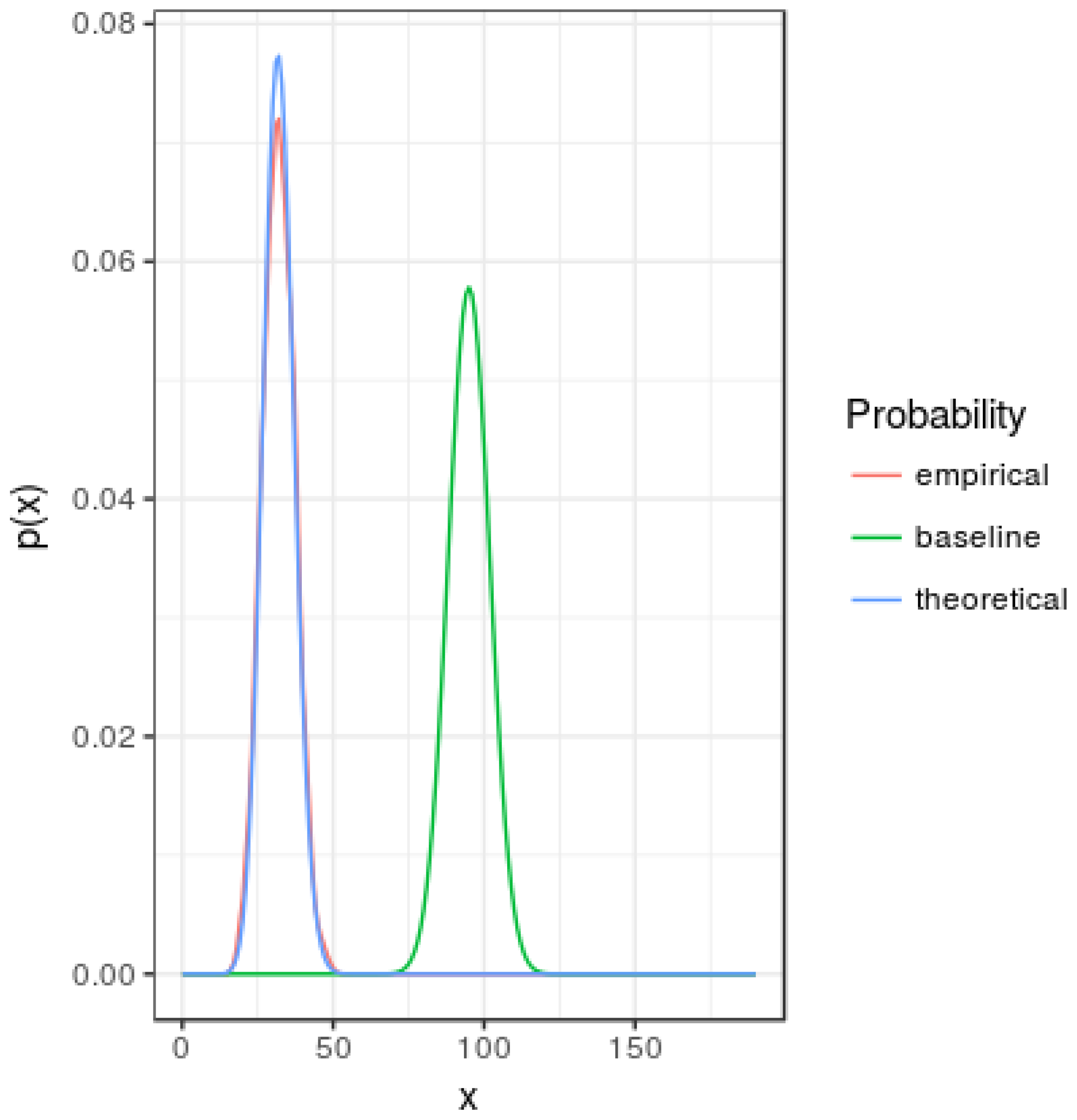
Figure 1 represents smoothed probability mass functions for the baseline, theoretical given by (
24) and empirical (based in simulations) with
and
. Note that asymmetry of the
u value generates a probability function with less entropy than the corresponding to the baseline mass function.
Alternative Simple Model
Another simple model could assume that, whenever an existing edge is selected to be removed, it is removed with probability
, whereas, alternatively, a new edge is randomly added. The transition matrix of the corresponding
for the number of links would be
Note that an equivalent symmetric model can be defined as follows. If the selected pair of nodes does not have an associated link, we add such a link with probability
; otherwise, an existing link is removed.
It can be proved that the resulting stationary distribution has the form:
which can be seen as another generalization of the binomial distribution
via the new parameter
. Again, the network snapshot entropy can be computed as
Both models (
23) and (
25) provide respectively stationary distributions (
24) and (
26), which, in general, are not binomial. Therefore, if we take a snapshot of these stationary distributions, the resulting network will follow a new static model, different from the standard known reference models for static networks.
Note that again these models can be interpreted as urn-derived finite state discrete-time birth-death models, in the sense that they do not incorporate network structural information, but only the total number of links. In other words, these models do not differentiate among networks that belong to the same equivalence class , i.e., they are structure independent.
The time evolution of the expected value for the number of links, the clustering coefficient, the connectivity and the sample degree distribution entropy define a vector time series that can be employed as a signature that characterizes the evolution models. The signature of the above considered structure independent models can be employed as a reference baseline to assess more complex behaviors.
In
Section 6, these signature quantities are estimated via simulation procedures.
5. Evolution Models Depending on Network Structure: Evolution of Clustering Coefficient
Usually, the evolution of networks depends not only on the number of links but also on the network structure. To illustrate this idea, we will analyze the behavior of models whose dynamics depend on the fact that triangles are going to be created or deleted in the network; then, the evolution of the clustering coefficient will be an essential feature to be considered.
Let us consider, for instance, an extension of the asymmetric model of
Section 4.3 where the probability of a given link to be added (or removed) may depend on the fact that a triangle will or will not be generated (or eliminated) when adding (or removing) such link. Precisely, the transition behavior from
to
is defined as follows:
a pair of nodes in network is uniformly selected.
- (a)
If the selected pair already has an associated link, such link is removed
- i.
with probability when the selected nodes have at least one common neighbor (hence, at least one triangle will be deleted), or
- ii.
with probability when the selected nodes do not have a common neighbor (no triangle will be deleted);
- (b)
if the selected pair does not have an associated link, a link is added between these nodes
- i.
with probability when the selected nodes have at least one common neighbor (hence, some new triangles will be generated), or
- ii.
with probability when the selected nodes do not have common neighbor (no triangle will be generated).
If no change (removal or addition) happens, the process is repeated until the network undergoes some modification, which is registered in .
The discrete process provided by this model remains invariant to a common scaling of all probability values, provided the proportion among them is preserved. Hence, such dynamical model behavior can be reformulated as a function of, for instance, the following three parameters, , and ; note that and measure the strength for favoring the creation and preservation of triangles, respectively, and the meaning of will become clear below. Note that this model is general enough to represent dynamic networks having a tendency to either create (and preserve) or eliminate triangles. In the specific case when and are larger than 1, triangle creation (and preservation) are promoted.
The analysis of this model can be complex since the existence and characterization of a stationary behavior may depend on the network size (number of nodes), the selected parameter values and the initial state
. Note that
cannot be directly defined anymore via a transition matrix of the type of (
22), (
23) or (
25), since the future evolution of such
depends not only on its actual value but also on some structural properties (i.e., the existence and location of triangles) of
. In addition, the existence and form of a limiting stationary distribution for
may be a complicated issue to deal with.
Two Regimes of Behavior
If we assume that
follows approximately a Gilbert model, the probability
of any pair of nodes
to have a common neighbor (i.e., they may take part of a triangle) depends on the ratio between the number of links
and the total number of node pairs
in
:
The value of
is very sensitive to the link density
. For large values of
N, we have that, if
then
remains small, approaching value 1 otherwise. Therefore, the behavior of the model presented in
Section 5 may be approximated considering two possible regimes.
Regime 1. For large enough
the probability of creating or deleting triangles is not negligible and the dynamics of the system are approximately governed by a model following (
23) with
.
Regime 2. For small
the probability of creating or deleting triangles is small and the dynamics of the system are approximately governed by a model following (
23) with
.
Hence, within each regime, the dynamics can be approximated via the baseline model (
23).
We now focus on the analysis for the cases where triangle creation and preservation is favored, meaning that both and would be larger than 1. Then, and several behaviors can be found depending on the concrete selected values for and (or ). Precisely, some regime may be transitory, or both may coexist as stationary behaviors depending on the selected initial conditions. In general, regime 1 will be more common since it fits with a wide range of possible values for ; only if is very large (note that it would imply a huge ) may we start with a satisfying regime 1 condition, but the expected value of stationary distribution for such may correspond to regime 2, so that the system may end up in such second regime. On the other hand, since regime 2 corresponds to a narrow range of small values of , a very large value of will be required for such regime to show up as stationary; if is not large enough, even if we start with a satisfying regime 2 condition, the expected value of stationary distribution for such may lie in the range of values corresponding to regime 1, so that the system may end up in such first regime. Finally, both regimes may coexist with large enough and small enough so that the respective expected values of stationary distributions correspond to each one of the regimes. Note that, if and are large enough to favor triangle creation and preservation, and may differ in some orders of magnitude allowing a natural coexistence of both regimes.
In the next section, different simulations are performed to characterize the time evolution of some basic features (e.g., the expected value for the number of links, the clustering coefficient, the connectivity and the sample degree distribution) for the dynamics models presented above.
6. Simulations for the Time Evolution of Features
Numerical simulations have been performed to characterize the time evolution of the number of links, the clustering coefficient and the entropy of the sample degree distribution for the extended model defined by (
23) and the structure dependent model presented in
Section 5.
6.1. Extended Asymmetric Model
We begin by characterizing the extended model defined by (
23).
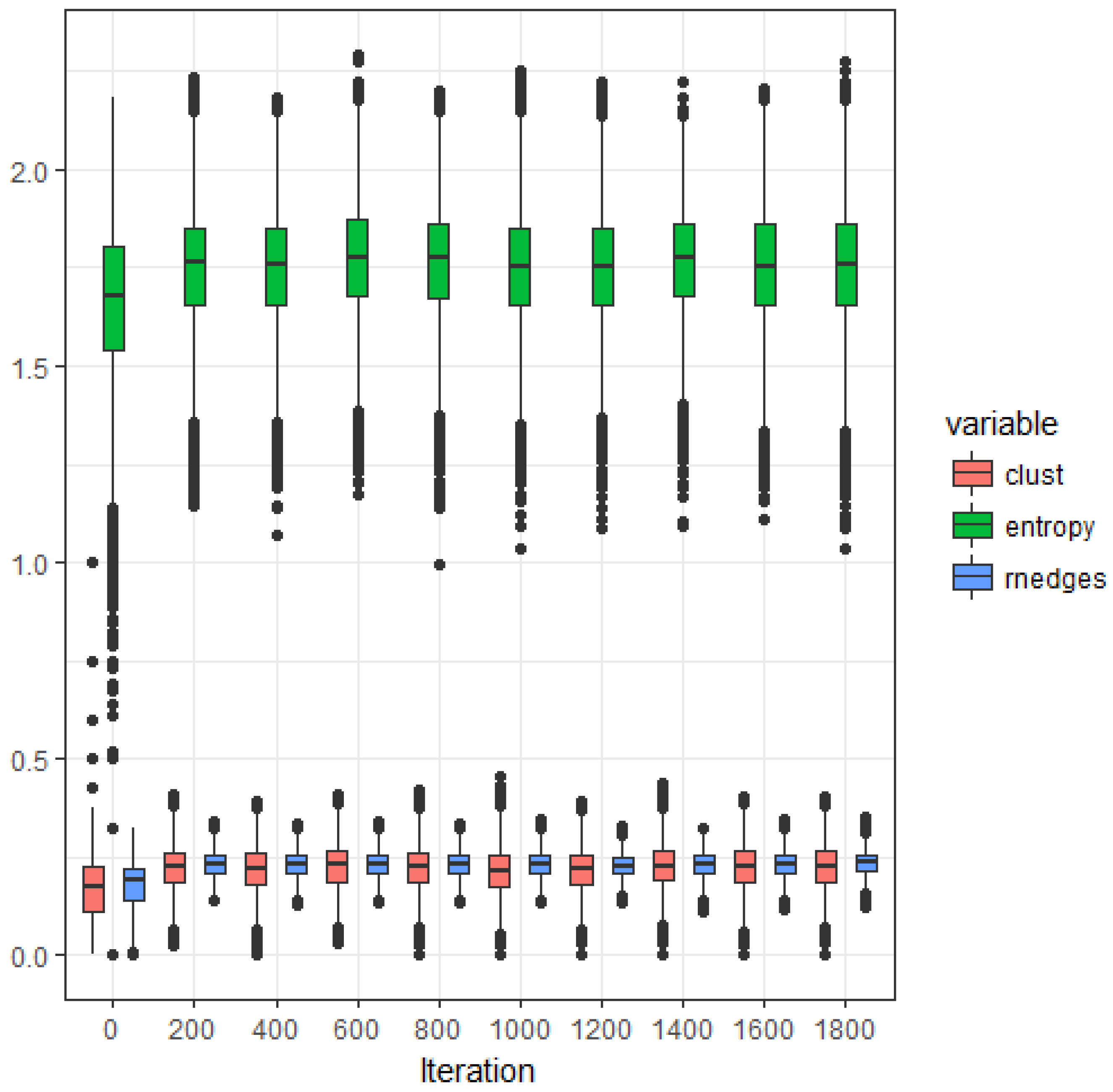
Figure 2 shows the evolution (starting from the empty graph) of the relative number of edges (i.e., edge density
), the clustering coefficient and the samples degree distribution entropy of a graph that evolves following the extended model defined by (
23) with
and
. The estimations of relative number of edges and clustering coefficient converge to the same stationary value as the iteration number increases; hence, their ratio converges to one, this value being a reference baseline signature of structure independent models. Note that the variance of the clustering coefficient is significantly larger than the variance corresponding the relative number of edges. The estimated degree distribution presents also a significant variance.
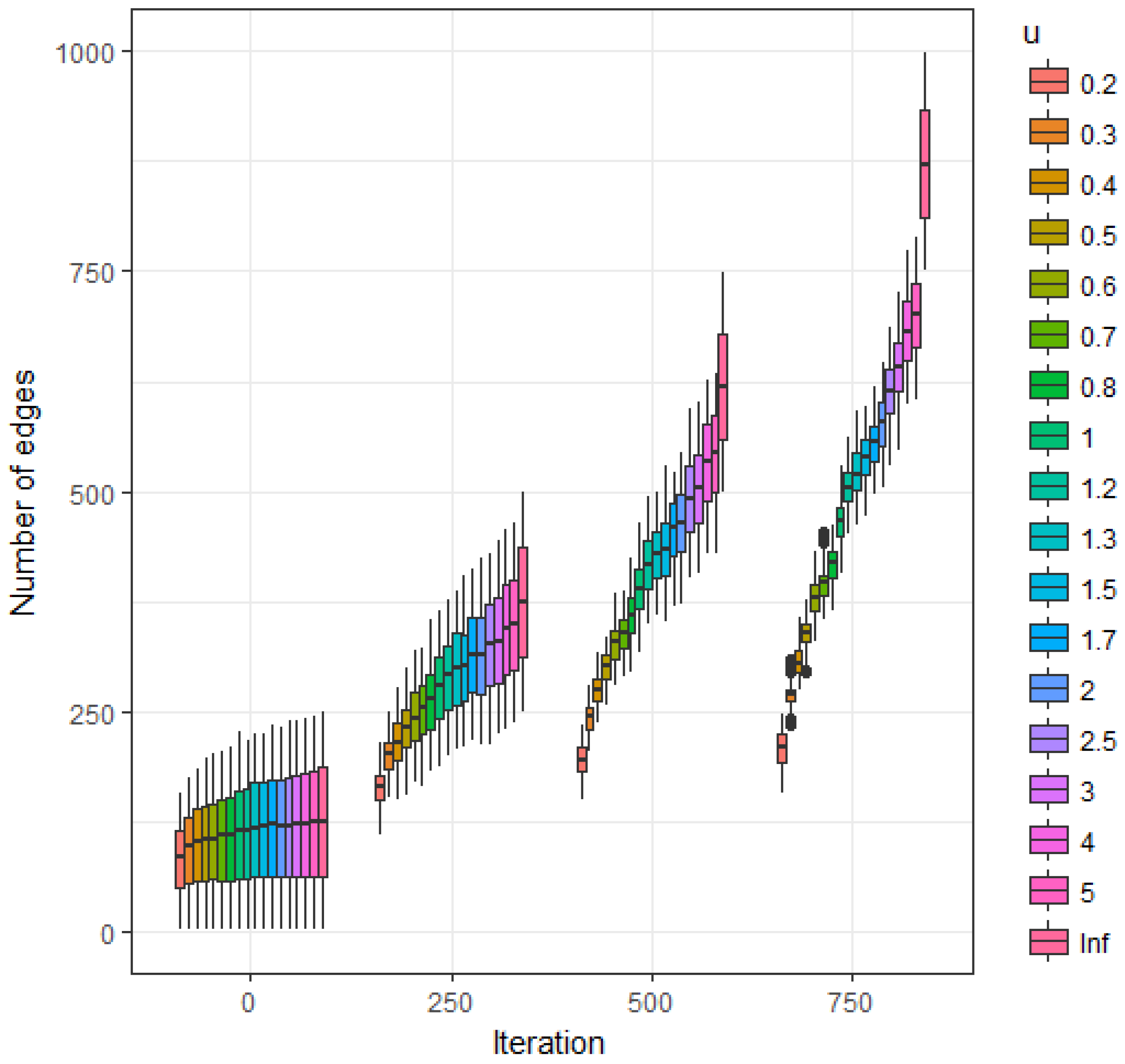
Figure 3 represents the estimated expected value of the number of edges as a function of iteration number (starting from the empty graph) and parameter
u. Due to the uniform nature of
the behavior of the clustering coefficient follows a similar behavior; again, this clustering coefficient/link density ratio value close to one is a reference baseline signature for these types of structure independent models.
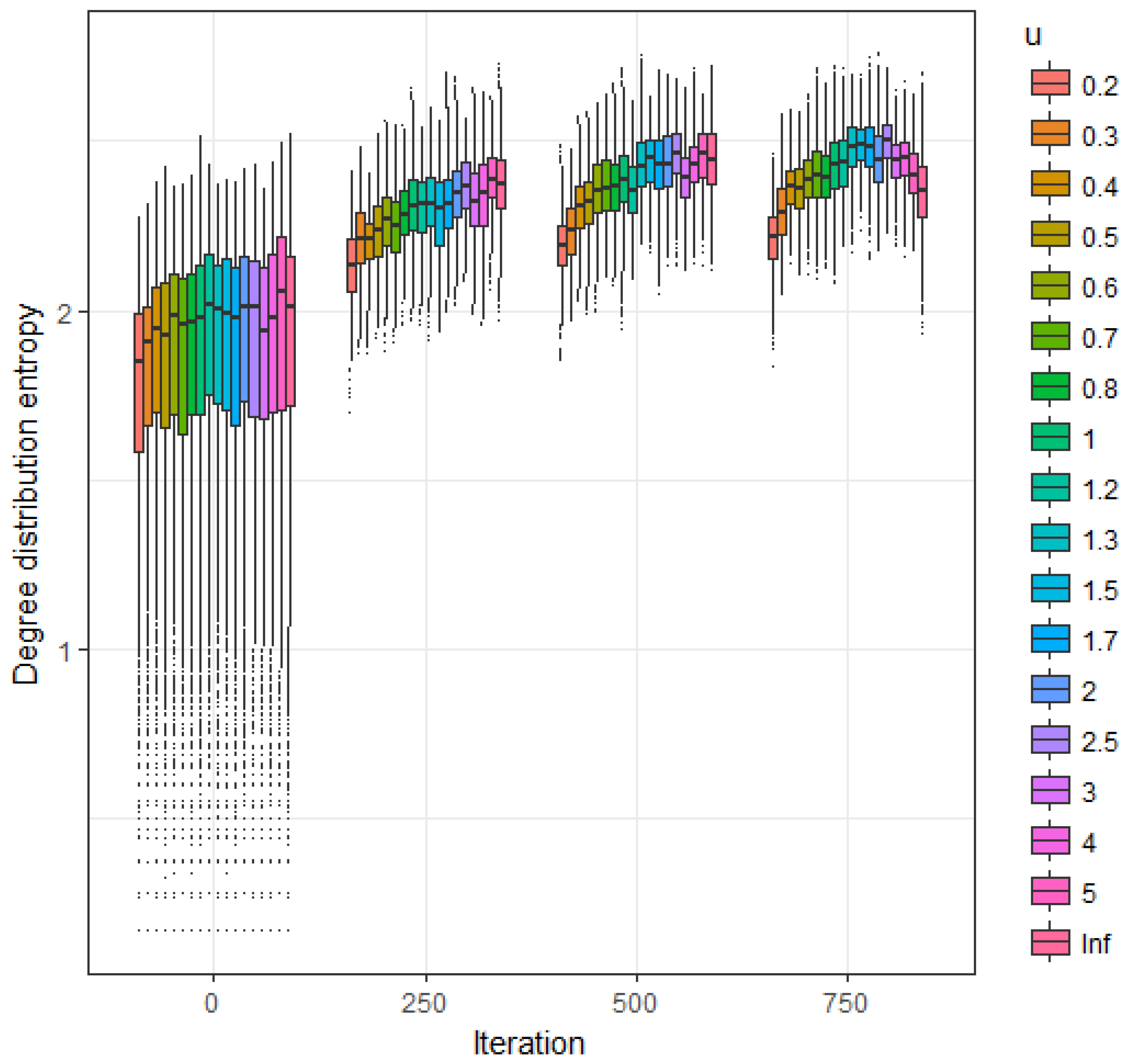
Figure 4 represents the estimated expected value of the sample degree distribution entropy as a function of iteration number (starting from the empty graph) and parameter
u. Larger values are obtained for
as also illustrated in
Figure 1.
6.2. Structure Depending Model
We now illustrate the behavior of some models of the type presented in
Section 5. A network with
has been considered, where different parameter values and initial conditions have been tested. In the following, we indicate some cases that illustrate the different behaviors:
If
,
,
and
(or, equivalently,
,
,
) the system always converges to a stationary behavior in regime 1, with link density
, and clustering coefficient
(hence the ratio
approaches 1 as it happens in Erdős–Renyi [
22] or Gilbert models).
If , , and (or, equivalently, , , ), the system always converges to a stationary behavior in regime 2, with link density , and oscillating clustering coefficient between 0 and (hence the ratio presents also large oscillations).
If , , and (or, equivalently, , , ), the system presents the two above illustrated regimes; and, depending on the initial condition, there is more or less probability to evolve within each one of these regimes:
- (a)
For following a Gilbert model with , the system is more likely to remain in regime 1 with link density , and clustering coefficient (hence the ratio approaches 1 as it happens in ER or Gilbert models).
- (b)
For following a Gilbert model with , the system is more likely to steadily remain (at least for a long time beyond the number of performed iterations) in regime 2 with link density , and clustering coefficient . Hence, the ratio evolves around 40; this large clustering coefficient in proportion to link density illustrates a very common feature of many real networks.
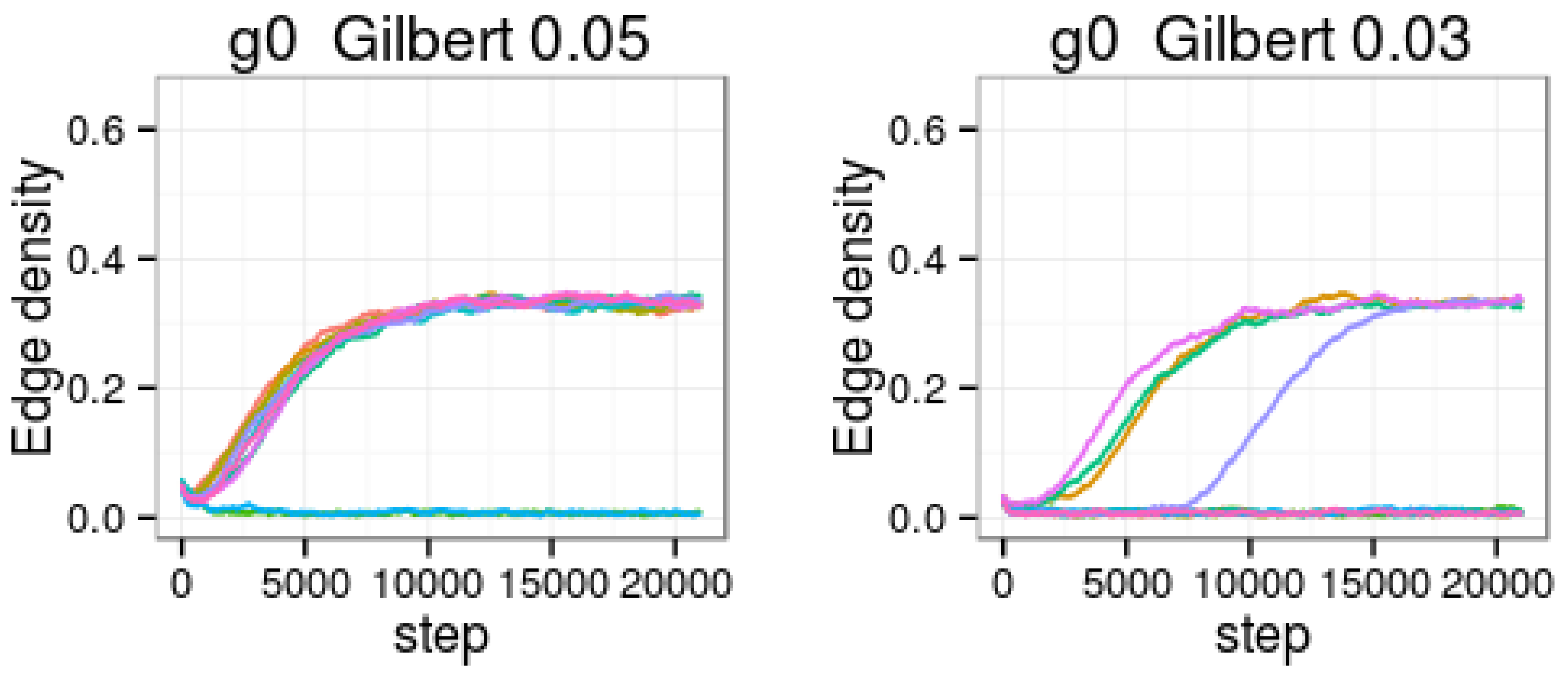
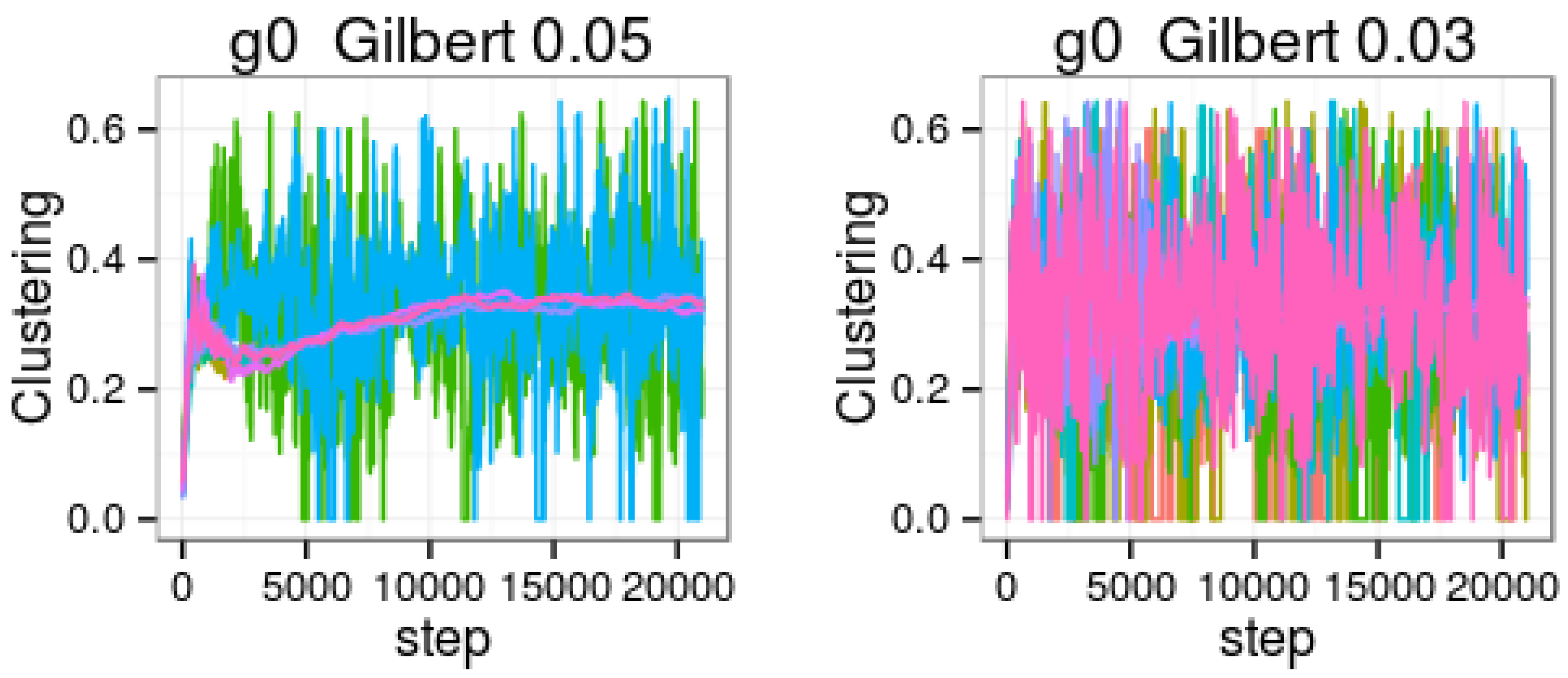
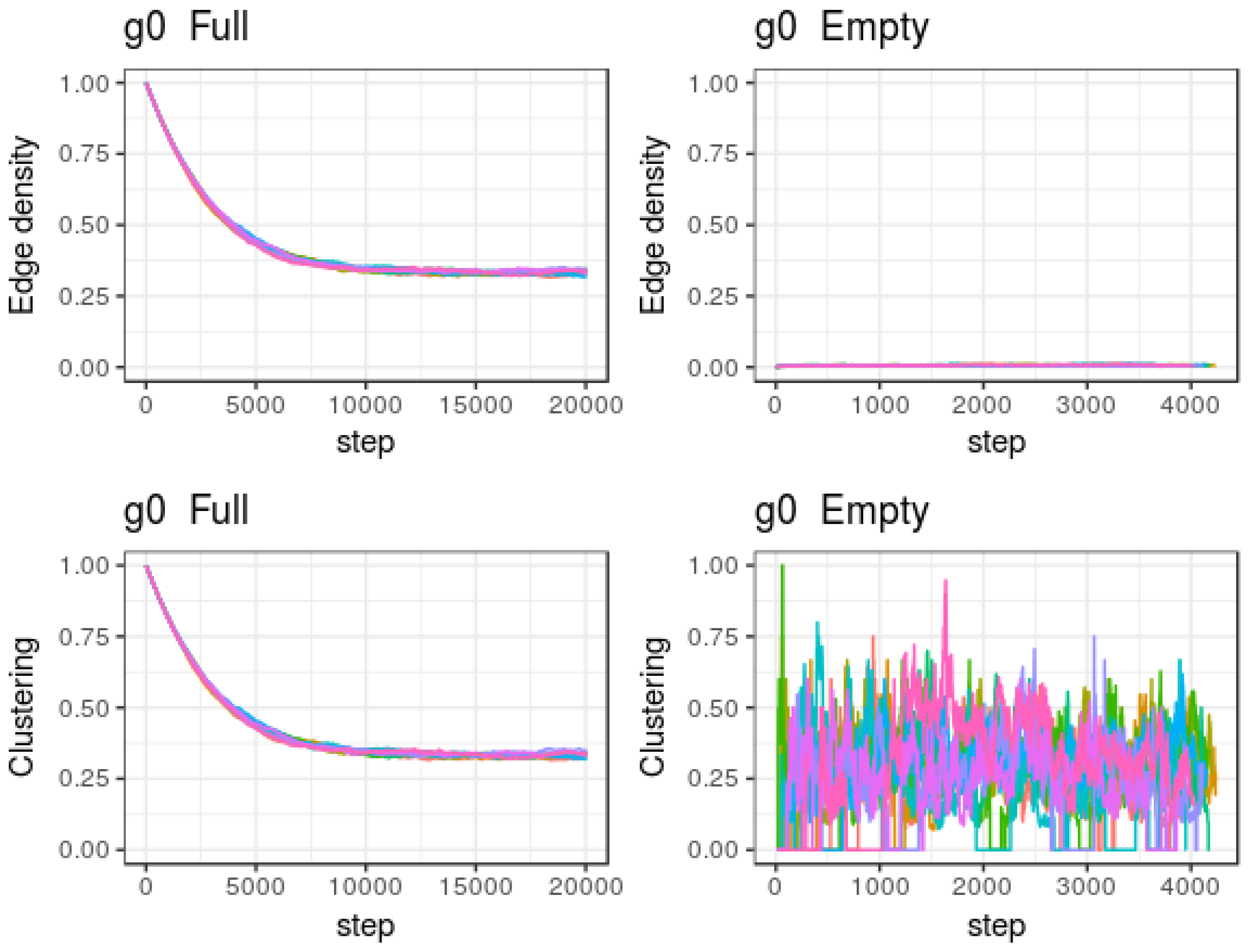
The two regime case is illustrated in
Figure 5 and
Figure 6, where the estimated expected value of the density of edges and the clustering coefficient as a function of the iteration number are presented for different initial condition graphs
.
Figure 5 illustrates the behavior when
is either the complete or the empty graph. All simulations starting from the complete graph led to regime 1, whereas all simulations starting from the empty graph led to regime 2.
Figure 6 illustrates the behavior for two cases when
is obtained as a sample of the Gilbert model with
and
, respectively. A majority of the simulations starting from a Gilbert
graph led to regime 1, whereas a majority of the simulations starting from a Gilbert
graph led to regime 2. These simulations illustrate approximately the size of the stochastic domains corresponding to each regime.
7. Conclusions
Several basic models for dynamic networks, based only on edge density, have been initially proposed and analyzed in terms of the time evolution of the number of links, clustering coefficient, connectivity and entropy of the sample degree distribution; the evolution of these features helps to characterize the proposed models and provides a reference baseline signature to assess more complex behaviors. The proposed model involving network structure presents a more sophisticated behavior and, for some regime, it leads to the generation of a high clustering coefficient/link density ratio when compared with the reference baseline values. This result is promising for the design of network models with tunable clustering coefficient with the aim to replicate some real networks characteristics.
The proposed framework will serve to assess, in a systematic manner, the properties of existing models as well as future more complex models for time evolving networks.
Author Contributions
P.J.Z. developed the conceptualization and formal analysis, wrote the document and helped with the simulations. I.B.-V. developed the simulations and helped with the theoretical content and the writing of the paper.
Funding
This research and the APC were funded by the Ministerio de Economía y Competitividad, Spain, grant number MTM2015-67396-P, and the ETSI Telecomunicación, Universidad Politécnica de Madrid.
Acknowledgments
This work has been partially supported by project MTM2015-67396-P of Ministerio de Economía y Competitividad, Spain.
Conflicts of Interest
The authors declare no conflict of interest.
References
- Watts, D.J.; Strogatz, S.H. Collective dynamics of “small-world” networks. Nature 1998, 393, 440–442. [Google Scholar] [CrossRef] [PubMed]
- Albert, R.; Barabási, A.L. Statistical mechanics of complex networks. Rev. Mod. Phys. 2002, 74, 47. [Google Scholar] [CrossRef]
- Newman, M. Networks: An Introduction; Oxford University Press: Oxford, UK, 2010. [Google Scholar]
- Newman, M.; Barabasi, A.L.; Watts, D.J. The Structure and Dynamics of Networks; Princeton University Press: Princeton, NJ, USA, 2011; Volume 19. [Google Scholar]
- Dorogovtsev, S.N.; Mendes, J.F. Evolution of Networks: From Biological Nets to the Internet and WWW; Oxford University Press: Oxford, UK, 2013. [Google Scholar]
- Siljak, D.D. Dynamic Graphs. Nonlinear Anal. Hybrid Syst. 2008, 2, 544–567. [Google Scholar] [CrossRef]
- Kejžar, N.; Nikoloski, Z.; Batagelj, V. Probabilistic inductive classes of graphs. J. Math. Sociol. 2008, 32, 85–109. [Google Scholar] [CrossRef]
- Holme, P.; Saramäki, J. Temporal networks. Phys. Rep. 2012, 519, 97–125. [Google Scholar] [CrossRef]
- Pastor-Satorras, R.; Vespignani, A. Epidemic spreading in scale-free networks. Phys. Rev. Lett. 2001, 86, 3200. [Google Scholar] [CrossRef] [PubMed]
- Rahmani, A.; Ji, M.; Mesbahi, M.; Egerstedt, M. Controllability of multi-agent systems from a graph-theoretic perspective. SIAM J. Control Optim. 2009, 48, 162–186. [Google Scholar] [CrossRef]
- Dorogovtsev, S.N.; Mendes, J.F. Evolution of networks. Adv. Phys. 2002, 51, 1079–1187. [Google Scholar] [CrossRef]
- Zufiria, P.J.; Barriales-Valbuena, I. Evolution models for dynamic networks. In Proceedings of the 2015 38th International Conference on Telecommunications and Signal Processing (TSP), Prague, Czech Republic, 9–11 July 2015; pp. 252–256. [Google Scholar]
- Herrera, C.; Zufiria, P.J. Generating scale-free networks with adjustable clustering coefficient via random walks. In Proceedings of the 2011 IEEE Network Science Workshop (NSW), West Point, NY, USA, 22–24 June 2011; pp. 167–172. [Google Scholar]
- Zufiria, P.J.; Barriales-Valbuena, I. Entropy Characterization of Random Network Models. Entropy 2017, 19, 321. [Google Scholar] [CrossRef]
- Klein, M.J. Entropy and the Ehrenfest urn model. Physica 1956, 22, 569–575. [Google Scholar] [CrossRef]
- Van Doorn, E.A.; Schrijner, P. Geometric ergodicity and quasi-stationarity in discrete-time birth-death processes. ANZIAM J. 1995, 37, 121–144. [Google Scholar]
- Feller, W. An Introduction to Probability Theory and Its Applications; Wiley: New York, NY, USA, 1968; Volume 1. [Google Scholar]
- Johnson, N.L.; Kemp, A.W.; Kotz, S. Univariate Discrete Distributions; John Wiley & Sons: New York, NY, USA, 2005; Volume 444. [Google Scholar]
- Kemp, A.W. Steady-state Markov chain models for certain q-confluent hypergeometric distributions. J. Stat. Plan. Inference 2005, 135, 107–120. [Google Scholar] [CrossRef]
- Gilbert, E.N. Random graphs. Ann. Math. Stat. 1959, 30, 1141–1144. [Google Scholar] [CrossRef]
- Morimoto, T. Markov processes and the H-theorem. J. Phys. Soc. Jpn. 1963, 18, 328–331. [Google Scholar] [CrossRef]
- Erdos, P.; Rényi, A. On the evolution of random graphs. Publ. Math. Inst. Hung. Acad. Sci. 1960, 5, 17–60. [Google Scholar]
© 2018 by the authors. Licensee MDPI, Basel, Switzerland. This article is an open access article distributed under the terms and conditions of the Creative Commons Attribution (CC BY) license (http://creativecommons.org/licenses/by/4.0/).