Abstract
Dividing the world into subsystems is an important component of the scientific method. The choice of subsystems, however, is not defined a priori. Typically, it is dictated by experimental capabilities, which may be different for different agents. Here, we propose a way to define subsystems in general physical theories, including theories beyond quantum and classical mechanics. Our construction associates every agent A with a subsystem , equipped with its set of states and its set of transformations. In quantum theory, this construction accommodates the notion of subsystems as factors of a tensor product, as well as the notion of subsystems associated with a subalgebra of operators. Classical systems can be interpreted as subsystems of quantum systems in different ways, by applying our construction to agents who have access to different sets of operations, including multiphase covariant channels and certain sets of free operations arising in the resource theory of quantum coherence. After illustrating the basic definitions, we restrict our attention to closed systems, that is, systems where all physical transformations act invertibly and where all states can be generated from a fixed initial state. For closed systems, we show that all the states of all subsystems admit a canonical purification. This result extends the purification principle to a broader setting, in which coherent superpositions can be interpreted as purifications of incoherent mixtures.
1. Introduction
The composition of systems and operations is a fundamental primitive in our modelling of the world. It has been investigated in depth in quantum information theory [1,2], and in the foundations of quantum mechanics, where composition has played a key role from the early days of Einstein–Podolski–Rosen [3] and Schroedinger [4]. At the level of frameworks, the most recent developments are the compositional frameworks of general probabilistic theories [5,6,7,8,9,10,11,12,13,14,15] and categorical quantum mechanics [16,17,18,19,20].
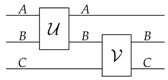
The mathematical structure underpinning most compositional approaches is the structure of monoidal category [18,21]. Informally, a monoidal category describes circuits, in which wires represent systems and boxes represent operations, as in the following diagram:
The composition of systems is described by a binary operation denoted by ⊗, and referred to as the “tensor product” (note that ⊗ is not necessarily a tensor product of vector spaces). The system is interpreted as the composite system made of subsystems A and B. Larger systems are built in a bottom-up fashion, by combining subsystems together. For example, a quantum system of dimension can arise from the composition of n single qubits.
In some situations, having a rigid decomposition into subsystems is neither the most convenient nor the most natural approach. For example, in algebraic quantum field theory [22], it is natural to start from a single system—the field—and then to identify subsystems, e.g., spatial or temporal modes. The construction of the subsystems is rather flexible, as there is no privileged decomposition of the field into modes. Another example of flexible decomposition into subsystems arises in quantum information, where it is crucial to identify degrees of freedom that can be treated as “qubits”. Viola, Knill, and Laflamme [23] and Zanardi, Lidar, and Lloyd [24] proposed that the partition of a system into subsystems should depend on which operations are experimentally accessible. This flexible definition of subsystem has been exploited in quantum error correction, where decoherence free subsystems are used to construct logical qubits that are untouched by noise [25,26,27,28,29,30]. The logical qubits are described by “virtual subsystems" of the total Hilbert space [31], and in general such subsystems are spread over many physical qubits. In all these examples, the subsystems are constructed through an algebraic procedure, whereby the subsystems are associated with algebras of observables [32]. However, the notion of “algebra of observables” is less appealing in the context of general physical theories, because the multiplication of two observables may not be defined. For example, in the framework of general probabilistic theories [5,6,7,8,9,10,11,12,13,14,15], observables represent measurement procedures, and there is no notion of “multiplication of two measurement procedures”.
In this paper, we propose a construction of subsystems that can be applied to general physical theories, even in scenarios where observables and measurements are not included in the framework. The core of our construction is to associate subsystems to sets of operations, rather than observables. To fix ideas, it is helpful to think that the operations can be performed by some agent. Given a set of operations, the construction extracts the degrees of freedom that are acted upon only by those operations, identifying a “private space” that only the agent can access. Such a private space then becomes the subsystem, equipped with its own set of states and its own set of operations. This construction is closely related to an approach proposed by Krämer and del Rio, in which the states of a subsystem are identified with equivalence classes of states of the global system [33]. In this paper, we extend the equivalence relation to transformations, providing a complete description of the subsystems. We illustrate the construction in a several examples, including
- quantum subsystems associated with the tensor product of two Hilbert spaces,
- subsystems associated with an subalgebra of self-adjoint operators on a given Hilbert space,
- classical systems of quantum systems,
- subsystems associated with the action of a group representation on a given Hilbert space.
The example of the classical systems has interesting implications for the resource theory of coherence [34,35,36,37,38,39,40,41]. Our construction implies that different types of agents, corresponding to different choices of free operations, are associated with the same subsystem, namely the largest classical subsystem of a given quantum system. Specifically, classical systems arise from strictly incoherent operations [41], physically incoherent operations [38,39], phase covariant operations [38,39,40], and multiphase covariant operations (to the best of our knowledge, multiphase covariant operations have not been considered so far in the resource theory of coherence). Notably, we do not obtain classical subsystems from the maximally incoherent operations [34] and from the incoherent operations [35,36], which are the first two sets of free operations proposed in the resource theory of coherence. For these two types of operations, we find that the associated subsystem is the whole quantum system.
After examining the above examples, we explore the general features of our construction. An interesting feature is that certain properties, such as the impossibility of instantaneous signalling between two distinct subsystems, arise by fiat, rather then being postulated as physical requirements. This fact is potentially useful for the project of finding new axiomatizations of quantum theory [42,43,44,45,46,47,48] because it suggests that some of the axioms assumed in the usual (compositional) framework may turn out to be consequences of the very definition of subsystem. Leveraging on this fact, one could hope to find axiomatizations with a smaller number of axioms that pinpoint exactly the distinctive features of quantum theory. In addition, our construction suggests a desideratum that every truly fundamental axiom should arguably satisfy: an axiom for quantum theory should hold for all possible subsystems of quantum systems. We call this requirement Consistency Across Subsystems. If one accepts our broad definition of subsystems, then Consistency Across Subsystems is a very non-trivial requirement, which is not easily satisfied. For example, the Subspace Axiom [5], stating that all systems with the same number of distinguishable states are equivalent, does not satisfy Consistency Across Subsystems because classical subsystems are not equivalent to the corresponding quantum systems, even if they have the same number of distinguishable states.
In general, proving that Consistence Across Subsystems is satisfied may require great effort. Rather than inspecting the existing axioms and checking whether or not they are consistent across subsystems, one can try to formulate the axioms in a way that guarantees the validity of this property. We illustrate this idea in the case of the Purification Principle [8,12,13,15,49,50,51], which is the key ingredient in the quantum axiomatization of Refs. [13,15,42] and plays a central role in the axiomatic foundation of quantum thermodynamics [52,53,54] and quantum information protocols [8,15,55,56,57]. Specifically, we show that the Purification Principle holds for closed systems, defined as systems where all transformations are invertible, and where every state can be generated from a fixed initial state by the action of a suitable transformation. Closed systems satisfy the Conservation of Information [58], i.e., the requirement that physical dynamics should send distinct states to distinct states. Moreover, the states of the closed systems can be interpreted as “pure”. In this setting, the general notion of subsystem captures the idea of purification, and extends it to a broader setting, allowing us to regard coherent superpositions as the “purifications” of classical probability distributions.
The paper is structured as follows. In Section 2, we outline related works. In Section 3, we present the main framework and the construction of subsystems. The framework is illustrated with five concrete examples in Section 4. In Section 5, we discuss the key structures arising from our construction, such as the notion of partial trace and the validity of the no-signalling property. In Section 6, we identify two requirements, concerning the existence of agents with non-overlapping sets of operations, and the ability to generate all states from a given initial state. We also highlight the relation between the second requirement and the notion of causality. We then move to systems satisfying the Conservation of Information (Section 7) and we formalize an abstract notion of closed systems (Section 8). For such systems, we provide a dynamical notion of pure states, and we prove that every subsystem satisfies the Purification Principle (Section 9). A macro-example, dealing with group representations in quantum theory is provided in Section 10. Finally, the conclusions are drawn in Section 11.
2. Related Works
In quantum theory, the canonical route to the definition of subsystems is to consider commuting algebras of observables, associated with independent subsystems. The idea of defining independence in terms of commutation has a long tradition in quantum field theory and, more recently, quantum information theory. In algebraic quantum field theory [22], the local subsystems associated with causally disconnected regions of spacetime are described by commuting C*-algebras. A closely related approach is to associate quantum systems to von Neumann algebras, which can be characterized as double commutants [59]. In quantum error correction, decoherence free subsystems are associated with the commutant of the noise operators [28,29,31]. In this context, Viola, Knill, and Laflamme [23] and Zanardi, Lidar, and Lloyd [24] made the point that subsystems should be defined operationally, in terms of the experimentally accessible operations. The canonical approach of associating subsystems to subalgebras was further generalized by Barnum, Knill, Ortiz, and Viola [60,61], who proposed the notion of generalized entanglement, i.e., entanglement relative to a subspace of operators. Later, Barnum, Ortiz, Somma, and Viola explored this notion in the context of general probabilistic theories [62].
The above works provided a concrete model of subsystems that inspired the present work. An important difference, however, is that here we will not use the notions of observable and expectation value. In fact, we will not use any probabilistic notion, making our construction usable also in frameworks where no notion of measurement is present. This makes the construction appealingly simple, although the flip side is that more work will have to be done in order to recover the probabilistic features that are built-in in other frameworks.
More recently, del Rio, Krämer, and Renner [63] proposed a general framework for representing the knowledge of agents in general theories (see also the Ph.D. theses of del Rio [64] and Krämer [65]). Krämer and del Rio further developed the framework to address a number of questions related to locality, associating agents to monoids of operations, and introducing a relation, called convergence through a monoid, among states of a global system [33]. Here, we will extend this relation to transformations, and we will propose a general definition of subsystem, equipped with its set of states and its set of transformations.
Another related work is the work of Brassard and Raymond-Robichaud on no-signalling and local realism [66]. There, the authors adopt an equivalence relation on transformations, stating that two transformations are equivalent iff they can be transformed into one another through composition with a local reversible transformation. Such a relation is related to the equivalence relation on transformations considered in this paper, in the case of systems satisfying the Conservation of Information. It is interesting to observe that, notwithstanding the different scopes of Ref. [66] and this paper, the Conservation of Information plays an important role in both. Ref. [66], along with discussions with Gilles Brassard during QIP 2017 in Seattle, provided inspiration for the present paper.
3. Constructing Subsystems
Here, we outline the basic definitions and the construction of subsystems.
3.1. A Pre-Operational Framework
Our starting point is to consider a single system S, with a given set of states and a given set of transformations. One could think S to be the whole universe, or, more modestly, our “universe of discourse”, representing the fragment of the world of which we have made a mathematical model. We denote by the set of states of the system (sometimes called the “state space”), and by be the set of transformations the system can undergo. We assume that is equipped with a composition operation ∘, which maps a pair of transformations and into the transformation . The transformation is interpreted as the transformation occurring when happens right before . We also assume that there exists an identity operation , satisfying the condition for every transformation . In short, we assume that the physical transformations form a monoid.
We do not assume any structure on the state space : in particular, we do not assume that is convex. We do assume, however, is that there is an action of the monoid on the set : given an input state and a transformation , the action of the transformation produces the output state .
Example 1 (Closed quantum systems).
Let us illustrate the basic framework with a textbook example, involving a closed quantum system evolving under unitary dynamics. Here, S is a quantum system of dimension d, and the state space is the set of pure quantum states, represented as rays on the complex vector space , or equivalently, as rank-one projectors. With this choice, we have
The physical transformations are represented by unitary channels, i.e., by maps of the form , where is a unitary d-by-d matrix over the complex field. In short, we have
where I is the d-by-d identity matrix. The physical transformations form a monoid, with the composition operation induced by the matrix multiplication .
Example 2 (Open quantum systems).
Generally, a quantum system can be in a mixed state and can undergo an irreversible evolution. To account for this scenario, we must take the state space to be the set of all density matrices. For a system of dimension d, this means that the state space is
where denotes the matrix trace, and means that the matrix ρ is positive semidefinite. is the set of all quantum channels [67], i.e., the set of all linear, completely positive, and trace-preserving maps from to itself. The action of the quantum channel on a generic state ρ can be specified through the Kraus representation [68]
where is a set of matrices satisfying the condition . The composition of two transformations and S is given by the composition of the corresponding linear maps.
Note that, at this stage, there is no notion of measurement in the framework. The sets and are meant as a model of system S irrespectively of anybody’s ability to measure it, or even to operate on it. For this reason, we call this layer of the framework pre-operational. One can think of the pre-operational framework as the arena in which agents will act. Of course, the physical description of such an arena might have been suggested by experiments done earlier on by other agents, but this fact is inessential for the scope of our paper.
3.2. Agents
Let us introduce agents into the picture. In our framework, an agent A is identified a set of transformations, denoted as and interpreted as the possible actions of A on S. Since the actions must be allowed physical processes, the inclusion must hold. It is natural, but not strictly necessary, to assume that the concatenation of two actions is a valid action, and that the identity transformation is a valid action. When these assumptions are made, is a monoid. Still, the construction presented in the following will hold not only for monoids, but also for generic sets . Hence, we adopt the following minimal definition:
Definition 1 (Agents).
An agent A is identified by a subset .
Note that this definition captures only one aspect of agency. Other aspects—such as the ability to gather information, make decisions, and interact with other agents—are important too, but not necessary for the scope of this paper.
We also stress that the interpretation of the subset as the set of actions of an agent is not strictly necessary for the validity of our results. Nevertheless, the notion of “agent” here is useful because it helps explaining the rationale of our construction. The role of the agent is somehow similar to the role of a “probe charge” in classical electromagnetism. The probe charge need not exist in reality, but helps—as a conceptual tool—to give operational meaning to the magnitude and direction of the electric field.
In general, the set of actions available to agent A may be smaller than the set of all physical transformations on S. In addition, there may be other agents that act on system S independently of agent A. We define the independence of actions in the following way:
Definition 2.
Agents A and B act independently if the order in which they act is irrelevant, namely
In a very primitive sense, the above relation expresses the fact that A and B act on “different degrees of freedom” of the system.
Remark 1 (Commutation of transformations vs. commutation of observables).
Commutation conditions similar to Equation (6) are of fundamental importance in quantum field theory, where they are known under the names of “Einstein causality” [69] and “Microcausality” [70]. However, the similarity should not mislead the reader. The field theoretic conditions are expressed in terms of operator algebras. The condition is that the operators associated with independent systems commute. For example, a system localized in a certain region could be associated with the operator algebra , and another system localized in another region could be associated with the operator algebra . In this situation, the commutation condition reads
In contrast, Equation (6) is a condition on the transformations , and not on the observables, which are not even described by our framework. In quantum theory, Equation (6) is a condition on the completely positive maps, and not to the elements of the algebras and . In Section 4, we will bridge the gap between our framework and the usual algebraic framework, focussing on the scenario where and are finite dimensional von Neumann algebras.
3.3. Adversaries and Degradation
From the point of view of agent A, it is important to identify the degrees of freedom that no other agent B can affect. In an adversarial setting, agent B can be viewed as an adversary that tries to control as much of the system as possible.
Definition 3 (Adversary).
Let A be an agent and let be her set of operations. An adversary of A is an agent B that acts independently of A, i.e., an agent B whose set of actions satisfies
Like the agent, the adversary is a conceptual tool, which will be used to illustrate our notion of subsystem. The adversary need not be a real physical entity, localized outside the agent’s laboratory, and trying to counteract the agent’s actions. Mathematically, the adversary is just a subset of the commutant of . The interpretation of B as an “adversary” is a way to “give life to to the mathematics”, and to illustrate the rationale of our construction.
When B is interpreted as an adversary, we can think of his actions as a “degradation”, which compromises states and transformations. We denote the degradation relation as , and write
for or .
The states that can be obtained by degrading will be denoted as
The transformations that can be obtained by degrading will be denoted as
The more operations B can perform, the more powerful B will be as an adversary. The most powerful adversary compatible with the independence condition (6) is the adversary that can implement all transformations in the commutant of :
Definition 4.
The maximal adversary of agent A is the agent that can perform the actions .
Note that the actions of the maximal adversary are automatically a monoid, even if the set is not. Indeed,
- the identity map commutes with all operations in , and
- if and commute with every operation in , then also their composition will commute with all the operations in .
In the following, we will use the maximal adversary to define the subsystem associated with agent A.
3.4. The States of the Subsystem
Given an agent A, we think of the subsystem to be the collection of all degrees of freedom that are unaffected by the action of the maximal adversary . Consistently with this intuitive picture, we partition the states of S into disjoint subsets, with the interpretation that two states are in the same subset if and only if they correspond to the same state of subsystem .
We denote by the subset of containing the state . To construct the state space of the subsystem, we adopt the following rule:
Rule 1.
If the state ψ is obtained from the state ϕ through degradation, i.e., if , then ψ and ϕ must correspond to the same state of subsystem , i.e., one must have .
Rule 1 imposes that all states in the set must be contained in the set . Furthermore, we have the following fact:
Proposition 1.
If the sets and have non-trivial intersection, then
Proof.
By Rule 1, every element of is contained in . Similarly, every element of is contained in . Hence, if and have non-trivial intersection, then also and have non-trivial intersection. Since the sets and belong to a disjoint partition, we conclude that . ☐
Generalizing the above argument, it is clear that two states and must be in the same subset if there exists a finite sequence such that
When this is the case, we write . Note that the relation is an equivalence relation. When the relation holds, we say that and are equivalent for agent A. We denote the equivalence class of the state by .
By Rule 1, the whole equivalence class must be contained in the set , meaning that all states in the equivalence class must correspond to the same state of subsystem . Since we are not constrained by any other condition, we make the minimal choice
In summary, the state space of system is
3.5. The Transformations of a Subsystem
The transformations of system can also be constructed through equivalence classes. Before taking equivalence classes, however, we need a candidate set of transformations that can be interpreted as acting exclusively on subsystem . The largest candidate set is the set of all transformations that commute with the actions of the maximal adversary , namely
In general, could be larger than , in agreement with the fact the set of physical transformations of system could be larger than the set of operations that agent A can perform. For example, agent A could have access only to noisy operations, while another, more technologically advanced agent could perform more accurate operations on the same subsystem.
For two transformations and in , the degradation relation takes the simple form
As we did for the set of states, we now partition the set into disjoint subsets, with the interpretation that two transformations act in the same way on the subsystem if and only if they belong to the same subset.
Let us denote by the subset containing the transformation . To find the appropriate partition of into disjoint subsets, we adopt the following rule:
Rule 2.
If the transformation is obtained from the transformation through degradation, i.e., if , then and must act in the same way on the subsystem , i.e., they must satisfy .
Intuitively, the motivation for the above rule is that system is defined as the system that is not affected by the action of the adversary.
Rule 2 implies that all transformations in must be contained in . Moreover, we have the following:
Proposition 2.
If the sets and have non-trivial intersection, then .
Proof.
By Rule 2, every element of is contained in . Similarly, every element of is contained in . Hence, if and have non-trivial intersection, then also and have non-trivial intersection. Since the sets and belong to a disjoint partition, we conclude that . ☐
Using the above proposition, we obtain that the equality holds whenever there exists a finite sequence such that
When the above relation is satisfied, we write and we say that and are equivalent for agent A. It is immediate to check that is an equivalence relation. We denote the equivalence class of the transformation as .
By Rule 2, all the elements of must be contained in the set , i.e., they should correspond to the same transformation on . Again, we make the minimal choice: we stipulate that the set coincides exactly with the equivalence class . Hence, the transformations of subsystem are
The composition of two transformations and is defined in the obvious way, namely
Similarly, the action of the transformations on the states is defined as
In Appendix A, we show that definitions (20) and (21) are well-posed, in the sense that their right-hand sides are independent of the choice of representatives within the equivalence classes.
Remark 1.
It is important not to confuse the transformation with the equivalence class : the former is a transformation on the whole system S, while the latter is a transformation only on subsystem . To keep track of the distinction, we define the restriction of the transformation to the subsystem via the map
Proposition 3.
The restriction map is a monoid homomorphism, namely and for every pair of transformations .
Proof.
Immediate from the definition (20). ☐
4. Examples of Agents, Adversaries, and Subsystems
In this section, we illustrate the construction of subsystems in five concrete examples.
4.1. Tensor Product of Two Quantum Systems
Let us start from the obvious example, which will serve as a sanity check for the soundness of our construction. Let S be a quantum system with Hilbert space . The states of S are all the density operators on the Hilbert space . The space of all linear operators from to itself will be denoted as , so that
The transformations are all the quantum channels (linear, completely positive, and trace-preserving linear maps) from to itself. We will denote the set of all channels on system S as . Similarly, we will use the notation [] for the spaces of linear operators from [] to itself, and the notation [] for the quantum channels from [] to itself.
We can now define an agent A whose actions are all quantum channels acting locally on system A, namely
where denotes the identity map on . It is relatively easy to see that the commutant of is
(see Appendix B for the proof). Hence, the maximal adversary of agent A is the adversary that has full control on the Hilbert space . Note also that one has .
Now, the following fact holds:
Proposition 4.
Two states are equivalent for agent A if and only if , where denotes the partial trace over the Hilbert space .
Proof.
Suppose that the equivalence holds. By definition, this means that there exists a finite sequence such that
In turn, the condition of non-trivial intersection implies that, for every , one has
where and are two quantum channels in . Since and are trace-preserving, Equation (27) implies , as one can see by taking the partial trace on on both sides. In conclusion, we obtained the equality .
Conversely, suppose that the condition holds. Then, one has
where is the erasure channel defined as , being a fixed (but otherwise arbitrary) density matrix in . Since is an element of , Equation (28) shows that the intersection between and is non-empty. Hence, and correspond to the same state of system . ☐
We have seen that two global states are equivalent for agent A if and only if they have the same partial trace over B. Hence, the state space of the subsystem is
consistently with the standard prescription of quantum mechanics.
Now, let us consider the transformations. It is not hard to show that two transformations are equivalent if and only if (see Appendix B for the details). Recalling that the transformations in are of the form , for some , we obtain that the set of transformations of is
In summary, our construction correctly identifies the quantum subsystem associated with the Hilbert space , with the right set of states and the right set of physical transformations.
4.2. Subsystems Associated with Finite Dimensional Von Neumann algebras
In this example, we show that our notion of subsystem encompasses the traditional notion of subsystem based on an algebra of observables. For simplicity, we restrict our attention to a quantum system S with finite dimensional Hilbert space , . With this choice, the state space is the set of all density matrices in and the transformation monoid is the set of all quantum channels (linear, completely positive, trace-preserving maps) from to itself.
We now define an agent A associated with a von Neumann algebra . In the finite dimensional setting, a von Neumann algebra is just a matrix algebra that contains the identity operator and is closed under the matrix adjoint. Every such algebra can be decomposed in a block diagonal form. Explicitly, one can decompose the Hilbert space as
for appropriate Hilbert spaces and . Relative to this decomposition, the elements of the algebra are characterized as
where is an operator in , and is the identity on . The elements of the commutant algebra are characterized as
where is the identity on and is an operator in .
We grant agent A the ability to implement all quantum channels with Kraus operators in the algebra , i.e., all quantum channels in the set
The maximal adversary of agent A is the agent B who can implement all the quantum channels that commute with the channels in , namely
In Appendix C, we prove that coincides with the set of quantum channels with Kraus operators in the commutant of the algebra : in formula,
As in the previous example, the states of subsystem can be characterized as “partial traces” of the states in S, provided that one adopts the right definition of “partial trace”. Denoting the commutant of the algebra by , one can define the “partial trace over the algebra ” as the channel specified by the relation
where is the projector on the subspace , and denotes the partial trace over the space . With definition (37), is not hard to see that two states are equivalent for A if and only if they have the same partial trace over :
Proposition 5.
Two states are equivalent for A if and only if .
The proof is provided in Appendix C. In summary, the states of system are obtained from the states of S via partial trace over , namely
Our construction is consistent with the standard algebraic construction, where the states of system are defined as restrictions of the global states to the subalgebra : indeed, for every element , we have the relation
meaning that the restriction of the state to the subalgebra is in one-to-one correspondence with the state .
Alternatively, the states of subsystem can be characterized as density matrices of the block diagonal form
where is a probability distribution, and each is a density matrix in . In Appendix C, we characterize the transformations of the subsystem as quantum channels of the form
where is a linear, completely positive, and trace-preserving map. In summary, the subsystem is a direct sum of quantum systems.
4.3. Coherent Superpositions vs. Incoherent Mixtures in Closed-System Quantum Theory
We now analyze an example involving only pure states and reversible transformations. Let S be a single quantum system with Hilbert space , equipped with a distinguished orthonormal basis . As the state space, we consider the set of pure quantum states: in formula,
As the set of transformations, we consider the set of all unitary channels: in formula,
To agent A, we grant the ability to implement all unitary channels corresponding to diagonal unitary matrices, i.e., matrices of the form
where each phase can vary independently of the other phases. In formula, the set of actions of agent A is
The peculiarity of this example is that the actions of the maximal adversary are exactly the same as the actions of A. It is immediate to see that is included in because all operations of agent A commute. With a bit of extra work, one can see that, in fact, and coincide.
Let us look at the subsystem associated with agent A. The equivalence relation among states takes a simple form:
Proposition 6.
Two pure states with unit vectors are equivalent for A if and only if for some diagonal unitary matrix U.
Proof.
Suppose that there exists a finite sequence such that
This means that, for every , there exist two diagonal unitary matrices and such that , or equivalently,
Using the above relation for all values of i, we obtain with .
Conversely, suppose that the condition holds for some diagonal unitary matrix U. Then, the intersection is non-empty, which implies that and are in the same equivalence class. ☐
Using Proposition 6, it is immediate to see that the equivalence class is uniquely identified by the diagonal density matrix . Hence, the state space of system is the set of diagonal density matrices
The set of transformations of system is trivial because the actions of A coincide with the actions of the adversary , and therefore they are all in the equivalence class of the identity transformation. In formula, one has
4.4. Classical Subsystems in Open-System Quantum Theory
This example is of the same flavour as the previous one but is more elaborate and more interesting. Again, we consider a quantum system S with Hilbert space . Now, we take to be the whole set of density matrices in and to be the whole set of quantum channels from to itself.
We grant to agent A the ability to perform every multiphase covariant channel, that is, every quantum channel satisfying the condition
where is the unitary channel corresponding to the diagonal unitary . Physically, we can interpret the restriction to multiphase covariant channels as the lack of a reference for the definition of the phases in the basis .
It turns out that the maximal adversary of agent A is the agent that can perform every basis-preserving channel , that is, every channel satisfying the condition
Indeed, we have the following:
Theorem 1.
The monoid of multiphase covariant channels and the monoid of basis-preserving channels are the commutant of one another.
The proof, presented in Appendix D.1, is based on the characterization of the basis-preserving channels provided in [71,72].
We now show that states of system can be characterized as classical probability distributions.
Proposition 7.
For every pair of states , the following are equivalent:
- 1.
- ρ and σ are equivalent for agent A,
- 2.
- , where is the completely dephasing channel .
Proof.
Suppose that Condition 1 holds, meaning that there exists a sequence such that
where and are basis-preserving channels. The above equation implies
Now, the relation is valid for every basis-preserving channel and for every state [71]. Applying this relation on both sides of Equation (52), we obtain the condition
valid for every . Hence, all the density matrices must have the same diagonal entries, and, in particular, Condition 2 must hold.
Conversely, suppose that Condition 2 holds. Since the dephasing channel is obviously basis-preserving, we obtained the condition , which implies that and are equivalent for agent A. In conclusion, Condition 1 holds. ☐
Proposition 7 guarantees that the states of system is in one-to-one correspondence with diagonal density matrices, and therefore, with classical probability distributions: in formula,
The transformations of system can be characterized as transition matrices, namely
The proof of Equation (55) is provided in Appendix D.2.
In summary, agent A has control on a classical system, whose states are probability distributions, and whose transformations are classical transition matrices.
4.5. Classical Systems From Free Operations in the Resource Theory of Coherence
In the previous example, we have seen that classical systems arise from agents who have access to the monoid of multiphase covariant channels. In fact, classical systems can arise in many other ways, corresponding to agents who have access to different monoids of operations. In particular, we find that several types of free operations in the resource theory of coherence [34,35,36,37,38,39,40,41] identify classical systems. Specifically, consider the monoids of
- Strictly incoherent operations [41], i.e., quantum channels with the property that, for every Kraus operator , the map satisfies the condition , where is the completely dephasing channel.
- Dephasing covariant operations [38,39,40], i.e., quantum channels satisfying the condition .
- Phase covariant channels [40], i.e., quantum channels satisfying the condition , , where is the unitary channel associated with the unitary matrix .
- Physically incoherent operations [38,39], i.e., quantum channels that are convex combinations of channels admitting a Kraus representation where each Kraus operator is of the formwhere is a unitary that permutes the elements of the computational basis, is a diagonal unitary, and is a projector on a subspace spanned by a subset of vectors in the computational basis.
For each of the monoids 1–4, our construction yields the classical subsystem consisting of diagonal density matrices. The transformations of the subsystem are just the classical channels. The proof is presented in Appendix E.1.
Notably, other choices of free operations, such as the maximally incoherent operations [34] and the incoherent operations [35], do not identify classical subsystems. The maximally incoherent operations are the quantum channels that map diagonal density matrices to diagonal density matrices, namely , where is the completely dephasing channel. The incoherent operations are the quantum channels with the property that, for every Kraus operator , the map sends diagonal matrices to diagonal matrices, namely .
In Appendix E.2, we show that incoherent and maximally incoherent operations do not identify classical subsystems: the subsystem associated with these operations is the whole quantum system. This result can be understood from the analogy between these operations and non-entangling operations in the resource theory of entanglement [38,39]. Non-entangling operations do not generate entanglement, but nevertheless they cannot (in general) be implemented with local operations and classical communication. Similarly, incoherent and maximally incoherent operations do not generate coherence, but they cannot (in general) be implemented with incoherent states and coherence non-generating unitary gates. An agent that performs these operations must have access to more degrees of freedom than just a classical subsystem.
At the mathematical level, the problem is that the incoherent and maximally incoherent operations do not necessarily commute with the dephasing channel . In our construction, commutation with the dephasing channel is essential for retrieving classical subsystems. In general, we have the following theorem:
Theorem 2.
Every set of operations that
- 1.
- contains the set of classical channels, and
- 2.
- commutes with the dephasing channel
identifies a d-dimensional classical subsystem of the original d-dimensional quantum system.
The proof is provided in Appendix E.1.
5. Key Structures: Partial Trace and No Signalling
In this section, we go back to the general construction of subsystems, and we analyse the main structures arising from it. First, we observe that the definition of subsystem guarantees by fiat the validity of the no-signalling principle, stating that operations performed on one subsystem cannot affect the state of an independent subsystem. Then, we show that our construction of subsystems allows one to build a category.
5.1. The Partial Trace and the No Signalling Property
We defined the states of system as equivalence classes. In more physical terms, we can regard the map as an operation of discarding, which takes system S and throws away the degrees of freedom reachable by the maximal adversary . In our adversarial picture, “throwing away some degrees of freedom” means leaving them under the control of the adversary, and considering only the part of the system that remains under the control of the agent.
Definition 5.
The partial trace over is the function , defined by for a generic .
The reason for the notation is that in quantum theory the operation coincides with the partial trace of matrices, as shown in the example of Section 4.1. For subsystems associated with von Neumann algebras, the partial trace is the “partial trace over the algebra” defined in Section 4.2. For subsystems associated with multiphase covariant channels or dephasing covariant operations, the partial trace is the completely dephasing channel, which “traces out” the off-diagonal elements of the density matrix.
With the partial trace notation, the states of system can be succinctly written as
Denoting , we have the important relation
Equation (58) can be regarded as the no signalling property: the actions of agent B cannot lead to any change on the system of agent A. Of course, here the no signalling property holds by fiat, precisely because of the way the subsystems are defined!
The construction of subsystems has the merit to clarify the status of the no-signalling principle. No-signalling is often associated with space-like separation, and is heuristically justified through the idea that physical influences should propagate within the light cones. However, locality is only a sufficient condition for the no signalling property. Spatial separation implies no signalling, but the converse is not necessarily true: every pair of distinct quantum systems satisfies the no-signalling condition, even if the two systems are spatially contiguous. In fact, the no-signalling condition holds even for virtual subsystems of a single, spatially localized system. Think for example of a quantum particle localized in the plane. The particle can be regarded as a composite system, made of two virtual subsystems: a particle localized on the x-axis, and another particle localized on the y-axis. The no-signalling property holds for these two subsystems, even if they are not separated in space. As Equation (58) suggests, the validity of the no-signalling property has more to do with the way subsystems are constructed, rather than the way the subsystems are distributed in space.
5.2. A Baby Category
Our construction of subsystems defines a category, consisting of three objects, , and , where is the subsystem associated with the agent . The sets , , and are the endomorphisms from S to S, to , and to , respectively. The morphisms from S to and from S to are defined as
and
respectively.
Morphisms from to S, from to S, from to , or from to , are not naturally defined. In Appendix F, we provide a mathematical construction that enlarges the sets of transformations, making all sets non-empty. Such a construction allows us to reproduce a categorical structure known as a splitting of idempotents [73,74]
6. Non-Overlapping Agents, Causality, and the Initialization Requirement
In the previous sections, we developed a general framework, applicable to arbitrary physical systems. In this section, we identify some desirable properties that the global systems may enjoy.
6.1. Dual Pairs of Agents
So far, we have taken the perspective of agent A. Let us now take the perspective of the maximal adversary . We consider as the agent, and denote his maximal adversary as . By definition, can perform every action in the commutant of , namely
Obviously, the set of actions allowed to agent includes the set of actions allowed to agent A. At this point, one could continue the construction and consider the maximal adversary of agent . However, no new agent would appear at this point: the maximal adversary of agent is agent again. When two agents have this property, we call them a dual pair:
Definition 6.
Two agents A and B form a dual pair iff and .
All the examples in Section 4 are examples of dual pairs of agents.
It is easy to see that an agent A is part of a dual pair if and only if the set coincides with its double commutant .
6.2. Non-Overlapping Agents
Suppose that agents A and B form a dual pair. In general, the actions in may have a non-trivial intersection with the actions in . This situation does indeed happen, as we have seen in Section 4.3 and Section 4.4. Still, it is important to examine the special case where the actions of A and B have only trivial intersection, corresponding to the identity action . When this is the case, we say that the agents A and B are non-overlapping:
Definition 7.
Two agents A and B are non-overlapping iff .
Dual pairs of non-overlapping agents are characterized by the fact that the sets of actions have trivial center:
Proposition 8.
Let A and B be a dual pair of agents. Then, the following are equivalent:
- 1.
- A and B are non-overlapping,
- 2.
- has trivial center,
- 3.
- has trivial center.
Proof.
Since agents A and B are dual to each other, we have and . Hence, the intersection coincides with the center of , and with the center of . The non-overlap condition holds if and only if the center is trivial. ☐
Note that the existence of non-overlapping dual pairs is a condition on the transformations of the whole system S:
Proposition 9.
The following are equivalent:
- 1.
- system S admits a dual pair of non-overlapping agents,
- 2.
- the monoid has trivial center.
Proof.
Assume that Condition 1 holds for a pair of agents A and B. Let be the center of . By definition, is contained into because contains all the transformations that commute with those in . Moreover, the elements of commute with all elements of , and therefore they are in the center of . Since A and B are a non-overlapping dual pair, the center of must be trivial (Proposition 8), and therefore must be trivial. Hence, Condition 2 holds.
Conversely, suppose that Condition 2 holds. In that case, it is enough to take A to be the maximal agent, i.e., the agent with . Then, the maximal adversary of is the agent with . By definition, the two agents form a non-overlapping dual pair. Hence, Condition 1 holds. ☐
The existence of dual pairs of non-overlapping agents is a desirable property, which may be used to characterize “good systems”:
Definition 8 (Non-Overlapping Agents).
We say that system S satisfies the Non-Overlapping Agents Requirement if there exists at least one dual pair of non-overlapping agents acting on S.
The Non-Overlapping Agents Requirement guarantees that the total system S can be regarded as a subsystem: if is the maximal agent (i.e., the agent who has access to all transformations on S), then the subsystem is the whole system S. A more formal statement of this fact is provided in Appendix G.
6.3. Causality
The Non-Overlapping Agents Requirement guarantees that the subsystem associated with a maximal agent (i.e., an agent who has access to all possible transformations) is the whole system S. On the other hand, it is natural to expect that a minimal agent, who has no access to any transformation, should be associated with the trivial system, i.e., the system with a single state and a single transformation. The fact that the minimal agent is associated with the trivial system is important because it equivalent to a property of causality [8,13,75,76]: indeed, we have the following
Proposition 10.
Let be the minimal agent and let be its maximal adversary, coinciding with the maximal agent. Then, the following conditions are equivalent
- 1.
- is the trivial system,
- 2.
- one has for every pair of states .
Proof.
: By definition, the state space of consists of states of the form , . Hence, the state space contains only one state if and only if Condition 2 holds. : Condition 2 implies that every two states of system S are equivalent for agent . The fact that has only one transformation is true by definition: since the adversary of is the maximal agent, one has for every transformation . Hence, every transformation is in the equivalence class of the identity. ☐
With a little abuse of notation, we may denote the trace over as because has access to all transformations on system S. With this notation, the causality condition reads
It is interesting to note that, unlike no signalling, causality does not necessarily hold in the framework of this paper. This is because the trace is defined as the quotient with respect to all possible transformations, and having a single equivalence class is a non-trivial property. One possibility is to demand the validity of this property, and to call a system proper, only if it satisfies the causality condition (62). In the following subsection, we will see a requirement that guarantees the validity of the causality condition.
6.4. The Initialization Requirement
The ability to prepare states from a fixed initial state is important in the circuit model of quantum computation, where qubits are initialized to the state , and more general states are generated by applying quantum gates. More broadly, the ability to initialize the system in a given state and to generate other states from it is important for applications in quantum control and adiabatic quantum computing. Motivated by these considerations, we formulate the following definition:
Definition 9.
A system S satisfies the Initialization Requirement if there exists a state from which any other state can be generated, meaning that, for every other state there exists a transformation such that . When this is the case, the state is called cyclic.
The Initialization Requirement is satisfied in quantum theory, both at the pure state level and at the mixed state level. At the pure state level, every unit vector can be generated from a fixed unit vector via a unitary transformation U. At the mixed state level, every density matrix can be generated from a fixed density matrix via the erasure channel . By the same argument, the initialization requirement is also satisfied when S is a system in an operational-probabilistic theory [8,10,11,12,13] and when S is a system in a causal process theory [75,76].
The Initialization Requirement guarantees that minimal agents are associated with trivial systems:
Proposition 11.
Let S be a system satisfying the Initialization Requirement, and let be the minimal agent , i.e., the agent that can only perform the identity transformation. Then, the subsystem is trivial: contains only one state and contains only one transformation.
Proof.
By definition, the maximal adversary of is the maximal agent , who has access to all physical transformations. Then, every transformation is in the equivalence class of the identity transformation, meaning that system has a single transformation. Now, let be the cyclic state. By the Initialization Requirement, the set is the whole state space . Hence, every state is equivalent to the state . In other words, contains only one state. ☐
The Initialization Requirement guarantees the validity of causality, thanks to Proposition 10. In addition, the Initialization Requirement is important independently of the causality property. For example, we will use it to formulate an abstract notion of closed system.
7. The Conservation of Information
In this section, we consider systems where all transformations are invertible. In such systems, every transformation can be thought as the result of some deterministic dynamical law. The different transformations in can be interpreted as different dynamics, associated with different values of physical parameters, such as coupling constants or external control parameters.
7.1. Logically Invertible vs. Physically Invertible
Definition 10.
A transformation is logically invertible iff the map
is injective.
Logically invertible transformations can be interpreted as evolutions of the system that preserve the distictness of states. At the fundamental level, one may require that all physical evolutions be logically invertible, a requirement that is sometimes called the Conservation of Information [58]. In the following, we will explore the consequences of such requirement:
Definition 11 (Logical Conservation of Information).
System S satisfies the Logical Conservation of Information if all transformations in are logically invertible.
The requirement is well-posed because the invertible transformations form a monoid. Indeed, the identity transformation is logically invertible, and that the composition of two logically invertible transformations is logically invertible.
A special case of logical invertibility is physical invertibility, defined as follows:
Definition 12.
A transformation is physically invertible iff there exists another transformation such that .
Physical invertibility is more than injectivity: not only should the map be injective on the state space, but also its inverse should be a physical transformation. In light of this observation, we state a stronger version of the Conservation of Information, requiring physical invertibility:
Definition 13 (Physical Conservation of Information).
System S satisfies the Physical Conservation of Information if all transformations in are physically invertible.
The difference between Logical and Physical Conservation of Information is highlighted by the following example:
Example 3 (Conservation of Information in closed-system quantum theory).
Let S be a closed quantum system described by a separable, infinite-dimensional Hilbert space , and let be the set of pure states, represented as rank-one density matrices
One possible choice of transformations is the monoid of isometric channels
This choice of transformations satisfies the Logical Conservation of Information, but violates the Physical Conservation of Information because in general the map fails to be trace-preserving, and therefore fails to be an isometric channel. For example, consider the shift operator
The operator V is an isometry but its left-inverse is not an isometry. As a result, the channel is not an allowed physical transformation according to Equation (65).
An alternative choice of physical transformations is the set of unitary channels
With this choice, the Physical Conservation of Information is satisfied: every physical transformation is invertible and the inverse is a physical transformation.
7.2. Systems Satisfying the Physical Conservation of Information
In a system satisfying the Physical Conservation of Information, the transformations are not only physically invertible, but also physically reversible, in the following sense:
Definition 14.
A transformation is physically reversible iff there exists another transformation such that .
With the above definition, we have the following:
Proposition 12.
If system S satisfies the Physical Conservation of Information, then every physical transformation is physically reversible. The monoid is a group, hereafer denoted as .
Proof.
Since is physically invertible, there exists a transformation such that . Since the Physical Conservation of Information holds, must be physically invertible, meaning that there exists a transformation such that . Hence, we have
Since , the invertibility condition becomes . Hence, is reversible and is a group. ☐
7.3. Subsystems of Systems Satisfying the Physical Conservation of Information
Imagine that an agent A acts on a system S satisfying the Physical Conservation of Information. We assume that the actions of agent A form a subgroup of , denoted as . The maximal adversary of A is the adversary , who has access to all transformations in the set
It is immediate to see that the set is a group. We call it the adversarial group.
The equivalence relations used to define subsystems can be greatly simplified. Indeed, it is easy to see that two states are equivalent for A if and only if there exists a transformation such that
Hence, the states of the subsystem are orbits of the group : for every , we have
Similarly, the degradation of a transformation yields the orbit
It is easy to show that the transformations of the subsystem are the orbits of the group :
8. Closed Systems
Here, we define an abstract notion of “closed systems”, which captures the essential features of what is traditionally called a closed system in quantum theory. Intuitively, the idea is that all the states of the closed system are “pure” and all the evolutions are reversible.
An obvious problem in defining closed system is that our framework does not include a notion of “pure state”. To circumvent the problem, we define the closed systems in the following way:
Definition 15.
System S is closed iff it satisfies the Logical Conservation of Information and the Initialiation Requirement, that is, iff
- 1.
- every transformation is logically invertible,
- 2.
- there exists a state such that, for every other state , one has for some suitable transformation .
For a closed system, we nominally say that all the states in are “pure”, or, more precisely, “dynamically pure”. This definition is generally different from the usual definition of pure states as extreme points of convex sets, or from the compositional definition of pure states as states with only product extensions [77]. First of all, dynamically pure states are not a subset of the state space: provided that the right conditions are met, they are all the states. Other differences between the usual notion of pure states and the notion of dynamically pure states are highlighted by the following example:
Example 4.
Let S be a system in which all states are of the form , where U is a generic 2-by-2 unitary matrix, and is a fixed 2-by-2 density matrix. For the transformations, we allow all unitary channels . By construction, system S satisfies the initialization Requirement, as one can generate every state from the initial state . Moreover, all the transformations of system S are unitary and therefore the Conservation of Information is satisfied, both at the physical and the logical level. Therefore, the states of system S are dynamically pure. Of course, the states need not be extreme points of the convex set of all density matrices, i.e., they need not be rank-one projectors. They are so only when the cyclic state is rank-one.
On the other hand, consider a similar example, where
- system S is a qubit,
- the states are pure states, of the form for a generic unit vector
- the transformations are unitary channels , where the unitary matrix V has real entries.
Using the Bloch sphere picture, the physical transformations are rotations around the y axis. Clearly, the Initialization Requirement is not satisfied because there is no way to generate arbitrary points on the sphere using only rotations around the y-axis. In this case, the states of S are pure in the convex set sense, but not dynamically pure.
For closed systems satisfying the Physical Conservation of Information, every pair of pure states are interconvertible:
Proposition 13 (Transitive action on the pure states).
If system S is closed and satisfies the Physical Conservation of Information, then, for every pair of states there exists a reversible transformation such that .
Proof.
By the Initialization Requirement, one has and for suitable . By the Physical Conservation of Information, all the tranformations in are physically reversible. Hence, , having defined . ☐
The requirement that all pure states be connected by reversible transformations has featured in many axiomatizations of quantum theory, either directly [5,44,45,46], or indirectly as a special case of other axioms [42,48]. Comparing our framework with the framework of general probabilistic theories, we can see that the dynamical definition of pure states refers to a rather specific situation, in which all pure states are connected, either to each other (in the case of physical reversibility) or with to a fixed cyclic state (in the case of logical reversibility).
9. Purification
Here, we show that closed systems satisfying the Physical Conservation of Information also satisfy the purification property [8,12,13,15,49,50,51], namely the property that every mixed state can be modelled as a pure state of a larger system in a canonical way. Under a certain regularity assumption, the same holds for closed systems satisfying only the Logical Conservation of Information.
9.1. Purification in Systems Satisfying the Physical Conservation of Information
Proposition 14 (Purification).
Let S be a closed system satisfying the Physical Conservation of Information. Let A be an agent in S, and let be its maximal adversary. Then, for every state , there exists a pure state , called the purification of , such that . Moreover, the purification of ρ is essentially unique : if is another pure state with , then there exists a reversible transformation such that .
Proof.
By construction, the states of system are orbits of states of system S under the adversarial group . By Equation (71), every two states in the same orbit are connected by an element of . ☐
Note that the notion of purification used here is more general than the usual notion of purification in quantum information and quantum foundations. The most important difference is that system need not be a factor in a tensor product. Consider the example of the coherent superpositions vs. classical mixtures (Section 4.3). There, systems and coincide, their states are classical probability distributions, and the purifications are coherent superpositions. Two purifications of the same classical state are two rank-one projectors and corresponding to unit vectors of the form
One purification can be obtained from the other by applying a diagonal unitary matrix. Specifically, one has
For finite dimensional quantum systems, the notion of purification proposed here encompasses both the notion of entanglement and the notion of coherent superposition. The case of infinite dimensional systems will be discussed in the next subsection.
9.2. Purification in Systems Satisfying the Logical Conservation of Information
For infinite dimensional quantum systems, every density matrix can be purified, but not all purifications are connected by reversible transformations. Consider for example the unit vectors
for some .
For every fixed , there is one and only one operator satisfying the condition , namely the shift operator . However, is only an isometry, but not a unitary. This means that, if we define the states of system as equivalence classes of pure states under local unitary equivalence, the two states and would end up into two different equivalence classes.
One way to address the problem is to relax the requirement of reversibility and to consider the monoid of isometries, defining
Given two purifications of the same state, say and , it is possible to show that at least one of the following possibilities holds:
- for some isometry acting on system
- for some isometry acting on system .
Unfortunately, this uniqueness property is not automatically valid in every system satisfying the Logical Conservation of Information. Still, we will now show a regularity condition, under which the uniqueness property is satisfied:
Definition 16.
Let S be a system satisfying the Logical Conservation of Information, let be a monoid, and let be the set defined by
We say that the monoid is regular iff
- 1.
- for every pair of states , the condition implies that there exists a transformation such that or ,
- 2.
- for every pair of transformations , there exists a transformation such that or .
The regularity conditions are satisfied in quantum theory by the monoid of isometries.
Example 5 (Isometric channels in quantum theory).
Let S be a quantum system with separable Hilbert space , of dimension . Let the set of all pure quantum states, and let be the monoid of all isometric channels.
We now show that the monoid is regular. The first regularity condition is immediate because for every pair of unit vectors and there exists an isometry (in fact, a unitary) V such that . Trivially, this implies the relation at the level of quantum states and isometric channels.
Let us see that the second regularity condition holds. Let be two isometries on , and let be the standard basis for . Then, the isometries V and can be written as
where and are orthonormal vectors (not necessarily forming bases for the whole Hilbert space ). Define the subspaces and , and let and be orthonormal bases for the orthogonal complements and , respectively. If , we define the isometry
and we obtain the condition . Alternatively, if , we can define the isometry
and we obtain the condition . At the level of isometric channels, we obtained the condition or the condition , with , , and .
The fact that the monoid of all isometric channels is regular implies that other monoids of isometric channels are also regular. For example, if the Hilbert space has the tensor product structure , then the monoid of local isometric channels, defined by isometries of the form , is regular. More generally, if the Hilbert space is decomposed as
then the monoid of isometric channels generated by isometries of the form
is regular.
We are now in position to derive the purification property for general closed systems:
Proposition 15.
Let S be a closed system. Let A be an agent and let be its maximal adversary. If is a regular monoid, the condition implies that there exists some invertible transformation such that the relation or the relation holds.
The proof is provided in Appendix H. In conclusion, we obtained the following
Corollary 1 (Purification).
Let S be a closed system, let A be an agent in S, and let be its maximal adversary. If the monoid is regular, then every state has a purification , i.e., a state such that . Moreover, the purification is essentially unique: if is another state with , then there exists a reversible transformation such that the relation or the relation holds.
10. Example: Group Representations on Quantum State Spaces
We conclude the paper with a macro-example, involving group representations in closed-system quantum theory. The point of this example is to illustrate the general notion of purification introduced in this paper and to characterize the sets of mixed states associated with different agents.
As system S, we consider a quantum system with Hilbert space , possibly of infinite dimension. We let be the set of pure quantum states, and let be the group of all unitary channels. With this choice, the total system is closed and satisfies the Physical Conservation of Information.
Suppose that agent A is able to perform a group of transformations, such as e.g., the group of phase shifts on a harmonic oscillator, or the group of rotations of a spin j particle. Mathematically, we focus our attention on unitary channels arising from some representation of a given compact group . Denoting the representation as , the group of Alice’s actions is
The maximal adversary of A is the agent who is able to perform all unitary channels that commute with those in , namely, the unitary channels in the group
Specifically, the channels correspond to unitary operators V satisfying the relation
where, for every fixed V, the function is a multiplicative character, i.e., a one-dimensional representation of the group .
Note that, if two unitaries V and W satisfy Equation (86) with multiplicative characters and , respectively, then their product satisfies Equation (86) with multiplicative character . This means that the function is a multiplicative bicharacter: is a multiplicative character for for every fixed , and, at the same time, is a multiplicative character for for every fixed .
The adversarial group contains the commutant of the representation , consisting of all the unitaries V such that
The unitaries in the commutant satisfy Equation (86) with the trivial multiplicative character , . In general, the adversarial group may contain other unitary operators, corresponding to non-trivial multiplicative characters. The full characterization of the adversarial group is provided by the following theorem:
Theorem 3.
Let be a compact group, let be a projective representation of , and let be the group of channels . Then, the adversarial group is isomorphic to the semidirect product , where is the commutant of the set , and is an Abelian subgroup of the group of permutations of , the set of irreducible representations contained in the decomposition of the representation .
The proof is provided in Appendix I, and a simple example is presented in Appendix J.
In the following, we will illustrate the construction of the state space in a the prototypical example where the group is a compact connected Lie group.
Compact Connected Lie Groups
When is a compact connected Lie group, the characterization of the adversarial group is simplified by the following theorem:
Theorem 4.
If is a compact connected Lie group, then the Abelian subgroup of Theorem 3 is trivial, and all the solutions of Equation (86) have .
The proof is provided in Appendix K.
For compact connected Lie groups, the the adversarial group coincides exactly with the commutant of the representation . An explicit expression can be obtained in terms of the isotypic decomposition [78]
where is the set of irreducible representations (irreps) of contained in the decomposition of U, is the irreducible representation of acting on the representation space , and is the identity acting on the multiplicity space . From this expression, it is clear that the adversarial group consists of unitary gates V of the form
where is the identity operator on the representation space , and is a generic unitary operator on the multiplicity space .
In general, the agents A and do not form a dual pair. Indeed, it is not hard to see that the maximal adversary of B is the agent that can perform every unitary channel where U is a unitary operator of the form
being a generic unitary operator on the representation space . When A and B form a dual par, the groups and are sometimes called gauge groups [79].
It is now easy to characterize the subsystem . Its states are equivalence classes of pure states under the relation iff
It is easy to see that two states in the same equivalence class must satisfy the condition
where the “partial trace over agent B” is is the map
being the projector on the subspace .
Conversely, it is possible to show that the state completely identifies the equivalence class .
Proposition 16.
Let be two unit vectors such that . Then, there exists a unitary operator such that .
The proof is provided in Appendix L.
We have seen that the states of system are in one-to-one correspondence with the density matrices of the form , where is a generic pure state. Note that the rank of the density matrices in Equation (A109) cannot be larger than the dimensions of the spaces and , denoted as and , respectively. Taking this fact into account, we can represent the states of as
where is a generic probability distribution. The state space of system is not convex, unless the condition
is satisfied. Basically, in order to obtain a convex set of density matrices, we need the total system S to be “sufficiently large” compared to its subsystem . This observation is a clue suggesting that the standard convex framework could be considered as the effective description of subsystems of “large” closed systems.
Finally, note that, in agreement with the general construction, the pure states of system S are “purifications" of the states of the system . Every state of system can be obtained from a pure state of system S by “tracing out" system . Moreover, every two purifications of the same state are connected by a unitary transformation in .
11. Conclusions
In this paper, we adopted rather minimalistic framework, in which a single physical system was described solely in terms of states and transformations, without introducing measurements. Or at least, without introducing measurements in an explicit way: of course, one could always interpret certain transformations as “measurement processes", but this interpretation is not necessary for any of the conclusions drawn in this paper.
Our framework can be interpreted in two ways. One way is to think of it as a fragment of the larger framework of operational-probabilistic theories [8,11,12,13], in which systems can be freely composed and measurements are explicitly described. The other way is to regard our framework as a dynamicist framework, meant to describe physical systems per se, independently of any observer. Both approaches are potentially fruitful.
On the operational-probabilistic side, it is interesting to see how the definition of subsystem adopted in this paper interacts with probabilities. For example, we have seen in a few examples that the state space of a subsystem is not always convex: convex combination of allowed states are not necessarily allowed states. It is then natural to ask: under which condition is convexity retrieved? In a different context, the non-trivial relation between convexity and the dynamical notion of system has been emerged in a work of Galley and Masanes [80]. There, the authors studied alternatives to quantum theory where the closed systems have the same states and the same dynamics of closed quantum systems, while the measurements are different from the quantum measurements. Among these theories, they found that quantum theory is the only theory where subsystems have a convex state space. These and similar clues are an indication that the interplay between dynamical notions and probabilistic notions plays an important role in determining the structure of physical theories. Studying this interplay is a promising avenue of future research.
On the opposite end of the spectrum, it is interesting to explore how far the measurement-free approach can reach. An interesting research project is to analyze the notions of subsystem, pure state, and purification, in the context of algebraic quantum field theory [22] and quantum statistical mechanics [32]. This is important because the notion of pure state as an extreme point of the convex set breaks down for type III von Neumann algebras [81], whereas the notions used in this paper (commutativity of operations, cyclicity of states) would still hold. Another promising clue is the existence of dual pairs of non-overlapping agents, which amounts to the requirement that the set of operations of each agent has trivial center and coincides with its double commutant. A similar condition plays an important role in the algebraic framework, where the operator algebras with trivial center are known as factors, and are at the basis of the theory of von Neumann algebras [82,83].
Finally, another interesting direction is to enrich the structure of system with additional features, such as a metric, quantifying the proximity of states. In particular, one may consider a strengthened formulation of the Conservation of Information, in which the physical transformations are required not only to be invertible, but also to preserve the distances. It is then interesting to consider how the metric on the pure states of the whole system induces a metric on the subsystems, and to search for relations between global metric and local metric. Also in this case, there is a promising precedent, namely the work of Uhlmann [84], which led to the notion of fidelity [85]. All these potential avenues of future research suggest that the notions investigated in this work may find application in a variety of different contexts, and for a variety of interpretational standpoints.

Acknowledgments
It is a pleasure to thank Gilles Brassard and Paul Raymond-Robichaud for stimulating discussions on their recent work [66], Adán Cabello, Markus Müller, and Matthias Kleinmann for providing motivation to the problem of deriving subsystems, Mauro D’Ariano and Paolo Perinotti for the invitation to contribute to this Special Issue, and Christopher Timpson and Adam Coulton for an invitation to present at the Oxford Philosophy of Physics Seminar Series, whose engaging atmosphere stimulated me to think about extensions of the Purification Principle. I am also grateful to the three referees of this paper for useful suggestions, and to Robert Spekkens, Doreen Fraser, Lídia del Rio, Thomas Galley, John Selby, Ryszard Kostecki, and David Schmidt for interesting discussions during the revision of the original manuscript. This work is supported by the Foundational Questions Institute through grant FQXi-RFP3-1325, the National Natural Science Foundation of China through grant 11675136, the Croucher Foundation, the Canadian Institute for Advanced Research (CIFAR), and the Hong Research Grant Council through grant 17326616. This publication was made possible through the support of a grant from the John Templeton Foundation. The opinions expressed in this publication are those of the authors and do not necessarily reflect the views of the John Templeton Foundation. The authors also acknowledge the hospitality of Perimeter Institute for Theoretical Physics. Research at Perimeter Institute is supported by the Government of Canada through the Department of Innovation, Science and Economic Development Canada and by the Province of Ontario through the Ministry of Research, Innovation and Science.
Conflicts of Interest
The author declares no conflict of interest.
Appendix A. Proof That Definitions (20) and (21) Are Well-Posed
We give only the proof for definition (20), as the other proof follows the same argument.
Proposition A1.
If the transformations are such that and , then .
Proof.
Let and be two finite sequences such that
Without loss of generality, we assume that the two finite sequences have the same length . When this is not the case, one can always add dummy entries and ensure that the two sequences have the same length: for example, if , one can always define for all .
Equation (A1) mean that for every i and j there exist transformations such that
Using the above equalities for , and using the fact that transformations in commute with transformations in , we obtain
In short, we proved that
To conclude, observe that the sequence satisfies , , and Equation (A4). By definition, this means that the transformations and are in the same equivalence class. ☐
Appendix B. The Commutant of the Local Channels
Here, we show that the commutant of the quantum channels of the form consists of quantum channels of the form .
Let be a quantum channel that commutes with all channels of the form , with . For a fixed unit vector , consider the erasure channel defined by
Then, the commutation condition implies
Tracing over B on both sides of Equation (A6), we obtain
The above relation implies that the state is of the form
for some suitable channel . Since and are arbitrary, we obtained .
Appendix C. Subsystems Associated to Finite Dimensional Von Neumann Algebras
Here, we prove the statements made in the main text about quantum channels with Kraus operators in a given algebra.
Appendix C.1. The Commutant of Chan(A)
The purpose of this subsection is to prove the following theorem:
Theorem A1.
Let be a von Neumann subalgebra of , , and let be the set of quantum channels with Kraus operators in . Then, the commutant of is the set of channels with Kraus operators in the algebra . In formula,
The proof consists of a few lemmas, provided in the following.
Lemma A1.
Every channel must satisfy the condition
where is the CP map , and is the projector on the subspace in Equation (31).
Proof.
Consider the quantum channel defined as
where each is a generic (but otherwise fixed) unit vector in and is the identity map on . By definition, every channel must satisfy the condition . In particular, we must have
Applying the CP map on both sides of the above equality, we obtain the relation
where is the map from to defined as .
Note that the right-hand side of Equation (A13) depends on the choice of vector , which is arbitrary. On the other hand, the left-hand side does not depend on . Hence, the only way that the two sides of Equation (A13) can be equal for is that they are both equal to 0. Moreover, since and are arbitrary vectors in and , respectively, Equation (A13) implies the relation
Since is an arbitrary operator in , we conclude that the relation holds for every . ☐
Lemma A2.
Every channel must satisfy the conditions
and
In short: for every k.
Proof.
Define . Then, the Cauchy–Schwarz inequality yields
Thanks to Lemma A1, we know the right-hand side is 0 unless . Since the vector is are arbitrary, the condition implies the relation . Using this fact, we obtain the relation
valid for arbitrary density matrices , and therefore for arbitrary matrices in . In conclusion, Equation (A16) holds.
The proof of Equation (A15) is analogous to that of Equation (A16), with the only difference that it uses the adjoint map, which for a generic linear map is defined by the relation
Specifically, we define the map . Then, we obtain the relation
where the right-hand side is 0 unless (cf. Lemma A2). Since the condition implies the condition , we obtained the relation
Using this fact, we obtain the equality
Since the equality holds for every , this proves Equation (A16). ☐
Lemma A2 guarantees that the linear map sends into itself. It is also easy to see that the map has a simple form:
Lemma A3.
For every channel , one has
where is the identity map from to itself, and is a quantum channel from to itself.
Proof.
Straightforward extension of the proof in Appendix B. ☐
Using the notion of adjoint, we can now prove the following
Lemma A4.
For every channel , the adjoint preserves the elements of the algebra , namely for all .
Proof.
Using Lemma A3 and the definition of adjoint, we obtain
having used Lemma A3 in the last equality. Then, we use the fact that the channel is trace-preserving, and therefore its adjoint preserves the identity. Using this fact, we can continue the chain of equalities as
having used Equation (A24) in the last equality. Since the equality holds for every density matrix , we proved the equality . ☐
We are now in position to prove Theorem A1.
Proof of Theorem A1. Let be a quantum channel in . Then, Lemma A4 guarantees that the adjoint preserves all operators in the algebra . Then, a result due to Lindblad [86] guarantees that all the Kraus operators of belong to the algebra . This proves the inclusion .
Appendix C.2. States of Subsystems Associated to Finite Dimensional Von Neumann algebras
Here, we provide the proof of Proposition 5, adopting the notation .
The proof uses the following lemma:
Lemma A5 (No signalling condition).
For every channel , one has .
Proof.
By definition, the partial trace channel can be written as
For every channel , we have
where the second equality follows from Lemma A3, and the third equality follows from the fact that is trace-preserving. ☐
Proof of Proposition 5. Suppose that and are equivalent for A. By definition, this means that there exists a finite sequence such that
The condition of non-trivial intersection implies that, for every , one has
where and are two quantum channels in . Tracing over on both sides we obtain the relation
and, thanks to Lemma A5, . Since the equality holds for every , we obtained the condition . In summary, if two states and are equivalent for A, then .
To prove the converse, it is enough to define the channel as
where each is a fixed (but otherwise generic) density matrix in . Now, if the equality holds, then also the equality holds. This proves that the intersection between and is non-empty, and therefore and are equivalent for A. ☐
Appendix C.3. Transformations of Subsystems Associated to Finite Dimensional von Neumann algebras
Here, we prove that all transformations of system are of the form , where each is a quantum channel from to itself. The proof is based on the following lemmas:
Lemma A6.
For every channel , one has the relation
where is a quantum channel from to itself.
Proof.
Let
be a Kraus representation of channel . The preservation of the trace amounts to the condition
which implies
Now, we have
where the channel is defined as
Since the density matrix in Equation (A37) is arbitrary, we proved the relation . ☐
Lemma A7.
For two channels , let and be the quantum channels defined in Lemma A6. Then, the following are equivalent:
- 1.
- 2.
- for every k.
Proof.
. For channel , we have
Similarly, for channel , we have
Clearly, if and are equal for every k, then the partial traces and are equal.
. Suppose that partial traces and are equal. Then, Equations (A39) and (A40) imply the equality
In turn, the above equality implies , , as one can easily verify by applying both sides of Equation (A41) to a generic product operator , with and . ☐
Lemma A8.
Two channels are equivalent for A if and only if .
Proof.
Suppose that and are equivalent for A. By definition, this means that there exists a finite sequence such that
This means that, for every i, there exist two channels such that
Tracing over on both sides, we obtain
and, using the no signalling condition of Lemma A5,
Since the above relation holds for every i, we obtained the equality .
Conversely, suppose that . Then, Lemma A7 implies the equality
where and are the quantum channels defined in Lemma A6.
Now, let be the channel in defined in Equation (A32). By definition, we have
Similarly, we have
Since and are equal for every k, we conclude that is equal to . This means that the intersection between and is non-empty, and, therefore is equivalent to modulo B. ☐
Combining Lemmas A7 and A8, we obtain the following corollary:
Corollary A1.
For two channels , let and be the quantum channels defined in Lemma A6. Then, the following are equivalent:
- 1.
- and are equivalent for A,
- 2.
- .
Proof.
By Lemma A8, and are equivalent for A if and only if the condition holds. By Lemma A7, the condition holds if and only if one has for every k. In turn, the latter condition holds if and only if the equality holds. ☐
In summary, the transformations of system are characterized as
where is the set of all quantum channels from to itself.
To conclude, we observe that the transformations of act in the expected way. To this purpose, we consider the restriction map
where is defined as in Lemma A6.
Using the restriction map, we can prove the following propositions:
Proposition A2.
For every channel we have the relation
In words, evolving system S with and then computing the local state of system is the same as computing the local state of system and then evolving it with .
Proof.
Using Lemma A6, the proof is straightforward:
☐
Proposition A3.
For every pair of channels , we have the homomorphism relation
Proof.
Let us write the channels , , and as
With this notation, we have
From the above equation, we obtain the equality for all k. In turn, this equality implies the desired result:
☐
Appendix D. Basis-Preserving and Multiphase-Covariant Channels
Appendix D.1. Proof of Theorem 1
Here, we prove that the monoid of multiphase covariant channels on S (denoted as ) and the monoid of basis-preserving channels on S (denoted as ) are one the commutant of the other.
The proof uses a few lemmas, the first of which is fairly straightforward:
Lemma A9.
.
Proof.
Every unitary channel of the form is basis-preserving, and therefore every channel in the commutant of must commute with it. By definition, this means that is multiphase covariant. ☐
To prove the converse inclusion, we use the following characterization of multiphase covariant channels:
Lemma A10 (Characterization of ).
A channel is multiphase covariant if and only if it has a Kraus representation of the form
where each operator is diagonal in the computational basis, and each is non-negative.
Proof.
Let be the Choi operator of channel . For a multiphase covariant channel, the Choi operator must satisfy the commutation relation [87,88]
This condition implies that M must have the form
where the matrix is positive semidefinite and each coefficient is non-negative. Then, Equation (A57) follows from diagonalizing the matrix and using the relation , where is the transpose of in the computational basis. ☐
From Equation (A57), one can show every multiphase covariant channel commutes with every basis-preserving channel:
Lemma A11.
.
Proof.
Let be a generic basis-preserving channel, and let be a generic multiphase covariant channel. Using the characterization of Equation (A57), we obtain
The second equality used the fact that the Kraus operators of are diagonal in the computational basis [71,72] and therefore commute with each operator . The third equality uses the relation , following from the fact that preserves the computational basis [71,72]. ☐
Summarizing, we have shown that the multiphase covariant channels are the commutant of the basis-preserving channels:
Corollary A2.
.
Note that Corollary A2 implies the relation
To conclude the proof of Theorem 1, we prove the converse inclusion:
Lemma A12.
.
Proof.
A special case of multiphase covariant channel is the erasure channel defined by for every . For a generic channel , one must have
Since the above condition must hold for every k, the channel must be basis-preserving. ☐
Combining Lemma A12 and Equation (A61), we obtain:
Corollary A3.
.
Putting Corollaries A2 and A3 together, we have an immediate proof of Theorem 1.
Appendix D.2. Proof of Equation (55)
Here, we show that the transformations on system are classical channels. To construct the transformations of , we have to partition the double commutant of into equivalence classes.
First, recall that (by Theorem 1). Then, note the following property:
Lemma A13.
If two channels satisfy the condition
then .
Proof.
Define the completely dephasing channel . Clearly, is basis-preserving. Using the idempotence relation , we obtain
Likewise, we have
If condition (A63) holds, then the equality holds, meaning that and have non-empty intersection. Hence, and must be in the same equivalence class. ☐
The converse of Lemma A13 holds:
Lemma A14.
If two channels are in the same equivalence class, then they must satisfy condition (A63).
Proof.
If and are in the same equivalence class, then there exists a finite sequence such that
The above condition implies
for all and for all . In particular, choosing we obtain
Hence, Equation (A63) follows. ☐
Appendix E. Classical Systems and the Resource Theory of Coherence
Here, we consider agents who have access to various types of free operations in the resource theory of coherence. We start from the types of operations that give rise to classical systems, and then show two examples that do not have this property.
Appendix E.1. Operations That Lead to Classical Subsystems
Consider the following monoids of operations
- Strictly incoherent operations [41], i.e., quantum channels with the property that, for every Kraus operator , the map satisfies the condition , where is the completely dephasing channel.
- Dephasing covariant operations [38,39,40], i.e., quantum channels satisfying the condition .
- Phase covariant channels [40], i.e., quantum channels satisfying the condition , , where is the unitary channel associated with the unitary matrix .
- Physically incoherent operations [38,39], i.e., quantum channels that are convex combinations of channels admitting a Kraus representation where each Kraus operator is of the formwhere is a unitary that permutes the elements of the computational basis, is a diagonal unitary, and is a projector on a subspace spanned by a subset of vectors in the computational basis.
- Classical channels i.e., channels satisfying .
We now show that all the above operations define classical subsystems according to our construction.
The first ingredient in the proof is the observation that each of the monoids 1–5 contains the monoid of classical channels. Then, we can apply the following lemma:
Lemma A15.
Let be a monoid of quantum channels, and let be its commutant. If contains the monoid of classical channels, then is contained in the set of basis-preserving channels.
Proof.
Consider the erasure channel defined by , . Clearly, the erasure channel is a classical channel. Then, every channel must satisfy the condition
Since k is generic, this implies that must be basis-preserving. ☐
Furthermore, we have the following
Lemma A16.
Let be a set of quantum channels that contains the monoid of classical channels. If two quantum states are equivalent for A, then they must have the same diagonal entries. Equivalently, they must satisfy .
Proof.
Same as the first part of the proof of Proposition 7. Suppose that Condition 1 holds, meaning that there exists a sequence such that
where and are channels in the commutant . The above equation implies
Now, we know that the commutant consists of basis-preserving channels (Lemma A15). Since every basis-preserving channel satisfies the relation [71,72], we obtain that all the density matrices must have the same diagonal entries, namely . ☐
Now, we observe that the completely dephasing channel is contained in the commutant of all the monoids 1–5. This fact is evident for the monoids 1, 2 and 5, where the commutation with holds by definition. For the monoid 3, the commutation with has been proven in [38,39], and for the monoid 4 it has been proven in [40].
Since is contained in the commutant of all the monoids 1–5, we can use the following obvious fact:
Lemma A17.
Let be a monoid of quantum channels and suppose that its commutant contains the dephasing channel . If two quantum states satisfy , then they are equivalent for A.
Proof.
Trivial consequence of the definition. ☐
Combining Lemmas A16 and A17, we obtain the following
Proposition A4.
Let be a monoid of quantum channels on system S. If contains the monoid of classical channels, and if the the commutant contains the completely dephasing channel , then two states are equivalent for A if and only if .
Proof.
Same as the proof of Proposition 7. ☐
Proposition A4 implies that the states of the subsystem are in one-to-one correspondence with diagonal density matrices. Since the conditions of the proposition are satisfied by all the monoids 1–5, each of these monoids defines the same state space.
The same result holds for the transformations:
Proposition A5.
Let be a monoid of quantum channels. If contains the monoid of classical channels, and if the the commutant contains the completely dephasing channel , then two transformations are equivalent for A if and only if .
Proof.
Same as the proofs of Lemmas A13 and A14. ☐
Proposition A5 implies that the transformations of subsystem can be identified with classical channels. Hence, system is exactly the d-dimensional classical subsystem of the quantum system S. In summary, each of the monoids 1–5 defines the same d-dimensional classical subsystem.
Appendix E.2. Operations That Do Not Lead to Classical Subsystems
Here, we show that our construction does not associate classical subsystems with the monoids of incoherent and maximally incoherent operations. To start with, we recall the definitions of these two subsets:
- The maximally incoherent operations are the quantum channels that map diagonal density matrices to diagonal density matrices, namely , where is the completely dephasing channel.
- The Incoherent operations are the quantum channels with the property that, for every Kraus operator , the map sends diagonal matrices to diagonal matrices, namely .
Note that each set of operations contains the set of classical channels. Hence, the commutant of each set of operation consists of (some subset of) basis-preserving channels (by Lemma A15).
Moreover, both sets of operations 1 and 2 contain the set of quantum channels defined by the relation
where is a fixed (but otherwise arbitrary) unit vector. The fact that both monoids contain the channels implies a strong constraint on their commutants:
Lemma A18.
The only basis-preserving quantum quantum channel satisfying the property for every is the identity channel.
Proof.
The commutation property implies the relation
where we used the fact that is basis-preserving. Tracing both sides of the equality with the projector , we obtain the relation
the second equality following from the definition of channel . In turn, Equation (A74) implies the relation . Since is arbitrary, this means that must be the identity channel. ☐
In summary, the commutant of the set of incoherent channels consists only of the identity channel, and so is the the commutant of the set of maximally incoherent channels. Since the commutant is trivial, the equivalence classes are trivial, meaning that the subsystem has exactly the same states and the same transformations of the original system S. In short, the subsystem associated with the incoherent (or maximally incoherent) channels is the full quantum system.
Appendix F. Enriching the Sets of Transformations
Here, we provide a mathematical construction that enlarges the sets of transformations in the “baby category” with objects and . This construction provides a realization of a catagorical structure known as splitting of idempotents [73,74].
As we have seen in the main text, our basic construction does not provide transformations from the subsystem to the global system S. One could introduce such transformations by hand, by defining an embedding [63]:
Definition A1.
An embedding of into S is a map satisfying the property
In other words, associates a representative to every equivalence class .
A priori, embeddings need not be physical processes. Consider the example of a classical system, viewed as a subsystem of a closed quantum system as in Section 4.3. An embedding would map each classical probability distribution into a pure quantum state satisfying the condition for all . If the embedding were a physical transformation, there would be a way to physically transform every classical probability distributions into a corresponding pure quantum state, a fact that is impossible in standard quantum theory.
When building a new physical theory, one could postulate that there exists an embedding that is physically realizable. In that case, the transformations from to S would be those in the set
and similarly for the transformations from to S. The transformations from to would be those in the set
and similarly for the transformations from to . In that new theory, the old set of transformations from should be replaced by the new set:
so that the structure of category is preserved. Similarly, the old set of transformations from to should be replaced by the new set.
When this is done, the embeddings define two idempotent morphisms and , i.e., two morphisms satisfying the conditions
The partial trace and the embedding define a splitting of idempotents, in the sense of Refs. [73,74]. The splitting of idempotents was considered in the categorical framework as a way to define general decoherence maps, and, more specifically, decoherence maps to classical subsystems [74,89].
Appendix G. The Total System as a Subsystem
For every system satisfying the Non-Overlapping Agents Requirement, the system S can be regarded as a subsystem:
Proposition A6.
Let S be a system satisfying the Non-Overlapping Agents Requirement, let be the maximal agent, and be the associated subsystem. Then, one has , meaning that there exist two isomorphisms and satisfying the condition
Proof.
The Non-Overlapping Agents Requirement guarantees that the commutant contains only the identity transformation. Hence, the equivalence class contains only the state . Hence, the partial trace is a bijection from to . Similarly, the equivalence class contains only the transformation . Hence, the restriction is a bijective function between and . Such a function is an homomorphism of monoids, by Equation (20). Setting and , the condition (A81) is guaranteed by Equation (21). ☐
Appendix H. Proof of Proposition 15
By definition, the condition holds if and only if there exists a finite sequence such that
Our goal is to prove that there exists an adversarial action such that the relation or holds.
We will proceed by induction on n, starting from the base case . In this case, we have . Then, the first regularity condition implies that there exists a transformation such that at least one of the relations and holds. This proves the validity of the base case.
Now, suppose that the induction hypothesis holds for all sequences of length n, and suppose that and are equivalent through a sequence of length , say . Applying the induction hypothesis to the sequence , we obtain that there exists a transformation such that at least one of the relations and holds. Moreover, applying the induction hypothesis to the pair we obtain that there exists a transformation such that , or . Hence, there are four possible cases:
- and . In this case, we have , which proves the desired statement.
- and . In this case, we have , or equivalently . Applying the induction hypothesis to the sequence , we obtain the desired statement.
- and . Using the second regularity condition, we obtain that there exists a transformation such that at least one of the relations and holds. Suppose that . In this case, we haveAlternatively, suppose that . In this case, we haveIn both cases, we proved the desired statement.
- and . In this case, we have , which proves the desired statement.
☐
Appendix I. Characterization of the Adversarial Group
Here, we provide the proof of Theorem 3, proving a canonical decomposition of the elements of the adversarial group. The proof proceeds in a few steps:
Lemma A19 (Canonical form of the elements of the adversarial group).
Let be a projective representation of the group , let be the set of irreducible representations contained in the isotypic decomposition of U, and let be a multiplicative character of . Then, the commutation relation
holds iff
- 1.
- The map is a permutation of the set , denoted as . In other words, for every irrep with , the irrep is equivalent to an irrep , and the correspondence between j and k is bijective.
- 2.
- The multiplicity spaces and have the same dimension.
- 3.
- The unitary operator V has the canonical form , where is an unitary operator in the commutant and is a permutation operator satisfying
Proof.
Let us use the isotypic decomposition of U, as in Equation (88). We define
where () is the projector onto (). Then, Equation (A85) is equivalent to the condition
which in turn is equivalent to the condition
where is a shorthand for the partial matrix element .
Equation (A89) means that each operator intertwines the two representations and . Recall that each representation is irreducible. Hence, the second Schur’s lemma [78] implies that is zero if the two representations are not equivalent. Note that there can be at most one value of j such that is equivalent to . If such a value exists, we denote it as . By construction, the function must be injective.
When , the first Schur’s lemma [78] guarantees that the operator is proportional to the partial isometry that implements the equivalence of the two representations. Let us write
for some . Note also that, since the left-hand side is sesquilinear in and , the right-hand side should also be sesquilinear. Hence, we can find an operator such that . Putting everything together, the operator V can be written as
Now, the operator V must be unitary, and, in particular, it should satisfy the condition , which reads
The above condition implies that: (i) the function must be surjective, and (ii) the operator must be a co-isometry. From the relation , we also obtain that must be an isometry. Hence, is unitary.
Summarizing, the condition (A85) can be satisfied only if there exists a permutation such that, for every j,
- the irreps and are equivalent,
- the multiplicity spaces and are unitarily isomorphic.
Fixing a unitary isomorphism , we can write every element of the adversarial group in the canonical form , where is the permutation operator
and is an element of the commutant , i.e., a generic unitary operator of the form
Conversely, if a permutation exists with the properties that for every
- and are equivalent irreps,
- and are unitarily equivalent,
We have seen that every element of the adversarial group can be decomposed into the product of a permutation operator, which permutes the irreps, and an operator in the commutant of the original group representation . We now observe that the allowed permutations have an additional structure: they must form an Abelian group, denoted as .
Lemma A20.
The permutations π arising from Equation (A85) with a generic multiplicative character form an Abelian subgroup of the group of all permutations of .
Proof.
Let V and W be two elements of the adversarial group , let and be the corresponding characters, and let and be the permutations associated with and as in Theorem A19, i.e., through the relation
Now, the element is associated with the permutation , while the element is associated with the permutation . On the other hand, the characters obey the equality
Hence, we conclude that and are, in fact, the same permutation. Hence, the elements of the adversarial group must correspond to an Abelian subgroup of the permutations of . ☐
Combining Lemmas A19 and A20, we can now prove Theorem 3.
Proof of Theorem 3. For different permutations in , we can choose the isomorphisms such that the following property holds:
When this is done, the unitary operators defined in Equation (A93) form a faithful representation of the Abelian group . Using the canonical decomposition of Theorem A19, every element of is decomposed uniquely as , where is an element of the commutant . Note also that the commutant is a normal subgroup of the adversarial group: indeed, for every element we have . Since is a normal subgroup and the decomposition is unique for every , it follows that the adversarial group is the semidirect product . ☐
Appendix J. Example: The Phase Flip Group
Consider the Hilbert space , and suppose that agent A can only perform the identity channel and the phase flip channel , defined as
Then, the actions of agent A correspond to the unitary representation
The representation can be decomposed into two irreps, corresponding to the one-dimensional subspaces and . The corresponding irreps, denoted by
are the only two irreps of the group and are multiplicative characters.
The condition yields the solutions
corresponding to the commutant . The condition yields the solutions
It is easy to see that the adversarial group acts irreducibly on .
Let us consider now the subsystem . The states of are equivalence classes under the relation
It is not hard to see that the equivalence class of the state is uniquely determined by the unordered pair . In other words, the state space of system is
Note that, in this case, the state space is not a convex set of density matrices. Instead, it is the quotient of the set of diagonal density matrices, under the equivalence relation that two matrices with the same spectrum are equivalent.
Finally, note that the transformations of system are trivial: since the adversarial group contains the group , the group is trivial, namely
Appendix K. Proof of Theorem 4
Let be a connected Lie group, and let be the Lie algebra. Since is connected, the exponential map reaches every element of the group, namely .
Let be a generic element of the group, written as for some , and consider the one-parameter subgroup . For a generic element , the corresponding unitary operator can be expressed as , where is a suitable self-adjoint operator. Similarly, the multiplicative character has the form , for some real number .
Now, every element V of the adversarial group must satisfy the relation
or equivalently,
Since the operators and are unitarily equivalent, they must have the same spectrum. This is only possible if the operators K and have the same spectrum, which happens only if .
Now, recall that the one-parameter Abelian subgroup is generic. Since every element of is contained in some one-parameter Abelian subgroup , we showed that for every .
To conclude the proof, observe that the map is the identity, and therefore induces the trivial permutation on the set of irreps . Hence, the group of permutations induced by multiplication by contains only the identity element. ☐
Appendix L. Proof of Proposition 16
Proof.
It is enough to decompose the two states as
where and are unit vectors in . Using this decomposition, we obtain
where () is the marginal of () on system . It is then clear that the equality implies and for every j. Since the states and have the same marginal on system , there must exist a unitary operator such that
We can then define the unitary gate
which satisfies the property . By the characterization of Equation (89), is an element of . ☐
References
- Nielsen, M.; Chuang, I. Quantum information and computation. Nature 2000, 404, 247. [Google Scholar]
- Kitaev, A.Y.; Shen, A.; Vyalyi, M.N. Classical and Quantum Computation; Number 47; American Mathematical Society: Providence, RI, USA, 2002. [Google Scholar]
- Einstein, A.; Podolsky, B.; Rosen, N. Can quantum-mechanical description of physical reality be considered complete? Phys. Rev. 1935, 47, 777. [Google Scholar] [CrossRef]
- Schrödinger, E. Discussion of probability relations between separated systems. In Mathematical Proceedings of the Cambridge Philosophical Society; Cambridge University Press: Cambrdige, UK, 1935; Volume 31, pp. 555–563. [Google Scholar]
- Hardy, L. Quantum theory from five reasonable axioms. arXiv, 2001; arXiv:quant-ph/0101012. [Google Scholar]
- Barnum, H.; Barrett, J.; Leifer, M.; Wilce, A. Generalized no-broadcasting theorem. Phys. Rev. Lett. 2007, 99, 240501. [Google Scholar] [CrossRef] [PubMed]
- Barrett, J. Information processing in generalized probabilistic theories. Phys. Rev. A 2007, 75, 032304. [Google Scholar] [CrossRef]
- Chiribella, G.; D’Ariano, G.; Perinotti, P. Probabilistic theories with purification. Phys. Rev. A 2010, 81, 062348. [Google Scholar] [CrossRef]
- Barnum, H.; Wilce, A. Information processing in convex operational theories. Electron. Notes Theor. Comput. Sci. 2011, 270, 3–15. [Google Scholar] [CrossRef]
- Hardy, L. Foliable operational structures for general probabilistic theories. In Deep Beauty: Understanding the Quantum World through Mathematical Innovation; Halvorson, H., Ed.; Cambridge University Press: Cambrdige, UK, 2011; p. 409. [Google Scholar]
- Hardy, L. A formalism-local framework for general probabilistic theories, including quantum theory. Math. Struct. Comput. Sci. 2013, 23, 399–440. [Google Scholar] [CrossRef]
- Chiribella, G. Dilation of states and processes in operational-probabilistic theories. In Proceedings of the 11th workshop on Quantum Physics and Logic, Kyoto, Japan, 4–6 June 2014; Coecke, B., Hasuo, I., Panangaden, P., Eds.; Electronic Proceedings in Theoretical Computer Science. Volume 172, pp. 1–14. [Google Scholar]
- Chiribella, G.; D’Ariano, G.M.; Perinotti, P. Quantum from principles. In Quantum Theory: Informational Foundations and Foils; Springer: Dordrecht, The Netherlands, 2016; pp. 171–221. [Google Scholar]
- Hardy, L. Reconstructing quantum theory. In Quantum Theory: Informational Foundations and Foils; Springer: Dordrecht, The Netherlands, 2016; pp. 223–248. [Google Scholar]
- Mauro D’Ariano, G.; Chiribella, G.; Perinotti, P. Quantum Theory from First Principles. In Quantum Theory from First Principles; D’Ariano, G.M., Chiribella, G., Perinotti, P., Eds.; Cambridge University Press: Cambridge, UK, 2017. [Google Scholar]
- Abramsky, S.; Coecke, B. A categorical semantics of quantum protocols. In Proceedings of the 19th Annual IEEE Symposium on Logic in Computer Science, Turku, Finland, 17 July 2004; pp. 415–425. [Google Scholar]
- Coecke, B. Kindergarten quantum mechanics: Lecture notes. In Proceedings of the AIP Conference Quantum Theory: Reconsideration of Foundations-3, Växjö, Sweden, 6–11 June 2005; American Institute of Physics: Melville, NY, USA, 2006; Volume 810, pp. 81–98. [Google Scholar]
- Coecke, B. Quantum picturalism. Contemp. Phys. 2010, 51, 59–83. [Google Scholar] [CrossRef]
- Abramsky, S.; Coecke, B. Categorical quantum mechanics. In Handbook of Quantum Logic and Quantum Structures: Quantum Logic; Elsevier Science: New York, NY, USA, 2008; pp. 261–324. [Google Scholar]
- Coecke, B.; Kissinger, A. Picturing Quantum Processes; Cambridge University Press: Cambridge, UK, 2017. [Google Scholar]
- Selinger, P. A survey of graphical languages for monoidal categories. In New Structures for Physics; Springer: Berlin/Heidelberg, Germany, 2010; pp. 289–355. [Google Scholar]
- Haag, R. Local Quantum Physics: Fields, Particles, Algebras; Springer: Berlin/Heidelberg, Germany, 2012. [Google Scholar]
- Viola, L.; Knill, E.; Laflamme, R. Constructing qubits in physical systems. J. Phys. A Math. Gen. 2001, 34, 7067. [Google Scholar] [CrossRef]
- Zanardi, P.; Lidar, D.A.; Lloyd, S. Quantum tensor product structures are observable induced. Phys. Rev. Lett. 2004, 92, 060402. [Google Scholar] [CrossRef] [PubMed]
- Palma, G.M.; Suominen, K.A.; Ekert, A.K. Quantum computers and dissipation. Proc. R. Soc. Lond. A 1996, 452, 567–584. [Google Scholar] [CrossRef]
- Zanardi, P.; Rasetti, M. Noiseless quantum codes. Phys. Rev. Lett. 1997, 79, 3306. [Google Scholar] [CrossRef]
- Lidar, D.A.; Chuang, I.L.; Whaley, K.B. Decoherence-free subspaces for quantum computation. Phys. Rev. Lett. 1998, 81, 2594. [Google Scholar] [CrossRef]
- Knill, E.; Laflamme, R.; Viola, L. Theory of quantum error correction for general noise. Phys. Rev. Lett. 2000, 84, 2525. [Google Scholar] [CrossRef] [PubMed]
- Zanardi, P. Stabilizing quantum information. Phys. Rev. A 2000, 63, 012301. [Google Scholar] [CrossRef]
- Kempe, J.; Bacon, D.; Lidar, D.A.; Whaley, K.B. Theory of decoherence-free fault-tolerant universal quantum computation. Phys. Rev. A 2001, 63, 042307. [Google Scholar] [CrossRef]
- Zanardi, P. Virtual quantum subsystems. Phys. Rev. Lett. 2001, 87, 077901. [Google Scholar] [CrossRef] [PubMed]
- Bratteli, O.; Robinson, D.W. Operator Algebras and Quantum Statistical Mechanics 1; Springer: Berlin/Heidelberg, Germany, 1987. [Google Scholar]
- Kraemer, L.; Del Rio, L. Operational locality in global theories. arXiv, 2017; arXiv:1701.03280. [Google Scholar]
- Åberg, J. Quantifying superposition. arXiv, 2006; arXiv:quant-ph/0612146. [Google Scholar]
- Baumgratz, T.; Cramer, M.; Plenio, M. Quantifying coherence. Phys. Rev. Lett. 2014, 113, 140401. [Google Scholar] [CrossRef] [PubMed]
- Levi, F.; Mintert, F. A quantitative theory of coherent delocalization. New J. Phys. 2014, 16, 033007. [Google Scholar] [CrossRef]
- Winter, A.; Yang, D. Operational resource theory of coherence. Phys. Rev. Lett. 2016, 116, 120404. [Google Scholar] [CrossRef] [PubMed]
- Chitambar, E.; Gour, G. Critical examination of incoherent operations and a physically consistent resource theory of quantum coherence. Phys. Rev. Lett. 2016, 117, 030401. [Google Scholar] [CrossRef] [PubMed]
- Chitambar, E.; Gour, G. Comparison of incoherent operations and measures of coherence. Phys. Rev. A 2016, 94, 052336. [Google Scholar] [CrossRef]
- Marvian, I.; Spekkens, R.W. How to quantify coherence: Distinguishing speakable and unspeakable notions. Phys. Rev. A 2016, 94, 052324. [Google Scholar] [CrossRef]
- Yadin, B.; Ma, J.; Girolami, D.; Gu, M.; Vedral, V. Quantum processes which do not use coherence. Phys. Rev. X 2016, 6, 041028. [Google Scholar] [CrossRef]
- Chiribella, G.; D’Ariano, G.; Perinotti, P. Informational derivation of quantum theory. Phys. Rev. A 2011, 84, 012311. [Google Scholar] [CrossRef]
- Hardy, L. Reformulating and reconstructing quantum theory. arXiv, 2011; arXiv:1104.2066. [Google Scholar]
- Masanes, L.; Müller, M.P. A derivation of quantum theory from physical requirements. New J. Phys. 2011, 13, 063001. [Google Scholar] [CrossRef]
- Dakic, B.; Brukner, C. Quantum Theory and Beyond: Is Entanglement Special? In Deep Beauty: Understanding the Quantum World through Mathematical Innovation; Halvorson, H., Ed.; Cambridge University Press: Cambridge, UK, 2011; pp. 365–392. [Google Scholar]
- Masanes, L.; Müller, M.P.; Augusiak, R.; Perez-Garcia, D. Existence of an information unit as a postulate of quantum theory. Proc. Natl. Acad. Sci. USA 2013, 110, 16373–16377. [Google Scholar] [CrossRef] [PubMed]
- Wilce, A. Conjugates, Filters and Quantum Mechanics. arXiv, 2012; arXiv:1206.2897. [Google Scholar]
- Barnum, H.; Müller, M.P.; Ududec, C. Higher-order interference and single-system postulates characterizing quantum theory. New J. Phys. 2014, 16, 123029. [Google Scholar] [CrossRef]
- Chiribella, G.; D’Ariano, G.; Perinotti, P. Quantum Theory, namely the pure and reversible theory of information. Entropy 2012, 14, 1877–1893. [Google Scholar] [CrossRef]
- Chiribella, G.; Yuan, X. Quantum theory from quantum information: The purification route. Can. J. Phys. 2013, 91, 475–478. [Google Scholar] [CrossRef]
- Chiribella, G.; Scandolo, C.M. Conservation of information and the foundations of quantum mechanics. In EPJ Web of Conferences; EDP Sciences: Les Ulis, France, 2015; Volume 95, p. 03003. [Google Scholar]
- Chiribella, G.; Scandolo, C.M. Entanglement and thermodynamics in general probabilistic theories. New J. Phys. 2015, 17, 103027. [Google Scholar] [CrossRef]
- Chiribella, G.; Scandolo, C.M. Microcanonical thermodynamics in general physical theories. New J. Phys. 2017, 19, 123043. [Google Scholar] [CrossRef]
- Chiribella, G.; Scandolo, C.M. Entanglement as an axiomatic foundation for statistical mechanics. arXiv, 2016; arXiv:1608.04459. [Google Scholar]
- Lee, C.M.; Selby, J.H. Generalised phase kick-back: The structure of computational algorithms from physical principles. New J. Phys. 2016, 18, 033023. [Google Scholar] [CrossRef]
- Lee, C.M.; Selby, J.H. Deriving Grover’s lower bound from simple physical principles. New J. Phys. 2016, 18, 093047. [Google Scholar] [CrossRef]
- Lee, C.M.; Selby, J.H.; Barnum, H. Oracles and query lower bounds in generalised probabilistic theories. arXiv, 2017; arXiv:1704.05043. [Google Scholar]
- Susskind, L. The Black Hole War: My Battle with Stephen Hawking to Make the World Safe for Quantum Mechanics; Hachette UK: London, UK, 2008. [Google Scholar]
- Takesaki, M. Theory of Operator Algebras I; Springer: New York, NY, USA, 1979. [Google Scholar]
- Barnum, H.; Knill, E.; Ortiz, G.; Somma, R.; Viola, L. A subsystem-independent generalization of entanglement. Phys. Rev. Lett. 2004, 92, 107902. [Google Scholar] [CrossRef] [PubMed]
- Barnum, H.; Knill, E.; Ortiz, G.; Viola, L. Generalizations of entanglement based on coherent states and convex sets. Phys. Rev. A 2003, 68, 032308. [Google Scholar] [CrossRef]
- Barnum, H.; Ortiz, G.; Somma, R.; Viola, L. A generalization of entanglement to convex operational theories: entanglement relative to a subspace of observables. Int. J. Theor. Phys. 2005, 44, 2127–2145. [Google Scholar] [CrossRef][Green Version]
- Del Rio, L.; Kraemer, L.; Renner, R. Resource theories of knowledge. arXiv, 2015; arXiv:1511.08818. [Google Scholar]
- Del Rio, L. Resource Theories of Knowledge. Ph.D. Thesis, ETH Zürich, Zürich, Switzerland, 2015. [Google Scholar] [CrossRef]
- Kraemer Gabriel, L. Restricted Agents in Thermodynamics and Quantum Information Theory. Ph.D. Thesis, ETH Zürich, Zürich, Switzerland, 2016. [Google Scholar] [CrossRef]
- Brassard, G.; Raymond-Robichaud, P. The equivalence of local-realistic and no-signalling theories. arXiv, 2017; arXiv:1710.01380. [Google Scholar]
- Holevo, A.S. Statistical Structure of Quantum Theory; Springer: Berlin/Heidelberg, Germany, 2003; Volume 67. [Google Scholar]
- Kraus, K. States, Effects and Operations: Fundamental Notions of Quantum Theory; Springer: Berlin/Heidelberg, Germany, 1983. [Google Scholar]
- Haag, R.; Schroer, B. Postulates of quantum field theory. J. Math. Phys. 1962, 3, 248–256. [Google Scholar] [CrossRef]
- Haag, R.; Kastler, D. An algebraic approach to quantum field theory. J. Math. Phys. 1964, 5, 848–861. [Google Scholar] [CrossRef]
- Buscemi, F.; Chiribella, G.; D’Ariano, G.M. Inverting quantum decoherence by classical feedback from the environment. Phys. Rev. Lett. 2005, 95, 090501. [Google Scholar] [CrossRef] [PubMed]
- Buscemi, F.; Chiribella, G.; D’Ariano, G.M. Quantum erasure of decoherence. Open Syst. Inf. Dyn. 2007, 14, 53–61. [Google Scholar] [CrossRef][Green Version]
- Selinger, P. Idempotents in dagger categories. Electron. Notes Theor. Comput. Sci. 2008, 210, 107–122. [Google Scholar] [CrossRef]
- Coecke, B.; Selby, J.; Tull, S. Two Roads to Classicality. Electron. Proc. Theor. Comput. Sci. 2018, 266, 104–118. [Google Scholar] [CrossRef]
- Coecke, B.; Lal, R. Causal categories: relativistically interacting processes. Found. Phys. 2013, 43, 458–501. [Google Scholar] [CrossRef][Green Version]
- Coecke, B. Terminality implies no-signalling... and much more than that. New Gener. Comput. 2016, 34, 69–85. [Google Scholar] [CrossRef]
- Chiribella, G. Distinguishability and copiability of programs in general process theories. Int. J. Softw. Inform. 2014, 8, 209–223. [Google Scholar]
- Fulton, W.; Harris, J. Representation Theory: A First Course; Springer: Berlin/Heidelberg, Germany, 2013; Volume 129. [Google Scholar]
- Marvian, I.; Spekkens, R.W. A generalization of Schur–Weyl duality with applications in quantum estimation. Commun. Math. Phys. 2014, 331, 431–475. [Google Scholar] [CrossRef][Green Version]
- Galley, T.D.; Masanes, L. Impossibility of mixed-state purification in any alternative to the Born Rule. arXiv, 2018; arXiv:1801.06414. [Google Scholar]
- Yngvason, J. Localization and entanglement in relativistic quantum physics. In The Message of Quantum Science; Springer: Berlin/Heidelberg, Germany, 2015; pp. 325–348. [Google Scholar]
- Murray, F.J.; Neumann, J.V. On rings of operators. Ann. Math. 1936, 37, 116–229. [Google Scholar] [CrossRef]
- Murray, F.J.; von Neumann, J. On rings of operators. II. Trans. Am. Math. Soc. 1937, 41, 208–248. [Google Scholar] [CrossRef]
- Uhlmann, A. The transition probability in the state space of a *-algebra. Rep. Math. Phys. 1976, 9, 273–279. [Google Scholar] [CrossRef]
- Jozsa, R. Fidelity for mixed quantum states. J. Mod. Opt. 1994, 41, 2315–2323. [Google Scholar] [CrossRef]
- Lindblad, G. A general no-cloning theorem. Lett. Math. Phys. 1999, 47, 189–196. [Google Scholar] [CrossRef]
- D’Ariano, G.M.; Presti, P.L. Optimal nonuniversally covariant cloning. Phys. Rev. A 2001, 64, 042308. [Google Scholar] [CrossRef]
- Chiribella, G.; D’Ariano, G.; Perinotti, P.; Cerf, N. Extremal quantum cloning machines. Phys. Rev. A 2005, 72, 042336. [Google Scholar] [CrossRef]
- Coecke, B.; Selby, J.; Tull, S. Categorical Probabilistic Theories. Electron. Proc. Theor. Comput. Sci. 2018, 266, 367–385. [Google Scholar]
© 2018 by the author. Licensee MDPI, Basel, Switzerland. This article is an open access article distributed under the terms and conditions of the Creative Commons Attribution (CC BY) license (http://creativecommons.org/licenses/by/4.0/).