Abstract
The main goal of this work is to determine a statistical non-equilibrium distribution function for the electron and holes in semiconductor heterostructures in steady-state conditions. Based on the postulates of local equilibrium, as well as on the integral form of the weighted Gyarmati’s variational principle in the force representation, using an alternative method, we have derived general expressions, which have the form of the Fermi–Dirac distribution function with four additional components. The physical interpretation of these components has been carried out in this paper. Some numerical results of a non-equilibrium distribution function for an electron in HgCdTe structures are also presented.
1. Introduction
In order to completely specify the operation of a device, we should ask what is the probability of finding a carrier with crystal momentum
at location
at time t? The answer is the distribution function
, a number between zero and one. The distribution function describes an average distribution of carriers in both position and momentum and can be used to obtain various quantities of interest, such as carrier, current and kinetic energy densities. Progress in molecular beam epitaxy (MBE) and metal organic chemical vapor deposition (MOCVD) epitaxial techniques makes it possible to fabricate heterostructures used to manufacture numerous new devices, such as two-color photodiodes matrices, super lattices, quantum dots, etc. The modeling of these devices is based on specialized computer software, whose key task is to calculate the distribution functions mentioned above. The distribution functions describing the statistics of carriers in semiconductor structures in thermal equilibrium usually differ quite significantly from those describing non-equilibrium states. Usually, in order to find a non-equilibrium distribution function for the electron and holes, the Boltzmann transport equation (BTE) is solved with a relaxation time approximation [1–4]. However, the distribution functions derived in this way may be used only in the cases where gradients of electrochemical potentials and gradients of temperature are sufficiently low [5]. By coupling the basic postulate of the thermodynamics of irreversible processes referring to entropy generation with the weighted Gyarmati’s principle in the forces representation, we have derived functionals adopting their extreme values in a steady state. Euler–Lagrange equations formulated for these functionals enable the determination of the distribution function for an electron in a conduction band (CB) and in a valence band (VB), which may be used in the case where strong gradients of temperature and those of quasi-Fermi energies occur.
2. Irreversible Process
The basic postulate of the thermodynamics of irreversible processes refers to the entropy generation. As a result of the irreversible process proceeding in the element of volume dV entropy generation is obtained with the rate of σSdV. σS ≥ 0, which is always a non-negative entropy generation rate (in unit volume and unit time), which equals zero only in equilibrium. The change of entropy in the given element dV in the time period dt is, however, the result of not only the entropy generation in the element itself, but it is also caused by an exchange of heat energy with its environment. Thus, it could be written as:
where ds is the difference of entropy density, T is the temperature and dq is the difference of heat density, which is exchanged by the element dV with its environment. Since there is always σS ≥ 0, therefore:
Equality in relation Equation (2) refers to reversible processes and non-equality to irreversible processes. In a system being in non-equilibrium conditions, gradients of intense state parameters (gradients of temperature and electrochemical potentials) occur. In semiconductors, relation Equation (2) may be referred to as the selected kinds of charge carriers, which are treated as a system. We can distinguish, for instance, between electrons in a conduction band and holes in a valence band, ionized impurities, etc. For the i-type particles, relation Equation (2) reads as:
The steady state is the goal of our considerations. In classical irreversible thermodynamics [6–9], it is presumed that small elements of a non-equilibrium system are in a state of local equilibrium, and equations of equilibrium thermodynamics hold well for such sub-system. This postulate is known as a local thermodynamic equilibrium.
Thus, considering the state of a small sub-volume dV of the semiconductor heterostructure, one can apply Gibbs relation to express the differential of heat density dqi of i-type particles by the differential of density of their energy dui, as well as the differential of particle density dni. Then, inequality Equation (2a) assumes the relation as:
where Φi is the electrochemical potential of i-type particles (for example, electrons in a conduction band). In a steady state, both intense and extensive state parameters are stable in an arbitrarily chosen element of the volume dV. Due to relation Equation (3), the function:
which is determined in dV should achieve maximum values in a steady state.
In a steady state, a source of entropy generates an entropy in each cell of space with a possible low rate. This is in accordance with Prigogine principle [10,11]. If we denote the efficiency of the entropy source (in J K−1 cm−3) for i-kind particles as
, then in steady-state conditions:
The steady state being a non-equilibrium state is caused by stationary gradients of state intensive parameters (temperature and electrochemical potentials, usually called quasi-Fermi energies), which cause flows of energy and electric carriers. However, these flows take place in a very complex and complicated way, being the result of a huge number of single acts of an electron and phonon scattering in a dissipative process. The integration of relation Equation (3) over all of the volume of the semiconductor structure leads to a relation of:
Let us denote as Mi the following integral:
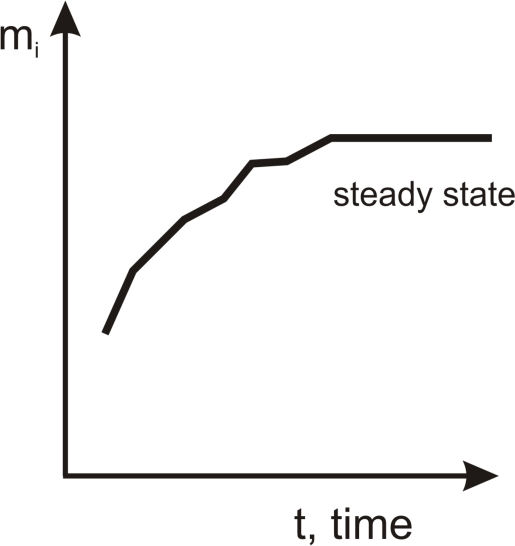
Thus, the right side of Equation (6) is the differential dMi of the function Mi. Since dMi is always positive during the irreversible process, then, in the steady state, Mi being of stable quantity achieves its maximum value. This value is stable as long as the steady state lasts (see Figure 1).
Figure 1.
In an irreversible process, differentials of the function mi in an arbitrarily chosen element of volume are always positive. This is the reason why in the steady state, mi achieves its maximum values.
Thus, in a steady state, the condition for the maximum of the following functional can be formulated as:
The state of intense parameters contained in functional Equation (8) are space-dependent quantities; however, they do not change in time. Using the expressions for electron and hole energy, as well as for their entropy (Equations (46)–(49)), the function for the electron and holes can be derived as below:
and:
respectively. Here,
is the distribution function for electrons in a conduction band and
is the distribution function for electrons in a valence band.
Functional Equation (8) for the electron and holes achieves the maximum if:
and:
respectively. Equations (11) and (12) are Euler–Lagrange (E-L) equations, and their solution are the functions:
It is apparent that the above functions cannot be the correct distribution functions by observing that they are even in the wave vector (kinetic energies
and
are square functions of
), and therefore, it can be predicted that current can never flow. Nevertheless, these are not unreasonable results considering that average carrier velocities are frequently small. If we measure the spread in velocities by the velocity at which
drops to
of its peak, we find a spread of about 107 cm s−1 for a semiconductor with m* ≈ m0 [12]. Since average velocities are often much smaller than this, an assumption that the average velocity equals zero may be not as bad as it seems. However, we will try to find more correct expressions for the distribution functions.
3. Gyarmati’s Variational Principle of Dissipative Processes
Non-equilibrium processes arise either due to the action of thermodynamic forces, which prevent the system from reaching the equilibrium state, or due to the process of internal phenomena, resulting from certain types of relaxation processes [13]. In the 1960s, Gyarmati proposed a variational principle, which describes the evolution of irreversible processes in space and time [14,15]. Gyarmati’s principle is based on the fact that the generalization of dissipation functions, which were introduced by Reyleigh and Onsager for special cases, always exist locally in continua [16–22]. In linear theory, these functions are defined as:
and:
The Rik coefficients are the components of the inverse of the Lik coefficient; hence, the existence of dissipation potentials is connected to the existence of the Onsager reciprocal relations. The current Ji is conjugated to the force Xi in the entropy production density σS. σS being the entropy production per unit volume and unit time is a bilinear function of the independent currents Ji and the conjugate dissipative forces Xi, that is:
According to the Onsager’s linear theory of irreversible processes, the currents Ji and the dissipative forces Xi are given by the following general constitutive laws [20,21]:
The most general form of Gyarmati’s principle is given by:
or:
Some weighted potentials ΨG and ΦG can be defined, as well. They show all of the essential properties of Ψ and Φ, but correspond to the weighted entropy production GσS [23–25] (here, G is an arbitrary, always positive state function):
In some cases, in steady-state conditions, especially for strictly linear problems, there are two partial forms that are also valid [25]:
and:
The first of these is called force, and the second is called flux representation. Both representations were applied to the solution of several practical problems (see the references cited in the paper of Verhas [25]).
We will apply Equation (23) for electrons and holes. The thermodynamic forces for electrons (see relation Equation (72)) are recognized as:
and:
where:
4. Postulate of the Variational Principle for the Semiconductor Heterostructure in Steady-State Conditions
As was shown in Section 2, functional Equation (8) is not sufficient to obtain the proper expression for a non-equilibrium distribution function for electrons in CB and VB. To achieve this goal, we postulate applying a new variational principle obtained through a connection of functional Equation (8) with Gyarmati’s principle expressed by relation Equation (23). In order to join them, we form the weighted potential ΨG by multiplying equation Equation (23) by the mean relaxation time
. This proposed principle (for CB electrons) reads as:
Why should the acceptance
as the multiplier be a good choice? First, Gyarmati’s principle remains valid if it is multiplied by any non-negative state function and the average relaxation time is a non-negative state function. Second, it is a characteristic time during which electron scattering takes place by collisions. This time determines band electron mobility and their drift velocity. We show further that the postulate will allow us to determine a non-equilibrium distribution function, which for small gradients of intensive parameters is identical to the function resulting from the BKEsolution, which will confirm the postulated validity.
By comparing the coefficient expression Equations (27)–(29), we note that the coefficient L22 is orders of magnitude less than the other three coefficients. Thus, in equation Equation (26), we can skip the last component. Now, using Equation (68) and using relations Equations (9), (25)–(29), we can present the function λe in the form of:
Equation (34) for holes takes the form of:
Proceeding as with electrons, λh will take the form of:
4.1. The Non-Equilibrium Distribution Function for Electrons
Functional Equation (34) achieves maximum value if the function λe meets the E-L equation, which means:
The solution of Equation (39) is the following function:
4.2. The Non-Equilibrium Distribution Function for Holes
Functional Equation (37) achieves maximum value, if the E-L equation reads as:
The solution of Equation (41) is the following function:
While the distribution function of holes fh will take the form of:
5. Verification of the Obtained Results
Here, we verify the obtained relation Equations (40) and (43) by comparing them with suitable results obtained by other authors using another method of analysis. The agreement of the results would be the confirmation that the postulated variational principles (relations Equations (34) and (37)) are suitable for analyzing the steady-state conditions in semiconductor heterostructures. Let us begin our considerations for the function
. We compare expression Equation (40) with Expression (5.1) obtained by Marshak and van Vliet [2] by a solution of the KBE under the assumption that the values of ∇Φn and ∇Te are low. We decompose relation Equation (40) into the Taylor series around Φn and Te under the assumption that ∇Φn and ∇Te are of low values. As a result, we obtain the relation of:
It is easy to notice that expression Equation (44) is the same as Expression (5.1) in the paper of Marshak and van Vliet [2].
Similarly, by decomposing the function fh around Φp and Th under the assumption that ∇Φp and ∇Th are of small values and by confining ourselves to the first order words, we are going to obtain the following:
Expression Equation (45) can be obtained similarly as what was done by Marshak and van Vliet [2] by solving the BKE under the assumption that the gradients ∇Φp and ∇Th are low. Thus, expression Equations (44) and (45) obtained in this paper are in agreement with the results obtained by solving the BKE in the special case. This confirms that the forms of functionals Equations (34) and (37) are proper and can be used to analyze semiconductor heterostructures in steady-state conditions
Expression Equations (40) and (43) are more general than the expressions for non-equilibrium distribution functions, obtained by solving the BKE. What is more, non-equilibrium distribution functions have the form of the Fermi–Dirac distribution function (with four additional components). The physical interpretation of these components is relatively simple. We explain it for
. The physical interpretation of suitable components in fh is analogous to those in
.
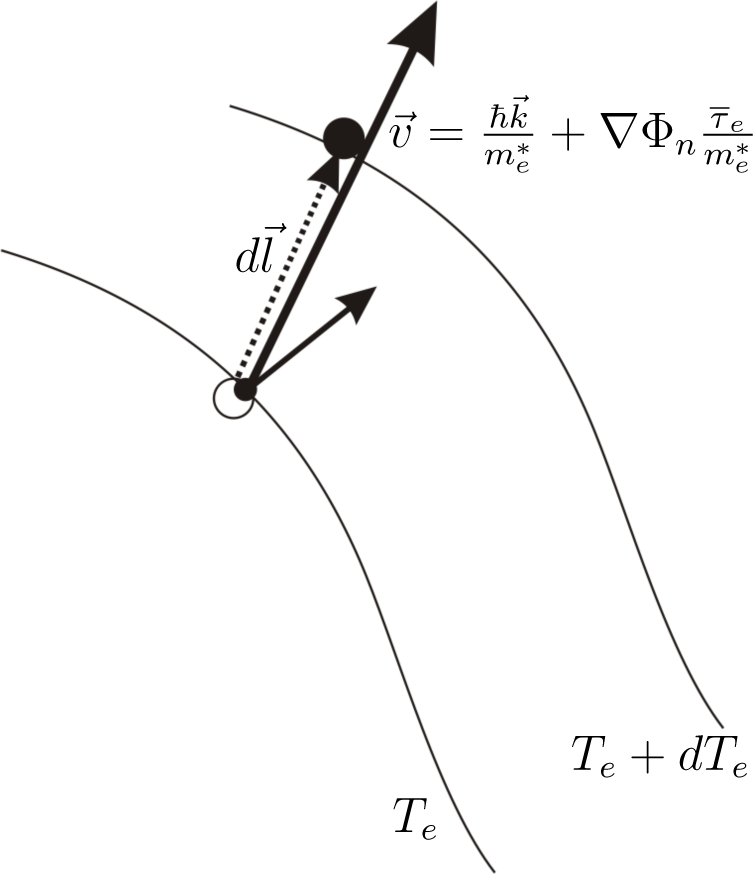
The expression
is equal to dTe, the change of the electron s temperature in the time period equal to the mean relaxation time
(Figure 2).
Figure 2.
An electron having thermal velocity
(total electron velocity with subtracted drift velocity caused by ∇Φn) at the point on the isotherm with temperature T in the time period equaling the mean relaxation time
moves to the point on the isotherm with temperature Te + dTe. Effective growth of electron temperature is
is the displacement vector of electron in time
.
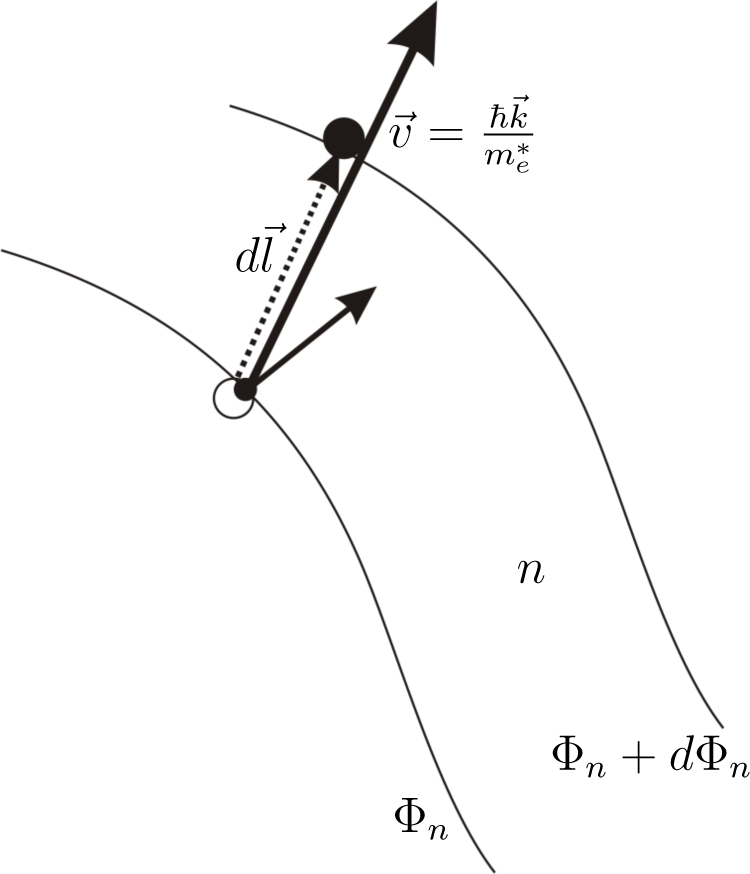
The expression
is recognized (Figure 3) as a change of electron kinetic energy caused by the movement of the electron in the region where the gradient of quasi-Fermi energy occurs. The sign of this change depends on the direction of the electron velocity The expression
is found as an increase of electron energy caused by the force −∇Φn working on the distance
.
Figure 3.
The electron having velocity
moves from the position where quasi-Fermi energy equals Φn in the time period equaling
to the point where quasi-Fermi energy equals Φn + dΦn, where
. The displacement vector
is equal to
. This leads to a change of the electron kinetic energy
.
6. The Calculation Method and Its Exemplary Results
We discuss here the calculation method consisting of calculating the electron and hole distribution function, as well as presenting the exemplary results of the calculations for electrons (relation Equation (40)). The calculations will involve ternary semiconductor compounds of mercury cadmium telluride (MCT) (CdxHg1–xTe) with two chosen values of x, a mole fraction of CdTe (x = 0.165 and x = 0.3), a concentration of donors ND = 1015 cm−3 and acceptors Na = 1013 cm−3. Data on the physical parameters of the material can be found, for example, in the book edited by Capper [26]. While conducting the numerical modeling of devices, we are not able to calculate non-equilibrium distribution functions at the heterostructure selected points directly using only relation Equations (40) and (43). The calculations must be conducted by iterative methods, because Equations (40) and (43) are highly non-linear. In turn, these values are dependent on external forces maintaining a steady state and on a distribution function. First, our calculations begin for a thermal equilibrium state by solving the Poisson equation with iterative methods for given spatial distributions of a molar composition and doping. This allows the determination of the spatial distribution of electric potential, as well as the electron, holes and ionized dopant concentrations. In order to determine these concentrations, the Fermi–Dirac functions applicable to the thermal equilibrium state are used. The accurate description of this method is in the paper of Jóźwikowska [27].
Next, by changing the boundary conditions on electrical contacts due to the value of the applied voltage, we solve the system of four or six transport equations with iterative methods. We gradually increase the voltage until it reaches a desired value. Subsequent changes to the voltage value are the condition for the convergence and stability of the iterative method used. In the first iterative step for the initial voltage, we make calculations by using the non-equilibrium distribution functions in the form of the Fermi–Dirac function for thermal equilibrium. In these functions, the Fermi level is replaced with quasi-Fermi levels, and we take into account that the electron and holes own a thermodynamic temperature, which can be different from the lattice temperature. For electrons in the conduction band and valence band, those are Equations (13) and (14), respectively. In subsequent iterations, we already use distribution functions in the form of Equations (40) and (43). Using these, we calculate both the carrier concentration, as well as the average relaxation time defined by Equation (71). Counting the relaxation time in MCT, we take into account two mechanisms of scattering: ionized impurity scattering and polarized optical phonon scattering [13]. Due to the fact that the effective mass of electrons in a HgCdTe narrow gap is more than an order of magnitude less than the effective mass of holes, effects related to the gradient influence of intensive parameters are in the case of the electron distribution function much stronger than for holes. Therefore, the exemplary calculation results are shown for the non-equilibrium distribution function for electrons, as they are the most spectacular. As we analyzed the semiconductor instruments, temperature gradients are usually very small, and their impact on the non-equilibrium distribution function is incomparably smaller than the impact of the quasi-Fermi level gradients. In the cases presented here, the influence of a temperature gradient on the function
is negligible.
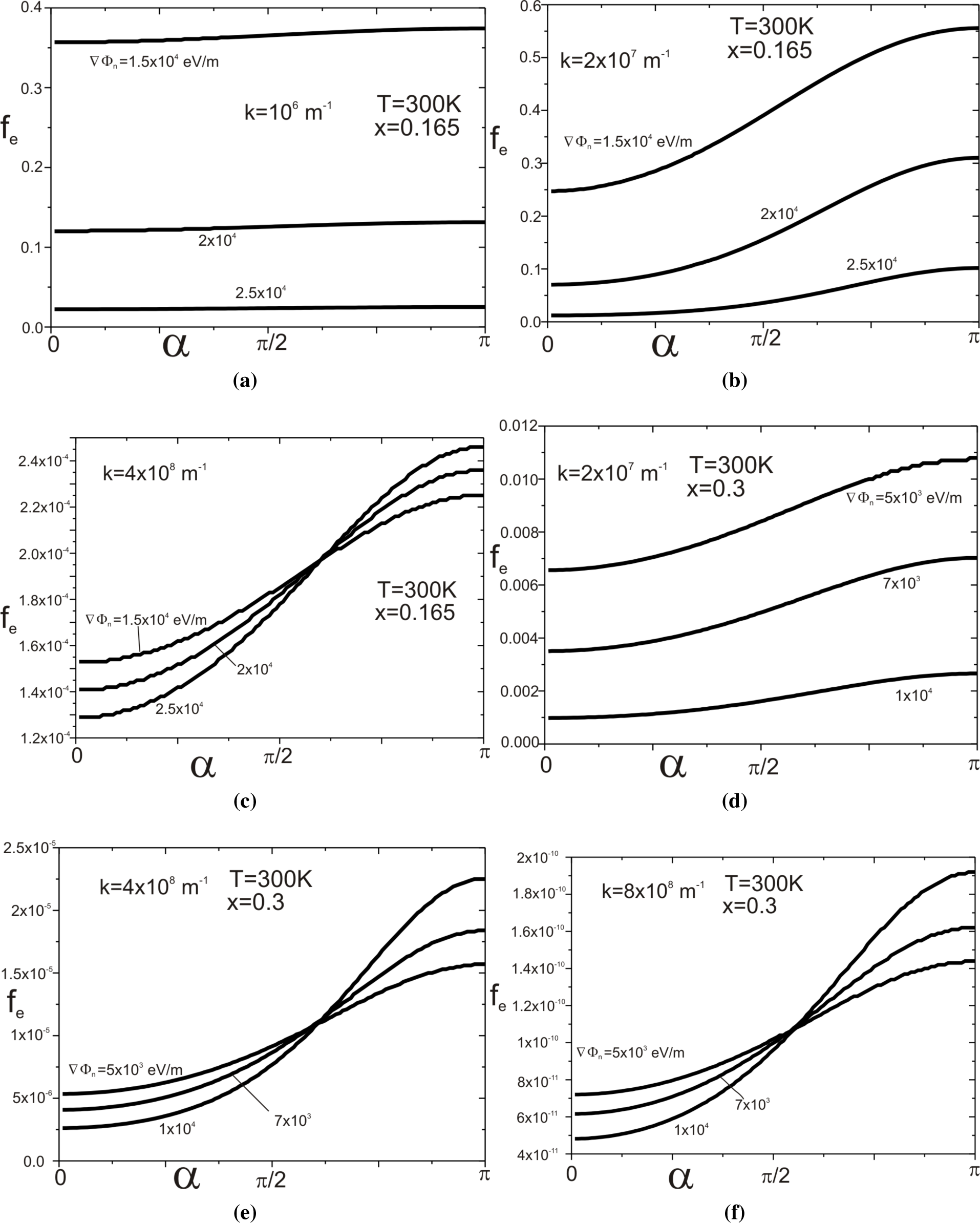
Figure 4a–4f presents the dependence of the function on the angle, which the wave vector
creates with the vector ∇Φn for selected modules of the vector
and the selected gradients ∇Φn (see Figure 5). Figure 4a–4c relates to the structure of the molar composition x = 0.165 and the temperature T = 300 K, and Figure 4d–4f relates to the structure with parameters x = 0.3 and T = 300 K.
Figure 4.
Dependence fe on the angle α that the wave vector
creates with the vector ∇Φn for the selected modules of the vector
and the selected gradients ∇Φn (numbers with curves). (a–c) The structure of x = 0.165, T = 300 K; and (d–f) the structure of x = 0.3, T = 300 K.
Figure 5.
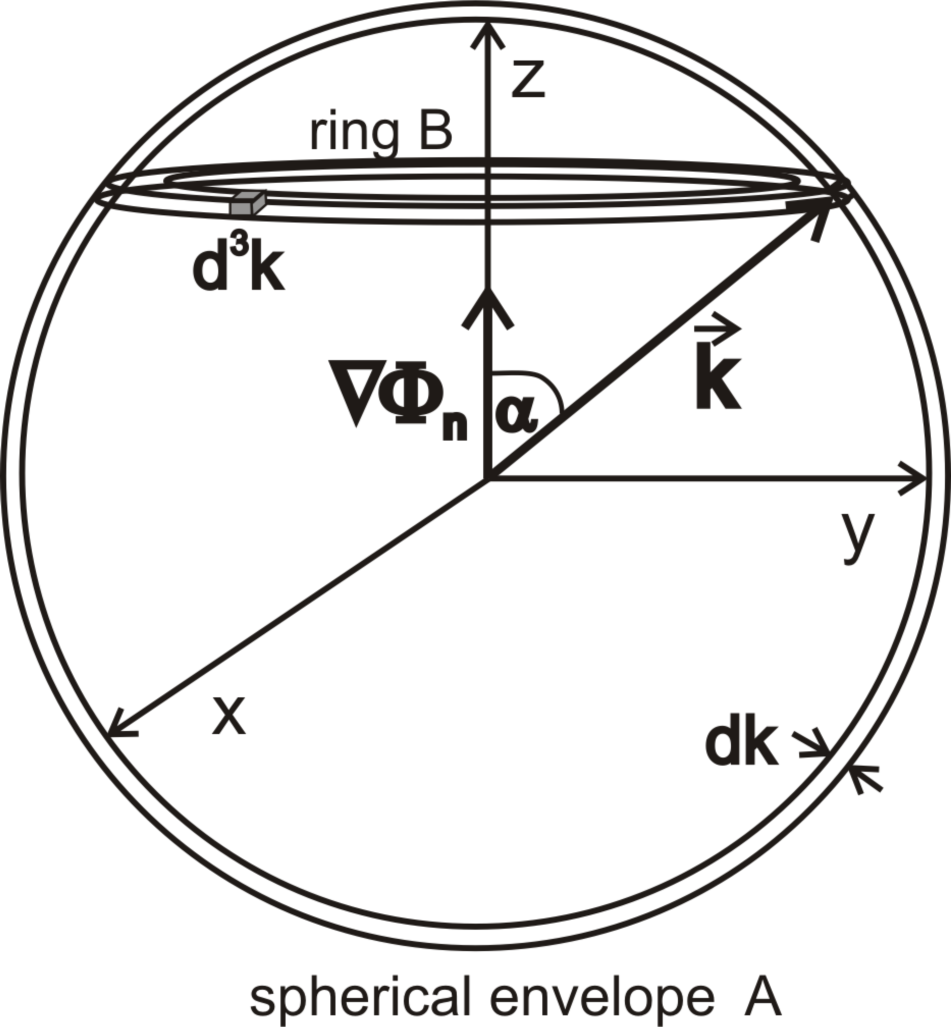
In the space of the wave vector
, we distinguish the z direction parallel to the vector ∇Φn. This space is divided into chase-space cells having a volume of d3k = 4π3/dV. Here, V denotes the volume of the semiconductor. The probability that any cell is occupied by an electron is determined by the distribution function
(relation Equation (40)) and depends on the absolute value of the electron wave vector
and the angle α between vector
and the z direction. For all phase space cells in Ring B, the values of
are the same.
Now, it is evident that distribution functions determined by relation Equation (40) are not even in the wave vector, in contrast to those determined by relation Equation (13).
determines it. When the dot product
is positive, it increases the potential energy of a moving electron at the expense of kinetic energy. Reducing the kinetic energy leads to increasing the value of
. When the movement direction is the opposite, then the electron potential energy decreases, and its kinetic energy increases. Hence, the increase in value of the function
is with the increase at the angle α. The impact of the component
on the function
becomes increased with both the increase of module
vector and with the gradient value ∇Φn, which is well illustrated by Figure 4.
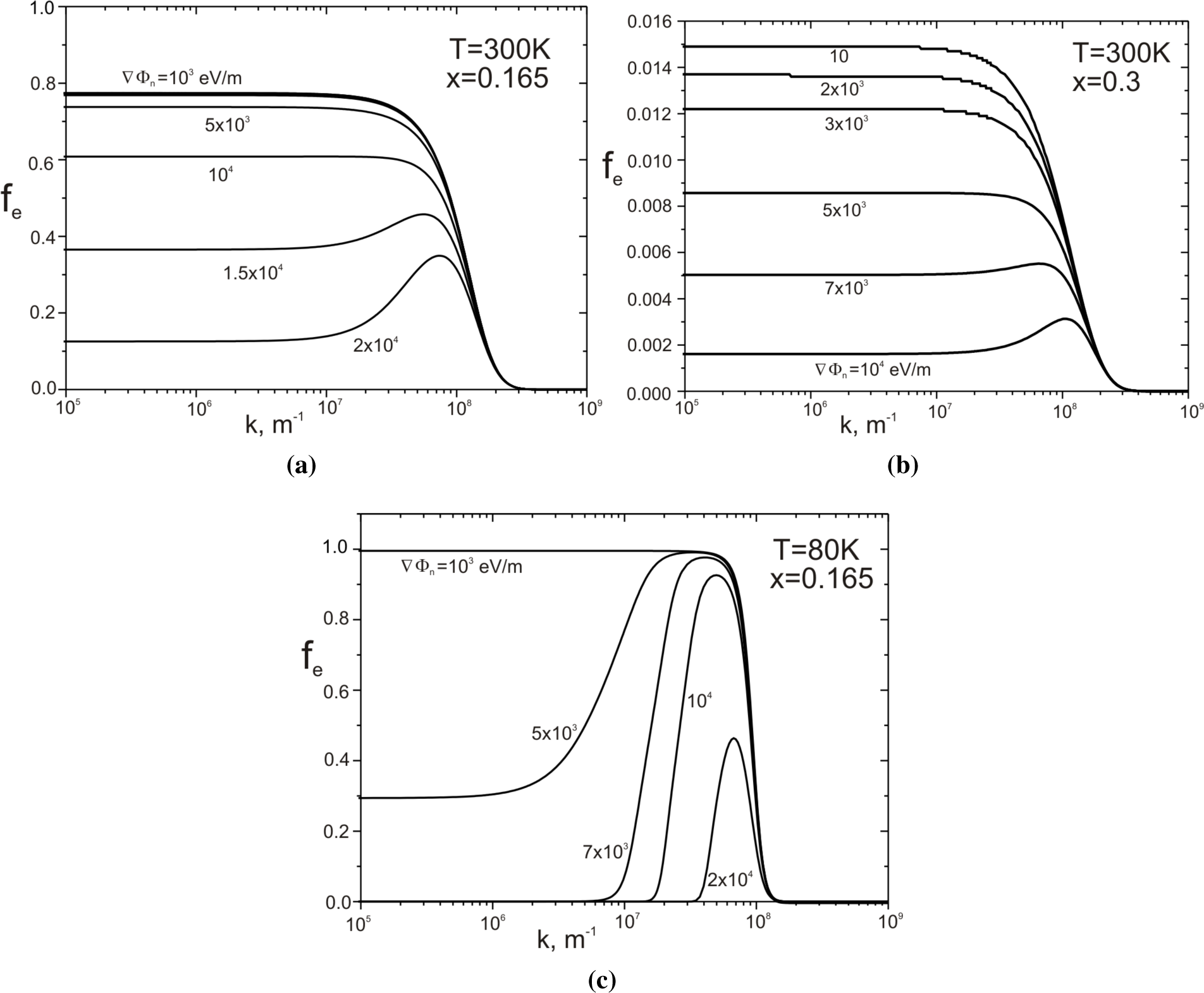
Figure 6 presents the dependence of
on the wave vector module
for the selected gradient values ∇Φn (numbers with curves). The presented values of the function
are mean values for cells that form the spherical Envelope A (see Figure 5). Figure 6a describes the structure with the parameters of x = 0.165, T = 300 K; Figure 6b, x = 0.3, T = 300 K; and Figure 6c, x = 0.165, T = 80 K. For k < 107 m−1,
weakly depends on k, but rapidly disappears with increasing k for k > 108 m−1. The reason for this failure is the kinetic energy
increase, which is a quadratic function of the wave vector
. Increasing the kinetic energy component
is the reason for the observed decrease in the value of
with the increasing values of ∇Φn. However, the increase of the value of ∇Φn increases the role of the component
, which depending on the sign of the scalar product
, can cause either an increase or decrease in the value of
. This component of the overall balance will increase the average value of the function
, which is noticeable for sufficiently large values of the gradient ∇Φn. This is particularly shown in Figure 6c, where the influence of this component in the range of values 107 m−1 < k < 108 m−1 seems to be dominant. This is achieved by the addition of average relaxation time, which grows with a decreasing temperature. Calculated by us,
, for the material x = 0.165 at T = 300 K is 4.17 × 10⁻¹² s and at T = 80 K is 7.3 × 10⁻¹² s.
Figure 6.
Dependence of the average fe on k, the module of the wave vector
, for the selected gradients ∇Φn (numbers with curves). (a) The structure of x = 0.165, T = 300 K; (b) x = 0.3, T = 300 K; (c) x = 0.165, T = 80 K. The figures present the mean value of the function distribution of phase cells located in the spherical Envelope A (see Figure 5).
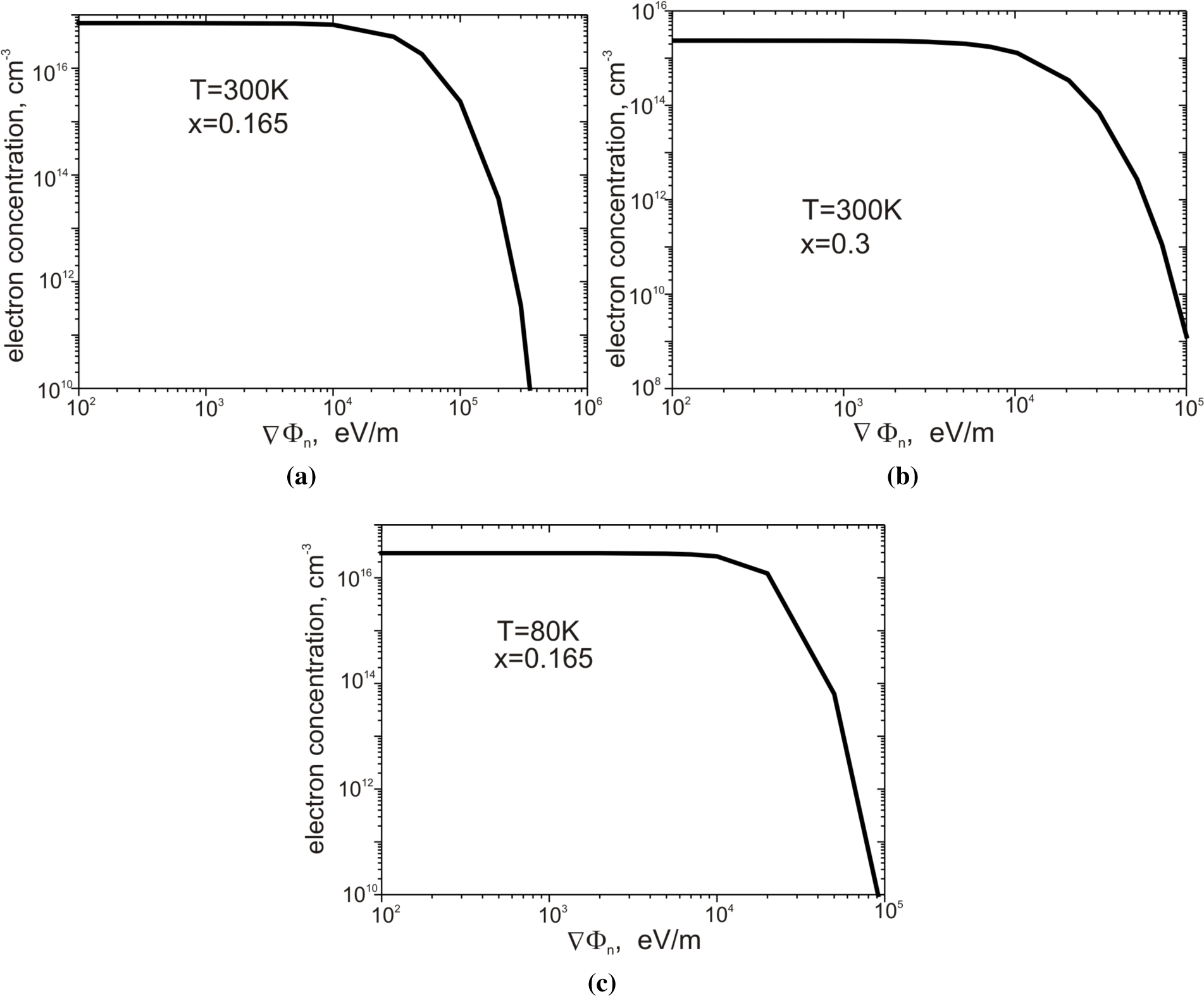
Figure 7a–7c presents the dependence of electron concentration on the value of VΦn. Figure 7a shows the structure with parameters x = 0.165, T = 300 K; Figure 7b, x = 0.3, T = 300 K; and Figure 7c, x = 0.165, T = 80 K. In all three cases, the electron concentration remains almost constant for gradients ∇Φn < 104 eV m−1. The increase of the gradient ∇Φn up to the value of 105 eV m−1 results in a reduction of the concentration in all cases by several orders of magnitude. The obtained values of electron concentration are in good agreement with the experimental data presented by Capper [26].
Figure 7.
Electron concentration in the function for the structures of: (a) x = 0.165, T = 300 K; (b) x = 0.3, T = 300 K; and (c) x = 0.165, T = 80 K.
7. Conclusions
Based on the postulates of local equilibrium, as well as on the integral form of Gyarmati’s variational principle in the force representation, we have derived distribution functions for an electron and holes. Thus, it is an alternative method commonly solving the BKE with the relaxation times’ approximation used. The obtained expressions have the form of the Fermi–Dirac distribution function with four additional components. We have shown the physical interpretation of these components as a change of effective carrier temperature and kinetic energy in the regions where gradients of temperature and electrochemical potential occur. These expressions should be used especially in areas where there are heavy electro-chemical potential gradients, such as the p-n junction, heterojunction, metal-semiconductor connectors, etc. If one assumes that these gradients are weak, our results are in excellent agreement with previous expressions obtained by solving the BKE. The presented method should be developed to additionally consider many galvanomagnetic and thermomagnetic effects, and so on, which may be important in some applications.
Acknowledgments
The work has been undertaken under the financial support of the Polish National Science Centre as research Project No. DEC-2013/08/M/ST7/00913 and Project No. POIG.01.03.01-14-016/08 “New Photonic Materials and Their Advanced Application”.
Appendix
A. The Energy and Entropy of Electrons and Holes in a Semiconductor Heterostructure
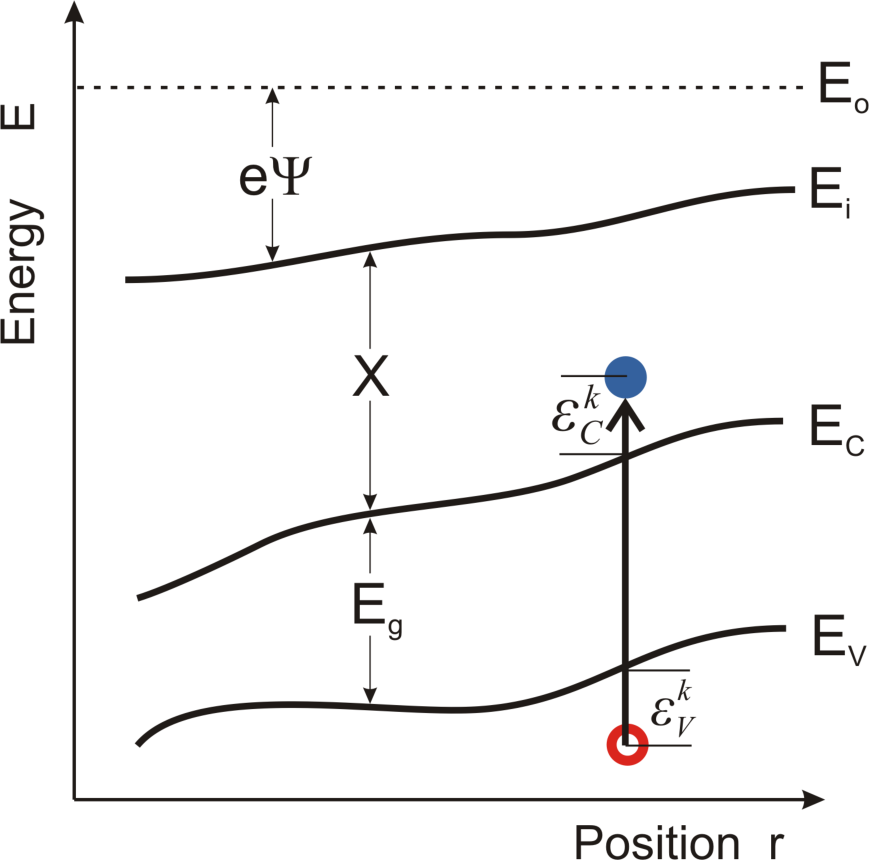
Figure 8 shows a two-band energy diagram for the general case of a semiconductor heterostructure. The concept of the local vacuum level Ei, which represents the energy of an electron at a given point if it is at rest and free from the influence of the crystal potential, was introduced by Marshak and van Vliet [2]. Thus, Ei gives the spatial variation of electrostatic potential Ψ. The reference level E0 may be an arbitrarily-chosen value of the energy. In our paper, we have assumed E0 = 0 without any loss of generality. EV is the VB edge, and EC is the CB edge.
Figure 8.
General one-dimensional two-band energy diagram of a semiconductor heterostructure defining variables of interest; E represents total electron energy; E0 is the reference level (we have assumed E0 = 0); Ψ is the electrostatic potential; X is the electron affinity; Ei is the local vacuum level (defined by Marshak and Vliet [2]); EV is the valence band (VB) edge; EC is the conductance band (CB) edge; and Eg is the bandgap. The transition of the electron from energy level
in VB to energy level
in CB demands that the delivery of energy equals
. This energy is the sum of the energy of the created electron
and the energy of the created hole
.
The energy of a single electron in CB
contains element
, which denotes the electron kinetic energy.
is the function of wave vector
. The density of CB electron energy ue in an element of volume determined by position vector
is expressed by:
Integration is carried out inside the Brillouin zone (BZ), and
is the distribution function for CB electrons. The density of the hole energy, uh, reads:
where
is the hole kinetic energy.
is the distribution function for VB electrons. The density of the CB electron entropy reads [28]:
The density of the VB electron entropy equal to the density of the hole entropy is expressed by [28]:
B. The Sources of Electron and Hole Entropy in Steady-State Conditions
Both the electrons’ energy and the holes’ energy contain kinetic energy (see Appendix A) associated with the chaotic thermal particles’ motion and the potential energy, determined by electrochemical potentials Φ (determined by the energies of band edges and chemical potentials). In thermal equilibrium, it is possible to apply the first law of thermodynamics. If we consider the densities of extensive variables (entropy and the number of electrons), the first law of thermodynamics for the differential of the electrons energy is expressed by Gibbs relation:
However, opportunely, the expression for the holes:
where du is the increment of energy density (subscript e refers to electrons, subscript h to holes), s, the density of entropy, n, the electron density (concentration), p, the hole concentration and Φ, Fermi energy. Thus, the increment of density of the carriers’ energy is caused by a change of the particles’ density, the consecutive changing potential energy and the energy associated with the increment of the density of entropy.
Now, we would like to analyze the structure of a semiconductor in steady-state conditions. We have used the postulate of local equilibrium. The first law of thermodynamics for the increments of electrons’ and holes’ density of energy changing locally in a semiconductor structure is expressed by:
where effective temperatures of electrons and holes (Te and Th, respectively) and quasi-electrochemical potentials (quasi-Fermi energies, Φn and Φp) are defined locally by the relations:
and
Here, Φn and Φp are the electrochemical potential for CB electrons and CV electrons, respectively. The electrochemical potential for holes is equal to –Φp.
Let us consider Equation (52). The first component is defined as thermal energy dQn. The second component includes the increment of potential energy
, determined by electrochemical potential. They are expressed by:
If there are flows of particles and energy, the balance equations for physical parameters are subject to a low of conservation and are expressed by:
where x is the density of the considered extensive parameter, jx is the current density of x, Gx is the generation rate and Rx the recombination rate of the x parameter. For ue, we obtain the following balance equation:
Here,
is the average of the kinetic energy of electrons generated with the net generation rate (Gn–Rn), and je, the density of the electron current (current of particles, no electric current). Similarly, as for electrons, the balance of energy density equation for holes, uh, is expressed by:
Here,
is the density of the hole’s heat current; jh, the density of the hole’s current (particles current); Gp, the density of the generation rate; Rp, the density of the hole’s recombination rate;
, the potential energy of the holes, defined by quasi-Fermi energy Φp.
A was shown by Parrot [29], there is a simple relation between the density of thermal energy current and the density of entropy current:
where se is the density of the electron entropy and
is an average electron velocity A similar equation for holes is expressed by [29]:
where sh is the density of the hole entropy and
is an average hole velocity
Entropy is not subject to the rules of conservation. Thus, it is difficult to drive an expression for the entropy balance equation. If we try to use the first law of thermodynamics, applied to the selected subsystem in the local equilibrium (Equation (52)), the increment of the entropy of electrons may be expressed by the increments of the particles’ number and energy. It is expressed by the equation:
The balance equation for the electrons density (concentration) has the form:
Equation (64) has the form of Equation (57); thus, it is an equation of the entropy density balance. The source of the density of electron entropy is now given by the expression:
In a steady state, the electrons’ generation rate is equal to the rate of the electrons’ recombination; thus, expression Equation (65) can be simplified to the form:
Similar considerations for holes lead us to the expression for the source of the holes entropy in steady-state conditions:
The left side of Equation (66) one can express in two ways. In the first method, the electron current density and density of their entropy current are derived by the integration of electron velocity
inside the Brillouin zone (BZ) as below.
In the second method, the electron current density, as well as the density of entropy current are expressed by the electron drift velocity
:
where
is the average electron relaxation time,
the effective electron mass and Fe is the electron driving force expressed by:
where Σe is Seebeck’s coefficient for electrons. As was shown in Appendix C,
.
The relaxation time in semiconductors is determined by some different scattering mechanisms [13]. The average relaxation time [5] is expressed by:
where
is the kinetic energy of the electron with quasi-momentum
.
Now, Equation (66) can be expressed in the form:
Similar considerations for holes lead to two different forms of expressions for
:
and:
C. The Transport Coefficients of Semiconductor Heterostructures in Steady-State Conditions
Forces acting on electric carriers in a semiconductor heterostructure are caused by gradients of quasi-Fermi energies or the gradient of temperature. To determine them, one has to find the kinetic coefficients by which these gradients have to be multiplied. Denoting these gradients by ∇Φ and ∇Ψ, respectively, the usual results, as found for example in the paper of Marshak and van Vliet [2], are:
The Onsager conductances (L) are band integrals, such as L11 and L12 for electrical conductance in a conduction band. The band integrals are found in the classical article by Marshak and van Vliet [2] and more succinctly in the latter’s recent book [30]. Lindefelt [3] approximated their results by using a “mean” energy ⟨E⟩ (cf. his Equation (12)); thus, for Equation (75), he wrote,
Here, jel is the electron electric current, and µe is the electron mobility.
We also note that the entropy per particle for the conduction band is just given by:
Thus, relation Equation (77) reads:
This way,
is Seebeck’s coefficient.
On the other hand, by multiplying
(relation Equation (66)) by Te, we obtain the heat energy generated in a unit of volume and a unit of time, that is
; the kinetic energy of CB electrons (in J m−3 s−1) reads:
On the other hand, the time derivative of electron kinetic energy in a unit of volume is equal to:
where Fe is the mean force acting on all conduction-band electrons in a unit volume. Therefore, now, the mean force acting on a single electron reads:
The transport coefficient
is here recognized as the Seebeck coefficient for electrons.
Similarly as for electrons, by multiplying
(relation Equation (67)) by Th, we obtain the heat energy generated in a unit of volume and a unit of time, that is the kinetic energy of holes (in J m−3 s−1). This leads to the expression of the mean force acting on all holes in a unit volume:
and, next, to the expression of the average force acting on a single hole.
Seebeck’s coefficient for holes is found as
.
PACS classifications: B15:3
Author Contributions
The theoretical idea is attributed to K.J. and A.J. M.N. is responsible for the numerical calculations. Both authors have read and approved the final manuscript.
Conflicts of Interest
The authors declare no conflict of interest.
References
- Van Vliet, K.M.; Marshak, A.H. Conduction current and generalized einstein relation for degenerate semiconductors and metals. Phys. Stat. Sol 1976, 78, 501–517. [Google Scholar]
- Marshak, A.H.; van Vliet, K.M. Electrical current and carrier density in degenerate materials with nonuniform band structure. Proc. IEEE 1984, 72, 148–162. [Google Scholar]
- Lindefelt, U. Current-density relation for nonisotermal modeling of degenerate heterostructure devices. J. Appl. Phys 1994, 75, 958–966. [Google Scholar]
- Parrot, J.E. Thermodynamic theory of transport processes in semiconductors. EEE Trans. Electron Devices 1996, 43, 809–826. [Google Scholar]
- Lundstrom, M. Fundamentals of Carrier Transport; Addison-Wesley Publishing Company Inc; Boston, MA, USA, 1990; Volume 10, p. 133. [Google Scholar]
- Prigogine, I. Introduction to Thermodynamics of Irreversible Processes; John Wiley: Hoboken, NJ, USA, 1956. [Google Scholar]
- De Groot, S.R.; Mazur, P. Non-equilibrium Thermodynamics; Wiley: New York, NY, USA, 1962. [Google Scholar]
- Gyarmati, I. Non-equilibrium Field Theory and Variational Principles; Springer Verlag: Berlin, Germany, 1970. [Google Scholar]
- Glansdorf, P.; Prigogine, I. Thermodynamic Theory of Structure, Stability and Fluctuations; Wiley Interscience: Hoboken, NJ, USA, 1971. [Google Scholar]
- Prigogine, I. Modération et transformations irreversibles des systemes ouverts. Bull. Cl. Sci. Acad. R. Belg 1945, 31, 600–606. [Google Scholar]
- Prigogine, I. Étude Thermodynamique des Phenoménes Irreversibles; Desoer: Paris, France, 1947. [Google Scholar]
- Lundstrom, M. Fundamentals of Carrier Transport; Addison-Wesley Publishing Company Inc: Boston, MA, USA, 1990; Volume 10, p. 103. [Google Scholar]
- Nag, B.R. Electron Transport in Compound Semiconductors; Springer Verlag: Berlin, Germany, 1980. [Google Scholar]
- Gyarmati, I. On the relation between Onsager’s and Prigogine’s principles. Zeitschrift für Physikalische Chemie 1967, 234, 371–378. [Google Scholar]
- Gyarmati, I. On the governing principle of dissipative processes and its extension to non-linear problems. Ann. Phys 1969, 23, 253–378. [Google Scholar]
- Verhas, J. Gyarmati’s variational principle of disipative processes. Entropy 2014, 16, 2364–2383. [Google Scholar]
- Markus, F.; Gambar, K. A variational principle in thermodynamics. J. Non-Equilib. Thermodyn 1991, 16, 27–32. [Google Scholar]
- Markus, F.; Gambar, K. Hamilton’s canonical equations and the entropy production. J. Non-Equilib. Thermodyn. 1992, 18, 288–292. [Google Scholar]
- Markus, F.; Gambar, K. Comments on the relationship between extended thermodynamics and the wave approach to thermodynamics. J. Non-Equilib. Thermodyn. 1989, 14, 355–362. [Google Scholar]
- Onsager, L. Reciprocal relations on irreversible processes. I. Phys. Rev 1931, 37, 405–426. [Google Scholar]
- Onsager, L. Reciprocal relations on irreversible processes. II. Phys. Rev 1931, 38, 2265–2279. [Google Scholar]
- Onsager, L.; Maclup, S. Fluctuations and irreversible processes. Phys. Rev 1953, 91, 1505–1512. [Google Scholar]
- Farkas, H. The reformulation of the Gyarmati principle in a generalized picture. Zeitschrift für Physikalische Chemie 1968, 239, 124–132. [Google Scholar]
- Bhattacharya, D.K. A variational principle for thermodynamical waves. Ann. Phys 1983, 39, 325–332. [Google Scholar]
- Verhas, J. Gayrmati’s variational principle of dissipative processes, Proceedings of the 12th Joint European Thermodynamics Conference, JETC 2013, Brescia, Italy, 1–5 July 2013; pp. 127–132.
- Capper, P. (Ed.) Properties of Narrow Gap Cadmium-based Compounds; The Institution of Engineering and Technology: London, UK, 1994.
- Jóźwikowska, A. Numerical solution of the nonlinear Poisson equation for semiconductor devices of a diffusion-equation finite difference scheme. J. Appl. Phys 2008, 104, 063715. [Google Scholar]
- Landau, L.D.; Lifshitz, E.M. Statistical Physics, 3rd ed; Butterworth-Heinemann: Oxford, UK, 1980. [Google Scholar]
- Parrott, J.E. Transport theory of semiconductor energy conversion. J. Appl. Phys 1982, 53, 9105–9111. [Google Scholar]
- Van Vliet, K. Equilibrium and Non-equilibrium Statistical Mechanics; World Scientific: Toh Tuck, Singapore, 2010. [Google Scholar]
© 2015 by the authors; licensee MDPI, Basel, Switzerland This article is an open access article distributed under the terms and conditions of the Creative Commons Attribution license (http://creativecommons.org/licenses/by/4.0/).