1. Introduction
Autism Spectrum Disorder (ASD) entails a series of difficulties, e.g., in communications and social interactions, as well as in learning essential life elements, such as basic instrumental skills (i.e., oral language, reading, writing, mathematics, etc.). Hence, early detection is important [
1], as well as implementing early, integrated care [
2] that stimulates a child on a cognitive, communicative, psychomotor, and socioemotional level.
ASD is influenced by alterations in communications and social interactions, which in turn entails the existence of repetitive patterns, restrictive interests [
3], and difficulties in neuro-development, with effects on the higher brain functions [
4]. In the words of Rogel-Ortiz [
5], “autism is a static neurodevelopmental disorder that persists throughout life and includes a wide margin of behavioral alterations” (p. 1). Wing [
6] discusses the autism triad, comprising symptoms linked to three areas: language and communication, social environment, behavior and thinking. This disorder is a lifelong condition; it manifest from infancy, and signs of autism normally appear before the age of three [
7,
8].
Families, teachers, and specialists, Due in part to research conducted by Kanner [
9], have utilized early stimulation techniques when supporting people with autism, to help encourage comprehensive growth and development. In this regard, information and communications technology (ICT) has taken on a significant role in the educational sphere [
10,
11], with various learning options for people with autism. In fact, digital tools and resources designed exclusively for children and adolescents have proliferated, offering a large variety of opportunities for development in the different areas where they have greater difficulty [
12]. Therefore, the most recent studies that focused on enhancing diverse skill sets based on smartphones, tablets, communication boards, and computers produced encouraging results in the therapy of children with autism [
13,
14,
15,
16,
17]. Lozano et al. [
18] describe ICT as versatile, flexible, and adaptable to the learning rates of children with autism, highlighting how motivating communication technology can be.
The use of apps in mobile devices is increasing and, fortunately, children with autism have a wide range of apps available that are specifically designed for them—apps that attend to their specific needs [
19]. In various scientific fields, including healthcare and education, many researchers have created apps for use in therapy treatments for children/adolescents with autism, offering different experiences with remarkable results [
20,
21,
22,
23,
24]. For example, Flores et al. [
25], via iPad interventions, showed how communication behaviors and social skills increased in children/young people with ASD. Desai et al. [
26], through an iPad-based alternative communication system, encouraged communication in a student with cerebral palsy and autism. Jiménez et al. [
27], through the use of apps, in the sole case of a four-year-old child, discerned progress in the prerequisites prior to language, communicative intent, and behavior. Franco et al. [
28], with the help of the app “
aBoard CAA”, enhanced the development of cognitive skills, the expression of needs, feelings and opinions, language, and literacy. Fage et al. [
29], through intervention in children aged between 12 and 17 with cognitive rehabilitation and care apps, obtained improvements in social-adaptive behavior and social responsiveness in school environments. Wisblatt et al. [
30] used the tablet software “
Point OutWords” to promote the development of manual and oral motor skills as a prerequisite for communication through pointing and speaking.
As well of enriching intervention and therapy treatments for children with autism, apps are appealing [
14], and offer content that is suited to the needs of the user [
31]. García-Rodríguez and Gómez-Díaz [
32] examined the interests these children show in smartphones and tablets, and reviewed the features that good apps, aimed at this group, must have, as well as examined the best search engines for finding suitable apps. Teixeira and Cunha [
33], following a rigorous review of the particular traits of children with autism, created the for-pay app “
123 Autism”, focused on teaching basic mathematical skills (association of numbers with their corresponding quantities, numerical sequences, sums, etc.). Aguilar-Vázquez et al. [
7] designed the app “
LEA: Lecto-Escritura para Autismo” [
LEA (READ): Reading-Writing for Autism], based on the high affinity children with autism have with electronic devices and used the agile methodology of XP (extreme programming), which means that the user is involved in the development of the app throughout the process. This app is closely connected to the needs and characteristics this disorder entails, and is capable of working on reading-and-writing processes from very basic to more advanced levels. Bondioli et al. [
20] created the app, “
MyDentist”, with accessible design and content for children with autism, in order to help them become familiar with strange or unpleasant situations linked to the environment of dentistry. Sweidan et al. [
34] developed the app “
Autistic Innovative Assistant (AIA)” with the aim of promoting language, mathematics, and social skills. Smith et al. [
35] created the “
SOFA” app, which is focused on social stories. Vyshedskiy et al. [
36] designed the app “
Terapia del Lenguaje y Cognitiva con MITA” [
Cognitive and Language Therapy with MITA (
Mental Imagery Therapy for Autism)], closely related to the teaching–learning processes that the basic instrumental skills require, and based on the needs of children with autism.
In this field, it is very important, as has been stated, to stimulate and develop basic instrumental skills from an early age, since attaining them tends to require greater effort, depending on the degree to which the child with autism is affected. Instrumental learning is based on acquiring essential tools and instruments, as the basis to grow more knowledgeable and attain quality education [
37]. Therefore, learning is a key aspect in the development of children, as it plays a decisive role in school success or failure, and causes or prevents the risk of one suffering social exclusion [
37,
38,
39].
These skills are framed within the fields of language, mathematics, and education in Spain; their importance was established in the organic law of education, LOE 2/2006, 3 May [
40], through competence in language communication and competence in mathematics. Toribio [
41] (p. 36) defines them as follows:
Competence in language communication: this refers to the use of language as an instrument of oral and written communication, of representation, interpretation, and understanding of reality, of construction and communication of knowledge, and of organization and self-regulation of thought, emotions, and behavior.
Competence in Mathematics: this consists of the ability to use and relate numbers, their basic operations, symbols, and forms of mathematical expression and reasoning, to produce and interpret different types of information, to increase knowledge on quantitative and spatial aspects of reality, and to solve problems related to daily life and work.
O’Malley et al. [
42] suggest that children with autism usually present difficulties in language, reading, writing, and mathematics; hence, developing these skills is essential for one to lead an independent and successful life. Children with autism often present difficulties in processing verbal information via the auditory channel. However, they do “have a good capacity for visual memory, which is why the use of tools with graphic and symbolic content, as in the case of reading and writing, is of great help to them” [
43] (p. 1). Hardy et al. [
44] show how various computer programs encourage vocalization and a predisposition towards oral communication.
“Learning to read and write is perhaps the first truly academic action in schools; it marks a before and after in the life of a child. Knowing how to read and write is, nowadays, something we expect of any person” [
45] (p. 1). The learning of reading and writing represents a step forward in development, since it gives an improved understanding of language and its development. Pérez et al. [
46] stress, “teaching to read in autism does not only mean one step further in the natural process of education and culturalization. In autism, reading and writing can provide a way in for intervention on particularly affected aspects” (p. 85).
In order to begin the reading–writing process, it is essential to implement schedules, establishing work routines, and conditions that are stimulating and controlled [
47]. In ConecTEA [
43], there are various key phases in the reading–writing assimilation process, such as matching words with their corresponding drawings, distinguishing images, separating words into syllables, and introducing verbs, articles, and prepositions. Lence and Fernández [
48] state that the process of learning reading and writing can be a long one, but that help from families, schools, and other specialists is vital during the learning process. Similarly, Badillo [
49] shows that the use of interactive stories heightens comprehension of reading and writing for people with autism—something that a more traditional teaching methodology often fails to achieve.
In regards to mathematical skills, developing “number sense” is fundamental in the learning process. This allows progress to continue once the child gives meaning to numbers [
50]. Adkins and Larkey [
51] show the importance of teaching mathematics to children with autism, due to the relevance it has on the development of other skills, such as reading or spelling. They also highlight key starting points, such as numbers, sequences, and counting. Arciniegas and Acevedo-Rincón [
52] stress the importance of introducing the concept of the number, starting with four approaches: “number-quantity relation, bodily (hands) representation of numbers, writing numbers, and order and sequence relations” (p. 12).
Lloréns [
53], in his interventions on students with autism, used computer programs, and highlighted how mathematical concepts and numerical calculation skills can be strengthened through them with perseverance and appropriate structuring. After children with autism utilized the mathematical skills app—“123 Autism”—Teixeira and Cunha [
33] concluded that the participants’ motivations to use tablets was higher compared to traditional formats (pencil and paper), and that they had greater interests and commitments in carrying out the proposed activities.
ICT and apps focused on teaching these skills are possible, given the volume of apps that work on these skills, as well as their designs [
12]. Thus, a variety of studies focused on their assessments. For example, Hourcade et al. [
54] examined apps for tablets for children with autism. Crescenzi and Grané [
55] explored the interactive designs of educational apps for children up to the age of eight. Larco et al. [
56] studied the quality of apps for people with disabilities. Studies of this nature are needed, given the large number of apps available [
19,
57]. In this context, it would be useful to examine what apps are offered to children with autism that focus on developing basic instrumental skills. Therefore, the objectives of this study are as follows:
To evaluate the quality of free apps focused on basic instrumental skills for children and adolescents with autism, available on the Google Play Store.
To determine what instrumental skills each app focuses on (oral language, reading, writing, or mathematics).
To examine what sub-areas of oral language, reading, writing, or mathematics the various apps focus on.
3. Results
3.1. Assessment of App Quality
Table 2 shows the 88 apps—each app is designated with the name that appears in the Google Play Store search engine—ordered by the total score attained in the assessment, including the score in each dimension, and the group to which it belongs. The total score of the apps ranged from 16 to 40 points, with an average of 32.02 points (
SD = 4.37). None of the apps assessed attained the maximum of 46 possible points, with 40 being the highest score obtained, but only by two of them (2.27%): “#Soyvisual” and “Otsimo”. #Soyvisual stood out above the rest in Dimension 1, particularly in its ergonomics, usability, and accessibility, while Otsimo did so in Dimension 2, thanks to its safety qualities and content. Apps that scored below the mean made up 38.63% (
n = 34), with “Autism mindAwakener” obtaining the lowest score of 16 points.
The dimension of design fluctuated between 7 and 20 points, with a mean of 16.99 (SD = 1.95). Only 5 apps (5.68%) achieved the maximum score in this dimension: “SymboTalk-AAC Talker”, “Aboard CAA”, “Asistente de voz AAC”, “Isecuencias lite”, and “LetMeTalk: Talker SAAC”. Here, 34.09% (n = 30) of the apps scored below the mean, with the app “Autism mindAwakener” being the worst rated, with only 7 points.
The dimension of content ranged between 4 and 17 points, with a mean of 11.27 (SD = 2.81). None of the apps attained the maximum score, with the app “Otsimo” scoring the highest with 17 points. This app, on top of having similar indicators to the others, also presented tutorials in audio and in written form, and sent notifications to the smartphone even when the app was not in use, as well as emails to the address of the registered user, informing the user about changes or new exercises, which made it even more interactive. In this dimension, 48.86% (n = 43) of the apps scored below the mean, with “Games for kids modern cars” obtaining the lowest score with 4 points.
The pedagogic dimension ranged from 2 to 6 points, with a mean of 3.78 (SD = 0.94). Only two apps (2.27%) attained the maximum score: “Michelzhino–Emoções” and “CPA”. Both apps allowed the user to add their own images or pictographs, offered different codes of communication, sufficient time to carry out the activities, and followed/assessed the proposed activities, so that the user could receive feedback on their progress. Here, 40.91% (n = 36) of the apps scored below the mean, with six apps obtaining the lowest score of only 2 points: “Aprender español para niños”, “Baby piano games & music for kids”, “Rompecabezas para niños-juego de dinosaurio”, “Talk to me 100® lite–Autism”, “PetterDay, Agenda Pictogramas”, and “Autism mindAwakener”.
The apps that made it into the “highly recommendable” group (G1) made up 14.77% (
n = 13); 82.95% (
n = 73) were placed in “recommendable” (G2), and 2.27% (
n = 2) in the “not recommendable” group (G3). This shows the average quality (“recommendable”) of the apps that worked on basic instrumental skills (
M = 1.87,
SD = 0.39). Comparing the groups, statistically significant differences were found in the scores obtained in the three dimensions (
Table 3). The apps in group 1 attained higher scores in all of the dimensions, with scores above the mean. The apps in group 3, meanwhile, scored below the mean in all dimensions, and those in group 2 were below in dimensions 2 and 3 but above in dimension 1. The dimension in which groups 1 and 2 differed the least was that of design—mostly of content. Comparing groups 1 and 3, they differed the most in the dimension of content, and the least in the pedagogical dimension. Groups 2 and 3 differed the most in design and the least in the pedagogical dimension.
3.2. Assessment of the Basic Instrumental Skills and the Sub-Areas That the Apps Address
Following the assessment of the app qualities, we analyzed which basic instrumental skill(s) each one addressed (
Figure 2). We observed that 87.5% (
n = 77) focused on the skill of reading; 81.82% (
n = 72) on oral language; 44.32% (
n = 39) on writing; and 23.86% (
n = 21) on mathematics. As can be seen by the non-exclusive percentages, most of the apps did not specialize on one single skill (22.72%,
n = 20). Rather, they worked on several simultaneously: 10 addressed four skills areas (11.36%), 34 focused on three skills (38.63%), and 24 apps on two (24.27%). Of the 10 apps that focused on four instrumental skills, three belonged to group 1 (highly recommendable), seven to group 2 (recommendable), and none to the not recommendable group. In contrast, of the 20 apps specializing on one single instrumental skill, 19 belonged to group 2 (recommendable) and one to group 3 (not recommendable). Of the 88 apps assessed, 71.59% (
n = 63) worked on oral language and reading simultaneously; 42.05% (
n = 37) oral language and writing; 21.59% (
n = 19) language and mathematics; 44.32% (
n = 39) reading and writing; 21.59% (
n = 19) reading and mathematics; and 11.36% (
n = 10) writing and mathematics.
Table 4 shows the 88 apps ordered according to the score obtained in the assessment of basic instrumental skills, which ranged from 1 to 25 points, with a mean of 6.21 (
SD = 4.86). None of the apps we assessed attained the maximum possible 29 points, with “
Smile and Learn” obtaining the highest score. Only eight apps (9%) earned at least half the points available (
SB = 14): “
Smile and Learn”, “
Symbotalk AAC Talker”, “
Teacch.me”, “
Visual Reading® Educación Especial”, “
Commboards-gratis terapia del autismo AAC”, “
Preescolar juegos en español”, “
Aboard CAA”, and “
Proyect@ PECS”.
The scores of the apps that worked on oral language (OL) fluctuated between 1 and 8 points, with a mean of 3.20 (SD = 1.36). None of the apps obtained the maximum score for this skill (OL = 9), with “Visual Reading® Educación Especial” being the highest scorer, while 64.38% (n = 47) of the apps treating oral language scored below the mean.
The apps for reading (R) scored between 1 and 6, with a mean of 2.91 (SD = 1.30). None attained the maximum score (R = 7), with only two apps “Smile and Learn” and “Symbotalk AAC Talker” obtaining the highest recorded score. In this basic skill, 50.65% (n = 39) of the apps scored above the mean.
The scores of the apps addressing writing (W) ranged from 1 to 7 (M = 2.77, SD = 1.22), with the app “Smile and Learn” being the only one to achieve the maximum score. Only 8 apps (20.51%) attained at least half the points available (W = 3.5): “Smile and Learn”, “Symbotalk AAC Talker”, “Teacch.me”, “Commboards-gratis terapia del autismo AAC”, “Aboard CAA”, “Proyect@ PECS”, “CPA” and “Asistente de voz AAC”.
The mathematics (M) apps scored between 1 and 6, with a mean of 2.14 (SD = 1.59). Just one app, “Smile and Learn”, attained the maximum score, and only 6 apps earned half the points available (M = 3): “Smile and Learn”, “Preescolar juegos en español”, “Preescolar aprende números 123”, “Ajedrez y Matemáticas para Niños Infantil gratis”, “Autastico” and “Niño conectar los puntos libre”.
In regards to the age (in years) of the target users of the apps (
Table 4), most made no specification. Only 24 of them (27.27%) included a recommended age range for their use in their description. Of these, seven were recommended for children and only three were aimed at higher evolutionary stages, such as adolescents, adults, or the elderly.
Below, we present the detailed analysis of the specific sub-areas that each app addresses for the acquisition and improvement of the instrumental skills studied.
Of the 73 apps involving oral language (
Table 5), the most common sub-area was “words” (
n = 70, 95.89%), followed by “vocabulary” (
n = 65, 89.04%), “oral language comprehension” (
n = 36, 49.32%), and “sentences” (
n = 36, 49.32%). In contrast, the sub-areas least addressed were “phonological awareness” (
n = 10, 10.70%), “fluency” (
n = 8, 11%), “phonemes” (
n = 5, 6.85%), “pronunciation” (
n = 3, 4.11%), and “syllables” (
n = 1, 3.40%).
Regarding the 77 apps addressing reading (
Table 6), the sub-areas that were most featured were “words” (
n = 71, 92.21%) and “vocabulary” (
n = 67, 87.01%), followed by “sentences” (
n = 29, 37.66%), “reading comprehension” (
n = 20, 25.97%), and “decoding” (
n = 19, 24.68%). Those that featured the least were “letters” (
n = 14, 18.18%) and “fluency” (
n = 4, 5.20%).
The 39 apps for the skill of writing (
Table 7) focused mostly on “vocabulary” (
n = 30, 76.92%) and “words” (
n = 30, 76.92%), followed by “sentences” (
n = 25, 64.10%) and “written composition” (
n = 15, 38.46%). In contrast, the aspects that were addressed the least were “orthography” (
n = 3, 7.69%), “graphomotricity” (
n = 3, 7.69%), and “written form” (
n = 2, 5.13%).
Regarding the skill of mathematics (
Table 8), the most common sub-area addressed in the 21 apps was “learning numbers” (
n = 18, 85.71%), followed by “counting” (
n = 10, 41.62%), “addition and subtraction” (
n = 6, 28.57%), “place value” (
n = 5, 23.81%), “problem solving” (
n = 4, 19.05%) and “multiplication and division” (
n = 2, 9.52%).
4. Discussion and Conclusions
Through the assessment of apps focused on basic instrumental skills, it was possible to learn what free apps are available for children with autism in the Google Play Store, and their quality levels. This search has shed light on the potentials of these apps, and, at the same time, it revealed details that are closely linked to instrumental skills that should not be ignored.
One important aspect, when it comes to choosing apps for people with autism, should be the age of the target user. However, most of the apps do not specify age, with those that do so forming a minority (27.27%). In regards to this aspect, there is a near inexistence of apps for adolescents, since, out of those apps that included age; only three were aimed at children older than 12.
Interest in (and motivation for the use of) digital resources covers all evolutionary stages, which is why it is essential for families and professionals in the field of autism to have an idea of the target age of the child, to guide the teaching–learning process based on ICT and apps. Both agents undertake important roles, which is why working jointly is key to a child’s development [
48].
Regarding the first research objective, in general, the set of apps reviewed produced positive results, as the majority belonged to the “Highly recommendable” and “Recommendable” groups. Just two of them were deemed “Not recommendable”. Therefore, we conclude that the apps that focused on basic instrumental skills, offered to children with autism, in terms of their design, content, and pedagogic aspects, attained high scores and showed notable qualities.
In regards to the study’s second aim—most of the apps worked on the skills of “oral language” and “reading”, but far fewer focused on “writing” (n = 39) or “mathematics” (n = 21). Evidence of this was seen in the simultaneousness apps that addressed each area, showing how the apps focused on writing and mathematics; mathematics and reading; or mathematics and language, representing a percentage that was far lower than the rest, at 11.36%, 21.59%, and 21.59%, respectively.
In this regard, the importance of learning writing for the comprehensive development of children with autism, and for language comprehension, should not be forgotten [
43,
45,
46]. The same can be said for the relevance of teaching mathematics as a bridge to enhancing skills linked to reading and spelling [
51], as well as for success in daily life [
62]. In general, the full development of instrumental skills is the pillar upon which other, equally enriching forms of knowledge can be taken on [
37]. Hence, it is hard to understand why something so important for human beings and for personal development, as mathematics and writing, has such low visibility in the app store.
Furthermore, the percentage of apps focused on mathematics reveals a lack of specialization in this skill. Authors, such as Adkins and Larkey [
51], stress that getting a start in mathematics, i.e., learning numbers and counting, is fundamental, but these two areas had scant representation in the 88 apps assessed. Only 18 apps worked on teaching numbers, and just ten addressed counting. In terms of the assessment, although “learning numbers” was more present than “addition and subtraction”, “place value”, “problem solving”, and “multiplication and division”, these sub-areas were the least represented of all the basic instrumental skills.
For the third aim, certain sub-areas of the different instrumental skills were developed very little. In “oral language”, the apps dealing with “fluency”, “phonemes”, “pronunciation”, and “syllables” were the least common. The same occurred with “phonological awareness”, “fluency”, “phonemes”, “pronunciation”, and “syllables” for the skill of “reading”. These aspects are indispensable prerequisites for understanding language and the subsequent learning of writing. ConecTEA [
43] highlights the importance of syllable identification and the association of words with their illustrations and verbalization, but neither aspect was well represented in the apps reviewed.
Regarding the apps that addressed “writing”, those that dealt with activities related to the sub-areas of “orthography”, “graphomotricity”, or “written form” were a minority. These sub-areas are essential for the development of adequate fine motor skills, and are starting points for structuring oral language, promoting its comprehension and expression [
45].
The app with one of the highest total scores in the different dimensions, and the best score in all of the instrumental skills, was “Smile and Learn” (Group 1). This app provided content linked to all the skills, even working on “phonological awareness” (10.70%), “phonemes” (6.85%), “letters” (18.18%), “orthography” (7.69%), “graphomotricity” (7.69%), “written form” (5.13%), “problem solving” (19.05%), and “multiplication and division” (9.52%)–sub-areas that, as can be seen, were given very little attention in the other apps.
In regards to the other apps that attained a total score for the basic skills that was above the mean, “Symbotalk AAC Talker” and “Commboards-gratis terapia del autismo AAC” belong to the Highly Recommendable group, while “Teacch.me”, “Visual Reading® Educación Especial”, “Preescolar juegos en español”, “Aboard CAA”, and “Proyect@ PECS”, belong to the “recommendable” group. Most of these were noteworthy for addressing “oral language” and “reading” more thoroughly but giving less attention to “mathematics”. However, “Preescolar juegos en español” excelled more in the skill of “mathematics” and less so in “writing” and “oral language”. In turn, “Visual Reading® Educación Especial” concerned itself more with “oral language” and less with “writing” and “mathematics”.
As we stated in the introduction, Aguilar-Vázquez et al. [
7] show that the app “
LEA: Lecto-Escritura para Autismo” is capable of working on the processes of reading and writing in a way that is adapted to children with autism. In our assessment, this app obtained 37 points, placing it in group 1 (
Highly recommendable), confirming its quality for use with children with autism. It was highly specialized in “reading” (L = 5), coming fourth in the ranking of this skill.
Similarly, Vyshedskiy et al. [
36], through the app “
Terapia del Lenguaje y Cognitiva con MITA”, demonstrate improvement in language acquirements by children with autism from the ages of 2 to 12, and consider it suitable for the development of the teaching–learning processes of the basic instrumental skills. In the assessment of quality, the app was ranked third highest with 39 points. However, it fell to 19th place in the total score for basic instrumental skills (“oral language” = 3, “reading” = 3, “writing” = 1 y, “mathematics” = 2). It did address them all, as the authors indicate, but not in any depth.
The results obtained show how, despite the importance that certain skills have in the development of children with autism, there is still much work to be done in providing greater depth and development in highly important areas, such as “writing” and “mathematics”. O’Malley et al. [
42] affirmed the significance of advancing and perfecting these skills for the sake of a self-sufficient and successful life.
In terms of future research, it would be valuable to examine the use that families and autism professionals make of apps focused on basic instrumental skills, as well as the purpose for which they use them (language development, reading–writing processes, or teaching and practicing mathematics). It would also be worthwhile to carry out a more thorough search, where the search terms (“autismo” and “autism”) are combined with others, such as reading and writing, language, phonological awareness, mathematics, numbers, etc. This search could open the way to new analyses—to consider new (or repeated) apps that result from it.
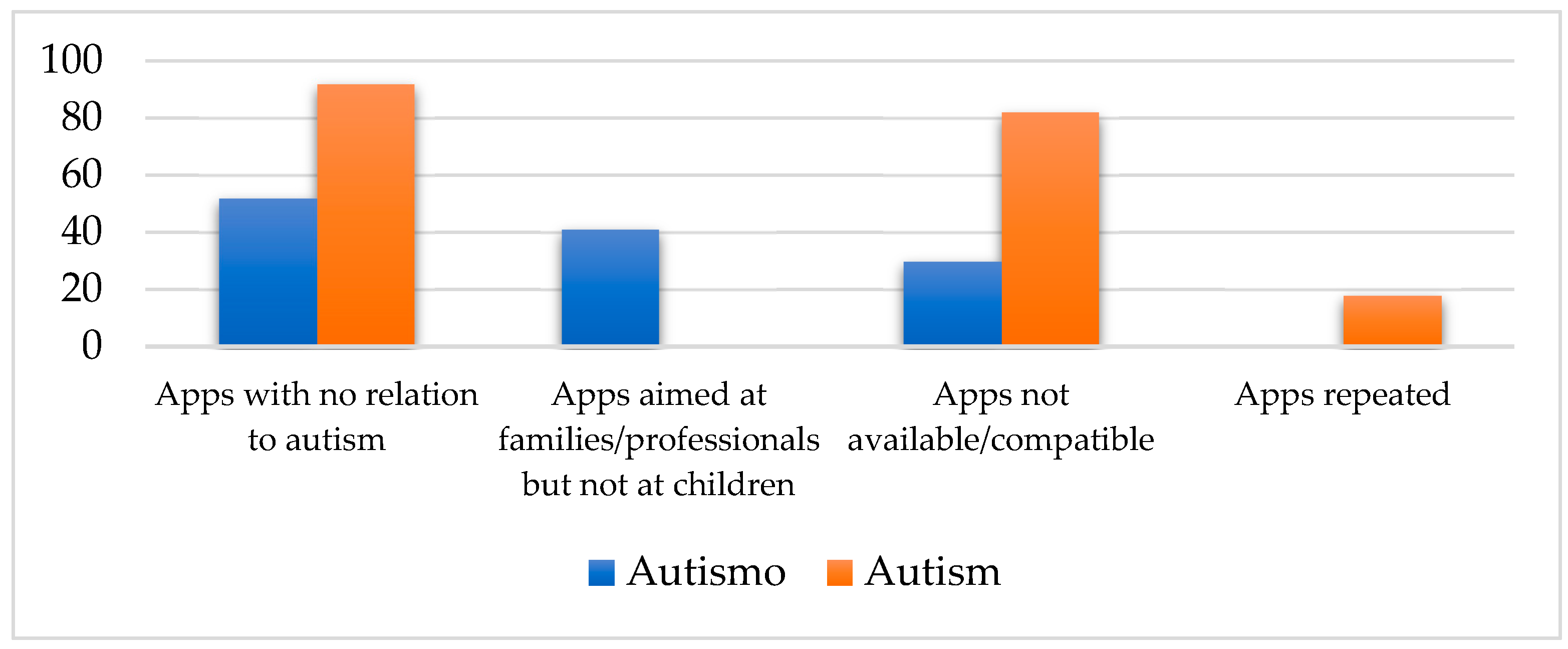
One important limitation of this study is the vast array of apps that different app stores (e.g., Google Play Store) offer. This means that, if one does not perform a meticulous analysis of the information, it will become complicated to assess, resulting in there being many apps repeated, or unconnected to the needs of children with autism. This limitation has been resolved by eliminating those that are redundant during the search process and painstakingly analyzing each app with the system of indicators.
To conclude, the number of apps designed for learning oral language and reading is high, as well as rich in content and subject matter. The app qualities, as we confirmed, are good. For example, in addition to including designs and content that are suitable to the needs of children with autism, these apps work on areas that are closely connected with difficulties that children face daily, both in social and academic spheres. In contrast, fewer apps focus on writing and mathematics. The apps that do, however, boast excellent qualities, in terms of their pedagogical aspects, formatting, and content. Nevertheless, it would be beneficial for families and specialists to have a wider range of apps aimed at basic instrumental skills, and designed for more age groups.




 ,
,