1. Introduction
Digital marketing and e-commerce have become central mechanisms for value creation, consumer engagement, and market expansion, particularly in economies where digital platforms increasingly mediate information search, product comparison, purchasing, and post-purchase activities [
1,
2,
3]. However, in emerging economies, the expansion of digital channels does not necessarily translate into effective online purchasing. E-commerce adoption depends on the interaction of multiple factors, including technological infrastructure, internet connectivity, digital literacy, payment security, logistics capabilities, institutional conditions, consumer trust, and firms’ readiness to operate in digital environments [
4,
5,
6]. Consequently, market growth and the digital maturity of commercial channels should be understood as related, yet distinct, processes.
This distinction is particularly relevant in emerging urban markets, where commercial demand may expand more rapidly than the digital capabilities required to transform that demand into online transactions. In these contexts, consumers may recognize the value of a consumption category and purchase products regularly through physical stores while avoiding digital platforms because of distrust, limited internet access, low familiarity with online shopping, poor recognition of trustworthy websites, or uncertainty regarding payment and delivery conditions [
5,
6,
7,
8]. Therefore, digital adoption is not solely a technological challenge but also a transactional and cognitive one. Online channels must be perceived as trustworthy, understandable, secure, and operationally reliable before consumer demand can effectively translate into digital purchases.
The pet care market provides an appropriate empirical setting for examining this tension. It represents a recurrent and emotionally meaningful consumption category, as household expenditures on pet food, veterinary care, health products, and complementary services are commonly associated with caregiving, emotional attachment, and animal welfare [
9,
10]. At the same time, this market offers substantial opportunities for digital marketing strategies, including online catalogs, subscription models, personalized recommendations, verified customer reviews, delivery services, and hybrid purchasing journeys [
11,
12]. Nevertheless, the existence of recurrent demand does not automatically lead consumers to adopt e-commerce. In high-involvement product categories, digital channels must reduce perceived risk, provide reliable information, ensure product suitability, and maintain consumer trust before, during, and after the transaction.
While the amount spent is a clear determinant of the budget burden, the literature on pet consumption and care suggests that affective reasons (emotional bond, sense of duty toward the pet) can legitimize spending and modify the perception of its economic impact. Therefore, we propose evaluating not only the intensity of spending but also affective justification as a mechanism or moderator of the perceived economic impact. Higher household expenditure on pet care is associated with an increased probability of reporting a moderate-to-high perceived economic impact. Furthermore, affective justification of pet-related spending is associated with perceived economic impact even after accounting for spending intensity and household socioeconomic characteristics. Accordingly, the study evaluates expenditure intensity and affective legitimization as complementary correlates of perceived economic incidence.
Previous research has examined e-commerce adoption in developing countries, the evolution of digital marketing, consumer trust, and online purchase intention [
1,
4,
5,
7,
8]. Other studies have explored the role of pet ownership in consumer spending and the importance of online services within pet food markets [
9,
11,
12]. However, limited attention has been devoted to understanding how economically active consumption categories perform in intermediate cities within emerging economies, where demand may be well established while digital channel adoption remains incomplete. This gap is particularly relevant to digital marketing research because it challenges the assumption that market opportunity, platform availability, and consumer adoption evolve in parallel.
Yopal, Colombia, provides an appropriate case for addressing this issue. As an intermediate urban market, the city concentrates commercial and service activities for its surrounding region but lacks the same density of digital infrastructure, last-mile logistics, platform penetration, and omnichannel business models typically found in large metropolitan areas. Within this context, the pet care market exhibits strong evidence of recurrent household spending and substantial emotional value attached to companion animals, whereas online purchasing remains limited. This setting makes it possible to examine whether consolidated market demand is sufficient to foster e-commerce adoption or whether digital trust, accessibility, and consumer familiarity continue to operate as decisive barriers.
Accordingly, this study aims to analyze how the intensity of recurrent pet care expenditures is associated with perceived economic impact on household budgets and how barriers related to trust, accessibility, and digital familiarity constrain e-commerce adoption in Yopal. To achieve this objective, the study adopts a quantitative, cross-sectional, non-experimental research design with a descriptive-explanatory scope. The empirical analysis is based on a sample of 619 pet owners and follows an analytical strategy that combines descriptive and inferential statistical techniques. Specifically, a binary logistic regression model was estimated to evaluate the perceived economic incidence of pet-related expenditures, while chi-square (χ
2) tests of independence and predicted probability analyses were conducted to explore online channel adoption in the presence of digital barriers. The hypotheses and proposition guiding the study are presented in the
Section 4.
This study uses the notion of a digitally incomplete market as an exploratory interpretative lens for examining a market-level mismatch between recurrent economic demand and limited digital transactional development. Rather than constituting a validated construct or a claim of a universally distinct market category, the notion provides a context-bound analytical formulation whose transferability requires further empirical validation. Digital readiness concerns the ex-ante conditions and capabilities required to adopt digital channels, whereas digital maturity concerns the extent to which digital capabilities, processes, and customer touchpoints have become systematically developed and integrated. Barriers to e-commerce adoption refer to specific technological, cognitive, transactional, or institutional constraints. By contrast, a digitally incomplete market describes the observed mismatch that occurs when an economically established consumption category generates recurrent demand through predominantly physical channels but achieves only limited conversion of that demand into sustained online transactions.
Empirically, the present study identifies this configuration through three components: recurrent household expenditures and their perceived economic incidence; the marginal use of online purchasing as the primary channel; and consumer-reported frictions associated with distrust of digital platforms, internet access, online purchasing familiarity, and awareness of trustworthy websites. Logistics capabilities, payment security, organizational readiness, and omnichannel continuity are treated as theoretically relevant contextual mechanisms, but they were not directly measured in the survey. Accordingly, the contribution of the study is a bounded explanatory lens for examining the decoupling of market consolidation and digital transaction development in emerging urban markets, rather than a validated digital maturity scale.
2. Pet Care Products and Services Market Context
The market context for pet care products and services is examined from three analytical perspectives. First, the section outlines the global and Latin American expansion of the pet care industry and its ongoing digitalization. Second, it analyzes the consolidation of the Colombian market and the factors influencing its transition toward digital sales channels. Finally, Yopal is positioned as an intermediate city and an emerging urban market with sufficient consumer demand for pet care products and services yet constrained by the structural limitations characteristic of non-metropolitan commercial ecosystems.
2.1. Global and Latin American Pet Care Market
The global pet care market has expanded considerably in recent years, driven by increasing pet ownership, greater product diversification, and growing demand for products and services related to nutrition, health, hygiene, well-being, and specialized pet care. Market indicators confirm the magnitude of this transformation. According to Grand View Research, the global pet care market reached USD 181.9 billion in 2025 and is projected to grow to USD 283.7 billion by 2033, representing a compound annual growth rate (CAGR) of 5.9% during the 2026–2033 period. Within this market structure, North America accounted for the largest global market share in 2025 (42.9%), while the Asia-Pacific region is expected to experience the fastest growth throughout the forecast period [
13]. These trends indicate that the sector has evolved beyond basic pet maintenance products to encompass nutrition, health, wellness, grooming products, and specialized solutions for companion animals.
The global pet services segment further illustrates the expansion of the industry toward specialized care activities. Grand View Research estimates that this market was valued at USD 65.1 billion in 2025 and is expected to reach USD 125.8 billion by 2033, with a CAGR of 8.6%. North America also dominated this segment in 2025, accounting for 38.0% of the global market, while veterinary and medical services represented 67.6% of total market value [
14]. These figures demonstrate that industry growth is driven not only by increasing expenditures on pet food and products but also by the expanding importance of veterinary care, medical services, grooming, boarding, training, and other specialized pet care services.
The international expansion of the pet care industry has also been accompanied by a significant transformation of its distribution channels. Grand View Research estimates that the global pet care e-commerce market reached USD 94.89 billion in 2024 and is projected to increase to USD 147.59 billion by 2030, corresponding to a CAGR of 7.8% during the 2025–2030 period. North America dominated this market in 2024, accounting for 40.04% of global sales, supported by a large population of pet owners, widespread access to digital platforms, greater familiarity with online shopping, and the expansion of subscription-based business models [
15]. In the specific case of pet food, online purchasing decisions are influenced by product attributes, consumption habits, owner characteristics, and trust in the digital purchasing environment [
12]. Lima et al. [
11] found that customer satisfaction with online pet food subscription services depends primarily on e-service quality, convenience, fulfillment performance, and provider responsiveness.
Despite these advances, digitalization has not progressed uniformly across regions. Euromonitor International reports that although e-commerce continued to gain market share in Latin America, online sales accounted for only 9% of total pet care sales in 2024 [
16], highlighting a clear gap between market expansion and digital channel maturity. Consequently, although the Latin American pet care industry continues to evolve as a specialized and recurrent consumption category, its digital transformation remains constrained by available infrastructure, transactional trust, logistics capabilities, and consumers’ familiarity with digital platforms.
Overall, the global pet care market demonstrates sustained growth, increasing specialization, and progressive digitalization. However, the evidence also indicates that the economic consolidation of the industry does not automatically imply digital maturity. This distinction provides an appropriate framework for positioning Yopal within a broader group of markets characterized by recurrent demand and significant digital growth potential, yet constrained by infrastructure limitations, transactional trust, business capabilities, and consumer familiarity with e-commerce.
2.2. Colombia: Market Consolidation and Digital Channel Development
The Colombian market exhibits trends like those observed globally. According to Euromonitor International [
16], the Colombian pet care market experienced robust growth in 2025, driven largely by the increasing importance that pet owners assign to their pets’ well-being. The report further suggests that persistent household expenditures on pets, combined with prevailing macroeconomic conditions, have encouraged consumers to shift toward lower-priced product brands.
In Colombia, the pet care industry has entered a stage of market consolidation characterized by the expansion of its consumer base and increasing differentiation by animal species. This trend is supported by recent market evidence indicating that 49% of Colombian households own at least one dog, while 38% own at least one cat, providing a broad demand base capable of sustaining continued market growth [
17]. The same report indicates that the Colombian pet food market grew by 2.7% in 2024 compared with the previous year. Sales remained dominated by dog food (64%), although cat food already represented a substantial 36% of total market sales.
Nevertheless, internal market dynamics reveal important structural differences. While dog food sales increased by only 1%, cat food sales grew by 12%, indicating that market development is driven not merely by market expansion but also by a progressive reconfiguration of consumer demand toward faster-growing product categories [
17]. This trend is consistent with Euromonitor International’s regional analysis, which identifies stronger growth in the feline segment throughout Latin America, largely associated with the increasing cat population, the humanization of companion animals, and the greater compatibility of cats with urban lifestyles characterized by smaller housing units and relatively lower maintenance costs [
18].
Although the Colombian pet care market presents substantial opportunities for digitalization, its transition toward online channels remains uneven. Previous studies on e-commerce adoption in developing countries suggest that converting market demand into digital transactions depends on factors such as household income, internet connectivity, consumer trust, payment security, firms’ digital capabilities, and institutional market conditions [
4,
5,
6]. Likewise, logistics performance and fulfillment capabilities in online retail significantly influence whether access barriers to digital channels are reduced or reinforced [
19]. Rather than replacing physical retail, digitalization is reshaping the role of physical stores, consumer touchpoints, and the transition toward omnichannel retail strategies [
20]. Consequently, the expansion of Colombia’s pet care market does not necessarily imply a proportional migration toward e-commerce, particularly in non-metropolitan cities where digital infrastructure, specialized retail supply, delivery logistics, and transactional trust evolve at different rates.
Within this context, the Colombian market illustrates a fundamental tension. While the growth of a specialized consumption category creates favorable conditions for digital business strategies, the successful adoption of online channels ultimately depends on the commercial ecosystem’s ability to build consumer trust, ensure service reliability, provide verifiable information, and effectively integrate physical and digital channels [
5,
19,
20,
21]. This challenge is particularly relevant for recurrent consumption markets, where consumers may consistently purchase products while continuing to prefer physical retail if digital environments fail to provide adequate security, familiarity, reliability, and continuity throughout the purchasing experience [
11,
12].
2.3. Yopal as an Emerging Urban Market
Yopal, the capital city of the Department of Casanare, represents an appropriate case for examining the relationship between market consolidation and digital maturity in an intermediate Colombian city. According to official territorial statistics cited in this study, the municipality had an estimated population of 196,758 inhabitants in 2025, of whom 170,493 lived within the urban area, accounting for approximately 40% of the department’s total population [
22,
23]. In addition, the 2018 National Population and Housing Census recorded 53,102 households within the municipality [
24]. These demographic characteristics indicate that Yopal possesses a sufficiently large urban market to sustain recurrent demand for products and services related to companion animal care.
Yopal’s economic importance within Casanare further reinforces its relevance as an emerging urban market. According to the Casanare Chamber of Commerce, the municipality generates 30.3% of the department’s total value added through commercial, financial, productive, and service-sector activities [
23]. This regional role positions Yopal as a commercial and service hub for its surrounding territory. However, its status as an intermediate city also implies important differences compared with large metropolitan areas, particularly regarding digital platform density, last-mile logistics, the availability of specialized suppliers, consumers’ experience with digital purchasing channels, and the development of omnichannel business strategies. These differences are especially significant because the expansion of e-commerce transforms urban logistics and requires fulfillment capabilities, delivery infrastructure, and territorial coordination that are not evenly distributed across mature and emerging markets [
25]. Moreover, retail digitalization does not eliminate the role of physical stores but rather redefines their function within hybrid customer journeys in which trust, information quality, and channel continuity remain essential determinants of consumer behavior [
20,
21].
Taken together, Yopal’s population size, urban concentration, number of households, and regional commercial role justify its selection as the empirical setting for this study [
22,
23,
24]. At the same time, its status as an intermediate city allows the analysis of structural constraints typical of non-metropolitan markets, particularly regarding digital platform availability, last-mile logistics, the presence of specialized suppliers, and the integration of physical and digital channels [
20,
21,
25]. Consequently, Yopal provides an appropriate subnational context for examining the pet care market, where strong consumer demand and economic dynamism coexist with significant limitations in digital market maturity.
3. Theoretical Framework
3.1. Digital Market Readiness
Digital market readiness can be defined as the capacity of a commercial ecosystem to transform potential demand into sustained digital transactions. This capability depends on the alignment of technological infrastructure, internet connectivity, digital literacy, payment systems, logistics capabilities, institutional conditions, firms’ digital capabilities, and consumer trust [
4,
5,
6,
19]. In emerging economies, these dimensions do not evolve uniformly. Consequently, a market may exhibit active demand and a well-established physical retail sector while still experiencing limited e-commerce adoption if the digital environment fails to provide adequate conditions of accessibility, security, fulfillment, and trust [
4,
5,
6,
19].
The literature on e-commerce adoption in developing countries indicates that digitalization is driven by both supply-side and demand-side factors. From the supply perspective, firms require capabilities to manage digital catalogs, inventories, payment systems, customer service, online reputation, logistics, and after-sales support [
4,
5,
6,
19,
26]. From the demand perspective, consumers require access to digital technologies, familiarity with online shopping, previous purchasing experience, trust, and a perceived usefulness of digital channels [
4,
5,
6]. Accordingly, digital market readiness should be understood as a concept distinct from the economic consolidation of a market.
This distinction is particularly relevant in emerging urban markets, where commercial demand may expand more rapidly than the digital capabilities of the surrounding business ecosystem. A market may display recurrent consumption patterns, an active physical retail sector, and consumer segments interested in specialized products, yet continue to exhibit low adoption of digital purchasing channels due to persistent limitations in internet connectivity, limited awareness of trustworthy websites, low perceived payment security, insufficient logistics capabilities, or inadequate digital preparedness among local businesses [
4,
6,
19]. This interpretation is consistent with previous research demonstrating that e-commerce adoption depends on the interaction of economic, regulatory, educational, financial, technological, and logistical conditions that support the relationship between consumers, digital platforms, and service providers [
4,
6,
19].
Digital market readiness also requires distinguishing between market opportunity and transactional maturity. The former refers to the existence of market demand, recurrent purchasing behavior, and growth potential, whereas the latter concerns the ability of digital channels to provide reliable information, fulfillment, traceability, secure payment methods, after-sales services, and seamless integration between physical and digital channels [
19,
26]. Consequently, in product categories such as pet care, where purchases are closely associated with the well-being of companion animals, digital readiness requires more than simply maintaining an online presence. It demands functional and reputational capabilities that enable consumers to perceive digital channels as reliable alternatives—or effective complements—to traditional physical stores. Therefore, digital market readiness should be conceptualized as a condition that is analytically distinct from the economic consolidation of the market.
3.2. Digital Trust and Perceived Risk
Digital trust and perceived risk are fundamental constructs for explaining the conversion of consumer demand into online purchasing behavior. In e-commerce environments, consumers face uncertainty regarding the authenticity of sellers, product quality, payment security, personal data protection, delivery fulfillment, and the availability of effective complaint and redress mechanisms in the event of service failures. Therefore, digital trust should not be understood merely as a favorable attitude toward an online platform, but rather as a key mechanism underlying transactional conversion. By reducing uncertainty, lowering perceived vulnerability, and facilitating the transition from purchase intention to actual transaction, trust plays a pivotal role in consumers’ adoption of digital channels [
7,
8,
27].
In emerging markets, this relationship becomes even more critical because consumers often experience information asymmetries, limited prior experience with digital platforms, distrust toward unfamiliar sellers, and constraints related to payment methods or internet connectivity [
5,
8]. Empirical evidence indicates that the perceived usefulness of online customer reviews can strengthen consumer trust while simultaneously reducing perceived risk, particularly in emerging contexts where external signals are essential for assessing platform credibility [
8]. Furthermore, recent meta-analytic evidence confirms that trust, perceived risk, perceived security, and electronic word-of-mouth exert significant influence on digital purchasing decisions [
7].
Perceived risk also has direct effects on both purchase intention and actual buying behavior. Recent studies on cross-border e-commerce demonstrate that risks associated with both the platform and the product can significantly reduce consumers’ purchase intentions and their willingness to recommend online channels, particularly when adequate mechanisms for protection, fulfillment, or warranty are perceived to be insufficient [
27]. This issue is especially relevant in the pet care market, where many products are directly associated with animal health, nutrition, well-being, and overall quality of life. Consequently, purchasing errors, delivery failures, incomplete product information, or inadequate customer support may have a greater impact on consumers’ evaluation of digital purchasing channels.
Digital trust is built upon tangible attributes of the online shopping environment. Website quality, perceived service quality, customer reviews, product variety, information transparency, and seller reputation all contribute to increasing consumers’ online purchase intentions, largely because they facilitate the development of trust [
28]. In markets where confidence in digital payment systems remains limited, mechanisms such as cash-on-delivery may serve as transitional strategies by reducing consumers’ perceived financial exposure and encouraging their first online purchasing experiences [
29]. Nevertheless, these mechanisms should not be viewed as substitutes for improving the overall quality of digital channels. Rather, they function as transitional tools that facilitate the gradual development of transactional trust.
From this perspective, the low adoption of e-commerce should not be interpreted solely as a consequence of limited access to technology. It may also reflect an insufficient capacity of the digital ecosystem to reduce uncertainty, communicate reliability, and provide adequate transactional security. In emerging urban markets, the main challenge lies in transforming the relational trust traditionally associated with physical retail into verifiable digital trust. While these theoretical considerations suggest that adoption friction varies across consumer profiles, empirical evidence remains inconclusive regarding the specific directional impact of demographic factors in localized markets. Consequently, this perspective provides the rationale for exploring—rather than directionally predicting—whether adoption barriers differ significantly across age and income groups, as formally posited in Hypothesis H2.
3.3. Affective and Recurrent Pet Care Consumption
Pet care consumption integrates functional value, emotional value, caregiving responsibility, and recurrent purchasing behavior. Although expenditures on pet food, veterinary care, and health products primarily address animals’ practical needs, purchasing decisions are also shaped by the affective, social, and symbolic meanings associated with the human–animal bond. Contemporary consumption value theories suggest that purchase decisions are driven not only by price or functional utility but also by emotional, social, situational, and perceived well-being benefits [
30]. This perspective helps explain why households continue to allocate substantial and recurrent expenditures to companion animals even under budget constraints.
The evolving human–animal relationship has reinforced the emotional dimension of pet care consumption. Recent studies indicate that attachment to pets, anthropomorphism, and self-expansion significantly influence consumers’ willingness to purchase specialized products for companion animals [
10]. From this perspective, pet-related consumption extends beyond the acquisition of goods for an animal; rather, it reflects a caregiving relationship with a valued member of the household. Companion animals become integrated into everyday family life as sources of companionship, well-being, family identity, and emotional support, thereby legitimizing household expenditures on food, healthcare, hygiene products, accessories, and complementary services.
The concept of psychological ownership provides a more precise explanation of how emotional attachment translates into economic valuation. When owners experience a strong sense of possession, attachment, and responsibility toward their pets, they tend to assign greater economic value to them and demonstrate a higher willingness to pay for veterinary procedures, medical treatments, and specialized products [
31]. This mechanism is particularly relevant to the present study because it links affective valuation with perceived economic incidence. Pet-related expenditures are therefore interpreted not merely as household expenses but as legitimate caregiving investments arising from the emotional bond between owners and their companion animals.
The recurrent nature of pet-related expenditures further demonstrates that pet care constitutes an economically structured consumption category. Recent evidence suggests that pet ownership increases both consumer purchasing frequency and overall household spending, largely because it is associated with greater subjective well-being and more frequent purchasing decisions [
9]. Likewise, consumer behavior studies have identified distinct purchasing patterns among dog and cat owners across multiple product categories, indicating that the pet care market is expanding not only in volume but also through the reconfiguration of household consumption baskets, creating opportunities for market segmentation, cross-selling strategies, and product specialization [
32].
Pet food exemplifies this pattern of recurrent and highly involved consumption. Recent research indicates that purchasing decisions are influenced by nutritional composition, perceived quality, brand reputation, price, sustainability, health attributes, and the specific needs of individual animals [
33]. Complementary evidence further demonstrates that dog and cat owners evaluate food quality using different criteria and place considerable importance on product characteristics that may affect digestive health, overall well-being, and product acceptance by their pets [
34]. Consequently, although pet food is purchased frequently, it should not be regarded as a low-involvement product category.
Accordingly, pet care consumption can be conceptualized as a recurrent and emotionally legitimized consumption category. Its economic relevance depends not only on household purchasing power but also on the interaction between spending frequency, the type of product or service purchased, the intensity of the emotional bond with the companion animal, and the owner’s perceived responsibility for animal welfare. These characteristics make the pet care market an appropriate context for examining how a well-established demand can create significant commercial opportunities while simultaneously requiring higher levels of consumer trust when purchasing decisions shift toward digital channels.
3.4. Omnichannel Continuity and Digital Maturity Gap
The transition of pet care consumption toward digital channels requires continuity between the trust established through physical retail and the customer experience delivered by online channels. The retail digitalization literature consistently demonstrates that physical stores do not disappear with the expansion of digital commerce; instead, they redefine their roles within hybrid customer journeys that encompass information search, product evaluation, purchasing, and post-purchase interactions [
20]. In product categories where consumers require professional advice, product verification, expert recommendations, or immediate assistance, physical stores continue to perform essential functions related to trust, guidance, and purchase validation.
An omnichannel strategy assumes that consumers do not interact with isolated channels but rather with an integrated network of customer touchpoints that should seamlessly coordinate information, product availability, customer service, payment, delivery, and after-sales support [
21,
35]. In markets characterized by low levels of digital maturity, such continuity becomes particularly important because consumers often rely on digital channels to search for information, compare alternatives, or verify product availability, yet ultimately complete their purchases through physical stores when they perceive greater security, control, or reassurance. Consequently, the primary challenge is not to replace physical retail but to develop a gradual integration of physical and digital channels that minimizes friction while preserving consumer trust.
Logistics continuity constitutes a critical dimension of the digital maturity gap. Within e-commerce environments, customer experience depends heavily on the ability to meet delivery deadlines, ensure product availability, provide shipment traceability, efficiently manage product returns, and respond effectively to service failures. Research on last-mile logistics demonstrates that urban distribution strategies differ substantially between mature and emerging markets because demand density, infrastructure, territorial coordination, and operational capabilities are unevenly distributed [
25]. In intermediate urban markets, these structural differences may constrain the expansion of digital channels even when recurrent consumer demand already exists.
Reputational continuity is equally essential. Consumers need to know who is selling the product, who is accountable for the transaction, what guarantees are provided, and how potential service failures will be resolved. Within the pet care market, these considerations become particularly important because many products are directly associated with animal health, nutrition, and overall well-being. Research on online pet food subscription services has shown that customer satisfaction depends on electronic service quality, convenience, fulfillment performance, and provider responsiveness [
11]. Similarly, online pet food purchasing decisions are influenced by product attributes, consumer purchasing habits, owner characteristics, and trust in the digital purchasing environment [
12]. Consequently, digital channel maturity requires not only product availability but also strong reputation, transaction traceability, and reliable customer support.
Post-purchase services complete this framework of omnichannel continuity. Previous e-commerce research indicates that order fulfillment, delivery performance, service recovery, warranty policies, and after-sales support significantly influence both customer satisfaction and trust in digital channels [
36,
37]. In recurrent consumption categories such as pet care, these attributes are particularly important because a single unsatisfactory purchasing experience may interrupt repeat purchases and encourage consumers to return to physical retail channels. Therefore, the digital maturity gap emerges when consumer demand exists, but the online ecosystem fails to provide sufficient levels of trust, fulfillment, reputation, and service continuity to sustain repeated digital transactions.
In summary, omnichannel continuity helps explain why recurrent market demand does not automatically translate into online purchasing behavior. While physical retail continues to provide trust, professional guidance, and purchase validation, digital channels must develop logistical, reputational, and post-purchase continuity to support sustained consumer engagement and repeated online transactions. This theoretical relationship underpins Proposition 1 and provides the conceptual basis for distinguishing market economic consolidation from the digital maturity of commercial channels.
3.5. Conceptual Distinctiveness of a Digitally Incomplete Market
The concept of a digitally incomplete market is proposed to capture a specific misalignment between the development of recurrent and economically relevant demand within a consumption category and the transactional development of its digital channels. It differs from digital readiness, which generally refers to the extent to which organizations possess the technological sensemaking, agility, resources, and implementation capabilities required to undertake digital transformation [
38]. It also differs from digital maturity, which is typically assessed through multidimensional models that position organizations according to their achieved capabilities and progression across predefined stages of digital transformation [
39]. Likewise, the concept is broader than conventional e-commerce adoption-barrier frameworks, which primarily identify technological, organizational, institutional, infrastructural, and consumer-level constraints affecting adoption [
5,
6]. Rather than treating these conditions separately, a digitally incomplete market captures the market configuration in which established demand and recurrent commercial activity coexist with limited digital transactional development, consistent with the view that digital transformation unfolds through interconnected changes in technologies, organizational processes, actors, and value-creation arrangements [
40,
41].
Three observable components define the configuration examined in this study. The first is recurrent and budget-relevant demand, reflected in repeated expenditures and in the perceived incidence of pet-related spending on household budgets. Previous evidence indicates that pet ownership increases purchasing frequency and household expenditure [
9], while emotional attachment and psychological ownership can strengthen the economic value attributed to companion animals [
10,
31]. The second component is weak digital conversion, reflected in the small proportion of respondents who identify online purchasing as their primary channel. Prior studies demonstrate that the existence of market demand does not automatically result in e-commerce adoption when technological, organizational, and consumer readiness remain uneven [
4,
5]. The third component is persistent consumer-facing friction. Distrust and perceived risk can inhibit online transactions even when consumers recognize the usefulness of digital channels [
7,
8], whereas limited internet access, inadequate digital skills, and unfamiliarity with reliable websites further restrict consumers’ ability to complete online purchases [
5,
6,
42]. A digitally incomplete market is therefore observed when these three conditions coexist: recurrent demand is evident, transactions remain concentrated in physical channels, and the online channel continues to be constrained by trust, access, and familiarity-related frictions.
The concept is relational rather than scalar because it concerns the mismatch between two dimensions—recurrent market demand and digital transactional development—rather than locating the market at a single point on a generalized maturity scale. This distinction is relevant because digital maturity models commonly evaluate progression through predefined organizational dimensions and successive stages [
39], whereas the proposed concept focuses on the relative development of economic demand and digital transaction capacity. It is also a market-level configuration, rather than an exclusively consumer- or firm-level characteristic, because digital outcomes emerge from interdependencies among consumers, businesses, platforms, complementors, and other ecosystem participants [
40,
41]. Digital commerce additionally depends on fulfillment capabilities, last-mile logistics, service continuity, and the territorial organization of distribution systems [
19,
25]. In the present study, however, only consumer-reported barriers, expenditure patterns, and purchasing-channel behavior were measured directly. Supply-side capabilities, platform characteristics, logistics conditions, and institutional arrangements are therefore treated as theoretically relevant contextual mechanisms requiring direct examination in future research.
The proposed configuration is expected to be particularly relevant in emerging urban markets and in recurrent, high-involvement consumption categories. In such categories, perceived product-performance risk increases consumers’ trust expectations when selecting online merchants [
43]. Physical retailers may consequently retain informational, relational, and reputational advantages by enabling consumers to inspect products, obtain personalized advice, and resolve uncertainty through direct interaction [
25,
35]. Recent evidence also shows that channel choice depends on differences in expected search outcomes, purchase outcomes, convenience, habits, and the perceived characteristics of online and offline retail environments [
44]. Under these conditions, increasing expenditure may strengthen the economic relevance of a consumption category without producing a proportional increase in online transactions [
4,
5]. Recurrent and budget-relevant demand is therefore conceptualized as an opportunity condition for e-commerce development, but not as a sufficient condition for achieving digital channel maturity.
Accordingly, the digitally incomplete market configuration should be understood as a provisional interpretative lens derived from the pattern observed in Yopal. Its conceptual distinctiveness and transferability require further validation across cities, consumption categories, and datasets incorporating direct measures of consumer-, firm-, logistical-, and institutional-level conditions.
4. Conceptual Model
The conceptual model integrates three interrelated dimensions: the affective legitimization of pet care consumption, the economic consolidation of the pet care market, and the digital maturity gap of commercial channels. The first dimension conceptualizes the emotional value attributed to companion animals as the underlying mechanism that legitimizes recurrent household expenditures. The second dimension is reflected in the intensity of spending on pet food, veterinary care, healthcare products, accessories, and complementary services and is empirically assessed through Hypothesis H1. The third dimension focuses on the barriers related to trust, accessibility, and digital familiarity that constrain the adoption of online purchasing channels and is examined through Hypothesis H2 and Proposition 1.
First, the model recognizes that expenditure on pet care products and services is influenced by the affective value that owners attribute to their companion animals. The human–animal relationship encourages households to allocate financial resources to pet food, veterinary services, healthcare products, accessories, and complementary services not only for functional reasons but also because of considerations related to animal welfare, caregiving responsibilities, and emotional attachment. In this context, affective legitimization is examined through observed survey indicators as an associative, rather than causal, component of the model.
Second, the economic consolidation of the pet care market is reflected in the intensity of recurrent expenditures and the perceived economic impact of those expenditures on household budgets. The recurrent nature of spending on pet food, veterinary care, and animal healthcare supports the interpretation of pet care as an established component of household consumption patterns. Accordingly, the conceptual model proposes that higher levels of recurrent expenditure are associated with a greater probability that households will perceive pet-related spending as having a moderate or high economic impact on their budgets. This relationship constitutes the principal empirical component of the model and is evaluated using binary logistic regression.
Third, the model incorporates the digital maturity gap as a central dimension for understanding e-commerce adoption in emerging markets. The existence of economically active demand does not necessarily imply that consumers will adopt digital purchasing channels. In intermediate urban markets, physical retail continues to provide trust, professional advice, product verification, and immediate assistance, whereas online channels may remain constrained by distrust of digital platforms, limited internet accessibility, low familiarity with online shopping, and limited awareness of trustworthy websites. Consequently, e-commerce adoption within the pet care market depends not only on the existence of consumer demand but also on digital trust, accessibility, reliable information, secure payment systems, logistics continuity, and consumers’ digital capabilities.
Based on this framework, the conceptual model does not assume an automatic relationship between market economic consolidation and digital maturity. Instead, it proposes that a market may exhibit recurrent expenditures, affective legitimization, and sustained consumer demand while still experiencing limited e-commerce adoption if the digital ecosystem fails to reduce transaction uncertainty, build trust, and provide reliable fulfilment and payment infrastructure. In other words, the readiness of digital channels to convert latent demand into sustained online transactions depends both on the structure and magnitude of household pet expenditures and on the capacity of digital platforms to lower informational and transactional frictions.
Based on these theoretical arguments, the following hypotheses and propositions are proposed:
H1. Posits the general proposition that the intensity of recurrent expenditures on pet care products and services is positively associated with the perceived economic incidence of pet-related spending within the household budget. Given the multidimensional nature of this relationship, H1 is decomposed into two complementary sub-hypotheses, H1a and H1b, which examine distinct mechanisms underlying the proposed association.
H1a. Examines whether higher recurrent expenditures on pet care are associated with a greater likelihood of perceiving pet-related spending as having a moderate-to-high economic incidence on the household budget. Accordingly, H1a provides a direct test of the proposed relationship from a behavioral and expenditure-based perspective.
H1b. Examines whether affective legitimization is associated with the perceived economic incidence of pet-related expenditures. This dimension is conceptually distinct from expenditure intensity because consumers may differ in how they interpret or legitimize the financial burden associated with pet care, even when their levels of expenditure are comparable.
H2. Among consumers who do not use online purchasing channels, the reported barriers to online shopping—including distrust, limited internet access, low digital familiarity, and limited awareness of trustworthy websites—differ significantly across age and income groups. These relationships are tested on the sub-sample of non-adopters; we report Pearson χ2 statistics with degrees of freedom and sample size, examine expected cell counts, and where expected counts are <5 we present Fisher’s exact test (Monte Carlo simulation, B = 10,000).
Proposition 1. In emerging urban markets, the economic consolidation of a consumption category does not necessarily imply the digital maturity of its commercial channels.
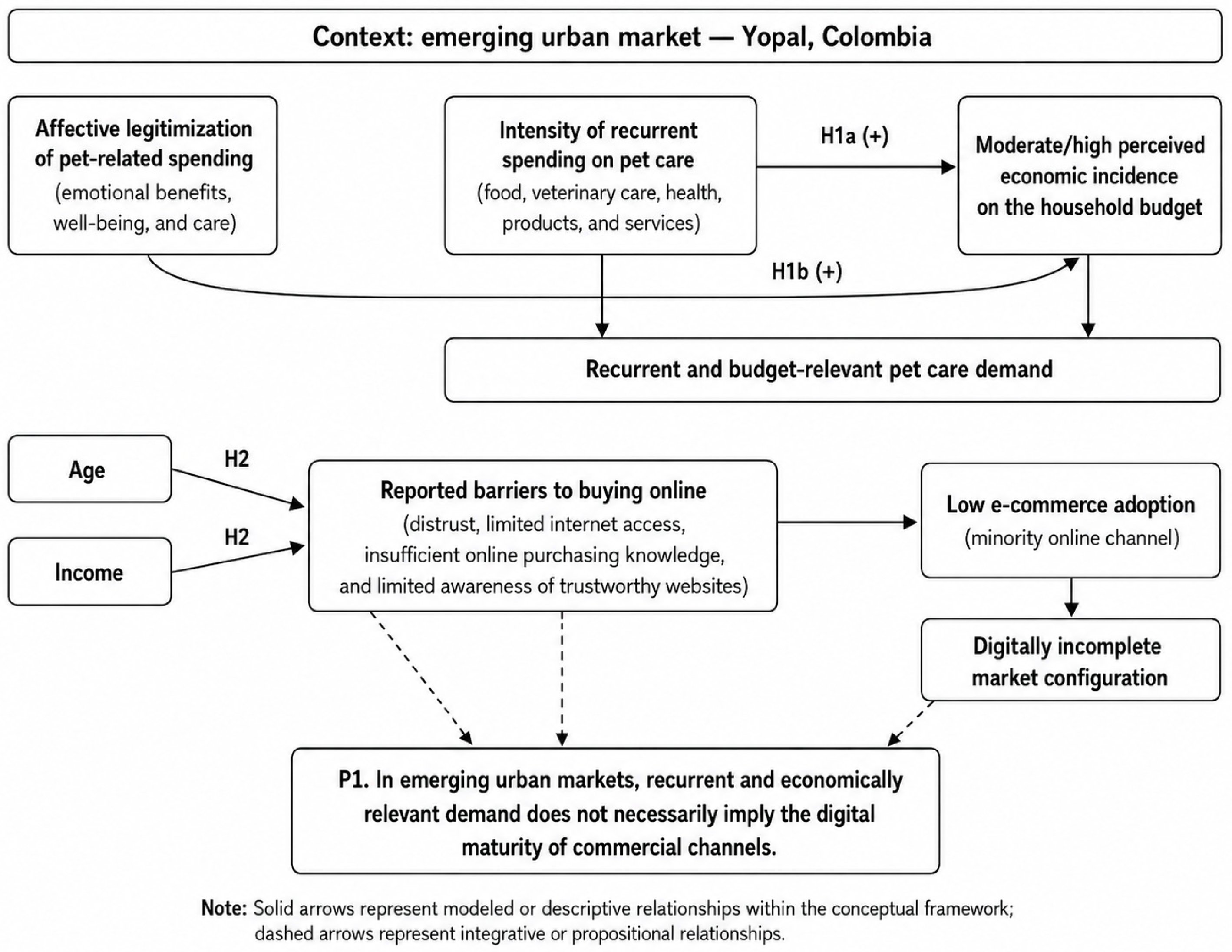
Figure 1 illustrates the conceptual model proposed in this study. The relationship between affective value and recurrent expenditure is conceptualized as a theoretical mechanism that legitimizes pet care consumption. The relationship between the intensity of recurrent expenditures and perceived economic incidence corresponds to Hypothesis H1a and H1b, which are empirically evaluated using binary logistic regression. The relationship between digital barriers, age, and income corresponds to Hypothesis H2 and is examined through descriptive analyses and chi-square tests of independence. Finally, Proposition 1 integrates the findings on market economic consolidation and digital adoption to explain the digital maturity gap characterizing the pet care market in Yopal.
5. Materials and Methods
5.1. Research Design
This study adopted a quantitative research approach based on a quantitative, cross-sectional, non-experimental design with descriptive and analytical components, incorporating an exploratory analysis of e-commerce adoption. The research examined the relationship between the intensity of recurrent household expenditures on pet care products and services, the perceived economic impact of these expenditures on household budgets, and the barriers that constrain e-commerce adoption in the urban market of Yopal, Colombia.
The analytical framework was structured around the proposed conceptual model. First, the study examined the economic consolidation of the pet care market through recurrent household expenditures on pet food, veterinary care, healthcare products, accessories, and complementary services. This component corresponds to Hypotheses H1a and H1b. H1a proposes that greater intensity of recurrent spending on pet care products and services is positively associated with a higher likelihood of perceiving these expenditures as having a moderate-to-high economic incidence on the household budget, whereas H1b proposes that affective legitimization of pet-related spending is also associated with perceived economic incidence, independently of expenditure intensity and household socioeconomic characteristics.
Second, the study investigated the adoption of online purchasing channels and the barriers reported by consumers who do not purchase pet care products online. This component addresses Hypothesis H2, which proposes that, among consumers who do not use digital purchasing channels, the reported barriers to online shopping—including distrust, limited internet access, low digital familiarity, and limited awareness of trustworthy websites—vary significantly across age and income groups.
Finally, the methodological design enabled the evaluation of Proposition 1, which argues that, in emerging urban markets, the economic consolidation of a consumption category does not necessarily imply the digital maturity of its commercial channels. To examine this proposition, evidence on recurrent expenditures and perceived economic incidence was contrasted with the low adoption of online purchasing channels and the digital barriers reported by consumers.
The study was conducted in Yopal, the capital city of the Department of Casanare, Colombia. The city was selected as an example of an emerging urban market because it functions as the principal commercial, financial, and service center for its surrounding region while lacking the level of digital, logistical, and commercial infrastructure typically found in large metropolitan areas.
Primary data were collected through a structured survey administered to residents of Yopal aged 18 years or older. The questionnaire was administered in person via an online application. Participants were interviewed at the exits of residential complexes, shopping malls, the main universities, and in some locations in the city center. A non-probability convenience sampling strategy was employed, resulting in an initial database of 669 respondents. Of these, 619 participants reported owning at least one companion animal and therefore constituted the analytical sample used for descriptive, bivariate, and multivariate regression analyses. As a contextual reference for assessing the numerical adequacy of the sample, the 2018 National Population and Housing Census recorded 112,857 residents aged 18 years or older in Yopal [
24]. Under a hypothetical simple random sampling design, a population of this size would require approximately 383 participants, assuming a 95% confidence level, a 5% margin of error, and maximum population variability
. The analytical sample of 619 pet owners exceeded this conventional benchmark by approximately 61.6%. Nevertheless, this comparison is presented solely as an indicator of numerical adequacy. Because participants were selected through non-probability convenience sampling, the sample size achieved does not confer statistical representativeness or permit the assignment of a design-based margin of error to the findings.
Because some variables contained missing values or invalid categories for specific statistical procedures, the effective sample size varied across analyses. Accordingly, a complete-case analysis approach was adopted for each statistical procedure. Attention was given to the pronounced imbalance between physical and online purchasing channels observed in the data, as online purchasing represented only a small proportion of respondents’ purchasing behavior. Consequently, the analysis of e-commerce adoption was treated as exploratory rather than as a confirmatory predictive modeling exercise.
5.2. Survey Instruments and Measures
Data were collected using a structured questionnaire consisting of 24 items organized into four sections.
The complete questionnaire is provided as Supplementary Material S1. The first section gathered respondents’ sociodemographic and household information, including household composition, age, gender, number of children, socioeconomic stratum, and monthly household income. The second section focused on pet ownership characteristics, including the number and type of companion animals, as well as household expenditures on pet food, veterinary care, healthcare products, accessories, complementary services, and animal healthcare. The third section explored respondents’ perceptions regarding the availability of veterinary services in Yopal, the adequacy of veterinary service costs, the emotional value attributed to companion animals, and their perceived contribution to household well-being. The fourth section examined purchasing behavior by distinguishing between physical and online purchasing channels and identifying the main reasons for not using digital purchasing platforms. The survey was administered between February and April 2025. Before administration, the research team reviewed the wording, response categories, sequence, and technical presentation for clarity and comprehensibility.
Expenditure variables were measured using ordinal expenditure ranges expressed in Colombian pesos (COP) and subsequently converted into U.S. dollars (USD) for the presentation of the results (Monetary amounts originally reported in Colombian pesos (COP) were converted to U.S. dollars (USD) using an approximate exchange rate of US$1 = COP 3100. Perception variables were measured using categorical response scales that assessed the perceived economic impact of pet-related expenditures, the adequacy of veterinary service availability, the perceived appropriateness of veterinary costs, and the emotional and well-being value attributed to companion animals. The e-commerce section included respondents’ primary purchasing channel and the reported reasons for not purchasing online, including distrust of digital platforms, limited internet access, lack of awareness of trustworthy websites, and insufficient knowledge of how to shop online.
The questionnaire was designed primarily as a descriptive market-diagnostic instrument and did not seek to estimate latent psychometric constructs. The item concerning distrust of digital platforms captured a reported reason for not purchasing online and should not be interpreted as a validated measure of digital trust. Perceived risk was incorporated into the theoretical interpretation of e-commerce adoption but was not directly measured. Similarly, the emotional benefits attributed to companion animals and their perceived contribution to household well-being were captured through separate survey items and were not combined into a psychometric scale of affective value. Consequently, internal consistency coefficients and latent-variable validity tests were not applicable to these observed indicators.
The use of concise items was intended to reduce respondent burden and to support a broad descriptive assessment of expenditure patterns, purchasing channels, and reported obstacles. Nevertheless, single-item measures provide limited coverage of multidimensional constructs and may be more sensitive to wording and measurement error. The results are therefore interpreted at the level of the specific survey questions rather than as comprehensive estimates of digital trust, perceived risk, or affective value. Future studies should use validated multi-item scales and assess their reliability, convergent validity, and discriminant validity.
5.3. Construct Operationalization
The variables included in the empirical analysis were operationalized in accordance with the conceptual model, the survey items, and the analytical procedures described above.
Table 1 summarizes the operational definition of each construct or observed variable, the corresponding survey indicators, measurement scales and coding procedures, their relationship with the hypotheses and proposition, and the statistical techniques used for analysis. Consistent with the design of the questionnaire, affective legitimization and digital barriers were represented through observed indicators rather than latent psychometric constructs, while the digitally incomplete market configuration was derived from the analytical integration of expenditure patterns, purchasing-channel behavior, and reported digital barriers.
5.4. Statistical Analysis
Data processing and statistical analyses were performed using R statistical software (version 4.5.3). The anonymized database used for the analyses is provided as
Supplementary Material S2. Initially, categorical variables were coded as factors, and the dataset was screened for missing values and invalid categories. A complete-case analysis approach was applied to each statistical procedure; therefore, the effective sample size varied depending on the variables included in each analysis.
The first stage consisted of a descriptive analysis based on absolute frequencies, valid percentages, and frequency distribution tables. This analysis was used to characterize the study sample, the structure of pet ownership, household expenditure patterns, the affective value attributed to companion animals, the perceived economic incidence of pet-related expenditures, and the predominant purchasing channel. These descriptive findings provided the empirical basis for interpreting the affective legitimization of pet care consumption and the economic consolidation of the pet care market.
5.4.1. Binary Logistic Regression for Perceived Economic Incidence
To test Hypothesis H1a and H1b, a binary logistic regression model was estimated to examine the factors associated with the perceived economic incidence of pet-related expenditures on the household budget. The dependent variable was derived from the respondents’ perceived economic impact of pet-related expenditures and was dichotomized as follows: responses indicating “Moderate” or “High” economic incidence were coded as 1, whereas responses indicating “No Impact” or “Low Impact” were coded as 0. Missing or invalid observations were excluded from the analysis.
The explanatory variables included expenditure ranges for pet food, veterinary care, pet products and accessories, complementary services, annual healthcare expenditures, number of companion animals, socioeconomic stratum, and monthly household income. Reference categories corresponded to the lowest expenditure ranges, ownership of a single companion animal, the absence of each specific pet type, socioeconomic stratum 1, and household income below one monthly legal minimum wage.
The general specification of the model was as follows:
where p
i denotes the probability that respondent
i perceives pet-related expenditures as having a moderate or high economic impact on the household budget, and
represents the set of explanatory variables related to expenditure patterns, pet ownership characteristics, and respondents’ socioeconomic profiles.
Before model estimation, multicollinearity among the explanatory variables was assessed using the Generalized Variance Inflation Factor (GVIF), an extension of the conventional VIF that is appropriate for categorical predictors with more than one degree of freedom. The standardized indicator was used to ensure comparability among predictors with different numbers of parameters and was interpreted analogously to the conventional VIF, where values below 2.0 indicate negligible multicollinearity. All predictors included in the model exhibited values well below this threshold, ranging from 1.06 for justification based on emotional benefits to 1.19 for veterinary care expenses, followed by pet product expenses and monthly household income (both at 1.17), and food expenses at 1.16. Although all five expenditure predictors were introduced into the model simultaneously, multicollinearity remained minimal, indicating that the simultaneous inclusion of these variables did not significantly inflate standard errors or compromise the interpretability of the individual coefficients.
Model parameters were estimated using Maximum Likelihood Estimation (MLE). Overall model fit was assessed using the Likelihood Ratio Test, the Akaike Information Criterion (AIC), and McFadden’s pseudo- as indicators of model fit and parsimony. Results were interpreted based on the estimated regression coefficients (β), their standard errors, the corresponding odds ratios , and associated p-values. This analytical approach enabled the assessment of whether greater recurrent expenditures on pet care products and services increased the probability that households perceived pet-related spending as having a moderate or high economic impact on their budgets.
5.4.2. Exploratory Analysis of E-Commerce Adoption and Digital Barriers
To examine Hypothesis H2, an exploratory analysis of e-commerce adoption and digital barriers was conducted. This component was not treated as a confirmatory predictive model because only a small proportion of respondents reported using online purchasing channels, resulting in a pronounced imbalance between physical and digital purchasing behavior.
The analysis was conducted in three stages. First, the distribution of respondents’ primary purchasing channels was described by distinguishing between physical and online purchasing. Second, the reported reasons for not purchasing online were analyzed using frequency distributions and percentages. These reasons included distrust of online platforms, limited internet access, insufficient knowledge of how to purchase online, and limited awareness of trustworthy websites. Third, chi-square tests of independence were performed to determine whether the distribution of these barriers differed significantly across age and income groups.
The chi-square analyses were restricted to the subgroup of respondents who did not use online purchasing as their primary purchasing channel. The null hypothesis assumed independence between respondents’ sociodemographic characteristics and the reported barriers to online purchasing, whereas the alternative hypothesis proposed an association between these variables. Statistical significance was evaluated at α = 0.05. This procedure allowed the identification of statistically significant differences in digital barriers across age groups and income levels, thereby providing empirical evidence for Hypothesis H2.
In addition, to further characterize the patterns of digital adoption, an exploratory binary logistic regression model was estimated. The dependent variable was the choice of purchasing channel (1 = Online; 0 = Physical), with age and monthly income as predictors. Given the low frequency of the event of interest, the model utilized an ordinal-linear specification for the predictors to ensure parsimony and stability in the estimations. This component was intended to illustrate differential patterns of digital adoption across sociodemographic segments rather than to estimate a confirmatory predictive model. The global fit was assessed using the Likelihood Ratio test, and the uncertainty of the estimates was captured through 95% confidence intervals, which are reported alongside the predicted probabilities in the
Section 6.
Finally, Proposition 1 was evaluated through an analytical integration of empirical evidence. Because only a small proportion of respondents (approximately 5% of the sample) reported purchasing pet care products through online channels, the proposition was examined from an exploratory perspective by integrating the findings obtained from the descriptive analyses, contingency tables, chi-square tests of independence, and the exploratory logistic regression analysis of online channel adoption. Market economic consolidation was assessed through recurrent expenditure patterns and perceived economic incidence, whereas digital maturity was evaluated based on the limited use of online purchasing channels and the digital barriers reported by respondents. Comparing these dimensions made it possible to identify the digital maturity gap characterizing the pet care market in Yopal.
5.5. Use of Generative Artificial Intelligence
During the preparation of this manuscript, the authors used ChatGPT 5.5 to assist with language refinement, improvement of clarity and coherence, organization of the introduction, alignment with the journal template, and formatting support for citations according to the numerical citation style required by the journal. ChatGPT was also used to suggest recent academic literature related to adoption of e-commerce, consumer behavior, digital trust, and emerging markets. The authors have reviewed and edited the output and take full responsibility for the content of this publication.
5.6. Ethical Considerations
The study was conducted with adult residents of Yopal, Colombia. Participation was entirely voluntary, and all data were processed in aggregated form without any individual identification of participants. The information collected was used exclusively for academic and research purposes.
The research protocol was reviewed and approved by the Research Ethics Committee of Corporación Universitaria Remington (Approval Record No. 04, 6 June 2024). Before participating, all respondents were informed about the academic purpose of the study and provided their voluntary informed consent. Data were analyzed anonymously and are reported exclusively in aggregated form to ensure participants’ confidentiality and privacy.
6. Results
The results are presented in four sections following the conceptual model and the hypotheses proposed in this study. First, the sociodemographic profile of pet owners surveyed in Yopal is described. Second, the analysis examines the affective value attributed to companion animals, recurrent expenditure patterns, and the perceived economic incidence of pet-related spending. Third, e-commerce adoption and the digital barriers reported by respondents who do not use online purchasing channels are analyzed. Finally, the results of the binary logistic regression model are presented to identify the factors associated with a moderate or high perceived economic incidence of pet-related expenditures on household budgets.
6.1. Sociodemographic Profile
A total of 669 residents of Yopal participated in the survey examining the economic impact of household expenditures on companion animals. Of the total sample, 619 respondents (92.5%) reported owning at least one companion animal and therefore constituted the analytical sample for the study.
In terms of gender, 62.0% of respondents were female, 35.7% were male, and 2.3% preferred not to disclose their gender. Regarding household composition, 31.7% lived alone, whereas 68.3% resided in households consisting of more than one person. The largest age groups were 18–23 years (23.1%) and 24–29 years (21.1%), indicating a substantial representation of young adults within the sample.
Regarding family composition, 54.8% of respondents lived in households without children, while 20.4% lived in households with one child. The socioeconomic distribution revealed a concentration in the lower and lower-middle socioeconomic strata. Specifically, 45.7% of respondents belonged to stratum 1, 32.0% to stratum 2, 16.3% to stratum 3, and 5.7% to stratum 4. With respect to monthly household income (
Table 2), 38.4% reported earning the equivalent of one monthly legal minimum wage, 36.7% reported income between two and three monthly legal minimum wages, 15.5% reported income below one monthly legal minimum wage, and 9.0% reported earning more than four monthly legal minimum wages (monetary amounts originally reported in Colombian pesos (COP) were converted to U.S. dollars (USD) using an approximate exchange rate of US
$1 = COP 3100; the 2026 Colombian minimum monthly wage was COP 1,750,905 (approximately US
$565)).
Regarding pet ownership structure, 43.9% of households reported owning one companion animal, 30.4% owned two, 16.0% owned three, 4.4% owned four, and 5.3% owned five or more companion animals. Overall, pet ownership was concentrated primarily among households with one or two companion animals. By pet type, dogs were the most frequently reported companion animals, followed by cats and, to a lesser extent, birds. This ownership pattern underscores the importance of products and services related to pet food, animal healthcare, and veterinary services for dogs and cats within the local market.
6.2. Affective Valuation and Recurrent Spending
The findings indicate that pet care expenditures constitute a recurrent component of household budgets, as shown in
Table 3. Regarding monthly expenditures on pet food, the most frequently reported spending ranges were USD 8.06–USD 16.13 (30.7%), more than USD 32.26 (30.0%), and USD 16.45–USD 32.26 (28.0%). Only 11.2% of respondents reported monthly expenditures below USD 8.06. This distribution indicates that pet food represents one of the primary components of recurrent household expenditures associated with companion animal ownership.
A similar pattern was observed for monthly veterinary expenditures. Specifically, 36.2% of respondents reported spending USD 8.06–USD 16.13 per month, 29.9% reported expenditures exceeding USD 32.26, 22.5% spent between USD 16.45 and USD 32.26, and 11.3% reported expenditures below USD 8.06. These findings suggest that veterinary care has become an established component of household expenditures related to companion animal care, although expenditure intensity varies across households.
The perceived economic incidence of pet-related expenditures indicates that spending on companion animals is not marginal for a substantial proportion of households. Specifically, 13.7% of respondents perceived these expenditures as having a high economic impact on their household budgets, whereas 27.0% perceived a moderate impact. Taken together, 40.7% of respondents reported that pet-related expenditures had a moderate-to-high economic impact on their household finances. By contrast, 37.8% indicated that these expenditures had little impact, while 20.8% considered that they had no economic impact on the household budget.
The affective value attributed to companion animals provides an important explanation for the recurrent nature of these expenditures. Overall, 73.4% of respondents stated that their investment in companion animals was fully justified by the emotional benefits they provide, while 70.6% perceived that their companion animals made a substantial contribution to household well-being. These findings suggest that pet care expenditures constitute a recurrent and emotionally legitimized category of household consumption, as resource allocation is motivated not only by functional needs but also by the emotional value that companion animals acquire within the family.
Additionally, 75.7% of respondents considered the availability of veterinary services in Yopal to be sufficient. Nevertheless, 36.4% perceived that the cost of these services was not appropriate, indicating that although veterinary services are generally available, important challenges remain regarding affordability and economic access to specialized animal healthcare.
6.3. E-Commerce Adoption and Digital Barriers
The adoption of e-commerce in the Yopal pet product market remains limited. Regarding the primary purchasing channels, 586 respondents reported buying pet products in physical stores; however, five of the 586 physical store shoppers were excluded from the subgroup analyses due to incomplete responses, resulting in a final analytical sample of 581. Only 31 used online channels (with two missing values). This confirms that physical stores are the dominant channel.
Given that only 31 respondents identified online purchasing as their primary channel (5.07% of valid cases), the descriptive distribution of purchasing channels and the analysis of reported barriers constitute the primary empirical evidence regarding digital adoption in this study. The binary logistic model presented below is retained only as a secondary exploratory analysis of tentative age- and income-related patterns and should not be interpreted as a confirmatory predictive model.
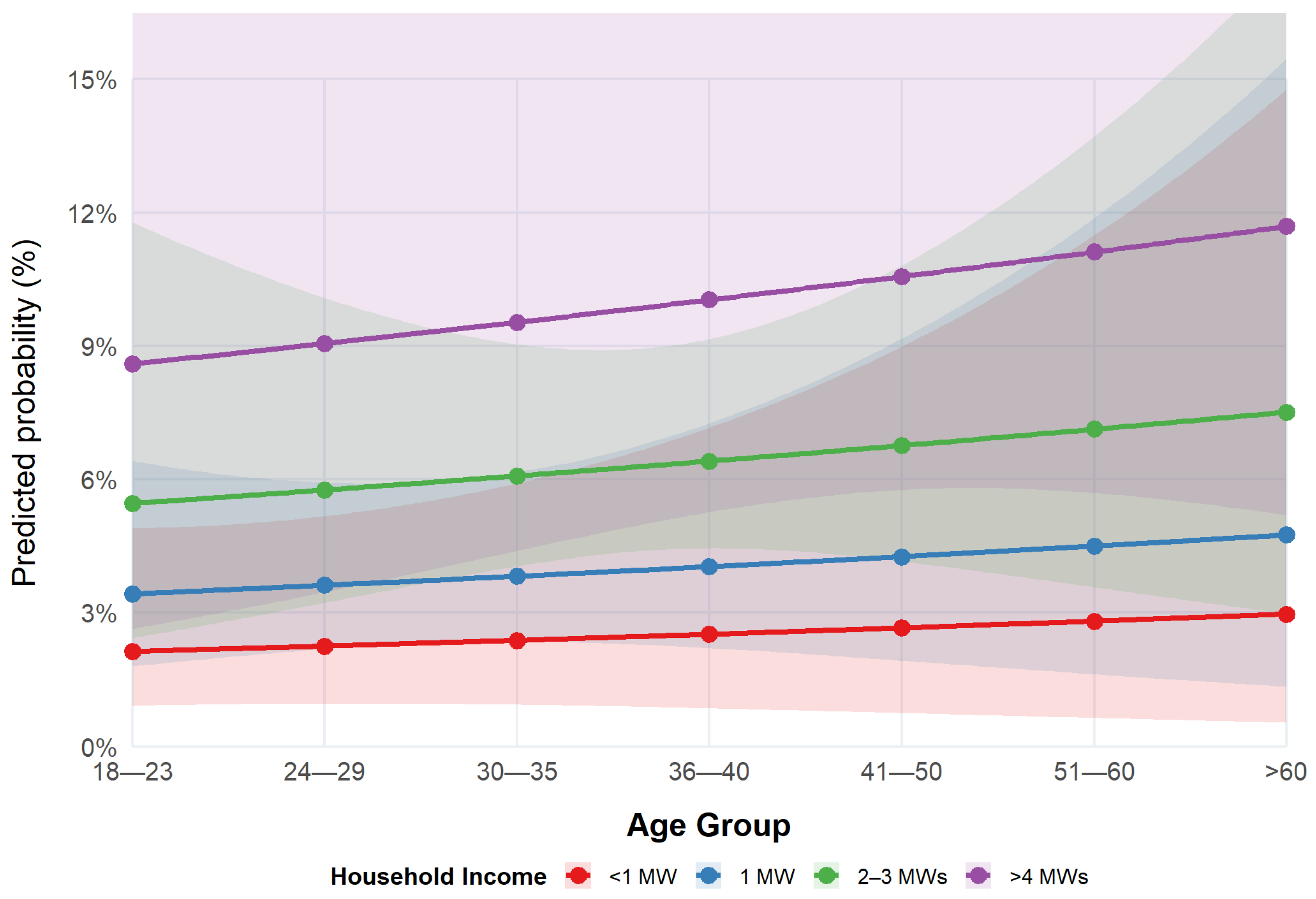
To explore differences in consumers’ propensity to purchase online, predicted probabilities of online purchasing were estimated using an exploratory binary logistic regression model. Given the low prevalence of the event (31 online buyers out of 612 valid cases; 5.07%), the model was specified parsimoniously, including only age and monthly income as predictors. The model showed a significant adjusted improvement over the null model (
), although its overall predictive capacity was limited (
;
). The full model specification, including coefficients, standard errors, and confidence intervals, is provided in
Table 4.
Regarding the individual effects, age was not statistically significantly associated with the probability of purchasing online (). Monthly household income showed a moderate positive association (), although it did not reach conventional levels of statistical significance (). Nevertheless, given the magnitude of the odds ratio and the proximity of the lower bound of the confidence interval to unity (IC 95%: 0.954–2.785) the results suggest an exploratory tendency toward a greater propensity to engage in e-commerce among higher-income segments.
The visual evidence presented in
Figure 2 complements these findings. The predicted probability curves show a slight positive slope across all income groups, suggesting that the estimated probability of purchasing online increases modestly with age. However, examination of the 95% confidence intervals, represented by the shaded bands, reveals substantial overlap across groups, particularly at middle-income levels. This overlap indicates that the observed differences are not sufficiently precise to support the identification of clearly differentiated behavioral segments.
Among respondents who did not purchase pet care products online, the most frequent barrier was distrust of digital platforms, identified by 222 respondents (46.54%). The second most frequent barrier was limited internet access, reported by 144 respondents (30.19%). Other barriers mentioned included a lack of knowledge about how to shop online (69 respondents) and a lack of information about trustworthy websites (42 respondents). These percentages are shown in
Table 5 and were calculated based on the subsample of respondents who completed this specific section (477), excluding 109 missing or inapplicable cases from the larger group of non-buyers (586). Overall, these findings indicate that low adoption of online purchasing channels is primarily associated with deficiencies in digital trust, internet accessibility, and familiarity with digital technologies.
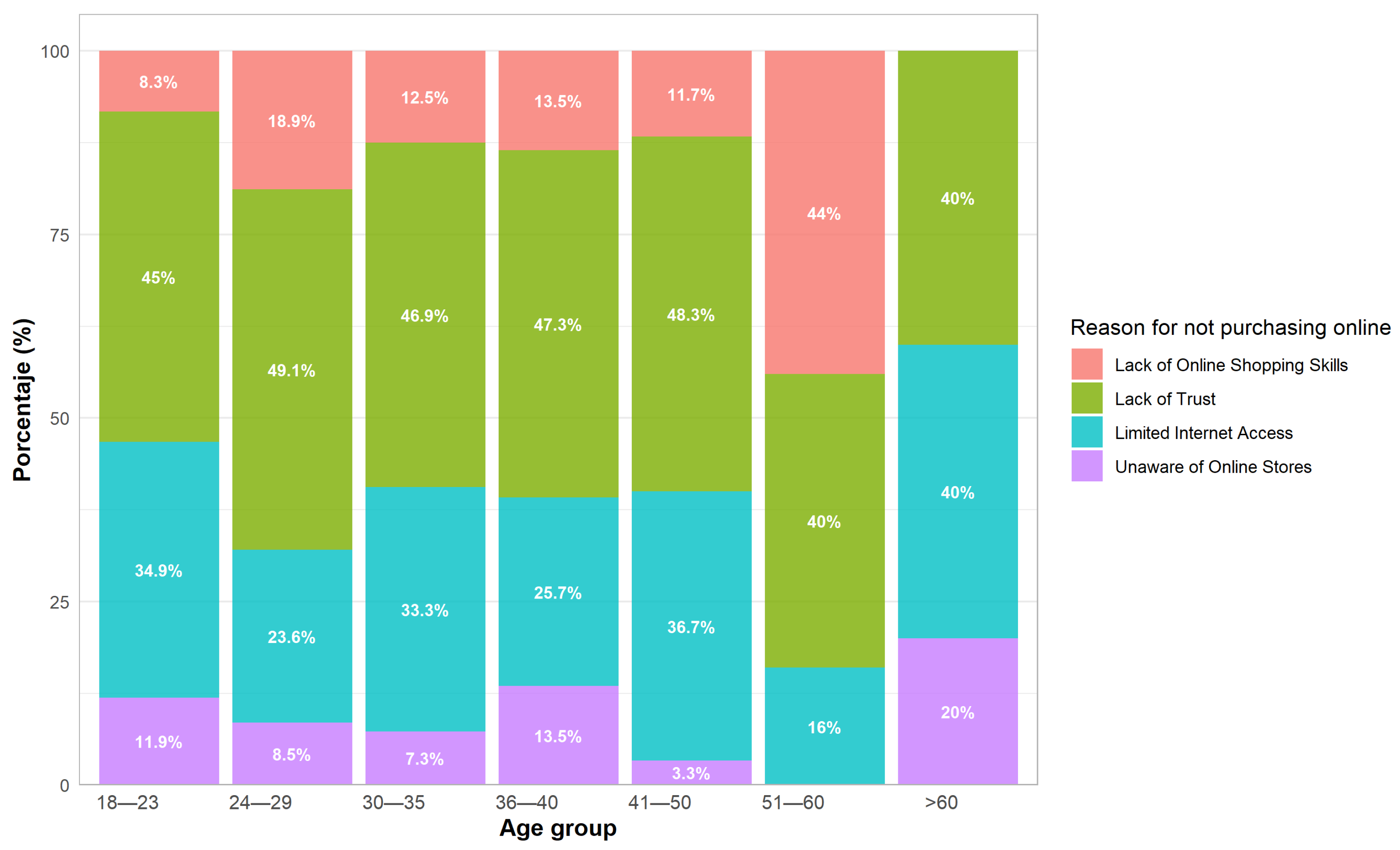
The distribution of reported barriers varied significantly across age groups. Among respondents who provided a substantive response to the barrier question, the association between age and reasons for not purchasing online was statistically significant according to both Pearson’s chi-square test, χ
2(18) = 35.27,
p = 0.0087, and Fisher’s exact test with Monte Carlo simulation (10,000 simulations),
p = 0.0192. As shown in
Figure 3, the distribution of barriers was not homogeneous across age groups. Distrust of digital platforms was the most frequently reported barrier across most age categories, whereas differences between observed and expected frequencies were particularly evident for lack of online shopping skills among respondents aged 51–60 years (11 observed versus 3.63 expected). Six cells had expected frequencies below 5, indicating sparse combinations of age and barrier categories; however, the association remained statistically significant when evaluated using the Monte Carlo–simulated Fisher test. Overall, these findings indicate that the barriers reported by non-adopters of online purchasing vary across age groups, with differences particularly evident in aspects of digital familiarity and online shopping skills.
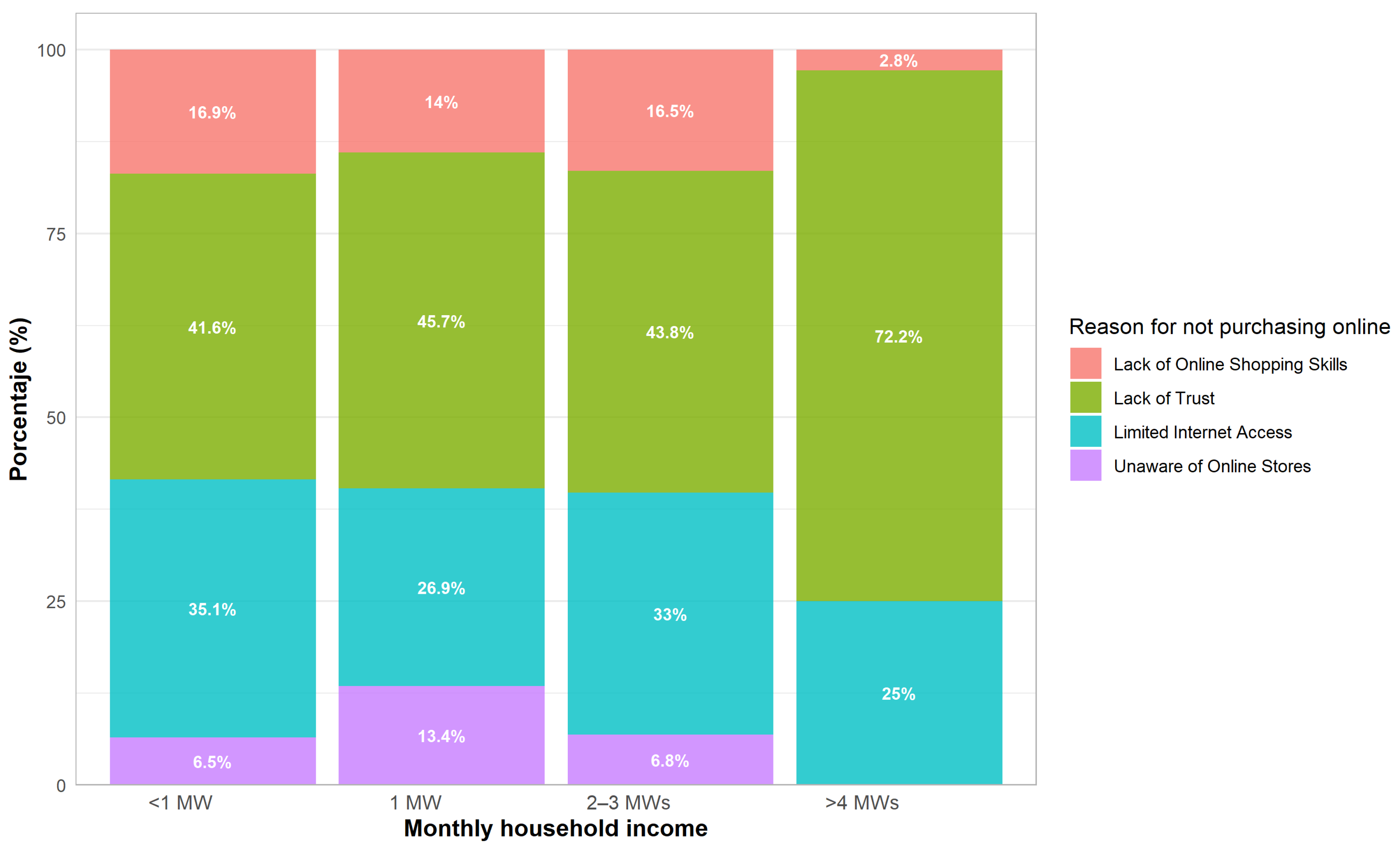
A statistically significant association was also identified between household income and the reported reasons for not purchasing online, χ
2(9) = 21.04,
p = 0.0125. As shown in
Figure 4, the distribution of reported barriers varied across income groups. Distrust of digital platforms was the most frequently reported barrier across all income categories, although differences between observed and expected frequencies indicate variation in the relative distribution of barriers. Among households with incomes above 4 MW, distrust of digital platforms was reported more frequently than expected (26 observed vs. 16.67 expected), whereas lack of online shopping skills was reported less frequently than expected (1 observed vs. 5.23 expected). Although one cell had an expected frequency below 5, the association remained statistically significant when assessed using Fisher’s exact test with Monte Carlo simulation (10,000 simulations),
p = 0.013. Overall, these findings indicate that the distribution of barriers to online purchasing varies across household-income groups, particularly with respect to digital trust and online shopping skills.
These findings provide support for Hypothesis H2, indicating that, among consumers who do not use online purchasing channels, the distribution of reported barriers varies significantly across both age and household-income groups. Distrust of digital platforms was the most frequently reported barrier across most demographic categories, while differences in specific barriers were particularly evident among older respondents and across household-income groups. Although several cells had low expected frequencies, the statistical associations remained significant when assessed using Fisher’s exact test with Monte Carlo simulation (10,000 simulations), confirming the robustness of the bivariate findings. Overall, the results indicate that limited adoption of online purchasing among non-adopters is associated with a combination of barriers related to digital trust, internet access, and familiarity with online purchasing.
6.4. Logistic Regression for Perceived Economic Incidence
To test Hypothesis H1, a binary logistic regression model was estimated to identify the factors associated with a moderate-to-high perceived economic incidence of pet-related expenditures on household budgets. Before interpreting the model coefficients, multicollinearity diagnostics confirmed the absence of problematic collinearity among the explanatory variables (all the
), supporting the stability of the estimated parameters. The dependent variable was dichotomized as 1 when respondents reported a moderate or high economic incidence and 0 when they reported low or no economic incidence. The explanatory variables included expenditures on pet food, veterinary care, pet products and accessories, complementary services, annual healthcare expenditures, number of companion animals, socioeconomic stratum, and monthly household income. The model was estimated using complete-case observations. The complete regression estimates, including coefficients, standard errors, odds ratios, 95% confidence intervals, and
p-values, are presented in
Table 6.
A binary logistic regression model was estimated to identify the factors associated with a moderate-to-high perceived economic burden of pet-related expenditures on household budgets. The model evaluates two complementary predictors of this perceived burden: the intensity of household spending on pets and the affective justification for such expenditures. The dependent variable was operationalized as a binary outcome by dichotomizing perceived economic impact (1 = moderate/high; 0 = none/low). Affective justification was represented by two dimensions: emotional attachment, which captures the psychological bond with the pet, and felt obligation, reflecting the perceived responsibility to provide care regardless of financial cost. The model also included expenditures on pet food, veterinary care, products, and services, together with socioeconomic controls for household income and socioeconomic stratum.
To evaluate H2, the overall statistical model was examined. The model exhibited a significantly better overall fit than the null model. Residual deviance decreased from 811.17 (df = 598) in the intercept-only model to 641.45 (df = 563) in the full model, representing a statistically significant reduction of approximately 169.75 deviance units (χ2 = 169.75, df = 31, n = 602, p < 0.001). As complementary measures of model performance, McFadden’s pseudo— was 0.18, and the Akaike Information Criterion (AIC) was 713.4. Collectively, these indicators suggest that the inclusion of the explanatory variables substantially improved model fit and provided an adequate representation of respondents’ perceived moderate-to-high economic incidence of pet-related expenditures.
The most consistent predictor was monthly expenditure on pet food. Relative to the reference category (households spending less than USD 8 per month), all higher expenditure categories exhibited positive and statistically significant coefficients. Specifically, households spending USD 8–USD 16 per month were 2.68 times more likely to perceive pet-related expenditures as having a moderate or high economic impact (OR = 2.68). This effect increased to 3.92 among households spending USD 16–USD 32 (OR = 3.92) and reached 6.16 among those spending more than USD 32 per month (OR = 6.16). These findings indicate that as monthly expenditures on pet food increase, so does the probability that households perceive companion animal ownership as imposing a moderate or high economic burden. Given its recurrent nature and its substantial share of household expenditures, pet food constitutes the component with the greatest influence on this perception.
Monthly veterinary care expenses showed a different pattern. Spending levels did not differ significantly from the baseline category; however, for expenses above $32, the p-value was 0.057. This finding suggests that high-cost veterinary expenses—likely associated with specialized treatments, emergency care, or complex medical procedures—may be generating the greatest perceived financial burden.
Expenditures on pet products and accessories showed a negative association with the perceived economic incidence of pet-related expenditures. Compared with households spending less than USD 3, those reporting higher expenditures on pet products and accessories exhibited significantly lower odds of perceiving a moderate or high economic impact. Households spending USD 3–USD 16 experienced an approximately 65% reduction in the odds of reporting a moderate or high economic incidence (β = −1.091; OR = 0.34; p < 0.001). This reduction became even greater among households spending USD 16–USD 32 (β = −1.511; OR = 0.22; p < 0.001) and those spending more than USD 32 (β = −1.356; OR = 0.26; p < 0.001). Because household income and socioeconomic stratum were controlled within the model, these findings suggest that discretionary spending on non-essential items—such as toys or decorative accessories—reflects flexible, non-recurrent purchases that do not drive financial strain. Instead, perceived economic burden is predominantly concentrated in rigid, non-discretionary expenses such as food and health care.
Annual pet healthcare expenditures also emerged as a significant predictor. Compared with households spending less than USD 32 annually, those reporting expenditures between USD 161 and USD 323 were 3.41 times more likely to perceive a moderate or high economic incidence (β = 1.226; OR = 3.41; p < 0.001), whereas households spending between USD 323 and USD 968 exhibited 2.93 times higher odds (β = 1.08, OR = 2.77, p = 0.031). These findings indicate that substantial healthcare expenditures associated with specialized treatments, surgical procedures, or other complex veterinary interventions represent an important component of the perceived economic burden of companion animal ownership.
Households with two pets are 1.89 times more likely to perceive a moderate or high economic impact than households with one pet (β = 0.634, OR = 1.89, p = 0.014). Regarding socioeconomic indicators, while monthly household income did not have a statistically significant effect after controlling for spending categories, socioeconomic status (stratum) emerged as a relevant predictor. Specifically, households in stratum 3 (OR = 1.99, p = 0.042) and stratum 4 (OR = 3.21, p = 0.024) exhibited significantly higher probabilities of economic impact compared to the reference category. This suggests that perceived economic impact is driven not only by short-term income but also by structural conditions and higher socioeconomic status, along with the actual structure and magnitude of pet-related expenditures.
In contrast, expenditures on ancillary services (between US$3 and US$16) showed a statistically significant inverse association with perceived economic impact (β = −0.673, OR = 0.51, p = 0.028), indicating a 49% reduction in the likelihood of reporting high budgetary pressure. Econometrically, this reflects the highly optional and temporally flexible nature of ancillary services, such as professional grooming, training, or daycare. Unlike mandatory, non-discretionary purchases, such as food or emergency medical care, ancillary services can be easily postponed or forgone during periods of financial hardship without compromising animal welfare. Consequently, spending in this category represents a controllable allocation of surplus budget rather than a persistent financial burden.
These findings provide empirical evidence supporting the argument that perceived economic burden is associated with both (a) the intensity of household pet-related expenditures and (b) the affective justification of such expenditures. Monthly expenditure on pet food showed a clear progressive increase in the likelihood of reporting a moderate-to-high perceived economic incidence as spending levels increased. Very high monthly veterinary expenditures and moderate-to-high annual healthcare expenditures were also associated with a moderate-to-high perceived economic incidence. Affective justification was also relevant, as respondents who reported that their expenditures were “partially justified” were more likely to perceive a moderate-to-high economic incidence. Given the cross-sectional nature of the data and the use of complete-case observations, these findings should be interpreted as associations rather than causal effects. In addition, the affective justification category “No, not at all” exhibited quasi-complete separation because of its low frequency and was therefore not interpreted.
Overall, the results suggest that, within the observed sample, the perceived economic incidence of pet ownership is more closely related to the magnitude and composition of pet-related expenditures than to household income. Notably, the highest-income category was not significantly associated with perceived economic incidence (OR = 0.45; IC = 95% = 0.16–1.20; p = 0.110), indicating that higher income alone did not reliably differentiate households reporting greater or lower perceived economic burden. This pattern underscores the importance of considering the structure and magnitude of pet-related expenditures together with household socioeconomic characteristics when examining the economic implications of pet ownership.
7. Discussion
7.1. Recurrent Spending and Economic Incidence
The findings indicate that the pet care market in Yopal can be characterized as a recurrent and emotionally legitimized consumption category. The descriptive evidence shows that household expenditures on pet food and veterinary services are concentrated within medium and high expenditure ranges, while a substantial proportion of households perceive these expenditures as having a moderate or high impact on their budgets. This spending pattern is consistent with previous research showing that pet ownership reshapes household consumption behavior by increasing purchasing frequency and encouraging greater expenditure on products and services associated with companion animal well-being [
9].
The strong affective valuation observed among respondents helps explain why pet-related expenditures cannot be regarded as marginal household consumption. Most respondents considered their investment in companion animals to be justified by the emotional benefits and well-being they provide. This finding is consistent with previous studies demonstrating that attachment to companion animals, anthropomorphism, and self-expansion positively influence consumers’ willingness to purchase specialized pet care products [
10]. Likewise, research on psychological ownership suggests that feelings of attachment, responsibility, and ownership strengthen the economic value attributed to companion animals, thereby increasing owners’ willingness to incur expenditures on veterinary care, animal health, and specialized products [
31].
The binary logistic regression model provides additional evidence regarding the economic structure of pet care consumption. Monthly expenditure on pet food emerged as the strongest predictor of respondents’ perceived moderate-to-high economic incidence, with progressively increasing odds ratios across higher expenditure categories. This finding is particularly relevant because pet food represents a recurrent, cumulative, and largely unavoidable household expenditure associated with the everyday care of companion animals. Previous studies on pet food purchasing behavior indicate that consumers evaluate not only price but also nutritional composition, brand reputation, perceived quality, and expected health benefits for their companion animals [
33,
34]. Consequently, expenditure on pet food reflects not only purchasing frequency but also caregiving decisions that progressively acquire greater importance within household budgets.
The finding observed in the group with veterinary expenses exceeding US$32 per month is of interest, despite not reaching conventional statistical significance. The estimate showed an odds ratio (OR) of 2.51, representing a potentially relevant magnitude of association. However, the p-value = 0.057 and the 95% confidence interval (CI) (0.98–6.57) indicate that the statistical evidence is insufficient to establish a conclusive association. The width of the confidence interval may reflect low precision of the estimate, possibly related to the sample size available in this category. Therefore, this result should be considered as a trend that could be explored in studies with larger sample sizes and sufficient representation of participants with higher levels of veterinary spending.
The association observed among respondents who considered pet-related expenditures only partially justified suggests a more complex evaluative tension than emotional attachment alone. Partial justification may characterize households that continue to recognize the affective and caregiving value of spending on companion animals while simultaneously experiencing such expenditures as financially constraining. Emotional value and economic burden are therefore not necessarily opposing evaluations: an expenditure may remain meaningful and perceived as necessary while still generating budgetary pressure. Because the survey did not directly measure financial stress or intra-household expenditure trade-offs, this interpretation should be regarded as a plausible explanatory reading rather than as an empirically tested mechanism.
Taken together, these findings provide empirical support for Hypothesis H1a and H1b, demonstrating that greater recurrent expenditures on pet care products and services are positively associated with a higher perceived economic incidence on household budgets. However, the absence of a statistically significant association between monthly household income and perceived economic incidence suggests that the perceived financial burden is driven primarily by the structure and composition of actual pet-related expenditures, rather than by respondents’ reported income levels. This finding reinforces the interpretation of pet care as a high-involvement consumption category, in which emotional attachment, caregiving responsibility, and recurrent expenditures jointly shape consumer demand.
7.2. Trust, Access and Digital Barriers
The findings on e-commerce adoption indicate that the limited use of online purchasing channels in Yopal’s pet care market should not be interpreted as evidence of insufficient consumer demand but rather as a failure of transactional conversion. Households allocate financial resources recurrently to pet care products and services; however, this demand remains concentrated in physical retail channels when the digital environment fails to provide adequate levels of trust, familiarity, accessibility, and perceived control. This interpretation is consistent with the literature on e-commerce adoption in emerging economies, which emphasizes that digital adoption depends on the interaction among technological infrastructure, user capabilities, payment security, consumer trust, and institutional market conditions [
4,
5,
6].
Distrust of digital platforms should be understood as a transactional barrier rather than merely an attitudinal one. In e-commerce environments, consumers evaluate seller credibility, product quality, payment security, personal data protection, delivery reliability, and the availability of effective mechanisms for resolving service failures. When these signals are weak or ambiguous, perceived risk increases, reducing the likelihood that purchase intentions will translate into completed online transactions. Previous studies have shown that, particularly in emerging markets, the perceived usefulness of online reviews, trust in online sellers, and reductions in perceived risk are fundamental drivers of digital purchase intention [
8]. Likewise, recent meta-analytic evidence demonstrates that trust, perceived risk, perceived security, and electronic word-of-mouth are among the most influential determinants of online purchasing behavior [
7].
Barriers related to digital access and familiarity complement this interpretation. Limited internet access restricts consumers’ ability to interact with digital platforms, whereas limited awareness of trustworthy websites and insufficient familiarity with online purchasing reduce their ability to evaluate alternatives, compare providers, and successfully complete digital transactions. This distinction is particularly important because the digital divide extends beyond connectivity alone. It also encompasses digital skills, previous online purchasing experience, recognition of reliable digital platforms, and consumers’ perceived control throughout the purchasing process. Recent studies on online food purchasing have shown that household income, internet availability, and connectivity conditions significantly influence digital channel adoption [
42]. Similarly, research on social commerce indicates that perceived behavioral control plays an important role in strengthening consumer confidence when purchasing through less formalized digital environments [
45].
From this perspective, Hypothesis H2 should not be interpreted merely as reflecting sociodemographic differences across age and income groups but rather as evidence of heterogeneity in digital barriers. Consumers with more limited economic resources may experience greater constraints related to internet access, connectivity, or payment methods, whereas other consumer segments may have adequate technological access but continue to distrust digital platforms, online vendors, or delivery processes. Accordingly, age and income function not simply as demographic variables but as indicators of unequal exposure to digital experiences, transactional familiarity, and the ability to assess online risks. This interpretation helps explain why e-commerce adoption remains limited despite the existence of a recurrent and economically established demand for pet care products and services.
Taken together, these findings provide exploratory support for Hypothesis H2, demonstrating that the reported barriers to online purchasing are associated with distinct conditions of digital trust, accessibility, and digital familiarity. Nevertheless, this evidence should be interpreted with caution because of the limited number of respondents who reported purchasing online and the substantial imbalance between physical and digital purchasing channels. Rather than providing a confirmatory model of e-commerce adoption, the results reveal a structure of transactional friction, whereby consumer demand clearly exists but the local digital ecosystem has not yet developed sufficient levels of trust, security, accessibility, and perceived control to support sustained online purchasing behavior.
7.3. Economic Consolidation Without Digital Maturity
Taken together, the findings are consistent with the configuration described in this study as a digitally incomplete market. Within the sample surveyed, recurrent pet care expenditures and substantial perceived economic incidence coexist with marginal use of online purchasing and persistent consumer-reported digital frictions. This pattern supports the analytical distinction between economic consolidation and digital transactional development. However, because the evidence comes from a single-city convenience sample and the study did not estimate a validated digital maturity scale, the results should be interpreted as contextual support for the proposed configuration rather than as definitive validation of a new universal construct.
This disconnect is consistent with the broader literature on e-commerce adoption in developing countries, which suggests that digital transformation depends on capabilities extending well beyond the existence of market demand. The expansion of e-commerce requires adequate technological infrastructure, internet connectivity, firms’ digital capabilities, secure payment systems, institutional trust, fulfillment logistics, and consumer readiness [
4,
5]. From this perspective, the growth of the pet care market represents a significant commercial opportunity but does not, by itself, guarantee that consumers will shift their purchasing behavior toward digital platforms. Market opportunities are transformed into online transactions only when digital channels successfully reduce perceived risk, provide reliable information, and deliver a trustworthy purchasing experience before, during, and after the transaction.
The digital maturity gap also has important logistical and territorial dimensions. In intermediate cities, digital platform density, last-mile delivery coverage, inventory coordination, fulfillment capabilities, and post-purchase responsiveness are often less developed than in large metropolitan areas. Previous research on online retail fulfillment has shown that logistics capabilities may either reduce or reinforce consumer exclusion from digital channels [
19], while studies on last-mile logistics demonstrate that urban distribution strategies differ substantially between mature and emerging markets because of variations in infrastructure, demand density, and territorial coordination [
25]. Consequently, the digitalization of the pet care market in Yopal depends not only on the existence of consumers willing to purchase online but also on the ability of digital channels to guarantee product availability, reliable delivery, transaction traceability, efficient return processes, and effective responses to service failures.
Within the pet care market, this digital maturity gap becomes even more complex because products and services are not perceived as routine or low-involvement purchases. Many pet-related purchases are directly associated with animal health, nutrition, well-being, and the care of emotionally valued companion animals. Previous research has shown that online pet food purchasing decisions are influenced by product attributes, consumption habits, owner characteristics, and trust in the digital purchasing environment [
12]. Likewise, studies on online pet food subscription services indicate that customer satisfaction depends on electronic service quality, convenience, fulfillment performance, and provider responsiveness [
11]. These findings suggest that digital channel maturity requires more than product availability alone; it also depends on establishing credibility, service continuity, and a strong organizational reputation.
The evidence from Yopal further clarifies the scope of Proposition 1. The challenge is not the absence of digital market potential but rather the fact that consumer demand has yet to encounter a digital ecosystem that is sufficiently trustworthy to support sustained online transactions. In this sense, market economic consolidation represents a necessary—but not sufficient—condition for commercial digitalization. Digital maturity requires the effective integration of consumer trust, reliable information, secure payment systems, logistics capabilities, organizational reputation, after-sales services, and omnichannel continuity. Previous research on customer experience and omnichannel retailing demonstrates that consumers do not interact with isolated channels but instead navigate integrated customer journeys that combine information search, product evaluation, purchasing, delivery, and post-purchase interactions [
21,
35]. When this continuity is lacking, physical retail channels retain important advantages by providing product validation, professional guidance, and immediate customer support.
The theoretical contribution of the study is therefore to specify a market-level lens through which market growth and digital channel development can be examined as related but non-equivalent processes. The evidence from Yopal illustrates how recurrent demand may coexist with weak online transactional conversion when consumer-facing conditions of trust, access, and familiarity remain fragmented. Future research should evaluate the transferability of this configuration across cities, consumption categories, and digital ecosystems and should develop multidimensional measures capable of assessing both demand-side and supply-side components.
7.4. Managerial and Policy Implications
From a managerial perspective, the findings suggest that firms operating in the pet care sector within emerging urban markets should not interpret low levels of digital adoption as evidence of weak consumer demand. Rather, they should recognize it as an indication of persistent barriers related to digital trust, access, and consumer familiarity. Based directly on the survey findings, firms operating in similar contexts may prioritize trust-building, consumer guidance, accessible digital purchasing processes, and clearer signals of website reliability. Broader implications concerning payment security, logistics reliability, after-sales service, and omnichannel continuity derive from the theoretical framework rather than from variables directly measured in this study. These mechanisms should therefore be regarded as theory-informed managerial implications requiring direct empirical examination.
Accordingly, digital strategies aimed at addressing the barriers identified in the survey should extend beyond simply launching an online store or promoting products through social media. The first strategic priority should be the development of trustworthy digital catalogs that provide clear information regarding product availability, pricing, composition, usage recommendations, delivery conditions, return policies, and customer service channels. Such information is particularly important in the pet care market because consumers make purchasing decisions based not only on price and convenience but also on the suitability of products for companion animal health, nutrition, and well-being. Previous research indicates that website quality, information transparency, product assortment, and verified customer reviews function as trust signals that reduce uncertainty and strengthen online purchase intentions [
28].
A second strategic priority involves establishing verifiable digital reputation. Because distrust of digital platforms emerged as the principal barrier among consumers who do not purchase online, firms should clearly communicate who is responsible for the transaction, what guarantees are provided, and how service failures are resolved. Verified customer reviews, public seller ratings, order traceability, explicit warranty policies, and responsive after-sales services are practical mechanisms for reducing perceived risk while increasing consumers’ sense of control. These recommendations are consistent with previous e-commerce research demonstrating that trust, perceived risk, perceived security, and electronic word-of-mouth significantly influence online purchasing decisions [
7,
8], as well as with studies highlighting the importance of order fulfillment, service recovery, and post-purchase satisfaction in shaping customer loyalty [
36,
37].
A third managerial implication concerns the adoption of conversational commerce as a transitional mechanism between physical and digital channels. In contexts where consumers have limited familiarity with conventional e-commerce platforms, communication tools such as WhatsApp, social media messaging, and direct messaging applications can serve as intermediate customer touchpoints. These channels allow consumers to ask questions, verify product availability, receive personalized advice, confirm prices, arrange delivery, and resolve concerns before completing payment. Previous research suggests that social and conversational commerce environments strengthen purchase intentions by fostering consumer trust, social interaction, and perceived platform quality, particularly during the early stages of digital adoption [
46,
47]. For local pet care businesses, conversational commerce provides an effective means of transferring the relational trust traditionally associated with physical retail into digital environments. Rather than requiring consumers to migrate immediately to fully transactional online platforms, conversational commerce facilitates gradual digital adoption through interaction, personalized assistance, and seller validation.
A fourth strategic implication concerns payment alternatives aimed at reducing consumers’ perceived financial risk. In emerging markets, cash-on-delivery (COD) may serve as an effective transitional mechanism when consumers distrust digital payment systems or have limited prior experience with online purchasing [
29]. However, this option should be complemented by flexible payment alternatives, including bank transfers, secure payment links, digital wallets, in-store payment options, and payment upon delivery confirmation. Offering multiple payment alternatives reduces initial transactional friction, enhances consumers’ perceived security, and facilitates the gradual development of trust in digital purchasing environments, thereby encouraging continued use of online channels [
48,
49]. The objective is not to preserve low levels of digitalization indefinitely but rather to reduce initial transactional friction and enable consumers to accumulate positive experiences with digital purchasing channels.
A fifth implication involves the implementation of integrated omnichannel strategies. Pet care businesses can design hybrid customer journeys in which consumers search for products online, receive personalized advice through messaging applications, validate recommendations with veterinarians or trusted local retailers, complete payment using their preferred method, and choose between home delivery and in-store pickup. Such integration is particularly relevant because omnichannel retailing requires effective coordination among product information, inventory management, customer service, payment systems, fulfillment, and after-sales support [
21,
35]. In Yopal, where physical retail continues to provide important functions related to trust and professional advice, the objective should not be to replace physical stores but rather to integrate them with digital channels capable of expanding market reach, improving customer convenience, and delivering a seamless purchasing experience [
20,
21].
Finally, strategic partnerships among veterinary clinics, local retailers, and specialized suppliers may facilitate the transfer of trust from physical to digital channels. For sensitive products such as prescription pet food, dietary supplements, veterinary medicines, hygiene products, and specialized services, professional recommendations and local reputations can substantially reduce consumers’ perceived uncertainty. Likewise, subscription-based models for pet food and other recurrent purchases may capitalize on the expenditure stability observed within the pet care market, provided that these services offer flexibility, reliable fulfillment, personalized reminders, product adjustments according to pets’ age or health conditions, and effective after-sales support. Previous research on online pet food subscription services demonstrates that customer satisfaction depends largely on electronic service quality, convenience, fulfillment reliability, and provider responsiveness [
11]. Therefore, the managerial opportunity extends beyond increasing online sales; it involves developing a trustworthy, traceable, and locally legitimized omnichannel ecosystem capable of sustaining long-term customer relationships.
From a public policy and local development perspective, the findings highlight the need to strengthen digital literacy, internet connectivity, and trust in digital payment systems. Research on e-commerce policy consistently shows that inclusive participation in digital markets depends not only on the availability of online platforms but also on institutional quality, regulatory capacity, consumer protection mechanisms, transactional trust, and the inclusion of populations with lower levels of digital readiness [
50]. The barriers identified in this study do not affect all population groups equally. Lower-income households experience more severe limitations related to internet access, whereas other consumer segments are primarily constrained by distrust of digital platforms and limited awareness of trustworthy websites. Consequently, policy interventions should extend beyond promoting the creation of online stores and should include educational initiatives on secure online purchasing, identification of trustworthy digital platforms, appropriate use of digital payment methods, personal data protection, and consumer complaint procedures. This recommendation aligns with recent evidence on digital financial literacy, which emphasizes the importance of equipping consumers with the knowledge required to recognize online fraud, protect personal information, and use digital payment systems safely and confidently [
51].
Public institutions and business support organizations should also facilitate the digital transformation of local businesses. For small and medium-sized enterprises operating in emerging markets, e-commerce adoption is frequently constrained by limited financial resources, organizational capabilities, technological expertise, and uncertain perceptions of digital business benefits [
26]. In intermediate cities such as Yopal, institutional support programs should include training in digital catalog management, online order processing, conversational commerce, urban logistics, online reputation management, and after-sales service. Through these initiatives, public policy and local chambers of commerce can contribute to narrowing the gap between recurrent consumer demand and the digital maturity of commercial channels, thereby fostering a more inclusive and sustainable digital marketplace.
7.5. Limitations
This study has several limitations that should be considered when interpreting its findings. First, the cross-sectional research design does not allow causal inferences to be established. Although the results identify associations between recurrent pet care expenditures and perceived economic incidence, as well as differences in digital barriers across age and income groups, they do not capture changes over time or the dynamics of digital adoption.
Second, the analysis relies on self-reported data. Respondents’ reports regarding household expenditures, perceived economic incidence, affective valuation, purchasing channels, and reasons for not purchasing online may be subject to recall bias, perceptual bias, or social desirability bias. Future research could strengthen these findings by incorporating transactional records from retailers, data obtained from digital platforms, or longitudinal information on repeated purchasing behavior.
Third, the study employed a non-probability convenience sampling strategy, which limits the external validity of the findings independent of the cross-sectional research design. Although the analytical sample of 619 pet owners exceeded the conventional benchmark of approximately 383 participants that would have been required under a hypothetical simple random sampling design based on Yopal’s adult population, this comparison reflects only the numerical size of the sample and does not confer statistical representativeness. Because individual probabilities of inclusion were unknown and participation depended on respondents’ accessibility and willingness to participate, the sample may be affected by coverage error, self-selection bias, and differential participation. Consequently, the sociodemographic composition, expenditure patterns, perceptions, and digital purchasing behaviors observed among respondents may differ systematically from those of pet owners who were not reached through the recruitment channels or who chose not to participate. The descriptive percentages should therefore be interpreted as characteristics of the study sample rather than as precise population estimates, and the findings should be generalized to all pet owners in Yopal or transferred to other intermediate cities only with caution and in consideration of comparable socioeconomic, commercial, logistical, and digital conditions.
Fourth, the analysis of e-commerce adoption was intentionally exploratory. The limited number of respondents who reported purchasing pet care products online prevented the estimation of a confirmatory predictive model and precluded the use of classification performance metrics such as the area under the receiver operating characteristic curve (AUC) or confusion matrices. Consequently, Hypothesis H2 was evaluated using descriptive statistics, exploratory predicted probabilities, and chi-square tests of association between digital barriers, age, and household income. This methodological decision avoided overstating the explanatory power of the available data; however, it also limited the possibility of estimating multivariate effects on online channel adoption.
Fifth, digital barriers were measured as respondents’ stated reasons for not purchasing online. Although this approach identifies perceived obstacles to digital adoption, it does not constitute a psychometric assessment of theoretical constructs such as digital trust, perceived risk, perceived usefulness, or perceived ease of use. Future studies should employ validated measurement scales to estimate structural models of digital adoption within the pet care market.
Finally, the study is limited to Yopal, an intermediate city in Colombia. Although this case provides an appropriate setting for examining emerging urban markets beyond large metropolitan areas, the findings should not be generalized automatically to other geographical contexts. Comparative research across intermediate cities in Latin America would help determine whether the gap between market economic consolidation and digital maturity is consistently observed under different conditions of digital connectivity, logistics infrastructure, commercial development, and institutional trust.
8. Conclusions
This study examined how recurrent pet care expenditures and their affective legitimization are associated with the perceived economic incidence of such expenditures on household budgets, while also analyzing the barriers that constrain e-commerce adoption in Yopal, Colombia. Within the analyzed sample, pet care emerged as a recurrent and budget-relevant consumption category, whereas online purchasing remained marginal and physical channels continued to dominate.
Concerning Hypothesis H1a, higher monthly expenditures on pet food exhibited the most pronounced and consistent positive association with a moderate-to-high perceived economic impact. Similarly, specific subcategories of annual veterinary expenses significantly elevated the likelihood of reporting greater budget strain. Nevertheless, these effects were non-uniform across expense categories; expenditures on products, accessories, and select complementary services displayed distinct association patterns. Collectively, these findings indicate that perceived economic impact is contingent not merely on total expenditure magnitude, but on the recurrence, composition, and allocation of pet-related expenses, alongside broader socioeconomic determinants.
In terms of socioeconomic variables, reported monthly household income did not consistently account for variations in perceived economic impact once the structure of expenditure was controlled for. Conversely, socioeconomic status (strata) operated as a pivotal structural determinant, with households in strata 3 and 4 exhibiting significantly higher odds of perceived financial impact compared to lower strata. This underscores that perceived economic strain is governed less by short-term liquid income and more by baseline structural living costs—such as the elevated fixed utility and housing expenses typical of middle-to-upper residential strata—interacting with the number of pets in the home and the allocation of expenses.
Regarding H1b, affective legitimization was associated with perceived economic incidence, particularly among respondents who considered their pet-related expenditures to be only partially justified, compared with those who considered them completely justified. Nevertheless, the relationship did not exhibit a uniform gradient across all response categories, and one low-frequency category showed quasi-complete separation. Accordingly, affective legitimization should be interpreted as an additional dimension associated with how households evaluate pet-related expenditures rather than as a causal mechanism. Taken together, H1a and H1b indicate that the economic meaning of pet care consumption is shaped both by expenditure structure and by how consumers interpret and legitimize such spending.
From an exploratory perspective, the results support H2. Among consumers who did not primarily purchase pet care products through online channels, the distribution of reported barriers differed significantly according to age and household income. Distrust of digital platforms was the most frequently reported barrier, followed by limited internet access, insufficient knowledge of online purchasing, and limited awareness of trustworthy websites. Given the small number of online buyers, these descriptive and barrier-based findings constitute the principal evidence regarding digital adoption. The online-purchasing regression provides only secondary exploratory evidence and is interpreted as hypothesis-generating rather than confirmatory. The exploratory online-purchasing model further showed that age was not significantly associated with digital adoption and that income displayed only a non-significant positive tendency. Therefore, the evidence points less to clearly differentiated digital consumer segments and more to persistent transactional frictions that affect sociodemographic groups in different ways.
These results provide contextual support for Proposition 1 and for the proposed notion of a digitally incomplete market. The study therefore offers an exploratory market-level interpretative lens through which the coexistence of recurrent demand, weak online conversion, and persistent consumer-facing frictions can be examined. The evidence from Yopal provides contextual support for this formulation but should not be interpreted as validation of a new universal construct. This perspective differs from digital readiness, digital maturity, and conventional e-commerce adoption-barrier approaches because it focuses on the relational mismatch between economic demand and digital transactional development rather than positioning the market at a specific stage, capability score, or isolated barrier.
From a managerial perspective, the findings indicate that digital growth in emerging urban markets requires more than simply creating online sales channels. Firms need to strengthen transactional trust, verifiable information, payment security, logistics reliability, after-sales service, and continuity between physical and digital touchpoints. These conclusions should be interpreted within the methodological limitations of the study. Future research should therefore examine the digitally incomplete market configuration across different cities and consumption categories using longitudinal designs, transactional data, validated scales, and direct measures of business, logistical, and institutional conditions.





 ,
,