
Article

Beyond Service and Cleanliness: Decoding Customer Experiences and Determinants of Satisfaction in Esports-Themed Hotels Through Large-Scale Online Review Text Mining

Faculty of International Tourism and Management, City University of Macau, Macau, China
*
Author to whom correspondence should be addressed.
J. Theor. Appl. Electron. Commer. Res. 2026, 21(8), 256; https://doi.org/10.3390/jtaer21080256
Submission received: 15 June 2026 / Revised: 26 July 2026 / Accepted: 28 July 2026 / Published: 4 August 2026
(This article belongs to the Section Digital Marketing and the Evolving Consumer Experience)

Abstract

Although esports-themed hotels have rapidly emerged as a technology-driven segment of smart hospitality, empirical research on their customer experience and satisfaction formation remains limited. Drawing on schema theory and expectancy violations theory (EVT), this study adopts a mixed-methods approach to examine the thematic attributes of esports-themed hotel experiences and their effects on customer satisfaction. Study 1 applied BERTopic and aspect-based sentiment analysis (ABSA) to 225,318 online reviews of 1601 esports-themed hotels. The results show that customer experience encompasses not only conventional hotel attributes, such as service, environment, and cleanliness, but also esports-specific attributes centered on gaming facilities, technological configurations, and esports-related social activities. ABSA results further reveal generally positive sentiment across most attributes, with service attitude and cleanliness receiving the strongest approval, whereas room facilities and comfort were the main sources of dissatisfaction. Study 2 employed hierarchical linear modeling to further examine the effects of six experience-related sentiments on customer satisfaction. The results indicate that all six sentiment dimensions significantly influence satisfaction and that hotel type moderates these relationships. Compared with professional esports-themed hotels (PETHs), the effects of experience-related sentiments on satisfaction are stronger in non-professional esports-themed hotels (NPETHs). This study extends schema theory and EVT to the esports-themed hotel context and offers practical implications for customer experience design and service management in this emerging hospitality segment.

1. Introduction

The growing popularity and recognition of electronic sports (esports) have fueled the expansion of the global esports industry. The global esports market is expected to generate USD 4.8 billion in revenue in 2025 and USD 5.9 billion by 2029 [1]. The growth of the esports market has generated spillover benefits for the tourism and hospitality industries, including the emergence of esports-themed tourism and hotels [2]. Esports-themed hotels are accommodations designed for gamers and esports enthusiasts [3].
Since the emergence of esports-themed hotels, the sector has developed into two major formats: professional esports-themed hotels (PETHs), which provide highly specialized gaming environments, and non-professional esports-themed hotels (NPETHs), which incorporate esports facilities as supplementary recreational features [3]. Although differing in their level of esports integration, both formats transform traditional hotels into hybrid spaces combining accommodation, gaming, and social interaction. Given that Generation Z represents the core customer segment with distinctive consumption preferences [4], understanding customer experience is critical for esports-themed hotels, as experience quality influences satisfaction, word-of-mouth, and competitive advantage [5,6].
Despite the growing popularity of esports-themed hotels, scholarly research remains fragmented, particularly regarding the experiential attributes that shape customer satisfaction. Existing studies have primarily examined the economic impacts of esports events, feasibility assessments, pricing strategies, operational practices, design features, and technology applications [7,8,9,10]. Although recent studies have begun to investigate esports-themed hotels using theoretical perspectives such as cue utilization theory, the stimulus–organism–response framework, and recreationist–environment fit theory [4,11,12], existing knowledge remains limited regarding how customer experiences are formed and translated into evaluative outcomes in this emerging hospitality context. Specifically, three critical gaps remain: (1) the experiential attributes constituting esports-themed hotel experiences have not been systematically identified; (2) customers’ emotional responses to these attribute-level experiences remain insufficiently explored; and (3) how attribute-specific emotions collectively shape overall satisfaction remains unclear. Addressing these questions is important because esports-themed hotels combine conventional hospitality services with technology-intensive gaming facilities and esports-related social experiences, creating a customer experience that differs substantially from that of traditional hotels.
Accordingly, this study aims to identify the key dimensions of customer experience, measure customers’ aspect-level sentiment toward these dimensions, and examine how such sentiment shapes overall satisfaction. Unlike conventional research approaches that rely on predefined experiential dimensions derived from surveys or experiments, this study adopts a data-driven analytical approach to uncover the multidimensional structure and evaluation mechanisms of esports-themed hotel experiences. Specifically, BERTopic is employed to identify core experiential dimensions from online reviews, BERT-based aspect-level sentiment analysis is used to capture customers’ emotional responses toward specific experience attributes, and hierarchical linear modeling is applied to examine how attribute-level emotions influence overall satisfaction. Theoretically, drawing on schema theory, this study conceptualizes esports-themed hotel experiences as a process through which consumers interpret service encounters based on existing cognitive schemas related to hospitality, leisure, and gaming [13]. Furthermore, expectancy violations theory is integrated to explicate how discrepancies between expectations and actual experiences shape emotional responses and satisfaction evaluations [14]. Building on the distinction between PETHs and NPETHs, this study further examines whether and how the effects of experiential attributes on overall satisfaction vary across hotels with different levels of esports integration. Therefore, this study seeks to address four key research questions (RQs):
RQ1: What are the key experiential attributes that constitute the customer experience in esports-themed hotels?
RQ2: What sentiment orientations do customers exhibit toward different experiential attributes?
RQ3: To what extent do attribute-level sentiment scores influence overall customer satisfaction?
RQ4: Does the impact of attribute-level sentiment scores on customer satisfaction differ between PETHs and NPETHs?
This study contributes to hospitality research in three ways. First, it provides one of the first systematic empirical examinations of customer experience in esports-themed hotels, offering a foundation for future research on this emerging lodging format and extending hotel experience research to a technology-integrated, digital leisure-oriented context. Second, by integrating schema theory and expectancy violations theory, this work identifies key experiential attributes, measures customers’ aspect-level sentiment toward these attributes, and explains how such sentiment shapes overall satisfaction, thereby extending these theories to technology-integrated accommodation settings. Third, by distinguishing between professional and non-professional esports-themed hotels, this study reveals the heterogeneous nature of customer experience and shows that satisfaction is shaped not only by digital facilities themselves but also by how they are embedded in the broader service environment. These findings provide both theoretical insight into technology experience-driven accommodation and practical guidance for service design, positioning, and marketing strategies.

2. Literature Review

2.1. Esports and Esports-Themed Hotels

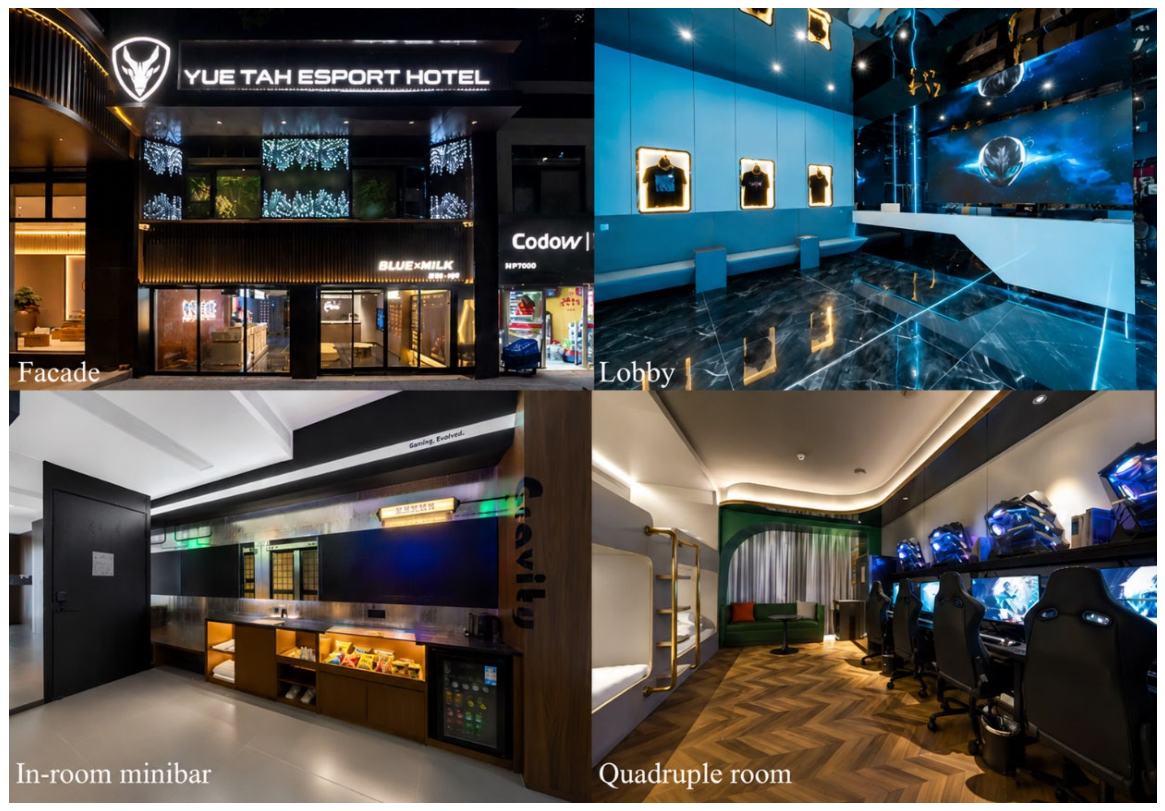
Esports, also known as cybersport, virtual sport, or competitive gaming, is organized competitive video gaming, encompassing both individual and team formats [15,16]. Its cultural and commercial appeal currently drives significant offline spillover, motivating both player communities and non-player spectators to engage in related tourism and leisure activities [2,17]. Within this context, esports-themed hotels (Figure 1) have emerged as a distinctive hospitality product, namely, a purpose-built accommodation that integrates dedicated gaming facilities, themed design, and related services to cater specifically to gaming enthusiasts and esports-oriented travelers [3]. Unlike traditional hotel guests, whose primary needs center on accommodation and basic services, esports-themed hotel customers are mainly driven by gaming-related motivations [18]. For these tourists, the hotel is perceived less as an overnight facility and more as a gaming-oriented space equipped with high-performance esports infrastructure [17]. Esports activities often dominate the stay, transforming accommodation into an immersive micro-vacation in which online competition becomes the core offline leisure experience.
PETHs and NPETHs currently coexist in the market, but they differ in the extent to which esports is embedded into the lodging experience. PETHs are designed around a specialized esports servicescape, typically featuring higher-quality gaming equipment, more stable technical configurations, stronger thematic ambience, and richer opportunities for social gaming interaction. By contrast, NPETHs incorporate esports facilities in a more limited or recreational manner, with gaming often functioning as an add-on to conventional accommodation rather than as the core experiential offering [3]. This distinction is theoretically important because the level of esports specialization may condition how customers interpret and evaluate the same experience attributes [19,20]. Recent research suggests that the fit between environmental attributes and consumer expectations plays a critical role in shaping customer experience and behavioral outcomes in esports-themed hotels [12]. Hospitality research also shows that physical and social servicescapes jointly influence customer evaluations and satisfaction [21,22], while expectation-disconfirmation theory suggests that customers assess service performance relative to their prior expectations [23]. Thus, guests staying in PETHs may hold stronger expectations regarding equipment quality, technical stability, thematic immersion, and social gaming atmosphere, whereas guests in NPETHs may evaluate esports features more as supplementary entertainment. As satisfaction drivers can vary across market segments [24], comparing PETHs and NPETHs is necessary to examine the boundary effect of esports specialization and to reveal whether customer experience attributes shape satisfaction differently across these two sub-sectors.
In recent years, hospitality research has paid growing attention to smart and digital services, particularly service robots and AI-enabled technologies, which are often examined in relation to service efficiency, convenience, safety, and responsiveness [25]. For instance, studies on hotel service robots and AI-driven delivery systems show that these technologies can enhance satisfaction when they perform well but are typically positioned as supportive tools for improving core service delivery rather than as the central basis of the hospitality experience [26,27,28]. However, emerging technology-integrated hotel formats require a broader perspective. In these settings, digital technologies are not merely used to facilitate check-in, delivery, or communication but are embedded into the core service offering through immersive themes, digital leisure activities, social interaction, and entertainment-oriented experiences. Customers, therefore, engage with technology more proactively and evaluate the hotel not only by functional service quality but also by immersion, playfulness, social connection, comfort, and the quality of digitally mediated leisure. This shift provides the basis for examining esports-themed hotels as a distinctive form of technology-integrated accommodation.
Research on esports-themed hotels remains fragmented, particularly regarding the experiential attributes that shape customer satisfaction. Existing studies have gradually shifted from macro-level concerns, such as the economic spillover effects of esports events and feasibility assessments, to firm-level issues, including pricing strategies and operational practices [7,8,9,10]. The field has also drawn on diverse perspectives, including design studies, computer science, and hospitality management [4,7,10]. More recent studies have introduced theoretical lenses such as cue utilization theory, the stimulus–organism–response framework, and recreationist–environment fit theory [4,11,12]. However, hospitality-focused research remains limited and often examines isolated elements, such as gaming cues, technological facilities, or entertainment value, without fully explaining how customers evaluate esports-themed hotels as integrated experiential environments. This gap is crucial because esports-themed hotels are not merely conventional hotels equipped with gaming facilities; they function as hybrid experiential hubs where accommodation services, digital leisure, esports ambience, social interaction, technological convenience, and value perceptions jointly shape customer experience. In response to this gap, this study integrates schema theory and expectancy violations theory to identify the key experiential attributes of esports-themed hotels, examine customers’ aspect-level sentiment toward these attributes, and explore how such sentiment shapes overall satisfaction (see Table 1). In doing so, the study offers a more holistic and theoretically grounded understanding of customer experience formation in technology-integrated and digital leisure-oriented accommodation settings.

2.2. Theoretical Foundation: Schema Theory and Expectancy Violations Theory

Schema theory provides a suitable foundation for understanding how to perceive and evaluate esports-themed hotel experiences. A schema refers to a structured cognitive framework stored in memory [29]. According to schema theory, individuals use existing schemas to organize knowledge, interpret new information, and guide subsequent evaluations and behaviors, reflecting a top-down information-processing mechanism [30,31]. In tourism contexts, tourists often rely on prior experience to interpret and evaluate tourism activities and settings [13]. Recent studies have therefore introduced concepts such as literary place schemas [32] and tourism activity schemas [33] to explain how tourists perceive and evaluate specific tourism objects. Compared with theoretical frameworks such as cue utilization theory, which often depend on researcher-defined experiential attributes, schema theory provides a more suitable perspective for uncovering experiential dimensions based on customers’ own cognitive structures and interpretations. This perspective fits the present study because esports-themed hotels combine accommodation, gaming, digital leisure, and social interaction. Even when customers have not previously stayed in esports-themed hotels, they may draw on related schemas formed through conventional hotel stays, internet cafés, gaming experiences, and digital social activities. These schemas help customers organize the experience into salient attributes, such as service quality, room comfort, gaming equipment, technical stability, esports ambience, social interaction, convenience, and price value, and then form aspect-level evaluations of these attributes. The experience attributes frequently mentioned in online reviews can thus be viewed as observable expressions of customers’ esports-themed hotel experience schemas. Accordingly, schema theory supports this study’s identification of key experience attributes and interpretation of customers’ aspect-level sentiment. In summary, schema theory provides a theoretical foundation for identifying core experiential dimensions and understanding consumers’ attribute-level emotional responses. Moreover, it offers a cognitive rationale for using BERTopic to extract experiential attributes from online reviews, as customer-generated narratives reflect underlying cognitive schemas through which experiences are organized and interpreted.
However, schema theory mainly explains how customers cognitively organize and interpret experience attributes; it offers a more limited explanation of why the same attribute may have different effects on satisfaction across hotel types. To address this issue, this study further draws on expectancy violations theory, which explains how individuals cognitively and emotionally respond when actual experiences deviate from prior expectations [14]. When performance exceeds expectations, customers may experience positive expectancy violations, which can generate surprise and enhance satisfaction. Conversely, when performance falls short of expectations, negative expectancy violations may lead to disappointment and dissatisfaction [14]. Based on this theoretical mechanism, the expectancy violations theory is particularly valuable for explaining how attribute-level emotional responses are generated and why the effects of experiential attributes on satisfaction may vary depending on differences between expected and actual experiences. Because expectations are context-dependent, the same experience attribute may exert different effects on satisfaction across different service settings [34]. This logic is particularly relevant to the comparison between professional esports-themed hotels (PETHs) and NPETHs. Customers of PETHs are more likely to be serious esports users or highly involved digital leisure consumers and may therefore hold higher expectations for gaming hardware, technical stability, esports atmosphere, and game-based social interaction. By contrast, customers of NPETHs may approach the stay with a conventional accommodation or casual digital leisure schema, leading to relatively lower or more flexible expectations for esports-related attributes. As a result, the same attribute may generate different satisfaction effects depending on the degree of esports specialization.
Existing hospitality studies have typically applied these two theories separately to address distinct research questions: Schema theory has primarily been used to explain how customers cognitively construct and interpret experiential attributes [32], whereas expectancy violations theory has mainly been applied to explain the formation of customer satisfaction through expectation–experience discrepancies [35]. However, neither perspective alone can fully capture the sequential mechanism of “experiential attribute construction–attribute-level emotional responses–heterogeneous satisfaction outcomes,” particularly in a digitally enriched and hybrid hospitality context such as esports-themed hotels. Therefore, this study integrates schema theory and expectancy violations theory into a complementary framework. Schema theory explains how customers construct and organize experiential attributes in esports-themed hotels, while expectancy violations theory explains how attribute-level emotional responses influence satisfaction and why these effects differ between PETHs and NPETHs. This integrated framework provides a more comprehensive explanation of customer evaluations in digital hybrid accommodation contexts. Integrating schema theory and expectancy violations theory, therefore, allows this study to explain both how customers construct esports-themed hotel experience attributes and why the effects of attribute-level sentiment on satisfaction may vary between PETHs and NPETHs.

3. Research Design

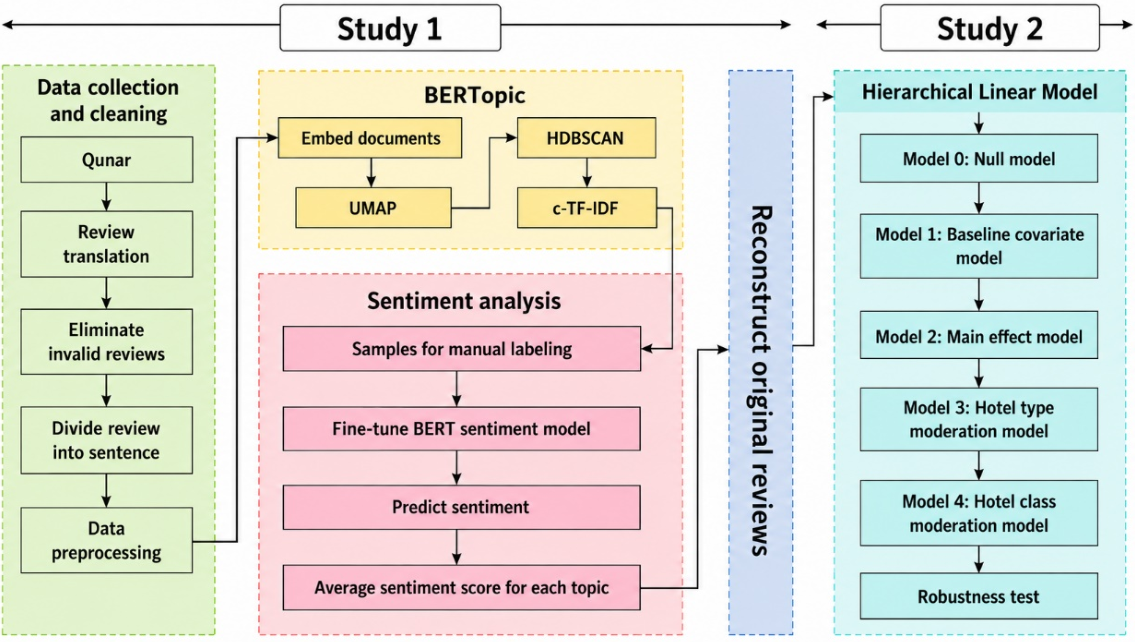
This study adopts a sequential mixed-methods research design (see Figure 2). Study 1 addresses RQ1 and RQ2 by analyzing online hotel reviews. After data preprocessing, including cleaning, translation, and sentence segmentation, BERTopic was applied to identify the core experiential attributes of esports-themed hotels. A fine-tuned BERT model was then used to conduct aspect-based sentiment analysis (ABSA), through which sentiment orientations toward each experiential attribute were extracted and aggregated back to the original review level. Study 2 addresses RQ3 and RQ4 by constructing a hierarchical linear model (HLM) to examine how sentiment toward different experiential attributes influences overall customer satisfaction. Robustness checks were further conducted to assess the stability of the findings.

4. Study 1: Text Analysis

4.1. Data Collection

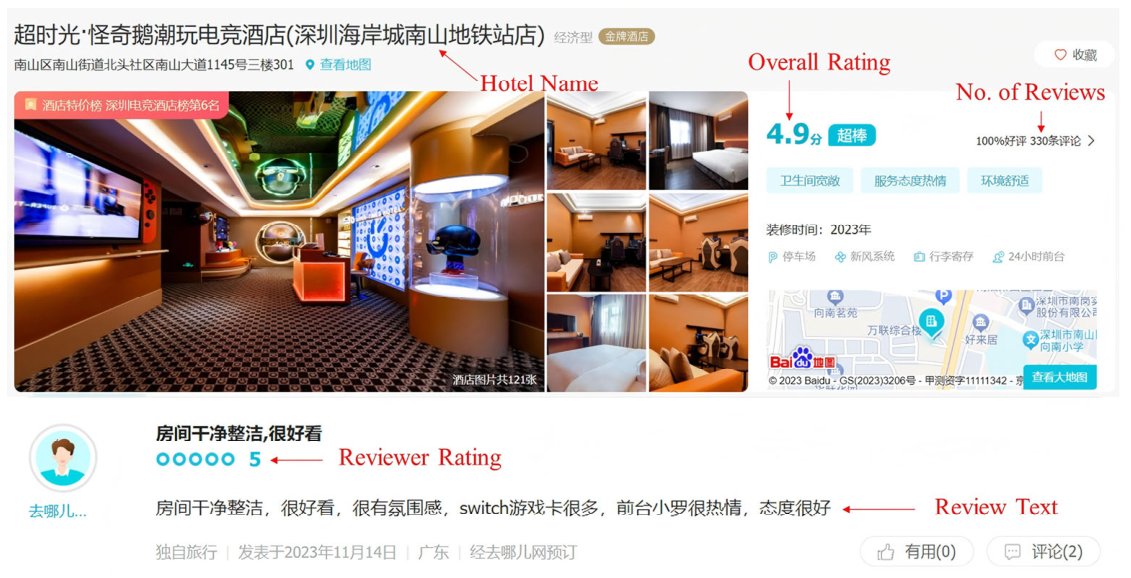
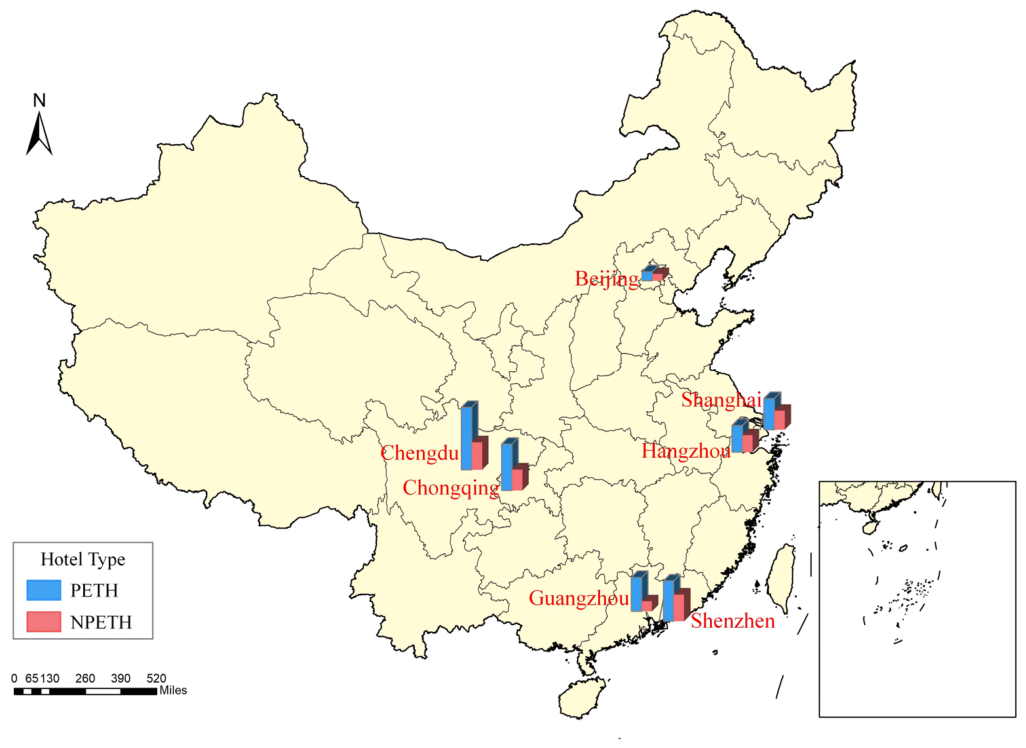
The raw dataset comprised 289,558 reviews of 1942 esports-themed hotels collected from Qunar.com, a major Chinese online travel agency with nearly 600 million active users. China is the world’s largest esports market [36,37], with 20,000 esports-themed hotels as of April 2023, and this number is projected to increase to 100,000 by 2025 [38]. Qunar.com offers both detailed hotel profiles and online reviews (Figure 3) and has been used as a data source for various tourism and hospitality studies [39,40]. The sampled hotels were located in seven first-tier or new first-tier cities (Figure 4), which have well-developed esports and esports-themed hotel industries [37].

4.2. Data Processing

All Chinese reviews were first translated into English using the Google Translate API [41]. During data cleaning, duplicate, invalid, promotional, and accommodation-irrelevant reviews were removed. Noise elements, including hyperlinks, HTML tags, abnormal characters, and redundant spaces, were also deleted. Reviews containing fewer than five words were excluded because they provided limited textual information for subsequent analysis [42]. In addition, reviews mentioning esports but referring to properties that were not esports-themed hotels were removed.
Following prior text-mining research, SpaCy in Python 3.10 was employed to segment reviews into sentences. Because a single review often contains multiple experiential attributes, sentence-level analysis can improve the precision of topic clustering and aspect-level sentiment identification [42]. All text was converted to lowercase and tokenized. Stop words, such as “the” and “a,” as well as low-information words, such as personal names, were removed. Since the subsequent BERTopic model and BERT-based ABSA rely on contextual semantics, stemming and lemmatization were not performed to avoid disrupting the semantic representation [43].
After data cleaning and preprocessing, the final sample comprised 1601 esports-themed hotels, 225,318 reviews, and 521,031 sentences. Specifically, the dataset included 1052 professional esports-themed hotels (PETHs), with 86,412 reviews and 194,084 sentences, and 549 non-professional esports-themed hotels (NPETHs), with 138,906 reviews and 326,947 sentences.

4.3. Text Analysis Methods

4.3.1. BERTopic Modeling

This study employed BERTopic to identify the experiential attributes reflected in customer reviews of esports-themed hotels. Although prior hotel studies have commonly used classical topic modeling methods such as latent Dirichlet allocation (LDA) [44], these methods are based on a bag-of-words assumption and treat texts as unordered word collections, thereby limiting their ability to capture contextual semantics [42]. This limitation is particularly relevant to hotel reviews, where customers often describe multiple experience attributes in short, context-dependent expressions. BERTopic addresses this issue by combining BERT-based sentence embeddings with density-based clustering, allowing semantically similar sentences to be grouped according to contextual meaning rather than word frequency alone. It has therefore shown strong applicability to short-text review analysis in hospitality contexts [45].
The BERTopic procedure involved four main steps. (1) The “paraphrase-multilingual-MiniLM-L12-v2” embedding model was used to transform sentences into semantic vectors. (2) Uniform manifold approximation and projection (UMAP) was applied to reduce the dimensionality of the embeddings. Based on multiple parameter comparisons, n_neighbors was set to 15 to balance local semantic similarity and broader topic structure. (3) Hierarchical density-based spatial clustering of applications with noise (HDBSCAN) was used to cluster the reduced embeddings, with min_cluster_size set to 50 to avoid generating overly small or semantically unstable topics. (4) Class-based term frequency–inverse document frequency (c-TF-IDF) was adopted to extract representative keywords for each topic [45]. To enhance semantic consistency and interpretability, the resulting topics were further reviewed and labeled manually based on topic keywords, representative sentences, and the review content within each topic.

4.3.2. Aspect-Based Sentiment Analysis

Following the identification of customer experience attributes through BERTopic, aspect-based sentiment analysis (ABSA) is used to assess customers’ sentiment toward each attribute. Aspect-based sentiment analysis is a fine-grained sentiment analysis approach that identifies sentiment orientation toward specific attributes mentioned in a text. This is particularly suitable for online hotel reviews, where a single review may contain mixed evaluations of different experience attributes [43]. Compared with overall sentiment classification, aspect-level sentiment analysis can avoid masking conflicting evaluations across multiple attributes [43]. Specifically, this study used a pre-trained BERT model fine-tuned on Yelp reviews and classified sentiment into three categories: positive, neutral, and negative [45,46].
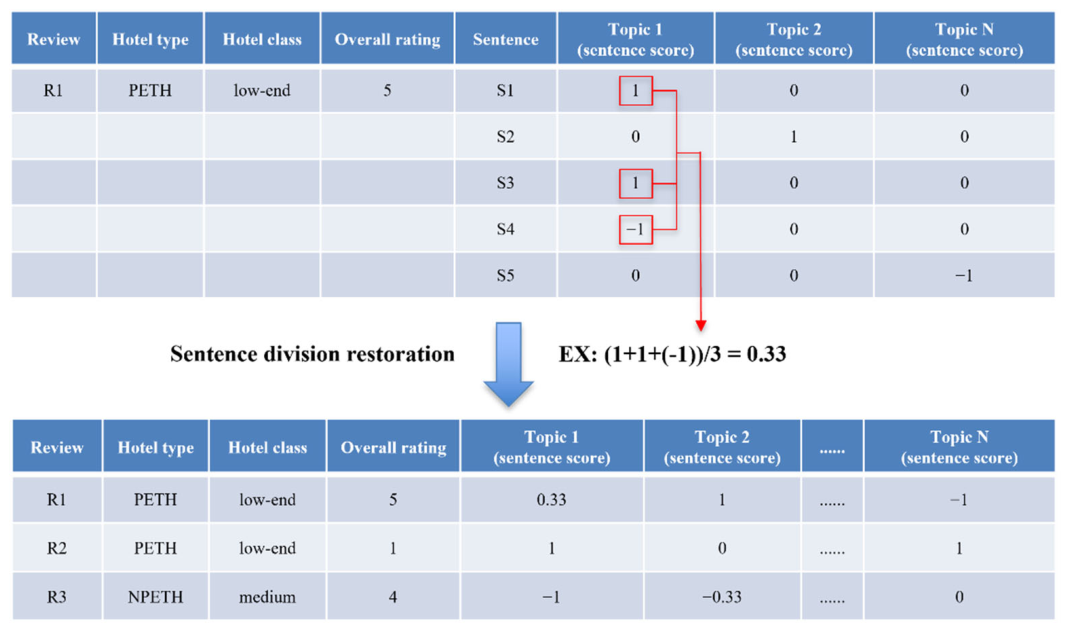
To adapt the model to the esports-themed hotel context, 1845 reviews were randomly selected and manually labeled. The labeled data were divided into training and validation sets at a ratio of 8:2. During model fine-tuning, the number of epochs was set to 4, the learning rate to 2 × 10⁻⁵, and the batch size to 16. Model performance was evaluated using a confusion matrix and standard metrics, including accuracy, precision, recall, and F1 score. The overall accuracy exceeded 80%, indicating acceptable reliability for sentiment classification in this context (see Table 2). The fine-tuned model was then used to predict the sentiment orientation of the remaining unlabeled texts. Sentiment scores were assigned as 1 for positive, 0 for neutral, and −1 for negative. Lastly, the sentence-level results were aggregated back to the original review level. For each review, the sentiment score of a given attribute was calculated as the average sentiment score of all sentences mentioning that attribute. If an attribute was not mentioned in a review, its sentiment score was coded as 0. Figure 5 presents the full procedure for calculating topic-level sentiment scores [42].

4.4. Text Analysis Results

4.4.1. BERTopic Modeling Results

The BERTopic model initially generated 14 original topics (N = 381,865) and one outlier topic (N = 139,166). The original topics were automatically produced by the model and labeled from Topic 0 to Topic 13. The high-frequency keywords for these topics are reported in Appendix A. Following prior text-mining studies, the research team manually reviewed the original topics by considering topic keywords, representative sentences, and the substantive focus of the study. Semantically similar topics were merged, whereas topics unrelated to hotel experience were excluded [43,47]. Specifically, three topics, namely “tourist type” (Topic 6, N = 2640), “nucleic acid testing” (Topic 10, N = 869), and “booking behavior” (Topic 11, N = 861), were excluded because they did not directly reflect hotel service or experience attributes. In addition, “negative emotional appeals” (Topic 13, N = 64) was removed due to its very small sample size and limited representativeness. After this refinement, six key topics, each with sufficient sample sizes and clear relevance to the hotel experience, were retained for subsequent ABSA and HLM analyses. The results are presented in Table 3.
The first topic, 1_service attitude and cleanliness, was formed by merging Topic 0 and Topic 7. It captures two closely related aspects of the basic hotel experience. Comments on service attitude mainly referred to front-desk reception, staff friendliness, and service enthusiasm, as reflected in keywords such as “front desk,” “lady,” and “enthusiastic.” Comments on cleanliness focused on overall hygiene, room tidiness, and pest control, with representative keywords including “clean,” “tidy,” “mosquito,” “prevention,” and “cockroach.”
The second topic, 2_breakfast and casual snacks, corresponds to Topic 1 and reflects customers’ evaluations of food and beverage provision. In addition to breakfast service, this topic includes immediately accessible food and drinks in the room, as indicated by keywords such as “breakfast,” “snack,” and “drink.” This suggests that customers evaluate the catering experience not only through formal breakfast provision but also through convenient food and beverage availability during the stay.
The third topic, 3_price and cost performance, corresponds to Topic 2 and captures customers’ value judgments. Keywords such as “price–performance ratio” and “RMB” indicate that customers assess value by comparing their actual stay experience with monetary expenditure. The keyword “economical” further suggests that many customers frame esports-themed hotels as affordable or value-oriented accommodation options.
The fourth topic, 4_esports-based social experience and supporting facilities, corresponds to Topic 3 and represents the most esports-specific dimension. Keywords such as “graphics card” and “computer configuration” indicate that guests pay close attention to technical configurations that support esports gaming, including graphics cards, memory capacity, and storage performance. The keyword “kaihei” is particularly noteworthy. As a gaming slang term used among Chinese esports enthusiasts, “kaihei” refers to forming a team of closely connected players, either in the same physical space, such as an esports-themed hotel, or through voice chat platforms, to play games collaboratively [48]. Its presence highlights a distinctive motivation for staying in esports-themed hotels: guests are not only seeking gaming equipment but also a communal space that supports coordinated gaming, social interaction, and shared esports experiences.
The fifth topic, 5_room facilities and comfort, was formed by merging Topic 4, Topic 5, and Topic 9. This topic reflects customers’ evaluations of the physical accommodation environment. Representative keywords such as “air conditioner,” “sound insulation,” and “soft” suggest that customers assess room experience through temperature control, acoustic comfort, bedding quality, and overall physical comfort.
The sixth topic, 6_intelligence and convenience, was formed by merging Topic 8 and Topic 12. It contains two sub-dimensions: smart service facilities and locational convenience. Keywords such as “robot” and “Xiaodu” show that customers pay attention to intelligent service elements, including delivery robots and in-room smart voice control systems. Meanwhile, keywords such as “location,” “Didi,” and “Chunxi” indicate that customers also evaluate convenience through geographic location, transport accessibility, and surrounding commercial facilities.

4.4.2. ABSA Results

Overall, customer sentiment was predominantly positive across the six experience attributes (see Table 4). Except for room facilities and comfort, all attributes recorded positive sentiment shares above 60%. 1_service attitude and cleanliness received the highest proportion of positive sentiment (76%), followed by 2_breakfast and casual snacks (73%). By contrast, 5_room facilities and comfort showed the lowest positive sentiment share (45%) and the highest negative sentiment share (25%), indicating that customers expressed relatively more dissatisfaction with room-related facilities, physical comfort, and accommodation conditions.
Notably, 4_esports-based social experience and supporting facilities also received strong positive feedback, with 71% positive sentiment and only 12% negative sentiment. This suggests that esports-related social interaction, gaming facilities, and supporting configurations were generally well received and constituted a distinctive positive component of the esports-themed hotel experience. Further comparison between hotel types demonstrates that positive evaluations of esports-specific experiences were stronger in PETHs than in NPETHs, whereas NPETHs received more favorable evaluations for price and cost performance. Taken together, the ABSA results indicate that both conventional hotel services and esports-specific experiences contribute to positive customer evaluations, while room facilities and comfort remain a principal area for improvement.

5. Study 2: Quantitative Analysis

5.1. Hierarchical Linear Model

Following the sentence-level ABSA, sentiment scores for each core experience derived from BERTopic topics were aggregated to the original review level. After data cleaning, the final dataset comprised 225,318 reviews nested within 1601 hotels. Given this hierarchical structure, a two-level random-intercept hierarchical linear model (HLM) was estimated, with reviews as level 1 and hotels as level 2 [49,50]. Review-level predictors were group-mean centered to capture within-hotel effects, while hotel-level averages were included to estimate contextual effects. The dependent variable was the overall review rating (overall_rating), representing overall guest satisfaction, and the independent variables comprised aspect-level sentiment scores from Study 1. Review length and the number of photos were included as control variables, and a random intercept accounted for unobserved heterogeneity across hotels.
For level 1, the six sentiment variables were centered and standardized within hotels: sent_service_clean1, sent_breakf_snack2, sent_cost_effi3, sent_esports_social_faci4, sent_room_conf5, and sent_intel_conv6. Corresponding hotel-level variables were computed by averaging and standardizing the review-level scores: zmean_sent_service_clean1, zmean_sent_breakf_snack2, zmean_sent_cost_effi3, zmean_sent_esports_social_faci4, zmean_sent_room_conf5, and zmean_sent_intel_conv6. Hotel class, originally coded from 1 to 5, was grouped into three categories—low-end (1–2), medium (3), and high-end (4–5)—following Roy [51]. Table 5 presents the detailed variable definitions and operationalization, while Table 6 reports the descriptive statistics.
The null model was first estimated to examine whether significant variation in overall ratings exists across hotels and to calculate the intraclass correlation coefficient (ICC). The null model is specified as
o v e r a l l _ r a t i n g i j = γ 00 + u 0 j + r i j
where o v e r a l l _ r a t i n g i j denotes the overall rating assigned by review (i) for hotel (j), γ 00 represents the grand mean intercept, u 0 j denotes the hotel-level random intercept, and r i j represents the review-level residual. The model assumes
u 0 j   ~   N   ( 0 ,   τ 2 )
r i j   ~   N   ( 0 ,   σ 2 )
The ICC is calculated as
I C C = τ 2 τ 2 + σ 2
where τ 2 represents the between-hotel variance and   σ 2 represents the within-hotel (review-level) variance. The ICC indicates the proportion of the total variance in overall ratings that is attributable to differences across hotels. A statistically significant ICC provides empirical justification for the use of multilevel modeling.
Model 1: Control Model
Model 1 incorporates both hotel-level and review-level control variables. Specifically, hotel type and hotel class are included as hotel-level controls, while review length and the number of photos attached to a review are included as review-level controls. The model is specified as
o v e r a l l _ r a t i n g i j = γ 00 + δ 1 h o t e l _ t y p e j + δ 2 h o t e l _ c l a s s j   +   θ 1 z _ r e v i e w _ l e n g t h i j + θ 2 z _ n u m _ p h o t o i j + u 0 j + r i j
where δ 1   captures the rating difference between PETHs and NPETHs. δ 2   represents a set of fixed-effect coefficients for hotel class; specifically, the coefficients for medium- and high-end hotels indicate their rating differences relative to low-end hotels, which serve as the reference group.
Model 2: Main-Effects Model
Model 2 builds on Model 1 by adding review-level attribute sentiment variables and hotel-level average sentiment variables to examine the main effects of experience attribute sentiment on overall ratings. Specifically, β k represents the effects of the six review-level experience attribute sentiment scores on overall ratings, whereas λ k signifies the effects of the six hotel-level average attribute sentiment scores on overall ratings.
o v e r a l l _ r a t i n g i j = γ 00 + k = 1 6 β k · X k i j + k = 1 6 λ k · W k j   + δ 1 h o t e l _ t y p e j + δ 2 h o t e l _ c l a s s j + θ 1 z _ r e v i e w _ l e n g t h i j   + θ 2 z _ n u m _ p h o t o i j + u 0 j + r i j
where
X k i j = { s e n t _ s e r v i c e _ c l e a n 1 , , s e n t _ i n t e l _ c o n v 6 i j } i j
                                      W k j = { z m e a n _ s e n t _ s e r v i c e _ c l e a n 1 j , , z m e a n _ s e n t _ i n t e l _ c o n v 6 } j
Model 3: Hotel-Type Moderation Model
Model 3 extends Model 2 by adding interaction terms between hotel type and the review-level attribute sentiment variables. This model examines whether hotel type moderates the effects of attribute sentiment on overall ratings. Specifically, η k represents the moderating effect of hotel type on the relationship between each of the six review-level attribute sentiment variables and overall ratings.
o v e r a l l _ r a t i n g i j = γ 00 + k = 1 6 β k · X k i j + k = 1 6 λ k · W k j + k = 1 6 η k ( X k i j × h o t e l _ t y p e j ) + δ 1 h o t e l _ t y p e j + δ 2 h o t e l _ c l a s s j   + θ 1 z _ r e v i e w _ l e n t h i j + θ 2 z _ n u m _ p h o t o i j + u 0 j + r i j
where
                                        X k i j = { s e n t _ s e r v i c e _ c l e a n 1 , , s e n t _ i n t e l _ c o n v 6 i j } i j
                                      W k j = { z m e a n _ s e n t _ s e r v i c e _ c l e a n 1 j , , z m e a n _ s e n t _ i n t e l _ c o n v 6 } j
Model 4: Hotel-Class Moderation Model
Model 4 extends Model 2 by incorporating interaction terms between hotel class and the review-level attribute sentiment variables. This model examines whether hotel class moderates the effects of attribute sentiment on overall ratings. Specifically, φ k   represents the moderating effect of hotel class on the relationship between each of the six review-level attribute sentiment variables and overall ratings. Because hotel class is a categorical variable with low-end hotels as the reference group, the interaction coefficients indicate how the effects of attribute sentiment differ between medium- and high-end hotels relative to low-end hotels.
o v e r a l l _ r a t i n g i j = γ 00 + k = 1 6 β k · X k i j + k = 1 6 λ k · W k j                                 + k = 1 6 ϕ k ( X k i j × h o t e l _ c l a s s j ) + δ 1 h o t e l _ t y p e j + δ 2 h o t e l _ c l a s s j   + θ 1 z _ r e v i e w _ l e n t h i j + θ 2 z _ n u m _ p h o t o i j + u 0 j + r i j
where
                                        X k i j = { s e n t _ s e r v i c e _ c l e a n 1 , , s e n t _ i n t e l _ c o n v 6 i j } i j
                                      W k j = { z m e a n _ s e n t _ s e r v i c e _ c l e a n 1 j , , z m e a n _ s e n t _ i n t e l _ c o n v 6 } j

5.2. Hierarchical Linear Model Results

The null model yielded an ICC of 0.160, indicating that approximately 16% of the variance in overall ratings is attributable to differences between hotels. This result suggests a nontrivial clustering effect among reviews within the same hotel and thus justifies the use of hierarchical linear modeling. Table 7 presents the results of Models 1–4. Compared with Model 1, Model 2 shows a substantial improvement in model fit, as evidenced by a higher log-likelihood value and lower AIC and BIC values. These results indicate that the inclusion of experience attribute sentiment variables significantly enhances the model’s explanatory power. The addition of interaction terms in Models 3 and 4 further improves model fit, reflected by increased log-likelihood values and continued reductions in AIC and BIC. Notably, Model 3 outperforms Model 4, exhibiting a higher log-likelihood value and lower AIC and BIC values. This finding suggests that hotel type provides a better explanation of the heterogeneity in the effects of attribute sentiment on overall ratings than hotel class.
In Model 1, review length has a significant negative effect on overall ratings (β = −0.095, p < 0.001), whereas the number of photos has a significant positive effect (β = 0.067, p < 0.001). Regarding hotel class, medium-end hotels receive significantly higher ratings than low-end hotels (β = 0.094, p < 0.001), while the difference between high-end and low-end hotels is not significant (β = 0.035, p > 0.05).
In Model 2, all six experience attribute sentiment scores exert significant positive effects on overall ratings at both the review level (Level 1) and the hotel level (Level 2), with all p-values below 0.05. Among them, service_clean1 emerges as the strongest predictor of customer satisfaction at both levels (β = 0.194, p < 0.001; β = 0.104, p < 0.001).
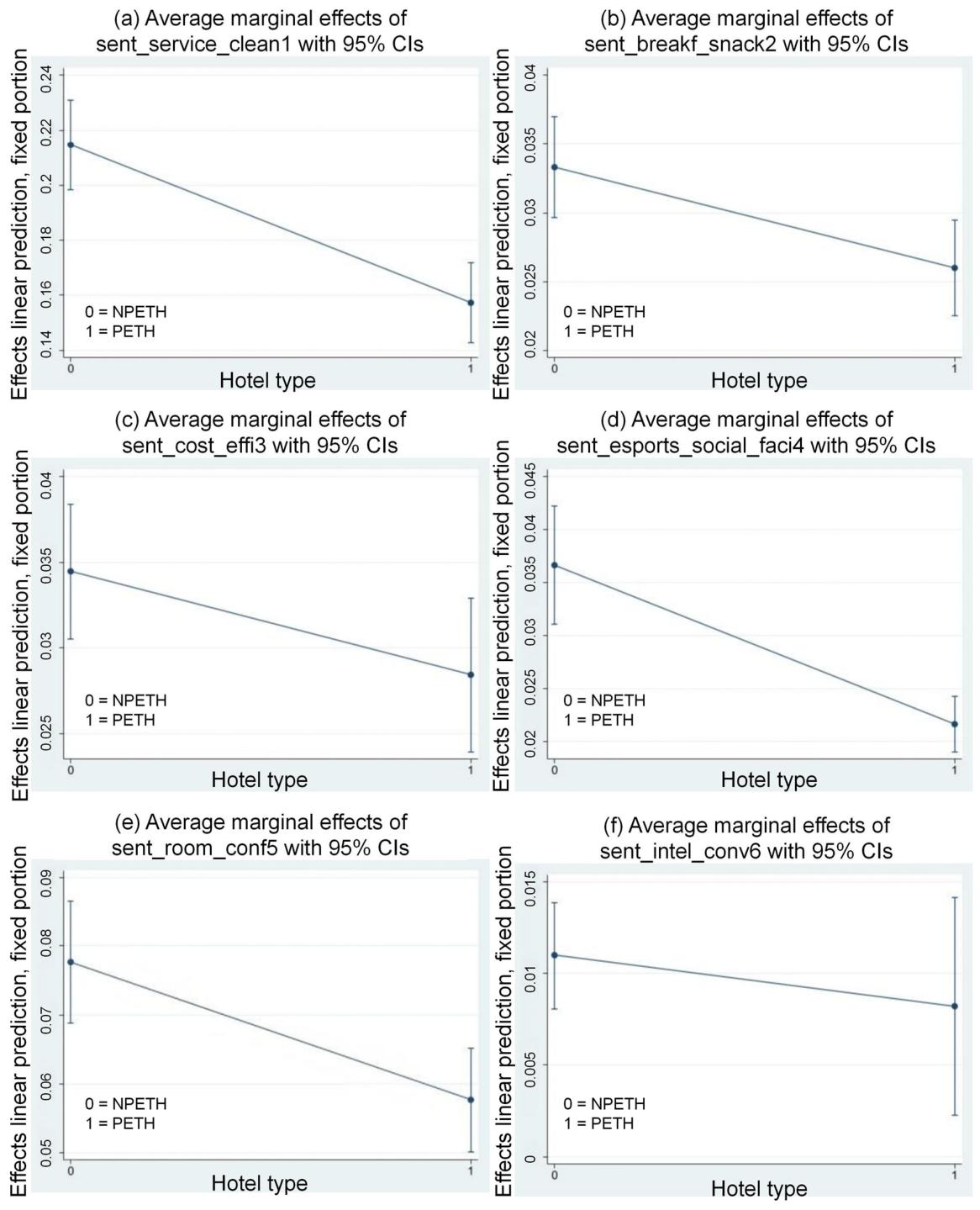
Model 3 examines the cross-level moderating effect of hotel type, using NPETH as the reference group. The interaction results indicate that hotel type generally exerts a significant negative moderating effect. Compared with NPETH, the positive effects of most experience attribute sentiment scores on overall ratings are significantly weaker for PETH. Specifically, the interaction effects are negative and significant for service and cleanliness (β = −0.057, p < 0.001), breakfast and snacks (β = −0.007, p < 0.01), cost efficiency (β = −0.006, p < 0.05), esports and social facilities (β = −0.015, p < 0.001), and room comfort (β = −0.020, p < 0.001). However, the interaction effect for intelligent convenience is not statistically significant (β = −0.003, p > 0.05). These findings suggest that, among PETH customers, overall ratings are less responsive to most attribute sentiment dimensions than among NPETH customers. The marginal effects of the six attribute sentiment scores across the two hotel types, visualized in Figure 6, further support this pattern.
Model 4 examines the cross-level moderating effect of hotel class, using low-end hotels as the reference group. Overall, the moderating effects of hotel class vary across experience attributes. Relative to low-end hotels, medium-end hotels show significant negative moderating effects for service and cleanliness and room comfort (β = −0.053, p < 0.01, and β = −0.018, p < 0.05, respectively). This indicates that the positive effects of these two attribute sentiment dimensions on overall ratings are significantly weaker for medium-end hotels than for low-end hotels. In contrast, high-end hotels show a significant positive moderating effect for cost efficiency (β = 0.016, p < 0.05), suggesting that the positive effect of cost-efficiency sentiment on overall ratings is significantly stronger for high-end hotels than for low-end hotels.
Ultimately, to assess the robustness of the results, four additional robustness checks were conducted: Model 5 used unstandardized centered sentiment scores, Model 6 was based on a winsorized sample, Models 7a and 7b were estimated using subsample regressions by hotel type, and Model 8 incorporated hotel fixed effects. The results show that the main effects of the six attribute sentiment dimensions and the moderating effects of hotel type remain consistent with the baseline models in terms of coefficient direction and statistical significance across all robustness checks (see Appendix B). These findings indicate that the estimation results are robust.

6. Conclusions and Implications

This study analyzes a large-scale dataset of online reviews to identify the core dimensions of customer experience and their associated sentiment characteristics in esports-themed hotels. It further examines how sentiment toward these experience attributes influences customer satisfaction. The findings underscore the experiential value of integrating esports elements into hotel operations, demonstrating that esports-themed design and service offerings play a meaningful role in shaping customer experiences and satisfaction. By uncovering the differential effects of various experience attributes across hotel types and classes, this study provides a deeper understanding of customer evaluation processes in the emerging esports hospitality sector and offers practical insights for the design and management of esports-themed accommodations.

6.1. Conclusions and Discussion

Customers evaluate esports-themed hotel experiences through three interrelated dimensions—esports engagement, social interaction, and accommodation quality—suggesting that esports-themed hotels function as integrated entertainment ecosystems rather than single-purpose gaming venues. From a schema theory perspective, esports-related cues are assimilated into customers’ existing accommodation schemas, enabling cognitive integration between novel themed experiences and traditional lodging expectations. Consequently, esports activities and gaming-related social interactions enrich customers’ cognitive structures, enhance emotional responses, and provide psychological mechanisms through which themed experiences influence satisfaction. The finding advances the themed hospitality literature by demonstrating that the value of esports-themed hotels stems not only from the presence of esports elements but also from the synergistic interaction between thematic and functional experience components. While prior esports research has highlighted the inherently social nature of gaming experiences [17], existing studies on esports-themed hotels have largely focused on esports-related facilities and activities [4], overlooking the broader constellation of experiences that shape customer evaluations. This study extends the literature by proposing a holistic experiential framework that distinguishes among core themed experiences (esports engagement), theme-extended experiences (social interaction), and the foundational service environment (accommodation quality). The findings suggest that customers do not evaluate esports elements independently; rather, they integrate themed experiences with conventional hospitality attributes to form an overall assessment of service quality and value.
Second, the e-sportification of hotels—that is, the integration of esports elements into hotel operations—is associated with favorable affective evaluations of the customer experience. The ABSA results unveil that positive sentiment predominates across most experience attributes, suggesting that customers generally evaluate esports-themed hotels favorably across multiple dimensions of the accommodation experience. Notably, “esports-based social experience and supporting facilities” shows a high proportion of positive sentiment, indicating that esports elements are not merely decorative features or a marketing gimmick but meaningful components of customer evaluation. This finding extends the extant research on the emotion-enhancing potential of esports experiences [11] by revealing that, in hospitality settings, esports-related facilities, social spaces, and supporting services can carry positive affective value beyond gaming itself. Customers appear to derive value from the broader themed environment, including opportunities for social interaction, community building, and immersion. From an affect-as-information perspective [52], the positive sentiment expressed in reviews may serve as an effective cue that informs customers’ overall judgments of service quality and satisfaction. Thus, esports-themed experiences contribute to hotel evaluation not only through functional facilities but also through favorable affective associations embedded in the overall accommodation experience.
Third, the HLM results indicate that positive sentiment toward all six experience attributes significantly increases customer satisfaction. This finding advances prior esports-themed hotel research in two ways. First, existing studies have mainly examined esports-related demand, design, pricing, or isolated experiential mechanisms, such as gaming cues, esports experience, or recreationist–environment fit [7,8,11,12]. By contrast, this study underscores that customer satisfaction in esports-themed hotels is jointly shaped by both esports-specific attributes and conventional hotel attributes. In particular, positive sentiment toward esports-based social experience and supporting facilities confirms the centrality of gaming participation, technical support, and social interaction, while positive sentiment toward service attitude, cleanliness, catering, price value, room comfort, intelligence, and convenience indicates that customers do not evaluate esports-themed hotels solely as gaming spaces. Rather, they assess them as hybrid hospitality environments in which digital leisure and accommodation services are integrated.
Finally, hotel type and the degree of e-sportification shape the relationship between experience attribute sentiment and customer satisfaction. Compared with PETHs, the effects of most experience attribute sentiments on satisfaction are stronger in NPETHs. This finding can be interpreted through the lens of expectancy violations theory [14]. Given their more distinctive esports positioning, PETH customers are likely to form higher expectations regarding esports facilities, social environments, and themed experiences before their stay. As a result, positive experiences in these areas may be perceived as meeting, rather than exceeding, expectations, thereby yielding a relatively limited increase in satisfaction. In contrast, customers of NPETHs generally hold lower expectations for esports-related experiences, making positive experiences more likely to generate favorable disconfirmation and stronger satisfaction responses.

6.2. Theoretical Implications

This study contributes to hospitality research by providing one of the earliest empirical examinations of guest experiences in esports-themed hotels. By conceptualizing esports-themed hotels as holistic experiential environments, this study unpacks the multidimensional structure of customer experiences and clarifies how different experience attributes contribute to customer satisfaction. It extends hospitality theory by demonstrating that the strategic integration of esports elements can effectively reshape guest experiences beyond conventional accommodation services. Consistent with emerging research on AI-themed hotels [53] and script-based themed hotels [54], the findings reinforce that deeply themed hospitality experiences have evolved beyond decorative or promotional elements to become core components of customer experience formation. However, unlike technology-enabled AI-themed hotels and narrative-driven script-based hotels, esports-themed hotels represent a digital leisure-based integration pathway, where gaming elements interact with social, functional, and service attributes to jointly shape a distinctive accommodation experience.
Rather than functioning merely as decorative or promotional features, esports elements interact with social, functional, and service-related attributes to form a distinctive themed hospitality experience. This study also bridges the hospitality and esports literature by demonstrating how esports-based experiences can be embedded in accommodation settings, thereby offering a theoretical foundation for future research on hybrid leisure–accommodation models [55]. Future research may extend this work by using mixed methods to examine how customers co-create esports-themed experiences and by further exploring esports specialization as a strategic positioning and marketing mechanism in hospitality contexts.
Moreover, this study contributes to the literature by extending schema theory and expectancy-disconfirmation theory to the emerging context of esports-themed hospitality. First, it broadens schema theory by showing that customers’ accommodation schemas can incorporate digitally mediated and entertainment-oriented cues, such as gaming facilities, esports social spaces, and themed atmospheres [56]. Previous research suggests that customers’ accommodation schemas are primarily shaped by externally communicated information, such as brand-generated social media content [57]. In contrast, this study reveals that embedded digital leisure activities within the hotel environment can serve as experiential sources that reshape customers’ cognitive representations of accommodation experiences. This insight advances understanding of how emerging digital consumption practices contribute to schema formation and evolution in hospitality settings. This suggests that hospitality schemas are becoming increasingly hybrid, combining traditional lodging expectations with leisure, technology, and gaming-related meanings. Also, this study extends expectancy violations theory by demonstrating that expectation standards are not necessarily homogeneous within the same hospitality category. Prior hotel satisfaction research has largely examined expectation–experience discrepancies at an overall service level while assuming relatively stable expectation standards within a given hotel category [35,58]. By comparing PETHs and NPETHs, this study reveals that the degree of thematic specialization reshapes customers’ expectations toward specific experiential attributes, thereby influencing how attribute-level emotions translate into satisfaction evaluations. This finding highlights thematic integration as an important boundary condition in expectation formation and violation processes [4].
In esports-themed hotels, customers’ expectations are shaped by the degree of esports specialization, which changes how specific experience attributes are evaluated. Thus, the same attribute may contribute differently to satisfaction depending on whether it is perceived as a basic requirement, a distinctive themed feature, or an unexpected value-added experience.
Third, this study advances esports hospitality research by adopting a systematic and multidimensional perspective on customer experience. Prior research has largely examined isolated aspects of esports experiences, such as gaming features or entertainment value [4,11], offering limited insight into how different experience dimensions jointly shape customer evaluations. By conceptualizing esports-themed hotel experiences as a constellation of distinct yet interconnected attributes, this research underscores that customer satisfaction is not driven by a single overarching experience but emerges from the heterogeneous contributions of multiple experiential components. This perspective extends customer experience theory by transcending holistic evaluations to uncover the differentiated roles that specific experience attributes play in satisfaction formation. Meanwhile, it highlights that the effects of these attributes are context-dependent rather than universal, varying across different hotel settings (e.g., degree of esports specialization). This fine-grained perspective provides a foundation for future research on how experience attributes interact, complement, or substitute for one another in shaping customer outcomes, as well as the boundary conditions under which these relationships may vary.
Finally, this study extends empirical research on esports-themed hotels through a data-driven paradigm based on large-scale online reviews. Existing studies have largely relied on survey- or experiment-based designs with predefined experiential dimensions and researcher-developed measurement scales [11,35]. While effective for theory testing, such approaches may be less suited to uncovering emergent and context-specific experience attributes in evolving hospitality formats. By analyzing large-scale user-generated reviews, this study uses unsupervised text mining to identify core experiential dimensions and combines attribute-level sentiment analysis with effect modeling to reveal how specific experiences shape overall satisfaction. This approach reduces dependence on a priori conceptualizations and offers a scalable framework for examining customer experiences in emerging themed hospitality contexts.

6.3. Practical Implications

Foremost, core hospitality quality remains a fundamental condition for customer satisfaction in esports-themed hotels. Although esports facilities provide differentiation, the findings suggest that service attitude and cleanliness are the most positively evaluated attributes, while room facilities and comfort remain key sources of dissatisfaction. As such, esports-themed hotels may benefit from strengthening staff training, cleanliness control, room maintenance, ergonomic design, soundproofing, and sleep-quality management to enhance customer experience and satisfaction.
Second, esports-themed hotels may create greater experiential value when esports experiences are designed as social ecosystems rather than as standalone gaming facilities. The findings indicate that esports-related social activities and supporting facilities are important components of customer evaluations. Team gaming rooms, co-play spaces, amateur tournaments, livestream viewing events, and community-based activities may help create a vibrant social atmosphere that encourages guest interaction and generates social value for customers.
Notably, operational and service strategies may need to be tailored to hotels with varying levels of esports specialization, particularly PETHs and NPETHs. Because PETH customers tend to hold higher expectations, basic esports facilities may be perceived as standard rather than exceptional. PETHs may therefore gain more from professional-grade equipment, high-performance internet infrastructure, curated esports events, and immersive themed services, whereas NPETHs may benefit from using selected esports elements as value-added features that pleasantly exceed guests’ expectations.
Finally, online review analytics can serve as a useful tool for continuous experience management in esports-themed hotels. Since different experience attributes contribute unevenly to customer satisfaction, attribute-level sentiment analysis may help managers identify service strengths, dissatisfaction points, and emerging customer needs. Such data-driven monitoring can support more precise resource allocation, improve underperforming attributes, and strengthen competitiveness in the evolving esports hospitality market.

6.4. Limitations and Future Research

First, this study draws on a large-scale dataset from a major Chinese online review platform. However, customer expectations, service standards, and review practices may vary across countries and platforms. Future research could therefore use cross-cultural and multi-platform data to examine whether the experience attributes and satisfaction mechanisms identified in this study remain consistent across different regional and digital market contexts. Second, this study focuses on the distinction between PETHs and NPETHs. While this classification captures an important form of esports specialization, future research could incorporate additional hotel-level characteristics, such as hotel brand, chain affiliation, hotel class, ownership structure, or market positioning. Such extensions would help clarify how different organizational and market conditions shape the design, delivery, and evaluation of esports-themed hotel experiences. Third, this study examines customer experience using online reviews, which provide rich and naturally occurring evaluations but offer limited information about individual customer profiles and travel motivations. Future research could combine review analytics with surveys, interviews, or behavioral data to explore how different customer segments—such as leisure travelers, business travelers, esports enthusiasts, casual gamers, and female esports fans—evaluate esports-themed hotels.

Author Contributions

Methodology, M.W. and X.H.; software, M.W.; validation, X.H.; investigation, M.W.; data curation, M.W.; writing—original draft, M.W.; supervision, X.H.; project administration, X.H. All authors have read and agreed to the published version of the manuscript.

Funding

This research received no external funding.

Institutional Review Board Statement

Not applicable.

Informed Consent Statement

Not applicable.

Data Availability Statement

Data are available upon request.

Conflicts of Interest

The authors declare no conflicts of interest.

Appendix A

Top Keywords and c-TF-IDF Scores for the Original BERTopic Topics Before Manual Topic Refinement
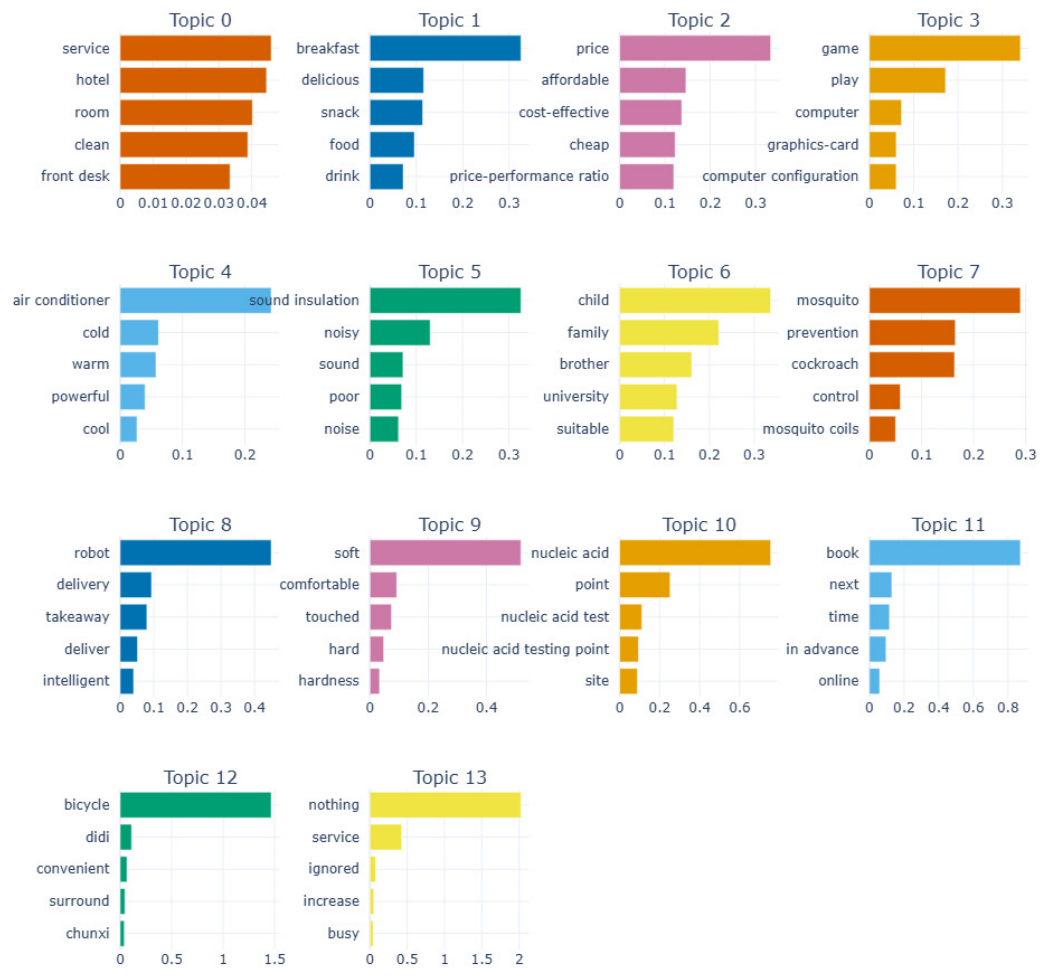
Figure A1. Top keywords and c-TF-IDF scores of original BERTopic topics.
Jtaer 21 00256 g0a1
Notes: c-TF-IDF = class-based term frequency–inverse document frequency.

Appendix B

Robustness Test Results

VariableModel 5Model 6Model 7aModel 7bModel 8
2.hotel_class30.068 ***0.068 ***0.027 *
(0.011)(0.011)(0.013)
3.hotel_class30.0560.0530.0180.218 ***
(0.032)(0.033)(0.023)(0.034)
review_length−0.093 ***−0.086 ***−0.097 ***−0.087 ***−0.093 ***
(0.004)(0.004)(0.006)(0.005)(0.004)
num_photo0.048 ***0.047 ***0.047 ***0.049 ***0.048 ***
(0.002)(0.002)(0.003)(0.003)(0.002)
cw_sent_service_clean10.405 ***
(0.016)
cw_sent_breakf_snack20.189 ***
(0.011)
cw_sent_cost_effi30.215 ***
(0.012)
cw_sent_esports_social_faci40.274 ***
(0.021)
cw_sent_room_conf50.446 ***
(0.026)
cw_sent_intel_conv60.157 ***
(0.021)
mean_service_clean11.065 ***
(0.042)
mean_sent_breakf_snack20.531 ***
(0.099)
mean_sent_cost_effi30.401**
(0.145)
mean_sent_esports_social_faci40.423 ***
(0.100)
mean_sent_room_conf51.025 ***
(0.133)
mean_sent_intel_conv60.728 *
(0.289)
zcw_sent_service_clean1 0.209 ***0.215 ***0.157 ***0.215 ***
(0.008)(0.008)(0.007)(0.008)
zcw_sent_breakf_snack2 0.033 ***0.034 ***0.025 ***0.033 ***
(0.002)(0.002)(0.002)(0.002)
zcw_sent_cost_effi3 0.033 ***0.035 ***0.028 ***0.034 ***
(0.002)(0.002)(0.002)(0.002)
zcw_sent_esports_social_faci4 0.033 ***0.037 ***0.021 ***0.037 ***
(0.003)(0.003)(0.001)(0.003)
zcw_sent_room_conf5 0.076 ***0.078 ***0.057 ***0.078 ***
(0.004)(0.005)(0.004)(0.005)
zcw_sent_intel_conv6 0.011 ***0.011 ***0.008**0.011 ***
(0.001)(0.002)(0.003)(0.001)
zmean_sent_service_clean1 0.101 ***0.134 ***0.082 ***
(0.004)(0.007)(0.004)
zmean_sent_breakf_snack2 0.016 ***0.024 ***0.010 **
(0.003)(0.006)(0.003)
zmean_sent_cost_effi3 0.008 **0.0070.008 *
(0.003)(0.005)(0.003)
zmean_sent_esports_social_faci4 0.010 ***0.016 ***0.010 ***
(0.002)(0.004)(0.003)
zmean_sent_room_conf5 0.022 ***0.029 ***0.020 ***
(0.003)(0.007)(0.003)
zmean_sent_intel_conv6 0.005 *0.012 **0.003
(0.003)(0.004)(0.003)
1.hotel_type0.091 ***0.090 ***
(0.009)(0.009)
1.hotel_type # cw_sent_service_clean1−0.109 ***
(0.021)
1.hotel_type # cw_sent_breakf_snack2−0.042 **
(0.014)
1.hotel_type # cw_sent_cost_effi3−0.038 *
(0.019)
1.hotel_type # cw_sent_esports_social_faci4−0.112 ***
(0.023)
1.hotel_type # cw_snet_room_conf5−0.115 ***
(0.034)
1.hotel_type # cw_sent_intel_conv6−0.040
(0.048)
1.hotel_type # zcw_sent_service_clean1 −0.057 *** −0.057 ***
(0.011) (0.011)
1.hotel_type # zcw_sent_breakf_snack2 −0.008 ** −0.007 **
(0.002) (0.002)
1.hotel_type # zcw_sent_cost_effi3 −0.006 * −0.006 *
(0.003) (0.003)
1.hotel_type # zcw_sent_esports_social_faci4 −0.012 *** −0.015 ***
(0.003) (0.003)
1.hotel_type # zcw_sent_room_conf5 −0.020 *** −0.020 ***
(0.006) (0.006)
1.hotel_type # zcw_sent_intel_conv6 −0.003 −0.003
(0.004) (0.003)
Observations (N)225,318223,073138,90686,412225,239
Log-likelihood−166,916.713−162,570.358−110,501.187−54,970.634−164,833.241
Notes: Robust standard errors are reported in parentheses. Model 5 uses unstandardized group-mean-centered sentiment scores; Model 6 excludes reviews with extreme review length based on the 1st and 99th percentiles; Model 7a and Model 7b report subsample regressions by hotel type; Model 8 uses hotel fixed effects; hotel-level main effects are absorbed; “zmean_” indicates variables standardized at the hotel level; “cw_” indicates variables centered at the review level; “mean_” indicates variables centered at the hotel level; “zcw_” indicates variables standardized at the review level; * p < 0.05, ** p < 0.01, *** p < 0.001. The symbol “#” denotes an interaction term.

References

  1. Statista Market Forecast. Esports—Worldwide. 2024. Available online: https://www.statista.com/outlook/amo/esports/worldwide (accessed on 4 November 2025).
  2. Luong, V.H.; Manthiou, A. Video game-inspired tourism: A synergistic framework. Tour. Manag. 2026, 112, 105282. [Google Scholar] [CrossRef]
  3. Vicente, M.; Tien, E. The Rise of Esports Hotels in Asia; Niko: San Francisco, CA, USA, 2022. Available online: https://nikopartners.com/the-rise-of-esports-hotels-in-asia (accessed on 19 December 2022).
  4. Zhang, M.; Li, J.J.; Li, X. Can esports help with hospitality marketing for Generation Z? The interaction of esports, novelty seeking, and subjective knowledge. Int. J. Hosp. Manag. 2025, 124, 103963. [Google Scholar] [CrossRef]
  5. Moliner-Tena, M.A.; Monferrer-Tirado, D.; Estrada-Guillen, M.; Vidal-Meliá, L. Memorable customer experiences and autobiographical memories: From service experience to word of mouth. J. Retail. Consum. Serv. 2023, 72, 103290. [Google Scholar] [CrossRef]
  6. Pekovic, S.; Rolland, S. Recipes for achieving customer loyalty: A qualitative comparative analysis of the dimensions of customer experience. J. Retail. Consum. Serv. 2020, 56, 102171. [Google Scholar] [CrossRef]
  7. Kong, C.; Ren, S.; Wang, H.; Zhou, H. A Study on Esports Hotel Price Prediction Based on Random Forest Model. In Proceedings of the 2024 IEEE 2nd International Conference on Image Processing and Computer Applications (ICIPCA), Shenyang, China, 28–30 June 2024; IEEE: Piscataway, NJ, USA, 2024; pp. 290–294. [Google Scholar]
  8. de Freitas, R. Gen Z and esports: Digitizing the live event brand. In Information and Communication Technologies in Tourism 2021: Proceedings of the ENTER 2021 eTourism Conference; Springer: Cham, Switzerland, 2021; pp. 188–201. [Google Scholar]
  9. Lebedeva, N.A. Hotel Amenities and Hidden Costs Associated With eSports Tourism in the Ukraine: Development of eSport Hospitality Opportunities. In Handbook of Research on Pathways and Opportunities into the Business of Esports; Andrews, S., Crawford, C.M., Eds.; IGI Global Scientific Publishing: Hershey, PA, USA, 2021; pp. 371–396. [Google Scholar]
  10. Lu, X. E-Sports Hotel, a Brand New Personalized Hotel in the Age of E-Sports. In Advances in Creativity, Innovation, Entrepreneurship and Communication of Design; Springer: Cham, Switzerland, 2020; pp. 213–218. [Google Scholar]
  11. Babar, Z.U.; Zhao, Y. Game on: Unleashing the potential of eSports innovation for predicting guest intentions in hospitality. J. Hosp. Tour. Technol. 2025, 1–20. [Google Scholar] [CrossRef]
  12. Jiao, Y.; Wen, T.; Shi, S.; Yan, S. Exploring e-sports hotel repurchase intentions through polynomial regression and response surface analysis. J. Vacat. Mark. 2026, 1–18. [Google Scholar] [CrossRef]
  13. Skavronskaya, L.; Scott, N.; Moyle, B.; Le, D.; Hadinejad, A.; Zhang, R.; Gardiner, S.; Coghlan, A.; Shakeela, A. Cognitive psychology and tourism research: State of the art. Tour. Rev. 2017, 72, 221–237. [Google Scholar] [CrossRef]
  14. Burgoon, J.K. Interpersonal expectations, expectancy violations, and emotional communication. J. Lang. Soc. Psychol. 1993, 12, 30–48. [Google Scholar] [CrossRef]
  15. Jenny, S.E.; Manning, R.D.; Keiper, M.C.; Olrich, T.W. Virtual(ly) athletes: Where eSports fit within the definition of “Sport”. Quest 2017, 69, 1–18. [Google Scholar]
  16. Funk, D.C.; Pizzo, A.D.; Baker, B.J. eSport management: Embracing eSport education and research opportunities. Sport Manag. Rev. 2018, 21, 7–13. [Google Scholar] [CrossRef]
  17. Zheng, D.; Huang, C. From online games to offline travel: Gaming flow, attachment, and esports travel. J. Vacat. Mark. 2025, 1–20. [Google Scholar] [CrossRef]
  18. Cumming, D.J.-J.; Gibbs, M.; Smith, W. Constructing Authentic Spectatorship at an Esports Bar. J. Contemp. Ethnogr. 2022, 51, 257–288. [Google Scholar]
  19. Lockwood, A.; Pyun, K. How do customers respond to the hotel servicescape? Int. J. Hosp. Manag. 2019, 82, 231–241. [Google Scholar] [CrossRef]
  20. Wong, I.A.; Wan, Y.K.P.; Sun, D. Understanding hospitality service aesthetics through the lens of aesthetic theory. J. Hosp. Mark. Manag. 2023, 32, 410–444. [Google Scholar] [CrossRef]
  21. Bitner, M.J. Servicescapes: The impact of physical surroundings on customers and employees. J. Mark. 1992, 56, 57–71. [Google Scholar] [CrossRef]
  22. Line, N.D.; Hanks, L. The social servicescape: Understanding the effects in the full-service hotel industry. Int. J. Contemp. Hosp. Manag. 2019, 31, 753–770. [Google Scholar] [CrossRef]
  23. Oliver, R.L. A cognitive model of the antecedents and consequences of satisfaction decisions. J. Mark. Res. 1980, 17, 460–469. [Google Scholar] [CrossRef]
  24. Füller, J.; Matzler, K. Customer delight and market segmentation: An application of the three-factor theory of customer satisfaction on life style groups. Tour. Manag. 2008, 29, 116–126. [Google Scholar] [CrossRef]
  25. Kim, J.J.; Han, H. Hotel of the future: Exploring the attributes of a smart hotel adopting a mixed-methods approach. J. Travel Tour. Mark. 2020, 37, 804–822. [Google Scholar] [CrossRef]
  26. Borghi, M.; Mariani, M.M. Asymmetrical influences of service robots’ perceived performance on overall customer satisfaction: An empirical investigation leveraging online reviews. J. Travel Res. 2024, 63, 1086–1111. [Google Scholar]
  27. Mariani, M.M.; Borghi, M. Artificial intelligence in service industries: Customers’ assessment of service production and resilient service operations. Int. J. Prod. Res. 2024, 62, 5400–5416. [Google Scholar]
  28. Yang, H.; Xu, H.; Qu, Y. Managing service failures of hotel robots by combining the Kano model with the service blueprint. Curr. Issues Tour. 2025, 1–14. [Google Scholar] [CrossRef]
  29. Ghosh, V.E.; Gilboa, A. What is a memory schema? A historical perspective on current neuroscience literature. Neuropsychologia 2014, 53, 104–114. [Google Scholar] [CrossRef] [PubMed]
  30. Anderson, R.C.; Pearson, P.D. A schema-theoretic view of basic processes in reading comprehension. In Handbook of Research on Reading; Pearson, P.D., Barr, R., Kamil, M.L., Mosenthal, P., Eds.; Longman: New York, NY, USA, 1984; pp. 255–291. [Google Scholar]
  31. Huang, L.; Tan, C.-H.; Ke, W.; Wei, K.-K. Do we order product review information display? How? Inf. Manag. 2014, 51, 883–894. [Google Scholar] [CrossRef]
  32. Yu, X.; Xu, H. Exploring literary texts as tourists’ prior knowledge: A schema perspective. Tour. Manag. 2026, 112, 105274. [Google Scholar] [CrossRef]
  33. Yang, T.; Hsu, C.H. Calculating tourist sentiment ambivalence through aspect-level sentiment analysis: Infusing tourism domain knowledge into a pre-trained language model. Tour. Manag. 2026, 113, 105294. [Google Scholar] [CrossRef]
  34. Tang, J.; Song, B.; Wang, Y. Fandom in comic-con: Cosplay tourists’ interaction and emotional solidarity. J. Hosp. Tour. Manag. 2023, 54, 346–356. [Google Scholar] [CrossRef]
  35. Zhang, G.; Liu, Y.B.; Cheng, M.; Du, M. While I’m not here, I can still welcome you home: How space–guest interactions shape P2P accommodation appeal. Int. J. Contemp. Hosp. Manag. 2025, 37, 3061–3079. [Google Scholar] [CrossRef]
  36. Shi, S.; Leung, W.K.; Munelli, F. Gamification in OTA platforms: A mixed-methods research involving online shopping carnival. Tour. Manag. 2022, 88, 104426. [Google Scholar] [CrossRef]
  37. Chen, H. China Reports $3.7B Esports Revenue in 2023. The Esports Advocate. 30 December 2023. Available online: https://esportsadvocate.net/2023/12/china-esports-revenue-2023 (accessed on 30 December 2025).
  38. Chan, V. More than 20,000 esports hotels have opened in China, occupancy reaches 60%. Asia Gaming Brief. 19 April 2023. Available online: https://agbrief.com/news/china/19/04/2023/more-than-20000-esports-hotels-have-opened-in-china-occupancy-reaches-60 (accessed on 19 October 2025).
  39. Xu, Y.; Li, S.; Law, R.; Jin, Y.; Lyu, Z. How does the COVID-19 pandemic influence tourist rating behaviour? An empirical exploration based on expectation theory. Curr. Issues Tour. 2023, 26, 4052–4068. [Google Scholar] [CrossRef]
  40. Li, H.; Hu, M.; Li, G. Forecasting tourism demand with multisource big data. Ann. Tour. Res. 2020, 83, 102912. [Google Scholar] [CrossRef]
  41. Mishra, R.K.; Urolagin, S.; Jothi, J.A.A.; Neogi, A.S.; Nawaz, N. Deep learning-based sentiment analysis and topic modeling on tourism during COVID-19 pandemic. Front. Comput. Sci. 2021, 3, 775368. [Google Scholar] [CrossRef]
  42. Li, J.; Lee, B.; Kim, J. Analyzing Factors Affecting Overall Customer Satisfaction Using Hotel Ratings and Reviews with BERTopic and Three-Factor Theory. SAGE Open 2025, 15, 21582440251335169. [Google Scholar] [CrossRef]
  43. Shahhosseini, M.; Khalili Nasr, A. What attributes affect customer satisfaction in green restaurants? An aspect-based sentiment analysis approach. J. Travel Tour. Mark. 2024, 41, 472–490. [Google Scholar] [CrossRef]
  44. Sim, Y.; Lee, S.K.; Sutherland, I. The impact of latent topic valence of online reviews on purchase intention for the accommodation industry. Tour. Manag. Perspect. 2021, 40, 100903. [Google Scholar] [CrossRef]
  45. Wang, B.; Zhao, Q.; Zhang, Z.; Xu, P.; Tian, X.; Jin, P. Understanding the heterogeneity and dynamics of factors influencing tourist sentiment with online reviews. J. Theor. Appl. Electron. Commer. Res. 2025, 20, 22. [Google Scholar] [CrossRef]
  46. Jeong, D.; Kim, D.; Yan, J.; Li, J. Effect of aspect-level emotion expression of online restaurant reviews on perceived helpfulness: An aspect-based sentiment analysis perspective. SAGE Open 2025, 15, 21582440251337195. [Google Scholar] [CrossRef]
  47. Wen, J.; Li, X.; Han, H. Emotional resonance and buying behavior in live streaming: A study on KOL influence and the mediation of purchase intentions. J. Theor. Appl. Electron. Commer. Res. 2025, 20, 108. [Google Scholar] [CrossRef]
  48. Szablewicz, M. “Losers””Acting Gay”: Internet Slang, Memes, and Affective Intensities. In Mapping Digital Game Culture in China: From Internet Addicts to Esports Athletes; Palgrave Macmillan: Cham, Switzerland, 2020; pp. 135–165. [Google Scholar]
  49. Hofmann, D.A. An overview of the logic and rationale of hierarchical linear models. J. Manag. 1997, 23, 723–744. [Google Scholar] [CrossRef]
  50. Zhao, Z.; Cheng, M.; Lv, K.; Huang, L. What matters most? A sustainable or a conventional hotel experience? The interaction effect on guest satisfaction: A mixed-methods approach. Int. J. Hosp. Manag. 2025, 124, 103988. [Google Scholar] [CrossRef]
  51. Roy, G. Travelers’ online review on hotel performance–analyzing facts with the theory of lodging and sentiment analysis. Int. J. Hosp. Manag. 2023, 111, 103459. [Google Scholar] [CrossRef]
  52. Schwarz, N.; Clore, G.L. Mood, misattribution, and judgments of well-being: Informative and directive functions of affective states. J. Personal. Soc. Psychol. 1983, 45, 513. [Google Scholar] [CrossRef]
  53. Yi, B.; Shi, D.; Li, G. What makes an AI-themed hotel successful? New evidence from a sequential research design. Int. J. Contemp. Hosp. Manag. 2025, 37, 783–804. [Google Scholar] [CrossRef]
  54. Xu, Y.Y.; Wong, I.A.; Lian, Q.L.; Li, M. Scripted gamified hotel: An edgework perspective of the impact of gamification on hotel selection. J. Hosp. Tour. Res. 2026. [Google Scholar] [CrossRef]
  55. Andrews, S.; Crawford, C.M. Handbook of Research on Pathways and Opportunities into the Business of Esports; IGI Global Scientific Publishing: Hershey, PA, USA, 2021. [Google Scholar]
  56. Stojanovic, I.; Andreu, L.; Curras-Perez, R. Social media communication and destination brand equity. J. Hosp. Tour. Technol. 2022, 13, 650–666. [Google Scholar] [CrossRef]
  57. Anaya, G.J.; Wang, S.; Lehto, X.Y. A schema-based perspective to understanding hotel social media content strategy. J. Qual. Assur. Hosp. Tour. 2022, 23, 56–88. [Google Scholar] [CrossRef]
  58. Chang, Y.; Zhang, C.; Li, T.; Li, Y. Social cognition of humanoid robots on customer tolerance of service failure. Int. J. Contemp. Hosp. Manag. 2024, 36, 2347–2366. [Google Scholar] [CrossRef]
Figure 1. Example of an esports-themed hotel and facilities. Sources: https://hotels.ctrip.com (accessed on 2 April 2026).
Jtaer 21 00256 g001
Figure 2. Methodological procedure.
Jtaer 21 00256 g002
Figure 3. Online reviews of esports-themed hotels on Qunar.com.
Jtaer 21 00256 g003
Figure 4. Geographical distribution of the sample hotels.
Jtaer 21 00256 g004
Figure 5. Process of calculating sentiment scores by topic (adapted from Li et al., 2025 [42]).
Jtaer 21 00256 g005
Figure 6. Marginal effect of attribute sentiment score across hotel type.
Jtaer 21 00256 g006
Table 1. Summary of prior studies on esports-themed hotels.
LiteratureMethodTheoryMain Findings
Babar and Yupei (2025) [11]SurveyStimulus–organism–response (SOR) frameworkThe esports experience directly fosters customer well-being, a relationship further enhanced through positive affect and meaningful engagement. This heightened well-being subsequently heightens brand engagement, reduces price sensitivity, and strengthens word-of-mouth intention.
Kong et al. (2024) [7]Big data/Developed a price prediction system for esports-themed hotels.
de Freitas (2021) [8]Interview, survey/Esports events stimulate substantial lodging demand, generating positive economic spillover effects for the hotel industry.
Jiao et al. (2026) [12]Polynomial regression, response surface analysisRecreationist–environment fit theoryThe fit between specialized esports-themed hotel environments and customers’ esports expectations enhances flow and reduces psychological detachment, thereby strengthening repurchase intention.
Lebedeva (2021) [9]//Assessed the viability, outlined a blueprint, and proposed policies for esports-themed hotel development in Ukraine.
Lu (2020) [10]//Identified the diverse scenario-based needs of esports-themed hotel customers (e.g., competitive gaming, dating, socializing), proposed a scenario-based design framework, and implemented it in new store openings.
Zhang et al. (2025) [4]ExperimentCue utilization theoryGaming-related cues in hotels can enhance the sense of coolness and perceived innovativeness among Generation Z, positively influencing their patronage intention.
Table 2. Performance of the fine-tuned sentiment analysis model.
Sentiment CategoryPrecisionRecallF1-Score
Positive0.840.860.85
Neutral0.780.750.76
Negative0.870.850.86
Overall accuracy0.84
Table 3. Topics extracted by the BERTopic model.
Target Topic (Number)Original Topics (Number)Top Words
1_service attitude and cleanliness (338,293)Topic 0
(336,795)
service, hotel, room, clean, front desk, attitude, hygienic, lady, tidy, enthusiastic
Topic 7
(1498)
mosquito, prevention, cockroach, control, mosquito coils, many, repellent, situation, bite, insect
2_breakfast and casual snacks (10,432)Topic 1
(10,432)
breakfast, delicious, snack, food, drink, variety, taste, noodle, milk, free
3_price and cost performance (10,045)Topic 2
(10,045)
price, affordable, cost-effective, cheap, price–performance ratio, expensive, high cost performance, yuan, economical, cost
4_esports-based social experience and supporting facilities (5682)Topic 3
(5682)
game, play, computer, graphics card, computer configuration, smooth, screen, kaihei, not stuck, accelerator
5_room facilities and comfort (11,548)Topic 4
(5640)
air conditioner, cold, warm, powerful, cool, central, weather, temperature, air conditioning, heating
Topic 5 (4751)sound insulation, noisy, sound, poor, noise, soundproof, night, loud, voice, morning
Topic 9 (1157)soft, comfortable, touched, hard, hardness, touch, touching, sheet, softness, uncomfortable
6_intelligence and convenience (1431)Topic 8 (1294)robot, delivery, takeaway, deliver, intelligent, meal, order, smart, interesting, Xiaodu
Topic 12 (137)bicycle, Didi, convenient, surround, Chunxi, tourism, walk, Tiananmen, business trips, location
Table 4. ABSA results (sentence-level).
AspectTypeNumberPositiveNeutralNegative
NumberPercent (%)NumberPercent (%)NumberPercent (%)
1_service attitude and cleanlinessTotal338,293256,4447652,9321628,9179
PETH126,40797,2197719,0541510,1348
NPETH211,886159,2257533,8781618,7839
2_breakfast and casual snacksTotal10,4327616731877189399
PETH2999236379439151977
NPETH743352537114381974210
3_price and cost performanceTotal10,045671767225322107511
PETH683245066615592376711
NPETH4029302375628163789
4_esports-based social experience and supporting facilitiesTotal56824050719691766312
PETH4029302375628163789
NPETH16531027623412128517
5_room facilities and comfortTotal11,548522345344630285925
PETH437622545211972792521
NPETH7172296941226932193427
6_intelligence and convenienceTotal1431950662451723616
PETH2151296042204420
NPETH1216821681941620117
Table 5. Variable and operationalization.
VariableDefinitionOperationLevel
overall_ratingCustomers’ overall rating, reflecting overall customer satisfactionOriginal rating ([1,5])Level 1
sent_service_clean1Review-level sentiment score for the topic ‘1_service attitude and cleanlinessWithin-hotel centered and then standardizedLevel 1
sent_breakf_snack2Review-level sentiment score for the topic ‘2_breakfast and casual snacksWithin-hotel centered and then standardizedLevel 1
sent-cost_effi3Review-level sentiment score for the topic ‘3_price and cost performance’Within-hotel centered and then standardizedLevel 1
sent_esports_social_faci4Review-level sentiment score for the topic ‘4_esports-based social experience and supporting facilitiesWithin-hotel centered and then standardizedLevel 1
sent_room_conf5Review-level sentiment score for the topic ‘5_room facilities and comfortWithin-hotel centered and then standardizedLevel 1
sent_intel_conv6Review-level sentiment score for the topic ‘6_intelligence and convenienceWithin-hotel centered and then standardizedLevel 1
review_lengthLength of the review textLog-transformed and then standardizedLevel 1
num_photoNumber of photos attached to the reviewLog-transformed and then standardizedLevel 1
hotel_typeHotel typeBinary variable: 0 = NPETH, 1 = PETHLevel 2
hotel_clsssHotel classOriginal hotel class, ranging from 1 to 5Level 2
Table 6. Descriptive statistics of variables.
VariableMeanStd. Dev.[Min, Max]
Continuous variables (review-level)
overall_rating4.817 0.578 [1, 5]
sent_service_clean10.557 0.538 [−1, 1]
sent_breakf_snack20.027 0.179 [−1, 1]
sent-cost_effi30.020 0.162 [−1, 1]
sent_esports_social_faci40.014 0.136 [−1, 1]
sent_room_conf50.011 0.175 [−1, 1]
sent_intel_conv60.003 0.070 [−1, 1]
review_length26.021 29.982 [5, 952]
num_photo0.426 0.995 [0, 3]
Categorical variables (hotel-level)FrequencyPercentage (%)
hotel_type
NPETH54934.29
PETH105265.71
hotel_classs
low_end155997.38
medium342.12
high_end80.50
Table 7. Multilevel linear regression results.
VariableModel 1Model 2Model 3Model 4
2.hotel_class30.094 ***0.0150.068 ***0.068 ***
(0.020)(0.010)(0.011)(0.011)
3.hotel_class30.0350.0090.0560.056
(0.085)(0.033)(0.032)(0.032)
review_length−0.095 ***−0.093 ***−0.093 ***−0.093 ***
(0.005)(0.004)(0.004)(0.004)
num_photo0.067 ***0.048 ***0.048 ***0.047 ***
(0.004)(0.002)(0.002)(0.003)
sent_service_clean1 0.194 ***0.215 ***0.202 ***
(0.006)(0.008)(0.006)
sent_breakf_snack2 0.031 ***0.033 ***0.032 ***
(0.001)(0.002)(0.002)
sent_cost_effi3 0.032 ***0.034 ***0.032 ***
(0.002)(0.002)(0.002)
sent_esports_social_faci4 0.026 ***0.037 ***0.027 ***
(0.001)(0.003)(0.001)
sent_room_conf5 0.070 ***0.078 ***0.074 ***
(0.003)(0.005)(0.003)
sent_intel_conv6 0.011 ***0.011 ***0.011 ***
(0.001)(0.001)(0.002)
zmean_sent_service_clean1 0.104 ***0.102 ***0.102 ***
(0.004)(0.004)(0.004)
zmean_sent_breakf_snack2 0.016 ***0.016 ***0.016 ***
(0.003)(0.003)(0.003)
zmean_sent_cost_effi3 0.005 *0.007 **0.007 **
(0.003)(0.003)(0.003)
zmean_sent_esports_social_faci4 0.016 ***0.010 ***0.010 ***
(0.003)(0.002)(0.002)
zmean_sent_room_conf5 0.025 ***0.023 ***0.023 ***
(0.003)(0.003)(0.003)
zmean_sent_intel_conv6 0.006 *0.006 *0.006 *
(0.003)(0.002)(0.002)
1.hotel_type 0.091 ***0.091 ***
(0.009)(0.009)
1.hotel_type # sent_service_clean1 −0.057 ***
(0.011)
1.hotel_type# sent_breakf_snack2 −0.007 **
(0.002)
1.hotel_type # sent_cost_effi3 −0.006 *
(0.003)
1.hotel_type # sent_esports_social_faci4 −0.015 ***
(0.003)
1.hotel_type # sent_room_conf5 −0.020 ***
(0.006)
1.hotel_type # sent_intel_conv6 −0.003
(0.003)
2.hotel_class3 # sent_service_clean1 −0.053 **
(0.019)
3.hotel_class3 # sent_service_clean1 −0.019
(0.012)
2.hotel_class3 # sent__breakf_snack2 −0.002
(0.004)
3.hotel_class3 # sent_breakf_snack2 0.000
(0.002)
2.hotel_class3 # sent_cost_effi3 −0.004
(0.006)
3.hotel_class3 # sent_cost_effi3 0.016 *
(0.007)
2.hotel_class3 # sent_esports_social_faci4 −0.005
(0.006)
3.hotel_class3 # sent_esports_social_faci4 0.005
(0.015)
2.hotel_class3 # sent_room_conf5 −0.018 *
(0.009)
3.hotel_class3 # sent_room_conf5 −0.011
(0.009)
2.hotel_class3 # sent_intel_conv6 −0.003
(0.003)
3.hotel_class3 # sent_intel_conv6 −0.000
(0.002)
N225,318225,318225,318225,318
Hotels1601160116011601
Log-likelihood−186,533.841−167,392.962−166,916.713−167,158.569
AIC373,081.683334,823.924333,885.425334,381.139
BIC373,153.959335,020.104334,153.882334,711.548
Notes: Robust standard errors are reported in parentheses. Reviews are nested within hotels. The ICC from the null model was 0.160. “zmean” denotes the standardized mean score of the six attributes at the hotel level; * p < 0.05, ** p < 0.01, *** p < 0.001. The symbol “#” denotes an interaction term.
Disclaimer/Publisher’s Note: The statements, opinions and data contained in all publications are solely those of the individual author(s) and contributor(s) and not of MDPI and/or the editor(s). MDPI and/or the editor(s) disclaim responsibility for any injury to people or property resulting from any ideas, methods, instructions or products referred to in the content.