
Toward Industry 5.0: An IoT-Enabled Digital Twin for Joint Sustainability and Resilience Optimization in Automated Warehouses

 ,
,  , , and
Abstract
1. Introduction
- A holistic DT framework for coupled operations: Unlike existing models that isolate single warehouse processes, the DT-JSRO integrates the core, highly interdependent operations (replenishment, picking, and packing) to prevent bottleneck-shifting and optimize system-wide performance.
- Joint optimization of conflicting objectives: A quantitative mechanism is introduced to evaluate the trade-off between sustainability (energy minimization) and resilience (throughput maximization under dynamic constraints).
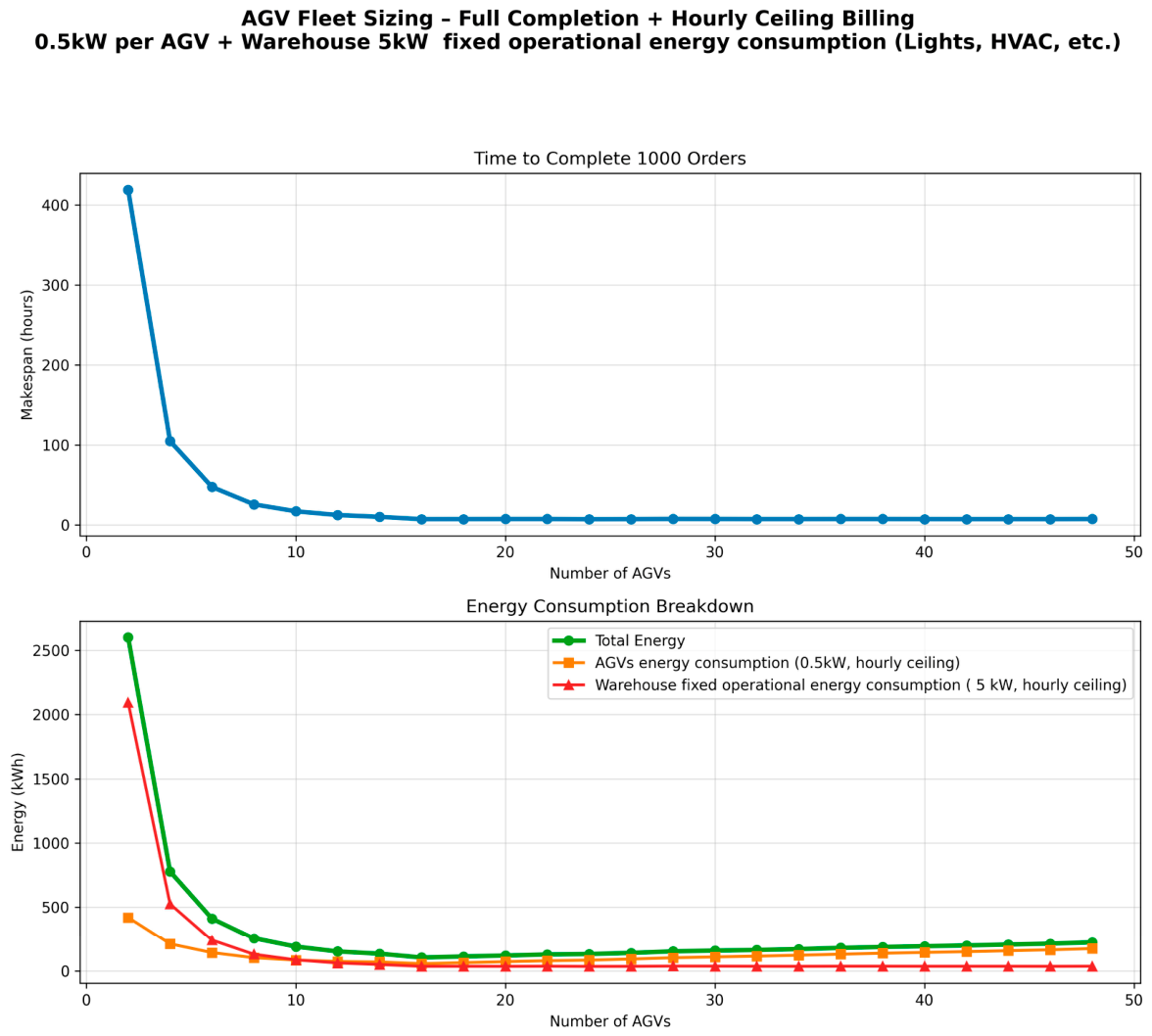
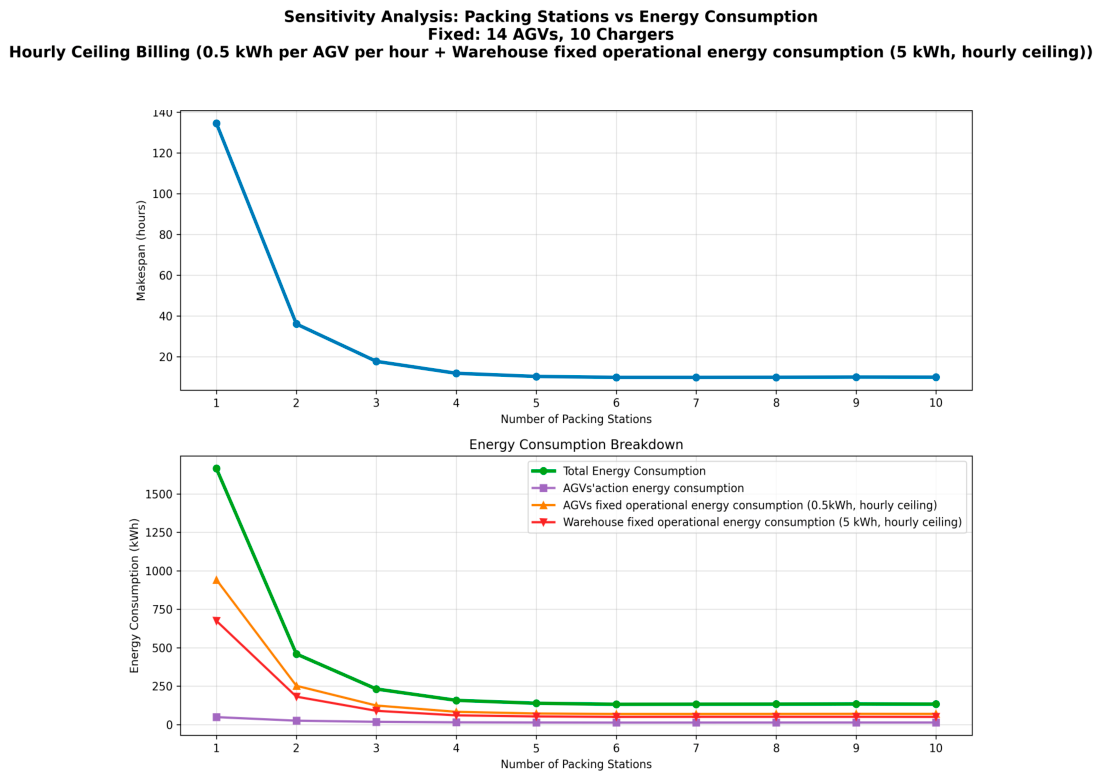
- Realistic energy billing modeling: An hourly ceiling billing mechanism is incorporated to account for both mobile resource consumption and fixed warehouse environmental loads. This provides a more accurate reflection of actual industrial operational costs than traditional 24/7 fixed-load assumptions.
2. Literature Review
2.1. Automated Warehouses in E-Commerce Logistics
2.2. Industry 5.0 for Sustainable and Resilient Automated Warehouses
2.3. Digital Twin for Transitioning to Industry 5.0
2.4. The Need for a Holistic Digital Twin Approach in Automated Warehouses
2.5. Research Gap and Summary
3. Methodology
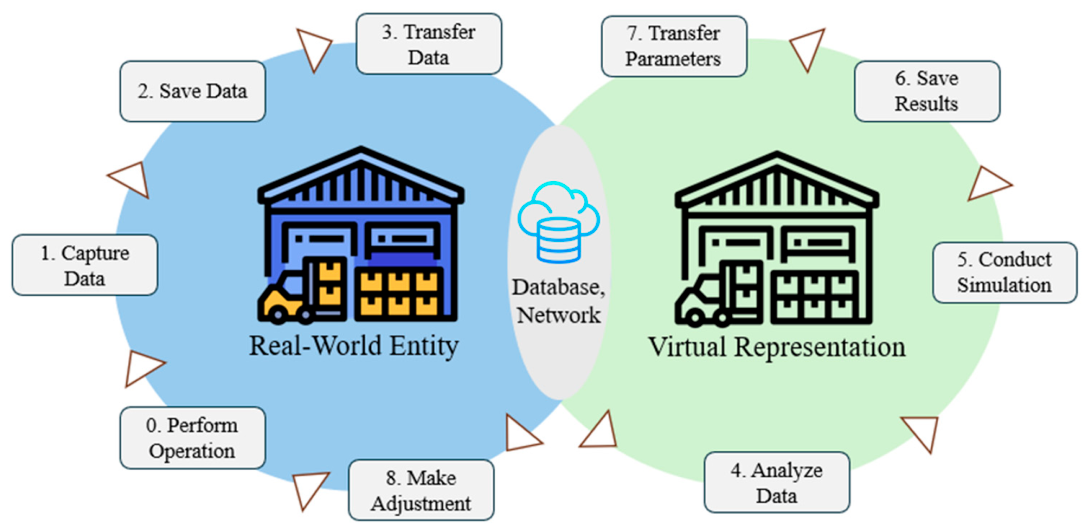
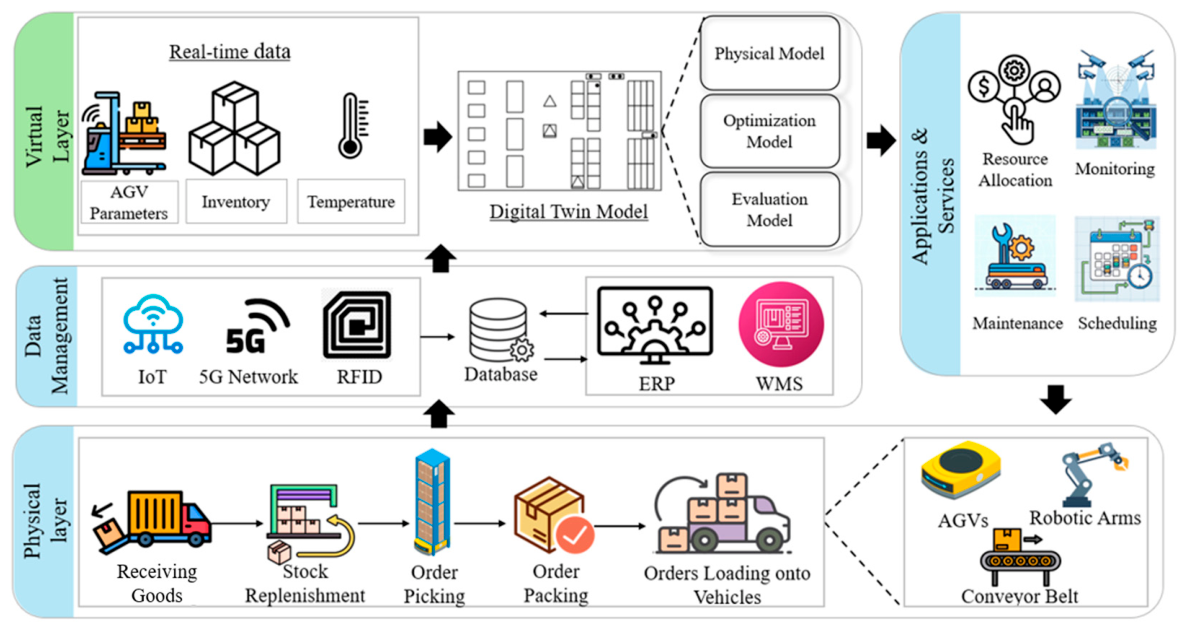
3.1. Introduction of DT-JSRO
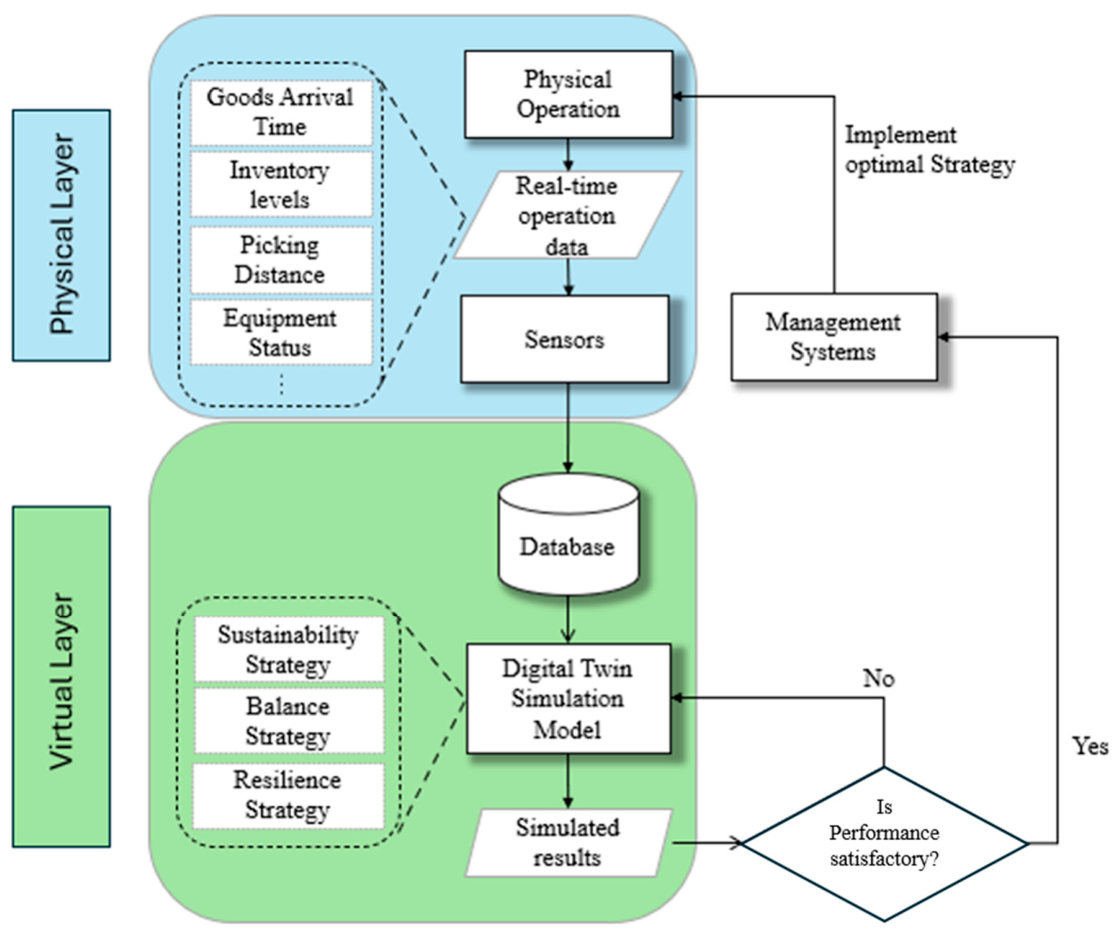
- Current position, speed, battery level, and state of each AGV;
- Environmental parameters (temperature, humidity—optional for future energy models);
- Inventory levels at each storage location and picking face;
- Order arrival times, order lines, and due dates;
- Queue lengths at packing stations and charging stations;
- Current number of active mobile resources and their utilization.
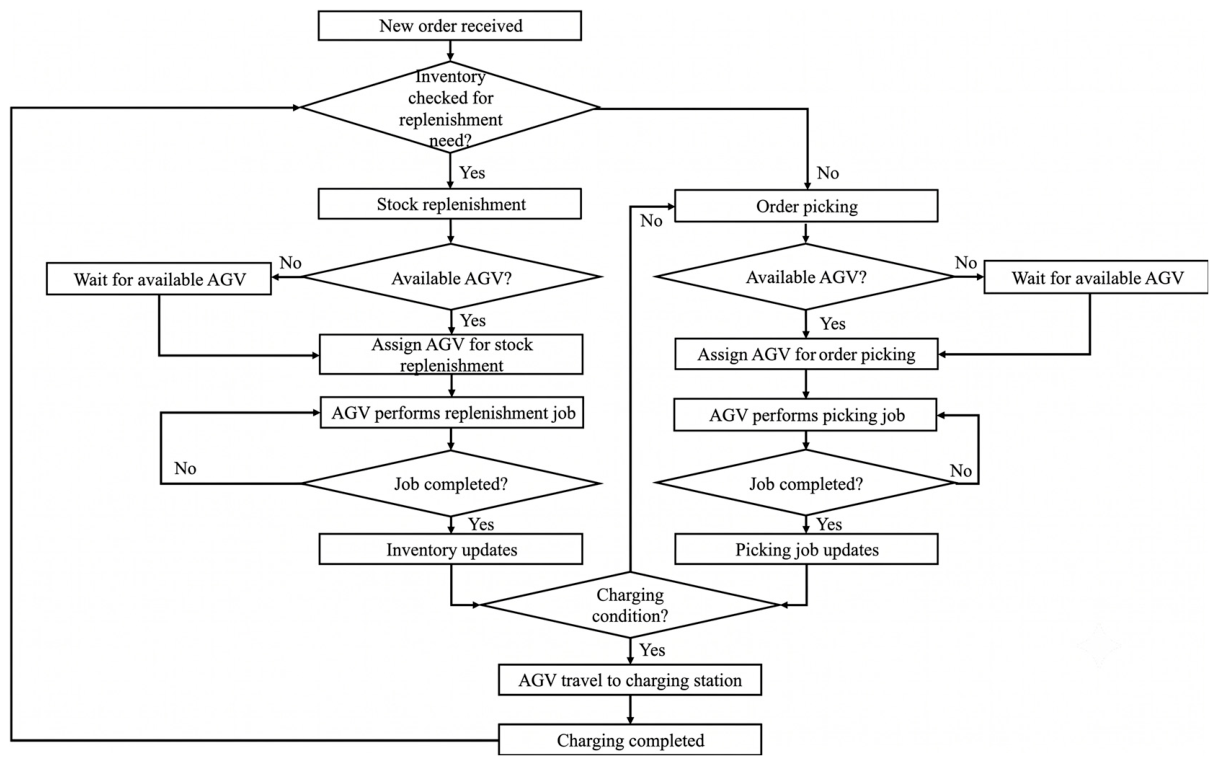
3.2. Process Flow of the Digital Twin
- These processes dominate variable resource utilization and energy consumption in modern automated e-fulfilment centers [14]. Mobile transport devices such as AGVs spend most of their operating time and battery capacity on replenishment tasks, order picking transport, and movements to/from packing stations.
- They are highly interdependent: poor replenishment creates picking delays and packing bottlenecks, directly affecting both sustainability (such as unnecessary waiting/idling energy) and resilience (such as reduced throughput under demand surge conditions).
- Receiving and outbound loading are typically batch-oriented, less frequent, and more predictable; their scheduling has limited interaction with real-time picking dynamics and contributes relatively little variable energy in highly automated systems, which are often handled by fixed conveyors or dock robots with near-constant power draw.
3.3. Simulation and Evaluation
3.3.1. Notation and Symbols
3.3.2. Mathematical Formulation and Objective Function
3.3.3. Hourly Ceiling Energy Billing with Shared Warehouse Environment Load
3.4. Generalization and Adaptability of the DT-JSRO Framework to Different Automation Technologies
4. Simulation Experiment
4.1. Environment
4.2. Model Assumptions and Scope
5. Results and Discussion
5.1. Sensitivity Analysis
5.1.1. Impact of Packing Stations and Order Volume
5.1.2. Performance of the DT-JSRO Model Under Varying Order and Infrastructure Conditions
5.2. Research Implications
5.2.1. Academic Implications
5.2.2. Managerial Implications
6. Conclusions
Author Contributions
Funding
Institutional Review Board Statement
Informed Consent Statement
Data Availability Statement
Acknowledgments
Conflicts of Interest
References
- Statista. Retail E-Commerce Sales Worldwide from 2022 to 2028 (in Billion U.S. Dollars). 2025. Available online: https://www.statista.com/statistics/379046/worldwide-retail-e-commerce-sales/ (accessed on 23 June 2025).
- Amorim, P.; DeHoratius, N.; Eng-Larsson, F.; Martins, S. Customer preferences for delivery service attributes in attended home delivery. Manag. Sci. 2024, 70, 7559–7578. [Google Scholar] [CrossRef]
- Tabaku, E.; Duçi, E.; Lazaj, A. From Physical Stores to Virtual Marketplaces: The Evolution of Shopping. Interdiscip. J. Res. Dev. 2024, 11, 175. [Google Scholar] [CrossRef]
- Leung, K.H.; Choy, K.L.; Siu, P.K.; Ho, G.T.; Lam, H.Y.; Lee, C.K. A B2C e-commerce intelligent system for re-engineering the e-order fulfilment process. Expert Syst. Appl. 2018, 91, 386–401. [Google Scholar] [CrossRef]
- Li, Y.; Zhang, R.; Jiang, D. Order-picking efficiency in e-commerce warehouses: A literature review. J. Theor. Appl. Electron. Commer. Res. 2022, 17, 1812–1830. [Google Scholar] [CrossRef]
- Odeyinka, O.F.; Omoegun, O.G. Warehouse Operations: An Examination of Traditional and Automated Approaches in Supply Chain Management. In Operations Management-Recent Advances and New Perspectives; IntechOpen: London, UK, 2023. [Google Scholar]
- Ho, G.T.S.; Tang, Y.M.; Leung, E.K.; Tong, P.H. Integrated reinforcement learning of automated guided vehicles dynamic path planning for smart logistics and operations. Transp. Res. Part E Logist. Transp. Rev. 2025, 196, 104008. [Google Scholar] [CrossRef]
- Fatima, Z.; Tanveer, M.H.; Waseemullah Zardari, S.; Naz, L.F.; Khadim, H.; Ahmed, N.; Tahir, M. Production plant and warehouse automation with IoT and industry 5.0. Appl. Sci. 2022, 12, 2053. [Google Scholar] [CrossRef]
- Tong, Q.; Ming, X.; Zhang, X. The realization for automated warehouse based on the integration of ERP and WMS. In Proceedings of the 2020 the 7th International Conference on Automation and Logistics (ICAL), Beijing, China, 22–24 July 2020; Association for Computing Machinery: New York, NY, USA, 2020; pp. 76–80. [Google Scholar]
- European Commission. Industry 5.0. Research and Innovation. 2024. Available online: https://research-and-innovation.ec.europa.eu/research-area/industrial-research-and-innovation/industry-50_en (accessed on 23 June 2025).
- Pasham, S.D. Energy-Efficient Task Scheduling in Distributed Edge Networks Using Reinforcement Learning. Computertech 2019, 7, 248–268. [Google Scholar] [CrossRef]
- Nweje, U.; Taiwo, M. Supply chain management: Balancing efficiency and environmental responsibility. World J. Adv. Res. Rev. 2025, 25, 1547–1564. [Google Scholar] [CrossRef]
- Perotti, S.; Colicchia, C. Greening warehouses through energy efficiency and environmental impact reduction: A conceptual framework based on a systematic literature review. Int. J. Logist. Manag. 2023, 34, 199–234. [Google Scholar] [CrossRef]
- Lewczuk, K.; Kłodawski, M.; Gepner, P. Energy consumption in a distributional warehouse: A practical case study for different warehouse technologies. Energies 2021, 14, 2709. [Google Scholar] [CrossRef]
- Riazi, S.; Bengtsson, K.; Lennartson, B. Energy optimization of large-scale AGV systems. IEEE Trans. Autom. Sci. Eng. 2020, 18, 638–649. [Google Scholar] [CrossRef]
- Maheshwari, P.; Kamble, S.; Kumar, S.; Belhadi, A.; Gupta, S. Digital twin-based warehouse management system: A theoretical toolbox for future research and applications. Int. J. Logist. Manag. 2024, 35, 1073–1106. [Google Scholar]
- Sahara, C.R.; Aamer, A.M. Real-time data integration of an internet-of-things-based smart warehouse: A case study. Int. J. Pervasive Comput. Commun. 2022, 18, 622–644. [Google Scholar] [CrossRef]
- Lam, H.Y.; Ho, G.T.S.; Mo, D.Y.; Tang, V. Responsive pick face replenishment strategy for stock allocation to fulfil e-commerce order. Int. J. Prod. Econ. 2023, 264, 108976. [Google Scholar] [CrossRef]
- Mikhail, D.; Sadllah, S. A Study on Layout Design for a Logistic Center–Case Study at ASSA ABLOY Opening Solutions Sweden AB. Master’s Thesis, Mälardalen University, Eskilstuna, Sweden, 2020. [Google Scholar]
- Edouard, A.; Sallez, Y.; Fortineau, V.; Lamouri, S.; Berger, A. Automated storage and retrieval systems: An attractive solution for an Urban warehouse’s sustainable development. Sustainability 2022, 14, 9518. [Google Scholar] [CrossRef]
- Azadeh, K.; De Koster, R.; Roy, D. Robotized and automated warehouse systems: Review and recent developments. Transp. Sci. 2019, 53, 917–945. [Google Scholar] [CrossRef]
- Plakas, G.; Aretoulaki, E.; Ponis, S.T.; Agalianos, K.; Maroutas, T.N. A proposed technology solution for enhancing order picking in warehouses and distribution centers based on a gamified augmented reality application. In Proceedings of the 14th IADIS International Conference Interfaces and Human Computer Interaction, Zagreb, Croatia, 23–25 July 2020; pp. 23–25. [Google Scholar]
- Cirillo, V.; Rinaldini, M.; Virgillito, M.E.; Divella, M.; Manicardi, C.; Massimo, F.S.; Cetrulo, A.; Costantini, E.; Moro, A.; Staccioli, J. Case Studies of Automation in Services; Publications Office of the European Union: Luxembourg, 2022. [Google Scholar]
- Roodbergen, K.J.; Vis, I.F. A survey of literature on automated storage and retrieval systems. Eur. J. Oper. Res. 2009, 194, 343–362. [Google Scholar] [CrossRef]
- Minashkina, D.; Happonen, A. Decarbonizing warehousing activities through digitalization and automatization with WMS integration for sustainability supporting operations. E3S Web Conf. 2020, 158, 03002. [Google Scholar] [CrossRef]
- Shabur, M.A.; Shahriar, A.; Ara, M. From automation to collaboration: Exploring the impact of industry 5.0 on sustainable manufacturing. Discov. Sustain. 2025, 6, 341. [Google Scholar] [CrossRef]
- Cosma, A.M.I.; Zangara, G.; Silvestri, L.; Filice, L. Sustainability Impact of Automated Warehouses in Industry 4.0 scenario. Procedia Comput. Sci. 2025, 253, 3196–3205. [Google Scholar] [CrossRef]
- Ahmed, T.; Karmaker, C.L.; Nasir, S.B.; Moktadir, M.A.; Paul, S.K. Modeling the artificial intelligence-based imperatives of industry 5.0 towards resilient supply chains: A post-COVID-19 pandemic perspective. Comput. Ind. Eng. 2023, 177, 109055. [Google Scholar] [CrossRef] [PubMed]
- Li, L.; Duan, L. Human centric innovation at the heart of industry 5.0—Exploring research challenges and opportunities. Int. J. Prod. Res. 2025, 64, 4901–4933. [Google Scholar] [CrossRef]
- Ferrari, A.; Zenezini, G.; Rafele, C.; Carlin, A. A Roadmap towards an Automated Warehouse Digital Twin: Current implementations and future developments. IFAC-PapersOnLine 2022, 55, 1899–1905. [Google Scholar] [CrossRef]
- Ponis, S.T.; Efthymiou, O.K. Cloud and IoT applications in material handling automation and intralogistics. Logistics 2020, 4, 22. [Google Scholar] [CrossRef]
- Soori, M.; Arezoo, B.; Dastres, R. Internet of things for smart factories in industry 4.0, a review. Internet Things Cyber-Phys. Syst. 2023, 3, 192–204. [Google Scholar] [CrossRef]
- Andiyappillai, N. Factors influencing the successful implementation of the warehouse management system (WMS). Int. J. Comput. Appl. 2020, 177, 21–25. [Google Scholar] [CrossRef]
- Li, C.H.; Lam, T.S.D.; Lo, C.K.D.; Liu, C.W. Digital Twins: Adoption in Solar Panel System Construction. In 2024 4th International Conference on Electrical, Computer, Communications and Mechatronics Engineering (ICECCME); IEEE: New York, NY, USA, 2024; pp. 1–5. [Google Scholar]
- Rasheed, A.; San, O.; Kvamsdal, T. Digital twin: Values, challenges and enablers from a modeling perspective. IEEE Access 2020, 8, 21980–22012. [Google Scholar] [CrossRef]
- Rajendiran, G.R.; Ayyadurai, R. Digital Twin Technology for Real-Time Simulation and Optimization of Warehouses. N. Am. J. Eng. Res. 2023, 4. [Google Scholar]
- Wu, S.; Xiang, W.; Li, W.; Chen, L.; Wu, C. Dynamic scheduling and optimization of AGV in factory logistics systems based on digital twin. Appl. Sci. 2023, 13, 1762. [Google Scholar] [CrossRef]
- Dai, M.; Shen, Y.; Liu, W.; Lü, M. Digital twin-based optimization of AGV scheduling under energy constraints in plant factories. J. Clean. Prod. 2025, 519, 146016. [Google Scholar] [CrossRef]
- Félix-Cigalat, J.S.; Domingo, R. Towards a digital twin warehouse through the optimization of internal transport. Appl. Sci. 2023, 13, 4652. [Google Scholar] [CrossRef]
- Leung, E.K.H. Total fulfillment management: Principles, practices and use cases. Transp. Res. Part E Logist. Transp. Rev. 2025, 194, 103888. [Google Scholar] [CrossRef]
- Ho, G.T.S.; Tang, V.; Tong, P.H.; Tam, M.M.F. Demand-driven storage allocation for optimizing order picking processes. Expert Syst. Appl. 2025, 272, 126812. [Google Scholar] [CrossRef]
- Jiang, Z.Z.; Zhao, J.; Sun, M. Joint optimization of order picking and delivery in ergonomic picking systems with due dates for sustainability and resilience. Transp. Res. Part E Logist. Transp. Rev. 2024, 191, 103727. [Google Scholar] [CrossRef]
- Leung, E.K.; Lee, C.K.H.; Ouyang, Z. From traditional warehouses to Physical Internet hubs: A digital twin-based inbound synchronization framework for PI-order management. Int. J. Prod. Econ. 2022, 244, 108353. [Google Scholar] [CrossRef]
- Zhang, L.; Yang, C.; Yan, Y.; Cai, Z.; Hu, Y. Automated guided vehicle dispatching and routing integration via digital twin with deep reinforcement learning. J. Manuf. Syst. 2024, 72, 492–503. [Google Scholar] [CrossRef]
- Naumov, V.; Kubek, D.; Więcek, P.; Skalna, I.; Duda, J.; Goncerz, R.; Derlecki, T. Optimizing energy consumption in internal transportation using dynamic transportation vehicles assignment model: Case study in printing company. Energies 2021, 14, 4557. [Google Scholar] [CrossRef]
- Chow, E.W.H.; Li, C.H.; Tang, V.; Tam, M.M.F.; Ho, G.T. Reinforcement learning-driven resilient smart Warehousing: A holistic approach for replenishment and picking. Eng. Appl. Artif. Intell. 2026, 177, 114921. [Google Scholar] [CrossRef]






| Parameter | Description | Value |
|---|---|---|
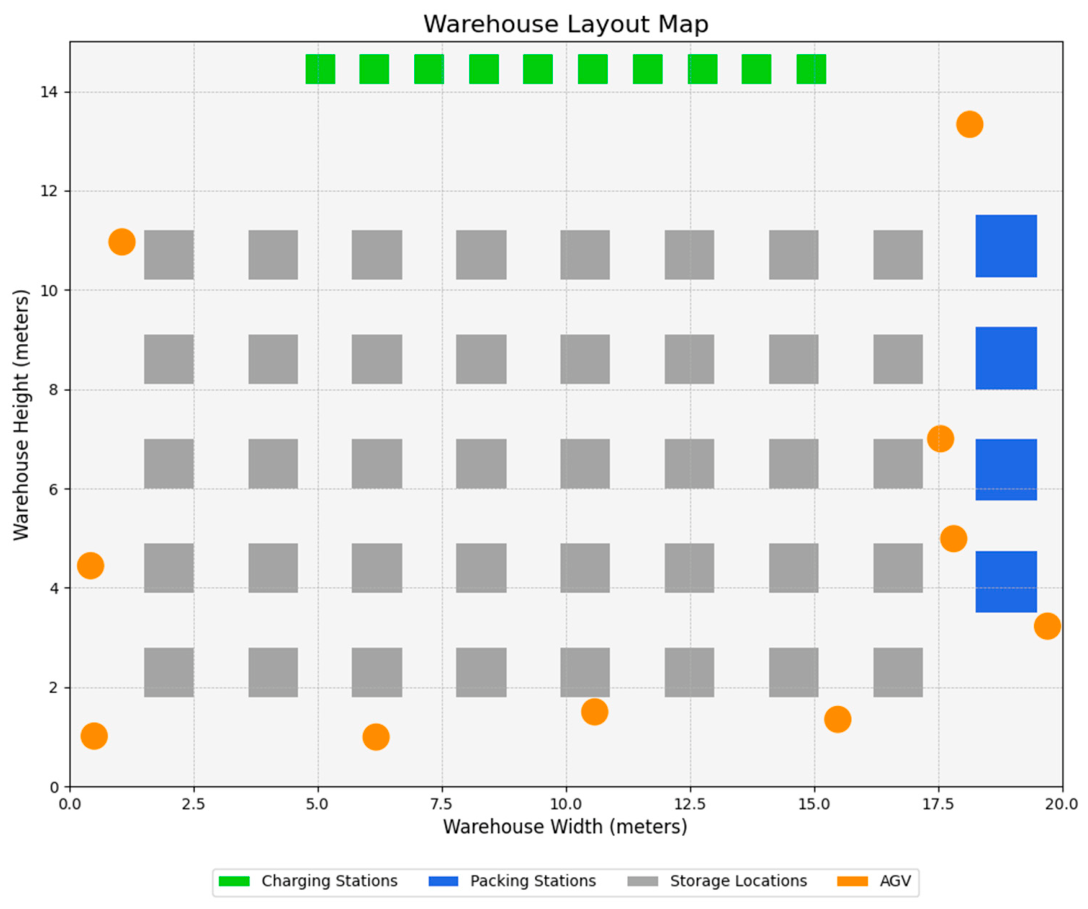
| Number of Automated Guided Vehicles (AGVs) | 10 | |
| Number of packing stations | 4 | |
| Number of charging stations | 10 | |
| Number of inventory storage locations | 40 | |
| Total duration of the operational shift in hours | 8 | |
| Total number of orders generated in a shift | 1000 | |
| The travel speed of an AGV in meters per second | 1.7 m/s | |
| The power consumed by an AGV while idle | 0.08 kWh | |
| The power consumed by an AGV while moving in kilowatts (kW) | 0.45 kWh | |
| The battery capacity of an AGV in kilowatt-hours (kWh) | 2.0 kWh | |
| The power supplied by a charging station in kilowatts (kW) | 1.5 kWh | |
| The physical dimensions (width and height) of the warehouse in meters | (20, 15) | |
| The set of unique inventory types (SKUs) | 6 types | |
| The power consumed by warehouse infrastructure | 5 kWh | |
| The energy per AGV when awake | 0.5 kW |
| Sensitivity Analysis Focus | Number of AGVs | Number of Charging Stations | Order Volume | Number of Packing Stations | Execution Time (in Seconds) |
|---|---|---|---|---|---|
| Packing stations | 10 | 10 | 1000 | from 2–10 | 7.655 |
| Order volume | 10 | 10 | 500 750 1000 1250 1500 | 10 | 1.315 1.915 2.674 3.409 3.959 |
| Orders | Packing Stations | Optimal Number of AGVs | AGV Energy Usage (kWh) | Warehouse Infrastructure (kWh) | Total Energy Consumption (kWh) | Completion Time (h) |
|---|---|---|---|---|---|---|
| 500 | 2 | 8 | 84.06 | 90 | 174.06 | 18 |
| 500 | 4 | 14 | 41.419 | 25 | 66.419 | 5 |
| 500 | 6 | 17 | 35.388 | 20 | 55.388 | 3.5 |
| 1000 | 2 | 8 | 179.396 | 195 | 374.396 | 38.5 |
| 1000 | 4 | 15 | 87.411 | 50 | 137.411 | 10 |
| 1000 | 6 | 16 | 67.44 | 35 | 102.44 | 7 |
| 1500 | 2 | 8 | 274.731 | 295 | 569.731 | 59 |
| 1500 | 4 | 15 | 136.479 | 80 | 216.479 | 15.5 |
| 1500 | 6 | 16 | 113.753 | 60 | 173.753 | 12 |
| Orders | Energy Priority () | Optimal Number of AGVs | AGV Total Energy Consumption (kWh) | Warehouse Fixed Operational Energy Consumption (kWh) | Total Energy Consumption (kWh) | Completion Time (h) |
|---|---|---|---|---|---|---|
| 2000 | 100% | 16 | 140.62 | 71.5 | 213.117 | 14.5 |
| 2000 | 50% | 18 | 147.63 | 70 | 217.63 | 14 |
| 2000 | 0% | 31 | 233.4 | 67.5 | 300.90 | 13.5 |
Disclaimer/Publisher’s Note: The statements, opinions and data contained in all publications are solely those of the individual author(s) and contributor(s) and not of MDPI and/or the editor(s). MDPI and/or the editor(s) disclaim responsibility for any injury to people or property resulting from any ideas, methods, instructions or products referred to in the content. |
© 2026 by the authors. Licensee MDPI, Basel, Switzerland. This article is an open access article distributed under the terms and conditions of the Creative Commons Attribution (CC BY) license.
Share and Cite
Ho, G.T.S.; Tang, V.; Lee, C.K.H.; Tam, M.M.F.; Chow, E.W.H. Toward Industry 5.0: An IoT-Enabled Digital Twin for Joint Sustainability and Resilience Optimization in Automated Warehouses. J. Theor. Appl. Electron. Commer. Res. 2026, 21, 222. https://doi.org/10.3390/jtaer21070222
Ho GTS, Tang V, Lee CKH, Tam MMF, Chow EWH. Toward Industry 5.0: An IoT-Enabled Digital Twin for Joint Sustainability and Resilience Optimization in Automated Warehouses. Journal of Theoretical and Applied Electronic Commerce Research. 2026; 21(7):222. https://doi.org/10.3390/jtaer21070222
Chicago/Turabian StyleHo, George To Sum, Valerie Tang, Carmen Kar Hang Lee, Manviel Man Fei Tam, and Elle Wing Ho Chow. 2026. "Toward Industry 5.0: An IoT-Enabled Digital Twin for Joint Sustainability and Resilience Optimization in Automated Warehouses" Journal of Theoretical and Applied Electronic Commerce Research 21, no. 7: 222. https://doi.org/10.3390/jtaer21070222
APA StyleHo, G. T. S., Tang, V., Lee, C. K. H., Tam, M. M. F., & Chow, E. W. H. (2026). Toward Industry 5.0: An IoT-Enabled Digital Twin for Joint Sustainability and Resilience Optimization in Automated Warehouses. Journal of Theoretical and Applied Electronic Commerce Research, 21(7), 222. https://doi.org/10.3390/jtaer21070222