Article

AI vs. Human Streamers: How Digital Agents Shape Consumer Persuasion Processing in Live Streaming Commerce

Business School, Hohai University, Nanjing 211100, China
*
Author to whom correspondence should be addressed.
J. Theor. Appl. Electron. Commer. Res. 2026, 21(6), 195; https://doi.org/10.3390/jtaer21060195 (registering DOI)
Submission received: 3 April 2026 / Revised: 11 June 2026 / Accepted: 16 June 2026 / Published: 21 June 2026
(This article belongs to the Special Issue Human–Technology Synergies in AI-Driven E-Commerce Environments)

Abstract

Live streaming commerce is increasingly relying on high-intensity persuasive tactics, yet such tactics may activate consumers’ persuasion knowledge and trigger defensive processing. This research examines whether AI streamers mitigate this defense more effectively than human streamers. Drawing on the Persuasion Knowledge Model, two experiments reveal that, under conditions of high persuasive intensity, consumers perceive lower persuasive intent from AI streamers than from human streamers, which, in turn, reduces consumer suspicion and increases purchase intention. Moreover, this serial mediating effect is stronger for independent accounts than for brand official accounts. These findings provide evidence for a PKM-based mechanism of AI-mediated persuasion and suggest that platforms should consider using AI streamers in high-pressure promotional contexts.

1. Introduction

Live streaming commerce (LSC) has emerged as one of the most popular formats in digital retail, creating an immersive shopping experience that is fundamentally distinct from traditional commerce [1,2]. This difference stems from the dual attributes of live streaming commerce: it serves as both a social interaction arena and a commercial transaction channel. On the relational side, the synchronous, interactive format enables streamers to cultivate ongoing connections with their audiences through real-time conversation, personal disclosure, and emotional expression [3,4]. Long-term viewers of live streaming develop parasocial relationships with streamers, which enhance viewers’ emotional engagement [5] and emotional arousal [6], reduce perceived risks [7], and further shape consumers’ purchase intention. On the transactional side, streamers serve as product experts who demonstrate features, provide comparative information, and answer questions in real time, thereby converting consumer interest into purchasing decisions through informational credibility and immediate purchase opportunities [8,9]. The combination of relational and transactional dimensions endows live streaming commerce with unique commercial competitiveness [10,11].
Yet this dual nature also creates an inherent tension. To boost conversion rates during limited live streaming periods, streamers leverage interpersonal bonds and information and adopt intensive persuasive strategies such as urgency portrayal, scarcity hints, time-limited promotions, and emotion-driven appeals to prompt audience actions [12,13,14]. However, this very strategy carries a structural risk rooted in the Persuasion Knowledge Model (PKM) framework: when consumers recognize a communicator’s persuasive intent, they activate their accumulated persuasion knowledge and begin evaluating the message more critically and defensively [15,16]. In highly commercialized live streaming environments, persuasive intent is difficult to conceal [17], and the relational warmth that streamers project can become a liability rather than an asset. Consumers may interpret the streamer’s emotional appeals and urgent pitches as calculated tactics that leverage interpersonal closeness to seek private financial benefits [17,18,19]. This suspicion triggers counter-arguing and resistance, which ultimately weakens rather than strengthens purchase intention [20,21]. Accordingly, relational traits inherent to live streaming commerce exert dual impacts, bringing persuasive merits alongside an increased risk that consumers perceive manipulative intent.
Meanwhile, AI streamers are rapidly entering live streaming commerce and showing advantages unavailable to human streamers, including reputation risk mitigation [22], tighter content control [23], consistent and sustained content output [24], and superior cost efficiency [25,26,27]. These benefits make AI streamers attractive to platforms and brands seeking predictable, scalable, and low-risk selling channels. However, numerous studies confirm that AI streamers possess critical weaknesses in the relational aspect of live streaming. Scholars rate AI streamers lower than human streamers in warmth, authenticity, and credibility [28,29,30]. Artificial intelligence streamers fail to evoke emotional resonance and form parasocial bonds achieved by human streamers, and score far poorer in social presence and reliability assessments [28,30,31]. Audiences know AI streamers operate based on preset scripts and algorithmic calculations instead of sincere interaction, which hinders their ability to establish intimate connections, prompting trust-driven consumption [32]. Most existing research thus regards AI streamers as imperfect replacements for human live streamers.
Yet we propose that these relational deficits may become advantageous under specific conditions. Drawing on the PKM [15,16], we argue that high-intensity persuasive cues alter consumers’ evaluative focus: their attention shifts away from assessing relational closeness and toward inferring ulterior motives. In this context, compared to a human streamer, an AI streamer’s emotional appeal and promotional behaviors are more likely to be attributed to depersonalized, programmed execution rather than strategic manipulation [33,34,35]. Because consumers generally perceive AI as lacking autonomous goals or self-interested intent [33], AI streamers may elicit lower perceived persuasive intent and weaker defensive responses, even though their relational warmth is limited [36]. In other words, AI’s relational deficits may become irrelevant, or even beneficial, precisely when consumers are most concerned with detecting manipulative intent rather than evaluating relational intimacy.
This prediction remains largely untested. Most existing studies on AI persuasion explore one-on-one interactions between AI agents and consumers under low-pressure contexts [37,38,39,40,41], without accounting for the highly commercialized environment of live streaming commerce, where consumers are continuously exposed to intense promotional cues [13,14,42]. It thus remains unclear whether the weakened resistance to AI persuasion found in previous studies persists under prominent persuasive pressure, and what contextual factors influence this phenomenon. Given the importance of atmospheric cues in livestreaming, we took two contextual factors into consideration. First comes persuasion intensity. PKM suggests salient environmental persuasion signals govern how strongly consumers initiate defensive processing [15]. Thus, we predict that perceived persuasive intent disparities between AI and human streamers will be more significant in high-intensity scenarios. Second, account origin serves as the other moderating factor. Independent streamers who earn income solely from commissions tend to hold stronger self-interested motives compared with brand official streamers [43]. Accordingly, we hypothesize that the perceived differences in persuasive intent between AI and human streamers will appear more prominent on independent personal accounts than on brand official accounts.
To test these propositions, we conducted two controlled experiments. Study 1 manipulates streamer type (AI vs. human) and persuasion intensity (high vs. low) to examine their joint effects on perceived persuasive intent, consumer suspicion, and purchase intention. Study 2 introduces account origin as a boundary condition, investigating how different account origins moderate the persuasive effectiveness of AI versus human streamers under high-intensity persuasion conditions. The results confirm a conditional effect: under high persuasion intensity, human streamers elicit stronger perceived persuasive intent than AI streamers, which sequentially increases consumer suspicion and reduces purchase intention; this difference diminishes under low persuasion intensity. Furthermore, the effect is more pronounced for independent streamer accounts than for brand official accounts.
This research offers three key contributions. First, we extend the Persuasion Knowledge Model (PKM) to the context of AI-mediated live streaming commerce by clarifying how streamer type (AI vs. human) influences consumers’ persuasion processing. Specifically, consumers perceive varying levels of persuasive intent in the information conveyed by different types of live streamers, which in turn generates different degrees of suspicion and ultimately affects their purchase intentions. Second, we identify persuasion intensity as a critical situational boundary condition. In contrast to prior studies that primarily emphasize AI streamers’ disadvantages in relational building, this research identifies the contextual conditions that can compensate for such relational disadvantages. Under high persuasion intensity, because AI streamers are perceived as lacking self-interested intent and emotional agency, consumers’ defensive processing of persuasive content is mitigated. Third, we clarify the moderating role of account origin. We demonstrate that under high persuasion intensity conditions, when streamers operate through independent streamer accounts, the difference in how consumers process information from AI versus human streamers is significantly larger. In contrast, because promotional intent is institutionally normalized for brand official accounts, the difference between AI and human agents gradually diminishes under such accounts. Together, these findings advance a more precise and conditional understanding of AI-mediated persuasion in live streaming commerce.

2. Theoretical Background and Hypotheses

2.1. The Dual Nature of Live Streaming Commerce

Live streaming commerce is an emerging form of digital retail that departs from traditional commerce. Compared with static product pages and pre-recorded promotional videos, LSC enables streamers to display goods, answer audience inquiries, and offer exclusive discounts in one live session [3]. Unlike static product pages and pre-recorded promotional videos, LSC enables streamers to showcase goods, answer audience inquiries, and offer exclusive discounts in one ongoing live broadcast, creating an experience that is simultaneously relational and transactional [44,45].
The transactional attribute represents the instrumental dimension of LSC, measuring how effectively broadcasts convey product information, guide purchasing choices, and provide utilitarian value. Consumers who enter a live streaming room with goal-directed motivations respond primarily to cues such as product expertise, information accuracy, price advantages, and the streamer’s ability to substitute for physical product inspection [45,46]. In this mode, the streamer functions essentially as a knowledgeable salesperson, and the channel competes with other commerce formats primarily on informational efficiency.
The relational attribute, by contrast, captures the interpersonal and affective dimension of LSC. Live streaming allows audiences to interact with streamers in real time by raising questions, gaining individual responses, and sharing social experiences, forming parasocial intimacy rarely seen in offline asynchronous shopping [45,47]. Such closeness transforms shopping interactions from simple trading behaviors into emotionally resonant interactive experiences [48]. Streamer traits, including warmth, authenticity, personality congruence, and spontaneous emotional expression, serve as core drivers of this relational bond, thereby enhancing consumers’ trust, engagement, and long-term loyalty [49,50]. From the perspective of consumption motivation, hedonic consumers tend to be more sensitive to relational cues, while utilitarian consumers attach greater importance to transactional attributes. In reality, both dimensions coexist and exert effects simultaneously during live streaming [46].

2.2. AI Streamers in Various Live Streaming Contexts

The fast commercialization of generative AI, digital human technology, and large language models allows brands and platforms to apply AI streamers with human-like appearances and algorithm-generated voices as automatic streamers in live streaming rooms [51,52]. These AI streamers simulate human live streamers by introducing product attributes, replying to audience messages, providing shopping consultation, and sticking to regular live broadcasting timetables [53,54]. Multiple operational advantages help AI streamers outperform human streamers in commercial practice. AI avatars can broadcast continuously without weariness, sustain product exposure in off-peak hours, and release brands from time constraints [23,24]. Virtual streamers greatly reduce operating costs by replacing or supporting human staff, mitigate reputational risks caused by scandals and contractual disputes, and deliver consistently accurate standardized product descriptions [22,54]. These advantages make AI streamers a potential choice for brands that seek scalable growth and cost efficiency in large-scale commerce businesses.
While the operational strengths of AI streamers have been widely recognized, their influence on consumer responses remains complex. The inherent features contributing to operational benefits may also bring psychological drawbacks or serve as unique persuasive advantages under specific circumstances. Three closely correlated characteristics deserve in-depth discussion.
First, algorithm-driven AI streamers maintain stable performance but lack emotional flexibility. Human streamers naturally adjust to audience reactions, add humorous elements, and convey real feelings, while AI streamers present product information via algorithm-generated fixed modes. Such modes keep steady output but restrict emotional diversity and impromptu responses [32,55]. This stability benefits transaction-oriented scenarios prioritizing precision, information volume, and a unified presentation. The Computers Are Social Actors framework confirms that AI performers handle repetitive, regular tasks proficiently, as audiences naturally adopt social cognitive judgment toward artificial agents [56]. Still, insufficient emotional expression weakens AI streamers’ performance in interactive communication scenarios. Consumers crave sincere interaction, warm sentiments, and instant interpersonal signals that sustain parasocial bonds. Scholars verify that audiences hardly build instant trust and emotional closeness with AI streamers, as people perceive their emotional displays as programmed outputs instead of true inner feelings [29,53,57].
Second, AI streamers maintain permanent availability while possessing a non-human essence. Their round-the-clock operation sustains steady market exposure and eliminates disruptions caused by human tiredness and personal emergencies [57]. Still, consumers’ recognition of AI streamers’ non-human nature creates core attribution difficulties. Studies based on the Uncanny Valley Theory indicate that AI streamers with increasingly humanoid looks and behaviors trigger consumers’ discomfort and perceptual inconsistency. Such feelings emerge easily when audiences expect genuine emotion but fail to detect it [56,58]. When LSC relational traits take priority, such as consumers judging high-trust and experience-complex products, AI streamers’ non-human identity arouses doubts and weakens persuasive effects [56,59]. By contrast, clear-cut task-driven scenarios, including standard product shopping, factual consultation, and frequent restocking, treat non-human attributes as symbols of objectivity and credibility instead of relationship drawbacks, as consumers demand no emotional interaction in these transactions [29,56,60].
Third, AI streamers deliver efficient information but lack authentic traits. Human streamers gain persuasive power primarily from perceived authenticity. Audiences regard their product promotions, personal stories, and lifestyle displays as genuine thoughts instead of commercial arrangements [61]. Consumers view AI streamers as fully commercialized creations that lack the authenticity of emotional exchanges [32,53,62]. When authenticity serves as a core evaluation standard, especially for fashion, beauty, and lifestyle products dominated by subjective taste, such perceived artificiality lowers brand credibility and consumer purchase intention [53,56]. By comparison, products prioritizing objectivity and factual precision, including electronic devices, dietary supplements, and standardized home goods, benefit from the neutral stance of AI streamers [53,63]. Consumers trust their unbiased and algorithm-verified information without subjective personal views.
In summary, AI streamers have both merits and demerits. Their inherent attributes, such as algorithmic stability, non-human identity, and insufficient authenticity, lead to distinct persuasive effects in diverse contexts. This raises a critical question: why do the characteristics of AI streamers produce vastly different persuasive results under varied circumstances? The Persuasion Knowledge Model (PKM) offers a vital theoretical perspective to interpret this mechanism.

2.3. Serial Mediation Mechanism Based on PKM

PKM suggests that consumers are not passive recipients of marketing messages but active interpreters who utilize their accumulated persuasion knowledge to comprehend and respond to persuasion attempts by marketers [15]. According to the PKM, consumers form and employ three interconnected knowledge structures to respond to persuasive appeals: topic knowledge, referring to perceptions of promoted products or services; agent knowledge, covering judgments on persuaders’ characteristics, capabilities, and motivations; and persuasion knowledge, involving understandings of persuasive goals, tactics, effects, and corresponding coping strategies [15]. A key function of persuasion knowledge is to help consumers recognize when an agent is attempting to influence them. In LSC scenarios, consumers mainly rely on streamer-related information to assess streamers, deducing their inherent intentions and economic motivations based on visible behaviors and contextual clues [17,64]. Such reasoning generates perceived persuasive intent, which refers to consumers’ cognitive judgments regarding the extent to which streamers deliberately seek to sway audiences for commercial benefits [15,65]. When contextual hints highlight streamers’ commercial purposes, including prominent product promotion, urgency marketing, and aggressive promotional strategies, consumers tend to perceive stronger persuasive intent and mobilize persuasion knowledge to conduct rigorous evaluation of relevant information [64,66].
Activated agent knowledge evokes consumer suspicion. This suspicion refers to consumers’ cognitive evaluative attitude toward streamers’ remarks and assertions, reflecting pervasive doubt over the validity and credibility of product descriptions, marketing promotions, and individual endorsements [19,64]. Perceived persuasive intent explains streamers’ behavioral motives and focuses judgment on the behavior subject, while consumer suspicion targets message content and judges the trustworthiness of streamers’ statements. Ultimately, such suspicion activates psychological defenses in consumers, leading to diminished perceptions of message credibility and a reduced likelihood of compliance with recommendations (e.g., purchase intention) [65,67].
The above mediating mechanism functions distinctly between human and AI streamers, as consumers hold disparate beliefs about agent knowledge in the two types of streamers. Human streamers derive economic benefits from this performance, typically through sales-based commissions and fixed slotting fees [68,69]. This direct pursuit of economic gain may induce some streamers to engage in behaviors detrimental to consumer interests, such as exaggerated claims, selling inferior products, or incidents like the “Li Jiaqi’s overpriced eyebrow pen” controversy [70], which sparked widespread suspension regarding price fairness and the streamer’s stance. The accumulation of such negative cases leads consumers to automatically categorize product recommendations from human streamers as potentially manipulative commercial acts when watching live streaming [71], thereby significantly heightening their perception of persuasive intent. This heightened perception activates consumers’ persuasion knowledge, subsequently triggering suspicion regarding the streamer’s ulterior motives (e.g., pursuing high commissions rather than considering genuine user needs) [65]. This suspicion forms the core of consumer psychological resistance, directly undermining message credibility and purchase intention.
In contrast to human streamers, AI streamers, as non-human entities driven by algorithms and data, are naturally perceived within consumers’ cognitive frameworks as lacking the agency and intrinsic motivation to pursue self-interest. First, consumers believe that AI lacks autonomous goals, intentions, or motives [64]. This leads consumers to view AI as machines serving human purposes, rather than entities with independent goals or intentions. AI’s behavior is perceived as programmed, not driven by personal economic gain [34,72]. In contexts sensitive to the purity of motives, consumers may favor AI—for instance, when providing objective product data comparisons [41] or handling sensitive personal information [73]. Second, consumers perceive AI as lacking emotional capability. Interactions with AI evoke lower levels of negative emotions, such as guilt [74], embarrassment [75], or anger [34], in consumers, which also limits AI’s application in service recovery scenarios [76]. Finally, consumers perceive AI as lacking humanization and uniqueness. In situations requiring recognition of individual uniqueness, such as one-on-one medical consultations, patients are more likely to accept advice from a human doctor than from an AI doctor [77]. In summary, consumers hold distinct perceptions regarding the motives, intentions, emotions, and uniqueness of humans versus AI. In the context of commerce live streaming, AI streamers are likely to be identified as agents with fewer economic motives, less persuasive intent, and a focus on providing objective information rather than emotional manipulation. Based on the above reasoning, we propose the following.
H1. 
Compared with AI streamers, human streamers will elicit higher perceived persuasive intent, which in turn increases consumer suspicion and ultimately reduces purchase intention.

2.4. The Moderating Role of Persuasion Intensity and Account Origin

While Hypothesis 1 outlines the core sequential mediation pathway, consumers’ agent knowledge remains inactive at times. Campbell and Kirmani (2000) propose the accessibility of ulterior motives: situational cues heighten cognitive awareness of actors’ hidden motives and strongly trigger perceived persuasive intent [65]. Consumers identify sales agents’ ulterior motives and initiate cognitive defense mechanisms more easily when persuasive environmental signals grow clearer and more prominent. This study argues that two types of signals within commerce live streaming rooms affect ulterior motive accessibility, namely persuasion intensity and account origin.
Persuasion intensity refers to the salience of the tools that streamers exert to drive transactions [66]. Existing research demonstrates that persuasion intensity significantly shapes consumers’ perception of persuasive intent and suspicion. In traditional interpersonal sales settings, consumers more readily detect persuasive intent and activate persuasion knowledge to evaluate a salesperson’s motives when the salesperson uses highly salient persuasion tactics, such as frequent flattery, repeated emphasis on limited-time offers, or close customer monitoring, and thus report greater suspicion [65,67]. Moreover, under high persuasion intensity, people more easily attribute a human sales assistant’s strong persuasive behaviors to self-interested motives, which elicits stronger consumer defensiveness. By contrast, consumers attribute AI behavior to programmed, objective, task-driven design, which reduces suspicion of ulterior motives [64]. These findings indicate that persuasion intensity acts as a critical boundary condition that moderates consumer responses to human versus AI persuasive agents.
In live streaming commerce, persuasion intensity varies through multiple dynamic, real-time interactive cues. These cues include changes in the streamer’s speech rate and pitch, promotional call-to-action frequency, flash sale countdowns, and viewer comment interaction density [4,13,42,66]. Together, these high-intensity persuasion cues foster a live atmosphere marked by urgency, excitement, and a strong focus on immediate purchase [2,13,42]. We posit that strong promotional signals in livestreaming increase consumers’ vigilance against intentional persuasion. In this scenario, the intense persuasive behaviors of human streamers are more likely to appear sales-driven by personal performance and vested interests, which sharply raises consumers’ perceived persuasive intent and suspicion. In contrast, AI streamers’ identical behaviors appear depersonalized and reflect the algorithmic, objective execution and presentation of promotional rules and product data [64,78]. Thus, in high-persuasion-intensity conditions, consumers perceive significantly lower persuasive intent and suspicion toward AI streamers than toward human streamers. Conversely, under low-persuasion-intensity live streaming conditions, such as those primarily focusing on product and performance introductions, where neither human nor AI streamers show obvious persuasive intent, the difference diminishes. Based on those insights, we propose the following hypothesis.
H2. 
The sequential process through which streamer type affects purchase intention via perceived persuasive intent and consumer suspicion will be stronger when persuasion intensity is high rather than low.
In live streaming commerce, streamer accounts can be broadly categorized into two types: independent streamer accounts and brand official accounts [79]. Independent streamer accounts are typically operated by individuals who build personal brands through continuous content creation and audience engagement [80]. In such accounts, the streamer’s personal identity is highly salient, and consumers are acutely aware that the streamer derives economic benefits directly from sales performance, often through commission-based compensation [69,79]. This personal economic interest makes the streamer’s persuasive behaviors particularly susceptible to being interpreted as self-interested and manipulative. For streamers operating in independent accounts, this heightened awareness of personal economic motives intensifies consumers’ perception of persuasive intent, thereby activating persuasion knowledge and triggering suspicion [65,81]. In contrast, companies or their authorized third parties directly manage brand official accounts. These accounts employ streamers as internal staff who represent the brand instead of pursuing personal interests [82]. When streamers operate under a brand official account, their persuasive behaviors are more likely to be interpreted as part of routine promotional activities rather than as personally driven attempts at manipulation [81,83]. Consequently, independent accounts magnify the difference in perceived persuasive intent between AI and human streamers, thereby making the advantage of AI streamers more salient. By contrast, when streamers operate through brand official accounts, their persuasive intent is already normalized, which weakens the effect of streamer type and thus diminishes the advantage of AI streamers.
H3. 
The sequential process through which streamer type affects purchase intention via perceived persuasive intent and consumer suspicion will be stronger when streamers operate through independent accounts than brand official accounts.

3. Overview of Studies

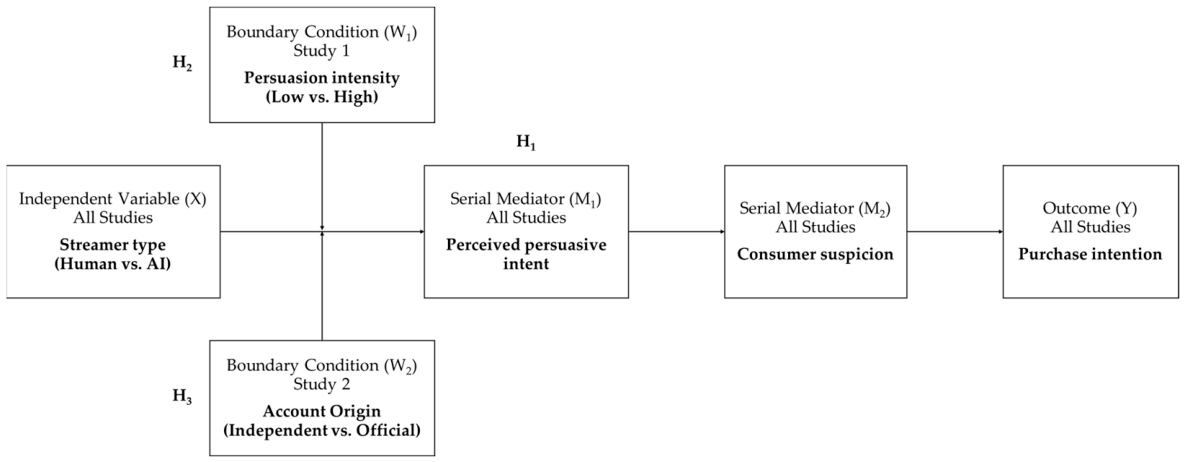
Figure 1 depicts the research model and associated hypotheses. To test the proposed hypotheses, we conducted two studies (see Table 1). Study 1 employed a 2 (streamer type: AI vs. human) × 2 (persuasion intensity: high vs. low) between-subjects experimental design. Its primary objectives were to examine the serial mediation effect of perceived persuasive intent and consumer suspicion in the relationship between streamer type and purchase intention (H1) and to test whether persuasion intensity moderates this serial mediation (H2). Study 2 employed a 2 (streamer type: AI vs. human) × 2 (account origin: independent vs. brand official) between-subjects design. It aimed to replicate the serial mediation effect (H1) and test whether account origin moderates the serial mediation (H3). The study used the same simulated live streaming format but manipulated the account identity shown on the interface. To ensure each study meets the minimum sample size requirement, we recruited 200 participants per study, with each participant randomly assigned to one of the four conditions. We calculated the minimum required sample size (32 participants for each group) via G*Power 3.1.9 for a 2 × 2 between-subjects design, with preset parameters of 80% statistical power, a medium effect size of 0.25, and an alpha level of 0.05 [84].

4. Study 1

Study 1 tests the serial mediating effects of perceived persuasive intent and consumer suspicion on the relationship between streamer type and purchase intention (H1), as well as the moderating effect of persuasion intensity on this serial mediation (H2). A 2 (streamer type: AI vs. human) × 2 (persuasion intensity: high vs. low) between-subjects experimental design was employed.

4.1. Method

4.1.1. Study Design and Procedure

This study focuses on Taobao Live, one of China’s major live streaming platforms, and only recruits users with live streaming viewing experience for the experiment [31]. Participants were recruited through Credamo (www.credamo.com), a professional online panel widely used in academic research [29,85]. To ensure data quality, Credamo implements rigorous quality control procedures, including attention checks, instructional manipulation checks, and participant screening based on historical response records.
Streamer type was manipulated by creating two versions of a live streaming video: one featuring an AI digital human and the other featuring a human streamer. The human streamer condition used a genuine clip sourced from a Taobao live stream, whereas the AI digital human condition employed a digital avatar of the same human streamer [29]. The AI digital human was designed to possess a highly realistic appearance, and the human streamer maintained consistent hairstyle, clothing, and gestures across both video versions. The two stimuli maintained identical scripts, vocal tones, delivery speeds, background settings, and product information, but the video for the AI streamer condition used an AI-generated voice [29]. This study chose a water cup as the core product following standardized methodologies for experimental research on the persuasion knowledge model. It aimed to distinguish how streamer categories and persuasive intensity cues activate consumers’ persuasion knowledge, thus minimizing the variance derived from product attributes. High-involvement products like electronic equipment, cosmetics, and luxury goods feature unique category evaluation criteria, solid brand perceptions, and individualized purchasing motivations. Such factors can obscure and disrupt the fundamental effects triggered by streamer categories. Accordingly, the research adopted a fictional branded water cup as the research object. As a low-involvement utilitarian product with a weak prior brand perception, it enabled respondents to assess streamer-related clues and persuasive strategies free from disturbances of professional product cognition, prominent brand prejudice, and personal purchasing intentions [18,86,87].
Persuasion intensity was manipulated by the presence or absence of time-limited promotion cues in the live streaming video. Prior research indicates that time pressure, typically operationalized via limited-time discounts, acts as a strong external stimulus that accelerates decision-making, reduces consumers’ cognitive deliberation, and increases their susceptibility to persuasive influence [42,88]. In live streaming environments, streamers frequently deploy such cues (e.g., countdown timers, flash discounts) to generate urgency and drive immediate purchase behavior [12,14]. Furthermore, the persuasion knowledge model posits that overt persuasive tactics, such as emphasizing scarcity or urgency, heighten the salience of sellers’ persuasive intent, which in turn activates consumers’ persuasion knowledge and shapes their evaluative responses [33]. Thus, varying the presence of this cue provides a theoretically valid and ecologically grounded manipulation of persuasion intensity within the live streaming context.
Following this logic, persuasion intensity was operationalized at two levels. In the high-persuasion-intensity condition, a visually prominent pop-up overlay featuring a 3-yuan discount coupon and a dynamic real-time countdown timer appeared mid-product demonstration in the live streaming video. In the low-persuasion-intensity condition, participants viewed the identical video without any time-limited coupon pop-ups or time pressure-inducing persuasive cues. We maintained strict consistency across both conditions in bullet comment content, interface layout, product introduction details, viewer interaction alerts, and other live streaming room elements to eliminate confounding effects from irrelevant variables on experimental outcomes.
The study proceeded as follows. Before the experiment, all participants reviewed an informed consent form and confirmed their voluntary participation in this online study. Participants were subsequently randomly allocated to one of four experimental groups. Each participant first read a group-specific introductory passage introducing the target product, a drinking cup, with detailed information about its volume, material, and heat preservation performance, as well as contextual details matching their assigned group (e.g., streamer and discount information). Next, they viewed a 30 s simulated live streaming clip. Upon completion of the video viewing, participants responded to scales assessing perceived persuasive intent, consumer suspicion, and purchase intention, alongside items for manipulation checks and control variable assessments.

4.1.2. Variable Measurement

All measurement items were adapted from established scales in existing literature and rated on seven-point Likert scales. All measurement items appear in Appendix A. Following standard back-translation procedures, a bilingual researcher translated the original English items into Chinese, and another bilingual researcher independently back-translated them into English to ensure conceptual equivalence and clarity. We revised the measures slightly to fit the specific context of live streaming commerce.
After watching the video, participants were asked to rate their perceived persuasive intent [89], consumer suspicion [19], and purchase intention [90]. Specifically, perceived persuasive intent (M = 3.69, SD = 1.83, Cronbach’s α = 0.94) comprised 3 items, consumer suspicion (M = 3.61, SD = 1.49, Cronbach’s α = 0.93) comprised 4 items, and purchase intention (M = 4.43, SD = 1.84, Cronbach’s α = 0.97) comprised 4 items. Then, participants completed a manipulation check. To verify the successful manipulation of the streamer type, participants were asked: “In the video you just watched, the streamer was…” (1 = definitely an AI digital human, 7 = definitely a human) [86]. Then, to assess the effectiveness of the persuasion intensity manipulation, participants responded to the following item after viewing the video: “While watching the live stream, I felt it was obvious that the streamer was trying to persuade me to make a quick purchase decision” [33].
Moreover, to account for potential confounding effects, we measured several control variables. Participants reported their live streaming viewing frequency, because prior exposure to this medium may shape their baseline suspicion [58]. Additionally, we measured perceived physical attractiveness (M = 5.29, SD = 0.96, Cronbach’s α = 0.88), as this factor can influence consumers’ attitudes and behaviors [91]. Consistent with existing research on AI streamers, we also assessed scenario realism (M = 5.60, SD = 0.91, Cronbach’s α = 0.77) [86]. Finally, we collected demographic data to control for their potential effects on purchase intentions.

4.2. Results

After excluding respondents who failed the attention check, 200 valid participants (61% female, Mage = 29.65, SD = 9.58) were retained for analysis [86]. To verify the effectiveness of the manipulation in the experiment, we performed two independent-samples t-tests. The results of the independent-samples t-test showed that participants in the different streamer condition groups successfully distinguished between AI streamers and human streamers (MAI = 3.52, MHuman = 5.98, p < 0.001). Participants in the high-persuasion-intensity group perceived greater persuasive salience in the live streaming video (MLow = 3.55, MHigh = 4.53, p < 0.001). Moreover, those groups did not differ significantly in perceived physical attractiveness (MAI = 5.30, MHuman = 5.27, p = 0.79; MLow = 5.23, MHigh = 5.34, p = 0.42) or scenario realism (MAI = 5.70, MHuman = 5.50, p = 0.11; MLow = 5.62, MHigh = 5.59, p = 0.82). The experiment successfully manipulated streamer type and persuasion intensity.
Prior to the PROCESS analysis, we assessed the discriminant validity of perceived persuasive intent and consumer suspicion to verify their empirical distinctiveness. The average variance extracted (AVE) of both constructs exceeded 0.50 (perceived persuasive intent: AVE = 0.846; consumer suspicion: AVE = 0.780), indicating adequate convergent validity. The square root of each construct’s AVE (0.920 and 0.883, respectively) exceeded their inter-construct correlation (r = 0.563), supporting discriminant validity based on the Fornell–Larcker criterion [92,93]. Additionally, the heterotrait–monotrait (HTMT) ratio between the two constructs was 0.559, well below the 0.85 threshold [94], further confirming that perceived persuasive intent and consumer suspicion are conceptually and empirically distinct constructs in the proposed serial mediation model.
We tested Hypothesis 1 using SPSS Process Model 6 with 5000 bootstrapped resamples to examine whether perceived persuasive intent and consumer suspicion serially mediate the effect of streamer type on purchase intention [95]. We adopted streamer type as the independent variable, perceived persuasive intent and consumer suspicion as the mediating variables, and purchase intention as the dependent variable. The indirect effect of streamer type → perceived persuasive intent → consumer suspicion → purchase intention for the target product was significant (b = −0.17, 95% CI [−0.33, −0.05]), indicating that human streamers (vs. AI streamers) negatively lowered purchase intention through these psychological mechanisms. Specifically, compared with AI streamers, human streamers were perceived to have higher persuasive intent (b = 0.79, t(198) = 3.12, p = 0.002). This, in turn, increased consumer suspicion (b = 0.40, t(197) = 8.04, p < 0.001) and then decreased purchase intention (b = −0.55, t(196) = −6.84, p < 0.001).
We tested H2 using Process Model 83 with 5000 bootstrap resamples [95]. We entered streamer type as the independent variable, persuasion intensity as the moderator, perceived persuasive intent and consumer suspicion as the mediators, and purchase intention as the dependent variable. Results revealed a significant moderated mediation effect of persuasion intensity on the serial mediation path (moderated mediation index = −0.29, 95% CI = [−0.55, −0.08]). As Table 2 shows, conditional indirect effects varied by persuasion intensity. The indirect effect was significant under high persuasion intensity (b = −0.32, 95% CI = [−0.54, −0.14]), but non-significant under low persuasion intensity (b = −0.03, 95% CI = [−0.20, 0.11]). These results indicate that under high persuasion intensity, AI streamers significantly reduce consumers’ perceived persuasive intent and consumer suspicion, thereby increasing purchase intention. By contrast, under low persuasion intensity, the difference in perceived persuasive intent between AI streamers and human streamers becomes non-significant. Taken together, H2 is supported.

4.3. Discussion

Study 1 tested the serial mediation mechanism proposed in H1 and the moderating role of persuasion intensity proposed in H2. The results validate both hypotheses and explain theoretically why and under what conditions AI streamers achieve better purchase outcomes than human streamers.
With respect to H1, the results verify a complete serial mediation effect: streamer type affects purchase intention sequentially via perceived persuasive intent and consumer suspicion. This outcome aligns with the reasoning derived from the Persuasion Knowledge Model presented in the theoretical framework. As consumers perceive AI agents as devoid of independent intentions, personal economic incentives, and emotional autonomy, they tend not to regard promotional behaviors of AI streamers as strategic manipulation. Instead, such behaviors are attributed to preset algorithmic operations that suppress the activation of persuasion knowledge and reduce consumers’ suspicious cognition. However, this serial mediation effect is conditional. The results verifying H2 indicate that persuasion intensity serves as a critical boundary condition. Specifically, the divergent influence of streamer type on purchase intention, mediated sequentially by perceived persuasive intent and consumer suspicion, is statistically significant at high levels of persuasion intensity yet insignificant at low levels. When time-limited discount prompts and real-time countdown timers make the commercial nature of live streaming highly prominent, consumers tend to divert their evaluation focus from relational clues to speculating on the hidden intentions behind persuasive appeals. In such scenarios, aggressive promotional conduct by human streamers is easily interpreted as driven by personal financial gains and self-interested motives, which substantially raises perceived persuasive intent and consumer suspicion. Conversely, identical promotional actions performed by AI streamers are regarded as impersonal algorithmic outputs rather than deliberate strategic manipulation, thereby triggering far less consumer defensive psychology. Under low persuasion intensity, neither human nor AI streamers generate notable commercial pressure. Consequently, the motivational divergence between the two streamer groups declines, and the sequential mediation effect is attenuated accordingly.

5. Study 2

Study 2 was designed to achieve two primary objectives. First, it aimed to test the robustness of H1. Second, it examined whether account origin (independent vs. brand official) moderates the serial mediation pathway from streamer type to perceived persuasion intent and consumer suspicion, and ultimately to purchase intention, thereby verifying the moderated serial mediation effect proposed in H3. To accomplish these goals, a 2 (streamer type: AI vs. human) × 2 (account origin: independent vs. brand official) between-subjects experimental design was employed.

5.1. Method

5.1.1. Study Design and Procedure

Consistent with the procedure used in Study 1, Study 2 used stimulus materials based on Taobao live streaming. We manipulated streamer type in the same way as in Study 1: an AI digital human and a human streamer used identical scripts, vocal tones, delivery speed, and background settings. We manipulated the account origin via the account information shown in the live streaming interface. In the independent streamer condition, we introduced the streamer as a professional streamer from an independent live streaming agency who collaborates with multiple brands and receives sales-based commissions. The account avatar used the streamer’s personal photo, and the account name appeared as “Da Fan’s Daily Picks”. In the brand official streamer condition, we introduced the streamer as a brand employee. The account avatar displayed the logo of the fictitious brand BEIZI, and the account name appeared as “BEIZI Official Flagship Store”. After viewing the video, participants completed the same measures as in Study 1.

5.1.2. Variable Measurement

All measurement items matched those used in Study 1 (see Appendix A). We measured perceived persuasive intent (M = 4.14, SD = 1.49, Cronbach’s α = 0.84), consumer suspicion (M = 4.03, SD = 1.61, Cronbach’s α = 0.90), and purchase intention (M = 3.77, SD = 1.65, Cronbach’s α = 0.91) using the same items. We used the same item from Study 1 to check the manipulation of streamer type. To verify the manipulation of account origin, participants answered the following item: “I believe the live streaming in the video was operated by (1 = an independent streamer agency, 7 = the brand officially).” We also collected the same control variables: perceived physical attractiveness (M = 5.41, SD = 1.00, Cronbach’s α = 0.85) and scenario realism (M = 5.82, SD = 0.84, Cronbach’s α = 0.75). Demographic information was also collected.

5.2. Results

We recruited 200 valid participants (58% female, Mage = 30.20, SD = 9.89) using Credamo. As in Study 1, we conducted independent-samples t-tests for manipulation checks. The results confirmed that participants in the AI streamer condition and the human streamer condition differed significantly (MAI = 3.34, MHuman = 5.05, p < 0.001). For account origin, participants in the brand official condition perceived the live streaming room as significantly more brand-operated than those in the independent streamer condition (MIndependent = 3.41, MOfficial = 4.75, p < 0.001). Furthermore, the groups did not differ significantly in perceived physical attractiveness (MAI = 5.37, MHuman = 5.45, p = 0.54; MIndependent = 5.50, MOfficial = 5.32, p = 0.22) or scenario realism (MAI = 5.79, MHuman = 5.85, p = 0.63; MIndependent = 5.80, MOfficial = 5.84, p = 0.76) across both streamer type and account origin conditions (all p values > 0.05). These results confirm that both manipulations were successful.
Prior to hypothesis testing, we again assessed the discriminant validity of perceived persuasive intent and consumer suspicion. Both constructs showed adequate convergent validity (AVE: perceived persuasive intent = 0.684, consumer suspicion = 0.729). The square root of each AVE (0.827 and 0.854) exceeded their inter-construct correlation (r = 0.700), and the HTMT ratio was 0.759 (<0.85), collectively confirming discriminant validity consistent with Study 1.
Consistent with Study 1, we tested H1 again using SPSS PROCESS Model 6 with 5000 bootstrapped resamples to examine whether perceived persuasive intent and consumer suspicion serially mediate the effect of streamer type on purchase intention [95]. Streamer type exerted a nonsignificant direct effect on purchase intention (direct effect = 0.04, 95% CI = [−0.12, 0.19]). By contrast, perceived persuasive intent and consumer suspicion serially mediated the effect (indirect effect = −0.36, 95% CI = [−0.63, −0.12]). These results indicate that streamer type influences purchase intention only through the serial mediation of perceived persuasive intent and consumer suspicion, which further supports H1 and confirms the robustness of the findings from Study 1.
We tested H3 using PROCESS Model 83 with 5000 bootstrap resamples and account origin as the moderator [95]. A significant moderated mediation index for the serial indirect path was observed (moderated mediation index = −0.50, 95% CI = [−0.99, −0.05]). Conditional serial indirect effects differed across account origin (Table 3). Specifically, when the streamer used an independent account, the serial indirect effect of streamer type on purchase intention, mediated sequentially by perceived persuasive intent and consumer suspicion, was significant (b = −0.61, 95% CI = [−0.97, −0.29]). In contrast, when the streamer operated a brand official account, this serial indirect effect weakened and became nonsignificant (b = −0.11, 95% CI = [−0.46, 0.23]). These findings demonstrate that account origin moderates the serial mediation; H3 is therefore supported.

5.3. Discussion

Study 2 replicated the serial mediation effect of streamer type on purchase intention through perceived persuasive intent and consumer suspicion (H1). This result confirms the robustness of the proposed mechanism. More importantly, Study 2 verified that account origin moderates this serial mediation process (H3). When streamers operate via individual accounts, where personal financial incentives such as commission-based earnings are explicit and prominent, the serial indirect effect of streamer type on purchase intention proves strong and statistically significant. In such scenarios, consumers clearly recognize that human streamers gain personal profits from every transaction, leading audiences to attribute promotional activities to self-serving persuasion tactics. Aligned with the PKM framework, the heightened salience of hidden motives elevates perceived persuasive intention and consumer suspicion. This outcome further widens the perceptual gap with AI streamers, whose conduct is regarded as neutral algorithmic operation unassociated with personal economic interests. In comparison, the serial indirect effect declines markedly and turns statistically insignificant when streamers use brand official accounts. Within brand official account contexts, consumers perceive promotional behaviors as officially authorized rather than driven by personal interests. Such cognition normalizes persuasive intentions across all streamer categories and narrows the motivational divergence between human and AI streamers.
Table 4 presents the results of the overall data analysis and hypothesis testing.

6. Discussion and Conclusions

This study examines how streamer type (AI vs. human) influences consumers’ persuasion processing and purchase intention in live streaming commerce, based on the Persuasion Knowledge Model (PKM). Two controlled experiments yield convergent evidence for a conditional serial mediation mechanism. Under high persuasion intensity, consumers perceive less persuasive intent from AI streamers than human streamers, which in turn mitigates consumer suspicion and boosts purchase intention. Importantly, these effects are not universal. The advantage of AI streamers in mitigating persuasion defenses is moderated by two contextual factors: persuasion intensity and account origin, and vanishes in low-intensity persuasion and brand official contexts. The subsequent sections elaborate on the theoretical contributions, practical implications, and limitations of this study.

6.1. Theoretical Implications

This research offers three theoretical contributions to the growing literature on AI-mediated persuasion and live streaming commerce.
First, this study extends the Persuasion Knowledge Model to the context of AI-mediated live streaming commerce by identifying perceived persuasive intent as the pivotal mechanism through which streamer type shapes consumer defensive processing. Prior literature has predominantly framed AI streamers as inferior substitutes for human streamers, citing their lower warmth, reduced authenticity, weakened credibility, and limited capacity to generate parasocial engagement [28,29,32]. This perspective, while empirically well-supported in relational contexts, provides an incomplete account of AI streamer effectiveness. Our findings reveal that in environments where persuasive intent is highly salient, the relational deficits of AI streamers lose their decisive influence. Because consumers perceive AI as lacking autonomous goals, independent intentions, and personal economic motives [34,64], AI streamers’ intense promotional behaviors are attributed to programmed, objective execution rather than self-interested manipulation. This attribution reduces perceived persuasive intent, which in turn suppresses consumer suspicion and sustains purchase intention.
Second, this research identifies persuasion intensity as a critical situational boundary condition that determines when and how streamer type differentially activates consumers’ persuasion knowledge. Consistent with the accessibility principle in PKM [15,64,65], our results demonstrate that high-intensity persuasion cues, such as urgency framing, scarcity appeals, and real-time countdown promotions, widen the attribution gap between AI and human streamers by making hidden commercial motives highly cognitively accessible. Under these conditions, human streamers’ intense promotional behaviors are readily interpreted as self-interested manipulation, while identical behaviors from AI streamers are attributed to algorithmic task execution. This finding advances PKM-based theorizing in two directions. It moves beyond the question of whether consumers possess and activate persuasion knowledge, toward identifying the specific conditions under which such activation generates the most consequential inter-agent differences. It also adds nuance to the emerging literature on AI persuasion effects [33,36,37], which has predominantly examined AI–consumer interactions in low-pressure, one-on-one service contexts, by demonstrating that the context-specificity of AI persuasion advantages is especially acute in high-intensity commercial environments.
Third, this study introduces account origin as a structural moderator that shapes the magnitude of the AI versus human streamer difference. By demonstrating that the serial mediation effect is significant for independent accounts but non-significant for brand official accounts, this research shows that consumers’ inferences about persuasive intent depend not only on agent type but also on the interaction between agent identity and the organizational context in which the agent operates. Independent accounts, where personal economic motives are transparent, heighten the motivational contrast between AI and human streamers, amplifying the AI advantage. Brand official accounts, where promotional intent is institutionally normalized [83,85], reduce this contrast and neutralize the agent-type effect. This finding extends prior work on source attribution and sponsorship disclosure [21,37,40] by establishing that the organizational framing of streamer activities constitutes a structural cue that modulates the accessibility of ulterior motives.

6.2. Practical Implications

This research offers practical guidance for live streaming commerce stakeholders, while acknowledging that the following recommendations are derived from experiments using a single low-involvement product under controlled, short-exposure conditions. Practitioners should therefore treat these findings as directional insights to inform strategy rather than definitive prescriptions applicable to all live streaming contexts.
For platform operators and streamers, deploying AI streamers in high-intensity promotional formats delivers tangible, practical value. Live streaming platforms adopt flash sales, countdown campaigns, and exclusive product launches to boost short-term conversion rates. Our findings indicate that these high-pressure promotions trigger consumers’ persuasion knowledge and defensive processing when hosted by human streamers. In this context, AI streamers maintain stable persuasive effects. Their strength lies not in superior overall persuasiveness, but in the public perception that they pursue no personal economic interests, which mitigates the defensive reactions aroused by aggressive sales tactics. Conversely, human streamers excel at formats centered on relational engagement, including product discovery, lifestyle narration, and interactive community operation. They retain irreplaceable edges in warmth, authenticity, and parasocial connection, dimensions beyond the scope of this study. Researchers and practitioners may explore a differentiated deployment strategy: assign AI streamers to high-intensity promotion scenarios and human streamers to relationship-building activities. This strategy requires further validation across diverse product categories and audience groups before large-scale implementation.
For brand managers, analysis of account characteristics provides actionable references. AI streamers exert a stronger persuasive edge than human streamers in specific contexts. This advantage is far more evident on independent streamer accounts, where commission-driven personal income highlights economic incentives, than on brand official accounts with standardized promotional operations. Brands adopting AI livestreaming should therefore account for account attributes and audience expectations in their judgments. Deploying AI streamers effectively reduces consumer resistance when audiences perceive prominent personal economic incentives. This edge fades on brand official accounts, where firms choose between AI and human streamers based on other factors, including cost efficiency, content uniformity, and reputation risk control. These factors are not explored in this study.

6.3. Limitations and Future Directions

We provide empirical evidence for a PKM-based mechanism underlying AI-mediated persuasion in live streaming commerce and identify key boundary conditions for this mechanism. Despite the meaningful findings, this work reveals several limitations that point to promising directions for future research.
First, both studies employed a single low-involvement utilitarian product (i.e., a water cup) and a 30 s simulated live streaming video. Although this research design effectively isolates the PKM mechanism, it limits the generalizability of the findings. Existing literature indicates that consumer motivations and behaviors in live streaming differ substantially between utilitarian and hedonic product settings; hedonic motivations are more strongly associated with streamer-specific attributes such as personal charisma and emotional appeal [46]. In addition, prior evidence reveals that AI and human streamers trigger distinct consumer reactions contingent on product type (utilitarian vs. hedonic) [35]. For high-involvement goods, including electronic devices, financial services, luxury products, and expertise-reliant categories like skincare and dietary supplements, evaluation standards, pre-existing brand perceptions, and perceived purchase risks may interfere with or supersede the motive–attribution mechanism investigated herein [42]. Apart from product characteristics, the 30 s viewing task only captures viewers’ initial perceptions, rather than the continuous and cumulative engagement typical of real-world live streaming. Future studies could examine whether the observed effects remain valid across various product types and consumer involvement degrees.
Second, this research focuses exclusively on China’s live streaming commerce ecosystem, using Taobao Live as the research platform. China’s live streaming industry has distinct features: well-established flash sales mechanisms, a widely adopted streamer commission model, and high consumer acceptance of AI digital humans [25]. These features do not apply to other cultural contexts and platform settings. Cross-cultural differences affect consumer attitudes toward AI agents, acceptance of commercial persuasion, and social norms for streamer incentives, and these factors moderate the research findings. Specifically, cultural values, self-construal, and norms governing data sharing and social interaction shape consumers’ experiential perceptions of AI [72]. Existing empirical evidence further proves that cultural backgrounds create notable disparities in consumer interaction with anthropomorphic AI agents [96] and live streaming purchasing behaviors between Eastern and Western markets [97]. Future cross-cultural research should explore how audiences respond to AI streamers and human streamers across diverse cultural groups, particularly groups with differing levels of AI trust, digital commerce rules and platform designs. Such research can support the development of a universally applicable theoretical framework for AI-mediated persuasion across cultures.
Third, this study has two interconnected methodological limitations related to consumer response measurement and experimental temporal design. First, like most consumer behavior research, we measured purchase intention using self-reports rather than actual purchases, which often diverge from real consumption [1,11]. In AI interaction contexts, social desirability bias may also skew responses, as participants tend to downplay skepticism toward AI streamers to appear open to new technology [31]. Second, the single-exposure design means the observed effects may partly result from technological novelty. New audiences perceive weaker persuasion from AI streamers, and the familiarity of an AI streamer may influence a consumer’s repeat purchase intention [58]. Future work should adopt mixed methods: field experiments, behavioral tracking and platform transaction data to align stated intentions with actual behavior, and repeated-exposure and longitudinal designs to disentangle novelty effects from the PKM mechanism. Moreover, experienced users hold more mature perceptions of AI agency [86], reducing attribution differences between AI and human streamers. Further research could examine AI experience or AI literacy as a boundary condition of this model.
Fourth, this study applies the PKM-driven motive–attribution pathway instead of the warmth–competence pathway. The Stereotype Content Model indicates that perceived warmth and competence of virtual streamers enhance consumers’ purchase intention [55], and AI agent’s role–context fit generates distinct effects across these two dimensions [98]. While human streamers foster consumer attachment through diverse relational characteristics, AI streamers lag significantly in this regard. Future research may compare the two pathways to examine their functions and interactions across various contexts. Moreover, the pratfall effect offers a particularly promising research direction in this regard. Rooted in social psychology, the pratfall effect refers to the phenomenon whereby a minor, relatable blunder enhances the interpersonal appeal of an otherwise competent individual by making them appear more human and approachable [99]. Such imperfections boost perceived warmth while barely eroding perceived competence of distant or highly competent actors (i.e., influencers or companies), and thus promote positive behavioral responses [100,101]. Future research may further investigate how this effect operates across different AI-mediated interaction settings, particularly in relation to variations in perceived agency and inferred persuasive motives.
Fifth, while this study distinguishes between independent streamer accounts and official brand accounts, it fails to adopt finer-grained account classifications. The independent streamer setting in Study 2 approximates the definition of influencer streamers but does not fully operationalize this concept. An influencer streamer refers to content creators with a large follower base, cross-platform influence, and commission-driven revenue [10]. Existing research on live streaming commerce has demonstrated that audience perceptions and behavioral responses vary with streamers’ scale and social influence. Specifically, micro-influencers, top key opinion leaders (KOLs), and professional non-influencer hosts generate distinct outcomes in user engagement and sales conversion [10,79]. Furthermore, AI streamers interact differently with the above types of human streamers. Since AI streamers are always accessible and equipped with unique functions, they can partly weaken human streamers’ strengths in interpersonal interaction [59]. For future research, scholars may systematically manipulate streamer identity and social influence levels to explore how these factors interact with streamer type (AI vs. human) and further affect consumers’ resistance to persuasion and purchase decisions.

Author Contributions

Conceptualization, Y.L. and G.L.; methodology, Y.L. and G.L.; software, Y.L.; validation, Y.L.; formal analysis, Y.L.; investigation, Y.L.; resources, Y.L.; data curation, Y.L.; writing—original draft preparation, Y.L.; writing—review and editing, Y.L. and G.L.; visualization, Y.L.; supervision, G.L.; project administration, G.L.; funding acquisition, Y.L. All authors have read and agreed to the published version of the manuscript.

Funding

This research received no external funding.

Institutional Review Board Statement

This study is a social science empirical research on consumer behavior in live streaming commerce, adopting online controlled experiments and anonymous questionnaires. Only non-identifiable, anonymized behavioral and attitudinal data are collected. The research involves no biomedical interventions, no physical or psychological harm, and no collection of sensitive personal information (biometrics, religious beliefs, medical records, financial data, etc.). All participants join voluntarily and may withdraw at any time without penalty All data are used exclusively for academic purposes, with no commercial interests or privacy breach risks. As a minimal-risk human-participant study, this project fully meets the exemption criteria under the above laws, regulations and international ethical guidelines.

Informed Consent Statement

Informed consent was obtained from all subjects involved in the study.

Data Availability Statement

Data will be shared on request.

Conflicts of Interest

The authors declare no conflicts of interest.

Abbreviations

The following abbreviations are used in this manuscript:
LSCLive streaming commerce
PKMPersuasion Knowledge Model
AIArtificial Intelligence
AVEAverage variance extracted
HTMTHeterotrait–monotrait
LLCILower limit of 95% confidence interval
ULCIUpper limit of 95% confidence interval

Appendix A. Measurements

Table A1. Constructs and measurements.
ConstructItemsReference
Perceived persuasive intentThis streamer is trying to sell this product to me in the live stream.[89]
This live streaming is essentially a commercial that is marketing this product.
This live streaming was conducted based on commercial intent.
Consumer suspicionI‘m basically skeptical about the product being promoted in this live stream.[19]
There are often problems with the way products are promoted in this kind of live stream.
I find it difficult to fully grasp the promotional claims about the product in this live stream.
I find the promotion of the product in this live streaming to be unbelievable.
Purchase intentionAfter viewing this live streaming, I became interested in making a purchase.[90]
After viewing this live streaming, I‘m willing to purchase the product being presented.
After viewing this live streaming, I would consider purchasing the presented product.
After viewing this live streaming, I will likely buy the product being presented.
Physical attractivenessThis streamer appeared attractive.[91]
This streamer appeared beautiful.
This streamer was good-looking.
Scenario realismI find this scenario to be realistic.[86]
I think this could happen in real life.
It’s easy to imagine myself in the condition as described here.

References

  1. Yu, T.; Teoh, A.P.; Bian, Q.; Liao, J.; Wang, C. What Drives Purchase Intention in Live Streaming E-Commerce? The Perspectives of Virtual Streamers. Int. J. Hum.-Comput. Interact. 2025, 41, 14689–14708. [Google Scholar] [CrossRef]
  2. Wang, Y.; Tang, H.; Zhang, J.; Wang, Y.; Liu, X. From Immersion to Purchase: How Live Streaming Catalyzes Impulse Buying Among Consumers. J. Theor. Appl. Electron. Commer. Res. 2026, 21, 68. [Google Scholar] [CrossRef]
  3. Luo, X.; Lim, W.M.; Cheah, J.-H.; Lim, X.-J.; Dwivedi, Y.K. Live Streaming Commerce: A Review and Research Agenda. J. Comput. Inf. Syst. 2025, 65, 376–399. [Google Scholar] [CrossRef]
  4. Gao, X.; Xu, X.-Y.; Tayyab, S.M.U.; Li, Q. How the Live Streaming Commerce Viewers Process the Persuasive Message: An ELM Perspective and the Moderating Effect of Mindfulness. Electron. Commer. Res. Appl. 2021, 49, 101087. [Google Scholar] [CrossRef]
  5. Shen, H.; Zhao, C.; Fan, D.X.F.; Buhalis, D. The Effect of Hotel Livestreaming on Viewers’ Purchase Intention: Exploring the Role of Parasocial Interaction and Emotional Engagement. Int. J. Hosp. Manag. 2022, 107, 103348. [Google Scholar] [CrossRef]
  6. Xu, X.; Wu, J.; Li, Q. What Drives Consumer Shopping Behavior in Live Streaming Commerce? J. Electron. Commer. Res. 2020, 21, 144–167. [Google Scholar]
  7. Li, J.; Song, S.; Liu, Y. The Impact of Parasocial Interaction and Perceived Risk on Consumer Purchase Intention in Livestreaming E-Commerce. Inf. Res. Int. Electron. J. 2026, 31, 95–117. [Google Scholar] [CrossRef]
  8. Lee, Z.W.Y.; Liu, W.Z.H.; Chan, T.K.H.; Wei, G.G.Z. Impulse Buying in Live Streaming Commerce: A Literature Review and Research Agenda. Inf. Manag. 2025, 62, 104220. [Google Scholar] [CrossRef]
  9. Zhang, S.; Huang, C.; Li, X.; Ren, A. Characteristics and Roles of Streamers in E-Commerce Live Streaming. Serv. Ind. J. 2022, 42, 1001–1029. [Google Scholar] [CrossRef]
  10. Gu, X.; Zhang, X.; Kannan, P.K. Influencer Mix Strategies in Livestream Commerce: Impact on Product Sales. J. Mark. 2024, 88, 64–83. [Google Scholar] [CrossRef]
  11. Wang, H.-M.; Zhu, Y.-P.; Lee, K.-T. What Signals Are You Sending? How Signal Consistency Influences Consumer Purchase Behavior in Live Streaming Commerce. J. Theor. Appl. Electron. Commer. Res. 2025, 20, 109. [Google Scholar] [CrossRef]
  12. Hao, S.; Huang, L. How the Time-Scarcity Feature of Live-Streaming e-Commerce Affects Impulsive Buying. Serv. Ind. J. 2023, 43, 875–895. [Google Scholar] [CrossRef]
  13. Xin, M.; Jian, L.; Liu, W.; Bao, Y. Exploring the Effect of Live Streaming Atmospheric Cues on Consumer Impulse Buying: A Flow Experience Perspective. J. Theor. Appl. Electron. Commer. Res. 2025, 20, 149. [Google Scholar] [CrossRef]
  14. Jiang, S.; Zhao, L. When Time Meets Scarcity: Differentiated Effects of Promotional Restrictions on Consumer Value in Live Commerce. J. Theor. Appl. Electron. Commer. Res. 2026, 21, 69. [Google Scholar] [CrossRef]
  15. Friestad, M.; Wright, P. The Persuasion Knowledge Model: How People Cope with Persuasion Attempts. J. Consum. Res. 1994, 21, 1–31. [Google Scholar] [CrossRef] [PubMed]
  16. Kirmani, A.; Zhu, R. (Juliet) Vigilant Against Manipulation: The Effect of Regulatory Focus on the Use of Persuasion Knowledge. J. Mark. Res. 2007, 44, 688–701. [Google Scholar] [CrossRef]
  17. Song, S.; Xu, Y.; Ma, B.; Zong, X. Understanding How Streamer’s Self-Presentation in E-Commerce Live Streaming Affects Consumers: The Role of Persuasion Knowledge. J. Theor. Appl. Electron. Commer. Res. 2024, 19, 1922–1942. [Google Scholar] [CrossRef]
  18. Huo, H.; Zhao, J.; Zhou, J. The Influence of Virtual Anchor Language Styles on Consumer Purchase Intentions:The Role of Psychological Vigilance and Cultural Endorsements. J. Retail. Consum. Serv. 2026, 91, 104750. [Google Scholar] [CrossRef]
  19. Wang, Y.; Jiang, S.; Jia, J. Limited-Quantity Scarcity and Streamer Creative Language: The Dual Effects on Live-Streaming Buying Behavior in Tourism E-Commerce. J. Tour. Res. 2025, 27, e70043. [Google Scholar] [CrossRef]
  20. Isaac, M.S.; Grayson, K. Beyond Skepticism: Can Accessing Persuasion Knowledge Bolster Credibility? J. Consum. Res. 2017, 43, 895–912. [Google Scholar] [CrossRef]
  21. Pierre, L.; Wang, J.; Zambrano Rodriguez, V.C. Exploring the Influence of ‘Artificial Intelligence’ Mentions in Advertising and Persuasion Knowledge on Brand Skepticism, Perceived Manipulativeness, and Purchase Intention. J. Mark. Commun. 2026, 1–26. [Google Scholar] [CrossRef]
  22. Fan, X.; Zhang, L. Live-Streaming E-Commerce Operations: Is It Wise for Manufacturers to Use AI Streamers When Human Streamers Face a Goodwill Crisis? Int. J. Prod. Res. 2026, 1–18. [Google Scholar] [CrossRef]
  23. Ding, L.; Xiang, G.; Peng, M.; Bi, F. A Study on the Causes of Viewers’ Non-Continuous Following Intention in Tourism Live Streaming. Sci. Rep. 2025, 15, 8307. [Google Scholar] [CrossRef] [PubMed]
  24. Zhang, Y.; Xu, Q. Whether and How to Introduce AI-Driven Virtual Streamers: Selling Mode Selection in Live Streaming Commerce. Electron. Commer. Res. 2026, 1–34. [Google Scholar] [CrossRef]
  25. Meng, Y. Governing AI Virtual Anchors in China’s Live Streaming E-Commerce Ecosystem: Policy Challenges and Global Implications. Telecommun. Policy 2026, 50, 103109. [Google Scholar] [CrossRef]
  26. Wen, J.; Li, X. AI Digital Human Responsiveness and Consumer Purchase Intention: The Mediating Role of Trust. J. Theor. Appl. Electron. Commer. Res. 2025, 20, 246. [Google Scholar] [CrossRef]
  27. Liu, Y.; Wang, L.; Yang, S.; Wang, Y. Artificial Intelligence-Powered Digital Streamers in Online Retail: Empirical Insights and Design Strategies from Experiments. Inf. Syst. Res. 2025, 280941223. [Google Scholar] [CrossRef]
  28. Liu, Q.; Ma, N.; Zhang, X. Can AI-Virtual Anchors Replace Human Internet Celebrities for Live Streaming Sales of Products? An Emotion Theory Perspective. J. Retail. Consum. Serv. 2025, 82, 104107. [Google Scholar] [CrossRef]
  29. Liu, Z.; Zhong, S.; Jia, N.; Zhang, J.; Lee, L. When Feeling Takes a Backseat in Livestream Commerce: The Effects of Virtual versus Human Streamers on Consumers’ Impulsive Buying. J. Retail. Consum. Serv. 2026, 88, 104517. [Google Scholar] [CrossRef]
  30. Xiao, Q.; Li, X.; Huang, W.; Zhang, X. Gimmick or Genuineness? Exploring the Antecedents of AI Virtual Streamers Aversion in Live-Streaming Commerce. Technol. Forecast. Soc. Change 2025, 212, 123981. [Google Scholar] [CrossRef]
  31. Gao, J.; Zhao, X.; Zhai, M.; Zhang, D.; Li, G. AI or Human? The Effect of Streamer Types on Consumer Purchase Intention in Live Streaming. Int. J. Hum.-Comput. Interact. 2025, 41, 305–317. [Google Scholar] [CrossRef]
  32. Zheng, D.; Ding, Y.; Bai, S. The Competition between Human and AI Streamers: Live Streaming Strategies in a Duopoly Market Considering Consumer Heterogeneity. Acta Psychol. 2025, 256, 105040. [Google Scholar] [CrossRef] [PubMed]
  33. Lee, H.; Yi, Y. Humans Vs. Service Robots as Social Actors in Persuasion Settings. J. Serv. Res. 2025, 28, 150–167. [Google Scholar] [CrossRef]
  34. Crolic, C.; Thomaz, F.; Hadi, R.; Stephen, A.T. Stephen Blame the Bot: Anthropomorphism and Anger in Customer-Chatbot Interactions. J. Mark. 2022, 86, 132–148. [Google Scholar] [CrossRef]
  35. Longoni, C.; Cian, L. Artificial Intelligence in Utilitarian vs. Hedonic Contexts: The “Word-of-Machine” Effect. J. Mark. 2022, 86, 91–108. [Google Scholar] [CrossRef]
  36. Luo, X.; Tong, S.; Fang, Z.; Qu, Z. Frontiers: Machines vs. Humans: The Impact of Artificial Intelligence Chatbot Disclosure on Customer Purchases. Mark. Sci. 2019, 38, 937–947. [Google Scholar] [CrossRef]
  37. Willemsen, L.M.; Withuis, I.; Brom, M.; Boerman, S.C. How Does Persuasion Knowledge Differ between Humanlike Virtual Influencers and Human Influencers? Int. J. Advert. 2025, 44, 109–130. [Google Scholar] [CrossRef]
  38. Zheng, Q.; Zhan, E.S.; Dong, C.; Thorson, E.; Hu, J.M. Can AI Chatbots Support Me as Human Agents? Exploring the Roles of Governmental Agent Type and Person-Centered Communication Strategies During Natural Disasters. Int. J. Hum.-Comput. Interact. 2026, 42, 4229–4246. [Google Scholar] [CrossRef]
  39. Zhao, H.; Song, Z.; Cai, Z. Should AI or Human Agents Handle Customer Complaints? Exploring the Impact of Agent Type and Complaint Response Type on Recovery Outcomes. J. Bus. Res. 2026, 202, 115805. [Google Scholar] [CrossRef]
  40. Kim, W.; Lee, D.; Ham, C.-D. Human vs. Artificial Intelligence: The Role of Agent Knowledge in Consumer Responses to AI Influencers, Moderated by Interactivity and Mediated by Anthropomorphism. J. Advert. 2025, 1–21. [Google Scholar] [CrossRef]
  41. Sun, J.; Si, J. When AI Chatbots Ask for Donations: The Construal Level Contingency of AI Persuasion Effectiveness in Charity Human–Chatbot Interaction. J. Theor. Appl. Electron. Commer. Res. 2025, 20, 341. [Google Scholar] [CrossRef]
  42. Kong, D.; Zhan, S.; Zhu, Y. Can Time Pressure Promote Consumers’ Impulse Buying in Live Streaming E-Commerce? Moderating Effect of Product Type and Consumer Regulatory Focus. Electron. Commer. Res. 2025, 25, 3223–3259. [Google Scholar] [CrossRef]
  43. Jin, D.; Lai, D.; Pu, X.; Han, G. Self-Broadcasting or Cooperating with Streamers? A Perspective on Live Streaming Sales of Fresh Products. Electron. Commer. Res. Appl. 2024, 64, 101367. [Google Scholar] [CrossRef]
  44. Wongkitrungrueng, A.; Dehouche, N.; Assarut, N. Live Streaming Commerce from the Sellers’ Perspective: Implications for Online Relationship Marketing. J. Mark. Manag. 2020, 36, 488–518. [Google Scholar] [CrossRef]
  45. Wongkitrungrueng, A.; Assarut, N. The Role of Live Streaming in Building Consumer Trust and Engagement with Social Commerce Sellers. J. Bus. Res. 2020, 117, 543–556. [Google Scholar] [CrossRef]
  46. Cai, J.; Wohn, D.Y.; Mittal, A.; Sureshbabu, D. Utilitarian and Hedonic Motivations for Live Streaming Shopping. In Proceedings of the 2018 ACM International Conference on Interactive Experiences for TV and Online Video; ACM: Seoul, Republic of Korea, 2018; pp. 81–88. [Google Scholar]
  47. Rungruangjit, W. What Drives Taobao Live Streaming Commerce? The Role of Parasocial Relationships, Congruence and Source Credibility in Chinese Consumers’ Purchase Intentions. Heliyon 2022, 8, e09676. [Google Scholar] [CrossRef] [PubMed]
  48. Feng, H.; Wei, Y. Drivers of Purchase Intention in E-Commerce Live Streaming in China: Assessing the Mediating Role of Perceived Value Using the Modified Vam Model. J. Law. Sustain. Dev. 2023, 11, e1983. [Google Scholar] [CrossRef]
  49. Shen, M.; Aw, E.C.-X.; Wei-Han Tan, G.; Ki, C.-W. (Chloe) Psychological Ownership and Parasocial Relationships: Pathways to Loyalty in Livestream Commerce. Asia Pac. J. Mark. Logist. 2025, 37, 2971–2989. [Google Scholar] [CrossRef]
  50. Zhang, M.; Liu, Y.; Wang, Y.; Zhao, L. How to Retain Customers: Understanding the Role of Trust in Live Streaming Commerce with a Socio-Technical Perspective. Comput. Hum. Behav. 2022, 127, 107052. [Google Scholar] [CrossRef]
  51. Gao, W.; Jiang, N.; Guo, Q. How Do Virtual Streamers Affect Purchase Intention in the Live Streaming Context? A Presence Perspective. J. Retail. Consum. Serv. 2023, 73, 103356. [Google Scholar] [CrossRef]
  52. Miao, F.; Kozlenkova, I.V.; Wang, H.; Xie, T.; Palmatier, R.W. An Emerging Theory of Avatar Marketing. J. Mark. 2022, 86, 67–90. [Google Scholar] [CrossRef]
  53. Liu, H.; Zhang, P.; Cheng, H.; Hasan, N.; Chiong, R. Impact of AI-Generated Virtual Streamer Interaction on Consumer Purchase Intention: A Focus on Social Presence and Perceived Value. J. Retail. Consum. Serv. 2025, 85, 104290. [Google Scholar] [CrossRef]
  54. Xu, B.; Dastane, O.; Aw, E.C.-X.; Jha, S. The Future of Live-Streaming Commerce: Understanding the Role of AI-Powered Virtual Streamers. Asia Pac. J. Mark. Logist. 2024, 37, 1175–1196. [Google Scholar] [CrossRef]
  55. Gao, W.; Jiang, N.; Guo, Q. How Cool Virtual Streamer Influences Customer in Live-Streaming Commerce? An Explanation of Stereotype Content Model. J. Retail. Consum. Serv. 2025, 82, 104139. [Google Scholar] [CrossRef]
  56. Chen, Y.; Zhang, Y.; Fan, H.; Guo, Y. Can AI Streamers Drive Purchases in Food Delivery E-Commerce Live Streaming? Evidence from an O2O Platform. J. Retail. Consum. Serv. 2026, 90, 104683. [Google Scholar] [CrossRef]
  57. Shui, X.; Bian, S.; Zhang, P. How Can AI Virtual Streamers Gain Consumer Trust to Influence Purchase Intention in Live-Streaming E-Commerce? J. Theor. Appl. Electron. Commer. Res. 2025, 20, 325. [Google Scholar] [CrossRef]
  58. Wang, S.; Qiang, J.; Yao, K. How Does Artificial Intelligence Digital Human Live Streaming Increase TikTok Consumer Repeat Purchase? Interaction between Vividness, Telepresence, Credibility and Trust. J. Bus. Res. 2025, 201, 115702. [Google Scholar] [CrossRef]
  59. Xiong, H.; Zhang, C.; Lin, Y.; Yan, H.; Xu, Y. Can AI Streamers’ Perseverance and Exceptional Intelligence Overcome KOLs’ Viewership Moat? Int. J. Inf. Manag. 2026, 87, 103005. [Google Scholar] [CrossRef]
  60. Zhang, D.; Fu, L.; Ma, J.; Chen, C. Social-oriented versus Task-oriented Streamer Interaction Styles on Live Streaming E-commerce: Empirical Research in China. J. Consum. Behav. 2024, 23, 1995–2008. [Google Scholar] [CrossRef]
  61. Koles, B.; Audrezet, A.; Moulard, J.G.; Ameen, N.; McKenna, B. The Authentic Virtual Influencer: Authenticity Manifestations in the Metaverse. J. Bus. Res. 2024, 170, 114325. [Google Scholar] [CrossRef]
  62. Stein, J.-P.; Linda Breves, P.; Anders, N. Parasocial Interactions with Real and Virtual Influencers: The Role of Perceived Similarity and Human-Likeness. New Media Soc. 2022, 26, 3433–3453. [Google Scholar] [CrossRef]
  63. Wang, X.; Zhang, Y. The Influence of Virtual Streamer on Purchase Intention: The Moderated Mediating Effect of Message Strategy and Live-Streaming Environment. Electron. Commer. Res. Appl. 2025, 73, 101520. [Google Scholar] [CrossRef]
  64. Hwang, K.; Lee, E.; Yoon, Y. Something Smells Fishy: How Sales Assistant Types and Suspicion Influence Perceived Message Credibility. J. Consum. Behav. 2025, 24, 3104–3122. [Google Scholar] [CrossRef]
  65. Campbell, M.C.; Kirmani, A. Consumers’ Use of Persuasion Knowledge: The Effects of Accessibility and Cognitive Capacity on Perceptions of an Influence Agent. J. Consum Res. 2000, 27, 69–83. [Google Scholar] [CrossRef] [PubMed]
  66. Feng, X.; Rong, Y.; Tian, X.; Wang, M.; Yao, Y. When Persuasion Is Too Persuasive: An Empirical Analysis of Product Returns in Livestream e-Commerce. Prod. Oper. Manag. 2025, 34, 3978–3997. [Google Scholar] [CrossRef]
  67. DeCarlo, T.E. The Effects of Sales Message and Suspicion of Ulterior Motives on Salesperson Evaluation. J. Consum Psychol. 2005, 15, 238–249. [Google Scholar] [CrossRef] [PubMed]
  68. Liu, Z.; Guo, Q.; Nie, J.; Wu, L. Manufacturer’s Channel Strategy in Live Streaming Commerce: Two Business Models. Manag. Decis. Econ. 2026, 47, 541–553. [Google Scholar] [CrossRef]
  69. Xiao, Y.; Yu, J.; Zhou, S.X. Commit on Effort or Sales? Value of Commitment in Live-Streaming E-Commerce. Prod. Oper. Manag. 2024, 33, 2241–2258. [Google Scholar] [CrossRef]
  70. Jia, C. Top Online Sales Host Apologizes for Insensitive Comments. Available online: https://global.chinadaily.com.cn/a/202309/11/WS64fe9955a310d2dce4bb5119.html (accessed on 26 March 2026).
  71. Ekinci, Y.; Dam, S.; Buckle, G. The Dark Side of Social Media Influencers: A Research Agenda for Analysing Deceptive Practices and Regulatory Challenges. Psychol. Mark. 2025, 42, 1201–1214. [Google Scholar] [CrossRef]
  72. Puntoni, S.; Reczek, R.W.; Giesler, M.; Botti, S. Consumers and Artificial Intelligence: An Experiential Perspective. J. Mark. 2021, 85, 131–151. [Google Scholar] [CrossRef]
  73. Ahuja, P.; Gupta, M.; Roy, A.; Gera, N.; Das, G. Artificial Intelligence and Credit Application Processing: The Role of Embarrassment. Eur. J. Mark. 2025, 59, 923–950. [Google Scholar] [CrossRef]
  74. Giroux, M.; Kim, J.; Lee, J.C.; Park, J. Artificial Intelligence and Declined Guilt: Retailing Morality Comparison Between Human and AI. J. Bus. Ethics 2022, 178, 1027–1041. [Google Scholar] [CrossRef] [PubMed]
  75. Jin, J.; Walker, J.; Reczek, R.W. Avoiding Embarrassment Online: Response to and Inferences about Chatbots When Purchases Activate Self-Presentation Concerns. J. Consum. Psychol. 2025, 35, 185–202. [Google Scholar] [CrossRef]
  76. Yu, S.; Xiong, J.; Shen, H. The Rise of Chatbots: The Effect of Using Chatbot Agents on Consumers’ Responses to Request Rejection. J. Consum Psychol. 2024, 34, 35–48. [Google Scholar] [CrossRef]
  77. Longoni, C.; Bonezzi, A.; Morewedge, C.K. Resistance to Medical Artificial Intelligence. J. Consum. Res. 2019, 46, 629–650. [Google Scholar] [CrossRef]
  78. Chang, Y.; Wang, H.; Guo, Z. Artificial Intelligence in Live Streaming: How Can Virtual Streamers Bring More Sales? J. Retail. Consum. Serv. 2025, 84, 104247. [Google Scholar] [CrossRef]
  79. Li, G.; Cao, Y.; Lu, B.; Yu, Y.; Liu, H. Luxury Brands’ Live Streaming Sales: The Roles of Streamer Identity and Level Strategy. Int. J. Advert. 2023, 42, 1178–1200. [Google Scholar] [CrossRef]
  80. Fan, Z.; Zhang, S.; Wang, Y.; Liu, W. The Impact of Multiple versus Single Streamers on the Audience Retention Rate in Live Streaming E-Commerce on TikTok. Electron. Commer. Res. 2026, 1–26. [Google Scholar] [CrossRef]
  81. Andriuzzi, A.; Arrivé, S. Small Influencers Should Inform, Brands Can Persuade: When Rational Content Works. J. Mark. Manag. 2026, 42, 91–118. [Google Scholar] [CrossRef]
  82. Xin, B.; Hao, Y.; Xie, L. Strategic Product Showcasing Mode of E-Commerce Live Streaming. J. Retail. Consum. Serv. 2023, 73, 103360. [Google Scholar] [CrossRef]
  83. Berthelot-Guiet, K. The Digital “Advertising Call”: An Archeology of Advertising Literacy. In Social Computing and Social Media. Participation, User Experience, Consumer Experience, and Applications of Social Computing; Meiselwitz, G., Ed.; Lecture Notes in Computer Science; Springer International Publishing: Cham, Switzerland, 2020; Volume 12195, pp. 278–294. [Google Scholar]
  84. Faul, F.; Erdfelder, E.; Lang, A.-G.; Buchner, A. G*Power 3: A Flexible Statistical Power Analysis Program for the Social, Behavioral, and Biomedical Sciences. Behav. Res. Methods 2007, 39, 175–191. [Google Scholar] [CrossRef] [PubMed]
  85. Gong, X.; Sun, P. How to Liberate Human Labor? Understanding the Interplay of Virtual Streamer Type and Interaction Style in Livestreaming e-Commerce. J. Bus. Res. 2026, 205, 115875. [Google Scholar] [CrossRef]
  86. Li, J.; Li, Y.; Wang, X. The Interaction Effect of Virtual Streamer Anthropomorphism and Price Expectation Discrepancy on Purchase Intention: The Mediating Role of Inferred Intentions. J. Retail. Consum. Serv. 2026, 90, 104684. [Google Scholar] [CrossRef]
  87. Shan, M.; Zhu, Z.; Song, C.; Chen, H. The Effectiveness of Advertising Appeals: A Culturally-Derived Power Perspective. J. Retail. Consum. Serv. 2023, 75, 103522. [Google Scholar] [CrossRef]
  88. Alam, S.S.; Ahsan, M.N.; Kokash, H.A.; Ahmed, S. Live Streaming Characteristics, Motivational Factors, Trust and Impulsive Hotel Booking Intention: Mediating Role of Customer Engagement and Moderating Role of Time Pressure. J. Hosp. Mark. Manag. 2025, 34, 651–680. [Google Scholar] [CrossRef]
  89. Hsieh, J.-K.; Hsieh, Y.-C.; Tang, Y.-C. Exploring the Disseminating Behaviors of eWOM Marketing: Persuasion in Online Video. Electron. Commer. Res. 2012, 12, 201–224. [Google Scholar] [CrossRef]
  90. Tong, X.; Chen, Y.; Zhou, S.; Yang, S. How Background Visual Complexity Influences Purchase Intention in Live Streaming: The Mediating Role of Emotion and the Moderating Role of Gender. J. Retail. Consum. Serv. 2022, 67, 103031. [Google Scholar] [CrossRef]
  91. Chen, H.; Shao, B.; Yang, X.; Kang, W.; Fan, W. Avatars in Live Streaming Commerce: The Influence of Anthropomorphism on Consumers’ Willingness to Accept Virtual Live Streamers. Comput. Hum. Behav. 2024, 156, 108216. [Google Scholar] [CrossRef]
  92. Fornell, C.; Larcker, D.F. Evaluating Structural Equation Models with Unobservable Variables and Measurement Error. J. Mark. Res. 1981, 18, 39–50. [Google Scholar] [CrossRef]
  93. Farrell, A.M. Insufficient Discriminant Validity: A Comment on Bove, Pervan, Beatty, and Shiu (2009). J. Bus. Res. 2010, 63, 324–327. [Google Scholar] [CrossRef]
  94. Henseler, J.; Ringle, C.M.; Sarstedt, M. A New Criterion for Assessing Discriminant Validity in Variance-Based Structural Equation Modeling. J. Acad. Mark. Sci. 2015, 43, 115–135. [Google Scholar] [CrossRef]
  95. Hayes, A.F. An Index and Test of Linear Moderated Mediation. Multivar. Behav. Res. 2015, 50, 1–22. [Google Scholar] [CrossRef] [PubMed]
  96. Mehmood, K.; Kautish, P.; Shah, T.R. Embracing Digital Companions: Unveiling Customer Engagement with Anthropomorphic AI Service Robots in Cross-Cultural Context. J. Retail. Consum. Serv. 2024, 79, 103825. [Google Scholar] [CrossRef]
  97. Wang, P.; Li, Y.; Chapa, S.; Jing, Z. Consumer and Cultural Values Affecting Live Streaming Impulse Buying Behavior: A Cross-Cultural Study Between China and the United States. J. Theor. Appl. Electron. Commer. Res. 2026, 21, 109. [Google Scholar] [CrossRef]
  98. Zhu, Y.; Liang, J.; Zhao, Y. Expert or Partner: The Matching Effect of AI Chatbot Roles in Different Service Contexts. Electron. Commer. Res. Appl. 2025, 71, 101496. [Google Scholar] [CrossRef]
  99. Helmreich, R.; Aronson, E.; LeFan, J. To Err Is Humanizing Sometimes: Effects of Self-Esteem, Competence, and a Pratfall on Interpersonal Attraction. J. Personal. Soc. Psychol. 1970, 16, 259–264. [Google Scholar] [CrossRef] [PubMed]
  100. Celik, F.; Koc, E.; Yildiz, S.Y.; Tarim, E.; Daryanto, A. Exploring the Potential of the Pratfall Effect in Travel Influencer Marketing. J. Hosp. Tour. Manag. 2026, 66, 101388. [Google Scholar] [CrossRef]
  101. De Kerpel, L.; Van Kerckhove, A.; Tessitore, T. Oops! Sorry, My Bad: How Apologizing for Trivial Mistakes in Direct Email Campaigns Leads to Positive Customer Evaluations. Int. J. Res. Mark. 2025, 42, 752–767. [Google Scholar] [CrossRef]
Figure 1. Conceptual Framework.
Jtaer 21 00195 g001
Table 1. Overview of studies.
StudyDesignDVMediatorModeratorHypotheses
Study 1 (N = 200)2 (streamer type: AI vs. human) × 2 (persuasion intensity: high vs. low)Purchase intentionPerceived persuasive intent, consumer suspicionPersuasion intensityH1, H2
Study 2 (N = 200)2 (streamer type: AI vs. human) × 2 (account origin: independent vs. brand official)Purchase intentionPerceived persuasive intent, consumer suspicionAccount originH1, H3
Table 2. Moderated Mediation Analysis Results via PROCESS Model 83 (Study 1; n = 200).
PathConditional Sequential Mediation EffectsIndex of Moderated MediationLLCIULCI
Low Persuasion IntensityHigh Persuasion Intensity
EffectLLCIULCIEffectLLCIULCI
Streamer type × Persuasion intensity → perceived persuasive intent → consumer suspicion → purchase intention−0.0280−0.19590.1127−0.3218−0.5402−0.1441−0.2938−0.5505−0.0825
Streamer type (0 = AI streamer, 1 = human streamer); persuasion intensity (0 = low persuasion intensity, 1 = high persuasion intensity).
Table 3. Moderated Mediation Analysis Results via PROCESS Model 83 (Study 2; n = 200).
PathConditional Sequential Mediation EffectsIndex of Moderated MediationLLCIULCI
Independent AccountOfficial Account
EffectLLCIULCIEffectLLCIULCI
Streamer type × Account origin → perceived persuasive intent → consumer suspicion → purchase intention−0.1076−0.45540.2250−0.6096−0.9737−0.2891−0.5020−0.9917−0.0473
Streamer type (0 = AI streamer, 1 = human streamer); account origin (0 = brand official account, 1 = independent account).
Table 4. Overview of studies.
HypothesisPROCESS ModelTested PathEffect95% CIConclusion
H1 (Study 1)Model 6Streamer type → perceived persuasive intent → consumer suspicion → purchase intentionIndirect effect = −0.17[−0.33, −0.05]Supported
H1 (Study 2)Model 6Streamer type → perceived persuasive intent → consumer suspicion → purchase intentionIndirect effect = −0.36[−0.63, −0.12]Supported
H2 (Study 1)Model 83Moderated mediation index (Persuasion intensity)Index = −0.29[−0.55, −0.08]Supported
H2-High intensityModel 83Conditional indirect effect (High persuasion intensity)b = −0.32[−0.54, −0.14]Significant
H2-Low intensityModel 83Conditional indirect effect (Low persuasion intensity)b = −0.03[−0.20, 0.11]Non-significant
H3 (Study 2)Model 83Moderated mediation index (Account origin)Index = −0.50[−0.99, −0.05]Supported
H3-IndependentModel 83Conditional indirect effect (Independent)b = −0.61[−0.97, −0.29]Significant
H3-Brand officialModel 83Conditional indirect effect (Brand official)b = −0.11[−0.46, 0.23]Non-significant
All indirect effects estimated with 5000 bootstrap resamples.
Disclaimer/Publisher’s Note: The statements, opinions and data contained in all publications are solely those of the individual author(s) and contributor(s) and not of MDPI and/or the editor(s). MDPI and/or the editor(s) disclaim responsibility for any injury to people or property resulting from any ideas, methods, instructions or products referred to in the content.