Systematic Review

Digital Transformations and the Changing Business-to-Business (B2B) Transactions in the Global Value Chains: A Systematic Literature Review


by
Muhammad Mohiuddin
1,*,
Meryem Ourhalouch
1,2,
Slimane Ed-Dafali
2 and
Md. Samim Al-Azad
3
1
Department of Management, Laval University (Université Laval), Pavillon Palasis-Prince, 2325 Rue de la Terrasse, Québec, QC G1V 0A6, Canada
2
Ecole Nationale de Commerce et de Gestion, Chouaib Doukkali University, El Jadida 24000, Morocco
3
Faculty of Business Administration, Lakehead University, Thunder Bay Campus, Thunder Bay, ON P7B 5E1, Canada
*
Author to whom correspondence should be addressed.
J. Theor. Appl. Electron. Commer. Res. 2026, 21(6), 177; https://doi.org/10.3390/jtaer21060177
Submission received: 3 March 2026 / Revised: 30 May 2026 / Accepted: 31 May 2026 / Published: 3 June 2026
(This article belongs to the Special Issue Global Supply Chain Management and Sustainability in E-Commerce)

Abstract

Digital transformation is contributing to changes in how both production processes and transactions take place among firms within global value chains (GVCs). Firms navigate rapid advancements in digital technologies, such as Industry 4.0-embodied technologies that are translating into the reconfiguration of their value chains. In an era of rapid growth in digital technologies, firms are in a position to reconsider their responsibilities within GVCs and reevaluate the strategic opportunities that come with digital transformation in the global market. Advanced technologies help firms in the GVC to streamline their cross-border production networks and enable real-time transactions between the firms. However, the impact of digitalization on the GVC has not been given much attention in earlier studies. This article presents a systematic literature review (SLR) based on the analysis of 43 articles on GVCs published between 2018 and 2024 and retrieved from the Scopus, Web of Science, and ProQuest databases. The study contributes in two ways: first, to elucidate the association between digital transformation and business-to-business (B2B) transactions within GVCs, and second, to propose future research directions aimed at enriching the literature on GVCs and suggesting theoretical and managerial implications.

1. Introduction

Globalization has led to the emergence of dispersed production systems on a global scale, thereby transforming how countries engage in trade transactions with the rest of the world [1,2]. The past decades have witnessed rapid advancements in information and communication technologies (ICTs), facilitated by the development of cost-effective and reliable telecommunication tools, alongside an increase in cross-border production outsourcing activities [3]. Indeed, the prevalence and continued expansion of Global Value Chains (GVCs) have coincided with revolutions in information and communication technologies [4] and advanced technologies, such as Industry 4.0 technologies. Almost 60% of international trade consists of intermediate goods and services incorporated at multiple levels of production networks for final goods production and consumption [4].
Scholars in a variety of academic fields, including international business (IB), strategic management, operation management, economic sociology [5], marketing [6], supply chain management [7], and development studies [8], have shown keen interest in studying GVCs. They bring together actors from various nations involved in both upstream and downstream activities, and they are recognized as governance structures and drivers of economic value creation [9]. The emergence of digitalization has also highlighted the importance of shifting GVCs toward a more digital environment [10]. The integration of GVCs with modern technologies such as automation, robotization, and cyber–physical systems has created a paradigm shift in production, trade, and investment worldwide [11].
It has been claimed that participation in GVCs promotes productivity and employability, as well as contributes to reducing poverty globally [4,10,11]. Additionally, González et al. [12] emphasize that SMEs can integrate into development pathways through participation in GVCs. Thanks to advanced technologies such as ICTs, blockchain, big data analytics, and robotics, participants in GVCs are able to communicate, share information, and coordinate in real time [13,14]. Thus, digital transformation contributes to the consolidation and upgrading of GVCs [4,15]. Although some recent digital technologies are still evolving [16], digital advancement can lead to systemic changes in GVC strategies [17], which may reshape GVC structures and make them less sensitive to uncertainty [14]. This reconfiguration is further reinforced as GVCs increasingly rely on digital analytics, data processing, and data-driven coordination [18,19].
Given these links between digital transformation and GVCs, researchers have begun to explore this field from various perspectives [17,20,21]. Published SLRs have focused on specific dimensions such as competitiveness, upgrading, or sustainability (Table 1), neglecting the mechanisms through which digital transformation reconfigures interactions among actors. None adopt an integrative perspective that simultaneously links the determinants, mechanisms, and outcomes of this transformation within GVCs. To address this gap, this review offers a novel, systematic integration that distinguishes itself from the six prior SLRs in Table 1. While Meixell and Gargeya [22] analyze supply chain design without digital technologies, and Awan et al. [23] limit their focus to circular economy principles within Industry 4.0, our review connects digital capabilities directly to GVC transaction structures. Furthermore, unlike De Marchi and Alford [24], who center on state-level upgrading policies, and [5], who examine firm-level competitiveness in isolation, this SLR investigates how technology redefines inter-organizational B2B dynamics and power relations across borders. Finally, in contrast to the sustainability-focused review of [25] and the functional supply chain analysis of Aamer et al. [26], our paper is the first to systematically map a multi-level B2B-GVC framework that simultaneously links digital and regulatory antecedents, process-oriented mediators (such as AI adoption, factor allocation, and network embedding), structural moderators (including institutional quality and sectoral digital intensity), and multidimensional outcomes (participation, upgrading, sustainability, and resilience). By doing so, we move beyond descriptive categorization to uncover the precise causal pathways that explain how digitalization drives GVC transformation.
Building on this identified research gap, the present SLR aims to synthesize the current state of knowledge on the transformation of GVCs in the era of digitalization, while highlighting the underlying mechanisms linking digital transformation to changes in B2B transactions within GVCs. Notably, drawing on the work of [27] and [23], the study also identifies key avenues for future research. Accordingly, this review addresses the following research questions:
RQ1: To what extent does digital transformation impact GVCs as presented in the current literature?
RQ2: What are the antecedents, mediators, moderators, and outcomes of digital transformation in GVCs?
RQ3: Which directions should future research pursue to advance knowledge on digital transformation in GVCs?
This article makes three major contributions. Firstly, it proposes an integrative framework that explains how digital transformation is reshaping B2B transactions within GVCs. Secondly, it identifies and articulates the relationships among antecedents, mediators, moderators, and outcomes, thereby highlighting interactions that have been little explored to date. Finally, it provides a structured and theoretically grounded research agenda aimed at advancing knowledge on digital transformation in GVCs and offers relevant theoretical and managerial implications.
This article is organized as follows: Section 2 presents the key concepts of the study, Section 3 describes the methodology, Section 4 presents the findings of the SLR and answers the research questions, Section 5 discusses future research directions, and Section 6 concludes the study and outlines its limitations.

2. Digital Transformation and GVCs

In the scientific literature, topics concerning the influence of digital transformation on the functioning of GVCs are even less developed, given the relatively restricted number of articles selected to conduct this SLR. Therefore, we have focused on drawing conclusions regarding digital transformation and digitalization impacts on GVCs. Firstly, we attempt to define the key theoretical concepts of our research, namely, “digital transformation” and “global value chains,” in order to conduct the SLR objectively and in a relevant manner. It is also important to note that these concepts are not easily defined clearly and directly, as they have multiple interpretations and encompass a mix of theoretical structures.
Digital transformation is a term not only characterized by strong dynamism but also by being multidimensional and cross-cutting within enterprises [5]. Theoretically, we can examine DT from two aspects that blur its perception. Firstly, we can discuss the “evolution” of the “information technology domain,” which began in a functional sphere, indicating that digitalization is also adopted at this level but is also present within companies as a strategy to develop [5]. The second aspect that, in turn, blurs digital transformation is the fact that it relies on a set of new digital technologies characterized by significant levels of innovation and visibility, which sometimes leads to considering them as digital transformation itself [5]. Among several definitions of digital transformation, we adopt Orji’s [28] definition:
Digital business transformation is much more than SMACIT, chatbots, and AI. It entails technology adoption, but beyond that, it also entails process alignment and cultural transformation that the organizations require to meet their agility demands. Digital transformation refers to a fundamental change in productivity, of which information technology happens to be a part. The changes could be efficiency-driven or innovation-driven. Hence, we can talk about “digital business transformation” or a “digital business optimisation” as two dimensions of the same enterprise performance journey which IT underpins. For this writing, the working definition of digital business transformation is organizational change leveraging digital technologies and business models to drive differential value creation aimed at enhanced productivity, performance, and profitability”.
Researchers and managers are increasingly interested in GVCs as a crucial element that impacts a wide range of businesses on one hand and as structures that contribute to understanding global industry and service activities while examining the dynamics of IB mutation on the other [29]. Indeed, GVCs are considered in the global economy as “complex and dynamic economic network(s) made up of inter-firm and intra-firm relationship(s)” [30]. Thus, GVCs explain the way value is created and generated from a set of activities that are functionally related but dispersed worldwide while considering power dynamics among the participating actors in these chains [23,31]. The first conceptual framework developed for GVCs found its origin in the works of Gereffi et al. [32], who provided explanations for the dynamics of the localization of these chains based on the economic power positions of both producers and buyers [33]. Researchers generally emphasize that the conceptual framework of GVCs is based on four main dimensions, namely, (a) specialization: the focus of companies on a limited number of activities to increase competitiveness; (b) geographic scope: the assessment of participation dynamics in GVCs at the global level; (c) governance: all strategies for control and coordination within GVCs; and (d) upgrading: the ways and positions enabling companies to create added value within GVCs [34,35,36].
The Fourth Industrial Revolution (4IR) describes a new phase of industrial transformation in which digital, physical, and cyber–physical systems are becoming increasingly intertwined—driven by technologies such as artificial intelligence (AI), the Internet of Things, and advanced data analytics [37,38]. While its conceptual boundaries and temporal scope remain a matter of ongoing academic debate, its practical consequences are already visible: the 4IR has given rise to a digital economy defined by new business models and increasingly valuable data-driven resources [39]. Indeed, companies in industrial sectors are increasingly integrating digital transformation technologies to strengthen their competitiveness in a market characterized by a shortage of financial and human resources [40]. Thus, the introduction of these digitalization tools allows companies to automate production processes through resource optimization, reductions in potential constraints, and improvements in process efficiency [41]. Technology is considered indispensable for companies wishing to participate in GVCs, because it enables coordination between production and logistics processes [42].
According to Götz et Jankowska [43], digitized GVCs bring together a set of actors, including suppliers, manufacturers, and customers, in strong digital ecosystems, enabling the modification of intra- and inter-company logistics to horizontally create virtual value networks. Indeed, new information and communication technologies and production technologies such as big data analytics, advanced trace and tracking systems, blockchain, decentralized agent-driven control systems, advanced robotics, and Industry 4.0 applications (like cyber–physical production systems or additive manufacturing) [13], offer participating companies in GVCs efficient real-time sharing and coordination. Thus, many digitalization technologies contribute to improving production management and control quality within GVCs by developing simulation models to prepare for disruptions and exploring various recovery and restructuring scenarios [16,18]. Although several digital technologies are currently in the early stages of development and are not sufficiently tested, researchers’ work emphasizes that digital transformation can give rise to new GVC structures that will be less sensitive to uncertainty [44].
In this study, the terms “digital transformation” and “digitalization” are used in a closely related manner, where digital transformation refers to the broader systemic and organizational change, while digitalization refers to the adoption and use of specific digital technologies. This distinction follows the dominant stream in the literature, where digital transformation refers to systemic and organizational change [45], while digitalization refers to the adoption and implementation of specific digital technologies across firms and value chains [46].
After establishing the conceptual grounding of digital transformation and GVCs, it is necessary to specify the methodological approach that underpins this study. The following section outlines the SLR protocol adopted to ensure transparency and reproducibility in the identification, screening, and inclusion of relevant studies.

3. Methodology

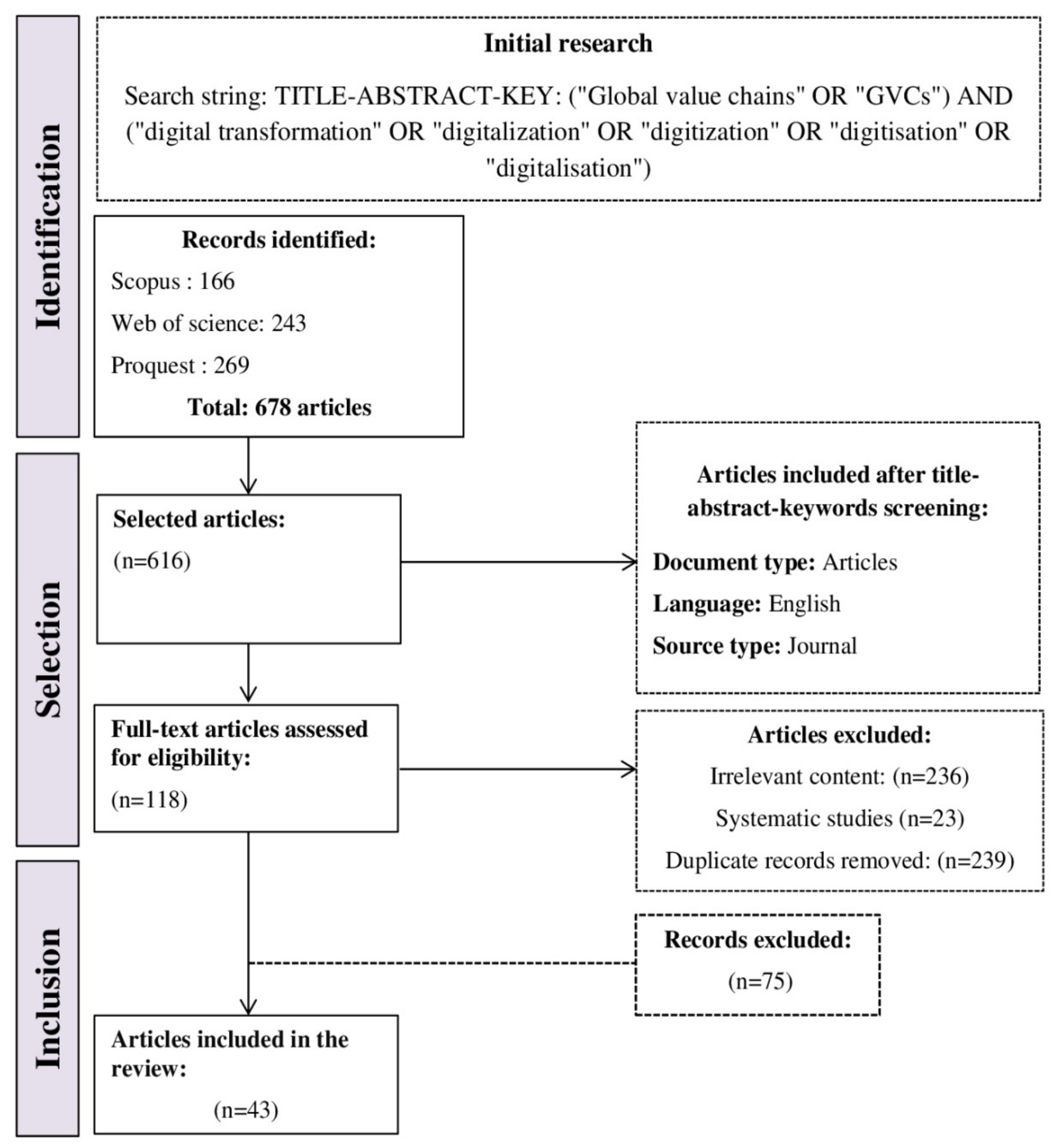
Unlike traditional narrative studies, SLRs follow specific and rigorous steps [47]. They offer reliability in both process and results [48], reduce identification errors [49], ensure organizational and methodological transparency [50], and enable researchers to synthesize existing knowledge and incorporate it into conceptual models [51,52]. Given these methodological strengths, an SLR represents an appropriate choice for providing a comprehensive synthesis of existing knowledge on GVCs in the era of digital transformation. The review adheres to the PRISMA protocol, which encompasses three critical stages: identification, screening, and inclusion [53,54]. A PRISMA flow diagram (Figure 1) is provided to summarize the overall selection process and enhance transparency.

3.1. Identification

All relevant research is primarily grounded in the formulation of precise research questions [55]. Based on an initial reading of published papers addressing digitalization within GVCs, the research question was collaboratively reformulated among the authors as follows: to what extent does digital transformation impact GVCs as presented in the current literature? We then searched the titles, abstracts, and keywords of the Scopus, Web of Science, and ProQuest databases, which are widely used in management research and have been adopted in comparable SLRs [56,57]. The search was conducted up to 2025, with the same strategy applied across all databases, subject to minor adjustments required by database-specific formats.
Keywords were selected to reflect the two central concepts of this review—GVCs and digital transformation—and were refined iteratively as initial results were examined and the terminology most frequently used in existing studies was identified [49]. Synonyms and spelling variants such as digitalization, digitization, and digitisation were also included. Keywords within each category were combined using the Boolean operator OR, while categories were linked using AND, yielding the following search string: (“global value chains” OR “GVCs”) AND (“digital transformation” OR “digitalization” OR “digitization” OR “digitisation” OR “digitalisation”). The search was restricted to peer-reviewed journal articles; book chapters, editorials, conference papers, extended abstracts, book reviews, and non-English publications were excluded [49,50,51].

3.2. Selection

The application of exclusion criteria enhances the quality of the evaluation process [49]. Following PRISMA guidelines, the selection process was conducted in several stages to ensure methodological rigor. First, duplicate records were removed, as were systematic and bibliometric reviews, such as those by [58,59]. Second, titles, keywords, and abstracts were screened to determine whether articles addressed the research question fully or partially, allowing for an inclusive approach at this stage. Articles were excluded on the following grounds: studies focusing exclusively on digital transformation without any reference to GVCs or, conversely, addressing GVCs without incorporating a digital dimension; articles with a strictly national scope lacking any cross-border or inter-organizational dimension; and papers insufficiently aligned with the research questions guiding this review. Beyond these criteria, studies were retained only if they provided sufficient methodological transparency to allow for the evaluation of the robustness of their findings, ensuring that the synthesized evidence base is both relevant and credible.

3.3. Inclusion

During this final phase, a thorough reading was conducted, and exclusion criteria were intensified to only retain works that significantly contribute to understanding the digitalization of GVCs. For instance, Pla-Barber et al. [36], which addresses GVC governance without sufficiently engaging the digital dimension, was excluded at this stage. This process yielded a final sample of 43 articles, forming the analytical basis of this SLR.
To enhance the robustness of this review and minimize potential selection bias, several measures were implemented throughout the process. The use of multiple databases ensured comprehensive coverage of the scientific literature, while predefined and transparent inclusion and exclusion criteria were applied consistently at each stage. Iterative discussions among the authors further reduced subjectivity in article selection. The 43 retained articles were then subjected to a systematic quality assessment along four dimensions: clarity of research design and methodology; adequacy of the empirical base in terms of sample size, data sources, and analytical approach; explicitness of theoretical grounding; and relevance of findings to the intersection of digitalization and GVCs. Each dimension was independently assessed by all authors on a three-level scale (low, moderate, and high), with any disagreements resolved through collective discussion until consensus was reached. Studies judged to be of higher methodological quality were prioritized in the construction of the conceptual framework, while those with more limited empirical bases were cited primarily to illustrate emerging or contested themes. Overall, the quality of the included studies is moderate to high, with the main limitation being the predominance of single-country or single-sector studies that constrains generalizability.
Building on the systematic selection process described in the previous section, the next section presents the findings of the review. The analysis of the final sample of 43 articles is organized into three steps: (i) descriptive characteristics of the literature, (ii) theoretical perspectives, and (iii) an analytical synthesis of the main themes emerging from the studies on digitalization and GVCs.

4. Findings

4.1. Descriptive Findings

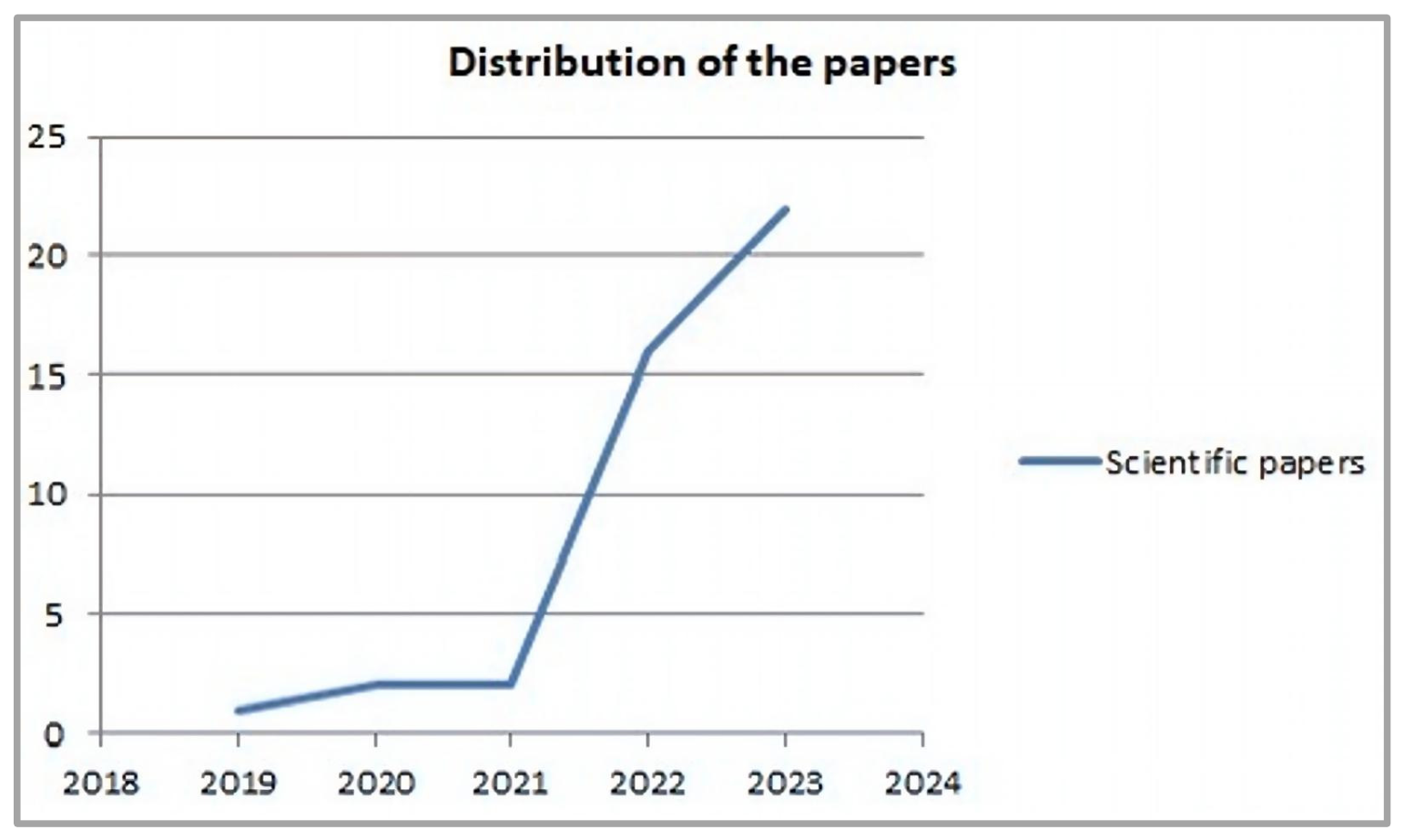
Research on GVCs and their interaction with digitalization has been published in a variety of journals from multiple disciplinary fields. Only three journal titles, “Sustainability,” “Environmental Science and Pollution Research,” and “Global Networks,” have published more than others on the subject. Furthermore, interest in this topic has significantly increased in recent years. Indeed, the majority of papers are published in 2022 and 2023, as the number of articles from these two years comprise 38 out of the 43 articles in the sample (Figure 2). This observation indicates that the topic has a contemporary nature, and debates on the digitalization of GVCs are further developing among academics, practitioners, and policymakers. With the rapid development of digitalization approaches, researchers have begun to focus on the potential effects of this revolution on global trade, particularly on GVCs.
The sample includes quantitative, qualitative, and mixed-method studies, with quantitative work predominating (27 of 43 articles; two are mixed-method). Regarding units of analysis, the firm is the most commonly used (22 articles), with other units also present (Table 2). Only three articles adopt GVCs as the unit of analysis in their own right, a reflection of the genuine difficulty in bounding and directly observing these chains. To address this challenge, we justify theoretically and methodologically how firm-level findings can support conclusions about GVC-level transformations, while calibrating our claims to avoid overgeneralization.
Theoretically, we draw on the “microfoundations” perspective of GVCs, which holds that governance structures and upgrading trajectories emerge from the strategic decisions of lead firms and suppliers. As established by Alfaro et al. [60] and Kano et al. [33], GVC-level dynamics follow from the boundary decisions—internalization versus outsourcing—and transaction safeguards implemented at the firm level. Studying firm capabilities and B2B dyads is therefore not a methodological fallback; it is the mechanism through which the configuration of global chains becomes observable. Methodologically, the reliance on firm-level data reflects persistent gaps in international trade statistics, particularly the absence of matched buyer–supplier transaction data at a global scale [61]. To work around this constraint, GVC research uses the widely accepted “two-way trading” proxy—firms that simultaneously import intermediate inputs and export intermediate or final goods—as an indicator of GVC participation [62,63].
In line with this empirical reality, we have recalibrated our argument throughout the manuscript. Rather than asserting that digitalization directly transforms GVCs at the macro level, we now argue that digitized firm-level capabilities and reduced transaction costs at the micro level aggregate into broader structural reconfigurations of GVC governance and value distribution, ensuring that our conclusions accurately reflect the firm-level and dyadic evidence drawn from the 43 reviewed studies.

4.2. Theoretical Perspectives of the Papers

Most studies (84%) did not reference any specific theory or framework. Among the remaining 16% of the articles, the paper by Meng and Zhao [64] is the only one that utilized a multi-theoretical approach, combining both the Ecological Modernization Theory and Global Value Chain Theory. The former is an approach that builds the economy with technologies geared towards environmental protection [65], while the Global Value Chain Theory emphasizes cooperation between countries upstream and downstream as a key factor that promotes the sharing of technologies and resources [66] and leads to resource optimization and ecological development [67]. The rest of the articles adopt mono-theoretical approaches, such as the Transaction Cost Theory, which focuses on the study of economic efficiency in the exchange processes of goods or services in the market [68], and is based on three key determinants: frequency, asset specificity, and uncertainty [69]. Additionally, Resource Dependency Theory treats firms as open systems exploiting various resources from their environment, including physical and financial resources, information, and legitimacy [70]. Similarly, the Social Network Theory highlights that firms’ economic behavior is based on their social networks and cannot exist in isolation [71], and these networks encompass various stakeholders such as the government, suppliers, customers, partners, and competitors [72]. Moreover, the Environmental Kuznets Curve Theory postulates that there is an inverted U-shaped relationship between environmental degradation and economic development; environmental degradation increases in the early stages of economic growth, but after a certain level of per capita income, the trend reverses, and economic growth leads to environmental improvement [73,74]. Furthermore, Dynamic Capabilities Theory focuses on firms’ abilities to innovate and reconfigure internal and external competencies over time to maintain and develop their competitive advantage [75]. Finally, Labor Process Theory is based on the study of work and employment, with roots in the Marxist approach emphasizing the conflict between capital and labor and work transformations in various contexts [76]. Thus, we observe that there is a lack of research on GVCs, and this can be explained by the recent nature of the subject and the lack of theoretical engagement addressing such an innovative research domain.
Since theory is considered a crucial and indispensable pillar for the development of knowledge in a field [77,78], existing studies on the digitalization of GVCs face difficulties in presenting solid theoretical contributions. This critical gap reveals a theoretical immaturity that remains characteristic of this field of research. The result is a fragmented body of literature, insufficiently equipped with conceptual frameworks capable of accounting for the complex, multi-level transformations brought about by digitalization within GVCs. This fragmentation consequently undermines both the generalizability of existing findings and their explanatory power.

4.3. Analytical Synthesis of the Findings

To enhance the analytical depth of the findings, the reviewed studies are organized along three dimensions: type of digital technology (ICTs, Industry 4.0, AI, blockchain, and e-commerce), affected GVC stage (sourcing, production, and distribution), and governance mechanism (platform-based vs. traditional coordination). Table 3 summarizes this taxonomy.
The literature is shifting from a focus on ICT adoption and the basic digitalization of GVCs [4,79,100] toward research on advanced technologies such as Industry 4.0, AI, blockchain, and digital platforms [43,93]. This evolution highlights the shift from a functional approach to technology toward a systemic digital transformation of GVCs, where digitalization becomes a lever for structural reconfiguration, real-time coordination, and resilience in the face of crises. As illustrated in Table 3, the reviewed studies cover a wide range of digital technologies, GVC stages, and governance configurations. Beyond this classification, three main analytical observations emerge. First, advanced technologies such as AI and blockchain remain relatively underrepresented despite their growing importance in GVC development. Second, production is the most extensively studied GVC stage, while upstream activities remain comparatively underexplored. Finally, governance structures are characterized by hybrid configurations combining traditional and platform-based coordination rather than mutually exclusive models. This suggests that digital transformation in GVCs is still in an exploratory phase, with uneven technological and conceptual coverage across the literature.
This section presents a synthesis of the findings and a critical analysis of the literature on GVCs and digitalization. The discussion is structured around five main aspects, participation in GVCs, competitiveness, sustainability, governance, and crisis contexts, following [25,49].
(a)
Digitalization and participation in GVCs
From a Dynamic Capabilities perspective, digitalization shapes participation in GVCs by enhancing firms’ abilities to sense new international opportunities, seize digital connectivity advantages, and reconfigure coordination processes in increasingly complex global environments [75]. From this view, digitalization operates as a higher-order capability that enables firms to continually realign their resources and routines with evolving GVC structures. Three distinct mechanisms emerge from the reviewed studies, each explaining a different dimension of how digitalization conditions GVC participation.
The first concerns access and barrier reduction. Digitalization reconfigures the conditions of GVC entry by improving connectivity, coordination capabilities, and reaching into international markets [99,100], an effect that is particularly pronounced for SMEs and firms operating in resource-constrained environments [4]. The second mechanism involves structural repositioning within chains. The digital transformation of service sectors stimulates technological innovation in manufacturing, facilitating upward movement along the chain [102], while at a broader level, digitalization contributes to sectoral restructuring by increasing participation in more digitalized industries [81]. The third mechanism is more infrastructural in nature and concerns the enabling conditions that determine whether the first two can be activated at all. In developing economies, and African countries in particular, the capacity to leverage digitalization for GVC integration depends on infrastructure quality, skill level, and institutional constraints that vary significantly across settings [79,80,81,93,99,102].
What the reviewed studies collectively show, then, is not simply that digitalization promotes GVC participation but that its integrative potential is neither uniform nor automatic. Firms that succeed in leveraging digitalization for GVC entry or repositioning do so through distinct pathways—ICT investment and digital infrastructure on one side, firm-level organizational capabilities and financial resources on the other [4]—and the relative importance of each pathway depends on the institutional and organizational environment in which firms operate. This is consistent with the Dynamic Capabilities view, which emphasizes that the effectiveness of sensing, seizing, and reconfiguring is always contextually conditioned. The heterogeneity in findings thus reflects genuine variation in the conditions under which each mechanism can be activated, rather than inconsistency in the literature.
(b)
Digitalization and competitiveness in GVCs
From a Dynamic Capabilities perspective, digitalization enhances firms’ competitiveness within GVCs by shaping their ability to identify technological opportunities, mobilize digital investments, and reconfigure organizational and production processes in response to changing competitive environments [75]. Rather than a single resource, it constitutes a capability bundle that underpins firms’ capacities to sustain and upgrade their competitive position along the value chain. The reviewed studies converge on this general positive relationship, but they diverge significantly on the mechanisms through which it operates—a divergence that is itself theoretically informative.
Three axes of variation run across the literature. The first concerns the channel of competitiveness being studied: Wu et al. [101] examine labor productivity, Yang et al. [96] focus on factor allocation mechanisms—substitution, synergy, and correction—while Li et al. [103] point to process efficiency and innovation. These findings are not contradictory; they reflect the multidimensional nature of competitiveness and suggest that digitalization acts through different levers depending on the analytical level of observation. The second axis concerns firm type, particularly SMEs. Erbay and Yıldırım [104] emphasize data analytics and sensor technologies, Oliveira et al. [15] highlight modularity and upgrading opportunities, while Gao et al. [86] focus on servitization. The variation here is not random: it maps onto differences in financial resources, sectoral exposure to digital technologies, and positions within GVC governance structures, suggesting that SME competitiveness gains are shaped by heterogeneous and context-specific enabling conditions rather than by digitalization. The third axis concerns technology type. Industry 4.0 studies [43,104] highlight maturity levels, efficiency gains, and financial constraints; blockchain is associated with transparency and traceability [84]; and AI is associated with production optimization [85]. Each technology thus activates a different set of Dynamic Capabilities, and the competitive outcomes it produces depend on which of those capabilities firms already possess.
Taken together, these three axes of variation point to a common underlying condition: firms that more effectively sense digital opportunities, seize them through targeted investments, and reconfigure their role within GVCs tend to achieve stronger competitive outcomes, but the form this takes differs by channel, firm type, and technology. This interpretation is supported by [105], who show that, even when AI and big data analytics offer significant competitive advantages, their realization depends on firms’ abilities to overcome psychological and structural barriers. The implication is that digitalization does not produce competitiveness gains uniformly; rather, it amplifies pre-existing differences in Dynamic Capability endowments. Several gaps follow from this: The conditions under which SMEs can effectively leverage digitalization remain underexplored, potential trade-offs between efficiency gains and upgrading strategies have not been systematically analyzed, and future research should unpack digitalization into specific sensing, seizing, and reconfiguring activities to more precisely capture how different digital technologies translate into competitive outcomes within GVCs.
(c)
Digitalization and sustainability in GVCs
Sustainability represents one of the most extensively studied dimensions of the digitalization–GVC nexus, with research concentrating on four main aspects: CO2 emissions, environmental data sharing, green innovation, and environmental sustainability more broadly.
On the emissions front, while GVC participation can itself exacerbate environmental degradation through fossil fuel consumption [91,106], digitalization emerges as a key mitigating factor. Several studies confirm that digitalization contributes to reducing carbon emissions within GVCs and promotes sustainable growth [87,88,106]. These findings are not, however, unambiguous. Li et al. [103] show that digitalization can increase emissions through high energy consumption, a result that sits in direct tension with the dominant decarbonization narrative. Zhang et al. [87] introduce a further distinction that complicates the picture: digital hardware adoption reduces environmental costs, whereas digital software services offer no such guarantee. This asymmetry is theoretically consequential, as it suggests that treating digitalization as a homogeneous variable obscures meaningful variation in its environmental effects and calls for greater precision in how it is measured and operationalized in sustainability research. A parallel source of heterogeneity concerns distribution: firms occupying stronger positions within GVCs are better placed to leverage digitalization for export carbon reduction [97,98], implying that sustainability benefits are not uniformly accessible but conditioned by actors’ structural positions within the chain.
Beyond emissions, digitalization facilitates environmental data sharing and transparency among GVC participants, and Industry 4.0 technologies enable firms to strategically align their digital and environmental objectives [90]. This is reinforced by findings from [107] and [108], which demonstrate that AI goes beyond its well-known role in boosting productivity to play a role in creating sustainable value through the optimization of flows and the transparency of data within global production structures, such as GVCs. At the macroeconomic level, GVC integration indirectly fosters green innovation through knowledge sharing and technological transfers [82] and enhances green total factor productivity, a measure of economic efficiency under environmental constraints [64]. Nevertheless, El Massah and Hassanein [89] caution that these benefits are contingent on a sufficient level of digitalization: where digital skills and infrastructure remain underdeveloped, GVC participation may fail to deliver sustainability gains, pointing to a critical threshold effect that future research should further investigate.
Taken together, these contributions reveal a certain level of inconsistency in the literature that is theoretically consequential rather than incidental. While several studies argue that digitalization contributes to reducing CO2 emissions and improving environmental performance [87,106], others suggest that it may increase environmental degradation due to intensified production and energy consumption [91,109]. These tensions are unlikely to be resolved by additional empirical accumulation alone: they may stem from differences in how digitalization is measured, the level of digital maturity of the firms studied, sector-specific characteristics, and the energy intensity of the underlying technological infrastructures. These point to a broader conceptual issue: digitalization should be understood as a heterogeneous configuration of technologies, capabilities, and governance arrangements rather than a single uniform driver of sustainability, one whose environmental implications vary depending on how digital capabilities are developed and combined with existing production structures. Clarifying these configurations is therefore essential for building a more coherent theoretical account of the digitalization–sustainability nexus in GVCs.
(d)
Digitalization and governance in GVCs
The reviewed studies converge on the idea that digitalization reshapes GVC governance, yet their differences are theoretically consequential. Kruk et al. [92] position digitalization as a structural force that governs transactions by controlling information flows, redistributing responsibilities, and extending coordination reach, reorganizing authority without necessarily involving explicit managerial intervention. Atiase et al. [110] shift the lens toward performance outcomes, arguing that governance mechanisms and digitalization jointly drive value creation and coordination efficiency; yet, in doing so, they largely reproduce the same underlying logic while framing it as an operational rather than structural question. Jamaluddin and Saibani [111] address the relational dimension both perspectives leave under-examined, arguing that B2B collaborative relationships grounded in trust, rather than power asymmetries, constitute an essential precondition for effective digital transformation, suggesting that structural and informational accounts of governance may be insufficient without attention to the inter-organizational conditions that enable them.
These insights can be read through the lens of GVC governance theory, which conceptualizes governance as the way in which control and coordination are exercised along the chain [9]. Digitalization alters these patterns by changing who holds information, how standards are monitored, and how coordination is achieved, thereby reshaping both the form and intensity of governance. In doing so, it enriches this framework by demonstrating that digital transformation redistributes power relations among actors and gives rise to hybrid structures combining traditional coordination with digital platforms, arrangements that are not mutually exclusive but reinforce one another. The Transaction Cost Theory [112] offers a complementary reading of this dynamic: by reducing information asymmetry and enhancing transparency and control, digitization lowers transaction costs and promotes more flexible organizational arrangements. In doing so, it reduces uncertainty and asset specificity, two determinants that, according to this theory, shape the choice of coordination mechanisms, thus explaining the observed shift toward decentralized yet technologically integrated forms.
There are two distinct readings of governance in digitalized GVCs that sit in unresolved tension. The performance-oriented reading [110] treats governance primarily as a coordination problem—one that digitalization solves by improving efficiency and value creation—while the power-centered reading [92] foregrounds the reconfiguration of control mechanisms and the redistribution of authority among actors. What the first paragraph describes as a difference in framing thus reveals, on closer inspection, a deeper theoretical disconnect between managerial and political economy approaches to GVC governance, one that neither study explicitly acknowledges and whose reconciliation remains an open task for the field.
A related tension concerns the nature of governance transformation itself. Rather than a wholesale substitution of traditional coordination models, the evidence points to hybridization, a process in which classical and platform-based governance coexist and interact. Yet this process is poorly accounted for in the literature: only three studies address platform-based governance directly [15,81,84], despite its growing practical relevance. This underrepresentation has two consequences. It limits the analysis of how digitalization reconfigures power asymmetries among GVC actors, and it leaves the question of interoperability between traditional and platform-based governance systems largely unexplored, which is precisely the terrain where hybridization plays out. From a theoretical standpoint, this suggests the need to articulate more clearly how GVC governance theory and Transaction Cost Theory can be jointly mobilized to explain these hybrid arrangements: digital platforms reallocate power and control, while, at the same time, altering the cost structure and coordination mechanisms that underpin governance choices. Making this integration explicit strengthens the role of governance theories as a foundation, rather than merely an interpretive lens, for understanding how digitalization transforms GVCs.
(e)
Digitalization and GVCs during crises
One of the contributions of advanced digitalization is the enhancement of firm resilience, particularly during times of crises, with the COVID-19 pandemic serving as the prime example [4,93]. It also enables firms to develop proactive strategies that rebuild processes and operations to be adaptable and responsive to crisis challenges [93]. Enterprises have invested in three different directions to overcome the obstacles posed by the urgency of COVID-19: refocusing on manufacturing, investing in sustainability, and resorting to digital technologies to interact with customers remotely [94]. The authors add that, during turbulent times, digitalization allows for the rebuilding of strong connections with customers and markets, making it crucial for companies to invest in digital technologies to address future crises [94]. Furthermore, countries that are heavily involved in digital business activities have a significant opportunity to withstand and/or adapt to uncertainty, thus strengthening their positions within GVCs [100]. In a study by Johns [95], it was demonstrated that additive manufacturing contributes to establishing resilience and flexibility in supply chains, thereby managing GVCs with relational governance. Ultimately, companies actively participating in GVCs and those that have developed a significant level of digitalization have a greater chance of withstanding and surviving crises [4].
From a Dynamic Capabilities perspective, these contributions can be understood as the outcome of firms’ enhanced abilities to sense impending disruptions, seize digital solutions, and reconfigure their operational and relational arrangements within GVCs under crisis conditions [75,113]. In other words, digitalization does not merely provide tools; it constitutes a bundle of crisis-oriented Dynamic Capabilities that underpins firms’ resilience strategies. Companies that made significant investments in digital technology prior to a crisis are therefore the most likely to detect disruptions early, implement adaptive adjustments, and reconfigure their supply chain relationships, which is precisely what the COVID-19 evidence illustrates [93,94]. At the same time, the strong interdependence of firms within GVCs, highlighted by [114], makes the resilience of these chains dependent on the robustness of the system as a whole and not solely on the individual capabilities of firms, underscoring the need for a multi-level theoretical approach. This multi-level view suggests that firm-level Dynamic Capabilities are nested within broader GVC governance structures so that resilience emerges from the interaction between micro-level reconfiguration capabilities and the macro-level architecture of inter-firm relationships.
Based on the foregoing, digitalization operates within GVCs on two registers that stand in tension with one another. At the firm level, it functions as both an efficiency-enhancing tool and a survival strategy, converting structural vulnerabilities into more flexible configurations under crisis conditions. Yet this protective role is not without ambiguity: the acceleration of digitalization in times of crisis generates feedback loops across markets that amplify systemic interdependencies, ultimately exacerbating the propagation of shocks throughout GVCs and undermining the very resilience it is meant to support [108]. Viewed through the lens of GVC governance, this tension reflects a reconfiguration of coordination and control mechanisms: digital technologies both enable firms to reconfigure their position in the chain and deepen their dependence on digitally mediated network structures. This tension points to a deeper gap in the literature. Resilience remains a crucial yet underexplored theme, and the mechanisms linking digital technologies to resilience-related outcomes are insufficiently specified, partly because digitalization is most often treated as a homogeneous concept, undifferentiated across technology types or GVC stages. The near-exclusive focus on the COVID-19 pandemic further constrains the generalizability of existing findings.
Beyond the specific dynamics examined in each thematic strand, this review shows that the research on digitalization and GVCs has grown significantly in recent years, but several structural limitations persist. First, while the predominance of quantitative approaches allows for the identification of general trends, it obscures the underlying mechanisms and contextual dynamics that can explain the reasons for and ways in which GVCs are transforming in the era of digitalization. Furthermore, the focus on the firm as the unit of analysis across all studies tends to obscure the relational and systemic dimension that is, however, at the very heart of the GVC concept. The still-limited use of conceptual frameworks hinders the cumulative development of knowledge in this field, and emerging technologies such as AI and blockchain remain understudied despite their transformative potential for restructuring GVCs. These limitations also reflect a lack of integration between antecedents, mediators, moderators, and outcomes, which remains largely fragmented. Consequently, this field of research suffers from a lack of dialog between studies, insufficient attention to conflicting findings, and a theoretical foundation that is still too fragile. Addressing these gaps requires both moving from a primarily descriptive use of theories toward a genuinely theory-driven research agenda—in which Dynamic Capabilities, Transaction Cost Theory, and GVC governance are mobilized not only to interpret empirical patterns but to formulate explicit propositions about how digitalization shapes resilience at different levels of the chain—and a shift toward more comparative research that is better conceptually articulated and more attentive to the complexity of the contexts in which the digitalization of GVCs takes place.

4.4. Towards a Conceptual Framework

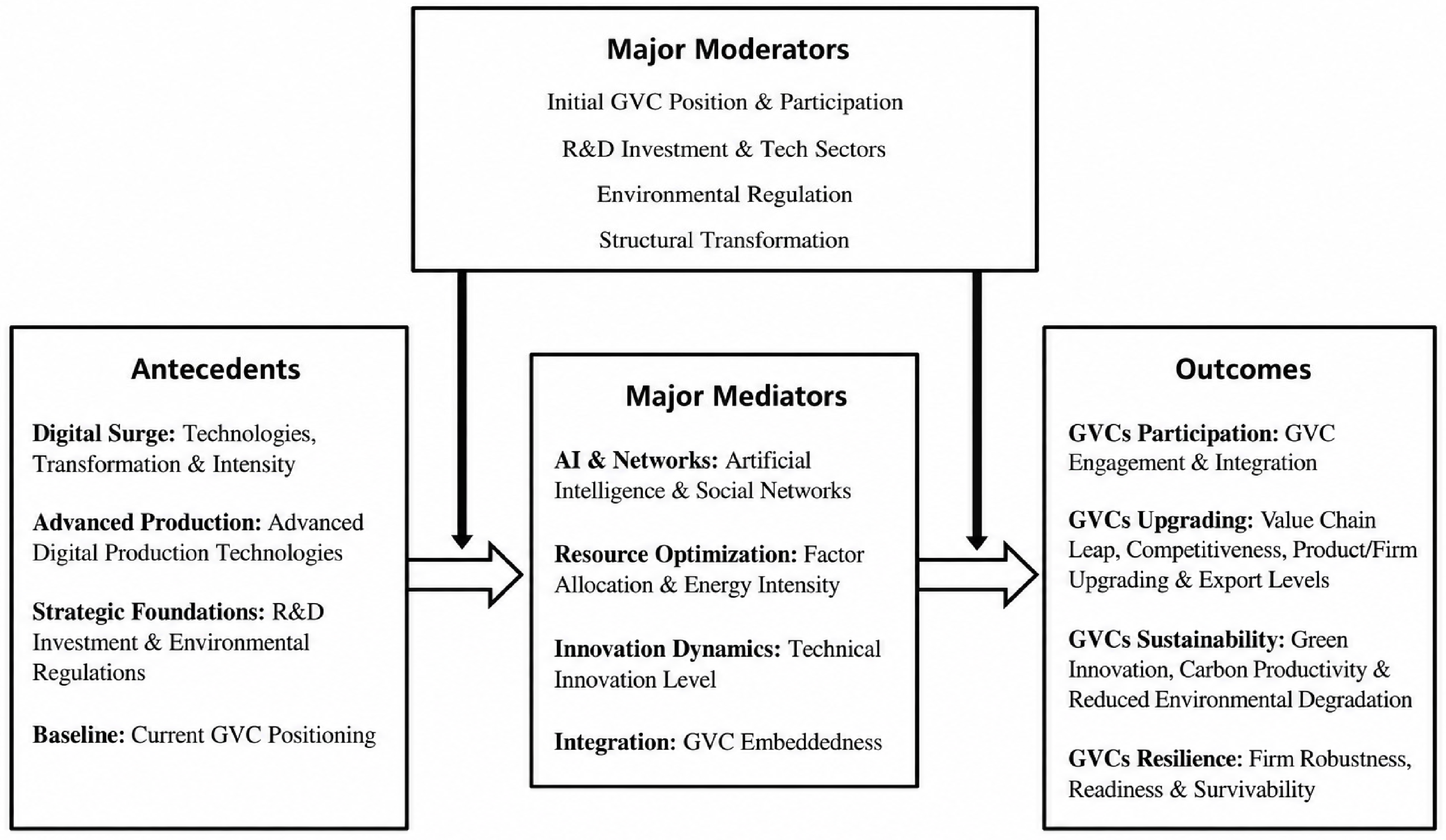
The proposed conceptual framework (Figure 3) articulates the antecedents, mediators, moderators, and outcomes of the integration of digitalization into GVCs along a left-to-right causal chain: antecedents exert a direct influence on outcomes, an influence that is structured by mediators and conditioned by moderators that strengthen or attenuate its intensity.
The framework therefore advances a theory-driven causal model designed to guide future empirical research. To avoid theoretical fragmentation, we integrate the Dynamic Capabilities Theory, Transaction Cost Theory, and Resource Dependence Theory into a unified dialog that explains digital GVC transformations. These three theories are not parallel explanatory paths; rather, they represent an analytical triptych where internal capabilities, transaction efficiency, and network power constraints interact. First, Dynamic Capabilities Theory explains “what firms can do”. Digitalization is not merely an exogenous technological shock but an internal capability bundle sensing digital opportunities, seizing them through targeted investments, and reconfiguring organizational routines. These Dynamic Capabilities are the prerequisites for firms seeking GVC participation and upgrading. Second, the Transaction Cost Theory structures “how firms coordinate”. When firms deploy their digital capabilities (e.g., using blockchain or AI systems), they directly lower transaction costs by reducing information asymmetries, managing bounded rationality, and controlling partner opportunism. This shift in cost structures allows firms to transition from rigid hierarchies to flexible, platform-based hybrid governance. Third, the Resource Dependence Theory “conditions the outcomes firms can achieve”. While Dynamic Capabilities enable digitalization, and lower transaction costs improve coordination efficiency, the ultimate distribution of value is conditioned by external power relations. Power asymmetries and dependency on lead firm resources can lock suppliers into captive positions, limiting their capacity to capture value despite advanced digital tools. Integrating these perspectives, our framework proposes that the positive relationship between digital capabilities and GVC upgrading is fundamentally moderated by external resource dependencies and network power structures.
The antecedents retained, new technologies and digitalization, GVC-related factors, and environmental regulation, determine outcomes through intermediate variables. Theoretically, the relationship between these antecedents and their effects is interpreted through the lens of the Dynamic Capabilities Theory [113]: digitalization is conceptualized as a Dynamic Capability, enabling firms to sense, seize, and reconfigure opportunities within GVCs. Firms that invest in digital technologies are thus better positioned to reconfigure their chain activities, strengthen their competitive advantage, and ensure sustainability and resilience. Environmental regulation and GVC-related factors, in this reading, constitute contextual contingencies that trigger a firm’s need to develop and deploy such capabilities. Two testable propositions follow: higher levels of firm-level digital capabilities are positively associated with GVC participation and upgrading (P1a); and, in more stringent regulatory contexts, the positive effect of digital capabilities on sustainability and resilience outcomes is amplified (P1b).
Mediating variables, including AI, social networks, factor allocation, foreign services, energy intensity, GVCs’ embedding position, and technical innovation, define the nature of the relationship between antecedents and outcomes. The Transaction Cost Theory [112] provides a relevant interpretive framework here: these mediators operate by reducing information asymmetry and coordination costs within GVCs. AI adoption, digital platforms, and a deeper GVC embedding position enhance information processing, monitoring, and coordination, thereby translating digital and regulatory antecedents into concrete performance outcomes. The framework accordingly proposes that the effect of digitalization on GVC upgrading and sustainability is mediated by process-oriented mechanisms such as AI adoption, improved factor allocation, and an increased GVC embedding position (P2a), and that reductions in transaction costs partly account for the link between digitalization and resilience (P2b). These propositions can be empirically investigated by modeling mediators such as AI use intensity, network centrality, or a GVC’s embedding position within path-analytic or structural equation models.
Moderating variables among them, such as the sectoral digitalization intensity, technology sector type, industrial digitization, institutional quality, industrial structure upgrading, GVC position upgrading, GVC participation, and environmental regulation, influence the strength, and sometimes the direction, of relationships among antecedents, mediators, and outcomes. The Resource Dependence Theory [70] accounts for this role: institutional and structural factors shape firms’ access to and control over critical external resources, conditioning the extent to which digital antecedents translate into positive GVC outcomes. The framework therefore proposes that the positive relationship between digital capabilities and GVC upgrading is stronger in countries with higher institutional quality (P3a) and that firms occupying more central or higher-value-added positions in the chain derive greater upgrading and resilience benefits from digitalization than firms in peripheral positions (P3b). These moderating hypotheses can be tested using multi-level or interaction-effect models combining firm-level data with sector- and country-level indicators.
The outcomes identified in the literature cluster around four themes: GVC participation, upgrading, sustainability, and resilience. Beyond descriptive synthesis, the framework is designed to guide empirical research along three concrete lines. First, it proposes an operationalization of constructs: antecedents can be measured through indicators of firm-level digital investment or sectoral digital intensity; mediators through AI usage, R&D intensity, or GVC embedding position measures; moderators through institutional quality indices or value chain positioning indicators; and outcomes through participation rates, upgrading indicators, environmental performance, and resilience metrics. Second, propositions P1 through P3 can be tested via regression, structural equation modeling, or multi-level models, depending on data availability. Third, because the framework foregrounds Dynamic Capabilities and institutional contingencies, it is particularly well suited to longitudinal and cross-country comparative designs, enabling researchers to examine how shifts in environmental regulation or digital infrastructure shape the trajectories of GVC participation, upgrading, sustainability, and resilience over time.

5. Future Research Directions

The analytical synthesis and limitations identified throughout this review paint a fairly clear picture of where the field stands and where it needs to go. Several blind spots are evident: Advanced technologies such as AI and blockchain remain understudied, coverage across GVC stages is uneven, the hybridization of governance structures is poorly theorized, and the overall body of literature suffers from theoretical and methodological fragmentation. Taken together, these gaps call for research that is at once more integrated and more attentive to context. To give this agenda some structure, we organize future research directions around three dimensions—theory, context, and method—each directly tied to the limitations identified above. Table 4 presents this research agenda.

5.1. Theory

Theories in economic sciences can serve as an effective starting point for developing relevant research topics to address issues related to digitalization within GVCs. We find that the majority of publications do not employ theories, which leads us to propose future directions for research grounded in a set of theories based on the future directions proposed by the authors of the articles in our review.
For example, the Resource-based Theory treats firms as combinations of tangible and intangible resources [115,116], leading to the creation of competitive advantage [117,118]. Thus, future research could analyze the potential application of emerging technologies such as Industry 4.0 and others within firms participating in GVCs and their influence on competitive advantage creation [43]. It would also be preferable to determine the network or partner resources necessary to develop a digital role in GVCs.
In line with the previous theory, the Theory of Dynamic Capabilities also appears interesting to mobilize in future research. This theory explains how a firm can enhance its competitiveness (e.g., through business model development), synchronize its processes with changes in the business world, and capitalize on opportunities [113]. Consequently, through this theory, researchers can not only inquire about the types of Dynamic Capabilities that promote the adoption of new technologies within GVCs but also about the influence of existing capabilities within the firm on its intention to digitize its role in GVCs [86].
Furthermore, Internationalization Theory can have a dimension in this subject as well. It can help us understand the opportunities and risks faced by firms wishing to internationalize through the digitalization of GVCs [43], especially those from emerging countries. Furthermore, comprehending the part that implementing sustainable practices—whether they be social, environmental, or economic—plays a role in this internationalization process.
Lastly, Behavioral Theory, which considers the firm as a coalition of stakeholders where each party has its own objectives, can be a theoretical basis for future studies [119]. Therefore, after the implementation of digital tools within GVCs, it will be necessary to study behavioral dynamics in the relationships among the stakeholders of the firm (managers, shareholders, employees, and customers), since new technologies enable the automation of manufacturing processes and rapid decision-making [120]. Additionally, it would be interesting to study the trust mechanisms between companies participating in GVCs and how this trust can be influenced by digitalization [121], particularly in relation to trust-based coordination and relational stability among GVC actors, as already reflected in the governance transformations discussed in the literature. Finally, Banga [83] also proposes addressing the potential for strengthening or reducing inequalities in the global distribution of value-added that digital transformation may present.

5.2. Research Context

Interest in societal issues is becoming increasingly formalized at the firm level [122]; thus, states are obliged to establish institutional regulations that will strengthen responsible business engagement. A study by Calza et al. [93] highlighted that digital transformation poses political challenges for countries; therefore, future research may focus not only on the relationship between the relevance or otherwise of the institutional sphere and the process of digitalization of GVCs but also on the contribution of this digitalization to the success of sustainable approaches adopted by firms participating in GVCs. Another point that warrants further study is environmental regulation and its relationship with participation in GVCs in the era of digital transformation, especially in the context of emerging countries; in particular, Gao [85] asserts that such regulation enhances the leap into GVCs.
Similarly, the emergence of sustainable development goals [123] has highlighted the crucial role that multinational firms can play in promoting strategies related to environmental protection and community development [124]. Consequently, it will be interesting to study the effect of the digital participation of multinational corporations in GVCs on their contributions to achieving the UN’s Agenda 2030, particularly in reducing CO2 emissions. The dynamics of influence and knowledge transfer between multinational corporations and SMEs in emerging countries regarding digital and sustainable transition also deserve further exploration.
From the results, it appears that the resilience of GVCs is still a relatively underexplored theme by researchers. Arthur [125] asserts that GVC resilience topics are generally addressed from a prospective research angle that refers to complexity economics approaches. Thus, it is essential to further develop understanding of the ability of GVCs to be resilient in the era of new technologies. Finally, it would be crucial to explore the hybridization process of governance in GVCs, particularly the coexistence of traditional and platform-based governance mechanisms, as already observed in the literature.

5.3. Research Methodology

One of the conclusions of this literature review is that the majority of articles contained quantitative studies. Therefore, we believe that the theme of digitalization within GVCs requires more in-depth case studies and process studies that will allow for the analysis of the implications of digital tools over long periods of time. Indeed, researchers in this field should develop longitudinal studies based on the analysis of data at two or more different points in time, with the aim of determining mechanisms of change and stability. Several articles in this review propose research avenues stemming from the methodological aspect. For example, a promising avenue of research is to develop new authoritative measures of digitalization in GVCs through longitudinal studies, especially considering that the digitalization process is constantly evolving and countries do not adopt it in the same manner or at the same pace [126]. Additionally, we believe it would be interesting to deeply explore whether there is a real causal relationship between the digitalization of GVCs and the competitiveness of firms participating in these chains, and to what extent digital transformation can impact mutual trust among companies participating in GVCs [83].
Similarly, there is a need for more in-depth case studies to study the impact of Industry 4.0 on the competitiveness of firms participating in GVCs [43], as well as the determination of the effect of digital GVCs on levels of employability and human resource development. Additionally, they propose to study in depth the relationship between digital GVC participation and the CO2 emissions embodied in digital exports [97]. Finally, another research avenue that presents itself is the examination of obstacles that may hinder the implementation of new technologies within GVCs, either for firms in developed countries or for firms in emerging countries, highlighting the need for stronger empirical validation of causal relationships, longitudinal evidence, and more precise measurement approaches already discussed in this review.
These research questions grow directly out of the gaps and tensions identified throughout this review. Rather than being imposed from the outside, they reflect what the literature itself calls for: studies that are more firmly anchored in theory, more rigorous in their methods, and more sensitive to the contexts in which the digitalization of GVCs actually unfolds.

6. Conclusions

Digital GVCs are perceived as a consequence of both globalization and technological advancement, and digital technologies have become significant across multiple levels of their organization. Through an SLR of 43 articles, this study examines the influence of digital transformation on GVCs. The findings demonstrate that digitalization is not a standalone variable but a catalyst that redefines the intersection of firm-level Dynamic Capabilities and chain-level governance structures, mediated by a systemic reduction in transaction costs. More specifically, the adoption of digital tools by firms strongly contributes to GVC integration, enhances competitiveness, and facilitates the incorporation of sustainability approaches. It also gives rise to new modes of governance and supports resilience during crises. Based on these findings, a range of research questions encompassing theoretical, methodological, and contextual dimensions have been identified to guide future studies in this field.
The present review elucidates the perspectives of digitalization to practitioners, notably as a motivating factor for participation in GVCs. Thus, once the idea of adopting a digitalization strategy is thoroughly studied and contemplated by managers, they could embark on the journey of digitalization and prepare to integrate into GVCs. Furthermore, digitalization appears to managers of companies participating in GVCs as a crucial step towards enhancing competitiveness and promoting sustainable development principles within GVCs, especially considering that participation in these chains leads to increased environmental pollution [91]. Additionally, digital technologies not only introduce new governance mechanisms within GVCs but also facilitate the establishment of environmental governance. Therefore, it is opportune for managers to be aware of governance changes within GVCs when adopting digital tools and how this may reshape the company’s position relative to other chain actors. Finally, as digitalization enables the creation of resilience during turbulent times within GVCs, managers can adopt it as a proactive strategy to cope with crises.
This review presents several limitations. While SLRs adopt “scientific strategies that limit bias to the systematic assembly, critical appraisal, and synthesis of all relevant research studies on a specific topic” [127], they also exhibit anomalies. Firstly, the selection of articles was conducted across three databases, which limits access to knowledge from other databases that could provide value to the research question. Additionally, the exclusion of articles written in languages other than English may also eliminate interesting papers. English was chosen as the language of choice due to its prevalence in scientific publications. Given the emerging nature of the topic, our sample only includes 43 articles. Therefore, it is crucial to conduct further studies and additional reviews, such as bibliometric analyses, to complement our findings and suggest new directions for future research.

Author Contributions

Conceptualization, M.M., M.O., S.E.-D., and M.S.A.-A.; methodology, M.M., M.O., S.E.-D., and M.S.A.-A.; software, M.M.; validation, M.M., M.O., S.E.-D., and M.S.A.-A.; formal analysis, M.M., M.O., S.E.-D., and M.S.A.-A.; investigation, M.M., M.O., S.E.-D., and M.S.A.-A.; resources, M.M.; data curation, M.M. and M.O.; writing—original draft preparation, M.M., M.O., S.E.-D., and M.S.A.-A.; writing—review and editing, M.M. and M.O.; visualization, M.O.; supervision, M.M. and S.E.-D.; project administration, M.M.; funding acquisition, M.M. All authors have read and agreed to the published version of the manuscript.

Funding

This research received no external funding and The APC was funded by the Department of Management, FSA, Université Laval, Québec, Canada.

Institutional Review Board Statement

Not applicable.

Informed Consent Statement

Not applicable.

Data Availability Statement

Data have been embedded in the article.

Acknowledgments

Global Affairs Canada (GAC) offered a scholarship to hire Meryem Ourhalouch as visiting scholar and She contributed to this article during her stay at Laval University.

Conflicts of Interest

The authors declare no conflicts of interest.

References

  1. Zhu, S.; Fu, X. Drivers of Export Upgrading. World Dev. 2013, 51, 221–233. [Google Scholar] [CrossRef]
  2. Grossman, G.M.; Rossi-Hansberg, E. Trading Tasks: A Simple Theory of Offshoring. Am. Econ. Rev. 2008, 98, 1978–1997. [Google Scholar] [CrossRef]
  3. World Bank. World Development Report 2020: Trading for Development in the Age of Global Value Chains; World Bank Publications: Washington, DC, USA, 2020. [Google Scholar]
  4. Gopalan, S.; Reddy, K.; Sasidharan, S. Does digitalization spur global value chain participation? Firm-level evidence from emerging markets. Inf. Econ. Policy 2022, 59, 100972. [Google Scholar] [CrossRef]
  5. Leão, P.; Da Silva, M.M. Impacts of digital transformation on firms’ competitive advantages: A systematic literature review. Strateg. Change 2021, 30, 421–441. [Google Scholar] [CrossRef]
  6. Golgeci, I.; Makhmadshoev, D.; Demirbag, M. Global value chains and the environmental sustainability of emerging market firms: A systematic review of literature and research agenda. Int. Bus. Rev. 2021, 30, 101857. [Google Scholar] [CrossRef]
  7. Golini, R.; Caniato, F.; Kalchschmidt, M. Linking global value chains and supply chain management: Evidence from the electric motors industry. Prod. Plan. Control 2016, 27, 934–951. [Google Scholar] [CrossRef]
  8. Pahl, S.; Timmer, M.P. Do global value chains enhance economic upgrading? Longview J. Dev. Stud. 2020, 56, 1683–1705. [Google Scholar] [CrossRef]
  9. Gereffi, G.; Humphrey, J.; Sturgeon, T. The governance of global value chains. Rev. Int. Political Econ. 2005, 12, 78–104. [Google Scholar] [CrossRef]
  10. Jithin, P.; Arayankalam, J.; Rajesh, S.P.; Tiwari, A.K. Decoding the Digital Leap: Exploring the Role of Global Value Chains in Driving Country-Level Digitalization. J. Clean. Prod. 2024, 454, 142208. [Google Scholar] [CrossRef]
  11. Lee, J.Y.; Kim, D.; Choi, B.; Jiménez, A. Early evidence on how Industry 4.0 reshapes MNEs’ global value chains: The role of value creation versus value capturing by headquarters and foreign subsidiaries. J. Int. Bus. Stud. 2023, 54, 599–630. [Google Scholar] [CrossRef]
  12. González, J.L.; Munro, L.; Gourdon, J.; Mazzini, E.; Andrenelli, A. Participation and Benefits of SMEs in GVCs in Southeast Asia; OECD: Paris, France, 2019. [Google Scholar]
  13. Das, A.; Gottlieb, S.; Ivanov, D. Managing Disruptions and the Ripple Effect in Digital Supply Chains: Empirical Case Studies; Springer: Berlin/Heidelberg, Germany, 2019. [Google Scholar]
  14. Aggarwal, P. Global Value Chains after COVID-19: A Thematic Discussion & Resilience-based Framework. Abhigyan 2023, 41, 50–62. [Google Scholar] [CrossRef]
  15. Oliveira, L.; Fleury, A.; Fleury, M.T. Digital power: Value chain upgrading in an age of digitization. Int. Bus. Rev. 2021, 30, 101850. [Google Scholar] [CrossRef]
  16. Ivanov, D. Viable supply chain model: Integrating agility, resilience and sustainability perspectives—Lessons from and thinking beyond the COVID-19 pandemic. Ann. Oper. Res. 2022, 319, 1411–1431. [Google Scholar] [CrossRef] [PubMed]
  17. Butollo, F.; Gereffi, G.; Yang, C.; Krzywdzinski, M. Digital transformation and value chains: Introduction. Glob. Netw. 2022, 22, 585–594. [Google Scholar] [CrossRef]
  18. Ivanov, D.; Dolgui, A.; Sokolov, B. The impact of digital technology and Industry 4.0 on the ripple effect and supply chain risk analytics. Int. J. Prod. Res. 2019, 57, 829–846. [Google Scholar] [CrossRef]
  19. Panwar, R.; Pinkse, J.; De Marchi, V. The Future of Global Supply Chains in a Post-COVID-19 World. Calif. Manag. Rev. 2022, 64, 5–23. [Google Scholar] [CrossRef]
  20. Dilyard, J.; Zhao, S.; You, J.J. Digital innovation and Industry 4.0 for global value chain resilience: Lessons learned and ways forward. Thunderbird Int. Bus. Rev. 2021, 63, 577–584. [Google Scholar] [CrossRef]
  21. Feng, S.; Zhang, R.; Di, D.; Li, G. Does digital transformation promote global value chain upgrading? Evidence from Chinese manufacturing firms. Econ. Model. 2024, 139, 106810. [Google Scholar] [CrossRef]
  22. Meixell, M.J.; Gargeya, V.B. Global supply chain design: A literature review and critique. Transp. Res. Part E Logist. Transp. Rev. 2005, 41, 531–550. [Google Scholar] [CrossRef]
  23. Awan, U.; Sroufe, R.; Bozan, K. Designing Value Chains for Industry 4.0 and a Circular Economy: A Review of the Literature. Sustainability 2022, 14, 7084. [Google Scholar] [CrossRef]
  24. De Marchi, V.; Alford, M. State policies and upgrading in global value chains: A systematic literature review. J. Int. Bus. Policy 2022, 5, 88–111. [Google Scholar] [CrossRef]
  25. Dimitropoulos, P.; Koronios, K.; Sakka, G. International business sustainability and global value chains: Synthesis, framework and research agenda. J. Int. Manag. 2023, 29, 101054. [Google Scholar] [CrossRef]
  26. Aamer, A.; Sahara, C.R.; Al-Awlaqi, M.A. Digitalization of the supply chain: Transformation factors. J. Sci. Technol. Policy Manag. 2023, 14, 713–733. [Google Scholar] [CrossRef]
  27. Maharjan, R.; Kato, H. Resilient supply chain network design: A systematic literature review. Transp. Rev. 2022, 42, 739–761. [Google Scholar] [CrossRef]
  28. Orji, C.I. Digital Business Transformation: Towards an Integrated Capability Framework for Digitization and Business Value Generation. J. Glob. Bus. Technol. 2019, 15, 47–57. [Google Scholar]
  29. Staritz, C.; Gereffi, G.; Cattaneo, O. Shifting End Markets and Upgrading Prospects in Global Value Chains. Int. J. Technol. Learn. Innov. Dev. 2011, 4, 2. Available online: https://www.inderscience.com/info/inarticletoc.php?jcode=ijtlid&year=2011&vol=4&issue=1/2/3 (accessed on 20 May 2025).
  30. Gereffi, G. Global value chains in a post-Washington consensus world. Rev. Int. Political Econ. 2014, 21, 9–37. [Google Scholar] [CrossRef]
  31. Fernandez-Stark, K.; Gereffi, G. Global Value Chain Analysis: A Primer, 2nd ed.; Edward Elgar Publishing: Cheltenham, UK, 2019; pp. 54–76. [Google Scholar]
  32. Gereffi, G.; Korzeniewicz, M. (Eds.) Commodity Chains and Global Capitalism (No. 149); ABC-CLIO: Santa Barbara, CA, USA, 1994. [Google Scholar]
  33. Kano, L.; Tsang, E.W.K.; Yeung, H.W. Global value chains: A review of the multi-disciplinary literature. J. Int. Bus. Stud. 2020, 51, 577–622. [Google Scholar] [CrossRef]
  34. Rehnberg, M.; Ponte, S. From smiling to smirking? 3D printing, upgrading and the restructuring of global value chains. Glob. Netw. 2018, 18, 57–80. [Google Scholar] [CrossRef]
  35. Szalavetz, A. Digitalisation, automation and upgrading in global value chains—Factory economy actors versus lead companies. Post-Communist Econ. 2019, 31, 646–670. [Google Scholar] [CrossRef]
  36. Pla-Barber, J.; Villar, C.; Narula, R. Governance of global value chains after the Covid-19 pandemic: A new wave of regionalization? BRQ Bus. Res. Q. 2021, 24, 204–213. [Google Scholar] [CrossRef]
  37. Lu, Y. Industry 4.0: A survey on technologies, applications and open research issues. J. Ind. Inf. Integr. 2017, 6, 1–10. [Google Scholar] [CrossRef]
  38. Hassoun, A.; Aït-Kaddour, A.; Abu-Mahfouz, A.M.; Rathod, N.B.; Bader, F.; Barba, F.J.; Biancolillo, A.; Cropotova, J.; Galanakis, C.M.; Jambrak, A.R.; et al. The fourth industrial revolution in the food industry—Part I: Industry 4.0 technologies. Crit. Rev. Food Sci. Nutr. 2023, 63, 6547–6563. [Google Scholar] [CrossRef] [PubMed]
  39. Bettiol, M.; Capestro, M.; Marchi, V.D.; Maria, E.D. Industry 4.0 Investments in Manufacturing Firms and Internationalization; Dipartimento di Scienze Economiche “Marco Fanno”, Università degli Studi di Padova: Padua, Italy, 2020; Available online: https://testweb.economia.unipd.it/sites/economia.unipd.it/files/20200245.pdf (accessed on 10 June 2025).
  40. Szabo, R.Z.; Vuksanović Herceg, I.; Hanák, R.; Hortovanyi, L.; Romanová, A.; Mocan, M.; Djuričin, D. Industry 4.0 Implementation in B2B Companies: Cross-Country Empirical Evidence on Digital Transformation in the CEE Region. Sustainability 2020, 12, 9538. [Google Scholar] [CrossRef]
  41. Aaldering, L.J.; Song, C.H. Of leaders and laggards—Towards digitalization of the process industries. Technovation 2021, 105, 102211. [Google Scholar] [CrossRef]
  42. Amador, J.; Cabral, S. Global Value Chains: A Survey of Drivers and Measures. J. Econ. Surv. 2016, 30, 278–301. [Google Scholar] [CrossRef]
  43. Götz, M.; Jankowska, B. Adoption of Industry 4.0 Technologies and Company Competitiveness: Case Studies from a Post-Transition Economy. Foresight STI Gov. 2020, 14, 61–78. [Google Scholar] [CrossRef]
  44. Smorodinskaya, N.V.; Katukov, D.D.; Malygin, V.E. Global Value Chains in the Age of Uncertainty: Advantages, Vulnerabilities, and Ways for Enhancing Resilience. Balt. Reg. 2021, 13, 78–107. [Google Scholar] [CrossRef]
  45. Hanelt, A.; Bohnsack, R.; Marz, D.; Antunes Marante, C. A systematic review of the literature on digital transformation: Insights and implications for strategy and organizational change. J. Manag. Stud. 2021, 58, 1159–1197. [Google Scholar] [CrossRef]
  46. Radicic, D.; Petković, S. Impact of digitalization on technological innovations in small and medium-sized enterprises (SMEs). Technol. Forecast. Soc. Change 2023, 191, 122474. [Google Scholar] [CrossRef]
  47. Tranfield, D.; Denyer, D.; Smart, P. Towards a methodology for developing evidence-informed management knowledge by means of systematic review. Br. J. Manag. 2003, 14, 207–222. [Google Scholar] [CrossRef]
  48. Leonidou, E.; Christofi, M.; Vrontis, D.; Thrassou, A. An integrative framework of stakeholder engagement for innovation management and entrepreneurship development. J. Bus. Res. 2020, 119, 245–258. [Google Scholar] [CrossRef]
  49. Vrontis, D.; Christofi, M. R&D internationalization and innovation: A systematic review, integrative framework and future research directions. J. Bus. Res. 2021, 128, 812–823. [Google Scholar] [CrossRef]
  50. Hollebeek, L.D.; Menidjel, C.; Sarstedt, M.; Jansson, J.; Urbonavicius, S. Engagingconsumers through artificially intelligent technologies: Systematic review, conceptual model, and further research. Psychol. Mark. 2024, 41, 880–898. [Google Scholar] [CrossRef]
  51. Madanaguli, A.; Srivastava, S.; Ferraris, A.; Dhir, A. Corporate social responsibility and sustainability in the tourism sector: A systematic literature review and future outlook. Sustain. Dev. 2022, 30, 447–461. [Google Scholar] [CrossRef]
  52. Sivarajah, U.; Kamal, M.M.; Irani, Z.; Weerakkody, V. Critical analysis of Big Data challenges and analytical methods. J. Bus. Res. 2017, 70, 263–286. [Google Scholar] [CrossRef]
  53. Page, M.J.; McKenzie, J.E.; Bossuyt, P.M.; Boutron, I.; Hoffmann, T.C.; Mulrow, C.D.; Shamseer, L.; Tetzlaff, J.M.; Akl, E.A.; Brennan, S.E.; et al. The PRISMA 2020 statement: An updated guideline for reporting systematic reviews. J. Clin. Epidemiol. 2021, 134, 178–189. [Google Scholar] [CrossRef]
  54. Ourhalouch, M.; Mohiuddin, M.; Ed-Dafali, S.; Katebi, P.; Mirzaye, S. Multinational enterprises’ approach to social innovation: Key findings and future research avenues based on the systematic literature review. Int. J. Innov. Sci. 2025, 18, 499–523. [Google Scholar] [CrossRef]
  55. Nguyen, D.H.; De Leeuw, S.; Dullaert, W.E.H. Consumer Behaviour and Order Fulfilment in Online Retailing: A Systematic Review. Int. J. Manag. Rev. 2018, 20, 255–276. [Google Scholar] [CrossRef]
  56. Mariani, M.M.; Perez-Vega, R.; Wirtz, J. AI in marketing, consumer research and psychology: A systematic literature review and research agenda. Psychol. Mark. 2022, 39, 755–776. [Google Scholar] [CrossRef]
  57. Nayak, B.; Bhattacharyya, S.S.; Krishnamoorthy, B. Exploring the black box of competitive advantage—An integrated bibliometric and chronological literature review approach. J. Bus. Res. 2022, 139, 964–982. [Google Scholar] [CrossRef]
  58. Massa, S.; Annosi, M.C.; Marchegiani, L.; Messeni Petruzzelli, A. Digital technologies and knowledge processes: New emerging strategies in international business. A systematic literature review. J. Knowl. Manag. 2023, 27, 330–387. [Google Scholar] [CrossRef]
  59. Mushi, G.E.; Di Marzo Serugendo, G.; Burgi, P.-Y. Digital Technology and Services for Sustainable Agriculture in Tanzania: A Literature Review. Sustainability 2022, 14, 2415. [Google Scholar] [CrossRef]
  60. Alfaro, L.; Chor, D.; Antras, P.; Conconi, P. Internalizing global value chains: A firm-level analysis. J. Political Econ. 2019, 127, 508–559. [Google Scholar] [CrossRef]
  61. Stemberger, J.; Zajc Kejžar, K. A firm-level analysis of global value chain participation effects. Rev. World Econ. 2025, 1–36. [Google Scholar] [CrossRef]
  62. Banga, K. Upgrading in global value chains. In A Firm-Level Empirical Analysis of Indian Manufacturing; The University of Manchester: Manchester, UK, 2018. [Google Scholar]
  63. Thang, D.N. Trade credit and global value chain: Evidence from cross-country firm-level data. Int. Econ. 2022, 171, 110–129. [Google Scholar] [CrossRef]
  64. Meng, F.; Zhao, Y. How does digital economy affect green total factor productivity at the industry level in China: From a perspective of global value chain. Environ. Sci. Pollut. Res. 2022, 29, 79497–79515. [Google Scholar] [CrossRef]
  65. Jänicke, M. Ecological modernisation: New perspectives. J. Clean. Prod. 2008, 16, 557–565. [Google Scholar] [CrossRef]
  66. Gonzalez-Torres, T.; Rodriguez-Sanchez, J.L.; Montero-Navarro, A.; Gallego-Losada, R. Visualizing research on industrial clusters and global value chains: A bibliometric analysis. Front. Psychol. 2020, 11, 1754. [Google Scholar] [CrossRef]
  67. Wang, S.H.; He, Y.Q.; Song, M.L. Global value chains, technological progress, and environmental pollution: Inequality towards developing countries. J. Env. Manag. 2021, 277, 110999. [Google Scholar] [CrossRef] [PubMed]
  68. Coase, R.H. The nature of the firm. Economica 1937, 4, 386–405. [Google Scholar] [CrossRef]
  69. Williamson, O.E. Markets and Hierarchies: Analysis and Antitrust Implications; Macmillan Publishers: New York, NY, USA, 1975. [Google Scholar]
  70. Hillman, A.J.; Withers, M.; Collins, B.J. Resource dependence theory: A review. J. Manag. 2009, 35, 1404–1427. [Google Scholar] [CrossRef]
  71. Hadjielias, E.; Christofi, M.; Vrontis, D.; Khan, H. Social Impact Through Family Firms’ Interorganizational Relationships within a Community and a Cooperative: An Embedded View of Stewardship. J. Bus. Res. 2022, 139, 584–601. [Google Scholar] [CrossRef]
  72. Zhang, K.Z.; Ouyang, J.; Li, W. Why Tax Cuts Cannot Reduce the Corporate Burden: Information Technology, Taxation Capacity and Corporate Tax Evasion. Econ. Res. J. 2020, 55, 116–132. [Google Scholar]
  73. Grossman, G.M.; Krueger, A.B. Economic Growth and the Environment. Q. J. Econ. 1995, 110, 353–377. [Google Scholar] [CrossRef]
  74. Stern, D.I. The Rise and Fall of the Environmental Kuznets Curve. World Dev. 2004, 32, 1419–1439. [Google Scholar] [CrossRef]
  75. Helfat, C.E.; Peteraf, M.A. Understanding dynamic capabilities: Progress along a developmental path. Strateg. Organ. 2009, 7, 91–102. [Google Scholar] [CrossRef]
  76. Omidi, A.; Dal Zotto, C.; Gandini, A. Labor process theory and critical HRM: A systematic review and agenda for future research. Eur. Manag. J. 2023, 41, 899–913. [Google Scholar] [CrossRef]
  77. Connelly, B.L.; Ketchen, D.J.; Hult, G.T.M. Global Supply Chain Management: Toward a Theoretically Driven Research Agenda. Glob. Strategy J. 2013, 3, 227–243. [Google Scholar] [CrossRef]
  78. Wong, C.; Skipworth, H.; Godsell, J.; Achimugu, N. Towards a theory of supply chain alignment enablers: A systematic literature review. Supply Chain Manag. Int. J. 2012, 17, 419–437. [Google Scholar] [CrossRef]
  79. Gniniguè, M.; Wonyra, K.O.; Tchagnao, A.-F.; Bayale, N. Participation of developing countries in global value chains: What role for information and communication technologies? Telecommun. Policy 2023, 47, 102508. [Google Scholar] [CrossRef]
  80. Nasser, F.; Ouerghi, F. Global Value Chains and Digitalization under Industry 4.0: The Hansen Threshold Regression Model in the Case of Africa. J. Int. Commer. Econ. Policy 2023, 14, 2350018. [Google Scholar] [CrossRef]
  81. Guo, X.; Xu, D.; Zhu, K. Measuring digitalization effects in China: A global value chain perspective. China Econ. Rev. 2023, 81, 102021. [Google Scholar] [CrossRef]
  82. Pan, H.; Yang, J.; Zhou, H.; Zheng, X.; Hu, F. Global value chain embeddedness, digital economy and green innovation—Evidence from provincial-level regions in China. Front. Environ. Sci. 2022, 10, 1027130. [Google Scholar] [CrossRef]
  83. Banga, K. Digital Technologies and Product Upgrading in Global Value Chains: Empirical Evidence from Indian Manufacturing Firms. Eur. J. Dev. Res. 2022, 34, 77–102. [Google Scholar] [CrossRef]
  84. Chen, W.; Botchie, D.; Braganza, A.; Han, H. A transaction cost perspective on blockchain governance in global value chains. Strateg. Change 2022, 31, 75–87. [Google Scholar] [CrossRef]
  85. Gao, Y. Unleashing the mechanism among environmental regulation, artificial intelligence, and global value chain leaps: A roadmap toward digital revolution and environmental sustainability. Environ. Sci. Pollut. Res. 2022, 30, 28107–28117. [Google Scholar] [CrossRef] [PubMed]
  86. Gao, J.; Zhang, W.; Guan, T.; Feng, Q.; Mardani, A. Influence of digital transformation on the servitization level of manufacturing SMEs from static and dynamic perspectives. Int. J. Inf. Manag. 2023, 73, 102645. [Google Scholar] [CrossRef]
  87. Zhang, T.; Wei, L.; Liu, J. How China’s digital technology development affects the environmental costs related to global value chains? Evidence from regional manufacturing sectors. Sci. Total Environ. 2023, 886, 163978. [Google Scholar] [CrossRef]
  88. Chen, J.; Zhang, S.; Ma, X.; Zhao, X.; Song, Y.; Fan, Y.; Yu, Y. Global Value Chains Embedding and Carbon Productivity of China’s Manufacturing Industry: Direct Influence, Adjustment Effect, and Heterogeneity Analysis. Sustainability 2023, 15, 13272. [Google Scholar] [CrossRef]
  89. Elmassah, S.; Hassanein, E.A. GVCs and environmental sustainability in MENA: Do digitalization and institutions make a difference? Environ. Sci. Pollut. Res. 2023, 30, 121614–121629. [Google Scholar] [CrossRef] [PubMed]
  90. Niehoff, S.; Matthess, M.; Zwar, C.; Kunkel, S.; Guan, T.; Chen, L.; Xue, B.; De Oliveira Pereira Grudzien, D.I.; Pinheiro De Lima, E.; Beier, G. Sustainability related impacts of digitalisation on cooperation in global value chains: An exploratory study comparing companies in China, Brazil and Germany. J. Clean. Prod. 2022, 379, 134606. [Google Scholar] [CrossRef]
  91. Ali, E.; Gniniguè, M.; Awade, N.E. Sectoral value chains and environmental pollution in Africa: Can development policies target digitalization and structural transformation to enhance environmental governance? J. Environ. Econ. Policy 2023, 12, 229–247. [Google Scholar] [CrossRef]
  92. Kruk, S.R.L.; Toonen, H.M.; Bush, S.R. Digital sustainability assurance governing global value chains: The case of aquaculture. Regul. Gov. 2024, 18, 1153–1170. [Google Scholar] [CrossRef]
  93. Calza, E.; Lavopa, A.; Zagato, L. Advanced digitalisation and resilience during the COVID-19 pandemic: Firm-level evidence from developing and emerging economies. Ind. Innov. 2023, 30, 864–894. [Google Scholar] [CrossRef]
  94. Di Maria, E.; Bettiol, M.; Capestro, M. How Italian Fashion Brands Beat COVID-19: Manufacturing, Sustainability, and Digitalization. Sustainability 2023, 15, 1038. [Google Scholar] [CrossRef]
  95. Johns, J. Digital technological upgrading in manufacturing global value chains: The impact of additive manufacturing. Glob. Netw. 2022, 22, 649–665. [Google Scholar] [CrossRef]
  96. Yang, G.; Li, H.; Nie, Y.; Yue, Z.; Wang, H. Digital transformation and firm performance: The role of factor allocation. Appl. Econ. 2024, 56, 6203–6220. [Google Scholar] [CrossRef]
  97. Ma, D.; Tang, J.; Jiang, X. Effects of digital global value chain participation on CO2 emissions embodied in digital exports: New evidence from PSTR approach. Energy Econ. 2023, 126, 106913. [Google Scholar] [CrossRef]
  98. Huang, Y.; Zhang, Y. Digitalization, positioning in global value chain and carbon emissions embodied in exports: Evidence from global manufacturing production-based emissions. Ecol. Econ. 2023, 205, 107674. [Google Scholar] [CrossRef]
  99. Reddy, K.; Sasidharan, S. Digitalization and global value chain participation: Firm-level evidence from Indian manufacturing. J. Ind. Bus. Econ. 2023, 50, 551–574. [Google Scholar] [CrossRef]
  100. Ha, L.T. Impacts of digital business on global value chain participation in European countries. AI Soc. 2024, 39, 1039–1064. [Google Scholar] [CrossRef] [PubMed]
  101. Wu, Y.-Q.; Lu, H.-X.; Liao, X.-L.; Zhu, J.-M. Research on the Digitization of Manufacturing Will Enhance the Competitiveness of the Value Chain Based on Advantage Comparison. Complexity 2021, 2021, 9917772. [Google Scholar] [CrossRef]
  102. Bian, R.; Fan, Z. Digitalization of services, innovation and manufacturing GVC upstreamness. Technol. Soc. 2024, 78, 102660. [Google Scholar] [CrossRef]
  103. Li, J.; Qamri, G.M.; Tang, M.; Cheng, Y. Connecting the sustainability: How renewable energy and digitalization drive green global value chains. J. Environ. Manag. 2025, 380, 124779. [Google Scholar] [CrossRef]
  104. Erbay, H.; Yıldırım, N. Combined technology selection model for digital transformation in manufacturing: A case study from the automotive supplier industry. Int. J. Innov. Technol. Manag. 2022, 19, 2250023. [Google Scholar] [CrossRef]
  105. Shashi Ertz, M.; Cerchione, R.; Kumar, V. Transforming business-to-business marketing from tradition to digitalization: A taxonomic review of current trends, methodologies and future paths. J. Bus. Ind. Mark. 2025, 40, 1335–1354. [Google Scholar] [CrossRef]
  106. Ali, E.; Bataka, H.; Wonyra, K.O.; Awade, N.E.; Braly, N.N. Global value chains participation and environmental pollution in developing countries: Does digitalization matter? J. Int. Dev. 2023, 36, 451–478. [Google Scholar] [CrossRef]
  107. Yildirim, H. Artificial intelligence and ESG: Exploring dynamic interdependencies in sustainable digital futures. J. Sustain. Digit. Futures 2025, 2, 149–164. [Google Scholar] [CrossRef]
  108. Balcı, N. Asymmetric Shock Transmission Between Artificial Intelligence Stocks and Carbon Markets: A Quantile-on-Quantile Connectedness Approach. Int. J. Bus. Econ. Stud. 2025, 7, 286–300. [Google Scholar] [CrossRef]
  109. Zhang, Y.; Khan, N.U.; Cai, H.H.; Tang, S.; Bousrih, J. Sowing the seeds of sustainability: Digitalization, renewable energy, and carbon emissions in emerging economies’ global value chains. J. Environ. Manag. 2025, 393, 127119. [Google Scholar] [CrossRef]
  110. Atiase, V.Y.; Agbanyo, S.; Ameh, J.K.; Sambian, R.M.; Ganza, P. Creating value for whom? Digitization and governance practices of nontraditional export firms in Africa. Strateg. Change 2022, 31, 31–44. [Google Scholar] [CrossRef]
  111. Jamaluddin, F.; Saibani, N. Systematic literature review of supply chain relationship approaches amongst business-to-business partners. Sustainability 2021, 13, 11935. [Google Scholar] [CrossRef]
  112. Cuypers, I.R.; Hennart, J.F.; Silverman, B.S.; Ertug, G. Transaction cost theory: Past progress, current challenges, and suggestions for the future. Acad. Manag. Ann. 2021, 15, 111–150. [Google Scholar] [CrossRef]
  113. Teece, D.J.; Pisano, G.; Shuen, A. Dynamic capabilities and strategic management. Strateg. Manag. J. 1997, 18, 509–533. [Google Scholar] [CrossRef]
  114. Balcı, N. Transforming towards sustainable digital futures: Global interactions between ESG and digitalisation indices. J. Sustain. Digit. Futures 2025, 2, 115–131. [Google Scholar] [CrossRef]
  115. Pereira, V.; Bamel, U. Extending the resource and knowledge based view: A critical analysis into its theoretical evolution and future research directions. J. Bus. Res. 2021, 132, 557–570. [Google Scholar] [CrossRef]
  116. Chahal, H.; Gupta, M.; Bhan, N.; Cheng, T.C.E. Operations management research grounded in the resource-based view: A meta-analysis. Int. J. Prod. Econ. 2020, 230, 107805. [Google Scholar] [CrossRef]
  117. Barney, J. Firm resources and sustained competitive advantage. J. Manag. 1991, 17, 99–120. [Google Scholar] [CrossRef]
  118. Pankaj, M.M. (Ed.) Resource Based View (RBV) of Competitive Advantage: An Overview. In Resource Based View: Concepts and Practices; Icfai University Press: Hyderabad, India, 2009; pp. 3–22. [Google Scholar]
  119. Surdu, I.; Greve, H.R.; Benito, G.R.G. Back to basics: Behavioral theory and internationalization. J. Int. Bus. Stud. 2021, 52, 1047–1068. [Google Scholar] [CrossRef]
  120. Primi, A.; Toselli, M. A global perspective on industry 4.0 and development: New gaps or opportunities to leapfrog? J. Econ. Policy Reform 2020, 23, 371–389. [Google Scholar] [CrossRef]
  121. Zhou, R.; Tang, D.; Da, D.; Chen, W.; Kong, L.; Boamah, V. Research on China’s Manufacturing Industry Moving towards the Middle and High-End of the GVC Driven by Digital Economy. Sustainability 2022, 14, 7717. [Google Scholar] [CrossRef]
  122. European Commision. Sustainable Finance Taxonomy—Regulation (EU) 2020/852. 27 November 2021. Available online: https://pub.norden.org/temanord2024-553/2-the-eu-taxonomy-regulation-eu-2020-852.html (accessed on 1 December 2025).
  123. United Nations. Transforming Our World: The 2030 Agenda for Sustainable Development. 2015. Available online: https://sdgs.un.org/2030agenda (accessed on 15 November 2025).
  124. Holmström Lind, C.; Kang, O.; Ljung, A.; Forsgren, M. MNC involvement in social innovations: The issue of knowledge, networks and power. Crit. Perspect. Int. Bus. 2018, 16, 79–99. [Google Scholar] [CrossRef]
  125. Arthur, W.B. Foundations of complexity economics. Nat. Rev. Phys. 2021, 3, 136–145. [Google Scholar] [CrossRef] [PubMed]
  126. Chiappini, R.; Gaglio, C. Digital intensity, trade costs and exports’ quality upgrading. World Econ. 2024, 47, 709–747. [Google Scholar] [CrossRef]
  127. Cook, D.J. Systematic Reviews: Synthesis of Best Evidence for Clinical Decisions. Ann. Intern. Med. 1997, 126, 376. [Google Scholar] [CrossRef]
Figure 1. Sample screening protocol.
Jtaer 21 00177 g001
Figure 2. Distribution of the publications in the SLR.
Jtaer 21 00177 g002
Figure 3. Conceptual framework for antecedents, mediators, moderators, and outcomes of GVCs with digitalization.
Jtaer 21 00177 g003
Table 1. Review articles related to GVCs.
ArticleAuthorsFocus of ReviewType of Review
Global supply chain design: A literature review and critiqueMeixell et Gargeya [21]GVCs designLiterature review
Designing Value Chains for Industry 4.0 and a Circular Economy: A Review of the LiteratureAwan et al. [22] Circular economyLiterature review
State policies and upgrading in global value chains: A systematic literature reviewDe Marchi et Alford [23]State policiesSLR
Impacts of digital transformation on firms’ competitive advantages: A systematic literature reviewLeão et Da Silva [5]Competitive advantagesSLR
International business sustainability and global value chains: Synthesis, framework and research agendaDimitropoulos et al. [24]SustainabilitySLR
Digitalization of the supply chain: transformation factorsAamer et al. [25]Supply chain SLR
Table 2. Theoretical lens and unit of analysis of analyzed papers.
Theoretical LensUnit of Analysis
Not Specified/No Theory (34)Organization/Firm (22)
Resource Dependency Theory (1)Country (8)
Ecological Modernization Theory and Global Value Chain Theory (1)Industry (8)
Labor Process Theory (1)Network/Chain (3)
Transaction Cost Theory (1)Region (2)
Dynamic Capabilities Theory (1)
Environmental Kuznets Curve Theory (1)
Social Network Theory (1)
Table 3. Taxonomy of reviewed studies by digital technology type, GVC stage, and governance mechanism.
StudyDigital TechnologyGVC StageGovernance Mechanism
Gopalan et al. [4] Basic ICT: Internet, websites, high-speed broadband, and emailSourcing & DistributionTraditional and platform-based
Gniniguè et al. [79]ICTs and e-commerceProduction & DistributionTraditional and platform-based
Nasser et Ouerghi [80]Industry 4.0: IoT, robotics, and big dataProductionTraditional and platform-based
Guo et al. [81]Digital infrastructure and e-commerceSourcing & ProductionPlatform-based governance
Zhou et al. [82]IoT, big data, cloud computing, and ICTSourcing, Production, & DistributionTraditional and platform-based
Banga [83]Hard assets (computers, IoT sensors) and soft assets (software, cloud computing)Sourcing & ProductionTraditional and platform-based
Götz et Jankowska [43]Industry 4.0Sourcing, Production, & DistributionTraditional and platform-based
W. Chen et al. [84]BlockchainDistributionPlatform-based governance
Gao [85]Artificial intelligenceProductionTraditional and platform-based
Oliveira et al. [15]Analytics tools, platforms, modular assets, and InternetProduction & DistributionPlatform-based governance
Gao et al. [86]Digital technology, big data, and industrial networksSourcing, Production, & DistributionTraditional and platform-based
Zhang et al. [87]Industrial Internet of Things (IIoT), big data, 5G, and 3D printingSourcing & ProductionTraditional and platform-based
J. Chen et al. [88]Industrial digitizationSourcing & ProductionTraditional and platform-based
Meng et Zhao [64]IoT, 5G, Internet, and terminal digital technologySourcing, Production, & DistributionTraditional and platform-based
El Massah & Hassanein [89]Digitalization index (Internet and mobile phone access)Sourcing & DistributionTraditional and platform-based
Niehoff et al. [90]Industry 4.0: IoT, big data analytics, and blockchainProductionTraditional and platform-based
Ali, Gniniguè et al. [91]Internet penetration and mobile cellular subscriptionsSourcing, Production, & DistributionTraditional and platform-based
Kruk et al. [92]Satellites and blockchainProduction & DistributionTraditional and platform-based
Calza et al. [93]Industry 4.0: IoT, AI, big data, additive manufacturing, robotics, and digital twinsProduction & DistributionTraditional and platform-based
Gopalan et al. [4]E-commerce and website adoptionSourcing & DistributionTraditional and platform-based
Di Maria et al. [94]Online communication, sales channels, big data, and augmented realitySourcing, Production, & DistributionTraditional and platform-based
Johns [95]Additive manufacturingSourcing, Production, & DistributionTraditional and platform-based
Yang et al. [96]Big data and blockchainSourcing, Production, & DistributionTraditional and platform-based
Ma et al. [97]ICTSourcing & DistributionTraditional and platform-based
Pan et al. [82]Digital infrastructure and digital industrySourcing, Production, & DistributionTraditional and platform-based
Huang & Zhang [98]Digital infrastructure, digital media, digital trading (robots, ICT)Sourcing, Production, & DistributionTraditional and platform-based
Reddy & Sasidharan [99]Software development and ICTSourcing, Production, & DistributionTraditional and platform-based
Ha [100]E-commerceSourcing, Production, & DistributionTraditional and platform-based
Wu et al. [101]Software/IT services, telecommunications, and electronic communication/optical manufacturingSourcing, Production, & DistributionTraditional and platform-based
Table 4. Future research agenda.
AreaFuture Research DirectionExample of Research Questions
Theory Resource-based View
-
What is the potential application of emerging technologies such as Industry 4.0, AI, and blockchain within different stages of GVCs, particularly upstream activities?
-
What are the networking resources needed to develop digitalization within GVCs?
-
How does digital readiness in GVCs open up or inhibit future real option portfolios of growth? [88].
Dynamic Capabilities Theory
-
How can the digital absorption capacity of firms improve integration in GVCs? [86]
-
What are the types of Dynamic Capabilities that promote the adoption of new technologies within GVCs?
Internationalization Theory
-
How can strengthening the role of firms in GVCs via digitalization impact their internationalization strategies? [43].
-
What is the impact of Industry 4.0 on increasing international competitiveness and export performance? [39]
-
To what extent can the adoption of sustainability strategies impact participation in GVCs and the internationalization process?
Behavioral Theory
-
What are the behavioral dynamics in the relationships between stakeholders of the company after the implementation of digital tools within GVCs?
-
How can digitalization impact mutual trust and relational coordination between participating companies in GVCs? [82].
-
Whether digital technologies will reinforce/widen existing inequalities in global value-added distribution or reduce global inequalities. [83].
Research contextRegulation
-
What is the relationship between the relevance or irrelevance of the institutional sphere and the process of digitalization for GVCs?
-
How do infrastructure, skills, and institutional constraints influence digitalization of GVCs in emerging economies?
-
In emerging countries, how can regulations present facilitators and/or obstacles to the digitalization of GVCs?
-
How can factors such as level of economic development, economic complexity performance, and government policies affect the digitalization of GVCs? [100]
GVCs sustainability
-
How can GVCs impact sustainability through digitalization in developing countries? [89]
-
What is the effect of digital participation by multinational corporations in GVCs on their contributions to achieving the UN’s Agenda 2030, particularly in reducing CO2 emissions?
-
What is the impact of the content of contracts that cover ownership and use of data between value chain actors and digital assurance providers on promotion of sustainability? [92]
-
What are the dynamics of influence and knowledge transfer between multinational corporations and SMEs in emerging countries regarding digital and sustainable transition?
-
How can digital technologies support environmental management systems of firms? [90]
GVCs resilience
-
How do new technologies influence the resilience of GVCs in emerging economies?
-
In what ways does digital empowerment impact the structures and key resources of companies participating in GVCs, thus influencing the degree of their resilience?
-
What is the role of prior investment in digitalization in helping firms to reinvent themselves in the wake of crisis? [4]
GVCs governance
-
How does digitalization influence governance mechanisms in GVCs, particularly in terms of the coexistence of traditional and platform-based governance structures across GVC configurations?
-
How do digital informational processes influence coordination and control among GVC actors? [92]
MethodQualitative studies
-
Is there a causal relationship between digitalization of GVCs and competitiveness?
-
What is the role of prior investment in digitalization in helping firms to reinvent themselves in the wake of crisis? [4]
-
What are the GVCs’ digitization policies for promoting the production and marketing of goods and services in emerging economies? [79]
Longitudinal studies
-
What are the authoritative standards for measuring global digitalization? [81]
-
What are the mechanisms of change and stability in the adoption of digital tools within GVCs?
-
What are the appropriate measures to assess the impact of digital transformation on sustainability within GVCs?
In-depth case studies
-
How can I4.0 impact the competitiveness of firms participating in GVCs? [43]
-
What is the effect of digital GVCs on levels of employability and human resource development?
-
What is the relationship between digital GVC participation and the CO2 emissions embodied in digital exports? [97]
-
What are the obstacles that can hinder the implementation of new technologies within GVCs, both for firms in developed countries and for firms in emerging countries, considering the fragmentation of existing studies?
Disclaimer/Publisher’s Note: The statements, opinions and data contained in all publications are solely those of the individual author(s) and contributor(s) and not of MDPI and/or the editor(s). MDPI and/or the editor(s) disclaim responsibility for any injury to people or property resulting from any ideas, methods, instructions or products referred to in the content.