
Article

The Role of Virtual and Human Influencer Characteristics in Shaping Gen Z Purchases on TikTok: Hybrid SEM-ANN Approach

by
Jindarat Peemanee
1,*,
Thanithaporn Udomlarp
1,
Ploychompoo Weber
1 and
Ranitha Weerarathna
2
1
Mahasarakham Business School, Mahasarakham University, Kantarawichai, Maha Sarakham 44150, Thailand
2
SLIIT Business School, Sri Lanka Institute of Information Technology, Malabe 10115, Sri Lanka
*
Author to whom correspondence should be addressed.
J. Theor. Appl. Electron. Commer. Res. 2026, 21(5), 150; https://doi.org/10.3390/jtaer21050150
Submission received: 30 March 2026 / Revised: 30 April 2026 / Accepted: 6 May 2026 / Published: 9 May 2026
(This article belongs to the Section Digital Marketing and the Evolving Consumer Experience)

Abstract

This study examines how human (HI) and virtual influencers (VI) shape consumer responses among Thai Generation Z users (Gen Z) on TikTok. Drawing on Source Credibility Theory (SCT), Parasocial Interaction Theory (PSI), and the Technology Acceptance Model (TAM), the study develops a comparative framework to explain how influencer characteristics affect attitude and purchase-related responses. Data were collected from 400 Generation Z TikTok users in Thailand and analyzed using Govariance-Based Structural Equation Modeling (CB-SEM). The results indicate that both human and virtual influencer characteristics positively influence influencer attitude (IA), which in turn significantly affects purchase decision (PD). However, the total effect of human influencer characteristics on purchase decision is substantially stronger than that of virtual influencers. These findings suggest that while virtual influencers contribute to favorable evaluations through innovation and visual consistency, human influencers remain more effective in translating attitudes into purchase-related outcomes. This study provides comparative evidence from a non-Western context and integrates credibility, relational, and technology-based perspectives into an integrated analytical framework.

1. Introduction

The blurring of boundaries between communication and commerce on social media sites has transformed everyday online interaction into opportunities for marketing and consumption [1]. This change is fundamentally driven by influencer marketing, which leverages the reach and credibility of online content creators [2]. This approach is particularly successful with Generation Z (Gen Z), who are digital natives deeply embedded in online communities [3]. TikTok has emerged as a leading platform for social commerce, driven by short-form video content, customized content, and communal trends [4]. Across Southeast Asia, TikTok has surpassed 460 million monthly users, including approximately 50 million in Thailand, reflecting the platform’s accelerating role in social commerce across emerging regional markets [5]. In Thailand, this trend is even more pronounced. With more than three hours a day on social media, Thai Gen Z uses TikTok for shopping, socializing, and entertainment, integrating the platform deeply into their daily consumption routines [6,7]. Rising acceptance of digital payment methods together with widespread smartphone use have propelled the Thai e-commerce industry [8,9]. TikTok has become a major social commerce hub in Thailand, enabling users to move seamlessly from product exposure to assessment and buying without leaving the application [10].
Human influencers derive persuasive power primarily from how audiences perceive them: when viewers regard an influencer as honest and dependable, the resulting sense of interpersonal closeness, even within a mediated, one-sided relationship—becomes a meaningful driver of influence [11,12]. These influencers are typically perceived as approachable and relatable, shaping followers’ opinions and purchase intentions through personal storytelling, authentic product demonstrations, and spontaneous interactions [13,14]. From a theoretical perspective, this dynamic aligns with both Source Credibility Theory and Parasocial Interaction Theory, which emphasizes how perceived knowledge, honesty, and relationship intimacy influence effective persuasive communication [15].
Along with these changes, the rise of digital influencers is transforming influencer marketing. Unlike human influencers, virtual influencers are characters created using artificial intelligence (AI) and cutting-edge visual technologies to simulate human appearance and behavior [15]. While they lack authentic lived experience, they offer distinct structural advantages, including control over narrative, ongoing content production, global reach, and less risk to reputation from personal misconduct [16,17]. As a result, brands are increasingly relying on virtual influencers as either strategic replacements or complements to human influencers in digital marketing initiatives. Their artificial character, however, raises fundamental issues about authenticity, emotional warmth, and honesty—qualities much valued in marketing communications, especially inside collectivist cultures such as Thailand’s, where consumer decision-making is grounded in interpersonal trust and genuine relational connection [18,19].
Particularly outside Western nations, the coexistence of both virtual and human influencers is an intriguing yet understudied phenomenon. Most research has looked at the credibility of human influencers [20], the attractiveness of virtual influencers [21], or the underlying concepts of parasocial interaction [22], and technology adoption [23]. Several critical gaps remain, however. First, direct comparisons between virtual and human influencers have been conducted predominantly in Western, individualistic contexts [24,25]. With its combination of collectivism, widespread use of social media, and rapidly expanding digital commerce, Thailand and the broader Southeast Asia region represent a markedly different context that has received comparatively little empirical attention [26]. Second, few studies have focused on Thai Gen Z, who may blend common collectivist ideals with creating personal digital identities on sites like TikTok [27]. Few studies have included the Technology Acceptance Model to explain how viewers assess AI-based influencers, although most previous research has relied on Source Credibility Theory or Parasocial Interaction Theory. Combining these viewpoints provides a more sophisticated knowledge of how technology acceptance, emotional engagement, and credibility interact to affect consumer attitudes and behaviors in social commerce [28,29].
However, even with these insights, there remain significant gaps in understanding the comparative influence of both human and virtual influencers within an integrated analytical framework, particularly in non-Western contexts such as Thailand.
Instead of viewing influencer success as a consistent phenomenon, this study examines how human and virtual influencers operate through distinct evaluative processes in TikTok-based social media. This study looks at how qualities of Thai Gen Z consumers affect their attitudes and, consequently, their purchasing decisions, emphasizing these aspects of influencers. Combining Source Credibility Theory, Parasocial Interaction Theory, and the Technology Acceptance Model into one conceptual framework, the study presents a comparative explanation of how technology-related evaluations interact in determining influencer effectiveness, therefore addressing credibility perceptions and emotionally grounded ties. Beyond establishing which influencer type exerts greater overall influence, this study also examines the specific psychological pathways through which human and virtual influencers shape consumer behavior. The results provide contextually relevant insights with both theoretical relevance and practical implications for marketers attempting to balance human authenticity with virtual innovation in designing influencer strategies within non-Western cultural contexts and the rapidly evolving social commerce platforms.

2. Literature Review and Hypothesis Development

Rather than viewing influencer marketing as a homogeneous phenomenon, this section reviews prior literature to clarify how contextual conditions, influencer characteristics, and theoretical perspectives shape influencer effectiveness. The review draws on peer-reviewed articles indexed in Scopus and Web of Science, published between 2015 and 2026, identified through search terms including “influencer marketing,” “virtual influencer,” “parasocial interaction,” “source credibility,” “TikTok,” and “Generation Z consumer behavior.” An initial pool of over 320 records was screened by title, abstract, and relevance to the study’s constructs; 66 studies were retained for substantive review. The discussion first situates the study within the Thai digital commerce ecosystem and Gen Z consumer behavior, before examining the defining characteristics and theoretical explanations associated with virtual and human influencers. Insights from these streams of research are then synthesized to develop the study’s hypotheses.

2.1. Context: The Thai Digital Commerce Ecosystem and Gen Z

Thailand represents a rapidly evolving yet underexplored context for influencer marketing research. The country’s digital infrastructure is characterized by high levels of internet connectivity and smartphone penetration, which have accelerated the growth of social commerce platforms such as TikTok, Shopee, and Lazada [11]. This environment has supported a sizable e-commerce market, with transaction values reaching approximately USD 28–30 billion in 2024 [30,31], driven in part by the widespread adoption of digital wallets and QR-based payment systems [12].
Social media serves Thai Gen Z—those born between 1995 and 2010—not only as a means of communication but also as a main venue for social interactions, identity development, and consumption-related decision-making [1,27]. Members of this cohort are among the heaviest users of social media, both as users and producers of content. They often interact with influencers as sources of peer validation and inspiration for their lifestyle [32,33]. Within this environment, influencers serve as effective opinion leaders who simplify information, offer social proof, and impact consumption trends [26]. Consistent with the theoretical framework of the research, credibility cues and relational bonds shape influencer attitudes; these evaluative responses play a central role in converting influencer exposure into purchase-related decisions [13]. Considered together, these theoretical perspectives offer a more complete account of how trust, relational ties, and technology-related evaluations jointly shape consumer attitudes and behavior in contemporary social commerce environments. These characteristics make Thailand a conceptually significant setting for examining how influencer-based persuasion operates in platform-driven digital markets.

2.2. Virtual Influencers: Characteristics and Theoretical Lenses

Virtual influencers (VI) are digitally created entities designed to simulate human appearance, personality, and social interaction patterns through algorithms and advanced visual technologies [14]. The increasing presence of Virtual influencers reflects a shift in digital marketing practices, as brands are attracted by advantages such as narrative control, consistency in brand representation, continuous content production, and reduced exposure to reputational risks linked to human influencers [8,16].
From a credibility perspective, Source Credibility Theory suggests that persuasive impact depends on perceptions of expertise, trustworthiness, and attractiveness [19]. In the case of virtual influencers, these perceptions are often shaped by technical refinement, alignment with brand identity, and message consistency. However, the absence of genuine lived experience can limit perceptions of authenticity and undermine trustworthiness for some audiences [20,25].
Parasocial Interaction Theory further explains how audiences may develop a sense of closeness with media figures, even if they have never met them in person. Through carefully selected stories and dynamic platform interactions, virtual influencers can create intimacy and closeness [15]. Research continues to question whether these parasocial relationships possess the same depth and emotional resilience as relationships developed with human influencers [22,23]. These parasocial relationships can vary in strength depending on whether the influencer is human or virtual. Human influencers tend to form deeper emotional bonds due to their perceived credibility and life experiences, while virtual influencers may rely on constructed narratives and visual interaction cues to simulate relational closeness [15,34]. As a result, the nature and intensity of parasocial interaction may differ between the two types of influencers, affecting how audiences form attitudes and respond to persuasive messages [35].
Humanistic perspectives also influence these judgments. Humanistic theory highlights the tendency of people to attribute human-like traits to non-human beings [16], a phenomenon that can increase engagement if done well. At the same time, exceedingly realistic designs can create an uncanny valley phenomenon, resulting in feelings of dislike or uncertainty rather than liking [18,20]. Technology adoption models provide a complementary perspective, as viewers’ attitudes toward digital influencers depend on whether these characters appear relevant and easily interactable within the platform environment [31]. While novelty and creative potential may attract consumers, empirical data indicate that the persuasive power of virtual influencers relies more on cognitive validation rather than emotional warmth [21,36].

2.3. Human Influencers: Characteristics and Theoretical Foundations

Human influencers (HI) derive their persuasive capacity from characteristics that are grounded in lived human experience rather than algorithmic design. Prior research consistently links their effectiveness to perceptions of authenticity, relatability, and domain-relevant expertise, all of which emerge through observable real-world behaviors [28]. By sharing personal stories, demonstrating products in everyday life contexts, and engaging in natural, spontaneous interactions, human influencers can build trust and authenticity among their followers [37]. From the perspective of Source Credibility Theory, these practices allow human influencers to perform strongly across the core dimensions of expertise, trustworthiness, and attractiveness identified in source credibility frameworks [29].
Beyond believability, emotionally grounded interaction methods confirm the impact of human influencers. According to Parasocial Interaction Theory and Social Presence Theory, vocal cues, facial expressions, and responsive communication can help viewers to see interactions with influencers as socially significant rather than solely mediated, hence increasing their sense of interpersonal presence [15,24]. This sense of closeness fosters the development of virtual relationships similar to friendships, fostering greater receptivity to recommendations from those they admire. Social Influence Theory helps to explain this mechanism by emphasizing the process of identification and internalization whereby consumers acquire the attitudes and preferences of influencers they like and perceive as aligning with their values [27].
Taken together, these processes suggest the considerable effectiveness of human influencers in collectivistic cultural settings such as Thailand, where consumer decisions may be shaped by broader cultural factors such as relational trust and social harmony [10].

2.4. Synthesis of Comparative Findings and Research Gap

A summary of prior studies, summarized in Table 1, reveals several converging insights as well as notable limitations in the existing literature. Across studies, authenticity and credibility consistently emerge as central drivers of consumer trust and influencer effectiveness, particularly in the case of human influencers [28]. Meanwhile, parasocial interaction has been identified as a key mediating mechanism that translates influencer characteristics into attitudinal and behavioral outcomes [23,24]. Research on virtual influencers, by contrast, highlights their perceived novelty, controllability, and creative flexibility, while simultaneously raising concerns regarding their capacity to convey emotional warmth and genuine authenticity [9].
However, comparative literature remains fragmented despite these insights. Most empirical studies directly comparing virtual and human influencers have been conducted in Western, individualistic contexts [38,39] leaving limited knowledge of these dynamics in Southeast Asia. Moreover, research from East Asian markets, particularly China, where Douyin, TikTok’s sister platform developed by ByteDance, has pioneered short-form video commerce and influencer marketing at scale, remains underrepresented in the available literature [40,41]. Given Douyin’s shared platform origins and regional influence on TikTok’s development, this gap represents a meaningful limitation in understanding influencer dynamics across Asian digital commerce ecosystems. For Thai Gen Z customers, whose media habits combine collectivist cultural values with intense platform engagement, particularly on TikTok [1]. This gap represents a particularly meaningful limitation. Furthermore, few studies have combined Source Credibility Theory, Parasocial Interaction Theory, and the Technology Acceptance Model to explain how perceptions of credibility, relational processes, and technology-related assessments together determine influencer impact [32]. Addressing these gaps requires a more comprehensive theoretical strategy that considers both human-centered and technology-mediated processes of impact within a culturally unique social commerce context.
In addition, a conceptual limitation in prior research lies in the ambiguous use of the term “attributes,” which is often employed without a clear operationalization of specific dimensions such as warmth and competence [42]. As a result, many studies rely on broad, loosely defined constructs [38,43], potentially reducing conceptual precision and limiting the explanatory power of influencer effectiveness models. In this study, the term ‘characteristics’ is therefore adopted to reflect consumers’ overall evaluative perceptions of influencer-related cues, rather than discrete trait categories with fixed psychological definitions. Conceptually, this distinction is foundational: whereas personality traits are theorized as stable, internal dispositions that reside within the influencer as a sender [43], characteristics as operationalized here are receiver-side constructs—they exist as perceptual judgments formed in the mind of the audience through repeated exposure to observable influencer behaviors, content style, and relational cues. This framing is consistent with Source Credibility Theory, which locates persuasive influence not in what the source objectively possesses, but in what the receiver perceives the source to possess [29]. Similarly, Parasocial Interaction Theory frames relational closeness as an audience experience shaped by repeated exposure, rather than a fixed quality that resides in the influencer [15]. Accordingly, the HI and VI constructs in this study capture the cumulative perceptual response that consumers form when evaluating influencers—responses that are sensitive to platform context, cultural orientation, and individual exposure history, and are therefore conceptually distinct from stable personality taxonomies such as Big Five Personality Traits. This difference is reflected even more clearly in the measurement methodology: every item is structured from a consumer evaluation perspective (e.g., “You think virtual influencers appear trustworthy”; “You feel that human influencers review products based on real-world experiences”). Therefore, these constructs are based on perceived and context-dependent assessments, rather than fixed character traits.
Table 1. Synthesis of Key Findings from Related Studies on Human and Virtual Influencers.
StudyArea of FocusKey Findings
Farrell & Phungsoonthorn (2020) [1]Thai Gen Z, CultureThai Generation Z places importance on perceived authenticity and cultural fit, while simultaneously navigating both collectivist values and emerging individualistic expressions in digital identity formation.
Belanche et al. (2021) [39]Human Influencer Credibility (Instagram)Perceptions of influencer trustworthiness and expertise play an important role in shaping follower evaluations, which are closely linked to attitudinal and behavioral responses.
Ju et al. (2024) [9]Virtual Influencer Design and AuthenticityAudience engagement with virtual influencers is highest when human-like features are balanced; overly realistic designs may reduce comfort and acceptance due to uncanny perceptions.
Lou & Yuan (2019) [44] Source Credibility and Message ContentInfluencer messages perceived as informative and credible tend to generate stronger brand-related attitudes and trust compared with content focused primarily on entertainment.
Angmo & Mahajan (2024) [45]Virtual Influencer Perceptions (Gen Z and Millennials)Younger audiences respond positively to the creative aspects of virtual influencers, yet transparency regarding their artificial nature appears important for fostering acceptance.
Lee et al. (2025) [10]Human versus Virtual Influencers and AuthenticityHuman influencers are generally perceived as more authentic, whereas perceptions of virtual influencer authenticity depend on heuristic judgments of machine-based cues.
Sutiono et al. (2024) [24] Parasocial Interaction Parasocial interaction serves as a key mechanism linking influencer content to purchase-related outcomes, particularly in lifestyle-oriented communication contexts.

2.5. Hypothesis Development

This study draws on an integrated perspective combining Source Credibility Theory (SCT) [46], Parasocial Interaction Theory (PSI) [47], and the Technology Acceptance Model (TAM) [48] to explain how influencer characteristics shape consumer responses. In the present study, TAM is not treated as a directly operationalized model with core constructs such as perceived usefulness or perceived ease of use; rather, it is used as an interpretive framework to explain how consumers cognitively evaluate virtual influencers in digital environments. SCT provides a basis for understanding how credibility-related characteristics influence persuasion, while PSI explains how perceived relational closeness contributes to the formation of positive attitudes toward influencers. TAM is particularly relevant for virtual influencers, as their effectiveness depends on how audiences cognitively evaluate and accept technology-mediated agents. In this study, these theoretical perspectives are employed as interpretive frameworks to explain the relationships among constructs, rather than being directly operationalized in the model.

2.5.1. Direct Effects

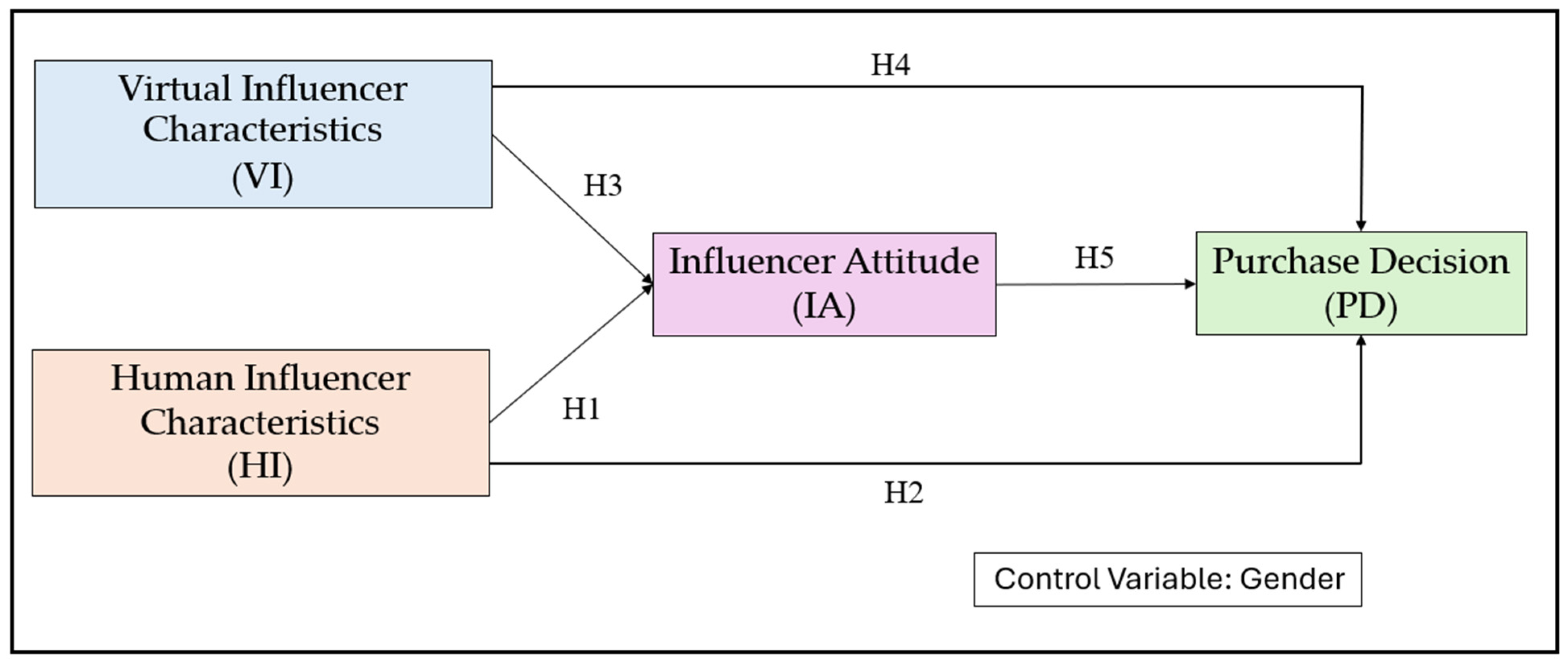
Based on this framework, human influencer characteristics are expected to influence influencer attitude through overall perceived credibility and relational evaluation. Prior studies suggest that the overall perception of influencer characteristics supports the development of trust and parasocial connections, which in turn foster more favorable evaluations of human influencers [26]. These characteristics are conceptualized at the construct level, reflecting consumers’ overall perceptions rather than individual measurement items. Beyond shaping attitudes, such characteristics may also directly influence consumers’ decision-making processes by reducing uncertainty and enhancing perceived credibility in product recommendations. Significantly, this study focuses on the holistic perception of influencer characteristics as a unified construct, rather than examining individual characteristics in isolation. Accordingly, the following hypothesis is proposed:
H1. 
Human influencer characteristics positively influence influencer attitude.
H2. 
Human influencer characteristics positively influence purchase decisions.
In contrast, virtual influencer characteristics are expected to influence attitude through a different mechanism. Virtual influencer characteristics are expected to influence attitude through a different mechanism. Rather than being evaluated based on isolated attributes, virtual influencers are assessed through an overall perception of technological embodiment and functional appeal, particularly by technologically experienced Gen Z consumers. However, this influence is more closely aligned with technology acceptance considerations than with deep emotional or relational bonding [9,32]. From a technology-oriented perspective, consumers may evaluate virtual influencers based on an integrated perception of technological and functional value, which can shape their overall attitudes. These characteristics may also directly affect purchase-related responses, particularly when virtual influencers are perceived as consistent and engaging sources of information. Therefore, the following hypothesis is proposed:
H3. 
Virtual influencer characteristics positively influence influencer attitude.
H4. 
Virtual influencer characteristics positively influence purchase decisions.
Across H1–H4, it should be noted that while both human and virtual influencer characteristics are predicted to positively influence influencer attitude, the underlying mechanisms are theoretically distinct. For human influencers, the proposed effect is primarily explained by SCT and PSI: perceived credibility, authenticity, and relational closeness are the mechanisms through which favorable attitudes are formed. For virtual influencers, the effect is driven more by TAM-consistent processes: consumers’ cognitive evaluation of technological novelty, functional consistency, and perceived fit within the digital platform environment. Although these mechanisms are not directly operationalized as separate latent variables—as the theoretical frameworks serve as interpretive lenses rather than empirically tested structures—this distinction forms the theoretical basis for expecting differential effect magnitudes across the two influencer types.
Finally, attitude toward an influencer is widely recognized as an important predictor of behavioral outcomes. Consistent with attitude–behavior frameworks, a more favorable attitude toward an influencer is expected to increase consumers’ willingness to follow recommendations and proceed with purchase decisions [13,36]. In this study, purchase decision is conceptualized as consumers’ reliance on influencer recommendations and their self-reported likelihood of acting upon such recommendations, rather than actual purchase behavior.
Although attitude is an important predictor of behavior, it does not fully influence purchase decisions, as consumer behavior is influenced by multiple contextual and individual factors. In this study, influencer attitude reflects an overall evaluative response toward the influencer, rather than isolated perceptions of specific attributes.
Thus, the following hypothesis is proposed:
H5. 
Influencer attitude has a positive effect on purchase decision.

2.5.2. Mediation Effects

Beyond direct effects, influencer attitude is expected to function as a mediating mechanism linking influencer characteristics to purchase decision. From a psychological perspective, consumers first form evaluative responses toward influencers before translating these perceptions into behavioral intentions. Therefore, both human and virtual influencer characteristics, as unified constructs, may exert indirect effects on purchase decision through influencer attitude. Thus, the following hypothesis is proposed:
H6. 
Influencer attitude mediates the relationship between human influencer characteristics and purchase decision.
H7. 
Influencer attitude mediates the relationship between virtual influencer characteristics and purchase decision.
Beyond testing the individual effects of each influencer type, a theoretically grounded question concerns whether human influencer characteristics exert a stronger overall influence on both influencer attitude and purchase decision than virtual influencer characteristics. Prior comparative studies consistently indicate that human influencers hold a persuasive advantage over their virtual counterparts, particularly in contexts where authenticity, emotional closeness, and relational credibility are central to consumer evaluation [10,39]. Human influencers’ ability to present life experiences, express genuine emotions, interact naturally generates stronger parasocial bonds and more attitudinal responses than the algorithm-controlled presentations of virtual influencers [38,49]. This advantage is amplified in inclusive cultural contexts such as Thailand, where interpersonal trust and social relationships carry particular weight in shaping consumer decision-making [50,51]. From the Source Credibility Theory, the perceived credibility and expertise of human influencers, based on observable real-world behavior, are more easily absorbed by audiences than the constructed credibility signals of virtual influencers, which rely more on heuristic assessments than experiential evaluation [10]. Accordingly, the following comparative hypothesis is proposed:
H8. 
Human influencer characteristics exert a stronger positive influence on both influencer attitude and purchase decision than virtual influencer characteristics.

2.6. Conceptual Framework

The hypothesized relationships are illustrated in the conceptual model presented in Figure 1. The model specifies Human Influencer Characteristics and Virtual Influencer Characteristics as exogenous constructs that influence Influencer Attitude. Influencer Attitude is positioned as a mediating construct that, in turn, affects Purchase Decision.

3. Research Methodology

3.1. Research Design and Measures

This study employed a quantitative research design using a cross-sectional survey to examine the relationships proposed in the conceptual model. The approach was suitable for assessing how influencer characteristics are associated with influencer attitude and subsequent purchase-related outcomes among Thai Gen Z consumers [37]. Data were collected at a single point in time, allowing examination of structural relationships among the study variables within a social commerce context.
All constructs were measured using established scales from prior studies [21,29,52,53], with minor adaptations to ensure relevance to the TikTok platform and the Thai cultural setting. Responses were recorded using a five-point Likert scale, ranging from 1 (strongly disagree) to 5 (strongly agree).
Virtual Influencer Characteristics (VI) were measured using a five-item scale adapted from Moustakas et al. [21] and Gerlich [54], capturing perceptions related to trustworthiness, innovativeness, product congruence, message consistency, and perceived neutrality. Human Influencer Characteristics (HI) were measured using items adapted from Ohanian’s [29] source credibility framework and subsequent refinements by Angmo & Mahajan [45], focusing on naturalness, experiential expertise, persuasive influence, personal appeal, and relatability. Significantly, both the HI and VI scales are designed to measure consumer perceptions of influencer behaviors and content characteristics, rather than fixed personality traits assigned to influencers. Each item is framed as a respondent judgment (e.g., “You think…”, “You feel…”), ensuring that the constructs reflect what consumers perceive in the influencer, rather than what the influencer inherently is. This operationalization aligns with the receiver-focused perspective of Source Credibility Theory and Parasocial Interaction Theory, and deliberately avoids conflating evaluative perception with personality attribution—a distinction that is particularly important in the case of virtual influencers, whose “characteristics” are entirely constructed and have no underlying psychological reality independent of audience interpretation.
Two items warrant additional justification in light of their wording. First, VI5 (“You think virtual influencers are more neutral than human influencers”) was retained from the scale developed by Gerlich [54], in which perceived neutrality relative to human influencers was theorized as a defining characteristic of virtual influencers, reflecting their algorithmic consistency and freedom from personal bias. The comparative phrasing was present in the original validated scale and reflects a property that is inherently relational—neutrality is meaningful only in contrast to human subjectivity. The item’s acceptable loading (β = 0.737) and the construct’s strong internal consistency (α = 0.878, AVE = 0.607) support its retention (see Table 2). Second, HI3 (“You think that recommendations from human influencers influence your purchasing decisions”) captures respondents’ perception of an influencer’s persuasive power over their decision-making—a dimension conceptually distinct from the Purchase Decision construct (PD), which measures actual behavioral reliance and product trial. This item reflects Source Credibility Theory’s persuasion dimension [31] and is consistent with the original Thai-language instrument, in which the item was designed to assess perceived influencer persuasiveness rather than actual purchase behavior. Its factor loading (β = 0.777) and the discriminant validity evidence (HTMT HI–PD = 0.658, well below the 0.85 threshold) confirm that HI and PD remain sufficiently distinct constructs (see Table 3).
Influencer Attitude (IA) reflects respondents’ overall affective and evaluative responses toward influencers and was measured using a five-item scale adapted from Feng, Chen & Xie [53]. The items assessed general appreciation, informational usefulness, confidence in decision-making, perceived product quality, and the influence of influencers on brand-related attitudes. Purchase Decision (PD) was measured using a five-item scale adapted from Schouten et al. [52], capturing the extent to which influencers affect product trial, discovery, confidence in purchasing, trust-based decisions, and ease of comparison among alternatives. It is acknowledged that the Purchase Decision scale contains items that vary in their behavioral specificity. Items PD1 and PD2 employ a past-behavioral framing (“Have you ever made a purchase decision after seeing an influencer review?”; “Have you ever tried buying something you did not know before because an influencer recommended it?”), while PD3–PD5 reflect attitudinal reliance and decision-making confidence. This integrated framework reflects the multidimensional nature of purchase decision as performed on the source scale [44], which incorporates both experiential recall and tendencies toward influencer-guided purchases. Table 2, all items loaded acceptably on a single factor (loadings: 0.765–0.869), and the construct demonstrated strong internal consistency (α = 0.886, AVE = 0.625), suggesting that respondents interpreted the items as reflecting a coherent underlying disposition. Nevertheless, future research may benefit from developing more homogeneously phrased scales that distinguish clearly between behavioral intention and past purchase behavior.
The measurement items were adapted from validated scales in prior research and modified to be contextually relevant to TikTok-based social commerce in Thailand. All measurement items were adapted to reflect the TikTok context by explicitly referring to TikTok influencers and user interactions on the TikTok platform. Respondents were instructed to evaluate all items based on their experiences with TikTok content and TikTok influencers.

3.2. Instrument Development and Validation

Measurement items were adapted from well-established scales to maintain content validity while ensuring contextual relevance. Example items include: “Virtual influencers on TikTok appear trustworthy and have a good image” for VI, “Human influencers review products based on real-world experiences” for HI, “You have a positive attitude toward the influencers you follow” for IA, and “You tend to buy products based on reviews from influencers you trust” for PD. The questionnaire explicitly framed all items within the TikTok environment to ensure contextual consistency between the study setting and construct measurement.
To ensure clarity and appropriateness, the questionnaire was reviewed by three scholars with expertise in digital marketing and consumer behavior. A pilot test was conducted with 30 respondents to assess clarity of wording, comprehension, and preliminary reliability. Minor revisions were made following the pilot test to improve linguistic clarity and cultural suitability for Thai Gen Z respondents.

3.3. Data Collection and Sample

Born between 1995 and 2010, Gen Z Thais who regularly use TikTok were the target population. A non-probability purposive sampling approach was employed to recruit respondents who met the predefined criteria for the study. Using social media channels, respondents were found by online survey distribution throughout Facebook, Line, Instagram, and TikTok—often used by Thai Gen Z. Participants went over eligibility screening questions before completing the main survey to ensure they met the research environment. Respondents were specifically asked if they (1) had previously followed influencers on digital platforms, (2) had seen or knew of virtual influencers, and (3) fit the age criteria for Gen Z. Only those who matched the criteria for inclusion completed the whole study. Given that a substantial proportion of respondents fell within the 15–18 age range, additional ethical considerations were observed. In Thailand, TikTok account registration for users under 18 requires parental involvement in accordance with platform regulations, thereby establishing an implicit layer of parental awareness regarding minors’ digital participation. Prior to completing the survey, all respondents received a written information sheet explaining the study’s purpose, voluntary nature, and data confidentiality. Participation was treated as constituting informed assent, and no sensitive or personally identifiable information was collected. The study protocol was reviewed and approved by the Mahasarakham University Ethical Committee for Research Involving Human Subjects (Approval number: 710-677/2025), covering research procedures relevant to participants in this age group. This recruiting and screening approach is widely used in studies on platform-based customer behavior and digitally active populations, therefore facilitating good access to appropriate participants while staying in line with the conceptual focus of the study. Respondents were instructed to answer all questions based on their experiences with TikTok influencers and TikTok content consumption. Although the measurement items were phrased in general terms, all responses were explicitly anchored in the TikTok context during data collection. Responses were reviewed to ensure data quality. All responses were complete due to the survey design, and no evidence of uniform response patterns was observed.
The minimum required sample size was calculated using Cochran’s formula for an unknown population, assuming a 95% confidence level and a 5% margin of error, which indicated a minimum of 385 respondents [55]. A total of 400 complete and valid responses were obtained and retained for analysis. This sample size exceeds the commonly cited minimum threshold of 200 for CB-SEM [56,57]; however, adequacy was further evaluated against the requirements of the specific model estimated in this study. The present model comprises four latent constructs, 20 observed indicators, and five structural paths, which places it within the range of moderate complexity. Based on established sample size guidelines for models of this complexity [58], a sample size of 400 provides sufficient capacity and supports reliable parameter estimation across all paths. Screening questions were included to confirm respondents’ TikTok usage.

3.4. Sample Characteristics

The final sample consisted of 400 Thai Gen Z respondents who actively use TikTok. Female respondents accounted for a larger proportion of the sample (72.0%), and most participants were between 15 and 18 years of age (78.0%). In terms of educational background, the majority were enrolled in high school or vocational programs (66.0%), while 95.5% were students at either the high school or university level. Regarding monthly income, three-quarters of the respondents (75.0%) reported earnings below USD 143. Overall, these characteristics reflect the younger, student-based segment of Thai Gen Z users who are actively engaged with TikTok.

3.5. Data Analysis

Data analysis was conducted in two stages following established guidelines for covariance-based structural equation modeling [56]. Covariance-based SEM was selected over variance-based alternatives because the study’s primary objective is theory testing with a pre-specified causal structure among latent constructs, a condition for which CB-SEM under maximum likelihood estimation is particularly well-suited [56,57]. Statistical analyses were performed using Jamovi (version 2.6) [59], a statistical software package that integrates modules using the R programming language for advanced analysis, with additional analyses supported by lavaan in SEM [60]. Supplementary ANN analysis was conducted using Python (version 3.10) with the scikit-learn library (version 1.2.2), specifically the MLPRegressor module [61].
In the first stage, the measurement model was evaluated to assess reliability and validity. Internal consistency was examined using Cronbach’s alpha and composite reliability, with values above 0.70 indicating acceptable reliability. Convergent validity was assessed using the average variance extracted (AVE), with values above 0.50 considered satisfactory [62]. Discriminant validity was evaluated using the Fornell–Larcker criterion, which requires the square root of the AVE for each construct to exceed its correlations with other constructs [62,63].
In the second stage, the structural model was assessed to test the proposed hypotheses. Covariance-based structural equation modeling (CB-SEM) was employed due to its suitability for theory testing and confirmation, as well as its ability to provide robust model fit indices and parameter estimates under maximum likelihood estimation [56,64]. The significance of the structural paths was examined using a bootstrapping procedure with 5000 resamples. Model explanatory power was assessed using the coefficient of determination (R2) for Influencer Attitude and Purchase Decision, while predictive relevance was evaluated using the Stone–Geisser Q2 statistic obtained through a blindfolding procedure [64].
Supplemental Predictive Check for an Artificial Neural Network (ANN): to reinforce the predictive interpretation and complement the SEM findings, we conducted a supplemental artificial neural network (ANN) analysis using construct mean scores (HI_mean, VI_mean, IA_mean, and PD_mean). Two models were projected to reflect the initial structural paths: (i) forecasting influencer attitude from HI and VI; (ii) predicting purchase decision from HI, VI, and influencer attitude. Ten-fold cross-validation and a holdout test set were used to assess model performance, and permutation-based relevance ranked the contributions of predictor variables. The ANN analysis was implemented in Python 3.10 using the scikit-learn library [61], specifically a Multi-Layer Perceptron (MLP) neural network for continuity prediction (MLPRegressor).

3.6. Common Method Bias Mitigation

Because data were collected using a self-reported questionnaire, potential common method bias was addressed using both procedural and statistical approaches. Procedurally, respondents were assured of anonymity and confidentiality, and the questionnaire was designed to minimize evaluation apprehension and response patterning by randomizing item order [65].
Statistically, Harman’s single-factor test was conducted using exploratory factor analysis. The results indicated that no single factor accounted for the majority of variance, suggesting that common method bias was unlikely to be a serious concern. In addition, a full collinearity assessment was conducted in accordance with Kock’s [66] recommendation. Variance inflation factor (VIF) values for all constructs were below the threshold of 3.3, with the highest VIF value of 2.89 (Table 4), providing further evidence that common method bias did not materially affect the results.
Table 3. Discriminant Validity (HTMT).
ConstructHIVIIAPD
HI0.731
VI0.6950.779
IA0.8220.6790.780
PD0.6580.5380.7540.790
Note. Bold diagonal values represent the square root of the Average Variance Extracted (√AVE). Off-diagonal values are HTMT ratios. Discriminant validity is supported when √AVE exceeds all corresponding off-diagonal HTMT values, and when all HTMT values fall below the threshold of 0.85 [62,63].
Table 4. Results of the Structural Model Analysis.
HypothesisPathStd. βCI (β) LowerCI (β) Upperz-Valuep-ValueVIFf2Result
H1HI → IA0.6190.5270.7118.834<0.0011.711.239Accepted
H2HI → PD0.039−0.1170.1940.4880.6262.430.006Not Accepted
H3VI → IA0.2830.1840.3835.159<0.0011.710.262Accepted
H4VI → PD0.007−0.1090.1240.1190.9052.110.000Not Accepted
H5IA → PD0.7350.5760.8937.322<0.0012.890.372Accepted
-GEN → IA−0.115−0.222−0.055−3.2530.0011.120.033Sig.
-GEN → PD−0.053−0.1970.036−1.3590.1741.120.004n.s.
Note. Std. β = standardized path coefficient; CI = 95% confidence interval; VIF = Variance Inflation Factor; f2 = Cohen’s effect size [67]. Hyphen (-) represents the control variable Gender (dummy-coded: 1 = female, 0 = male). All VIF values < 3.3 indicate no multicollinearity concern. f2 benchmarks: ≥0.02 small, ≥0.15 medium, ≥0.35 large. Sig. represents significance. n.s. represents not significance.

4. Results

4.1. Measurement Model Assessment

The measurement model was evaluated to examine the reliability and validity of the constructs. As reported in Table 2, all indicator loadings met the recommended threshold of 0.60. Measures of internal consistency showed satisfactory results, with Cronbach’s alpha and composite reliability values exceeding 0.70 across all constructs. In addition, the average variance extracted (AVE) values for each construct were above the minimum criterion of 0.50 [62]. Collectively, these results confirm that the measurement scales demonstrate adequate internal consistency and convergent validity.

4.2. Structural Model and Hypothesis Testing

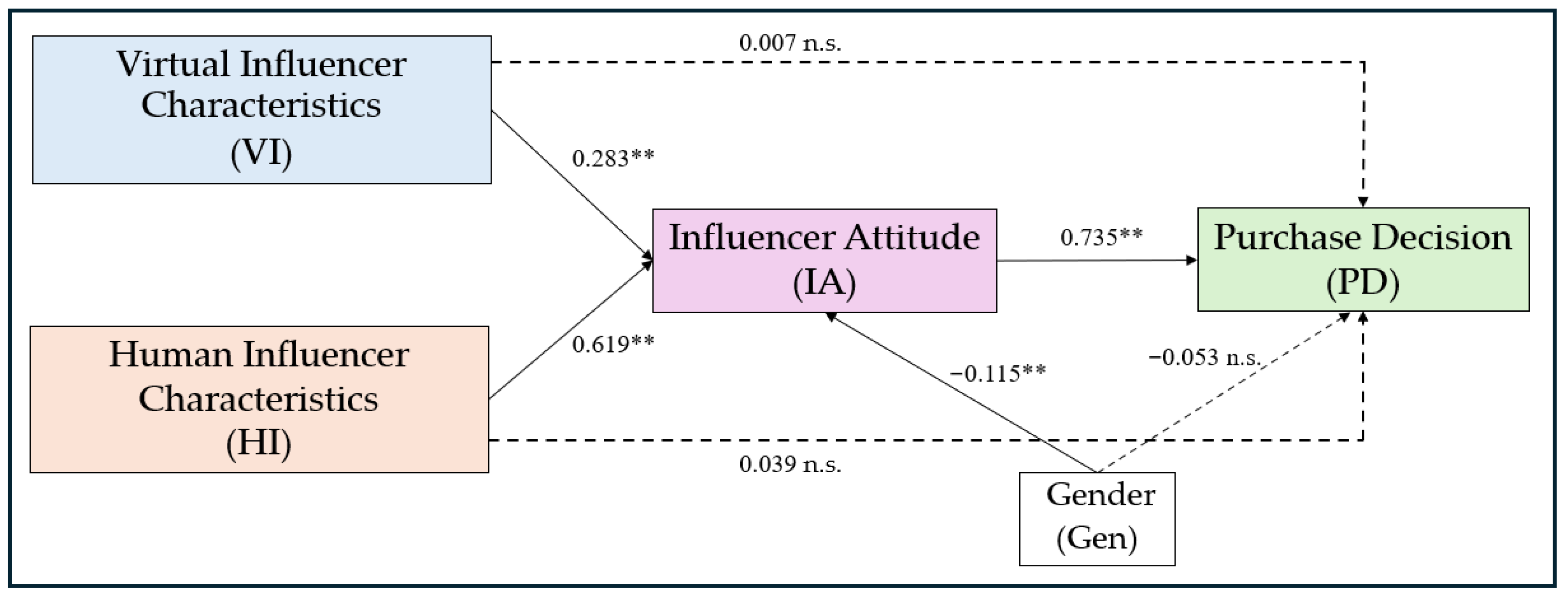
The structural model was evaluated to examine the hypothesized relationships among the constructs, and the results are reported in Table 4 and Table 5, and Figure 2. Prior to hypothesis testing, the overall model fit was assessed. The standardized root mean square residual (SRMR) value was 0.030, which is below the recommended threshold of 0.08, indicating an acceptable level of model fit [64].
The model also demonstrates satisfactory explanatory power. The coefficient of determination (R2) for Influencer Attitude (IA) is 0.689, while that for Purchase Decision (PD) is 0.594, suggesting that the model explains a substantial proportion of the variance in both endogenous constructs. These values are considered moderate to substantial in behavioral research contexts [64]. In addition, predictive relevance was assessed using the Q2 statistic approximated from the coefficient of determination following Hair et al. [47]. The resulting values of Q2(IA) = 0.689 and Q2(PD) = 0.594, both substantially exceeding zero, confirm adequate predictive relevance for both endogenous constructs.
Discriminant validity was further examined using the HTMT criterion, as presented in Table 3. All HTMT values fall below the threshold of 0.85, providing additional support for the distinctiveness of the construct. Additionally, HTMT inference was assessed, and none of the confidence intervals included the value of 1.0, further confirming discriminant validity [63].
As shown in Table 4 and Figure 2, the results reveal both significant and non-significant relationships. Human Influencer Characteristics (HI) have a strong, positive effect on Influencer Attitude (IA) (β = 0.619, p < 0.001), supporting H1. This finding suggests that attributes such as authenticity, experiential credibility, and relatability play a central role in shaping favorable evaluations of influencers among Thai Gen Z users.
Virtual Influencer Characteristics (VI) also show a positive and significant effect on Influencer Attitude (β = 0.283, p < 0.001), supporting H3. However, the magnitude of this effect is notably smaller than that of human influencers, indicating that virtual influencers contribute to attitude formation through a different, and potentially less emotionally grounded, evaluative process.
In contrast, the direct effects of both Human Influencer Characteristics (β = 0.039, p > 0.05) and Virtual Influencer Characteristics (β = 0.007, p > 0.05) on Purchase Decision (PD) are not statistically significant. These findings do not support H2 and H4, and suggest that influencer characteristics do not directly translate into purchasing behavior.
By comparison, Influencer Characteristics (IA) shows a strong and positive effect on Purchase Decision (β = 0.735, p < 0.001), supporting H5. This result confirms the central role of attitude as the primary mechanism through which influencer characteristics are translated into behavioral outcomes. The relatively high standardized coefficient observed for the IA → PD path (β = 0.735) warrants interpretive consideration. Within a full mediation model, where the predictor constructs exert no significant direct effects on the outcome, a large attitude–behavior coefficient is both theoretically expected and empirically consistent with prior research in platform-based consumer contexts [13,53]. This pattern reflects a structural condition in which influencer characteristics operate exclusively through attitudinal formation, thereby concentrating explanatory variance in the IA → PD path. Critically, multicollinearity does not account for this result: all VIF values fall below 3.3 (range: 1.12–2.89), and all HTMT ratios are below 0.85, ruling out inflated coefficient estimates due to construct overlap. The observed coefficient magnitude is therefore attributable to the psychological mechanism under study rather than a statistical artifact.

4.2.1. Mediation Effects

To further examine the indirect relationships, mediation analysis was conducted, and the results are presented in Table 5. The findings indicate that Influencer Attitude (IA) significantly mediates the relationship between Human Influencer Characteristics and Purchase Decision (β = 0.455, p < 0.001), accepting H6. Similarly, IA also mediates the relationship between Virtual Influencer Characteristics and Purchase Decision (β = 0.207, p < 0.001), supporting H7. Importantly, the confidence intervals for both indirect effects do not include zero, confirming the presence of significant mediation effects. Given that the direct effects of HI → PD and VI → PD are non-significant, the results suggest a full mediation mechanism, in which influencer characteristics affect purchase decisions only through the formation of an influencer attitude.
Overall, the structural model demonstrates a clear and theoretically consistent pattern. Both human and virtual influencer characteristics contribute to shaping influencer attitudes, but only indirectly influence purchase decisions through this attitudinal pathway. Among the predictors, Human Influencer characteristics have a stronger effect on attitude formation, while Influencer Attitude is the most influential determinant of Purchase Decision.
These findings reinforce the role of attitudinal evaluation as a key psychological mechanism in influencer-based persuasion within TikTok-driven social commerce environments. This pattern is also consistent with further supplementary predictive analysis using ANN, which highlights the significant role of influencer attitudes in predicting purchase decisions (see Appendix A).

4.2.2. Comparing the Effects

To further compare the overall influence of human influencer characteristics (HI) and virtual influencer characteristics (VI), total effects on purchase decision were examined in addition to the direct and indirect paths. The results show that HI exerted a substantially stronger total effect on purchase decision (β = 0.493, z = 6.267, p < 0.001) than VI (β = 0.215, z = 2.895, p = 0.004). This pattern is consistent with the structural paths reported earlier, where HI had a stronger effect on influencer attitude (β = 0.619, p < 0.001) than VI (β = 0.283, p < 0.001), and where only the indirect effects through influencer attitude were significant for both predictor constructs. Across both attitude formation and total effects on purchase decision, the evidence consistently points to a stronger influence of human influencers relative to virtual influencers in the TikTok context. These results provide support for H8, confirming that human influencer characteristics exert a stronger positive influence on both influencer attitude and purchase decision than virtual influencer characteristics. The difference is evident across attitude formation (β = 0.619 vs. 0.283) and total effects on purchase decision (β = 0.493 vs. 0.215).
To establish the statistical significance of this difference, confidence intervals for the total effects were examined using bootstrap resampling (5000 iterations). The 95% confidence interval for HI’s total effect on purchase decision (0.440, 0.837) does not overlap with that of VI (0.066, 0.351), confirming that the difference between the two total effects is statistically significant at p < 0.05. This non-overlapping interval pattern provides direct statistical support for H8 and substantiates the conclusion that human influencer characteristics exert a stronger overall influence on consumer outcomes than virtual influencer characteristics within this context.

4.3. Supplementary Predictive Check Using Artificial Neural Network (ANN)

A supplementary artificial neural network (ANN) analysis was conducted to complement the SEM findings with a non-parametric predictive check. While CB-SEM excels at theory testing and estimating directional relationships among latent constructs under distributional assumptions, ANN offers a model-free approach capable of capturing non-linear patterns and ranking predictor importance without imposing structural constraints [68]. The ANN was therefore employed not as a replacement for SEM but as a convergent validation tool to assess whether the predictor importance rankings identified through SEM hold under a different analytical paradigm—thereby strengthening confidence in the substantive conclusions.
Two multilayer perceptron regression models were specified to mirror the SEM structure: Model A predicted influencer attitude (IA_mean) from HI_mean and VI_mean; Model B predicted purchase decision (PD_mean) from HI_mean, VI_mean, and IA_mean. Each model used a single hidden layer with five nodes and a sigmoid activation function. The dataset was partitioned into 70% training and 30% holdout test sets. Ten-fold cross-validation was applied on the training set to reduce overfitting. The network was trained using a gradient descent backpropagation algorithm with early stopping based on validation loss, with a maximum of 1000 iterations and a convergence tolerance of 0.0001. Predictor importance was assessed via permutation-based importance computed on the holdout test set. Full ANN settings and diagnostics are provided in Appendix B.
Model A achieved cross-validated RMSE = 0.435 (R2 = 0.521) and holdout R2 = 0.465. Model B achieved cross-validated RMSE = 0.592 (R2 = 0.405) and holdout R2 = 0.449. Permutation importance confirmed that HI_mean contributed more strongly than VI_mean to predicting IA_mean (importance: 0.482 vs. 0.228), while IA_mean was the most influential predictor of PD_mean (importance: 0.736). These results converge with the SEM pattern, providing cross-methodological support for the dominance of human influencer characteristics in attitude formation and the central role of influencer attitude in predicting purchase decisions. Notably, the differential importance scores—with authenticity-related indicators contributing most strongly for human influencers and visual–technological indicators leading for virtual influencers—provide partial insight into the decomposed mechanisms underlying each influencer type, partially addressing the limitation of aggregate construct measurement. Future research employing multi-dimensional sub-scales would allow more definitive decomposition of these characteristic-level effects.

5. Discussion

5.1. Key Findings and Interpretation

The findings reveal clear differences in how human and virtual influencers shape the attitudes and purchase decisions of Thai Gen Z consumers on TikTok, particularly in terms of effect magnitude and underlying persuasive mechanisms.
The results show that the characteristics of human influencers have a significantly stronger effect on influencer attitude than the virtual influencer characteristics. Notably, neither influencer type directly affects purchase decision; instead, both operate exclusively through influencer attitude as a mediating mechanism, confirming attitude as the primary psychological pathway linking perceived influencer characteristics to consumer behavior.
The magnitude of this effect (β = 0.619) suggests the role of authenticity, emotional warmth, and real-life experience in influencer-based persuasion. These characteristics appear to resonate strongly with Thai Gen Z users, who tend to place trust in influencers that demonstrate genuine expertise, share relatable personal experiences, and communicate in a way that feels socially and emotionally close [26,39]. Within the Thai cultural context, which prior research characterizes as placing considerable value on interpersonal trust and relational closeness [1,29], the ability of human influencers to express empathy and engage spontaneously may contribute to their stronger evaluative advantage.
Virtual influencer characteristics also show a positive relationship with influencer attitude, although the effect is noticeably weaker (β = 0.283). This indicates that virtual influencers are perceived as effective, even though their evaluation process underlying their effectiveness more cognitively oriented. Rather than emotional connection, their appeal is more closely linked to innovation, visual design, and consistency in brand presentation. From this perspective, the findings are consistent with the Technology Acceptance Model, indicating that Thai Gen Z consumers evaluate virtual influencers primarily in terms of usefulness and ease of engagement within a digital environment [10]. Features such as continuous content availability and creative storytelling contribute to positive evaluations, while the absence of lived human experience appears to limit the depth of relational connection that virtual influencers can establish [21,39].
In addition, influencer attitude plays a central role in translating influencer characteristics into actual purchasing decisions. The strong and significant relationship between influencer attitude and purchase decision (β = 0.735) suggests that a favorable overall evaluation serves as a key mechanism through which influence operates. This is consistent with theories of reasoned action, which emphasize attitude as a direct precursor to behavioral outcomes [13]. In a platform context such as TikTok, where users are exposed to a large volume of content in a short time, a positive attitude toward an influencer may reduce perceived risk and simplify decision-making by helping consumers narrow their product choices to sources they trust [7,69].
Beyond the direct relationships, the findings further reveal a full mediation mechanism. Neither human nor virtual influencer characteristics show a significant direct effect on purchase decision; instead, their influence is fully transmitted through influencer attitude. This pattern highlights that consumers do not respond immediately to perceived influencer characteristics. These characteristics first shape an overall evaluative response, which then guides behavioral decisions.
From a theoretical perspective, this finding supports the combined explanatory power of Source Credibility Theory and Parasocial Interaction Theory, where credibility cues and relational closeness influence behavior indirectly through attitudinal formation [15,29]. At the same time, it is consistent with the Technology Acceptance Model, suggesting that technology-related evaluations may shape consumer responses indirectly through attitudinal formation rather than as directly measured TAM constructs. [13,53].
It should be acknowledged, however, that the strong IA → PD coefficient also reflects the design conditions under which the data were collected. The sample consists exclusively of Gen Z TikTok users who self-report active influencer engagement, a characteristic that predisposes them toward attitude-consistent behavioral responses. In contrast to general population surveys, where the attitude–behavior gap tends to be wider due to competing motivations and contextual barriers, high-involvement digital consumers in this context are more likely to act on their evaluations within the same platform environment [69]. The integrated TikTok ecosystem—where content exposure, product evaluation, and purchase execution occur within a single interface—further compresses this gap by reducing friction between attitudinal formation and behavioral follow-through. This contextual explanation does not eliminate the possibility that the observed coefficient overstates the relationship in less engaged populations; accordingly, the attitude–behavior gap is discussed as a limitation below.
Beyond the mediation results, an additional insight emerges from the comparison of total effects. This comparative finding reinforces the argument that human and virtual influencers operate through distinct persuasive mechanisms and should not be treated as interchangeable agents. The stronger total effect of HI indicates that the persuasive advantage of human influencers extends beyond attitude formation and translates more effectively into purchase-related outcomes. This is consistent with Source Credibility Theory, which highlights the roles of perceived expertise, trustworthiness, and authenticity in shaping consumer responses [70], as well as Parasocial Interaction Theory, which emphasizes relational closeness and emotional connection as key drivers of influence [15]. In collectivistic cultural contexts such as Thailand, where prior research suggests that interpersonal trust and social relatability shape consumer behavior [1,29], these human-centric qualities may carry comparatively greater weight in guiding purchase-related decisions. By contrast, although virtual influencers positively affect attitudes, their influence appears to rely more on cognitively oriented evaluations such as novelty, design consistency, and technological appeal, which may be less effective in translating favorable attitudes into stronger behavioral outcomes. This pattern is also consistent with previous research suggesting that technology-mediated agents are often evaluated based on functional and symbolic characteristics rather than deep relational understanding [21,71].
These differential patterns may also reflect cultural trust mechanisms operating within the Thai context. Source Credibility Theory and Parasocial Interaction Theory were developed primarily in individualistic, low-context research settings, where persuasion is modeled largely as a cognitive evaluation of message attributes. In collectivist, high-context cultures such as Thailand, trust operates across both cognitive and affective dimensions—rooted in perceived competence and reliability, and in-group belonging [72]. For human influencers, both dimensions may be simultaneously activated through authentic self-presentation and spontaneous relational engagement. For virtual influencers, the affective dimension is structurally limited by the absence of genuine emotional capacity. The observed difference in effect magnitude (HI β = 0.619 vs. VI β = 0.283) is broadly consistent with this interpretation. However, as this study does not directly measure cognitive versus affective trust, nor include individual-level cultural value scales, this account remains theoretically informed but empirically unverified, and is better understood as a direction for future research than as a conclusion of the present study.

5.2. Theoretical Contributions

This study contributes to the literature on digital marketing and influencer research in several ways. First, it brings together Source Credibility Theory, Parasocial Interaction Theory, and the Technology Acceptance Model within a single analytical framework, allowing influencer effectiveness to be explained simultaneously through credibility perceptions, relational processes, and technology-related evaluations. By integrating these perspectives, the study moves beyond single-theory explanations that have dominated prior research. The differential effect magnitudes observed across the two influencer types—HI (β = 0.619) versus VI (β = 0.283) on influencer attitude, are broadly consistent with theoretical expectations that human influencers engage relational-affective pathways more effectively than virtual influencers. However, as this study did not include direct measures of affective or cognitive persuasion processes, this interpretation remains exploratory. Future research employing emotion-specific scales or the Elaboration Likelihood Model (ELM) framework would be better positioned to rigorously test this distinction.
A second contribution concerns the conceptual distinction between influencer characteristics as consumer-side evaluative perceptions and as sender-side personality constructs. Prior influencer research has frequently conflated these two levels—treating perceived credibility or relatability as though they were stable traits residing in the influencer rather than judgments formed in the minds of audiences [42]. The present study addresses this by grounding both the HI and VI constructs in audience evaluation: all items are framed as respondent judgments rather than influencer attributions, and the constructs are interpreted through SCT and PSI as receiver-side perceptions rather than fixed influencer properties. While grounding constructs in audience evaluations rather than sender attributes is an established practice in persuasion research, its systematic application to comparing human versus virtual influencers remains limited in the existing literature. The contribution of this study, therefore, lies not in the conceptual distinction per se but in demonstrating how an audience evaluation lens reveals meaningfully different persuasive profiles across the two influencer types within a Southeast Asian social commerce context.
Third, the findings provide direct empirical evidence comparing human and virtual influencers within a Southeast Asian context. While existing studies have largely focused on Western settings, this research responds to a clear geographical gap by examining influencer dynamics among Thai Gen Z consumers. The results, therefore, extend current understanding of influencer marketing to a cultural context characterized by collectivist values and strong relational orientation.
Finally, this study contributes contextually grounded evidence from a Southeast Asian market that has been underrepresented in the influencer marketing literature. The observed advantage of human influencers among Thai Gen Z consumers is broadly consistent with prior research, suggesting that in collectivist, high-context cultural settings, relational authenticity and affective trust may carry greater persuasive weight than abstract credibility signals [27]. However, as this study does not employ individual-level cultural value measures or a cross-cultural comparison, such interpretations remain exploratory rather than empirically established. Future research should incorporate cultural value scales or comparative designs to formally test whether the structural model is culturally contingent. Examining these dynamics within TikTok’s short-form, algorithm-driven environment further contributes to a more platform-specific understanding of influencer persuasion, a level of contextual specificity that has not yet been fully achieved in studies relying on general social media platforms.

5.3. Managerial Implications

The following implications are based on the empirical findings reported in Section 4. Where recommendations extend to specific product categories, content formats, or campaign contexts, these should be understood as theoretically informed extrapolations rather than direct conclusions from the present data, given that the study did not empirically examine category-specific effects. Such recommendations would benefit from validation in future research designed to test boundary conditions across product types and campaign objectives.
The findings of this study provide several practical implications for marketers and brands targeting Gen Z consumers on TikTok. When campaign objectives emphasize trust building, emotional connection, or the demonstration of real product usage, human influencers appear to be particularly effective. Their ability to express authenticity and personal experience may be particularly suited for categories such as skincare, wellness, and fashion—contexts where credibility-driven persuasion is theoretically expected to be influential, though this inference extends beyond the present data, where perceived credibility plays a critical role in consumer decision-making.
At the same time, virtual influencers offer distinct advantages in campaigns that prioritize innovation, visual consistency, or large-scale content production. Their strengths are especially relevant for technology-oriented, gaming, or highly stylized creative campaigns, where futuristic branding and narrative control are valued. Rather than viewing human and virtual influencers as substitutes, the results suggest that a hybrid strategy may be particularly effective. In such an approach, human influencers can provide emotional resonance and authentic endorsement, while virtual influencers support continuous branded presence through always-on content and interactive digital experiences.
Content strategy should be customized to the nature of the influencer. Human influencers benefit from sharing unscripted, behind-the-scenes, and experiential content that reinforces authenticity, whereas virtual influencers are most effective when leveraged through visually sophisticated, narratively coherent, and interactive formats. Importantly, transparency regarding the artificial nature of virtual influencers remains essential, as openness helps preserve consumer trust and allays the risk of negative reactions associated with perceived deception [44,73].

5.4. Limitations and Future Research Directions

This study’s scope necessarily entails boundary conditions that, taken together, outline a productive agenda for future research. Each of the following points identifies both a constraint of the present design and a specific opportunity for subsequent inquiry. First, the focus on Thai Gen Z consumers and the TikTok platform may limit the generalizability of the findings. Future studies could apply the proposed model in different cultural contexts, including more individualistic societies, as well as across other social media platforms, to examine potential boundary conditions.
Second, the cross-sectional data restrict causal interpretation. Furthermore, this study did not incorporate control variables beyond gender, such as platform usage intensity or prior purchase experience, which may independently influence consumer responses and should be considered in future model specifications. Moreover, constructs such as interpersonal trust and social harmony were not directly measured; interpretations referencing these factors therefore reflect contextual reasoning grounded in prior literature rather than empirical conclusions drawn from the present data.
Third, the potential attitude–behavior gap constitutes a meaningful boundary condition for interpreting the findings. The observed IA → PD coefficient (β = 0.735) is consistent with full mediation in a structurally constrained model; however, it may not generalize to contexts where consumers have lower platform involvement or face greater purchase friction. The present study measured purchase decision as self-reported behavioral intention rather than actual transactional behavior, which introduces the possibility that favorable attitudes are overstated relative to real purchasing outcomes. Future research would benefit from incorporating observed behavioral data—such as click-through rates, cart additions, or completed transactions—to assess the extent to which attitudinal evaluations translate into measurable commercial outcomes.
Fourth, the absence of attention check items represents a procedural limitation. Although data quality was monitored through survey design controls and screening for uniform response patterns, the inclusion of dedicated attention checks in future studies would provide a more rigorous basis for verifying respondent engagement and excluding inattentive responses.
Fifth, the use of screening criteria requiring prior influencer exposure may introduce selection bias. Respondents who had never followed influencers were systematically excluded, meaning the sample is drawn from a population already predisposed toward positive influencer evaluations. This concentration of high-involvement respondents likely contributed to the strong IA → PD coefficient observed, and may lead to an overestimation of the relationships when applied to broader consumer populations. Future studies would benefit from including respondents with varying levels of influencer engagement to better assess the boundary conditions of the model.
Sixth, the study relied on broad composite measures of influencer characteristics. Future research may benefit from examining more specific sub-dimensions, such as distinct facets of authenticity among human influencers or varying degrees of perceived human likeness among virtual influencers, to provide more granular insight into the mechanisms of influencer effectiveness.
Finally, the demographic composition of the sample warrants critical discussion regarding generalizability. With 78% of respondents aged 15–18 and 95.5% identifying as students, the sample is concentrated in the younger and educationally homogeneous segment of Gen Z. While this group is among the most active TikTok users and represents a primary target audience for influencer marketing, it may not reflect the full range of Gen Z consumer behavior. Younger adolescents may exhibit heightened susceptibility to social influence and novelty effects, which could amplify the observed attitude–behavior relationship relative to what might be found among older Gen Z consumers. Working Gen Z adults, by contrast, may prioritize different influencer characteristics—such as domain expertise and product credibility—over relatability and esthetic appeal. These intra-generational differences may meaningfully alter the strength and direction of the proposed relationships. Future research should purposefully recruit across the full Gen Z age spectrum and occupational range to examine whether the structural model holds across these subgroups. The inclusion of older Gen Z age, such as early-career professionals, would substantially strengthen the external validity of the findings. Future research could also explore emerging hybrid forms of influence—including heavily edited human influencers or collaborative human–AI personas—to better understand the expanding spectrum of digital influence.

6. Conclusions

This study shows that both human and virtual influencers play meaningful roles in shaping the purchasing decisions of Thai Gen Z consumers on TikTok, albeit through different mechanisms. Human influencers remain particularly influential due to their perceived authenticity, emotional closeness, and real-life experience, while virtual influencers derive value from innovation, consistency, and creative control. Across both influencer types, a positive overall attitude toward the influencer emerges as the key link between influencer characteristics and consumer action.
By integrating multiple theoretical perspectives and examining a non-Western cultural context, this research contributes to a more nuanced understanding of influencer marketing in social commerce. From a practical standpoint, the findings encourage marketers to move beyond a binary choice between virtual and human influencers and instead adopt strategies that leverage the complementary strengths of both. As artificial intelligence and digital content creation continue to advance, recognizing these differentiated pathways of influence will be increasingly important for effective and responsible marketing practice.

Author Contributions

Conceptualization: J.P. and T.U.; Data curation: J.P. and P.W.; Investigation: J.P.; Methodology: J.P., R.W. and T.U.; Software: J.P. and T.U.; Visualization: J.P. and P.W.; Writing—original draft: J.P., R.W. and T.U.; Writing—review & editing: J.P. and P.W. All authors have read and agreed to the published version of the manuscript.

Funding

This research project was financially supported by Mahasarakham Business School, Mahasarakham University, Thailand.

Institutional Review Board Statement

This study was reviewed and approved by the Mahasarakham University Ethical Committee for Research Involving Human Subjects (Approval number: 710-677/2025; approval date 27 October 2025).

Informed Consent Statement

Informed consent was obtained from all subjects involved in the study. For respondents aged 15–18, participation was conducted with parental awareness consistent with Thai regulatory requirements for minor users of social media platforms. The study was approved by the Mahasarakham University Ethical Committee for Research Involving Human Subjects (Approval number: 710-677/2025).

Data Availability Statement

The data presented in this study are available on request from the corresponding author.

Conflicts of Interest

The authors declare no conflicts of interest.

Appendix A. Survey Instruments

ConstructsItems
Virtual Influencer
(VI)
VI1: You think virtual influencers on TikTok have a good image and are trustworthy.
VI2: You think virtual influencers are modern and innovative.
VI3: You think virtual influencers fit well with the products they promote.
VI4: You think virtual influencers speak or post content clearly and consistently.
VI5: You think virtual influencers are more neutral than human influencers.
Human Influencer
(HI)
HI1: You think that human influencers’ personalities are natural and approachable.
HI2: You feel that human influencers review products based on their real-world experiences.
HI3: You think that recommendations from human influencers influence your purchasing decisions.
HI4: You feel that human influencers’ appearance/personality appeals to you.
HI5: You think that human influencers’ lifestyles are like your own.
Influencer Attitude
(IA)
IA1: You appreciate and have a positive attitude towards the influencers you follow.
IA2: Influencers help you understand product information more easily.
IA3: You feel more confident in making purchasing decisions after watching influencer reviews.
IA4: When your favorite influencers recommend products, you perceive them as good quality.
IA5: Influencers influence your feelings or attitudes towards brands.
Purchase Decision
(PD)
PD1: Have you ever made a purchase decision after seeing an influencer review?
PD2: Have you ever tried buying something you did not know before because an influencer recommended it?
PD3: Influencers helped you be confident that the product you were buying was right for your needs.
PD4: You tend to buy products based on reviews from influencers you trust.
PD5: Influencers make it easier for you to make a decision when comparing multiple products.

Appendix B. Supplementary Predictive Analysis Using ANN

Appendix B.1. Purpose and Data Preparation

To offer a complimentary predictive robustness check supporting the SEM results described in the primary text, we ran an artificial neural network (ANN) analysis employing the same constructs and directional structure as the postulated model. Construct mean scores obtained from the questionnaire items (five items per construct; 5-point Likert scale; N = 400) were used in the investigation. Specifically calculated were the construct scores:
  • HI_mean: mean of HI1–HI5
  • VI_mean: mean of VI1–VI5
  • IA_mean: mean of IA1–IA5
  • PD_mean: mean of PD1–PD5

Appendix B.2. Evaluation and Specification of ANN Model

The continuous character of the construct scores was meant to match a multilayer perceptron regression model. Inputs were matched before the instruction. Two ANN models were found to reflect the SEM structure:
Model A (Attitude prediction): IA_mean predicted from HI_mean and VI_mean
Model B (Purchase decision prediction): PD_mean predicted from HI_mean, VI_mean, and IA_mean
The dataset was divided 70% training and 30% holdout test samples to lower overfitting and evaluate generalization. Ten-fold cross-validation was conducted on the training set. R2, RMSE, and MAE were used to evaluate model performance. The relative contribution of predictors was rated using permutation-based importance calculated on the holdout test set (reported as the mean reduction in model score upon permutation of a predictor).

Appendix B.3. ANN Results (Predictive Performance)

Table A1. The predictive performance of both ANN models.
ModelDependent VariablePredictors10-Fold CV RMSE (SD)10-Fold CV MAE10-Fold CV R2Holdout RMSEHoldout MAEHoldout R2
AIA_meanHI_mean, VI_mean0.435 (0.085)0.3150.5210.4690.3480.465
BPD_meanHI_mean, VI_mean, IA_mean0.592 (0.132)0.4320.4050.4920.3580.449

Appendix B.4. Predictor Importance (Permutation Importance)

Table A2. Reports permutation-based importance on the holdout test set.
ModelPredictorImportance
A (IA_mean)HI_mean0.4820
A (IA_mean)VI_mean0.2283
B (PD_mean)IA_mean0.7357
B (PD_mean)HI_mean0.0716
B (PD_mean)VI_mean0.0199

Appendix B.5. ANN to Main SEM Findings

The ANN results further support the SEM findings in the main text. First, human influencer characteristics more strongly predict influencer attitude than virtual influencer characteristics. Second, influencer attitude remains the strongest predictor of purchase decisions in the TikTok social commerce context.

References

  1. Farrell, W.C.; Phungsoonthorn, T. Generation Z in Thailand. Int. J. Cross Cult. Manag. 2020, 20, 25–51. [Google Scholar] [CrossRef]
  2. Dataxet, L. Thailand Media Landscape 2024–2025: 2025 Thai Media Outlook: Opportunities and Challenges Ahead; Dataxet Limited: Bangkok, Thailand, 2024. [Google Scholar]
  3. Kullolli, T.; Trebicka, B. Generation Z and the Evolution of Social Media: A Two-Decade Analysis of Impact and Usage Trends. Interdiscip. J. Res. Dev. 2023, 10, 77. [Google Scholar] [CrossRef]
  4. Chen, H.; Ma, D.; Sharma, B. Short video marketing strategy: Evidence from successful entrepreneurs on TikTok. J. Res. Mark. Entrep. 2023, 26, 257–278. [Google Scholar] [CrossRef]
  5. Leesa-nguansuk, S. TikTok targets app marketers in bid to accelerate growth. Bangk. Post 2025. [Google Scholar]
  6. National Statistical Office of Thailand. Survey on the Use of Information and Communication Technology in Households; National Statistical Office of Thailand: Bangkok, Thailand, 2024. [Google Scholar]
  7. Jamil, R.A.; Qayyum, U.; ul Hassan, S.R.; Khan, T.I. Impact of social media influencers on consumers’ well-being and purchase intention: A TikTok perspective. Eur. J. Manag. Bus. Econ. 2024, 33, 366–385. [Google Scholar] [CrossRef]
  8. Pushparaj, P.; Kushwaha, B.P.; Prashar, S. A systematic literature review of virtual influencers in marketing using bibliometric analysis. Int. Rev. Public Nonprofit Mark. 2025, 22, 631–662. [Google Scholar] [CrossRef]
  9. Ju, N.; Kim, T.; Im, H. Fake human but real influencer: The interplay of authenticity and humanlikeness in Virtual Influencer communication? Fash. Text. 2024, 11, 16. [Google Scholar] [CrossRef]
  10. Lee, H.; Shin, M.; Yang, J.; Chock, T.M. Virtual influencers vs. human influencers in the context of influencer marketing: The moderating role of machine heuristic on perceived authenticity of influencers. Int. J. Hum. Comput. Interact. 2025, 41, 6029–6046. [Google Scholar] [CrossRef]
  11. Zhou, X.; Huang, Y.; Inoue, Y. Parasocial interactions and parasocial relationships on Instagram: An in-depth analysis of fashion and beauty influencers. Heliyon 2024, 10, e39708. [Google Scholar] [CrossRef] [PubMed]
  12. Vu, V.C.; Wang, S.; Keating, B.W.; Chen, E.Y. Increasing Social Media Stickiness Through Parasocial Interaction and Influencer Source Credibility. Australas. Mark. J. 2025, 33, 352–370. [Google Scholar] [CrossRef]
  13. Ajzen, I. The theory of planned behavior. Organ. Behav. Human. Decis. Process. 1991, 50, 179–211. [Google Scholar] [CrossRef]
  14. Conti, M.; Gathani, J.; Tricomi, P.P. Virtual influencers in online social media. IEEE Commun. Mag. 2022, 60, 86–91. [Google Scholar] [CrossRef]
  15. Labrecque, L.I. Fostering consumer–brand relationships in social media environments: The role of parasocial interaction. J. Interact. Mark. 2014, 28, 134–148. [Google Scholar] [CrossRef]
  16. Kim, S.; He, H. The impact of brand activism on consumer behaviors: Examining the contrasting roles of admiration and anger. J. Bus. Res. 2025, 201, 115704. [Google Scholar] [CrossRef]
  17. Wannow, S.; Haupt, M.; Ohlwein, M. Is brand activism an emotional affair? The role of moral emotions in consumer responses to brand activism. J. Brand. Manag. 2023, 31, 168–192. [Google Scholar] [CrossRef]
  18. Grazzini, L.; Viglia, G.; Nunan, D. Dashed expectations in service experiences. Effects of robots human-likeness on customers’ responses. Eur. J. Mark. 2023, 57, 957–986. [Google Scholar] [CrossRef]
  19. Mucundorfeanu, M.; Balaban, D.C.; Mauer, M. Exploring the effectiveness of digital manipulation disclosures for Instagram posts on source credibility and authenticity of social media influencers. Int. J. Advert. 2025, 44, 131–163. [Google Scholar] [CrossRef]
  20. Zhang, L.; Mo, L.; Sun, X.; Zhou, Z.; Ren, J. How Visual and Mental Human-Likeness of Virtual Influencers Affects Customer–Brand Relationship on E-Commerce Platform. J. Theor. Appl. Electron. Commer. Res. 2025, 20, 200. [Google Scholar] [CrossRef]
  21. Moustakas, E.; Lamba, N.; Mahmoud, D.; Ranganathan, C. Blurring lines between fiction and reality: Perspectives of experts on marketing effectiveness of virtual influencers. In 2020 International Conference on Cyber Security and Protection of Digital Services (Cyber Security), Dublin, Ireland, 15–19 June 2020; IEEE: New York, NY, USA, 2020; pp. 1–6. [Google Scholar]
  22. Maryanto, S.; Royhana, A.; Dhamatiyo, R.; Setiowati, R. Influence of social media influencers on parasocial interaction impacts value perception and purchase intention luxury bags. Ilomata Int. J. Manag. 2024, 5, 191–211. [Google Scholar] [CrossRef]
  23. Chen, C.-P. YouTube influencer marketing through parasocial interaction: A dyadic perspective. J. Res. Interact. Mark. 2025, 19, 460–481. [Google Scholar] [CrossRef]
  24. Sutiono, H.; Hayumurti, A.; Tugiyo, T.; Harjanti, S. Parasocial Interaction as a Mediator: Unraveling the Influence of Social Media Influencers on Purchase Intentions. Asia Pac. J. Manag. Educ. 2024, 7, 125–140. [Google Scholar] [CrossRef]
  25. Audrezet, A.; de Kerviler, G.; Guidry Moulard, J. Authenticity under threat: When social media influencers need to go beyond self-presentation. J. Bus. Res. 2020, 117, 557–569. [Google Scholar] [CrossRef]
  26. Migkos, S.P.; Giannakopoulos, N.T.; Sakas, D.P. Impact of Influencer Marketing on Consumer Behavior and Online Shopping Preferences. J. Theor. Appl. Electron. Commer. Res. 2025, 20, 111. [Google Scholar] [CrossRef]
  27. Wuttaphan, N. Invariance analysis of causal relationship model of self-disclosure in social media of generation Y and Z: A case of collectivism country. Kasetsart J. Soc. Sci. 2023, 44, 39–50. [Google Scholar] [CrossRef]
  28. Campagna, C.L.; Donthu, N.; Yoo, B. Brand authenticity: Literature review, comprehensive definition, and an amalgamated scale. J. Mark. Theory Pract. 2023, 31, 129–145. [Google Scholar] [CrossRef]
  29. Ohanian, R. Construction and Validation of a Scale to Measure Celebrity Endorsers’ Perceived Expertise, Trustworthiness, and Attractiveness. J. Advert. 1990, 19, 39–52. [Google Scholar] [CrossRef]
  30. International Trade Administration. Thailand—eCommerce; International Trade Administration: Washington, DC, USA, 2024.
  31. Suphatthaphan, D. Thai e-commerce hits 1 trillion baht milestone amid TikTok shopping boom. Nation Thail. 2025. [Google Scholar]
  32. Băltescu, C.A.; Untaru, E.-N. Exploring the Characteristics and Extent of Travel Influencers’ Impact on Generation Z Tourist Decisions. Sustainability 2025, 17, 66. [Google Scholar] [CrossRef]
  33. Saravanan, M.; Thamilmani, R.; Lourdu Vesna, J.; Karpaga Sundaram, K. From Likes to Buys: Understanding the Relationship Between Social Media Influences and Online Purchase Decisions Among Young Generation. In Empowering Business Through Technology: Innovations Shaping Our Future; Springer: Berlin/Heidelberg, Germany, 2026; pp. 331–343. [Google Scholar]
  34. Sokolova, K.; Kefi, H. Instagram and YouTube bloggers promote it, why should I buy? How credibility and parasocial interaction influence purchase intentions. J. Retail. Consum. Serv. 2020, 53, 101742. [Google Scholar] [CrossRef]
  35. Balaban, D.C.; Szambolics, J.; Chirică, M. Parasocial relations and social media influencers’ persuasive power. Exploring the moderating role of product involvement. Acta Psychol. 2022, 230, 103731. [Google Scholar] [CrossRef]
  36. Gao, X.; Li, W.; Zhao, Y. Value-dependent and empathy-mediated: How artificial intelligence-generated marketing content influences customer engagement, and when to disclose its origin. Front. Psychol. 2026, 16, 1701085. [Google Scholar] [CrossRef]
  37. Dondapati, A. Maximizing the consumer connection: Avatars, emotions, and effective virtual influencer advertising. Rev. Mark. Sci. 2025, 23, 117–137. [Google Scholar] [CrossRef]
  38. Byun, K.J.; Ahn, S.J. A systematic review of virtual influencers: Similarities and differences between human and virtual influencers in interactive advertising. J. Interact. Advert. 2023, 23, 293–306. [Google Scholar] [CrossRef]
  39. Belanche, D.; Casaló, L.V.; Flavián, M. Human versus virtual influences, a comparative study. J. Bus. Res. 2024, 173, 114493. [Google Scholar] [CrossRef]
  40. Kaye, D.B.V.; Chen, X.; Zeng, J. The co-evolution of two Chinese mobile short video apps: Parallel platformization of Douyin and TikTok. Mob. Media Commun. 2021, 9, 229–253. [Google Scholar] [CrossRef]
  41. Zeng, J.; Abidin, C.; Schäfer, M.S. Research perspectives on TikTok & its legacy apps| research perspectives on TikTok and its legacy apps—Introduction. Int. J. Commun. 2021, 15, 3161–3172. [Google Scholar]
  42. Fiske, S.T.; Cuddy, A.J.; Glick, P.; Xu, J. A model of (often mixed) stereotype content: Competence and warmth respectively follow from perceived status and competition. J. Pers. Soc. Psychol. 2002, 82, 878–902. [Google Scholar] [CrossRef] [PubMed]
  43. McCrae, R.R.; Costa, P.T., Jr. A five-factor theory of personality. Handb. Personal. Theory Res. 1999, 2, 139–153. [Google Scholar]
  44. Lou, C.; Yuan, S. Influencer marketing: How message value and credibility affect consumer trust of branded content on social media. J. Interact. Advert. 2019, 19, 58–73. [Google Scholar] [CrossRef]
  45. Angmo, P.; Mahajan, R. Virtual influencer marketing: A study of millennials and gen Z consumer behaviour. Qual. Mark. Res. An. Int. J. 2024, 27, 280–300. [Google Scholar] [CrossRef]
  46. Hovland, C.I.; Janis, I.L.; Kelley, H.H. Communication and Persuasion; Psychological Studies of Opinion Change; Yale University Press: New Haven, CT, USA, 1953; pp. 355–357. [Google Scholar]
  47. Horton, D.; Wohl, R.R. Mass communication and para-social interaction; observations on intimacy at a distance. Psychiatry 1956, 19, 215–229. [Google Scholar] [CrossRef]
  48. Davis, F.D. Perceived Usefulness, Perceived Ease of Use, and User Acceptance of Information Technology. Manag. Inf. Syst. Q. 1989, 13, 319–340. [Google Scholar] [CrossRef] [PubMed]
  49. Ko, C.; Baek, H. Effects of emotional expression on user engagement in virtual influencers’ Instagram posts: A comparative analysis with human influencers. J. Retail. Consum. Serv. 2026, 88, 104484. [Google Scholar] [CrossRef]
  50. Looi, J.; Kahlor, L.A. Artificial Intelligence in Influencer Marketing: A Mixed-Method Comparison of Human and Virtual Influencers on Instagram. J. Interact. Advert. 2024, 24, 107–126. [Google Scholar] [CrossRef]
  51. Angmo, P.; Mahajan, R.; Gupta, S.; Dash, S.B. Pixels versus Personalities: A Comparative Analysis of Virtual and Human Influencers. Serv. Mark. Q. 2026, 1–24. [Google Scholar] [CrossRef]
  52. Schouten, A.P.; Janssen, L.; Verspaget, M. Celebrity vs. Influencer endorsements in advertising: The role of identification, credibility, and Product-Endorser fit. Int. J. Advert. 2020, 39, 258–281. [Google Scholar] [CrossRef]
  53. Feng, Y.; Chen, H.; Xie, Q. AI influencers in advertising: The role of AI influencer-related attributes in shaping consumer attitudes, consumer trust, and perceived influencer–product fit. J. Interact. Advert. 2024, 24, 26–47. [Google Scholar] [CrossRef]
  54. Gerlich, M. AI Tools in Society: Impacts on Cognitive Offloading and the Future of Critical Thinking. Societies 2025, 15, 6. [Google Scholar] [CrossRef]
  55. Cochran, W.G. Sampling Techniques; John Wiley & Sons: New York, NY, USA, 1977. [Google Scholar]
  56. Kline, R.B. Principles and Practice of Structural Equation Modeling, 4th ed.; The Guilford Press: New York, NY, USA, 2016; 534p. [Google Scholar]
  57. Anderson, J.; Gerbing, D.W. Structural equation modeling in practice: A review and recommended two-step approach. Psychol. Bull. 1988, 103, 411–423. [Google Scholar] [CrossRef]
  58. Kock, N.; Hadaya, P. Minimum sample size estimation in PLS-SEM: The inverse square root and gamma-exponential methods. Inf. Syst. J. 2018, 28, 227–261. [Google Scholar] [CrossRef]
  59. The p.j. Jamovi (Version 2.6). Available online: https://www.jamovi.org/ (accessed on 13 August 2025).
  60. Rosseel, Y. lavaan: An R Package for Structural Equation Modeling. J. Stat. Softw. 2012, 48, 1–36. [Google Scholar] [CrossRef]
  61. Pedregosa, F.; Varoquaux, G.; Gramfort, A.; Michel, V.; Thirion, B.; Grisel, O.; Blondel, M.; Louppe, G.; Prettenhofer, P.; Weiss, R.; et al. Scikit-learn: Machine Learning in Python. J. Mach. Learn. Res. 2011, 12, 2825–2830. [Google Scholar]
  62. Fornell, C.; Larcker, D.F. Evaluating Structural Equation Models with Unobservable Variables and Measurement Error. J. Mark. Res. 1981, 18, 39–50. [Google Scholar] [CrossRef]
  63. Henseler, J.; Ringle, C.M.; Sarstedt, M. A new criterion for assessing discriminant validity in variance-based structural equation modeling. J. Acad. Mark. Sci. 2015, 43, 115–135. [Google Scholar] [CrossRef]
  64. Hair, J.F.; Risher, J.J.; Sarstedt, M.; Ringle, C.M. When to use and how to report the results of PLS-SEM. Eur. Bus. Rev. 2019, 31, 2–24. [Google Scholar] [CrossRef]
  65. Podsakoff, P.M.; MacKenzie, S.B.; Lee, J.-Y.; Podsakoff, N.P. Common method biases in behavioral research: A critical review of the literature and recommended remedies. J. Appl. Psychol. 2003, 88, 879–903. [Google Scholar] [CrossRef] [PubMed]
  66. Kock, N. Common method bias in PLS-SEM: A full collinearity assessment approach. Int. J. e-Collab. 2015, 11, 1–10. [Google Scholar] [CrossRef]
  67. Cohen, J. Statistical Power Analysis for the Behavioral Sciences; Lawrence Erlbaum Associates: Hillsdale, NJ, USA, 1988. [Google Scholar]
  68. Kalinić, Z.; Marinković, V.; Kalinić, L.; Liébana-Cabanillas, F. Neural network modeling of consumer satisfaction in mobile commerce: An empirical analysis. Expert. Syst. Appl. 2021, 175, 114803. [Google Scholar] [CrossRef]
  69. Lăzăroiu, G.; Neguriţă, O.; Grecu, I.; Grecu, G.; Mitran, P.C. Consumers’ decision-making process on social commerce platforms: Online trust, perceived risk, and purchase intentions. Front. Psychol. 2020, 11, 890. [Google Scholar] [CrossRef]
  70. Hovland, C.I.; Weiss, W. The Influence of Source Credibility on Communication Effectiveness. Public Opin. Q. 1951, 15, 635–650. [Google Scholar] [CrossRef] [PubMed]
  71. Jin, S.V.; Ryu, E. “I’ll buy what she’s #wearing”: The roles of envy toward and parasocial interaction with influencers in Instagram celebrity-based brand endorsement and social commerce. J. Retail. Consum. Serv. 2020, 55, 102121. [Google Scholar] [CrossRef]
  72. McAllister, D.J. Affect- and Cognition-Based Trust as Foundations for Interpersonal Cooperation in Organizations. Acad. Manag. J. 1995, 38, 24–59. [Google Scholar] [CrossRef]
  73. Lou, C.; Kiew, S.T.J.; Chen, T.; Lee, T.Y.M.; Ong, J.E.C.; Phua, Z. Authentically Fake? How Consumers Respond to the Influence of Virtual Influencers. J. Advert. 2023, 52, 540–557. [Google Scholar] [CrossRef]
Figure 1. Proposed Conceptual Research Model.
Jtaer 21 00150 g001
Figure 2. Standardized path coefficients (β) are shown on each path. Solid lines indicate statistically significant paths; dashed lines indicate non-significant paths. Gender (GEN) was included as a control variable. ** p < 0.01 (two-tailed); n.s. = non-significant.
Jtaer 21 00150 g002
Table 2. Measurement Model Results: Indicator Loadings and Convergent Validity.
ConstructItemLoadingCronbach’s αCRAVE√AVE
Virtual InfluencerVI10.8220.8780.8850.6070.779
(VI)VI20.677
VI30.834
VI40.812
VI50.737
Human InfluencerHI10.6960.8320.8570.5350.731
(HI)HI20.750
HI30.777
HI40.763
HI50.702
Influencer AttitudeIA10.6840.8900.8800.6090.780
(IA)IA20.753
IA30.779
IA40.815
IA50.813
Purchase DecisionPD10.7720.8860.8960.6250.790
(PD)PD20.765
PD30.781
PD40.784
PD50.869
Note. α = Cronbach’s alpha; AVE = Average Variance Extracted; CR = Composite Reliability. All AVE values exceed the threshold of 0.50, confirming convergent validity.
Table 5. Mediation Analysis.
HPathStd. βCI (β) LowerCI (β) Upperz-Valuep-Valuef2Result
H6HI → IA → PD0.4550.3320.5796.224<0.0010.510Accepted
H7VI → IA → PD0.2070.1200.2944.447<0.0010.106Accepted
H8(PD~HI) + (IA~HI) ∗ (PD~IA)0.4930.4400.8376.267<0.0010.599Accepted
H8(PD~VI) + (IA~VI) ∗ (PD~IA)0.2150.0660.3512.8950.0040.114Accepted
Note. Std. β = standardized path coefficient; CI = 95% bootstrapped confidence interval (5000 resamples); f2 = Cohen’s effect size [67]. H6 and H7 report indirect (mediation) effects. H8 reports total effects. f2 benchmarks: ≥0.02 small, ≥0.15 medium, ≥0.35 large. All confidence intervals exclude zero, confirming significant mediation.
Disclaimer/Publisher’s Note: The statements, opinions and data contained in all publications are solely those of the individual author(s) and contributor(s) and not of MDPI and/or the editor(s). MDPI and/or the editor(s) disclaim responsibility for any injury to people or property resulting from any ideas, methods, instructions or products referred to in the content.