1. Introduction
The rapid expansion of business-to-consumer (B2C) e-commerce has changed the competitive conditions under which firms operate. In digital consumer markets, firms must respond to changing customer expectations, platform developments, public online feedback, and competitor actions within very short time horizons. Under these conditions, organisational agility has become increasingly important because firms can no longer depend only on price, product variety, or basic online presence. They also need the ability to recognise external change early and respond in a timely and flexible manner [
1,
2].
This issue is especially relevant in Croatia and similar digitally maturing markets. Croatia has experienced continued growth in online shopping, internet use, and enterprise participation in digital commerce, which has increased both the opportunity and the pressure for firms to improve their responsiveness [
3,
4,
5]. At the same time, many B2C e-commerce firms in such contexts still operate with limited resources, uneven digital capability, and relatively simple intelligence routines. This creates a situation in which firms are expected to respond quickly to market change, but may not always possess the same ability to monitor and interpret relevant external signals in a structured way [
3,
5].
In this environment, competitive intelligence becomes an important organisational capability. Competitive intelligence refers to the systematic collection, analysis, and interpretation of information about the external environment for managerial decision-making [
6,
7,
8]. In B2C e-commerce, this intelligence does not come from one single source. Firms must monitor changes in customer needs and market trends, developments in digital technologies, visible signals emerging from social media and online reviews, and the strategic behaviour of competitors. These different streams of intelligence can help firms reduce uncertainty and improve the quality and speed of their responses [
9,
10,
11].
The relationship between competitive intelligence and organisational agility can be understood through the dynamic capabilities perspective. Dynamic capabilities theory emphasises that firms must sense environmental change, seize relevant opportunities, and reconfigure resources in response to uncertainty [
1]. From this perspective, competitive intelligence supports organisational agility because it strengthens the firm’s sensing function and improves the basis for timely action. Prior work on digital capability, information processing, and organisational responsiveness also suggests that firms with stronger intelligence-related capabilities are better positioned to adapt to turbulent environments [
10,
12,
13,
14].
However, the existing literature does not clearly show whether all dimensions of competitive intelligence contribute equally to organisational agility. Much of the prior research discusses competitive intelligence in broad terms or examines intelligence-related capabilities without distinguishing clearly between market, technological, social, and competitor intelligence [
11,
15,
16]. This creates an important theoretical and practical gap. From a theoretical perspective, it remains unclear whether these intelligence domains influence agility in similar ways or with different levels of strength. From a managerial perspective, this limits the ability of firms to decide which intelligence activities deserve greater attention when time, money, and expertise are constrained.
This gap is particularly important in B2C e-commerce because the external environment is highly visible, data-rich, and fast-moving. Customer reactions are publicly expressed through digital channels, platform and technology changes can affect operations immediately, and competitor moves can be observed and compared in real time. As a result, B2C e-commerce firms require not only information, but also the ability to prioritise which forms of external intelligence matter most for agile organisational response [
17,
18,
19,
20,
21].
Accordingly, this study focuses on four dimensions of competitive intelligence—market intelligence, technological intelligence, social intelligence, and competitor intelligence—and examines their relationship with organisational agility in Croatian B2C e-commerce firms. By doing so, the study seeks to provide a more focused and contextually grounded explanation of how distinct intelligence practices relate to agility in digital consumer markets, rather than treating competitive intelligence as a single undifferentiated capability [
15,
16,
22].
1.1. Research Problem
The central research problem in this study is that existing literature does not clearly explain how different dimensions of competitive intelligence relate to organisational agility in B2C e-commerce firms operating in digitally maturing markets such as Croatia. Although prior studies recognise that firms depend on external intelligence to reduce uncertainty and improve responsiveness, much of the literature treats competitive intelligence as a broad or aggregated capability rather than examining its specific dimensions separately [
6,
7,
8,
15,
16]. As a result, there is still limited empirical clarity on whether market intelligence, technological intelligence, social intelligence, and competitor intelligence contribute to organisational agility in the same way, with the same strength, or even with the same practical relevance.
This creates both a theoretical and a managerial problem. From a theoretical perspective, when different intelligence domains are combined into one general construct, it becomes difficult to understand the differentiated pathways through which firms sense change and translate external information into agile response. In particular, the literature does not adequately show which dimensions of intelligence are more closely linked to agility in highly visible and fast-moving digital markets [
1,
12,
13,
14]. From a managerial perspective, this lack of clarity is equally problematic because B2C e-commerce firms often operate under limited time, budget, and analytical capacity. In such settings, managers cannot invest equally in all intelligence activities, yet the literature provides insufficient guidance on which forms of intelligence deserve greater priority if the objective is to strengthen organisational agility.
The problem is especially important in B2C e-commerce because firms are exposed to multiple streams of external signals at the same time. They must respond to changes in customer demand, platform and technology developments, socially visible feedback, and competitor actions, often within very short decision cycles [
17,
18,
19,
20,
21]. However, existing research does not provide a sufficiently focused explanation of how these specific intelligence dimensions operate in relation to organisational agility in Croatian B2C e-commerce firms and similar market contexts. Therefore, the research problem addressed by this study is the lack of clear empirical evidence on the differentiated effects of market intelligence, technological intelligence, social intelligence, and competitor intelligence on organisational agility in Croatian B2C e-commerce firms.
1.2. Research Questions
RQ1: What is the relationship between market intelligence and organisational agility in Croatian B2C e-commerce firms?
RQ2: What is the relationship between technological intelligence and organisational agility in Croatian B2C e-commerce firms?
RQ3: What is the relationship between social intelligence and organisational agility in Croatian B2C e-commerce firms?
RQ4: What is the relationship between competitor intelligence and organisational agility in Croatian B2C e-commerce firms?
RQ5: Which dimension of competitive intelligence shows the strongest relationship with organisational agility in Croatian B2C e-commerce firms?
1.3. Main Purpose of the Study
The main purpose of this study is to examine how four dimensions of competitive intelligence—market intelligence, technological intelligence, social intelligence, and competitor intelligence—relate to organisational agility in Croatian B2C e-commerce firms. The study focuses specifically on these four dimensions because competitive intelligence is not a single uniform capability. Instead, firms obtain external intelligence from different domains, and these domains may not contribute equally to agile organisational response in digital markets [
6,
7,
8,
15,
16].
To achieve this purpose, the study first seeks to assess the level of each competitive intelligence dimension and the level of organisational agility within the selected sample of Croatian B2C e-commerce firms. It then aims to analyse the relationships between these intelligence dimensions and organisational agility through quantitative analysis, while also using qualitative follow-up evidence to support the interpretation of the findings. In this way, the study not only examines whether competitive intelligence is associated with organisational agility, but also provides a more focused understanding of how different intelligence domains relate to agile behaviour in practice.
Accordingly, the purpose of the study is to contribute to a more refined and contextually grounded explanation of the competitive intelligence–organisational agility relationship in B2C e-commerce. At the same time, it seeks to offer practical insight for managers by clarifying which intelligence dimensions appear to be more relevant for supporting agile organisational responses in a digitally dynamic market context.
1.4. Significance of the Study
The significance of this study can be understood from theoretical, contextual, practical, and methodological perspectives.
From a theoretical perspective, the study contributes to the literature on competitive intelligence and organisational agility by treating competitive intelligence as a multidimensional concept rather than as a single undifferentiated capability. Although earlier studies acknowledge the value of intelligence for decision-making and responsiveness, many do not clearly distinguish between different intelligence domains when examining their relationship with organisational agility [
6,
7,
8,
15,
16]. By focusing separately on market intelligence, technological intelligence, social intelligence, and competitor intelligence, this study provides a more detailed explanation of how distinct forms of external intelligence relate to agile organisational behaviour in digital markets. In this way, the study contributes to a more refined understanding of the role of intelligence within the broader dynamic capabilities perspective [
1,
12,
13,
14].
The study also has contextual significance. Empirical evidence on competitive intelligence and organisational agility remains limited in Croatian B2C e-commerce and similar digitally maturing market settings. Croatia represents a useful context because digital commerce has grown steadily, while many firms still operate with limited analytical resources and uneven intelligence practices [
3,
4,
5]. By examining the relationship between competitive intelligence dimensions and organisational agility in this setting, the study provides contextually grounded evidence from a market environment that has received relatively limited scholarly attention. This helps extend the relevance of intelligence and agility research beyond the more commonly studied large-firm or highly developed market settings.
From a practical perspective, the study is significant because it offers clearer guidance to managers of B2C e-commerce firms. In digital consumer markets, firms must respond quickly to changing customer expectations, technological developments, public online feedback, and competitor actions. However, managers often face constraints in time, financial resources, and analytical capability. Under such conditions, it is important to understand whether all dimensions of competitive intelligence deserve equal attention or whether some appear more relevant than others in relation to organisational agility. By examining the differentiated relationship between the four intelligence dimensions and agility, the study provides practical insight that can support more focused managerial decision-making and resource allocation.
The study is also significant for institutions and policymakers who support digital-business development. If some forms of competitive intelligence are shown to be more closely associated with agility than others, industry-supporting organisations, trade bodies, and public agencies may use these findings to design more relevant training, advisory support, and intelligence-related capability-building programmes for smaller firms. This is especially important in digitally maturing markets where many firms still lack structured routines for market monitoring, social listening, technology scanning, or competitor tracking.
Finally, the study has methodological significance. By using a mixed-methods design, it combines quantitative analysis with qualitative follow-up evidence to provide both measurable and contextually interpretable findings. This is important because intelligence-related practices are not always fully captured through numerical patterns alone. The qualitative component therefore supports a deeper understanding of how managers interpret and use external intelligence in practice. In this way, the study contributes not only to what is known about competitive intelligence and organisational agility, but also to how these relationships can be investigated in B2C e-commerce research.
1.5. Scope and Limitations
The scope of this study is limited to B2C e-commerce firms operating in Croatia. The focus is on firms that sell directly to final consumers through digital channels and that rely on online platforms, websites, or related digital interfaces as an important part of their commercial activity. Within this context, the study examines the relationship between four dimensions of competitive intelligence—market intelligence, technological intelligence, social intelligence, and competitor intelligence—and organisational agility. The unit of analysis is the firm, represented by a knowledgeable respondent who is directly involved in online operations and decision-making. The study therefore does not attempt to examine all possible drivers of organisational agility, but instead concentrates on the selected intelligence dimensions in order to provide a more focused explanation of their relevance in Croatian B2C e-commerce.
Several limitations should be acknowledged when interpreting the findings. First, the study employs a cross-sectional design, which means that data were collected at a single point in time. As a result, the analysis identifies relationships among the variables but does not establish causality with certainty. Although the theoretical framing suggests that competitive intelligence supports organisational agility, the design does not allow the study to observe how these relationships develop over time [
1,
23].
Second, the study uses non-probability sampling because a complete and reliable sampling frame of Croatian B2C e-commerce firms was not available. The final analysis was based on 208 valid responses. While this sample size is adequate for the selected analyses, the findings should be interpreted as analytically informative and contextually grounded rather than statistically representative of the entire population of Croatian B2C e-commerce firms [
23,
24]. Accordingly, broader generalisation should be made with caution.
Third, the study relies on self-reported data collected from single respondents within each firm. Although the respondents were selected as individuals with relevant managerial or operational knowledge, the use of single-respondent survey data may still introduce some degree of subjective bias. To address this concern, procedural remedies were applied during questionnaire design and administration, and statistical checks for common method bias were also conducted. The results of these checks did not indicate that common method bias posed a serious threat to the study findings. However, the possibility of response-related bias cannot be eliminated entirely.
Fourth, the measurement model required refinement after validity assessment. Some items performed more strongly than others, and the final interpretation of the results should therefore be made with appropriate caution. While discriminant validity was acceptable, the convergent validity of some constructs was weaker than ideal. This means that the study provides useful empirical insight, but the measurement quality of certain dimensions should be improved further in future research.
Finally, although the study adopted a mixed-methods design, the qualitative component was used primarily to support and interpret the quantitative findings rather than to build an independent qualitative theory. Therefore, the qualitative evidence adds contextual understanding, but the main explanatory weight of the study remains with the quantitative analysis. Despite these limitations, the study provides a useful and contextually relevant contribution to understanding how different dimensions of competitive intelligence relate to organisational agility in Croatian B2C e-commerce firms.
2. Literature Review
The literature review of this study focuses on the relationship between competitive intelligence and organisational agility in the context of B2C e-commerce. The review is organised around the four dimensions of competitive intelligence examined in the study—market intelligence, technological intelligence, social intelligence, and competitor intelligence—together with the broader concept of organisational agility. This structure is important because competitive intelligence is often discussed in broad terms, even though firms collect and interpret different types of external information that may not contribute equally to agile organisational response [
6,
7,
8,
15,
16].
The review begins by explaining the conceptual and theoretical relationship between competitive intelligence and organisational agility. It then examines each intelligence dimension separately in order to clarify its possible relevance to agility in digital consumer markets. Finally, it discusses the Croatian B2C e-commerce context and identifies the specific research gap addressed by the present study. Through this structure, the literature review provides the theoretical and empirical foundation for the research questions and the analytical model used in the study.
2.1. Competitive Intelligence and Organisational Agility: Conceptual and Theoretical Link
Competitive intelligence is commonly understood as a systematic process through which firms collect, analyse, and interpret information about their external environment for decision-making purposes [
6,
7,
8]. It goes beyond the narrow idea of simply watching competitors and includes information from customers, markets, technologies, social signals, and rival firms. In this sense, competitive intelligence is not only an information activity but also an organisational capability that supports managerial awareness in dynamic and uncertain environments.
Organisational agility, by contrast, refers to the firm’s ability to recognise change, make timely decisions, and respond quickly and effectively through adjustments in processes, structures, and market actions [
1,
12,
14]. In B2C e-commerce, organisational agility is especially important because customer expectations, digital platforms, communication patterns, and competitive pressures can shift rapidly. Firms operating in such environments must not only detect change but also adapt in ways that are timely, coordinated, and relevant to the market context.
The conceptual link between competitive intelligence and organisational agility can be explained through the dynamic capabilities perspective. Dynamic capabilities theory argues that firms must sense changes in the external environment, seize relevant opportunities, and reconfigure their resources and activities in response to uncertainty [
1]. Within this logic, competitive intelligence supports agility because it strengthens the sensing function of the firm. When firms gather and interpret relevant external information more systematically, they are better positioned to identify change early, understand its implications, and respond more effectively. In this way, intelligence-related capabilities provide an important foundation for agile organisational behaviour [
12,
13,
14].
Prior literature also supports this relationship more broadly. Studies on business intelligence, digital capability, information processing, and responsiveness suggest that firms with stronger information-related capabilities are often better able to adapt to changing conditions [
10,
11,
12,
13,
14,
25]. At the same time, some studies indicate that intelligence should not be treated as a single undifferentiated construct. Different intelligence domains may contribute to organisational response in different ways, depending on the nature of the external signals and the market environment in which the firm operates [
15,
16,
22]. This is especially relevant in B2C e-commerce, where firms must simultaneously monitor customer behaviour, digital technology developments, socially visible feedback, and competitor activity.
Accordingly, the present study adopts a multidimensional view of competitive intelligence. It focuses on market intelligence, technological intelligence, social intelligence, and competitor intelligence because these represent distinct but complementary external intelligence domains that are especially relevant in digital consumer markets. Examining them separately allows a more precise understanding of how competitive intelligence relates to organisational agility, rather than assuming that all forms of intelligence operate in the same way or with the same level of importance [
15,
16,
22].
2.2. Market Intelligence and Organisational Agility
Market intelligence refers to the firm’s systematic collection and interpretation of information related to customer needs, demand shifts, buying behaviour, and broader market developments. In B2C e-commerce, this form of intelligence is especially important because firms operate in environments where customer expectations change quickly and where digital channels generate continuous behavioural and transactional data [
9,
18,
21]. Market intelligence therefore helps firms move beyond intuition and base their decisions on structured knowledge of what customers value and how market conditions are evolving.
The relevance of market intelligence to organisational agility lies in its ability to improve the firm’s responsiveness to customer and market change. When managers are able to identify changes in preferences, complaints, purchasing patterns, and emerging demand conditions at an early stage, they are better positioned to adjust products, promotions, communication, and service processes in a timely way. In this sense, market intelligence supports agility by reducing the delay between external change and organisational response [
1,
13,
15]. This relationship is especially important in B2C e-commerce, where customers can compare alternatives quickly and shift to competing sellers with little effort.
The dynamic capabilities perspective also provides a useful explanation for this relationship. Market intelligence supports the sensing function of the firm by helping managers detect changes in customer behaviour and market demand. It can then support seizing by informing timely decisions on pricing, product adaptation, and communication strategy. It may also contribute to reconfiguring when firms change internal processes or offerings to remain aligned with market expectations [
1]. Thus, market intelligence can be understood as one of the external information capabilities that may support agile organisational action.
Prior studies also suggest that customer-focused information and market-based knowledge are important for organisational responsiveness and adaptive decision-making [
15,
18,
26]. In digital commerce settings, this relevance becomes even stronger because online channels allow firms to observe review patterns, search activity, conversion behaviour, and product-level demand changes more directly than in many traditional retail contexts [
9,
21]. However, although market intelligence is frequently recognised as important, the literature does not clearly show whether it exerts a strong or consistent relationship with organisational agility when examined alongside other intelligence dimensions in B2C e-commerce.
This issue is important because market intelligence is often assumed to be central to agility, yet the extent of its relationship with agility may vary depending on context, firm capability, and the presence of other more immediate intelligence signals. For Croatian B2C e-commerce firms, market intelligence may support agility, but it may not necessarily be the only or strongest intelligence domain influencing organisational response. Therefore, market intelligence is included in this study as a distinct dimension in order to assess its relationship with organisational agility in a more focused and contextually grounded way.
2.3. Technological Intelligence and Organisational Agility
Technological intelligence refers to the firm’s systematic monitoring and interpretation of technological developments that may affect its operations, customer interface, digital channels, or competitive position. In the context of B2C e-commerce, this includes developments in online platforms, payment systems, analytics tools, logistics technologies, automation features, and other digital solutions that shape how firms interact with customers and manage transactions [
9,
10,
11,
25]. Because e-commerce activities are deeply dependent on digital systems, technological intelligence is not a peripheral concern but a central part of organisational adaptation.
The relevance of technological intelligence to organisational agility lies in the speed with which technological change can alter business conditions in digital markets. Firms that track technological developments more systematically are better able to identify useful tools, platform changes, or process innovations before they become urgent competitive pressures. This improves the firm’s capacity to adjust operations, customer experience, and decision-making routines in a timely way. In this sense, technological intelligence can support agility by strengthening the firm’s ability to anticipate and respond to digital change rather than reacting only after disruption occurs [
1,
10,
14].
From the dynamic capabilities perspective, technological intelligence contributes primarily to sensing by helping firms detect relevant technological change in the external environment. It may support seizing when managers use such intelligence to adopt or prioritise useful technologies, and it may support reconfiguring when firms redesign workflows, customer processes, or digital interfaces in response to those changes [
1]. This makes technological intelligence particularly relevant in digital commerce, where technology affects not only internal efficiency but also customer satisfaction, payment convenience, fulfilment visibility, and platform competitiveness.
Prior research supports the broader importance of technology-related capabilities for organisational responsiveness and agility. Studies on e-business capability, information technology competence, and business intelligence suggest that firms with stronger technology-related information capabilities are often better positioned to respond effectively in changing environments [
10,
11,
25,
27]. However, although technological intelligence is often discussed as an important enabler of digital responsiveness, the literature does not clearly establish whether it consistently shows a stronger relationship with organisational agility than other intelligence dimensions when tested empirically in B2C e-commerce settings.
This question is important because firms in digitally maturing markets may differ considerably in their ability to monitor and interpret technological change. Some firms may recognise their strategic relevance but lack formal routines for technology scanning or evaluation. Others may focus more on customer-facing information and less on technological developments until change becomes unavoidable. For Croatian B2C e-commerce firms, technological intelligence is therefore included as a separate dimension in this study in order to assess whether and how it relates to organisational agility in a context where digital adaptation has become increasingly important, but capability development may still be uneven.
2.4. Social Intelligence and Organisational Agility
Social intelligence, in the context of this study, refers to the firm’s ability to monitor and interpret information that emerges through social media interactions, online reviews, customer comments, digital communities, and other publicly visible online exchanges. In B2C e-commerce, these channels often provide immediate signals about customer reactions, dissatisfaction, reputation, and emerging preferences [
19]. Unlike more structured internal reports, social intelligence is dynamic, externally visible, and often generated in real time, making it especially relevant in digital consumer markets.
The relationship between social intelligence and organisational agility lies in the speed and accessibility of socially generated signals. Customer reactions expressed through comments, ratings, reviews, and social media conversations may reveal service problems, changing expectations, or emerging interests before they appear in more formal performance indicators. Firms that monitor these signals systematically are therefore better positioned to respond quickly through communication changes, service recovery, product adjustments, or promotional adaptation. In this sense, social intelligence can support agility by reducing the time between external reaction and organisational response [
16,
19].
From the dynamic capabilities perspective, social intelligence contributes first to sensing by helping firms recognise socially visible changes in customer sentiment and public response. It may then support seizing by informing timely managerial action in areas such as communication, customer engagement, or complaint handling. It may also support reconfiguring when firms adjust digital interaction routines, response processes, or customer-facing practices based on recurring social signals [
1]. In digital commerce environments, where brand perception and customer experience are highly visible and quickly shared, this form of intelligence may become particularly influential.
It is also important to distinguish social intelligence from market intelligence. Market intelligence generally concerns broader and more structured understanding of customer needs, demand shifts, and market trends, whereas social intelligence concerns more immediate and conversational digital signals that are publicly expressed online. This distinction is analytically useful because some socially visible issues may emerge rapidly and require quick response even before they are reflected in purchasing data or formal market analysis. In such situations, social intelligence may be especially relevant to agile behaviour in online markets [
19].
Prior studies suggest that social listening and socially generated information can contribute to organisational responsiveness and relationship strength in digital settings [
16,
19]. However, this dimension has received less focused attention than other intelligence domains in the competitive intelligence literature, especially in relation to organisational agility in B2C e-commerce. For Croatian B2C e-commerce firms, where customer reactions are often visible across multiple online platforms, social intelligence is therefore included as a separate dimension in this study in order to assess its relationship with organisational agility more clearly.
2.5. Competitor Intelligence and Organisational Agility
Competitor intelligence refers to the firm’s systematic monitoring and interpretation of rival firms’ actions, strategies, product changes, pricing decisions, promotional campaigns, service innovations, and broader market behaviour. In B2C e-commerce, competitor activity is often highly visible because customers can compare products, prices, delivery promises, digital interfaces, and promotional offers across multiple sellers with relative ease [
20,
21]. As a result, competitor intelligence remains an important component of external awareness in online consumer markets.
The relevance of competitor intelligence to organisational agility lies in its ability to help firms recognise competitive change and respond more effectively. When firms observe competitor moves in a structured manner, they are better able to judge whether those moves signal a meaningful market shift, a short-term tactical action, or a broader competitive trend. This can support faster and more informed decisions relating to pricing, product positioning, service adaptation, communication, or promotional timing. In this way, competitor intelligence may contribute to agility by improving the firm’s ability to adjust when rival behaviour changes the competitive environment [
16,
20].
From the dynamic capabilities perspective, competitor intelligence contributes first to sensing by helping firms detect changes in the behaviour and strategies of rival firms. It may support seizing when managers use such information to identify openings for differentiation or timely counteraction. It may also support reconfiguring when firms revise internal priorities, market tactics, or customer-facing offerings in response to observed competitive pressures [
1]. In digital commerce, where competitor moves can become visible and comparable almost immediately, this form of intelligence can potentially support agile response.
Competitor intelligence is also conceptually distinct from the other intelligence dimensions examined in this study. Market intelligence focuses on customer and demand changes, technological intelligence focuses on digital tools and systems, and social intelligence focuses on publicly visible customer sentiment and interaction. Competitor intelligence, by contrast, focuses specifically on rival firms and their observable actions. Treating it separately therefore improves analytical clarity and allows the study to assess whether awareness of competitor behaviour shows an independent relationship with organisational agility beyond the effects of other intelligence domains [
6,
15].
Prior studies suggest that competitor-focused intelligence can support strategic responsiveness and flexibility, especially in dynamic competitive environments [
16,
20]. However, the literature does not clearly establish whether competitor intelligence has a strong and consistent relationship with organisational agility in B2C e-commerce settings, particularly when examined alongside market, technological, and social intelligence. For Croatian B2C e-commerce firms, competitor intelligence is therefore included as a separate dimension in order to assess its relationship with organisational agility in a more focused and contextually relevant manner.
2.6. Croatian B2C E-Commerce Context and Research Gap
The Croatian B2C e-commerce sector provides a relevant context for examining the relationship between competitive intelligence and organisational agility. Croatia has experienced continued growth in online shopping, internet use, and enterprise participation in digital commerce, which has increased both the opportunities and the pressures faced by firms operating in this space [
3,
4,
5]. At the same time, many Croatian B2C e-commerce firms are still relatively small and may not possess equally developed routines for market analysis, technology scanning, social listening, or competitor tracking. This makes Croatia a useful setting for understanding how different intelligence dimensions relate to agile organisational response in a digitally maturing market.
The context is important because B2C e-commerce firms in Croatia operate under conditions that require continuous adaptation. Customer expectations are shaped not only by domestic sellers but also by international digital standards and cross-border e-commerce alternatives. Firms must therefore respond to changing preferences, publicly visible feedback, platform developments, and rival actions while often working within limited financial and analytical capacity [
3,
5]. In such conditions, it becomes especially important to understand which forms of external intelligence are more closely associated with agility in practice.
Although prior literature has examined competitive intelligence, business intelligence, digital capability, and organisational agility across different sectors and national contexts, there is still limited empirical evidence on how distinct dimensions of competitive intelligence relate to organisational agility in Croatian B2C e-commerce firms [
11,
14,
15,
16]. Existing studies often focus on intelligence in broader organisational settings, discuss agility without differentiating the intelligence dimensions that may support it, or examine digital responsiveness in contexts that differ substantially from Croatian B2C e-commerce [
10,
11,
12]. As a result, the literature does not provide sufficiently focused evidence on whether market intelligence, technological intelligence, social intelligence, and competitor intelligence show similar or different relationships with organisational agility in this setting.
This creates a clear research gap. First, the competitive intelligence literature still tends to discuss intelligence broadly, without consistently examining the differentiated role of specific intelligence domains in relation to organisational agility [
6,
7,
8,
15,
16]. Second, empirical evidence remains limited in Croatian B2C e-commerce and similar digitally maturing markets, where firms may face unique combinations of growth pressure, resource constraints, and uneven intelligence capability development [
3,
4,
5]. Third, existing work does not sufficiently clarify whether all intelligence dimensions matter equally for agility in B2C e-commerce, or whether some dimensions appear more relevant than others in practice.
Accordingly, the present study addresses this research gap by examining the relationship between four dimensions of competitive intelligence—market intelligence, technological intelligence, social intelligence, and competitor intelligence—and organisational agility in Croatian B2C e-commerce firms. By doing so, the study aims to provide a more focused, contextually grounded, and empirically differentiated understanding of how competitive intelligence relates to agile organisational behaviour in digital consumer markets.
2.7. Hypotheses Development
Based on the above theoretical discussion, this study proposes that each dimension of competitive intelligence may relate positively to organisational agility in B2C e-commerce firms. The underlying logic is that firms become more agile when they are able to notice relevant external change, interpret its meaning, and respond in a timely and flexible way. From the dynamic capabilities perspective, this process depends on the firm’s ability to sense change, seize relevant opportunities, and reconfigure actions and resources where necessary [
1]. Since market intelligence, technological intelligence, social intelligence, and competitor intelligence each provide a different type of external signal, all four dimensions are expected to have relevance to organisational agility, although their strength may not necessarily be the same.
Market intelligence is expected to relate positively to organisational agility because it helps firms identify changes in customer needs, demand patterns, and market conditions. When firms understand what customers are looking for and how demand is shifting, they are more likely to adjust products, communication, and service processes in a timely manner. In this way, market intelligence supports the sensing of demand-side change and may improve agile organisational response [
1,
15,
18]. Therefore, the following hypothesis is proposed:
H1. Market intelligence is positively associated with organisational agility.
Technological intelligence is expected to relate positively to organisational agility because it helps firms monitor developments in digital platforms, payment systems, analytics tools, logistics technologies, and related digital solutions. In B2C e-commerce, such changes may directly affect operations, customer experience, and competitive positioning. Firms that detect and interpret technological developments more effectively are more likely to respond quickly through process adjustment and digital adaptation [
1,
10,
14,
25]. Therefore, the following hypothesis is proposed:
H2. Technological intelligence is positively associated with organisational agility.
Social intelligence is expected to relate positively to organisational agility because socially visible online feedback often provides immediate signals about customer reactions, dissatisfaction, emerging expectations, and reputational issues. Firms that systematically monitor reviews, comments, and social media interactions may be better able to identify change early and respond quickly through communication, service recovery, or offering adjustments. Thus, social intelligence may support agility by reducing the time between external reaction and managerial response [
1,
16,
19]. Therefore, the following hypothesis is proposed:
H3. Social intelligence is positively associated with organisational agility.
Competitor intelligence is expected to relate positively to organisational agility because it helps firms monitor rival actions, including pricing, product changes, promotions, and service innovations. In digital markets, where competitor moves are often highly visible, such information may support faster and more informed strategic response. Firms that understand competitor behaviour more clearly may be better positioned to adapt when competitive conditions shift [
1,
16,
20]. Therefore, the following hypothesis is proposed:
H4. Competitor intelligence is positively associated with organisational agility.
Based on these hypotheses, the study examines whether the four dimensions of competitive intelligence show positive relationships with organisational agility in Croatian B2C e-commerce firms, and whether some dimensions appear more strongly related to agility than others in this context.
2.8. Conceptual Framework of the Study
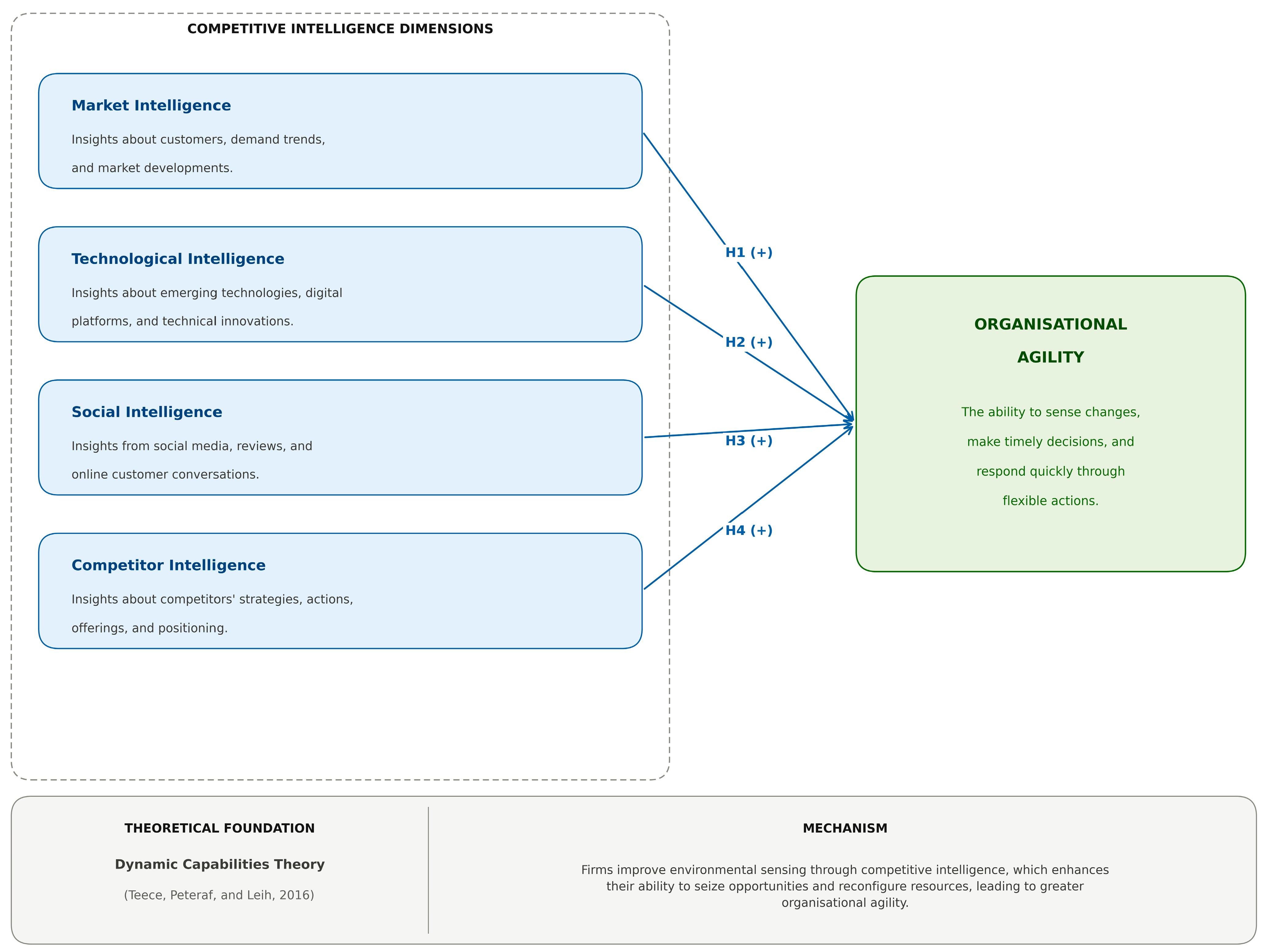
The conceptual framework of this study was developed based on the theoretical arguments presented in the literature review and the hypotheses derived from them. The framework reflects the view that competitive intelligence is a multidimensional construct and that its different dimensions may show different relationships with organisational agility in B2C e-commerce firms. In line with this perspective, the study treats market intelligence, technological intelligence, social intelligence, and competitor intelligence as the independent variables, while organisational agility is treated as the dependent variable.
The framework is grounded in the dynamic capabilities perspective, which suggests that firms improve their responsiveness when they are able to sense relevant external change, interpret it in a timely manner, and adjust their actions accordingly [
1]. Within this logic, the four dimensions of competitive intelligence represent different categories of external signals that may support agile organisational response. Market intelligence captures changes in customer needs and market conditions. Technological intelligence captures developments in digital systems and tools. Social intelligence captures publicly visible customer reactions and social feedback. Competitor intelligence captures rival firms’ actions and strategic behaviour. Together, these dimensions form the external intelligence base through which firms may recognise and respond to change in digital consumer markets.
Accordingly, the conceptual framework proposes that each of the four competitive intelligence dimensions is positively associated with organisational agility. At the same time, the framework does not assume that all dimensions contribute equally. Instead, it allows the empirical analysis to assess whether some intelligence domains are more strongly related to organisational agility than others in the Croatian B2C e-commerce context.
Figure 1 presents the conceptual framework of the study.
3. Methodology
The methodology of this study explains how the research was designed, how the data were collected, and how the data were analysed to address the research questions. The study focused on examining the relationship between four dimensions of competitive intelligence—market intelligence, technological intelligence, social intelligence, and competitor intelligence—and organisational agility in Croatian B2C e-commerce firms. Because the study aimed not only to identify measurable relationships but also to understand how these relationships could be interpreted in practice, a mixed-methods approach was considered appropriate [
23,
28,
29].
The methodology was therefore developed to provide both quantitative and qualitative insight. The quantitative component was used as the main analytical strand to examine the relationships between the variables through survey data. The qualitative component was used as a follow-up strand to support the interpretation of the quantitative findings and to provide additional contextual understanding of how intelligence-related practices were understood in B2C e-commerce settings. In this way, the methodology was designed to produce results that were both analytically grounded and contextually meaningful.
3.1. Study Design
This study was guided by a pragmatic research philosophy. Pragmatism was considered appropriate because the study was not designed to defend a single philosophical position, but rather to generate useful and contextually relevant knowledge about how competitive intelligence dimensions relate to organisational agility in Croatian B2C e-commerce firms [
28,
29]. A pragmatic position supports the combination of quantitative and qualitative methods when that combination is more suitable for answering the research problem than relying on one method alone.
In line with this orientation, the study adopted an explanatory sequential mixed-methods design. In this design, quantitative data are collected and analysed first, and qualitative evidence is then used to support and interpret the quantitative findings [
28]. This design was appropriate for the present study because the main objective was first to identify the relationships between the four dimensions of competitive intelligence and organisational agility, and then to use qualitative follow-up evidence to better understand how these patterns could be interpreted in practice. The mixed-methods design therefore added interpretive depth to the study without shifting the main explanatory focus away from the quantitative analysis.
The study also followed a primarily deductive approach, supported by a limited inductive element. The deductive aspect of the study is visible in the way the research was grounded in prior literature and in the dynamic capabilities perspective, from which the conceptual framework and hypotheses were developed [
1]. The inductive element appears in the qualitative follow-up stage, where additional contextual insight was used to support the interpretation of the survey findings. Thus, the study remained theory-informed while still allowing room for practical interpretation.
The research adopted a cross-sectional design, as data were collected at one point in time rather than over an extended period [
23]. This design was considered suitable because the study aimed to examine the relationships among the selected variables within the operating context of Croatian B2C e-commerce firms. The main quantitative data collection was carried out during 2023, and the qualitative follow-up was conducted after the preliminary quantitative analysis had been completed. Taken together, the pragmatic philosophy, explanatory sequential mixed-methods design, deductive orientation, and cross-sectional time horizon provided a coherent methodological framework for investigating the relationship between competitive intelligence dimensions and organisational agility in this study.
3.2. Data Collection Design
The target population of this study consisted of Croatian B2C e-commerce firms that sell products or services directly to final consumers through digital channels. These firms operate through websites, online platforms, or related digital interfaces, and their commercial activities depend to a considerable extent on online interaction with customers. Because a complete and reliable sampling frame of Croatian B2C e-commerce firms was not available, the study used a non-probability sampling approach. This approach was considered suitable because it allowed the researcher to reach relevant firms through practical and accessible channels in a context where the full population could not be clearly enumerated [
23,
24].
The unit of analysis was the firm, represented by one knowledgeable respondent from each organisation. Suitable respondents included owners, managers, or other individuals directly involved in e-commerce operations, digital decision-making, and related strategic or operational activities. These respondents were selected because they were expected to possess direct knowledge of the firm’s intelligence-related practices and its ability to respond to external change. Data were collected through an online questionnaire, which was distributed to relevant firms using digital communication channels. After screening the responses and removing unusable cases, the final quantitative analysis was based on 208 valid responses.
The questionnaire was designed to measure the key constructs of the study in a structured way. The final instrument consisted of 30 items measured on a five-point Likert scale ranging from strongly disagree to strongly agree. The instrument covered four competitive intelligence dimensions—market intelligence, technological intelligence, social intelligence, and competitor intelligence—and organisational agility as the dependent construct. Organisational agility was measured through multiple items reflecting the firm’s ability to respond, adapt, and adjust in relation to external change. The competitive intelligence dimensions were measured through items designed to capture the firm’s practices in market monitoring, technological scanning, social feedback interpretation, and competitor observation. The use of a structured questionnaire was appropriate because the study sought to examine relationships among clearly defined variables across a relatively broad set of firms.
Before the main survey was conducted, the instrument was subjected to expert review and pilot testing. The draft questionnaire was reviewed to improve clarity, relevance, and alignment with the research purpose. A pilot study was then conducted, and although 30 responses were initially approached for this stage, 27 usable pilot responses were retained for preliminary testing. The pilot stage was used to examine item clarity and internal consistency before launching the main survey more broadly. Based on the pilot evidence, minor adjustments were made where necessary, while the overall structure of the questionnaire was retained.
The timing of the data collection followed the logic of the explanatory sequential mixed-methods design. The quantitative survey was conducted first, and the qualitative follow-up was carried out after the initial quantitative analysis had been completed. This sequencing was important because the qualitative stage was intended to support the interpretation of the quantitative findings rather than function as an independent parallel strand [
28]. In this way, the data collection design ensured that the study first established the measurable relationships among the variables and then used qualitative evidence to provide additional contextual understanding of those relationships.
In addition to the survey, qualitative follow-up evidence was collected from a smaller sub-sample of firms that were relevant to the mixed-methods objective of the study. This follow-up evidence was used to provide practical insight into how intelligence-related practices were understood and applied in the participating firms. Thus, the data collection design combined a structured quantitative instrument with a supporting qualitative stage, enabling the study to generate findings that were both analytically grounded and contextually interpretable.
3.3. Data Analysis Design
The data analysis design of this study was developed to address the research questions in a systematic and transparent manner. Since the study aimed to examine the relationship between four dimensions of competitive intelligence and organisational agility, the analysis needed to establish the measurement quality of the constructs first and then test the relationships among them. In line with the explanatory sequential mixed-methods design, the quantitative analysis was treated as the main analytical strand, while the qualitative analysis was used to support the interpretation of the quantitative results [
23,
28,
30].
The quantitative data obtained through the questionnaire were first prepared for analysis through coding and cleaning. The response categories of the Likert-scale items were converted into numerical values, and the negatively worded items were reverse-coded before construct scores were created. The dataset was then checked for missing values, duplicate submissions, and clearly problematic response patterns. After this screening process, the final usable sample remained at 208 responses. This preparation stage was necessary to ensure that the subsequent statistical analyses were based on a consistent and reliable dataset.
The next stage of the analysis focused on measurement assessment. Descriptive statistics were used to summarise the sample characteristics and the central tendency of the constructs. Internal consistency was examined using Cronbach’s alpha. Because the reviewers raised concerns regarding construct validity, the measurement model was assessed more carefully through construct-validity procedures, including composite reliability, average variance extracted, the Fornell–Larcker criterion, and the heterotrait–monotrait ratio. These analyses were used to determine whether the constructs showed acceptable levels of reliability, convergent validity, and discriminant validity. Since some items performed more weakly than others, refinement of the measurement model was undertaken where necessary in order to improve the overall quality of the construct structure.
Because the study relied on single-respondent self-reported data, common method bias was also considered in the analysis. In addition to procedural steps taken during questionnaire design and administration, statistical checks were conducted. Harman’s single-factor test and full collinearity variance inflation factor analysis were used to assess whether common method bias posed a serious threat to the data. These steps were important because they allowed the study to respond more directly to methodological concerns regarding potential method effects.
After the measurement stage, the main relationship testing was carried out. Pearson correlation analysis was used to examine the direction and strength of the bivariate relationships between the four dimensions of competitive intelligence and organisational agility. Multiple regression analysis was then used to assess the combined and individual relationships of market intelligence, technological intelligence, social intelligence, and competitor intelligence with organisational agility. In addition to the regression coefficients and significance values, model explanatory power was examined through R2 and adjusted R2. Multicollinearity was also assessed using tolerance and variance inflation factor values in order to confirm that the predictors were sufficiently distinct for regression analysis. These analyses enabled the study to identify which intelligence dimensions showed stronger or weaker relationships with organisational agility in the final validated model.
The qualitative follow-up evidence was analysed using thematic analysis [
30]. The purpose of this stage was not to develop an independent qualitative theory, but to provide contextual explanation for the quantitative findings. The qualitative material was therefore reviewed, coded, and grouped into themes that reflected how intelligence-related practices were understood and applied in the participating firms. These themes were then used to support the interpretation of the quantitative results, especially in areas where the statistical findings required deeper practical explanation. In this way, the qualitative analysis strengthened the mixed-methods design by adding interpretive depth to the main quantitative strand.
Taken together, the data analysis design allowed the study to move from data preparation, reliability testing, validity assessment, and bias checking to relationship analysis and qualitative interpretation. This sequence ensured that the findings were not based only on statistical association, but were also grounded in a more careful assessment of measurement quality and contextual meaning.
4. Data Analysis and Discussion
This section presents the empirical findings of the study and discusses their implications in relation to the research questions and the supporting literature. In line with the methodological design of the study, the analysis begins with the profile of the responding firms and then proceeds to the quantitative findings, including descriptive statistics, reliability and validity assessment, common method bias testing, correlation analysis, and multiple regression analysis. The final part of the section integrates the qualitative follow-up evidence with the quantitative results in order to provide a more contextually grounded interpretation of the findings.
The purpose of this section is not only to report statistical outputs, but also to explain what the results mean in the context of Croatian B2C e-commerce firms. Since the study examines the relationship between four dimensions of competitive intelligence and organisational agility, the discussion pays attention to whether these intelligence dimensions show similar or different relationships with agility, and to what extent the observed findings support the proposed hypotheses. In doing so, the section also responds to the need for stronger analytical interpretation rather than simple description of numerical results.
4.1. Response Rate and Profile of Firms
The quantitative analysis of this study was based on 208 valid responses obtained from Croatian B2C e-commerce firms. These responses were retained after the screening and cleaning of the survey dataset. The final sample was considered adequate for the selected statistical analyses, although the use of non-probability sampling means that the findings should be interpreted with caution in terms of wider statistical generalisation [
23,
24]. Nevertheless, the sample provides a useful basis for examining the relationship between competitive intelligence dimensions and organisational agility within the context of Croatian B2C e-commerce.
The profile of the responding firms indicates that the sample reflects a range of firms operating in consumer-oriented digital markets. The firms varied in terms of years of operation, industry sector, and company scale. This variation was useful because it provided a broader view of intelligence-related practices and organisational responsiveness across different types of B2C e-commerce firms rather than focusing on one narrow segment alone. At the same time, the sample remains contextually grounded in Croatia, which is important because the study is concerned with intelligence and agility in a digitally maturing market environment.
As shown in
Table 1, the descriptive profile of the sample also supports the practical relevance of the study. B2C e-commerce firms in such settings often face continuous pressure to respond to changing customer expectations, public online feedback, technology-related developments, and competitor actions, while still operating under resource limitations. Therefore, the characteristics of the sample are consistent with the broader logic of the study, which seeks to understand how different forms of competitive intelligence relate to organisational agility in firms that operate in dynamic digital consumer markets.
4.2. Descriptive Statistics and Reliability
The next stage of the quantitative analysis examined the descriptive properties and internal consistency of the main constructs. Mean values and standard deviations were calculated in order to understand the general response pattern of the sample, while Cronbach’s alpha was used to assess internal consistency. Because the later validity assessment showed that some items performed more strongly than others, the descriptive statistics and reliability discussion presented here are aligned with the construct specification used in the final analysis of the study.
Table 2 presents the mean values, standard deviations, and Cronbach’s alpha coefficients for organisational agility, market intelligence, technological intelligence, social intelligence, and competitor intelligence. Overall, the mean values are relatively high across all constructs, indicating that the participating Croatian B2C e-commerce firms generally reported favourable levels of intelligence-related practice and organisational responsiveness. The highest mean value is observed for market intelligence, followed closely by social intelligence, competitor intelligence, and technological intelligence. Organisational agility also records a relatively high mean value, suggesting that the firms in the sample generally perceived themselves as reasonably responsive and adaptable within their operating environment.
The reliability results show a mixed pattern. Competitor intelligence records the strongest internal consistency, with a Cronbach’s alpha value well above the commonly accepted threshold. Organisational agility also shows acceptable internal consistency in the final analytical specification. Social intelligence and technological intelligence show moderate reliability, with social intelligence approaching acceptable consistency more closely than technological intelligence. By contrast, market intelligence records the weakest alpha value among the constructs, indicating that its items are less internally consistent than those of the other dimensions.
This pattern is important for interpreting the later analyses. The descriptive statistics suggest that the responding firms generally rated themselves positively across the study variables, but the reliability results indicate that the measurement quality is not equally strong across all constructs. In particular, the weaker internal consistency of market intelligence and the only moderate consistency of technological intelligence suggest that these dimensions should be interpreted with more caution than competitor intelligence and organisational agility. For this reason, the analysis did not stop at Cronbach’s alpha alone. Instead, a more detailed validity assessment was conducted in the next stage to examine the construct structure more closely and to determine whether refinement of the measurement model was necessary.
Taken together, the descriptive and reliability findings show that the study constructs are substantively relevant and generally meaningful within the sample, but they also indicate that some constructs perform more strongly than others in measurement terms. The next subsection therefore presents the validity assessment of the measurement model in order to strengthen the methodological rigour of the study and to respond directly to the concerns raised regarding construct quality.
4.3. Validity Assessment of the Measurement Model
Following the descriptive and reliability assessment, the next stage of the quantitative analysis examined the validity of the measurement model. This step was necessary because the reviewers raised concerns regarding construct validity and the overall measurement quality of the study. Accordingly, the construct structure was assessed more carefully through composite reliability, average variance extracted, the heterotrait–monotrait ratio, and the Fornell–Larcker criterion. Since the earlier assessment indicated that some organisational agility items were performing more weakly than others, the final publication-oriented model retained the stronger organisational agility indicators while the four competitive intelligence dimensions were maintained in their original conceptual form.
Table 3 presents the composite reliability and average variance extracted values for the final analytical model. The results show that competitor intelligence demonstrates the strongest construct quality, with high composite reliability and the highest average variance extracted among the constructs. Social intelligence also performs relatively well, while organisational agility shows acceptable composite reliability after refinement of the weaker items. Technological intelligence shows moderate construct quality, whereas market intelligence remains the weakest construct in the model. In particular, its average variance extracted remains below the ideal threshold, which suggests that this dimension should be interpreted with greater caution than the others.
These results indicate that convergent validity is not equally strong across all constructs. Competitor intelligence and, to a lesser extent, social intelligence show the most acceptable measurement performance. Organisational agility becomes more stable after refinement of the weakest items, but its AVE still remains below the ideal level. Market intelligence and technological intelligence show weaker convergent validity, suggesting that some of their items do not converge as strongly as expected. This means that the findings related to these dimensions should be discussed carefully and not interpreted as if all constructs exhibit equally strong measurement properties.
Although convergent validity is mixed, the evidence for discriminant validity is more satisfactory. The heterotrait–monotrait ratio values were all below commonly accepted threshold levels, indicating that the constructs are sufficiently distinct from one another.
Table 4 presents the HTMT values.
All HTMT values are well below conservative cut-off values, indicating that the constructs do not overlap excessively. This pattern supports the view that market intelligence, technological intelligence, social intelligence, competitor intelligence, and organisational agility should be treated as analytically distinct dimensions in the final model.
The Fornell–Larcker criterion provides further support for discriminant validity. As shown in
Table 5, the square root of the AVE for each construct is greater than its correlations with the other constructs. This indicates that each construct shares more variance with its own indicators than with other constructs in the model.
Taken together, the validity assessment shows a mixed but interpretable pattern. Convergent validity is stronger for competitor intelligence and social intelligence, moderate for organisational agility and technological intelligence, and weaker for market intelligence. However, discriminant validity is acceptable across the model, which supports the conceptual distinction among the study constructs. This means that while some dimensions require more cautious interpretation than others, the final analytical model remains suitable for testing the relationships proposed in the study. The next subsection therefore examines whether common method bias posed a serious threat to the dataset before proceeding to the main relationship analysis.
4.4. Common Method Bias Assessment
Because the study relied on self-reported data collected from single respondents within each firm, common method bias was examined before testing the main relationships among the constructs. In addition to the procedural precautions taken during questionnaire design and administration, statistical checks were conducted in order to assess whether a substantial method effect was likely to threaten the validity of the findings.
The first statistical check used was Harman’s single-factor test. When all measured items were entered into an unrotated factor solution, the first factor accounted for 13.93% of the total variance. This value is substantially below the commonly used threshold of 50%, which suggests that the covariance among the items is not dominated by a single general factor. Therefore, the data do not indicate a serious single-factor common method bias problem.
A second check was conducted through full collinearity variance inflation factor analysis. This procedure was used as an additional statistical assessment because it provides a broader indication of whether a common source effect may be inflating the relationships among the study variables. The variance inflation factor values for the final constructs were all very low, ranging from 1.02 to 1.12, which is well below even conservative cut-off levels.
Table 6 presents these values.
Taken together, these results suggest that common method bias is unlikely to be a serious threat to the present dataset. This does not mean that method-related influence can be ruled out completely, since self-reported cross-sectional survey data always carry some possibility of response-related bias. However, the statistical evidence indicates that the observed relationships among the constructs are not primarily the result of a dominant common measurement source. On this basis, the study proceeded to the main relationship analysis with a reasonable degree of confidence that common method bias was not materially distorting the empirical results.
4.5. Correlation Analysis
After confirming that common method bias was not likely to pose a serious threat to the dataset, the next stage of the quantitative analysis examined the bivariate relationships between the four dimensions of competitive intelligence and organisational agility. Pearson correlation analysis was used for this purpose because it provides a direct indication of the direction and strength of the linear relationships among the study constructs [
23]. This step was important because it allowed the study to observe whether the intelligence dimensions were positively, negatively, or only weakly related to organisational agility before testing their combined relationships in the regression model.
Table 7 presents the correlation coefficients for the final analytical model. The results show that the bivariate relationships between the competitive intelligence dimensions and organisational agility are generally weak. Among the four dimensions, social intelligence shows the strongest positive correlation with organisational agility, although the strength of this relationship remains low in practical terms. Technological intelligence also shows a weak positive correlation with organisational agility. By contrast, market intelligence and competitor intelligence show near-zero relationships with organisational agility in the present sample.
The correlation findings provide several important insights. First, they suggest that the four dimensions of competitive intelligence do not show equally strong simple relationships with organisational agility in the Croatian B2C e-commerce sample. The strongest bivariate relationship appears for social intelligence, indicating that firms that report stronger attention to socially visible customer signals also tend to report somewhat higher levels of organisational agility. Second, the very small correlations for market intelligence, technological intelligence, and competitor intelligence suggest that these dimensions do not show strong direct bivariate associations with organisational agility in the present data.
At the same time, the correlations among the intelligence dimensions themselves are positive in direction, although generally modest in size. This indicates that firms that are relatively active in one type of intelligence practice may also tend to be active in other forms of intelligence. These patterns suggest that intelligence-related practices may still co-exist as part of a broader information-oriented organisational approach, even if their relationships with organisational agility are not equally strong.
Overall, the correlation analysis suggests that the intelligence dimensions are conceptually related to one another, but their simple relationships with organisational agility are weaker than initially expected. This makes it necessary to examine the variables together in a multiple regression model in order to determine whether any intelligence dimension shows a distinct relationship with organisational agility when the overlap among the predictors is taken into account. The next subsection therefore presents the multiple regression analysis.
4.6. Multiple Regression Analysis
After examining the bivariate relationships, multiple regression analysis was conducted to assess the combined and individual relationships of market intelligence, technological intelligence, social intelligence, and competitor intelligence with organisational agility. This analysis was necessary because the correlation results alone do not show whether a particular intelligence dimension remains relevant when the overlap among the predictors is taken into account. In other words, the regression model provides a clearer indication of whether any intelligence dimension shows a distinct relationship with organisational agility after controlling for the others.
Before interpreting the regression coefficients, the main assumptions of the model were examined. Multicollinearity was assessed through tolerance and variance inflation factor values, and the results indicated that multicollinearity was not a concern. All VIF values were low and well below conventional cut-off levels, indicating that the four predictors were sufficiently distinct for use in the same regression model. In addition, the residual diagnostics did not indicate serious homoscedasticity or autocorrelation problems. Although the residual distribution was not perfectly normal, the sample size of 208 responses was considered adequate for the regression analysis, and supplementary robust estimation did not materially alter the interpretation of the findings.
As shown in
Table 8, the tolerance values ranged from 0.908 to 0.962, while the VIF values ranged from 1.04 to 1.10. These values indicate that multicollinearity was not a serious concern in the regression model. Therefore, the regression coefficients were not likely to be distorted by excessive overlap among the predictors, supporting the use of all four competitive intelligence dimensions in the same model. The results of the multiple regression analysis are presented in
Table 9, showing the individual effects of market intelligence, technological intelligence, social intelligence, and competitor intelligence on organisational agility.
As shown in
Table 9, the regression model is statistically significant at the overall level, but its explanatory power is modest. The four competitive intelligence dimensions together explain 6.1% of the variance in organisational agility, which indicates that they have only limited combined explanatory strength in the present sample. This finding is important because it shows that the relationship between competitive intelligence and organisational agility is more selective and weaker than might be expected from a broad conceptual argument that treats all intelligence dimensions as equally important drivers of agility.
At the individual predictor level, social intelligence is the only dimension that shows a statistically significant positive relationship with organisational agility. Its standardised beta coefficient is the largest in the model, and the result remains significant at the 0.01 level. This suggests that firms that more actively monitor and interpret socially visible online signals, such as reviews, comments, and related customer reactions, tend to report higher levels of organisational agility when the effects of the other intelligence dimensions are held constant.
By contrast, market intelligence does not show a significant relationship with organisational agility in the final model. Although market intelligence is often assumed to be closely linked to agile response, its coefficient in this study is very small and statistically non-significant. Technological intelligence shows a positive coefficient, but the relationship is also non-significant. This means that, within the present sample, technological intelligence does not demonstrate a distinct enough relationship with organisational agility after the other dimensions are considered simultaneously. Competitor intelligence shows a negative but non-significant coefficient, indicating that it does not provide a meaningful explanatory contribution to organisational agility in the final model.
These findings suggest that the four intelligence dimensions do not contribute equally to organisational agility in Croatian B2C e-commerce firms. Instead, the final regression model indicates that social intelligence has the most visible and robust relationship with organisational agility, while the other intelligence dimensions do not show statistically significant independent effects. Accordingly, the hypothesis results can be summarised as follows:
H5. Market intelligence is positively associated with organisational agility—Not supported.
H6. Technological intelligence is positively associated with organisational agility—Not supported.
H7. Social intelligence is positively associated with organisational agility—Supported.
H8. Competitor intelligence is positively associated with organisational agility—Not supported.
Overall, the regression analysis refines the understanding of the competitive intelligence–organisational agility relationship in this study. Rather than showing that all intelligence dimensions are equally important, the results suggest a more differentiated pattern in which social intelligence appears to be the only robust positive predictor of organisational agility in the final validated model. This makes it necessary to interpret the findings in a more focused and context-sensitive manner, which is taken up in the next subsection through the integration of quantitative and qualitative evidence.
4.7. Integration of Quantitative and Qualitative Findings
The mixed-methods design of this study was intended to ensure that the quantitative results were not interpreted only as isolated statistical patterns, but were also considered in relation to the practical realities of B2C e-commerce. Accordingly, the qualitative follow-up stage was used in a supportive interpretive role rather than as a separate explanatory model. The main value of this integration lies in clarifying how the final quantitative pattern can be understood within the broader context of digital consumer markets, where firms are exposed simultaneously to customer reactions, technology-related change, and competitor activity.
The quantitative analysis showed a differentiated pattern rather than a uniform competitive intelligence effect. More specifically, social intelligence emerged as the only statistically significant positive predictor of organisational agility in the final model, while market intelligence, technological intelligence, and competitor intelligence did not show significant independent relationships with organisational agility. When considered from an interpretive mixed-methods perspective, this pattern suggests that not all forms of external intelligence are translated into agile organisational action with the same immediacy or practical intensity.
In the context of B2C e-commerce, socially visible signals may be especially influential because they are immediate, public, and often directly connected to customer experience. Comments, reviews, visible dissatisfaction, and online reactions can create pressure for firms to respond quickly, not only to protect customer relationships but also to manage public perception in a highly transparent market environment. This helps explain why social intelligence may show a stronger relationship with organisational agility than other intelligence dimensions. Unlike broader market trends or competitor observations, socially visible signals often require quicker short-term action and therefore appear more closely aligned with the behavioural aspect of agility.
By contrast, the non-significant results for market intelligence, technological intelligence, and competitor intelligence suggest that these dimensions may still be relevant to managerial awareness, but their relationship with agility is less direct in the present sample. Market intelligence may inform longer-term understanding of customer and demand conditions without necessarily producing immediate organisational response. Technological intelligence may be important for strategic adaptation, but firms may not always convert technological awareness into rapid operational change, particularly when resources, skills, or implementation capacity are limited. Competitor intelligence may also contribute to general strategic awareness, but it may not translate into agile response unless competitor actions are judged to be urgent, highly visible, or directly threatening to the firm’s position.
From an integrated perspective, the findings therefore suggest that agility in Croatian B2C e-commerce may be influenced more strongly by intelligence that is socially immediate and publicly visible than by intelligence that is broader, more technical, or more strategically observational in nature. This does not mean that the non-significant intelligence dimensions are unimportant. Rather, it indicates that their influence on agility may be more indirect, more context-dependent, or more difficult to capture through the present model. The mixed-methods logic of the study is therefore useful because it allows the final quantitative pattern to be interpreted as a differentiated intelligence–agility relationship rather than as a simple confirmation or rejection of intelligence-based explanations.
Overall, the integration of the quantitative and qualitative strands supports a more cautious but more meaningful interpretation of the study findings. The evidence suggests that competitive intelligence should not be treated as a single, uniform capability with equal effects across all domains. Instead, the relationship between intelligence and organisational agility appears to vary by intelligence type, with social intelligence showing the clearest practical relevance in the present context. This integrated interpretation provides the basis for the broader discussion of findings in the next subsection.
4.8. Discussion of Findings
The findings of this study provide a more differentiated understanding of the relationship between competitive intelligence and organisational agility in Croatian B2C e-commerce firms. Rather than showing that all four dimensions of competitive intelligence are equally important, the final validated model indicates that only social intelligence has a statistically significant positive relationship with organisational agility. This result is important because it moves the discussion beyond the general assumption that more intelligence in all forms automatically leads to greater agility. Instead, it suggests that the influence of intelligence on agile organisational behaviour may depend on the type of intelligence involved and the practical context in which firms operate.
The first important finding is the positive and significant role of social intelligence. Among the four dimensions examined in this study, social intelligence is the only one that shows a distinct relationship with organisational agility when the effects of the other intelligence dimensions are taken into account. This suggests that firms that monitor and interpret socially visible digital signals more actively are better positioned to respond in a timely and flexible manner. In B2C e-commerce, this result is understandable because customer reactions, dissatisfaction, reviews, and public feedback often appear quickly and may require immediate action. In this sense, social intelligence appears closely aligned with the behavioural and response-oriented nature of organisational agility. The result is broadly consistent with the view that digital responsiveness is strengthened when firms engage actively with visible customer sentiment and socially generated information [
1,
16,
19].
The second important finding is that market intelligence does not show a significant independent relationship with organisational agility in the final model. This result is noteworthy because market intelligence is often expected to play a central role in helping firms adjust to customer and demand changes. However, the present findings suggest that, within the sampled Croatian B2C e-commerce firms, market intelligence may function more as a general source of awareness than as a direct driver of agile organisational response. One possible explanation is that market intelligence often relates to broader patterns of customer needs, preferences, and market conditions, which may support strategic understanding but not always lead to immediate operational adaptation. Another possible explanation is that the weaker measurement quality of this construct may have reduced its statistical strength in the final model. Therefore, the non-significant result should not be read as evidence that market intelligence is irrelevant, but rather that its measurable relationship with agility was not sufficiently strong in the present study.
A similar pattern appears for technological intelligence. Although technological intelligence is conceptually important in digital markets, it does not show a statistically significant relationship with organisational agility in the final analysis. This suggests that awareness of technological developments alone may not be enough to produce agile organisational behaviour. Firms may recognise the importance of digital tools, platform developments, and technological change, but still lack the resources, capabilities, or decision speed required to convert such awareness into rapid organisational adaptation. In other words, technological intelligence may be necessary for longer-term digital readiness, but not always sufficient to generate immediate agility in practice. This interpretation is consistent with the idea that digital intelligence and technological awareness only become strategically valuable when firms are able to mobilise action around them [
10,
11,
14,
25].
Competitor intelligence also fails to show a significant positive relationship with organisational agility in the final model. This indicates that the systematic observation of rival firms, while potentially useful for strategic awareness, does not appear to function as a strong independent driver of agility in the present sample. One possible explanation is that competitor intelligence in B2C e-commerce may inform benchmarking and general positioning more than immediate adaptive response. It is also possible that firms monitor competitors but do not always interpret competitor moves as requiring rapid organisational adjustment unless those moves have direct visible consequences for sales, reputation, or customer behaviour. Thus, competitor intelligence may remain strategically relevant, but its independent contribution to agility may be weaker than often assumed, particularly in contexts where customer-facing social signals create more direct pressure for response [
16,
20].
Taken together, these findings suggest that the relationship between competitive intelligence and organisational agility is selective rather than uniform. This has several implications for theory. First, it supports the argument that competitive intelligence should not be treated as a single undifferentiated construct [
15,
16]. The present study shows that intelligence dimensions may differ in their practical relevance to agile behaviour, even when they are all conceptually related to external sensing. Second, the findings refine the dynamic capabilities perspective by suggesting that not all sensing-related capabilities translate into the same type of organisational response. In the present context, social intelligence appears to be more closely connected to the immediate response aspect of agility than market, technological, or competitor intelligence. This means that sensing is not only about the existence of information, but also about the visibility, urgency, and actionability of that information in a particular market setting.
The findings also have practical implications. For managers of Croatian B2C e-commerce firms, the results suggest that attention to socially visible digital signals may be especially valuable when the objective is to support agile organisational response. This means that online reviews, customer comments, public complaints, and related social feedback should not be treated as secondary or informal sources of information. Instead, they should be monitored in a structured way because they may provide the most immediate signals requiring response. At the same time, the non-significant findings for market intelligence, technological intelligence, and competitor intelligence suggest that these domains may still matter, but their influence may depend more heavily on how firms convert intelligence into action. Managers therefore need not only intelligence-gathering routines, but also internal response mechanisms that allow information to be translated into timely decisions and adjustments.
Finally, the discussion of findings must be considered in light of the study’s limitations. The model explains only a modest proportion of the variance in organisational agility, which suggests that other factors not included in the present study may also play an important role. In addition, the convergent validity of some constructs, especially market intelligence and technological intelligence, was weaker than ideal. Accordingly, the results should be interpreted carefully and not overstated. Even so, the study makes a useful contribution by showing that the intelligence–agility relationship is more differentiated and context-dependent than broad conceptual arguments might suggest. In the Croatian B2C e-commerce context examined here, social intelligence appears to be the most clearly relevant competitive intelligence dimension for organisational agility, while the other dimensions show weaker and non-significant independent relationships.
5. Conclusions and Recommendations
5.1. Conclusions
This study examined the relationship between four dimensions of competitive intelligence—market intelligence, technological intelligence, social intelligence, and competitor intelligence—and organisational agility in Croatian B2C e-commerce firms. The study was developed in response to the need for a more focused understanding of competitive intelligence in digital consumer markets, particularly in contexts where intelligence is often discussed broadly without sufficient attention to its differentiated dimensions. By examining these four dimensions separately, the study sought to provide a more precise explanation of how external intelligence relates to agile organisational behaviour.
The findings show that the relationship between competitive intelligence and organisational agility is not uniform across all intelligence dimensions. In the final validated model, social intelligence emerged as the only statistically significant positive predictor of organisational agility. This indicates that firms that more actively monitor and interpret socially visible online signals, such as customer comments, reviews, and public feedback, tend to report higher levels of agility. By contrast, market intelligence, technological intelligence, and competitor intelligence did not show statistically significant independent relationships with organisational agility in the final model.
These findings lead to an important conclusion. Competitive intelligence should not be treated as a single undifferentiated capability with equally strong effects across all domains. Although all four dimensions are conceptually relevant to external sensing, their practical relationship with organisational agility appears to differ in strength and significance. In the Croatian B2C e-commerce context examined in this study, social intelligence appears to be the most directly relevant intelligence dimension for agile organisational response. This suggests that agility may be influenced more strongly by intelligence that is immediate, public, and closely connected to visible customer reaction than by intelligence that is broader, more technological, or more competitor-focused in nature.
The study therefore contributes to the literature in two main ways. First, it offers a more differentiated view of competitive intelligence by examining its dimensions separately rather than as a single aggregate construct. Second, it provides contextually grounded evidence from Croatian B2C e-commerce, a setting in which digital commerce is growing but intelligence capability development may still be uneven. In this way, the study refines the broader theoretical discussion on intelligence and agility by showing that the value of intelligence may depend not only on its existence but also on its type, immediacy, and practical actionability.
At the same time, the findings should be interpreted with caution. The model explains only a modest proportion of the variance in organisational agility, which suggests that other organisational and environmental factors are also likely to shape agility in B2C e-commerce firms. In addition, some constructs showed weaker convergent validity than ideal, particularly market intelligence and technological intelligence. The cross-sectional design, non-probability sampling approach, and reliance on single-respondent self-reported data also limit the broader generalisability of the results. Nevertheless, the study provides a useful empirical basis for understanding the competitive intelligence–organisational agility relationship in a more focused and context-sensitive way.
Overall, the study concludes that competitive intelligence remains relevant to organisational agility, but its dimensions do not operate with equal force. In the present sample of Croatian B2C e-commerce firms, social intelligence shows the clearest positive relationship with organisational agility, while the other dimensions do not demonstrate significant independent effects in the final model. This conclusion offers a more cautious but more realistic understanding of intelligence-driven agility in digital consumer markets.
5.2. Recommendations
Based on the findings of this study, several recommendations can be made for managers, support institutions, and future researchers.
The first recommendation is that managers of Croatian B2C e-commerce firms should give greater strategic attention to social intelligence. Since social intelligence emerged as the only significant positive predictor of organisational agility in the final model, firms should treat online reviews, customer comments, social media interactions, and other publicly visible digital signals as an important source of actionable intelligence. These signals should not be handled only informally or occasionally. Instead, firms should establish regular routines for monitoring, categorising, and responding to socially visible customer reactions. This may help firms detect dissatisfaction, emerging expectations, or service-related issues earlier and respond more quickly in ways that strengthen agility.
The second recommendation is that managers should improve the way other forms of intelligence are translated into action. Although market intelligence, technological intelligence, and competitor intelligence did not show significant independent effects in the final model, this does not mean that these dimensions are irrelevant. Rather, the findings suggest that awareness alone may not be enough. Firms may collect information about customers, technologies, and competitors, but unless this information is converted into timely managerial response, its contribution to agility may remain limited. Therefore, managers should strengthen the organisational routines that connect intelligence gathering to actual decision-making and operational adjustment.
The third recommendation is that smaller B2C e-commerce firms should adopt practical and low-cost intelligence routines rather than waiting for sophisticated formal systems. In many digitally maturing markets, firms operate with limited time, staff, and analytical resources. Under such conditions, even simple weekly review processes, customer feedback summaries, social listening practices, and structured competitor observation logs may improve the quality of organisational response. What matters is not only the collection of information, but the consistency with which firms interpret it and act on it.
The fourth recommendation is directed at industry-supporting institutions and policymakers. Public agencies, trade associations, and digital-business support organisations should provide more structured support for intelligence capability development in B2C e-commerce firms. This support should go beyond general digital adoption and include practical guidance on how firms can monitor customer sentiment, interpret online feedback, track relevant technological developments, and organise intelligence for quicker managerial response. Training programmes, toolkits, templates, and sector-specific intelligence briefings may be particularly useful for smaller firms that lack internal analytical capacity.
The final recommendation is for future research. Further studies should examine the competitive intelligence–organisational agility relationship using longitudinal designs, because this would allow stronger insight into how intelligence and agility evolve over time. Future research should also consider additional variables that may influence or mediate this relationship, such as organisational culture, digital capability, leadership style, learning orientation, and firm performance. In addition, future studies should aim to strengthen measurement quality further, especially for market intelligence and technological intelligence, and to deepen the qualitative component so that the practical pathways between intelligence and agility can be understood more clearly. Comparative studies across countries or across different e-commerce models may also help determine whether the present findings are specific to Croatian B2C e-commerce or visible in other digitally dynamic market settings as well.