How Does Information Interactivity Promote Customer Trustiness and Positive WOM in AI-Powered Chatbots? Examining Significant Roles of Perceived Values and Active Involvement


Abstract
1. Introduction
2. Literature Review and Hypotheses Formulation
2.1. Linking Information Interactivity to Perceived Values
2.2. Linking Perceived Values to Active Involvement
2.3. Linking Active Involvement to Customer Trustiness and Positive WOM
2.4. Linking Customer Trustiness to Positive WOM
3. Methodology
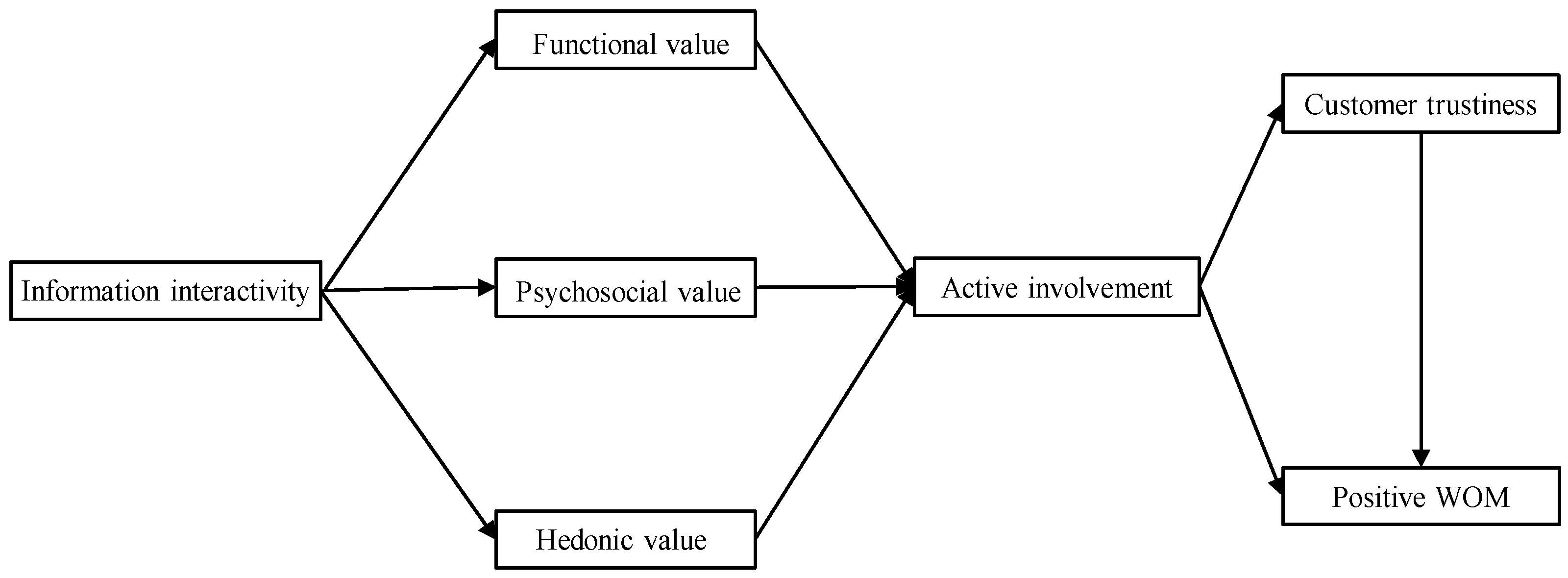
3.1. Research Model
3.2. Data Collection
3.3. Measurement
3.4. Data Analysis Strategy
4. Empirical Findings
4.1. Measurement Model, Reliability, and Validity
4.2. Assessment of Common Method Variance
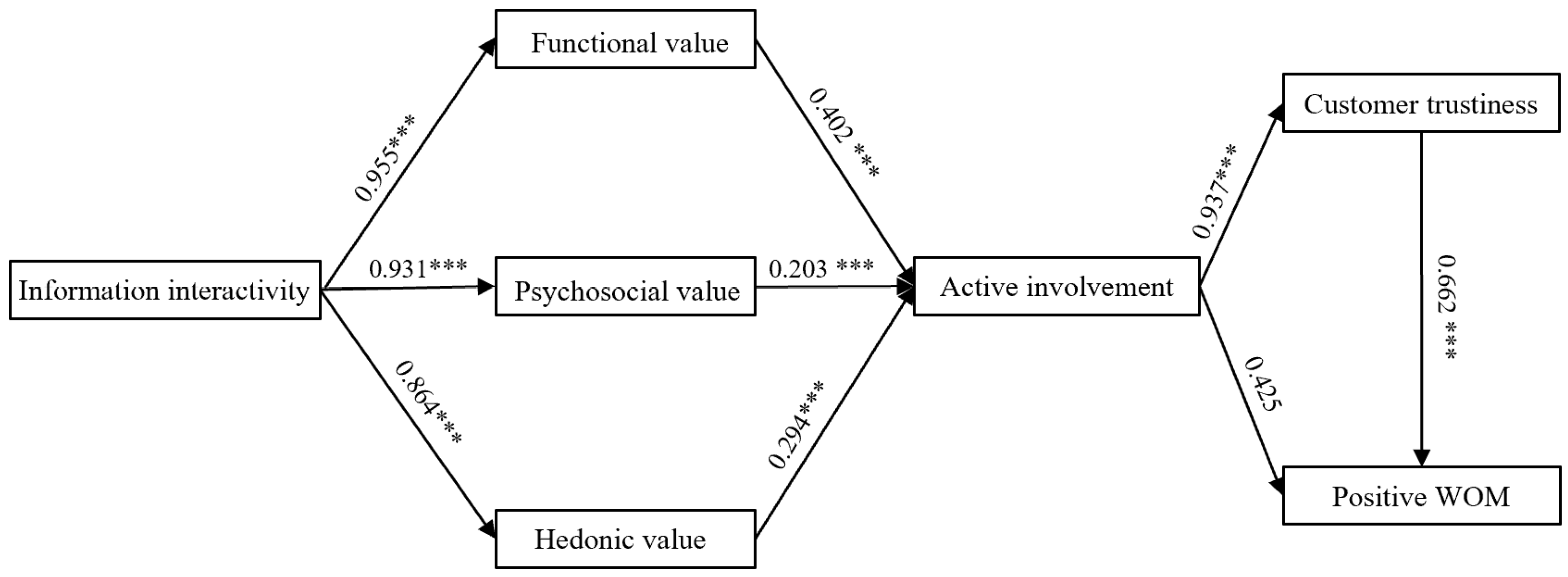
4.3. Structural Model
5. Discussion
5.1. Conclusions
5.2. Theoretical Contributions
5.3. Empirical Ramifications
6. Limitations and Future Research Directions
Author Contributions
Funding
Institutional Review Board Statement
Informed Consent Statement
Data Availability Statement
Conflicts of Interest
References
- Brown, J.E.; Halpern, J. AI chatbots cannot replace human interactions in the pursuit of more inclusive mental healthcare. SSM-Ment. Health 2021, 1, 100017. [Google Scholar] [CrossRef]
- Al-Abdullatif, A.M. Modeling students’ perceptions of chatbots in learning: Integrating technology acceptance with the value-based adoption model. Educ. Sci. 2023, 13, 1151. [Google Scholar] [CrossRef]
- Pergantis, P.; Bamicha, V.; Skianis, C.; Drigas, A. Ai chatbots and cognitive control: Enhancing executive functions through chatbot interactions: A systematic review. Brain Sci. 2025, 15, 47. [Google Scholar] [CrossRef] [PubMed]
- Shahzad, M.F.; Xu, S.; An, X.; Javed, I. Assessing the impact of AI-chatbot service quality on user e-brand loyalty through chatbot user trust, experience and electronic word of mouth. J. Retail. Consum. Serv. 2024, 79, 103867. [Google Scholar] [CrossRef]
- Al-Shafei, M. Navigating human-chatbot interactions: An investigation into factors influencing user satisfaction and engagement. Int. J. Hum.–Comput. Interact. 2025, 41, 411–428. [Google Scholar] [CrossRef]
- Cheng, X.; Bao, Y.; Zarifis, A.; Gong, W.; Mou, J. Exploring consumers’ response to text-based chatbots in e-commerce: The moderating role of task complexity and chatbot disclosure. Internet Res. 2021, 32, 496–517. [Google Scholar] [CrossRef]
- Jiang, Y.; Yang, X.; Zheng, T. Make chatbots more adaptive: Dual pathways linking human-like cues and tailored response to trust in interactions with chatbots. Comput. Hum. Behav. 2023, 138, 107485. [Google Scholar] [CrossRef]
- Meier, M.; Maier, C.; Thatcher, J.B.; Weitzel, T. Chatbot interactions: How consumption values and disruptive situations influence customers’ willingness to interact. Inf. Syst. J. 2024, 34, 1579–1625. [Google Scholar] [CrossRef]
- Lin, J.-S.E.; Wu, L. Examining the psychological process of developing consumer-brand relationships through strategic use of social media brand chatbots. Comput. Hum. Behav. 2023, 140, 107488. [Google Scholar] [CrossRef]
- Sundar, S.S.; Bellur, S.; Oh, J.; Jia, H.; Kim, H.-S. Theoretical importance of contingency in human-computer interaction: Effects of message interactivity on user engagement. Commun. Res. 2016, 43, 595–625. [Google Scholar] [CrossRef]
- Yim, M.C. Effect of AI chatbot’s interactivity on consumers’ negative word-of-mouth intention: Mediating role of perceived empathy and anger. Int. J. Hum.–Comput. Interact. 2024, 40, 5415–5430. [Google Scholar] [CrossRef]
- Gul, S.; Zulfiqar, B.; Khan, F.; Jabeen, N.; Fareed, G. Impact of AI-powered chatbots on customer retention: Moderating role of service quality perception. J. Manag. Sci. Res. Rev. 2025, 4, 100–117. [Google Scholar]
- Hapsari, R.; Clemes, M.; Dean, D. The mediating role of perceived value on the relationship between service quality and customer satisfaction: Evidence from Indonesian airline passengers. Procedia Econ. Financ. 2016, 35, 388–395. [Google Scholar] [CrossRef]
- Nguyen, X.H.; Nguyen, T.T.; Anh Dang, T.H.; Dat Ngo, T.; Nguyen, T.M.; Anh Vu, T.K. The influence of electronic word of mouth and perceived value on green purchase intention in Vietnam. Cogent Bus. Manag. 2024, 11, 2292797. [Google Scholar] [CrossRef]
- Pang, H. How multi-dimensional mobile social media characteristics promote user loyalty and positive word-of-mouth: The moderating role of functional value and experiential value. Curr. Psychol. 2024, 43, 36629–36642. [Google Scholar] [CrossRef]
- Cheng, Y.; Jiang, H. How Do AI-driven Chatbots Impact User Experience? Examining Gratifications, Perceived Privacy Risk, Satisfaction, Loyalty, and Continued Use. J. Broadcast. Electron. Media 2020, 64, 592–614. [Google Scholar] [CrossRef]
- Abbasi, A.Z.; Tsiotsou, R.H.; Hussain, K.; Rather, R.A.; Ting, D.H. Investigating the impact of social media images’ value, consumer engagement, and involvement on eWOM of a tourism destination: A transmittal mediation approach. J. Retail. Consum. Serv. 2023, 71, 103231. [Google Scholar] [CrossRef]
- Kang, J.; Tang, L.; Fiore, A.M. Enhancing consumer–brand relationships on restaurant Facebook fan pages: Maximizing consumer benefits and increasing active participation. Int. J. Hosp. Manag. 2014, 36, 145–155. [Google Scholar] [CrossRef]
- Lee, C.T.; Pan, L.-Y.; Hsieh, S.H. Artificial intelligent chatbots as brand promoters: A two-stage structural equation modeling-artificial neural network approach. Internet Res. 2022, 32, 1329–1356. [Google Scholar] [CrossRef]
- Liu, Y.; Zhang, K.; Zhang, Y.; Pang, H.; Liu, B. How personal anticipations and perceived gratifications influence continuous use intention toward AI-driven chatbots? Moderating roles of perceived innovativeness and active involvement. Acta Psychol. 2026, 264, 106526. [Google Scholar] [CrossRef]
- Pang, H.; Hu, Z.; Wang, L. How perceived motivations influence user stickiness and sustainable engagement with AI-powered chatbots—Unveiling the pivotal function of user attitude. J. Theor. Appl. Electron. Commer. Res. 2025, 20, 228. [Google Scholar] [CrossRef]
- Pang, H.; Zhou, M. Determining composite influences of human and system interactivity on continued use of mobile short video apps: Mediating roles of user gratification and platform attachment. Telemat. Inform. 2026, 105, 102379. [Google Scholar] [CrossRef]
- Vafeiadis, M. Message interactivity and source credibility in online dental practice reviews: Responding to reviews triggers positive consumer reactions regardless of review valence. Health Commun. 2023, 38, 80–90. [Google Scholar] [CrossRef] [PubMed]
- Niu, Z.; Heckman, C.J. Digital Educational Strategies to teach skin self-examination to individuals at risk for skin Cancer. J. Health Commun. 2022, 27, 790–800. [Google Scholar] [CrossRef]
- Lin, Y.-T.; Doong, H.-S.; Eisingerich, A.B. Avatar design of virtual salespeople: Mitigation of recommendation conflicts. J. Serv. Res. 2021, 24, 141–159. [Google Scholar] [CrossRef]
- Sarraf, S.; Kar, A.K.; Janssen, M. How do system and user characteristics, along with anthropomorphism, impact cognitive absorption of chatbots–Introducing SUCCAST through a mixed methods study. Decis. Support Syst. 2024, 178, 114132. [Google Scholar] [CrossRef]
- Sundar, S.S.; Kalyanaraman, S.; Brown, J. Explicating web site interactivity: Impression formation effects in political campaign sites. Commun. Res. 2003, 30, 30–59. [Google Scholar] [CrossRef]
- Yang, M.; Feng, L.; Zhou, H.; Chen, S.-C.; Lim, M.K.; Tseng, M.-L. Perceived interactivity in real estate APP increases consumers’ psychological well-being: A moderated mediation model. Ind. Manag. Data Syst. 2024, 124, 1385–1412. [Google Scholar] [CrossRef]
- Dastane, O.; Goi, C.L.; Rabbanee, F.K. The development and validation of a scale to measure perceived value of mobile commerce (MVAL-SCALE). J. Retail. Consum. Serv. 2023, 71, 103222. [Google Scholar] [CrossRef]
- Roig, J.C.F.; Garcia, J.S.; Tena, M.A.M.; Monzonis, J.L. Customer perceived value in banking services. Int. J. Bank Mark. 2006, 24, 266–283. [Google Scholar] [CrossRef]
- Omigie, N.O.; Zo, H.; Rho, J.J.; Ciganek, A.P. Customer pre-adoption choice behavior for M-PESA mobile financial services: Extending the theory of consumption values. Ind. Manag. Data Syst. 2017, 117, 910–926. [Google Scholar] [CrossRef]
- Zhou, T.; Li, S. Understanding user switch of information seeking: From search engines to generative AI. J. Librariansh. Inf. Sci. 2026, 58, 696–708. [Google Scholar] [CrossRef]
- Çam, S.; Tuna, M.F.; Bayır, T. Exploring the Customer Experience Regarding AI-Powered Fintech Chatbots in Terms of SOR Theory. J. Theor. Appl. Electron. Commer. Res. 2026, 21, 49. [Google Scholar] [CrossRef]
- Rather, R.A.; Hollebeek, L.D. Customers’ service-related engagement, experience, and behavioral intent: Moderating role of age. J. Retail. Consum. Serv. 2021, 60, 102453. [Google Scholar] [CrossRef]
- Sharma, V.M.; Klein, A. Consumer perceived value, involvement, trust, susceptibility to interpersonal influence, and intention to participate in online group buying. J. Retail. Consum. Serv. 2020, 52, 101946. [Google Scholar] [CrossRef]
- Yang, Y.; Tavares, J.; Oliveira, T. A New Research Model for Artificial Intelligence–Based Well-Being Chatbot Engagement: Survey Study. JMIR Hum. Factors 2024, 11, e59908. [Google Scholar] [CrossRef]
- Vivek, S.D.; Beatty, S.E.; Dalela, V.; Morgan, R.M. A generalized multidimensional scale for measuring customer engagement. J. Mark. Theory Pract. 2014, 22, 401–420. [Google Scholar] [CrossRef]
- Wang, F.-J.; Hsiao, C.-H.; Shih, W.-H.; Chiu, W. Impacts of price and quality perceptions on individuals’ intention to participate in marathon events: Mediating role of perceived value. SAGE Open 2023, 13, 21582440231181431. [Google Scholar] [CrossRef]
- Zhang, Q.; Abdullah, F. Hedonic Beats Utilitarian: Differential Effects of AI Chatbots and AR/VR on Consumer Engagement in E-Commerce. J. Theor. Appl. Electron. Commer. Res. 2026, 21, 60. [Google Scholar] [CrossRef]
- Kim, H.W.; Gupta, S. Investigating customer resistance to change in transaction relationship with an i nternet vendor. Psychol. Mark. 2012, 29, 257–269. [Google Scholar] [CrossRef]
- Gupta, S.; Kim, H.W. Value-driven Internet shopping: The mental accounting theory perspective. Psychol. Mark. 2010, 27, 13–35. [Google Scholar] [CrossRef]
- Jakob, R.; Harperink, S.; Rudolf, A.M.; Fleisch, E.; Haug, S.; Mair, J.L.; Salamanca-Sanabria, A.; Kowatsch, T. Factors influencing adherence to mHealth apps for prevention or management of noncommunicable diseases: Systematic review. J. Med. Internet Res. 2022, 24, e35371. [Google Scholar] [CrossRef] [PubMed]
- Rita, P.; Oliveira, T.; Farisa, A. The impact of e-service quality and customer satisfaction on customer behavior in online shopping. Heliyon 2019, 5, e02690. [Google Scholar] [CrossRef]
- Chung, M.; Ko, E.; Joung, H.; Kim, S.J. Chatbot e-service and customer satisfaction regarding luxury brands. J. Bus. Res. 2020, 117, 587–595. [Google Scholar] [CrossRef]
- Ng, S.W.T.; Zhang, R. Trust in AI-driven chatbots: A systematic review. Telemat. Inform. 2025, 97, 102240. [Google Scholar] [CrossRef]
- Filieri, R.; Alguezaui, S.; McLeay, F. Why do travelers trust TripAdvisor? Antecedents of trust towards consumer-generated media and its influence on recommendation adoption and word of mouth. Tour. Manag. 2015, 51, 174–185. [Google Scholar] [CrossRef]
- Aghakhani, N.; Karimi, J.; Salehan, M. A unified model for the adoption of electronic word of mouth on social network sites: Facebook as the exemplar. Int. J. Electron. Commer. 2018, 22, 202–231. [Google Scholar] [CrossRef]
- Talwar, S.; Dhir, A.; Khalil, A.; Mohan, G.; Islam, A.N. Point of adoption and beyond. Initial trust and mobile-payment continuation intention. J. Retail. Consum. Serv. 2020, 55, 102086. [Google Scholar] [CrossRef]
- Islam, J.U.; Rahman, Z. Linking customer engagement to trust and word-of-mouth on Facebook brand communities: An empirical study. J. Internet Commer. 2016, 15, 40–58. [Google Scholar] [CrossRef]
- Kanje, P.; Charles, G.; Tumsifu, E.; Mossberg, L.; Andersson, T. Customer engagement and eWOM in tourism. J. Hosp. Tour. Insights 2020, 3, 273–289. [Google Scholar] [CrossRef]
- Gummesson, E. From relationship marketing to total relationship marketing and beyond. J. Serv. Mark. 2017, 31, 16–19. [Google Scholar] [CrossRef]
- Yang, K.; Li, X.; Kim, H.; Kim, Y.H. Social shopping website quality attributes increasing consumer participation, positive eWOM, and co-shopping: The reciprocating role of participation. J. Retail. Consum. Serv. 2015, 24, 1–9. [Google Scholar] [CrossRef]
- Meilatinova, N. Social commerce: Factors affecting customer repurchase and word-of-mouth intentions. Int. J. Inf. Manag. 2021, 57, 102300. [Google Scholar] [CrossRef]
- Kim, S.; Park, H. Effects of various characteristics of social commerce (s-commerce) on consumers’ trust and trust performance. Int. J. Inf. Manag. 2013, 33, 318–332. [Google Scholar] [CrossRef]
- Lin, K.-Y.; Lu, H.-P. Intention to continue using Facebook fan pages from the perspective of social capital theory. Cyberpsychol. Behav. Soc. Netw. 2011, 14, 565–570. [Google Scholar] [CrossRef]
- Johnson, M.D.; Herrmann, A.; Huber, F. The evolution of loyalty intentions. J. Mark. 2006, 70, 122–132. [Google Scholar] [CrossRef]
- Chen, H.; Papazafeiropoulou, A.; Chen, T.-K.; Duan, Y.; Liu, H.-W. Exploring the commercial value of social networks: Enhancing consumers’ brand experience through Facebook pages. J. Enterp. Inf. Manag. 2014, 27, 576–598. [Google Scholar] [CrossRef]
- Bhatnagr, P.; Rajesh, A.; Misra, R. Study of AI-enabled chatbots driving customer experience and intention to recommend. Int. J. Syst. Assur. Eng. Manag. 2024, 1–16. [Google Scholar] [CrossRef]
- Pham, H.C.; Duong, C.D.; Nguyen, G.K.H. What drives tourists’ continuance intention to use ChatGPT for travel services? A stimulus-organism-response perspective. J. Retail. Consum. Serv. 2024, 78, 103758. [Google Scholar] [CrossRef]
- Kull, A.J.; Romero, M.; Monahan, L. How may I help you? Driving brand engagement through the warmth of an initial chatbot message. J. Bus. Res. 2021, 135, 840–850. [Google Scholar] [CrossRef]



| Categories | Frequency | Percentage (%) |
|---|---|---|
| Gender | ||
| Male | 226 | 38.4 |
| Female | 362 | 61.6 |
| Age | ||
| ≤18 | 7 | 1.2 |
| 19–29 | 361 | 60.5 |
| 30–40 | 158 | 29.0 |
| ≥41 | 62 | 9.3 |
| Educational background | ||
| Middle school or below | 5 | 1.8 |
| High school (including vocational/technical education) | 29 | 4.9 |
| Undergraduate degree (including junior college) | 382 | 64.9 |
| Bachelor’s degree (including associate degree) | 167 | 28.4 |
| Years of using AI-powered chatbots | ||
| ≤1 | 102 | 17.3 |
| 1–3 | 379 | 64.5 |
| 4–6 | 79 | 13.4 |
| ≥6 | 28 | 4.8 |
| Average weekly times of AI-powered chatbot usage | ||
| Under 30 min | 145 | 24.6 |
| 30–60 min | 221 | 37.5 |
| 1–2 h | 112 | 19.0 |
| 2–3 h | 65 | 11.1 |
| Over 3 h | 45 | 7.8 |
| Variable | Item | Source |
|---|---|---|
| Information interactivity | (1) The AI-powered chatbot’s replies maintained continuity with the prior dialogue context. | [10] |
| (2) The AI-powered chatbot demonstrated attentiveness to my inputs by providing contextually relevant feedback. | ||
| (3) I perceived the AI-powered chatbot’s responses as tailored specifically to my interactions. | ||
| (4) The AI-powered chatbot’s messages were systematically derived from my earlier inputs. | ||
| Functional value | (1) The AI-powered chatbot demonstrates proficient execution of its intended functions. | [30] |
| (2) The AI-powered chatbot consistently provides current and relevant informational content. | ||
| (3) The information delivered by the AI-powered chatbot is consistently valuable to me. | ||
| (4) The AI-powered chatbot delivers service of high quality. | ||
| Psychosocial value | (1) Using the AI-powered chatbot enhances how others perceive me socially. | [31] |
| (2) The AI-powered chatbot provides dependable services and credible perspectives. | ||
| (3) Interacting with the AI-powered chatbot strengthens my connections with family, friends, and social networks. | ||
| Hedonic value | (1) Interacting with the AI-powered chatbot is an enjoyable experience. | [55] |
| (2) Engaging with AI-powered chatbot brings me considerable pleasure. | ||
| (3) I find using the AI-powered chatbot to be pleasurable. | ||
| Active involvement | While interacting with AI-powered chatbot, … (1) time seemed to pass rapidly. | [10] |
| (2) I often spent longer than originally planned. | ||
| (3) I could effectively disregard external distractions. | ||
| (4) my attention did not get diverted. | ||
| Customer trustiness | (1) The AI-powered chatbot I use demonstrates concern for its users. | [40] |
| (2) The AI-powered chatbot I use performs its functions competently. | ||
| (3) The AI-powered chatbot I use is reliable and trustworthy. | ||
| Positive word-of-mouth (WOM) | (1) I would speak favorably about the AI-powered chatbot to other people. | [56,57] |
| (2) I will recommend AI-powered chatbot to someone who seeks my advice. | ||
| (3) I will actively introduce the AI-powered chatbot I’ve used to other people. |
| χ2/d.f | GFI | AGFI | RMSEA | RMR | IFI | NFI | CFI | TLI | |
|---|---|---|---|---|---|---|---|---|---|
| <3 | >0.9 | >0.9 | <0.05 | <0.08 | >0.9 | >0.9 | >0.9 | >0.9 | |
| Measurement model | 2.616 | 0.919 | 0.905 | 0.042 | 0.028 | 0.945 | 0.918 | 0.949 | 0.937 |
| Structural model | 2.872 | 0.902 | 0.929 | 0.046 | 0.031 | 0.929 | 0.906 | 0.939 | 0.919 |
| Constructs and Items | Cronbach’s Alpha | Loading (>0.7) | SMC (>0.5) | AVE (>0.5) | CR (>0.7) |
|---|---|---|---|---|---|
| Information interactivity (Inf) | 0.705 | 0.840 | 0.832 | ||
| Inf1 | 0.783 | 0.613 | |||
| Inf2 | 0.756 | 0.572 | |||
| Inf3 | 0.724 | 0.524 | |||
| Inf4 | 0.751 | 0.564 | |||
| Functional value (Fuv) | 0.751 | 0.854 | 0.853 | ||
| Fuv1 | 0.793 | 0.629 | |||
| Fuv2 | 0.721 | 0.519 | |||
| Fuv3 | 0.779 | 0.607 | |||
| Fuv4 | 0.788 | 0.621 | |||
| Psychosocial value (Psv) | 0.750 | 0.747 | 0.747 | ||
| Psv1 | 0.742 | 0.551 | |||
| Psv2 | 0.735 | 0.540 | |||
| Psv3 | 0.738 | 0.539 | |||
| Hedonic value (Hev) | 0.842 | 0.842 | 0.842 | ||
| Hev1 | 0.767 | 0.674 | |||
| Hev2 | 0.812 | 0.659 | |||
| Hev3 | 0.821 | 0.588 | |||
| Active involvement (Act) | 0.743 | 0.843 | 0.840 | ||
| Act1 | 0.778 | 0.606 | |||
| Act2 | 0.737 | 0.543 | |||
| Act3 | 0.790 | 0.624 | |||
| Act4 | 0.721 | 0.520 | |||
| Customer trustiness (Tru) | 0.711 | 0.848 | 0.847 | ||
| Tru1 | 0.799 | 0.638 | |||
| Tru2 | 0.816 | 0.666 | |||
| Tru3 | 0.805 | 0.648 | |||
| Positive word-of-mouth (Wom) | 0.836 | 0.836 | 0.836 | ||
| Wom1 | 0.837 | 0.575 | |||
| Wom2 | 0.783 | 0.613 | |||
| Wom3 | 0.758 | 0.701 |
| Inf | Hev | Psv | Fuv | Act | Tru | Wom | |
|---|---|---|---|---|---|---|---|
| Inf | |||||||
| Hev | 0.845 | ||||||
| Psv | 0.803 | 0.945 | |||||
| Fuv | 0.803 | 0.862 | 0.806 | ||||
| Act | 0.669 | 0.834 | 0.827 | 0.829 | |||
| Tru | 0.852 | 0.967 | 0.936 | 0.834 | 0.871 | ||
| Wom | 0.731 | 0.826 | 0.826 | 0.798 | 0.736 | 0.932 |
| Hypotheses | Path | Path Coefficient | p-Value |
|---|---|---|---|
| H1 | Information interactivity → Functional value | 0.955 | 0.000 *** |
| H2 | Information interactivity → Psychosocial value | 0.931 | 0.000 *** |
| H3 | Information interactivity → Hedonic value | 0.864 | 0.000 *** |
| H4 | Functional value → Active involvement | 0.402 | 0.000 *** |
| H5 | Psychosocial value → Active involvement | 0.203 | 0.000 *** |
| H6 | Hedonic value → Active involvement | 0.294 | 0.000 *** |
| H7 | Active involvement → customer trustiness | 0.937 | 0.000 *** |
| H8 | Active involvement → Positive WOM | 0.425 | 0.133 |
| H9 | Customer trustiness → Positive WOM | 0.662 | 0.000 *** |
Disclaimer/Publisher’s Note: The statements, opinions and data contained in all publications are solely those of the individual author(s) and contributor(s) and not of MDPI and/or the editor(s). MDPI and/or the editor(s) disclaim responsibility for any injury to people or property resulting from any ideas, methods, instructions or products referred to in the content. |
© 2026 by the authors. Licensee MDPI, Basel, Switzerland. This article is an open access article distributed under the terms and conditions of the Creative Commons Attribution (CC BY) license.
Share and Cite
Pang, H.; Jin, C.; Zhou, Z. How Does Information Interactivity Promote Customer Trustiness and Positive WOM in AI-Powered Chatbots? Examining Significant Roles of Perceived Values and Active Involvement. J. Theor. Appl. Electron. Commer. Res. 2026, 21, 111. https://doi.org/10.3390/jtaer21040111
Pang H, Jin C, Zhou Z. How Does Information Interactivity Promote Customer Trustiness and Positive WOM in AI-Powered Chatbots? Examining Significant Roles of Perceived Values and Active Involvement. Journal of Theoretical and Applied Electronic Commerce Research. 2026; 21(4):111. https://doi.org/10.3390/jtaer21040111
Chicago/Turabian StylePang, Hua, Chenyang Jin, and Zihan Zhou. 2026. "How Does Information Interactivity Promote Customer Trustiness and Positive WOM in AI-Powered Chatbots? Examining Significant Roles of Perceived Values and Active Involvement" Journal of Theoretical and Applied Electronic Commerce Research 21, no. 4: 111. https://doi.org/10.3390/jtaer21040111
APA StylePang, H., Jin, C., & Zhou, Z. (2026). How Does Information Interactivity Promote Customer Trustiness and Positive WOM in AI-Powered Chatbots? Examining Significant Roles of Perceived Values and Active Involvement. Journal of Theoretical and Applied Electronic Commerce Research, 21(4), 111. https://doi.org/10.3390/jtaer21040111