Systematic Review

Digital Payments as a Conceptual Pathway Linking COVID-19 and Financial Inclusion: A PRISMA-Based Systematic Review and Bibliometric Analysis


by
Abdelhalem Mahmoud Shahen
1 and
Mesbah Fathy Sharaf
2,*
1
Department of Economics, College of Business, Imam Mohammad Ibn Saud Islamic University (IMSIU), Riyadh 11432, Saudi Arabia
2
Department of Economics, Faculty of Arts, University of Alberta, Edmonton, AB T6G 2H4, Canada
*
Author to whom correspondence should be addressed.
J. Theor. Appl. Electron. Commer. Res. 2026, 21(4), 108; https://doi.org/10.3390/jtaer21040108
Submission received: 16 January 2026 / Revised: 21 March 2026 / Accepted: 23 March 2026 / Published: 30 March 2026

Abstract

This study offers an integrative and systematic examination of the relationship between the COVID-19 pandemic, digital payment systems, and financial inclusion. To achieve this, it adopts a dual methodological approach that combines a PRISMA 2020-based systematic literature review with bibliometric analysis. The analysis covers a set of peer-reviewed journal articles published between 2020 and 2025, using bibliometric mapping to explore the conceptual structure of the field, its main thematic clusters, and its temporal evolution. The findings indicate that COVID-19 acted as an external shock that accelerated the adoption of digital payment technologies. However, this acceleration did not automatically or uniformly lead to sustainable financial inclusion. Instead, digital payments emerge in the literature as an intermediate pathway linking the pandemic to financial inclusion outcomes under specific conditions. The strength and direction of this process depend on factors such as structural readiness, regulatory quality, digital infrastructure, levels of trust, and financial and digital literacy. Bibliometric results reveal strong conceptual convergence around three core themes—COVID-19, Digital Payments, and Financial Inclusion—forming a cohesive knowledge structure. Over time, the literature progresses from describing the crisis itself, to analyzing digital operational responses and finally to assessing longer-term inclusion and development outcomes. Overall, the study clarifies the interactive nature of the digital payments–financial inclusion nexus and proposes an integrative interpretive framework that can guide future research and support the design of more inclusive and resilient digital financial policies in post-crisis contexts.

1. Introduction

Over the past decade, the global financial system has witnessed a deep transformation driven by the rapid growth of digital payment technologies and the expansion of financial technology innovations. This shift has reshaped the ways financial services are accessed and delivered, particularly in developing and emerging economies [1,2]. Against this background, the COVID-19 pandemic acted as a major external shock that disrupted economic activity, with its effects differing across countries depending on economic conditions, financial structures, and policy responses [3,4].
Digital payment technologies represent a key pillar of financial transformation by accelerating transactions and improving efficiency, transparency, and security within payment systems, while reducing reliance on traditional channels [5,6]. These technologies—including mobile payments, electronic wallets, and QR-based solutions—have be-come core components of digital financial infrastructure due to their scalability and ease of use [7]. Building on this role, digital payments further enhance financial system performance by lowering service costs, expanding access for underserved populations—particularly in rural and geographically constrained areas—and strengthening transparency and formal financial channels through higher traceability [8,9,10]. Their global expansion has been driven by the widespread adoption of smartphones, digital applications, and broader FinTech development over the past two decades [2,11].
In terms of financial inclusion, the evidence shows that financial inclusion improves individuals’ ability to own financial accounts, make payments, save, and access credit. It is also linked to higher income levels and sustainable economic growth by expanding participation in the formal financial system and increasing opportunities for investment and consumption [12]. In the broader development context, digital financial inclusion is associated with the Sustainable Development Goals, including reducing poverty and inequality and supporting sustainable growth, making it an important element of long-term development and the reduction in financial exclusion [13].
However, realizing these benefits requires enabling policies. Evidence indicates that providing low-cost accounts and improving access—such as lowering fees and increasing proximity to financial institutions—raises account ownership and usage and reduces barriers for excluded groups [14]. At the macro level, analyses by the International Monetary Fund show a positive relationship between financial inclusion and economic stability, noting that this effect is more sustainable when supported by an appropriate regulatory and supervisory framework that limits risks linked to weak financial oversight [15].
Financial inclusion is defined as the ability of individuals and firms to access formal financial services in an affordable and convenient manner [16]. From this perspective, digital payments represent a key mechanism for activating financial inclusion, as they facilitate account ownership, reduce geographical constraints, and enhance transparency through digital traceability. They also support operational efficiency and government-to-person (G2P) payments, while encouraging the use of formal financial services among underserved groups, particularly in developing countries [12,14,17].
Global evidence shows that the expansion of digital payment systems is consistently associated with higher levels of financial inclusion, including increased account ownership and reduced reliance on cash, particularly in developing economies. Data from the Global Findex database further confirm this trend, with accelerated growth in digital payment usage following the COVID-19 pandemic [16,18,19]. In this context, FinTech development represents a broader structural transformation that enhances financial service delivery and supports inclusion through digital innovation and improved regulatory frameworks [20,21].
Evidence suggests an interactive relationship between financial digitalization and financial inclusion, where digitalization expands access for rural and low-income groups by reducing infrastructure costs and easing transactions, while greater financial inclusion encourages wider adoption of digital financial services. This interaction depends on supportive regulatory and institutional frameworks that enhance trust, security, and financial innovation, enabling FinTech to expand access and usage [22,23]. The effectiveness of digital payment solutions also depends on digital infrastructure, particularly internet connectivity and payment networks, which strengthen digital financial usage and support financial stability. Evidence from Ghana shows that the spread of mobile phones and internet access contributes to higher financial inclusion in underserved communities, highlighting how digital financial inclusion supported by digital payments can reduce socioeconomic gaps when embedded in coherent financial and development policies [24,25,26,27].
At the social level, digital payment services reduce financial exclusion, particularly among women and youth. The expansion of mobile money is associated with higher use of digital payments by women and stronger control over resources and economic participation [28,29]. This pattern is particularly visible in developing economies—especially in Africa—where mobile financial services enable low-income populations to access accounts, conduct transactions, and reduce barriers to formal inclusion [30,31].
Evidence from emerging economies further supports these effects, as mobile money solutions such as M-Pesa are linked to higher use of formal accounts among unbanked groups in Kenya, Ghana, and Tanzania, helping to reduce inclusion gaps [32]. Studies also show that mobile payment systems accelerated rural financial inclusion by linking users to savings and credit and reducing cash dependence [33,34]. Recent evidence also indicates that mobile payments provide an entry point to basic accounts and facilitate sending and receiving payments, supporting later formal financial integration in low-income countries [35,36].
Finally, recent findings support the role of FinTech in improving payment system efficiency and expanding services to excluded groups. The adoption of mobile-based services, including digital payments and electronic wallets, is associated with lower barriers and higher formal usage in developing economies [37]. The integration of digital innovations appears to generate a cumulative effect that increases usage among underserved groups over time, supported by panel evidence linking digital service adoption to broader economic participation [38,39]. In parallel, FinTech-enabled digital finance models may reshape credit markets by opening channels for digital credit to excluded groups within new institutional and technological environments that expand access to formal financial services [40].
To place these recent developments in context, earlier studies show that FinTech evolved gradually rather than emerging as a sudden shock. Before the COVID-19 pandemic, Arner et al. [41] indicate that financial technology (FinTech) did not emerge as a sudden shock, but rather developed gradually through a long interaction between technology and the financial sector. This process accelerated after the 2008 global financial crisis, driven by the expanded use of big data, mobile technologies, and cloud computing to deliver financial services more efficiently and at lower cost compared to traditional banking channels [41]. Within this context, the focus shifted from financial products themselves to delivery mechanisms, as digital channels enabled FinTech startups to enter markets through faster, more reliable, and user-friendly solutions for individuals and firms [23].
The literature shows that technological progress in digital financial services—such as internet banking, e-wallets, and digital cards—expanded access to financial services and strengthened financial inclusion by enabling more efficient and lower-cost transactions [42]. At the same time, digital payment systems evolved from single payment channels into multi-sided platforms, where users, merchants, and application developers interact within shared digital environments that support the expansion and diversification of financial services [43]. Before the COVID-19 pandemic, this digital transformation was already contributing to the gradual expansion of financial services in developing countries, encouraging more individuals to join the formal financial system and benefit from basic digital services [44].
Evidence also shows that electronic payment transactions—such as credit and debit card payments—were already increasing before the pandemic, reflecting a broader trend in digital financial activity [45]. The COVID-19 crisis did not initiate this trajectory but significantly accelerated it, as lockdowns and health concerns boosted the adoption of digital and contactless payments and reduced reliance on cash [45,46,47]. Empirical evidence further confirms this acceleration, with financial app downloads rising by 24–32% across 74 countries during periods of strict pandemic restrictions [48].
From a financial inclusion perspective, financial digitalization became a critical tool during the pandemic for enabling vulnerable groups to access government support and financial resources through digital payment channels, particularly in developing economies [49]. Global Findex 2021 data confirm this shift, showing that many adults opened their first accounts during the pandemic to receive wages or government transfers, while about 40% made digital merchant payments for the first time after the crisis began [18,50]. Additional evidence also indicates that digital financial services expanded access to accounts in cash-based economies, supporting broader and more sustainable financial inclusion [51].
Pre-existing mobile and communication infrastructure in developing economies facilitated the rapid adoption of digital payments during the crisis [52]. At the same time, pandemic restrictions changed consumer behavior, increasing the use of contactless payments and online transactions—particularly in the European Union after contactless payment limits were raised during lockdowns [46,53,54,55]. Evidence also shows that digital financial services expanded among low-income groups, women, and young people during this period [56,57].
To explain this pattern, Ozili argues that the crisis increased the importance of using FinTech solutions to expand inclusion and support vulnerable groups within response policies [58]. Evidence from 84 countries also shows that encouraging FinTech development is associated with lower financial fragility in emerging markets, which helps explain the rapid expansion of these solutions during the pandemic [59].
The literature identifies a set of related changes, including higher digital adoption, wider use of contactless payments, expanded digital transfers to vulnerable groups, and strengthened government payment infrastructure. At the same time, innovation accelerated in areas such as biometric payments and central bank digital currencies, while digital access gaps across countries and individuals became more visible [60,61,62].
Digital payments also gained analytical importance during the crisis because they generate high-frequency data that can be used for real-time monitoring. Evidence shows that payment card transaction data help forecast GDP and provide timely signals of changes in economic activity [63]. More recent studies confirm that payment system data improve short-term growth forecasts and real-time analysis of spending patterns [64,65,66].
Although sharp shocks can create financial stress and liquidity challenges [67], international evidence suggests that digital payment systems supported economic continuity during the pandemic. In Africa, mobile money sustained activity during lockdowns and reduced rural–urban access gaps [68,69], while in the United States, online and mobile payments expanded as traditional instruments declined [70]. In China, digital transformation supported widespread adoption of electronic payment systems [71]. Evidence from emerging economies also points to a structural shift in payment systems. In India, data show that the Unified Payments Interface (UPI) became the main digital payment channel during the pandemic, reflecting rapid adoption of low-cost solutions and its role in expanding financial inclusion, with network effects reinforcing this trend as platforms gain value when user bases grow [72,73].
Recent studies suggest that the COVID-19 pandemic further reinforced this transformation in the global evolution of payment systems, as health concerns related to cash accelerated digital transformation and increased the adoption of digital and contactless payments. Evidence from BIS reports and financial app usage data shows sharp increases in FinTech app downloads during the pandemic, while World Bank data indicate rising financial inclusion, with account ownership reaching 76% in 2021 compared with 68% in 2017, alongside a narrowing gender gap [18,46,48]. Further analysis based on Global Findex 2021 confirms that the pandemic acted as a shock accelerating digital payment adoption and financial inclusion, as digital infrastructure, user capabilities, education, and access to the internet and electricity became key enabling factors. These findings highlight the importance of strengthening digital literacy and expanding connectivity and energy infrastructure to support sustainable financial inclusion through digital payments [60].
Overall, the pandemic acted as a strong accelerator of digital payments, increasing usage, expanding the base of new users, and reinforcing their role in business continuity and government payments, while strengthening digital payments as a channel for financial inclusion and a high-frequency information source for policy responses during shocks. However, these outcomes varied across countries depending on pre-existing levels of digital readiness. Countries that had already invested in digital infrastructure and supportive regulatory frameworks adopted contactless and cashless payments more rapidly, with digital payments reaching around 62% of transactions in some advanced economies [74]. During the pandemic, this prior digital readiness helped absorb the sudden rise in digital payment demand, supporting financial service continuity, lowering user barriers, and strengthening financial inclusion, particularly for previously excluded groups. Key determinants included internet penetration, digital literacy, and access to digital accounts [60,75,76].
UNCTAD reports further confirm that the pandemic acted as a strong accelerator of digital transformation, as countries with stronger digital foundations were able to adapt more quickly by expanding digital government payments and delivering support through digital channels, which helped narrow access gaps and enhance digital financial inclusion [18,77]. Consistently, the literature shows that the diffusion of digital financial services depends on the interaction between digital infrastructure readiness and an innovation-friendly regulatory environment that builds trust and security. It also emphasizes that improving the quality of digital infrastructure—particularly high-speed internet and instant payment systems—is a key condition for expanding digital payment adoption, especially in rural areas and low-income economies [78,79,80].
Despite the rapid expansion of the literature addressing digital payment technologies, financial inclusion, and the implications of the COVID-19 pandemic, this research field still suffers from clear conceptual and methodological fragmentation. Most existing studies have focused either on the adoption of digital payments during the pandemic as a technical or behavioral response, or on financial inclusion within a general digital financial services framework. In contrast, studies that integrate the pandemic, digital payments, and financial inclusion within a single analytical framework remain very limited. As a result, there is a lack of coherent understanding of how the health shock translated from short-term digital adoption into longer-term financial inclusion outcomes.
From a methodological perspective, the literature also reveals the absence of comprehensive studies that combine systematic review approaches based on recent protocols such as PRISMA 2020 with bibliometric analysis to map the knowledge structure and shared research trends in this field. Available studies are largely confined to separate quantitative or regional analyses, or to limited narrative reviews, without employing network-based and temporal analytical tools to explain the interaction among the core concepts. Accordingly, there is a clear need for an integrative study that addresses this gap by combining rigorous systematic methodology with bibliometric analysis, and by providing an interpretive framework that links the pandemic, digital payments, and financial inclusion within a unified analytical path.
In response to this gap, the present study adopts an integrative approach that combines a PRISMA 2020-based systematic review with bibliometric analysis using VOSviewer. The study seeks to answer the following research question: How did the COVID-19 pandemic influence financial inclusion through digital payment technologies, and how does the literature explain the pathway linking these concepts?
To address this question, the review examines empirical and conceptual studies published between 2020 and 2025. The analysis focuses on how research evolved during and after the pandemic, identifies recurring theoretical and methodological patterns, and develops a framework explaining how the literature links pandemic-related shocks, digital payment systems, and financial inclusion outcomes.
The selected timeframe begins in 2020, marking the onset of the COVID-19 shock, and extends through 2025 to include the most recent studies available at the time of the review. This period captures both the immediate crisis response and the early post-pandemic adjustments, offering a clearer understanding of recent structural developments in digital financial inclusion.

2. Methodology

This study uses an integrative methodological design that combines a PRISMA 2020-based systematic review with bibliometric analysis using VOSviewer. The aim is to examine the existing literature on digital payment technologies and their role in promoting financial inclusion during the COVID-19 pandemic. The review was conducted following the PRISMA 2020 guidelines to ensure transparency and replicability in the study selection and reporting process. This review was not prospectively registered.
This approach reflects the economic, financial, and technological overlap of the topic and allows for both systematic organization of evidence and quantitative mapping of research networks. The analysis is limited to the economic and financial dimensions of the digital payments–financial inclusion relationship, excluding purely technical or health-related aspects without direct economic relevance, in order to maintain clarity of the analytical framework and ensure transparency and replicability across the research process [81,82].
This research design is appropriate because the study does not aim to test causal relationships. Instead, it synthesizes existing literature to identify conceptual patterns and explain the relationship between COVID-19, digital payments, and financial inclusion. The PRISMA-based systematic review ensures transparency in the study selection process, while the bibliometric analysis helps map the knowledge structure and thematic connections across the literature.
A systematic search strategy was implemented using two widely used academic databases, Scopus and the Web of Science Core Collection, which provide broad coverage of peer-reviewed journals in economics, financial technology, payment systems, and development studies and are suitable for both systematic reviews and bibliometric analysis. The databases were last searched in December 2025. It should be noted that while the systematic review includes studies retrieved from both Scopus and Web of Science (n = 136), the bibliometric analysis is conducted using only the Web of Science dataset (n = 113) to ensure consistency in bibliographic metadata required for network mapping using VOSviewer. The search relied on an expanded set of keywords developed from recent literature, particularly the conceptual classification proposed by Shahen & Sharaf [27] on digital payment technologies, and was organized around three main analytical themes: digital payments, financial inclusion, and the COVID-19 pandemic.
At first, using only the term “digital payments” resulted in a small number of studies. Therefore, the keywords were expanded to better represent the rapid growth and variety of digital payment technologies, especially after the COVID-19 pandemic. Guided by recent literature, this expansion reflects that digital payments go beyond traditional electronic transactions to include “digital payments”, “mobile payments”, “e-payments”, “digital wallets”, “contactless payments”, “NFC payments”, “QR code payments”, “mobile money”, “blockchain payments”, “cryptocurrency transactions”, “biometric payments”, “CBDC”, “fintech payments”, “payment gateways”, and “embedded payments”.
Keywords related to financial inclusion were selected to capture access to financial services and the role of financial technology, including “financial inclusion”, “digital financial inclusion”, “inclusive finance”, “financial access”, and “fintech inclusion”. Keywords related to the pandemic were also included to reflect both the health shock and its economic context, such as “COVID-19”, “coronavirus pandemic”, “pandemic”, “post-pandemic digitalization”, and “pandemic financial behavior”.
The study relied on inclusion and exclusion criteria to keep the reviewed literature focused on the research objectives. Studies published between 2020 and 2025 were considered, provided they were written in English and published as peer-reviewed journal articles or review papers. The review mainly covers studies discussing digital payments, financial inclusion, and the COVID-19 pandemic in a related way, and only papers with accessible full texts were retained.
Studies were excluded when they were weakly connected to the core themes of the review, or when they appeared as books, book chapters, reports, or academic theses. Research that focused only on technical or health aspects, without a clear economic or financial angle, was also excluded, together with duplicate records. Studies examining payment tools without linking them to financial inclusion outcomes were not kept.
The screening and selection of studies followed the PRISMA 2020 framework. The process started by identifying relevant records and removing duplicates. Titles and abstracts were then screened, and the remaining studies were reviewed in full text to confirm their eligibility. Two reviewers carried out the screening, full-text assessment, and data extraction independently using predefined inclusion and exclusion criteria. Any disagreements were resolved through discussion until a consensus was reached. Since the study focuses on the economic dimension of digital payments and financial inclusion, an additional relevance filter was applied. Studies that did not include a clear economic analysis of financial inclusion or digital payments were excluded, especially those focusing mainly on technical or health-related aspects.
Data from the selected studies were extracted using a structured coding template, where each row represented one study. The extracted information included publication year, geographical scope, research methodology, type of digital payment technology, the role of the COVID-19 pandemic, and the reported financial inclusion outcomes. Coding was done manually to keep the classification consistent across studies. All screening stages and selection decisions were recorded in a multi-sheet data file to maintain transparency. In addition to the systematic review, the study also uses bibliometric analysis to explore the structure of the literature and identify connections between key research themes related to digital payments and financial inclusion during the COVID-19 period.
The bibliometric analysis in this study seeks to provide a quantitative and structural overview of the research landscape through the examination of keyword co-occurrence networks. This allows for a clearer understanding of how the scientific discourse around digital payments and financial inclusion is organized, before moving to the visual presentation and interpretation of results in a later section. The bibliometric methodology was designed to fully align with the outcomes of the systematic review, meaning that only studies that passed the PRISMA-based screening and the economic relevance filter were included in the bibliometric analysis. This integration ensures methodological consistency by combining strict selection procedures with the descriptive strengths of bibliometric techniques [81].
The analysis was conducted using VOSviewer software (version 1.6.x), which is widely used for bibliometric network analysis and scientific mapping. The software applies the association strength normalization method to measure the relative strength of relationships between network elements, such as keywords. This approach is particularly suitable for co-occurrence analysis, as it helps reduce biases related to absolute frequency and provides a clearer representation of the underlying knowledge structure [83].
Bibliometric data were taken from the Web of Science Core Collection, which was used as the main database to build the VOSviewer maps. Although both Scopus and Web of Science were used during the systematic review stage, the bibliometric analysis relied only on Web of Science. When records from the two databases were initially combined, differences in metadata formats created inconsistencies in the network mapping. For this reason, the Web of Science dataset was used to maintain consistency in author keywords, cited references, and publication information. Using a single database also helped ensure a more stable dataset for the bibliometric analysis, which has different technical requirements than the systematic review stage.
The bibliometric analysis was based on a raw data file exported from Web of Science, containing 113 bibliographic records that formed the operational dataset used in VOSviewer. These records included the standard bibliographic fields required for network analysis, such as author information, affiliations, cited references, author keywords, and Keywords Plus. This dataset was used exclusively for bibliometric purposes and does not replace the final sample used in the systematic review, in line with the methodological separation between study selection and knowledge structure analysis.
In the first stage of bibliometric analysis, a keyword co-occurrence analysis was conducted using the raw data without applying any conceptual standardization. Author keywords were selected as the unit of analysis, as they directly reflect the thematic intentions of the original studies. Full counting was applied, meaning that each keyword appearing in a study was treated as an independent unit with equal weight in building the network.
Given the presence of terminological variation across studies, a second stage focused on conceptual consolidation through the development of a customized thesaurus compatible with VOSviewer. This step aimed to group semantically similar expressions under unified concepts in order to improve conceptual consistency within the network. The thesaurus was designed to standardize references to COVID-19, consolidate terms related to financial technology and digital services under the broader concept of digital payments, and link different expressions related to access to financial services within the concept of financial inclusion. Care was taken to comply with VOSviewer’s technical constraints, particularly by avoiding indirect or chained substitutions and ensuring that each term was linked directly to its final standardized concept.
After applying the customized thesaurus, the keyword co-occurrence analysis was re-estimated using the same methodological settings applied in the initial stage, including the unit of analysis, full counting method, and association strength normalization. This ensured full methodological comparability between the two analyses. Outputs from this stage were documented separately, and their results are presented and interpreted in detail in Section 3. Before applying the thesaurus, the initial keyword map included a broader set of thematic terms. The consolidation step was applied only to highlight the core relationship between COVID-19, digital payments, and financial inclusion. The conceptual validation step did not exclude studies from the systematic review sample but was used only to refine the conceptual structure of the bibliometric mapping.
Overall, this stepwise bibliometric approach highlights the importance of distinguishing between the construction of the initial conceptual network and the stage of conceptual consolidation. It ensures analytical consistency and replicability, while providing a clear methodological pathway for moving from data processing to the visual presentation and interpretation of bibliometric results in the subsequent section.

3. Results

This section presents the results of the systematic literature review conducted in line with the PRISMA 2020 framework, together with the findings of the bibliometric analysis based on Web of Science data. The results provide a quantitative and methodological overview of the literature trajectory, its conceptual structure, and the evolution of research interest related to digital payments and financial inclusion in the context of the COVID-19 pandemic.
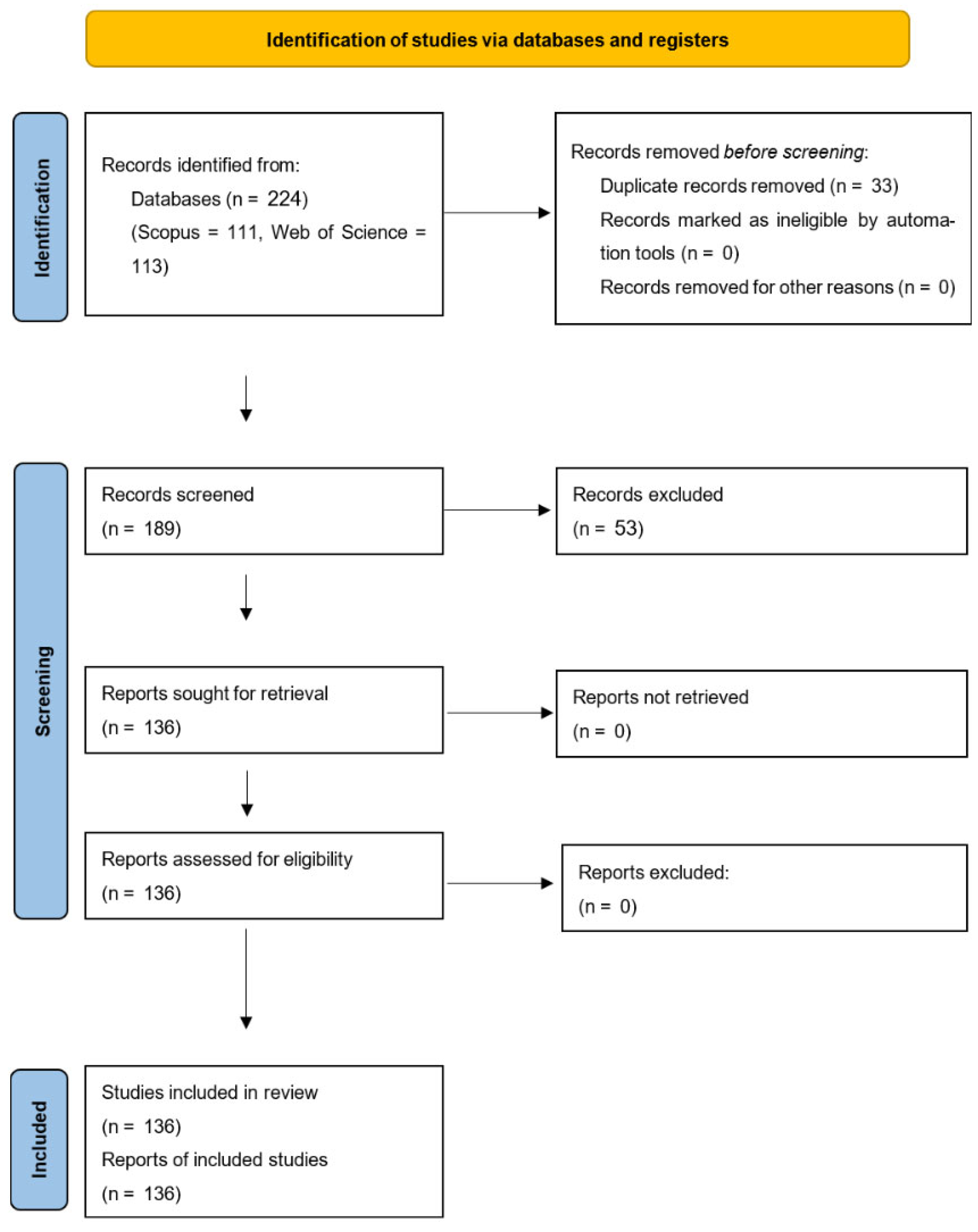
The systematic screening and selection process, conducted according to the PRISMA 2020 guidelines, followed four sequential stages, including identification, removal of duplicates, screening of titles and abstracts, and full-text assessment leading to the final inclusion of studies.
During the identification stage, a total of 224 records were retrieved, including 111 records from Scopus and 113 records from the Web of Science, after applying publication year, language, and document type restrictions. After merging records from both databases, 33 duplicate studies were removed based on matching digital object identifiers (DOIs) and study titles. This resulted in 189 unique records that proceeded to the title and abstract screening stage.
The screening stage led to the exclusion of studies that were not directly related to the three core research themes or that did not include an explicit economic or financial perspective. The remaining studies were then subjected to full-text assessment. At the end of this process, 136 studies were included in the final sample for the systematic review. All included studies consisted of peer-reviewed journal articles and review articles, and this sample formed the basis for all subsequent analyses in the study. It should be noted that all exclusions had occurred during the title and abstract screening stage, with no additional exclusions being recorded at the full-text assessment stage. The review followed the PRISMA 2020 guidelines for new systematic reviews that are based exclusively on database searches, ensuring methodological transparency and replicability of the process. The complete selection pathway is visually presented in the PRISMA flow diagram (Figure 1).
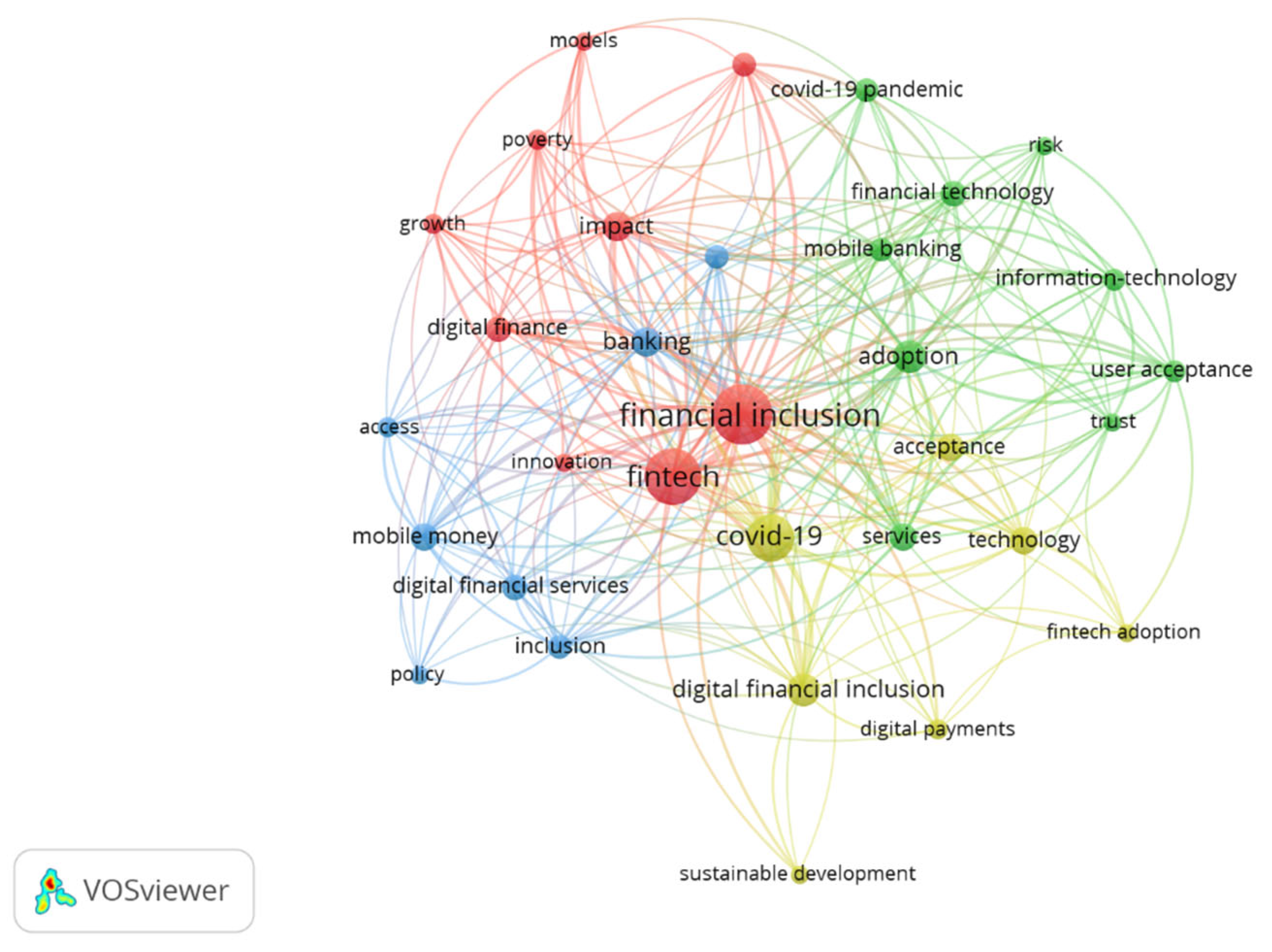
The keyword co-occurrence analysis based on raw Web of Science data revealed a relatively fragmented conceptual structure. The network was characterized by a large number of closely related nodes distributed across multiple clusters, reflecting the wide variety of terminological expressions used in the literature to describe overlapping core concepts.
For instance, pandemic-related concepts appeared as separate nodes, such as COVID-19 and COVID-19 pandemic. Similarly, concepts related to financial technology and digital payments were represented through multiple terms, including “digital finance”, “financial technology”, “fintech”, and “digital payments”. The concept of financial inclusion was also split into distinct nodes, such as “financial inclusion”, “digital financial inclusion”, and “digital financial services”. This terminological variation fragmented central concepts and weakened structural links within the network, indicating that conceptual consolidation was necessary to improve the interpretability of the bibliometric analysis.
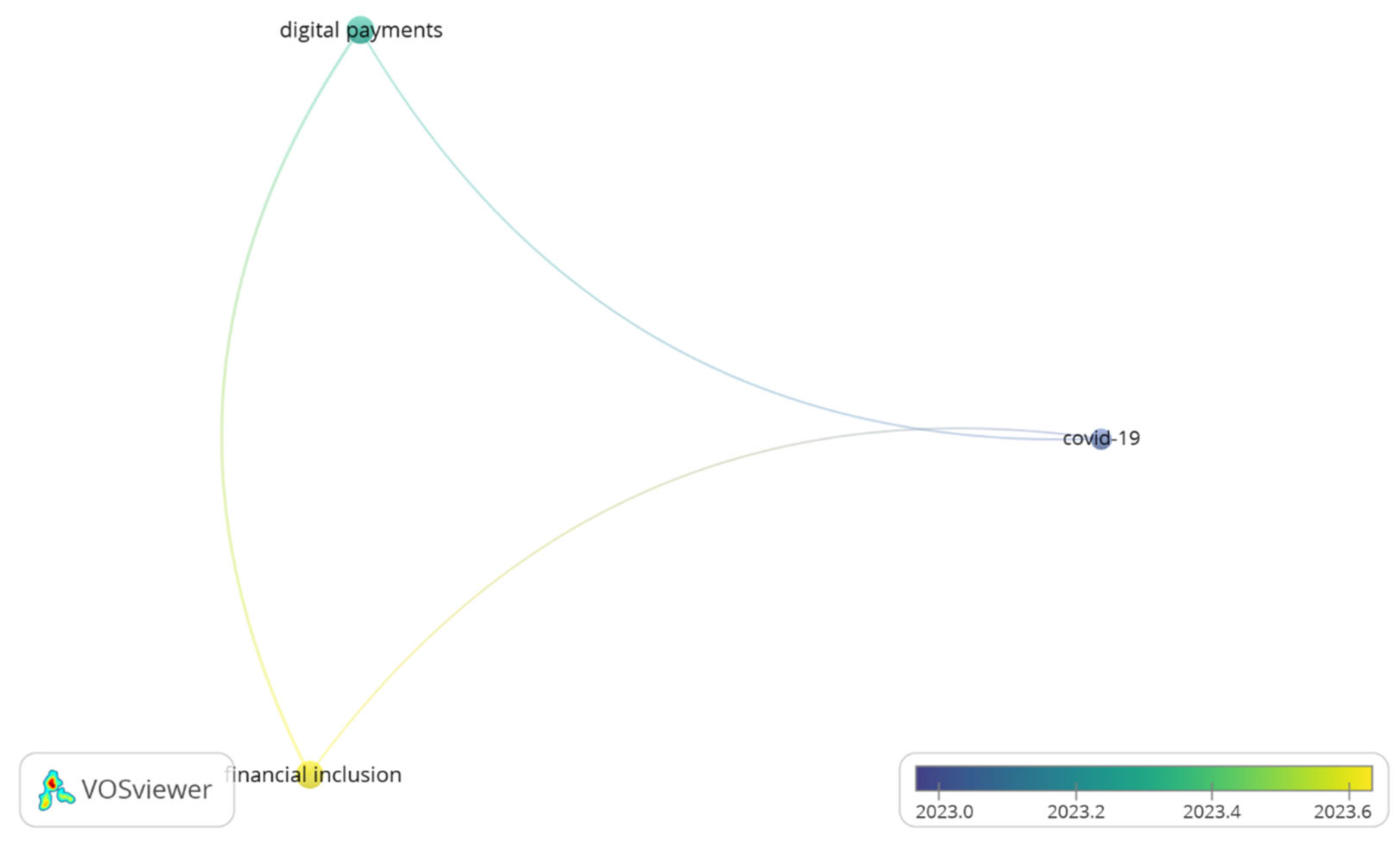
As shown in Figure 2, After applying the customized thesaurus file and re-running the analysis using the same methodological settings, the conceptual structure of the bibliometric map became clearer. The number of nodes decreased as semantically similar terms were merged into unified concepts. The refined analysis highlighted three central nodes—COVID-19, digital payments, and financial inclusion—grouped within a single thematic cluster and connected through strong links. This pattern indicates strong thematic integration in the literature, suggesting that much of the diversity in the initial map reflected linguistic variation rather than distinct research streams. This concentration partly reflects the search strategy, which was intentionally constructed around these three core themes. Rather than causing information loss, the conceptual consolidation helped clarify the literature by reducing terminological noise and highlighting the core relationships between the three concepts, as illustrated in Figure 3.
The application of conceptual unification led to a qualitative improvement in the analytical outputs. This improvement was reflected in the elimination of redundant terminological variants that previously fragmented key concepts, clearer bibliometric indicators for the main nodes, including occurrences and total link strength, and a more concentrated network centered on a limited number of highly interpretable nodes. In addition, the refined network allowed for a closer alignment between the bibliometric results and the theoretical framework of the study and its research question.
As shown in Figure 3, the final bibliometric map became more consistent with the logic of the study and more suitable for analytical interpretation of the relationship between the health shock, digital transformation, and financial inclusion. The structural analysis after conceptual unification shows that financial inclusion emerges as a central node within the network. It recorded 63 occurrences and a total link strength of 60, which reflects its position as the main outcome around which the literature is organized. Financial inclusion appears as the ultimate objective in studies assessing the impact of the shift toward digital payments and in analyses examining the ability of financial systems to expand access to services during crises. Its direct links with both digital payments and COVID-19 support its interpretation as an interaction outcome resulting from the overlap between the health shock caused by the pandemic and the technological response represented by the expansion of digital payment solutions.
Digital payments represent the most prominent node in the network in terms of frequency, with 62 occurrences and a total link strength of 61. This prominence reflects their role as an enabling mechanism linking the COVID-19 shock with longer-term outcomes related to financial inclusion and digital financial transformation. COVID-19 also occupies a central position within the network after related terms were consolidated into a single node, recording 38 occurrences and a total link strength of 41. The literature generally frames the pandemic as an external shock that accelerated the adoption of digital payment technologies and influenced subsequent developments in financial inclusion.
Overall, the network structure indicates that the relationship among these elements is interactive and non-linear. Health shocks and technological innovation intersect to reshape financial system trajectories and patterns of access to financial services, rather than operating through a simple or one-directional causal path.
The temporal interpretation of the bibliometric results relies mainly on the average publication year calculated by VOSviewer for each keyword. This is shown using a color gradient that ranges from dark blue for earlier publications toward light yellow for the more recent ones, as illustrated in Figure 3. The map covers a very narrow time span, from 2023.0 for the earliest nodes up to 2023.6 for the most recent, which indicates that the observed differences are quite subtle and concentrated in a short period, and therefore require careful reading of color intensity as well as node position. Although the dataset covers the period 2020–2025, the overlay visualization generated by VOSviewer reflects the average publication year of keywords, which explains the relatively narrow time interval observed in the map.
Within this structure, the COVID-19 node appears in a darker blue tone, suggesting that it represents the earliest stage of the literature. Studies that are linked to this keyword mainly focus on describing the health and economic shock of the pandemic and its immediate effects on financial systems and payment behavior, which makes it the starting point of the research trajectory.
The Digital payments node appears in a green-to-turquoise color near the middle of the gradient, indicating a transitional phase in the literature. This reflects a shift in research attention toward more operational and technological responses to the crisis, where cashless and contactless payments are discussed as tools to adapt to health restrictions and to maintain continuity of transactions.
In contrast, the financial inclusion node appears in the brightest yellow color, indicating that it is the most recent one within the network. This shows a growing focus on assessing the longer-term effects of digital payments and their ability to expand access to financial services, especially for marginalized and unbanked groups. Financial inclusion therefore emerges not as an immediate response to the crisis, but rather as a later structural outcome of the digital transformation that was accelerated by the pandemic.
Overall, despite the close publication years, the map reveals a clear internal sequence moving from COVID-19 as an external shock, to digital payments as a response mechanism, and finally to financial inclusion as a structural outcome.
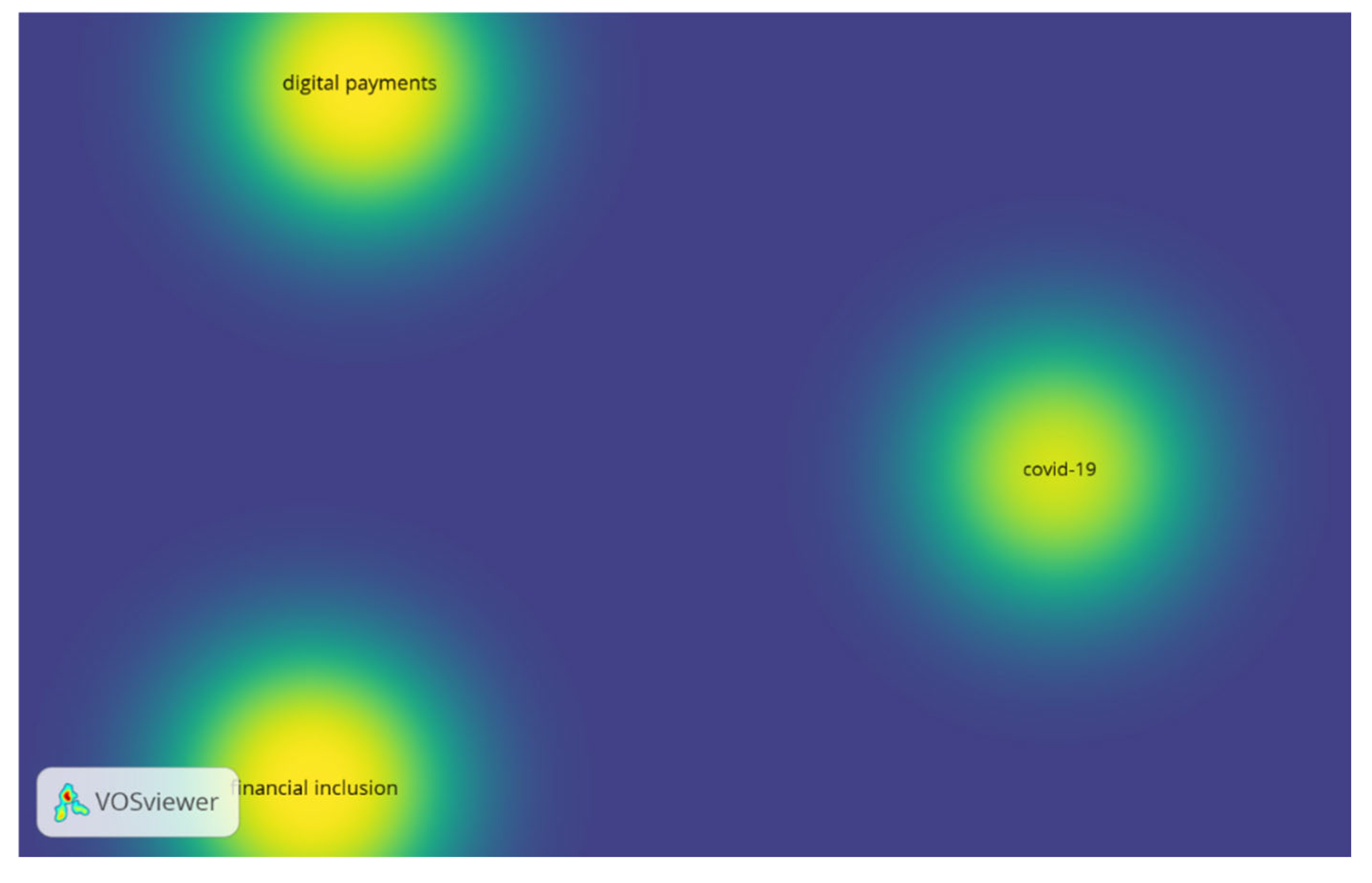
The density visualization in VOSviewer measures the level of conceptual concentration by combining keyword occurrences and total link strength and represents higher density areas using lighter colors that tend toward yellow. After applying conceptual unification, the density map reveals a highly concentrated structure, characterized by only three main density hotspots and an almost complete absence of peripheral areas. This pattern indicates a clear reduction in terminological noise and a higher level of coherence within the literature.
As shown in Figure 4, The highest density areas are centered on digital payments, which appear as the main operational enabling mechanism, and financial inclusion, which emerges as both the analytical framework and the final developmental outcome discussed in the literature. The COVID-19 node also appears as a distinct density area, though relatively less extensive, reflecting its role as a contextual trigger that initiated the transformation process rather than as a long-term outcome itself.
These results suggest that, after conceptual refinement, the literature adopts a more integrated perspective that links the health shock of the pandemic with digital transformation and its broader developmental implications. The density visualization confirms that conceptual unification strengthened the interpretive power of the bibliometric analysis by producing a clearer and more focused network structure. In this sense, density analysis represents a final step that highlights the consolidation of the literature around a limited set of core concepts, providing a more solid analytical and visual basis for the theoretical discussion and policy implications that follow.
The integrated reading of the bibliometric results, combining network, temporal, and density analyses, shows that the literature on COVID-19, digital payments, and financial inclusion has a highly cohesive knowledge structure. Structurally, the network analysis after conceptual unification identifies three central nodes within a single thematic cluster, confirming strong conceptual linkage. Temporally, the literature progresses from COVID-19 as the initial trigger, to digital payments as an operational response, and then to financial inclusion as a later developmental outcome. This pattern is further reinforced by the density map, which highlights three main areas of concentration with no significant peripheral concepts, reflecting a more integrated view of the technological and developmental dimensions. Overall, these findings provide a clear basis for moving into Section 4 and for linking the results with theoretical perspectives and policy implications.
Building on the bibliometric findings, particularly those derived from network maps, density visualization, and temporal analysis, this section moves toward explicit conceptual validation of the study’s core themes. After completing the PRISMA-based selection process and conducting the bibliometric analyses, including network, temporal, and density analyses, an additional analytical step was applied through the construction of a conceptual validation table. This step aimed to assess the explicit presence of digital payments, financial inclusion, and COVID-19 within the analytical sample at the level of individual studies. The purpose of this procedure was to strengthen the interpretation of the bibliometric results and to provide a structured analytical bridge leading into the subsequent discussion.
This phase relied on the same Web of Science data used during the identification and screening stages under the PRISMA framework. The unit of analysis was the bibliographic record of each study as indexed in Web of Science. Conceptual validation initially covered 113 studies before the application of a series of conceptual verification and refinement filters. The validation process focused exclusively on the three core concepts that directly reflect the research question, namely digital payments, financial inclusion, and COVID-19, without introducing intermediary themes or additional conceptual decompositions.
Conceptual validation was conducted using the TITLE–ABS–KEY approach, in which the title, abstract, author keywords, and Keywords Plus were merged into a unified text for each study. The explicit presence of a concept within this scope was considered validation. An expanded dictionary of indicative terms captured terminological variation across the literature, covering digital payments (e.g., mobile payments, digital wallets, mobile money, CBDCs), financial inclusion (e.g., inclusive finance, financial access), and pandemic-related terms (e.g., COVID-19, coronavirus). Validation was coded in binary form, assigning a check mark when a concept appeared explicitly. A strict relevance filter excluded studies containing only one of the three core concepts, resulting in the removal of 22 studies and an intermediate sample of 89 studies.
The sample was then restricted to peer-reviewed journal articles and review papers indexed in Web of Science, excluding books and book chapters based on document type. This step produced a conceptual sample of 87 studies. A final qualitative screening removed studies with scientific integrity concerns or limited thematic relevance (e.g., retracted articles or studies outside the economic scope), resulting in a final analytical sample of 66 studies. All retained studies fall within economics, finance, business, development studies, or closely related fields. Table 1 presents the explicit conceptual validation of the core themes across these 66 studies.
The table shows that the dominant research focus centers on the interaction between digital payments and financial inclusion, while the COVID-19 context is most often used as an accelerating factor or explanatory frame. This conceptual pattern prepares the ground for a deeper discussion of the economic and institutional dimensions of digital transformation in payment systems.
Following the construction of the analytical sample and the conceptual validation table, the study proceeded to a more focused analytical stage by identifying a core analytical subsample consisting only of studies in which all three concepts—digital payments, financial inclusion, and COVID-19—were simultaneously and explicitly present according to the TITLE–ABS–KEY criterion. This step reflects the view that studies addressing all three concepts together provide the most complete analytical evidence for understanding the interaction between digital transformation in payment systems, financial inclusion expansion, and the role of global health shocks in accelerating this process. Studies covering only two concepts were excluded from this deeper analysis but retained within the broader analytical sample. Application of this core filter resulted in a subsample of 27 studies, which serves as the primary basis for advanced interpretive analysis and the development of the subsequent discussion, not as a replacement sample, but as a complementary analytical layer within the overall study.

4. Discussion

In light of the PRISMA 2020-based systematic review and the accompanying bibliometric analysis, the literature shows a clear expansion in research interest on the relationship between digital payments, financial inclusion, and the COVID-19 pandemic. This expansion is reflected not only in the growing volume of studies but also in the increasing conceptual overlap between these themes, which appear clustered within a single knowledge structure rather than as separate research streams. To interpret these relationships more deeply, the discussion adopts a multi-level analytical approach combining evidence from the final systematic review sample (136 studies), the patterns revealed by bibliometric network and temporal maps, and an in-depth interpretive analysis of a core subsample of 27 studies drawn from the Web of Science dataset and explicitly addressing the three core concepts examined in this study.
A closer examination of the reviewed literature shows that studies can be broadly grouped into three thematic clusters: digital payment adoption during the pandemic, financial inclusion outcomes associated with the expansion of digital payments, and the institutional and regulatory environment shaping this relationship, including FinTech ecosystems, digital infrastructure, and public policy. Evidence from the core analytical sample further indicates that the COVID-19 pandemic acted as an external shock that accelerated the adoption of digital payments through lockdown measures, mobility restrictions, and the growing preference for contactless transactions, particularly during 2020–2021 [56,102,108,149]. Cross-country evidence also suggests that pre-existing levels of financial inclusion provided a foundational capacity that enabled some economies to adopt digital payment systems more rapidly during the crisis [80]. This pattern is consistent with the Global Findex 2021 report—the first global dataset explicitly documenting digital payment adoption during the COVID-19 shock—which shows that the pandemic accelerated digital payments while a gap between account ownership and actual usage persisted [18].
In developing country contexts, mobile money services and digital payment applications played a key role in helping households and small businesses adapt to uncertainty by facilitating everyday payments and transfers during lockdown periods [98,122,149]. Evidence from rural agriculture also shows that the expansion of mobile banking services can link farming communities to formal financial systems, thereby supporting financial inclusion pathways during periods of economic disruption [93]. However, despite the rapid spread of digital payments during the COVID-19 period, the evidence does not indicate that financial inclusion improved in a direct or uniform way. In some countries, wider digital payment use facilitated easier access to financial services, while in others the impact remained limited or depended on deeper structural conditions rather than technology alone [99,113,150]. This distinction highlights the difference between short-run adoption effects and longer-term financial inclusion outcomes, which depend on structural factors such as digital infrastructure, regulatory support, financial literacy, and trust in digital financial services.
This pattern suggests that the contribution of digital payments to financial inclusion is strongly shaped by institutional context and development conditions. In many emerging economies, digital payment systems supported access to financial services through mobile money platforms and government-to-person (G2P) payment programs introduced during the pandemic. However, several studies also caution that rapid digitalization may generate new forms of financial exclusion when digital infrastructure, user capabilities, or regulatory readiness remain uneven across populations [18,126,127].
Evidence from Europe suggests that the pandemic widened the gap between cash and cashless users, indicating that digital adoption can sometimes deepen inequality when differences in skills or infrastructure persist [108]. Similar findings appear in Hassan et al. [114], while studies from India show that the expansion of digital financial services during the pandemic did not automatically lead to long-term financial inclusion for all groups [110,150]. Other evidence indicates that ownership and effective use of digital payment tools, such as cards or mobile money accounts, depends strongly on social and economic background, meaning that digital adoption alone does not guarantee equitable outcomes [90,101]. Comparable patterns are observed in the Middle East, where achieving inclusive digital finance requires targeted policy support [151]. More broadly, the reviewed studies confirm that the relationship between digital payments and financial inclusion is shaped by structural factors, particularly digital infrastructure and institutional conditions. Evidence from Ethiopia shows that adoption depends on the interaction between individual characteristics and infrastructure availability such as connectivity and digital services [130], while studies from Zambia highlight the role of supportive digital environments in sustaining mobile money transactions [129]. In the Euro Area, Petrikova & Kocisova [127] further suggest that the spread of digital payments can serve as an indicator of financial inclusion, although its interpretation remains sensitive to institutional differences across countries.
Institutional and regulatory capacity also plays an important role. Chitimira & Torerai [85] emphasize that regulation shapes how digital financial services develop and how risks are managed, including debates related to central bank digital currencies. In African contexts, Anakpo et al. [126] show that policies, practices, and challenges such as consumer protection and governance are crucial in turning digital access into actual financial inclusion, rather than just formal availability of services. In addition, recent research highlights the growing strategic role of global payment infrastructures and their impact on financial systems [152], reinforcing the importance of institutional and systemic conditions in shaping financial outcomes.
Measurement approaches further affect how outcomes are understood. Khera et al. [88] propose a framework for constructing a digital financial inclusion index in emerging and developing economies, while Suhrab et al. [119] develop a multidimensional index for BRICS countries using a data-driven approach. These methods highlight that differences across countries cannot be explained only by adoption levels, but also by how inclusion is defined and measured.
The interaction between digital payments and financial inclusion operates through several overlapping channels. One important channel is access, as digital payment tools expand entry points to financial services, especially in areas with weak traditional banking presence [98,149]. In urban settlements in Manila, digital tools were used to improve collection efficiency and investment recovery, showing practical uses beyond simple consumer payments [131]. Other evidence suggests that digital financial services help groups facing spatial or institutional constraints by enabling daily transactions and connecting them to the formal financial system [104].
Another channel through which digital payments influence financial inclusion is cost reduction. Lower transaction costs make digital payments more attractive for low-income users and support sustained use over time [27,102,108]. However, trust and behavioral adoption also play an important role. Evidence from Vietnam shows that financial health during the pandemic was linked to how users interacted with FinTech platforms and to their level of digital trust [94], while research from India suggests that technology can signal financial system maturity and influence whether digital tools are used regularly or only occasionally [93]. Innovation in payment gateways and peer-to-peer applications has further accelerated the expansion of digital payments, but it has also introduced concerns related to security, fraud, and user experience [148]. These factors help explain why increased usage does not always translate into equal gains in financial inclusion, highlighting the importance of institutional designs that balance technological innovation with user protection [85,126].
When the findings of the reviewed studies are taken together, it becomes clear that the COVID-19 pandemic accelerated the global adoption of digital payments. However, its impact on financial inclusion is not automatic and depends on several conditions. These include the structural readiness of digital infrastructure, the quality of the regulatory framework, the level of digital literacy and skills, and the measurement approaches used to capture the multiple dimensions of financial inclusion [80,88,114,119].
Studies on social inequalities confirm that gender gaps and regional disparities play a key role in determining who actually benefits from digital transformation. This is particularly clear in the context of developing countries, where existing inequalities strongly shape digital outcomes [137]. Evidence related to tool ownership and actual use in India also shows that results are influenced by social and economic characteristics, rather than by the mere availability of technology [90,101,143]. In addition, broader trends in FinTech research and its intersections with information systems suggest that the shift in payment systems is not only a technical pathway, but also an institutional and knowledge-based process in which business models, governance structures, and data practices continue to evolve [135,137].
Finally, many systematic reviews suggest that digital payments can reduce transaction costs, improve access, and make financial activities more transparent, but these advantages do not appear by themselves. They usually need multi-dimensional policies that include infrastructure development, regulation, user protection, and digital financial education, so that the fast acceleration during crises can turn into real and sustainable financial inclusion [27,153]. In this sense, Shalini & Sabitha [111] also point out that digital technology adoption in times of disruption depends on how technological readiness interacts with perceived ease of use and trust, which helps explain why outcomes still differ across societies even when they face the same pandemic shock.
The results of the study show that the relationship between the COVID-19 pandemic, digital payments, and financial inclusion is not direct, but rather interactive and indirect. The effects of the health shock are reflected in the literature through the expansion of digital payment systems as a linking pathway to financial inclusion outcomes. The pandemic accelerated the adoption of these systems through changes in behavior, operational restrictions, and the expansion of digital channels. However, this acceleration does not automatically translate into sustainable financial inclusion but instead represents a transitional phase that opens different possibilities, with outcomes varying across contexts.
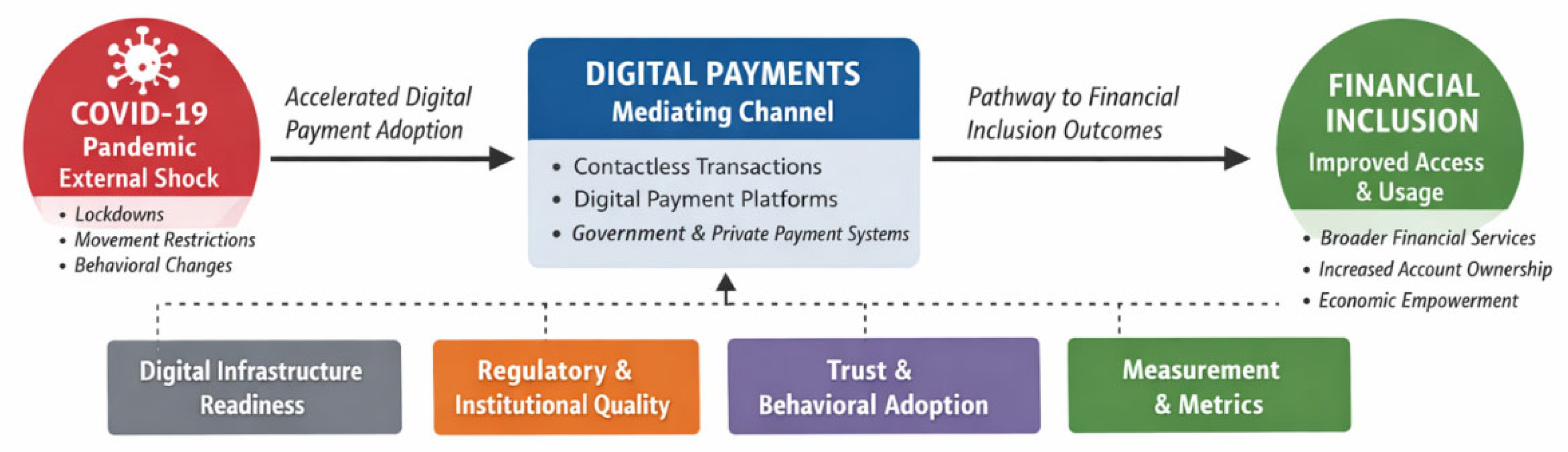
From a theoretical point of view, the relationship found in this study can be understood by combining more than one framework. The COVID-19 pandemic can be considered as an external shock that accelerated the adoption of technology, which is in line with the idea of innovation diffusion. At the same time, digital payments work as an enabling mechanism that moves the effect of the pandemic from short-term reactions toward longer-term financial inclusion outcomes. This role is also related to the technology acceptance model (TAM), since the use of these technologies depends on perceived usefulness, ease of use, and also trust. However, the differences in financial inclusion results across countries and contexts can be better explained by institutional theory [154,155], which focuses on the importance of regulatory quality, infrastructure readiness, and governance conditions. Based on this, financial inclusion should not be seen as a direct result of digital payment expansion, but rather as an interactive outcome shaped by these factors together. This interpretation is also shown in Figure 5, where digital payments appear as a conditional pathway linking the pandemic shock to financial inclusion. This theoretical integration gives a clearer explanation of why short-term adoption during the crisis does not always lead to sustainable financial inclusion outcomes.
The figure illustrates the role of the COVID-19 pandemic as an external shock that accelerated the adoption of digital payment systems, where digital payments emerge as an intermediate pathway linking the pandemic to financial inclusion outcomes. The framework also highlights that the size and direction of this effect remain conditioned by several structural, regulatory, and behavioral factors, including the readiness of digital infrastructure, regulatory quality, and different levels of trust and behavioral reliance.
The refined reading of the literature shows that the fragmentation seen in the initial mapping does not really reflect separate research streams, but rather comes mainly from differences in language and wording used to describe the same core ideas. Despite the methodological diversity and the variation across countries, most of the literature works within a relatively unified analytical structure that focuses on COVID-19, digital payments, and financial inclusion. This structure follows an interactive logic that starts from an external shock, then moves through a digital operational response, and finally leads to developmental outcomes, which helps to reveal the real coherence of the research field.
From a structural point of view, financial inclusion appears as the final objective in this trajectory, showing that research attention has shifted from only describing the event and the tool toward assessing longer-term structural effects of digital transformation. In this context, digital payments are presented as an enabling mechanism that links the pandemic to financial inclusion, not just as a technical solution, but also as an institutional channel that reshaped access to financial services during the crisis. COVID-19 itself remains mainly a triggering factor that redirected research and innovation paths, without being the final analytical focus, which indicates that the relationship between these concepts is interactive and not linear.
The literature also shows a clear temporal progression. Early studies mainly focus on describing the pandemic as a health and economic shock; then, later works move to analyzing digital payments as adaptive and operational responses. More recent studies start to evaluate the implications of these changes for financial inclusion. This pattern suggests that financial inclusion was not treated as an immediate response to the crisis, but rather as a cumulative outcome of accelerated digital changes, which reflects a gradual maturity in the research questions.
The literature also shows a relatively high level of conceptual concentration, where most of the main debates are centered around a limited number of concepts with strong explanatory value, without the appearance of many fragmented or marginal research paths. This pattern suggests that the research field has gradually moved from a stage of broad conceptual exploration toward a more analytically mature phase, with a clear functional distinction between the three core concepts. Digital payments are mainly positioned as an operational enabling mechanism, and financial inclusion represents the main analytical frame and the final developmental outcome, while the pandemic remains a contextual factor that initiated the transformation dynamics without dominating the final analytical focus.
From an integrative perspective, the reading of the literature indicates that the digital transformation of payment systems, as reflected in both the conceptual structure and the temporal evolution of research debates, is closely aligned with the findings of empirical studies. In both strands, digital payments are not treated as an end in themselves, but rather as a means whose developmental effects depend on broader structural, regulatory, and social conditions. In this sense, the discussion does not only confirm the internal consistency of the study’s theoretical framework but also provides an interpretive explanation showing that the evolution of the literature mirrors the actual trajectory of financial system transformations during the pandemic period.
In light of the conceptual maturity and the structural variation observed in the outcomes of digital transformation, the following section focuses on deriving policy implications aimed at transforming the expansion of digital payments into sustainable financial inclusion across different contexts. The literature also points to several concrete policy mechanisms that can strengthen this transformation, including expanding digital infrastructure, improving interoperability of payment systems, strengthening consumer protection and cybersecurity frameworks, promoting financial literacy and digital skills, and enhancing coordination between financial regulators and digital payment service providers.

5. Policy Implications

The discussion results show that the fast shift toward digital payments, which was strongly reinforced during the COVID-19 pandemic, does not by itself guarantee the achievement of sustainable financial inclusion. Instead, the developmental impact of this shift is still conditional on the interaction between several structural, regulatory, and social factors. This means that policy responses should not stay focused only on technological expansion but need to adopt a more comprehensive and multi-dimensional approach.
The evidence suggests that digital transformation policies in payment systems need to be better aligned with financial inclusion as a clear development goal, and not only as a side effect of technical modernization. Expanding the use of digital payments should be designed within policy frameworks that clearly define the target groups, especially low-income people, rural populations, women, and workers in the informal sector. This requires moving away from policies that mainly focus on “increasing usage” toward policies that give more attention to effective access and long-term use.
The findings also indicate that investment in digital infrastructure should not be seen as a purely technical intervention, but rather as a transformative condition that allows marginalized groups to benefit from digital payment systems in real practice. This includes the quality of internet connectivity, the availability of low-cost digital services, system stability, and balanced geographic coverage. Reducing the gap between urban and rural areas appears important to avoid digitalization becoming a new source of financial exclusion.
At the same time, the literature points out that the quality of regulatory frameworks is among the most influential factors for transforming digital expansion into real financial inclusion. Effective policy design therefore requires flexible regulatory arrangements that try to balance innovation with user protection, including data protection, cybersecurity, dispute settlement mechanisms, and some limits on monopolistic behaviors. This also requires closer coordination between central banks, financial regulators, and digital payment service providers, so that regulatory goals can stay consistent with wider development objectives.
In addition, limited financial literacy and digital skills still constrain the transformative impact of digital payments, even in contexts where digital infrastructure already exists. This highlights the need for complementary policies that focus on digital financial education, building trust in digital systems, and simplifying the user interfaces. These measures become especially important during crisis periods, where adoption may increase very fast without enough learning, experience, or confidence among users.
The evidence also shows that relying only on single indicators, such as account ownership rates or digital transaction volumes, can lead to an overestimated assessment of financial inclusion outcomes. More multi-dimensional measurement approaches are therefore needed to capture access, actual usage, service quality, and financial empowerment in a better way. This helps policymakers to design more accurate interventions and to evaluate their effectiveness, while also taking into account the structural differences between countries and different social groups.
Finally, while the pandemic demonstrates the ability of digital payment systems to support economic continuity during crisis times, it also shows the limits of short-term and reactive policy responses. The main policy implication is the need to move from crisis-driven actions toward more long-term strategies that integrate digital payments within a wider development vision for financial inclusion. This includes linking digital transformation with sustainable development agendas, and improving coordination between financial, digital, and social policies, so that technological acceleration can translate into more lasting inclusion benefits.

6. Conclusions

This study provides an integrated analytical reading of the relationship between the COVID-19 pandemic, digital payments, and financial inclusion, by relying on a systematic review following the PRISMA 2020 guidelines and a bibliometric analysis that was supported by an in-depth empirical discussion. The findings show that the pandemic acted as an external shock which accelerated the digital transformation of payment systems, but it was not alone a sufficient factor to guarantee the achievement of sustainable financial inclusion.
The literature reveals that the impact of expanding digital payments was not automatic and also not homogeneous, since its outcomes vary depending on differences in structural readiness, the quality of regulatory frameworks, levels of digital and financial literacy, and the measurement approaches that are applied. Therefore, financial inclusion cannot be explained as a direct result of digital adoption, but rather as an interactive outcome that is conditioned by the integration of institutional, social, and regulatory factors.
The bibliometric analysis further indicates a high level of conceptual coherence and analytical maturity in the literature, where a clear research trajectory has been formed. This trajectory moves from describing the health shock itself, to analyzing digital adaptation tools, and then toward evaluating longer-term developmental outcomes. This pattern reflects a qualitative change in the type of research questions, shifting from a narrow focus on technical expansion toward more attention to the quality of transformation and its inclusive results.
Based on these findings, this study contributes to the existing literature by stressing that transforming the expansion of digital payments into sustainable financial inclusion requires multi-dimensional policy approaches that go beyond crisis-response logic. The results also open new directions for future research that focus on the long-term interactions between financial innovation, digital governance, and social inequalities, which can help in designing more equitable and sustainable financial inclusion paths in both developed and developing economies.

7. Future Research Directions

The findings of this study highlight the need to further deepen research on the long-term effects of the shift toward digital payments after the end of health-related shocks. Future research should rely more on longitudinal study designs that allow us to distinguish between temporary effects related to crisis situations and more permanent structural changes in financial inclusion. Expanding cross-country comparative studies is also an important research direction, since it helps us to understand how regulatory frameworks and levels of digital readiness explain the variation in financial inclusion outcomes across different economic contexts.
The results also point to the importance of expanding micro-level studies that focus on financial behavior, digital trust, and digital financial skills, especially among marginalized groups such as women, rural populations, and workers in the informal sector. In addition, combining economic analysis with approaches from information systems and public policy can support the development of more integrated interpretive frameworks, which are able to translate the expansion of digital payments into sustainable financial inclusion in the long term.
These future research directions support the formulation of more evidence-based public policies and help in improving the transformation of digital payment expansion into more lasting financial inclusion outcomes.

Author Contributions

Conceptualization, A.M.S. and M.F.S.; methodology, A.M.S. and M.F.S.; software, A.M.S.; validation, A.M.S. and M.F.S.; formal analysis, A.M.S.; investigation, A.M.S. and M.F.S.; resources, A.M.S.; writing—original draft preparation, A.M.S. and M.F.S.; writing—review and editing, A.M.S. and M.F.S.; visualization, A.M.S. and M.F.S.; supervision, A.M.S.; project administration, A.M.S.; funding acquisition, A.M.S. All authors have read and agreed to the published version of the manuscript.

Funding

This work was supported and funded by the Deanship of Scientific Research at Imam Mohammad Ibn Saud Islamic University (IMSIU) (grant number IMSIU-DDRSP2604).

Institutional Review Board Statement

Not applicable.

Informed Consent Statement

Not applicable.

Data Availability Statement

No new data were created or analyzed in this study.

Conflicts of Interest

The authors declare no conflicts of interest.

References

  1. Panetta, I.C.; Leo, S.; Delle Foglie, A. The Development of Digital Payments—Past, Present, and Future—From the Literature. Res. Int. Bus. Financ. 2023, 64, 101855. [Google Scholar] [CrossRef]
  2. Polasik, M.; Piotrowski, D. Payment Innovations in Poland: The Role of Payment Services in the Strategies of Commercial Banks. Ekon. Prawo 2016, 15, 73–101. [Google Scholar] [CrossRef][Green Version]
  3. Sharaf, M.F.; Shahen, A.M. From Crisis to Recovery: COVID-19, Macroeconomic Shocks, and the Resilience of Kuwait’s Real Estate Market. Int. J. Hous. Mark. Anal. 2025; ahead of print. [CrossRef]
  4. Baldwin, R.; Weder di Mauro, B. (Eds.) Mitigating the COVID Economic Crisis: Act Fast and Do Whatever It Takes; CEPR Press: London, UK, 2020; ISBN 978-1-912179-29-9. [Google Scholar]
  5. Dodgson, M.; Gann, D.; Wladawsky-Berger, I.; Sultan, N.; George, G. Managing Digital Money. Acad. Manag. J. 2015, 58, 325–333. [Google Scholar] [CrossRef]
  6. World Bank. Global Digitalization in 10 Charts. 2024. Available online: https://www.worldbank.org/en/news/immersive-story/2024/03/05/global-digitalization-in-10-charts (accessed on 10 March 2026).
  7. Mada, L. The Rise of Mobile Payment Systems, Digital Wallets: Successes, Security and Challenges. Eur. J. Comput. Sci. Inf. Technol. 2025, 13, 137–152. [Google Scholar] [CrossRef]
  8. Aron, J. Mobile Money and the Economy: A Review of the Evidence. World Bank Res. Obs. 2018, 33, 135–188. [Google Scholar] [CrossRef]
  9. Law, S.W. Financial Inclusion and Virtual Bank in the Era of Digitalization: A Regulatory Case Study in Hong Kong. In Financial Inclusion, Technology and Virtual Banking: A Theoretical Perspective; Springer Nature: Singapore, 2024; pp. 25–39. [Google Scholar] [CrossRef]
  10. Better than Cash Define Digital Payments. Available online: https://www.betterthancash.org/define-digital-payments (accessed on 20 March 2025).
  11. Chen, J.; Mahajan, D.; Nadeau, M.-C.; Varadarajan, R. Consumer Digital Payments: Already Mainstream, Increasingly Embedded, Still Evolving. Available online: https://www.mckinsey.com/industries/financial-services/our-insights/banking-matters/consumer-digital-payments-already-mainstream-increasingly-embedded-still-evolving (accessed on 17 December 2025).
  12. World Bank Financial Inclusion; World Bank: Washington, DC, USA, 2025.
  13. Ferrata, L. Digital Financial Inclusion—An Engine for “Leaving No One Behind”. Public Sect. Econ. 2019, 43, 445–458. [Google Scholar] [CrossRef]
  14. Allen, F.; Demirguc-Kunt, A.; Klapper, L.; Martinez Peria, M.S. The Foundations of Financial Inclusion: Understanding Ownership and Use of Formal Accounts. J. Financ. Intermediat. 2016, 27, 1–30. [Google Scholar] [CrossRef]
  15. Sahay, R.; Cihak, M.; N’Diaye, P.M.; Barajas, A.; Mitra, S.; Kyobe, A.J.; Mooi, Y.N.; Yousefi, S.R. Financial Inclusion: Can It Meet Multiple Macroeconomic Goals? IMF Staff Discussion Notes; International Monetary Fund: Washington, DC, USA, 2015; Volume 2015. [Google Scholar]
  16. Demirgüç-Kunt, A.; Klapper, L.; Singer, D.; Ansar, S.; Hess, J. The Global Findex Database 2017: Measuring Financial Inclusion and the Fintech Revolution; World Bank: Washington, DC, USA, 2018; ISBN 978-1-4648-1259-0. [Google Scholar]
  17. Aurazo, J.; Frost, J.; Kosse, A. Faster Digital Payments: Global and Regional Perspectives; BIS Papers; Bank for International Settlements (BIS): Basel, Switzerland, 2024; Available online: https://www.bis.org/publ/bppdf/bispap152.pdf (accessed on 22 March 2026).
  18. Demirgüç-Kunt, A.; Klapper, L.; Singer, D.; Ansar, S. The Global Findex Database 2021: Financial Inclusion, Digital Payments, and Resilience in the Age of COVID-19; The World Bank: Washington, DC, USA, 2022; ISBN 978-1-4648-1897-4. [Google Scholar]
  19. Soriano, M.A. Factors Driving Financial Inclusion and Financial Performance in Fintech New Ventures: An Empirical Study. Ph.D. Thesis, Singapore Management University, Singapore, 2017; pp. 1–258. Available online: https://ink.library.smu.edu.sg/etd_coll/145 (accessed on 22 March 2026).
  20. Arner, D.W.; Barberis, J.; Buckley, R.P. FinTech, RegTech, and the Reconceptualization of Financial Regulation. Northwest. J. Int. Law Bus. 2017, 37, 371–414. Available online: https://scholarlycommons.law.northwestern.edu/njilb/vol37/iss3/2/ (accessed on 22 March 2026).
  21. Gomber, P.; Koch, J.-A.; Siering, M. Digital Finance and FinTech: Current Research and Future Research Directions. J. Bus. Econ. 2017, 87, 537–580. [Google Scholar] [CrossRef]
  22. Ozili, P.K. Impact of Digital Finance on Financial Inclusion and Stability. Borsa Istanb. Rev. 2018, 18, 329–340. [Google Scholar] [CrossRef]
  23. Amnas, M.B.; Selvam, M.; Parayitam, S. FinTech and Financial Inclusion: Exploring the Mediating Role of Digital Financial Literacy and the Moderating Influence of Perceived Regulatory Support. J. Risk Financ. Manag. 2024, 17, 108. [Google Scholar] [CrossRef]
  24. Agyekum, F.; Locke, S.; Hewa-Wellalage, N. Financial Inclusion and Digital Financial Services: Empirical Evidence from Ghana. MPRA Paper. 2017. Available online: https://mpra.ub.uni-muenchen.de/82885/ (accessed on 22 March 2026).
  25. Anton, S.; Nucu, A.E.A. The Impact of Digital Finance and Financial Inclusion on Banking Stability: International Evidence. Oeconomia Copernic. 2024, 15, 563–593. [Google Scholar] [CrossRef]
  26. Auer, R.; Frost, J.; Gambacorta, L.; Monnet, C.; Rice, T.; Shin, H.S. Central Bank Digital Currencies: Motives, Economic Implications, and the Research Frontier. Annu. Rev. Econ. 2022, 14, 697–721. [Google Scholar] [CrossRef]
  27. Shahen, A.M.; Sharaf, M.F. The Role of Digital Payment Technologies in Promoting Financial Inclusion: A Systematic Literature Review. FinTech 2025, 4, 59. [Google Scholar] [CrossRef]
  28. Heath, R.; Riley, E. Digital Financial Services and Women’s Empowerment: Experimental Evidence from Tanzania. 2024. Available online: https://escholarship.org/uc/item/0z88s5d9 (accessed on 22 March 2026).
  29. Kodom, M.; Osarfo, D.; Quartey, P. Digital Financial Inclusion and Women’s Economic Empowerment in Northern Ghana: The Experience of Rural Women in the Shea Value Chain. In Sustainable Development Goals Series; Sustainable Development Goals Series; Springer: Berlin/Heidelberg, Germany, 2024; pp. 179–200. [Google Scholar]
  30. Suri, T. Mobile Money. Annu. Rev. Econ. 2017, 9, 497–520. [Google Scholar] [CrossRef]
  31. Suri, T.; Jack, W. The Long-Run Poverty and Gender Impacts of Mobile Money. Science 2016, 354, 1288–1292. [Google Scholar] [CrossRef]
  32. Osabutey, E.L.C.; Jackson, T. Mobile Money and Financial Inclusion in Africa: Emerging Themes, Challenges and Policy Implications. Technol. Forecast. Soc. Change 2024, 202, 123339. [Google Scholar] [CrossRef]
  33. Agarwal, A.; Assenova, V.A. Mobile Money as a Stepping Stone to Financial Inclusion: How Digital Multisided Platforms Fill Institutional Voids. Organ. Sci. 2024, 35, 769–787. [Google Scholar] [CrossRef]
  34. Kanga, D.; Oughton, C.; Harris, L.; Murinde, V. The Diffusion of Fintech, Financial Inclusion and Income per Capita. Eur. J. Financ. 2022, 28, 108–136. [Google Scholar] [CrossRef]
  35. Fabregas, R.; Yokossi, T. Mobile Money and Economic Activity: Evidence from Kenya. World Bank Econ. Rev. 2022, 36, 734–756. [Google Scholar] [CrossRef] [PubMed]
  36. Younas, A.; Ahmed, J.; Audi, M. Financial Inclusion or Financial Vulnerability? The Dual Effects of Digital Payment Platforms on Consumer Behaviour. Available online: https://mpra.ub.uni-muenchen.de/126075/ (accessed on 15 December 2025).
  37. Hornuf, L.; Safari, K.; Voshaar, J. Mobile Fintech Adoption in Sub-Saharan Africa: A Systematic Literature Review and Meta-Analysis. Res. Int. Bus. Financ. 2025, 73, 102529. [Google Scholar] [CrossRef]
  38. Mashoene, M.; Tweneboah, G.; Schaling, E. FinTech and Financial Inclusion in Emerging and Developing Economies: A System GMM Model. Cogent Soc. Sci. 2025, 11, 2491701. [Google Scholar] [CrossRef]
  39. Ocharive, A.; Iworiso, J. The Impact of Digital Financial Services on Financial Inclusion: A Panel Data Regression Method. Int. J. Data Sci. Anal. 2024, 10, 20–32. [Google Scholar] [CrossRef]
  40. Gabor, D.; Brooks, S. The Digital Revolution in Financial Inclusion: International Development in the Fintech Era. New Polit. Econ. 2017, 22, 423–436. [Google Scholar] [CrossRef]
  41. Arner, D.W.; Barberis, J.N.; Buckley, R.P. The Evolution of Fintech: A New Post-Crisis Paradigm? Georget. J. Int. Law 2016, 47, 1271–1319. [Google Scholar] [CrossRef]
  42. Durai, D.T.; Stella, G. Digital finance and its impact on financial inclusion. JETIR 2019, 6, 122–127. [Google Scholar]
  43. De Reuver, M.; Ondrus, J. When Technological Transitions Hit Multi-Sided Platforms: The Case of Mobile Payments. Commun. ACM 2017, 60, 65–70. [Google Scholar] [CrossRef]
  44. Sahay, R.; von Allmen, U.E.; Lahreche, A.; Khera, P.; Ogawa, S.; Bazarbash, M.; Beaton, K. The Promise of Fintech: Financial Inclusion in the Post COVID-19 Era; Departmental Papers; International Monetary Fund: Washington, DC, USA, 2020; p. 83. [Google Scholar] [CrossRef]
  45. Galbraith, J.W.; Tkacz, G. Nowcasting GDP with Electronic Payments Data; ECB Statistics Paper Series; European Central Bank (ECB): Frankfurt am Main, Germany, 2015; Available online: https://www.econstor.eu/handle/10419/154645 (accessed on 22 March 2026).
  46. Auer, R.; Cornelli, G.; Frost, J. COVID-19, Cash, and the Future of Payments. 2020. Available online: https://www.findevgateway.org/paper/2020/04/covid-19-cash-and-future-payments (accessed on 22 March 2026).
  47. Kosse, A.; Szemere, R. COVID-19 Accelerated the Digitalisation of Payments; Commentary on the BIS Committee on Payments and Market Infrastructures (CPMI); Bank for International Settlements (BIS): Basel, Switzerland, 2021; Available online: https://www.bis.org/statistics/payment_stats/commentary2112.htm (accessed on 22 March 2026).
  48. Fu, J.; Mishra, M. Fintech in the Time of COVID-19: Technological Adoption During Crises. J. Financ. Intermed. 2022, 50, 100945. [Google Scholar] [CrossRef]
  49. Gutiérrez-Romero, R.; Ahamed, M. COVID-19 Response Needs to Broaden Financial Inclusion to Curb the Rise in Poverty. World Dev. 2021, 138, 105229. [Google Scholar] [CrossRef]
  50. The World Bank Global Findex Database 2021 Survey Headline Findings on the Use of Financial Services. Available online: https://www.worldbank.org/en/publication/globalfindex/brief/the-global-findex-database-2021-chapter-2-use-of-accounts (accessed on 15 December 2025).
  51. Digital Financial Inclusion. Available online: https://www.worldbank.org/en/topic/financialinclusion/publication/digital-financial-inclusion (accessed on 16 December 2025).
  52. Aker, J.C.; Mbiti, I.M. Mobile Phones and Economic Development in Africa. J. Econ. Perspect. 2010, 24, 207–232. [Google Scholar] [CrossRef]
  53. Donthu, N.; Gustafsson, A. Effects of COVID-19 on Business and Research. J. Bus. Res. 2020, 117, 284–289. [Google Scholar] [CrossRef]
  54. Nicola, M.; Alsafi, Z.; Sohrabi, C.; Kerwan, A.; Al-Jabir, A.; Iosifidis, C.; Agha, M.; Agha, R. The Socio-Economic Implications of the Coronavirus Pandemic (COVID-19): A Review. Int. J. Surg. 2020, 78, 185–193. [Google Scholar] [CrossRef]
  55. Yıldırım, S.; Bostancı, S. COVID-19 Krizi Etkisinde Dijital Ekonomide Yaşanan Gelişmelere Yönelik Nitel Bir Yaklaşım. JOEEP J. Emerg. Econ. Policy 2022, 7, 32–44. [Google Scholar]
  56. Mansour, H. How Successful Countries Are in Promoting Digital Transactions during COVID-19. J. Econ. Stud. 2021, 49, 435–452. [Google Scholar] [CrossRef]
  57. Siddika, A.; Sarwar, A. Digital Financial Inclusion: COVID-19 Pandemic as a Catalyst for Adoption. J. Syst. Manag. Sci. 2023, 13, 88–106. [Google Scholar] [CrossRef]
  58. Ozili, P.K. Financial Inclusion and Fintech during COVID-19 Crisis: Policy Solutions. SSRN Electron. J. 2020, 8. [Google Scholar] [CrossRef]
  59. Fung, D.W.H.; Lee, W.Y.; Yeh, J.J.H.; Yuen, F.L. Friend or Foe: The Divergent Effects of FinTech on Financial Stability. Emerg. Mark. Rev. 2020, 45, 100727. [Google Scholar] [CrossRef]
  60. Cull, R.J.; Foster, V.; Jolliffe, D.M.; Lederman, D.; Mare, D.S.; Veerappan, M. Digital Payments and the COVID-19 Shock: The Role of Preexisting Conditions in Banking, Infrastructure, Human Capabilities, and Digital Regulation; Policy Research Working Paper; The World Bank: Washington, DC, USA, 2023. [Google Scholar]
  61. Qiang, C.Z.; Rutkowski, M.; Pesme, J. The COVID-19 Crisis Showed the Future of G2P Payments Should Be Digital. Here’s Why. World Bank Blogs. 2022. Available online: https://blogs.worldbank.org/voices/covid-19-crisis-showed-future-g2p-payments-should-be-digital-heres-why (accessed on 10 March 2026).
  62. Srivastava, C.; Mahendar, G.G.; Vandana, V. Adoption of Contactless Payments during Covid 19 Pandemic an Integration of Protection Motivation Theory (PMT) and Unified Theory of Acceptance and Use of Technology (UTAUT). Acad. Mark. Stud. J. 2021, 25, 1–361. [Google Scholar]
  63. Galbraith, J.W.; Tkacz, G. Electronic Transactions as High-Frequency Indicators of Economic Activity; Staff Working Paper No. 2007-58; Bank of Canada: Ottawa, ON, Canada, 2007. [Google Scholar] [CrossRef]
  64. Aladangady, A.; Aron-Dine, S.; Dunn, W.; Feiveson, L.; Lengermann, P.; Sahm, C. From Transactions Data to Economic Statistics: Constructing Real-Time, High-Frequency, Geographic Measures of Consumer Spending; NBER Working Paper No. 26253; National Bureau of Economic Research: Cambridge, MA, USA, 2019. [Google Scholar] [CrossRef]
  65. Aprigliano, V.; Ardizzi, G.; Monteforte, L. Using Payment System Data to Forecast Economic Activity. Int. J. Cent. Bank. 2019, 15, 55–80. Available online: https://www.ijcb.org/journal/v15n4/using-payment-system-data-forecast-economic-activity (accessed on 22 March 2026).
  66. Felber, L.; Beyeler, S. Nowcasting Economic Activity Using Transaction Payments Data. SSRN Electron. J. 2023. [Google Scholar] [CrossRef]
  67. Bae, K.-H.; Karolyi, G.A.; Stulz, R.M. A New Approach to Measuring Financial Contagion. Rev. Financ. Stud. 2003, 16, 717–763. [Google Scholar] [CrossRef]
  68. GSMA: State of the Industry Report on Mobile Money. Available online: https://www.thistleinitiatives.co.uk/blog/gsma-state-of-the-industry-report-on-mobile-money (accessed on 14 December 2025).
  69. Koomson, I.; Bukari, C.; Villano, R.A. Mobile Money Adoption and Response to Idiosyncratic Shocks: Empirics from Five Selected Countries in Sub-Saharan Africa. Technol. Forecast. Soc. Change 2021, 167, 120728. [Google Scholar] [CrossRef]
  70. Greene, C.; Merry, E.A.; Stavins, J. Has Covid Changed Consumer Payment Behavior? Working Papers No. 21-12; Federal Reserve Bank of Boston Research Department: Boston, MA, USA, 2021. [Google Scholar] [CrossRef]
  71. Hua, X.; Huang, Y. Understanding China’s Fintech Sector: Development, Impacts and Risks. Eur. J. Financ. 2021, 27, 321–333. [Google Scholar] [CrossRef]
  72. Economides, N.; Jeziorski, P. Mobile Money in Tanzania. Mark. Sci. 2017, 36, 815–837. [Google Scholar] [CrossRef]
  73. Reserve Bank of India (RBI) DFS Drives Expansion of Digital Payments in India and Abroad. Available online: https://www.pib.gov.in/PressReleaseIframePage.aspx?PRID=2057013 (accessed on 18 December 2025).
  74. Hassan, N. Share of Digital Payments in Saudi Arabia Hits 62%, Says SAMA Official. Available online: https://www.arabnews.com/node/2367251/business-economy (accessed on 17 December 2025).
  75. Agur, I.; Martinez Peria, S.; Rochon, C. Digital Financial Services and the Pandemic: Opportunities and Risks for Emerging and Developing Economies; International Monetary Fund: Washington, DC, USA, 2020. [Google Scholar]
  76. Cui, L.; Weng, S.; Song, M. Financial Inclusion, Renewable Energy Consumption, and Inclusive Growth: Cross-Country Evidence. Energy Effic. 2022, 15, 43. [Google Scholar] [CrossRef]
  77. UNCTAD. COVID-19 and e-Commerce: A Global Review. 2021. Available online: https://unctad.org/publication/covid-19-and-e-commerce-global-review (accessed on 22 March 2026).
  78. Ghandour, A.; Al-Srehan, H.; Almutairi, A. Analysis of Demand and Supply for Mobile Payments in the UAE during COVID-19. J. Risk Financ. Manag. 2023, 16, 59. [Google Scholar] [CrossRef]
  79. Lashitew, A.; van Tulder, R.; Liasse, Y. Mobile Phones for Financial Inclusion: What Explains the Diffusion of Mobile Money Innovations? Res. Policy 2019, 48, 1201–1215. [Google Scholar] [CrossRef]
  80. Niankara, I.; Traoret, R.I. The Digital Payment-Financial Inclusion Nexus and Payment System Innovation within the Global Open Economy during the COVID-19 Pandemic. J. Open Innov. Technol. Mark. Complex. 2023, 9, 100173. [Google Scholar] [CrossRef]
  81. Donthu, N.; Kumar, S.; Mukherjee, D.; Pandey, N.; Lim, W.M. How to Conduct a Bibliometric Analysis: An Overview and Guidelines. J. Bus. Res. 2021, 133, 285–296. [Google Scholar] [CrossRef]
  82. Page, M.J.; McKenzie, J.E.; Bossuyt, P.M.; Boutron, I.; Hoffmann, T.C.; Mulrow, C.D.; Shamseer, L.; Tetzlaff, J.M.; Akl, E.A.; Brennan, S.E.; et al. The PRISMA 2020 Statement: An Updated Guideline for Reporting Systematic Reviews. BMJ 2021, 372, 71. [Google Scholar] [CrossRef] [PubMed]
  83. Van Eck, N.J.; Waltman, L. Software Survey: VOSviewer, a Computer Program for Bibliometric Mapping. Scientometrics 2010, 84, 523–538. [Google Scholar] [CrossRef] [PubMed]
  84. Khatun, M.N.; Mitra, S.; Sarker, M.N.I. Mobile Banking during COVID-19 Pandemic in Bangladesh: A Novel Mechanism to Change and Accelerate People’s Financial Access. Green Financ. 2021, 3, 253–267. [Google Scholar] [CrossRef]
  85. Chitimira, H.; Torerai, E. A Regulatory Analysis of Digital Financial Services and the Adoption of Central Bank Digital Currencies in Zimbabwe and South Africa. Jurid. Trib. 2023, 13, 384–407. [Google Scholar] [CrossRef]
  86. Ozili, P.K.; Mhlanga, D. Why Is Financial Inclusion so Popular? An Analysis of Development Buzzwords. J. Int. Dev. 2024, 36, 231–253. [Google Scholar] [CrossRef]
  87. Sant’Anna, D.A.L.M.; Figueiredo, P.N. Fintech Innovation: Is It Beneficial or Detrimental to Financial Inclusion and Financial Stability? A Systematic Literature Review and Research Directions. Emerg. Mark. Rev. 2024, 60, 101140. [Google Scholar] [CrossRef]
  88. Khera, P.; Ng, S.; Ogawa, S.; Sahay, R. Measuring Digital Financial Inclusion in Emerging Market and Developing Economies: A New Index. Asian Econ. Policy Rev. 2022, 17, 213–230. [Google Scholar] [CrossRef]
  89. Ha, L.O.; Nguyen, T.H.; Nguyen, V.C. Developing Financial Inclusion in the Context of COVID-19 Pandemic: The Case of a Developing Country. In Computer Intelligence Against Pandemics: Tools and Methods to Face New Strains of COVID-19; De Gruyter: Berlin, Germany, 2023; Volume 9, pp. 173–185. [Google Scholar]
  90. Nandru, P.; Chendragiri, M.; Arulmurugan, V. Socioeconomic Determinants of Ownership of Payment Cards, Mobile Money Account, and Government Remittances of Digital Financial Services: Evidence from India. J. Financ. Econ. Policy 2024, 16, 247–271. [Google Scholar] [CrossRef]
  91. Ha, D.; Nguyen, K. Unlocking Financial Access in a Developing Country amidst COVID-19: The Impacts of Financial Literacy and Fintech. J. Asia Pac. Econ. 2025, 30, 1574–1610. [Google Scholar] [CrossRef]
  92. Parvathy, V.K.; Kumar, J. Driving Financial Inclusion: Technology as an Indicator of Financial Ecosystem Development During the COVID-19 Pandemic in India. Int. J. E-Bus. Res. 2022, 18, 1–15. [Google Scholar] [CrossRef]
  93. Khatun, M.N.; Sarker, M.N.I.; Mitra, S. Adoption of Mobile Banking to Promote Financial Inclusion among Rural Farming Community: Drivers and Satisfaction Level Perspective. J. Agric. Food Res. 2024, 18, 101448. [Google Scholar] [CrossRef]
  94. Nathan, R.J.; Setiawan, B.; Quynh, M.N. Fintech and Financial Health in Vietnam during the COVID-19 Pandemic: In-Depth Descriptive Analysis. J. Risk Financ. Manag. 2022, 15, 125. [Google Scholar] [CrossRef]
  95. Berg, T.; Fuster, A.; Puri, M. FinTech Lending. Annu. Rev. Financ. Econ. 2022, 14, 187–207. [Google Scholar] [CrossRef]
  96. Ly, H.T.N.; Khuong, N.V.; Son, T.H. Determinants Affect Mobile Wallet Continuous Usage in COVID-19 Pandemic: Evidence from Vietnam. Cogent Bus. Manag. 2022, 9, 2041792. [Google Scholar] [CrossRef]
  97. Sodokin, K.; Djafon, J.K. Role of Digital Transformation in Closing the Financial Inclusion Disparities in West African Economic and Monetary Union and the COVID-19 Effect. J. Int. Dev. 2025, 37, 887–923. [Google Scholar] [CrossRef]
  98. Mugume, R.; Bulime, E.W.N. Post-COVID-19 Recovery for African Economies: Lessons for Digital Financial Inclusion from Kenya and Uganda. Afr. Dev. Rev.-Rev. Afr. Dev. 2022, 34, S161–S176. [Google Scholar] [CrossRef]
  99. Dluhopolskyi, O.; Pakhnenko, O.; Lyeonov, S.; Semenog, A.; Artyukhova, N.; Cholewa-Wiktor, M.; Jastrzębski, W. Digital Financial Inclusion: COVID-19 Impacts and Opportunities. Sustainability 2023, 15, 2383. [Google Scholar] [CrossRef]
  100. Sultana, N.; Chowdhury, R.S.; Haque, A. Gravitating towards Fintech: A Study on Undergraduates Using Extended UTAUT Model. Heliyon 2023, 9, e20731. [Google Scholar] [CrossRef]
  101. Soni, S.; Manogna, R.L. Financial Inclusion in India Amid COVID-19 Pandemic: Recent Trends and Determinants. J. Knowl. Econ. 2024, 15, 20699–20717. [Google Scholar] [CrossRef]
  102. Aurazo, J.; Vega, M. Why People Use Digital Payments: Evidence from Micro Data in Peru. Lat. Am. J. Cent. Bank. 2021, 2, 100044. [Google Scholar] [CrossRef]
  103. Setiawan, B.; Phan, T.D.; Medina, J.; Wieriks, M.; Nathan, R.J.; Fekete-Farkas, M. Quest for Financial Inclusion via Digital Financial Services (Fintech) during COVID-19 Pandemic: Case Study of Women in Indonesia. J. Financ. Serv. Mark. 2024, 29, 459–473. [Google Scholar] [CrossRef]
  104. Munyegera, K.G.; Kwizera, S.; Akampumuza, P. Development of the Digital Financial Ecosystem in Rwanda: Patterns, Trends, and Way Forward. J. Afr. Dev. 2025, 26, 259–292. [Google Scholar] [CrossRef]
  105. Lorain, M.-A.; Barreal Pernas, J.; Jannes, G.; Urquia Grande, E.; Lopez Sanchez, P.; Sierra, J. Unraveling Financial Exclusion during the COVID-19 Pandemic: A Gender Perspective in Latin American Countries. World Dev. 2025, 188, 106924. [Google Scholar] [CrossRef]
  106. Bublyk, Y.; Shapoval, Y.; Shpanel-Yukhta, O.; Brus, S. Effect of Financial Access on Cashless Economy: The Case of Ukraine. Banks Bank Syst. 2023, 18, 91–102. [Google Scholar] [CrossRef]
  107. Wójcik, D. Financial Geography II: The Impacts of FinTech—Financial Sector and Centres, Regulation and Stability, Inclusion and Governance. Prog. Hum. Geogr. 2021, 45, 878–889. [Google Scholar] [CrossRef]
  108. Kotkowski, R.; Polasik, M. COVID-19 Pandemic Increases the Divide between Cash and Cashless Payment Users in Europe. Econ. Lett. 2021, 209, 110139. [Google Scholar] [CrossRef]
  109. Mohamed, H.A.; Otake, T. The Role of Islamic FinTech in Digital Financial Inclusion and Sustainable Development Post COVID-19: Cross-Country Analysis. Int. J. Islam. Middle East. Financ. Manag. 2025, 18, 649–671. [Google Scholar] [CrossRef]
  110. Sam, J.S.; Chakraborty, A.; Srinivasan, J. Cashlessness in India: Vision, Policy and Practices. Telecommun. Policy 2021, 45, 102169. [Google Scholar] [CrossRef]
  111. Shalini, V.; Sabitha, D. Fintech Innovation Adoption in the Digital Payments Landscape Amidst the Pandemic: Empirical Evidence and Future Outlook. IIM Kozhikode Soc. Manag. Rev. 2025, 14, 233–241. [Google Scholar] [CrossRef]
  112. Semerikova, E.N. Cashless Payments beyond Access: What Influences the Intensity of Use? J. New Econ. Assoc. 2024, 64, 171–188. [Google Scholar] [CrossRef]
  113. Ul Hassan, M.I.; Wu, M.; Lu, J.; Sohu, J.M.; Ali, S.; Anjum, H.N.; Bilal, M. Financial Technology and Banking Performance in Developing Countries: Evidence from an Advanced Quantile Regression Approach. Humanit. Soc. Sci. Commun. 2025, 12, 1455. [Google Scholar] [CrossRef]
  114. Hassan, M.K.; Bayat, T.; Yüzbaşı, B.; Kayhan, S. Was Digitalization Effective in Enhancing Financial Inclusion in the EU-27 During the COVID–19 Pandemic? East. Eur. Econ. 2025, 1–17. [Google Scholar] [CrossRef]
  115. Al-Okaily, M.; Boshnak, H.A. Toward a Comprehensive Understanding of Digital Financial Services: Fresh Insights from the Emerging Market. Int. J. Hum.-Comput. Interact. 2025, 1–15. [Google Scholar] [CrossRef]
  116. Banna, H.; Alam, M.R. Impact of Digital Financial Inclusion on ASEAN Banking Stability: Implications for the Post-COVID-19 Era. Stud. Econ. Financ. 2021, 38, 504–523. [Google Scholar] [CrossRef]
  117. Gertze, L.; Petersen, F. Factors Influencing the Acceptance and Use of a South African Online Bank. South Afr. J. Inf. Manag. 2024, 26, 11. [Google Scholar] [CrossRef]
  118. Puri, V.; Kaur, G.; Kalra, J.K.; Gill, K. Bank Stability and Digitalisation: Empirical Evidence from Selected Indian Banks. J. Econ. Adm. Sci. 2025, 41, 1386–1409. [Google Scholar] [CrossRef]
  119. Suhrab, M.; Pinglu, C.; Qian, N. Constructing Tech-Driven Multidimensional Financial Inclusion Index in the Digital Era: A Data-Driven Analysis for BRICS Nations. Asia-Pac. Financ. Mark. 2025. [Google Scholar] [CrossRef]
  120. Alshater, M.M.; Saba, I.; Supriani, I.; Rabbani, M.R. Fintech in Islamic Finance Literature: A Review. Heliyon 2022, 8, e10385. [Google Scholar] [CrossRef]
  121. Aloulou, M.; Grati, R.; Al-Qudah, A.A.; Al-Okaily, M. Does FinTech Adoption Increase the Diffusion Rate of Digital Financial Inclusion? A Study of the Banking Industry Sector. J. Financ. Rep. Account. 2024, 22, 289–307. [Google Scholar] [CrossRef]
  122. Ky, S.S.; Rugemintwari, C. Informal Firms’ Adoption and Use of Mobile Money Under Uncertain Times: Evidence from Burkina Faso. Rev. Dev. Econ. 2025. [Google Scholar] [CrossRef]
  123. Banna, H.; Hassan, M.K.; Ahmad, R.; Alam, M.R. Islamic Banking Stability amidst the COVID-19 Pandemic: The Role of Digital Financial Inclusion. Int. J. Islam. Middle East. Financ. Manag. 2022, 15, 310–330. [Google Scholar] [CrossRef]
  124. Le, M.T.H. Psychological Drivers of E-Impulsive Buying: Investigating the Mediating Role of Loneliness Coping Strategies in Fintech Adoption Contexts. Electron. Gov. Int. J. 2025, 21, 523–545. [Google Scholar] [PubMed]
  125. Marcelin, I.; Sun, W.; Teclezion, M.; Junarsin, E. Financial Inclusion and Bank Risk-Taking: The Effect of Information Sharing. Financ. Res. Lett. 2022, 50, 103182. [Google Scholar] [CrossRef]
  126. Anakpo, G.; Xhate, Z.; Mishi, S. The Policies, Practices, and Challenges of Digital Financial Inclusion for Sustainable Development: The Case of the Developing Economy. FinTech 2023, 2, 327–343. [Google Scholar] [CrossRef]
  127. Petrikova, T.; Kocisova, K. Digital Payments as an Indicator of Financial Inclusion in Euro Area Countries. EM Ekon. Manag. 2024, 27, 162–182. [Google Scholar] [CrossRef]
  128. Tikku, S.R.; Singh, A.K. Financial Disruption and Microentrepreneurs: Empirical Study on Adoption of E-Wallet Among Micro-Entrepreneurs in India. Int. J. E-Collab. 2023, 19, 1–14. [Google Scholar] [CrossRef]
  129. Mwila, R.; Kunda, D. Predictive Model to Determine the Growth of Mobile Money Transactions in Zambia Using Data Mining Techniques. Int. J. Data Min. Bioinform. 2022, 27, 139–170. [Google Scholar] [CrossRef]
  130. Andaregie, A.; Abebe, G.K.; Gupta, P.; Worku, G.; Matsumoto, H.; Astatkie, T.; Takagi, I. Exploring Individuals’ Socioeconomic Characteristics and Digital Infrastructure Determinants of Digital Payment Adoption in Ethiopia. Digit. Bus. 2024, 4, 100092. [Google Scholar] [CrossRef]
  131. Rosete, A.T.; Seifnezhad, A.M.; Marcos, Z.Z.R.; Galvez, R.T.; Cruz, J.P. The Use of Digital Technology for Collection Efficiency and Investment Recovery in Manila Urban Settlements. In Proceedings of the IC4E 2022: 2022 13th International Conference on E-Education, E-Business, E-Management, and E-Learning, Tokyo, Japan, 14–17 January 2022; Association for Computing Machinery: New York, NY, USA, 2022; Volume 2022, pp. 426–432. [Google Scholar]
  132. Jun, W.; Ran, X.Q. Dynamics in Digital Finance and Its Impact on SME Financing. Heliyon 2024, 10, e30586. [Google Scholar] [CrossRef]
  133. Li, Y.; Shahid, M.N.; Islam, M.U.; Ishtiaq, M.; Sher, F. FinTech, Environmental Innovation, and Social Capital Drive Environmental and Economic Development in Asia. Environ. Dev. Sustain. 2025. [Google Scholar] [CrossRef]
  134. Urooj, S.; Luo, G.; Ullah, A. Empowering Sustainable Future in the Wake of COVID-19 and beyond: Insights from a Novel Gender Equality Financial Inclusion and Its Determinants in Asia and Africa. J. Financ. Serv. Mark. 2025, 30, 6. [Google Scholar] [CrossRef]
  135. Cai, C.; Marrone, M.; Linnenluecke, M. Trends in FinTech Research and Practice: Examining the Intersection with the Information Systems Field. Commun. Assoc. Inf. Syst. 2022, 50, 803–834. [Google Scholar] [CrossRef]
  136. Nguyen-Thi-Phuong, A.; Dao-Viet, A.; Vu, D.; Ngo, T.; To-The, N. Is Adopting Cashless Transactions a Rational or Irrational Decision? Evidence from Informal Sectors. J. Financ. Serv. Mark. 2025, 31, 9. [Google Scholar] [CrossRef]
  137. Chatterjee, A. Digital Finance: A Developing Country Perspective with Special Focus on Gender and Regional Disparity. Digit. Policy Regul. Gov. 2024, 26, 394–419. [Google Scholar] [CrossRef]
  138. Bajakic, I.; Branica, V. Reshaping Regulatory Governance: Leveraging Fintech to Enhance Financial Inclusion for Persons Living with a Mental Health Condition. Cogent Soc. Sci. 2025, 11. [Google Scholar] [CrossRef]
  139. Wang, J.; Zhu, G.; Chang, T.-C. Unveiling the Relationship between Institutional Quality, Fintech, Financial Inclusion, Human Capital Development and Mineral Resource Abundance. An Asian Perspective. Resour. Policy 2024, 89, 104521. [Google Scholar]
  140. Koranteng, B.; You, K. Does P2P Lending Promote the Traditional Bank-Based Financial Inclusion? Spatial Evidence from 34 Developing Economies. Res. Int. Bus. Financ. 2025, 77, 102947. [Google Scholar]
  141. Yang, B.; Ma, F.; Deng, W.; Pi, Y. Digital Inclusive Finance and Rural Household Subsistence Consumption in China. Econ. Anal. Policy 2022, 76, 627–642. [Google Scholar] [CrossRef]
  142. Kumar, S.; Verma, A. Evaluating the Financial Performance of Payment Banks in India Since COVID-19 Pandemic: Using the GMM and Dynamic OLS Approach. Millenn. Asia 2025. [Google Scholar] [CrossRef]
  143. Yadav, P.; Shaikh, I. Measuring Financial Resilience with Consumer Sentiment Data from India. Int. J. Bank Mark. 2023, 41, 1083–1103. [Google Scholar] [CrossRef]
  144. Vasile, V.; Manta, O. FinTech and AI as Opportunities for a Sustainable Economy. FinTech 2025, 4, 10. [Google Scholar] [CrossRef]
  145. Cangombe, E.L.; Almeida, L.G.; Tavares, F.O. Determinants of Banking Profitability in Angola: A Panel Data Analysis with Dynamic GMM Estimation. Risks 2025, 13, 123. [Google Scholar] [CrossRef]
  146. Glavina, S.; Aidrus, I.; Trusova, A. Assessment of the Competitiveness of Islamic Fintech Implementation: A Composite Indicator for Cross-Country Analysis. J. Risk Financ. Manag. 2021, 14, 602. [Google Scholar] [CrossRef]
  147. Hassan, M.S.; Islam, M.A.; Sobhani, F.A.; Nasir, H.; Mahmud, I.; Zahra, F.T. Drivers Influencing the Adoption Intention towards Mobile Fintech Services: A Study on the Emerging Bangladesh Market. Information 2022, 13, 349. [Google Scholar] [CrossRef]
  148. Zehra, F.; Khan, F.S.; Mazhar, S.S. Scanning the Surging Indian Digital Payment Gateways through Peer-to-Peer (P2P) Applications and Challenges: A Literature Review. J. Stat. Manag. Syst. 2024, 27, 133–154. [Google Scholar] [CrossRef]
  149. Tut, D. FinTech and the COVID-19 Pandemic: Evidence from Electronic Payment Systems. Emerg. Mark. Rev. 2023, 54, 100999. [Google Scholar] [CrossRef]
  150. Shafeeq, M.; Beg, S. A Study to Assess the Impact of COVID-19 Pandemic on Digital Financial Services and Digital Financial Inclusion in India. Afr. J. Account. Audit. Financ. 2021, 7, 326–345. [Google Scholar] [CrossRef]
  151. Sharaf, M.F.; Shahen, A.M.; Alharaib, M.A. Digital Financial Inclusion and Socioeconomic Sustainability in Saudi Arabia Examining Drivers Disparities and Policy Pathways. Discov. Sustain. 2026, 7, 19. [Google Scholar] [CrossRef]
  152. Sharaf, M.F.; Shahen, A.M.; Mansour, E.-H.I.; Elboghdadly, N.N. Financial Resilience in a Fragmented System: Assessing Russia’s SPFS and the Sustainability of Global Payment Networks. Int. Econ. Econ. Policy 2026, 23, 36. [Google Scholar] [CrossRef]
  153. Ha, D.; Le, P.; Nguyen, D.K. Financial Inclusion and Fintech: A State-of-the-Art Systematic Literature Review. Financ. Innov. 2025, 11, 69. [Google Scholar] [CrossRef]
  154. Meyer, J.W.; Rowan, B. Institutionalized Organizations: Formal Structure as Myth and Ceremony. Am. J. Sociol. 1977, 83, 340–363. [Google Scholar] [CrossRef]
  155. Di Maggio, P.J.; Powell, W.W. The Iron Cage Revisited: Institutional Isomorphism and Collective Rationality in Organizational Fields. Am. Sociol. Rev. 1983, 48, 147–160. [Google Scholar] [CrossRef]
Figure 1. PRISMA 2020 flow diagram of study selection. Source: Authors’ own elaboration based on PRISMA 2020 guidelines [82].
Jtaer 21 00108 g001
Figure 2. Keyword co-occurrence network before thesaurus application. Source: Authors’ own elaboration based on Web of Science data using VOSviewer. The colors indicate different clusters of closely related keywords.
Jtaer 21 00108 g002
Figure 3. Temporal Overlay Visualization of Keyword Co-occurrence after Conceptual Unification. Source: Authors’ own elaboration based on Web of Science data using VOSviewer, after applying the thesaurus file.
Jtaer 21 00108 g003
Figure 4. Density Visualization of Keyword Co-occurrence After Conceptual Unification. Note: Warmer colors (yellow) indicate higher keyword density, while cooler colors (green to blue) indicate lower density. Source: Authors’ own elaboration based on Web of Science data using VOSviewer (Density Visualization), after applying the thesaurus file.
Jtaer 21 00108 g004
Figure 5. Integrative interpretive framework linking COVID-19, digital payments, and financial inclusion. Source: Authors’ own elaboration based on the study’s systematic review, bibliometric analysis, and interpretive synthesis.
Jtaer 21 00108 g005
Table 1. Explicit conceptual validation of the core study themes across the analytical sample.
Study IDAuthor & YearDigital PaymentsFinancial InclusionCOVID-19
1Khatun et al. [84]
2Chitimira & Torerai [85]
3Ozili & Mhlanga [86]
4Sant’Anna & Figueiredo [87]
5Khera et al. [88]
6Ha et al. [89]
7Nandru et al. [90]
8Ha & Nguyen [91]
9Parvathy & Kumar [92]
10Khatun et al. [93]
11Nathan et al. [94]
12Berg et al. [95]
13Ly et al. [96]
14Sodokin & Djafon [97]
15Mugume & Bulim [98]
16Dluhopolskyi et al. [99]
17Sultana et al. [100]
18Soni & Manogna [101]
19Aurazo & Vega [102]
20Setiawan et al. [103]
21Munyegera et al. [104]
22Lorain et al. [105]
23Bublyk et al. [106]
24Wójcik [107]
25Kotkowski & Polasik [108]
26Mohamed & Otake [109]
27Sam et al. [110]
28Shalini & Sabitha [111]
29Semerikova [112]
30Ul Hassan et al. [113]
31Hassan et al. [114]
32Al-Okaily et al. [115]
33Banna & Alam [116]
34Gertze & Petersen [117]
35Puri et al. [118]
36Suhrab et al. [119]
37Alshater et al. [120]
38Aloulou et al. [121]
39Ky & Rugemintwari [122]
40Banna et al. [123]
41Le [124]
42Marcelin et al. [125]
43Mansour [56]
44Anakpo et al. [126]
45Petrikova & Kocisova [127]
46Tikku & Singh [128]
47Mwila & Kunda [129]
48Andaregie et al. [130]
49Rosete et al. [131]
50Jun & Ran [132]
51Li et al. [133]
52Urooj et al. [134]
53Cai et al. [135]
54Nguyen-Thi-Phuong et al. [136]
55Chatterjee [137]
56Bajakic & Branica [138]
57Wang et al. [139]
58Koranteng & You [140]
59Yang et al. [141]
60Kumar & Verma [142]
61Yadav & Shaikh [143]
62Vasile & Manta [144]
63Cangombe et al. [145]
64Glavina et al. [146]
65Hassan et al. [147]
66Zehra et al. [148]
Source: Authors’ own elaboration based on Web of Science data and conceptual validation using the TITLE–ABS–KEY approach. Note: ✓ indicates that the corresponding concept is explicitly addressed in the study, based on TITLE–ABS–KEY screening criteria. Blank cells indicate the absence of explicit reference.
Disclaimer/Publisher’s Note: The statements, opinions and data contained in all publications are solely those of the individual author(s) and contributor(s) and not of MDPI and/or the editor(s). MDPI and/or the editor(s) disclaim responsibility for any injury to people or property resulting from any ideas, methods, instructions or products referred to in the content.